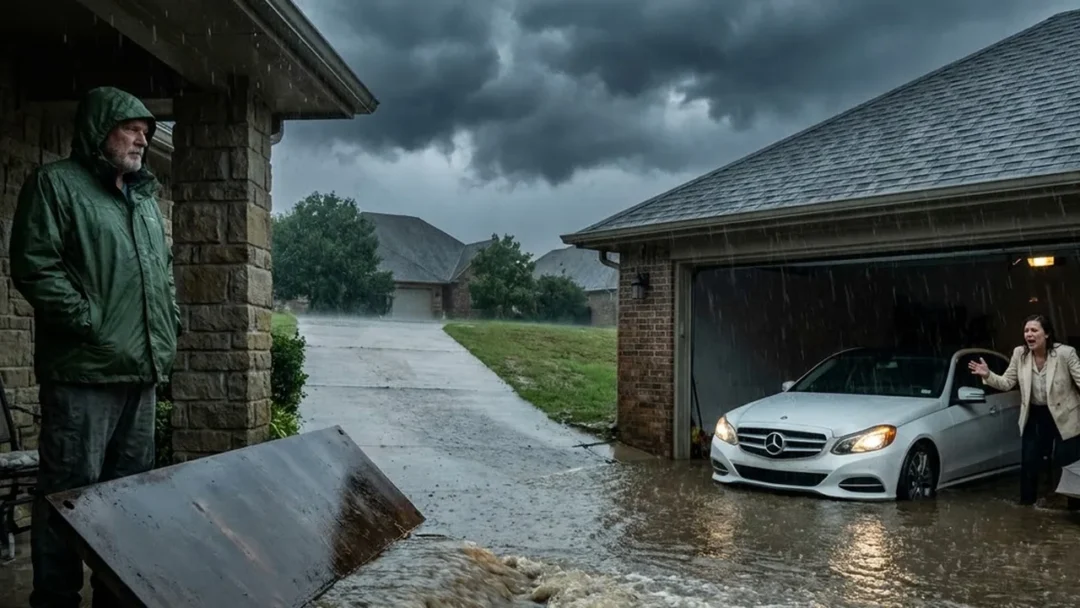
The Steel Storm Drain Grate And The Sunken Luxury Garage
CHAPTER 7: THE CLEAR WATERS OF OAK HOLLOW
Thursday morning broke over Oak Hollow Lane in a magnificent display of late-summer splendor. The Virginia sky was an infinite dome of flawless sapphire, and the morning sun filtered through the emerald leaves of the tulip poplars in long, golden shafts of light that warmed the cool, clean air. The scent of blooming wild phlox, sweet honeysuckle, and sun-warmed pine needles filled the cul-de-sac.
Outside Colonel James Caldwell’s home, the atmosphere was completely transformed.
Where Vanessa Sterling’s luxury sedan had been submerged days earlier, a fleet of heavy-duty municipal excavation trucks from the Fairfax County Department of Public Works was finishing the final site stabilization. Massive pneumatic grout pumps were carefully backfilling the unpermitted subterranean void beneath Lot 18 with engineered cellular concrete, restoring the natural bedrock support to the hillside forever.
At the crest of the shared driveway, two county civil works engineers were putting the finishing touches on a brand-new, heavy-duty forged cast-iron drainage intake. The new grate was double the width of the old one, engineered with tamper-proof security bolts and fitted with automated electronic telemetry sensors that beamed water levels directly to the county emergency operations center.
Bolted permanently into the native granite curbstone beside the grate was a newly dedicated bronze historical plaque:
THE CALDWELL HYDROLOGIC INFRASTRUCTURE CORRIDOR
ENGINEERED 1958 – DEFENDED BY THE CITIZENS 2026
DEDICATED IN PERPETUITY TO CIVIL ENGINEERING INTEGRITY, PUBLIC SAFETY, AND THE FREEDOM OF THE WATERSHED
WHERE NATURE’S FLOW SHALL NEVER BE BLOCKED BY PRIVATE PRIDE
Standing on the driveway apron was a gathering of over sixty local neighbors: families with children on bicycles, retired teachers, and local homeowners who had lived in fear of Walter Sterling’s corporate threats.
Parked along the curb was a community refreshment table laden with fresh iced tea, lemonade, and homemade peach cobbler provided by the neighbors.
Captain David Ross stepped up to the microphone, his uniform clean and pressed, addressing the smiling crowd:
“Thanks to the unyielding courage, vigilance, and technical mastery of Colonel James Caldwell, our neighborhood is safe, our infrastructure is permanently protected, and the rule of law has been restored to this community.”
The crowd erupted into an emotional, standing ovation that echoed through the trees. Children cheered, neighbors embraced, and Captain Ross presented Colonel Caldwell with the Fairfax County Distinguished Public Service Medal.
Caldwell stepped forward, holding the microphone with a warm, humble smile.
“Civil infrastructure isn’t just concrete and iron,” Caldwell said, his voice deep, resonant, and clear in the morning air. “It is a sacred social covenant. It is the silent, unyielding promise that we make to protect one another from the elements, to respect the earth, and to ensure that no person’s selfish pride ever endangers their neighbor’s home. Keep the grates clean, watch the water, and look out for one another.”
Caldwell stepped back, receiving a thunderous round of applause.
He walked over to the side of his porch, where Captain Ross had retrieved his original three-foot iron lifting hook from the ravine, having cleaned and oiled the steel until it gleamed like new.
Caldwell took the hook, running his calloused hand along the cold tool steel.
He walked over to the new iron storm grate, looking down into the clean, four-foot culvert throat. Far below, a gentle mountain spring was murmuring through the darkness, flowing crystal-clear over the smooth river stones, rushing forward to join the great river—unobstructed, unpolluted, and free.
Caldwell hung the hook on the heavy brass bracket beside his front door, sat down on his cedar porch swing, and took a slow, satisfying sip of hot coffee as the morning sun warmed the peaceful hills of Virginia.