The Yellow Fiber Cable And The Red Boardroom Crash Screen
CHAPTER 2: THE RED GLOW IN THE BOARDROOM
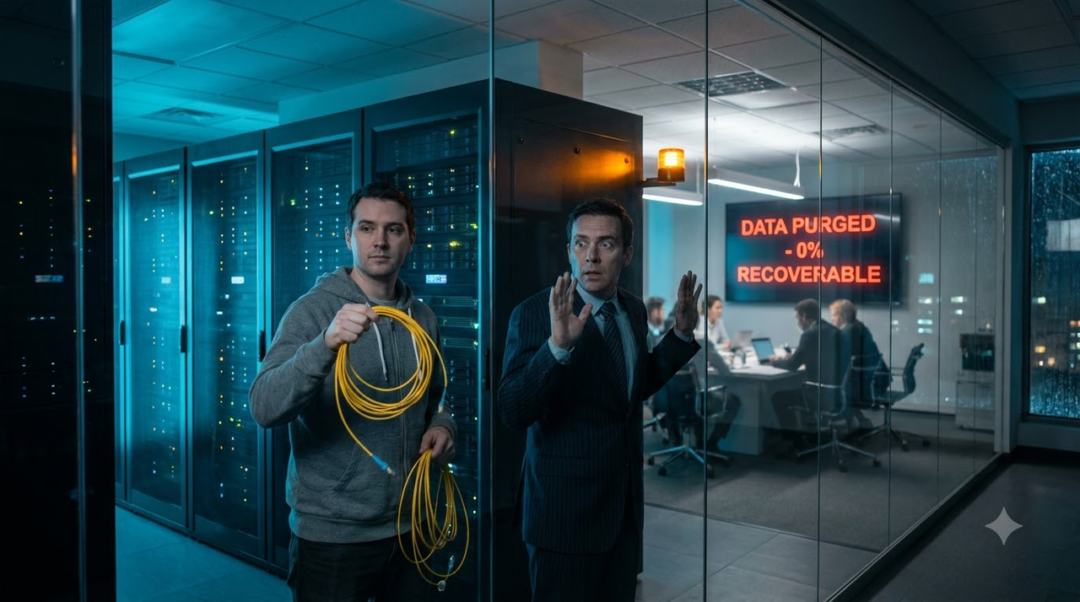
The blood-red glow reflecting from the massive one-hundred-inch presentation display washed through the soundproofed glass wall of the data vault, painting the cold blue server racks in garish, violent shades of crimson.
Derek Vance spun around on his designer loafers, his breath catching in his throat as if he had been struck in the chest with a baseball bat. His wireless presentation clicker slipped from his fingers, tumbling onto the perforated floor tiles with a dull plastic clatter. Through the tempered glass, he could see every single face in the executive boardroom—men and women whose combined net worth exceeded two billion dollars—staring at the flashing red error screen in catastrophic, paralyzed silence.
At the head of the walnut table, CEO Victoria Sterling did not move. Her steel-gray eyes were fixed through the glass directly upon Vance, her expression devoid of human warmth, radiating the lethal, calculated fury of an apex predator watching an incompetent subordinate blow up the company’s balance sheet.
“No…” Vance whispered, his hands rising to press flat against the cold surface of the glass wall. “No, no, no… that’s impossible. It’s just an interface timeout. It’s a cached video buffer glitch. Marcus, reboot the terminal! Switch to the redundant node! You have three minutes before the international press stream connects!”
Dr. Aris Thorne stepped between Vance and the server rack, his rumpled tweed jacket bristling with professional outrage. At fifty-eight, Thorne had spent thirty years writing the foundational network code that powered enterprise computing. He looked at Vance not with anger, but with the cold, absolute disgust of an engineer beholding an act of pure vandalism.
“There is no redundant node, Derek,” Dr. Thorne said, his voice shaking with tightly controlled rage. “Because the redundant node was the exact unit plugged into that yellow single-mode patch cable you just ripped out of the wall like an illiterate toddler.”
“I didn’t rip it out!” Vance shrieked, his voice climbing into an uncoordinated, panicked falsetto that bounced off the steel server cabinets. “It was loose! It snagged on my cuff! This engineer was running unauthorized updates! He was sabotaging my product launch because IT has always been jealous of Marketing’s budget!”
Marcus Cole didn’t look up from his shattered ThinkPad. Moving with quiet, unhurried discipline, he reached into his tool pouch, pulled out a small, specialized Torx screwdriver, and unfastened the mounting screws holding a secondary solid-state storage blade inside the crash cart.
He reached into his backpack, pulled out a spare, clean thirteen-inch Lenovo diagnostic laptop, and booted it from an encrypted USB recovery key. Within four seconds, the clean screen illuminated with a black-and-green terminal interface.
Marcus typed three rapid command strings:
sudo dmesg -T | grep -E "eth4|link_down|drop"
journalctl -u omnicorp-sync.service --since "5 minutes ago"
The terminal instantly outputted twenty lines of cryptographically signed, timestamped kernel logs:
13:56:42.102 [KERNEL] eth4: Link up at 100Gbps, Full Duplex, carrier detected.
13:56:44.891 [SECURITY] Block-level clone initiated: /dev/nvme0n1 -> /dev/nvme1n1 (Status: 94.2% completed).
13:57:12.401 [KERNEL] eth4: Link down (PHYSICAL CARRIER LOSS – FIBER CORE SEVERED).
13:57:12.402 [STORAGE] Target buffer dropped unexpectedly. Incomplete parity block detected. Filesystem marked DIRTY.
13:57:12.405 [PANIC] Kernel panic – not syncing: Fatal hardware disconnect during uncommitted database transaction.
Marcus swung the laptop screen around, angling it directly toward Vance.
“The physical carrier loss occurred at precisely thirteen fifty-seven and twelve seconds, Mr. Vance,” Marcus said in his flat, clinical monotone. “The exact microsecond your hand touched that cable. The write-cache was flushed into thin air. You didn’t just drop the stream; you corrupted the Master Boot Record of the entire presentation partition.”
Before Vance could speak, the glass airlock door hissed open again.
Victoria Sterling walked into the server vault. She wore an immaculate charcoal tailored pantsuit, an understated platinum necklace, and an aura of supreme, unshakeable authority that made the roaring fans seem to drop into respectful silence. Behind her walked two armed corporate security officers wearing black suits and discreet earpieces.
Victoria stopped three feet in front of Derek Vance. She did not raise her hand. She did not shout.
“Derek,” Victoria said, her voice smooth, low, and cold as liquid nitrogen. “Our market makers on Wall Street just called my private line. Because our global launch stream failed to connect at two o’clock, automated algorithmic trading bots have begun shorting OmniCorp shares on the pre-market exchange. Our stock is down six point four percent. That represents eight hundred and forty million dollars in shareholder equity wiped out in ninety seconds.”
Vance began to shake violently, his knees visibly trembling beneath his tailored pinstripe trousers. “Victoria… please, listen to me! It was an infrastructure glitch! The IT department—”
“The IT department didn’t pull that cable, Derek,” Victoria interrupted, her eyes cutting him to ribbons. “I was watching through the glass. I watched you slam Marcus’s laptop. I watched you rip the fiber out of the switch. And right now, the only thing keeping you from being escorted to the county jail in handcuffs is my desire to know what was on that drive.”
Victoria turned her gaze to Marcus Cole.
“Marcus. Can you recover the data?”
Marcus looked at the flashing red servers, then down at his diagnostic screen.
“I can’t recover Vance’s presentation deck, Ms. Sterling,” Marcus said quietly. “Because his presentation deck was never a legitimate product launch. It was an active ransomware carrier.”