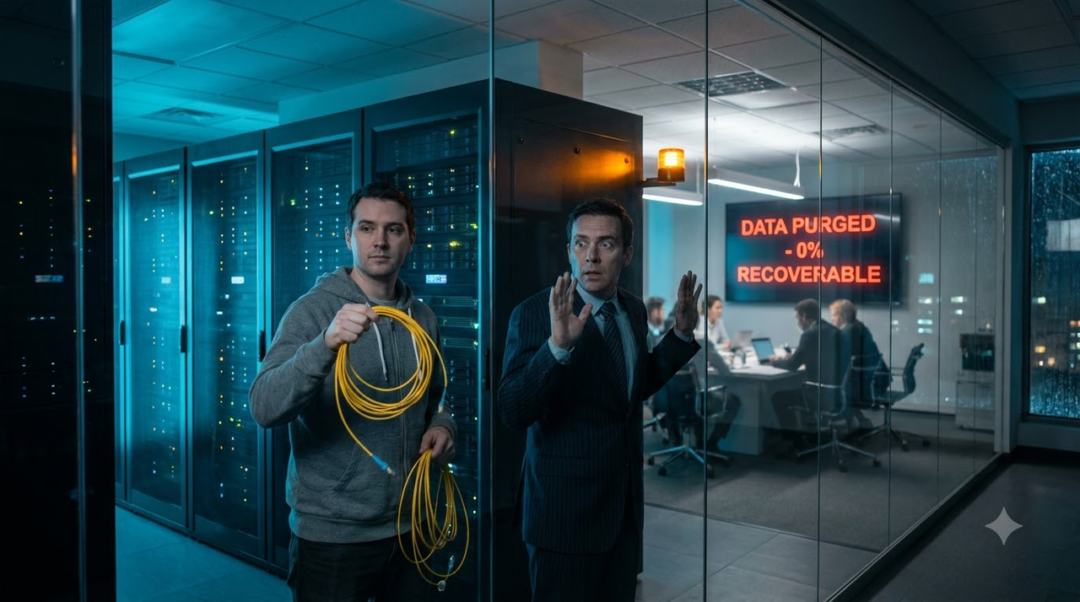
The Yellow Fiber Cable And The Red Boardroom Crash Screen
CHAPTER 3: THE TROJAN IN THE SILVER DRIVE
The silence in the server vault deepened, punctured only by the steady, hypnotic whir of the cooling racks and the rhythmic pulsing of the red fault indicators.
Victoria Sterling’s eyebrows rose by a fraction of a millimeter. In thirty years of leading Fortune 50 technology giants, she had seen market crashes, hostile takeovers, and corporate espionage. But the word ransomware uttered inside her private data center struck with the chilling gravity of an active bomb threat.
“Explain, Marcus,” Victoria said, stepping closer to the crash cart.
Marcus Cole clicked a key on his diagnostic laptop, pulling up a color-coded hexadecimal memory dump from the compromised server partition.
“Twenty minutes before Mr. Vance entered this room,” Marcus began, his voice calm, methodical, and devoid of emotion, “the automated intrusion prevention sensors on the presentation subnet flagged an unauthorized remote procedure call trying to elevate privileges to Domain Administrator. The origin of the injection was not an external hacker. It was a physical USB mass storage device plugged directly into the podium terminal in the main boardroom.”
Dr. Aris Thorne leaned over the screen, his sharp eyes scanning the disassembly code. “Look at the API hooks. It’s a custom variant of the DarkLocker ransomware family. It utilizes an unpatched vulnerability in the Windows kernel print spooler to bypass endpoint detection.”
“And who plugged that USB drive into the podium terminal?” Victoria asked, her voice dropping into a register of icy danger.
Marcus reached into his pocket and placed an anti-static evidence bag onto the crash cart table. Inside was a sleek, brushed-aluminum USB flash drive shaped like a miniature sports car, embossed with the logo of a third-party venture capital advisory firm based in San Jose.
“Mr. Vance’s executive assistant handed this drive to our AV technicians thirty minutes ago,” Marcus stated. “She stated that Mr. Vance had personally loaded his keynote presentation onto this drive during a private lunch meeting at the Four Seasons downtown.”
Derek Vance backed away against a titanium server enclosure, his face glistening with cold sweat. “That… that was a promotional drive given to me by my keynote advisory consultants! They told me it contained high-resolution four-K video renders that were too large to send over corporate email! I didn’t know there was malware on it!”
“You didn’t know, Derek?” Dr. Thorne asked, stepping toward him with a look of profound disgust. “Every vice president in this company is required to complete mandatory annual cybersecurity hygiene certification. You personally signed the corporate policy stating that no unverified external USB media may ever be connected to an executive presentation terminal without a physical sandbox quarantine by the security team.”
“It was an emergency!” Vance pleaded desperately, his hands clutching his designer tie. “The corporate sandbox takes four hours to clear a drive! The launch was today! I didn’t have time to wait for bureaucratic red tape!”
Marcus opened an isolated Ghidra reverse-engineering session on his terminal, disassembling the raw executable payload captured from the memory buffer. The code displayed an intricate, malicious architecture designed with terrifying sophistication.
“Notice the export table,” Marcus explained, pointing his pen to the scrolling disassembly. “The malware hooks into the Windows cryptographic service provider, replacing the default RSA encryption keys with an ephemeral elliptic-curve public key generated on an external server. The moment the marketing slide deck advanced to slide three—which contains an embedded macro object disguised as a video codec—the background thread was programmed to spawn an un-throttled PowerShell process executing with elevated SYSTEM privileges. From there, it would execute a recursive traversal of every mounted SMB network share across the enterprise.”
He keyed another command string into his terminal:
strings /mnt/malware_dump/payload.bin | grep -i "c2_server"
A single IP address flashed onto the green terminal screen, followed by an encrypted domain name:
COMMAND SERVER: 185.220.101.5 [RESOLVED: APEX-VENTURES-PACIFIC.CH]
Victoria Sterling stared at the domain name, her eyes narrowing into razor-sharp slits. “Apex Pacific? That is the private investment firm managed by Julian Kensington—the firm that launched a hostile tender offer for our enterprise cloud division two weeks ago.”
“Precisely, Ms. Sterling,” Marcus said. “The payload wasn’t designed to demand a five-hundred-dollar bitcoin ransom. It was a specialized corporate wiper. Once Mr. Vance started his presentation, the script would have silently traversed our corporate active directory, encrypted our core intellectual property repositories, and left OmniCorp’s cloud architecture completely paralyzed. By tomorrow morning, our stock would have collapsed to fifteen dollars a share, and Kensington’s syndicate would have acquired our patents for pennies on the dollar.”
Victoria looked at Derek Vance. The Marketing VP had sunk to his knees on the perforated floor tiles, his face buried in his hands, trembling like an animal caught in a snare.
“You didn’t just pull a cable, Derek,” Victoria said, her voice filled with absolute, unyielding contempt. “You almost gave away the entire company to a corporate raider.”
Victoria turned back to Marcus, her expression firm and resolute.
“Marcus. We have forty minutes before the New York Stock Exchange opens for afternoon trading. Can we purge the network and restore the core enterprise infrastructure?”
Marcus picked up a fresh, sealed yellow fiber-optic patch cable from his tool chest.
“I can do it, Ms. Sterling,” Marcus replied. “Provided Mr. Vance is permanently removed from my room.”