When The Federal Siren Howls Across The Broken Boulevard
CHAPTER 3: THE BLACK SUBURBANS
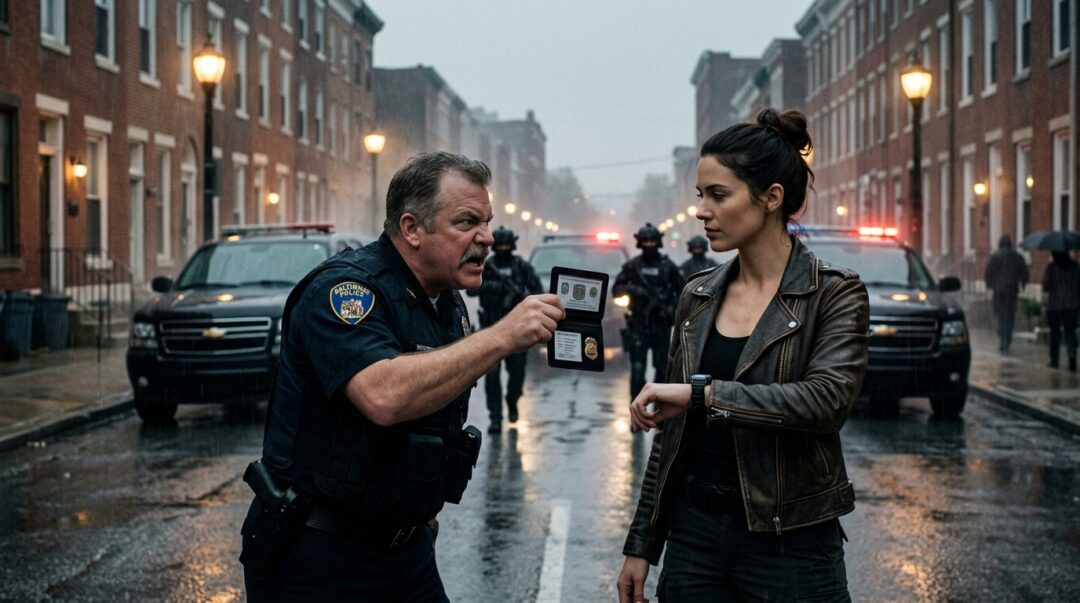
David Miller walked through the rain with the slow, deliberate stride of a man who held the authority of the federal government in the palm of his hand. He was fifty-five years old, his iron-gray hair cropped close, his weathered face carved with the grim lines of twenty-five years in federal law enforcement. He stopped two feet from Maya Lin, ignoring the two shivering city officers as if they were discarded trash on the pavement.
He gave Maya a crisp, respectful nod. “Agent Lin. Status report.”
Maya stepped away from the cruiser, her posture snapping into immaculate federal attention. “Operation Harbor Sweep is secure, SAC Miller. Suspects Vince Kroll and Tara Simmons attempted unlawful detention, physical intimidation, and unlawful seizure of federal credentials under color of municipal authority. They have attempted to obstruct an ongoing federal interception.”
Miller turned his head slowly, his piercing gray eyes fixing on Officer Vince Kroll.
Kroll was still holding the open leather badge case in his trembling right hand, his fingers white, his mouth opening and closing soundlessly like a fish out of water. The swagger that had dominated Pratt Street two minutes earlier had evaporated into pure, paralyzing terror.
“Is that Agent Lin’s credential case in your hand, Officer?” Miller asked. His voice was quiet, conversational, and infinitely more terrifying than a shout.
Kroll tried to speak, but only a dry, squeaking rattle escaped his throat. “Sir… Chief… I… we didn’t know. We had no idea she was real. We thought it was a prop. There was no radio call on the city frequency—”
“You didn’t know?” Miller stepped forward until he was six inches from Kroll’s mustache. “You didn’t know because you are running an unauthorized, off-duty blockade on municipal overtime to provide armed perimeter security for Viktor Brand’s arms-smuggling syndicate.”
Kroll’s knees visibly buckled. He leaned against the cruiser’s fender to keep from collapsing onto the wet cobblestones. “No! That’s… that’s not true! We were just running a traffic detail! We had a call about a suspicious vehicle near the pier!”
“You were running a traffic detail?” Miller asked with chilling sarcasm. “A traffic detail that conveniently blocks city fire engines from accessing the container docks? A detail that turns off municipal dash cameras forty minutes before an unregistered Panamanian freighter begins loading stolen military equipment?”
Miller turned toward the tactical team. “Breach team, secure suspects Kroll and Simmons. Disarm them. Bag their electronics. And open that trunk.”
Two federal operators surged forward like shadows through the misty rain. One caught Kroll by the back of his jacket collar, kicking his feet out from under him and driving the two-hundred-pound officer face-down across the cruiser’s hood. Steel handcuffs—heavy, cold, and unrelenting—clicked brutally around Kroll’s thick wrists, ratcheting tight against the bone.
“Hey! Easy! I’m a cop!” Kroll screamed into the cold sheet metal, his cheek pressed against the wet hood, water running into his mouth. “I have rights! You can’t treat a city police officer like this! I demand to speak to my union representative! I demand to call Deputy Commissioner Lawson!”
“You surrendered your rights as a peace officer the moment you sold your badge to a Russian cartel, Kroll,” the operator pinning him snarled, tossing Kroll’s confiscated wallet, duty keys, and encrypted cell phone into an evidence pouch. “You’ll get your phone call from a holding cell in the federal courthouse.”
Across Pratt Street, the crowd of onlookers had grown to fifty people—dockhands in woolen beanies, warehouse clerks in yellow rain jackets, and evening commuters stranded by the roadblock. For years, Officer Vince Kroll had terrorized this working-class neighborhood, extorting free meals from sandwich shops, writing retaliatory parking tickets to dockworkers, and bragging openly that the mayor was in his back pocket. Now, as rain pelted the pavement, murmurs of stunned satisfaction rippled through the spectators as they filmed the arrogant sergeant being held face-down on the hood of his own patrol vehicle by armed federal agents.
Beside the rear wheel, Officer Tara Simmons was already on her knees in the rain, weeping hysterically as zip-ties bound her wrists behind her back. “I was just following orders! Frank and Vince set this up! I didn’t know what was in the containers! I swear to God, I just needed the overtime money to pay my rent! Please, don’t put me in federal prison!”
“Nobody is shooting, Officer Simmons,” Miller said without looking at her. “You will be afforded full constitutional due process in the United States District Court. Which is considerably more courtesy than you afforded Agent Lin five minutes ago.”
A tactical operator stepped to the rear of the cruiser, inserted a specialized pneumatic pry tool into the trunk lock, and pulled with a sharp hiss of compressed gas.
With a sharp crack, the trunk latch gave way. The steel lid swung open, illuminating the dark interior under the pulsing emergency flashers.
Maya stepped up beside Miller, looking down into the trunk bed.
Inside, resting on top of spare road flares, raincoats, and emergency blankets, were three heavy-duty Pelican 1650 hard cases, molded in olive-drab polymer and stamped with official yellow Department of Defense stencils: PROPERTY OF US NAVY SPECIAL WARFARE COMMAND — CRANE DIVISION.
Maya reached down and flipped the heavy latches of the center case.