The Arrow In The Crosswind Pierced The Bullseye He Feared Most
CHAPTER 1: THE RIBBON ON THE BLUFF
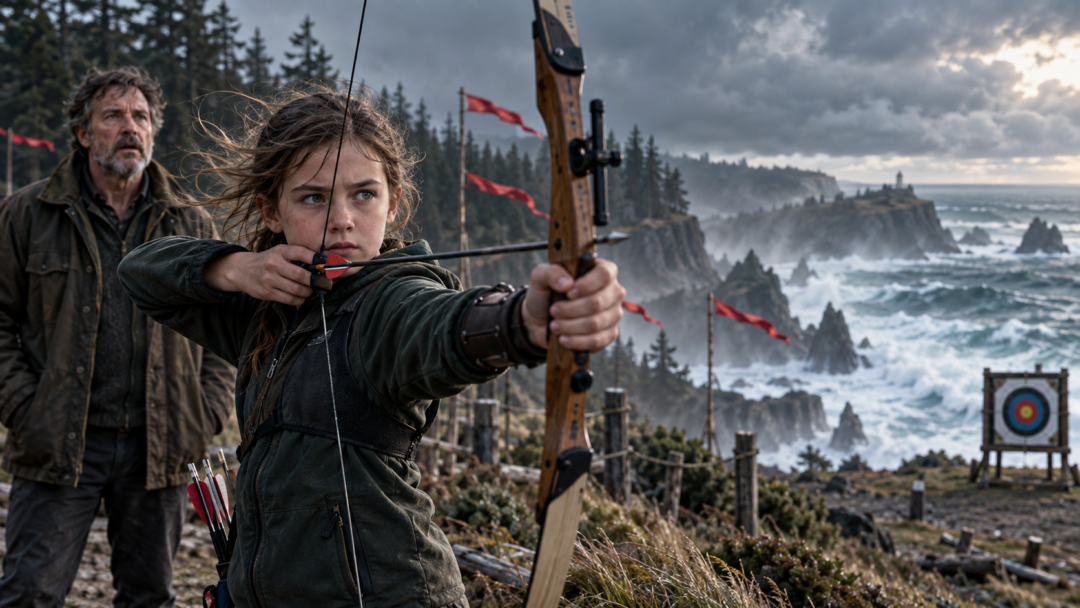
The North Pacific gale screamed off the basalt headlands of Cape Lookout, driving salt spray three hundred feet up the sea cliffs to whistle through the twisted branches of the shore pines. At the Cape Lookout Municipal Archery Range, the red nylon wind ribbons tied to the target stanchions stood straight out horizontally, snapping with the violent, rhythmic crack of whip leather. The ocean below was a churning cauldron of black water and white foam, and seventy meters across the wind-scoured turf sat a solitary foam target boss, its ten-ring looking no larger than a gold coin against the grey horizon.
Juno Vance stood on the chalked shooting line, her feet planted shoulder-width apart in the crushed gravel. At twelve years old, she possessed the quiet, rooted stillness of an osprey perching on an ocean spar. Her dark hair was plaited into a tight braid tucked into her collar, her slender frame clad in a fitted windproof shell over wool layers. In her left hand, she held a forty-two-pound Olympic recurve bow, its riser custom-carved from figured Oregon walnut, its limbs laminated with black carbon fiber that gleamed with muted resilience in the stormy twilight.
A heavy shadow fell across her lane.
Frank Renner stepped directly in front of her target line, his size-twelve hiking boots grinding into the chalk mark. At fifty-four, Renner was the autocratic director of Pacific Apex Archery, a former national champion whose weathered face had been baked by thirty years of sun and sour grievances. He wore an insulated team parka bearing three corporate sponsor patches, a digital stopwatch hanging from a lanyard around his thick neck, his scarred thumb hovering over the split-second button.
“Step off the line, kid,” Renner barked, pitching his voice over the howl of the thirty-knot gale. “The Pacific Invitational qualifiers are closed to junior amateurs when the anemometer registers above twenty knots. Look at those flags. That crosswind will eat a child’s arrow alive, blow it sixty feet into the pine scrub, and shatter an eighty-dollar carbon shaft against the rocks. Go play with a compound bow at the indoor range in Tillamook.”
Juno did not step back. Her breathing remained slow, deep, and rhythmic, synchronized with the rhythmic surge of the breakers below. Her grey eyes, clear as rain puddles on stone, looked calmly into Renner’s florid, aggressive face.
“The tournament rulebook states that any registered competitor who has made the qualifying minimum score may shoot their ranking round during regulation daylight hours, Mr. Renner,” Juno said, her voice clear, calm, and effortlessly piercing the wind without shouting. “The sun sets at six-twelve. It is currently five-forty. I have twenty-two minutes.”
Four adult competitors—veteran archers who had spent the afternoon struggling to keep their sixty-pound bows on the target face—sat on the timber benches beneath the rain shelter fifty feet back. They lowered their bows, watching the confrontation with tense, uncomfortable fascination.
Renner let out a harsh, mocking laugh that rasped like dry sandpaper against metal. He leaned down, placing his hands on his knees, bringing his face within twelve inches of hers. “I have trained Olympic alternates, little girl. I have stood on the line in Atlanta, in Sydney, and in Athens. You think because your grandfather built a few wooden bows in a barn you understand ballistics? You don’t have the skeletal mass to anchor forty pounds in a gale. You’ll collapse your shoulder, pluck the string, and embarrass yourself before this entire county. You’re just a kid. This isn’t for you.”
Juno looked past his shoulder at the target seventy meters away. She watched the red ribbons on the five-meter mast: three sharp snaps to the north, a flutter, then a swirling updraft rising from the cliff face.
“Okay,” Juno said softly.
She did not wait for his permission. She stepped smoothly around his left shoulder, planted her boots exactly four inches behind the white chalk line, and reached into the leather hip quiver slung across her right thigh.
With effortless, muscular economy, she pulled a twenty-eight-inch micro-diameter carbon arrow, seated the nock onto the serving thread with a crisp, magnetic click, and laid the shaft against the magnetic wire rest.
Renner straightened up, his arms crossing over his broad chest, his jaw working in furious irritation. “Fine. Waste an arrow. Show the room what happens when arrogance meets an ocean gale.”
Juno did not look at him. She closed her eyes for two seconds, letting the cold spray mist her eyelashes, feeling the pressure of the wind against her left shoulder blade.
She raised the walnut riser.
Her left arm locked out like an oak timber, her right elbow tracking upward in a high, textbook alignment. She drew the string back to her face, locking the brass tab against the corner of her jawbone, the clicker blade resting across the razor tip of her target point.
The recurve limbs flexed under forty-two pounds of stored kinetic energy.
The crosswind screamed across the cliff, tearing at her sleeves, whipping the red ribbons into a blur.
For three seconds, Juno held the draw, her body an unyielding pillar of balance. She did not fight the wind; she leaned into it by a single millimeter, aiming not at the target, but twelve inches into the teeth of the gale to the left of the boss.
Click.
The magnetic clicker dropped.
Juno’s fingers relaxed.
The bowstring sprang forward with a sharp, concussive TWANG that reverberated through the cliffside trees like an electric discharge.
The black carbon arrow vanished into the squall.
The four adult archers in the shelter stood up from their benches in unison.
The arrow did not tumble. It did not drift into the brush. Cutting through the turbulent ocean crosswind in a breathtaking, laser-straight parabolic arc, the shaft drifted smoothly back toward the center line as the atmospheric pressure yielded to the kinetic velocity.
Seventy meters away, a heavy, concussive THUNK echoed across the grass.
The arrow had struck the target boss dead center.
Not in the outer gold nine-ring. Not on the inner line. It had split the center X-ring dead center, vibrating in the high-density foam like a steel tuning fork.
Renner’s jaw dropped. The stopwatch slipped from his fingers, dangling by its lanyard against his belt. His face lost every vestige of color, turning the sickly grey of wet driftwood.
Juno did not jump. She did not smile. She did not look at the adult archers who were staring in open-mouthed, stunned disbelief.
She turned, unclipped her leather finger tab, placed her custom recurve bow neatly onto the timber rack, and walked past Renner with unhurried, serene dignity.
As she passed his shoulder, she paused for half a second.
“The wind was talking, Mr. Renner,” Juno whispered, her voice carrying the quiet, devastating clarity of pure mastery. “You just stopped listening.”
CHAPTER 2: THE LIMB IN THE VISE
The silence that hung over the Cape Lookout range after the arrow struck was more concussive than the gale. The four adult archers stood motionless on the gravel, their eyes fixed on the distant yellow target face where the white fletching of Juno’s arrow was still quivering against the center bullseye.
Frank Renner stood frozen on the shooting line, his boots rooted in the chalk, staring at the distant foam boss as if he were looking at an impossible ghost. For thirty years, he had built his reputation in the Pacific Northwest as an infallible authority on heavy-weather ballistics, telling every generation of aspiring Olympians that survival in high crosswinds required brute draw weight, heavy stabilizers, and mechanical compound releases.
And a twelve-year-old girl with a wooden riser and forty pounds of limb weight had just put an arrow through the X-ring on her first shot.
“A fluke,” Renner muttered, his voice cracking as he spun around, his eyes wild and bloodshot. “A thermal draft caught the vane. You couldn’t replicate that shot in a thousand attempts!”
Juno had already reached the wooden equipment bench beneath the timber pavilion, where her mother, Sarah Vance, stood drying a set of spare cedar arrows with a soft flannel cloth. At thirty-eight, Sarah had the same quiet, discerning eyes as her daughter, her hands bearing the faint scars and smooth calluses of a master bowyer who spent twelve hours a day at the shaping vise.
“Good release, sweetheart,” Sarah said softly, kissing Juno’s forehead. “You felt the offshore shear at the forty-meter mark, didn’t you?”
“It dropped three inches right past the gully,” Juno replied, taking a sip of warm spiced cider from a thermos. “Just like Grandpa’s notebook said.”
Renner strode across the gravel, his heavy boots kicking up stones, stopping before the workbench with a snarl of bureaucratic aggression. He reached out with both hands, lunging to grab Juno’s recurve bow from the timber rack.
Sarah’s hand moved with lightning speed, catching Renner’s wrist in a vise-like grip that brought the two-hundred-pound coach to an abrupt, jarring halt.
“You don’t touch that bow, Frank,” Sarah said, her voice dropping into a register of icy, absolute finality.
Renner pulled his arm back, rubbing his wrist, his face darkening with humiliated fury. “Under Rule 4, Section B of the Oregon Interscholastic Athletic Association, the tournament technical director has the right to inspect any equipment suspected of unauthorized mechanical assistance. Look at the profile of those limbs! The recurve hooks are too radical! The taper on the carbon core doesn’t match standard factory limb specifications!”
“It doesn’t match factory specifications because my father designed it thirty years ago,” Sarah said, stepping between Renner and the bow. “It’s the Vance Dynamic Taper. It was patented in nineteen seventy-two, Frank. You know that better than anyone on this coast.”
Renner’s eyes flicked to the polished walnut riser. In the center of the grip, inlaid in silver wire beneath the clear epoxy finish, was a tiny hallmark: an arrow wrapped around an anchor.
The personal mark of David Vance.
Thirty years ago, David Vance had been the premier traditional bowyer in the United States, an Olympic team coach who believed that archery was a dialogue with the natural environment rather than a mechanical war against it. And in 1996, during the bitter Olympic trials at Stone Mountain, Georgia, Frank Renner had been David Vance’s star pupil—until Renner failed to make the team and publicly accused Vance of providing him with defective, experimental limbs that had cost him his life’s dream.
The scandal had destroyed David Vance’s reputation, driving him from national coaching into quiet exile on the Oregon coast, where he had spent the rest of his life building bows in a cedar barn while Renner commercialized his training academy into a million-dollar enterprise.
“David Vance died in a mountain cabin with thirty dollars in his bank account,” Renner sneered, leaning over the bench, his voice dripping with venom. “And his experimental junk has no place on a certified tournament line. I am the chairman of the equipment review committee. I am officially flagging this bow for non-compliant draw-force curve irregularities.”
He pulled a neon-orange disqualification tag from his parka pocket and attempted to slap it onto the walnut riser.
“Step back, Frank,” a calm, authoritative voice echoed from the pavilion entrance.
Marcus Thorne, the sixty-six-year-old chief tournament referee and former Olympic technical judge, walked into the shelter. He wore the blue blazer of the World Archery Federation, his silver hair neatly combed beneath a waterproof cap, holding a digital scale and a certified measuring bow-square in his leather briefcase.
“Marcus,” Renner stammered, pulling his hand back from the bow. “This is an internal district safety matter. The girl is using non-homologated equipment in hazardous weather.”
“I wrote the homologation guidelines for the Olympic Committee in nineteen ninety-two, Frank,” Thorne said, stopping at the bench, looking at the walnut bow with eyes that held thirty years of quiet, unspoken memory. “And David Vance’s limb tapers were approved for international competition before you ever won your first state medal. If you want to challenge the legality of this bow, we conduct a formal draw-curve test right now on the digital test rig in the range clubhouse.”
Renner’s eyes narrowed into slits of cornered, desperate panic. “The clubhouse is closed for private administrative business! We have the city council committee meeting in forty minutes!”
“Then we have forty minutes to see whether David Vance’s bow is illegal,” Thorne replied, lifting the walnut recurve by the grip with reverent, effortless balance. “Or whether you are simply terrified of watching a child finish the journey you abandoned.”
CHAPTER 3: THE TARGET IN THE FOG
The clubhouse of the Cape Lookout Archery Range was an old timber pavilion built by the Civilian Conservation Corps in 1938, its high open rafters constructed of peeled Douglas fir logs that smelled of woodsmoke, turpentine, and aged cedar. Rain hammered against the corrugated tin roof with deafening intensity, while outside the windows, the dense coastal fog rolled in from the Pacific, swallowing the seventy-meter targets in a swirling shroud of grey mist.
In the center of the workshop room stood a precision digital draw-board—a heavy aluminum test bed fitted with load cells, micrometer scales, and laser alignment sights used by Olympic technicians to map the force-displacement curves of competition bows.
Marcus Thorne clamped Juno’s walnut recurve into the padded machine vise. He hooked the mechanical release jaw onto the Dacron bowstring, zeroed the digital load cell on the monitor screen, and turned the hand crank.
The limbs flexed smoothly, the carbon laminations humming under progressive tension.
On the high-resolution monitor, a green graph line plotted in real-time across the screen: a perfectly linear, buttery-smooth ascent that showed zero “stacking”—the sudden spike in resistance that plagued inferior bows at full draw. At twenty-eight inches of draw length, the digital readout clicked to a halt: 42.1 LBS – STABILITY INDEX 99.4%.
Thorne leaned over the screen, adjusting his reading glasses, a slow, admiring smile touching his weathered mouth. “Incredible. The energy storage is nearly forty percent more efficient than modern mass-produced carbon limbs. The limb tips don’t twist a single micron under torque. It is completely regulation-compliant, Frank. In fact, it’s a masterpiece.”
Frank Renner stood leaning against the tool locker, his arms crossed tightly across his chest, his face dark with suppressed rage. “A laboratory test on a mechanical crank means nothing in the field, Marcus. The girl doesn’t have the endurance to maintain that draw curve across a full seventy-two-arrow ranking round in thirty knots of wind. She’ll fatigue by end six, her anchor will drift, and her arrows will go over the safety berm into the public scenic turnout.”
“Juno shoots one hundred and twenty arrows every morning before breakfast on our private ridge, Mr. Renner,” Juno spoke quietly from the doorway, her voice devoid of boastfulness, merely stating a physical fact. “In forty-knot winds. With rain on her sights.”
Renner turned on her, his face contorting into an ugly sneer. “Don’t get cocky, kid. Hitting one bullseye on a practice end doesn’t make you an archer. Archery is about tournament nerve. When the cameras are on you, when your name is on the scoreboard, and when a single bad release destroys your family’s future, let’s see how steady your little hands are.”
While Renner argued with Thorne, Juno’s eyes wandered to the open steel filing cabinet beside the tool locker.
Tucked between stacks of municipal range maintenance logs was a thick blue leather presentation folder embossed with the logo of Pacific Apex Real Estate Holdings LLC—Renner’s private corporate entity.
The top document was a formal petition addressed to the Tillamook County Board of Commissioners:
APPLICATION FOR EMERGENCY CONDEMNATION & COMMERCIAL REZONING: THE CAPE LOOKOUT MUNICIPAL HEADLANDS.
Juno stepped closer, her keen eyes scanning the executive summary:
‘…The current public archery facility represents an unmitigated liability to the municipality due to hazardous coastal wind conditions and recurring equipment failures by uncredentialed junior shooters. Upon condemnation of the athletic easement, Pacific Apex will acquire the forty-acre oceanfront parcel for the construction of “The Lookout Crest Luxury Resort & Spa”, generating twelve million dollars in private development capital…’
Below the petition was an engineering survey map.
The seventy-meter shooting line where she had just stood was marked with red hatching: FUTURE RESORT CLUBHOUSE & SWIMMING PAVILION.
And stapled to the back of the survey was a confidential memo from the city planning director, dated this morning:
‘Contingent upon the athletic range failing mandatory safety certification during the Pacific Invitational on October 24th, the emergency zoning variance will be ratified at tonight’s seven o’clock council session.’
Juno felt a cold wave of realization wash through her chest.
Renner wasn’t trying to disqualify her because he thought she was too young.
He was staging a public safety crisis. If he could prove that a child had lost control of an arrow in the coastal gale, he could declare the public range dangerous, force its immediate closure, and bulldoze the headlands into a private luxury resort by spring.
“Mom,” Juno whispered, tugging Sarah’s sleeve. “Look at the desk.”
Sarah leaned down, her eyes scanning the condemnation documents. Her face hardened into cold, diamond-hard fury as she recognized her father’s original surveyor coordinates on the parcel map.
“He’s selling the headland, Marcus,” Sarah spoke, her voice carrying through the workshop like an iron bell. “The forty acres my father donated to the children of this county in nineteen sixty-eight. Renner is using this tournament to stage a condemnation.”
Renner lunged toward the cabinet, slamming the steel drawer shut with a deafening crash. “That is private corporate development strategy! You have no right to look through my desk!”
“Your grandfather didn’t just donate this land, Juno,” Marcus Thorne said, his voice dropping into a register of profound authority as he pulled a brass key from his pocket. “He embedded an irrevocable reversionary clause into the county charter. If any commercial entity attempts to seize this bluff, the original athletic dedication can be defended by a direct blood descendant of David Vance in an open, public trial of skill.”
Thorne turned to face Renner, his gaze piercing the corrupt director to the bone.
“An open shoot-off, Frank. Tonight. Before the city council convenes at seven o’clock. Seventy meters. Twelve arrows in the teeth of the gale. You against Juno Vance. If you win, the safety condemnation stands. If she wins, your commercial charter is permanently revoked, and the range remains public forever.”
CHAPTER 4: THE QUIVER IN THE GALE
The challenge thrown down by Marcus Thorne fell upon the workshop like a lightning strike. The rain outside seemed to redouble its fury, water cascading off the cedar eaves in roaring sheets, while the coastal fog pressed against the windows like a living wall.
Frank Renner stood frozen before the closed filing cabinet, his hands knotted into fists at his sides, his chest heaving beneath his team parka. A sudden, dangerous light flared in his eyes—a mixture of arrogant vanity and the desperate realization that his sixty-million-dollar real estate coup was slipping through his fingers.
“A shoot-off?” Renner laughed, a harsh, jagged sound that carried no humor. “You want me to shoot against a twelve-year-old child in thirty-five knots of wind? It’s a circus act, Marcus! It violates every sanctioning protocol of the state athletic association!”
“The State Athletic Association has no jurisdiction over the 1968 Deed of Athletic Dedication, Frank,” Thorne replied, his voice calm, steady, and immovable as the basalt headlands below. “David Vance placed the deed into the trust of the Tillamook County Court. Under Section 12, any dispute regarding the physical safety or athletic viability of this range must be resolved by an open match between the challenger and the trustee’s lineage under the prevailing meteorological conditions. The city council members are already en route for the seven o’clock meeting. They will witness the match from the pavilion veranda.”
Sarah Vance stepped forward, her hand resting firmly on Juno’s shoulder. “My daughter accepts the challenge, Frank. We will shoot six ends of two arrows at seventy meters. Standard target face. Regulation ten-ring scoring.”
Renner’s jaw tightened until the muscles bulged along his neck. He looked at Juno, who met his gaze with unblinking, serene composure, her fingers lightly resting on the walnut riser of her recurve.
“Fine,” Renner hissed, his teeth bared in a feral smirk. “Let’s see what happens to the Vance name when the ocean gale tears that wooden toy to pieces. We shoot at six-fifteen. Under the floodlights.”
He grabbed his heavy double-bow travel case from the corner, kicked the workshop door open, and vanished into the stormy gloom toward his private coaching trailer on the north ridge.
Juno and Sarah returned to the timber range shelter to prepare their arrows.
Sarah took each carbon arrow from the quiver, inspecting the straightness of the shaft with an optical dial indicator, testing the bond of the plastic parabolic vanes, and polishing the hardened steel target points with fine steel wool.
Juno sat on the timber equipment bench, her small fingers rhythmically checking the nocks of her remaining arrows. She remembered the quiet summer afternoons in her grandfather’s workshop, where David Vance would sit beside the open barn doors, carving Port Orford cedar with an antique drawknife. Her grandfather had always taught her that a bow was not merely an instrument of propulsion; it was an acoustic resonator, tuned to the frequency of the surrounding landscape. He had spent fifty years studying the laminar flow of wind across ocean headlands, calculating how barometric pressure and coastal humidity influenced the drag coefficients of feathered projectiles. Frank Renner had dismissed those lessons as romantic folklore, choosing instead to rely on high-let-off compound cams and mechanical stabilizers. But Juno understood that true mastery was not about overpowering the elements; it was about entering into a quiet, harmonious dialogue with the storm and allowing the arrow to find its natural path through the gale.
“The wind is shifting, sweetheart,” Sarah said quietly, looking out through the rain at the three red ribbons snapping violently on the five-meter mast. “The gale has swung five degrees to the north-northwest. That means when the arrow clears the shelter wall, it will hit a pocket of dead air for twenty meters before the cliff updraft catches it at the fifty-meter line. You have to aim fourteen inches low and eight inches left of the ten-ring to compensate for the lift.”
“I know, Mom,” Juno said softly, taking a carbon shaft into her small fingers. “Grandpa showed me on the ridge. He said the wind isn’t an enemy trying to push the arrow away. It’s an ocean of air, and the arrow is just a boat that knows how to sail through it.”
Sarah’s eyes misted with tears. She kissed Juno’s forehead, pressing a small leather-bound notebook into her hands—David Vance’s personal ballistic ledger from the 1996 trials.
Meanwhile, three hundred yards away on the dark, rain-swept bluff behind the seventy-meter targets, a shadowy figure moved through the sodden salal brush.
It was Cole Brady, Renner’s head range technician and private contractor. He carried a heavy canvas duffel bag and a pair of industrial ratcheting wire-cutters.
Working under the cover of the dense fog and the roar of the surf, Brady slipped behind Target Boss 1—the primary target assigned to Juno. He knelt in the mud, locating the heavy steel guy-wires that anchored the forty-foot backstop safety netting to the granite bedrock.
The safety netting was the only barrier preventing missed arrows from flying off the cliff onto the public scenic highway below.
With three violent, rhythmic strokes of the ratcheting cutters, Brady severed the high-tension steel cable. The heavy braided wire snapped with a concussive whip-crack that was instantly drowned out by the roar of the ocean gale.
He repeated the cut on the secondary tension turnbuckle, leaving the massive netting hanging by a single frayed strand of nylon cord.
If an arrow struck the upper edge of the target frame, the impact would collapse the backstop net, allowing the projectile to sail directly toward the roadway, providing Renner with undeniable, catastrophic physical proof that the range was an uninsurable public menace.
Brady stuffed the severed cable into his duffel, zipped his dark oilskin jacket, and melted back into the coastal scrub just as the high-intensity halogen floodlights along the shooting line ignited with a concussive hum, bathing the stormy range in blinding, crystalline white light.
CHAPTER 5: THE LINE IN THE RAIN
The six towering halogen floodlights mounted along the roofline of the Cape Lookout pavilion blazed into life, cutting through the swirling coastal fog in blinding cones of white illumination. The freezing rain, swept by thirty-five-knot ocean gusts, streaked across the light beams like showers of silver needles, drumming against the wet gravel of the shooting line with concussive urgency.
On the sheltered veranda of the clubhouse, twenty prominent spectators had gathered: the five members of the Tillamook County Board of Commissioners in heavy wool coats, three reporters from the coastal newspapers, and thirty local archers and parents who had braved the storm to witness the defense of their public headlands.
At the center of the shooting line stood Frank Renner.
He had abandoned his recurve bow entirely. In his hands, he held an ultra-modern, seventy-pound commercial compound bow finished in tactical matte black, equipped with dual cam pulleys, high-magnification optical scope sights, pneumatic vibration dampeners, and a hydraulic balance stabilizer that extended four feet forward like a naval gun barrel. He looked like an operator armed for combat, his face grim, confident, and utterly focused on victory.
Beside him, standing on the chalked junior line, was Juno Vance.
She carried only her forty-two-pound walnut recurve bow, an unadorned leather finger tab, and six black carbon arrows resting in her hip quiver. Her posture was serene, relaxed, and balanced, her boots resting lightly in the wet gravel, her eyes tracking the rhythmic dance of the red wind ribbons snapping violently against the gale.
“Archers to the line,” Marcus Thorne’s voice boomed through the public address bullhorn, standing at the center of the timing console with a stopwatch and an electronic whistle. “Six ends of two arrows each. Regulation seventy meters. Standard target scoring. You have forty seconds per arrow. Shoot-off commences on the whistle.”
TWEET.
The whistle shrieked through the wind.
Renner stepped to his mark with aggressive certainty. He hooked his mechanical wrist release onto the D-loop of his compound bow, locked his optical scope onto the distant yellow bullseye, and hauled the seventy-pound string back to his anchor point with the assistance of his high-let-off cams.
The compound bow hummed with mechanical tension. Renner’s four-foot stabilizer trembled slightly in the gale, but his heavy muscular mass held the crosshairs steady.
He touched the micro-trigger.
SNAP.
The heavy carbon arrow detonated from the string at three hundred and twenty feet per second. The projectile tore through the crosswind, its sheer mass and velocity punching through the turbulence.
Seventy meters away, the arrow struck Target 2: an eight-ring hit, four inches to the right of the center gold.
A polite murmur broke out among the council members. In a thirty-five-knot gale, an eight at seventy meters was an exceptional, world-class shot.
Renner smiled—a smug, vicious smirk of triumph. He lowered his bow, turned to Juno, and gestured toward the distant target with theatrical pity. “Match that, kid.”
Juno did not look at him. She did not look at the scoreboard.
She stepped to the line. She reached into her quiver, nocked her first carbon arrow, and drew a single, deep breath of cold Pacific air that filled her chest with the clean fragrance of salt and cedar.
She raised the walnut riser.
Her slender back muscles engaged with textbook alignment, drawing the recurve string back to her jaw in a smooth, continuous, beautiful arc.
As she reached full draw, her sharp grey eyes caught a subtle, terrifying detail seventy meters away in the floodlight glare.
The heavy safety netting behind Target 1 was sagging. The upper steel tension cable had been severed; it was dangling in limp loops against the scrub pine, the heavy black mesh billowing in the gale like a loose sail. If an arrow deflected off the target frame, there was no safety backstop to catch it.
Juno did not release. She did not panic.
With smooth, controlled strength, she slowly let down the draw, easing the tension back into the limbs without firing, and raised her left hand high above her head.
“Safety hold!” Juno called out, her voice ringing clear over the storm. “Cease fire on the line!”
Renner exploded in fury, slamming his compound bow against his thigh. “What is this nonsense? She’s stalling! The forty-second timer is running! Disqualify her!”
Marcus Thorne marched onto the shooting line, his whistle held aloft. “Explain your hold, Miss Vance.”
“Target One safety netting is compromised, Judge Thorne,” Juno stated calmly, pointing her bow toward the distant backstop. “The primary steel anchor cable on the north corner has been cut. If an arrow drifts high, it will pass through the pine gap onto the scenic highway.”
Thorne pulled a pair of high-powered marine binoculars from his coat and trained them on the distant backstop.
His face went white. The severed steel cable was glinting in the floodlights, hanging by a single frayed thread.
“Hold the line!” Thorne roared into the bullhorn. “Range safety officers, inspect the backstop immediately!”
Two range marshals sprinted across the turf. Within three minutes, they returned, holding up the clean, sheared ends of the steel cable, followed by Cole Brady’s dropped canvas duffel containing the ratcheting wire-cutters bearing the engraved initials: P.A.A. – PACIFIC APEX ARCHERY.
The veranda erupted in shocked, furious shouts. Councilwoman Miller stood up, pointing an accusing finger at Renner, while the newspaper reporters frantically photographed the severed cables.
Renner stumbled backward against the timber wall, his face ashen, his hands shaking as his own technical sabotage was laid bare before the entire governing board of the county.
“I… I know nothing about this!” Renner stammered, his eyes darting frantically. “My technician was doing maintenance!”
“Your technician just committed felony reckless endangerment, Frank,” Marcus Thorne said, his voice trembling with cold, unyielding disgust.
Thorne turned to Juno, his eyes shining with profound reverence.
“Miss Vance,” Thorne said gently. “The backstop will take twenty minutes to secure with emergency chains. Or, if you choose, you may conclude this match on Target Two—Renner’s target. The safety netting on Target Two is intact.”
Juno looked at the distant yellow bullseye seventy meters away through the howling wind.
She smiled—a quiet, radiant smile of absolute mastery.
“Target Two is fine, Judge,” Juno said. “We can share the gold.”
CHAPTER 6: THE DUEL ON THE CLIFFTOP
The decision to share Target 2 transformed the shoot-off into a gladiatorial spectacle of ballistic mastery and moral reckoning. The two archers stood side by side on the rain-swept gravel line, seventy meters from a single four-foot foam boss illuminated in the harsh white glare of the floodlights.
Frank Renner was visibly unraveling. His hands shook as he nocked his second arrow, his breath coming in ragged, shallow gasps, his eyes darting between the grim faces of the county commissioners and the twelve-year-old girl standing serenely beside him.
“Archers to the line for the final end,” Marcus Thorne announced into the storm. “Total accumulated scores across ten arrows: Renner ninety-one, Vance ninety-six. Two arrows remain. Shoot on the whistle.”
TWEET.
Renner stepped forward, his knuckles white against the grip of his seventy-pound compound bow. The gale had reached peak velocity, shrieking at forty knots across the bluffs, tossing spray over the verandas.
He raised his bow. His mechanical stabilizer shuddered violently in the turbulence. He fought the wind with brute muscular force, his teeth gritted, his face purple with strain as his crosshairs swam wildly across the target face.
He punched the release trigger.
CRACK.
The heavy arrow tore into the gale. But Renner’s forward arm had flinched under the strain. The arrow caught a swirling cliff updraft at the sixty-meter mark, soared upward, and struck the outer blue five-ring on the far left edge of the boss.
A collective groan rippled across the watching crowd.
Renner lowered his bow, his shoulders slumping, his face contorted in bitter, agonized realization. He had ninety-six points total. If Juno scored a single seven or higher with her remaining two arrows, his thirty-year reign on the coast was finished.
Juno stepped to the line.
The wind whipped her dark braid against her cheek, but her eyes were entirely locked upon the distant gold center.
She nocked her first carbon arrow. She raised the walnut recurve, drawing the forty-two pounds of stored energy back to her jaw in a single, fluid motion that seemed completely unaffected by the gale.
She held the draw for three seconds, reading the wind not with her eyes, but with her skin—feeling the drop in temperature that preceded a momentary lull in the turbulence.
Click.
The arrow departed the string with the silent, deadly whisper of a hawk diving through mist.
It cut through the teeth of the gale, held its line against the crosswind, and struck the gold ten-ring dead center.
THUNK.
A roar of applause erupted from the pavilion veranda.
Renner let out a broken, pathetic sob, dropping his compound bow into the wet gravel, his hands trembling as he stared at the distant target.
Juno did not celebrate. She reached into her quiver and pulled her final arrow.
“One arrow remaining,” Thorne’s voice called out, thick with emotion.
Juno nocked the shaft. She did not need to shoot. She had already won the match. The municipal charter was saved, the range was protected, and Renner’s commercial coup was destroyed.
Yet she raised the bow once more.
She was not shooting for a score, for a tournament medal, or for revenge. She was shooting for David Vance—the grandfather who had carved this walnut riser in his barn, the master who had taught her that an arrow flying true was the purest expression of human integrity.
The forty-knot gale screamed across the cliff.
Juno drew the string back to her jaw, anchored, and smiled into the storm.
Release.
The black carbon shaft streaked through the floodlights in a perfect, breathtaking trajectory.
Seventy meters away, an audible, wooden CRACK echoed across the range.
The arrow did not merely hit the ten-ring.
It struck the back of her own first arrow, splitting the carbon nock cleanly in half—a Robin Hood shot in the dead center of the X-ring in a forty-knot Pacific storm.
The silence that followed the concussive crack of the interlocked arrows was so absolute that the falling of rain against the pavilion roof sounded like scattering grain. The four adult archers who had spent the afternoon struggling to keep their sixty-pound bows on the paper stood transfixed, their eyes moving between the seventy-meter boss and the slender girl standing in the chalk. For thirty years, the athletic culture of the Pacific Northwest had been dominated by Renner’s aggressive, industrialized philosophy—a doctrine that treated sportsmanship as an exercise in intimidation and reduced the sacred art of archery to commercial sponsorships and real estate speculation. Now, watching the perfect alignment of Juno’s posture and the impossible symmetry of her split arrows, the illusion of Renner’s superiority vanished like mist before the sun. The applause that broke out from the veranda was not a mere polite acknowledgment of victory; it was a profound, collective catharsis, celebrating the triumph of patience, humility, and authentic genius over decades of institutional bullying.
The pavilion veranda erupted into total, unrestrained pandemonium. County commissioners, reporters, archers, and parents leaped to their feet, cheering, clapping, and shouting into the rain, a thunderous roar of acclaim that drowned out the fury of the ocean.
Frank Renner fell to his knees in the mud beside his dropped compound bow, his head bowed against his chest, completely broken by the impossible perfection of the shot he had feared his entire life.
Juno Vance unhooked her leather finger tab, placed her bow upon the rack, and walked into her mother’s open arms beneath the golden light of the pavilion.
CHAPTER 7: THE TRUE FLIGHT IN THE MORNING
By seven o’clock on Monday morning, the coastal storm had completely blown out over the Cascade Range, leaving behind an ocean of immaculate sapphire and a radiant, golden sunrise that bathed the cliffs of Cape Lookout in warm autumn light. The salt air was sweet with the fragrance of drying shore pines and wild mountain lupine, the waves lapping peacefully against the basalt rocks two hundred feet below.
The outdoor range had already been restored to pristine order. The severed backstop cables had been replaced with new heavy-duty galvanized steel turnbuckles, installed by six volunteer carpenters from the Tillamook archery club.
At the seventy-meter line, the target boss stood tall and proud in the morning sun, bearing the two interlocked carbon arrows standing in the dead center of the gold X-ring, preserved under a clear acrylic protective shroud as a permanent historical monument.
A crowd of sixty local residents, young archers with their families, and the full Board of County Commissioners gathered before the clubhouse veranda for the emergency municipal dedication ceremony.
County Commissioner Miller stood at the podium, holding an official proclamation bearing the golden seal of the State of Oregon.
“By unanimous decree of the County Court and the Parks Commission,” Commissioner Miller announced, her voice ringing across the sunlit bluffs, “the commercial purchase option held by Pacific Apex Real Estate is permanently cancelled. The seventy-acre headland parcel is hereby declared an irrevocable public athletic sanctuary: The David Vance Memorial Youth Archery Reserve.”
A thunderous round of applause echoed across the range, young archers raising their recurve bows into the air with triumphant cheers.
Miller turned toward Frank Renner, who stood at the edge of the parking lot flanked by two Oregon State Police troopers. His coaching license had been revoked by the World Archery Federation at dawn, and he was being escorted to a state transport vehicle to face formal charges of criminal sabotage, reckless endangerment, and municipal fraud.
Renner did not look at the crowd. He looked at the distant target boss, his face hollow, ruined, and silent—a man who had spent thirty years fighting the wind, only to be broken by its truth.
Juno Vance stood on the shooting line beside her mother Sarah and Coach Marcus Thorne. She wore her clean wool sweater over her jeans, holding her walnut recurve bow lightly in her left hand.
Coach Thorne presented Juno with an official blue leather credentials folio issued by the United States Olympic Training Center in Colorado Springs.
“Your invitation to the National Junior Olympic Squad, Juno,” Thorne said, his lined face glowing with unadorned reverence. “The committee reviewed the telemetry from Saturday’s shoot. You are the youngest archer in American history to achieve a perfect X-ring robin-hood in regulation storm conditions.”
Juno accepted the folio, running her thumb over the embossed Olympic rings, then looked up at Thorne with her calm, clear grey eyes.
“Thank you, Coach Thorne,” Juno said softly. “But I’m going to train here on the bluffs with Mom.”
Sarah smiled, placing her arm around her daughter’s shoulders as they looked out over the boundless blue Pacific stretching toward the horizon.
Juno pulled a single wooden arrow from her quiver—an arrow carved from old-growth port orford cedar by her grandfather thirty years ago. She nocked the shaft, raised the walnut bow, and drew the string back to her jaw, feeling the gentle morning breeze whisper across her fingers.
She did not aim at a target. She aimed high into the golden sky, releasing the arrow toward the open sea.
Juno walked along the edge of the headland trail, looking down at the churning white foam where the Pacific rollers crashed against the black basalt cliffs. The air was crisp and revitalizing, carrying the sharp, resinous perfume of crushed spruce needles and salty ocean kelp. She thought of her grandfather’s long, lonely years in the cedar barn, remembering how he had never spoken a word of bitterness or anger toward the men who had stolen his Olympic standing. David Vance had understood that true legacy was not etched onto gilded medals or recorded in ephemeral newspaper clippings; it was preserved in the living knowledge passed down to the next generation through quiet discipline and unconditional love.
As she looked back at the historic timber pavilion, where a dozen young archers were setting up their target stands under the guidance of Coach Thorne, Juno felt the deep, unbroken continuity of her family’s art. The range was safe, the land was protected, and the children of the coast would have a place to shoot for generations to come.
She paused by the ancient cedar bench near the edge of the firing line, looking at the carved initials D.V. 1968 embedded in the weathered wood. Her grandfather had carved those letters with his pocketknife on the day the first tournament was hosted on these bluffs, dreaming of a sanctuary where young archers could learn the value of patience, honesty, and moral discipline. That dream had survived thirty years of betrayal and bureaucratic greed, emerging triumphant in the morning sunlight.
She slung her custom walnut recurve over her shoulder, feeling the balanced warmth of the wood against her back, and walked down the trail beside her mother into the golden morning light.
The cedar shaft soared into the sunlight, climbing higher and higher into the clean ocean air, carrying the name of David Vance into the infinite horizon, flying true, free, and unbroken forever.