The Morning She Returned to the Yard Without Looking Away
Part I — The Fist Near Her Face
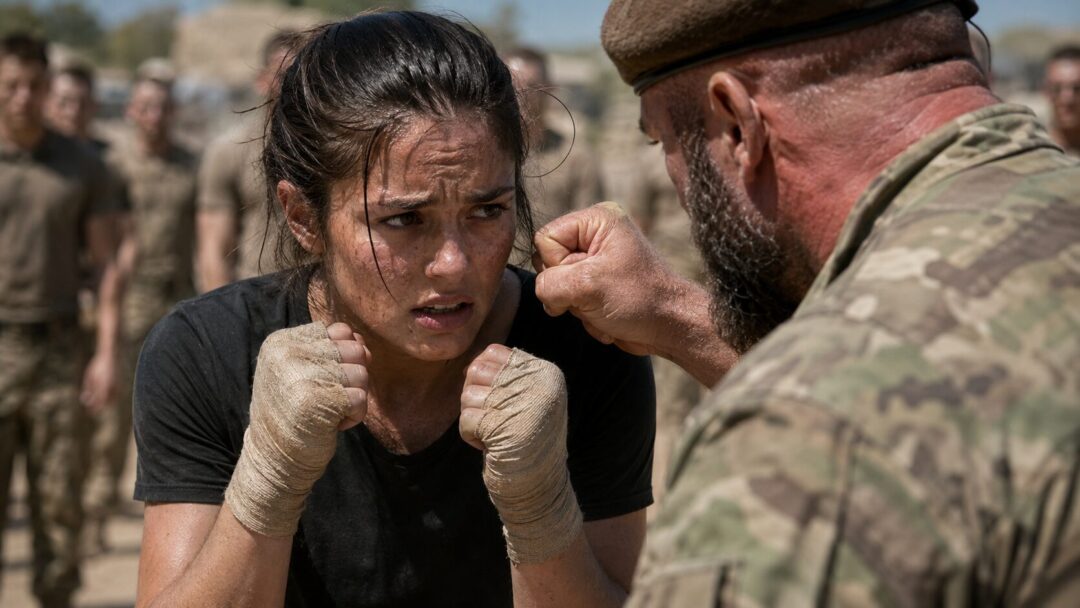
Sarah stood in the center of the yard with dust on her jaw, sweat under her collar, and thirty people watching her fail in silence.
Sergeant Mark stood close enough for her to smell coffee on his breath.
“You stop moving like that when it matters,” he said, “somebody pays for it.”
His fist hovered beside her cheek.
Not touching her. Not striking her. Just close enough that the air changed when his knuckles shifted.
Sarah kept her hands up because he had told her to. Her wraps were still too clean, tied tight around her wrists that morning like neatness could hold her together. Her dark hair had been pulled back so hard it tugged at her scalp. Now loose strands clung to her temples.
Behind Mark, the platoon stood in a ragged line near the edge of the yard. No one spoke. No one laughed now.
They had laughed earlier.
Not loudly. Not cruelly enough for anyone to be punished. Just a few sharp breaths after she froze beside the mock vehicle and stared through the smoke while everyone else moved.
That was worse than laughter.
A laugh could be answered. A breath meant they were trying not to say what they thought.
Mark leaned closer. He was broad, sunburned above the collar, beard rough across his jaw, sleeves tight around his forearms. His brown beret sat low, throwing his eyes into shadow.
“Hands higher.”
Sarah lifted them.
“Higher.”
She lifted them again.
Her shoulders burned.
“Look at me.”
She tried.
His eyes were too close. His voice was too close. The yard was too bright. Dust sat on every surface, pale and fine, the kind that rose under boots and hung in the heat like memory refusing to settle.
“Why’d you stop this morning?” he asked.
Sarah swallowed.
No answer came.
A vehicle door slammed somewhere behind the equipment shed.
Her stomach dropped so fast she almost bent with it.
Not here, she told herself.
Not now.
Mark saw something shift in her face.
Of course he saw it. He was paid to see weakness before people named it.
“There it is,” he said, quiet enough that only the first row could hear. “That’s the look.”
Sarah’s hands trembled.
A tall private near the left end of the line moved half a step forward before catching himself. Samuel. Sandy hair, restless hands, face too open for this place. He had been beside her during the morning drill. He had shouted her name when the smoke charges went off.
She had heard him.
She had not moved.
Captain Barbara stood beyond him, arms folded, expression unreadable. Her uniform looked untouched by the dust, as if even the yard respected distance when she asked for it. She watched Mark. Then Sarah. Then Samuel.
Samuel took the half step back.
Mark’s fist twitched near Sarah’s cheek.
She flinched.
It was small, but everyone saw it.
A sound moved through the platoon—not speech, not quite. A tiny collective shift. Boots scraping. A breath taken and held.
Heat rushed up Sarah’s neck.
Mark smiled without warmth.
“That,” he said, “is what gets people hurt.”
The word hit harder than his fist would have.
Sarah wanted to say she knew.
She wanted to say there were things the body remembered before the mind gave permission.
She wanted to say she had joined because of a voice she kept on her phone and a brother who used to stand in the driveway with his hands up, laughing, saying, Feet first, Sarah. Always feet first.
But she said nothing.
Silence was the only thing she had left that did not shake.
Mark turned from her to the platoon.
“What happens when somebody stops moving?”
No one answered.
He barked, “What happens?”
A few voices came unevenly. “The team stops, Sergeant.”
“And when the team stops?”
No one wanted the next sentence.
Mark looked back at Sarah as if the answer were written across her face.
“Somebody else has to carry the cost.”
Her hands dipped.
“Up,” he snapped.
She raised them.
Dust stuck to the sweat on her knuckles.
He stepped around her slowly, making her turn with him. The whole yard rotated: the low buildings, the waiting line, Samuel’s tense face, Captain Barbara’s stillness, the mock vehicles in the distance with their canvas panels and fake scorch marks.
The morning came back in broken pieces.
A pop.
White smoke.
A shout.
Move.
Move.
Move.
Her palms pressed against hot metal.
The world narrowing to one sound: the slam of a door from another day.
Mark stopped in front of her again.
“You want to be here?” he asked.
“Yes, Sergeant.”
“That came out fast. Try truth.”
Sarah blinked sweat from her eye.
“Yes, Sergeant.”
“Why?”
“To serve.”
He laughed once. No humor. Just dismissal.
“That answer comes printed on brochures.”
The line behind him tightened. Sarah felt it without looking.
Mark raised his fist again.
She tried not to blink.
He feinted.
Her whole body jerked back.
This time a few soldiers looked away.
That burned worse than if they had stared.
Mark lowered his hand.
“You can tape your wrists as pretty as you want,” he said. “You can stand in the gear. You can memorize every answer. But when pressure touches your face, you leave.”
Something inside Sarah went cold.
Not calm.
Cold.
The kind of cold that came before disappearing.
She had done it before. At her brother’s service when people told stories about Dennis like memories could make up for absence. At the kitchen table when her mother asked if she wanted to hear the last voicemail again. At the recruiter’s office when she signed her name and told herself this was purpose, not grief wearing boots.
Pressure touched your face, and you leave.
Mark was still talking.
She could see his mouth move.
But for one second, she was no longer in the yard.
She was seventeen again, standing in the driveway with Dennis, both of them barefoot, both of them laughing because he was home for fourteen days and had decided she needed to learn how not to fall over every time life leaned on her.
“Hands don’t save you if your feet already quit,” he had said.
Then he tapped her forehead.
“Feet first, Sarah.”
Dust lifted under Mark’s boot.
Sarah came back.
His shoulder moved before his hand did.
She noticed it by accident.
A small roll beneath the fabric. A warning. A beginning.
Mark was still inches away.
He did not know she had seen it.
Not yet.
Part II — The Morning That Followed Her
The failed drill had started like every other test that week: too early, too hot, and loud before anyone was ready.
Sarah had stood behind the mock convoy vehicle with Samuel to her right, both of them waiting for the signal. The exercise yard had been turned into a narrow training lane with stacked tires, plywood walls, and smoke charges hidden behind dented barrels.
“Remember your lane,” Samuel had muttered.
“I know my lane.”
“You always know your lane. I’m reminding myself.”
She almost smiled.
That was before the first charge went off.
White smoke swallowed the front of the vehicle. Someone shouted. Two trainees dropped low and moved right. Samuel grabbed her sleeve.
“Sarah, move!”
Her boots stayed planted.
It was not confusion. That was the terrible part.
She knew exactly what to do.
Her mind gave the order. Her body refused to accept it.
The smoke rolled over the hood. A metal panel slammed loose from the side of the mock vehicle, clanging hard against the frame.
And suddenly it was not a training lane.
It was a phone ringing in the kitchen at 2:13 a.m.
It was her mother saying no before anyone on the other end finished speaking.
It was a video clip she should never have searched for and did anyway, dust rising beside a road in a place she had never seen, heat bending the image until everything looked unreal except the sound of a vehicle door slamming.
Sarah had not screamed during the drill.
She had not cried.
She had done something worse.
She had become empty.
By the time Samuel shoved her behind cover, the exercise was already broken. Two lanes had collapsed around her. One trainee had gone the wrong direction trying to compensate. The instructor whistle cut through the smoke, sharp and final.
Mark had walked through the haze and stopped in front of her.
His face had not changed when he saw her shaking.
That was how she knew it was bad.
Angry men performed anger.
Quiet men made decisions.
After chow, the entire platoon was ordered back to the yard.
No one had asked why.
They knew.
Sarah had walked there with her hands wrapped tight, hair pulled tighter, eyes on the ground. Samuel stayed beside her but did not speak until they reached the edge of the open dirt.
“You don’t have to explain anything to them,” he said.
“That’s convenient,” she said. “Since I can’t.”
He looked like he wanted to say more.
Instead he said the wrong thing softly.
“I can talk to Captain Barbara.”
Sarah stopped.
“Don’t.”
“I saw what happened.”
“So did everyone.”
“That’s why—”
“No.” She turned to him then. “If you step in, it becomes true.”
His brow tightened. “What becomes true?”
“That I need someone else to stand between me and the room.”
He had no answer for that.
Then Mark called her name.
Not gently. Not loudly enough to be theater yet.
Just once.
“Sarah.”
And the whole platoon shifted to make a space for her in the center of the yard.
Now she stood in that space while the past licked at the edges of everything.
Mark circled her again.
“You think I’m being hard on you?”
Sarah said nothing.
He leaned closer.
“I asked you a question.”
“Yes, Sergeant.”
“Yes, I’m being hard?”
“Yes, Sergeant.”
“Good.”
He turned to the platoon. “Because everything else will be harder.”
Captain Barbara’s expression changed at that. Barely. Only her eyes moved.
Mark saw it.
“Problem, ma’am?”
“Continue,” she said.
Her voice did not rise.
That somehow made the yard quieter.
Mark looked back at Sarah. “What do you think happens if I pass you through because you tried? Because you meant well? Because your paperwork says you’re motivated?”
Sarah tasted dust.
He stepped close again.
“People don’t get carried by your intentions.”
That one landed.
Because Dennis had intended to come home.
He had intended to fix the loose porch rail.
He had intended to take her to the range and then for tacos and then maybe, if she stopped pretending not to care, help her fill out her first college forms.
He had left a voicemail the night before the attack.
She still had it.
She knew every breath in it.
Hey, Sar. Don’t spend your life proving things to people who shout. That includes me, by the way. Call Mom. She’s pretending she doesn’t miss me, which means she absolutely does.
A pause.
And hey. Feet first.
She had played it before her first day of training. Then before the first evaluation. Then every night this week, thumb hovering over delete and never pressing.
Mark’s hand moved.
Sarah flinched before she understood he had only pointed.
A private in the back whispered something. It died quickly.
Mark heard enough.
“Louder,” he said, still looking at Sarah. “If you’ve got an opinion, share it.”
No one spoke.
The silence did not protect her.
It made her the center of a judgment too polite to name.
Mark’s voice dropped.
“You froze beside a vehicle. You know what that tells me?”
Sarah forced the answer out. “That I need to do better.”
“No.” His eyes narrowed. “That tells me you can know what to do and still not do it.”
Her throat tightened.
There was no defending against the truth when it arrived dressed as accusation.
Captain Barbara stepped forward half a pace.
“Sergeant.”
Mark did not look away from Sarah.
Barbara said, “Watch the line.”
For a second, something old passed across Mark’s face. Not shame. Not regret. A door shutting.
“The line is why we’re here,” he said.
“Pressure teaches,” Barbara replied. “Punishment performs.”
The words moved through the yard like a wire pulled tight.
Mark finally turned.
“With respect, ma’am, hesitation performs too. It performs at the worst possible time.”
Barbara held his gaze.
Nobody breathed.
Then Mark looked back at Sarah, and the moment was gone.
But Sarah had seen it.
The crack.
Not softness. Something more dangerous.
Memory.
Part III — Shoulder, Boot, Breath, Hand
Mark raised both hands.
“Again.”
Sarah’s palms felt slick inside the wraps.
She wanted to wipe them on her pants but would not give him the movement.
“Look at my eyes,” he said.
So she did.
And almost lost herself again.
His eyes were not wild. That was the problem. The rest of him performed anger: the voice, the gestures, the proximity. But his eyes were controlled. Measuring. Waiting for a collapse he expected and hated before it happened.
Sarah knew that look.
She had seen it in herself every morning in the barracks mirror.
Mark snapped forward.
She flinched.
Not as badly as before, but enough.
He stopped short.
“There.”
Sarah dragged air through her nose.
His shoulder had moved first.
Again, that tiny roll beneath the fabric.
It happened before the hand, before the feint, before the air near her face changed.
Her heart was still wild.
Her body still wanted out.
But a small part of her mind stepped aside from the panic and took notes.
Shoulder.
Mark circled.
His right boot scraped before he changed direction.
Boot.
He breathed in through his nose before he closed distance.
Breath.
His fist came last.
Hand.
Shoulder. Boot. Breath. Hand.
The sequence did not save her.
But it gave fear edges.
Mark stepped in again. “Still with me?”
No, she thought.
“Yes, Sergeant.”
He almost smiled. “That answer was also too fast.”
Sarah did not respond.
The yard tightened around her. The line of soldiers became a blur of tan and green. Samuel’s face appeared between two shoulders, strained and pale. He looked ready to move again.
Barbara saw him before he did.
She did not shake her head. She did not need to.
Samuel’s jaw locked.
Stay, his body said.
Move, his eyes said.
Sarah looked away from him before his fear became hers.
Mark noticed.
“Don’t look for help.”
Her hands rose another inch.
“I’m not.”
“No?”
“No, Sergeant.”
“Then stop leaving.”
The words cut through the noise in her head.
Stop leaving.
Her brother’s voicemail pressed against her memory.
Don’t spend your life proving things to people who shout.
Mark was shouting. Dennis had warned her about men like that.
But Dennis had also taught her to move before she felt ready.
That was the part she had been avoiding. The part grief did not let her keep.
It was easier to make Dennis into a reason to endure than to remember he had hated watching her shrink.
Mark leaned close again. “Why did you join?”
The old answer sat on her tongue.
To serve.
To honor him.
To finish something.
To stand where he stood and maybe understand why the world had taken him there.
None of it felt safe enough to say.
So she said, “Because I was tired of being still.”
The yard changed.
Not visibly. No one gasped. No one moved.
But Mark heard the answer.
So did Barbara.
So did Samuel.
For the first time, Mark did not reject it.
His voice lowered. “Still gets people hurt too.”
Sarah nodded once.
“I know.”
The admission cost her more than defiance would have.
Mark’s face shifted again, that shuttered look.
Years earlier, before Sarah ever arrived, he had said something similar over a body bag. Not the same words. Not the same yard. Not the same heat. But the same terrible math: one person unable to move, others moving toward them, and the cost spreading outward.
He did not say that.
He only raised his hands.
“Then move.”
This time Sarah did not look at his fist.
She looked at the seam of his sleeve where his shoulder would tell the truth first.
Mark saw where her eyes went.
Good, his expression almost said.
Then he stepped in faster.
Shoulder.
Boot.
Breath.
Hand.
Sarah’s body screamed at her to flinch.
She did.
But not backward.
She slipped to the side.
For one clean second, Mark was where he had intended to be, and Sarah was not.
His weight carried forward.
Her left foot found the dust.
Her right hand moved short and straight into the center of his chest protector.
Not hard enough to injure.
Hard enough to stop the world.
Dust lifted around their boots.
Mark turned half a step with the force of his own momentum.
The platoon went silent in a way silence had not been silent before.
This silence had weight.
Sarah’s arm was still extended.
Her breath came once.
Twice.
Mark looked down at where she had hit him.
Then at her.
His eyes were wide.
Only for a heartbeat.
But everyone saw it.
Sarah pulled her hand back and raised both fists again.
She did not smile.
She did not look at Samuel.
She did not look at Barbara.
If she celebrated, they would call it luck.
If she lowered her hands, they would call it over.
So she said the only word that gave the moment back to her.
“Again.”
Part IV — The Yard Waited
Mark’s face hardened.
For a dangerous second, Sarah thought he might punish her for succeeding.
Not openly. Not in a way anyone could write down. He knew better than that. But there were many ways to make a person pay for embarrassing authority.
The platoon knew it too.
No one moved.
Samuel whispered, “Sarah.”
It was almost nothing.
Half warning. Half awe.
Mark heard him.
“So now she has a corner man?” he said.
Samuel straightened. “No, Sergeant.”
Sarah did not turn.
Mark’s gaze stayed on Samuel just long enough to make the line feel the heat of it. Then Barbara’s voice cut in.
“Sergeant Mark.”
Not loud.
Enough.
Mark looked at her.
Barbara did not step closer. She did not need space to hold authority. She carried it like still water carried depth.
“Proceed as an instructor,” she said.
The words were clean.
The meaning was not.
A muscle jumped in Mark’s jaw.
“Yes, ma’am.”
Sarah realized then that his pride was not the only thing at stake. His method was. His whole belief about what fear required. If he kept pressing cruelly, everyone would see the loss of control. If he stopped, everyone would see she had changed the terms.
For the first time, he was the one being watched.
Not her.
The shift should have felt like victory.
Instead it scared her.
Because when men like Mark lost control of a room, they took it back with interest.
He faced her again.
“You want again?”
Sarah’s mouth was dry.
“Yes, Sergeant.”
“Then understand something.” His voice was no longer theatrical. That made it worse. “One clean move does not make you ready.”
“I know.”
“Do you?”
“Yes, Sergeant.”
He stepped closer, but not into her face this time.
“Good. Because now I stop giving you time to look brave.”
He came in fast.
Too fast.
No big shoulder roll. No performance. No lesson wrapped in shouting.
Just pressure.
Sarah barely caught the first movement. His forearm swept her guard aside, controlled but firm, and his body angle drove her back two steps. Dust slid under her boots.
Her lungs tightened.
The old panic surged up, angry at being denied.
Smoke.
Door.
Heat.
Samuel shouting.
Sarah, move!
Mark pushed again. She blocked poorly. His glove tapped her shoulder—not a strike, a mark. A reminder.
“Gone,” he said.
She tried to reset.
He crowded her.
“Gone again.”
Her heel caught uneven ground. She stumbled, recovered badly, and heard the line behind Mark shift.
Not laughing this time.
Worried.
That almost undid her.
Pity had always been worse than doubt.
Mark advanced.
Shoulder. No.
Too late.
Boot. No.
He was changing rhythm.
Of course he was.
He was not a machine. He was not a pattern. He was a man trained to break patterns the moment someone found them.
Sarah’s breath fractured.
The yard blurred.
Her hands became too light. Her legs too far away.
She was leaving again.
She felt it happen.
The terrible ease of disappearing inside herself.
A body could stand in the sun and still be gone.
Mark saw it.
His anger flickered into something almost like fear.
“Carter,” he snapped, forgetting he was not supposed to use the old name. Then he corrected himself with her name, harder. “Sarah.”
She barely heard him.
The dust was too bright.
The phone was ringing.
Her mother was saying no.
The voicemail icon glowed on the screen.
Hey, Sar.
Don’t spend your life proving things to people who shout.
Her brother had laughed after that. He always laughed when he was trying not to sound serious.
And hey.
Feet first.
From the line, Samuel’s voice cut through the yard.
“Feet first, Sarah.”
The world stopped pulling her backward.
Not because the words were magic.
Because they belonged to a moment before loss.
Driveway gravel under bare feet. Dennis grinning. Her own knees scraped from falling. His hand extended, not to pull her up before she tried, but after.
“Feet first,” he had said. “Your hands panic. Your feet decide.”
Sarah almost turned toward Samuel.
That would have ended it.
She caught herself.
Feet first.
Her left boot pressed into dust.
Her right foot found angle.
Her hands were still shaking, but her feet had answered.
Mark came in again.
This time she did not wait for the fist.
She watched the space he needed.
He gave her pressure.
She gave him absence.
He adjusted.
She did not retreat.
He closed.
She stepped off-line, caught the edge of his momentum with her forearm, turned her hips the way they had practiced a hundred times when no one was watching, and let his force carry him past the place where she had been.
For one second she felt how simple it could have been all along.
Not easy.
Simple.
Move.
Mark dropped to one knee in the dust.
Not slammed. Not thrown for spectacle. Just placed there by physics and timing and one soldier finally staying present in her own body.
Sarah stepped back.
Hands up.
The whole yard waited.
Mark stayed on one knee, gloved hand against the ground.
Dust clung to his fingers.
He looked at the place where his hand touched the earth as if the answer might be there.
Sarah’s chest heaved.
She expected anger.
She expected correction.
She expected him to rise and make the moment smaller because it had happened to him.
Instead, Mark tapped the dust once.
Then he stood.
His face was red, his beard full of grit, his pride wounded in front of everyone.
But when he spoke, his voice was level.
“Reset.”
No one cheered.
That was what made it matter.
Part V — What Was Handed Back
The platoon dispersed badly.
No one knew how to leave a moment like that. They picked up canteens, adjusted straps, brushed dust from pants that would be dusty again in three steps. A few looked at Sarah and then away, as if direct admiration might embarrass her more than doubt had.
She lowered her hands only when Mark turned away.
Her arms shook immediately.
Not a little.
Violently.
She pressed her fists against her sides and hoped nobody saw.
Of course Samuel saw.
He approached slowly, like she was an animal that might bolt.
For a second she thought he would say too much.
You did it.
Are you okay?
I knew you could.
Any of those would have made her crack.
Instead, he held out his hand.
Her black hair tie sat in his palm, dusty and stretched.
“You dropped this.”
Sarah stared at it.
She had tied her hair so tightly that morning her scalp ached. Somewhere between the first flinch and the last step, it had come loose. She had not noticed. She had been too busy trying not to vanish.
She took it from him.
“Thanks.”
Samuel nodded.
He looked like he wanted to say the phrase again. Feet first. As if maybe he had earned the right to explain why he had used it.
He did not.
That was when Sarah understood he had changed too.
He had helped without taking over.
“You okay?” he asked finally.
A normal question.
Still dangerous.
Sarah looked at the hair tie in her palm. Dust lined its edges.
“No,” she said.
Samuel accepted it.
That was better than comfort.
Mark walked past them, close enough that Samuel straightened without meaning to. Mark ignored him and stopped beside Sarah.
For a moment, she saw only the man from ten minutes ago: fist near her cheek, voice rough with accusation, his certainty pressing everyone into shape.
Then she saw the other thing too.
The hesitation after Barbara warned him.
The way his anger had flickered when Sarah started to leave herself.
The tap in the dust before he said reset.
Not apology.
Never that.
Something smaller. Harder.
Recognition.
“You froze this morning,” he said.
Sarah looked straight ahead.
“I know.”
“You moved this afternoon.”
She turned then.
His eyes were no longer close enough to trap her.
They were tired.
“Don’t confuse one with the other,” he said.
“I won’t.”
He gave a short nod.
Then he walked away.
Captain Barbara waited until Mark was out of earshot before approaching. She looked at Sarah’s hands first. Then her face.
“You’ll repeat the lane at dawn.”
Sarah’s stomach tightened.
Samuel’s head snapped toward the captain. “Ma’am—”
Barbara did not look at him.
Sarah did.
One look.
He stopped.
Good, she thought.
Not because she wanted the dawn. She did not. The thought of smoke and metal and shouted movement made her hands go cold again.
But dread was not the same as refusal.
Not anymore.
“Yes, ma’am,” Sarah said.
Barbara studied her for a second longer.
“Not as punishment.”
Sarah almost laughed. It would have sounded wrong.
Barbara continued, “As answer.”
Then she left too.
The yard emptied until only the raked dust remained, scuffed into proof that something had happened there. Sarah stood with the hair tie in her fist and did not put it back in.
Samuel walked beside her toward the barracks but did not match her too closely.
At the door, he paused.
“I shouldn’t have tried to step in earlier,” he said.
“No.”
He winced.
Sarah let the silence hold for one beat, not to punish him, but because truth deserved room.
Then she added, “But I heard you at the end.”
His face changed.
Not relief exactly.
Something like it, but quieter.
“Dennis said that?” he asked.
Sarah’s fingers tightened around the hair tie.
She had told Samuel about her brother only once, late in week two, after lights out, when everyone else had pretended to sleep and homesickness had made strangers honest. She had not told him everything. Only enough.
“He said a lot of things,” she said.
Samuel nodded.
“That one seemed useful.”
“It was.”
He left her there without trying to make the moment warmer.
Sarah appreciated him for that.
Inside, the barracks smelled like detergent, dust, and tired bodies. She sat on the back steps instead of going in. The sky had turned the color of old brass. The day’s heat rose from the concrete in waves.
Her phone felt heavier than it should have.
She opened the saved voicemail before she could decide not to.
Dennis’s voice filled the small space between her and evening.
“Hey, Sar. Don’t spend your life proving things to people who shout. That includes me, by the way. Call Mom. She’s pretending she doesn’t miss me, which means she absolutely does.”
A pause.
She heard him breathe.
The living sound of him.
“And hey. Feet first.”
The message ended.
The screen offered its usual choices.
Play again.
Share.
Delete.
For years, delete had looked like betrayal.
Tonight it looked like a door.
Sarah played it once more.
Not because she needed permission.
Because goodbye deserved to be heard clearly.
Then she pressed delete.
The phone asked if she was sure.
She was not.
She pressed it anyway.
The absence that followed was not peace. It was not healing. It did not lift the grief from her chest or make dawn less frightening.
It simply removed the place where she had been hiding.
Sarah sat there until the sky darkened and the first coolness touched the dust.
Then she tied her hair back loosely.
Not tight enough to hurt.
Part VI — The Ground Beneath Her
At dawn, the yard looked gentler only because no one had filled it yet.
The dust was still there.
The heat would come back.
The lane waited in the distance with its mock vehicle and stacked tires and barrels placed where smoke would bloom on command.
Sarah arrived before the others.
She had not slept much. Every time her eyes closed, a door slammed in her head. But she had stopped trying to force calm. Calm came and went as it pleased. Her job was simpler.
Feet first.
She stood in the center of the yard where Mark had hovered over her the day before. The scuffs were still visible in the dirt, though the night wind had softened them. A half circle where the platoon had stood. Two deeper marks where Mark’s boots had driven forward. One narrow slide where her own foot had finally chosen angle instead of retreat.
She placed her boots there.
Not exactly.
Close enough.
The barracks door opened behind her.
She did not turn.
Samuel’s steps paused at the edge of the yard. He stayed there. Watching, but not entering.
Good.
A minute later, Captain Barbara arrived with a clipboard tucked under one arm. She looked at Sarah, then at the empty lane, then said nothing. Her silence was different this morning. Less like judgment. More like space being held open.
Last came Mark.
No shouting announced him.
His boots scraped the dust before his voice did.
Sarah heard shoulder, boot, breath, hand in the rhythm of his approach, and almost smiled at how the body learned what pain taught it.
Mark stopped several feet away.
He wore the same brown beret. Same beard. Same broad shape against the pale morning.
But he did not step into her face.
He did not raise his voice.
For a while, they stood across from each other in the quiet yard while the day gathered itself.
“You ready?” he asked.
Sarah looked past him at the lane.
Smoke would come.
The metal panel would slam.
People would shout.
Her body might still betray her. She knew that now. Knowing did not destroy her. It only told her where the work began.
“No,” she said.
Mark’s eyes narrowed slightly.
Then Sarah raised her hands.
“But I’m here.”
The answer settled between them.
Not brave enough to be a speech.
True enough to stand on.
Mark nodded once.
Then, slowly, he raised his own hands.
No performance.
No crowd.
No fist beside her face.
Just the space between them, and the ground beneath her feet.
Sarah felt the old fear rise.
She let it.
Then she moved.