The Man Who Asked Them To Read Every Name In The Room
Part I — The Wrong Guest
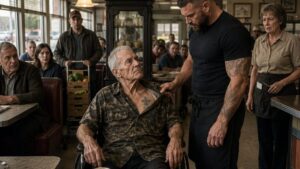
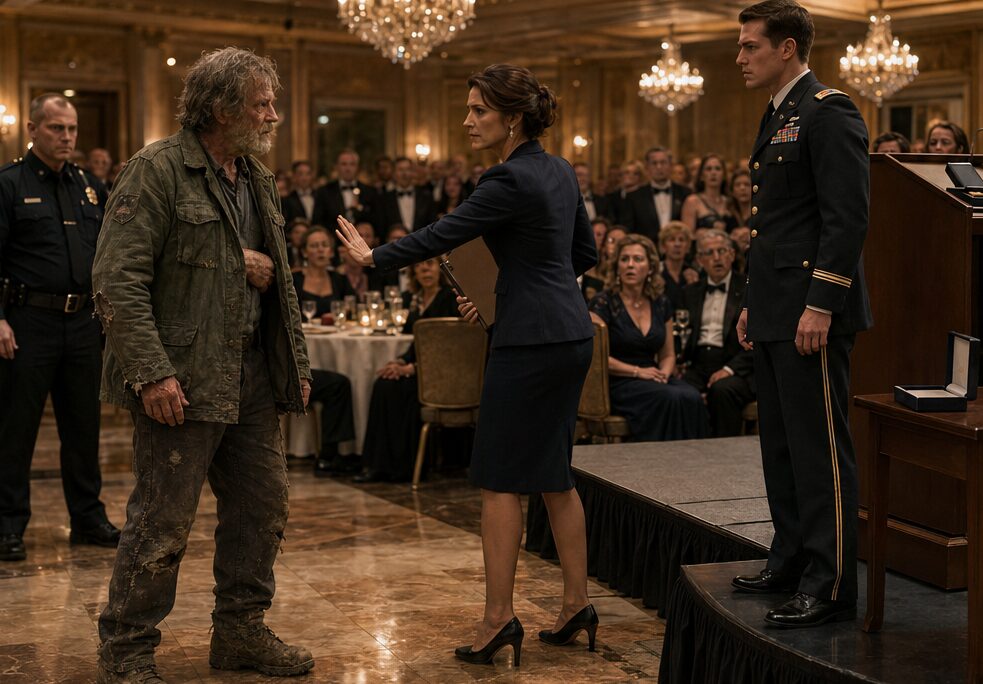
The old man entered the ballroom with mud on his boots, a torn green jacket hanging from his shoulders, and a thin red trail slipping from his left hand onto the polished floor.
For three seconds, no one moved.
The string quartet kept playing near the windows. The chandeliers burned soft gold over crystal glasses and pressed black jackets. On the stage, beneath a blue velvet banner, Captain Brandon Harris stood beside a closed medal box, waiting for the applause to settle so the foundation president could say his name again.
Then the old man limped farther in.
A woman near the front whispered, “Someone get that man out before the cameras turn.”
A security guard stepped forward.
The old man did not look at him.
He looked only at Brandon.
Every head in the ballroom turned with him. Donors in evening gowns leaned away from his smell of rain, street dust, and something metallic. A waiter froze with a silver tray of champagne halfway between tables. The big screens on either side of the stage still showed Brandon’s official portrait: clean-shaven, straight-backed, one hand on his cap, eyes fixed somewhere noble and distant.
The old man looked like he had crawled out of that distance and brought it into the room.
“Sir,” the security guard said, trying to keep his voice low. “You can’t be here.”
The old man stopped ten feet from the stage.
His beard was gray and uneven. His eyes were tired but not unfocused. His jacket had an old unit patch stitched above the heart, faded almost colorless. One sleeve was dark at the cuff where his hand kept bleeding.
Brandon saw the patch.
His spine tightened before he understood why.
The guard reached for the old man’s elbow.
“Sir, we need you to come with us.”
A man at the closest table gave a short laugh into his drink.
“Some old drunk found the wrong banquet.”
The words were quiet, but the room was quieter.
The old man heard them.
So did Brandon.
Still, the old man did not look away from the stage. His mouth moved once before sound came out, as if the sentence had been waiting too long and had grown heavy.
“You’re wearing a dead man’s citation.”
The guard stopped.
The quartet faltered.
Brandon did not blink.
The foundation president, Katherine Collins, crossed the stage from the podium with the quick, smooth steps of someone trained to rescue expensive evenings.
“Sir,” she said, with a smile that did not reach her eyes. “We are grateful for your attendance, but this is a private ceremony. Let’s step outside and get you some help.”
“I didn’t come for help.”
His voice was rough, but it carried.
Brandon felt every camera in the back of the room tilt toward them.
Katherine’s smile tightened. “Then tell us your name, and we can—”
The old man lifted his right hand toward the inside pocket of his jacket.
The room changed in one breath.
Chairs scraped. A woman gasped. The security guard shifted his weight forward. Another guard near the side doors touched the radio at his shoulder.
Brandon’s own hand twitched.
Not toward a weapon. Toward restraint.
“Stop,” he said.
Everyone heard that.
The old man’s hand froze halfway to his pocket.
Brandon stepped down from the stage.
Up close, the old man’s face was worse than it had seemed from the lights. Not crazed. Not lost. Worse because he was completely present. The lines around his mouth looked carved by years of not saying something. His left hand kept dripping onto the floor, slow and bright against the marble.
Katherine moved beside Brandon and lowered her voice.
“Captain Harris, let security handle this.”
Brandon did not answer her.
He was staring at the patch.
A shape from an old file. A symbol he had seen in classified debriefings, on grainy photographs and burned paper, attached to a mission everyone in this room knew by its polished name.
Operation Lantern.
The rescue that had made careers.
The rescue that had made his own.
The old man’s eyes held him there.
“Did they ever tell you,” he asked, “whose voice you heard on the radio?”
Brandon’s throat closed.
Because there had been a voice.
A hoarse voice under static. A voice from an old recording played during his debriefing years ago, guiding men out through smoke and wrong coordinates and collapsing roads. Officially, that voice belonged to Colonel Stephen Reeves.
Stephen Reeves, the legend.
Stephen Reeves, the mentor whose story had filled foundation brochures for twenty years.
Stephen Reeves, whose widow sat in the front row in a black dress with silver hair pinned at the back of her head.
The old man leaned closer.
“Stephen was already gone when that voice gave them the road out.”
Part II — The Name Nobody Wanted
The room did not explode.
It did something worse.
It held its breath and waited for someone powerful to decide what was true.
Katherine moved first.
“Ladies and gentlemen,” she said into the air, not yet at the microphone, “we apologize for the interruption. Please remain seated.”
Her hand flicked behind her back. The quartet began again, too softly, all trembling strings and no confidence.
The old man did not raise his voice.
That made him harder to dismiss.
Brandon heard himself ask, “Who are you?”
The old man gave him only a last name.
“Whitaker.”
At the front table, Linda Reeves went pale.
It was not a dramatic movement. She did not faint or cry out. Her hand simply closed around the stem of her water glass until the knuckles showed.
Brandon saw it.
So did Katherine.
For the first time, Katherine looked at the old man as more than a problem with shoes.
“Mr. Whitaker,” she said carefully, “this is not the appropriate place.”
“No,” he said. “This is exactly the place.”
He looked past her at the framed program near the podium. Beneath Brandon’s portrait, in elegant silver lettering, the night’s theme read: REMEMBERING LANTERN.
There was an auction table along the wall.
Mounted photographs. Replica field maps. A commemorative watch. A signed copy of Stephen Reeves’s memoir, sealed under glass.
The old man stared at it until his mouth tightened.
“You’re auctioning off the wrong story.”
A murmur ran through the room.
Katherine lifted her chin. “That is enough.”
“No,” he said.
One syllable. No anger in it. Just a door closing.
The old man reached again toward his jacket.
This time Brandon moved first.
“Let him.”
The guards looked to Katherine.
Katherine looked to Brandon as if he had just stepped off a ledge.
Slowly, the old man pulled out a folded photograph. The paper was soft at the creases, darkened at one corner by blood from his hand.
He held it toward Brandon.
Four young men stood beside a field radio. Their sleeves were rolled. Their faces were lean and sunburned. One of them was Stephen Reeves, younger than his statue in the foundation lobby, his smile sharp and confident. Another was the old man, though it took Brandon a second to see him under the years.
In the photograph, James Whitaker had a narrow face, dark hair, and one hand resting on the radio like it was alive.
“You were a radio operator,” Brandon said.
“I was the radio operator.”
Katherine’s voice cut in, softer now, more dangerous.
“Captain Harris, the foundation has a process for service-related claims. This is neither the time nor the venue.”
James Whitaker looked at her then.
It was the first time he had allowed her his full attention.
“I gave your process thirty-one years.”
Katherine did not flinch, but color rose in her face.
Linda Reeves stood.
The whole front row shifted with the importance of her movement.
“Mr. Whitaker,” she said.
Her voice was steady because she had made it steady. Brandon could hear the work inside it.
James looked at her.
For a moment, something in him changed. Not softened exactly. Lowered.
“Mrs. Reeves.”
Linda swallowed.
“You were listed missing.”
“Yes, ma’am.”
“And then recovered.”
“Yes, ma’am.”
Her eyes went to his jacket, his hand, his ruined boots. “We were told you were… unwell.”
A few people looked down at their laps.
James gave a dry, small nod.
“That was the polite word.”
Linda’s mouth trembled once before she controlled it.
“My husband’s name is on that memorial.”
“I know.”
“My husband died in that operation.”
“I know.”
“Then why are you here?”
James looked at the photograph in his hand.
The room waited for accusation.
What came was quieter.
“Because if they say it wrong one more time, there’ll be no one left who remembers how it sounded.”
Brandon felt the sentence land somewhere behind his ribs.
Katherine stepped toward the microphone.
“Ladies and gentlemen, we will take a brief intermission while we resolve—”
“No,” Brandon said.
It came out before he had decided to say it.
Katherine turned. “Captain.”
Brandon looked at James, then at Linda, then at the medal box waiting under the lights.
He had imagined this night many times. He had imagined the weight of the medal, the applause, the photograph with Linda Reeves, the handshake with three generals and the foundation donors. He had imagined feeling worthy.
He had not imagined an old man bleeding on the floor and looking at him like the floor had always known the truth.
Brandon stepped to the microphone.
The room sharpened around him.
“Let him speak,” he said.
Katherine’s eyes flashed.
James Whitaker gave Brandon no gratitude.
He only folded the photograph once and held it against his chest.
“Don’t do me favors,” he said.
Brandon looked at him.
“Then do it for the names.”
That was the first time James looked away.
Part III — The Voice Under Static
James did not climb onto the stage.
He stood below it, where the lights were poorer and the red drops from his hand made a broken line beside his boot.
“They called it Lantern because somebody in headquarters liked clean words,” he said. “There was nothing clean about it.”
No one breathed too loudly.
“It was a border campaign. Bad maps. Bad weather. Worse intelligence. A convoy got trapped after the route changed. The official account says Colonel Stephen Reeves held command long enough to transmit the extraction path.”
Linda closed her eyes.
James looked at her, then away.
“That is not what happened.”
Katherine stood frozen near the podium, one hand still close to the microphone controls.
James continued.
“Colonel Reeves changed the route because the first call was his. He believed the ridge road was open. It wasn’t. When the reports came in wrong, he tried to move fast enough to make the mistake look like bad luck.”
A stir went through the front tables.
Linda opened her eyes.
“That is not fair,” she said.
“No,” James answered. “It wasn’t.”
She stared at him.
He let the words stand between them.
Then he said, “He was brave after. That matters too.”
The room shifted again.
People wanted a villain. James refused to give them one.
“He came back to the relay station when he didn’t have to,” James said. “He knew the convoy would not trust my voice once command went silent. He gave me his call sign. Told me to keep transmitting until they cleared the valley.”
Brandon saw it then, not as memory, but as shape.
A relay station split by shelling. A field radio patched with wire. A young operator with smoke in his lungs. A colonel bleeding out beside him, trying to repair the thing his pride had broken.
James touched the old photograph with his thumb.
“Stephen died before the second transmission.”
Linda made a sound so small it barely existed.
James did not look at her this time.
“I kept using his call sign. I told them the lower road was blocked. Told them to cross east before the bridge went. Told them when to shut their headlights. Told them when to leave the wounded and come back with stretchers.”
His jaw flexed.
“I told them things a man should not have to tell boys who wanted to live.”
Brandon remembered the old recording.
Not the words. The feeling of it.
A voice turned to gravel by smoke and exhaustion, cutting through panic with the force of command.
Hold the road.
No, not that road.
Turn east.
Keep moving.
Do not answer unless I ask you.
Keep moving.
For years, Brandon had heard that voice and imagined Stephen Reeves standing heroic over a radio, giving everything until the end.
Now the voice had a body.
A gray one, bleeding in front of him.
“What happened after?” Brandon asked.
James’s eyes stayed on the ballroom floor.
“After they cleared the valley, the relay was overrun. I burned what I could. Not enough.”
He paused.
Katherine’s expression had gone carefully blank. She knew the room was no longer hers.
“They took me across the border,” James said. “I was gone long enough for everybody to get comfortable with the story.”
No one asked what happened there.
The way James held his left hand made the question unnecessary.
“When I came home, the foundation had already built its first memorial. Stephen was dead. The survivors were grateful. The widows had something to hold. The command review was sealed. My report became an inconsistency.”
His mouth twitched.
“That was another polite word.”
Linda’s eyes filled, but no tears fell.
“Why didn’t you come to me?” she asked.
James looked at her then, and for the first time his face showed something like fear.
“Because you had buried him once.”
Linda’s lips parted.
James looked down at the photograph again.
“And because I wasn’t sure what I had done.”
Brandon heard the change before he understood it.
The room had been listening for proof. James was giving them guilt.
“I used his name after he died,” James said. “I told myself it was because they would trust it. I told myself it saved them. But some nights I wondered if I saved boys with one lie and buried him with another.”
Linda pressed her hand to her chest.
“He gave you the call sign,” she said.
“He did.”
“Then he chose that.”
“Yes.”
“Then why did they not say your name?”
That question did what accusation had not.
It broke something open.
James’s shoulders lowered, not in relief but in exhaustion.
“Because my name made the story harder.”
The ballroom was silent.
Not respectful. Not yet.
Guilty silence has a different temperature.
Brandon looked at the medal box. He could no longer see the polished lid without seeing the field radio in the photograph.
“What do you want from me?” he asked.
James looked up.
“Not your medal.”
Brandon waited.
“Not a salute.”
The old man’s voice roughened.
“And not pity. I’m tired of men turning pity into a smaller kind of burial.”
That line went through the room like a blade no one could call violent because it was too true.
James lifted the photograph.
“Read the names they left out.”
Katherine moved.
“Captain Harris,” she said sharply, “may I speak with you privately?”
“No,” James said.
She ignored him.
“Captain, there are classified issues involved here, donor obligations, family considerations, and frankly, questions about the reliability of—”
She stopped herself one word too late.
Reliability.
James smiled without humor.
“There it is.”
Part IV — The Polite Word
Katherine did not want to sound cruel.
That made it worse.
She walked to the podium, lifted a folder from beneath it, and opened it with hands that had saved many evenings from disorder.
“Mr. Whitaker,” she said, “no one here wishes to diminish your service.”
James gave a short breath.
The old drunk had become Mr. Whitaker now.
That was how rooms like this worked. They raised your title only when they needed to manage the damage.
Katherine continued, facing the audience more than him. “The foundation has, over the years, reviewed several accounts related to Operation Lantern. Some records are incomplete. Some claims were disputed. And it is my understanding that Mr. Whitaker has publicly struggled with memory deterioration resulting from his years after the operation.”
The room shifted again.
Not all at once.
A glance here. A lowered phone there. A donor leaning back as if the story had become safer to doubt.
James stood still.
Only Brandon saw his right hand close.
Linda Reeves looked at Katherine. “Katherine.”
“I am trying to protect everyone involved,” Katherine said.
“No,” James said quietly. “You’re trying to protect the program.”
Katherine’s eyes hardened.
“Sir, you walked into a formal event injured, uninvited, and making a serious allegation. Surely you understand why people are concerned.”
James nodded once.
“I understand exactly what people are.”
He reached into his jacket.
Security moved.
Fast.
Two men stepped forward from either side of the room. Someone cried out. A phone clattered against a plate. Katherine said, “Stop him,” and Brandon said, louder, “No.”
The guards froze.
James’s hand remained inside the jacket.
The room stared at the pocket as if all their fear had been waiting there for proof.
Slowly, James withdrew a bundle wrapped in dark oilcloth.
No weapon.
No threat.
Just something small enough to fit in an old man’s hand.
He placed it on the nearest table and unfolded the cloth.
A battered radio key lay inside, its metal dulled, its base scratched by use. Beside it was a small cassette recorder, black plastic, worn at the corners. The kind of object no one in the ballroom had touched in years.
“This was kept by a field medic,” James said. “Paul Mercer. He found me after I came back. He didn’t trust the official archive. Smart man.”
Katherine looked as if she wanted to object, but no words came quickly enough.
James turned the recorder over with his uninjured hand.
“It still plays if you ask it nice.”
A nervous laugh rose and died instantly.
He pressed the button.
Static filled the ballroom.
Thin. Brittle. Ancient.
Then a young man’s voice came through it.
Not clear. Not whole. But there.
“Lantern Six to Ridge Column. Lower road is gone. Repeat, lower road is gone. Turn east by the dry creek and kill your lights.”
Brandon’s chest tightened.
He knew that voice.
Everyone in his unit knew that voice. It had been played for them as history, as doctrine, as proof of what command under pressure sounded like.
The tape hissed.
Another voice in the distance shouted something no one could make out.
Then the young voice again, rougher.
“Do not answer unless I call you. Keep moving.”
Linda gripped the back of her chair.
James did not look at anyone while it played.
The recording crackled, dipped, returned.
“Lantern Six—” Static swallowed the rest. Then: “Tell Emma I kept the lamp on.”
The room did not understand at first.
Brandon did.
Maybe Linda did too, from the way her face changed.
James reached out and stopped the tape before it could say anything else.
“My wife’s name was Emma,” he said.
Was.
The smallest word in the room.
The largest one.
No one challenged him after that.
Katherine’s folder hung useless in her hand.
Linda’s voice trembled when she spoke.
“Stephen did not say that.”
“No, ma’am.”
“He would not have known to.”
“No, ma’am.”
James wrapped his fingers around the radio key, then let it go.
“I’m not here to spit on your husband.”
Linda’s eyes flashed through tears.
“You already have.”
James accepted that like a sentence he had expected.
“Maybe.”
He looked at the photograph.
“But he came back. He knew what he had done, and he came back to the relay. He could have run the clean way. He didn’t.”
Linda turned her face away.
James waited until she looked at him again.
“He died trying to fix it. Not as clean as they printed. Not as cheap as I believed for a long time.”
Linda covered her mouth.
Katherine whispered, “This is not the way.”
James looked at her.
“The way was thirty-one years ago.”
Part V — Read Them
The medal box sat unopened under the lights.
For the first time all night, no one seemed to want to touch it.
Brandon looked at it and saw how small it was. Smaller than the photograph. Smaller than the radio key. Smaller than the number of names never printed in the program.
Katherine came to his side.
“Captain,” she said under her breath, “you need to be very careful. If you validate this publicly, there will be consequences you cannot control.”
Brandon almost laughed.
Control had been the room’s religion all evening.
Control the program. Control the donors. Control the widow’s grief. Control the old man’s hands. Control the story until it became smooth enough to auction.
James was watching him now.
Not pleading.
That was what made it hard.
A man begging could be refused. A man standing there with the truth in his open hand could only be answered.
Brandon stepped to the podium.
Katherine moved with him. “Captain Harris.”
He picked up the medal box.
The room seemed to lean forward.
Then he set it down again, unopened.
The sound was soft.
It carried anyway.
“I cannot accept this under the story printed tonight,” Brandon said.
Katherine shut her eyes.
A murmur rose. He let it. Then he looked down at the photograph James had handed him.
On the back, in tight handwriting, were names.
Some were smudged. Some had notes beside them. Two had crosses. One had the word “sang” written beside it. Another had “owed me cards.”
These were not memorial-wall names.
These were names remembered by a man who had been alone too long with the dead.
Brandon read the first one.
“Stephen Reeves.”
Linda bowed her head.
“Paul Mercer.”
Somewhere in the room, an older man at a rear table covered his face.
“James Whitaker.”
The old man’s eyes closed for one brief second.
Not because the name healed him.
Because it had finally entered the room without apology.
Brandon kept reading.
He read the men at the relay. He read the men lost on the road. He read the support team listed in old records as unconfirmed. He read slowly enough that no one could pretend the names were decoration.
Halfway through, he mispronounced one.
“Branigan,” James said.
Brandon stopped.
“Branigan,” James repeated. “Hard g. He hated when people got it soft.”
A few people looked startled.
Then Brandon corrected himself.
“Andrew Branigan.”
James nodded.
That was all.
No speech could have honored the man more.
Katherine reached toward the microphone switch.
Linda Reeves stepped into her path.
“Katherine,” Linda said.
It was not loud.
It did not have to be.
Katherine stopped.
Linda’s face was wet now, but her spine was straight.
“Let him finish.”
So Brandon finished.
When the last name was read, the room did not burst into applause.
That would have been easier.
Instead there were scattered sobs, the rustle of expensive clothes, the small humiliation of people not knowing what to do with their hands.
James stepped beside Brandon.
Not behind him.
Beside him.
He placed the radio key on the podium.
For a moment, his hand rested there next to it, old skin beside old metal, both damaged, both still present.
Brandon turned toward him.
“You saved them before I was even born.”
James shook his head.
“No.”
The room waited.
“I saved boys who wanted to go home. That’s all any of us were.”
Brandon had no answer.
That was right.
Some sentences were not made to be answered.
Linda came forward slowly.
James stiffened, as if grief itself had reached for him.
She stopped at the podium and looked at the radio key.
“My husband gave you his call sign?” she asked.
“Yes, ma’am.”
“And you carried it.”
James’s mouth tightened.
“I carried what was left.”
Linda looked at the photograph, then at him.
“May I see it?”
James held it for one second longer than politeness allowed.
Then he gave it to her.
She looked at the four young men by the field radio.
Her thumb moved over Stephen’s face first.
Then, after a long moment, over James’s.
“James,” she said.
Not Mr. Whitaker.
Not sir.
His name.
He looked away before the room could see what it did to him.
Part VI — The Record Before Morning
The gala did not end.
It came apart.
Donors stood in tight groups whispering into phones. Foundation staff moved without purpose, carrying folders no one needed anymore. The quartet packed their instruments in silence. The screens still showed Brandon’s official portrait until someone finally had the sense to turn them off.
James refused the ambulance twice.
The third time, Brandon did not ask.
He brought a medic from the hotel staff and stood there while the man cleaned James’s hand. The cut was ugly but not deep. He had fallen outside the hotel, James admitted, clipped by a delivery cart while crossing against the light.
“I was late,” he said, as if that explained everything.
Brandon looked at the old jacket, the mud on his boots, the tired set of his shoulders.
“You came alone?”
James gave him a look.
“Didn’t want to make a party of it.”
The medic wrapped his hand in white gauze.
The clean bandage looked almost offensive against the rest of him.
Linda Reeves waited near the side doors with the photograph in both hands. For several minutes, she seemed unable to decide whether to keep it or return it. Finally, she walked back to James.
“This belongs to you,” she said.
James shook his head.
“No. I had him long enough.”
Linda inhaled sharply.
Brandon looked away.
James softened his voice.
“He was more than the program made him. Less, too. So were the rest of us.”
Linda looked down at the photograph.
“I don’t know what to do with that.”
“Nobody does at first.”
She almost smiled. It broke before it formed.
“Did Emma know?”
James’s face went still.
“She knew I came back different. She knew I kept a box under the sink and never opened it where she could see.”
“Did you tell her?”
“Not enough.”
That was all he offered.
Linda accepted the limit.
She touched the radio key, still resting on the podium.
“May I say something?”
James looked tired enough to vanish.
But he nodded.
Linda placed her hand on the photograph.
“My husband’s name should stay,” she said.
James’s eyes lifted.
“So should yours.”
He looked at her for a long time.
Then he said, “That would be the truth.”
Outside, the air had turned cold.
Brandon walked with James through the hotel doors, away from the chandeliers, away from the velvet banner, away from the room where everyone had finally learned how badly a clean story could stain the people left out of it.
James sat on the stone steps before anyone could stop him.
The city moved around them. Cars passed. A woman in a silver dress hurried to a rideshare. Somewhere behind the doors, Katherine was already speaking in a low voice to lawyers, board members, donors, anyone who could help turn truth into language safe enough for an email.
James looked up at Brandon.
“They’ll change the program?”
Brandon sat beside him, careful not to crowd.
“Yes.”
James gave a dry little laugh.
“You say that like a young man.”
Brandon took out his phone.
James watched him.
“What are you doing?”
“Making a record before morning gets to it.”
He opened a voice memo. His thumb hovered over the red button, then pressed it.
“This is Captain Brandon Harris,” he said. “At tonight’s foundation ceremony, the account of Operation Lantern was challenged by Staff Sergeant James Whitaker, formerly listed as unconfirmed support. Based on physical evidence and recorded transmission, the following names require immediate correction in the public record.”
James looked straight ahead.
The streetlight caught the wetness in his eyes and made nothing sentimental of it.
Brandon read the names again.
This time there was no ballroom.
No donors.
No medal box.
No music pretending the evening was intact.
Only the city, the cold stone, an old man with a bandaged hand, and a young officer speaking into a phone as if words could still arrive in time if someone sent them clearly enough.
When Brandon reached the final name, he paused.
James did not look at him.
Brandon said it anyway.
“Staff Sergeant James Whitaker.”
The old man closed his eyes.
A bus sighed at the curb. The hotel doors opened behind them, spilling warm light across the steps and then closing it away again.
After a while, James said, “Hard to hear it.”
“Your name?”
“No.”
He opened his eyes.
“My name in someone else’s mouth.”
Brandon stopped the recording.
Neither of them moved.
Inside, the room would argue. The foundation would soften statements. People would remember themselves kindly if they could. By morning, someone would already be trying to decide which parts of the truth were useful.
But for that moment, the names existed outside the program.
They existed in the cold air.
They existed because James had carried them into the wrong room wearing the wrong clothes, and because, for once, the room had not been able to send him away before he spoke.
James reached into his jacket and found nothing there now.
No photograph.
No radio key.
No proof left to hold.
His bandaged hand rested open on his knee.
Brandon looked at it and understood that recognition did not give back the years. It did not return Emma. It did not make captivity shorter or silence kinder. It did not turn the old man into the clean hero the room had wanted.
It only did one necessary thing.
It stopped the second forgetting.
James leaned back against the stone step and looked up at the dark windows of the hotel.
“Read them once more,” he said.
So Brandon did.
And this time, James kept his eyes open.