The Folder He Carried Into the Room No One Wanted Opened
Part I — The Cane on the Floor
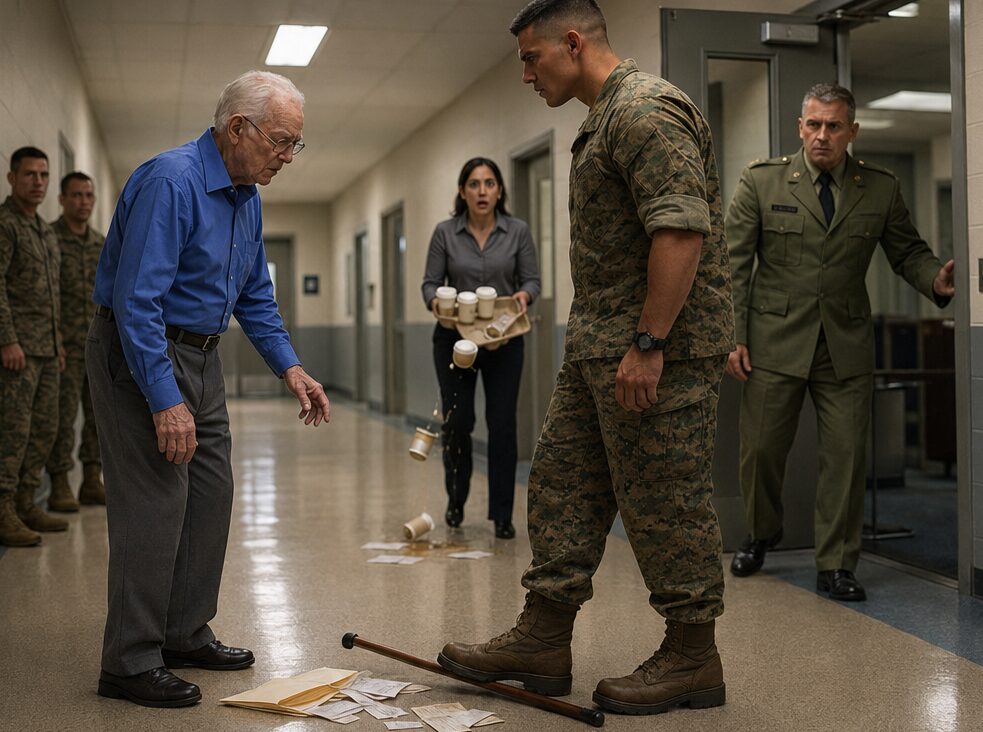
The old man’s cane lay under Sergeant Jason Miller’s boot, and every person in the hallway pretended not to see it.
It was a polished wooden cane, dark from age and oil, with one worn place near the handle where a hand had gripped it for years. Beside it, a manila folder had split open across the glossy floor. Yellowed pages slid under chairs. Small tags with faded strings scattered like leaves. A hand-drawn map curled at the corner near Jason’s heel.
The old man stood very still.
He wore a blue button-up shirt, gray slacks, and glasses that had slipped low on his nose. He was thin in the way some old men became thin without becoming weak. His right hand hung slightly open, as if it still remembered the cane.
Jason stood over him in clean camouflage and polished boots.
“You can’t just wander into a restricted hall,” Jason said. “This isn’t a public lobby.”
The old man looked at the papers, not at Jason.
“That folder is mine.”
“It was in my way.”
“It has names in it.”
Jason glanced down. “It has junk in it.”
Two younger soldiers stood near the wall, suddenly interested in nothing. One studied the floor. The other stared straight ahead with the fixed expression of a man hoping silence would make him innocent.
At the far end of the hallway, Carolyn Brooks came around the corner carrying a cardboard tray of coffee cups for the briefing room. She saw the old man, the cane, Jason’s boot, and the folder emptied across the floor.
Her hands loosened.
The tray dropped.
Coffee burst across the tile and rolled in thin brown streams toward the scattered pages.
Jason turned at the sound, annoyed. “Watch it.”
Carolyn did not answer. She was looking at the old man’s face.
There was no panic in it. No trembling outrage. No theatrical hurt.
Just an old, controlled stillness.
The kind that made the hallway feel colder.
The door to the command briefing room opened.
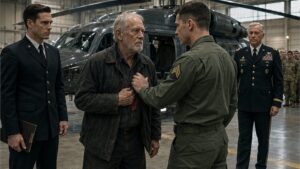
Major Patrick Carter stepped out in a green dress uniform, one hand still holding a folder from the meeting inside. He took in the scene quickly: Jason too close, the old man without his cane, the papers on the floor, Carolyn frozen near the spilled coffee.
“Sergeant,” Patrick said.
Jason straightened. “Sir. This civilian entered the restricted corridor without authorization. I was removing him.”
Patrick’s eyes moved to the cane.
“By stepping on his cane?”
Jason’s jaw tightened. “It fell, sir.”
The old man bent slowly, knees stiff, reaching for a small faded tag before the coffee reached it.
Patrick moved first.
He crouched and picked up the tag.
For one second, his expression did not change. Then something behind his eyes shifted.
The tag was old, stiffened at the edges. A name had been written across it in dark pencil, almost rubbed away by time. Beneath the name were three words Patrick recognized from a sealed training annex he had reviewed that morning.
North Lantern Evacuation.
Patrick looked at the old man again.
“What’s your name?”
The old man took the tag from his hand with care.
“William Hayes.”
Jason made a small sound, half impatience, half disbelief.
Patrick ignored him. “Mr. Hayes, why are you here?”
William lowered himself enough to pick up another tag. His hand shook, but he did not let the paper touch the coffee.
“Because you’re teaching it wrong.”
No one moved.
Inside the briefing room, voices continued behind the door. Officers waiting for slides. Cadets waiting for doctrine. A whole room waiting to be told what had happened long ago by men who had not been there.
Patrick looked down at the cane trapped near Jason’s boot.
“Sergeant,” he said quietly, “move your foot.”
Jason moved it.
William reached for the cane, but Patrick picked it up and offered it to him.
William did not take it immediately.
For a moment, the old man looked at the hand offering help the same way he had looked at the boot taking it away.
Then he took the cane.
Not gratefully.
Precisely.
As if both gestures had been recorded.
Part II — Five Minutes
Patrick did not take William into the briefing room.
He took him into a small waiting office with no windows, two chairs, a water cooler, and a framed poster about integrity on the wall. Jason was ordered to stand just outside the door. Carolyn knelt in the hallway, gathering wet papers with paper towels and more care than anyone had shown the old man so far.
William sat only after Patrick asked him twice.
Even then, he kept the folder on his lap and one hand on the cane.
“Mr. Hayes,” Patrick said, “Operation North Lantern is part of a training presentation scheduled in less than an hour.”
“I know.”
“How?”
William opened the folder. “You sent an invitation to observers from the veterans’ archive. No one expected any of us to read the attached syllabus.”
Patrick’s mouth tightened. “You were in North Lantern?”
“I was attached as a medic to the third evacuation convoy.”
Patrick sat back slightly.
Jason, visible through the glass strip in the door, looked away as if the words were an inconvenience.
William removed a hand-drawn map from the folder. It had been folded and unfolded so many times that white lines split the paper into squares. There were pencil marks along a road, an X near a bridge, and names written beside small circles.
“The lesson you teach says the convoy collapsed because medics broke route discipline,” William said. “Because men on the ground panicked.”
Patrick did not confirm it.
He did not have to.
William tapped the map once with two fingers.
“That is not why it collapsed.”
Carolyn stepped into the doorway with the rescued papers. “Major?”
Patrick turned.
She held out a damp photocopy, careful not to smear the writing. “This was under the coffee.”
Jason muttered from behind her, “It’s probably not relevant.”
Carolyn looked at him.
For the first time, Jason looked embarrassed.
Patrick took the paper. It was an old correction request. Thirty-two years old. Signed, returned, stamped, and marked with the kind of language institutions used when they did not want to say no directly.
Insufficient corroboration.
Personal recollection.
Supporting documents unavailable.
Patrick looked at William. “You filed this?”
“I filed it three times.”
“And no one responded?”
“They responded.” William pointed at the stamp. “They just didn’t listen.”
The line landed harder than anger would have.
Jason shifted in the hall.
Patrick had spent his career believing in process. Not blindly. He knew process could fail. But he also believed failure could be repaired by better process, better review, better command attention.
William’s folder looked like thirty-two years of command attention turned away.
“What exactly are you saying we’re teaching wrong?” Patrick asked.
William looked toward the briefing room door.
“I’m saying you are about to tell young officers that the people closest to the wounded caused the failure.”
“That is the official conclusion.”
“No,” William said. “That is the comfortable conclusion.”
Patrick glanced at the clock.
The presentation was scheduled in forty-eight minutes.
Senior officers were already arriving. The simulation had been approved through command channels. A revised scenario had been built around old terrain, old decisions, and modern assumptions. Patrick had rehearsed it. His name was on it.
He looked back at William.
“How much time do you need?”
“Ten minutes in front of your map.”
Jason stepped into the doorway. “Sir, with respect, we cannot let every walk-in with a folder interrupt a command event.”
William did not look at him.
Carolyn did.
Patrick said, “You don’t have the floor, Sergeant.”
Jason stiffened. “Yes, sir.”
William closed the folder halfway, then stopped.
“I don’t need you to believe me because I’m old,” he said. “I need you to check the road.”
Patrick held his gaze.
“Five minutes.”
William nodded once.
“Then don’t waste them.”
Part III — The Wrong Road
The map room smelled like dry markers, coffee, and laminated paper.
A large training board filled one wall. Red and blue route lines crossed a fictionalized terrain model built from old records. The North Lantern scenario had been cleaned for instruction: simplified roads, casualty points, convoy movements, communications breakdowns, decision points.
It looked clear.
That was what bothered William.
He stood before the board with his cane in his left hand and the old map in his right. Jason stood near the door, arms at his sides, trying to look like security instead of a man who had been told to be quiet. Carolyn held the damp papers. Patrick watched the old man study the board.
William did not start with a story.
He started with one line.
“This bridge was not passable.”
Patrick followed his cane tip.
“In the archive, it was.”
“In the archive, it was assumed.”
Jason could not stop himself. “Based on field reports.”
William looked at him then.
“Whose?”
Jason opened his mouth.
Nothing came out.
William turned back to the board. “The warning came from a local driver before dusk. He told command the bridge was cracked and the road beyond it was watched. He was dismissed because he was not part of the chain.”
Patrick’s face tightened.
William moved the cane tip along the printed route.
“The convoy was ordered through here after the extraction point changed. We were carrying men who could not walk. We lost communications after the second turn. When we reached the bridge, it held one vehicle and failed under the next. After that, there was no clean road and no clean order.”
The room was quiet.
Jason said, softer now, “The lesson says casualty collection failed because the medics scattered.”
William nodded.
“The lesson says that.”
He pointed to a space on the current training board.
“If the bridge is lost here, where do you place the casualty collection point?”
Jason looked at Patrick, then at the map. His answer came automatically. “High ground east of the road. Cover, visibility, access to extraction.”
William’s eyes did not leave the board.
“That is where Daniel Price died.”
Jason blinked.
William tapped another point.
“That is where Mark Ellis died. That ditch is where Paul Reeves begged me to move him because he could hear the engine fire spreading. That orchard line is where Thomas Gray stopped answering questions.”
No one spoke.
William lowered the cane.
“You gave the doctrinal answer. So did they.”
Jason’s face changed.
Not completely. Not enough.
But the certainty in it cracked.
Patrick stepped closer to the board. “You remember all those names?”
William’s eyes remained on the route.
“I came here because you don’t.”
Carolyn looked down at the tags in her hand. Each one had a name. Some had pencil marks beside them, tiny and repeated, as if someone had touched the paper every year and counted again.
Patrick turned to the current simulation packet on the table. The route matched the line William had marked. A safe-looking road. A bridge assumed passable. A fallback point chosen because the map made it look logical.
The room had lost its clean edges.
Patrick said, “Why wasn’t this in the final report?”
William folded the old map along its worn lines.
“Because the men who write reports prefer causes that don’t look back at them.”
Jason looked at him. “You’re saying command blamed the medics.”
“I’m saying command survived long enough to explain itself.”
The sentence sat between them.
Patrick checked the clock again.
Thirty-nine minutes.
He could delay the presentation. Maybe. He could call the colonel. He could ask for review. He could also be told to proceed, because old claims without official support could not derail a scheduled event.
William seemed to read the calculation on his face.
“I’ve watched men choose the room over the truth before, Major.”
Patrick looked up sharply.
William’s expression did not accuse him.
That made it worse.
Part IV — What the Cane Remembered
Patrick asked for a private word with William, but privacy was impossible in a building built on glass panels and rank.
Jason stood outside the map room, hearing just enough.
Carolyn stood at the table, pretending to reorganize documents she had already organized twice.
Patrick kept his voice low. “If I alter the briefing now, it becomes a command issue.”
“It already is one.”
“I believe there may be enough here to justify review.”
William’s grip tightened on the cane. “Review is where truth goes when men are not ready to obey it.”
Patrick swallowed that.
He did not deserve it entirely.
He did not escape it either.
“This training package has been approved,” Patrick said. “Senior command is attending. If I walk in and say the foundation is flawed because of unofficial documents—”
“Then you will be doing your job.”
“My job also includes maintaining order.”
William looked toward the hallway, where Jason stood stiff beside the door.
“So did his.”
Jason’s face warmed.
Patrick said, “Mr. Hayes, I’m trying to help.”
“Then don’t make me a guest.”
Patrick paused.
William’s voice stayed even. “Don’t put me in a chair, call me brave, and continue teaching the lie after I leave.”
Carolyn stopped moving papers.
William looked at the cane in his hand.
For the first time, his face changed.
Not much. Just enough for the room to feel it.
“This isn’t from a store,” he said.
Patrick waited.
William ran his thumb over the worn handle.
“It was part of a stretcher pole.”
Jason looked through the glass.
William did not look at him.
“There was a man on that stretcher when the order came to move. He was too heavy for one medic and too hurt to drag. I said the road was wrong. My lieutenant told me the road was open. I told him it wasn’t.”
His hand stopped on the cane.
“He ordered me to leave the stretcher.”
Carolyn’s eyes lowered.
Patrick said nothing.
“I kept the pole after they recovered what they could,” William said. “I had it cut and shaped because I needed something in my hand that would not let me forget.”
Jason stared at the cane.
In the hallway, his own polished boot seemed suddenly too loud against the floor.
He remembered the cane under it.
The casual pressure of his heel.
The impatience in his voice.
It has junk in it.
William looked at Patrick again.
“I did not come here to be forgiven. I came here because you put that road in front of young men and called it a lesson.”
The door at the far end opened before Patrick could answer.
A colonel stepped in, followed by two staff officers. His eyes moved from Patrick to William to the map board.
“What is this?”
Patrick came to attention. “Sir, we have a concern regarding the North Lantern scenario.”
The colonel glanced at William’s folder. “From?”
Patrick hesitated.
The colonel’s expression cooled. “Major, the briefing starts in thirty minutes.”
“Yes, sir.”
“Proceed with the approved presentation.”
William’s face did not move.
Patrick said, carefully, “Sir, the material may contain a significant error.”
“Then submit a review memo after the event.”
William gave a small laugh.
It had no humor in it.
The colonel looked at him. “Mr.—?”
“Hayes,” William said.
The name struck the room differently than before, but not hard enough.
The colonel turned back to Patrick. “Remove him from the controlled area. We are not improvising doctrine in front of visiting officers.”
Patrick’s jaw worked once.
Then he looked at Jason.
“Sergeant Miller. Escort Mr. Hayes to the lobby.”
Jason’s eyes flicked to William’s cane.
“Yes, sir.”
William closed his folder.
Not in defeat.
In recognition.
As if the room had finally become exactly what he had expected it to be.
Part V — The Name on the Tag
The hallway had been cleaned badly.
The coffee was gone, but a pale brown shadow remained in the seam between tiles. Someone had gathered the cups. Someone had missed a paper towel near the wall. The place looked orderly from a distance and stained up close.
Jason walked beside William, not behind him.
He did not know if that made it better or worse.
William moved slowly, but not aimlessly. His cane touched the floor with a steady, soft sound. The folder was held tight against his ribs.
At the stain, William stopped.
Jason stopped too.
A small triage tag lay half under the edge of a bench, missed by everyone. William bent toward it.
His hand trembled.
For one tense second, Jason thought the old man would fall.
He reached out, then stopped himself.
William got the tag between two fingers.
He straightened with effort and held it to the light.
Jason saw the name.
Patrick Donnelly.
Not the major. Not anyone in the hallway.
A name from the old operation.
But Jason had seen it that morning on the simulation roster. The training scenario used historical casualty names as placeholders, stripped of biography, assigned to decision points.
Patrick Donnelly had been a teaching marker.
A number.
A role.
William rubbed his thumb lightly across the faded letters.
“They made him a prompt,” William said.
Jason’s throat tightened.
William looked at him for the first time since the hallway confrontation.
“He had two sisters. He played harmonica badly. He kept asking if anyone had fed his dog.”
Jason had no answer.
“He was not a prompt.”
The briefing room door opened down the hall. Laughter came out, controlled and professional. Men preparing to teach clean lessons.
Jason looked at the folder under William’s arm.
Then at the cane.
Then at the tag.
His father’s voice came back suddenly, from a kitchen table years ago: Don’t ask questions they don’t want asked, Jason. They don’t punish the wrong order. They punish the man who points at it.
Jason had built his life against that sentence.
He had turned obedience into proof he was better. Cleaner. Safer.
Now an old man was holding a dead man’s name in a hallway stain.
Jason put out his hand.
William looked at it.
“No,” William said.
Jason flinched.
William’s voice was quiet. “You don’t get to carry it because you feel bad.”
Jason let his hand fall.
The shame that hit him then was not hot. It was cold and useful.
He looked down the hallway toward the briefing room.
“What if I open the door?”
William studied him.
“You already did once,” he said.
Jason absorbed it.
Then he reached for the folder again, slower this time. Not taking. Asking.
William did not give it to him immediately.
The hallway seemed to hold its breath.
Finally, William placed the folder in Jason’s hands.
It was heavier than Jason expected.
He walked toward the briefing room before he could become the kind of man who changed his mind.
When he opened the door, the room quieted at once.
The colonel turned.
Patrick stood near the front, caught between the approved slides and the map that now looked like evidence.
Jason crossed the room and placed William’s folder on the table.
“Sir,” he said, voice tight, “before you proceed, you need to read this.”
The colonel’s face hardened. “Sergeant.”
Jason stood at attention.
“I removed Mr. Hayes without reading a page,” he said. “I also knocked his cane aside in the hallway. I treated him like a disruption because he looked like one to me.”
No one moved.
Jason looked at the folder.
“I think that is the same mistake this briefing is about to teach.”
The silence changed shape.
Patrick looked past Jason.
William stood in the doorway, one hand on his cane, the other holding the recovered tag.
He had not been invited in.
But he was no longer outside.
Part VI — The Room That Finally Listened
No one offered William a place at the head of the table.
That would have been too easy.
Patrick brought him a chair near the map board. William looked at it, then at the officers, then sat because his legs needed the truth more than his pride needed the performance.
He laid the cane across his knees.
Everyone saw it.
No one mentioned it.
The colonel stood with both hands on the back of a chair. “Mr. Hayes, you have five minutes.”
William opened the folder.
“No,” Patrick said.
The colonel turned.
Patrick’s voice was steady now. “Sir, if we hear him, we hear him properly.”
A dangerous sentence.
A necessary one.
The colonel’s eyes narrowed. “Major.”
Patrick did not look away. “Teaching a known false lesson would be a greater breach than delaying a presentation.”
The room went still.
William took out the old map and placed it beside the clean training board. He did not speak for several seconds. He let the two routes accuse each other.
Then he pointed.
“The official route says we moved east by choice. We did not. The extraction point was changed after an intelligence update that was incomplete. The bridge was assumed clear. It was not. A civilian driver warned command. He was dismissed. I repeated the warning. I was overruled.”
One of the staff officers shifted. “The final report states medics dispersed casualties outside the designated zone.”
William nodded. “Because the designated zone was unreachable.”
The officer looked at the map.
William placed three tags beside three points.
“Price. Ellis. Reeves.”
He placed another.
“Gray.”
His hand moved slower with each name.
“We put them where doctrine told us to put them after the road failed. Then the road failed again.”
No one interrupted now.
William removed the returned correction request. Carolyn had slipped it into a protective sleeve. He noticed that and looked toward the doorway, where she stood half-hidden against the wall.
She nodded once.
He continued.
“I filed this because the record blamed the men who carried the wounded. It taught that discipline failed at the bottom. That was not the lesson. The lesson was that command certainty became deaf.”
The colonel’s face had gone unreadable.
Patrick looked at the current training board. The safe-looking road. The fallback point. The same elegant mistake.
“Stop the presentation,” Patrick said.
The colonel turned slowly. “You are not authorized to—”
“I am responsible for the accuracy of the training delivered under my signature,” Patrick said. “And I will not deliver this as written.”
It was not loud.
It did not need to be.
The room understood what it cost.
William closed his eyes briefly, but when he opened them, he was not relieved.
Not yet.
“There’s one more,” he said.
From the back of the folder, he removed a sealed envelope. It was old enough that the adhesive had yellowed, but it had been protected from air and light. His name was written on the front in another man’s handwriting.
He held it for a long moment.
Patrick said quietly, “You don’t have to.”
William looked at him.
“That’s what they told me then.”
He opened it.
The sound of paper tearing seemed too sharp for the room.
Inside was a field note, half a page, folded once.
William did not hand it away.
He read it himself.
“We were told the road was open. Hayes said it wasn’t. I made him obey.”
His voice held until the final word.
Then it thinned.
Not enough to break. Enough for everyone to hear what not breaking had cost him.
He placed the note on the table.
“This clears the map,” he said. “It does not clear me.”
No one answered.
There are silences that protect people.
This one did not.
This one made them look.
Jason stared at the note and thought of his boot on the cane. He thought of how easy it had been to decide what an old man was worth before he knew what the old man had carried.
Patrick picked up the note with both hands.
Not ceremonially.
Carefully.
“Mr. Hayes,” he said, “your testimony will be entered into the revised record. The scenario will be rewritten around the corrected account.”
William’s eyes stayed on the map.
“And the names?”
Patrick looked at the tags.
“The names too.”
For the first time all morning, William’s hand left the cane.
It rested flat on the table, beside the old map.
Weathered. Unsteady.
Still there.
Part VII — What Remained in the Hallway
The hallway was quiet when they came out.
The briefing had been postponed. Not canceled. Not buried in soft language. Postponed pending correction. Patrick had made sure the word was correction.
Carolyn stood near the wall with the recovered papers stacked in a new folder, dry sleeves between the fragile pages. She handed it to William.
“I’m sorry about the coffee,” she said.
William took the folder. “You picked up the names.”
It was not forgiveness.
It was more exact than that.
Carolyn’s eyes shone, but she did not make the moment about tears. “Yes, sir.”
William turned toward the memorial wall at the end of the corridor.
The wall held plaques from old operations, training casualties, humanitarian missions, and exercises whose names had outlived the men beneath them. North Lantern had a small section near the bottom. The inscription was polished, brief, and incomplete.
Jason followed two steps behind.
Patrick walked beside William, close enough to help if he stumbled, far enough not to make help the story.
At the wall, William stopped.
His hand rose, then hovered near the names without touching them.
Jason held the cane.
He had picked it up from beside the chair in the briefing room without thinking, then realized he was holding the thing he had stepped over that morning. He turned it in both hands.
Not by the handle.
Across his palms.
“Mr. Hayes.”
William turned.
Jason offered the cane.
No speech came with it. No excuse. No request to be released from shame.
William looked at the cane, then at Jason’s hands.
He accepted it.
Jason swallowed. “I’m sorry.”
William adjusted his grip.
“Don’t apologize to me because I’m old.”
Jason looked down.
William’s voice was tired, but clear.
“Apologize because you didn’t look.”
Jason nodded.
“I’m sorry because I didn’t look.”
William held his gaze for a moment.
Then he nodded once.
Not warmly.
Enough.
Patrick stood by the memorial wall, the field note secured in the folder under his arm. His career might become harder after today. He knew that. He also knew that some rooms became smaller forever if a man chose comfort inside them.
“We’ll correct the inscription,” Patrick said.
William looked at the names.
“Don’t polish it too much.”
Patrick understood.
Truth did not need shine. It needed room.
William touched the wall then, one finger beneath the incomplete line, and for a moment no one spoke. The hallway no longer looked like the place where an old man had been diminished.
It looked like the place where the room had finally run out of excuses.
When William turned to leave, the folder was lighter under his arm.
Not empty.
Never empty.
But lighter.
Jason stepped aside before William reached him.
This time, he did not move because rank required it.
He moved because he saw him.