The Morning Her Mother Learned to Wait at the Kitchen Island
Part I — The Picture on the Phone
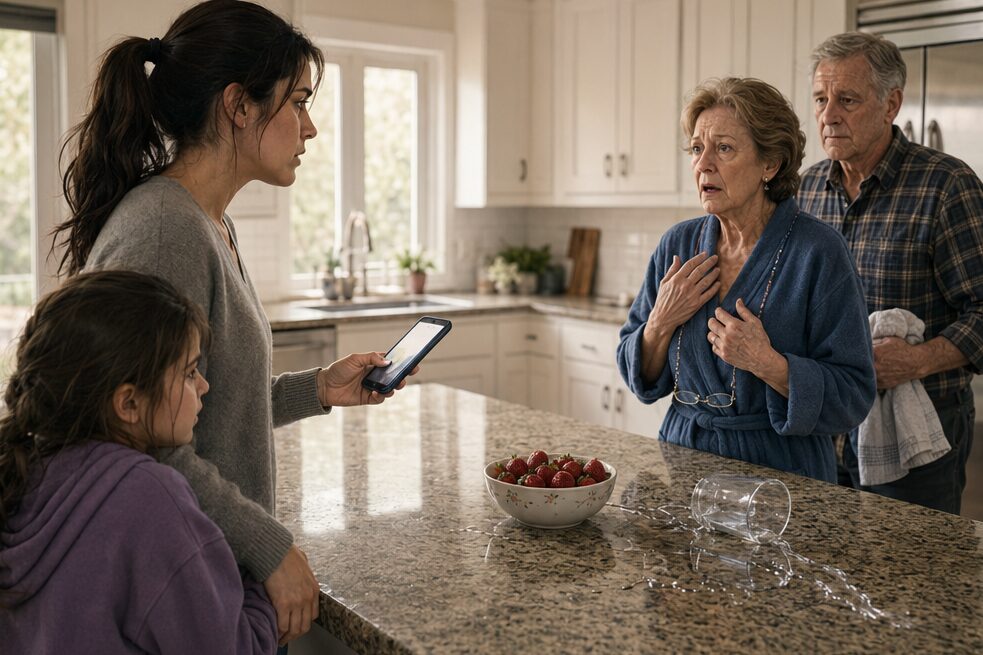
Mary’s glass tipped before anyone touched her.
One second it stood beside the bowl of strawberries, clear and sweating in the morning light. The next, it rolled against the granite island and spilled water toward Angela’s sleeve while Mary stared at the phone in Angela’s hand like it had opened a door in the middle of the kitchen.
Elizabeth wrapped both arms around Angela’s waist.
James stopped with his coffee halfway to his mouth.
And Angela, who had promised herself she would say it calmly, held the screen out farther and heard her own voice come out thin.
“Mom. Look.”
Mary lifted both hands to her mouth. Her blue robe slipped open at the throat. Her reading glasses swung against her chest on their little gold chain.
On the phone screen was a gray blur. A date. A name. A shape that did not look like much to anyone except the person whose whole future had been rearranged by it.
Mary made a sound Angela had not heard since childhood.
Not quite joy.
Not quite pain.
Something older than both.
“Oh,” Mary said, and then again, louder, “Oh my God.”
She reached toward Angela.
Elizabeth flinched.
That was the moment the kitchen changed.
Mary saw the flinch. Her hands froze in the air, still open, still wanting. Water kept spreading across the island, inching toward the strawberries, toward the phone, toward everything nobody had been able to say.
Angela’s smile stayed on her face because she did not know what else to do with it.
James set his mug down carefully, as if one more loud sound might break the room.
Nobody moved.
Only the water did.
Part II — Before the Glass Fell
Three hours earlier, Angela sat in her car outside her parents’ house and looked at the same phone screen until it dimmed.
The house looked unchanged. White siding. Black shutters. A wreath Mary changed with the seasons. Two ceramic rabbits near the porch steps even though Easter had passed six weeks ago, because Mary believed decorations should ease people from one feeling to the next.
Angela had not been inside since February.
She had told herself it was because of work. Because of Elizabeth’s school schedule. Because Sunday mornings were hard after the divorce. Because the drive across town felt longer than it was.
The truth was simpler.
At her parents’ house, help always came with a room key.
“Are we going in?” Elizabeth asked from the back seat.
She wore an oversized purple hoodie and bright orange sneakers Mary hated. Her braid had already loosened, little brown wisps escaping around her face. She held a library book in one hand and the strap of her backpack in the other, as if breakfast required supplies.
“In a minute,” Angela said.
“You said that three minutes ago.”
Angela looked at her in the rearview mirror. “You timing me now?”
Elizabeth shrugged. “Grandma times everything.”
That landed too close.
Angela locked the phone and placed it face-down in the cup holder. The message from Mark still glowed in her mind even after the screen went black.
I’m not getting pulled into another complicated situation.
He had not asked if she was okay. He had not asked what she needed. He had written situation, as if the life inside her were a scheduling error.
Angela pressed both hands against the steering wheel.
She had come to tell her parents before anyone else did. That was the plan. Tell them in private. Ask for nothing. Accept congratulations if they came. Leave before Mary started turning joy into logistics.
But when the front door opened, Mary was already waving.
Not just waving.
Performing cheerfulness for the windows.
“There they are!” Mary called, stepping onto the porch in her blue robe. “James, they’re here!”
Angela felt Elizabeth’s hand slip into hers before they reached the walkway.
Mary came down the steps and bent toward Elizabeth first.
“Oh, sweetheart, your braid is falling out.” She kissed the top of Elizabeth’s head and immediately began tucking hair behind her ears. “Did Mommy let you sleep with it wet again?”
Elizabeth looked at Angela.
Angela smiled without showing teeth. “Good morning, Mom.”
Mary blinked, as if remembering there was another person standing there. “Good morning, honey. You look tired.”
There were a hundred things Angela could have said to that. She chose none.
James appeared behind Mary in a plaid shirt and slippers, coffee mug in hand, gray hair flattened on one side. His smile was soft and cautious.
“Hey, Angie,” he said.
Nobody else called her that anymore.
She let him hug her because he did not use hugs to inspect her.
Inside, the house smelled like bacon, coffee, and lemon cleaner. The kitchen was bright, white cabinets shining, the island set with plates and a bowl of strawberries cut exactly in half. Mary had put out cloth napkins.
Sunday breakfast, but staged.
Angela saw it immediately.
The extra casserole dishes near the sink. The guest towels folded on the back counter. A stack of school worksheets Elizabeth had left here months ago, now neatly clipped together.
And, through the open hallway, the downstairs guest room door stood open.
The bed was made.
Fresh sheets. A stuffed bear placed on the pillow. A plastic bin of Elizabeth’s old toys beside the dresser.
Angela stopped walking.
Mary noticed. Of course she did.
“I just freshened it up,” she said lightly. “No reason. It was dusty.”
“Dusty,” Angela repeated.
“You never know when someone might need a soft place to land.”
There it was. The sentence Mary had polished until it sounded kind.
Angela turned her phone over in her palm and then turned it face-down again.
She had not even taken off her coat, and already the house had started making room for her in ways she had not asked for.
Part III — Help With Edges
Virginia arrived at nine fifteen carrying two casserole dishes and pretending it was a coincidence.
She was Mary’s neighbor from three houses down, a woman with silver-blond hair, careful lipstick, and the gentle voice people used when they wanted information without appearing hungry for it.
“I won’t stay,” Virginia said, stepping into the kitchen. “I’m just returning these.”
Mary took the dishes with both hands. “You should have called. Angela and Elizabeth are here.”
“I can see that.” Virginia turned with a smile that landed on Angela’s face and stayed there too long. “How are you, honey?”
Honey.
Angela had been divorced for eight months, and every woman over fifty in Mary’s circle had started calling her honey like she had dropped something fragile in public.
“Good,” Angela said.
Virginia’s eyes flicked to Elizabeth, then to Angela’s left hand, then to the phone on the island. “Settling in okay?”
Angela did not answer quickly enough.
Mary did it for her.
“She’s doing her best. Aren’t you, honey? Sit, Elizabeth. Let Grandma fix that braid before syrup gets in it.”
Elizabeth slid into a stool and gave Angela a look.
A tiny one.
Not angry. Not even embarrassed.
Just tired.
Mary came behind her with a comb from the kitchen junk drawer. Of course there was a comb. There was always a tool for whatever Mary thought needed fixing.
“Mom,” Angela said, “her hair is fine.”
“It’ll take two seconds.”
“It’s fine.”
Mary’s hands paused for half a beat, then continued. “I’m not hurting anyone.”
That was the problem. Mary never thought she was hurting anyone.
James cleared his throat. “Virginia, you want coffee?”
“No, no, I’m really just dropping these off.” Virginia placed a hand over her chest. “But Mary, don’t forget to text me about Wednesday. The ladies were asking.”
Angela looked up.
Mary’s smile tightened. “Of course.”
“What ladies?” Angela asked.
“Oh, nobody,” Mary said. “Just church.”
Virginia made a soft little sound. “Everyone worries. That’s all. After everything, people like to know you’re supported.”
Supported.
Angela put her palm over her phone.
Elizabeth’s braid was now tight and perfect. She reached back and tugged it loose the moment Mary turned away.
Angela almost laughed.
Then her phone buzzed.
Mark.
She did not open it at first. She watched the screen light against her hand, a private world glowing under her palm while Mary poured coffee, Virginia lingered, and James pretended not to see anything.
Finally, Angela tilted the phone enough to read.
Have you told them yet? Because I don’t want your mom calling me.
Angela locked it again.
Too late. Mary had seen her face.
“Everything okay?” Mary asked.
“Yes.”
“You sure?”
“Yes.”
Mary lowered the coffee pot. “Angela, if there’s something we should know—”
“There is,” Angela said.
The kitchen went still.
Virginia’s expression sharpened before she smoothed it away.
Angela looked at her mother, then at Virginia, then at the casserole dishes.
“Not with an audience.”
Virginia’s face colored.
Mary’s did too.
James finally stepped in. “Virginia, I’ll walk you out.”
“Oh, I didn’t mean—”
“I know,” James said, already moving. “Still.”
It was the first time that morning Angela felt air enter the room.
Virginia left with apologies folded into smiles. The front door closed.
Mary turned back to Angela, hurt now. Not angry. Hurt was worse because Mary wore it like evidence.
“You embarrassed her.”
Angela stared. “I embarrassed her?”
“She came to return dishes.”
“She came because you told her we’d be here.”
Mary picked up a napkin and smoothed it beside a plate. “I said you might stop by. People care about you.”
“People don’t need a viewing window.”
James returned slowly. “Let’s eat before everything gets cold.”
That was his gift and his failure. He could turn down the heat in any room without ever asking who had lit the match.
Angela sat at the island. Elizabeth climbed onto the stool beside her and leaned into her arm.
Mary served pancakes with the concentration of a surgeon.
For ten minutes, nobody mentioned Virginia.
Then Mary said, “Have you found a stable apartment yet?”
The knife in Angela’s hand stopped.
James looked down at his plate.
Elizabeth pushed a strawberry through syrup.
“It’s stable,” Angela said.
“It’s month-to-month.”
“It has a roof.”
“Angela.”
There it was again. Her full name, polished into disappointment.
Mary lowered her voice. “I’m not criticizing. I’m asking because I can help.”
“I didn’t ask.”
“You never ask. That’s why everything becomes an emergency.”
Angela felt the phone against her thigh. The picture inside it. The date. The tiny proof.
“I have news,” she said.
At that exact moment, Elizabeth’s elbow knocked her orange juice sideways.
It spread in a bright stream across the island.
“Oh, honey!” Mary jumped up. “See? This is why we don’t put cups near the edge.”
“It was an accident,” Angela said.
“I know it was an accident.”
But Mary was already blotting, already lifting Elizabeth’s plate, already moving the child’s arm, already rearranging the world before anyone else could decide what needed saving.
Elizabeth sat frozen.
Angela reached for a towel.
Mary reached faster.
“I’ve got it,” Mary said.
Angela let go.
That was how it always happened.
Part IV — The Room That Was Ready
After breakfast, Mary asked Elizabeth if she wanted to see the guest room.
She made it sound casual. It was not casual.
Elizabeth looked at Angela first.
Angela hated that she had to.
“You can,” Angela said. “If you want.”
“I’ll go with Grandpa,” Elizabeth said.
James glanced at Angela, something apologetic in his eyes, and held out his hand. “Come on, kiddo. Let’s inspect the bear.”
When they left, Mary began stacking plates.
Angela stood beside the island, phone still in her pocket, and watched her mother rinse syrup from a fork that was already clean.
“You don’t have to do all this,” Angela said.
Mary did not look up. “Wash dishes?”
“The room.”
“It’s a room.”
“It’s a message.”
Mary turned off the faucet. “Fine. It’s a message. The message is that you and Elizabeth have a place here.”
“And if I don’t want to move back?”
“Then don’t.”
“You say that like you mean it.”
Mary’s face tightened. “What do you want me to say?”
“I want you to stop planning around me like I’m not in the room.”
Mary gripped the counter. Her hands were small and strong, the hands that had packed lunches, signed permission slips, folded laundry, arranged doctors’ appointments, mailed thank-you cards, and somehow made every act of care feel like a form that had to be filled out correctly.
“I am trying,” Mary said, “to keep you from falling apart.”
Angela laughed once. It came out uglier than she meant. “Maybe I would fall apart less if you stopped announcing it.”
Mary flinched.
The hurt on her face almost undid Angela. Almost.
Then Mary said, quietly, “You have no idea what it feels like to watch your child make her life harder and not be allowed to speak.”
Angela went still.
From upstairs came Elizabeth’s laugh, followed by James’s lower one. The sound cut through the room like a reminder of what was still possible.
Angela softened her voice. “I’m not a child.”
“No,” Mary said. “You’re my child.”
“That’s not the same thing.”
Mary looked away first.
Angela’s phone buzzed again. She checked it before she could stop herself.
Mark.
Please don’t make this about me. I’ll do what I’m legally required to do.
The words blurred for a second.
Not because she was surprised. Because she wasn’t.
Mary’s eyes dropped to the phone. “Is that him?”
Angela locked the screen. “It’s nothing.”
“Angela.”
“Mom.”
“You don’t have to protect him.”
“I’m not protecting him. I’m protecting myself from everyone else’s opinion about him.”
Mary opened her mouth, then closed it. For once, she seemed to have no ready system for that sentence.
James came back downstairs alone.
He saw their faces and stopped near the fridge. “Elizabeth is reading to the bear.”
Mary picked up the plates. “I’ll go check on her.”
“No,” Angela said too sharply.
Mary froze.
James set his mug down. “Mary.”
“What?” Mary snapped. “I can’t check on my granddaughter now?”
Angela pressed her fingers to her eyes.
Her mother was not cruel. That was the terrible part. Mary loved with full force. She loved like a person bracing for weather nobody else could see. She loved so hard that people started ducking.
James waited until Mary left the room anyway, not upstairs but into the laundry room, where she could fold something into obedience.
Then he moved closer to Angela.
“She wasn’t always like this,” he said.
Angela gave him a tired look. “Dad.”
“I know. I know that sounds like an excuse.”
“It does.”
“It isn’t.” He rubbed the back of his neck. “After your brother, she started thinking every ordinary delay was danger. A late call. A cough. A bad mood. A bill. She’d hear about something after the fact and say, ‘If I’d known sooner.’ That sentence got into her bones.”
Angela looked toward the hallway.
Her older brother’s photograph still sat on the bookshelf in the living room, half-hidden by a plant. He had been eleven when he died, and the house had never fully stopped listening for him.
“I know why she does it,” Angela said.
James nodded. “I know you do.”
“That doesn’t make it easier to live inside.”
“No,” he said. “It doesn’t.”
For a moment they stood in the kitchen like two people who had found the same crack in the wall years apart.
Then Elizabeth appeared at the bottom of the stairs, the stuffed bear tucked under one arm.
“Grandpa,” she said, not looking at Angela. “Can I ask you something?”
James smiled. “Always.”
Elizabeth glanced toward the laundry room. Then she whispered, loudly enough for Angela to hear every word, “When the new one comes, is Grandma going to take that one too?”
Angela’s heart stopped.
James’s face changed.
Elizabeth looked at Angela then, guilty and scared. “I didn’t mean to look. Your phone was open in the car.”
Angela could not move.
The house seemed to shrink around them.
Mary’s folding stopped in the laundry room.
No one spoke.
Elizabeth hugged the bear tighter. “I just saw the picture.”
Angela crouched slowly until she was eye-level with her daughter.
“How long have you known?”
Elizabeth’s mouth twisted. “Since Tuesday.”
Four days.
Four days Angela had been carrying fear alone, and Elizabeth had been carrying it beside her in silence.
“Oh, sweetheart,” Angela said.
“I didn’t tell,” Elizabeth whispered.
“I know.”
“Are you mad?”
Angela pulled her close. “No.”
Elizabeth’s voice was muffled against Angela’s shoulder. “Grandma always says she’s helping. But sometimes helping feels like being moved.”
Angela closed her eyes.
That was the sentence that made the morning irreversible.
Part V — The Story Already Written
Mary came out of the laundry room holding a stack of folded dish towels that did not need folding.
Her face had gone careful.
Angela knew then that she had heard enough.
Not all of it. Enough.
“Elizabeth,” Mary said gently, “Grandma would never take anything from you.”
Elizabeth did not answer.
Mary stepped forward.
Elizabeth stepped back into Angela.
The movement was small. It still landed.
Mary looked as if someone had pressed a thumb into a bruise.
James said, “Maybe we all sit down.”
“No,” Angela said.
The word surprised everyone, including her.
She stood, keeping one hand on Elizabeth’s shoulder.
“I need a minute.”
She walked down the hall toward the bathroom, not because she needed it, but because every room in that house had ears and the bathroom was the only one with a lock.
She did not make it there.
Mary’s voice floated from the kitchen, low and strained.
Angela stopped near the dining room entrance.
“I can’t talk long,” Mary was saying. “No, don’t say anything yet. I think she may be moving back in. We may need to help her get her life straight.”
Silence.
Then Mary again.
“I know. I know. I’m trying not to push, but you should see Elizabeth. And Angela is so thin. Something is going on.”
Angela stood with one hand on the wall.
The wallpaper was the same pale yellow pattern Mary had chosen when Angela was in middle school. Tiny blue flowers. A cheerful cage.
Mary lowered her voice further, but not enough.
“I’ll tell you when I know more.”
Angela walked back into the kitchen before she could lose courage.
Mary was just setting the phone down.
Their eyes met.
For one wild second, Mary looked like a teenager caught doing something she knew was wrong.
Then she lifted her chin. “That was Virginia. She was worried.”
“Of course she was.”
“Angela—”
“No.”
Mary blinked.
Angela’s voice shook, but it held. “You don’t get to narrate my life to the neighborhood and call it love.”
James stood near the sink, motionless.
Mary’s cheeks flushed. “That is not fair.”
“It’s exact.”
“I have covered for you more times than you know.”
Angela stared at her.
Mary seemed to regret it as soon as it left her mouth, but the words were already standing between them.
“Covered for me,” Angela repeated.
“I didn’t mean—”
“Yes, you did.”
Mary gripped the island. The glass of water sat beside her hand, untouched, perfectly placed.
“I have listened to people talk,” Mary said. “About the divorce. About your apartment. About whether Elizabeth is adjusting. I have smiled and said you are strong. I have done everything I can to make sure people see you with dignity.”
Angela felt something cold pass through her.
“You think dignity is something you lend me?”
Mary went quiet.
That was the line. Even Mary knew it.
Elizabeth’s hand slipped into Angela’s again.
James looked at his wife. “Mary.”
But Mary had tears in her eyes now, and tears made her dangerous because she believed pain gave her permission.
“What do you want from me?” she asked. “Do you want me to not care?”
“I want you to care smaller,” Angela said.
Mary shook her head. “That makes no sense.”
“It does to people who have to live under it.”
The kitchen held its breath.
Then Mary did the thing that almost broke Angela. She softened.
Not performatively. Not to win.
She just looked suddenly old in her blue robe, hair brushed, glasses on a chain, surrounded by dishes and plans and all the tools she had collected to keep disaster away.
“I don’t know how,” she said.
Angela believed her.
That was worse than anger.
Because now the choice was not between a good mother and a bad one.
It was between staying silent to protect Mary from her own fear, or speaking and letting everyone feel the cost.
Mary took a breath and returned to what she knew.
“Okay,” she said, wiping under one eye. “Okay. We will be practical. If you need to move back, we’ll make the downstairs room work. I can do pickup on Mondays and Wednesdays. The church has a sitter list. We’ll set a budget. You can’t keep doing month-to-month leases. And we need to think about what people will—”
Angela laughed.
Not because anything was funny.
Because Mary had just walked straight back into the burning house carrying curtains.
“What?” Mary said.
Angela pulled her phone from her pocket.
Her hands were shaking so badly she mistyped the passcode.
Mary saw. “Honey, what is it?”
Angela tried again. The phone unlocked.
James went very still.
He knew before Mary did. Maybe because he had listened to Elizabeth. Maybe because fathers who avoided conflict became experts in weather.
“Angela,” he said softly.
She opened the image.
The gray shape. The date. The future, reduced to pixels.
Elizabeth pressed into her side.
Mary frowned at the screen from across the island. “What am I looking at?”
Angela walked closer.
Her mother’s glass sat between them.
Angela could have said, I’m pregnant.
She could have said, You’re going to be a grandmother again.
She could have said, I’m scared.
Instead, she held out the phone.
“Look.”
Mary took one step forward, confused.
Angela pushed the screen closer.
“Mom. Look.”
Mary looked.
The glass tipped.
Part VI — Waiting to Be Invited
Water ran across the island in a thin bright sheet.
Mary did not notice.
Her hands flew to her mouth. Her eyes filled so quickly Angela almost looked away.
“Oh,” Mary said.
The sound came from somewhere under the kitchen, under the years, under every ordinary morning that had failed to save anyone.
“Oh my God. Angela.”
Elizabeth tightened around Angela’s waist.
Mary reached for her daughter, arms opening before thought could catch them.
Elizabeth flinched.
Mary stopped.
For the first time all morning, maybe for the first time in years, Mary let the unfinished gesture stay unfinished.
Her hands hovered in the air.
Angela could see the effort it cost her.
Joy had hit Mary like a wave. Her whole body wanted to move with it—to touch, to claim, to plan, to call, to fold the news into a system where she could keep it safe.
But Elizabeth was watching.
Angela was watching.
James was watching too, one hand on the counter, as if he could steady the house without touching anyone in it.
Mary lowered her hands slowly.
Angela’s voice came out quiet.
“You can be her grandmother.”
Mary’s face crumpled.
Angela swallowed.
“You cannot be her mother.”
No one corrected the word her. No one asked whether Angela knew. No one reached for the phone. No one turned the moment into questions.
Mary covered her face with both hands.
For a terrible second, Angela thought she had been too hard.
Then Mary nodded behind her fingers.
Once.
Then again.
James moved to her side and touched her elbow. Not to guide her. Just to let her know he was there.
Mary breathed in shakily. “Can I—”
She stopped herself.
Angela waited.
Mary uncovered her face. Her cheeks were wet. She looked at Angela, then at Elizabeth, then at the phone.
“Can I see the picture again?” she asked.
Not take it.
Not send it.
Not show Virginia.
See.
Angela looked down at Elizabeth. “Do you want to hold it?”
Elizabeth’s eyes widened. “Me?”
“If you want.”
Elizabeth took the phone with both hands, serious as a person carrying a candle.
She turned it toward Mary.
Mary did not lean over her. She did not grab her shoulders. She did not fix her braid. She crouched slowly until her knees cracked and she was at Elizabeth’s height.
The blue robe pooled around her.
“Oh,” Mary whispered again, but softer this time. “Hello, sweetheart.”
Elizabeth watched her carefully. “You’re not going to tell Mrs. Virginia?”
Mary’s mouth trembled.
Angela felt James shift behind her.
“No,” Mary said. The word seemed to cost her pride, habit, and something like relief. “No. Not unless your mom says I can.”
Elizabeth considered this.
“And you’re not going to make us move into the downstairs room?”
Mary closed her eyes for a second.
When she opened them, she looked at Angela.
“I’ll wait to be invited,” Mary said.
It was not a magic sentence. It did not repair the months of silence. It did not erase the voicemail, or the guest room, or the way Angela had learned to turn her phone face-down in her own mother’s house.
But it was a new sentence.
Angela had not heard many new sentences in that kitchen.
James exhaled, almost a laugh, and reached for a towel.
“Well,” he said, looking at the water sliding toward the edge of the island, “before we all learn to swim.”
The laugh that came out of Angela surprised her.
It was small and cracked, but it was real.
Mary laughed too, one hand still over her mouth. Elizabeth giggled because James made a show of chasing the water with the towel like it had personally offended him.
For a moment, the room loosened.
Not healed.
Loosened.
Angela took the phone back when Elizabeth handed it to her. She wiped a drop of water from the corner of the screen with her sleeve. The image remained unchanged. Gray, blurry, impossible, real.
Mary rose carefully from her crouch.
Her first instinct showed itself—one small step toward Angela, one hand lifting.
Then she stopped.
“May I hug you?” she asked.
Angela looked at her mother’s open hand.
There were easier answers. Kinder ones. Crueler ones.
She chose the truest.
“Not yet,” she said.
Mary’s face tightened with pain, but she nodded.
James paused with the towel in his hand.
Elizabeth leaned into Angela’s side, not hiding this time. Just standing there.
Angela took a breath.
“But you can sit with us,” she said.
Mary pressed her lips together. Another nod. This one less broken.
They sat at the island because no one knew where else to go. James brought fresh napkins. Mary pushed the bowl of strawberries toward Elizabeth and then, visibly catching herself, stopped before putting one on her plate.
Elizabeth took two on her own.
Mary saw it.
Angela saw Mary seeing it.
That was how the new world began. Not with a speech. Not with forgiveness. With a grandmother not serving a strawberry until a child chose one.
After a while, Mary looked at Angela’s phone, face-down now beside her hand.
“When you’re ready,” she said carefully, “I would like to know how you’re feeling.”
Angela nodded. “I can tell you some of it.”
“Some is okay.”
It was not perfect. Perfect would have been suspicious.
James poured more coffee. His hand shook a little, but he did not hide it. “Do we still eat pancakes?”
Elizabeth made a face. “They’re cold.”
“I’ve eaten worse,” he said.
Mary looked at Angela again. “I can warm them.”
Angela almost said no out of reflex.
Then she stopped.
Help was not the enemy. Being swallowed was.
“Okay,” Angela said. “Thank you.”
Mary stood too quickly, then slowed herself down. “Just warming,” she said, almost to herself. “Not reorganizing breakfast.”
Angela smiled despite everything.
Mary smiled back through tears.
Outside, somewhere down the street, a car door closed. Maybe Virginia. Maybe someone else. The neighborhood would keep existing. People would ask questions. Mary would want to answer them. Angela would have to say no more than once.
Nothing about the future had become simple.
Mark’s message still waited unanswered. The apartment was still month-to-month. The downstairs room still stood ready with its fresh sheets and its soft little bear. Mary was still Mary. Angela was still afraid.
But the phone stayed face-down.
The news stayed in the kitchen.
For now, that was enough.
Mary returned with the warmed pancakes and set the plate in the center of the island instead of in front of anyone.
Elizabeth reached first.
James passed the syrup.
Angela watched her mother’s hands fold together, resisting the urge to arrange, assign, correct, protect.
Then Mary looked at the phone one more time and looked away.
She waited.
And because she waited, Angela stayed.