The Evening She Returned the Key and Kept the Napkin
Part I — The Bag on the Driveway
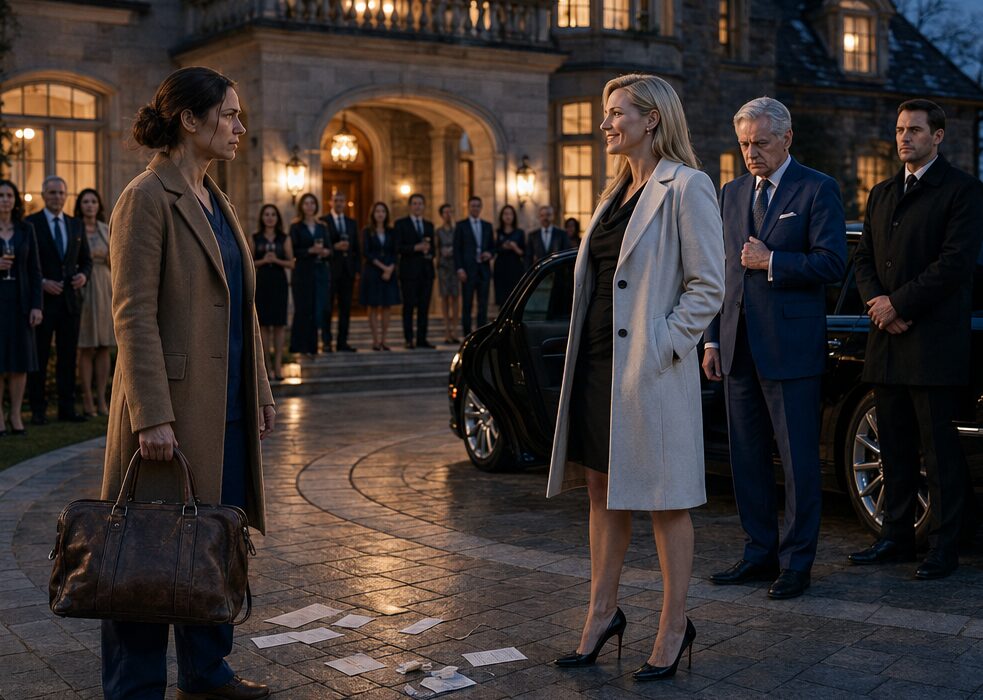
Catherine dropped the brown leather medical bag onto the circular driveway before anyone had the chance to ask why she was there.
It landed with a dull, ugly sound against the stone pavers, too heavy for a purse and too worn for the kind of luggage people brought to the Charles Whitmore house. The mansion glowed behind it, every tall window lit gold for the fundraiser inside. Cars curled around the drive. Women in satin coats moved behind the glass with stemmed drinks in their hands.
Beside the black town car, Samantha smiled like Catherine had arrived exactly on cue.
“Well,” Samantha said, her voice bright enough to carry, “are you still doing the nurse thing, or just collecting sympathy now?”
Catherine kept her hands at her sides.
She had told herself in the rideshare not to answer the first insult.
Not the second either.
She had told herself she would step out, return the key, hand over the records, and leave before anyone from the neighborhood saw her standing outside the house she used to enter through the side door.
She had not told herself what to do if they were waiting for her.
Samantha stood near the open town car door in a black dress and pale coat, blond hair tucked perfectly behind one ear. Her younger sister, Barbara, leaned against the fender with a champagne flute she was not supposed to have outside. Charles Whitmore stood beside them in a blue suit, silver hair combed back, one hand tucked stiffly against his side.
Edward, the driver, waited near the car with his hands folded.
He had driven Catherine to pharmacy pickups at midnight once. He had watched her carry groceries in the rain while the rest of the family argued upstairs.
Tonight, he looked at the medical bag on the ground and then at her face.
He said nothing.
Catherine reached into the pocket of her camel coat and touched the house key.
It was wrapped in a tissue, not because it was delicate, but because she could not bear the feel of it anymore.
Thomas had texted her that morning.
You still have family property. Bring it back tonight. Don’t make this harder than it needs to be.
That was how Thomas wrote now. Like every sentence had been reviewed by a lawyer, a therapist, and his own cowardice.
She had almost mailed the key.
Then a second message came.
Dad wants the care notebook too. Samantha thinks it’s best if everything is returned before the event.
That was when Catherine understood.
They did not need the notebook before the event.
They wanted her before the event.
They wanted her visible, contained, small.
Samantha stepped closer, her heels clicking once, twice.
“You could have given those things to Edward,” she said. “No need for a performance.”
Catherine looked past her at the house. Through the windows she saw white flowers, a string quartet, the moving silhouettes of neighbors who had once waved to her while she carried Charles’s walker down the front steps.
“I was asked to bring them,” Catherine said.
Barbara laughed into her drink.
“You were asked to return them. Different thing.”
Charles shifted his weight. The movement was tiny, but Catherine saw the effort in it. His left hand, the one he liked to hide, curled against his jacket seam. Two years ago, that hand had lain open and useless on a hospital blanket while he cried because he could not button his own shirt.
Catherine had buttoned it for him.
Then she had stepped out into the hall and let him pretend she had not seen him cry.
Now he looked at the bag as if it were something indecent.
“Catherine,” he said carefully, “thank you for coming.”
It was the kind of thanks one gave a florist.
She waited.
His eyes flicked toward Samantha, then toward the house.
“If we could avoid making this emotional,” he added, “I’d appreciate it.”
There it was.
Not an insult. Worse.
A request that she protect them from the consequences of what they had done.
Catherine bent, lifted the bag by its handle, and set it upright. The leather creaked. The old zipper had been repaired twice. She knew because she had repaired it herself with a curved needle at Charles’s kitchen table while his blood pressure cuff inflated around his arm.
“I’m here to return what belongs to this house,” she said.
Samantha’s smile sharpened.
“Good. Then we’re all on the same page.”
They were not.
That was the problem.
Part II — Family Property
The first time Catherine had come to the Whitmore house after the divorce, Charles had refused to look at her.
Not because he hated her.
Because he needed help getting from his bed to the bathroom, and pride had made him cruel.
Thomas had called her from the hospital parking lot three months after the papers were signed. His voice had been low, urgent, embarrassed.
“Dad won’t accept a stranger,” he said. “He says he’ll leave the house before he lets some agency person in.”
“Then let him leave,” Catherine had said.
There had been a pause.
Then Thomas said, “He asked for you.”
That was the part that undid her.
Not Thomas. Never Thomas by then.
Charles.
The man who had once corrected her pronunciation of a wine region at Thanksgiving. The man who signed birthday cards with only his first initial. The man who had always made Catherine feel like she had married into a museum and touched the wrong furniture.
He asked for you.
So she went.
At first, she told herself it would be two weeks.
Then six.
Then through the winter, because the ramp installation was delayed.
Then through spring, because Charles became anxious at night.
By the end of the first year, Catherine had a key, a notebook, a pharmacy account, and a shelf in the laundry room where she kept spare scrubs. By the end of the second, everyone in the house knew she could be called before sunrise and after midnight.
No one called it care.
They called it helping.
Helping sounded lighter.
Helping did not need invoices.
Helping did not need gratitude in public.
On the driveway, Samantha glanced toward the front porch. Two guests had stepped outside, laughing softly until they saw the group by the car. Their laughter thinned into curiosity.
Catherine felt the old trap tighten.
If she spoke loudly, she would be unstable.
If she spoke quietly, they would not hear her.
If she left, they would say she had made a scene.
If she stayed, they would make the scene for her.
Samantha tilted her head. “Thomas said you were upset.”
Catherine almost smiled. “Thomas says a lot of things once someone else writes them for him.”
Barbara’s eyebrows rose.
“Oh,” she said. “There she is.”
Charles gave Catherine a warning look, a small one, the kind he used to give when his blood pressure numbers were bad and he wanted her not to tell Thomas.
Catherine ignored it.
“I brought the key,” she said. “I brought the notebook. I brought the receipts your accountant said didn’t exist. I’m giving them to Charles, and then I’m leaving.”
Samantha’s expression did not change, but something behind it tightened.
“Receipts?”
“You asked for family property.”
Barbara pushed off the car. “Nobody asked you to bring a scrapbook.”
Edward lowered his gaze, but not before Catherine saw his mouth press into a line.
There were things employees knew before families admitted them. Edward knew which nights Catherine had slept in the den because Charles had been afraid to be alone. He knew which mornings she arrived straight from a double shift with drugstore coffee and compression socks under her scrubs. He knew Thomas had stopped coming by unless there were donors in town.
He knew, but knowing was not the same as saying.
Samantha stepped closer to the bag.
“What exactly are you trying to prove?”
Catherine tightened her grip on the handle. “Nothing.”
That was the first lie she had told that night.
She had come to return the key. She had come to return the notebook.
But some small, foolish part of her had also come to be acknowledged.
Not loved.
Not welcomed.
Just acknowledged.
She wanted Charles to say, in front of someone who mattered to him, that she had been there.
That she had not imagined the nights, the laundry, the panic, the pill alarms, the calls from the bathroom, the way he gripped her wrist after nightmares and whispered, Don’t let them send me away.
Samantha’s gaze flicked over Catherine’s navy scrubs beneath the coat.
“You know,” she said, “for someone who claims she doesn’t want anything from this family, you always arrive with an invoice.”
Catherine’s fingers went numb around the bag.
Charles said, “Samantha.”
It was almost a correction.
Almost.
Samantha’s face softened instantly toward him. “I’m only trying to keep tonight calm.”
The porch door opened wider.
More voices drifted out.
The fundraiser had begun. Catherine could smell wine, expensive perfume, and the buttery pastry trays she used to reheat when caterers left too early and Charles refused to eat anything cold.
She took one step toward the car.
“I’m leaving.”
Edward moved before he seemed to think about it.
Not much. Just enough to stand between her and the open door.
His face remained polite.
His body said no.
Catherine looked at him.
Edward’s eyes apologized.
That almost hurt more than Samantha’s smile.
Part III — The Things That Counted
“Edward,” Catherine said quietly.
He did not move.
Behind him, Samantha sighed. “Nobody is keeping you here. Don’t be dramatic.”
That was the genius of people like Samantha. They could build a wall and then blame you for noticing it.
Catherine turned back.
“Then tell him to move.”
Samantha looked amused. “After we have what belongs to the family.”
Catherine lowered the bag to the driveway again, slower this time. She crouched and unzipped it.
Charles took a step forward.
“Catherine,” he said, and now his voice had changed.
There was fear in it.
Not of her.
Of what she had carried.
She opened the flap.
On top lay the old plastic pill organizer, each compartment labeled in her handwriting because Charles used to mix up the evening dose and the blood thinner. Beneath it was the blue notebook with the elastic band, its pages swollen from being carried between kitchen, bedroom, pharmacy, and clinic.
There were grocery receipts folded into quarters.
Pharmacy slips.
A blood pressure log.
A printout from the home-care agency Charles had rejected because the hourly rate offended him.
A stack of invoices Catherine had written and never sent.
And tucked inside the front pocket, wrapped in wax paper like something fragile, was the folded cocktail napkin.
Charles saw it and closed his eyes.
Catherine did not touch it yet.
Samantha stared down into the bag.
For the first time that night, she looked uncertain.
Barbara leaned over. “What is all that?”
“Family property,” Catherine said.
The words landed harder the second time.
Samantha recovered quickly. “This is ridiculous. Anyone can keep receipts.”
“Yes,” Catherine said. “Anyone can.”
She lifted the pharmacy stack.
“March eighteenth. Antibiotics after the incision infection. Your card declined, Charles. Mine didn’t.”
Charles’s jaw moved.
“April second. Protein shakes because you wouldn’t eat after physical therapy. May ninth. Waterproof mattress cover. June eleven. Compression socks. June twelve, because you hated the first pair and threw one at the wall.”
Edward looked away.
Barbara’s smile faded into discomfort.
Samantha’s returned, too bright.
“So this is about money.”
“No,” Catherine said. “That would have been easier.”
Charles’s stiff hand trembled once against his jacket.
Catherine saw it. So did he.
She picked up the notebook.
His eyes snapped to hers.
“Please,” he said.
One word.
No one else heard the weight of it.
But Catherine did. She heard the bedroom at 2:14 a.m. when he thought the ceiling fan was a helicopter. She heard the morning he had begged her not to tell Thomas he had fallen. She heard him after the bathroom accident, voice raw with shame, saying, Don’t look at me like this, and her answering, I’m looking because you need help, not because you are less.
Samantha reached for the notebook.
Catherine pulled it back.
“Careful,” Catherine said.
Samantha’s eyes narrowed. “With what? Your little diary?”
Charles said, “It has medical details.”
Barbara made a small disgusted sound. “Then why bring it to a party?”
Catherine looked at Charles.
Because your son asked for it.
Because your family called it property.
Because you let them.
Charles did not speak.
That silence answered every question.
Catherine set the notebook back inside the bag, but she did not close it.
Samantha noticed.
So did Catherine.
The power had shifted, but not cleanly. The bag had made them afraid, but it had also made Charles vulnerable. Catherine could ruin them with the truth, but only by exposing moments she had promised, without saying the words, to protect.
She hated that the promise still mattered.
She hated that decency could become another leash.
Then the front door opened.
Thomas stepped onto the porch.
He wore a dark suit and the strained expression of a man arriving late to a problem he had helped create.
“Catherine,” he called, too loudly. “What are you doing?”
Several guests turned.
There it was.
Her name, carried into the warm porch light like a warning.
Samantha crossed her arms.
Barbara lifted her glass again, safer now that Thomas had arrived.
Charles seemed to shrink half an inch inside his blue suit.
Catherine stood beside the open bag.
Thomas came down the steps, smiling at the guests as if this were an amusing family hiccup.
When he reached the driveway, his smile disappeared.
“I asked you to return a key and Dad’s notebook,” he said under his breath. “Not dump your grievances on the pavement.”
Catherine looked at him and felt something strange.
Not heartbreak.
Not even anger.
Recognition.
She had once mistaken his discomfort for kindness because he never shouted. But Thomas did not need to shout. He simply waited for other people to make Catherine smaller, then called it unfortunate.
“I brought what you asked for,” she said.
“Then pick it up before people see.”
Catherine looked around.
People already had.
Part IV — The Napkin
Barbara laughed.
It was the wrong laugh for the moment: loud, careless, relieved to have found a shape for her discomfort.
“Honestly,” she said, “this is so much. Are we all supposed to pretend you weren’t getting paid to play Florence Nightingale?”
“I wasn’t getting paid,” Catherine said.
Samantha’s smile tightened. “That was your choice.”
“No,” Catherine said. “It was everyone’s convenience.”
A woman on the porch whispered something. A man beside her stopped sipping his drink.
Charles looked at the porch, then at the notebook, then at the ground.
Still nothing.
Thomas ran a hand over his mouth.
“Catherine, don’t do this.”
She almost asked, Do what?
Tell the truth?
Return your things?
Stand where I can be seen?
But she had learned that questions gave them room to escape.
Samantha crouched suddenly and reached for the bag.
Catherine moved at the same time.
“Don’t touch it.”
Samantha’s hand closed on the strap. “If it’s Charles’s, then it belongs inside.”
“It belongs to the truth before it belongs inside.”
The words came out before Catherine could soften them.
Samantha yanked.
Catherine held on.
The bag tipped.
For one suspended second, everything inside shifted but did not fall.
Then the zipper gave way.
The contents spilled across the driveway.
Receipts skidded over stone. The pill organizer cracked open, empty compartments flashing under the driveway lights. The blue notebook slapped face-down near Charles’s polished shoes. The unpaid invoices fanned out like pale cards.
And the letter slid free.
Edward bent instinctively to catch it, but it landed by Samantha’s heel.
Thomas saw the letterhead first.
Dr. Helen Armitage, Neurological Rehabilitation.
His face changed.
Samantha saw the change and reached for it.
Catherine got there first.
She lifted the letter with two fingers, not to read it aloud, only to keep it clean.
But Barbara leaned in.
“What is that?”
Catherine did not answer.
Thomas did.
“It’s nothing.”
That was enough to make everyone want it.
Samantha snatched it from Catherine’s hand.
“Then no one will mind.”
She read the first line silently. Then the second.
Her face flushed.
Catherine knew the letter by heart.
Dear Mrs. Whitmore,
Thank you for the thorough care notes and coordination of Mr. Whitmore’s home recovery plan. Your consistency has made a measurable difference in his progress…
Mrs. Whitmore.
Not because Catherine had lied.
Because everyone assumed the woman doing the work must be the wife.
Samantha’s eyes lifted.
For a moment, Catherine saw the fear underneath the polish.
Not fear that Catherine had been loved more.
Fear that Catherine had mattered in a way Samantha could not decorate over.
Barbara peered at the page. “Why does it call you Mrs. Whitmore?”
“Because I was the one answering the calls,” Catherine said.
Thomas took the letter from Samantha.
“That’s enough.”
“No,” Catherine said. “It was enough a long time ago.”
Charles bent slowly, carefully, and picked up the blue notebook. His stiff hand struggled with the elastic band.
Catherine reached without thinking to help him.
He pulled back.
It was small.
It was public.
It was everything.
Her hand froze between them.
Something in her chest went quiet.
Samantha saw the movement. Saw the withdrawal. Saw Catherine absorb it.
And because she could not resist an opening, she smiled.
“Oh, Catherine,” she said softly. “You really thought all this made you family.”
The porch went still.
Even Barbara looked down.
Catherine did not move.
Charles said nothing.
Thomas said nothing.
Edward closed his eyes for half a second.
Catherine bent and began gathering the receipts.
One by one.
No rush. No tears.
Her hands knew how to clean up other people’s messes.
That was the worst part.
She was good at it.
Barbara, trying to recover the room she did not have, gave another brittle laugh.
“She’s performing poverty in the driveway now.”
Catherine picked up the pharmacy slip.
The grocery receipt.
The invoice she had never sent.
The pill organizer.
Then she saw the napkin.
It had unfolded halfway near Samantha’s shoe.
The paper was soft from age, the ink faded in places. Three shaky attempts, each one worse than the last.
Thank you.
Tha—
Thank you, C.
Charles had written it on the second Thanksgiving after the stroke, while Thomas and his cousins watched football downstairs and no one noticed Charles had not eaten. Catherine had brought him soup in a mug and sat with him until his hand stopped shaking enough to hold the spoon.
He had pushed the napkin toward her afterward, embarrassed.
“Don’t make a thing of it,” he had muttered.
So she hadn’t.
She had kept it instead.
Samantha stepped backward.
Her heel landed on the napkin.
A wet patch on the driveway darkened the paper beneath her shoe.
Catherine saw the ink smear.
Her body moved before her pride could stop it.
Part V — What Everyone Saw
Catherine lunged.
Not at Samantha’s face. Not at her hair. Not to hurt her.
She shoved Samantha’s ankle sideways with one hand and snatched the napkin with the other.
But Samantha was in heels on smooth stone, and she had been standing with all her weight on that careless foot. She gasped, stumbled backward, grabbed for the open town car door, missed the handle, and sat hard on the driveway with a shocked sound that seemed to stop the entire house.
Barbara screamed Samantha’s name.
Thomas reached for Catherine, then stopped when Edward stepped between them.
Charles said, “Oh my God.”
But Catherine was not looking at any of them.
She was crouched over the napkin, holding it in both hands.
The ink had blurred at the edge. The word thank remained. The rest was wounded into softness.
For one second, Catherine was back in Charles’s upstairs bedroom, holding a mug of soup while a proud man tried to write the only words he could not say out loud.
Then she stood.
Samantha stared up at her from the ground, pale coat twisted under her, hair fallen loose from behind one ear.
The image was so close to justice that Catherine almost hated it.
Because it was not justice.
It was only gravity.
People had gathered on the porch now. Donors. Neighbors. A woman from the garden committee. The retired judge who sent Christmas pears. The couple who had once praised Charles for being “so brave” while Catherine stood behind him holding extra medication in her pocket.
They had not seen two years.
They had seen six seconds.
Maybe that was all people ever saw.
Catherine looked at Charles.
His face had gone gray.
She could have opened the notebook.
She could have read the entries aloud.
April 22, 3:10 a.m. Confused, crying, asked for Thomas. Thomas did not answer.
May 4, bathroom accident. Refused breakfast. Reassured no assisted living discussion today.
June 19, panic after donor visit. Said he would rather die in house than be seen helpless.
She could have made him as small as he had allowed her to become.
She could have won completely.
Instead, she folded the napkin once along its old crease and held it against her palm.
Then she spoke, not loudly, but clearly enough for the porch to hear.
“I was good enough to clean him, feed him, and keep him alive.”
No one moved.
Catherine looked at Samantha, then Thomas, then Charles.
“I’m not good enough to be laughed at in your driveway.”
The words stayed there.
They did not echo. They did not need to.
Samantha’s mouth opened, but nothing came out.
Barbara bent to help her sister up, muttering, “This is insane,” but her voice had lost its audience.
Thomas looked at the porch and realized too late that the story had escaped him.
Charles’s eyes were wet.
Catherine did not look away.
That was the hardest kindness she offered him.
She let him know she had seen the tears.
Then she let him know they no longer changed anything.
Edward crouched and began gathering the papers.
Samantha snapped, “Edward, don’t.”
His hand stopped over a receipt.
For a moment, Catherine thought he would obey.
Then he picked it up anyway.
A small act.
Almost nothing.
Enough.
He handed the receipt to Catherine without meeting Samantha’s eyes.
Barbara helped Samantha stand. Samantha brushed at her coat, but the fall had changed her. Not ruined her. Not humbled her in any permanent way.
Only rearranged the air around her.
She looked less like the woman of the house and more like someone who had arrived early and mistaken access for belonging.
Thomas took a step toward Catherine.
“Can we go inside and talk about this?”
Catherine almost laughed.
Inside.
Where doors closed.
Where carpets softened every sound.
Where truth became tone and tone became problem and problem became Catherine.
“No,” she said.
One word.
The cleanest one she had said all evening.
Part VI — The Door Edward Opened
Catherine gathered the bag slowly.
She put the pill organizer in first, though it was empty now. Then the receipts. Then the invoices. Then the letter from the doctor, which Thomas did not try to take back. Edward handed her the last two slips from beneath the car.
The blue notebook remained in Charles’s hand.
He held it like it was heavier than the bag.
Catherine looked at it, then at him.
“You can keep that,” she said.
His lips parted.
Catherine added, “The private pages stay private because I chose that. Not because you deserved it tonight.”
Charles flinched.
It was not dramatic.
It was worse. It was true.
She reached into her coat pocket and took out the tissue-wrapped key. The tissue had worn thin around the teeth.
She unwrapped it and held it out.
Charles looked at the key for a long moment before taking it. His stiff fingers struggled to close around it.
This time, Catherine did not help.
The porch had gone quiet except for a glass clinking softly against someone’s ring.
Thomas stood uselessly between the house and the driveway.
Samantha had stopped brushing her coat.
Barbara stared at Catherine as if seeing her for the first time and not liking what it required.
Catherine slipped the folded napkin into the inside pocket of her bag.
Not with the receipts.
Not with the invoices.
With her wallet and her keys.
With what was hers.
Charles swallowed.
“Catherine,” he said.
There was so much inside her name now. Apology. Pleading. Shame. Maybe even gratitude, finally trying to stand upright.
But he had taught her something without meaning to.
Some words arrived too late to be gifts.
She zipped the bag halfway. The broken teeth caught near the corner, so she left it like that and lifted it under her arm.
Edward stepped to the town car and opened the rear door.
Not for Charles.
Not for Samantha.
For Catherine.
The gesture was simple. Professional, even.
But everyone understood it.
Catherine looked at him.
Edward gave the smallest nod.
She did not get in. The rideshare that had brought her had already turned out of the gate, and she was not going to sit in a Whitmore car, not even as a final image.
But she appreciated the door.
Sometimes dignity was not being carried away.
Sometimes it was someone opening a way out and letting you choose your own feet.
“Thank you,” she said.
Edward stepped back.
Catherine turned toward the end of the driveway.
Behind her, the mansion glowed as if nothing inside it had changed. The flowers were still perfect. The quartet had started again, uncertainly. Guests would go back inside soon. Someone would say it was sad. Someone would say divorce made people behave strangely. Someone would say Charles had been through enough.
By morning, the story would already be polished.
But not completely.
Too many people had seen the bag.
Too many had heard the sentence.
Too many had watched the driver open the door for the woman they were supposed to dismiss.
Catherine walked past the black town car, past the crushed white petals fallen from the urns, past the place where her bag had first hit the stone.
At the edge of the drive, she heard Charles say her name once more.
Softer this time.
Almost like the man upstairs with the soup mug and the shaking hand.
She stopped.
Only for a breath.
Then she kept walking.
The napkin rested against her side, folded and imperfect, the ink blurred but not gone.
She had come to return what belonged to the house.
She left with what the house had never deserved to keep.