The Night She Finally Learned Which Door Was Really Hers
Part I — The Suitcases on the Porch
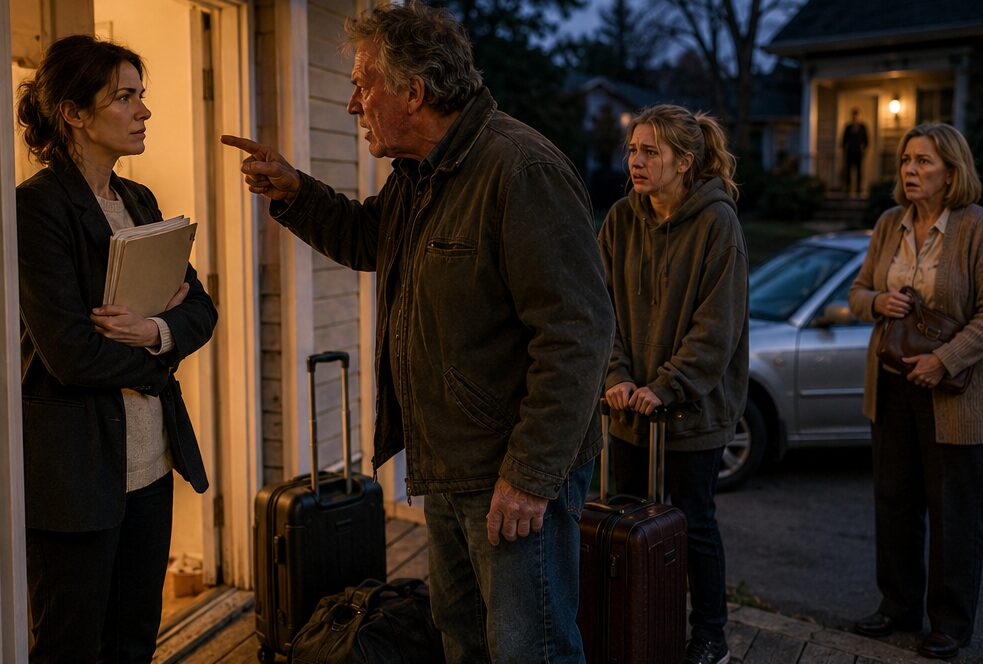
Nancy opened the front door with a folder pressed against her chest and found her father pointing at her before he even said hello.
Charles stood under the porch light with two suitcases at his feet and a duffel bag leaning against his leg. His gray hair was wind-tossed, his jacket half-zipped, his face already red with the confidence of a man who had arrived angry so he would not have to arrive ashamed.
Behind him, Carolyn stood beside the old silver sedan with one hand around her purse strap and the other near her mouth.
Sandra was crying in the driveway.
Not quiet crying. Not the kind a person tries to hide.
The kind that makes neighbors pause behind curtains.
Charles jabbed a finger toward Nancy’s chest. “Move. Your sister’s been sleeping in a car.”
Nancy did not move.
Warm light from her hallway spilled around her shoulders. Behind her was the narrow entryway she had painted herself last spring, the little table where she dropped her keys, the basket for mail, the framed picture of her mother she kept angled away from direct sun.
In front of her was everything she had spent years trying not to become responsible for again.
“Dad,” she said, because some habits survived even after respect was gone.
“Don’t Dad me.” Charles lifted the handle of one suitcase and let it fall hard against the porch boards. “We have had the worst week of our lives, and you’re standing there like a bank teller.”
Sandra took a step closer. Her blonde hair was twisted into a loose, messy knot, her hoodie sleeves pulled over her hands. Mascara had collected beneath her eyes.
“Nancy, please,” she said. “I can sleep on the couch. I don’t care. I’ll pay you when I get my shifts back.”
Carolyn glanced toward the neighboring house.
Mrs. Walker’s porch light had just come on.
“Nobody needs to hear all this,” Carolyn said softly.
Charles heard her and raised his voice.
“Good. Let them hear. Let them know what kind of daughter locks family out.”
Nancy felt the folder bend under her fingers.
Inside were copies of signatures that looked like hers but were not. A letter from an attorney she had read three times and still could not make less real. Old account statements. A printout from a loan application with her name typed under guarantor.
And, by accident, one photograph.
She had meant to take that one out.
Charles stared at the folder. “What’s that supposed to be?”
Nancy looked at his finger still pointed at her.
“Not tonight,” she said.
His mouth tightened. “Oh, it is absolutely tonight.”
A car slowed at the corner. Not enough to stop. Enough to see.
Sandra covered her face with both hands.
“Please,” she whispered. “I can’t do this out here.”
Nancy wanted to step aside for her. That was the worst part.
Not for Charles.
Not even for Carolyn, who had spent years smoothing over his lies with a careful smile and a lowered voice.
But Sandra was twenty-three and scared. She had spent her childhood arriving late to every family event, clutching a fast-food cup, apologizing for things she had not done yet. Nancy had watched her grow up under the same weather system and had never quite known how to invite her in without bringing the storm behind her.
Charles saw the hesitation. He always did.
“There,” he said, softer now, because softness was also a tool. “You see her. You see what you’re doing.”
Nancy’s throat tightened.
“I see her,” she said.
“Then open the damn door.”
Nancy looked down at the suitcases.
They were not packed neatly. One zipper strained around the corner, a shirt sleeve caught in its teeth. The duffel had a luggage tag from a beach trip years ago, the one Charles had told everyone he paid for even though Nancy had covered the hotel deposit with money from her tax refund.
Need had a shape tonight.
It had wheels, handles, and a place on her porch.
Nancy lifted her eyes. “I said no.”
For the first time, Sandra stopped crying long enough to stare at her.
Carolyn’s hand dropped from her mouth.
Charles smiled once, a small ugly thing.
“Your mother would be ashamed of you,” he said.
The porch seemed to tilt.
Nancy felt the folder shift against her ribs.
“No,” she said, quiet enough that he had to lean in to hear it. “She wouldn’t.”
Part II — The Story He Kept Telling
A week earlier, Charles had called Nancy during her lunch break at the dental office and said there had been a mistake.
That was how he began most disasters.
A mistake at the bank. A mistake with the landlord. A mistake on a form. A mistake in somebody else’s memory of what he had promised.
Nancy had been sitting in her car behind the office, eating crackers from a sleeve and trying not to get mustard on her blouse.
“Two nights,” Charles had said. “Maybe three. Just until the rental clears.”
“What rental?”
“The one in Millbrook.”
“You said you hated Millbrook.”
“I hate sleeping in a car more.”
He laughed after that, like he had made a joke and not a threat.
Nancy had closed her eyes. She saw Sandra first. Sandra folding herself into the back seat. Sandra pretending the whole thing was an adventure. Sandra texting Nancy at midnight, then deleting the message before sending it.
“Where’s Carolyn’s sister?” Nancy asked.
Charles made a sound through his nose. “Kathleen? She’s got opinions, not room.”
“You always said she had a finished basement.”
“She also has a husband who thinks he’s better than everybody.”
Nancy had almost said, Maybe he just says no faster.
Instead she asked, “What happened to the house?”
“Don’t start.”
“I’m asking.”
“And I’m telling you we need family right now, not an audit.”
There it was. Family meant the part where Nancy stopped asking.
That afternoon, she almost prepared the guest room.
She stood in the doorway after work, staring at the folded quilt at the foot of the bed. Her house was small, but it was clean. Two bedrooms, one bath, a kitchen with cabinets she had repainted blue because her mother used to say every house needed one brave color. A maple tree out front. A mortgage she paid on time.
The guest room still held boxes she had not unpacked because some part of her did not believe she was allowed to settle fully into a life nobody else could claim.
She took a clean sheet from the linen closet.
Then the doorbell rang.
Not the family.
A certified envelope.
Nancy signed the little screen with her finger and stood in the hall while the postal carrier hurried back down the walk.
Inside the envelope was a letter from an attorney whose name she did not recognize at first. The first page referenced a lien inquiry on an old property. The second referenced an account opened years ago. The third contained her name.
Not as daughter.
Not as emergency contact.
As guarantor.
Nancy read the line again.
Then again.
By the time she reached the copy of the signature, her hands had gone cold.
It looked close enough to hurt.
Not perfect. Charles had always made his capital N too sharp, too eager. But close.
That night, she searched through old boxes in the guest room and found the folder she had not opened in years. Her mother’s house documents. Final bills. Credit card notices. Hospital payment letters. The receipts Nancy had kept because she was twenty-four then and terrified that grief without paperwork would swallow her whole.
Her mother, Mary, had left no inheritance.
Only a ring, a house with a loan against it, and a man who told everyone he had handled things.
Nancy had handled things.
She had sold the house because there was no other way to stop the calls. She had paid two collectors. She had covered Charles’s “temporary” shortage when he said the funeral flowers cost more than expected. She had sent him money when he said Carolyn’s car needed tires.
She had done all of it quietly.
That was the agreement nobody had spoken aloud.
Charles got to remain the father who had “kept the family together.”
Nancy got to become the daughter who never needed help.
The morning after the envelope arrived, she called the attorney. By lunch, she understood enough. By evening, she understood too much.
Charles had not only used her name.
He had used the story of her mother to make it sound deserved.
Three cousins thought Nancy had inherited money and refused to help him. An aunt had left Nancy a voicemail saying, “You only get one father.” A neighbor from Charles’s old street had sent a message: Heard about your dad. Hope you remember who raised you.
Who raised you.
Nancy had stared at those words until the screen blurred.
Now Charles stood on her porch saying the same thing with suitcases at his feet.
“I gave you everything after your mother died,” he shouted.
The folder creaked under Nancy’s grip.
“You gave me her bills.”
The words landed differently than she expected. Not loud. Not dramatic.
Just true.
Charles blinked.
Carolyn looked away.
Sandra’s crying stuttered into confusion. “What does that mean?”
Charles spun toward her. “It means she’s always had a flair for making herself the martyr.”
Nancy watched Sandra absorb that. Watched her decide where to put her fear.
It landed, as usual, on Nancy.
“Can we just come inside?” Sandra asked. “Please. We can talk about old stuff later.”
Old stuff.
Nancy almost laughed.
Some people called a wound old because they had not been the one carrying it.
Part III — What the Ring Was Supposed to Prove
The neighbor across the street opened her front door just wide enough for her little dog to pretend it needed air.
Carolyn saw it and stiffened.
“Charles,” she said, “lower your voice.”
He did not even look at her. “No. I’m tired of lowering my voice while she stands there with central air and a mortgage like she got here by herself.”
Nancy felt that one. Not because it was true.
Because he had counted on it sounding true.
Her home did look steady from the outside. White siding. Blue shutters. A wreath on the door even though it was nowhere near a holiday. A ceramic planter with rosemary by the steps.
No one could see the years she ate rice and eggs because she had sent Charles three hundred dollars for a water bill he later admitted was actually a credit card minimum.
No one could see her checking account after she paid the second collection notice with her mother’s name still on it.
No one could see the nights she sat on the kitchen floor with a calculator, whispering, “I can do one more month.”
Charles pointed past her shoulder into the house. “Your mother’s things are in there, aren’t they?”
Nancy went still.
Sandra looked up. “Dad.”
“No, she needs to hear it.” Charles stepped closer, one shoe on the top step now. “You built this whole life off what was left to you, and now you can’t spare one room?”
Nancy’s voice came out flat. “Nothing was left to me.”
“That’s not what you told people.”
“That’s not what you told people.”
The sentence passed between them like a match.
Sandra wiped her cheek with her sleeve. “Wait.”
Charles exhaled hard. “Don’t let her twist this.”
Sandra looked from him to Nancy. “Dad said Mom’s ring paid for your down payment.”
For a moment, the porch went silent.
Even the little dog across the street stopped barking.
Nancy heard her own pulse.
“What?” she said.
Sandra swallowed. “He said your mom had this ring. A diamond one. He said you sold it and used the money for the house. He said that’s why, if things got bad, you’d help us. Because this house was kind of…”
She could not finish.
Charles did it for her.
“Family property,” he said.
Nancy stared at him.
That was the moment the door behind her stopped feeling like an entrance and started feeling like a line drawn through her life.
Her mother’s ring had not paid for the house.
Her mother’s ring was in Nancy’s bedroom, in a small velvet box inside the top drawer of her dresser. It was not grand. It was not the kind of diamond people imagined when they told stories about inheritance. It was modest, warm-toned, slightly loose in its setting because her mother had once knocked it against a grocery cart and laughed about it all the way home.
Nancy had kept it because it was the only thing from her mother that Charles had not turned into a bill.
Now he had turned even that into a debt.
Sandra’s voice cracked. “Is that not true?”
Nancy looked at her half-sister.
Sandra was not trying to attack her. Not exactly. She was trying to survive inside the only story she had been given.
“No,” Nancy said. “It’s not true.”
Charles scoffed. “And here come the tears. Right on schedule.”
Nancy looked at him then. “I’m not crying.”
“You always cried when you wanted people to stop asking questions.”
That was so completely backwards that Nancy almost lost her breath.
Carolyn stepped away from the car at last. “Charles, enough.”
He turned on her. “You want to sleep on the sidewalk tonight?”
She shrank back, but not fully.
Nancy noticed that.
A small thing.
A first crack.
Carolyn’s eyes moved to the folder.
“What exactly do you have in there?” she asked.
Charles answered before Nancy could.
“Nothing. She printed some nonsense to make herself look wounded.”
Carolyn looked at Nancy anyway.
And in that look, Nancy understood something that made the whole porch colder.
Carolyn knew.
Maybe not all of it. Maybe not the signature. Maybe not the legal language. But she knew enough to be afraid of the folder.
“You knew he was telling people I owed him,” Nancy said.
Carolyn’s mouth tightened.
Sandra stared at her mother. “Mom?”
Carolyn looked toward the street again. “This is not the place.”
Charles snapped, “Exactly. So tell her to open the door.”
Carolyn did not.
Nancy’s anger did not flare. It settled.
That was worse.
“How long?” Nancy asked.
Carolyn’s eyes shone under the porch light. “He was upset.”
“That wasn’t my question.”
Carolyn looked at Sandra, then at the car, then down at the suitcase by Charles’s feet.
“We needed somewhere to go,” she said.
Sandra took a small step back as if the driveway had shifted beneath her.
Nancy nodded once.
There it was.
Not an apology. Not a defense.
The plain shape of complicity.
We needed somewhere to go.
So they had built a road through Nancy.
Part IV — The Papers on the Porch
Charles moved fast when he realized silence had stopped helping him.
He reached for the folder.
Nancy pulled back, but he caught the edge. The papers slid loose with a dry, rushing sound, white sheets flashing in the porch light before they scattered across the boards and down the steps.
“Nancy!” Sandra cried.
Charles held up two pages like he had caught her cheating. “See? This is what she does. She waves fake paperwork around and suddenly everybody forgets she’s the one standing in a warm house while her family’s outside.”
Nancy dropped to one knee.
Not for dignity. Not for drama.
Because the attorney’s letter had landed faceup near the doormat.
Because the credit statement had skidded under Charles’s shoe.
Because the photograph had fallen halfway down the steps.
Sandra bent first.
Charles barked, “Leave it.”
She froze.
The word was too sharp. Too automatic.
Nancy saw Sandra hear it too.
Across the street, Mrs. Walker pretended to adjust her porch plant.
Carolyn whispered, “Charles.”
He pointed at Sandra now. “Get away from that.”
But Sandra had already picked up the photograph.
It was old, the edges softened. Nancy’s mother stood in a backyard in a sleeveless blue dress, one hand lifted to shade her eyes. On that hand was the ring.
Small. Bright. Still there.
Sandra looked at the photo, then at Nancy.
“This is your mom?”
Nancy nodded.
Sandra rubbed her thumb carefully along the edge of the picture. “She’s wearing it.”
Charles grabbed for the photo. Sandra pulled it against her chest.
“She’s wearing the ring,” Sandra said again.
“I never said she didn’t wear it,” Charles snapped.
“You said Nancy sold it.”
“I said a lot of things trying to explain why your sister has always had more than us.”
Nancy stood slowly. She had half the papers now, bent and out of order. Her hands shook, but not enough to drop them.
“She has more because she kept a job,” Charles said. “She has more because she could walk away. She has more because some of us stayed and dealt with real life.”
Nancy laughed once, and the sound surprised everyone.
“Real life?” she said. “You mean the collection calls you forwarded to my phone?”
His face darkened.
“The card in Mom’s name you told me was closed?”
“Nancy,” Carolyn said, but there was no command in it now.
“The emergency loan you said was for the funeral balance, except the funeral home told me it had been paid in full?”
Sandra’s eyes went wide.
Charles stepped closer. “Stop.”
Nancy looked down at the paper under his shoe. “Move your foot.”
He did not.
She did not bend for it.
She held his gaze.
“Move your foot.”
Something in her voice made him do it.
The page beneath was wrinkled but readable. Her name. His address. A copied signature. The word guarantor halfway down the page.
Sandra read it before Charles could block her.
Her lips parted. “Did you use her name?”
Charles looked at Carolyn. “Tell your daughter to get in the car.”
Sandra did not move. “Dad.”
“Now.”
“Did you?”
Charles threw up his hands. “Everybody loves a simple question until they have to live in the answer.”
“That’s not an answer,” Sandra said.
“It was a form.”
“With her name?”
“It was temporary.”
“With her name?”
“She wasn’t going to help otherwise.”
Nancy felt the sentence pass through her, clean and final.
Not because it shocked her.
Because he had finally said the quiet part where everyone could hear.
Carolyn put a hand over her mouth again, but this time it did not look like shock.
It looked like shame arriving late.
Charles saw all their faces and changed tactics.
“You think I wanted this?” he said. “You think I enjoyed asking? Your mother needed things, Sandra. You needed school. Carolyn couldn’t keep a budget if the numbers were written in crayon. The bank changed terms. Nancy stopped answering. Everybody had a hand in this.”
Nancy stared at him.
There it was, his oldest magic trick: turn one hand on the wheel into everyone’s fingerprints.
“No,” she said.
Charles pointed at her again. “You do not get to stand in judgment of me.”
“I’m not judging you.”
“Then what is this?”
Nancy lifted the bent documents. “A door.”
He blinked.
She did not explain it.
She did not need to.
For years, every paper had been a chain. Tonight, the papers were the thing keeping him out.
Sandra looked at Nancy with the photo still pressed against her hoodie.
“I didn’t know,” she said.
Nancy believed her.
That did not make it hurt less.
Part V — The Choice at the Threshold
Charles turned toward Sandra with the slow anger of a man whose audience had stopped clapping.
“Get in the car.”
Sandra stood beside the bottom step, one suitcase behind her, Nancy’s mother’s photograph in her hand. She looked smaller than twenty-three and older than fear.
“Dad, did you tell everyone she owed us?”
Charles laughed. “Everyone? Listen to yourself. You sound just like her now.”
“Did you?”
“I told people the truth.”
Nancy stepped down one stair. “You told them a version that made me useful.”
His head snapped toward her. “You always think everything is about you.”
“No,” she said. “That was the problem. I thought none of it was allowed to be.”
Carolyn made a quiet sound.
Charles pointed at Nancy, then at Sandra. “You see what she’s doing? She wants to split this family right down the middle so she can feel powerful.”
Nancy’s voice was steady now.
“You don’t get to put one more woman between you and what you did.”
The sentence changed the air.
Carolyn closed her eyes.
Sandra looked at her mother.
Charles’s face went blank for half a second, and in that half second Nancy saw what he hated most.
Not being blamed.
Being seen.
He lunged toward Sandra.
It was not a movie moment. There was no grand violence, no dramatic fall. Just a fast, ugly reach for her arm, the kind of movement a man makes when he believes obedience belongs to him.
Sandra jerked backward.
Her heel caught the edge of the driveway.
She cried out and folded in on herself, one hand still gripping the photograph.
Carolyn gasped. “Charles!”
Nancy moved before she decided to.
She stepped all the way out of the doorway for the first time that night. The porch boards were cold through the soles of her boots. The folder was crooked in her arm. Papers were still scattered near her feet.
She put herself between Charles and Sandra.
Not close enough to touch him.
Close enough to make him choose what kind of man he wanted the neighbors to see.
Mrs. Walker was no longer pretending. She stood on her porch in a blue robe with her dog under one arm.
Charles’s breathing was loud.
Nancy could smell his aftershave. The same kind he had worn to her mother’s memorial. The same kind he had worn when he told everyone Nancy was “holding up well,” as if grief were another bill she could pay on schedule.
He leaned toward her. “You think this makes you good?”
“No.”
“Then what does it make you?”
Nancy looked back at Sandra, shaking at the edge of the driveway, and Carolyn, who had both hands pressed against her purse as if it were the only thing keeping her upright.
Then Nancy looked at the open door.
Her house waited behind her.
Not grand. Not inherited. Not owed.
Hers.
“Sandra can come in tonight,” Nancy said.
Charles’s eyes narrowed.
Nancy raised her voice, not screaming, not shaking, just carrying clearly across the porch and driveway.
“You cannot.”
Sandra began crying again, but softer this time.
Charles stared at Nancy as if she had spoken a language he refused to learn.
“You ungrateful girl,” he said.
The word girl almost made her smile.
She was thirty-four. She had a mortgage, a job, a chipped mug in the sink, and a drawer full of receipts from debts she had not created. But to him, she would always be young enough to command.
“No,” Nancy said. “I’m done being useful.”
Charles’s face changed.
For years, Nancy had imagined that saying the right sentence would make him understand. She had believed truth, if arranged correctly, could become a key.
But some people did not misunderstand the door.
They simply hated that it had a lock.
Charles stepped back.
Not because he accepted it.
Because the street had gone too quiet.
Carolyn walked to the porch and picked up one of the suitcases. It was the brown one with the cracked handle. She lifted it halfway, looked at Sandra, then set it down beside her feet.
Charles stared at her.
“What are you doing?”
Carolyn did not look at him when she answered.
“She needs somewhere to sleep.”
“I said get in the car.”
This time Carolyn did look at him.
“Get in the car, Charles.”
It was not loud.
It did not have to be.
For a second, Nancy saw the cost of it pass over Carolyn’s face. The rent lost. The marriage still waiting. The life she would have to sit beside in the passenger seat after refusing him in public.
Charles looked from Carolyn to Sandra to Nancy.
Then he kicked the duffel bag so hard it tipped over.
No one moved to pick it up.
That, more than anything, made him leave.
Part VI — What Stayed Inside
The silver sedan sat at the curb for almost a full minute before Charles started it.
No one spoke while it idled.
Carolyn gathered the duffel from the ground, then paused beside Sandra. Her hand lifted, stopped, and finally touched her daughter’s hair.
“I’ll call you,” she said.
Sandra nodded, but her eyes were on the porch.
Carolyn looked at Nancy.
There were a dozen things she might have said. Sorry. Thank you. I should have told you. I did what I thought I had to do. Please don’t make me say this where he can hear.
She said none of them.
Nancy was grateful for that.
Some apologies demanded forgiveness too quickly.
Carolyn turned and walked back to the car with the duffel over one shoulder. Charles did not help her put it in the trunk.
When they drove away, Mrs. Walker stayed on her porch for three more seconds before disappearing inside.
The street returned to its ordinary shape.
A sprinkler clicked somewhere.
A garage door hummed shut.
Sandra stood at the bottom of the steps with one suitcase, one photograph, and no idea what to do with her hands.
Nancy bent and began gathering the papers.
After a moment, Sandra joined her.
They picked them up without speaking. The attorney’s letter. The account statement. The copy of the signature. A receipt from the funeral home Nancy had forgotten was in the folder. The papers were bent now, dirty at the corners, one page marked by the faint print of Charles’s shoe.
Sandra touched that page and winced.
“Don’t,” Nancy said.
Sandra pulled her hand back.
“I just…”
“I know.”
“No, I don’t think you do.” Sandra’s voice broke. “I don’t even know what I’m sorry for yet.”
That landed harder than a perfect apology would have.
Nancy looked at her younger sister. Half-sister, people said, as if blood measured in fractions could make responsibility easier.
Sandra still had the photograph tucked against her chest.
Nancy held out her hand.
Sandra gave it back carefully, like returning something sacred.
Nancy looked at the image of her mother in the blue dress, sunlight on her face, ring on her hand.
For years, Nancy had kept that picture in a box because looking at it made her feel young and unfinished. Tonight it looked different. Not less painful. Just less fragile.
She handed it to Sandra.
Sandra stared at it. “Are you sure?”
“No.”
Sandra gave a shaky laugh that turned into another sob.
Nancy opened the door wider.
The hallway light reached the bottom step now.
Sandra did not move.
“I can go somewhere else,” she said, though they both knew she had nowhere.
“You can come in tonight.”
“Just tonight?”
Nancy looked at the suitcase.
Then at the street where the car had disappeared.
Then at the papers in her arms.
“Tonight,” she said. “Tomorrow we talk about what help looks like when it doesn’t come with a lie attached.”
Sandra nodded slowly.
At the threshold, she stopped again.
“I thought you hated us.”
Nancy looked at the little table by the door, the key bowl, the mail basket, the framed picture angled away from the sun.
“No,” she said. “I just couldn’t survive being needed like that anymore.”
Sandra stepped inside.
Nancy followed and closed the door softly behind them.
Not fast.
Not hard.
Not to punish anyone left outside.
The sound was small, almost gentle.
Inside, the house felt different with another person breathing in it. Not peaceful. Not healed. Not safe in the easy way people meant when they used that word without thinking.
But the papers were inside.
The photograph was inside.
Sandra was inside.
Charles was not.
Nancy stood in the hallway with one hand still on the knob while the porch light glowed through the narrow glass beside the door.
For the first time in years, the light was not an invitation to everyone.
It was a choice.