The Flowers He Kept Planting Before Anyone Finally Asked Why
Part I — The Flowers Out of Place
“Sir, get up.”
The old man did not move.
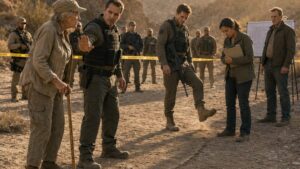
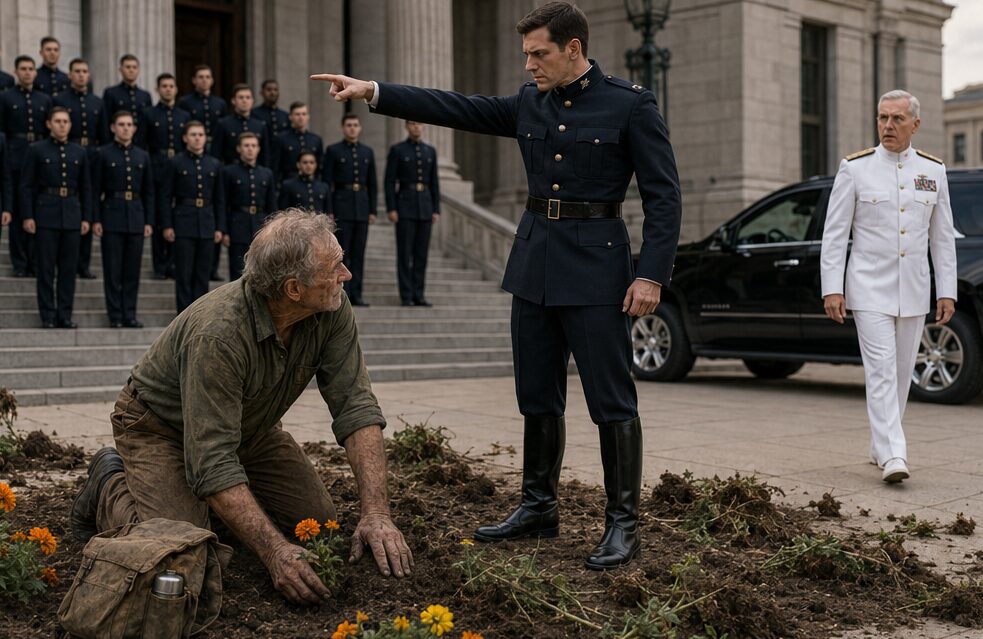
He stayed kneeling in the dirt beside the academy’s front walk, one hand pressed into the soil, the other cupped around a marigold seedling as if it were something breakable. His faded olive shirt clung to his narrow shoulders. Brown dust marked both knees of his pants. Beside him sat an old canvas satchel with a dented thermos tucked into the side pocket.
Instructor Stephen Miller stood over him in a dark training uniform, boots polished, jaw tight, one finger pointed toward the service gate.
“I said get up. You can’t be here.”
Three cadets had stopped near the steps of the main hall. A fourth slowed, pretending to adjust her sleeve. The morning inspection was less than an hour away, and every window of the academy had been polished until it reflected the sky. The brass handles shone. The stone path had been swept twice. The new shrubs beside the memorial wall had been arranged in a clean, modern line.
Except here.
Here, the shrubs were pulled loose. Clumps of damp soil sat on the walkway. Orange and yellow marigolds had been planted in their place.
The old man pressed soil gently around one stem.
Stephen’s face tightened. “Are you listening?”
“I hear you,” the old man said.
His voice was thin, but not weak.
“Then stand up.”
The old man brushed dirt from the base of the plant with his thumb. “These bloom on time.”
One of the cadets made a small sound behind Stephen. Not quite a laugh. Enough to turn the instructor’s embarrassment into heat.
Stephen glanced back. The cadets went rigid.
Then he looked down at the old man again. “This is not a public park. This is restricted academy property. We have a command visit today, and you have torn up approved landscaping.”
The old man finally looked up.
His eyes were pale and steady. Not confused. Not frightened. Tired, maybe. Hurt, maybe. But not lost.
“That line was wrong,” he said.
Stephen stared at him. “The landscaping order was wrong?”
“The depth was wrong.”
“The depth.”
The old man nodded once and reached for another marigold.
Stephen stepped closer, shadow falling over the flowers. “Sir, I don’t know who let you in, but whatever arrangement you had with grounds maintenance is over. Pack your things.”
The old man’s fingers paused.
Not on his tools.
On the satchel.
Stephen noticed it then. The bag looked older than the man’s shirt. Its seams were repaired in three different places. A strip of faded cloth crossed the front flap. Something had once been stitched there, but time had eaten most of the shape away.
“Now,” Stephen said.
The old man picked up a trowel and made a narrow hole in the soil.
The cadets were definitely watching now.
Stephen felt it. He felt their eyes on his back, measuring whether he controlled the moment or not. He had spent six years earning authority in rooms full of young people looking for weakness. He knew how fast discipline could slip if embarrassment entered the air.
He pointed toward the gate.
“Whatever you used to be, sir, today you’re in the way.”
The old man’s hand closed around the trowel.
For one second, the courtyard went quiet enough to hear the flag rope tapping the pole.
Then the old man pushed himself upright.
It took effort. One knee first. Then the other. His hand trembled as he rose, but he did not reach for Stephen. He did not ask for help. He stood shorter than the instructor, thinner, shoulders bent by age and something heavier.
Stephen expected an argument.
Instead, the old man looked past him.
Beyond the cadets.
Beyond the steps.
At the bronze wall near the entrance, where names had been engraved beneath the academy seal.
“I know exactly where I am,” the old man said.
That should have ended it.
It did not.
Stephen turned his head slightly and saw the memorial wall reflected in the old man’s eyes.
For the first time that morning, he felt a small uncertainty move through him.
Then his radio clicked.
“Command vehicle ten minutes out,” a voice said.
Stephen’s uncertainty vanished. He lifted the radio. “Copy. Front courtyard has an unauthorized civilian. Send security.”
The old man lowered himself back to the soil.
And kept planting.
Part II — The Bag Beside Him
The cadets did not laugh anymore.
That bothered Stephen more than laughter would have.
They watched the old man as if he had become a test no one had prepared for. His movements were slow, but precise. Thumb to root. Soil pressed firm, not packed. Space measured by two fingers. The kind of care Stephen associated with drills, not gardening.
“Cadet Amanda Parker,” Stephen snapped.
The young woman who had stopped near the steps straightened. “Yes, sir.”
“Clear his tools from the walkway.”
Amanda hesitated just long enough for Stephen to notice.
“Problem?”
“No, sir.”
She stepped down from the path and approached the old man’s satchel.
The old man did not look at her. “Not that.”
Amanda froze with one hand inches from the flap.
Stephen’s voice cut in. “Cadet, remove the bag.”
The old man turned then.
Only his head. Not his body. But the look he gave Amanda made her withdraw her hand before she could stop herself.
“Please,” he said.
There was nothing dramatic in it. No threat. No pleading.
That was what made it worse.
Amanda swallowed. “Sir, may I move the trowel instead?”
Stephen stared at her. “Move the bag.”
Amanda bent again, this time careful. Her fingers touched the canvas flap. It shifted open.
Inside, sewn to the lining, was a patch darkened by age. A faded medical cross. Beneath it, two letters in old thread.
G.C.
Amanda looked at the old man.
He reached out, slow but immediate, and closed the flap.
“Some things don’t get carried by strangers,” he said.
Stephen heard it and hated that it landed.
He stepped between them. “Enough.”
The old man’s mouth tightened, but he said nothing.
Stephen crouched, not because he wanted to be gentle, but because he wanted the moment back in his hands. “Listen to me. I have a class of cadets, an inspection, and the commandant arriving in minutes. I don’t have time to debate flowers with someone who wandered in through the wrong gate.”
“I came through the same gate I always do.”
“Then someone has been making a mistake for a long time.”
The old man looked at the marigolds.
“Yes,” he said quietly. “They have.”
Stephen did not know what to do with that.
He preferred anger. Anger had handles. Anger could be corrected, escalated, documented. This old man gave him no handle. Just silence. Just dirt. Just that bag.
Behind them, the cadets shifted as a group. Stephen heard one whisper, “Who is he?”
He turned sharply. “Eyes forward.”
They snapped still.
But Amanda’s gaze remained on the satchel.
The old man took another seedling from a small flat beside him. Its roots dangled pale and fragile. He tucked it into the earth with the care of someone returning something to its rightful place.
Stephen checked his watch.
Seven minutes.
He looked toward the memorial wall.
The bronze had been cleaned that morning. A cloth still hung over the new plaque beneath it, ready for the unveiling. The old plaque named eight academy trainees lost years ago in a training disaster near the southern range. Stephen had read the official account during instructor orientation. Poor visibility. Equipment failure. A heroic recovery effort. Lessons learned.
Clean language.
Academy language.
The kind that fit well on stone.
The old man was looking at the cloth-covered plaque too.
Not with pride.
Not with anger.
With recognition so old it no longer needed to announce itself.
Stephen lowered his voice. “If you know this place, you know what that wall means.”
The old man’s answer came without delay.
“Better than you.”
Stephen felt the cadets hear it. His face warmed.
“You’re about to be removed from academy grounds.”
The old man pressed soil around another stem.
“Not before I finish this row.”
It was not defiance the way Stephen understood defiance.
It was worse.
It was priority.
Part III — The Man Who Stopped Walking
The black SUV came through the gate at exactly 0820.
Every cadet in the courtyard straightened. Stephen turned so fast his boots scraped the stone.
The vehicle rolled to a stop near the main steps. Its door opened. General Richard Harris stepped out in a formal white uniform, silver hair cut close, posture crisp enough to quiet the entire courtyard without a word.
Stephen felt relief rush through him.
At last.
An authority higher than his own. A clean end to an untidy problem.
He moved forward and saluted. “General Harris. Instructor Stephen Miller. We apologize for the disturbance. We’re removing an unauthorized civilian from the memorial grounds.”
The general did not return the salute immediately.
He was looking past Stephen.
At the old man.
At the marigolds.
At the satchel.
Something changed in his face.
It was not visible enough for the cadets to understand. But Stephen was trained to read command presence, and for half a second, the general lost his.
His shoulders remained square.
His expression remained controlled.
But his eyes moved like a door had opened beneath him.
The old man stood again.
Slower this time.
He brushed dirt from his palms onto his pants, leaving brown streaks across the fabric. He did not salute. He did not smile. He only lowered his chin once.
“General,” he said.
Richard Harris took three steps forward.
Then stopped.
“Doc Carter,” he said.
The courtyard held its breath.
Stephen looked from one man to the other. “Sir?”
The general finally returned Stephen’s salute, but it was automatic. His attention stayed on the old man.
“I didn’t know you were coming,” Richard said.
“I come every year.”
The sentence landed harder than it should have.
Richard’s face tightened. “Every year?”
The old man looked toward the flowers. “When the gate is open.”
Stephen felt the first real crack inside the morning.
The academy did not forget people by accident. At least, that was what he had believed. There were rosters, records, memorials, ceremonies, plaques. There were dates printed on programs and names reviewed before speeches.
And yet the commandant was standing in front of this old man as if the academy had failed to see a person standing in its doorway for decades.
Richard glanced at Stephen. “What happened here?”
Stephen answered too quickly. “Sir, he removed the approved shrubs and began planting unauthorized flowers before inspection. He refused several direct requests to leave.”
The old man said nothing.
Richard looked at the pulled shrubs. Then at the marigolds already set in place.
“These flowers were here before the shrubs,” Richard said.
Stephen frowned. “Sir?”
Richard’s voice lowered. “A long time before.”
The old man’s jaw shifted once.
Not gratitude.
Warning.
Richard seemed to receive it. He did not explain further.
Stephen felt Amanda watching him. He did not turn.
The general stepped toward the memorial wall. His gaze went to the covered plaque.
“Is that the new dedication?”
“Yes, sir,” Stephen said. “Prepared for today’s ceremony.”
Richard’s eyes remained on the cloth.
The old man bent to pick up a small clod of soil from the walkway. He crumbled it in his palm and scattered it back into the bed. His fingers trembled again.
Richard saw the tremor.
Stephen saw him see it.
“George,” Richard said softly.
The old man’s name.
Not Doc. Not sir.
George.
The old man did not look up. “Don’t.”
One word.
Richard stopped.
Stephen had never heard a subordinate speak to a general that way. He waited for correction.
None came.
Instead, Richard looked toward the flowers and said, “The ceremony is in thirty minutes.”
George Carter reached for another seedling.
“Then you have time to fix the plaque.”
Part IV — The Name Not on the Wall
No one moved for a moment.
Then Richard’s face closed.
Stephen recognized the expression. Command face. The one men used when emotion had become inconvenient.
“The plaque was reviewed,” Richard said.
“By people who were not there.”
Stephen watched the words strike. He did not understand them, but he understood impact.
Richard stepped closer to George. “This is not the place.”
George looked at the covered bronze. “It was always the place.”
Amanda stood near the satchel, hands at her sides. Her gaze dropped to the flap again. It had fallen open slightly when George stood.
Inside, something stiff and folded showed beneath the cloth lining.
Not paper exactly. Thicker. Water-stained. Preserved.
Amanda should not have looked.
She did.
A card. Faded ink. A name in block letters.
Paul Reed.
George closed the satchel before she could read more.
Amanda whispered, “Who is Paul?”
Stephen turned sharply, but Richard answered before he could stop him.
“A man we should have named.”
The words changed the courtyard.
Even the cadets who did not know the story felt its shape. The air had the pressure of a room where a family argument has broken through a formal dinner.
Stephen stepped back, suddenly unsure where he belonged.
Richard looked at him. “Instructor Miller, clear the courtyard for ceremony prep.”
Stephen nodded. “Yes, sir.”
But George spoke before Stephen could move.
“Leave them.”
Richard’s eyes narrowed.
George’s voice remained quiet. “They’re being taught today, aren’t they?”
Stephen felt that line go through him like a blade without a wound.
Richard looked at the cadets, then at George.
He did not order them away.
The old man lowered himself onto the edge of the flower bed. For the first time all morning, he looked tired in a way no posture could hide.
“There were nine names,” George said.
Richard’s jaw flexed.
“The wall has eight.”
Stephen stared at the bronze memorial. Eight names beneath the academy seal. He knew them from orientation. Every instructor did.
George’s hand rested on the satchel. “Paul Reed held the line after the smoke shifted. He kept counting voices after everyone else stopped counting. He put seeds in his pocket that morning because his daughter liked orange flowers.”
Amanda’s eyes lifted.
George’s voice tightened, but he did not break. “He didn’t make it to the wall because his orders were never supposed to exist on paper.”
Richard’s face went pale under its discipline.
Stephen knew enough not to ask. Not there. Not like that.
But his mind moved despite him. The official account had always sounded complete. Poor visibility. Equipment failure. Recovery effort. Eight trainees lost. Survivors extracted.
Clean language.
Academy language.
George looked toward the newly planted marigolds. “I dragged out who I could. Paul sent me with the last breathing boy.”
Richard closed his eyes.
Only for a second.
But Stephen saw.
The last breathing boy.
The general.
George looked up at Richard now. “You were nineteen. You kept trying to apologize for breathing.”
Richard did not answer.
The cadets stood frozen.
Stephen felt his own earlier words return to him with unbearable clarity.
Today you’re in the way.
George Carter had been in the way of forgetting.
That was all.
Stephen turned toward him. “Sir, I—”
George cut him off without looking at him. “Don’t spend apology money before you know what it costs.”
Stephen closed his mouth.
For the first time since he had put on the uniform that morning, he felt underdressed.
Part V — Before the Cloth Came Off
The ceremony chairs filled quickly.
Families sat in the front rows. Staff stood along the walkway. Cadets formed lines near the steps. The cloth over the new plaque stirred in the light wind.
George stood beside the marigolds, not on the platform.
Richard had asked twice.
“Stand with me,” he said the second time, his voice low enough that only George heard.
George shook his head. “I didn’t plant these for cameras.”
“For honor, then.”
“For Paul’s daughter.”
Richard looked toward the seated families. “She’s here.”
George’s hands went still.
Richard nodded toward a woman in the second row. Mid-forties, dark jacket, both hands wrapped around a folded program. Karen Reed. Paul’s daughter. She had been listed under families of the fallen, invited like the others, given the same printed paragraph everyone received.
George stared at her for a long moment.
“She knows his name,” Richard said.
George’s voice was almost flat. “That’s not the same as knowing where he stood.”
Richard had no answer.
Stephen approached then, slower than before. His cap was tucked under one arm. His face had lost its morning edge.
“Mr. Carter.”
George did not correct him.
Stephen looked at the ground. “I was wrong.”
George waited.
“I spoke to you like you were a problem because I was afraid of looking like I didn’t have control.”
“That’s not an apology,” George said. “That’s a report.”
Stephen swallowed.
Amanda, standing with the cadets, heard it and looked down.
Stephen tried again. “I’m sorry.”
George studied him. There was no softness in his face, but no cruelty either.
“Discipline without memory becomes cruelty,” he said.
Stephen looked as if the sentence had found a private place in him.
“Yes, sir.”
George nodded once. “Then remember it longer than today.”
The ceremony began.
Richard stepped to the podium. He had commanded rooms larger than this, spoken before cameras, boards, grieving families, men who wanted certainty and men who wanted permission. He knew how to make words stand straight.
But when he looked down at the prepared speech, the lines seemed suddenly polished to the point of emptiness.
“We gather today,” he began, “to honor courage, sacrifice, and the enduring values of this academy.”
George looked at the flowers.
Stephen watched him.
Amanda watched the satchel.
Richard continued. “The names on this wall remind us that service is not an abstraction. It is a choice made by real people in moments that ask everything of them.”
His voice faltered on everything.
George closed his eyes.
In the second row, Karen Reed looked up from her program.
Richard turned toward the covered plaque. An aide stepped forward to pull the cord.
George opened the satchel.
The sound was small. Canvas against canvas. A buckle shifted. A folded card slid against old cloth.
But Stephen heard it.
So did Amanda.
George took out the water-stained casualty card and held it between both hands.
Then he stepped forward.
Stephen moved on instinct.
One step. Half a hand raised.
The same old reflex: stop the interruption, protect the ceremony, control the moment.
George saw him.
Stephen saw George see him.
And this time, Stephen lowered his hand.
He stepped aside.
George passed.
Part VI — What the Flowers Remembered
The courtyard did not know what to do with an old man walking into the ceremony with dirt on his hands.
No one stopped him.
George reached the memorial wall and stood below the covered plaque. He did not climb onto the platform. He did not take the microphone. He did not face the crowd like a man about to make a speech.
He placed the casualty card at the base of the bronze wall.
Then he rested one hand on the stone to steady himself.
“Paul Reed,” he said.
The name was not loud.
But it carried.
“Field medic. Twenty-six. Father. Friend. He held the evacuation line long enough for eight wounded recruits and three civilians to move through smoke and falling timber.”
The courtyard was silent.
George looked at the card.
“He put marigold seeds in his pocket that morning because his little girl liked the color. He told me, ‘If I don’t get back, plant them somewhere she can find.’”
Karen Reed’s program slipped from her hands.
George’s jaw tightened. He still did not look at her. Not yet.
“I did not plant them soon enough,” he said.
Richard stepped down from the platform.
George continued. “I left with the last breathing boy because Paul ordered me to. That boy lived. He became the man standing behind me.”
Every face turned to Richard.
The general did not hide.
George’s voice roughened. “The wall named the students. It did not name the man who stayed. The reports praised the plan. They did not name the cost of surviving it.”
He placed two fingers on the casualty card.
“I have come here every year because flowers were the only record that did not ask permission.”
No one breathed loudly.
George turned then, not to the crowd, but to Karen.
“I am sorry,” he said. “Your father stood longer than the words they gave him.”
Karen covered her mouth with one hand.
Richard stopped beside George.
For a moment, the two men stood together: one in a formal white uniform, one in a faded olive shirt streaked with dirt. The academy’s polished wall rose behind them. The marigolds burned orange at their feet.
Then Richard raised his hand.
He saluted George first.
Not the wall.
Not the ceremony.
George.
The old man did not return it right away.
His hand trembled when he lifted it. Age. Nerve damage. Memory. All of it visible.
But he held the salute.
Then Richard turned and saluted the card.
Stephen’s throat tightened.
Amanda raised her hand next.
Then Stephen.
Then the cadets.
Then the staff.
One by one, the courtyard joined the silence.
George lowered his hand last.
His eyes were wet, but he did not wipe them.
The aide never pulled the cloth from the plaque.
Not that day.
Afterward, the ceremony dissolved into quiet clusters. No applause. No announcement could survive what had just happened.
Stephen found George back at the flower bed.
The old man was kneeling again.
Not because anyone had put him there.
Because one row still needed planting.
Stephen removed his jacket, folded it once, and set it on the grass. Then he knelt beside him.
George glanced over. “Too deep.”
Stephen looked at the seedling in his hand. “This?”
“The hole.”
Stephen adjusted it.
George watched. “Better.”
They worked for several minutes without speaking.
That was the apology that finally counted.
Near the memorial wall, Richard stood with an aide and gave short instructions in a voice no longer ceremonial. The new plaque would be recut. Paul Reed’s name would be added. So would the unnamed civilians. The language would be changed.
Not perfected.
Changed.
Karen Reed approached the flower bed slowly.
George sensed her before he looked up.
She knelt on the other side of the marigolds, careful not to crush the stems.
“My father really carried seeds?” she asked.
George reached into the satchel.
From an inner pocket, he took a small paper packet, brittle at the edges, blank except for a faint orange smear where a printed flower had once been.
He held it out.
Karen took it with both hands.
For a while she could not speak.
George looked at the flowers between them. “He believed things could still grow after hard days.”
Karen pressed the packet to her chest.
Stephen kept his eyes on the soil.
Amanda stood with the cadets nearby, silent and straighter than before.
George picked up the last marigold.
His hands still trembled.
But they knew exactly what to do.
He set the roots into the earth, pressed soil around the stem, and gave it enough room to live.
Behind him, the academy wall waited for a name it should have carried long ago.
In front of him, the flowers stood in their old pattern again.
And for the first time in years, George Carter did not feel like the only one remembering.