The Patch He Carried Back to the Place That Remembered Too Late
Part I — The White Glove
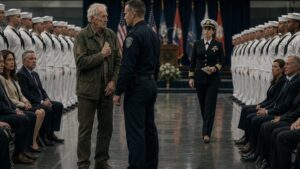
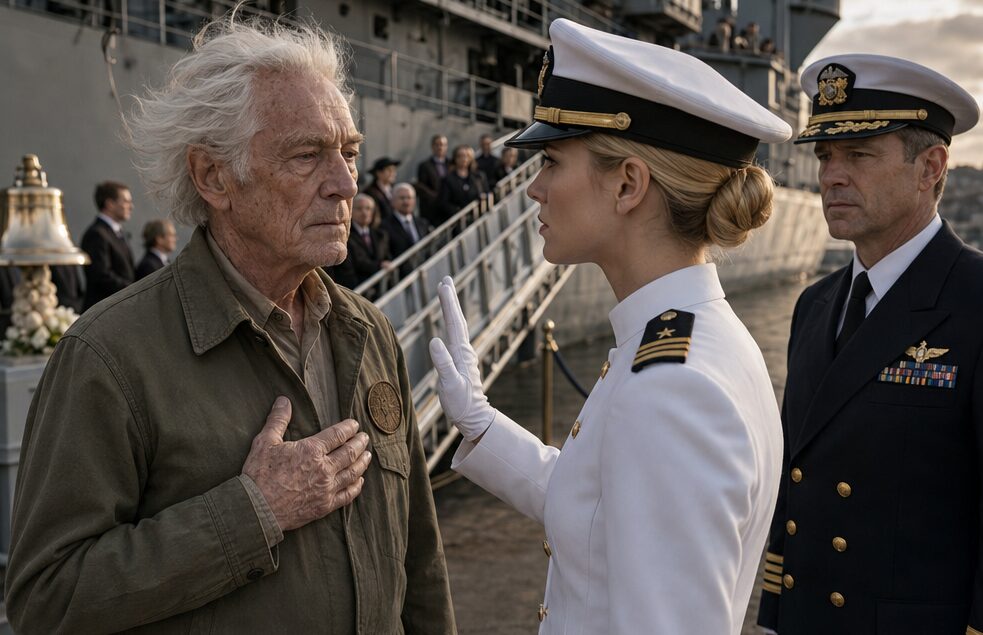
The young officer’s white-gloved finger stopped less than an inch from the patch over Gregory’s heart.
“Sir,” she said, loud enough for the line behind him to hear, “you can’t board with unauthorized insignia.”
For a moment, no one moved.
The afternoon heat shimmered off the gray side of the USS Calder, its old steel freshly painted for the reopening ceremony. Families waited in a roped line along the pier. Donors stood under a canopy with bottled water and small folded programs. A brass band was warming up near the gangway, the notes coming out in broken pieces.
Gregory stood at the front of the line in a faded olive jacket that looked too warm for the weather and too old for the event. His white hair lifted slightly in the wind off the harbor. His invitation was folded in one hand.
The officer in front of him was young, straight-backed, and polished so thoroughly she seemed almost unreal. Her blonde hair was pinned tight beneath her cap. Her white dress uniform had not a crease out of place.
Her name tag read CARTER, but Gregory never looked at it.
He looked only at her finger.
Then at the patch.
It was round, darkened by age, and stitched by hand over the left side of his chest. The thread had been repaired more than once. Part of the border had gone soft. Whatever image it once carried clearly had meant something to someone, but time had worn it down until it looked less like a symbol and more like a scar.
Gregory said, “I was invited.”
His voice was quiet. Not weak. Quiet.
The officer lowered her hand but did not step aside.
“I understand,” she said. “May I see your credentials?”
He gave her the paper invitation.
She read it quickly. “This admits you to the public dedication. It doesn’t authorize display of unlisted decorations or unit markings.”
A man behind Gregory laughed under his breath.
Someone else muttered, “Stolen valor gets uglier every year.”
The words reached Gregory. His face did not change.
That was what made Laura Carter hesitate for half a second.
Most people got defensive when accused. Some got angry. Some became loud, as if volume could make false things true. This old man did none of that. He simply stood there with the calm of someone who had heard worse from louder people and survived both the sound and the silence afterward.
But calm could be performance too.
Laura had been assigned to ceremony security for a reason. She noticed what others missed. Wrong pins. Incorrect ribbons. Family members stepping where they should not. Donors trying to bring guests who had not been cleared. Veterans’ groups whose patches matched the approved list.
This one did not.
“Sir,” she said, firmer now, “I can let you board if you remove the jacket.”
Gregory looked past her toward the ship.
Up on the rail, under a dark cloth, sat the memorial bell.
His hand tightened around the paper invitation.
“The jacket goes aboard,” he said, “or I go home.”
The line shifted behind him. A woman sighed. A photographer turned, sensing the shape of a scene.
Laura felt the attention gather around her shoulders.
She had been warned that ceremonies like this were magnets for people who wanted to attach themselves to history. Some came with real stories. Some came with borrowed ones. Her job was not to judge the ache in anyone’s face. Her job was to protect the ceremony from becoming a stage for false claims.
“Then I’ll need you to step aside,” she said.
Gregory looked at her at last.
His eyes were pale, steady, and tired in a way that did not ask for pity.
“Of course,” he said.
That was all.
No protest. No explanation. No attempt to shame her. He stepped out of line, his old shoes careful on the painted pier, and followed where she pointed.
It would have been easier for Laura if he had argued.
Instead, he obeyed like a man who knew the cost of orders.
Part II — The Bell Under the Cloth
Laura guided him to the side of the gangway, close enough that the ship filled the sky above them but far enough that the boarding line could continue moving.
The ceremony resumed around them as if nothing important had happened.
Children held paper flags. Older couples took photographs beside the ship’s name. A local official practiced his remarks with two fingers pressed to his earpiece. The band found its rhythm and then lost it again.
Gregory stood with his hands folded over the invitation.
Laura kept her place beside him.
She told herself she was being professional, not punitive. Still, she could feel people glancing over. The old man in the faded jacket. The young officer guarding him. The patch.
That patch kept drawing her eyes back.
The stitching was not neat enough for a collector. The fabric beneath it had faded differently from the rest of the jacket, as if it had been moved from another garment long ago. On the lower edge, one loose thread hung free and trembled whenever the harbor wind passed.
Gregory touched it once, gently, with the tip of his thumb.
Not like a man protecting evidence.
Like a man checking a pulse.
“Sir,” Laura said, lowering her voice, “if this is a family item, you can explain that.”
He did not answer.
“If it belonged to someone else, there may be a way to document it.”
Still nothing.
The silence irritated her more than defiance would have. Not because it was rude, but because it made her feel as though she was the one standing in the wrong place.
“I’m trying to help you,” she said.
Gregory’s gaze remained on the covered bell.
“No,” he said. “You’re trying to keep things in order.”
Laura stiffened. “That is my assignment.”
“It’s not a small one.”
The answer disarmed her.
He was not mocking her. He meant it.
The band stopped. A speaker announced that the public would be seated within ten minutes. The first group of guests began climbing the gangway. Their shoes rang softly against the metal, one after another.
Gregory watched each step.
Laura followed his gaze to the bell.
It was not especially large. Polished brass beneath the cloth, she guessed, mounted on a temporary stand near the rail for the dedication. The program called it a symbolic restoration of the Calder’s “rescue legacy.”
She had read the packet twice that morning.
Commissioned decades earlier. Later decommissioned. Now reopened as a public memorial and museum. Known for humanitarian assistance, evacuations, and service during tense years no one at the podium would name too directly.
It was all clean in the program.
Clean words. Clean photographs. Clean history.
Gregory suddenly closed his eyes.
Just for a second.
Laura saw his jaw tighten.
“Are you all right?” she asked.
He opened his eyes. “Yes.”
“You looked—”
“I’m all right.”
But he was not looking at her anymore.
He was looking at the bell as if it had called him by a name no one else knew.
A sound cracked through his memory.
Not the band. Not the crowd.
Metal under a fist.
Tap. Tap. Tap.
A young man’s hand drumming against a bulkhead because he could not stay still. Sleeves rolled badly. Red hair darkened by seawater. A grin that came too easily for a night that had none left to spare.
Gregory blinked the memory away before it could take shape.
He had promised himself he would not come undone at the pier.
He had made a smaller promise before that.
A much older one.
The officer beside him said, “I’m going to call my superior.”
Gregory nodded once.
The loose thread on the patch fluttered again.
He pressed it flat with two fingers.
“Do what you have to do,” he said.
Part III — The Name the Captain Knew
Captain David Walker arrived with the controlled pace of a man trained never to appear rushed in public.
Laura saw him before Gregory did. Dark formal uniform. Gold trim. Peaked cap. Face composed enough to calm a room without asking permission.
Relief moved through her.
Now this would be settled.
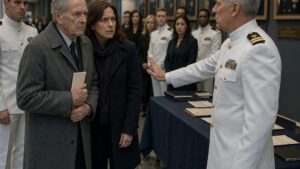
“Captain,” she said, stepping forward. “This gentleman has an invitation, but he’s wearing an unverified patch. I asked him to remove the jacket before boarding.”
David’s eyes moved from Laura to Gregory.
Then to the patch.
The change in him was small, but Laura saw it.
His mouth tightened. His shoulders, already straight, became still in a different way. Not formal. Stunned.
Gregory saw it too.
For the first time since Laura had stopped him, something like regret crossed his face.
David took one step closer.
“Chief Hayes?”
The name landed between them like a dropped object.
Gregory looked down.
“Not anymore.”
Laura felt heat climb into her face.
Chief.
The word did not prove anything by itself. Plenty of retired men preferred old titles. But David had not said it with doubt. He had said it carefully, almost unwillingly, as if he had found something fragile in public and wished he could cover it before anyone else noticed.
David removed his cap.
Laura had never seen him do that outside a formal moment.
“Sir,” he said quietly, “we weren’t told you were coming.”
Gregory glanced at the ship. “That was intentional.”
“The invitation list came through the foundation.”
“I know.”
David’s eyes returned to the patch. “Is that his?”
Gregory’s hand closed over it.
Laura waited for someone to explain.
No one did.
The ceremony coordinator waved from the ship and pointed at his watch. David lifted one finger in acknowledgment without looking away from Gregory.
“Lieutenant,” David said to Laura, “come with me for a moment.”
Laura followed him a few steps away, close enough to keep Gregory in sight.
Her mouth had gone dry.
“Sir, I followed the protocol sheet.”
“I know.”
“It wasn’t on the approved list.”
“I know.”
“Then who is he?”
David looked toward Gregory, who stood alone beside the gangway, old jacket moving slightly in the wind.
“A man who should have been on more lists than he was.”
Laura said nothing.
David’s voice lowered further. “Have you heard of Operation Lantern?”
“No, sir.”
“You wouldn’t have. Most people haven’t.”
He glanced toward the crowd, then toward the covered bell.
“The Calder took part in an evacuation during a communications blackout. Official records were thin for years. Some still are. A vessel went dark. People were trapped. Orders were to maintain silence until higher command confirmed the situation.”
Laura waited.
David’s jaw flexed once.
“Gregory was communications chief. He broke silence long enough to send a rerouted signal. That signal helped bring survivors out.”
Laura turned back toward the old man.
He looked smaller now, not because he had changed, but because the space around him had.
“How many?” she asked.
“Dozens.”
The answer should have brought relief.
David did not let it.
“Three sailors followed the relay point he opened and never made it back.”
The band began again behind them, bright and wrong.
Laura heard her own earlier words return.
Unauthorized insignia.
Remove the jacket.
Step aside.
“Was he disciplined?” she asked.
“No. Not officially. Not honored properly either. The operation stayed sealed long enough that the clean version became the public one.”
“And the patch?”
David looked at it again.
“I believe it belonged to one of the three.”
Laura swallowed.
Gregory had not tried to prove her wrong.
That was the part that made her feel worst.
He had simply allowed her to misunderstand him because explaining would have required taking something private and spreading it on the pier.
She looked down at her white gloves.
They suddenly seemed too bright.
Part IV — The Program With Missing Names
Laura found the ceremony program folded on a small table beside the reserved seating area.
She should have left it alone. David had not ordered her to investigate. The ceremony was minutes from beginning. Guests were already taking seats on the pier and along the ship’s deck.
But she opened the program anyway.
The Calder’s legacy was printed in smooth paragraphs.
Rescue operations. Service. Courage. Preservation. Community. Memory.
There was a list of honored personnel from notable missions.
No Gregory.
No Joseph.
No two other names David had mentioned in passing when a staff member interrupted them: Matthew Price and David Collins.
Laura read the list again, as if the names might appear because she wanted them to.
They did not.
The omission felt different now from a clerical gap. It felt like a door left closed because opening it would disturb the room.
She carried the program back toward David.
Gregory stood beside him now, but not as a guest being escorted. More like a witness being asked to step into a place he had spent years avoiding.
David said, “We can board you quietly. I’ll see that the record is reviewed after today.”
Gregory gave a faint, humorless smile. “After today is where records go to rest.”
Laura stopped.
David noticed the program in her hand.
Gregory noticed her face.
“You found the missing space,” he said.
Laura did not know how to answer.
“I’m sorry,” she said.
The words came too quickly. Too small.
Gregory looked at her then, really looked at her. Not with anger. That might have been easier. His expression carried something worse: understanding.
“You were doing your job,” he said.
“I was wrong.”
“Yes.”
The word was not cruel.
That made it heavier.
Laura held out the program. “Their names aren’t here.”
“No,” Gregory said.
“Were they supposed to be?”
A pause.
The band finished its warm-up. Applause rose from somewhere near the canopy as the first speaker approached the lectern.
Gregory’s hand went to the patch.
“This was Joseph’s,” he said.
The name changed the air.
Not much. Just enough.
“He used to tap on pipes when he was nervous,” Gregory continued. “Drove everyone half mad. Said quiet made him think too much.”
His thumb pressed the frayed edge.
“That night, he asked me one thing. If the story ever came up clean, make it dirty again.”
Laura stared at him.
Gregory’s mouth trembled once, then steadied.
“He didn’t use those exact words.”
“What did he say?”
Gregory looked toward the ship rail, where the covered bell waited.
“He said, ‘Don’t let them polish us out of it.’”
The line entered Laura and stayed there.
David’s eyes closed briefly.
On the platform, a woman began thanking donors.
Gregory turned the program over in his hand.
“It was never about putting my name anywhere,” he said. “Mine has been in enough rooms. Not always kindly, but it survived. Joseph’s didn’t. Matthew’s didn’t. David’s didn’t.”
Laura flinched slightly at the last name because the captain shared it. David Walker did not.
Gregory noticed.
“Names belong to more than one person,” he said. “That’s why you have to say the right ones.”
The ceremony speaker reached the phrase printed in the program.
“Today we honor the Calder’s proud rescue legacy—”
Gregory looked down.
For a moment, Laura thought he would leave.
Instead, he folded the program carefully and handed it back to her.
Then he turned toward David.
“When do they ring the bell?”
David’s face changed.
“After the remarks.”
“How long?”
“Two minutes. Maybe less.”
David stepped closer. “Gregory, let me handle this.”
Gregory gave him a tired look. “That’s how it got handled the first time.”
Part V — Before the Papers Knew
David moved with him, blocking half a step without making it look like a block.
“We can correct it,” David said. “Properly. Respectfully. I’ll personally make sure the foundation issues an addendum.”
Gregory looked at the seated guests, the cameras, the prepared remarks, the bell waiting to become part of a clean story.
“Addendum,” he said softly.
“It’s not nothing.”
“No,” Gregory said. “But it’s what comes after everyone has gone home.”
Laura heard the ceremony speaker invite David to the platform.
The captain did not move.
The crowd began to look around for him.
Laura stood between what she had done and what she still might do.
“I should apologize publicly,” she said suddenly.
Both men looked at her.
Laura’s throat tightened, but she forced herself on. “I stopped you in front of everyone. I questioned your integrity. I should say I was wrong.”
Gregory studied her.
“No.”
The answer struck harder than anger.
“Sir—”
“No,” he repeated. “Your shame won’t carry their names any better than my silence did.”
Laura had no defense against that.
David said, “Then what do you want?”
Gregory looked at the patch.
The memory came again, fast and incomplete.
Joseph’s hand tapping the bulkhead.
Matthew laughing once because fear had made everything absurd.
David Collins saying his wife would kill him if the sea didn’t get there first.
The signal opening.
The order he had broken.
The voices that came through because he broke it.
The three who followed the path his signal made.
The silence after.
Gregory had spent forty years knowing two truths that would not fit in the same sentence.
He saved them.
He sent them.
Every ceremony wanted only the first truth.
Every nightmare brought the second.
He took a breath.
“I want to ring the bell once,” he said.
David’s face hardened with concern. “That’s not on the program.”
Gregory almost smiled. “I noticed.”
The speaker at the lectern turned toward them, still smiling, trying to fill time. Guests shifted in their seats. The photographer raised his camera.
Laura saw the moment narrowing.
If Gregory waited, the bell would ring clean.
If he moved, the ceremony would fracture.
David said, “If you do this, people will ask questions.”
“They should.”
“You don’t owe them the whole story.”
“No,” Gregory said. “But I owe three men the part they were in.”
He stepped toward the gangway.
Laura’s body moved before her mind did.
She stepped in front of him.
For one terrible second, everything returned to the beginning.
Her white glove.
His old jacket.
The patch.
The eyes of the crowd.
Gregory stopped.
He did not accuse her. He did not plead.
He simply waited.
Laura felt the weight of the first time she had lifted her hand. How certain she had been. How clean the rule had felt before it touched a life.
Behind her, the speaker said, “Captain Walker will now join us for the bell dedication.”
David did not answer the invitation.
Laura lowered her hand.
Then she stepped aside.
Gregory nodded once, not as forgiveness, not as absolution.
As permission accepted.
He began to climb.
Each step on the gangway gave back a hollow metal sound.
The crowd quieted as he passed.
No one knew yet what they were seeing. That was why they watched so closely.
An old man in a faded jacket walking toward a bell.
A young officer standing below with her white gloves at her sides.
A captain following, no longer controlling the moment.
Gregory reached the rail and stopped beside the covered bell.
The speaker looked helplessly toward David.
David gave one small nod.
The cloth was removed.
The brass shone in the sun.
Gregory stared at it for a long breath.
Then he removed the patch from his jacket.
Laura had not realized it was only partly stitched now. He worked the loose thread free with careful fingers, as if the patch might feel pain if handled roughly. When it came away, it left a darker oval over his heart.
He placed it beside the bell.
Not on top.
Beside it.
Then he faced the people below.
He did not raise his voice much.
“Permission to ring once,” he said, “for the men who were there before the papers admitted they existed.”
No one clapped.
No one moved.
David Walker stood behind him, his face pale beneath his cap.
After a moment, he said, “Granted.”
Gregory took the cord.
The bell rang once.
The sound went out over the pier, over the seated guests, over the donors and children and photographers, over the water that had kept more secrets than anyone standing there could name.
Gregory kept his hand on the cord.
“Joseph,” he said.
The name was plain.
Not dramatic. Not decorated.
Just spoken.
“Matthew.”
A woman in the crowd lowered her phone.
“David.”
Captain Walker’s chin dipped.
Gregory let go of the cord.
He looked at the patch beside the bell.
For forty years, he had imagined this moment as something larger. More formal. More complete. In his imagination, there had been documents, signatures, maybe a room with people who already understood.
Instead, there was a confused crowd, a stopped ceremony, a young officer who had mistaken memory for costume, and a bell that had finally said what paper would not.
It was enough.
Not enough to fix it.
Enough to stop carrying it alone.
Behind him, David Walker raised his hand.
The salute was slow, formal, and unmistakable.
Gregory did not return it at first.
His hand stayed at his side.
Then he turned.
His face was steady, but his eyes had changed. The grief had not left them. It had only been joined by something else.
He lifted his hand.
Not high. Not sharply.
Enough.
The crowd remained silent.
That silence was the first honest thing the ceremony had produced all afternoon.
Part VI — The Thread Left Behind
Afterward, people spoke softly, as if the ship had become a room where someone was sleeping.
The program did not continue exactly as planned. David Walker took the lectern and said very little. He did not explain Operation Lantern in detail. He did not turn Gregory into a hero for the convenience of the crowd. He said only that the Calder’s legacy had arrived with unfinished names, and that the dedication would not proceed without them.
Then he said Joseph, Matthew, and David again.
This time into a microphone.
The foundation director looked shaken. A staff member began making calls. Someone brought a pen and a clean sheet of paper to the memorial table. Laura watched as the three names were written by hand and placed beside the printed program.
Handwriting looked fragile next to glossy ink.
It also looked more alive.
Gregory stood near the rail after most of the crowd had moved below for the reception. The patch remained beside the bell until David quietly asked whether Gregory wanted it back.
Gregory did not answer right away.
Then he picked it up.
He held it in his palm like something both returned and not returned.
Laura approached him after waiting too long.
Her cap was tucked beneath her arm now. Her gloves were still on, though she wished they were not.
“Sir,” she said.
Gregory turned.
She had rehearsed several apologies. All of them sounded like speeches written to make the apologizer feel cleaner.
So she used none of them.
“I was wrong,” she said.
“Yes,” Gregory said.
The answer hurt less the second time.
“I’m sorry.”
He looked past her at the water.
“Don’t spend too much time being sorry. It can turn into another way of thinking about yourself.”
Laura absorbed that.
Then Gregory added, “But don’t skip it either.”
A faint, broken breath escaped her. Not quite a laugh.
“I won’t.”
They stood beside the rail without speaking.
Below, the donor who had muttered about stolen valor earlier lingered near the reception table, refusing to look up. Laura found she did not need him punished. The day had already done enough.
Gregory turned the patch over. On the back, threads crossed and recrossed in uneven lines. One of them had come loose, the same one he had pressed flat at the gangway.
He tugged it free.
It was no longer than Laura’s finger.
He held it out.
She stared at it.
“I can’t take that.”
“You can.”
“What is it for?”
“For the next program.”
Laura’s throat tightened.
Gregory placed the thread in her gloved palm.
“Rules matter,” he said. “Memory needs guarding. But rules without humility can mistake a memorial for a costume.”
Laura closed her hand around the thread.
It weighed nothing.
It felt impossible to drop.
“I’ll make sure their names stay,” she said.
Gregory looked at her carefully, as if measuring whether she understood the size of what she had promised.
Then he nodded.
“Good.”
David Walker came up the stairs behind them but stopped at a respectful distance. For once, he did not manage the moment.
Gregory put the patch into his jacket pocket instead of sewing it back over his heart.
Laura noticed.
He saw her notice.
“It made it aboard,” he said.
The words were simple, but his voice changed on the last one.
A small release. Not freedom. Not peace.
Something humbler.
Room.
He began walking toward the gangway.
No escort this time. No hand raised to stop him. No one asking him to prove what he had carried.
Laura stood at attention as he passed.
Gregory paused beside her.
For a moment she thought he might offer forgiveness, or correction, or one final sentence shaped like wisdom.
Instead, he looked at the pier, then at the ship, then at the place on his jacket where the patch had been.
“Some things get lighter,” he said, “only after you put them down in the right place.”
Then he stepped off the Calder.
Laura remained by the memorial table long after he disappeared into the crowd.
Beside the printed program, the handwritten names waited for replacement by something official. Joseph. Matthew. David.
She opened her palm.
The loose thread lay bright against the white glove.
For the first time all day, Laura took the glove off before touching what mattered.