The Empty Seat at the End of the Bar Remembered Everything
Part I — The Seat Nobody Offered
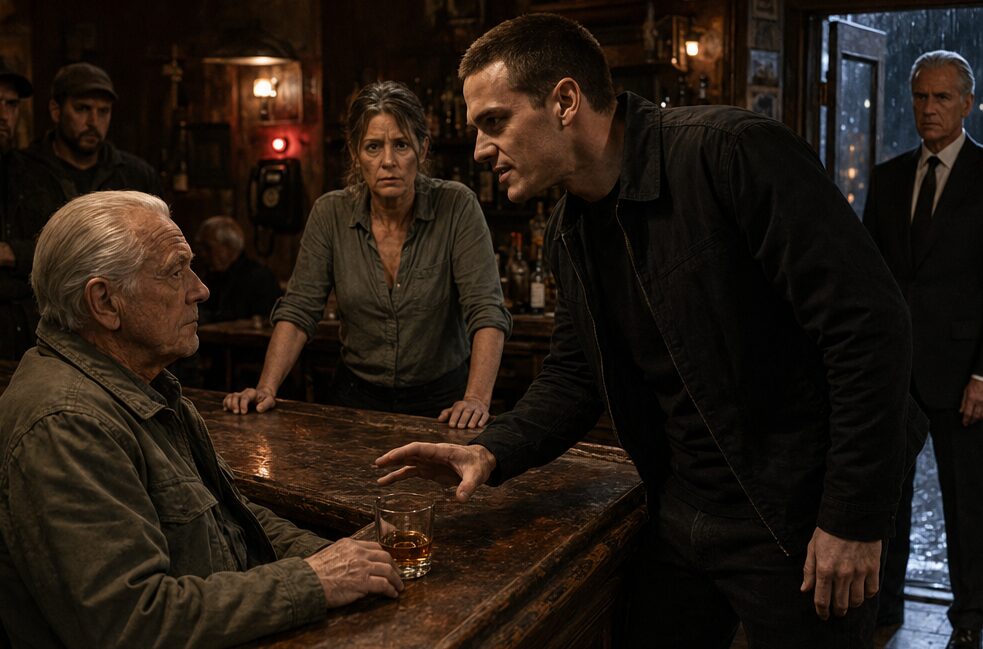
Jason leaned so close to the old man’s face that the room forgot how to breathe.
The old man did not move.
He sat at the last stool of The Lantern Room with one hand resting near a glass he had not touched. His white hair was combed back. His field jacket hung loose on his shoulders, faded at the elbows, the name strip torn away long ago. He looked too thin for the jacket now, too quiet for a room full of men who still believed volume was strength.
Jason smiled like he had found something easy to break.
“That seat’s for people who still matter,” he said.
The two men behind him laughed because they were expected to. They wore black contractor jackets like his, new boots, clean watches, hard faces. They had come in with the developer’s crew to make sure the final night did not get sentimental. No fights. No stolen memorabilia. No old men refusing to leave when the building changed hands in the morning.
The old man looked at Jason’s hand.
It was inches from the glass.
“Don’t touch that,” he said.
His voice was low enough that some people missed it.
Jason didn’t.
He looked down at the whiskey, then back at the old man. The glass held two fingers of amber light. It had been poured twenty minutes earlier by Mary, who had served it without asking, the way her father had taught her to do every year.
The old man had not lifted it.
Jason tapped the bar with one finger.
“This?” he said. “That what you’re protecting?”
Mary looked up from the register. “Jason. Leave him alone.”
The old man kept his eyes on the glass.
The Lantern Room was half-empty, though it had been packed in its better years. Old photographs had already come off the walls, leaving pale rectangles in the wood paneling. A few framed patches and folded flags still waited by the back office door. The jukebox was unplugged. The neon sign over the bar flickered like it was tired of pretending.
Tomorrow, the building would belong to a company with glass renderings and a parking structure. Tonight, it belonged to whoever could stand the smell of old varnish and endings.
Jason straightened and looked around the room.
“You all hear that?” he said. “Man won’t drink it. Won’t leave it. Just sits here guarding it.”
No one answered.
The old regulars looked into their own glasses. Mary set both hands on the bar, knuckles pale.
The old man’s face did not change.
That bothered Jason more than anger would have.
“You got a name, old-timer?” Jason asked.
The old man said nothing.
Jason glanced at the jacket. “Or did that fall off too?”
One of his friends made a small sound that tried to be a laugh and failed halfway.
Mary came down the bar fast. “Enough.”
Jason held up one hand. “I’m just trying to understand the dress code. Guy shows up in a jacket like that on closing night, takes the best seat in the place, stares at a drink he won’t touch.”
He leaned in again.
“You one of those guys who tells stories for free rounds?”
The old man’s eyes lifted then.
Not fast. Not sharp. Just enough.
Jason saw them and hesitated.
Only for a second.
Then he remembered who he was in the room: thirty-two years old, broad-shouldered, paid to enforce the new owner’s rules, son of a man who had come home angry and never stopped being angry. Jason had grown up knowing the difference between real service and old men who polished lies until they shone.
“My father actually served,” Jason said. “He didn’t spend his life rotting in bars.”
Something shifted in the old man’s face.
It was so small Mary almost missed it.
Almost.
“Jason,” she said again, softer now.
But Jason had seen the shift too, and he mistook it for fear.
That made him bolder.
He reached for the glass.
The old man’s hand moved first.
Not far. Not fast enough to seem threatening. Just enough to cover the space between Jason’s fingers and the whiskey.
Jason stared at the old hand.
The veins were raised. The skin was thin. But the hand did not shake.
“Don’t,” the old man said.
Jason’s smile vanished.
“What did you say?”
The old man looked at him fully.
“I said don’t.”
The room went quiet enough to hear the red signal light blink behind the bar.
Part II — The Red Light
The little red light sat beside the old wall phone near the office door. It had been there for decades, wired by Mary’s father for reasons no one remembered clearly. Sometimes it blinked when the office line was active. Sometimes it blinked when there was no call at all.
Jason noticed it because the room had gone still.
He pointed at it.
“What’s that? Museum alarm?”
Mary didn’t look away from him. “Back office line.”
“Looks broken.”
“A lot of things in here are old and still work.”
The words landed harder than she meant them to.
Jason’s jaw tightened.
The old man was staring at the light.
Not at Jason. Not at Mary. At the light.
Blink.
Pause.
Blink-blink.
Pause.
His fingers curled once against the bar.
For one breath, the bar was gone from his eyes. The room, the contractors, the closing night—gone. Something else had him. Something with cold air and metal and voices cutting in and out. The red light blinked again, and the old man’s face seemed to draw inward around a sound no one else could hear.
Jason saw the change.
He picked up the glass.
Mary said, “Put it down.”
Jason slid it away from the old man, just far enough to make the gesture public.
A chair scraped somewhere behind them.
The old man did not reach for it.
He looked at Jason’s hands.
Then he said, “Your father had the same hands when he was scared.”
The sentence did not explode.
It entered the room quietly and changed every face.
Jason went still.
“What?”
The old man said nothing more.
Jason stepped closer, but now his anger had a crack in it. “What did you say about my father?”
Mary’s eyes moved to the old man. “Edward.”
It was the first time anyone had said his name that night.
Edward did not look at her.
Jason heard it and repeated it with contempt, as if naming him would make him smaller. “Edward. Okay, Edward. You knew my father?”
Edward’s hand returned to the place where the glass had been.
“Let it be,” he said.
Jason laughed once. It sounded wrong. “No. You don’t get to do that. You don’t get to sit here like some silent saint and toss out a line about my father.”
Mary came around the bar. She was in her late forties, sleeves rolled to the elbow, silver in her brown hair, tired in a way closing a place could make a person tired. She planted herself between Jason and Edward, though Jason was bigger than she was.
“He’s been coming here since before you were born,” she said. “He gets that seat tonight.”
Jason looked past her at the pale rectangles on the walls.
“Place is done, Mary. The seat, the walls, the stories. All of it. Tomorrow it’s inventory.”
Edward flinched at none of it.
That, too, irritated Jason.
“You hear me?” Jason said. “It’s over.”
Edward finally stood.
Not all the way. Just enough to reach the glass Jason had moved. He took it back without drinking from it and set it in its original place.
Then he sat again.
Jason’s friends exchanged a look.
One of them muttered, “Let’s just go outside.”
Jason ignored him.
“My father said men like you were the reason he never slept,” he said. “Men who came back clean. Men who got salutes. Men who let everyone else carry the mess.”
Edward’s eyes dropped to the whiskey.
For a moment, the room saw the age in him.
Not weakness.
Weight.
“Your father came home,” Edward said, “because someone else didn’t.”
Jason’s face changed.
It was anger, yes.
But under it was something younger.
Something that had once sat at the edge of a bed listening to a father shout in his sleep.
“What the hell do you know?” Jason asked.
Edward did not answer.
The red light blinked again.
Mary looked toward the back office, then toward the locked cabinet beneath the old photographs she had not yet packed.
Her father had left instructions in an envelope.
She had spent the whole week pretending she did not remember them.
Part III — The Man at the Door
The front door opened at 9:17.
Cold air moved through the bar, carrying rain and streetlight.
A man in a dark suit stepped inside and stopped just past the threshold. He had silver hair, polished shoes, and the stillness of someone who expected rooms to arrange themselves around him. Several men recognized him before they remembered how.
Steven.
Retired colonel. Charity board member. Public face of the foundation that had promised to “preserve local service history” before the developer took the building. He had shaken hands in this bar two weeks earlier beneath a photographer’s flash.
Jason recognized him too.
Relief crossed Jason’s face first. Then confidence.
“Good,” Jason said. “Maybe you can tell him he needs to clear out.”
Steven did not seem to hear him.
He was looking at Edward.
The room watched the recognition strike him. It did not arrive as warmth. It arrived like a bill finally brought to the table.
Steven crossed the room slowly.
Edward remained seated.
The whiskey waited by his hand.
When Steven reached him, he did not offer a handshake.
He stood straight.
His voice lowered.
“Sergeant Edward.”
Jason blinked.
Mary closed her eyes for half a second.
Edward’s mouth tightened. “Don’t do that.”
But Steven had already raised his hand.
The salute was not theatrical. It was restrained, formal, almost painful. The kind of gesture a man gives when he knows it is too late and necessary anyway.
No one moved.
Jason stared at Edward as if the old man had changed shape.
Edward did not return the salute.
He looked embarrassed by it.
Worse than embarrassed.
Angry.
“Put your hand down,” he said.
Steven lowered it.
Jason stepped back, his voice rough now. “You know him?”
Steven looked at him for the first time. “Yes.”
“Then tell him to explain what he meant about my father.”
Steven’s eyes moved from Jason to the glass, then to the blinking red light, then back to Edward.
“Is that why you came tonight?” Steven asked. “To tell it?”
Edward’s answer was immediate.
“No.”
“Then why?”
Edward touched the bar with two fingers. “I made a promise.”
Steven’s face changed again. The room could not read it, but Edward could.
Jason could not stand being outside the meaning.
“What promise?” he demanded. “What story? Why did he say my father came home because someone else didn’t?”
Edward looked at Mary. “Don’t.”
Mary’s lips parted.
She glanced toward the back office.
Steven saw the glance.
So did Jason.
“What’s back there?” Jason asked.
Mary said nothing.
Edward turned toward Steven. “You don’t get to open this.”
Steven’s jaw flexed. “No. I don’t.”
Jason stepped between them. “Somebody does.”
Edward looked at him then, and for the first time his calm seemed less like refusal and more like protection.
“You want your father back clean,” Edward said. “I understand that.”
Jason’s face hardened. “Don’t talk like you knew him.”
“I knew him before you did.”
The words hit.
Jason’s hands curled.
Steven said, “Jason—”
“No,” Jason snapped. “You all know something, and you’ve been standing here like it’s a private club. My father died thinking the Army left him to rot and decorated cowards. If this old man was there, if you were there, I want the truth.”
Edward looked at Steven.
Steven looked away.
That told Jason enough.
“You helped bury it,” Jason said.
Steven did not answer.
Edward did.
“Yes.”
It was one word.
It took the room down with it.
Mary turned and walked to the back office before she could change her mind.
Edward said her name, but she did not stop.
She returned carrying a wooden box darkened by age, with a brass latch and her father’s handwriting taped across the top.
For Edward, if he comes on the last night.
Edward stood so fast the stool scraped.
“No.”
Mary held the box like it was heavier than wood. “My father made me promise.”
“He had no right.”
“He said you’d say that.”
Edward’s face had gone pale.
Jason reached for the box.
Edward caught his wrist.
The grip was not hard enough to hurt. It was hard enough to stop him.
“The story belongs to the ones who aren’t here first,” Edward said. “If you want it, you hear all of it.”
Jason swallowed.
“Including the part about your father?” Edward asked.
Jason pulled his wrist free.
“Yes.”
Edward looked at him a long time.
Then he nodded once.
Mary set the box on the bar.
The red light blinked behind her like it had been waiting.
Part IV — The Box Beneath the Bar
Inside the box were four things.
A field notebook swollen at the edges.
A folded notice yellowed along the creases.
A damaged unit patch.
A cassette tape with a date written in black marker.
Jason stared at the tape.
Steven stared at the notebook.
Edward stared at none of it.
He looked at the whiskey.
Mary whispered, “Dad kept this all these years?”
Edward’s voice was flat. “Jerry kept things he should’ve burned.”
Mary’s eyes filled, but she blinked it back. She had spent the week selling chairs, taking down photographs, sorting the past into boxes marked keep, donate, trash. Now she understood her father had left one box unsorted because he knew she could not judge what it contained.
Jason picked up the notebook.
Edward’s hand came down over it.
“No.”
Jason’s anger rose again because shame had nowhere else to go. “That’s my father’s history.”
“It’s not only his.”
“He lived like a guilty man.”
Edward’s eyes lifted. “He was one.”
Silence.
Jason’s face tightened as if he had been struck.
Steven said, “Edward.”
Edward looked at him sharply. “You don’t get to soften it now.”
Mary set the cassette beside the glass. “What happened?”
For a while, Edward did not speak.
The bar waited.
Finally, he placed his hand flat on the old wood.
“There was an evacuation,” he said. “A bad one. Night extraction. Radio breaking up. Too many wounded. Not enough room.”
No one interrupted.
“I was a medic,” Edward said. “Not a commander. I didn’t make the plan. I didn’t pick who mattered.”
Steven closed his eyes.
“But I carried who I could.”
Jason’s breathing had changed.
Edward touched the field notebook with one finger, not opening it. “Your father was hurt. Scared. He had every right to be scared.”
Jason looked down.
“He kept saying he couldn’t feel his legs,” Edward continued. “He could. He just couldn’t believe they still belonged to him. That happens. The body survives before the mind agrees.”
Jason’s mouth trembled once, then stopped.
Steven spoke quietly. “The order was to take the ranking officer and the mobile wounded first.”
Edward turned to him. “The order was to leave two men.”
Steven did not deny it.
Mary’s hand went to her throat.
Edward looked at Jason. “Your father wasn’t supposed to make it onto the first vehicle.”
Jason’s eyes sharpened.
“But he did,” Edward said.
“How?” Jason asked.
Edward did not answer immediately.
His gaze moved to the whiskey glass.
The room followed it.
“That glass belonged to Jerry,” Edward said. “Mary’s father mailed it overseas in a care package. Stupid thing to send. Heavy. Breakable. Useless.”
Mary gave a small, wounded laugh.
Edward almost smiled, but it disappeared before it became one.
“We passed it around before bad nights,” he said. “Not with whiskey. Water, mostly. Coffee if we had it. The joke was whoever made it back to The Lantern Room had to buy the first real drink.”
Jason stared at the glass now as if it had become dangerous.
“The man holding it that night was named Jerry,” Edward said.
Mary’s head snapped up.
Edward did not look at her. “Not your father. Another Jerry. He used to say having two Jerrys in one story was bad bookkeeping.”
A breath moved through the room. Small. Sad.
“He was hurt worse than your father,” Edward said to Jason. “But his mind was clear. Clearer than anyone’s.”
Jason’s voice was thin. “What did he do?”
Edward’s hand tightened.
“He gave up his place.”
No one spoke.
“He grabbed my sleeve and told me to take your father. Said your father had a boy coming someday, even if he didn’t know it yet.”
Jason shook his head. “He couldn’t know that.”
“No,” Edward said. “He couldn’t.”
The words were plain.
That made them worse.
“He was making a reason because we needed one.”
Jason looked at the glass again.
Edward’s voice lowered. “I dragged your father out. Then I went back.”
Steven turned away.
“For Jerry?” Mary asked.
Edward nodded.
The red light blinked once.
“I came back with the glass,” Edward said. “Not him.”
Mary covered her mouth.
Jason’s anger had drained into something more unstable.
“My father knew?”
Edward nodded. “He remembered enough.”
“But he said they abandoned him.”
“They did,” Steven said.
Edward looked at him.
Steven held the look this time.
“We did,” Steven corrected.
The room seemed to tilt.
Steven’s voice lost its polish. “The report removed the order. Removed the choice. Removed Jerry’s name from the part that mattered. It made the extraction sound cleaner than it was.”
“Cleaner,” Edward repeated.
Steven’s face tightened. “I was young. I thought protecting the command meant protecting the families from an uglier truth.”
Edward looked at the box.
“The silence spared no one.”
Jason’s head lowered.
For the first time that night, he looked less like a man trying to win and more like a son who had spent his life arguing with a locked door.
“Why didn’t you tell him?” Jason asked. “My father.”
Edward’s answer came slowly.
“Because when I found him after, he had torn the name strip off his jacket. Said he didn’t deserve to be called by it.”
Jason looked up.
“I thought if I gave him the whole truth, it would finish what that night started.”
“And did silence save him?” Jason asked.
Edward’s eyes stayed on the glass.
“No.”
Part V — The Seat for the Ones Who Didn’t Come Home
Mary found the old cassette player beneath the register.
It had belonged to her father, like everything else that still worked when it had no business working. She set it on the bar with shaking hands and pushed the tape inside.
Edward did not ask her to stop.
That was the choice.
Not the telling. Not the box. Not the salute.
This.
Letting another voice enter the room.
The tape clicked.
For a moment, there was only static.
Then a young man laughed.
The sound was so alive that Mary stepped back.
“Jerry,” Edward whispered.
The voice on the tape was careless at first, teasing someone about mailing a fancy glass to a place where nothing stayed clean. Another voice in the background told him to shut up. Someone else laughed.
Then the voice came closer to the recorder.
“All right,” young Jerry said. “If any of you make it back to The Lantern Room before I do, save me the end seat. Not the wobbly one near the bathroom. The good one. And if I don’t make it, save it anyway.”
A pause.
No one in the bar moved.
The voice softened.
“Save a seat for the ones who don’t.”
The tape hissed.
Mary pressed both hands to the bar as if the floor had shifted beneath her.
Edward reached for the whiskey.
Jason stiffened, thinking he would finally drink.
He did not.
Edward lifted the glass with both hands. He carried it to the empty stool beside him—the one no one had sat in all night, though the bar was nearly bare and every chair had been for sale.
He set the glass there.
Not in front of himself.
In front of the empty seat.
The gesture was small.
It changed the room more than shouting could have.
Steven straightened.
His hand rose first, but this time his face held no ceremony. Only grief. He saluted the empty stool, then Edward.
Mary followed, not with a salute, but by placing her hand over her heart.
One of the old regulars stood.
Then another.
Jason did not move.
His contractor badge hung from his jacket, bright and plastic and suddenly ridiculous.
He unclipped it.
The small sound of it hitting the bar carried.
He stepped back from Edward.
His hand rose awkwardly, as if his body knew the shape before his pride did.
The salute was clumsy.
It was also real.
Edward looked at him.
No forgiveness passed between them. Not yet. Maybe not ever in the easy way people liked to imagine.
But something did pass.
A burden changed hands without leaving Edward empty.
Jason lowered his hand.
“I didn’t know,” he said.
Edward’s face remained still.
“That’s not the same as being innocent.”
Jason accepted the words because there was no defense left that would not make him smaller.
Steven looked at Edward. “I should have told it years ago.”
“Yes,” Edward said.
Steven swallowed. “I’m sorry.”
Edward did not answer.
That, too, was an answer.
The tape continued to hiss until Mary reached over and stopped it.
No one clapped.
No one spoke about honor as if naming it could repair what had been done to it.
Outside, rain tapped against the windows. Inside, the glass sat before the empty stool, catching the bar light as if it had been waiting forty years to be put down in the right place.
Jason looked at it, then at Edward.
“What was my father like before?” he asked.
Edward seemed almost too tired to answer.
Then he said, “He sang badly when he was scared.”
Jason’s mouth opened.
Nothing came out.
Edward looked back at the glass.
“He wanted people to think he was brave,” he said. “Most scared men do.”
Jason nodded once.
The line reached him where anger had lived.
Mary came around the bar and touched the old wood near Edward’s hand. “Dad knew?”
“Some,” Edward said. “Enough.”
“And he kept the box for you?”
Edward’s face softened for the first time all night.
“No,” he said. “He kept it for tonight.”
Part VI — What Remained on the Stool
By morning, the rain had stopped.
The developer’s crew arrived at eight with clipboards, dollies, and paper cups of coffee. They found Jason already there, standing outside The Lantern Room in the gray light, speaking to a supervisor who looked annoyed until he looked through the front window and saw Mary removing the memorial wall piece by piece.
Jason had bought her time.
Not much. A few hours. Enough to take down what mattered without treating it like debris.
The building would still be emptied.
The sign would still come down.
By spring, strangers would park where men once sat trying to remember how to be alive after coming home.
Edward arrived without the field jacket on his shoulders. He carried it folded over one arm.
Mary looked up from a box of photographs. Her eyes were swollen, but her voice was steady. “You don’t have to stay.”
“I know.”
Jason stood near the end of the bar, not touching anything.
The empty stool was still there.
The glass remained on the wood in front of it.
No one had moved it.
For several minutes, they worked without speaking. Mary wrapped framed patches in newspaper. Steven arrived in the same dark suit, less crisp now, and began unscrewing the old wall phone himself. Jason lifted chairs into a stack, then stopped at Edward’s stool.
“Can I help with this one?” he asked.
Edward looked at him.
Jason did not add anything. No apology. No explanation. No performance.
Just the question.
Edward nodded.
Together, they carried the stool out from the end of the bar.
It was lighter than Jason expected and heavier than he could explain.
At the door, Edward paused.
He reached into the pocket of the folded jacket and took out a narrow strip of cloth.
Jason saw the letters before he understood them.
COLE.
Edward held it out.
Jason did not take it at first.
“He tore it off after the evacuation,” Edward said. “Said he didn’t deserve his own name.”
Jason’s face broke in a quiet, almost invisible way.
Edward kept his hand extended.
“I kept it because I thought one day he might ask for it back.”
Jason’s fingers closed around the strip.
“He never did,” Edward said.
Jason pressed the cloth between both hands. For the first time, the name felt less like an inheritance he had to defend and more like a person he had never been allowed to know.
“Thank you,” he said.
Edward looked past him into the bar.
Mary had stopped working. Steven had stopped too.
No one interrupted.
Edward walked back inside one last time.
He stood before the empty stool.
The whiskey glass caught the morning light now, pale instead of amber.
Mary said, “Do you want to take it?”
Edward looked at the glass for a long time.
Then he shook his head.
“No,” he said. “It belongs to the seat.”
He turned toward the door.
Jason stepped aside.
Edward walked out without the glass, without the jacket on his back, without the story locked inside him the way it had been the night before.
Behind him, the stool remained.
The glass remained.
The room would be dismantled, the walls stripped, the name above the door taken down and carried away. But for a little while longer, before the workers came in with gloves and lists, there was still an empty seat at the end of the bar.
And this time, everyone knew who it was for.