The Promise She Carried Back Across the Desert That Morning
Part I — The Woman at the Line
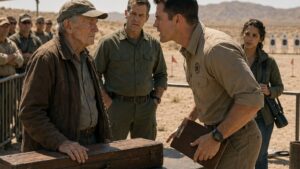
The old woman crossed the red safety rope like it had been put there for someone else.
Every head on the range turned.
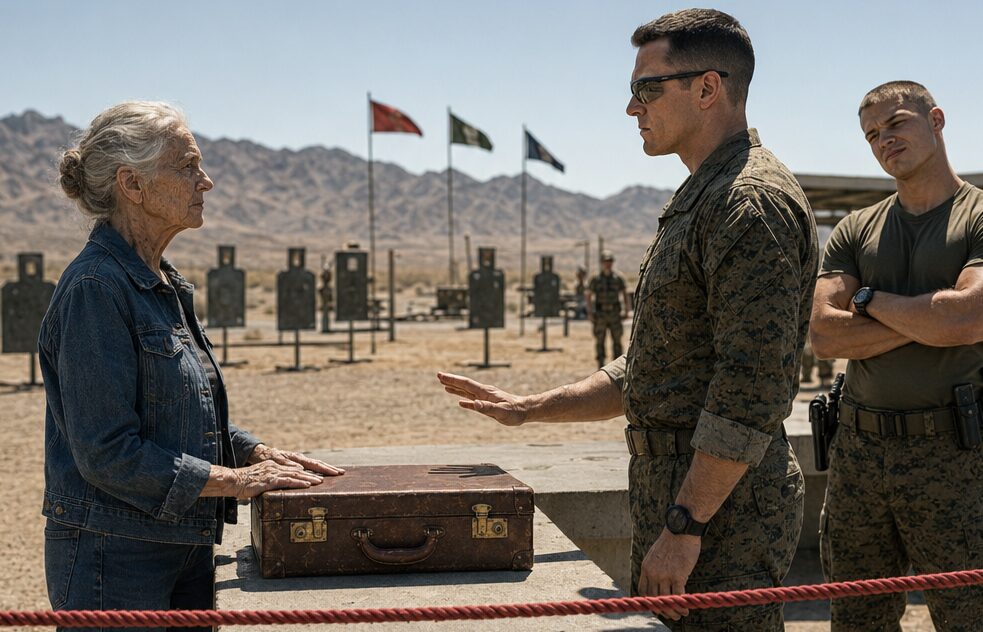
She was thin, upright, and moving slowly under the white desert sun, one hand curled around the handle of a scarred brown leather case. Brass latches flashed on its side. Dust clung to the hem of her denim jacket. Her silver hair was pinned so neatly it looked almost formal against the hard glare of the training field.
Captain Jack Miller stepped away from the firing bench at once.
“Ma’am,” he called, sharp enough to stop the young soldiers behind him. “You can’t be here.”
The woman did not stop.
Behind Jack, a broad-shouldered trainee lowered his modern scoped rifle and leaned toward the man beside him.
“Grandma wandered into the wrong movie,” he muttered.
The other soldier laughed before he could stop himself.
Jack shot them both a look, but the damage had already reached her. It hung in the bright air between the flags and steel targets.
The woman heard it. Everyone knew she heard it.
She kept walking.
That bothered Jack more than if she had shouted.
He was thirty-four, clean-cut, controlled, the kind of officer who could silence a room by setting down a coffee mug. His father had taught him early that discipline was not volume. It was pressure applied correctly.
So he did not raise his voice again.
He stepped into her path.
“This is a closed qualification range,” he said. “Live-fire area. You need to step back behind the rope.”
The old woman looked at his tactical glasses, his pressed range uniform, the badge clipped to his chest. Then she looked past him at the concrete bench.
“I have an appointment with the range commander.”
Jack kept his expression still. “Name?”
“Ruth Hayes.”
He checked the day’s roster on the tablet in his hand. Contractor team. Two armorers. Evaluation board. No civilians. No Hayes.
“There’s no appointment listed.”
“He knows I’m coming.”
“Colonel Anthony Harris is delayed. Until he arrives, I’m responsible for this range.” Jack’s gaze moved to the case. “What are you carrying?”
Ruth shifted her fingers on the handle.
“Something that belongs here.”
The trainee who had made the joke, Jason, gave a soft breath through his nose. Not quite a laugh this time, but close enough.
Jack felt irritation rise, partly at Jason, partly at the woman, partly at the way the entire range had stopped moving for a civilian who refused to understand danger.
“Ma’am,” he said, quieter now, “I’m going to ask you once more. Step away from the firing line and set the case down.”
Ruth did set it down.
Not behind the rope.
On the concrete bench in front of him.
Then she placed both hands flat on top of it.
There was nothing theatrical in the gesture. No threat. No challenge. But something about the way her palms settled on the worn leather made Jack think of a person touching a headstone.
“Do not move that case,” she said.
Jack’s jaw tightened.
“Are you refusing a lawful range instruction?”
“I’m refusing to let a stranger carry what he doesn’t understand.”
Jason shifted his weight. The other soldier looked away.
Jack reached for the case.
Ruth’s voice cut through the range.
“Don’t touch it unless you intend to carry the dead with it.”
The sentence did what no shouted command had done.
It made the desert quiet.
Jack’s hand stopped above the handle.
For the first time, he looked at her hands. They were sun-browned and narrow, the knuckles swollen with age, a plain wedding ring worn smooth against one finger. They trembled slightly, but not from fear. Not the way Jack understood fear.
“Open it,” he said.
Ruth studied him for a long second.
Then, slowly, she lifted the first brass latch.
The small click sounded louder than it should have.
Part II — Red Velvet
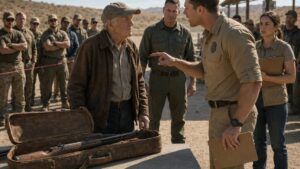
Ruth opened the case as if the air inside it needed permission.
The second latch gave with a dry metallic snap. The leather lid rose.
Inside lay an old long rifle, polished dark, its metal clean and its stock rubbed smooth by years of careful hands. It rested in faded red velvet, the cloth worn pale around the barrel. Beside it sat a folded cloth patch and a small envelope, yellowed at the edges.
Jack’s first reaction was anger.
Not because of the rifle.
Because of the patch.
He knew its shape before his mind admitted it. A narrow mountain line. A small silver star. The old emblem of a reconnaissance unit that had been disbanded before he entered service.
He had seen that patch framed in his mother’s hallway, beside a faded photograph of his father at twenty-seven.
Jack’s throat tightened.
“Where did you get that?”
Ruth did not answer immediately. She touched the velvet near the stock, not the rifle itself.
Jason leaned closer despite himself. “That thing even still work?”
“Brooks,” Jack snapped.
Jason straightened. “Sorry, sir.”
Ruth turned her head just enough to look at the younger man.
“It fires straighter than men who talk before they aim.”
Jason’s face went hot.
The other soldier coughed into his fist.
Jack should have moved her away then. He should have shut the case, called range control, and waited for Harris. Instead, he kept staring at the envelope.
Across the front, written in careful old ink, was one word.
Miller.
His name.
Or his father’s.
His pulse changed.
“My father was in that unit,” Jack said.
“I know.”
The answer landed too quickly.
Jack looked at her then, really looked. Not at her age. Not at the old boots, the jacket, the careful hair. At the calm in her face.
“How?”
Ruth lowered the lid halfway, but did not close it.
“Ask Colonel Harris.”
“I’m asking you.”
“Then ask better.”
Jason’s eyes flicked between them, entertained and nervous. Jack felt it, the slipping authority of the moment. A closed military range, a civilian woman at the bench, an antique rifle lying open like evidence, and his own name on an envelope he suddenly did not want to touch.
He stepped closer.
“You brought a firearm onto a restricted range without clearance.”
“It has been cleared before.”
“That doesn’t mean anything today.”
“It meant something then.”
Jack hated the way she spoke in doors instead of answers.
He took a breath. “You’ll remain here until Colonel Harris arrives. You will not approach the active lane. You will not handle that rifle without my authorization.”
Ruth gave the faintest nod.
“That sounds like something a man says when he thinks the range belongs to him.”
“It does today.”
“No,” she said. “Today it belongs to what you’re willing to remember.”
Jack almost told her to close the case.
He almost called security just to regain control of the scene.
Instead, because the patch had his father’s silence stitched into it, he said nothing.
For the next ten minutes, the range tried to return to motion.
It failed.
The soldiers resumed their qualification drills. Rifles settled on sandbags. Spotters called corrections. The radios crackled. A range officer raised and lowered flags.
Ruth stood several feet behind the bench, exactly where Jack had told her to stand. She did not argue. She did not wander. She did not ask for water. She watched.
That was all.
But Jack noticed her eyes.
When Jason took his next position, she watched his shoulder before he fired. When the rifle moved, she blinked once. When the spotter called the result, she seemed unsurprised.
Jason missed low.
He swore softly.
Ruth said nothing.
He adjusted.
Missed left.
Ruth’s gaze moved to his breathing.
Jack noticed because Jack had been trained to notice.
Jason fired again. Better, but still not clean.
Ruth finally spoke, almost to herself.
“He’s chasing the last mistake.”
Jason turned. “What?”
Jack said, “Ignore her.”
But Ruth had already looked away.
Jason clenched his jaw and fired again. Another poor mark.
The other soldier smirked. Jason’s confidence cracked at the edge.
Jack should not have cared that Ruth had been right.
He cared.
He walked toward her.
“You said you had an appointment. For what?”
Ruth kept her eyes on the range. “One target.”
“That’s not an answer.”
“It is the only one I came to give you.”
“You expect me to believe you walked onto a closed range to fire one round from a museum piece?”
Her face did not change.
“No.”
“Then what do you expect?”
Ruth looked at the envelope.
“I expect you to open what was left for you.”
Jack’s stomach tightened.
He had not touched the envelope. He did not want to. Anything inside that case had traveled too far to be simple.
“My father is dead,” he said.
“I know.”
“You knew him?”
Ruth’s mouth pressed into a line. Not sorrow exactly. Not nostalgia either.
“I knew him once.”
Jack waited.
Ruth did not continue.
“Once,” he repeated.
Her eyes returned to the firing lane.
“Yes,” she said. “Once.”
The word did not explain anything.
It made everything worse.
Part III — The Man Who Knew Her Name
Colonel Anthony Harris arrived in a white range truck with dust spinning behind the tires.
The moment he stepped out, Jack saw the day change.
Harris was sixty-two, rigid-backed, weathered, a man whose uniform looked less worn than endured. He moved like procedure had become bone. Usually, his presence settled a place.
This time, he saw Ruth and stopped.
Not for long.
Only a fraction.
But Jack saw it.
Ruth saw it too.
“Mrs. Hayes,” Harris said.
Not ma’am.
Not who are you.
Mrs. Hayes.
Ruth’s hands rested on the case again. “Colonel.”
Harris’s eyes dropped to the open lid. The rifle. The patch. The envelope.
His face went still in a way Jack had only seen during casualty calls.
“Why did you bring that here?”
“You stopped answering my letters.”
Jack turned to him. “Sir, you know this woman?”
Harris ignored the question. “We should talk in my office.”
“No,” Ruth said.
The refusal was calm, but it landed like a closed gate.
Harris lowered his voice. “This is not the place.”
“This is exactly the place.”
“Mrs. Hayes—”
“The promise was made on a range,” she said. “It will be settled on a range.”
Jason looked at Jack, no longer amused.
Jack looked from Harris to Ruth and felt something cold begin behind his ribs. “What promise?”
Harris’s mouth tightened. “Captain, clear the trainees to the south lane.”
“No, sir.”
The words left Jack before he had fully chosen them.
Harris stared at him.
Jack felt the weight of rank, training, reflex. He felt the old pressure to obey first and question later. His father had believed in that pressure. Or Jack had believed his father believed in it.
“My name is on that envelope,” Jack said. “My father’s patch is in that case. I’m asking what this is.”
Harris glanced at Ruth.
Ruth said nothing.
That silence did not protect him anymore.
Harris exhaled through his nose. “Your father served with my reconnaissance section during Operation Glass Ridge.”
Jack knew the name.
Not from briefings. Not from official histories. From fragments. A phrase his mother once said while clearing out a box. A line in his father’s service record. A shadow around certain anniversaries.
“A border evacuation,” Jack said.
“Yes.”
“My father received a citation for that operation.”
Harris’s eyes moved to the ground.
Ruth’s did not.
Jack felt his voice sharpen. “What does that have to do with her?”
Harris seemed to age in the silence.
“More than the record says.”
Ruth closed the case halfway, just enough to cover the rifle but not the envelope.
“No,” she said. “Say it properly, Anthony.”
Harris flinched at his first name.
Jack had never heard anyone on the range speak to him that way.
Harris looked toward the trainees, the flags, the open desert. Everything in him wanted walls. A door. A controlled statement.
Ruth gave him none.
“She was living near the relay station,” Harris said at last. “Her husband was contracted as a field radio operator.”
“Larry,” Ruth said.
The name was soft, but it did not bend.
Harris nodded. “Larry Hayes.”
Jack waited.
Harris continued, each sentence stiff, dragged out of him. “A convoy was misrouted during the evacuation. Communications failed. Sergeant Brandon Miller and five others were pinned below the north ridge.”
Jack stared.
Brandon.
His father’s name, spoken by Harris in that dry official voice, suddenly sounded like a stranger’s.
“My father told me he held the ridge,” Jack said.
Ruth looked down at the case.
“He tried.”
Harris’s eyes closed briefly.
Jack’s anger rose fast, because anger was easier than confusion. “What does that mean?”
“It means,” Ruth said, “your father was brave. It also means he was not standing when the last call came.”
Jason shifted behind him. No one told him to leave. No one wanted to move.
Jack heard his own breathing.
Harris said, “Her husband was wounded. Unconscious. The rifle was still in position.”
Jack understood the shape of the sentence before he accepted the words.
“No.”
Ruth did not argue.
That made it worse.
“No,” Jack repeated, quieter.
His father’s photograph flashed in his mind. Young, unsmiling, decorated. A man who had never spoken of the operation except to say, “Some things cost more than the paper they give you afterward.”
Jack had made that sentence noble.
Now it sounded like a warning.
Harris said, “She took the rifle.”
The range seemed too bright.
Jack turned to Ruth. “You?”
She met his eyes.
“There was no one else left on the ridge.”
No one spoke.
The wind moved grit along the concrete.
Jack wanted details and did not want them. He wanted to defend his father and knew too little to do it. He wanted to accuse her of lying, but Harris’s face had already confessed more than his mouth.
“Why wasn’t this reported?” Jack asked.
Harris’s answer came too quickly. “It was complicated.”
Ruth gave a small, humorless breath.
Jack looked at Harris. “Complicated?”
“She was a civilian,” Harris said. “Her husband was attached to our relay team. The section was already under review for the misroute. There were questions about command decisions. About communications. About who authorized what.”
“And giving credit to a civilian woman would have made the report messy,” Ruth said.
Harris did not deny it.
Jack felt something inside him tilt.
His father’s citation. The framed patch. The silence at dinner when Jack asked too many questions. The way his mother once touched the medal box and shut the drawer without opening it.
“All these years,” Jack said, “you let my father take credit for something she did?”
Ruth’s voice was quiet.
“Your father did not let anything easily.”
Jack looked at her.
“He came to my house after,” she said. “Could barely stand on the porch. Tried to give me the citation. Tried to say he was a coward.”
Her fingers tightened on the leather.
“I told him cowards don’t come back to apologize.”
Harris looked away.
Jack swallowed. “Then why are you here?”
Ruth’s eyes moved to the envelope.
“Because your father asked me to come when you were ready.”
Jack almost laughed, but the sound died before it left him.
“I never asked for this.”
“No,” Ruth said. “Most debts arrive without asking.”
Part IV — The Letter He Wouldn’t Open
The envelope sat in the case between them, small enough to fit in Jack’s hand and heavy enough to stop the range.
He did not pick it up.
Ruth watched him not pick it up.
Harris stood beside the bench as if guarding a door that had already been opened.
“Your father left a statement,” Harris said.
Jack turned on him. “You knew?”
“Yes.”
“For how long?”
Harris’s face hardened, but not with authority. With shame trying to survive. “Since before he passed.”
Jack let out a breath. “And you buried it.”
“I preserved the integrity of the record.”
Ruth looked at him then.
Harris corrected himself, lower. “I preserved what I thought would hurt the fewest people.”
“That is what men call mercy when they are afraid,” Ruth said.
Jason stared at the ground.
Jack hated that Jason was there. Hated that the young soldier had heard the old woman mocked and now had to watch his captain become smaller in front of everyone. But maybe that was part of it. Maybe history always needed witnesses who had laughed too early.
Jack looked at the envelope again.
Miller.
His father’s name had been Jack’s compass. Not a warm compass. Not an easy one. Brandon Miller had been strict, distant, disciplined past tenderness. He checked locks twice. He polished boots he no longer wore. He never wasted words.
When Jack was fifteen, he had asked what courage felt like.
His father had answered, “Usually like being ashamed and moving anyway.”
Jack had thought that was wisdom.
Now he wondered if it had been memory.
“I don’t want to read it here,” Jack said.
Ruth nodded once. “Then don’t.”
That surprised him.
“You came all this way.”
“I came to keep my part. Not to force yours.”
Harris seized on it. “Then we can continue privately.”
“No,” Ruth said.
The word was not loud. It did not need to be.
She lifted the case lid again and touched the folded patch beside the rifle.
“Brandon said if the truth could not be written where men file their clean reports, then one day it should be witnessed by someone who carried his name.”
Jack’s throat tightened at his father’s first name in her mouth.
Ruth looked at him with a steadiness that did not ask permission.
“Your father spent his life trying to be the man they said he was. I came because he was better than that.”
The sentence struck him harder than accusation.
Because accusation he could fight.
This sounded like grief.
A call came over the radio. The south lane was clear for final demonstration. Targets were reset. Wind was acceptable. Evaluators waiting.
The ordinary rhythm of the range tried to return, absurd and impossible.
Jason, perhaps desperate to escape the silence, looked at the old rifle and said, too casually, “Even if the story’s true, can she actually hold that thing steady now?”
Jack turned so fast Jason stepped back.
“Enough.”
Jason’s face drained. “Sir, I didn’t—”
But Ruth raised one hand.
“Let him finish learning.”
Jason stared at her, ashamed now but still defensive.
Ruth looked past him to the far target line. “Set one target.”
Harris stiffened. “No.”
“Not a demonstration,” Ruth said. “Not a contest. Not a trick for boys with expensive glass.” Her eyes moved to Jack. “One target. The distance from the report.”
Harris’s voice sharpened. “Absolutely not. You are seventy-six years old. This is a controlled environment. There are procedures.”
Ruth turned to him fully.
“Procedure had no trouble using me when men were dying.”
No one breathed for a moment.
Harris’s mouth opened.
Closed.
The old woman’s face did not change, but Jack saw it then: not bitterness, not hunger for praise. Fatigue. The kind that settles into a person after carrying a story too long because everyone else found it convenient.
Jack reached for the envelope.
His fingers hesitated only once.
Then he opened it.
The paper inside was folded in thirds. His father’s handwriting was rougher than he remembered, less controlled, as if the words had been dragged through him.
Jack read the first line.
My son, if Ruth Hayes is standing in front of you, then I failed to do this while I was alive.
His vision blurred at the edges.
He read on.
Not all of it. Not yet. Enough.
Enough to see the words she held the ridge.
Enough to see I accepted a clean version because I was young and ashamed.
Enough to see do not confuse silence with honor.
Jack lowered the paper.
The range was waiting.
So was Ruth.
So was the version of his father that had lived in Jack’s chest for thirty-four years, perfect because it had never been allowed to speak.
Jack folded the letter carefully.
Then he faced Harris.
“Clear the lane.”
Harris stared at him. “Captain Miller.”
“Clear the lane.”
“That is not your call.”
Jack’s voice was calm now. Too calm for the way his pulse hit his throat.
“I’m correcting a range error.”
Harris understood the sentence. Everyone did.
For a moment, Jack thought the colonel would stop him.
Then Harris looked at Ruth’s hands on the case, and the fight went out of his posture by inches.
He gave the order.
Part V — One Target
The target stood far enough away to make silence useful.
Not impossible. Not legendary. Just far enough that error had room to breathe.
Ruth removed the rifle from the velvet.
Her hands trembled.
Jason saw it. Jack saw Jason see it. This time the young soldier did not smirk.
Ruth set the rifle down on the bench and took one slow breath.
Jack moved beside her. “I can help.”
“No.”
He stepped back.
She adjusted the rifle, then paused. Her fingers curled once against the wood. Pain crossed her face so briefly it might have been sunlight.
Jack did not move.
After a moment, she said, “You can steady the bag.”
Only the bag.
Not her elbow. Not her shoulder. Not her old hands.
Jack understood the boundary and honored it.
He adjusted the sandbag beneath the fore-end and moved away.
Ruth lowered herself behind the rifle. The movement took effort. Not weakness. Effort. There was a difference, and every man on that range knew it now.
Her cheek settled against the stock.
The desert narrowed.
Jack watched her breathe.
Not like the trainees. Not like Jason, fighting himself between each shot. Ruth breathed like someone counting the distance between a memory and a decision.
For one flashing second, she was not at the range.
She was on the ridge.
Wind colder than this. A radio coughing static. Larry on the ground beside her, bloodless and breathing shallowly. Men below in the wash, one of them Brandon Miller, dragging another by the strap of his vest. Voices breaking apart over distance. No one in position. No one left to ask permission.
The rifle had been too heavy then too.
She had lifted it anyway.
Now, decades later, she did not tell them that. She did not turn the moment into a story. She did not ask them to imagine what it cost.
She lined up the target.
Jason’s lips parted slightly.
Harris stood behind the line, face carved shut.
Jack held his father’s letter in his hand and felt every word on the paper without reading them.
Ruth exhaled.
The range heard the crack.
Dust jumped beyond the target.
The spotter lifted binoculars.
A second passed.
Then another.
“Center mark,” the spotter said, voice smaller than before.
No one cheered.
That would have ruined it.
Ruth stayed behind the rifle for a moment, her eye still near the sight, as if the past might require one more breath to release her.
Then she lifted her head.
Her face looked older than it had when she arrived.
It also looked lighter.
She set the rifle down with both hands.
“That was the last one I owed him,” she said.
Jack looked at her and understood, at last, that the shot had not been for him.
Not really.
Not for Harris. Not for Jason. Not for the record.
It had been for the young man his father had been, ashamed and alive.
It had been for Larry Hayes, who never woke to hear the truth told correctly.
It had been for Ruth herself, who had mistaken silence for kindness until kindness began to look too much like disappearance.
Harris removed his cap.
Not high. Not ceremonial. Just enough that he no longer hid beneath it.
“Mrs. Hayes,” he said, voice rough. “I can initiate a correction.”
Ruth looked at him.
“How many years does that give back?”
Harris had no answer.
She nodded, not cruelly.
“I didn’t think so.”
Jack stepped closer. “Ruth.”
It was the first time he used her name.
She turned.
He looked down at the letter in his hand, then back at her. His apology seemed too small before he said it, but not saying it would have been worse.
“I was wrong,” he said. “The way I spoke to you. The way I judged you. I was wrong.”
Ruth watched him for a long time.
Then she said, “Respect means more before proof than after it.”
Jack absorbed that like an order he should have known years ago.
“Yes, ma’am.”
“Don’t ma’am your way out of it.”
A faint, painful smile touched her mouth.
It was gone almost immediately.
Jason stepped forward, then stopped, unsure if he had earned the right to speak. Ruth looked at him and waited.
His voice came out low. “I’m sorry.”
Ruth studied the young man who had laughed when she entered.
“Be better before someone has to deserve it,” she said.
Jason nodded once.
He did not look away.
Part VI — What She Left Behind
Jack read the rest of his father’s letter beside the open tailgate of the range truck while Ruth sat on a folding chair in the shade.
No one rushed him.
The letter did not make his father smaller.
That was what Jack had feared.
Instead, it made him human in a way Jack had never been allowed to know.
Brandon Miller had written of panic. Of shame. Of waking in a field station and learning what had been filed under his name. Of trying to give Ruth the citation and finding her on the porch with laundry still clipped to the line, her husband gone, her face too tired for anger.
She would not let me call myself a coward, he had written. But she never let me forget that surviving creates debts.
Jack stopped reading there.
He pressed the paper once between both hands.
When he returned to the bench, Ruth had already placed the rifle back into the red velvet. She did it carefully, without ceremony. The way a person puts away something that has served its purpose and should not be asked for more.
Harris stood nearby, older than he had looked an hour ago.
“I’ll start the correction,” he said.
Ruth closed one latch. “Do what your conscience can still afford.”
He flinched, but he accepted it.
Jack picked up the folded unit patch from the case and held it out to her.
Ruth shook her head.
“No. That goes with you.”
“I can’t take this.”
“You can.”
“It was your husband’s.”
“It was also your father’s debt.” She looked at him plainly. “Carry something true.”
Jack’s fingers closed around the patch.
The cloth was softer than he expected.
Ruth closed the second latch.
The sound was small.
Final.
Jack wanted to ask her to stay. To sit in Harris’s office. To tell him everything his father never had. To let him earn, in one afternoon, the respect he had failed to give in the first five minutes.
But her face told him not to ask for too much.
Some stories were not owed just because a man was finally ready to hear them.
He walked with her toward the red safety rope.
Jason and the other trainee stood aside.
No jokes now.
No smirks.
At the rope, Ruth paused and looked back once at the range. The flags moved in the dry wind. The target still stood in the distance. The concrete bench held a rectangle of dust where the case had been.
Harris remained by the firing line, cap in hand.
Jack stood straight.
Not for the colonel.
Not for the trainees.
For Ruth.
She noticed.
“Don’t make a scene of it,” she said.
“I’m not.”
But he did not relax.
Ruth studied him, and for the first time that morning, the sternness in her face softened into something almost like mercy.
“You look more like him when you’re ashamed,” she said.
Jack swallowed.
“Is that good?”
Ruth picked up the case.
“It can be.”
Then she stepped over the rope and walked back across the desert lot, slower than when she had arrived, but not smaller.
Jack watched until she reached her old car.
Only when the door closed did he look down at the patch in his hand.
Behind him, the range waited for commands.
Ahead of him, Ruth’s car started with a tired engine and turned toward the road.
Jack unfolded his father’s letter one more time.
The last line was shorter than all the others.
If she comes, listen before you decide who she is.
Jack read it twice.
Then he folded the page, placed it carefully beside the patch, and gave the order to reset the range.
This time, no one moved quickly.
This time, every man looked once toward the empty road before returning to the line.