The Way She Walked Into That Apartment Like She Already Belonged There
Part I — The Entrance Nobody Understood
The knock came while Jack was still kneeling on the living room floor with an Allen wrench in his mouth.
“I thought she said seven,” his mother called from the kitchen.
Jack checked his phone. “It’s six-thirty.”
The knock came again. Fast this time. Not impatient. Nervous.
Rain hammered the duplex windows hard enough to shake them.
Jack stood, stepping around half-built bookshelf panels and a pile of grading papers. The apartment smelled like dust, coffee, and fresh paint from the wall his mother had patched that morning to make the spare room look more rentable.
His mother opened the door before he could.
And then everything in the apartment changed shape.
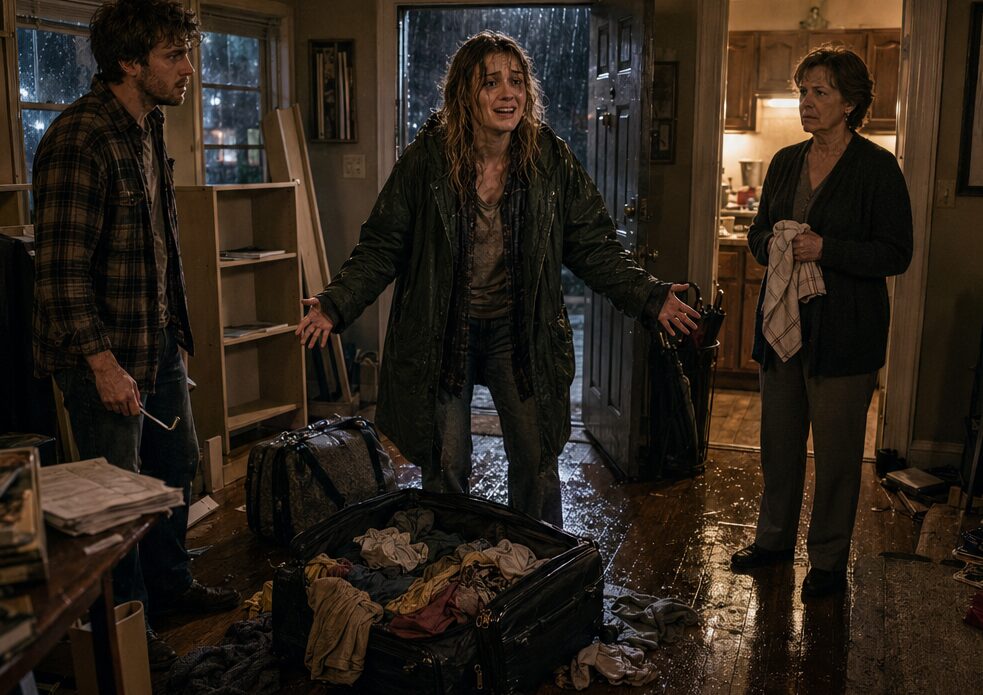
A woman burst through the doorway dragging two giant suitcases behind her and balancing a plastic storage bin against her hip like she was entering a game show instead of a rented room in a tired Midwestern duplex.
“Oh my God, this rain is cinematic,” she announced.
Water dripped from her oversized green coat. Her dark-blonde hair clung messily to her cheeks. One suitcase wheel squealed against the floor.
Before either of them could respond, she spun once in the tiny hallway with both arms stretched wide.
“I’m free,” she declared dramatically.
Jack blinked.
His mother blinked harder.
The woman laughed too loudly at their faces.
“Sorry. Hi. I’m Lisa.”
She dropped one suitcase. The zipper immediately split open. Clothes spilled halfway into the hallway.
Lisa stared down at the mess for one second too long.
Then she smiled again.
“Perfect. This feels symbolic.”
Jack almost laughed. His mother absolutely did not.
“Come inside before the whole building floods,” his mother said quietly.
Lisa saluted her.
“Yes, ma’am.”
She hauled the broken suitcase over the threshold and nearly knocked over the umbrella stand. Then she noticed the half-built bookshelf in the living room.
“Oh no,” she gasped dramatically. “A man assembling furniture. I’m intruding on a sacred masculine ritual.”
Jack laughed despite himself.
His mother closed the door slowly, still studying Lisa with the careful expression she used at the pharmacy when customers looked one sentence away from crying.
The apartment suddenly felt much smaller.
Lisa filled every space she entered.
She walked into the living room like she already lived there.
Not arrogantly.
Desperately.
Jack didn’t understand that yet.
None of them did.
By nine o’clock, the apartment no longer looked like a temporary rental setup.
It looked like a storm had unpacked itself.
Lisa’s scarves hung over kitchen chairs. One storage bin sat open beside the couch. Her boots blocked half the hallway.
She had unpacked almost nothing properly.
Instead she moved things.
Jack noticed it slowly.
The ceramic bowl from the table had migrated to the windowsill. A lamp had shifted three inches left. She rearranged magnets on the refrigerator while talking.
“I just think spaces should feel alive,” she said.
His mother — Virginia — looked at the moved magnets for several seconds before quietly straightening them again.
Lisa noticed.
She grinned.
“Oh, you’re one of those.”
“One of what?”
“People who need things exactly where they belong.”
Virginia folded a dish towel carefully.
“Yes.”
Lisa smiled like she found that adorable instead of dangerous.
At midnight, Jack woke to singing.
Not loud singing.
Kitchen singing.
The kind people do when they think nobody can hear them.
He walked into the hallway and found Lisa baking boxed brownies barefoot in borrowed pajama pants.
“You bake when stressed?” he asked.
“I bake when avoiding emotional collapse.”
She said it casually, like a joke. Then she pointed the spoon at him.
“Important distinction.”
Jack leaned against the doorway.
“You always like this?”
“Like what?”
“Like you drank six energy drinks and escaped prison.”
She burst out laughing so hard she had to grab the counter.
“Oh my God.”
Then she stopped laughing abruptly.
Too abruptly.
“I did just leave my sister’s apartment,” she said.
Something tightened briefly in the room.
Then she smiled again.
“But now I’m here.”
Like that explained everything.
Like she needed it to.
Three days later, everyone downstairs already knew her.
The duplex had four units and one shared laundry room in the basement. By Friday, Lisa had somehow learned:
everyone’s names,
whose dog belonged to which apartment,
which mailbox stuck when it rained,
and whose divorce was apparently happening “very respectfully.”
“She talks to people like she’s hosting a party nobody agreed to attend,” Virginia muttered one morning.
But people liked Lisa.
That was the problem.
The older man downstairs started saving newspapers for her because she said she liked doing crossword puzzles “ironically.”
The woman across the hall lent her mixing bowls.
Somehow Lisa turned borrowing sugar into a seven-minute emotional experience.
Jack watched neighbors smile before they even opened their doors.
Meanwhile Virginia looked more exhausted every day.
Because the walls were thin.
Too thin.
Lisa talked while brushing her teeth.
She danced while cleaning.
She paced during phone calls.
She reheated leftovers at one in the morning while whisper-singing old pop songs into the refrigerator light.
And every night, Virginia quietly fixed the apartment back into place after her.
Moving coasters.
Straightening shoes.
Closing cabinet doors Lisa left open behind her like unfinished thoughts.
One night Jack found his mother standing silently in the kitchen at two a.m.
Lisa had left flour all over the counter after baking banana bread “for morale.”
Virginia was wiping the counter slowly.
Not angry.
Just tired.
“You can tell me if this isn’t working,” Jack said.
Virginia kept wiping.
“She’s not rude,” she said carefully.
“No.”
“She says thank you.”
“Yeah.”
“She’s trying very hard to be liked.”
Jack looked toward Lisa’s closed bedroom door.
Music hummed faintly underneath it.
Virginia finally sighed.
“That’s what worries me.”
Part II — Our Little Family
A week later, Lisa started saying “our.”
“Our coffee filters.”
“Our hallway.”
“Our neighbors.”
Then one night during dinner she smiled around a forkful of pasta and said:
“We’re becoming a little family up here.”
Silence settled over the table immediately.
Not hostile.
Worse.
Careful.
Jack stared down at his plate.
Virginia took a sip of water.
Lisa looked between them and laughed awkwardly.
“Okay, wow. That sounded way more emotionally loaded than I meant it.”
But Jack could tell she had meant it.
Maybe not consciously.
But she meant it.
The apartment developed new rhythms around her anyway.
Virginia left for the pharmacy before sunrise.
Jack taught middle school social studies and came home carrying stacks of papers he never fully finished grading.
Lisa worked inconsistently from her laptop at the kitchen table doing freelance graphic design jobs that seemed to disappear as quickly as they arrived.
Every few days she announced a “new era.”
One afternoon it was:
“I’m entering my financially responsible era.”
That same evening she ordered expensive takeout because “healing requires noodles.”
Another day she declared:
“No more chaos. I’m becoming grounded.”
Then she accidentally knocked over an entire plant while dancing to music with headphones on.
Jack laughed so hard he had to sit down.
Lisa bowed dramatically after every disaster like applause was expected.
But sometimes Jack caught moments she didn’t know anyone saw.
The way she froze when checking her bank account.
How long she stared at apartment listings online.
The speed with which she hid overdue notices beneath magazines.
One afternoon he came home early and found her sitting cross-legged on the kitchen floor beside the open refrigerator.
Not eating.
Just staring inside it.
She looked up quickly.
“Hey.”
“You okay?”
“Yeah.”
Too fast.
Then she smiled.
“Just deciding if shredded cheese counts as a personality.”
Jack almost answered.
Then didn’t.
Because suddenly he understood something uncomfortable:
Lisa treated ordinary moments like performances because silence terrified her.
Virginia understood it too.
She just reacted differently.
One evening Lisa left her shoes in the hallway again. Virginia moved them neatly against the wall.
Lisa noticed immediately.
“You really can’t help yourself, huh?”
Virginia looked up from the mail.
“I like clear walkways.”
“You’d hate my sister.”
The room shifted.
Lisa rarely mentioned her sister directly.
Virginia kept her voice neutral.
“You lived together a long time?”
Lisa opened the refrigerator without answering.
“Long enough to become a financial cautionary tale.”
Then she laughed lightly like that sentence belonged to somebody else.
Later that night, Jack found his mother fixing the zipper on Lisa’s broken suitcase at the kitchen table.
“You could’ve just told her to buy another one,” he said quietly.
Virginia kept sewing carefully.
“With what money?”
Jack looked at her.
Virginia didn’t look back.
That bothered him more.
The tension became physical after that.
Not explosive.
Dense.
Like humidity.
Lisa started lingering near Jack constantly.
In the kitchen.
On the fire escape.
In the hallway while he graded papers.
She wasn’t flirting exactly.
She was attaching herself emotionally to movement, conversation, presence.
One night she knocked on his bedroom door holding two mugs of tea.
“I can’t tell if your mother hates me.”
Jack sighed.
“She doesn’t hate you.”
“She reorganized the refrigerator after I made sandwiches.”
“You put strawberries in the vegetable drawer.”
“She said fruit needs boundaries.”
Jack laughed despite himself.
Lisa smiled for a second.
Then the smile faded.
“She thinks I’m too much.”
The honesty in her voice caught him off guard.
“You are a lot,” he admitted gently.
She looked down into her tea.
“That’s usually how people say they’re getting tired of me.”
Jack opened his mouth.
Nothing came out.
Because the problem was he was getting tired.
Not of Lisa exactly.
Of the apartment constantly vibrating around her moods.
Of feeling responsible for whether she was okay.
Of how quickly her presence had become emotional weather.
And he hated himself for thinking that.
Three nights later, Virginia accidentally overheard the truth.
The basement laundry room had terrible acoustics. Every sound bounced off concrete.
Virginia was halfway down the stairs carrying detergent when she heard Lisa talking softly.
At first she thought Lisa was on the phone.
Then she realized she was recording voice messages.
Cheerful ones.
“Things are amazing here,” Lisa said brightly.
“I’m serious. I finally feel settled.”
Pause.
Delete.
Then again.
“No, honestly, I’m doing really good. The apartment’s adorable.”
Pause.
Delete.
Silence.
Virginia should have gone back upstairs.
Instead she stood frozen beside the stairs.
Lisa’s voice changed.
Smaller now.
“I just can’t mess this up again.”
Virginia heard fabric rustling.
A shaky inhale.
Then:
“I can’t afford another deposit. I literally can’t.”
Long silence.
When Lisa spoke again, her cheerful voice returned instantly.
“So anyway! Fresh start!”
Virginia closed her eyes.
The performance was exhausting even to listen to.
She carried the detergent back upstairs without doing laundry at all.
That night she left half her dinner in the refrigerator labeled with masking tape:
FOR LISA.
No explanation.
Part III — The Shape of Obligation
After the laundry room, Virginia softened.
Not visibly.
Quietly.
Which somehow made everything harder.
She started buying extra groceries without mentioning it.
She paid the increased utility bill herself when Lisa apologized for “accidentally air-conditioning emotionally.”
She repaired a loose wheel on Lisa’s suitcase while pretending she’d merely been “looking at it.”
Lisa responded to kindness the way thirsty people respond to rain.
Too fast.
Too completely.
By November, she talked about future plans inside the apartment like permanence had already been agreed upon.
“We should decorate for Christmas early this year.”
“We should repaint the hallway.”
“We should all do Thanksgiving together.”
Every sentence tightened something behind Virginia’s eyes.
Jack noticed.
But he kept mediating instead of speaking honestly.
That was his specialty.
Making discomfort survivable instead of resolved.
The neighborhood cookout happened the first Saturday after Thanksgiving.
Someone downstairs dragged folding tables into the courtyard between the duplexes. Cheap string lights glowed above damp concrete. Everybody brought casseroles or beer or grocery-store cookies pretending not to notice whose contribution looked cheapest.
Lisa thrived instantly.
Of course she did.
Within twenty minutes she had organized a ridiculous trivia game involving holiday movies and celebrity divorces.
People laughed around her like gravity had shifted.
Jack watched her spin through conversations holding a paper plate in one hand and somebody else’s scarf in the other.
She looked incandescent.
And exhausted.
At one point she climbed onto a patio chair dramatically and announced:
“To surviving terrible apartments and emotionally confusing adulthood.”
People cheered.
Virginia looked down at her food.
The problem started an hour later.
Jack had gone upstairs briefly to grab more cups when he heard voices through the cracked kitchen window.
Virginia was downstairs near the mailboxes talking quietly to Mrs. Harper from Unit Two.
“I may rent the room after New Year’s,” Virginia said.
Jack stopped moving.
Mrs. Harper nodded sympathetically.
“You need somebody more stable.”
Virginia hesitated too long.
“I just need something more predictable.”
Jack felt sick instantly.
Not because his mother was wrong.
Because Lisa would hear eventually.
And when Lisa heard things, she reacted with her entire body.
She found out twenty minutes later.
Jack never learned exactly how.
Maybe a neighbor mentioned it casually.
Maybe she overheard.
Maybe emotionally desperate people simply develop radar for abandonment.
All he knew was the energy around her changed instantly.
She became brighter.
Louder.
Faster.
Dangerously cheerful.
She pulled neighbors into dancing beside the folding tables.
She kept announcing:
“This is my reinvention era!”
She laughed half a second too long after every joke.
Jack crossed the courtyard toward her carefully.
“Hey,” he said quietly. “You okay?”
And something finally snapped.
Lisa looked at him with glittering eyes.
“Why does everyone keep asking me that like I’m a stray dog?”
People nearby went silent.
Jack lowered his voice. “I’m just checking on you.”
“No, you’re monitoring me.”
“That’s not—”
“I get it, Jack.”
Her smile looked painful now.
“I’m the fun unstable renter. Everybody’s little project.”
The courtyard had gone completely still.
Even the music felt embarrassed.
Virginia stood frozen near the folding tables.
Lisa laughed suddenly.
Sharp this time.
“You know what’s humiliating?” she said. “Realizing other people thought your temporary situation was temporary before you did.”
Jack stared at her.
Nobody moved.
Then Lisa handed her untouched paper plate to the nearest person and walked upstairs alone.
The party never recovered.
Part IV — The Leak Above the Living Room
For three days, the apartment barely spoke.
Lisa stopped singing.
Virginia stopped correcting things.
Jack felt trapped inside the silence he’d spent months trying to prevent.
The apartment sounded different without Lisa’s noise.
Smaller.
Sadder.
At night Jack heard her moving carefully around her room like somebody afraid to take up measurable space.
That felt worse somehow.
The storm came Thursday night.
Rain hammered the roof hard enough to rattle the windows.
At eleven-thirty, Jack heard shouting from the hallway.
“Jack!”
He opened his bedroom door to find water dripping through Lisa’s ceiling light.
Not dripping.
Pouring.
“Oh my God,” Lisa whispered.
Virginia appeared carrying buckets already half awake in practical crisis mode.
The three of them spent an hour moving Lisa’s things into the living room while water spread across the bedroom ceiling in dark widening circles.
Her mattress leaned against the wall.
Storage bins crowded the couch.
Clothes hung from dining chairs.
By two in the morning, the entire apartment looked temporarily dismantled.
Nobody had energy left to avoid each other.
Rain hammered above them while buckets filled steadily beneath the leak.
Drip.
Drip.
Drip.
Lisa sat cross-legged on the floor wrapped in a blanket, staring at her half-packed belongings.
Jack sat on the couch.
Virginia drank cold coffee at the kitchen table.
The apartment finally looked as emotionally exhausted as all three of them felt.
Around three in the morning, Lisa spoke without looking up.
“I knew the room wasn’t permanent.”
Neither of them answered.
She laughed quietly.
“That’s the stupid part. I knew.”
Rain rattled the windows harder.
Lisa pulled the blanket tighter around herself.
“When I walked in here that first night…” She swallowed. “I wasn’t actually happy.”
Virginia looked up slowly.
Lisa smiled weakly.
“I mean, I was relieved. But mostly I felt embarrassing.”
Nobody interrupted her.
“My sister used to introduce me to people as her ‘creative situation.’”
Jack closed his eyes.
Lisa stared at the leaking ceiling.
“I kept thinking if I walked in here fun enough… exciting enough… maybe nobody would notice I was basically a grown woman arriving with broken luggage and nowhere real to go.”
The room stayed quiet except for rainwater hitting buckets.
Then Virginia spoke softly.
“I noticed.”
Lisa looked at her immediately.
Virginia folded her hands around the coffee mug.
“I just didn’t know what to do with it.”
That line settled heavily into the room.
Because it was true.
Not cruel.
Not kind either.
Just true.
Virginia exhaled slowly.
“When my husband got sick, people started needing things from me constantly. Money. Help. Time. Emotional energy.” She stared down into the coffee. “After a while, caring for people stopped feeling generous. It started feeling expensive.”
Lisa’s eyes filled instantly.
Virginia continued before emotion could harden into apology.
“You came in here like a tornado trying to convince everybody you were sunlight.” A tiny tired smile appeared. “And I was scared if I let myself care too much, eventually you’d need something I couldn’t afford to give.”
Nobody spoke.
Then Jack finally did.
Quietly.
“I invited you here because I missed who you used to be.”
Lisa looked at him.
Jack rubbed his face tiredly.
“Back before every conversation became about money or surviving or pretending everything was fine.” He swallowed. “But I think I wanted the entertaining version of you without realizing how exhausted the actual version was.”
Lisa laughed once through tears.
“That’s fair.”
“No,” he said softly. “It isn’t.”
The rain kept falling.
Buckets kept filling.
But something in the apartment loosened anyway.
Not fixed.
Just honest.
For the first time since Lisa arrived, nobody in the room seemed to be performing a role.
Part V — The Quiet Way She Left
Three weeks later, Lisa found a studio apartment across town above a laundromat.
The plumbing groaned.
The windows stuck.
The kitchen was barely a kitchen.
But it was hers.
Mostly.
Jack helped carry boxes up the narrow stairs.
Virginia packed leftover containers into a grocery bag and pretended not to notice when Lisa became emotional about it.
The last thing left in the duplex was the repaired suitcase.
The zipper still snagged halfway unless you angled it carefully.
Lisa stood in the living room looking around the apartment one final time.
The bookshelf Jack never finished properly still leaned slightly left.
One of her mugs remained beside the sink.
Virginia had already straightened the hallway twice that morning.
Some habits survived everything.
Lisa smiled faintly at that.
Months earlier, she would’ve made a speech here.
Something theatrical.
Something about growth or destiny or found family.
Instead she just picked up the suitcase quietly.
Virginia stepped forward first.
The hug surprised both of them.
It wasn’t dramatic.
It wasn’t long.
But Virginia held on for one extra second at the end like she wanted the gesture to count correctly.
Lisa pulled back blinking fast.
“Thank you,” she said.
Virginia nodded once.
Jack carried the final box toward the door.
Lisa followed him into the hallway.
For a second, standing there with her coat on and suitcase in hand, she almost did it again.
Almost spun.
Almost turned the moment into something cinematic.
Jack saw the impulse cross her face.
So did she.
And this time she let it pass.
Instead she rested her hand lightly on the damaged suitcase handle and looked back at the apartment quietly.
“Thanks for letting me land here for a while,” she said.
No one answered immediately.
The hallway felt full of things nobody knew how to phrase properly.
Then Virginia reached over and fixed the collar of Lisa’s coat where it had folded inward.
A tiny practical gesture.
Careful.
Maternal.
Lisa’s eyes watered again.
She left before she embarrassed herself.
Down the narrow duplex stairs.
Past the mailboxes.
Out into the cold afternoon.
Not healed.
Not transformed.
Just slightly less afraid of being seen without performing first.
And upstairs, in the suddenly quiet apartment, the three coffee mugs still sitting in the sink somehow looked like evidence that she had really been there at all.