His Children Sold The Medal Case He Had Not Opened Since His Wife’s Funeral
Chapter 1: The Boxes Were Already Labeled When Edward Came Outside
The first thing Edward Bennett saw was not his daughter’s car in the driveway or his son’s pickup backed crookedly toward the garage.
It was the word TRASH.
Black marker, thick strokes, all capital letters, written across the side of a cardboard box that had once held canned peaches. The box sat near the lip of the garage, already half full. A cracked plastic sprinkler head. Two extension cords tied in knots. A stack of old seed catalogs with their corners curled soft from years of being thumbed through in February. On top lay one of Susan’s faded gardening gloves, palm up, as if it had been trying to wave him back inside.
Edward stood on the back step with one hand on the railing and the other holding the screen door open behind him.
For a moment, no one noticed him.
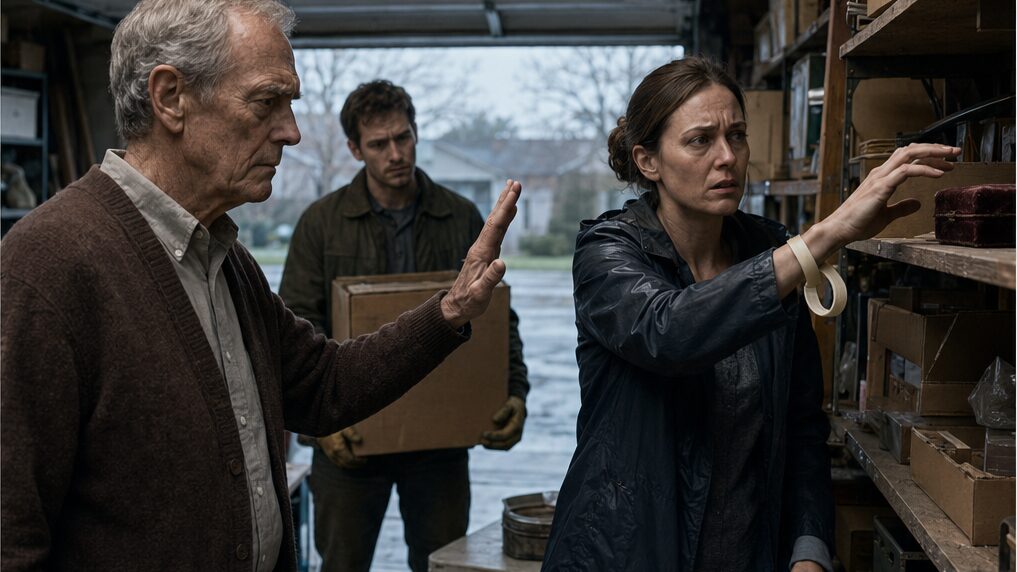
Melissa moved through the garage with a roll of masking tape looped around her wrist. She had her hair pulled back too tightly, the way she did when she was trying not to cry or trying not to yell. John stood near the old workbench, lifting a banker’s box from the lower shelf with both hands, his face already red from effort. A woman Edward did not know knelt beside a folding table, sorting things into three neat lines. KEEP. DONATE. TRASH.
The labels were everywhere.
They were on boxes, on plastic bins, on the backs of chairs turned upside down against the wall. They were on a crate of Mason jars Susan had used for peach preserves. They were on a shallow drawer Edward recognized from his old desk, now emptied of screws and rubber bands and little brass keys that had not opened anything in years.
The garage smelled like dust, cardboard, and spring rain on concrete. The wide door had been rolled up, letting in the pale morning light and the sound of a neighbor’s mower coughing to life two houses down.
Edward had known Melissa was coming.
She had called twice during the week, both times with the same careful voice.
“We’re just going to help you get a handle on a few things, Dad.”
“A few things,” he had said.
“Just the garage first.”
He had not said yes. Not exactly. He had said, “We’ll talk about it Saturday.” To him, that meant coffee at the kitchen table, maybe a list, maybe a decision about the old freezer that hummed too loudly in summer.
It had not meant this.
John looked up first. “Dad.”
Melissa turned so fast the roll of tape slipped down to her elbow. “You’re up.”
Edward let the screen door close behind him. It tapped once against the frame.
“I live here,” he said.
The woman near the table stood, smoothing her hands down the front of her pale sweater. She was younger than Melissa but had the calm expression of someone paid to enter other people’s houses and stay unbothered by what she found there.
“Mr. Bennett,” Melissa said, stepping around a box marked DONATE. “This is the estate organizer I told you about.”
“You told me about a woman who knew where to take old magazines.”
Melissa’s jaw tightened. “She helps families make safe choices.”
Edward looked at the garage floor. At his choices, apparently. The old picnic cooler. The lawn chairs with frayed webbing. The crate of Christmas candles Susan used to set in every window even after the children complained about fire hazards. A shoebox of greeting cards sat open beneath the folding table. Someone had made piles of birthdays, sympathy, holidays, unknown.
The organizer gave him a practiced smile. “We’re being very respectful. Nothing important is being thrown away without review.”
Edward stepped off the back stoop.
The concrete was cold through the soles of his slippers. He should have put on shoes. Susan would have told him so. Not scolded. Just glanced down and said, “Edward.” That one word could carry weather reports, grocery reminders, and entire moral positions.
Melissa saw his slippers. “Dad, you shouldn’t be out here like that. The floor’s damp.”
“I’m looking.”
“We wanted to get started before it got too hot.”
“It’s April.”
John shifted the box in his arms. “Mel thought it would be easier if we did the first pass.”
“The first pass over what?”
No one answered fast enough.
Edward walked deeper into the garage. Each step changed the room. Objects he had passed every day for years had become strangers under labels. Susan’s canning jars were donation. His old postal satchel was keep, though whoever had chosen that had placed it upside down with the strap dragging. A cracked kitchen chair with a towel tied around one leg was trash.
“That chair belonged at the card table,” he said.
Melissa glanced at it. “Dad, it wobbles.”
“I know how it wobbles.”
“That’s not a reason to keep it.”
“It is if you’re the one who sat in it.”
John exhaled through his nose. “We’re not getting rid of everything.”
Edward looked at him. John had Susan’s eyes but not her patience. He had driven in from three towns over, probably resenting the early hour, probably already thinking about leaving before lunch. He wore work gloves Edward did not recognize.
“You brought gloves,” Edward said.
John looked down at them as if caught stealing. “There’s broken stuff in here.”
“There is old stuff in here.”
“There’s both.”
Melissa came closer, lowering her voice though the organizer stood close enough to hear every word. “Dad, please don’t turn this into a fight. We talked about this. The garage is crowded. The steps are crowded. The hallway closet is crowded. You almost tripped over that box by the back door last month.”
“I bumped it.”
“You said you bumped it. You had a bruise the size of a plum.”
“People bruise.”
“People also fall.”
There it was. Not said harshly, but placed between them like another label. Fall. Unsafe. Alone.
Edward’s eyes moved past her shoulder to the shelves along the far wall.
The top shelf held paint cans, a tackle box, an old radio wrapped in a towel. The second shelf held Susan’s holiday tins and a row of coffee cans filled with nails. The third shelf held his brown winter cap, a shoe brush, and the small velvet medal case.
It had been sitting there for nearly four years.
Not hidden. Not displayed. Just placed where his hand could reach it if he ever decided to.
He had not decided.
The case was darker than the dust around it, the velvet worn flat along the edges. A brass clasp caught a narrow strip of morning light. On the front, a small piece of yellowing tape lay near the hinge, Susan’s handwriting still visible in blue ink.
Not yet.
That was all she had written.
Melissa followed his gaze.
Her face changed before she moved. It became efficient again, the soft daughter replaced by the person who had arrived with tape and boxes.
“Oh,” she said. “That should probably go in the house.”
Edward did not answer.
John set down the banker’s box. “What is it?”
“You know what it is,” Edward said.
John looked embarrassed. “The medal thing?”
The organizer’s expression sharpened with professional interest. “Military items can be valuable. Depending on condition.”
Edward turned toward her slowly.
Melissa stepped in before he spoke. “We’re not talking value right now.”
But they were. The word had entered the garage and begun touching things.
Valuable.
Not useful. Not loved. Not remembered. Valuable.
Melissa reached up toward the shelf.
Edward’s body moved before his thoughts did. One hand came out, not grabbing her, not touching her, but stopping the air between them.
“Leave that,” he said.
Melissa froze with her fingers inches from the case.
“Dad.”
“Leave it.”
Her eyes flicked toward John, then the organizer. Edward saw the look pass among them, quick and practiced. The look people used around him lately when they thought calm was something to be managed.
“We’re just sorting,” Melissa said.
“No.”
“We are not throwing it away.”
“No.”
“It’s sitting in the garage collecting dust.”
Edward’s hand lowered. “So am I some mornings.”
John made a small sound. It might have been a laugh if the garage had been another kind of room.
Melissa did not laugh. “That isn’t fair.”
Edward looked again at the labels. KEEP. DONATE. TRASH. SELL had not appeared yet, but he could feel it waiting.
“What time did you get here?” he asked.
“Eight.”
“It’s not nine.”
“We wanted to make progress.”
“You made categories.”
Melissa rubbed her forehead with the heel of her hand. “Dad, we are trying to help you.”
Edward looked at Susan’s glove in the trash box. The fingers had flattened under the sprinkler head.
“Then start by asking me what help is.”
The organizer shifted, her shoes squeaking faintly on the concrete. “Maybe we should pause and make a memory pile.”
Edward turned to her. “Everything is a memory pile if you lived long enough.”
No one had an answer for that.
Outside, the donation boxes waited in the driveway like open mouths. John’s pickup tailgate was down. In the bed, Edward saw two boxes already loaded, one marked DONATE, one marked TRASH. A blue rain tarp had been folded beside them.
He wondered what had left the garage before he came outside.
Melissa reached for the medal case again, slower this time, as though moving slowly made it permission.
“Melissa,” he said.
Her fingers closed around the velvet.
The shelf showed a clean rectangle in the dust where it had rested all those years.
Edward felt that empty shape in his chest.
Chapter 2: Which Pile Did You Put My Permission In
Melissa held the medal case with both hands, but not carefully enough.
Edward saw her thumb press against the velvet lid. He saw the brass clasp face down instead of out. He saw the small strip of tape with Susan’s handwriting bend at one corner where the adhesive had dried.
“Don’t hold it like that,” he said.
Melissa looked at the case as if she had been caught mishandling a sleeping animal. “I’ve got it.”
“No, you don’t.”
John stepped closer. “Dad, nobody’s hurting it.”
Edward kept his eyes on the case. “That’s what people say right before they do.”
The organizer gave a soft professional cough. “Maybe we should place it on the table and discuss the best category.”
“The best category,” Edward repeated.
Melissa turned the case over and read the tape. Her lips pressed together.
Not yet.
She did not ask what it meant. That hurt worse than if she had.
“Dad,” she said, quieter now, “you haven’t opened this since Mom died.”
Edward’s face remained still.
The garage seemed to notice the sentence. Even John stopped pretending to adjust the boxes. The lawn mower down the street went quiet, leaving behind the scrape of cardboard against concrete as the organizer moved one box with her foot.
“You don’t know that,” Edward said.
Melissa looked at him.
He did not correct himself. They both knew she did.
Susan’s funeral had been in February. Cold rain, dark coats, damp flowers at the cemetery. Edward had come home and placed the medal case on the kitchen table because it had been in Susan’s cedar chest, wrapped in tissue with the strip of tape across the clasp. Melissa had offered to help him go through things. John had said it could wait.
Edward had carried the case to the garage that evening and put it on the shelf.
It had waited better than people did.
Melissa turned toward the folding table. “I’m putting it here.”
“No.”
“We’ll decide later.”
“No.”
Her shoulders rose. “Dad, you cannot say no to every single thing.”
“I can say no to things that are mine.”
“That’s not what this is about.”
“It is exactly what this is about.”
“No, it’s about the house. It’s about you living alone in a place full of things you won’t touch and won’t let anyone move. It’s about me getting calls from the neighbor because your porch light stayed on for two days. It’s about John finding expired food in the pantry. It’s about Mom’s clothes still in the closet.”
Edward’s gaze sharpened. “Leave your mother’s closet out of the garage.”
Melissa’s face flushed. “It’s all the same, Dad.”
“No, it is not.”
“It is. It is all the same refusal. You won’t let anything change, and then you act surprised when we worry.”
John said, “Mel.”
She turned on him. “No, don’t ‘Mel’ me. You get to drive over, carry two boxes, and go home. I’m the one who gets the calls. I’m the one who checks whether he paid the electric bill. I’m the one who has to ask if he ate.”
Edward heard the truth in it. He hated that he heard it.
The organizer kept her eyes down, suddenly busy folding the flaps of an empty box. Edward wondered how many families she had seen arrive at this point—where concern and resentment stopped taking turns and began speaking together.
Melissa lifted the medal case slightly. “This is not helping him. It just sits there. He won’t open it. He won’t talk about it. He won’t even dust around it.”
Edward took one step forward.
His slippers whispered against the concrete.
“Put it down.”
Melissa’s mouth trembled, but her grip tightened. “I am trying to keep you safe.”
“By taking what I told you not to touch?”
“By making decisions you keep avoiding.”
John rubbed his jaw. “Maybe we should just put that one back for now.”
Melissa looked at him in disbelief. “For now means forever. That’s how everything works here.”
Edward turned toward the table. He saw the roll of labels, the marker, the clean handwriting that had divided his life into instructions for strangers.
KEEP.
DONATE.
TRASH.
A fourth box had been opened beside Melissa’s knee. Empty so far. On its side, in newer marker, was the word SELL.
Edward looked from the box to his daughter.
“Were you going to ask me,” he said, “or tell me after?”
Melissa said nothing.
The organizer interjected gently. “Some families find it easier to sell specialty items and use the money toward repairs or care needs.”
“Care,” Edward said.
Melissa’s eyes filled, which made him angrier than if she had shouted. Tears could turn the room in her favor without meaning to. They could make him look cruel for standing still.
“The back steps need replacing,” she said. “The upstairs bathroom has that loose tile. You refuse to discuss help. You refuse to discuss moving your bedroom downstairs. You refuse—”
“I refuse to be handled.”
“You refuse to be realistic.”
Edward reached the SELL box and pulled it closer with the toe of his slipper. It scraped loudly. He tapped the side where the word had been written.
“Which pile did you put my permission in?”
The sentence fell cleanly.
John looked away.
Melissa blinked. “That is not fair.”
Edward held out his hand.
For a moment, Melissa did not move. Her fingers pressed into the velvet lid. The case looked small in her hands, almost ordinary. A person could have mistaken it for a jewelry box, a coin set, something bought at an estate sale and forgotten in a closet.
Then the brass clasp caught the light again.
Edward remembered Susan’s hands closing that clasp the last time he had seen it open.
She had been sitting on the edge of their bed with the cedar chest at her feet. Her hair had grown thin from treatment, and she had tied a scarf over it even though he told her she was beautiful without it. She had told him not to hover. He had hovered anyway.
“You don’t have to look now,” she had said.
“Look at what?”
“When you’re ready.”
“I’m ready for whatever you need.”
“No,” she had answered, and her smile had almost broken him. “You’re ready to be brave for me. That isn’t the same thing.”
He had not asked again. Some mercy arrived as silence.
Now Melissa stood in the garage holding that silence like clutter.
“Give it to me,” Edward said.
“Dad—”
“Give it to me.”
Melissa crossed the few feet between them and placed the case in his hands.
The weight was familiar and not. He cradled it against the front of his brown cardigan, feeling the flattened velvet beneath his fingers, the little ridge of the tape near the hinge.
His breath came shallow.
The organizer said, “Maybe this item belongs in a special review category.”
Edward looked at her. “It belongs where I put it.”
Melissa wiped under one eye with the back of her wrist. “Then open it.”
The garage went still again.
Edward’s fingers tightened around the case.
Melissa saw it. Her voice changed—less angry, more desperate. “Just open it, Dad. Show us why this is different. Help me understand why I’m the villain for trying to deal with what you won’t deal with.”
“You are not the villain.”
“Then don’t treat me like one.”
“I’m treating you like a daughter who forgot to knock.”
Melissa flinched.
John said, “Dad, come on.”
Edward looked at his son. “You carried boxes out before I woke up.”
John’s face colored. “We didn’t think—”
“I know.”
That silenced him.
Edward turned toward the shelf where the medal case had sat. The empty dust rectangle looked brighter now, almost accusing. He wanted to put the case back there and stand in front of it until everyone left. He wanted to say the kind of thing that ended arguments. He wanted Susan beside him, her hand on his arm, interpreting him for the children the way she always had.
Your father means this.
Your father isn’t angry at you.
Your father needs a minute.
But Susan was not there, and no one translated silence fairly.
Melissa stepped toward him. “If it matters, then let it matter out loud.”
Edward looked down at the tape.
Not yet.
“No,” he said.
The word was small, but it cost him.
Melissa stared at him. “Then what are we supposed to do?”
“Wait.”
“For what?”
“For me.”
Her face hardened again, not because she did not love him, but because love had been standing too long beside fear.
“We have waited,” she said. “For four years.”
Edward held the case against his chest and walked toward the house.
No one stopped him.
At the back step, his slipper caught on the edge of the concrete. He stumbled, just once, just enough for John to reach out and Melissa to gasp.
“I’m fine,” Edward snapped.
The sharpness embarrassed him before the echo left the garage.
He steadied himself on the railing. The medal case pressed between his arm and ribs. He did not look back at their faces. He did not want to see the proof they thought he had given them.
Inside, the kitchen was dim and smelled faintly of coffee grounds. He set the case on the table and stood over it until his breathing slowed. Through the window, he could see the garage in pieces: Melissa talking with one hand at her mouth, John staring at the ground, the organizer folding tape over another box.
Edward touched the brass clasp.
His thumb rested on Susan’s tape.
Not yet.
He whispered, “Not yet,” though he did not know whether he meant it to Susan, to himself, or to the children outside.
The phone rang once in the living room and stopped. A minute later, a car door closed. Then another.
Edward remained in the kitchen, one hand on the back of Susan’s chair, the medal case unopened before him.
He did not hear Melissa come in.
He did not hear her pause at the doorway.
By the time he went to the bathroom to wash his face, the case was still on the table.
When he came back, it was gone.
Chapter 3: The Glass Counter Made It Look Like Merchandise
Heather Carter knew the difference between grief and inventory most days.
Inventory had tags. Inventory had item numbers. Inventory could be dusted, photographed, entered into a spreadsheet, and placed in the front display if it had enough shine to catch somebody’s eye from the sidewalk.
Grief came in holding something too tightly.
The woman who brought in the velvet case did not hold it tightly. That was the first thing Heather noticed.
She carried it under one arm with a canvas tote bag and a phone, distracted, already apologizing before she reached the counter. Behind her, a man waited near the door with his hands in his jacket pockets, scanning the shop as if hoping no one he knew would see him there.
“I called earlier,” the woman said. “About military items?”
Heather stood behind the glass counter, wearing the dark green polo the shop owner insisted looked “heritage” instead of “pawn shop.” She had been sorting old fountain pens when the bell over the door rang.
“Yes,” Heather said. “You said you had a medal set?”
The woman placed the case on the counter.
Not gently. Not roughly. Just with the tired efficiency of someone setting down one more task in a day full of them.
“My father’s,” she said. “Or my mother’s keepsake of my father’s. I’m not sure anymore.”
The man near the door looked toward her.
Heather saw the look and filed it away.
The shop was quiet for a Saturday afternoon. Rain had started again, soft against the front window. The fluorescent lights hummed overhead, flattening the colors of everything they touched: campaign buttons, pocket watches, old postcards, framed discharge papers, coins in plastic sleeves. A rack of reproduction signs near the door promised nostalgia to people who had not lived through the thing being sold.
Heather turned the medal case so the clasp faced her.
A strip of old tape clung near the hinge. Two words were written on it in faded blue ink.
Not yet.
Heather glanced up.
The woman looked away too quickly.
“You want an appraisal?” Heather asked.
“I want to know what it’s worth.”
The man by the door muttered, “Melissa.”
She shot him a look. “John, please.”
Heather kept her expression neutral. Families argued in shops more often than people thought. Usually over watches, china, guitars, wedding rings. Someone always wanted to know the value. Someone else always wanted to know why that question came first.
Heather opened the case.
The velvet inside was darker, protected from dust and light. The medals lay in fitted grooves, ribbons still crisp in places, frayed in others. Not a huge collection. Not the kind that screamed battlefield legend to collectors who wanted stories bigger than the men who carried them. But real. Personal. Kept.
There were service medals, a commendation, unit pins, a small ribbon bar, and a folded photograph tucked half beneath the lining. Heather did not touch the photograph yet.
She felt the woman watching her.
“These belonged to your father?” Heather asked.
“Yes.”
“Is he living?”
The woman hesitated.
Heather looked up.
“Yes,” the woman said. “But he doesn’t need them sitting in a garage.”
That answer did not belong to the question.
Heather lowered her eyes again. “Does he know you brought them in?”
The man by the door took one step forward. “We should go, Mel.”
The woman’s jaw tightened. “He knows we’re cleaning.”
Heather did not close the case, but her hands went still.
The shop owner was in the back room taking a call. Through the half-open door, Heather could hear the low rumble of his voice and the squeak of his chair. She wished suddenly that he would come out, then wished harder that he would not. He would talk numbers. He would say everything had a price if the paperwork was clean.
Heather had learned that was not true.
Her grandfather’s flag sat in a triangular case on her mother’s mantel, the wood scratched at one corner where it had fallen during a move. The flag was not rare. Not valuable. Not interesting to collectors. But when Heather’s mother dusted it, she did it with both hands.
“Some military items have restrictions,” Heather said. “And some families prefer documentation.”
Melissa gave a tired laugh. “I am his daughter.”
John moved closer to the counter. His face had the strained look of a man who had agreed to something by not objecting soon enough.
Heather studied the medals again. Beneath one ribbon, barely visible where the lining had pulled loose, was a name written in careful ink.
Susan.
Not the veteran’s name, then. Someone else’s hand. Someone else’s keeping.
The bell over the door rang.
All three of them turned.
An elderly man stood just inside the shop, rain on the shoulders of his brown jacket, one hand braced on the doorframe though the door had already closed behind him. He was not tall, but he held himself with a careful uprightness that made the room adjust around him. His gray hair had been combed with water or rain. His eyes went straight to the open case.
Heather did not need anyone to introduce him.
“Dad,” Melissa said.
The word carried anger first, then fear.
Edward Bennett looked at his daughter, then at John, then at the case under Heather’s hands.
“I went to the garage,” he said. His voice was calm enough to make Heather uncomfortable. “Then I went to the kitchen. Then I came here.”
Melissa’s face changed. “You followed us?”
“I followed what you took.”
John put a hand over his eyes for one second. “Dad, we were going to talk to you after.”
Edward looked at him. “You keep saying after like it is a kindness.”
Melissa stepped between Edward and the counter. “You should not have driven in the rain.”
“I did not drive.”
John looked up. “What?”
“I walked to the bus stop.”
Melissa’s mouth opened. Closed. “Dad, that’s almost six blocks.”
“Seven if you count the way the sidewalk breaks near the church.”
Heather looked down at the open medals so no one would see her face.
Melissa turned toward her quickly. “Can we just finish the appraisal?”
“No,” Edward said.
“It is just an appraisal.”
“No.”
“It doesn’t mean we’re selling them today.”
Heather heard the lie before Melissa seemed to.
Edward heard it too, but he did not accuse her. He simply came closer to the counter, slowly, rainwater darkening the cuffs of his jacket.
Heather shifted the case toward him.
Melissa put a hand down on the glass. “Please don’t make this harder than it has to be.”
Edward stopped on the other side of the counter, close enough now that Heather could see the tremor in his left hand. He folded both hands together to hide it.
The medals lay open between them.
Under the fluorescent lights, they looked less like memory than product. The glass counter doubled their image, making it seem there were two sets: one above, one below, one real, one already slipping away.
Heather said, “Mr. Bennett?”
He looked at her.
“Are these yours?”
Melissa made a frustrated sound. “They are his, yes, but—”
Heather kept her eyes on Edward. “Sir?”
Edward’s gaze dropped to the medal case.
For a long moment he said nothing.
Then he reached out, not to take the case, not to close it, but to touch one ribbon with the tip of his finger. The movement was so precise it made Melissa stop breathing.
“They were mine,” he said. “Then Susan kept them. Then they became something else.”
Heather waited.
Edward withdrew his hand. “I don’t know what they are now.”
Melissa’s face softened despite herself. “Dad.”
He did not look at her.
Heather noticed the folded photograph again, tucked beneath the loosened velvet. Beside it, something white edged out from under the lining. Not a price tag. Not a certificate.
Paper.
Old, folded, hidden by care or accident.
“Would you like me to close it?” Heather asked.
Edward’s eyes moved to the brass clasp, then to the tape.
Not yet.
“No,” he said, but the word seemed pulled from somewhere deep. “Not yet.”
Melissa turned away, wiping quickly at her cheek.
John stared at the case as if seeing it for the first time.
Heather reached for her phone under the counter. Not to search the value. Not yet. She wanted to check the shop’s purchase rules for contested family property. She wanted the shop owner out here. She wanted someone official enough to make the next minute easier.
But as the phone lit in her hand, Edward lowered himself carefully into the wooden chair near the display of old postcards. He looked smaller sitting down, his wet jacket hanging loose at his shoulders.
The case remained open on the glass.
Heather glanced at the medals, then at the phone, then at Melissa standing rigid near the door.
The shop bell trembled faintly from the last gust of rain.
In the doorway to the back room, the shop owner appeared and looked first at the open case, then at Edward, then at Melissa.
“So,” he said, “are we buying or not?”
Heather turned toward him, shocked by the plainness of the question.
Chapter 4: The Name Under The Ribbon Was Not For Sale
For one breath, nobody answered the shop owner.
Heather still had her phone in her hand, screen glowing against her palm. Edward sat near the postcard rack with rainwater darkening the shoulders of his jacket. Melissa stood stiff beside the counter, her face caught between anger and embarrassment. John had moved close enough to the door to leave but not close enough to escape.
The shop owner looked around at them, then at the open case.
“I asked a question,” he said.
Heather slipped her phone back under the counter. “Not yet.”
He frowned. “What does that mean?”
“It means not yet.”
The words were not hers, not really. She had seen them written on the tape, heard Edward say them as if they belonged to another room. Saying them aloud made the shop feel smaller.
Melissa turned toward Heather. “We are not here for a family therapy session. We asked for an appraisal.”
“And I’m telling you I’m not comfortable proceeding until I know the owner consents.”
“I told you. I’m his daughter.”
Edward lifted his head then, slowly.
Heather expected him to speak, but he only looked at Melissa. The look did more than an argument could have. Melissa’s mouth tightened, and she turned away.
The shop owner came behind the counter. He was broad across the middle, with reading glasses hanging from a cord around his neck. He leaned over the case with the expression of someone seeing numbers arrange themselves.
“Good condition,” he said. “Not rare, but clean. Family set. There’s a market.”
“There is not a market,” Edward said.
The shop owner glanced at him. “Sir?”
Edward rose from the chair. It took him a moment, one hand on the postcard rack, the other against his thigh. Heather saw Melissa lean forward as if to help, then stop herself because he would not want the help in front of strangers.
Edward crossed to the counter.
“There is a price,” he said. “That is not the same thing.”
The shop owner gave a short, uneasy laugh. “Well, around here it mostly is.”
Heather saw Edward’s fingers curl once at his side. Not into a fist. Just inward, like he was gathering something before it spilled.
John spoke from near the door. “Can we just take it home?”
Melissa looked at him. “Now you want to take it home?”
“I didn’t say I wanted to bring it here.”
“You didn’t stop me.”
John’s face went flat. “No. I didn’t.”
That confession stayed between them.
Heather turned the case slightly so the medals faced Edward instead of the shop owner. Beneath one ribbon, the loosened velvet showed the small handwritten name. Susan. Heather had not meant to stare at it, but the ink seemed to draw the eye.
“Mr. Bennett,” she said softly, “may I ask who Susan was?”
The question landed carefully, but Edward still closed his eyes.
Melissa answered too quickly. “Our mother.”
Heather nodded. “Her name is written under the ribbon.”
Melissa looked down sharply. “What?”
Heather pointed without touching. “There.”
John came forward at last. He stood beside Melissa and bent over the case. For a moment, brother and sister looked like children at the same kitchen table, both trying to read something upside down.
Susan.
The name had been written on a narrow strip of cloth tucked beneath a faded ribbon bar. Not on the medal, not on a certificate. Hidden under what a buyer would barely notice.
Melissa’s expression shifted. She had been ready for an argument about value, safety, clutter. She had not been ready for her mother’s name.
“I never saw that,” she said.
Edward’s voice was low. “You never looked.”
“I looked plenty.”
“At the case,” he said. “Not into it.”
The shop owner cleared his throat. “Family inscriptions can add sentimental value, but not necessarily—”
Heather gave him a look that made him stop.
Melissa pressed both hands to the edge of the glass counter. “Dad, why is Mom’s name in there?”
Edward looked at the medals, then at the folded corner of paper barely visible under the velvet lining. Heather watched his eyes find it. Something changed in his face—not surprise exactly. More like a man recognizing a knock he had been avoiding.
“I don’t know,” he said.
Melissa almost laughed. “How can you not know?”
“Because I have not opened it.”
“It is open right now.”
“No,” Edward said. “The lid is open.”
No one answered.
The rain thickened against the window. A passing truck sent gray light sliding across the glass case, over old watches and coins and the velvet box that had stopped being inventory before it ever became family again.
Heather picked up her phone. “I’m going to check something.”
The shop owner made an impatient sound. “Heather.”
She ignored him and moved to the side counter, where a small computer sat beside a stack of receipt books. Her fingers shook as she typed Edward Bennett, local veterans hall, service medals, Susan Bennett. Nothing official came up at first. A church bulletin. An obituary for Susan Bennett from four years earlier. A grainy photo in a veterans hall newsletter: Edward standing in the back row of a Memorial Day breakfast, looking uncomfortable beside a coffee urn.
Heather opened the obituary.
Beloved wife of Edward. Mother of Melissa and John. Known for peach preserves, window candles, and never letting anyone leave her kitchen without a second cup of coffee.
Heather looked back at the case.
On the counter, Melissa had gone very still.
“Dad,” she said, softer now, “why didn’t you tell us she put something in there?”
“I did not know.”
“But you knew the case mattered.”
“Yes.”
“Why?”
Edward reached toward the brass clasp, though the case already lay open. His thumb hovered over Susan’s tape. He did not touch the paper beneath the lining. He did not lift the photograph.
“Because she told me to wait.”
Melissa’s eyes filled again, but this time she seemed less angry about the tears. “For what?”
Edward looked at her then. “For when I was ready to find out.”
John turned away, one hand at the back of his neck.
Heather read the obituary line again. Window candles. Second cup of coffee. Small ordinary proofs of a life that would never make an appraisal sheet.
The shop owner lowered his voice. “Look, no one’s buying anything today. Take it home and figure it out.”
It was the closest thing to grace Heather had heard from him.
Melissa did not move.
Edward reached for the case, then stopped before his fingers touched the velvet. Heather understood before anyone said it. If he took it now, he might have to open it. If he left it, he would lose it again.
Heather closed the lid gently but did not latch it.
“I can hold it behind the counter until you decide,” she said. “No sale. No appraisal. Just held.”
Melissa straightened. “That’s not necessary.”
“Yes,” John said.
Melissa looked at him.
He met her eyes. “It is.”
Edward looked from one child to the other. He seemed tired in a way that had nothing to do with the walk or the rain.
“No,” he said.
Heather’s hand stilled on the case.
Edward slid it toward himself. “It leaves with me.”
Melissa inhaled. “Dad, you walked here.”
“Then one of you can drive me home.”
John stepped forward. “I will.”
Melissa’s face tightened. “We all need to talk.”
“Yes,” Edward said. “But not here. Not with my life open on a sales counter.”
Heather felt the words in her throat.
The shop owner found a paper bag from beneath the counter, then seemed to think better of it and set it down unused. Edward lifted the medal case with both hands and held it against his chest the same way he must have carried it out of the garage. The tape faced outward. Not yet.
As they turned toward the door, Heather noticed the folded paper had slipped a little farther from beneath the lining. A thin edge showed near the corner, marked with blue ink.
Not the same handwriting as the tape.
Edward had not seen it.
Melissa had not seen it.
Heather did.
“Mr. Bennett,” she said.
He turned back.
Heather looked from the paper to him, then decided against reaching for it. “Be careful with the lining. There’s something tucked underneath.”
The air changed.
Edward looked down at the case in his hands.
Melissa whispered, “What?”
But Edward did not open it.
He only held the case closer, as if the question inside had weight.
Outside, John opened the door. The bell rang once, bright and ordinary.
Edward stepped into the rain with the case still closed.
Chapter 5: Melissa Called It Help Because Guilt Sounded Worse
By the time they reached Edward’s house, the rain had thinned into a mist that clung to the windshield and made every porch light look blurred.
Melissa drove behind John’s pickup in silence, gripping the steering wheel so tightly her knuckles ached. She could see her father’s head through the pickup’s rear window, turned slightly toward the passenger-side glass. The medal case rested on his lap. John had not put it in the back seat. For that, Melissa was grateful in a way that made her feel worse.
She had not meant to sell it.
That was what she kept telling herself.
She had meant to ask what it was worth. She had meant to understand whether it belonged in a display, a safe, a donation, somewhere better than a garage shelf beside paint cans and dead batteries. She had meant to be practical.
She had meant so many things that did not change what she had done.
At the house, John pulled into the driveway behind the organizer’s empty folding table, still standing in the open garage like an accusation. The labels remained taped to boxes. The SELL box sat near the threshold, blank inside now except for a long thread of brown velvet caught on the cardboard flap.
Melissa parked at the curb and watched her father wait for John to come around the truck. Edward did not accept help getting out, but he let John stand near him. That was something.
Inside, the house smelled like old coffee and lemon dish soap. The kitchen light above the sink flickered once before settling. Susan had always hated that fixture and had kept saying they would replace it after Christmas, then after tax season, then after she felt better.
The medal case went onto the kitchen table.
No one sat down.
Edward stood behind Susan’s chair with one hand on the curved wooden back. Melissa stood near the doorway, aware of the house around her in a way she had been trying to avoid for months. The stack of mail on the sideboard. The folded blanket at the end of the sofa where Edward sometimes slept instead of going upstairs. The narrow path through the back room where boxes had gathered like snowdrifts.
John closed the back door. “Do you want coffee?”
Edward looked at him. “No.”
John nodded as though that had been a complicated answer.
Melissa took off her raincoat and hung it on the chair where her mother used to sit. Edward’s eyes went to it. She removed it quickly.
“Dad,” she said, “I am sorry I took the case.”
He did not answer.
The apology felt thin as soon as it left her mouth. Not wrong. Just too small.
“I should have asked.”
“Yes,” Edward said.
Melissa waited for more. None came.
John leaned against the counter. “Maybe we should stop for today.”
Melissa’s head snapped toward him. “That is exactly how we got here.”
He looked exhausted. “No, Mel. We got here because we didn’t stop before.”
She swallowed the first reply that came to her. It tasted like resentment.
Edward pulled out Susan’s chair and sat, not in his own place at the head of the table but hers. The movement unsettled Melissa. He placed both hands flat on either side of the medal case and looked at neither child.
“I want to know what left before I came outside,” he said.
John rubbed his forehead. “Mostly old cords. Some magazines. A broken fan.”
“The shoebox from the workbench?”
John’s eyes shifted.
Edward saw it. So did Melissa.
“What shoebox?” she asked.
“The gray one,” Edward said. “Rubber band around it.”
John looked toward the garage. “I think it went in donation.”
Melissa closed her eyes. “John.”
“It had greeting cards in it.”
Edward’s hands remained flat on the table.
“They were from your mother,” he said.
John’s face changed. “I didn’t know.”
“That is becoming a theme.”
Melissa felt the sentence strike all three of them.
She pulled out a chair and sat across from Edward. “I can get it back. The donation boxes are still in the truck.”
John moved at once toward the back door.
“Leave it,” Edward said.
John stopped.
Edward looked tired, but not weak. Melissa wished she knew the difference before today.
“I didn’t ask about the box because I wanted you to run after it,” Edward said. “I asked because you did not know what you were carrying.”
Melissa placed her hands in her lap. “That’s why we need to sort things with you.”
“You were not sorting with me.”
“I know.”
“Do you?”
The question was not cruel. That was worse.
Melissa looked at the table. Its surface was worn pale near the edge where her mother had rolled pie crust. There was a small burn mark from the year John had tried to make bananas foster after watching a cooking show and nearly set a dish towel on fire. Melissa remembered laughing so hard Susan had cried. She also remembered opening the refrigerator last month and finding three containers of spoiled soup, each one covered neatly with foil.
“I came over in January,” Melissa said. “You didn’t answer the door. I used my key. You were sitting in the living room with the lights off.”
Edward’s jaw tightened. “It was afternoon.”
“It was almost seven.”
“Winter gets dark early.”
“You hadn’t eaten.”
“I wasn’t hungry.”
“You said Mom had just gone upstairs.”
The room changed.
John turned from the door.
Edward’s face closed. “I was half asleep.”
“You scared me,” Melissa said.
“I scared you, so you took my things?”
“No. You scared me, and I didn’t know what to do with the fear. So I made lists. I called people. I thought if the house was safer, then you would be safer.”
Edward looked at her then.
Melissa’s voice shook, and she hated it, but she kept going. “Every time I bring up help, you look at me like I’m trying to put you away. Every time I ask about repairs, you say later. Every time I ask about Mom’s things, you leave the room. So yes, I pushed. I pushed because waiting felt like watching something happen in slow motion.”
John’s voice was quiet. “Mel.”
“No, he should know.” She wiped her cheek, angry at the tears again. “I am tired, Dad. I am tired of guessing what is grief and what is danger. I am tired of feeling like the bad daughter because I notice the stairs are loose and the bills are late and the refrigerator smells wrong.”
Edward listened without moving.
For a moment Melissa thought he might soften. Instead he looked at the medal case.
“Your mother used to say a clean house could still be a lonely one.”
Melissa breathed out. “That sounds like her.”
“She also said a stubborn man could turn a memory into a wall.”
John gave a faint, sad smile.
Edward touched the edge of the case. “She was speaking of me.”
The kitchen was quiet except for the ticking wall clock. Susan had bought it at a yard sale because the little painted rooster made her laugh. Edward had never liked it. He had changed its batteries anyway.
Melissa looked at the case. “Why didn’t you open it after she died?”
His hand drew back.
“I couldn’t.”
“Why?”
Edward’s eyes lifted. “Because she put that tape on it while she was still alive. Because she told me not to open it until I was ready. Because after the funeral everyone left casseroles and instructions, and that case was the only thing in the house that did not ask me to do anything.”
Melissa’s anger loosened in a way that hurt.
“I didn’t know,” she said.
“You didn’t ask.”
“I tried.”
“You asked when I was selling the car. You asked when I was moving downstairs. You asked whether I needed pill boxes and grab bars and a man to clean the gutters. You asked around it.”
She wanted to defend herself. She could have. Some of those questions mattered. The gutters did need cleaning. The stairs did worry her. The house had become too much for one man pretending it was not.
But the medal case sat between them, and for once she understood that being right about one thing did not make her right about all of it.
John opened the back door. “I’m going to get the gray shoebox.”
Edward started to object, then stopped.
John looked at him. “Not because it fixes it.”
Edward held his gaze.
“Because it’s yours,” John said.
He went out into the mist.
Melissa looked toward the living room, where family photographs still lined the mantel. Her graduation. John in a baseball uniform. Her parents on their fortieth anniversary, Susan laughing at something beyond the frame while Edward looked at her instead of the camera.
“The organizer is coming back tomorrow,” Melissa said.
Edward’s expression hardened.
“I’ll cancel her.”
He did not answer.
“I will,” she said.
Outside, John lowered the pickup tailgate. Cardboard scraped. A box dropped with a thud, and John cursed under his breath.
Edward looked toward the sound. His mouth twitched once, almost a smile, then settled.
Melissa reached toward the medal case, not touching it. “Heather said there was something tucked inside.”
Edward’s face turned inward again.
“I know.”
“Are you going to look?”
He stared at Susan’s tape.
Not yet.
“I don’t know,” he said.
Melissa nodded, though the answer frightened her. Not because he refused. Because for the first time she heard the difference between refusal and not being ready.
The phone on the wall rang once, then again.
Melissa rose to answer it out of old habit, but Edward lifted a hand.
He let it ring.
After the fourth ring, the machine clicked on in the living room. A stranger’s cheerful voice filled the quiet.
“This is a reminder that the donation truck is scheduled for pickup tomorrow morning between nine and eleven—”
Melissa closed her eyes.
Edward looked at her.
Outside, John stood in the open garage holding the gray shoebox against his chest.
Chapter 6: Susan’s Last Note Waited Under The Velvet
Edward did not sleep much that night.
He lay on the sofa beneath the folded blanket because the stairs felt longer after the argument and because the house did not sound the same when he was angry. Pipes ticked inside walls. The refrigerator turned on and off with a tired shudder. Rainwater dripped from the gutter outside the living room window, striking the metal downspout at uneven intervals.
The medal case sat on the coffee table.
He had moved it there after Melissa and John left, because the kitchen table still felt crowded with things said and unsaid. The gray shoebox had been returned to the workbench, though not before Edward opened it and saw Susan’s handwriting on envelopes he had forgotten existed. Birthday cards. Notes from years when she had gone to visit Melissa after the first child was born. A grocery list with a joke written at the bottom.
Buy oranges. Do not let Edward choose cantaloupe. He has no gift for it.
He had laughed once, alone in the garage, and the sound had startled him.
Now the shoebox was safe, if safe meant back where it had been before people who loved him proved how easily love could carry things away.
Near midnight, Edward sat up and reached for the medal case.
He did not open it.
He held it on his lap and ran one thumb along the edge where the velvet had worn smooth. The brass clasp was cool. Susan’s tape had started to peel at the corner. Not yet. Her handwriting leaned slightly to the right, impatient even in two words.
“You always did leave instructions like riddles,” he whispered.
The house gave no answer.
He thought of Melissa sitting across from him at the table, saying she was tired of guessing what was grief and what was danger. He had wanted to tell her that he was tired too. Tired of being watched for signs. Tired of every forgotten appointment becoming evidence. Tired of people speaking gently when they meant seriously.
But there had been the evening in January.
He could not deny that.
He had woken in the chair after dreaming of Susan in the upstairs hallway. In the dream she had called down that she could not find the blue towels. When he opened his eyes, the room had been dark and the house so quiet he could hear his own breathing. For one foolish, tender second, he had believed she was upstairs.
Then Melissa had come through the front door with her key and found him sitting there.
He had seen the fear on her face before she covered it with busyness.
That fear had brought the boxes. Not greed. Not cruelty. Fear wearing work gloves.
Edward opened the case at dawn.
The lid lifted with a soft resistance, as if the velvet itself had grown used to being closed. The medals lay as they had in the shop, neat and strange under the gray morning light. He had not looked at them closely in years. They belonged to a younger man who had written letters home with bravado he did not feel and returned with a silence Susan never tried to pry open all at once.
The medals were not the part that hurt.
He touched the loosened lining near Susan’s name. There, tucked beneath the ribbon bar, was the folded paper Heather had noticed. Edward slid it free with two fingers.
His name was on the outside.
Edward.
Not Ed. Not Mr. Bennett, as she used when pretending to be stern. Edward.
He sat back.
The paper trembled slightly. He set it on the coffee table until his hand steadied, then unfolded it.
Her handwriting was smaller than it had been before the illness, but clear.
Edward,
If you are reading this, then either you finally got brave in the right way, or someone has made you mad enough to open what I told you not to.
He stopped there.
A sound left him, not quite laughter, not quite pain.
Trust Susan to know him even from paper.
He continued.
I put this with your medals because everyone thinks they know what these mean. Service. Sacrifice. Pride. They are not wrong. But they do not know what I know.
I know you kept them in a drawer for twenty years because you said a man should not decorate himself for coming home when others did not. I know you only let me frame them after Melissa asked why her father never kept anything from before she was born. I know you wore the small ribbon to John’s school program because he begged you and then pretended he hadn’t.
Edward wiped his eyes once and read on.
I also know you will be tempted to make the house a place where nothing moves because I am gone. Please don’t do that to yourself. I loved our kitchen, but I am not the kitchen. I loved the cedar chest, but I am not folded inside it. I loved the garage because you always swore you knew where every screw was, though we both know that was a lie.
This time he did laugh, and the laugh broke in the middle.
Do not let the children rush you. They will try because they love you and because they are afraid. Melissa will make lists. John will carry heavy things and think that counts as talking. Forgive them when you can, but do not surrender your say.
The house is yours while you are in it. The memories are yours while you carry them. Let go of what you can. Keep what lets you live, not what helps you disappear.
Under the medals is the photograph from the bus station. You hated it because your hair was a mess. I loved it because you were home and pretending not to cry.
When you are ready, put this case somewhere light can reach it. Not because of the medals. Because we survived more than the parts people could see.
And Edward, when the day comes that the children want to help, make them sit down first. If they cannot sit with you, they do not get to sort you.
Love,
Susan
Edward lowered the letter to his lap.
Morning had entered the room without asking. It touched the mantel photographs, the rooster clock, the edge of the blanket. The house looked the same and not the same.
He lifted the medal lining carefully and found the photograph.
The bus station behind them was crowded, blurred by motion. Edward stood in uniform with his cap crooked and his eyes red. Susan, young and fierce and smiling, had both arms around his waist as if she meant to keep him from leaving again by strength alone. He remembered the smell of diesel, the noise of brakes, her face pressed against his coat.
He had not known she kept the picture there.
For four years, he had guarded the case without knowing it guarded him back.
A truck beeped outside.
Edward looked up.
At first he thought the sound belonged to memory. Then it came again, louder, practical, close.
He stood with Susan’s letter in one hand and crossed to the front window.
A white donation truck was backing into the driveway.
For several seconds he simply watched it come. The driver leaned out the window, guiding himself around John’s pickup marks in the damp gravel. The garage door was still open from yesterday. Boxes waited inside beneath their labels.
KEEP.
DONATE.
TRASH.
SELL.
The house seemed to hold its breath.
Edward turned from the window and looked at the medal case open on the coffee table. At Susan’s letter. At the photograph of two young people who had not known how long a life could become, or how many times love would have to change shape to survive.
He folded the letter along its old creases and placed it back inside the case, but not under the lining. Not hidden.
Then he took the photograph and set it on top of the medals.
The doorbell rang.
Edward did not hurry.
He went to the hall closet, put on shoes, and reached for his brown jacket. His hand paused over the sleeve. Then he took the medal case from the coffee table and carried it with him to the front door.
Outside, the donation driver stood on the porch with a clipboard. Behind him, Melissa’s car turned the corner fast enough to make water spray from the curb. John’s pickup followed.
Edward opened the door before anyone could knock again.
Chapter 7: Nothing Leaves Until I Touch It First
The donation driver looked at Edward’s medal case before he looked at Edward.
People did that now, Edward noticed. The case had become the loudest thing in any room, even closed. The worn velvet, the taped hinge, the brass clasp dulled by age—none of it should have drawn a stranger’s eye. But perhaps the way Edward held it told the truth before he did.
“Morning,” the driver said, glancing down at his clipboard. “Pickup for Bennett?”
Edward stepped onto the porch and pulled the door closed behind him.
“Yes.”
The driver smiled, relieved by a simple answer. “Great. We’ve got a garage pickup, general household donation, some boxes, small furniture. Family said everything would be ready.”
Behind him, the truck idled in the driveway, white sides streaked with road dirt. The open garage looked worse in daylight. Boxes stood where they had been left, some damp at the bottom from rain blown under the door. The folding table waited with the labels still on it. KEEP. DONATE. TRASH. SELL. A black marker lay uncapped beside them, its tip staining the cardboard beneath.
Melissa’s car stopped at the curb. She got out quickly, not bothering with an umbrella. John pulled in behind her and opened his door before his engine fully quieted.
“Dad,” Melissa called. “I canceled them.”
The driver turned.
Edward looked at her. “He is still here.”
“I left a message.”
The driver checked his clipboard. “No cancellation came through on my end.”
John came up the walk, breath visible in the damp morning air. “We’ll pay whatever fee. We’re not doing pickup today.”
The driver lifted both hands slightly. “No problem. I just need someone to sign the cancellation on site.”
Melissa reached for the clipboard.
Edward said, “No.”
Her hand stopped.
The driver looked between them, wishing himself elsewhere.
Edward walked down the porch steps one at a time. Melissa moved as if to help him, then caught herself. He saw the effort it took. That mattered. Not enough to erase yesterday, but enough to notice.
At the bottom step, he turned toward the garage.
“No one signs anything yet,” he said.
Melissa’s face tightened with worry. “Dad, you don’t have to do this out here.”
“Yes,” he said. “I do.”
John shoved his hands into his jacket pockets. “Do what?”
Edward crossed the driveway. The donation driver stepped aside. The garage smelled of wet cardboard and cold concrete. He placed the medal case on the folding table, directly over the label marked SELL.
Then he picked up the black marker.
The estate organizer’s handwriting had been neat. Edward’s was less steady, but he pressed hard. On the back of an unused label, he wrote one word.
ASK.
He peeled the label away slowly. It stuck to his thumb for a moment before he smoothed it onto the front of the nearest box, covering DONATE.
Melissa watched from the driveway.
“Dad,” she said softly.
Edward moved to the next box. This one held Susan’s holiday tins and a bundle of extension cords. He covered TRASH with ASK.
Then the next.
ASK.
ASK.
ASK.
The marker squeaked each time.
John came into the garage and stood near the workbench. “You don’t have to relabel all of them.”
“I know.”
Edward covered KEEP last.
Melissa looked startled. “Even keep?”
Edward pressed the label flat. “You don’t get to decide that either.”
Her face flushed, but she did not argue.
The driver shifted his weight. “Sir, I can come back another day.”
Edward turned to him. “Thank you. Not today.”
The driver held out the clipboard. “Cancellation signature?”
Edward took it.
Melissa stepped forward. “Dad, I can—”
Edward looked at her.
She stopped.
He signed slowly, each letter more deliberate than the last. Edward Bennett. The driver tore off a yellow copy and handed it to him. Edward folded it once and placed it beside the medal case.
The truck pulled away three minutes later, leaving damp tire marks on the driveway and a silence too large for the garage.
John picked up one of the boxes from the pickup bed and carried it back inside. He did not ask which one. He chose the gray shoebox first, though Edward had already returned it the night before, then seemed to realize and set it gently on the workbench anyway.
“I’ll bring everything back,” John said.
Edward watched him. “You will bring back what you took. Then we will talk about what leaves.”
John nodded.
Melissa stood at the edge of the garage with her arms folded tight, not against the cold, Edward thought, but against herself.
“I was wrong,” she said.
The words came out plain, almost stiff.
Edward leaned one hand against the folding table. “Yes.”
She looked down.
He had not meant to make the word hurt. It had to be said cleanly or it would be softened into something else.
“I was wrong,” she repeated, quieter. “But I wasn’t making up the other things. The steps are loose. The bills were late. You scared me in January. The house is too much in some places.”
Edward looked toward the open shelves. Paint cans. Tools. Boxes. Gaps where things had been removed and returned poorly. It was easier to be angry when she was entirely wrong. She had not given him that mercy.
“I know,” he said.
Melissa’s eyes lifted.
Edward rested his fingers on the medal case. “Your mother left me a note.”
The garage seemed to settle around the sentence.
John came down from the pickup bed carrying another box and froze near the tailgate.
Melissa’s lips parted. “You opened it?”
“Yes.”
John lowered the box to the driveway. “What did it say?”
Edward looked at both of them, his children grown and tired and suddenly young in the morning light.
“It said neither of us was doing this right.”
A small, unwilling sound escaped John. Melissa pressed her fingertips to her mouth.
Edward opened the medal case.
He did it without ceremony. The lid rose. The medals caught the gray light from the garage door. Susan’s letter lay folded on top now, no longer hidden beneath the lining. The photograph rested beside it.
Melissa took one step closer, then stopped. “May I?”
The question reached him more deeply than any apology.
Edward nodded.
She came to the table and looked down. John joined her, standing at her shoulder. For a while none of them touched anything.
“That’s Mom?” John said at last.
Edward looked at the photograph of Susan at the bus station. “Before she learned to tell me when my tie was crooked.”
Melissa gave a tearful laugh, quick and broken. “She learned early.”
“She had natural gifts.”
John bent closer. “You look terrified.”
“I was.”
“I thought you’d say you were brave.”
Edward looked at him. “I was brave later. At the station I was just home.”
Melissa wiped her cheek. “What does the note say?”
Edward picked it up, but did not hand it over yet. The paper felt fragile and strong at once.
“It says the house is mine while I’m in it. The memories are mine while I carry them.” He paused. “It says I should not let you rush me.”
Melissa closed her eyes.
“It also says I should not let the house become her mausoleum.”
John leaned back against the workbench.
Edward folded the note again. “So here is what we will do.”
Neither child spoke.
Edward pointed to the boxes. “Nothing leaves this house until I touch it first. Not the box. The thing inside it. I will say what it is. If I cannot remember, I will say that too. If it can go, it goes. If it stays, it stays where I choose. If it needs repair, we decide whether repair is worth doing.”
Melissa listened as if taking instructions without paper might prove something.
Edward continued, “No more labels without me. No more professionals without asking me. No more selling anything because you are afraid of what will happen if you wait.”
John nodded. “Okay.”
Melissa’s voice was careful. “And the safety things?”
Edward looked toward the porch steps. The railing had loosened last winter. He had known. Susan would have told him to stop pretending he could fix it with one screw.
“The steps get fixed,” he said. “The upstairs bathroom can wait until next month. I will move the blanket off the sofa because I know you both think it means something.”
“It does mean something,” Melissa said.
“It means I fall asleep watching television.”
“It means you don’t always want to go upstairs.”
Edward considered denying it. Then he looked at Susan’s handwriting.
“Yes,” he said. “Sometimes.”
Melissa swallowed. “Could we move your bedroom downstairs?”
“No.”
Her shoulders fell.
“Not today,” Edward said.
She looked back at him.
He touched the case. “Ask me again after the steps.”
John lowered his head, and Edward saw relief pass through him like weather.
Melissa moved toward one box near the tailgate. “This one has the old kitchen chair.”
Edward looked at the cardboard. The label TRASH was still visible beneath ASK.
“The wobbly one?” he said.
“Yes.”
“Bring it here.”
John carried it to the table and opened the flaps. The chair lay on its side, towel still tied around one leg. Edward put his palm on the worn seat.
“Your mother used to sit in this when we played cards in the garage,” he said. “It pinched her skirt every time.”
Melissa smiled faintly. “Why did she keep sitting there?”
“Because the good chair faced the draft.”
John looked at the chair. “So keep?”
Edward ran his hand over the cracked rung. He remembered Susan laughing, shifting, saying, “This chair bites like your aunt.” He remembered meaning to fix it. He remembered not fixing it.
“No,” he said.
Melissa looked surprised.
Edward lifted the towel from the leg and folded it. “The chair can go. The towel stays. Your mother embroidered that edge.”
Melissa took the towel from him with both hands.
One thing named. One thing released.
Outside, the truck’s tire marks began to fade as the driveway dried.
Edward picked up the marker again and wrote ASK on another label.
This time, Melissa helped him smooth it down.
Chapter 8: The Things He Released Had Names Before They Had Labels
Two weeks later, the garage door stood open by choice.
That was the first difference.
The second was the table.
Edward had moved the folding table away from the center of the garage and placed it near the workbench, where the morning light reached it without turning everything on it into evidence. There were no piles called TRASH or DONATE now. No aggressive black letters telling the objects what they had become before Edward could remember what they had been.
Instead there were three index cards weighted down with coffee mugs.
Ask.
Repair.
Ready.
Melissa had written them, but only after Edward handed her the pen.
She arrived every Tuesday and Saturday with coffee and a yellow pad she rarely wrote on unless he asked. John came Sundays after lunch, sometimes with tools, sometimes with nothing but time and an awkward determination to stay longer than felt natural. They still got things wrong. Melissa still reached too quickly for a box now and then. John still tried to carry three things at once to prove he was useful.
Edward still snapped when he was tired.
But the garage no longer felt like a room being emptied behind his back.
It felt like a room being answered.
The old kitchen chair went first. Edward touched the seat, named the card games, kept the embroidered towel, and watched John carry the chair to the curb for a neighbor who wanted to repair it. The cracked fan went next. The paint cans followed after John checked which ones had dried solid. Susan’s holiday tins stayed, but only four of them. The rest went to Melissa, who promised not to make every window glow at Christmas unless she wanted to hear her mother complain from heaven about excess.
The gray shoebox moved to the front room bookshelf.
Not hidden. Not displayed. There.
The medal case took longer.
For days, Edward left it on the coffee table, open sometimes, closed sometimes. Melissa never touched it without asking. John looked at it often but said little. Heather sent a note through the mail a week after the shop incident, written on plain cream paper.
Mr. Bennett,
My grandfather’s flag sat in a case for fifteen years before my mother found the right shelf. No rush. But if you ever want a stand for yours, the shop had one that did not feel too much like a display case. I bought it before my boss could put a price tag on it.
Respectfully,
Heather Carter
The small wooden stand arrived two days later in a box with no invoice.
Edward held it in his hands at the kitchen table. Smooth walnut, simple angle, nothing polished enough to make the medal case look like a trophy. It looked like a place to rest.
“Do you want to send it back?” Melissa asked.
Edward looked at the stand, then toward the front room, where the afternoon sun touched the corner beside Susan’s reading chair.
“No,” he said. “I want to write her a thank-you.”
Melissa smiled. “You want me to help?”
“I know how to write a thank-you note.”
“I meant finding a stamp.”
“That,” Edward said, “you may do.”
She laughed, and it did not break into tears.
They put the medal case in the front room on a narrow table that had once held a fern Susan managed to keep alive for twelve years and Edward killed in six months. The table stood beside her reading chair, near the window but out of direct sun. Edward placed Susan’s letter inside the case, unfolded, beneath the photograph from the bus station. The medals remained where they had always been, but they seemed less heavy now that they were not carrying the whole story alone.
For the first time, Melissa and John read the note.
Edward stayed in the room while they did. He sat in his chair with both hands on the arms, resisting the urge to explain each line. Susan did not need him to interpret her. She had always been clear when people finally stopped talking long enough to hear her.
Melissa cried quietly at the sentence about making lists.
John laughed at the line about carrying heavy things and thinking it counted as talking, then covered his eyes.
“She got us,” he said.
“She usually did,” Edward answered.
When Melissa finished, she folded the letter along its creases with care.
“I’m sorry,” she said.
Edward nodded.
She looked pained by the smallness of his response, but this time she did not ask for more than he was ready to give.
“I am sorry too,” he said after a moment.
Her eyes lifted.
“I made you guess,” he said. “That was not fair either.”
John leaned forward, elbows on knees. “We should have sat down first.”
Edward looked at Susan’s note. If they cannot sit with you, they do not get to sort you.
“Yes,” he said.
The house changed slowly after that.
Not dramatically. Not enough for before-and-after photographs. The porch railing was repaired by a handyman who called Edward “sir” until Edward told him his name. The loose tile upstairs was marked with blue painter’s tape and placed on a list for June. Melissa stopped mentioning downstairs bedrooms as if they were surrender terms. Edward agreed to keep a lamp on a timer in the living room and to answer his phone before noon on days when he had no plans.
Some objects left.
The old magazines went without ceremony. The extra jars went to a church kitchen. Three boxes of cords became one small drawer of cords, which still felt excessive to Melissa and insufficient to Edward. Susan’s clothes remained in the closet, but one Sunday afternoon Edward opened the door and chose two coats for donation. He kept her blue cardigan because it still held the shape of her elbows.
No one argued.
When he handed Melissa the coats, she asked, “Are you sure?”
Edward said, “No. But I am ready.”
That became the rule.
Not sure.
Ready.
They were not the same thing, and once the family understood that, the house became easier to enter.
On the last Saturday of the month, Edward stood in the garage with John, holding a coffee can full of mixed screws.
John shook it. “Do you know what these go to?”
“Of course.”
“What?”
“Things.”
John smiled. “Ready?”
Edward took the can, removed one brass screw from the top, and slipped it into his shirt pocket.
“Now I am.”
John placed the can in the Ready box.
Melissa came in from the kitchen carrying three mugs of coffee. “What did I miss?”
“Dad parted with historic screws,” John said.
“Not all of them,” Edward said.
“Growth,” Melissa said.
Edward gave her a look, but he took the mug she offered.
Later, after they left, Edward walked through the house alone. The rooms had more space now, though not enough to echo. He did not want echo. Echo belonged to places already emptied of their people.
In the front room, the medal case rested on Heather’s stand beside Susan’s chair.
Edward sat across from it as evening gathered at the windows. For many years, he had thought remembering meant holding still. Then he had thought letting go meant losing. He was beginning, late but not too late, to understand Susan had asked him for a harder thing.
To keep moving without throwing away the proof that he had loved.
He opened the case.
The brass clasp clicked softly.
The medals caught the last light, but Edward looked first at the photograph. Susan at the bus station, arms locked around him, face bright with relief. Himself young, frightened, home. He touched the edge of the picture, then the letter beneath it.
“I put it where light can reach it,” he said.
The house did not answer in words.
But the kitchen clock ticked. The repaired porch railing held against the evening wind. The empty places on the garage shelves waited without accusing him. In the front window, one lamp came on by timer, warm and steady.
Edward closed the case, but he did not put it away.
The story has ended.