The Old Man They Dragged From The Hangar Was The Reason That Helicopter Came Home
Chapter 1: The Man At The Hangar Door
The first thing William Bennett heard when he stepped out of the shuttle was the low mechanical groan of the hangar doors.
It came across the morning air like an animal waking from sleep, metal rolling on metal, old tracks complaining under weight. The sound stopped him halfway between the curb and the security post. For a moment, the years slipped their grip. The gray building in front of him was not freshly painted, not lined with temporary flags, not dressed for guests and cameras. It was tin siding in the rain. It was red dust blown through open bays. It was men shouting over rotor wash while somebody cursed a stuck fuel line and somebody else prayed under his breath.
Then the breeze shifted, carrying the smell of coffee from a folding table near the entrance, and William was an old man again.
He adjusted the collar of his dark jacket. The cloth had gone shiny at the elbows. One pocket sagged where he kept his reading glasses; the other, the left one, lay flat against his ribs because his hand had not left it since the shuttle pulled through the base gate.
Inside his fist, the ignition tag had warmed to his skin.
It was smaller than memory made it, a battered strip of metal with a stamped code nearly rubbed smooth. A frayed piece of faded red cloth hung from one end. It had once been bright enough to spot in a dim cockpit, but now it was the color of old brick and dried clay. He had kept it in a coffee tin for most of forty-eight years, wrapped in a shop rag behind invoices, spark plugs, and a photograph he never took out when anyone else was in the room.
This morning, he had put it in his palm before leaving home.
Not in his pocket. Not in an envelope. In his palm.
He wanted to feel the weight of it when the time came.
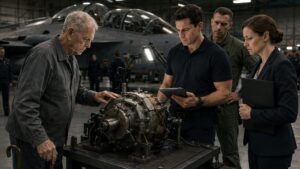
The main hangar stood beyond a temporary security line, where two young soldiers checked badges against a tablet. Past them, the open bay revealed the nose and cockpit glass of the helicopter. Even partly hidden in shadow, the aircraft pulled his eyes toward it. Its paint had been redone more than once. Its tail number was clean now, ceremonial. Its panels carried decades of maintenance that were not his. But the shape of it was unchanged in the way that mattered: the stubborn nose, the heavy belly, the broad rotor resting overhead like a held breath.
Mercy Seventeen.
The name did not appear anywhere on the banner hung near the bay. The banner read: FINAL HONOR CEREMONY. SERVICE. COURAGE. LEGACY.
William stood still long enough for a civilian volunteer carrying a crate of programs to step around him.
“You all right, sir?” the volunteer asked.
William nodded.
The volunteer smiled politely, already moving on. “Guests check in to the left.”
William did not move left.
The guest line ran toward a roped-off area with chairs, flags, a lectern, and neat rows of printed programs. Men and women in jackets and dresses waited there, some wearing ball caps with unit patches, some guiding older relatives by the elbow. That was where visitors belonged. That was where memory could sit quietly and be thanked at a safe distance.
William looked instead at the hangar floor.
A strip of yellow paint marked the restricted zone. Beyond it, maintenance crew moved with ladders and cables. A soldier in green utility uniform stood near the aircraft, watching anyone who drifted too close. Another man in a dark formal uniform held a clipboard and pointed sharply toward a table being rearranged beneath the rotor.
The helicopter seemed larger than it had any right to be.
William had seen it torn open. He had seen oil streaked along its side like black blood. He had seen men load stretchers through its door with hands slick from rain and fear. He had slept under it once because there was nowhere else dry. He had kicked its wheel and called it a mule, a coffin, a miracle, and one other name he had never said in church.
Now it sat polished under white hangar lights.
William took one step forward.
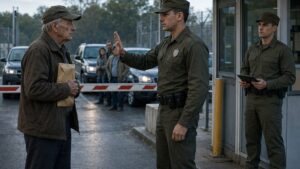
“Sir?” the soldier at the checkpoint said.
William kept walking until the young man moved into his path. He had a square, clean face and the posture of somebody who had been told that posture could solve most problems.
“Restricted area,” the soldier said. “Guests are checking in over there.”
“I’m not a guest.”
The soldier’s eyes went to William’s jacket, his worn boots, the stubble under his jaw where his razor had missed, then back to his face. Not rude. Not yet. Just quick and measuring.
“Staff badge?”
“No.”
“Vendor credential?”
“No.”
“Then I need you in the guest line, sir.”
William looked past him. The hangar lights caught the helicopter’s windshield. For one second, he saw not the glass but the reflection of a young crewman with his helmet pushed back, grinning like he had borrowed the day from God and expected to return it in one piece.
William closed his fist tighter.
“I need to see the aircraft.”
“You can see it from the guest area.”
“No,” William said. “I need to see her.”
The soldier’s polite expression thinned. “Sir, I can’t let you past this point without authorization.”
William heard the old tracks groan again as the bay doors paused halfway open. The sound scraped down his spine. He had told himself on the shuttle that he would be calm. He would sign whatever paper they asked. He would say as little as possible. He would find someone old enough to understand what “Mercy Seventeen” meant, hand over the tag, and leave before people started thanking him for things they did not know.
But there was the aircraft.
There was the open bay.
There was the tag in his hand.
And there was the terrible possibility that he had arrived too late, that the ceremony would be over before anyone said the names right.
The soldier glanced toward the man with the clipboard. “Major Reed?”
The formal officer turned. He had a stern, narrow face, the kind that looked designed for bad weather and shorter answers. His uniform was immaculate. His shoes shone under the hangar lights. On his clipboard, colored tabs stuck out like little flags of authority.
“What’s the issue?” he asked, approaching.
“This gentleman says he needs access to the aircraft, sir. No credential.”
Major Stephen Reed looked at William the way people looked at abandoned luggage. Not with hatred. With calculation.
“Sir, the hangar floor is secured until after the ceremony,” he said. “Family seating is to your left. If you need assistance, we can get a volunteer.”
“I don’t need assistance.”
“Then I need you to follow the posted process.”
William looked at the clipboard. He saw a stack of programs clipped under Stephen’s thumb. The top page showed the helicopter’s official photograph, clean and bright, with a short paragraph beneath it. His eyes found the tail number. Then the line below it.
Legacy aircraft retired after decades of distinguished stateside and overseas support service.
Distinguished support service.
His hand tightened so hard the edge of the tag bit his palm.
Stephen followed his stare. “Programs will be available once guests are seated.”
“That paragraph wrong?”
Stephen’s face changed almost imperceptibly. “Excuse me?”
William’s voice came out rougher than he intended. “That paragraph. Is that all you’re saying about her?”
The young soldier shifted his weight. Stephen’s tone cooled.
“Sir, this ceremony has been prepared by the base historical office and reviewed by command.”
William looked past him again, to the helicopter’s open side door. The shadow inside seemed deep enough to hold all the years he had not spoken about.
“She had another name,” William said.
Stephen waited.
William swallowed. “Mercy Seventeen.”
The young soldier frowned.
Stephen did not.
“Sir,” he said, “I’m going to ask you one more time to move to the guest area.”
The words were not loud, but they carried. A few people in the guest line turned their heads. William felt their eyes touch his back, then slide away. An old man making trouble. An old man confused by boundaries. An old man who had mistaken memory for permission.
He had been called worse by men he loved.
William took a slow breath. “I’m not here to make a scene.”
“Then don’t,” Stephen said.
The young soldier looked uncomfortable, as if the sentence had landed harder than he expected.
William lowered his eyes to the yellow line at his feet. Paint over concrete. A simple warning. He had spent a lifetime respecting lines when they meant safety. Stay clear of the tail rotor. Keep hands off the linkage. Do not step beneath a load. Check the pins twice. Count the stretchers in. Count the crew out.
Count them again.
He opened his fingers enough to look at the tag. The stamped code showed in broken flashes beneath his thumb.
B-17 AUX IGN.
He could hear a voice, young and breathless, saying, You hang on to that, Bennett. You hear me?
William closed his hand.
Then he stepped over the yellow line.
The young soldier moved fast.
“Sir, stop right there.”
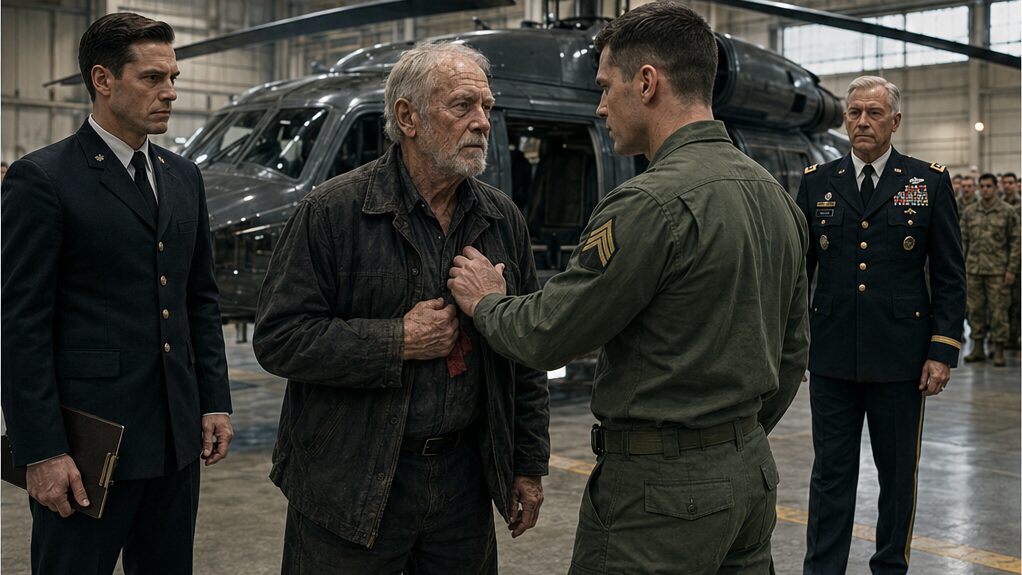
William did not stop until the soldier’s hand came down against his chest, not striking him, but firm enough to halt his forward motion. The contact jolted him. Not from pain. From the sudden indignity of another man’s hand pressing the old jacket against the place where the tag had rested all morning.
William looked down at the hand.
“Don’t,” he said quietly.
The soldier’s jaw tightened. “I gave you an instruction.”
Stephen’s voice sharpened. “Sergeant Carter.”
The soldier did not remove his hand. “I’ve got him, sir.”
William lifted his eyes from the hand to the helicopter.
The bay doors groaned again, higher this time, and daylight spread across the concrete like water.
Chapter 2: The Hand On The Old Jacket
The young sergeant’s name tape read Carter.
William saw it because the hand at his chest held him close enough to read everything: the black stitching, the crease of the uniform sleeve, the tiny scratch on the sergeant’s watch face. Anthony Carter was younger than William’s youngest grandson would have been, if there had been a youngest grandson. Twenty-five, maybe. Maybe less. Wide shoulders, clean shave, a face trying very hard not to look uncertain.
“Sir,” Anthony said, “step back behind the line.”
William kept his voice low. “Move your hand.”
“Step back first.”
“That side of the jacket,” William said, “you don’t pull on it.”
Anthony looked at him as though he had chosen the wrong detail to care about. His fingers had gathered the worn fabric near the left breast, not enough to tear it, but enough to drag the cloth tight over William’s ribs. Under that pressure, the ignition tag’s edge pressed against William’s palm, and his hand pressed against his own jacket as if holding closed an old wound.
Stephen Reed came closer. “Sergeant, maintain control until base security arrives.”
Anthony’s grip firmed.
Something in William’s face must have shifted, because the sergeant’s eyes flickered. The old man did not raise a fist. He did not shout. But his right hand came up, not to push, not to strike, only to settle over Anthony’s wrist with surprising steadiness.
“I said don’t pull on that side.”
Anthony’s mouth tightened. “Sir, you crossed into a secured area.”
“I crossed a painted line.”
“You crossed an active restricted boundary.”
William looked at the helicopter. “I crossed worse for her.”
Stephen made a short sound of impatience. “This is exactly why we don’t allow unscheduled access. People come in with stories, they interfere with operations, and then my soldiers have to manage it.”
William turned his head slowly. “Stories.”
Stephen held his stare. “Yes, sir. Stories.”
For the first time that morning, heat rose in William’s chest. Not the young heat that once made him throw wrenches across a repair bay. That had burned out of him long ago. This was colder and smaller, sharpened by years of swallowing sentences before they hurt somebody.
He could have told them then.
He could have opened his hand and said the words. Crew chief. Nineteen seventy-one. Emergency extraction. Two engines shot full of holes. Three wounded loaded under fire. One pilot bleeding through his glove. One medic laughing because the alternative was screaming. Two men who did not make it into any clean paragraph.
He could have told them he knew the way the aircraft shuddered before the left hydraulic line failed. He could have told them the exact smell of overheated transmission fluid. He could have told them why the old auxiliary ignition kit had been stripped and wired in a way that would have gotten him court-martialed if it had failed and buried if it had not.
Instead, he said, “Her name was Mercy Seventeen.”
Anthony blinked. The name meant nothing to him.
Stephen’s eyes narrowed. “That nickname does not appear in the prepared historical materials.”
“No,” William said. “It wouldn’t.”
A movement at the far side of the hangar drew Stephen’s attention. A cluster of officers had entered through a side door near the staging area. At their center walked a tall older man in a dark dress uniform decorated with rows of ribbons. His hair was silver, his face lined, his posture straight enough to make younger men check their own shoulders without realizing it.
The hangar seemed to notice him before anyone spoke.
Stephen turned fully. “Colonel Sullivan.”
Anthony did not remove his hand, but his arm lost a fraction of its force.
The older officer approached without hurry. His eyes moved first to Stephen, then Anthony, then William’s face, then the young sergeant’s fist in William’s jacket. By the time he stopped in front of them, the conversations nearby had thinned into silence.
“What’s happening here?” Colonel Charles Sullivan asked.
Stephen answered quickly. “Sir, this gentleman entered the restricted floor without clearance. He refused the guest route and continued past the line.”
Charles looked at William. “Sir?”
William met his eyes. He saw intelligence there, and weariness, and something else he did not trust himself to name. Recognition had many false beginnings. Men sometimes stared at old faces and pretended to remember out of politeness. Men sometimes saluted hats, plaques, uniforms, not people.
William said nothing.
Anthony shifted. “He said he needed to see the aircraft, sir.”
Charles’s gaze dropped to the hand still holding the jacket. His voice did not rise. “Sergeant.”
Anthony released William at once.
The fabric fell loose. William smoothed it once with his open hand. The tag flashed between his fingers.
It was barely a glint. Dull metal. Faded red cloth. A stamped code half hidden in the fold of his palm.
Charles saw it.
His face changed so little that anyone who had not spent years watching men hide bad news might have missed it. But William did not miss it. The colonel’s eyes fixed on the tag, then on William’s hand, then on William’s face with a care that made the surrounding hangar vanish.
“May I see that?” Charles asked.
William’s fingers closed again.
“No.”
Stephen frowned. “Sir, if the object is unauthorized—”
Charles lifted one hand slightly, and Stephen stopped.
Not sharply. Not out of fear. Out of habit. Authority had entered the space with less noise than the hangar doors.
Charles took one step closer to William, slow enough not to crowd him. “That looks like an auxiliary ignition tag.”
William said nothing.
“Old kit,” Charles continued. “Emergency start rig. We phased those markings out long before anyone in this room was born.”
Anthony looked from Charles to William.
Stephen’s expression tightened, caught between embarrassment and resistance. “Sir, we should still confirm—”
Charles did not look away from William. “B-seventeen?”
The tag seemed to grow heavier.
William’s thumb moved, just enough for the stamped letters to show.
B-17 AUX IGN.
The silence around them changed texture. It had been administrative before, the silence of people waiting for a disturbance to be handled. Now it was alert. Listening.
Charles drew a breath through his nose.
“I heard that code once,” he said. “From an old warrant officer who said a crew chief rewired a dying aircraft with his bare hands and bad language.”
William’s mouth tightened despite himself. “Wasn’t bare hands.”
“No?”
“Had one glove left.”
Something almost like a smile crossed Charles’s face, but it disappeared before it settled. His eyes had grown wet, not with softness but with the effort of holding history steady in public.
Anthony stared at William’s hand as if the old man had been holding fire.
Stephen looked at the helicopter. “Colonel, with respect, are you saying this gentleman is connected to the aircraft?”
Charles turned his head then. The movement was slow. “Major Reed, I’m saying you should choose your next words carefully.”
Stephen’s neck colored.
Charles faced William fully. “Your name, sir?”
William did not answer right away. Names had weight in places like this. Once spoken, they traveled.
“William Bennett,” he said.
The colonel’s shoulders changed. Not much. Enough.
He brought his heels together.
The sound of them on the concrete was small, but everyone near the helicopter heard it.
Then Charles Sullivan raised his hand and saluted.
It was not theatrical. There was no flourish, no dramatic pause for anyone watching. It was clean, restrained, and exact. The kind of salute one man gave another when ceremony was too small for the thing being acknowledged.
Anthony straightened without meaning to.
Stephen’s clipboard lowered an inch.
William stood with the ignition tag in his fist and the sunlight from the half-open bay doors striking the side of his face. For a second, his body wanted to answer as it once would have. Spine straight. Chin level. Right hand sharp to brow.
But he was not in uniform, and the arm that had once moved without thought now carried too many years. He gave Charles a small nod instead.
“Colonel,” William said.
Charles lowered his hand.
The hangar breathed again in pieces: a chair leg scraping, somebody coughing, the distant beep of a lift backing up. Anthony swallowed hard.
“Mr. Bennett,” Charles said softly, “are you the crew chief who brought her back?”
William looked past him to the helicopter. To the open side door. To the shadows inside.
“No,” he said after a moment. “Not by myself.”
Chapter 3: The Name Missing From The Program
They moved William to a side office because Charles Sullivan asked, not because William agreed.
It was a narrow room with a metal desk, two filing cabinets, and a window that looked onto the hangar floor. Through the glass, William could still see the helicopter’s nose and the lower sweep of one rotor blade. He took the chair nearest the window without being invited. His knees had begun to ache, though he would not have admitted it to anyone in the room.
Stephen Reed closed the door behind them.
Anthony Carter remained outside at first, posted beside the frame like a man assigned to guard a mistake he had made. After a minute, Charles opened the door again.
“Sergeant Carter,” he said. “In.”
Anthony stepped inside, careful now, too careful. His eyes went to William’s jacket and away.
A woman in civilian clothes entered carrying a thin folder and a tablet against her chest. She had gray threaded through dark hair and reading glasses hanging from a cord. Unlike Stephen, she did not look annoyed by paper. She looked as if paper had disappointed her often enough that she trusted it only after a long conversation.
“Margaret Harris,” Charles said. “Base archive liaison.”
Margaret gave William a small nod, not quite formal, not quite familiar. “Mr. Bennett.”
William nodded back.
Stephen set his clipboard on the desk. “Colonel, the ceremony begins in less than three hours. We have visitors arriving, a public affairs schedule, and a security issue that still has not been documented.”
Charles looked at him. “Document it after we know what it is.”
“With respect, sir, we know enough to say an unauthorized individual crossed onto a restricted hangar floor.”
Anthony’s face tightened.
William watched him, not unkindly.
Stephen continued, “I am not dismissing the possibility of a historical connection. But this ceremony has been planned for months. If there’s an adjustment to be made, it needs to go through proper review.”
Margaret opened the folder. “The ceremony packet is here.”
She placed a printed program on the desk. The cover showed the helicopter in its polished retirement state, angled under bright lights. The old machine looked clean, honorable, and harmless. William hated that more than he expected.
Charles turned the program so William could read it.
The paragraph was the same one he had seen under Stephen’s thumb. Below it was a list of notable operational periods. Training support. Disaster response. Overseas deployment. Final stateside service.
No Mercy Seventeen.
No emergency extraction.
No crew names.
William stared at the page until the letters softened.
Margaret noticed. “Mr. Bennett?”
He tapped the program once with his forefinger. “Who wrote this?”
“I compiled it from the base historical file,” she said. “Public affairs shortened it for the ceremony.”
“Shortened it.”
The word sat between them.
Margaret did not defend herself. “Yes.”
Charles leaned over the page. “Where’s the seventies deployment record?”
Margaret swiped on her tablet, then frowned. “There’s an aircraft movement summary. Maintenance logs for later years. A scanned transfer record. But the combat rescue notes are thin.”
“They’re not thin,” William said.
Everyone looked at him.
“They’re missing.”
Stephen folded his arms. “That is a serious claim.”
William looked at the man’s polished nameplate, then his eyes. “So was what happened.”
The room held still.
Charles pulled out the chair across from William and sat down. It lowered the temperature immediately. A standing officer could command. A seated one could listen.
“Mr. Bennett,” he said, “what did you come here to do?”
William opened his hand for the first time since entering the office.
The ignition tag lay across his palm. In the flat office light, it looked smaller and uglier than it had beneath the hangar lamps. The frayed red cloth had dark stains that no washing had ever removed. The stamped letters were uneven from age and use.
Anthony stared at it.
Stephen looked unimpressed, or tried to.
Margaret leaned closer but kept her hands to herself. William appreciated that.
“I came to put this back,” William said.
Charles’s voice softened. “Back where?”
William nodded toward the window. “With her.”
“The aircraft?”
“The log, if they still keep one. If not, wherever you put the things you don’t know how to throw away.”
Margaret’s eyes moved from the tag to the program.
Stephen exhaled. “Colonel, we cannot place unverified personal memorabilia into official archival material on the morning of a ceremony.”
William closed his fingers halfway around the tag. Not hiding it now. Protecting it.
Charles turned to Margaret. “Can we verify the code?”
“I can try.”
Stephen gave a tight smile. “Try is not a process.”
Margaret looked at him over her glasses. “It is often how records begin, Major.”
Charles almost smiled.
William did not.
Margaret opened the tablet again. “B-17 auxiliary ignition. If this was local to the aircraft, there may be a maintenance notation. Tail number?”
Stephen supplied the modern tail number from the program.
William gave another one.
The room went quiet.
Margaret typed both.
Anthony spoke before he seemed to realize he would. “How did you know the old number, sir?”
The last word came late, but it came.
William looked at him. Anthony’s face had changed since the hangar floor. He was still embarrassed, still guarded, but the hard certainty had drained out of him. In its place was a young man trying to stand near something he had almost broken.
“I painted around it enough times,” William said.
Anthony lowered his eyes.
Margaret’s tablet chirped softly. She frowned.
“What?” Charles asked.
“There’s a cross-reference,” she said. “The old number appears in a depot transfer file. Different nickname field.”
“Mercy Seventeen?” Charles asked.
She shook her head. “Blank.”
William looked back through the window.
Stephen’s shoulders eased, as if absence proved order.
Then Margaret said, “But there’s a linked incident file.”
Charles leaned forward. “Open it.”
“I’m trying. It’s partial. Scanned from damaged paper.” Her finger moved over the screen. “Emergency medical evacuation. Weather delay. Aircraft returned with structural damage. Crew manifest…”
She stopped.
William did not turn from the window.
Charles said, “Margaret.”
She read more quietly. “Crew manifest incomplete.”
The office seemed to shrink around the words.
Stephen’s arms unfolded.
Anthony looked at William.
William kept his eyes on the helicopter, where workers were laying a blue carpet beneath the rotor for the ceremony. A young airman smoothed the fabric with both hands, making the floor neat for people who would sit comfortably and remember cleanly.
Charles said, “Mr. Bennett, who is missing?”
William’s fingers closed fully around the ignition tag.
Outside, someone tested the microphone at the lectern. A brief squeal of feedback cut through the glass and vanished.
William’s face did not change, but his voice came out scraped raw at the edges.
“Start with the men who didn’t get a chair today.”
Chapter 4: Mercy Seventeen Was Not Empty
Margaret Harris brought them to the archive room because the side office had too many windows.
The archive sat two corridors away from the hangar, behind a door with a keypad and a sign reminding visitors that food and drink were not allowed near historical materials. It smelled faintly of paper, dust, toner, and old air-conditioning. Metal shelves lined the walls. On one table rested a scanner, a pair of white cotton gloves, and three gray boxes labeled with aircraft numbers in Margaret’s careful handwriting.
William stood just inside the door for a moment, the ignition tag closed in his hand.
He had spent his life fixing things other people used until they broke. Trucks. Tractors. Pumps. A neighbor’s furnace once in the middle of a January storm. He trusted grease under fingernails more than filing systems. Still, the sight of the boxes unsettled him. Men could be reduced to paper in a place like this. Flights, dates, serials, signatures. Enough to prove something happened. Not enough to tell anyone what it cost.
Margaret pulled out a chair. “Mr. Bennett.”
“I’ll stand.”
Charles Sullivan watched him but did not argue. Stephen Reed remained near the doorway with his arms folded, as if distance could protect him from the possibility that his ceremony packet was wrong. Anthony stood behind him, quieter than he had been in the hangar, hands clasped in front of him now rather than resting near his belt.
Margaret set her tablet on the table and opened one of the boxes. “The original file is incomplete,” she said. “But sometimes the transfer records reference attachments that didn’t survive in the main folder.”
Stephen checked his watch. “How long will this take?”
Margaret did not look up. “Longer if you ask every minute.”
Charles gave Stephen a glance. Stephen’s mouth closed.
William’s eyes moved to the nearest box. A faded label showed the old aircraft number he had given them. Beneath it, in smaller print, someone had written: RETIRED AIRFRAME — CEREMONIAL USE.
Ceremonial use.
That was what they called old machines when the danger had been scrubbed off them.
Margaret removed a folder and opened it gently. The paper inside had been photocopied more than once. Some pages were pale at the edges. Others carried handwritten notes that looked like ghosts of ghosts.
“Maintenance summary,” she murmured. “Depot transfer. Parts replacement. Rotor assembly. Medical configuration update. Here.”
She placed a scanned page on the table and turned it toward Charles.
William did not move closer.
Charles read first. His brows drew together.
“What is it?” Stephen asked.
Charles slid the page toward William, but stopped before it reached his hand. “Do you recognize this?”
William looked down.
The page showed a maintenance discrepancy report with the top corner damaged and the bottom half darkened from a bad scan. Several lines were unreadable. But one phrase remained clear: auxiliary ignition bypass installed under emergency conditions.
Below it was a signature.
Not his. The officer’s.
William exhaled through his nose.
“That was after,” he said.
“After what?” Margaret asked.
He looked at the wall, not because there was anything to see, but because walls were easier than faces.
“After we got back.”
The room waited.
William touched the edge of the table with his free hand. The skin over his knuckles looked thin under the archive light. He remembered his hands being wide, quick, stupidly confident. Hands that could find a bad connection in darkness. Hands that could safety-wire a bolt while another man held a flashlight between his teeth. Hands that had once known exactly what to do until they didn’t.
“We were supposed to wait out the weather,” he said. “That was the first order. Nobody liked it, but we’d had two birds turned back and one grounded. Valley was closing in. Rain came sideways. You couldn’t see the ridgeline unless lightning showed it to you.”
Anthony’s gaze lifted.
William kept his voice even. “Then the call changed. Not routine evac. Men pinned down. Wounded. No landing zone worth the name. Pilot said we could get in if the clouds lifted five minutes. Clouds gave us three.”
Margaret had stopped moving.
Stephen still looked skeptical, but less certain now. He had the expression of a man realizing the floor beneath the official version was thinner than expected.
William’s thumb rubbed the edge of the tag. “We took fire before we saw them. Not heavy at first. Enough to make the aircraft shake wrong. You learn the difference between weather and somebody trying to knock you out of the sky.”
Charles asked quietly, “Who was aboard?”
William’s eyes closed for a breath.
“Pilot. Copilot. Medic. Crew chief. Door gunner.” He opened his eyes. “Me.”
“And the wounded?”
“Three in. One more we went back for.”
Margaret turned to her tablet. “The incident file lists two wounded transferred, not four.”
“That file is wrong.”
Stephen said, not unkindly this time, “Records are often made from what arrives, not what leaves.”
William looked at him then.
Stephen seemed to regret the sentence before it finished living in the room.
“What arrived,” William said, “was not all that mattered.”
No one answered.
Margaret pulled another sheet from the folder. “There’s a crew note here. Hard to read. It mentions structural damage, emergency start, partial loss of electrical—”
“Battery bus was gone,” William said. “Main ignition relay was burned. Auxiliary kit was supposed to be backup only. Not for what I did with it.”
Charles leaned forward. “What did you do?”
William almost smiled, but the memory had no humor left. “Made it lie.”
Anthony frowned softly. “Sir?”
“Machines tell the truth if you listen. That day I asked one to lie long enough to get us home.”
He opened his hand and set the tag on the table.
No one touched it.
The metal made almost no sound, but every eye went to it.
“That tag was tied to the auxiliary ignition harness,” William said. “Red cloth so you could find it fast. I pulled it loose when the panel was smoking because the kit wasn’t mounted where it should’ve been after the hit. We had a medic yelling for power, pilot yelling for options, and a wounded boy on the floor asking if we were landing.”
He stopped.
The archive light hummed overhead.
Anthony’s face had gone pale.
William picked up the scanned report and stared at the signature. “We got enough spark into her to turn over. Not clean. Not proper. Enough. She coughed like an old mule, then caught. Pilot said if she died again, we’d settle wherever gravity put us.”
Charles looked at the helicopter file, then toward the closed archive door, as if the hangar were just beyond it. “But she came back.”
William’s jaw worked once.
“She came back.”
Margaret’s voice was careful. “The crew manifest still doesn’t list names.”
“It would list them if the after-action report had been filed complete,” Stephen said. “Unless the unit records were damaged.”
“They were,” Charles said. “A lot of those deployment packets were transferred twice before digitization.”
William shook his head. “Paper didn’t forget them. People did.”
The sentence struck harder than he intended. He saw Stephen absorb it, and for the first time the major looked less offended than ashamed.
Margaret searched through the folder again. “Here’s a casualty cross-reference, but the scan is poor. Two names legible. One attached to the wounded pickup site. One to the receiving station.”
William turned away from the table.
He could smell rain now though the room was dry. Could hear the rotor slap beating ragged against bad air. Could feel the deck under his knees. He had been trying to reach a junction box with one hand while bracing himself with the other, and somebody had laughed near the door. A high, panicked laugh. The medic, maybe. Or the gunner. Memory had moved the sound around for years, unable to let it rest in one throat.
Anthony spoke softly. “Mr. Bennett.”
William looked at him.
The young sergeant’s shoulders were no longer squared for control. His hands were open at his sides. He swallowed once before continuing.
“When you said Mercy Seventeen,” Anthony said, “you weren’t talking about a nickname on a plaque.”
“No.”
“You were talking about them.”
William looked at the tag lying on the table.
“I was talking about who was inside.”
Margaret’s tablet chimed again. She tapped the screen, then stiffened.
“I found a display draft from public affairs,” she said. “The ceremony panel has a hero note attached to the aircraft. One rescued serviceman named. No crew casualties. No mention of an incomplete manifest.”
Stephen moved closer despite himself. “Let me see.”
She turned the screen.
William did not intend to look. Then he saw the name in the draft heading, large and clean for visitors to read.
His breath caught.
Charles saw it. “William?”
“That man wasn’t on the aircraft,” William said.
Margaret looked from the tablet to him. “The display says he was evacuated aboard it.”
“He was the reason we turned around.”
The room went still again, but this silence had teeth.
William reached for the ignition tag and closed it back into his fist before anyone else could decide what it meant.
“He wasn’t on the aircraft,” he repeated, quieter now. “He was the one we went back for.”
Chapter 5: The Record That Protected The Wrong Truth
The hangar had changed while they were in the archive.
Rows of chairs now faced the helicopter. Flags stood behind the lectern in measured angles. A blue carpet ran across the concrete, ending beneath the rotor as if the old aircraft had agreed to receive guests with dignity. Workers moved softly, adjusting cables and checking microphones. The public affairs officer near the stage spoke into a headset, smiling at no one.
William stood at the edge of it all and felt more outside than he had before the salute.
Not because they had dismissed him.
Because now they were trying not to.
Anthony walked a few steps behind him, close enough to assist if needed, far enough not to crowd. The distance was careful. William noticed. He said nothing about it.
Stephen carried Margaret’s printouts in one hand and the ceremony program in the other. The two packets looked nearly the same from a distance. That bothered William more than it should have. Truth and error could both be stapled neatly.
Charles led them to a small staging table set behind a row of portable partitions. Margaret spread out the photocopies, the incomplete manifest, the maintenance note, and a fresh page she had printed from the archive system. Across the top of that page were the old tail number and the phrase INCIDENT RECORD — PARTIAL.
Stephen stared at the documents. “This still doesn’t give us enough to rewrite the ceremony.”
Charles looked at him. “It gives us enough to stop pretending the current version is complete.”
“The current version is approved.”
William turned his head.
Stephen did not back down, but his voice had lost its earlier sharpness. “Colonel, I am not arguing against correcting history. I am saying there is a procedure. Public statements, especially involving combat incidents and casualty records, require review. If we alter the program from the podium and get a name wrong—”
“Then we dishonor them twice,” Margaret said.
Stephen looked at her. “Exactly.”
The word surprised William. It surprised Anthony too, judging by the way his eyes moved to Stephen’s face.
Stephen lowered the program to the table. “My job is not to erase anyone, Mr. Bennett. My job is to keep this command from making public claims it cannot support.”
“You already printed one,” William said.
Stephen took that without flinching.
Outside the partition, guests began entering the seating area. Soft conversation filtered through the gap. Old men greeting each other. A child asking whether the helicopter still flew. Someone laughing too loudly, then lowering their voice beneath the rotor.
William looked through the narrow opening toward the aircraft. The side door was still open. A maintenance crew member had placed a small informational placard nearby. From where William stood, he could not read the words, but he could see the photograph attached to it. Clean aircraft. Clean sky. Clean memory.
Margaret tapped the partial record. “The display draft names the rescued serviceman as the center of the mission. That came from a later commendation summary, not the original incident file. It appears the aircraft’s role was folded into his rescue record, but the crew event wasn’t preserved as its own entry.”
Charles nodded. “So the mission survived under the wrong heading.”
“The wrong truth,” William said.
They looked at him.
He rubbed the tag between finger and thumb. “The boy they named mattered. We went back for him. But he wasn’t the whole story.”
“Do you remember the missing names?” Margaret asked.
William’s fingers stopped moving.
For a moment, no one spoke. The question was not cruel. That made it harder.
He remembered voices. He remembered hands. He remembered one man’s habit of tapping the cockpit frame twice before takeoff, as if asking the aircraft to behave. He remembered a medic who wrote letters for wounded men when their hands shook. He remembered a gunner who carried peppermint candy because he said the smell cut through fuel stink. He remembered a copilot who could not sing but did anyway.
Names lived in him too, but not cleanly. Memory had worn grooves around some and buried others under guilt.
“I remember two clear,” he said. “The third, I remember wrong half the time.”
Margaret’s face softened. “That happens.”
“I don’t want kindness on that,” William said.
She nodded once. “Then I won’t give you kindness. I’ll give you accuracy.”
Charles turned to Stephen. “Can we delay?”
Stephen checked the schedule sheet. “Ten minutes, maybe fifteen. Guests are already seated. Command party arrives at the hour.”
“Use fifteen.”
“For what?”
“For finding enough to say what we can say truthfully.”
Stephen’s eyes flicked toward William. “And if we can’t?”
William answered before Charles could. “Then don’t lie more.”
Anthony looked down at the floor.
William saw the young man’s jaw working. He had been waiting for an apology since the archive, or perhaps trying to build one and finding the pieces too childish for the size of what had happened.
Finally Anthony stepped closer.
“Mr. Bennett,” he said.
William did not turn all the way. “Sergeant.”
Anthony’s throat moved. “I shouldn’t have grabbed you.”
“No.”
The answer landed bluntly.
Anthony accepted it. “I was wrong.”
William looked at him then. The sergeant’s eyes held embarrassment, but he did not look away. That counted for more than the words.
“You were doing your job,” William said.
“I did it wrong.”
William studied him. “Yes.”
Anthony nodded once, like the correction itself was a thing he had asked for.
Stephen glanced at them, then back to the papers. Some tension moved in his face. He had not apologized. William did not expect him to. Men like Stephen reached truth through narrower doors.
Margaret suddenly straightened. “Wait.”
She pulled the tablet close and enlarged a scan with two fingers. “The damaged manifest has initials beside the crew positions. I thought they were unreadable, but the maintenance note includes sign-offs from the preflight inspection. Same date. Same aircraft.”
Charles leaned in. “Names?”
“Two full. One partial.” Margaret turned the screen. “The pilot’s name is clear. The medic’s name is clear. The crew chief line is Bennett. Door gunner is partial. Copilot is smudged, but there’s a service number fragment.”
William stared at the screen.
Bennett.
There it was, plain as a nail driven into wood.
Not a story. Not a feeling. Not an old man interrupting a ceremony.
Ink.
Stephen looked at the name, then at William. “That’s you.”
William’s mouth went dry. “I know who I am.”
“I didn’t mean—”
“I know what you meant.”
Stephen closed his mouth.
Margaret typed quickly. “I can cross-reference the service number fragment with personnel rosters. It may take longer than fifteen minutes, but the two names—”
“No,” William said.
Margaret paused.
He put one hand on the table to steady himself. “Not two if there were more.”
Charles spoke gently. “William, if we can verify two now, we can say two now and continue the research afterward.”
“That leaves somebody outside again.”
Stephen rubbed a hand over his face, the first untidy thing William had seen him do. “Mr. Bennett, the ceremony cannot become an unresolved investigation in front of families.”
“It already is one,” William said. “You just invited them to sit down for it.”
The words were not loud, but Stephen looked as if they had crossed the table and struck him.
Beyond the partition, a microphone clicked on and off. Chairs shifted. The public affairs officer announced that the ceremony would begin shortly.
Shortly.
William had spent decades living beside that word. Shortly, he would clean out the coffee tin. Shortly, he would write down the names while they were still sharp. Shortly, he would call the archive. Shortly, he would stop avoiding reunions, hangar tours, Veterans Day breakfasts, every place where people wanted stories with endings.
He opened his hand and looked at the ignition tag.
“I kept it,” he said, mostly to himself, “because I thought keeping it was remembering.”
No one interrupted.
He turned the tag over. The back carried a scratch he had made with a pocketknife the night after they returned. Not a name. He had not trusted himself with names then. Just three small lines.
Margaret saw them. “What are those marks?”
William closed his hand again. “A coward’s list.”
Charles’s face tightened. “Don’t call it that.”
William looked at him. “I marked three lines because I was afraid if I wrote names, they’d be dead twice.”
The words left him tired.
Stephen lowered himself into a folding chair beside the table. The movement was sudden enough that Anthony glanced at him.
“What do you want done?” Stephen asked.
It was not surrender. Not yet. But it was the first question that did not treat William as a problem to be moved.
William looked toward the helicopter. “I want the panel taken down.”
“The display panel?”
“If it tells the wrong truth.”
Stephen looked toward the staging area. “That can be done.”
“I want no speech about me.”
Charles nodded. “Agreed.”
“I want the record corrected.”
Margaret said, “That will take time, but I can open the amendment file today.”
William swallowed. His voice came quieter. “And if you speak any names, you speak all you can stand behind.”
Stephen looked at Margaret. “Can we stand behind the two full names and state the remaining crew record is under correction?”
Margaret considered. “Yes. If we word it carefully.”
William hated the compromise. He also knew the dead had lived in worse.
Charles checked his watch. “The ceremony starts in thirty minutes.”
He looked at William, not Stephen, not Margaret.
“What do you want done before then?”
William closed his eyes briefly.
The tag was warm again.
Chapter 6: Before They Open The Bay Doors
For fifteen minutes, everyone moved around William as though he had become the center of a storm no one could name.
Margaret returned to the archive with a maintenance crew member carrying the display panel under one arm. Stephen rewrote lines on a legal pad, crossed them out, rewrote them again, then handed the page to Charles for review. Anthony disappeared and came back with a chair, a bottle of water, and an expression that suggested he had argued with himself about whether offering either would be insulting.
William accepted the chair.
He did not touch the water.
Behind the closed hangar bay doors, the ceremony space had dimmed into a strange half-light. Most of the guests were seated now. Their voices rose and fell beyond the partitions. The helicopter waited under the rotor, polished and still. A flag near its nose stirred whenever the ventilation kicked on.
William sat where he could see the aircraft but not the audience.
The tag rested in his open palm.
Without the effort of hiding it, his hand trembled. He watched the red cloth quiver and thought how strange it was that age got blamed for every shaking thing. His hands had shaken when he was twenty-three, crouched beside the panel with smoke in his eyes, trying to strip a wire with a knife that kept slipping because blood, rain, or hydraulic fluid had made everything slick.
He had told himself it was hydraulic fluid.
He still told himself that.
Charles came to stand beside him. “We can keep your name out of the remarks.”
William nodded.
“The two verified names will be read as part of the aircraft’s service history. Margaret is preparing an archival note that says the crew manifest is incomplete and under correction. Stephen is removing the old display language.”
William looked at him. “He angry?”
“Major Reed?”
“Mm.”
“He is uncomfortable.”
“Good.”
Charles’s mouth moved slightly. “Yes. Sometimes that’s the door.”
William turned the tag over in his palm. The three scratched lines caught the light.
Charles saw them but did not ask again.
After a moment, William said, “I used to think the machine was the thing I saved.”
Charles remained quiet.
“That’s what people ask about. How damaged was she? How did you keep her running? Was it true you bypassed the ignition? They like that part. Wrench and wire. Smart crew chief. Stubborn aircraft.”
He rubbed one thumb over the stamped code.
“But machines don’t wake up sweating.”
“No,” Charles said.
William looked toward the helicopter’s open side door. “We got the first three aboard. Then the call came that one more was still out there. Pilot said we were too heavy. Medic said he’d throw out his own kit before we left him. Door gunner laughed and said nobody was throwing anything because he’d shoot the next man who wasted time talking.”
A faint smile crossed William’s face and disappeared.
“We went back.”
Charles’s voice was low. “That was the man on the display?”
“Yes.”
“But he didn’t make it aboard.”
William shook his head. “Not the way they wrote it.”
He could feel the cabin again. The tilt. The awful drag when the aircraft refused to lift clean. The pilot fighting the stick. The copilot calling numbers that got worse every second. The wounded boy near the door with mud on his face, eyes open, one hand reaching up not for rescue but for anything that proved the world still had hands in it.
“We got close enough for the medic to jump down,” William said. “Too close. Fire picked up. Something hit the panel. Something hit him.”
Charles said nothing.
“The medic shoved the boy toward the door. Door gunner grabbed him. Then the aircraft lurched. I don’t remember if the boy was in or out when we lifted. I remember the medic’s hand on the rail. I remember somebody yelling that we had to go. I remember the ignition dying.”
His fingers closed slowly around the tag.
“I remember making her start again.”
“And the medic?”
William stared at the floor.
“He told me to hang on to the tag.”
Charles waited.
William’s voice went almost flat. “He said, ‘You hang on to that, Bennett. You hear me?’ Like he was giving me a tool to put away. Like we were going back to the maintenance bay and he’d ask for it after coffee.”
“Did he know?”
William looked at him then. “They know before the rest of us do.”
Charles’s eyes lowered.
Outside the partitions, Stephen’s voice carried briefly, clipped but controlled, giving instructions to someone about the revised remarks. He sounded different now. Less like a man protecting an event. More like a man afraid to get it wrong.
Anthony appeared at the opening. He did not step through.
“Colonel,” he said. “They’re asking if we’re ready to move the command party.”
Charles turned. “Two minutes.”
Anthony nodded. His eyes went to William. “Sir, may I come in?”
The words were simple. William felt them more than he wanted to.
“Yes.”
Anthony entered and stopped several feet away. He had removed his gloves. William noticed that too.
“Major Reed asked me to return this,” Anthony said.
He held out the ceremony program. The top page had been marked with a black line through the original paragraph. A new sheet was clipped behind it with Stephen’s handwritten corrections.
Anthony did not place it on William’s lap. He waited.
William took it.
The revised lines were brief. There was no decoration in them. No grand language. They stated that the aircraft had served in an emergency evacuation under hostile conditions; that records were incomplete; that two crew names had been verified; that additional correction would continue after the ceremony; and that the aircraft’s retirement would include acknowledgement of those not yet properly recorded.
William read it twice.
“They didn’t put me in it,” he said.
“No, sir,” Anthony replied. “Colonel Sullivan said you asked not to be.”
William handed the page back.
Anthony accepted it with both hands.
Neither man spoke for a moment.
Then Anthony said, “When I grabbed your jacket, I thought I was stopping someone from making trouble.”
William looked at the helicopter. “You were.”
Anthony’s face tightened.
William added, “Just not the kind you thought.”
The young sergeant absorbed that. His eyes moved to the tag.
“May I ask what happens to it?”
William turned the metal in his palm. “I thought I knew.”
“And now?”
Now, the tag felt less like proof and more like a debt that had finally found the address.
William looked at Charles. “You still keep aircraft logs?”
“For retired airframes, yes. Maintenance history, ceremonial file, preservation notes.”
“Not a display case?”
“If you don’t want one.”
“I don’t.”
Charles nodded. “Then not a display case.”
William looked back at the aircraft. “It belongs with the log. Not where people point at it. Where somebody looking for the truth might find it.”
Anthony’s voice was careful. “Would you like someone to place it there for you?”
William almost said no.
Pride rose first, old and foolish. He had walked into the hangar under his own power. He had crossed the line under his own power. He could put one piece of metal where it belonged without being escorted like a relic.
Then his knee shifted and pain cut bright through his leg.
He did not flinch quickly enough to hide it.
Anthony saw. He did not step forward.
That restraint, more than the offer, changed something in the air between them.
William closed his fingers around the tag and pushed himself to his feet. Charles moved slightly, then stopped. Anthony remained still, waiting.
The old man stood a moment until the room steadied.
“Not yet,” he said. “After.”
Charles understood. “After the names.”
William nodded.
The public affairs officer’s voice came over the sound system, asking guests to rise for the arrival of the command party. Chairs scraped beyond the partition. The hangar doors gave a deep metallic shudder as someone prepared them for the final opening sequence.
That old sound moved through William’s bones.
Anthony stepped to the side, clearing the path.
Then he straightened, not in display, not for Charles, but for the old man in the worn jacket holding the faded red tag.
“Sir,” Anthony said, softer than before, “may I escort you?”
William looked at him long enough for the young sergeant to feel the full weight of the question he had finally learned to ask.
Then William gave one small nod.
“Walk beside me,” he said. “Not in front.”
Chapter 7: The Names Spoken Under The Rotor
Anthony walked beside William through the gap in the partitions.
Not ahead. Not behind. Beside.
It was a small correction, the kind no audience would notice, but William felt it in every step. The young sergeant matched his pace without making a show of slowing down. When William’s left knee hesitated, Anthony did not reach for him. He simply shortened his stride and looked straight ahead, as if the pace had always been his own.
The hangar had gone quiet for the command party.
Rows of guests stood facing the aircraft. Some wore suits. Some wore old unit caps. Some held folded programs. A few turned when William emerged, curiosity passing over their faces at the sight of an old man in a worn jacket being escorted near the ceremony area. William kept his eyes on the helicopter and let the attention pass.
The aircraft rested beneath its rotor like something too tired to fly but too stubborn to be called dead. The blue carpet under it looked out of place to William, but the open side door helped. It made the machine seem less like a display and more like a memory someone had forgotten to close.
Charles Sullivan stood near the lectern with Stephen Reed a step behind him. Stephen held the revised page. His uniform remained exact, his posture formal, but something had changed in his face. He looked less polished than he had that morning. Not weaker. More present.
Margaret stood beside the staging table with a slim archival folder in her hands.
Anthony stopped at the edge of the front row. “Here, sir?”
William looked at the chair placed near the aisle, close enough to see the helicopter, not so close that he became part of the stage. Someone had chosen that carefully.
“Yes,” he said.
Anthony waited until William sat before stepping back. Then he remained at the aisle, facing the crowd, hands folded in front of him. When a younger soldier near the rope line leaned over and whispered something with a glance at William, Anthony turned his head.
“Mr. Bennett is an invited guest,” he said quietly.
The younger soldier straightened. “Yes, Sergeant.”
William heard it. He did not look over.
The public affairs officer adjusted the microphone, then introduced Charles. There was polite applause. William kept the tag closed in his fist inside his jacket pocket. For the first time all day, he was not afraid someone would take it from him. He was afraid of giving it up.
Charles began with the expected words. Service. Longevity. Generations of crews. Mechanics, pilots, medics, maintainers. He spoke well, but not grandly. William listened with half an ear, watching the aircraft instead.
Then Charles paused.
The pause was long enough for heads to lift from the printed programs.
“This morning,” Charles said, “we were reminded that official history can be incomplete even when it is written with good intentions.”
A small movement passed through the seated guests.
Stephen stood still behind him, the revised page in his hand.
Charles continued. “The aircraft before us served in many missions, not all of them preserved with the care they deserved. One such mission involved an emergency medical evacuation under hostile conditions during an overseas deployment. The records available to us today are partial. That incompleteness is now part of what we must acknowledge.”
William stared at the open door.
He had expected the words to feel too small. They did. But they did not feel empty.
Charles looked down at the paper once, then back at the guests. “Two crew names connected to that mission have been verified this afternoon. Others remain under review and will be added to the permanent record as they are confirmed.”
William’s hand closed around the tag until the metal edge bit him.
Charles read the first name.
Then the second.
The hangar did not erupt. No one applauded. That was good. Applause would have been wrong there, under the rotor, with the names still settling into the air.
Instead, people stood a little straighter.
An older man in the second row removed his cap.
A woman near the aisle pressed two fingers beneath her glasses.
Stephen lowered his eyes while the names hung in the quiet. His lips moved once, not speaking into the microphone, only repeating them for himself.
William did not know whether the names had sounded exactly as they once sounded in life. He had not heard them spoken aloud in years. The first had come out clean. The second had caught slightly on Charles’s tongue, as if the colonel understood that a name was not a line item and should not be rushed.
Charles folded the paper. “Today, this aircraft’s retirement will not close its history. It will reopen part of it, so that the record can be corrected with care.”
He looked toward William then.
Not long. Not dramatically. But enough.
“We are also grateful,” Charles said, “to the veteran who brought forward the evidence that made this correction possible, and who asked that the attention remain where it belongs.”
William looked down.
The tag was warm in his palm.
There was no salute this time. Charles did not call him up. He did not ask him to stand. He did not tell the crowd what William had done with wire, fear, and one glove. The gratitude stayed contained, which allowed William to bear it.
Stephen stepped to the microphone next.
For a moment, William wondered if the major would retreat into polished language. Stephen unfolded his paper carefully. His voice, when he spoke, carried less confidence than before. That was not a flaw.
“The display panel prepared for today’s ceremony has been removed,” Stephen said. “Its wording did not meet the standard this history deserves. A corrected archival notice will be prepared after review of the available records.”
He looked out across the guests. “Anyone with personal documents, photographs, or records connected to this aircraft’s early service may leave their contact information with the historical office.”
A practical request. A changed behavior. William felt something in his chest loosen by a small degree.
Stephen stepped back.
The rest of the ceremony moved around that absence: the missing display, the altered program, the two names now present where none had been before. There were formal remarks, a short prayer, a reading of the aircraft’s service periods. William let most of it pass over him. His attention stayed on the helicopter’s side door, on the dark interior where a younger version of himself had once knelt and ordered a machine not to die.
At the end, Charles asked the guests to remain standing while the hangar bay doors opened for the aircraft’s final public salute.
The motors engaged.
The old groan filled the building.
William’s eyes closed.
Metal rolled on metal. The sound came across decades without asking permission. The hangar filled with daylight by degrees, bright strips widening across concrete, across boots, across the blue carpet, across the helicopter’s nose.
When he opened his eyes, the bay doors were partway open, and sunlight touched the aircraft’s windshield.
Anthony leaned slightly toward him. “Sir.”
William looked up.
Margaret stood beside the aircraft log table. She held the slim archival folder open. Charles waited near her. Stephen stood on the other side, hands clasped behind his back.
Not rushing him.
Not displaying him.
Waiting.
William pushed himself up from the chair before Anthony could offer. Pain rose in his knee, and he accepted it. Anthony walked beside him again down the aisle. The guests watched, but quietly, as if some instruction had passed through the room without being spoken.
At the aircraft log table, Margaret turned the folder toward him.
Inside was a clear sleeve labeled with the old tail number and the current one. Beneath it was a temporary archival note in Margaret’s neat type, leaving space for additions. The two verified names were listed. A third line read: additional crew records pending verification.
William looked at that line for a long time.
“It should not stay pending forever,” he said.
Margaret’s voice was steady. “It won’t.”
He believed she meant it. That was not the same as believing the world would obey, but it was something.
Charles said, “Would you like to place it yourself?”
William opened his hand.
The tag lay across his palm: dull metal, faded red cloth, three scratches on the back, a stamped code that had outlived men. He had carried it through decades of oil changes and doctor visits, quiet dinners and long nights, winters when his hands stiffened and summers when the garage smelled like hot rubber. It had been proof, punishment, promise.
For one terrible second, he could not release it.
Then Anthony moved.
Not toward William. Toward the table.
The young sergeant removed his own handkerchief, plain white, folded it once, and laid it beside the open sleeve.
“In case you want to set it down first, sir,” he said.
William looked at him.
Anthony’s face was calm now, but not proud of itself. That mattered. He was not offering a performance. He was offering a place.
William set the tag on the white cloth.
His fingers opened slowly. The metal left his skin.
Nothing dramatic happened. No thunder in the rafters. No ghost rising from the cockpit. The tag simply lay there, smaller than grief, heavier than decoration.
Margaret waited. “May I?”
William nodded.
She lifted the tag by the cloth, not touching the metal, and slid it into the archival sleeve with the temporary note. The red strip settled against the paper. The stamped code faced outward.
B-17 AUX IGN.
William’s throat tightened.
Charles stood very straight. Stephen looked at the sleeve and then at William.
“Mr. Bennett,” Stephen said.
William turned.
Stephen did not offer a salute. Maybe he knew that was not what this moment needed from him.
“I was wrong this morning,” he said. “Not only in what I assumed. In how I listened.”
William studied him. A clean apology could be another kind of ceremony if a man used it to polish himself. Stephen’s face showed no polish now.
“Do better with the next old man at your door,” William said.
Stephen nodded once. “Yes, sir.”
It was enough.
The ceremony concluded without applause for William. There was applause for the aircraft, for the unit, for the families, and finally a quieter standing silence when Charles repeated the two verified names. William remained seated for that part. Not because he would not stand, but because his legs had given enough for one day.
When the guests began to move, several looked toward him. A few seemed ready to approach. Charles intercepted the first with a gentle word. Margaret directed others toward the historical office table. Anthony stood near the aisle, not guarding William from people exactly, but guarding the space around him.
After a while, William rose.
No one stopped him.
He walked toward the open bay doors, the daylight broad and warm ahead. Behind him, the helicopter rested under the rotor with the log folder now placed on a small table beside it. The tag was no longer in his hand. His palm felt oddly light, almost exposed.
At the yellow line, William paused.
The same line he had crossed that morning ran under his boots.
Anthony stopped beside him.
William looked at the paint, then at the young sergeant.
Anthony said nothing.
William stepped over it.
This time, no hand came to his chest.
He walked out into the sun. The hangar doors stood open behind him, and the old sound of metal on metal had gone quiet at last.
The story has ended.