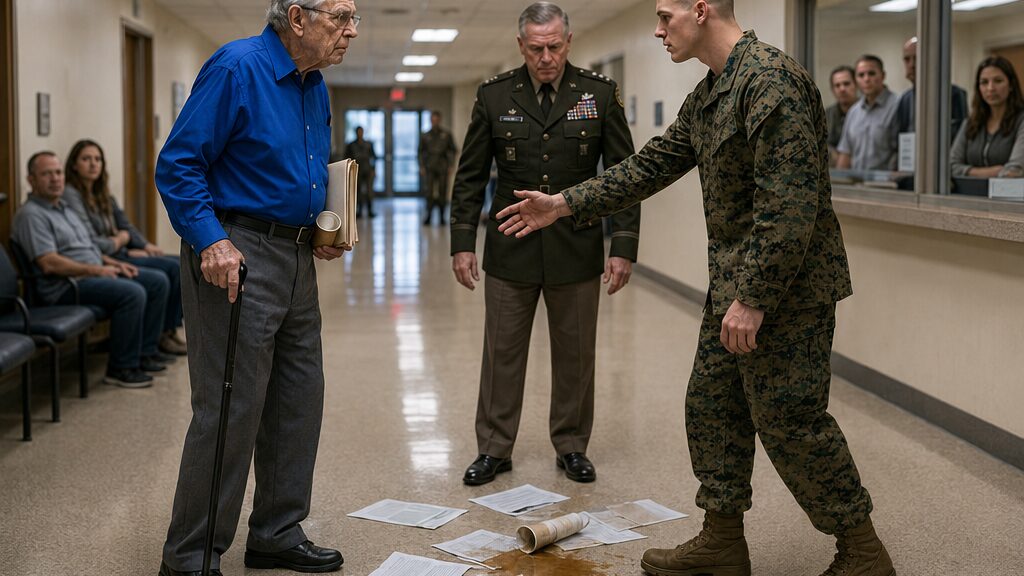
The Old Veteran Stood Silent While His Papers Lay Scattered Across The Military Hallway
Chapter 1: The Papers On The Hallway Floor
James Bennett wore the blue shirt because Virginia Miller had once told him it made him look less like a man waiting for bad news.
The shirt was too bright for the gray morning, too bright for the military administration building with its polished floors and pale walls and framed photographs of people who had stood straighter than James could manage now. But he had ironed it the night before with slow hands, pressing the collar twice, then folding the sleeves to the exact line above his wrists. He had laid his papers flat beneath the telephone book on his kitchen table, slipped the oldest page into a plastic sleeve, and tied the rolled document with a faded rubber band that threatened to snap every time he touched it.
Now, at eight minutes past nine, he stood just inside the front hallway of the records administration building, one hand wrapped around the handle of his black cane, the other holding the packet against his ribs.
The hallway smelled faintly of floor wax and coffee. A young woman at the reception window was speaking into a headset. Two veterans sat along the wall, one in a wheelchair, one with a ball cap pulled low over his eyes. A uniformed security clerk pointed a delivery driver toward the elevators without looking up from his screen.
James moved slowly because speed had become expensive. Each step required negotiation with his right knee, his hip, the dull pressure behind his chest that had made his doctor raise one eyebrow and say, “Don’t push unnecessary trips.”
This one was necessary.
He reached the sign that read RECORDS AND SERVICE VERIFICATION, ROOM 114, and paused to shift the folder under his arm. The rolled document slipped an inch. He caught it before it fell.
“Sir,” a voice said, sharp enough to stop him.
James turned.
A young serviceman in camouflage stood near the hallway intersection. His name tape read CARTER. His boots were polished, his jaw tight, his posture too squared for a man who had only asked one word.
“Yes?” James said.
“You can’t block the corridor.”
James glanced around him. There was enough room for three men to pass side by side. “I’m going to Room 114.”
“Appointments check in at the front desk.”
“I did.”
The young man’s eyes moved to the papers under James’s arm, then to the cane. Not long enough to be kind. Long enough to decide something.
“Then you need to sit until they call you.”
“My appointment was at nine.”
“They’ll call you.”
James looked toward the reception window. The woman with the headset was still speaking, still not looking his way. Behind the glass, a printer coughed sheets into a tray.
“I was told to bring original copies,” James said. “Not leave them at the desk.”
Carter exhaled through his nose. “Sir, I’m not debating the process in the hallway.”
James had heard tones like that before, though they had usually come from men too tired to be careful or too frightened to admit they were frightened. This tone was different. It belonged to someone guarding a rule as if the rule itself could be injured.
“I’m not debating,” James said.
“You’re standing in the traffic path.”
A pair of office workers came around the corner carrying binders. They slowed at the sight of the two men and angled around James with the careful impatience people gave to wet floors or old dogs.
Heat rose along James’s neck.
He moved his cane half a foot closer to the wall. “There.”
Carter stepped nearer. “Sir, please return to the waiting area.”
The word please did not soften anything.
James looked at the door to Room 114. It was ten steps away. Through its narrow window, he could see a row of file cabinets and the edge of an American-made metal desk, brown at the corners from years of use. Somewhere in that room, if he had understood the phone call correctly, was a person who could stamp the verification line before the request expired.
“My packet is time-sensitive,” he said.
“Everybody’s packet is time-sensitive.”
That drew a glance from the veteran in the wheelchair. The man’s face tightened, then went blank again.
James swallowed. He had promised himself he would not make a scene. Not here. Not in a building where half the men already carried enough embarrassment just walking to a window and asking someone younger to read back a number they could no longer see clearly.
Carter held out his hand. “I can take it to reception.”
James’s grip tightened on the packet. “No.”
“Sir.”
“I was told not to let it out of my hand.”
“Then you can hold it in the waiting area.”
James did not move.
Carter’s eyes flicked past him toward the entrance. A senior officer in a dark dress uniform had just come through the glass doors, speaking quietly with an administrative supervisor. Ribbons lined his chest. His hair was silver at the temples. He carried himself with the ease of someone who did not have to raise his voice to be obeyed.
The change in Carter was small but immediate. His shoulders locked. His chin lifted. His hand came again toward James’s packet, faster this time.
“Sir, step aside.”
James pulled the folder back. “Don’t.”
Carter did not mean to strike him. James understood that later. In the moment, there was only the quick movement, the young man’s fingers closing around the edge of the folder, James’s old hand refusing to release it, and the rubber band on the rolled document snapping with a dry little pop.
The packet opened.
Papers slid out like white birds startled from a roof.
They hit the polished floor and skidded in different directions. The rolled document thumped once, unraveled halfway, and bumped against Carter’s boot. James’s paper cup, tucked awkwardly against the crook of his arm, tipped forward. Coffee spilled across two pages before he could catch it.
For a second, no one moved.
The sound seemed too small for what had happened. A cup tapping the floor. Paper whispering. James’s cane making one hard click as he planted it to keep his balance.
The hallway had gone quiet.
One page lay faceup near the officer’s shoe. James could see the damp creeping toward the typewritten line he had protected all morning. Another page had landed under the edge of the reception chairs. The oldest sheet, the one in the plastic sleeve, had slid almost to the wall. His fingers twitched toward it, but his knee would not bend that far, not safely, not in front of everyone.
Carter looked down.
James looked down too.
He did not say what came first to his mind. He did not say that men had been gentler with radio parts in the rain, gentler with letters from home, gentler with the dead. He did not say that the page by Carter’s boot had a name on it that deserved better than floor wax and coffee.
Instead he steadied his breath.
“Son,” he said quietly, “please take your foot back.”
Carter looked at his own boot. The edge of the rolled document had caught beneath the sole. He moved it quickly, too quickly, and the paper curled.
The senior officer stopped beside them.
“What happened here?” he asked.
Carter straightened so hard James could almost hear his spine protest. “Sir, this gentleman refused to clear the corridor.”
The word gentleman landed badly. It sounded borrowed.
James kept his eyes on the floor.
The officer’s gaze moved from Carter to James, then down to the papers. His expression changed not into anger, not yet, but into attention. Real attention. He bent enough to pick up the nearest page. Coffee had blurred one corner, but the heading remained visible.
Record Correction Request.
The officer read the name beneath it. Not James Bennett’s name. Another man’s.
James watched the officer’s thumb pause along the damp edge.
“Did you drop these?” the officer asked.
James lifted his head. “They fell.”
Carter spoke quickly. “Sir, I attempted to assist him with intake procedure.”
The officer did not look away from James. “Mr…?”
“Bennett,” James said. “James Bennett.”
The hallway held that name for a moment and did nothing with it.
The officer gathered one more sheet, then another. He did not hand them to Carter. He held them himself, carefully, by the dry corners.
“Mr. Bennett,” he said, “are you injured?”
“No.”
“Are you sure?”
James nodded once. His knee had begun to throb. His face felt hot. But those were not injuries that counted in a report.
The officer looked at Carter then. His voice remained level. “Why is a veteran’s paperwork on the floor?”
Carter’s mouth opened.
Nothing useful came out.
James wished, suddenly and fiercely, that the officer had not said veteran so loudly. The word moved through the hallway. The veteran in the wheelchair looked up fully now. The woman behind the reception glass removed one side of her headset. The delivery driver stopped pretending to read the building directory.
James had never minded being known for what he had done. He minded being reduced to it at the wrong moment, as if the word itself were a bandage someone could slap over carelessness.
The officer lowered his voice. “Mr. Bennett, what office were you trying to reach?”
“Room 114.”
The officer looked toward the door ten steps away. Then he looked at the cane, the spilled coffee, the pages under the chairs, the young serviceman standing rigidly beside the mess.
“Carter,” he said.
“Yes, sir.”
“Pick up every page. Slowly. If there is coffee on it, do not wipe it across the print.”
Carter’s face colored. “Yes, sir.”
“And when you are done, you will explain to me why your first instinct was to move the man instead of asking what he needed.”
James lowered his eyes again.
Carter bent. His movements were stiff, embarrassed, watched. He reached for the rolled document and hesitated when he saw how fragile it had become at the fold.
James shifted his weight on the cane. The sound of the rubber tip against the floor seemed louder now.
The officer stepped closer, not crowding him.
“I’m Colonel Frank Sullivan,” he said. “I’m going to see that someone in Room 114 speaks with you.”
James looked at the papers in the officer’s hands. “That page can’t get lost.”
“It won’t.”
“They said I needed the original.”
“We’ll handle it carefully.”
James wanted to believe him. He had spent too many years believing men who meant well and too many years after that learning how paper could fail where memory did not. Still, the officer was holding the page correctly, by the edges, keeping the damp corner down.
From the floor, Carter lifted a sheet and froze.
James knew which one it was before he saw it.
The old page in the plastic sleeve had turned in Carter’s hand, and through the cloudy film appeared a typed service line, a date, and the name of a man who had been dead for thirty-seven years.
Carter’s eyes moved over it, confusion replacing irritation.
James held out his hand.
This time, Carter gave the page back without argument.
Chapter 2: The Appointment That Wasn’t There
Room 114 was colder than the hallway.
James noticed that first because cold always found the joints before anything else. It slipped through the fabric at his knees and settled in the bones of his hand where he gripped the cane. The records office had two desks, three filing cabinets, one copier, and a counter that separated visitors from the people who decided whether paper was complete enough to matter.
Sarah Reed sat behind the counter with James’s packet spread before her on a clean blotter. She had put paper towels under the damp pages and weighted the corners with two staplers. The rolled document lay beside her keyboard like a small injured thing.
Colonel Sullivan stood near the door, speaking quietly with the administrative supervisor. Carter remained outside in the hallway. James could see the edge of his uniform through the narrow window whenever someone passed.
“Mr. Bennett,” Sarah said, “I need to ask you about the appointment.”
James sat in the visitor chair because the colonel had asked twice and because his knee had begun to tremble. He kept his cane upright between both hands.
“I called last Thursday,” he said.
“Do you remember who you spoke to?”
“No.”
Sarah’s mouth did not change, but something in her eyes settled into a familiar professional patience. James had seen it in clinics, pharmacies, bank offices. It was the face people wore when they were preparing to tell an old person that remembering a thing was not the same as proving it.
“I was told nine o’clock,” James said.
“I believe you. I’m just not seeing an appointment under Bennett.”
“It may not be under mine.”
Sarah looked down. “Miller?”
“Possibly.”
She typed. The keys clicked lightly. She frowned, typed again, then shook her head. “No Miller appointment for today either.”
James’s fingers pressed into the cane handle.
Colonel Sullivan had stopped speaking near the door. James could feel him listening, though he did not turn.
“The woman on the phone said originals had to be brought in person,” James said. “She said a mailed copy would delay it.”
“That can be true in some cases.”
“This is one of those cases.”
Sarah moved a damp page aside with care. “The issue is the verification line. The request form references service records for a Frank Miller, but the surviving claimant listed is Virginia Miller. The supporting document is incomplete.”
James leaned forward. “Not incomplete. Faded.”
“In the system, if the verification number can’t be read, it’s incomplete.”
The distinction sat between them, small and cruel.
James looked at the page under the stapler. Coffee had darkened the lower left corner, but the worst blur had been there before the cup fell. It had been there when Virginia gave it to him in a folder she kept inside a dresser drawer with church envelopes and her husband’s watch. The number had faded with age, humidity, and too many moves between apartments.
“He served,” James said.
Sarah’s face softened slightly. “I’m not saying he didn’t.”
“You’re saying the page can’t say it clearly enough.”
“I’m saying I need something the system can accept.”
The system. James had no quarrel with systems when they worked. He had once trusted systems more than memory. Supply lists, movement orders, message logs, maintenance cards, morning reports. A unit could run on paper if the men handling it knew that every line had a body behind it.
But a system could also turn a living promise into an error box.
Colonel Sullivan stepped closer. “What deadline is attached to this?”
Sarah pulled another sheet forward. “The appeal window closes Wednesday at end of business. There may be extension options, but they’re not guaranteed.”
“Today is Monday,” Sullivan said.
“Yes, sir.”
James closed his eyes for half a second. Virginia had not wanted him to come. She had stood in her small kitchen with one hand on the back of a chair and said, “James, it’s been too long. Let it rest.”
But her electric bill had been folded under the sugar bowl, and the pharmacy bag on the counter had held only half the prescription her doctor had written. Let it rest was something proud people said when they could not afford to keep asking.
Sarah lifted the plastic sleeve. “Who is Frank Miller to you?”
James opened his eyes. “A friend.”
“Service friend?”
“Yes.”
“Were you in the same unit?”
“For part of it.”
“What was your role?”
James glanced toward Sullivan, then back to Sarah. “Communications. Later records support when my hearing started giving trouble.”
Sarah nodded in the automatic way of someone gathering relevance. “Do you have your own discharge paperwork?”
“That’s not what I came for.”
“I understand, but if we can establish your connection to the unit, it may help us locate a secondary record.”
James almost smiled. Not because it was funny. Because the day had circled back to asking him to prove he had stood where he remembered standing.
“My papers are at home.”
“Could someone bring them?”
“No.”
The answer came too quickly. Sarah waited, but James did not fill the silence. His own papers were in a metal box under his bed, wrapped in a towel. He had not opened the box since his wife died. He knew what was inside. He also knew what was not.
Sullivan said, “What do you need from this office today?”
James looked at the colonel. The man’s expression was steady, not impatient. That made it harder to answer carelessly.
“I need someone to accept the correction request before Wednesday,” James said. “Virginia Miller’s claim was denied because the record says her brother was not attached to the unit during the operation named in the file. He was. I was there when the field roster was copied wrong. I knew it then. I was nineteen. Nobody wanted to hear it by the time I understood what the mistake meant.”
Sarah’s fingers stilled above the keyboard.
James looked down at his cane. “Frank Miller died with the wrong line following him. His sister should not have to pay for that too.”
The office quieted. Outside the door, a phone rang in the hallway and was answered by someone with a bright voice that did not belong near this conversation.
Sarah drew the request form closer. “Mr. Bennett, the form also requires a claimant signature on the second page.”
“It’s there.”
“The copy is signed. The original signature page is missing.”
James stared at her.
Sarah turned the packet gently so he could see. Page one. Page three. Supporting statement. Old roster copy. Service note. Medical cross-reference. The plastic sleeve. The rolled document.
No second page.
James felt something drop inside him, lower than embarrassment. “It was there this morning.”
“It may still be in the hallway,” Sullivan said at once.
“It was in the packet.”
“We’ll look.”
James saw again the papers sliding across the floor, Carter’s boot shifting, coffee spreading, the old page skating toward the wall.
Sarah stood. “I’ll check the hallway and reception.”
“No,” James said.
She stopped.
The word had come out harsher than he intended. He adjusted his hand on the cane. “Please. Let me look.”
Sullivan’s eyes narrowed slightly, not in suspicion, but concern. “Mr. Bennett, we can help.”
“I know where I had it.”
No one said the obvious thing: that knowing where a page had been did not mean knowing where it was now.
James pushed himself up from the chair. Pain moved through his knee in a white flash, and he waited for it to pass before taking a step. Sarah came around the counter but did not touch him.
When they opened the door, Carter was still in the hallway. He looked first at Sullivan, then at James. His face carried the stiff misery of someone who had been corrected but not yet changed.
“Sir,” he said.
James did not answer. He looked at the floor.
The hallway had been cleaned. The spilled coffee was gone. No paper remained under the chairs. The wet shine of the floor showed only ceiling lights and the faint streak where a mop had passed.
A janitor stood near the supply closet with a yellow bucket.
Sarah asked him about a missing page. The janitor shook his head and said anything wet on the floor had gone into the trash liner unless it looked official.
“Where is the trash?” Sullivan asked.
The janitor pointed.
James looked toward the gray bin beside the reception desk. It had already been emptied.
For the first time that morning, his grip on the cane faltered.
Sarah returned to the office and checked the copier tray, the counter, the gap behind the chair. Sullivan questioned reception. Carter stood uselessly until the colonel turned to him and said, “Start looking.”
Carter did.
He checked beneath every chair in the hallway. He opened the lid of the shred bin, then closed it when the reception clerk snapped that nothing went in there without logging. He went to the janitor’s cart, pulled a pair of gloves from the box, and lifted the tied trash liner from the bucket.
James watched him carry it to a utility alcove.
The young man’s face tightened as he opened the bag.
Sarah came back to James with a photocopy of the packet. “If the signature page is gone, Mrs. Miller can sign a replacement.”
“She doesn’t drive anymore.”
“We can fax it.”
“She doesn’t have a fax.”
“Email?”
James shook his head.
Sarah’s face fell into the helplessness of someone discovering that solutions often belonged to people who already had resources.
Sullivan said, “Could she come tomorrow?”
James looked at the damp pages on Sarah’s desk. “She shouldn’t have to.”
No one answered.
From the utility alcove, Carter called, “Sir.”
They all turned.
He held up a damp half-sheet, not the missing signature page, but a torn corner with Virginia Miller’s name visible in blue ink.
James knew then that the page had not merely fallen.
It had torn.
Chapter 3: The Name On The Damp Page
By the time James reached home, the bright blue shirt had lost its shape at the cuffs.
He hung it on the back of a kitchen chair instead of putting it in the laundry. A brown coffee stain marked the left sleeve where the cup had splashed him. He touched it once, then let his hand fall.
His apartment was quiet except for the refrigerator hum and the soft tick of the wall clock his wife had bought at a yard sale fifteen years earlier. The clock had a painted rooster on it. It had never matched anything they owned, but she had liked the red comb and the foolish confidence of its chest.
James set the packet on the kitchen table.
The pages Sarah had salvaged were separated by paper towels and clipped in careful groups. The torn corner with Virginia’s signature sat in a small envelope marked FOUND FRAGMENT. Sarah had written those words in neat block letters, as if politeness could make the fragment less absurd.
James eased himself into the chair. His knee pulsed. His hand shook when he reached for the glass of water he had left near the sink that morning.
The doctor had told him to keep emergency tablets in his pocket and not to ignore pressure in his chest. James had nodded, taken the prescription, and ignored the look that came with it. People started giving a man that look when they believed every trip outside his home was a negotiation with risk.
He took the tablets from his pocket, counted them without needing to, and put them back.
Then he picked up the oldest page.
The plastic sleeve was cloudy along one edge. Inside it, the typed lines were uneven, made on a machine that had struck some letters harder than others. The paper named a unit, an operation, dates, transfer codes, and men who had once been young enough to think they would remember everything accurately forever.
Frank Miller’s name sat near the bottom.
The wrong line sat beneath it.
Detached prior to action.
James had hated those four words for thirty-seven years.
He closed his eyes, and for a moment the kitchen light became a tent bulb swinging in damp heat. He saw a field desk, carbon paper, a stack of rosters, a sergeant with a cigarette clamped in his mouth telling him to copy what was legible and leave the rest for morning. He saw Frank Miller leaning into the tent flap with rain on his shoulders, grinning because somebody had found peaches in a crate meant for another unit.
“Bennett,” Frank had said, “you ever get tired of writing down where everybody else is supposed to be?”
“Every day,” James had said.
“Then write me down someplace warm.”
James opened his eyes.
The memory did not hurt as sharply as it once had. It had worn itself smooth from being handled too often. What hurt was the knowledge that a line typed wrong by a tired nineteen-year-old clerk had outlived the man it misnamed.
The phone rang at five seventeen.
James let it ring twice before answering. “Bennett.”
“It’s Virginia.”
He looked at the packet. “I was going to call you.”
“That means it went badly.”
James said nothing.
Virginia Miller had known him too long to require explanations for silence. She had been sixteen when James first met her, a narrow-faced girl with a ribbon in her hair, standing behind her brother at the bus station and trying not to cry. Now she was eighty, widowed, and still able to hear trouble through a telephone line before a word was spoken.
“What happened?” she asked.
“There was trouble with the paperwork.”
“The office wouldn’t take it?”
“They may still.”
“James.”
He rubbed his thumb against the cane handle beside him. “One page was damaged.”
“What page?”
“The second signature page.”
The line went quiet.
“I signed where Sarah told me,” Virginia said.
“I know.”
“I told you to make copies.”
“I did.”
“But they wanted the original.”
“Yes.”
She breathed out slowly. “Then I’ll sign again.”
“It has to be in by Wednesday.”
“Then bring it.”
“You don’t need to do that.”
“Don’t start deciding what I need.”
A small smile moved across James’s face and disappeared. Virginia had been using that tone since 1968.
“You’re tired,” she said.
“I’m sitting down.”
“That isn’t what I said.”
James looked toward the window. Across the parking lot, a boy guided a bicycle along the curb, one foot on a pedal, the other pushing against the pavement. His mother carried groceries up the stairs without looking back, trusting him to follow.
“I can bring the form in the morning,” James said.
“You’re not going back there alone.”
“I am.”
“After what happened?”
He looked at the coffee stain on his sleeve. “You heard?”
“I heard enough from the way you’re talking.”
James shifted the receiver to his other ear. “A young man was careless. That’s all.”
“That is never all when an old man says it that way.”
He did not answer.
Virginia’s voice softened. “Frank would be angry.”
“No,” James said. “He’d make a joke first.”
“He’d still be angry.”
James pictured Frank Miller’s grin, the way he could drain shame from a room by refusing to let it settle. Frank had been loud where James was quiet, quick where James was careful. If Frank had lived long enough to become old, he would have been impossible in waiting rooms.
“Maybe,” James said.
“Let it go, James.”
He looked down at the page in the sleeve. “No.”
“I mean the claim. The correction. All of it. I shouldn’t have given you that folder.”
“You gave it to me because the denial letter was wrong.”
“I gave it to you because I was upset.”
“You were right to be.”
“I don’t want you hurting yourself for my sake.”
“It isn’t only your sake.”
The words came out low. Virginia heard them anyway.
For a while neither of them spoke.
James could see her kitchen in his mind: the yellow curtains, the pill organizer by the sink, the photograph of Frank in uniform on the shelf beneath the radio. Frank forever twenty-one. Frank forever leaning one shoulder toward the camera like he had somewhere better to be.
“You still think about that roster,” Virginia said.
James ran one finger along the edge of the plastic sleeve. “I was the one who noticed.”
“You were a boy.”
“I was old enough to read.”
“And were you old enough to make officers listen?”
That was the question he never answered, because the answer changed depending on the hour. At nineteen, a man believed the world ran upward. Orders, reports, corrections. If a line was wrong, you told the next man, and the next man told the next, and somewhere above them accuracy happened. By the time James learned how easily the chain could drop a small truth, Frank was dead, the unit had moved, and the paper had hardened into record.
“I should have kept pushing,” James said.
“You did push.”
“Not enough.”
Virginia’s voice thinned. “My brother loved you. You know that?”
James closed his eyes.
“He wrote me that you were the only man he knew who could look scared and still do the job right.”
A laugh moved through James once, without sound. “That sounds like him.”
“He wouldn’t want this eating the last good years you’ve got.”
James opened his eyes. “These are the years I have to finish it.”
After the call, he spread the pages across the table. He placed dry towels beneath them, then set the telephone book over the damp corners. For the torn signature page, there was nothing to flatten. Only Virginia’s name remained, a blue curve of ink on a half-ruined scrap.
At seven, there was a knock.
James rose slowly, expecting the neighbor from across the hall or the delivery driver who sometimes confused the apartment numbers. When he opened the door, Samuel Carter stood on the landing in civilian clothes, holding a large brown envelope.
James did not invite him in.
Carter’s hair looked different without the patrol cap. Younger. His shoulders were still squared, but not as sharply. He held the envelope with both hands.
“Mr. Bennett,” he said. “Colonel Sullivan asked me to bring copies of the replacement forms.”
James looked at the envelope, then at the young man’s face.
“That could have been mailed.”
“Yes, sir.”
“But it wasn’t.”
“No, sir.”
The hallway light above them flickered once.
Carter swallowed. “Mrs. Miller needs to sign page two again. Ms. Reed marked the line. Colonel Sullivan said I should offer to drive the form wherever it needs to go.”
James rested one hand on the doorframe. His knee ached. His chest felt hollow with fatigue. Behind him, the old papers lay under books like pressed leaves.
“And did the colonel tell you to apologize?” James asked.
Carter’s jaw tightened. “Yes, sir.”
James waited.
Carter looked down at the envelope. “I’m sorry your papers fell.”
James’s expression did not change.
The apology sat there, correct and useless.
Carter seemed to know it. Color rose under his skin. “I’m sorry I grabbed them,” he said. “I thought you were refusing to follow procedure.”
“I was refusing to let go of something important.”
“Yes, sir.”
“You didn’t ask why.”
“No, sir.”
James looked past him toward the stairs. The building smelled faintly of boiled cabbage from someone’s dinner. A television laughed behind a closed door.
Carter held out the envelope.
James took it.
For a moment, both men held opposite edges of the brown paper. Carter released his side first.
“I can drive you to Mrs. Miller’s in the morning,” he said.
James almost refused out of habit, pride, and plain dislike of needing anything from the young man. Then he thought of Virginia’s voice on the phone, the torn corner with her name, the deadline Sarah had circled in red.
“What time?” James asked.
Carter blinked, as if he had expected punishment more than acceptance. “Any time you say.”
James tucked the envelope under his arm.
“Seven-thirty,” he said. “And don’t be late.”
Carter straightened. “No, sir.”
James began to close the door, then stopped.
“Mr. Carter.”
“Yes, sir?”
James looked at him for a long moment. “Tomorrow, you carry the copies. I carry the originals.”
Carter nodded once.
This time, he understood enough not to argue.
Chapter 4: The Young Man Who Saw A Problem
Samuel Carter arrived at the administration building before the doors were fully unlocked.
He told himself it was because Colonel Sullivan had ordered him to report early. That was true enough to stand on. The colonel had told him, in a voice quiet enough to be worse than shouting, that he wanted a written incident statement before morning briefing. He wanted the timeline. He wanted the reason Samuel had touched a visitor’s documents without permission. He wanted the reason Samuel had described an elderly veteran as a corridor obstruction before asking what the man needed.
Samuel had written the statement three times.
The first version sounded defensive. The second sounded like he was begging. The third was the one folded in his pocket, six short paragraphs, each one stripped of explanations that made him look smaller the longer he looked at them.
At six forty-five, he stood in the same hallway where the papers had fallen.
The floor had been buffed overnight. No stain remained where the coffee had spread. No torn corner, no damp edge, no sign that a man’s hands had shaken there while half a dozen people watched him decide not to be angry.
That bothered Samuel more than he expected.
He had thought the hallway would accuse him somehow. Instead it looked ready to pretend nothing had happened.
He unlocked the reception barrier, checked the visitor log, and turned on the desk monitor. On the counter lay a photocopy Sarah Reed had left in a clear folder. Across the top, in her tidy handwriting, was written: BENNETT / MILLER CORRECTION / URGENT.
Samuel opened it.
The top page was the replacement signature form for Virginia Miller. Under it was a copy of the damaged request. Beneath that was a photocopy of the old service page from James Bennett’s plastic sleeve. The copy was pale and grainy, but the line was readable.
Detached prior to action.
Samuel did not understand why that mattered enough for an old man to drag himself across town with a cane. He understood only that it did matter, and that yesterday he had treated it as if it were clutter.
At seven, Colonel Frank Sullivan came down the hall in dress trousers and shirtsleeves, jacket over one arm. He did not look surprised to see Samuel already there.
“Statement,” he said.
Samuel handed it over.
Sullivan read the first page while standing. His face gave nothing away. When he finished, he folded it once and held it at his side.
“You wrote that Mr. Bennett resisted assistance.”
“Yes, sir.”
“Did he resist assistance, or did he resist you taking something he had been told not to release?”
Samuel’s throat tightened. “The second, sir.”
“Then your statement is inaccurate.”
Samuel stared at a point over the colonel’s shoulder. “Yes, sir.”
“Write it again.”
“Yes, sir.”
Sullivan walked to the reception counter and picked up the clear folder. “What time are you taking him to Mrs. Miller?”
“Seven-thirty, sir.”
“Did he agree?”
“Yes, sir.”
“Good.”
The colonel looked through the copy. He paused at the old service page the same way he had paused the day before. Samuel noticed it now. The attention. Not dramatic, not sentimental. Careful.
“Do you know what this is?” Sullivan asked.
“A service record, sir.”
“That’s what it looks like.”
Samuel waited.
Sullivan set the page back into the folder. “Most people think records are history. They aren’t. They’re instructions the future follows. A wrong line can keep hurting people long after the person who typed it is gone.”
Samuel did not answer.
“When I came in yesterday,” Sullivan said, “you were worried about an inspection route.”
“Yes, sir.”
“You saw a man in the way.”
Samuel’s face burned.
Sullivan’s voice stayed level. “That is not a crime. It is a failure of attention. But if you make a habit of it, you will become the kind of man who can pass a problem every morning and call it order.”
The words settled worse than a reprimand.
Samuel had joined to become orderly. Useful. Reliable. His father had called him scattered when he was young, always moving too quickly, always missing one detail because he was already reaching for the next. In uniform, details had rules. Boots polished. Corners folded. Hallways clear. Visitors logged. Forms complete. If he followed each visible rule, no one could call him careless.
Yesterday, James Bennett had become an irregularity in the system Samuel was trying to keep clean.
An old man standing where he should not stand.
A folder where it should not be held.
A refusal where there should have been compliance.
He had seen a problem. He had not seen a person.
Sullivan slid the folder toward him. “You will assist Mr. Bennett today. Not manage him. Not hurry him. Assist him.”
“Yes, sir.”
“If he refuses help, accept that unless safety requires otherwise.”
“Yes, sir.”
“And Carter.”
Samuel met his eyes.
“The apology you delivered last night. Did you mean it?”
Samuel hesitated too long.
Sullivan nodded once, as if the hesitation had answered.
“Then find the part you do mean before you see him again.”
At seven-twenty-five, Samuel parked outside James Bennett’s apartment building. He had signed out a government sedan only after Sullivan told him not to use his own car. The sedan smelled faintly of vinyl and old dashboard heat.
James came out at seven-thirty exactly.
He wore a gray jacket over the same blue shirt, now washed but faintly stained at one cuff. He carried the original packet under his left arm, pressed close to his body. His cane struck the walkway in measured beats.
Samuel got out and opened the passenger door.
James stopped. “I can open a car door.”
“Yes, sir.”
Samuel let the door go.
James opened it himself, slowly, using the frame to lower his body into the seat. Samuel waited with his hands at his sides. Only when James had both feet in did Samuel close the door, gently.
They drove without speaking for six blocks.
At a red light, Samuel glanced at the packet in James’s lap. It was wrapped now in a clean kitchen towel and tied with string.
“I brought a document box,” Samuel said. “In the back seat. For the copies.”
James looked straight ahead. “Copies can ride in a box.”
Samuel accepted the correction. “Yes, sir.”
Virginia Miller lived in a small brick duplex with a narrow porch and two clay pots of dry soil beside the door. She was waiting before Samuel knocked. Her white hair was pinned back, and she wore a cardigan buttoned wrong at the top.
Her gaze went first to James, then to Samuel.
“This him?” she asked.
James said, “This is Carter.”
Samuel removed his cap though he was not wearing one. His hand rose halfway, found nothing, and dropped.
Virginia noticed. Her mouth tightened, not unkindly. “Come in before the heat gets out.”
The house smelled of toast, furniture polish, and medicine. A photograph of a young man in uniform stood on a shelf beneath a radio. Samuel recognized the face from the grainy copied page only because he was looking for it.
Frank Miller had been smiling when the picture was taken.
Virginia signed the replacement page at the kitchen table. Her hand trembled, and the first stroke of her name wavered. She stopped, irritated with herself.
James placed his palm flat on the table near the paper but did not touch her. “Take your time.”
“I am taking my time. My hand isn’t.”
Samuel looked away.
On the wall near the stove hung a calendar from a local pharmacy. Several dates were circled. Prescription pickup. Utility due. Claim deadline.
Virginia finished the signature and set the pen down with more force than necessary. “There.”
James inspected only the place where she had signed, not the quality of the handwriting. “Good.”
“Don’t talk like a clerk.”
He almost smiled. “I learned from them.”
Samuel slipped the signed page into the folder Sarah had prepared. He did it carefully, touching only the margins.
Virginia watched him. “You the one who dropped the papers?”
Samuel’s fingers stopped.
James said, “Virginia.”
“No, I want to know.”
Samuel looked at her. “Yes, ma’am.”
“Did you pick them up?”
“Yes, ma’am.”
“All of them?”
Samuel thought of the torn corner, the gray trash liner, the utility alcove. “No, ma’am.”
Virginia held his gaze long enough to make him wish she would raise her voice. She did not.
“My brother used to say paper was how the Army remembered what it didn’t want to feel,” she said. “So be careful what you let fall.”
Samuel nodded. “Yes, ma’am.”
On the drive back, James held the original packet and Virginia’s new signature page in separate hands. Samuel drove below the speed limit though traffic behind him grew impatient.
At the administration building, Sarah Reed met them at the reception window before James reached it.
“I have the replacement page scanned and logged as pending original review,” she said. “But there’s another issue.”
James stopped.
Sarah’s expression carried apology before the words arrived. “The verification number is still unreadable on the supporting page. Without a secondary record, the submission may be marked insufficient.”
Samuel saw James’s grip tighten on the packet.
Colonel Sullivan stepped out of Room 114 behind her. “There may be one more place to look.”
James turned toward him.
Sullivan held up a requisition slip. “Basement archive. Old movement ledgers. Not all of them were digitized.”
Sarah glanced at the clock. “The archive clerk said that section is scheduled for off-site transfer tomorrow.”
James leaned on the cane. “Can we see it today?”
Sullivan looked at Samuel. “Carter will take you down.”
Samuel felt the order before it was spoken.
James looked at him too, not with trust, not yet, but with a weary calculation of need.
Samuel reached for the elevator button, then stopped and stepped aside so James could press it himself if he wanted.
After a moment, James did.
Chapter 5: A Cane Beside The Records Desk
The basement smelled of cardboard, dust, and machinery that ran behind walls.
James had always distrusted basements in official buildings. They collected what people did not want to throw away and did not want to face. Boxes labeled in fading marker. File cabinets with bent handles. Chairs with one bad leg. Old printers no one knew how to repair. The past was rarely honored down there. Mostly, it was stored until inconvenient.
Samuel walked beside him, one pace back, carrying the document box with the copies. He had offered once to carry more. James had said no. Since then, the young man had kept quiet except to warn him before a strip of uneven flooring.
The elevator opened onto a short corridor where fluorescent lights hummed overhead. At the end stood a locked half door with a bell beside it. Sarah Reed was already there, a key ring in one hand and a file request form in the other.
“I got permission to pull the ledgers for supervised review,” she said. “We can’t remove them from the archive room.”
“How long do we have?” James asked.
“Until noon for this first search. The archive clerk has appointments after lunch.”
James checked the wall clock. Ten fourteen.
Sullivan had not come downstairs. James understood why. A colonel standing over the shoulder of a clerk could open doors, but it could also make people perform instead of think. What James needed now was not ceremony. It was accuracy.
Sarah unlocked the half door and led them inside.
The archive room was larger than James expected. Metal shelves ran in narrow rows from floor to ceiling. Boxes sat in numerical order where order had survived, and in practical piles where it had not. A dehumidifier rattled in one corner. On a central table lay three ledgers already pulled, their covers cracked, their labels handwritten.
“These are from the year range on Mr. Miller’s request,” Sarah said. “Movement logs, transfer sheets, and supplemental rosters. Some entries are handwritten. Some are carbon copies.”
James set his packet on the table, then placed his cane beside it. The cane rolled slightly. Samuel reached out as if to stop it, then caught himself. James stopped it with two fingers.
“I need a chair,” James said.
Samuel moved at once toward the wall.
“A plain one,” James added. “Not the rolling kind.”
Samuel brought a straight-backed chair and set it at the table. James lowered himself into it, feeling the strain in his thigh. He kept his face still.
Sarah opened the first ledger. “We’re looking for Frank Miller, unit attachment, and any transfer correction matching the date on the damaged line.”
James nodded.
For thirty minutes, the work was ordinary and slow. Sarah turned pages. Samuel read dates aloud. James checked names, initials, unit abbreviations. The old ledgers had their own weather. Some pages smelled dry and sweet, others metallic from old ink. Several entries were clean. Several were nearly useless.
James found himself remembering the shape of forms he had not seen in decades. Not the words, always, but where a thing would be placed. Date top right. Receiving unit left column. Temporary attachment in the narrow box no one liked using because the type never fit.
“Stop,” he said.
Samuel stopped mid-number.
James leaned closer to the second ledger. His glasses had slipped down his nose. Sarah angled the desk lamp without being asked.
There, near the inner margin, was a faint handwritten note beside three names. The first two had been crossed through. The third began with M.
Miller, Frank.
James did not touch the page.
Sarah bent over it. “Temporary attachment confirmed?”
“No,” James said. “Look at the notation.”
Sarah followed his finger. “Returned to original?”
“Corrected from detached.” James’s voice sounded rougher than he intended.
Samuel leaned in, then stepped back to give him space.
Sarah checked the date. “This is one day after the action listed in the claim.”
“There should be a preceding log.”
She turned back three pages. Nothing. Two more. A water stain had swallowed the lower half. One more.
James’s hand hovered above the page.
The entry was there, but incomplete, the left side darkened by age. A verification number appeared near the spine of the book, broken by the curve where the paper disappeared into binding.
Sarah frowned. “I can see the first four digits.”
“The rest are in the gutter,” Samuel said.
James looked at him.
Samuel colored slightly. “Binding. Sorry.”
“I know what a gutter is.”
“Yes, sir.”
Sarah tried to flatten the page without stressing it. “I can’t press harder than this.”
James took off his glasses and cleaned them with the edge of his shirt. His fingers were not steady. He put the glasses back on and leaned as far as his back allowed.
The number remained half-hidden.
“We may need conservation to image it,” Sarah said. “That won’t happen before tomorrow.”
Tomorrow was not soon enough.
Samuel shifted his weight. “Could we photograph it at an angle?”
Sarah shook her head. “Phones aren’t allowed for archive records.”
“With office equipment?”
“We have a scanner upstairs, but the ledger can’t leave.”
James listened to them step carefully around impossibility. He had heard the rhythm before. Men around a radio with a broken handset. Clerks around a missing manifest. Officers around weather they could not order away.
“What else is in the transfer section?” he asked.
Sarah turned to the back index. “Supplemental corrections may be in Ledger C.”
She opened the third book.
The pages were brittle and uneven. Some had come loose from the binding. Others bore carbon smears where names doubled like ghosts. James sat back, gathering breath while Sarah moved through them.
Samuel stood at the table’s edge, looking not bored but painfully alert. He seemed to be trying to make up for yesterday by noticing everything today. The effort showed in the tightness around his eyes.
James almost told him to stop standing like a man waiting for inspection. He did not.
“There’s a Miller entry here,” Sarah said.
James leaned forward again.
Ledger C held a supplemental correction sheet stapled to a page of similar names. Frank Miller appeared in the middle. Beside his name was a notation, handwritten by someone James did not remember but could have known.
Attachment verified per field roster. Prior detachment entry erroneous.
Sarah inhaled softly. “This could support the correction.”
“Could?” Samuel asked.
“It still needs the verification number.”
James kept reading. The page referenced a ledger number, then a clerk’s initials. No full verification line. The initials were not his. For a moment he felt relief so sharp it was almost shameful. Then he felt disappointment because relief did not help Virginia.
Sarah tapped the notation. “If we attach this with a statement explaining the damaged number, it may be enough to get review.”
“May be?” Samuel said.
“It’s not guaranteed.”
James looked at the page, at Frank’s name, at the word erroneous.
There it was. The truth had existed, small and buried, in a basement ledger for longer than Samuel had been alive. It had not saved Frank’s record. It had not helped Virginia pay a bill. It had simply waited for someone stubborn enough to come looking.
James reached for his packet. “Then we attach it.”
Sarah hesitated. “Mr. Bennett, if we submit without the full number and review rejects it, the appeal window may close before we can supplement.”
Samuel looked at James. “What happens if we don’t submit?”
Sarah answered. “Then nothing is in before the deadline.”
The dehumidifier rattled. Somewhere overhead, footsteps passed across the floor.
James opened his packet and took out his own supporting statement. It was two pages, typed by Sarah’s office from notes he had dictated over the phone. The language was stiff, correct, and bloodless. I affirm that Frank Miller was attached to the unit during the relevant period. I believe the detachment notation to be in error.
He had signed it because that was what the form required.
It was not enough.
“There was an original field roster,” he said.
Sarah looked up. “The one referenced here?”
“No. A working roster. Temporary. We copied from it.”
“Would it be here?”
“Maybe not in this section.”
“What section?”
James closed his eyes, pulling at memory as if at a drawer swollen shut. The tent. The carbon paper. The sergeant with the cigarette. The wooden crate used as a table. Forms stacked in two piles: movement and morning status.
“Daily strength reports,” he said.
Sarah looked toward the shelves and then at the clock. “Those are a different range.”
“Are they here?”
“They may be, but we didn’t request them.”
“Request them.”
Sarah glanced toward the half door. “The archive clerk is at lunch coverage until eleven-thirty. I’m not authorized to pull outside the request.”
Samuel straightened. “Colonel Sullivan can authorize it.”
“He’s in a command briefing until noon.”
James placed both hands flat on the table and pushed himself up. His knee protested, but he stood. He took the cane and turned toward the shelves.
Sarah moved quickly. “Mr. Bennett, visitors can’t search the shelves.”
“I’m not searching.”
He looked down the rows. The labels were faded, but the organization had not entirely disappeared. Year. Unit group. Report type. Movement logs on the left. Supplemental corrections beside them. If the archive had been built by the same logic as any records room he had known, daily reports would be near the end of the row or the beginning of the next.
“I’m remembering where a clerk would put what he didn’t want mixed,” James said.
Samuel stepped beside him, not blocking him this time. “Tell me what to look for.”
James looked at the young man’s face. No impatience now. No polished irritation. Just focus, and beneath it, unease.
“Brown boxes,” James said. “Narrow. Marked daily strength or morning status. Same year. Same unit group.”
Sarah hesitated, then exhaled. “Do not remove anything from the shelf until I confirm the label.”
They moved slowly down the row. Samuel read labels aloud. James corrected him twice on abbreviations. Sarah checked each possible box against her request sheet, biting her lip at every boundary they crossed.
At the far end of the shelf, behind two newer storage cartons, Samuel found a narrow brown box with a warped lid.
“Daily strength,” he said. “Same unit group.”
Sarah came forward and read the label. “This was supposed to be transferred last month.”
“But it wasn’t,” James said.
She looked at him, then at the clock.
Eleven twenty-six.
Sarah lifted the box with both hands and carried it to the table.
Inside were folders tied with cotton tape. James sat before his legs could betray him. Samuel placed the document box aside and stood ready, but did not reach.
Sarah opened the first folder.
The top sheet was a daily strength report.
James saw the form and felt something inside him go still. Not calm. Recognition.
“That’s it,” he said.
Sarah turned pages by date.
Eleven twenty-nine.
Eleven thirty-one.
The archive clerk appeared at the half door. “You folks about done?”
Sarah did not look up. “Almost.”
The clerk frowned. “I need that room cleared.”
Samuel looked at James. “What date?”
James gave it.
Sarah turned two more pages.
There, in the temporary attachment box no one liked using because the type never fit, was Frank Miller’s name.
And beside it, written small but clear, was the verification number.
Sarah froze.
Samuel leaned over the page, then looked at James.
James did not move. His cane lay across his knees now, both hands resting on it.
For a moment, the room held the sound of the dehumidifier, the fluorescent hum, and James Bennett breathing through a weight that had taken thirty-seven years to loosen.
Then Sarah said, “We need to copy this.”
The archive clerk said, “That ledger doesn’t leave.”
Samuel looked from the page to the door. “Then bring the copier down.”
The clerk laughed once, annoyed. “That is not how this works.”
James lifted his head.
“No,” he said, very quietly. “But it is how it has to work today.”
Chapter 6: The Ledger Before Closing
Colonel Sullivan arrived in the archive room at twelve ten with his jacket on and his briefing folder still under one arm.
By then, Sarah had filled out two additional request forms, the archive clerk had called someone upstairs twice, and Samuel had positioned himself near the half door as if standing there could keep time from entering. James remained seated at the table with the daily strength report open before him, his cane laid across his knees, his eyes on the small line that had survived where so much else had not.
Frank Miller. Temporary attachment. Verification number.
Not glory. Not rescue. Just the correct line in the correct box.
Sullivan looked at the page before he looked at anyone else.
“Is that enough?” he asked Sarah.
“It should be strong support,” she said. “But we need an authorized copy. The ledger can’t leave the archive, and the scanner is upstairs.”
Sullivan turned to the archive clerk. “What equipment can be brought down?”
The clerk’s mouth tightened. “Portable copier from admin supply, maybe. But it needs approval, and someone has to log the copy against the ledger.”
“You have approval.”
“Sir, with respect, there’s procedure.”
Sullivan nodded. “Then follow it quickly.”
The clerk looked as if he might argue, then thought better of it and left.
Samuel let out a breath through his nose.
James noticed. “Don’t do that yet.”
Samuel glanced at him. “Sir?”
“Relief before the thing is done. Bad habit.”
Samuel looked at the open ledger. “Yes, sir.”
Sullivan’s eyes flicked between them, but he said nothing.
The portable copier arrived twenty minutes later on a rolling cart pushed by the administrative supervisor and a maintenance worker. It was older than Samuel expected, beige, square, and heavy-looking, with a cord wrapped around its side. The maintenance worker plugged it in. The machine warmed with a smell of hot dust.
Sarah and the archive clerk prepared the ledger. No one wanted to flatten the binding too far. No one wanted to crop the verification number. The first copy came out too dark. The second cut off the left margin. The third caught the page shadow in the center, turning the number into a gray scratch.
Samuel felt the old impatience rise in him, the urge to say, Just press it harder, just make the copy, just get it done.
He looked at James.
The old man sat very still. That stillness was not passive. It was effort. Samuel could see it now in the set of his jaw, the careful way he rationed movement, the way one hand rested near the packet but did not clutch it.
Sarah adjusted the angle again.
The archive clerk muttered, “This is why we don’t do rushed pulls.”
James looked up. “This is why old mistakes should not wait for old men to find them.”
The clerk went silent.
The fourth copy worked.
The verification number appeared faint but complete. Sarah held the page near the lamp, comparing it to the ledger. “Readable.”
Sullivan leaned in. “Log it.”
The clerk stamped the copy, signed the log, and added a reference number. Sarah attached it to the correction packet with Virginia’s new signature page and James’s supporting statement.
“We still need Mr. Bennett to confirm his statement,” she said.
“I already signed.”
“I know. But with the new ledger copy, we can add a supplemental note explaining how you identified the relevant report.”
James looked at the chair beside him. “Then write what I say.”
Sarah sat, pen ready.
Samuel expected James to recite a formal explanation. Instead, the old man was quiet long enough that Sarah lowered the pen.
“When I was nineteen,” James said, “I copied names from one roster to another because the first roster was wet. I was told to mark three men detached. Frank Miller was one of them. I knew the line was wrong because he had come through our message tent that morning and again after dark. I reported it. The correction was made on a daily strength report. It did not carry forward into the later summary.”
Sarah wrote quickly, then paused. “Do you want to include that you reported it at the time?”
James looked at the ledger. “Yes.”
“To whom?”
He closed his eyes.
A name came close, then slipped away. He could remember the cigarette, the rain, the sleeve rolled above the elbow, the wedding ring that had left a pale band when the man took it off to wash ink from his hands. The name would not come.
“I don’t remember,” James said.
Samuel saw the shame cross his face before James lowered it.
Sarah’s pen hovered. “We can write that the report was made to the records sergeant on duty.”
James nodded once.
“No,” Samuel said.
Everyone looked at him.
His stomach tightened, but he continued. “Don’t make it sound like he’s guessing. Write what he remembers and what he doesn’t. The ledger is the proof. He doesn’t have to fill in what time took.”
Sullivan’s gaze settled on him.
Samuel wished he had said it more cleanly, less like a man stumbling into a room where he did not belong. But James was looking at him too.
For once, Samuel did not look away.
Sarah adjusted the sentence. “Mr. Bennett recalls reporting the error to the records sergeant on duty; he does not recall the sergeant’s name. The daily strength report reflects the correction.”
James listened, then nodded. “That’s true.”
The word true changed the air more than any rank in the room.
They returned upstairs after one. Samuel carried the copies in the document box. James carried the originals. No one questioned that arrangement.
At the records desk, Sarah assembled the packet in order. Request form. Virginia’s signature. Ledger copy. Supplemental correction page. James’s statement. Damaged original. Supporting identification. She scanned each page, naming the files aloud so James could hear.
“Miller correction request, page one.”
“Claimant signature, original.”
“Daily strength ledger, certified copy.”
“Supplemental correction ledger.”
“Bennett statement.”
“Damaged supporting original.”
James stood beside the counter, one hand on his cane, the other resting lightly on the edge. Samuel stood behind him, close enough to help if asked, far enough not to crowd.
When the last page fed through, the scanner beeped.
Sarah checked the screen. “The packet is complete enough to submit for review.”
Complete enough.
James absorbed the phrase. It was not victory. It was a door opening one inch.
“Submit it,” he said.
Sarah did.
A confirmation number appeared on the screen. She printed it, stamped it, and slid the page across the counter.
James did not pick it up immediately.
For thirty-seven years, the wrong line had lived in files, copies, summaries, denials, and systems. For two days, it had lived on hallway floors, in trash bags, under paper towels, and inside the embarrassed hands of a young man who had not known what he was holding. Now the correction request had a number of its own.
Samuel watched James fold the confirmation slowly and place it inside the packet.
Colonel Sullivan came out of his office holding a thin folder. “Mr. Bennett.”
James turned.
“I reviewed the incident statement,” Sullivan said. “If you want to attach a formal complaint regarding yesterday’s handling of your documents, I will make sure it is processed.”
Samuel’s back stiffened.
James did not look at him.
Sarah stopped typing. The reception clerk behind the glass went still. Even the office printer seemed to pause between jobs.
James looked down at his cane. The black rubber tip rested on the polished floor. He could still see, though the floor was clean, where the coffee had spread. He could still feel the hallway watching him.
He had every right to complain. The sentence formed easily. People would sign it. Sullivan would process it. Samuel would carry the mark in his file, maybe deservedly. Something in the institution would acknowledge that a man had been mishandled.
James thought of Virginia’s torn signature. The janitor’s trash bag. Carter’s hands opening it. Carter at Virginia’s table, accepting her anger without defending himself. Carter in the archive room, saying James did not have to fill in what time took.
He also thought of the next old man who would come through the door with a folder held too tightly because it contained the last official version of someone he loved.
“What would a complaint teach?” James asked.
Sullivan answered carefully. “That conduct has consequences.”
James nodded. “It should.”
Samuel’s face had gone pale.
James looked at him then. “And what would no complaint teach?”
Samuel did not answer.
“That nothing happened?” James asked. “That because the old man decided not to write it down, it wasn’t real?”
“No, sir,” Samuel said.
James studied him. “Then don’t let that be the lesson.”
Sullivan remained silent.
James turned back to the colonel. “I don’t want him protected from what he did.”
Samuel’s eyes lowered.
“I don’t want him made an example either,” James said. “Examples are easy. They let everyone else watch one man carry what belongs to the room.”
Sarah looked down at her hands.
James tapped the confirmation page inside his packet. “I want the process changed at the front desk. If a veteran comes in with original records, someone asks before touching them. If a man with a cane is standing in the hallway, someone asks where he is trying to go before deciding he is in the way. Put that in writing. Train him on it. Have him train the next one when he’s learned it.”
Sullivan’s expression shifted, not softening exactly, but deepening. “That can be done.”
James looked at Samuel. “Can it?”
Samuel swallowed. “Yes, sir.”
“Not because I let you off.”
“No, sir.”
“Because papers should not have to hit the floor before a man becomes visible.”
Samuel’s mouth tightened. For a moment James thought the young man might try to thank him. He was glad when he did not.
Sullivan closed the complaint folder. “I’ll document corrective training and procedure review. No formal complaint attached unless you change your mind.”
“I won’t.”
James turned to leave, then paused as pain caught in his knee. Samuel took half a step forward and stopped himself.
James saw the movement.
After a moment, he held out the document box containing the copies.
“You can carry those to the car,” he said.
Samuel took the box as if it weighed more than paper.
At the hallway door, James looked back once. Sarah had returned to her desk, but she was watching him. Sullivan stood beside the counter. The reception clerk was speaking quietly to an elderly visitor instead of pointing toward the waiting chairs.
It was a small thing.
Small things, James knew, were where records began.
Chapter 7: Before Another Man’s Papers Fall
Thursday morning came in pale and hot, with sunlight flattening itself against the administration building windows.
James Bennett stood outside the glass doors for almost a full minute before going in. He had not planned to pause. He had planned to step from the curb to the entrance, through the metal detector, across the lobby, and back into the hallway as if the place had no claim on him.
But the body remembered rooms differently than the mind.
His right hand tightened around the cane. His left held the corrected packet, thinner now, clipped cleanly, the confirmation page tucked behind the first sheet. No kitchen towel. No string. No damp corners curling like wounded leaves. The originals were back inside the folder where they belonged, each page separated by Sarah Reed’s careful copies.
Across the parking lot, a flag moved lazily in the heat. James watched it until the cloth folded once around itself and opened again.
He was not there for the flag. He was not there for the building. He was not even there for Colonel Sullivan, though the colonel had asked him to come by at ten to receive the logged copy of the procedure change.
He was there because Sarah had called at eight fifteen.
“Mr. Bennett,” she had said, her voice carrying the tightness of someone trying not to sound too pleased, “the packet was accepted for review. Not approved yet. But accepted. It is in the system as timely.”
Timely.
The word had made him sit down at the kitchen table.
Not finished. Not repaired. Not justice wrapped and delivered. But timely. Alive inside the process. No longer a loose page on a hallway floor or a faded line in a basement ledger.
He had called Virginia afterward. She had answered on the fourth ring.
“It’s in,” he said.
For once, she had no answer ready.
Then she said, “Frank would say you’re still stubborn as a fence post.”
James had looked at the wall clock with the painted rooster and let himself breathe. “He’d say worse.”
“Yes,” Virginia said. “But not today.”
Now James opened the building door and stepped inside.
The hallway smelled the same: wax, paper, coffee, old air pushed through clean vents. The reception window was busy. A delivery driver stood near the directory. Two older men waited along the wall, one with a folder on his lap, the other holding a hearing aid case in both hands. A woman in a volunteer vest sorted visitor badges at the counter.
James saw Samuel Carter before Samuel saw him.
The young serviceman stood near the corridor intersection, not in exactly the same spot as before but close enough that memory placed him there anyway. His posture was still straight, his uniform still sharp. But his eyes were not fixed above people anymore. They moved from face to face, hands to folders, canes to doorways, as if the hallway had become a page he was learning to read.
James took one step. His cane tapped.
Samuel turned.
For a moment, the young man’s expression tightened with the old reflex of embarrassment. Then he came forward, stopping at a respectful distance.
“Good morning, Mr. Bennett.”
“Mr. Carter.”
“Colonel Sullivan is expecting you.”
“I know.”
Samuel looked at the folder under James’s arm. He did not reach for it.
“This way, when you’re ready,” he said.
James almost told him he knew the way. He did know it. Ten steps to Room 114, then the counter, then the chair that was too low. But the correction in Samuel’s wording mattered. Not this way, sir. Not follow me. When you’re ready.
James nodded and began down the hall.
They had gone only a few steps when the man with the hearing aid case rose from the waiting row. His folder slipped from his lap before he could catch it. Three forms slid out and scattered across the floor near the chairs.
The man froze.
He was not as old as James, perhaps late sixties, but his face took on the same stunned blankness James knew too well. The quick shame of a small accident made public. The calculation of whether the knees would bend, whether the hands would shake, whether others had seen.
A woman behind him shifted her purse off her lap but did not move.
The volunteer at the counter glanced over, then back to the badges.
Samuel moved first.
He did not rush. He did not bark, “I’ve got it.” He did not snatch the forms like trash in a walkway. He stepped closer, lowered himself to one knee, and said, “Sir, may I gather these for you?”
The man blinked.
“Yes,” he said, almost whispering.
Samuel picked up each paper by the edges and stacked them on the empty chair beside the man. One sheet had slid under the row of seats. Samuel reached for it carefully, checked that it was not torn, and placed it on top of the others.
“Do you need these kept in order?” Samuel asked.
“I don’t know,” the man said. “My daughter filled them out.”
“Then we’ll keep them as they are.”
James stood six feet away, leaning on his cane.
No one applauded. No one stopped the building to witness a lesson learned. The receptionist did not look up long enough to understand what had changed. A phone rang behind the glass. The copier in Room 114 started and stopped. Somewhere down the corridor, a printer jammed and someone sighed.
But James saw it.
Samuel stayed low until the man had his folder back. He did not make the man bend. He did not make the accident disappear by pretending it had been nothing. He treated the papers as if they mattered because they mattered to the hands that had dropped them.
When Samuel stood, his eyes found James.
He did not smile.
James gave him the smallest nod.
It was not forgiveness. Not completely. Forgiveness was a larger word than the hallway needed. It was an acknowledgment that a man could be corrected without being crushed, and that correction could show itself in the next small thing.
Samuel returned to James’s side. “Colonel Sullivan is in the records office.”
James resumed walking.
In Room 114, Sarah Reed had cleared a space at the counter. She wore a blue cardigan over her office blouse, and her hair was pinned with a pencil that had already begun to slide loose.
“Mr. Bennett,” she said. “I have your stamped copy.”
She placed the page on the counter in front of him. The stamp was fresh and dark.
RECEIVED FOR REVIEW.
Beneath it was the date, the confirmation number, and Sarah’s initials.
James read it twice. He had learned not to trust paper until he had looked at every line with his own eyes.
Sarah waited.
“It’s right,” he said.
Her shoulders eased. “I also included the supplemental ledger reference and the note on the damaged original. The review board may still ask for more, but they cannot say it missed the deadline.”
“Thank you.”
Sarah looked down at the counter. “I should have asked more questions on Monday.”
James folded the stamped copy once. “You asked them eventually.”
“That isn’t the same.”
“No.”
She looked up then.
James slid the copy into his folder. “But eventually still matters.”
Colonel Sullivan came from his office with a single sheet in his hand. He gave it to James without ceremony.
“This is the interim procedure notice,” Sullivan said. “Original documents are to be handled only with permission from the owner unless safety or legal custody requires otherwise. Visitors with mobility limitations are to be offered assistance before being redirected. Staff are to ask destination and purpose before determining obstruction. Carter will conduct the first refresher at afternoon shift change.”
James read the notice slowly. It was plain, official, almost dry. That made it better. Big feelings faded. Dry instructions remained.
“Good,” he said.
Sullivan seemed to accept that as more than it sounded.
“Your complaint option remains open,” the colonel said.
“I told you my answer.”
“I know. I’m required to remind you.”
“Then you have.”
Sullivan’s mouth moved slightly, not quite a smile. “Yes, sir.”
The sir slipped out naturally enough that no one made it into a moment.
James looked through the interior window to the hallway. Samuel was speaking to the man with the hearing aid case, pointing toward the correct door, waiting while the man tucked his forms securely into the folder.
“He’s young,” Sullivan said.
“So was I.”
“That isn’t always an excuse.”
“No,” James said. “But sometimes it’s where the work starts.”
Sullivan nodded. “Mrs. Miller will receive notice by mail.”
“She’ll call me before she opens it.”
“I expect she will.”
James tucked the procedure notice behind his stamped copy. The folder was neat now, heavier in meaning than in weight. He had carried it into the building like something that could be ruined by careless hands. He would carry it out as something not fixed, but no longer invisible.
At the door, Sarah stopped him.
“Mr. Bennett?”
He turned.
“I made two extra copies,” she said. “One for Mrs. Miller. One for you.”
She held out a second envelope.
James took it. “That was not required.”
“I know.”
He looked at her for a moment, then slipped the envelope under his arm. “Thank you, Ms. Reed.”
In the hallway, Samuel was waiting near the door, not blocking it.
“Do you need a ride home?” he asked.
“No.”
Samuel nodded. “All right.”
James took two steps, then paused. The building entrance seemed farther away than it had that morning. His knee had stiffened during the meeting. His hand ached from gripping the cane. Pride told him to keep moving. Sense told him pride had already had a long week.
He looked at Samuel. “You can walk with me to the car.”
Samuel’s face changed only around the eyes. “Yes, sir.”
They walked together without hurry.
Near the reception window, the volunteer in the vest was explaining a form to an older woman. She spoke too quickly, then caught herself and slowed down. The woman nodded, following line by line.
James noticed. Samuel did too.
At the place where the papers had fallen on Monday, James stopped.
Nothing marked it. The floor shone. People crossed it without knowing.
Samuel stopped beside him, holding his silence.
James looked down at the polished tile. “I was angry here.”
Samuel’s jaw tightened. “You had reason.”
“I still do.”
“Yes, sir.”
James adjusted his grip on the cane. “Anger is useful for about ten steps. After that, it wants to drive.”
Samuel said nothing.
“I’ve let it drive before,” James said. “It doesn’t know the way.”
The young man looked at him, but James kept his eyes on the floor.
“I don’t know how to make up for Monday,” Samuel said.
“You don’t.”
Samuel absorbed that.
“You make the next Monday different,” James said.
Outside, heat rose from the pavement. Samuel opened the building door, then held it without making a show of it. James passed through.
His car was parked in the visitor lot beneath a narrow strip of shade. It was an old sedan with a dull hood and a veteran plate Virginia had teased him about years ago. He unlocked it, placed the folder on the passenger seat, and stood a moment before getting in.
Samuel remained on the curb.
James looked back at the building. Through the glass, he could see the hallway, the reception window, the chairs, the moving shapes of people carrying paper from one place to another.
So much of a life could come down to what someone did with a sheet of paper.
File it. Lose it. Stamp it. Drop it. Read it. Ignore it. Pick it up.
James opened the car door.
“Mr. Bennett,” Samuel said.
James waited.
“I’ll remember.”
The words were simple. They did not ask to be praised.
James nodded. “See that you do.”
He lowered himself into the driver’s seat, placed the cane beside him, and set the folder flat where it would not slide. Before starting the engine, he touched the edge of the stamped copy through the folder, not for reassurance exactly, but to feel that it was there.
Virginia would want to see the page. She would pretend not to cry. She would say the review was not approval, because she distrusted hope when it arrived wearing official language. James would agree. Then he would put the kettle on in her kitchen, and she would take Frank’s photograph from the shelf so the young face in uniform could be near the paperwork that finally said he had not been absent from the place he had given himself to.
James started the car.
In the rearview mirror, Samuel was still standing by the curb. Then a visitor approached the entrance with a walker and a folder tucked under one arm. Samuel turned at once, opened the door, and spoke to him before the man had to ask.
James watched for one breath longer.
Then he drove home slowly, the papers beside him, the cane steady against his leg, and the hallway behind him a little less unchanged than it had been before.
The story has ended.