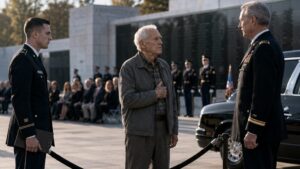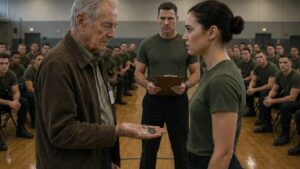
The Old Man in Green Coveralls Heard One Wrong Click No Soldier Wanted to Believe
Chapter 1: The Sound Beneath the Armory Racks
Joseph Bennett arrived before the lights knew what to do with the room.
The armory sat at the rear of the training building, behind two metal doors and a corridor that always smelled faintly of oil, dust, and floor wax. At 0550, the hallway was still mostly dark, with only the emergency strips throwing pale lines along the cinder-block wall. Joseph walked slowly, one hand holding the ring of keys, the other steadying the old canvas bag against his hip. His knees had been forecasting rain since three in the morning, though the sky outside was clear.
He paused before the second door and listened.
It was an old habit. Not necessary, according to anyone young enough to say so. The cameras worked. The alarm worked. The lock had been changed last spring and came with a laminated instruction card that nobody but Joseph had bothered to read. Still, he listened. Buildings spoke before people did. A fan belt going loose. A drip behind a wall. A boot where no boot belonged.
Nothing moved inside.
He unlocked the door.
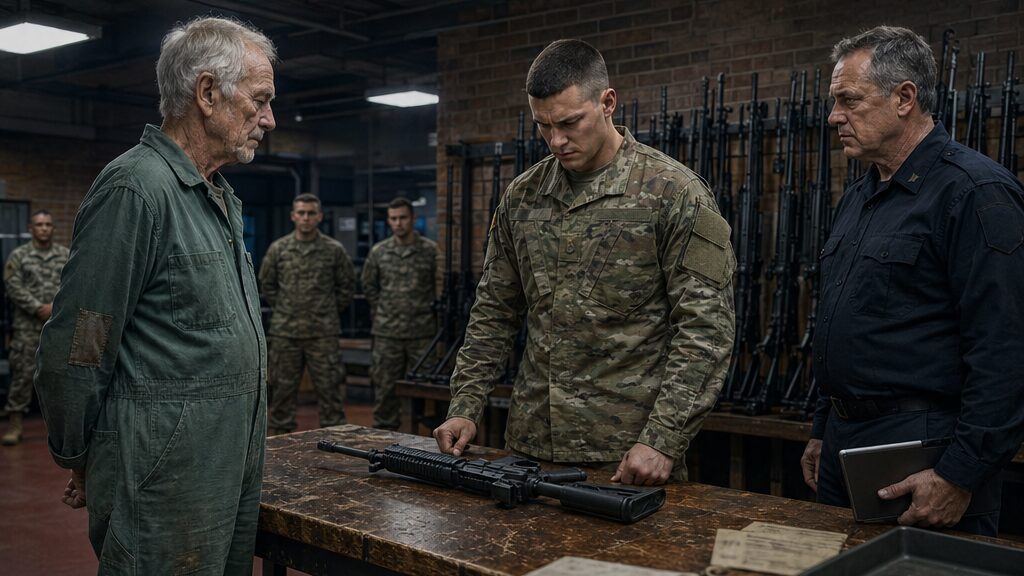
The armory lights came awake one row at a time. Rifles stood in their racks along the brick wall, long black shapes in clean vertical order. The heavy wooden workbench ran beneath them, scarred from years of parts, tools, elbows, and impatient hands. The floor was painted a dark red that never looked clean no matter how often Joseph mopped it. He liked it anyway. The red hid nothing from him. Dust made a gray skin on it. Oil made a dull shine. Brass left a crescent glint if the light hit right.
Joseph set his canvas bag under the bench, hung his faded green coveralls on the hook, then changed out of his jacket. The coveralls had been patched twice at the knee and once at the left cuff. The name strip had come loose years ago. He had sewn it back himself with thread that did not match.
BENNETT, it said.
Most of the young soldiers called him Mr. Bennett when they remembered. A few called him Joe until he looked at them long enough.
He started with the room, not the weapons. Trash bin. Rag bucket. Sign-in clipboard. Vent grate. Lockers. Bench. Under-bench shelf. The routine mattered because the room changed in small ways, and small ways were how trouble first introduced itself.
On the bench sat a tray of cleaning patches from the previous night, a bottle of solvent with its cap left half-turned, and three laminated tags waiting to be returned to the rack. Joseph touched the solvent cap and tightened it. He did not sigh. Sighing made young people think you were complaining.
By 0615, the first pair of soldiers came in laughing about coffee. Joseph was on one knee near the far rack, wiping a line of dust from the baseboard. One of them stepped over his mop handle without looking down.
“Morning, Mr. Bennett,” the other said.
Joseph nodded. “Morning.”
Boots. Velcro. Plastic case latches. A shoulder bump against the rack. The armory filled the way it always did—first with noise, then with urgency. Inspection week made men move faster while calling it discipline. Joseph had seen it all his life: the closer people got to being judged, the more they polished what showed and hurried what mattered.
Matthew Carter came in at 0630 with a clipboard under his left arm and a pen clipped too neatly to his pocket. He was young but not brand-new, built square through the shoulders, with his camouflage uniform pressed in a way that said he had woken up angry at the wrinkles. He had been assigned temporary control of the morning inventory after the night-shift clerk mixed two rack numbers on a report. Joseph had heard that from the clerk, who told him everything while pretending not to.
“Line them by tag,” Matthew said to the two soldiers. “No shortcuts today. I want serials checked before breakfast.”
Nobody answered casually. Matthew liked short answers.
Joseph rose carefully, one hand on the bench. His knee clicked. Not loudly, but enough that one of the soldiers glanced at him and then away.
“You need that side clear?” Joseph asked.
Matthew looked at the mop bucket as if it had personally failed inspection. “I need the whole room clear.”
Joseph gave a small nod and pulled the bucket toward the wall.
The check began fast. Rack door open. Item lifted. Tag read. Serial confirmed. Action cycled. Back to the tray. Sign. Next. Matthew watched each movement with the impatience of a man who believed speed was proof of control.
Joseph moved along the edge of the room, wiping surfaces already wiped. He did not touch anything on the bench except the trash and a stray cleaning patch. He had learned long ago that being allowed near a thing was not the same as being trusted with it.
A soldier placed the fifth rifle of the morning on the bench. It landed a little harder than it should have. Joseph’s eyes lifted before his head did.
Matthew read from the clipboard. “Rack four, slot twelve.”
“Rack four, slot twelve,” the soldier repeated.
The action cycled.
Click.
Joseph’s hand stopped on the rag.
The sound was almost right. That was the trouble with it. Wrong things that sounded fully wrong were gifts. They made everyone look. This one hid inside the ordinary metal rhythm, a thin hitch under the return, a dry half-note where there should have been a clean finish.
Matthew had already turned the page.
“Again,” Joseph said.
The room did not stop, but it changed.
Matthew looked over. “What?”
Joseph set the rag down flat on the bench. “Cycle that one again.”
The soldier holding the rifle glanced at Matthew first, not Joseph. Matthew’s jaw tightened, the smallest movement. Joseph saw it. He saw the embarrassment under it too. Young men hated being corrected in front of other young men, especially by someone in patched coveralls.
“We’re in the middle of inventory,” Matthew said.
“I heard something.”
“You heard something?”
Joseph kept his voice even. “Yes.”
The soldier gave a faint smile and killed it badly.
Matthew took the rifle himself, angled it safely, and cycled the action with brisk, irritated precision.
Click.
This time Joseph heard it more clearly because he was waiting. A soft drag. A wrong little catch. Not dramatic. Not enough to frighten anyone who wanted to keep moving.
Matthew lowered the rifle. “Sounds fine.”
“No,” Joseph said.
One word. Quiet. The room heard it anyway.
Matthew’s eyes came up. “Mr. Bennett, are you certified on today’s inspection?”
Joseph let the question settle. “No.”
“Then don’t interrupt it.”
A younger version of Joseph might have answered too quickly. A younger version might have named courses, dates, rooms, men long dead, weapons long replaced. Age had taken speed from him, but it had given him a clean place behind his teeth where anger could sit until it cooled.
He looked at the rifle, then at the bench beneath it. There was a crescent scratch in the wood near the old vise mount, pale against dark grain. Joseph had made that scratch years ago by accident with a rear sight tool, back when the room had different locks and different men sweating under the same fluorescent lights. He placed one finger beside it, not touching the weapon.
“That one should be set aside,” he said.
Matthew stared at his hand. “Because of a sound.”
“Because of the wrong sound.”
The two soldiers had gone still in the way young soldiers went still when authority might become anger. Matthew’s face did not change much, but the skin at his throat moved.
“Sir,” one of the soldiers said cautiously, “we’ve got twenty-three more before formation.”
Matthew handed the rifle back. “Clear it.”
Joseph looked at him. “Don’t put it back in rotation.”
“Mr. Bennett.” Matthew’s voice lowered. “Move away from the bench.”
For a moment, nobody breathed loudly.
Joseph removed his finger from the crescent scratch. He wiped the place where it had been, though there was no dust there. Then he stepped back half a pace.
Matthew wrote on the clipboard with hard strokes. The pen sounded louder than it should have.
The rifle went into the holding tray.
Not the caution tray. Not the repair tray. The holding tray, where inconvenience waited until someone decided it had never been danger.
Joseph picked up his rag. His hand wanted to tremble, so he folded the cloth once, then twice, until the tremor had something to do.
By 0730, the room was moving again. The young soldiers talked louder than necessary. Matthew did not look at Joseph. The wrong rifle sat on the tray with its laminated tag half under the sling.
Joseph finished wiping the bench.
When Matthew passed him near the door, he stopped just long enough to speak without facing him fully.
“From now on, Mr. Bennett, don’t touch the logs unless someone asks you.”
Joseph looked at the clipboard under Matthew’s arm. “I didn’t touch the log.”
Matthew turned then. “Good. Keep it that way.”
The door closed behind him.
Joseph stood alone with the racks and the red floor and the faint smell of solvent in the air. Somewhere beyond the wall, morning formation began, a barked command flattening itself through brick.
He walked back to the bench and looked at the holding tray.
The rifle was gone.
Chapter 2: The Old Man Who Would Not Sign the Log
Matthew Carter did not think of himself as disrespectful.
He thought of himself as responsible. There was a difference, and lately nobody seemed willing to notice it. The armory had failed a preliminary paperwork check two weeks earlier because the night-shift clerk transposed two digits and a private returned a cleaning kit without signing the bottom line. Neither mistake had been catastrophic, but both had landed on Matthew’s desk with red ink and Benjamin Sullivan’s voice behind them.
“You want responsibility?” Benjamin had said. “Then make the room boring. Boring rooms pass inspection.”
So Matthew made it boring. He tightened signatures, corrected rack labels, rewrote the morning sequence, and stopped letting people lean on the bench with coffee in their hands. He did not have the luxury of folklore. He had a commander who wanted clean numbers, a supervisor who wanted quiet halls, and younger soldiers who turned every simple task into a test of whether they could get away with something.
And then there was Joseph Bennett.
Matthew found him at 0940 standing near the workbench again, one hand flat beside the holding tray, looking down at the rifle tag like he was reading a letter from someone dead.
“I thought we talked about this,” Matthew said.
Joseph did not flinch. That bothered Matthew more than if he had. Most civilians on base either overexplained themselves or acted offended. Joseph simply raised his eyes.
“You moved it,” Joseph said.
“I moved a lot of things.”
“That one was in the holding tray.”
“It still is.”
Joseph glanced toward the rack wall. “No. It isn’t.”
Matthew followed his gaze. The morning rush had thinned, leaving the armory in its usual false order. Racks locked. Tags aligned. Workbench wiped. Red floor marked by a few drying streaks from Joseph’s mop. Against the far wall, rack four stood secured.
Matthew felt irritation before doubt could get a foothold. He went to the rack, checked the slot, then checked the tag hanging on the exterior hook.
Rack four. Slot twelve.
The same laminated card.
He turned back. “It was cleared after recheck.”
“By who?”
“By me.”
Joseph nodded once, as though Matthew had confirmed something disappointing but not surprising.
That nod lit heat along Matthew’s neck. “You have a problem with that?”
“I have a problem with the sound.”
“Mr. Bennett, it cycled clean.”
“It cycled fast.”
Matthew gave a short laugh. “That’s what it’s supposed to do.”
“No,” Joseph said. “Fast hides things.”
The armory door opened before Matthew could answer. Benjamin Sullivan entered with a tablet in one hand and a half-finished coffee in the other. He was older than Matthew but not old, with the settled heaviness of a man who had learned to carry pressure by giving pieces of it away.
“What’s the hold?” Benjamin asked.
“No hold,” Matthew said.
Joseph said nothing.
Benjamin looked between them. “Then why does this room feel like church before bad news?”
Matthew forced his shoulders down. “Mr. Bennett is concerned about an item we already rechecked.”
Benjamin turned toward Joseph. His expression was not unkind, but it was tired in a way that made kindness expensive. “Which item?”
“Rack four, slot twelve,” Joseph said.
Benjamin looked at Matthew. “The one from this morning?”
“Yes, Sergeant.”
“It passed function check?”
“Yes, Sergeant.”
“Logged?”
“Yes.”
Benjamin nodded, already moving on. “Then we’re done.”
Joseph’s fingers curled once against his palm. He looked at the workbench. The crescent scratch sat near the vise mount, half filled with old oil darkened into the wood. He placed his weathered finger beside it again, exactly where he had placed it before.
“Bring it here,” he said.
Matthew stared at him. “Excuse me?”
Joseph did not raise his voice. “Bring it here. Cycle it slow.”
One of the younger soldiers near the lockers stopped pretending not to listen.
Benjamin’s eyebrows drew together. “Joseph.”
The use of his first name softened the room and hardened Matthew at the same time. Of course they knew each other. The old man had been here forever. He was part of the furniture, part of the smell of oil and dust. That did not make him inspection authority.
Matthew stepped closer. “Mr. Bennett, you don’t give orders in this room.”
“No,” Joseph said. “I give warnings.”
The words landed too cleanly.
Benjamin set his coffee on the bench. “Carter, humor him.”
Matthew turned. “Sergeant—”
“Humor him,” Benjamin repeated, quieter.
Matthew unlocked rack four. The key slipped once because his hand was angrier than he wanted it to be. He took the rifle from slot twelve and brought it to the bench. He laid it down with controlled care, refusing to let Joseph make him look careless.
Joseph watched the placement, not Matthew’s face.
“Slow,” he said.
Matthew checked clear, angled properly, and cycled the action slowly.
The room heard metal move. A smooth draw. A return.
Click.
Joseph’s head tilted, barely.
“There,” he said.
Matthew’s mouth tightened. “That is normal mechanical sound.”
“No. The return is late by a breath.”
“A breath.”
Joseph looked at him then. There was no insult in his eyes. That made it worse.
“When a thing is right,” Joseph said, “you don’t hear it trying.”
One of the younger soldiers looked down at the floor.
Matthew felt Benjamin watching him, and the watching turned his skin hot. “With respect, Mr. Bennett, this isn’t 1975. We have written procedure. We have gauges. We have inspection standards.”
Joseph’s face changed at the year, not much, but enough. A flicker behind the eyes. Then gone.
“Use them,” Joseph said.
“We did.”
“Use them slow.”
Matthew picked up the gauge kit from the shelf harder than necessary. The latch snapped open. He ran the checks again, step by step, the way the sheet required. Everything fell inside tolerance. Not beautifully, perhaps, not with the satisfying ease of new equipment, but inside.
He held the gauge out so Benjamin could see. “Pass.”
Benjamin exhaled through his nose. “Joseph?”
Joseph looked at the gauge. “Paper says pass.”
“Then what are we doing?” Matthew asked.
Joseph placed his palm flat on the bench. The old coverall cuff rode up, showing the ropey tendons at his wrist and a pale scar that disappeared under the sleeve. His hand was not steady. Matthew saw that too. A tremor moved through two fingers before Joseph pressed them still against the wood.
“You want my signature on the cleaning log?” Joseph asked.
Matthew blinked. “You’re assigned to room maintenance confirmation.”
“Not weapon clearance.”
“Exactly.”
Joseph reached for the lower clipboard, the one used for bench and tool condition. His name was on the printed line for morning room maintenance. He held the pen but did not write.
Benjamin said, “Joseph.”
“I cleaned the room,” Joseph said. “I will sign that. I won’t sign that the bench was clear when that item sat on it and sounded wrong.”
Matthew stared. “That is not what the line means.”
“It is what my name means.”
The younger soldier by the lockers shifted his weight.
Matthew felt the room tipping away from him. Not because Joseph had proved anything. He had not. The gauges passed. The log was clear. Procedure favored Matthew. But Joseph’s refusal made the paper feel suddenly thinner.
Benjamin rubbed one hand over his mouth. “Carter, mark it for storage review.”
“It already passed.”
“Mark it,” Benjamin said. “Then we move.”
Matthew wrote the note. STORAGE REVIEW. NO DEFECT FOUND. He hated every letter.
Joseph signed the room maintenance line only after the rifle was placed in a separate tray. His handwriting was slow, upright, and old-fashioned, each letter taking the time it needed. Matthew watched the pen move and felt an unreasonable urge to tell him to hurry.
Instead, he said, “You know, this kind of thing is why people don’t like civilians interrupting military procedure.”
Joseph capped the pen. “I remember military procedure.”
There it was, Matthew thought. The old-man sentence. The door into a story nobody had asked for.
But Joseph did not walk through it. He did not mention rank, unit, years, deployments, schools, commendations, or the way things used to be. He simply slid the clipboard back into place and folded his hands.
Benjamin picked up his coffee. “That’s enough.”
Matthew lifted the rifle tray. “I’ll put it in review.”
“Not rotation,” Joseph said.
Matthew stopped.
The words had come softly, almost too softly to challenge. But everyone heard them.
Benjamin closed his eyes for half a second.
Matthew turned back. “Mr. Bennett, I’ve been very patient.”
“Yes,” Joseph said.
“You are not the armorer of record.”
“No.”
“You are not assigned to weapons inspection.”
“No.”
“You are room maintenance.”
Joseph nodded.
“Then let me do my job.”
The old man looked at the rifle in the tray, then at Matthew.
“I’m trying to help you keep it,” he said.
For a moment Matthew had no answer. The sentence slipped past his anger and found the part of him that had not slept well since Benjamin handed him the inspection packet.
He covered it quickly.
“Keep it in review,” he told the soldier near the lockers. “And nobody touches it unless I say.”
Joseph stepped back from the bench. The tremor returned to his fingers, and this time he let his hand fall to his side instead of hiding it.
Matthew saw it. The weakness. The age. The stubbornness. The strange certainty.
He chose the only one that helped him move forward.
Stubbornness.
By noon, the armory had returned to its rhythm. Tags clicked. Locks closed. Signatures gathered in neat blocks. Joseph mopped the red floor where boot prints had dried into pale dust.
Matthew carried the review tray toward the side cabinet. Before he shut the door, he looked once more at the rifle.
He cycled it quickly.
Click.
Normal, he told himself.
He shut the cabinet.
Behind him, Joseph’s mop paused for the length of one breath, then moved again.
Chapter 3: The Notebook Nobody Asked to Read
Catherine Bennett could tell how the day had gone by the way her father removed his boots.
If he sat first and untied them slowly, the day had only been long. If he stood by the door and used the toe of one boot against the heel of the other, pretending impatience because bending hurt, then someone had made him feel old before his body had the chance.
That evening, he stood.
Catherine watched from the kitchen, one hand on the dish towel, saying nothing until the second boot came loose and thumped against the mat.
“You skipped lunch again,” she said.
Joseph hung his keys on the nail beside the door. “I ate.”
“What?”
He considered lying better, then decided against it. “Crackers.”
“That’s not lunch.”
“It was six crackers.”
She turned back to the stove. “A banquet.”
The kitchen was small, yellowed by years of steam and evening light. A radio sat unplugged near the window because Joseph said the weather came through better in his knees than through any broadcast. On the table lay the mail, a folded grocery flyer, and the pill organizer Catherine had filled on Sunday. Tuesday evening’s compartment was still closed.
Joseph saw her notice it.
“I’ll take them.”
“You said that yesterday.”
“Yesterday I took them.”
“After I handed them to you.”
He did not argue. He crossed to the sink, washed his hands slowly, and watched gray water circle the drain. The smell of armory oil clung under his nails no matter how carefully he scrubbed. Most people disliked that smell. Joseph found it honest. Oil did not pretend to be anything but oil.
Catherine put a bowl of soup in front of him. She had made too much, as always, because caring for one elderly father was easier if she pretended she was cooking for a houseful.
He sat, lowering himself carefully.
She sat across from him. “What happened?”
“Nothing happened.”
“Dad.”
He tasted the soup. Potato, onion, pepper. Too little salt because Catherine watched his blood pressure like it had personally offended her. “There was a disagreement.”
“At the armory?”
He nodded.
“With that young soldier?”
Joseph looked up.
“You mentioned him last week,” she said. “The one with the clipboard face.”
“Matthew Carter.”
“That is exactly a clipboard-face name.”
A reluctant smile touched Joseph’s mouth, then left. “He has pressure on him.”
“So do you.”
“Different kind.”
Catherine leaned back. She was fifty-two, with her mother’s eyes and Joseph’s habit of folding worry into practical tasks. She had spent the last six months trying not to say retirement every time he came home tired. Sometimes she succeeded for whole days.
“Was he rude to you?” she asked.
Joseph stirred his soup though it needed no stirring. “He was young.”
“That’s not an answer.”
“It’s part of one.”
She studied him. The overhead light showed the deep lines around his mouth, the thinning white hair combed back, the careful way he kept his left hand under the table when it trembled. She hated that armory some evenings. Not because of weapons. Because it took the strongest man she knew and sent him home measuring how little of himself to show.
“You don’t have to keep doing this,” she said.
He did not look surprised. “Working?”
“Being treated like furniture.”
Joseph set down the spoon.
“I know what that place means to you,” Catherine said, softer now. “I know you served. I know you trained men before I was old enough to understand what that meant. But they don’t see that when you walk in wearing patched coveralls. They see an old man with a mop.”
“That is what I am paid to be.”
“That is not all you are.”
“No,” he said. “But it is honest work.”
“I’m not insulting the work.”
“I know.”
“I’m asking why you keep going back to a room that won’t remember you.”
The question sat between them with the steam from the soup.
Joseph looked toward the hallway. At the far end was the small back room that had once been Catherine’s bedroom, then a storage room, then after his wife died, the place he put the boxes he could not throw away and did not want to see. He stood, slower than he meant to, and took his bowl to the counter.
“You didn’t finish,” Catherine said.
“I will.”
He went down the hall.
The back room smelled of cardboard and old paper. A single lamp stood on the desk, its shade tilted. Joseph pulled the chain. Light fell across stacked file boxes, a folded flag in a case on the shelf, and a row of black notebooks held together by a cracked leather belt.
He did not touch the flag.
He lifted the belt from the notebooks and chose the third from the left. The cover had softened at the corners. Inside, his handwriting filled page after page in narrow, disciplined lines. Dates. Rack numbers. Parts replaced. Weather conditions when humidity mattered. Names of soldiers who had needed extra instruction but not extra shame.
He turned pages until he found an old note marked with a triangle.
Delayed return sound. Slight drag under slow cycle. Do not trust fast function check. Listen for effort.
Joseph rested one hand on the desk.
The note was thirty-one years old.
He remembered the day less as a picture than as a feeling in his chest. A crowded room. A sergeant impatient to make range time. A young Joseph Bennett not yet old enough to distrust hurry. A small sound he had noticed and then let pass because three men above him said the gauge was good.
Nobody had died. That was what people said later, as if it settled the debt. Nobody had died, but a young soldier’s hand had been bandaged for weeks, and Joseph had learned that relief could still carry shame.
Catherine appeared in the doorway but did not come in.
“Dad?”
He closed the notebook halfway. “I heard something today.”
“At work?”
“Yes.”
“Something dangerous?”
He did not answer quickly enough.
Catherine’s expression changed. “Did you tell them?”
“I tried.”
“And?”
“They heard an old man.”
She came into the room then. “Then write it down. Send it up. Make a report.”
“I am room maintenance.”
“You are Joseph Bennett.”
He looked at her, and for a moment she saw the man who had taught her to change a tire in the rain because waiting helplessly made bad weather worse. Then he looked back at the notebook.
“They have reports,” he said. “They have procedures.”
“And you have what?”
He touched the old page. “A memory I wish I didn’t.”
Catherine’s anger softened into something more frightened. “That is exactly why you should not carry this alone.”
He closed the notebook. “I’m not trying to be right.”
“I know.”
“I’m not trying to prove anything to that boy.”
“I know.”
“If I push too hard, they’ll decide I’m confused. Then the sound becomes about me instead of the rifle.”
Catherine had no answer for that because she knew it was true. Age turned even certainty into evidence against a person if the room had already decided what it wanted to see.
Joseph opened the notebook again and wrote beneath the old entry.
Rack four, slot twelve. Same delayed return. Carter present. Sullivan notified. Not cleared by me.
His hand moved slowly. The letters stayed upright.
Catherine watched the pen. “You still call them by rack numbers.”
“That’s where they live.”
“They’re things, Dad.”
“Yes,” Joseph said. “And things can hurt people when men get careless with them.”
He tore no page out. He made no dramatic copy. He simply closed the notebook and put it on top of the stack instead of back inside it.
At the kitchen table, the soup had cooled. Joseph took his pills while Catherine watched, then ate three more spoonfuls because she was still standing there.
Later, after she left, he returned to the back room. The house was quiet except for the refrigerator clicking on and a car passing outside. He sat at the desk, opened the notebook one more time, and read the thirty-one-year-old line until the words blurred.
Do not trust fast function check.
He placed his palm flat over the page to steady it.
In the silence, he heard the armory again.
Click.
Not loud. Not broken.
Trying.
Chapter 4: Clean Paperwork on a Dirty Red Floor
By 0610 the next morning, Matthew had rewritten the armory flow twice and still disliked the shape of it.
The inspection office was barely large enough for two desks, a filing cabinet, and the government printer that jammed whenever anyone used fresh paper. Matthew stood beside the smaller desk with yesterday’s forms spread in front of him, a mug of coffee gone cold near his elbow. He had drawn lines through errors, circled missing initials, and rewritten one rack summary because the night-shift clerk had used blue ink instead of black.
Everything looked correct now.
That should have settled him.
Instead, his eyes kept returning to one short note written in his own hand.
STORAGE REVIEW. NO DEFECT FOUND.
The phrase annoyed him because it was true and still sounded defensive.
Benjamin Sullivan came in without knocking, tablet under one arm and keys hooked to his belt. He glanced at the papers, then at Matthew’s face.
“You look like the paperwork fought back.”
“It’s clean.”
“Clean isn’t the same as calm.”
Matthew stacked the forms. “Rack four, slot twelve is still in review. I can leave it out of rotation until the commander’s walk-through if you want.”
Benjamin’s mouth tightened. “I want what procedure supports.”
“It passed.”
“Then procedure supports rotation.”
Matthew waited a beat. “Mr. Bennett still won’t sign the bench line if it’s handled there.”
Benjamin closed the door behind him. “Joseph signs room maintenance. He doesn’t certify weapons.”
“I know that.”
“Then stop giving his refusal more weight than it has.”
Matthew looked down at the note again. The office light made the ink shine.
Benjamin’s voice softened by a fraction. “Carter, I’m not telling you to ignore safety. I’m telling you not to let one man’s feeling turn into a failed inspection.”
“He says it’s not a feeling.”
“Joseph says a lot without saying much.”
“You know him.”
“I know he’s been around a long time.”
Matthew heard the carefulness there. “Was he an armorer?”
Benjamin reached for the top form, scanned it, and placed it back exactly where it had been. “Before my time.”
“That’s not an answer.”
“It’s the answer I have time for.” Benjamin tapped the stack. “The commander wants preliminary readiness by 1400. The civilian safety inspector comes through tomorrow. The range schedule is already compressed because of weather last week. We are not freezing equipment on instinct.”
Matthew nodded because nodding was easier than admitting he had wanted Benjamin to say the old man was wrong.
In the armory, Joseph had already started his morning routine. He was wiping the lower shelf beneath the workbench, moving slowly, his body angled to spare one knee. The red floor still showed the pale scars of old mop strokes. He looked up when Matthew entered, then went back to his rag.
No greeting. No accusation.
That irritated Matthew too.
The first hour ran smoothly. Soldiers came in by pairs, signed what they needed to sign, checked what they needed to check. Matthew kept his voice level. Benjamin moved in and out, answering calls, opening locked cabinets, checking the tablet. Joseph emptied trash, replaced a torn label sleeve, and wiped the crescent scratch on the workbench without seeming to notice he did it.
At 0835, Matthew unlocked the side cabinet and removed the review tray.
Joseph stopped near the mop sink.
Matthew saw him in the corner of his eye. He did not turn.
He placed the rifle from rack four, slot twelve, on the bench and opened the paper file beside it. The laminated tag had a shallow bend in one corner. The serial matched the line. The cleaning date matched. The function check matched. The gauge reading matched. Everything matched except the old man’s face.
“Running it again?” Joseph asked.
Matthew kept his eyes on the form. “Completing review.”
Joseph came no closer. “Slow?”
Matthew inhaled through his nose. “By the checklist.”
He cycled the action deliberately, not fast enough to be accused of rushing, not slow enough to feel like obedience.
Click.
There it was again, or maybe there was nothing there except the memory of being watched. Matthew set the rifle down and picked up the gauge kit.
Joseph listened from across the room.
The checks passed.
Matthew wrote the results, initialed the line, then noticed something small on the movement log. Rack four, slot twelve had been checked out three days earlier for cleaning instruction, returned, then moved to holding during night shift, then returned to rack, then pulled again yesterday. There was nothing illegal about that. Items moved. Logs recorded movement.
But the handwriting on one return line did not match the night-shift clerk’s usual rounded letters. It was sharper, hurried. The rack number had been corrected once, a dark overwrite turning an eleven into a twelve.
Matthew stared at it.
Joseph’s voice came from the mop sink. “Tag corner bent?”
Matthew looked up despite himself. “What?”
“The laminated tag. Top right corner.”
Matthew glanced at the tag. Bent. Slightly whitened at the crease.
“What about it?”
Joseph wrung out the rag. “It was straight Monday.”
Matthew’s patience thinned. “You memorize tag corners now?”
“I notice when things change.”
“That’s not evidence.”
“No.”
The answer was so calm that Matthew had nowhere to put his irritation.
Benjamin entered with the base commander’s aide behind him, a role-only soldier carrying a folder and the expression of someone sent to collect bad news without touching it. Benjamin saw the rifle on the bench and stopped.
“Why is that still out?”
“Completing review,” Matthew said.
“Finding anything?”
“No defect.”
Joseph looked down into the mop bucket.
Benjamin’s gaze moved between them. “Then return it.”
Matthew hesitated.
It was small. Less than a second. But Benjamin saw it.
“Carter.”
“Yes, Sergeant.”
Matthew gathered the papers. “There is an overwritten rack number on Monday’s movement log. It may be nothing.”
Benjamin took the sheet. His face did not change, but his thumb pressed hard against the edge of the paper. “It is nothing if the serial matches.”
“It does.”
“Then it’s nothing.”
The aide cleared his throat. “Sergeant Sullivan, the commander asked if the preliminary packet would be ready by lunch.”
Benjamin handed the form back to Matthew. “It will.”
Joseph moved toward the bench with his rag.
Matthew said, sharper than he intended, “You can wait.”
Joseph stopped.
The aide glanced at him and then away, dismissing him as quickly as a piece of furniture. That glance bothered Matthew for reasons he did not want to examine.
Benjamin lowered his voice. “Return it to rack. Note the overwrite as administrative correction. We are not creating a readiness issue over a bent tag and a sound only one person hears.”
Matthew felt the sentence settle over the room. It was reasonable. It was exactly the kind of sentence that passed through offices cleanly.
He wrote ADMIN CORRECTION in the margin.
Joseph watched the pen.
When Matthew returned the rifle to rack four, slot twelve, the lock closed with a heavy, final sound. The room relaxed around it. Soldiers resumed talking. The aide left. Benjamin checked his tablet and moved on to the next problem.
Only Joseph stayed still.
Matthew walked to him before he could decide not to.
“You saw the overwrite before I did,” he said quietly.
Joseph folded the rag once over his hand. “I saw the tag first.”
“Why didn’t you say that yesterday?”
“I did not know yesterday.”
Matthew studied him. “And if the tag means nothing?”
“Then it means nothing.”
“But you don’t think that.”
Joseph looked toward rack four. “Things get misplaced when people hurry. People trust the rack because the tag tells them to. They trust the tag because the paper tells them to. They trust the paper because somebody signed it.”
“That’s how accountability works.”
Joseph met his eyes. “Only if the thing itself agrees.”
Matthew had no answer ready.
At 1350, the preliminary packet passed through the commander’s aide without issue. At 1400, Benjamin told Matthew the room was back on track. At 1415, rack four, slot twelve was marked available for range preparation the following morning.
Clean paperwork.
Clean packet.
Clean numbers.
Joseph mopped the red floor after everyone left, pushing the bucket slowly around the legs of the workbench. Near rack four, a thin dark streak of oil had dried where a drop must have fallen and been stepped through by a boot. He knelt with effort and wiped it away.
Then he looked up at the locked rack.
The room was quiet now.
He did not need to hear the rifle to remember the sound.
Chapter 5: The Range Morning Matthew Stopped Laughing
Range mornings had a different kind of pressure.
The armory opened earlier, and nobody admitted to being tired. Soldiers came in with helmets clipped, gloves half on, voices low but quick. Outside, trucks coughed awake in the dark. The air carried damp grass, exhaust, and the faint metallic cold that settled before sunrise.
Matthew arrived at 0505 with a fresh checklist and a stomach that had not forgiven him for the coffee. Benjamin was already there, talking to the range instructor near the door.
“We stay on schedule,” Benjamin said. “The commander wants the first group moving by 0600.”
The range instructor nodded. “As long as your side is ready.”
“Our side is ready.”
Matthew set his clipboard on the workbench. The word ready followed him across the room like a dare.
Joseph came in five minutes later, canvas bag in hand, green coveralls already zipped. He moved more slowly than usual. Matthew noticed the stiffness in his left leg and looked away before Joseph could catch him noticing.
“Morning,” Joseph said.
Matthew answered, “Morning,” before he could decide whether he wanted to.
Joseph began his routine. Door. Trash. Bench. Floor. Tags. It was almost comforting, the old man moving around the edges while the room prepared for motion. Almost.
At 0525, Matthew unlocked rack four.
The soldiers lined up by assignment. Each item came out, serial read, tag matched, condition confirmed. Matthew kept the pace brisk but clean. He heard Joseph behind him replacing paper towels near the sink. He heard Benjamin’s tablet chime. He heard the trucks outside.
He did not hear the wrong click until he was the one holding the rifle.
Rack four, slot twelve.
It came out of the rack normally. Weight, balance, sling. Nothing unusual. The tag still had the bent white corner. Matthew checked the serial against the form. Correct. He checked clear. Correct. He angled it as he had done dozens of times that week.
Then he cycled the action.
Click.
His hand froze.
Not because it was loud. It was not. Not because it failed. It did not. It was the same small delay, the same thin hesitation under the return, only this time the room around it had gone quiet enough for his pride to stop talking over it.
A soldier waiting in line said, “Sergeant?”
Matthew cycled it again before anyone could ask why.
Click.
The sound was still small. But now that he heard it, he could not unhear the effort inside it.
He looked across the room.
Joseph stood near the workbench, both hands resting lightly on the back of a wooden chair someone had left there the night before. He was not surprised. That was what struck Matthew first. Not satisfied. Not angry. Not triumphant.
Waiting.
Benjamin turned from the range instructor. “Problem?”
Matthew’s mouth had gone dry. “Maybe.”
The range instructor frowned. “We moving or not?”
Matthew looked down at the rifle. Every path appeared at once. Say nothing and keep the schedule. Run the check fast and let procedure carry him. Mark it out and explain later. Call attention to it and give Joseph Bennett the room.
He heard his own voice from two days earlier.
You are not the armorer of record.
He also heard Joseph’s answer.
I’m trying to help you keep it.
Matthew set the rifle on the bench.
Benjamin walked over immediately. “Carter.”
“I heard it.”
The room changed. Soldiers looked at one another. The range instructor exhaled in open annoyance.
Benjamin lowered his voice. “Heard what?”
“The delayed return.”
The words tasted like surrender.
Joseph did not move.
Benjamin glanced toward him, then back at Matthew. “Run the check.”
“I did.”
“Run it again.”
Matthew did, slowly.
Click.
This time Benjamin heard something, or heard the way Matthew heard it. His expression tightened, not with belief yet, but with calculation.
The range instructor stepped closer. “If that item is questionable, swap it and document. I’ve got people standing outside.”
Matthew reached for the gauge kit. His fingers were clumsier than he wanted. He ran the measurements, the same ones as before. The numbers stayed barely inside tolerance.
“Pass,” Benjamin said.
Matthew looked at the gauge. “Technically.”
“Technically is what inspections use.”
Joseph spoke from beside the chair. “Not ranges.”
The range instructor turned. “Who’s that?”
Matthew answered before Benjamin could. “Mr. Bennett. Room maintenance.”
The phrase came out wrong this time. Smaller.
The range instructor gave Joseph a quick look and then dismissed him with a blink. “Okay. Room maintenance can let us work.”
Joseph did not answer. He walked to the bench slowly, not into the center of authority, just close enough to see the tag. His left hand trembled once near his thigh. He placed it behind his back.
Matthew saw it. Benjamin saw it. The range instructor did not.
Joseph nodded toward the tag. “May I?”
Benjamin hesitated.
Matthew said, “Let him look.”
Joseph lifted the laminated tag, not the rifle. He turned it over. The back had a smudge of old adhesive near the corner and a faint line where another label had once pressed against it.
“This tag has been switched,” he said.
The range instructor scoffed. “You can tell that by looking?”
Joseph placed it down. “No. I can tell it was handled wrong. The log tells the rest.”
Matthew pulled Monday’s movement sheet from the folder. The overwritten eleven-to-twelve stared back at him. He felt heat move across his face.
Benjamin took the sheet. “This still doesn’t prove a defect.”
“No,” Joseph said. “It proves confusion.”
“That is not enough to stop a range cycle.”
Joseph’s eyes moved to the rifle. “Then don’t stop the range. Stop this item.”
The room held on that distinction.
Matthew turned to Benjamin. “We can swap it.”
Benjamin’s jaw worked once. “And report what? Old tag confusion? Sound concern? Barely-in-tolerance pass?”
“Report exactly that.”
The range instructor looked at his watch. “I need a decision.”
Benjamin looked at Matthew, and Matthew understood the burden being passed. If he pushed, the delay had his name on it. If he folded, the sound had his name on it too.
For the first time all week, he did not want responsibility to mean looking certain.
He picked up the rifle and moved it to the caution tray.
“Swap it,” he said.
Benjamin stared at him. “Carter.”
Matthew kept his voice steady. “I’m not sending it.”
The range instructor muttered something under his breath, but he signaled for a replacement. The line shifted. Soldiers adjusted. The schedule bent without breaking.
Joseph stepped back from the bench.
Matthew expected him to say something. He almost wanted him to. An I told you so would have been easier to resent than silence. But Joseph only reached for a clean rag and wiped the place where the tag had rested.
The range group moved out twelve minutes late.
Twelve minutes. That was all. Less than the time men wasted looking for gloves, coffee, missing pens. Yet the delay left a mark on the room deeper than any scratch.
Benjamin waited until the trucks pulled away before speaking.
“My office,” he said to Matthew.
Then, after a beat, “Mr. Bennett. You too.”
The walk down the corridor felt longer than it was. Matthew carried the folder. Joseph carried nothing. His coveralls whispered faintly at each step. A pair of younger soldiers passed them and looked away too quickly.
In the inspection office, Benjamin closed the door.
He did not sit.
“Explain,” he said.
Matthew opened the folder. “The item passed standard gauge checks but produced a repeatable delayed return sound under slow cycle. Movement log shows an overwritten rack entry. Tag shows handling irregularity. Mr. Bennett identified the sound first.”
Benjamin looked at Joseph. “Is that accurate?”
Joseph stood with his hands folded. “Mostly.”
“Mostly?”
“I did not identify it.” Joseph’s mouth tightened. “I heard it.”
Matthew looked at him then.
Benjamin rubbed his forehead. “Joseph, I need more than poetry.”
“It isn’t poetry.” Joseph’s voice stayed quiet. “Metal tells you when it is clean. It tells you when it is dry. It tells you when something is dragging where it should not drag. The gauge tells you size. The sound tells you effort.”
Benjamin looked tired enough to be angry. “And why should I put that in a report?”
Joseph’s eyes lowered to the folder in Matthew’s hand.
“Because thirty-one years ago,” he said, “I didn’t.”
No one spoke.
The words did not explain everything, but they opened a door Matthew suddenly did not want to rush through.
Benjamin’s expression changed first. Not soft. Not yet. But less closed.
“What happened?” he asked.
Joseph looked at the wall behind him, where a framed safety poster had curled slightly inside its plastic. “A young soldier trusted a pass. I trusted the men telling me to move faster. The item tried to warn us before it failed. Nobody died.”
The last sentence came too practiced.
Matthew understood then that nobody died was not comfort. It was a sentence Joseph had been handed and had never been able to use.
Benjamin sat down slowly.
Outside the office, the armory phone rang once, then stopped.
Matthew looked at Joseph’s hands. The tremor was back, visible now because he was not hiding it.
“I should have listened earlier,” Matthew said.
Joseph turned to him.
The apology had come out before Matthew knew whether he was ready for it. It was not enough. He knew that too.
Joseph nodded once. “You listened this morning.”
It would have been easier if the old man had made him pay.
Benjamin pushed the folder back toward Matthew. “Pull every movement log tied to that rack for the last two weeks. Find the tag history. Keep the item locked in caution until the safety inspector sees it.”
“Yes, Sergeant.”
Benjamin looked at Joseph. “And you. I want your old note, if you still have it.”
Joseph’s face gave away nothing, but Matthew saw his fingers curl against his palm.
“I have it,” he said.
Benjamin leaned back. “Of course you do.”
It was meant lightly. It did not land that way.
Joseph opened the office door, then paused.
Matthew said, “Mr. Bennett.”
Joseph looked back.
Matthew tried to find the right words and found only plain ones. “I’ll come with you to get the notebook.”
Joseph studied him for a moment, not granting forgiveness and not withholding it.
“No,” he said. “You stay here and pull the logs.”
Then he added, so quietly Matthew almost missed it, “That is your work.”
The door closed.
Matthew stood with the folder in his hand, feeling the weight of paper differently than he had yesterday.
Chapter 6: Joseph Bennett Chose the Quiet Way to Stop It
Joseph did not bring the whole notebook at first.
He brought one copied page, folded once and placed inside a plain envelope. He had gone home after the morning range delay, ignored Catherine’s questions long enough to use the printer she had bought him and he disliked, and returned to the base before noon. The original notebook stayed on his kitchen table under Catherine’s hand.
“You’re not handing them the only copy of your memory,” she had said.
“It’s not memory. It’s a note.”
“It’s yours.”
He had let her win because she was right and because his knee hurt too much to stand there pretending otherwise.
Now the copied page lay on the armory workbench beside the current movement log, the bent tag, the gauge sheet, and the caution tray key. Joseph had arranged them in a straight line without thinking. Old habit. A disorderly table invited disorderly thought.
Matthew stood opposite him. Benjamin stood at the end of the bench. The civilian safety inspector had arrived early after Benjamin made a call that used the words repeatable concern and range delay. The base commander came ten minutes later with the expression of a man who disliked surprises but disliked hidden surprises more.
The armory seemed smaller with all of them in it.
Rifles watched from the racks. The red floor held boot prints drying in dull patches. The crescent scratch near Joseph’s hand looked pale under the fluorescent lights.
The commander picked up the copied page. He was not a large man, but people made space around him as if he were. He read the old note once, then again.
“Thirty-one years ago,” he said.
Joseph nodded.
“You wrote this?”
“Yes, sir.”
“What was your position then?”
The question came calmly, but it pulled the room toward the answer. Joseph felt Matthew watching him. Benjamin too. Even the inspector lifted his head.
Joseph did not want to step into the old uniform in front of them. It would be too easy for the room to change its mind for the wrong reason. A title could make them listen, but it could also let them avoid learning why they had not listened before.
“I was assigned to armory instruction and maintenance oversight,” he said.
The commander waited.
Joseph added, “Army.”
“Rank?”
Joseph’s jaw tightened.
Matthew saw it and looked down at the log.
“Staff sergeant when I left that position,” Joseph
Chapter 7: The Bench Remembered What the Room Forgot
One week later, the armory opened to a different kind of quiet.
Not an empty quiet. Soldiers still came through with boots, tags, forms, and the dull morning impatience of people who believed every locked door stood between them and the rest of the day. The printer still jammed. The fluorescent lights still took one flicker too long to settle. The red floor still showed every pale scrape of dust before Joseph could reach it with the mop.
But the room no longer rushed past its own sounds.
Matthew stood at the workbench with two younger soldiers in front of him and a laminated instruction sheet taped to the bench edge. The sheet was new. Its corners were sharp, its plastic clear, its wording plain enough that Joseph knew Matthew had rewritten it three times.
SLOW-CYCLE CHECK REQUIRED BEFORE RANGE ISSUE ON MARKED INVENTORY.
Below that, in smaller print:
Listen for drag, delay, scrape, or effort. If uncertain, stop the item. Do not explain away what repeats.
Joseph had not written that last sentence. He had suggested something shorter. Matthew had written it anyway.
Joseph came in at 0552, canvas bag in one hand, keys in the other. His left knee had been bad since dawn. Catherine had noticed before he left and asked if he wanted her to drive him. He had said no. She had said, “That was not the question I asked.” Then she had handed him a travel mug of coffee and let him go without making victory out of it.
Matthew looked up when Joseph entered.
“Morning, Mr. Bennett.”
“Morning.”
The younger soldiers turned too. One of them stepped aside to clear the path to the bench. Not dramatically. Not with embarrassment. Just enough. Joseph noticed and pretended not to.
He hung his jacket, zipped the green coveralls, and began the room.
Door. Trash. Bench. Floor. Tags.
At the bench, Matthew lifted an older rifle from the tray and demonstrated the slow-cycle check. He did not make a performance of it. He checked clear, angled safe, and moved the action with measured patience.
The sound came back clean.
Not loud. Not proud. Just clean.
Joseph heard the difference all the way from the mop sink.
Matthew looked over once, not asking for approval exactly.
Joseph gave a small nod.
The young soldier nearest the bench copied the motion. Too fast the first time. Matthew stopped him.
“Again,” he said. “Slower.”
The soldier tried again.
“Don’t force it,” Matthew said. “Let the item tell you what it’s doing.”
Joseph lowered his eyes to the bucket. The words were not his, not exactly, but they had passed through him on their way to Matthew. That was enough.
The audit had found more mess than danger. Two swapped tag sleeves. One old correction never initialed. Three movement lines written so poorly they had to be reconstructed from camera time and memory. The rifle from rack four, slot twelve, had gone to maintenance, where the inspector’s concern became a formal defect after a deeper teardown. It had not been dramatic enough for rumor. No explosion, no injury, no commander shouting in the hallway.
Joseph was grateful for that.
Nobody died had been a burden once. This time, nobody got hurt could remain clean.
Benjamin came in after 0700 carrying a stack of revised logs. He stopped near Joseph, who was wiping the lower shelf beneath rack four.
“Joseph.”
Joseph looked up.
Benjamin held out the top form. “I added your review note to the local procedure draft. Not your name. The method.”
Joseph took the page and read the first few lines. The language was stiff, official, and necessary. No mention of old notebooks. No mention of staff sergeant. No mention of a man in coveralls who heard what others missed.
“Good,” Joseph said.
Benjamin seemed to expect more. When it did not come, he nodded. “Commander wants the training completed by Friday.”
“Then Friday it is.”
A small discomfort crossed Benjamin’s face. “I also owe you a cleaner apology than the one I gave.”
Joseph folded the page once. “You held the room together.”
“I pushed it too fast.”
“Yes.”
Benjamin accepted the word as Matthew had. Joseph respected him more for not arguing with it.
“I’ll do better,” Benjamin said.
Joseph handed the page back. “Then it counts.”
Near the bench, Matthew pretended not to listen.
The morning moved on. Items came out and went back. Tags were checked by two sets of eyes. Slow-cycle checks made the room feel awkward at first, like people learning a dance they had previously mocked. Then, gradually, the rhythm settled. The room lost speed but gained attention.
At 0930, the civilian safety inspector returned to review the new process. He watched without interrupting, made two notes, and asked Matthew why the final line of the instruction sheet was worded the way it was.
Matthew glanced toward Joseph, then did not pass the question to him.
“Because repeated uncertainty is a reason to stop,” Matthew said. “Not an inconvenience to explain away.”
The inspector wrote that down.
Joseph pushed the mop along the red floor, past the place where the oil streak had been. His back ached. His hands were stiff. Recognition did not make the body younger. Respect did not loosen joints or turn a long shift short.
But the room had changed the way a room could change: not by remembering a man, but by remembering what he had tried to protect.
After lunch, Catherine arrived at the outer office with a paper bag she claimed was “not a rescue, just food.” The clerk let her through after calling Benjamin. She found Joseph at the workbench, sorting worn rags into a bin.
“You forgot this,” she said, holding up the pill organizer.
“I did not forget.”
“You left it on the counter.”
“That is a form of remembering where it is.”
Matthew, passing behind her with a tray, coughed once into his shoulder. It sounded suspiciously like a laugh.
Catherine looked at him. “You must be Matthew Carter.”
Matthew straightened. “Yes, ma’am.”
She studied him with the calm severity of a daughter who had received several edited versions of the truth. “Clipboard face.”
Joseph closed his eyes.
Matthew blinked, then smiled despite himself. “I’ve been called worse, ma’am.”
“I’m sure you earned some of it.”
“Yes, ma’am.”
Joseph took the pill organizer from her. “Catherine.”
“What? I’m being polite.”
“You are being accurate.”
“That too.”
For the first time that week, Joseph laughed. It was small and rough, but it warmed the bench more than the overhead lights ever had.
Catherine’s expression softened when she heard it. She touched the edge of his sleeve, just above the patch at the cuff. “You okay?”
He could have said yes. The old automatic answer waited ready.
Instead, he looked at the floor, the bench, the racks, the young soldier checking a tag twice without complaint. Then he looked back at his daughter.
“Tired,” he said.
She nodded as if he had given her something important. “That I believe.”
At closing, Matthew found Joseph lifting a crate of cleaning supplies from under the bench. The old man had one hand under the side, testing the weight, already calculating what pride would cost.
Matthew stepped closer. “I can get that.”
Joseph did not let go. “Can you?”
The question stopped Matthew. A week ago he would have answered too quickly.
“Yes,” he said. “If you let me.”
Joseph looked at him for a long moment. Then he moved his hand away.
Matthew lifted the crate. Not triumphantly. Not as a favor to a helpless man. Just as work shared in a room that required more than one pair of hands.
“Where to?” he asked.
“Supply cabinet.”
They walked together across the red floor. Joseph’s steps were slower. Matthew matched them without making a show of it.
At the cabinet, Matthew set the crate down. The latch clicked shut with a clean metal sound.
Joseph heard it.
No drag. No delay. No effort hidden inside.
He returned to the bench at the end of the shift and ran his hand once over the crescent scratch near the old vise mount. Years had darkened it. Oil had softened its edge. It remained anyway, a small pale curve in the wood where a careless motion had become a marker.
Matthew stood by the door with the final log.
“Mr. Bennett?”
Joseph turned.
Matthew held out the clipboard. “Room maintenance line.”
Joseph took the pen. His hand trembled before he touched it to paper. Matthew saw and looked at the log instead of the tremor.
Joseph signed slowly.
BENNETT.
The letters stood upright.
When he gave the clipboard back, Matthew did not say sir. He did not need to. He simply nodded the way soldiers nodded when a thing had been checked and found sound.
Joseph hung his green coveralls carefully in the locker room before leaving. He smoothed one patched sleeve, then the other. For years, those coveralls had made men see a custodian before they saw a veteran. Now they were still coveralls. Still patched. Still plain. The difference was not in the cloth.
Catherine waited outside in her car, engine running, headlights soft in the early dark.
Joseph locked the armory door behind him and paused, listening.
Inside, the room settled.
No wrong click answered.
He walked toward the car, slower than he wanted, steadier than yesterday. Behind him, the armory held its rifles, its red floor, its scarred bench, and the new quiet of people learning to listen before they moved too fast.
The story has ended.