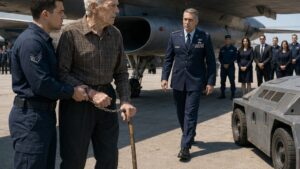
The Old Veteran Touched the Rifle Once and Saw What Every Young Soldier Missed
Chapter 1: The Old Man Beside the Rifle Case
Timothy Bennett arrived at the range with one hand around the handle of a hard black rifle case and the other pressed against the doorframe of Donna Cooper’s van, waiting until his left knee stopped arguing with him.
The afternoon had gone gold over the pines. Dust hung low across the lanes, the kind of fine brown dust that found bootlaces, sleeve cuffs, rifle oil, and the cracks in old hands. Downrange, paper targets shifted faintly against their frames. Somewhere beyond the berm, a bird called once and went quiet.
Donna came around the front of the van too fast, already reaching for the case.
“I can take that, Mr. Bennett.”
Timothy gave her a mild look. “I brought it this far.”
“I know you did.” She stopped with both hands half-raised, then smiled as if she had been corrected kindly in church. “Just trying to help.”
“That you are.”
He lifted the case out himself. The handle creaked against his fingers. It was not heavy the way it used to be heavy, back when he could carry two at a time and still bark at a line of recruits. Now it had weight because everything had weight: the case, the dust, the late sun, the rows of young soldiers moving briskly as if time belonged to them.
A banner had been tied between two posts near the range office.
VETERANS RANGE APPRECIATION DAY
The wind had folded one corner behind the rope so that the word APPRECIATION kept disappearing and returning.
Donna walked beside him at his pace. “They’re excited you came.”
Timothy kept his eyes on the firing line. “People get excited about old things when they think they’re safe.”
She glanced at him, uncertain whether to laugh. He saved her the trouble by not smiling.
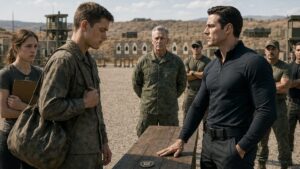
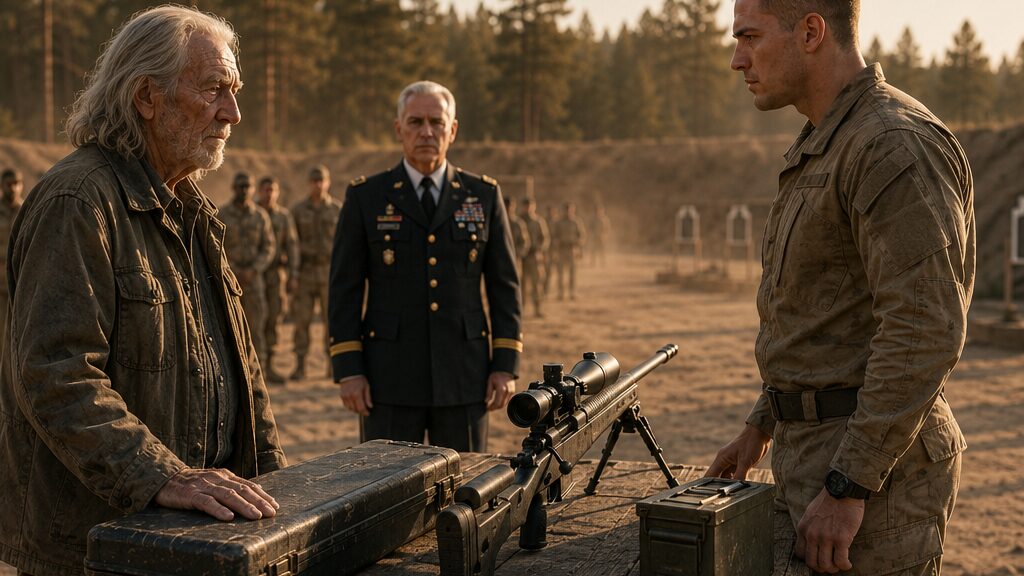
At the center lane, a rough wooden table had been set aside. On it sat a modern scoped rifle mounted on a bipod, its matte barrel aimed downrange, its glass clean enough to catch the sun. Beside it rested a metal ammunition box, a clipboard with a range card clipped under a steel spring, and a small row of cartridges lined up too neatly for Timothy’s taste.
A young instructor in tan field clothing stood at the table, talking to two trainees. He had close-cropped hair, squared shoulders, and the bright hard focus of a man who had learned procedures well and trusted them fully. When he saw Timothy and Donna approaching, he looked first at the case, then at Timothy’s face, then at Donna, as if checking whether he had missed a wheelchair.
“Mr. Bennett?” the instructor asked.
“Timothy.”
“Sergeant Brian Miller. I’ll be running you through the demonstration.” Brian held out a hand.
Timothy shifted the case to his left, took the handshake, and felt the young man soften his grip at the last moment. That was always worse than a firm hand. A firm hand said hello. A softened grip said careful, fragile, might break.
“Demonstration,” Timothy repeated.
“Just one ceremonial shot. We’ll set you up, you’ll take your time, and Colonel Harris will say a few words afterward.” Brian pointed toward the range tower, where a decorated officer in dress uniform stood speaking with the safety officer. “We’ve got everything dialed in already.”
Timothy set the case on the table. Its rubber feet knocked once against the wood.
Brian’s eyes flicked to it. “You won’t need your own equipment, sir. This rifle’s already zeroed. Much easier platform.”
Timothy looked down at the modern rifle. The cheek rest had been adjusted high. The bipod legs were uneven by half a notch. The elevation turret had fresh chalk across it. The scope rings were clean, but one screw showed a tiny silver crescent where the finish had been recently disturbed.
He did not touch the rifle yet.
One of the trainees, a lean young man with nervous eyes, whispered something to the soldier beside him. The other soldier looked away quickly when Timothy raised his head.
Donna heard it too. Her face tightened.
Brian clapped once, too brightly. “We’re a little behind schedule, so we’ll make this smooth. You ever used a chassis rifle before?”
Timothy looked at him.
Brian’s confidence faltered only a fraction. “Modern stock, adjustable comb, different from the older wood-stock systems you might remember.”
A memory moved through Timothy’s fingers before he could stop it: wet canvas, a night wind, a young Marine saying he had checked the mount because the board said checked, and Timothy’s own voice coming too late.
He put his right hand on the latch of the old case. Touched it once. Then again.
Donna watched the gesture. “Mr. Bennett?”
“I’m here,” he said.
Brian had already turned toward the rifle. “We’ll help you get behind it. No rush once you’re down. Just watch your knee around the bench.”
Timothy studied the firing lane. The dirt beyond the muzzle shimmered in uneven sheets. The left flag near the fifty-yard marker hung lazy, but the grass at the base of the right berm trembled in short, nervous pulses. Downrange, lane three’s target frame leaned a degree off square. Not much. Enough.
Behind them, Colonel Charles Harris began walking from the tower. His uniform looked too formal for dust, but he wore it as if dust had no authority over him. Medals sat in controlled rows on his chest. His expression was unreadable.
“Mr. Bennett,” Charles called. “Glad you made the trip.”
Timothy nodded. “Colonel.”
“It means something to the young soldiers to have men like you here.”
Men like you.
Timothy looked at the banner again. Appreciation appeared, vanished, appeared.
Brian slid the ammunition box closer, eager to regain command of the moment. “We’re ready when you are. Like I said, rifle’s set.”
Timothy finally let his hand leave the case latch. He placed his palm lightly against the rifle stock, not gripping, not claiming, only listening through the contact. The wood table was warm. The rifle was cooler. The bipod shifted faintly under the pressure of two fingers.
“No,” Timothy said.
Brian blinked. “Sir?”
Timothy kept his eyes on the scope ring. “It isn’t.”
The two trainees stopped whispering. Donna’s breath caught softly behind him. Colonel Harris, still a few steps away, slowed.
Brian’s smile returned, thinner now. “The rifle was confirmed this morning.”
“Was it?”
“Yes, sir.”
Timothy lifted his hand from the rifle and rested it again on the old case. The latch clicked under his thumb, quiet as a tooth.
Brian glanced toward the colonel, then back at the old man. “Maybe let me walk you through it first.”
Timothy looked downrange, where the shimmer bent slightly right, then broke left near the berm.
“You can walk,” he said. “But that rifle is not set.”
Chapter 2: The Instructor Who Explained the Wrong Thing
Brian Miller had learned early that the best way to manage a range was to leave no empty space for confusion.
Commands clean. Movements clean. Weapons pointed in safe directions. Ammunition counted. Lanes assigned. Time protected. There was a rhythm to it, and when the rhythm held, everyone trusted the line.
Timothy Bennett had broken the rhythm without raising his voice.
Brian felt it in the bodies around him. The trainees had turned their attention toward the table. Donna Cooper stood near the back edge of the firing point, hands clasped around her clipboard. Colonel Harris had come close enough to hear every word. Even the safety officer near lane five glanced over with the careful look of a man who did not want to be drawn into someone else’s awkward moment.
Brian kept his voice level. “Sir, I understand this equipment can feel unfamiliar. The optic has already been set for this distance. All you need to do is settle in behind it and put the reticle center mass.”
Timothy looked at the rifle, then at Brian. Not angry. That was the irritating part. If the old man had snapped, Brian could have handled it. If he had shaken, Brian could have softened. But Timothy only watched him with pale, tired eyes that made Brian feel as if he were explaining rain to a farmer.
“I know what a reticle is,” Timothy said.
A trainee coughed into his shoulder.
Brian felt heat climb his neck. “Of course.”
Colonel Harris folded his arms. “What exactly is the issue, Mr. Bennett?”
Timothy did not answer immediately. He looked toward the target frames again, then at the clipboard clipped to the ammunition box. “Who wrote the range card?”
Brian picked it up. “I did.”
“Today?”
“Yes.”
“Before or after they moved the lane markers?”
Brian frowned. “They weren’t moved.”
Timothy’s eyes shifted to the dirt just forward of the table. Brian followed the look and saw tire tracks cutting diagonally across the packed ground, probably from the maintenance cart that had brought fresh target backers. That meant nothing by itself. The frames were checked. The berm was checked. The distances had been lasered.
“Markers are fixed,” Brian said.
“Some things are fixed until someone leans on them.”
A whisper moved through the trainees and died as soon as Brian looked up.
He turned the clipboard around, tapping the numbers with one finger. “This is current. Wind, distance, elevation correction. The rifle was fired by the armorer at fourteen hundred. Confirmed.”
Timothy leaned slightly closer to the card. His long gray-white hair moved in the faint wind. He did not squint as much as Brian expected him to. Instead he read the card once, then looked past it to the rifle.
“The board says one thing,” Timothy said.
“It says the correct thing.”
“The rifle says another.”
Brian exhaled through his nose. He reminded himself that Donna had said the man was important, that Charles Harris had personally approved the invitation, that the event had a base photographer wandering around looking for respectable moments. An argument with a seventy-four-year-old veteran beside a ceremonial rifle was not the kind of image anyone wanted online.
He softened his voice again, though it cost him. “Mr. Bennett, with respect, we’ve got a lot of people waiting. This is just a ceremonial shot.”
Timothy’s face changed then, not much, but enough.
“Just,” he said.
Brian heard the warning in the single word and still stepped past it.
“I mean it’s not a scored qualification. Nobody’s asking you to prove anything.”
That was meant to be kind. He knew it as soon as he said it. He also knew, before Timothy answered, that it had landed wrong.
The old man looked down at his own hand resting on the case. The skin was thin over the knuckles, the veins raised, two fingers slightly bent from old injuries. Brian saw, with a flicker of shame, that the hand was completely steady.
“I don’t fire a rifle because a schedule is uncomfortable,” Timothy said.
Brian’s jaw tightened. “No one is asking you to do anything unsafe.”
“No one thinks they are.”
Donna shifted beside the table. “Sergeant Miller, maybe we should just take a minute.”
“We’ve taken several,” Brian said, then immediately regretted the edge in it.
Colonel Harris’s eyes moved to him.
Brian straightened. “Sir, the line is stacked. Lane three is due for trainee qualification after the demonstration. We have visiting veterans in the shade area, families waiting, and daylight going. If there’s a technical concern, I can have the armorer recheck it after Mr. Bennett takes the shot.”
Timothy looked at him again.
After.
The word sat there with all its weight.
Brian reached for the rifle with practiced care. “Let me show you what we’re working with.”
He adjusted the comb, checked the bolt open, pointed to the turret marks. He explained the magnification ring, the parallax knob, the bipod tension. He kept his tone patient. The same tone he used with brand-new trainees who were afraid of embarrassing themselves.
Timothy listened without interrupting.
That should have pleased Brian. Instead, it made every sentence sound smaller as it left his mouth.
“This platform is more forgiving than what you probably trained on,” Brian said. “Less felt recoil. Clearer glass. Better stability. Once you’re behind it, you’ll see.”
“I already see.”
Brian set the rifle back down. “Then what do you need?”
Timothy pointed with two fingers, not at the scope glass, not at the barrel, but at the front scope ring. “That screw was touched after your confirmation.”
Brian looked. The screw head showed a faint bright mark along one edge.
He nearly laughed from relief. “That? That’s just finish wear. These rifles get handled.”
“Not like that.”
“Sir, I inspected it.”
Timothy’s voice stayed quiet. “You looked at it.”
The trainees heard that one. Brian knew because their faces went still.
The difference between inspected and looked had been thrown at him by older instructors when he was new. He had hated it then too.
He picked up the clipboard and clipped it back onto the ammunition box harder than necessary. “The rifle is safe. The card is correct. The demonstration is waiting. If you’re uncomfortable firing, no one will hold it against you.”
The moment stretched.
Timothy did not defend himself. He did not tell them what he had done in the service. He did not ask Charles to intervene. He only turned his head toward the tripod set beside the observation point.
“Bring me the spotting scope,” he said.
Brian stared at him.
Colonel Harris’s brows drew together. “For what purpose?”
Timothy looked downrange, where dust lifted in a thin veil across lane three.
“To see whether the rifle is lying,” he said, “or the board is.”
Chapter 3: The Detail No One Wanted to See
The spotting scope stood twenty feet away in the thin shade of the range tower, angled toward the far targets like an officer keeping its own counsel.
No one moved for it at first.
Timothy could feel the pause settle over the firing line. He had known pauses like that in younger rooms, harder rooms, places where men waited to see whether pride or sense would speak next. It was never the loud men who worried him most. It was the quiet crowd giving permission.
Brian Miller looked toward Colonel Harris.
Charles looked at Timothy.
Timothy waited.
The wind slid over the range and folded the edge of the banner again. Appreciation vanished.
At last Charles lifted one hand toward the safety officer. “Bring the scope.”
Brian’s mouth tightened, but he said nothing.
The safety officer carried the tripod over and set it beside the table. Timothy did not reach for it immediately. First he touched the latch on his old case, once with his thumb, once with the side of his forefinger. The old habit steadied the order of things inside him.
Latch. Line. Glass. Wind. Metal. Breath.
He had not meant to bring all that with him. Donna had called two weeks ago and said the base wanted a few retired service members for a respectful event, photographs, a few words, maybe a ceremonial shot if he was comfortable. He had almost said no. Then he had looked at the black case in the closet, with dust along its handle and his wife’s old storage label still stuck crookedly on one end.
You can go without performing, she would have said.
He had come believing that.
Now a young sergeant was watching him as if Timothy had chosen the most public possible way to become difficult.
“Do you need help adjusting that?” Brian asked.
Timothy bent slowly, ignoring the pinch in his knee, and set his eye to the scope.
The world tightened into a circle.
Target frames. Stapled paper. Heat shimmer crawling up from the dirt. The left marker flag hung heavy, but the low grass near the berm fluttered against it. Beyond lane three, the backer leaned just enough to catch sunlight unevenly along its edge. The shimmer did not travel in one clean direction. It braided. Broke. Rejoined. Something near the lane markers had changed the channel of the wind.
He shifted the scope lower, toward the near dirt, then back to the rifle.
“Your lane is reading two winds,” Timothy said.
Brian folded his arms. “We accounted for wind.”
“You accounted for the flag.”
“That’s what it’s there for.”
Timothy lifted his head from the scope. “It’s there to help you think. Not to think for you.”
A couple of trainees looked down at their boots. The nervous one, Matthew Reed, stared at the target frames as if he might see what Timothy had seen by wanting badly enough.
Brian stepped closer. “Sir, respectfully, this is turning into a lesson nobody asked for.”
“No,” Timothy said. “It’s turning into one somebody needs.”
The words came out before he had weighed them. He regretted the sharpness, but not the meaning.
Brian’s eyes hardened. “Are you saying my line is unsafe?”
Timothy looked at the rifle. “I’m saying that rifle has been touched since it was confirmed, the board does not match the lane, and the wind near the berm is not the wind at the table.”
“That’s not the same as unsafe.”
“It is if nobody cares.”
The range seemed to draw in around them. Even Charles said nothing now.
Brian reached toward the rifle. “Then we’ll settle it. You take the shot. If you’re right, you’ll hit where you say. If not, we move on.”
Timothy’s hand came down on the rifle case.
Not hard. Not dramatic. Just enough that the latch clicked.
“No.”
Brian froze. “No?”
“I won’t fire to win an argument.”
The young sergeant’s face flushed. “This isn’t an argument.”
Timothy glanced at the watching trainees, at Donna’s worried face, at Charles standing as if carved from the same rules that had shaped him. “Then stop treating it like one.”
For the first time, Brian lost the polished patience from his voice. “Mr. Bennett, I have been respectful. I have explained the system. I have offered assistance. But you cannot walk onto an active range, question my setup in front of my trainees, refuse to demonstrate the problem, and expect me to hold the line on a feeling.”
Timothy looked at him for a long moment.
He had heard the word feeling before. Men used it when they did not want to admit that experience had spoken in a language they had not learned yet.
He reached for the rifle, moving slowly enough that no one could mistake it for defiance. His fingers settled near the scope ring. He did not turn the screw. He only brushed the edge of it and lifted his hand again.
“See that mark?”
Brian did not answer.
“Fresh. Not worn. The ring shifted or was checked after your confirmation. Maybe not enough to scare anyone. Enough to matter if the shooter trusts the card too much.”
Brian looked despite himself.
Timothy pointed downrange. “Lane three target frame is leaning. Not much. Enough that a shooter already fighting a bad call will chase what isn’t there.”
Matthew swallowed. Timothy heard it.
“And the wind?” Brian asked, trying to make the question sound like a challenge.
Timothy nodded toward the dirt. “Your flag is high. The trouble is low.”
Brian stared at the range. He saw dust. Flags. Paper. Nothing that deserved this interruption.
Charles stepped forward. “What do you recommend?”
Timothy almost smiled at the question. Not because it pleased him, but because it was the first useful one anyone had asked.
“Hold the line. Recheck the mount. Reconfirm lane three from the berm back, not the table forward. Then update the card.”
Brian let out a breath that was close to a laugh. “That will take fifteen minutes.”
“Then take fifteen.”
“We don’t have fifteen.”
Timothy’s eyes moved to the trainees waiting under the shade net. Young faces. Young shoulders. Young men trying not to look interested.
“You always have fifteen before,” he said. “Sometimes you don’t get one after.”
The words quieted him inside as soon as they left his mouth.
He saw, not the range in front of him, but a different one: gray morning, damp sandbags, a corporal grinning because he had been told he worried too much, Timothy’s own younger hand waving him through because the board had been checked and the line had to move. A sound. Then a silence that lasted decades.
Donna lowered her eyes.
Charles studied Timothy with a different expression now, less formal and more human. Brian noticed it and stiffened.
The young instructor turned to the colonel. “Sir, if we stop every time a guest questions a confirmed rifle, we undermine the whole line.”
Timothy stepped back from the table. His knee complained. He let it.
“I’m not a guest questioning a rifle,” he said. “I’m an old man telling you it already answered.”
Brian shook his head, but uncertainty had entered his face. Small, unwelcome, and visible.
Charles looked toward the observation point, then toward the targets, then at the rifle lying between them.
“Hold lane three,” he said.
Brian stared at him. “Sir?”
“Sixty seconds,” Charles said. “No firing on lane three until I say otherwise.”
It was not full belief. Timothy knew that. It was a commander buying time without surrendering authority.
But the line held.
The range command passed down in clipped voices. Rifles stayed open. Trainees shifted. The banner snapped once in the wind, and APPRECIATION showed itself whole before folding away again.
Brian leaned close enough that only Timothy could hear him.
“If this turns out to be nothing,” he said, “you’ll have made me stop a live range in front of everyone for nothing.”
Timothy looked at the rifle, then at the young man who still thought embarrassment was the danger.
“No,” he said softly. “For nothing is when you don’t stop.”
Chapter 4: The Shot That Wasn’t for Showing Off
Charles Harris had spent thirty-one years learning how long a minute could be.
A minute could be nothing when a commander wanted more time. It could be forever when men were waiting under rifles and orders. It could make a room angry. It could save a life. On a range, a minute had its own temperature.
This one was hot with embarrassment.
The line had gone quiet in a way no commander liked. Rifles open. Bolts back. Trainees pretending not to watch. The base photographer lingering near the shade canopy, camera lowered, sensing that whatever was happening at lane three no longer belonged in a veterans’ appreciation album.
Charles stood with the sun on the medals he had not wanted to wear and watched Brian Miller wrestle with obedience.
Brian was a good instructor. That mattered. Charles would not have put a careless man on a public range day, not with visiting veterans, families, and young soldiers all mixed into one long schedule of ceremony and qualification. Brian knew safety rules. Brian kept his lanes clean. Brian did not let trainees get casual around weapons.
But there were ways to follow rules that made a man stop looking.
Timothy Bennett still stood beside the table, one hand resting on the hard rifle case, the other loose at his side. He looked tired now. Not defeated. Just tired in the old way, as if the argument had asked him to lift something he had set down long ago.
Charles remembered the file.
Not much of it. Enough. Bennett, Timothy. Marine Corps. Scout sniper. Later range safety instructor. Commendations folded into old language. Incidents described with the clean cruelty of official records. One training mishap marked by injury, inquiry, corrective action, no negligence found.
No negligence found did not mean no one carried it.
Charles had not told Brian any of that. He had wanted the younger soldiers to meet Timothy without a myth placed over him. He had wanted a simple day. A photograph. A respectful shot. A few words about service.
He saw now that simple had been the mistake.
“Sergeant Miller,” Charles said, “check the scope ring.”
Brian’s face tightened. “Sir, the line is held for sixty seconds.”
“Use them.”
Brian stepped to the rifle. His movements were controlled, but Charles saw the stiffness in his shoulders. He leaned close to the mount and examined the screw Timothy had indicated. The young man’s jaw worked once.
“Well?” Charles asked.
“It’s marked,” Brian said. “But that doesn’t mean movement.”
Timothy said nothing.
Charles looked to the safety officer. “Tool.”
The safety officer passed over a torque driver from the range kit. Brian accepted it, set it into the screw head, and stopped.
That pause told Charles more than any explanation.
Brian tried again, carefully this time. The screw moved before the torque broke.
The silence at the table changed shape.
“Not loose enough to fall off,” Brian said quickly.
Timothy’s voice came low. “Loose enough to lie.”
Charles looked downrange. The leaning target frame seemed innocent from where he stood. Most problems did. He turned to the safety officer. “Check lane three marker alignment from the berm back. Not from the table forward.”
The safety officer gave a quick nod and started down the side path with another range assistant.
Brian set the torque driver down. “Sir, we can still verify with one shot. Controlled conditions. I’ll fire it.”
“No,” Timothy said.
Brian turned on him. “No?”
Timothy’s hand remained on the case. “You fire it angry, you’ll learn less.”
Brian’s mouth opened, but Charles cut in before the young man could answer.
“Mr. Bennett,” Charles said, “would you be willing to take a verification shot?”
Timothy looked at him for a long moment. The request sat between them differently than Brian’s challenge had. Charles had not asked for a show. He had asked for help.
“One shot,” Timothy said. “Not for the banner.”
“Understood.”
Brian stepped back, though every inch of him resisted it.
Donna Cooper moved as if to assist Timothy down behind the rifle, then stopped herself. Timothy noticed and gave her a small nod, not quite thanks, not quite permission. He lowered himself slowly, one knee first, then an elbow against the table, then his cheek to the stock.
No one helped. No one spoke.
Charles watched the old man’s body remember.
The stiffness remained. The age did not vanish. His shoulder settled with care, not ease. His neck found the comb after a small adjustment. His breathing took longer to slow than a young shooter’s would have. He was not transformed into some impossible version of himself.
That was what held Charles still.
Timothy was old. His knee hurt. His hands bore years. And still, when his eye came behind the scope, the entire line seemed to organize itself around his quiet.
Brian watched too. Charles saw it in his face. Not belief yet. Not respect, exactly. But attention.
Timothy lifted his head before touching the trigger. “Do not write this correction from the hole alone.”
Brian frowned. “What?”
“The shot will show the error. It won’t tell you all of it.”
Charles felt the warning land. “Noted.”
Timothy settled again.
The range waited.
His finger took the trigger as if asking a question. There was no drama in it. No flourish. Only a clean pause, the faintest exhale, and the crack of the rifle breaking the held air.
Dust flinched near the berm. A few visiting veterans under the shade canopy turned their heads. The target downrange did not reveal its secret to the naked eye.
Charles stepped to the spotting scope.
He bent, closed one eye, and found the paper.
The hole sat almost exactly where Timothy’s earlier correction had implied it would sit: not where Brian’s board promised, not wildly wrong, not miraculous, but wrong enough. Wrong in a way that mattered. Wrong in a way that would make a young shooter chase his own breathing, his hold, his confidence, when the fault had started in the equipment and the lane.
Charles stayed at the scope a second longer than he needed to.
He had commanded men who thought admitting error weakened authority. He had once been one of them. The range beyond the glass shimmered and narrowed until all he could see was a small dark hole punched through paper, accusing no one and teaching everyone.
He straightened.
Brian was looking at him. So was Timothy, though the old man had not moved from the rifle.
Charles kept his voice even. “Impact confirms Mr. Bennett’s concern.”
Brian’s eyes flickered. He glanced at the target, though he could not see it clearly from there, then at the rifle, then down at the range card clipped to the ammunition box.
“How far off?” he asked.
“Enough,” Charles said.
Timothy pushed himself up slowly. Donna stepped forward, then stopped again. This time he accepted her hand for balance, briefly, without surrendering the rest of himself.
The safety officer’s voice came over the radio from downrange. “Lane three target frame is off its mark. Looks like the base shifted. Maybe cart bumped it during setup. Confirming now.”
Brian closed his eyes for half a second.
Charles could have ended it there. He could have given an order, moved the schedule, protected Brian with procedure. Part of him wanted to. Public correction could sour into humiliation fast, and humiliation taught men to hide their mistakes.
But Timothy had said not to write the correction from the hole alone.
Charles turned toward Brian. “Update the card after they finish the berm check. Reconfirm the mount. Hold qualification on three.”
Brian nodded once. “Yes, sir.”
The words were correct. The face was not yet ready for them.
Timothy closed the bolt on nothing, checked the chamber by habit, and stepped back from the rifle. The old case waited beside him, black and scuffed, its latch dulled from years of use.
Charles moved closer to him. “That was a fine shot.”
Timothy looked down at the rifle, not the target. “Fine enough.”
“I appreciate it.”
Timothy’s eyes shifted to the trainees under the shade. Matthew Reed stood near the end of the row, staring downrange with his mouth tight.
“Don’t appreciate the shot,” Timothy said. “Fix what made it necessary.”
Charles absorbed that without answering.
Behind them, Brian unclipped the range card from the ammunition box. For the first time that afternoon, he studied it as if it might not be telling him everything.
Chapter 5: The Young Soldier in the Wrong Lane
Matthew Reed had been trying all afternoon not to look nervous.
It was not working.
He could feel nervousness in his hands even when they were still. He felt it in the careful way he checked his magazine, in the too-straight line of his back, in the way his tongue kept finding the dry place behind his teeth. Qualification day did that to some soldiers. The others acted like the rifle was just another tool, another block to check, another story they would tell later. Matthew treated it like a question he might answer wrong in front of everyone.
The old veteran had made it worse at first.
Matthew had watched him come in with the black case and the slow knee and the long white-gray hair. He had heard one of the other trainees mutter, “They’re really letting Grandpa shoot the demo?” and Matthew had almost smiled because it was easier to smile than to admit he was relieved the attention had shifted to someone else.
Then the old man touched the rifle, looked downrange, and stopped the line.
Now Matthew was no longer smiling.
The safety officer returned from the berm with dust on his boots and a look on his face that made every trainee stand straighter.
“Lane three frame was shifted,” he reported to Sergeant Miller. “Base is off the mark. Not huge, but off. Wind read is dirty low across the lane. Mount screw took torque too.”
Brian Miller listened without interruption. That alone told Matthew something had changed.
Colonel Harris stood beside the firing table, arms behind his back. Donna Cooper had moved the visiting veterans farther toward the shade canopy, speaking softly, keeping their curiosity from crowding the line. Timothy Bennett sat now on a bench beside his rifle case, not looking victorious. He looked as if someone had asked him to remember a name he had spent years trying not to say aloud.
Matthew wished, suddenly and sharply, that he had not smiled.
“Reed,” Brian called.
Matthew’s stomach dropped. “Sergeant?”
“Lane three is yours once we reset.”
Of course it was.
The other trainees shifted away from him with the small, sympathetic cruelty of people grateful not to be chosen.
Brian turned back to the table. “We’ll correct the card, confirm the mount, and run it clean.”
Matthew nodded, though no one had asked him to.
He had qualified before, but not well. Barely enough. He could shoot in calm conditions. He could follow commands. But when something felt off, he tended to correct too much, then correct the correction, until his target became a record of doubt. Sergeant Miller had told him twice that his problem was trust.
Trust your fundamentals.
Trust the equipment.
Trust the call.
Matthew had tried.
He watched Timothy rise from the bench with one hand on the case. The old man did not come toward him. He only stood where he was, looking downrange through the heat. For a moment Matthew thought Timothy was looking at the target. Then he realized the old man was watching the air between.
Brian came over with the updated range card. His voice had regained its command shape, but not its earlier shine.
“Reed, listen up. We’re going to run this deliberate. No rushing the shot. You’ll confirm natural point of aim, control breathing, and wait for my command.”
“Yes, Sergeant.”
Brian paused. “If anything feels off, you say so.”
Matthew heard the difference. Before, that sentence would have sounded like routine. Now it sounded borrowed from someone older.
Timothy stepped closer then, slow across the dirt.
Brian noticed and stiffened. “Mr. Bennett?”
Timothy stopped far enough away not to crowd the instruction. “May I ask him one thing?”
Brian looked toward Charles.
Charles said, “Sergeant Miller has the line.”
That put the choice back where it belonged.
Brian’s jaw moved once. “One thing.”
Timothy looked at Matthew. Up close, his eyes were lighter than Matthew expected. Not soft exactly. Clear.
“When your first shot doesn’t go where you expected,” Timothy asked, “what do you blame?”
Matthew felt every other trainee listening.
“My fundamentals,” he said.
“Always?”
“That’s what Sergeant Miller says to check first.”
Timothy nodded. “Good first. Bad always.”
Brian’s expression tightened, but he did not interrupt.
Timothy pointed with two fingers toward the target frame. “If you chase a bad call with good effort, you only get lost faster.”
Matthew swallowed. “How do I know the difference?”
“You slow down before you decide you failed.”
The answer was simple enough to sound useless, except Timothy said it like a man who had bought it at a cost.
Brian looked away toward the lane.
The target frame was reset. The mount was torqued. The updated card was clipped back to the ammunition box, this time with a pencil mark written in Brian’s own hand. Matthew saw Timothy’s gaze touch the card, then the scope, then the low grass by the berm.
The line went hot again.
Matthew lay behind the rifle. The stock felt too hard against his cheek. His pulse tapped in his neck. The corrected numbers were on the board, but now he knew boards could be wrong. That knowledge should have helped. Instead it opened a door under him.
“Natural point of aim,” Brian said.
Matthew adjusted.
“Breathe.”
He breathed.
“Send when ready.”
Matthew looked through the scope. The target floated. The reticle wavered, settled, wavered again. He thought of the shifted frame. The loose screw. The old man’s hand touching the case latch. He thought of the other trainees waiting for him to prove the delay had not been wasted.
His first shot broke a hair early.
He knew it before the sound faded.
“Impact left edge,” the safety officer called after a moment. “Still on paper.”
Heat rushed into Matthew’s face.
Brian leaned in. “What happened?”
Matthew started to answer the way he always answered. “I pulled—”
“No,” Timothy said.
It was not loud, but it cut cleanly.
Brian turned. “Mr. Bennett.”
Timothy did not look at him. He looked at the rifle, then at Matthew’s shoulder. “Don’t correct the boy until you correct the lane.”
Brian’s face darkened. “We corrected the lane.”
“You corrected the numbers.”
“The mount is confirmed. Frame reset. Card updated.”
Timothy stepped closer, pointing not at the target but at the dirt just beyond the muzzle line. “His mat is canted.”
Everyone looked.
Matthew froze behind the rifle.
The firing mat under him had been laid partly over an old tire rut from the maintenance cart. Under his left elbow, the mat dipped just enough to cant his body. It was small. Ridiculously small. The kind of thing Matthew would never have named because it sounded like an excuse.
Brian stared at the mat.
Timothy’s voice remained calm. “He built his position on a lie and blamed his hands.”
Matthew felt the sentence pass through him with more force than the shot.
Brian knelt beside the mat. He pressed his palm against the left edge, then the right. His mouth flattened.
“Clear the rifle,” he said quietly.
Matthew opened the bolt and showed clear.
Brian stood. For a moment, he looked as if he wanted to be angry at the dirt, the mat, the maintenance cart, the whole day. Then his gaze moved to Timothy.
The old man had not smiled.
That seemed to make it harder.
Brian picked up the mat himself, shook dust from its underside, and moved it clear of the rut. He checked it twice, then looked back at Matthew.
“Rebuild your position,” he said.
Matthew did.
This time, when he settled behind the rifle, the ground did not argue with his body. His shoulder relaxed by a fraction. The target still moved with his breathing, but it moved honestly.
Brian crouched beside him.
“Reed,” he said, and his voice had changed. “Before you blame yourself, check what you’re resting on.”
Matthew glanced sideways. “Yes, Sergeant.”
From the bench, Timothy watched the target through the spotting scope. His hand rested on the old case, but the latch did not click.
Brian gave the command.
Matthew breathed, waited, and fired.
The call came back clean.
“Center.”
No one cheered. That made it better.
Matthew stayed behind the rifle for one more breath, staring through the scope at the paper downrange. The hole was only a hole. It did not make him brave. It did not erase every bad shot before it. But it proved something he had not known how badly he needed proved.
Not every miss was a failure of the man holding the rifle.
Brian rose slowly. He did not look at the target first. He looked toward Timothy Bennett.
Timothy nodded once, small enough that anyone not watching for it would miss it.
Matthew saw it.
So did Brian.
Chapter 6: What the Case Had Been Carrying
The range office smelled of old coffee, paper dust, and gun oil baked into wood.
Timothy sat on a bench along the wall with the black rifle case across his knees. Outside, the line was paused while the safety officer reset the next rotation. Voices came muffled through the walls: young soldiers laughing too loudly after tension, Donna directing visitors toward water, Colonel Harris speaking low to someone near the door.
Brian Miller stood near the office desk, holding his cap in one hand. Without it, he looked younger.
He had followed Timothy in after Matthew’s clean shot, not immediately, and not with the stiff march of a man ordered to apologize. He had waited until the rifle was cleared, the lane reset, and Matthew had stepped back among the other trainees with a different set to his shoulders. Then Brian had said, “Mr. Bennett, when you have a minute.”
Now he had the minute and did not seem to know what to do with it.
Timothy saved him from starting badly.
“You run a clean range,” he said.
Brian looked up, surprised.
“I missed a loose mount,” Brian said.
“You found it when you looked.”
“After you made me.”
Timothy ran his thumb along the case latch. “Most men need making sometimes.”
Brian gave a short, humorless breath. “Is that supposed to make me feel better?”
“No.”
The answer landed, and then, unexpectedly, Brian smiled at the floor. It was not much. Enough to loosen the room.
Timothy set the case on the bench beside him and turned it so the latches faced up. For a while he only looked at it. The case was not special to anyone else. Scuffed corners. Faded tape. A handle worn smooth where his hand had worried it over years. One end still carried the crooked storage label his wife had put there because she said if he was going to keep half the garage under lock, at least it could be labeled like civilization.
RANGE / OLD NOTES / DO NOT TOSS
Her handwriting had outlived her voice in the house. That was the sort of thing objects did. They stayed rude with memory.
Brian looked at the label but did not comment.
Timothy opened the latches.
Inside lay no rifle. Brian’s eyes showed that he had expected one.
Instead there were oilcloth packets, folded range cards, a worn data book with rounded corners, a small screwdriver set, a coil of faded cord, a pencil no longer than Timothy’s thumb, and a few empty cartridge cases kept in a plastic bag. Everything had its place. Everything looked used, not displayed.
Brian stepped closer despite himself. “You brought notes.”
“I bring habits.”
Timothy lifted the data book. The cover had softened from years of hands and weather. He opened it to a page marked with a strip of masking tape. The writing inside was small, exact, and faded in places where rain had once reached it.
Brian leaned over. “These are wind calls.”
“Some.”
“From when?”
Timothy turned a page. “Different years. Different ranges.”
Brian looked at the rows of numbers, arrows, distances, corrections, and brief notations that were almost too plain to carry memory.
LOW WIND LIED UNDER HIGH FLAG.
FRAME SHIFTED AFTER CART.
SHOOTER BLAMED BREATH. MAT UNEVEN.
Brian read the last line twice.
“You’ve seen that before,” he said.
Timothy kept his eyes on the page. “Most mistakes are old. They just wear new uniforms.”
Brian was quiet.
Outside, a command rang faintly across the range. Not lane three. Another lane. A shot followed, then another.
Brian took the cap in both hands. “I thought you didn’t want to shoot because you were nervous.”
“I was.”
The young man looked at him.
Timothy closed the data book halfway. “Not of missing.”
Brian understood enough not to ask too quickly.
Timothy looked toward the small office window. Through it, he could see the far edge of the range, the pine trees darkening as the sun lowered, the tops of target frames beyond the dirt.
“A long time ago,” he said, “I had a young corporal on a training line. Good Marine. Careful most days. The kind who wanted to do right so badly he’d say yes before he was sure.”
Brian’s face stilled.
“The mount had been checked. The board was marked. Weather looked simple. We were behind schedule.” Timothy touched the page with one finger, though he was no longer reading it. “He said something felt off. I looked at what I expected to see and told him to send.”
The office seemed smaller.
“What happened?” Brian asked.
Timothy did not turn toward him. “Enough.”
The word did not invite more.
Brian lowered his eyes.
Timothy sat with the memory until it stopped moving so sharply. He had learned not to fight it in public. Fighting gave it teeth. Letting it pass cost less.
“No negligence,” Timothy said after a moment, because official words had their own bitter taste. “Equipment issue. Procedure updated. Men signed papers. Command moved on.”
“But you didn’t.”
Timothy looked at him then. “Would you?”
Brian had no answer.
The door opened, and Colonel Harris stepped in. He stopped when he saw the open case. Donna stood just behind him with two cups of water, read the room, and stayed in the doorway.
Charles’s eyes moved over the data book. “I didn’t realize you still kept those.”
Timothy turned another page. “Nobody asked.”
Donna came in quietly and set one cup beside Timothy, one near Brian. “Somebody should have.”
No one corrected her.
Brian’s voice came rougher than before. “Why didn’t you just tell me who you were?”
Timothy shut the book. Not sharply. Finally.
“Because if a man needs my history before he checks a screw, he hasn’t learned the lesson.”
Brian looked away.
Timothy regretted the hardness in it, but not enough to take it back. The young man needed the truth plain. Not cruel. Plain.
Charles stepped closer to the bench. “We still need to finish qualification. The visitors can wait, but the trainees can’t lose the whole block.”
Brian put his cap back under his arm. “I’ll reset lane three and run Reed again.”
“You’ll run all of them again where needed,” Charles said. “Clean.”
“Yes, sir.”
Charles looked to Timothy. “Would you be willing to stay?”
Timothy’s hand moved toward the case latch, then stopped.
There it was. The pull he had feared. Not the rifle. Not the shot. The need. Once you showed people you could still carry something, they often handed you more than you had agreed to lift.
Donna saw the hesitation. “You don’t have to,” she said.
Brian did not speak.
That helped.
Timothy looked at the young instructor. Brian’s pride had not vanished. It still stood in him, bruised and wary. But beneath it was something better than shame. Attention.
“I won’t take your line,” Timothy said.
Brian met his eyes. “I’m not asking you to.”
Charles waited.
Timothy placed the data book back inside the case, aligned its edge with the oilcloth packet, and closed the cover halfway.
“I’ll stay on one condition.”
Brian straightened. “Name it.”
“You give the commands.”
Brian frowned. “I don’t understand.”
“Yes, you do.”
Outside, Matthew Reed laughed once at something another trainee said. The sound was quick, relieved, young.
Timothy closed the case lid but did not latch it.
“I can point at things all afternoon,” he said. “That won’t change your range. If they’re your soldiers, they need to hear you correct it.”
Brian looked at the floor, then through the window toward lane three.
When he turned back, the answer was in his posture before his voice.
“Yes, sir,” he said.
Timothy touched the latch once. This time, he left it open.
Chapter 7: The Command Given Twice
Brian Miller had given range commands thousands of times.
He knew how to pitch his voice so it carried without sounding panicked. He knew the difference between a command that steadied a line and one that merely filled air. He knew how to keep his eyes moving: chamber, muzzle, finger, target, backstop, body position, breathing. He had built pride on that knowledge because pride, when kept clean, could hold a young instructor upright through long days and sharper eyes.
Now he stood at lane three with Timothy Bennett ten feet behind him, and every command felt newly weighed.
The sun had dropped lower, flattening the shadows of the firing benches across the dirt. The visiting veterans had settled under the shade canopy with cups of water. Families spoke quietly. The photographer had stopped hunting for staged smiles and now stood near the range office, camera hanging from his neck, watching without raising it.
Brian was grateful for that.
The trainees lined up again, not loose now, not bored. They watched the range with the alertness that comes after a mistake is discovered close enough to touch. Matthew Reed stood first in the lane rotation, helmet strap straight, shoulders no longer bunched near his ears.
Brian glanced at the updated range card clipped to the ammunition box. The pencil marks were his. The corrected lane note was his. The mount had been torqued and marked again. The firing mat lay clear of the rut, checked by hand rather than glance.
He could still feel the old man’s words under his ribs.
If they’re your soldiers, they need to hear you correct it.
Colonel Harris stood near the spotting scope, but not behind it. He had left the glass angled toward the target and stepped back, giving Brian the line in full view of everyone. That was mercy and burden in the same motion.
Timothy had not taken the place of honor. He had not stood beside the colonel or at the front of the table like an expert waiting to be thanked. He stood slightly behind the firing point, next to his old rifle case, hands folded loosely over the cane Donna had quietly found for him near the office door. He looked tired in the sunset. Older than he had while arguing. More human than legend.
Brian took one breath.
“Lane three,” he called, “listen up.”
The trainees straightened.
“We reset this lane because I missed details that mattered.”
No one moved.
The sentence did not kill him. Brian had expected it might.
He kept his eyes forward. “The rifle mount has been checked and marked. Target frame has been reset. Mat placement has been corrected. Wind call has been updated from the berm back. You will not assume the board is right just because it is written. You will verify what you can verify.”
His gaze passed over Matthew, then the others.
“And when something feels wrong, you will say so before you decide the problem is only you.”
From the edge of his vision, Brian saw Timothy lower his eyes.
Not approval exactly. But he had heard.
Brian turned to Matthew. “Shooter to the line.”
Matthew stepped forward and got behind the rifle.
Brian watched him build the position. Not quickly. Not because the schedule wanted him to. Elbow. Shoulder. Cheek. Feet. Breathing. The mat stayed level. The rifle settled into him instead of forcing him to chase it.
Brian crouched beside him.
“What are you resting on?” he asked.
Matthew blinked once, then answered, “Level mat. Elbow set. No rut.”
“What is the rifle telling you?”
Matthew looked through the scope. “Reticle steady. No shift when I load the bipod.”
“What is the range telling you?”
Matthew’s eye stayed to the glass. “Low wind moving right to left near the berm. Flag is slower than the grass.”
Brian felt the words move through the lane. Other trainees heard them. Charles heard them. Timothy heard them.
“Good,” Brian said. “Do not rush the trigger to impress anyone.”
Matthew’s mouth tightened in something that almost became a smile. “Yes, Sergeant.”
Brian stood.
For the first time all afternoon, he did not feel the need to sound impressive.
“Load one round.”
Matthew loaded.
“On my command.”
The line held.
Brian waited longer than he normally would have. Not theatrically. Long enough to let the young man settle. Long enough to remind himself that waiting could be part of command, not a failure of it.
“Send.”
Matthew fired.
The shot cracked across the range and rolled into the pines.
Brian did not look at the target first. He looked at Matthew’s shoulder, his breathing, his hand off the trigger. Then he looked toward the spotting scope.
Colonel Harris did not step behind it.
He looked at Brian.
The scope was waiting.
Brian walked to it.
He bent, put his eye to the glass, and found the paper. The hole sat clean inside the scoring area, steady and honest. Not perfect. Better than perfect for what it needed to be. It belonged to the shooter, the rifle, and the corrected lane together.
“Impact center,” Brian called.
The breath that left Matthew was almost hidden under the small rustle of trainees shifting. No cheering. No performance. Just a quiet lift through the line, the sense of men seeing a thing corrected without anyone being crushed under it.
Brian turned back. “Reed, clear and show.”
Matthew cleared the rifle and showed safe.
“Good work,” Brian said.
Matthew rose, careful not to grin too much. “Thank you, Sergeant.”
Brian wanted to say more, to undo every earlier look and sharp sentence, but the line was not the place for private repair. He nodded once and moved to the next trainee.
The rhythm returned, but it was not the same rhythm as before. It had more space in it. Brian checked things he used to assume. He made each trainee speak one detail aloud before firing: mat, mount, wind, lane, breath. Some answered smoothly. Some stumbled. He corrected without cutting them down.
Once, when a trainee rushed a reply, Brian stopped him.
“Don’t give me the answer you think sounds right,” he said. “Tell me what you see.”
The words came out before he realized where he had learned them.
He did not turn around, but he knew Timothy had lifted his head.
The sun reached the tops of the pines. Dust floated red at the edge of the lanes. The banner near the office hung still now, the word APPRECIATION visible and unbroken.
Halfway through the rotation, the spotting scope’s angle slipped slightly when the tripod foot settled into soft dirt. Brian noticed the movement, small as a shrug.
Earlier, he might have nudged it back and moved on.
Instead he held up a hand. “Pause.”
The trainee at the rifle froze.
Brian crouched, checked the tripod foot, reset it on firmer ground, then looked toward Timothy.
The old man was watching him.
Brian lifted two fingers from the scope in silent acknowledgment. Not a salute. Not a show. Just a mark between men who had both seen the small thing before it became a larger one.
Timothy answered with the faintest nod.
The rotation continued.
When the final trainee finished, the light had gone bronze and thin. Brian called the line cold, heard the command repeat downrange, and watched bolts open, rifles clear, bodies relax. The qualification block had run late, but it had run clean.
Colonel Harris came to stand beside him.
“That was your line,” Charles said.
Brian kept his eyes on the trainees. “It almost wasn’t.”
“That matters too.”
Brian did not answer. He watched Matthew help another soldier lift the mat and shake dust from its underside before stacking it properly. The small act struck him harder than the clean shot had.
The lesson was already moving without Timothy touching it.
Brian turned then and walked to where the old veteran stood beside the black case.
Timothy looked as if he might prefer Brian to keep walking.
Brian stopped anyway. “Mr. Bennett.”
“Sergeant.”
“I owe you an apology.”
Timothy’s face did not change. “You owe them a better habit.”
Brian accepted that. “Yes, sir.”
“And yourself one.”
That caught him.
Timothy shifted his hand on the cane. “Pride is a loud thing when it gets scared.”
Brian looked toward the range card on the ammo box, the pencil corrections still visible. “I was scared of looking incompetent.”
“Most incompetence hides there.”
Brian let the sentence sit. It did not feel like an insult. Not anymore.
From near the shade canopy, Matthew Reed looked over. Brian met his eye and gave him a small nod. The young soldier nodded back.
Brian turned to Timothy again. “Will you watch the next block? Not take over. Just watch.”
Timothy’s gaze moved to the old case. The lid was closed now, latches still open from the office.
“For today,” he said.
Brian nodded. “For today.”
Timothy bent slowly and closed one latch. The click was small in the evening air.
Then he left the other latch open.
Chapter 8: The Man They Finally Listened To
By dusk, the range had begun turning back into a place instead of an event.
The families drifted toward the parking area with folded chairs and paper cups. The visiting veterans moved slowly under Donna Cooper’s careful direction, some talking more than they had when they arrived, some quieter. The base photographer took one final picture of the banner after the wind had stopped moving it. No one asked Timothy Bennett to stand beneath it.
He appreciated that more than he would have known how to say.
The rifles had been cleared and carried off. The ammunition box sat empty on the wooden table, lid open, range card still clipped to its side with Brian’s corrected pencil marks dark against the paper. The spotting scope remained near lane three, its tripod properly seated now, aimed downrange at targets already softening into shadow.
Timothy stood beside the table and let the evening air cool his face.
His knee hurt. His back hurt. His hands ached from doing less than they had once done easily. He was aware of every year in him now that the pressure had passed. During the argument, the old machinery had run because it had to. Afterward came the cost.
Donna appeared beside him without making a fuss of it.
“I saved you a bottle of water,” she said.
“Kind of you.”
“You scared me for a minute.”
He took the bottle. “Only a minute?”
She smiled, but her eyes stayed serious. “I thought they were going to turn you into a show.”
Timothy looked across the range. Brian was helping Matthew Reed store the mats. Not ordering from a distance. Helping. The two of them lifted each one and checked the underside before stacking it.
“Almost did,” Timothy said.
Donna followed his gaze. “You didn’t let them.”
He did not answer.
That was not entirely true. He had almost let them in another way. Pride could wear old clothes too. When Brian had challenged him, when the trainees had watched, when the young man had spoken to him as if patience were charity, Timothy had felt the old heat rise. Not just duty. Anger. The desire to put a shot through the paper so clean that every young face would rearrange itself around shame.
He had known that desire. He had seen men call it correction when it was only revenge with better posture.
The rifle case had helped. The latch under his thumb. The old order. The memory of what a trigger was for and what it was not.
Colonel Harris crossed from the range office with his dress jacket unbuttoned now, medals catching the last of the light. Without the full shape of ceremony, he looked more tired and less distant.
“Mr. Bennett,” Charles said.
“Colonel.”
“I wanted to thank you before you left.”
“You already did.”
“Not properly.”
Timothy took a sip of water, buying himself a second. “Careful with properly. It usually means longer.”
Donna looked away to hide a smile.
Charles accepted the warning. “No speech, then.”
“Good.”
“No plaque.”
“Better.”
Charles glanced toward the banner, then back. “I was going to ask you to let us recognize you in front of the visitors.”
Timothy said nothing.
“I won’t,” Charles added.
The quiet after that was easier.
A truck door shut in the parking area. Somewhere near the office, a young soldier laughed and then lowered his voice, as if remembering where he was.
Charles looked down at the old rifle case on the table. “I read about the training accident years ago.”
Timothy’s hand tightened on the water bottle.
“I should have mentioned that earlier,” Charles said. “Not to Brian. To you. I should have understood what kind of day this might become.”
Timothy watched the dark line of the berm. “Files don’t tell you that.”
“No,” Charles said. “They don’t.”
For a moment, Timothy heard the past trying to enter the present. The gray morning. The young corporal. The report that said no negligence found. The folded flag at a hospital bed years later that had nothing to do with that day and yet seemed tied to every day like it.
He let the sounds pass.
Charles shifted his weight. “Would you consider coming back? Not for ceremonies. To advise. Maybe once a month. Range safety review. Old eyes on new habits.”
Timothy almost laughed at the phrase old eyes. From Charles, it did not sound careless. That made it harder.
“I don’t want to be your story,” Timothy said.
“I’m not asking for that.”
“People say that before they ask you to stand in front of a camera.”
Donna’s expression hardened. “He’s not wrong.”
Charles nodded. “Then no camera. No announcement. No banner.”
Timothy looked toward Brian again.
The young instructor had finished stacking mats. He lifted the spotting scope next, paused, checked the tripod feet, then carried it with both hands instead of one. Matthew walked beside him, listening as Brian said something too low to hear.
“What would you want me to teach?” Timothy asked.
Charles did not answer quickly. That counted in his favor.
“Listening before correction,” the colonel said at last. “Seeing before assuming. The difference between procedure and attention.”
Timothy looked at him. “Those are expensive lessons.”
“I know.”
“No,” Timothy said softly. “You know they’re valuable. That’s different.”
Charles absorbed it the way Brian had learned to absorb things by the end of the day: without reaching too quickly for defense.
“You’re right,” he said.
Timothy set the water bottle on the table and placed both hands on the rifle case. The black surface had cooled. Dust lay along the edges, caught in old scratches. He closed the remaining latch.
Click.
The sound seemed louder than it was.
For years, that click had meant away. Done. Not today. Not anymore. He had closed the case on habits he still carried, on memories he could not clean by keeping them hidden, on a life other people wanted either to honor too loudly or ignore too easily.
Today, the sound meant something less final.
Maybe that was enough.
“I’ll come back once,” he said.
Donna turned to him. Charles held still.
Timothy lifted a finger from the case. “Once. No photographer. No ceremony. No one calls me a legend. I sit where I can see the line. Sergeant Miller runs his own range.”
Charles nodded. “Agreed.”
“And if I say stop, he stops.”
From behind them, Brian’s voice answered. “Yes, sir.”
Timothy turned.
Brian stood a few feet away with Matthew beside him, both carrying folded mats. Brian’s face held embarrassment at having overheard and resolve at not pretending he had not.
“I’ll stop,” Brian said. “And I’ll ask why before I decide I know.”
Timothy studied him in the dimming light.
The young man looked different, though nothing about his uniform had changed. Maybe it was only that he was no longer trying to look uncorrectable.
Matthew shifted the mats in his arms. “Mr. Bennett?”
Timothy looked at him.
The young soldier swallowed. “Thank you for stopping the line.”
A simple sentence. Not dramatic. No flourish. Timothy found he had to look away from it for a moment.
“You fired the shot,” he said.
“After you made sure I knew what I was firing from.”
Brian glanced at Matthew, then at the ground. He did not interrupt.
Timothy picked up the rifle case. It felt heavier now, but not in the same way as when he had arrived. Donna reached out, then caught herself again.
This time, Timothy passed her the water bottle instead.
“You can take that.”
She accepted the compromise gravely. “Yes, sir.”
He carried the case toward the parking area. The others walked with him, not surrounding him, not escorting him like a guest of honor. Just walking at his pace.
Near the range table, Brian stopped and turned back to the trainees gathering the last equipment.
“Reed,” he called.
Matthew looked over. “Sergeant?”
“Before you lock that case, check the card against the lane.”
Matthew nodded. “Yes, Sergeant.”
Brian paused, then added, “And check what the rifle is telling you before you touch the trigger.”
Timothy kept walking, but the words reached him.
At the van, he set the old case down just long enough to rest his hand on the handle. The pines had gone dark. The first evening insects started up beyond the berm. The range no longer smelled of hot dust and pressure. It smelled of cooling earth.
Charles held out his hand.
This time, when Timothy took it, the grip did not soften.
“Good night, Mr. Bennett,” Charles said.
“Colonel.”
Brian offered his hand next. “Good night, sir.”
Timothy looked at the young instructor’s face, then at the hand. He took it.
“Brian,” he said.
The use of the name moved through the young man more visibly than any praise would have.
“Good night, Timothy,” Brian said, carefully, as if he had been trusted with something.
Timothy nodded once and climbed into the van. Donna closed the door only after making sure his case was secure beside him, handle facing up.
As the van pulled away, he looked back through the window.
The range was almost empty now. Brian stood beside Matthew at lane three, both of them facing downrange. The spotting scope had been left properly aligned on firm ground. The ammunition box was closed. The banner still hung between the posts, all its words visible in the last light.
Timothy rested his old hand on the rifle case.
For once, he did not touch the latch to steady himself.
He only let it be there.
The story has ended.