The Old Veteran Everyone Ignored at the Range Saw the Shot That Could Have Ruined Them All
Chapter 1: The Old Man at the Wooden Bench
Donald Bennett arrived at the range in the front seat of a white base shuttle that smelled faintly of vinyl, dust, and coffee gone cold. The driver had offered to help him down before the bus had even stopped moving.
“I’ve got it,” Donald said.
He did not say it sharply. Sharpness wasted energy. He waited until the wheels settled, took the metal rail in his right hand, and lowered one boot to the gravel. The desert heat came up through the soles before it touched his face. Fort Ward’s range complex sat beyond the parking lot in long flat lines: sun-bleached shelters, red safety flags, target berms, storage sheds, and a row of benches facing a shimmer of empty distance.
He had not been here in eleven years.
Not this exact range, maybe. Bases changed signs and repainted gates. Benches got replaced. Targets moved. The desert stayed. So did the sound of a place built for controlled danger: clipped voices, metal latches, canvas flapping, the low mechanical cough of trucks somewhere behind the admin sheds.
Carolyn Reed waved from beneath a shade canopy near the check-in table. She wore a base visitor badge clipped to her blouse and held a folder against her chest like the wind might steal the day’s schedule from her hands.
“Mr. Bennett,” she called. “Donald. I’m so glad you made it.”
He walked toward her without hurrying. Hurrying told people they could hurry you again.
“I said I would.”
“Yes, you did.” Carolyn smiled too broadly, the kind of smile people used when they were trying to make an old man feel welcome without quite knowing what to do with him. “We’re just getting set up. The veterans’ outreach group is over there. We’ll have a short safety brief, then a demonstration, and then the qualification group comes through.”
Donald looked past her toward the firing line.
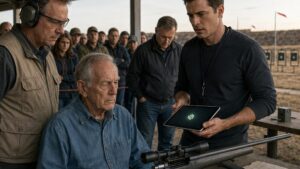
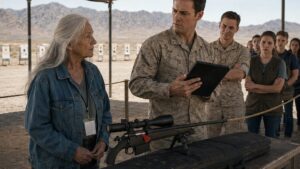
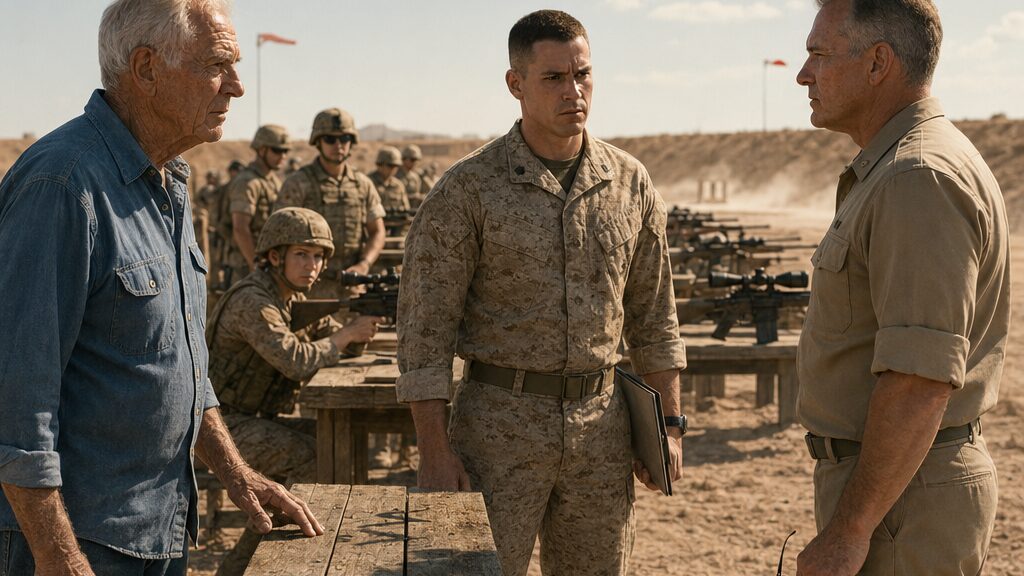
A wooden bench sat under the open shelter, its surface scarred by years of elbows, bipods, sling buckles, and impatient hands. Across it lay a scoped rifle in a padded rest, black barrel angled safely downrange, bolt open, chamber flag showing. Someone had placed it with care, but not familiarity. The stock was too far forward in the rest. The sling lay twisted beneath the bench lip. The scope cap hung open, tapping once in the wind.
Tap.
Then again.
Tap.
Donald looked at it longer than he meant to.
Carolyn followed his gaze. “That’s the rifle they’ll use for the demonstration. Don’t worry, Sergeant Carter will handle everything.”
“I wasn’t worried.”
The words came out before he could soften them.
Carolyn’s smile shifted. “Of course.”
Behind the rope line, a cluster of young soldiers stood in loose formation, desert camouflage faded by sun and wash. Some watched the instructors. Some checked phones until a corporal barked at them. A few glanced toward Donald and then away, their eyes doing the quick arithmetic people did with age: white hair, work shirt, careful steps, invited guest.
He wore a plain blue shirt buttoned at the wrist though the heat had already begun pressing through it. Carolyn had told him there was no need to wear anything formal. The outreach event was meant to be casual. Comfortable. Honoring service through connection.
He had almost not come.
At home, the invitation had sat for three days on his kitchen table under a saltshaker. Carolyn’s note had been handwritten at the bottom: We would be honored to have you with us. He had read that line more times than the printed schedule above it. Honored. People used that word easily when they did not have to live under what it remembered.
A range safety NCO strode out from beside the equipment shed, clipboard tucked against his side. He was young, maybe early thirties, with close-cropped hair and a face set in the firm, efficient expression of a man determined not to let ceremonies ruin a training day. His name tape read CARTER.
Carolyn lifted her hand. “Sergeant Carter, this is Mr. Donald Bennett. He’s one of our veteran guests.”
Ryan Carter stopped in front of Donald and gave him a quick professional nod. Not disrespectful. Not warm.
“Sir.”
“Sergeant.”
Ryan glanced at Donald’s visitor badge, then his shirt, then his shoes. “We’ll have you seated behind the rope once we start live fire. The line gets loud.”
Donald nodded.
Carolyn cleared her throat. “Actually, Sergeant, Mr. Bennett was one of the names I mentioned. He may participate in the demonstration if there’s still room.”
Ryan’s eyes returned to Donald, and this time the arithmetic took a little longer.
“The demonstration?”
“Only if appropriate,” Carolyn said quickly. “No pressure either way.”
Donald watched a gust lift dust from the hardpan beyond the firing line. The range flag at the left corner snapped east. Dust moved south.
Not much. Enough.
Ryan shifted the clipboard to his other hand. “We usually keep guest participation limited. Liability. Timing. Familiarity with the platform.”
“I understand,” Donald said.
The answer seemed to relieve everyone except him.
Carolyn leaned closer. “You don’t have to decide now.”
“I decided before I came.”
Ryan looked up. “Sir?”
Donald pointed with two fingers, not at the rifle, but at the bench. “If you want me to sit there, I’ll sit there. If you don’t, I’ll stand behind the rope. Either way is fine.”
Carolyn’s face colored a little, as if she heard the tiredness beneath the courtesy. Ryan looked toward the line where two soldiers were adjusting steel plates.
“We’ll see where we are after the safety brief,” he said.
It was a clean answer. Official. It meant no.
Donald nodded once.
He moved to the rope line with the other visitors. An older veteran in a ball cap asked what unit he had served with. Donald gave him the short answer. The man gave his own short answer back. They stood together after that in the silence men used when the long answers were too heavy for a sunny morning.
Ryan began the safety brief under the shelter. He had a good command voice. Clear. No nonsense. Donald listened despite himself, noting what was solid and what was rushed. Muzzle awareness. Bolt open until commanded. Finger straight and off the trigger. Know your lane. Obey cease fire immediately. Good rules. Necessary rules.
Rules had weight only if someone was willing to slow down when they mattered.
As Ryan spoke, Donald’s eyes kept drifting past him.
The wind flag on the far side of the range hung limp for three seconds, then snapped hard from the opposite direction. The near flag barely moved. Dust continued to slide low across the berm as if it belonged to a different day.
Donald touched the edge of the rope line with his thumb.
Ryan noticed. “Sir, please stay behind the marker.”
Donald removed his hand.
“I wasn’t crossing it.”
“No problem. Just keeping it clean.”
A few soldiers behind Donald exchanged small looks. Not laughter exactly. Almost. The kind that did not need sound.
Carolyn stepped beside him. “They’re strict about procedure.”
“They should be.”
“That’s good, then.”
Donald did not answer. Downrange, one of the rectangular target frames trembled. Not from impact. No one had fired. It shifted at the bottom, a slight sideways walk, then settled.
Tap.
The scope cap on the bench knocked softly against the rifle.
Donald felt the sound in his teeth.
For a moment he was not at Fort Ward. He was on another range, another hot day, another line moving too fast because officers were visiting and scores had to look clean on paper. He heard himself saying, Wait. He heard someone else saying, We’re fine.
He blinked once.
Carolyn was speaking to him. “Donald?”
He looked at her.
“Are you all right?”
“Yes.”
But his eyes had already gone back to the flag.
It snapped wrong again, hard and quick, while the dust kept sliding sideways across the ground.
Chapter 2: Ryan Carter Checks the Old Guest
Ryan Carter had learned early that a range could fall apart in small ways before anyone noticed the large one.
A private forgot a chamber flag. A visitor stepped past a rope. Someone assumed the word clear meant the same thing to everyone who heard it. A clipboard got signed before a bolt was checked. Nothing happened ninety-nine times. Then the hundredth time wrote the report everyone swore they had seen coming.
That was why Ryan did not like outreach days.
He did not dislike veterans. His grandfather had served. Half the men who had taught Ryan to shoot were old enough to complain about the new Army and right enough often enough that Ryan had learned to listen. But there was a difference between respect and letting a public event blur the line. Cameras came out. Visitors wanted memories. Coordinators wanted meaningful moments. Senior officers wanted clean photos for the base page. And Ryan was the one who had to make sure meaningful did not become unsafe.
He watched Donald Bennett from the firing line while the armorer checked the demonstration rifle.
The old man stood too still.
Most visitors fidgeted around weapons, either leaning away from them or wanting to touch everything. Donald stood behind the rope with his hands loose at his sides and his gaze moving in quiet lines: bench to muzzle, muzzle to berm, berm to flag, flag to target frame. Not confused, exactly. But distracted.
Ryan did not have time for distracted.
“Sergeant Carter,” Carolyn Reed said, appearing at his elbow with her folder. “Can I ask about the participation slot?”
“We’re tight.”
“I understand that. But Mr. Bennett was specifically invited because of his background.”
Ryan checked the schedule. Veterans’ welcome. Static display. Demonstration shot. Safety reset. Junior qualification group. Visiting command walkthrough at fourteen hundred. Lunch somewhere in there if the universe was generous.
“What background?”
“Former instructor. Marksmanship, I believe.”
Ryan kept his face neutral. “Do you have documentation?”
Carolyn hesitated. “I have his service dates and a note from the veterans’ liaison.”
“That’s not current range qualification.”
“No, but he isn’t asking to run the line. Just participate.”
Ryan looked back at Donald. The old man had turned his head toward the far target frames again. His white hair lifted slightly in the hot wind. His blue shirt made him stand out among the uniforms in a way Ryan did not like. It made him look civilian. Fragile. Easy for someone to film from the wrong angle and misunderstand.
Or worse, easy for someone to pity.
Ryan lowered his voice. “Ms. Reed, if he gets behind that rifle and shakes, freezes, or forgets a command, nobody here wins. Not him. Not you. Not the base.”
“He won’t forget commands.”
“You know that?”
She looked down at her folder, then back at him. “No. I believe it.”
Belief was not a safety control.
Ryan closed the clipboard. “One controlled dry run. No live round until I’m satisfied. If I say he’s done, he’s done.”
Carolyn exhaled. “Thank you.”
“I’m not promising a photo moment.”
“I didn’t ask for one.”
Ryan almost smiled at that. Almost.
He walked to the rope line. “Mr. Bennett.”
Donald turned before Ryan finished the name, as if he had been expecting him.
“We’ll run a familiarization check. You’ll follow my commands exactly. If anything feels uncomfortable, you say so. If I stop the exercise, you come off the rifle. Clear?”
“Clear.”
“You’ve used a modern optic?”
“Yes.”
Ryan waited for more. Donald gave him nothing.
“All right. Step through here.”
The rope was unclipped. A few soldiers watched more openly now. Ryan caught one of them whispering and snapped his fingers once. Eyes front. The whisper died.
Donald walked to the bench. He did not shuffle. That surprised Ryan. His steps were slow, but each one landed with care, heel setting down like he had decided exactly where the ground ought to be. At the bench, he paused without touching the rifle.
Ryan expected a question about the weapon. Instead Donald looked downrange.
“Something wrong?” Ryan asked.
“Maybe not.”
“That’s not an answer I can use.”
Donald shifted his eyes to the wind flag. “Who set the far frame after the gusts?”
Ryan followed his gaze. “Target crew checked frames this morning.”
“Before the wind came around?”
Ryan kept his tone even. “Frames are checked on schedule.”
Donald nodded faintly, as if Ryan had confirmed something without meaning to.
That irritated him.
“Sir, I need your attention here. Not downrange.”
“My attention is downrange.”
A couple of soldiers behind the rope went quiet enough for Ryan to feel it.
He stepped closer. “The rifle is safe. Bolt open. Chamber flag inserted. You will not touch it until instructed.”
“I wasn’t going to.”
“Good. When instructed, you’ll sit, shoulder the weapon, establish sight picture, keep your finger straight and off the trigger until told. This is a dry run.”
Donald looked at him then, not offended, not amused. Simply present. “You give good commands.”
Ryan did not know what to do with that, so he ignored it.
“Take your seat.”
Donald lowered himself onto the bench. His left hand touched the scarred wood first, not for support exactly, more like greeting an old work surface. Ryan watched for tremor. There was some. Not much. In the fingers. Age, heat, maybe nerves.
The old man leaned toward the rifle, then stopped.
“What is it now?” Ryan asked.
“The sling is under the front rest.”
Ryan looked. It was. Barely. Not dangerous for a dry run, but sloppy. He reached to move it.
Donald’s hand lifted two inches, then stopped itself.
Ryan saw the motion. “Let me handle the weapon.”
Donald lowered his hand. “I was going to say lift the stock first. If you drag the sling, it will shift the rest.”
Ryan felt heat rise under his collar. He lifted the stock, freed the sling, set everything back. The rifle settled cleaner than before.
“Thank you,” Carolyn said from behind them, trying to smooth a moment that had already sharpened.
Ryan ignored her. “Proceeding. Place your shoulder.”
Donald fit himself behind the rifle. The movement was not quick. It was not graceful either. But it had sequence: elbow, cheek, breath, shoulder, stillness. Muscle memory under rust.
Ryan had seen young soldiers with steadier hands and worse habits.
“Finger straight,” Ryan said.
Donald’s finger was already straight along the stock.
“Do not anticipate commands.”
“I didn’t.”
Again, not sharp. That made it worse somehow.
Ryan moved to Donald’s right side. “Sight picture?”
“Yes.”
“What do you see?”
Donald was quiet too long.
“Sir?”
“Target is not where the flag says it should be.”
Ryan glanced downrange again. Heat shimmered over the lane. The far flag hung loose now. The near flag twitched. The target sat centered in its frame.
“This is a dry run,” Ryan said.
“That doesn’t change the air.”
A private behind the rope coughed into his fist. Someone else shifted boots on gravel.
Ryan straightened. He could feel the day slipping. The coordinator. The visitors. The qualification group waiting under another canopy. The senior training officer somewhere expecting the schedule to hold.
“Mr. Bennett, with respect, I need you to focus on the commands, not give commentary.”
Donald lifted his cheek from the stock and looked downrange with his naked eye.
“The bottom brace on lane four has play.”
Ryan’s jaw tightened. “Lane four is not active for this demonstration.”
“It will be for qualification.”
Patrick Miller’s voice came from behind them. “Problem, Sergeant?”
Ryan turned. The senior training officer had arrived in sunglasses, sleeves rolled, expression already impatient.
“No problem, sir. Guest familiarization.”
Patrick looked at Donald, then at Carolyn, then at the line. “We’re ten minutes behind.”
“Yes, sir.”
Donald remained seated, one hand resting near the rifle but not on it.
Patrick gave him the polite nod reserved for ceremonies. “Mr. Bennett, appreciate you coming out. We’ll get you through this safely.”
Donald nodded back. “That’s what I’m trying to do.”
The words landed oddly. Not loud. Not dramatic. But several people heard them.
Ryan stepped closer to the bench, lowering his voice. “Sir, I’m going to ask once more. Are you able to continue the familiarization?”
Donald turned his eyes from the target frame to Ryan’s face.
“Yes.”
“Then follow the next command.”
Donald placed his cheek back on the stock. The scope cap tapped in the wind.
Tap.
Ryan looked at the target. Then at the flag. Then at the clipboard in his hand.
“Dry run only,” he said. “On my command.”
Donald did not move.
A gust came over the range low and hot. The far flag barely stirred.
Downrange, just for a second, the target frame on lane four shifted sideways and settled back into place.
Donald saw it.
Ryan saw Donald see it.
Chapter 3: The Flag Is Lying
Donald Bennett had spent much of his life learning the difference between stillness and waiting.
Waiting belonged to people who wanted time to pass. Stillness belonged to people who were using it.
He stayed behind the rifle and let the range move around him. Boots on gravel. Paper on clipboard. A cough from the rope line. The soft throat-clearing of Carolyn Reed trying not to interfere. Ryan Carter’s breathing just behind his right shoulder, controlled but shallow now. Downrange, heat lifted from the earth in wavering sheets.
The scope showed him a round black center against pale backing. A simple picture for simple eyes. Target centered. Lane clear. Flag slack. Demonstration ready.
Donald did not trust simple pictures.
“Establish sight picture,” Ryan said.
“Established.”
“Confirm target.”
“Target visible.”
“Finger straight.”
“Straight.”
Ryan paused. Donald could feel the young man looking at his hand, at the line of the finger outside the trigger guard. That was good. Check what matters. Assume nothing. Donald had taught that before Ryan was born, though saying so would help no one.
Patrick Miller stood a few yards back with his arms folded. Donald did not have to look to know. Officers had a way of occupying space that pressed on the neck.
Behind the rope line, the young soldiers were quiet in the wrong way. Not attentive. Curious. Waiting to see if the old man would shake.
Donald breathed in through his nose.
Dust lifted low near the berm and slid left.
The near flag twitched right.
The far flag hung dead.
“That flag is lying,” Donald said.
Ryan’s voice came tight. “Sir, this is not the time.”
Donald lifted his cheek from the stock. The rifle remained pointed downrange, untouched by his trigger finger.
“That flag is lying,” he repeated, softer, “and that frame is walking.”
A silence opened around the bench.
Patrick took one step forward. “What does that mean?”
Ryan answered before Donald could. “Sir, he’s concerned about wind indicators and a target frame on an inactive lane.”
“Is it unsafe?”
“No, sir. Not for this dry run.”
Donald said, “For this dry run, no.”
Ryan looked at him sharply. “Then we continue.”
“No.”
The word was so plain that it seemed to confuse them more than anger them.
Carolyn moved closer to the rope. “Donald?”
He did not look at her. If he looked at kindness now, he might soften. Softness had its place. So did refusal.
Ryan set the clipboard on the bench, carefully, as though controlling the sound might control the moment. “Mr. Bennett, you are not being asked to fire a live round. You are being asked to complete a familiarization sequence. You told me you were able to continue.”
“I am able.”
“Then why are you refusing?”
“Because you are building speed around a bad read.”
Ryan’s face hardened. “You don’t know our procedures.”
“I know speed.”
That one slipped out with more weight than he intended.
He heard it. So did Ryan.
Patrick removed his sunglasses. His eyes were pale and watchful. “Explain your concern, Mr. Bennett.”
Ryan’s shoulders shifted. “Sir, with respect, we are already behind schedule. I can send someone to recheck lane four before qualification. Right now, lane two is active for demonstration, and the weapon is safe.”
Donald turned slightly on the bench, enough to see both men without swinging the rifle. “Send someone now.”
Patrick’s mouth tightened. “We don’t halt a line because a guest doesn’t like a flag.”
There it was.
Guest.
Not instructor. Not soldier. Not even veteran in the way that meant anything. Guest meant chair, certificate, lunch, thank you for your service, please don’t touch the machinery.
Donald felt the old heat rise under his ribs. Not anger. Anger was fast and mostly useless. This was older. A pressure stored in bone.
He put both hands flat on the bench and began to rise.
Ryan stepped in quickly, one hand hovering as if Donald might fall. “Careful.”
Donald stopped halfway up and looked at the hand.
Ryan withdrew it.
“I’m not fragile, Sergeant.”
“I didn’t say you were.”
“You thought it loud enough.”
A small breath moved through the soldiers behind the rope. Someone shifted again. Carolyn’s face tightened.
Ryan flushed, but he did not look away. “My job is to keep this range safe.”
“Then do it.”
For the first time, Ryan had no immediate answer.
Donald stood fully. His knees complained; he ignored them. The scoped rifle remained in the rest, bolt open, chamber flag bright against the metal. He pointed downrange with two fingers.
“Watch the grass line below the berm.”
“There’s no grass,” Ryan said.
“Exactly. Dust is your grass here. Watch it.”
Ryan stared at him.
Donald waited.
The wind moved again, barely touching the flags. The dust did what the dust had been doing all morning. It slid along the ground in a low sheet, leftward and uneven, then broke around the base of lane four’s target frame. The frame shivered once. Not much. A careless eye would miss it. A hurried eye would resent being asked to see it.
“There,” Donald said.
Patrick squinted. “I saw dust.”
“You saw air telling the truth closer to the ground than your flag is.”
Ryan turned toward the far flag. “The flag’s high. Ground swirl happens.”
“Ground swirl doesn’t make a brace walk.”
“The brace was checked.”
“Before the gusts.”
The same exchange from before, but now people were listening. Not believing yet. Listening because refusal had made the old man inconvenient.
Ryan picked up the clipboard, then set it down again. “If the frame has play, it affects target stability. It doesn’t make the firing point unsafe.”
“Depends what it is tied to.”
“It’s a target frame.”
“On a shared brace line?”
Ryan looked toward the armorer.
The armorer, who had been pretending not to listen, shrugged. “Old frames are paired at the base on four and five. Temporary repair from last month.”
Patrick’s head turned. “Temporary?”
“Work order’s in, sir.”
Ryan’s jaw set. “Lane five is closed.”
Donald nodded once. “Today.”
The silence changed shape.
A young soldier behind the rope whispered, “How’d he know that?”
Donald heard. He wished he hadn’t.
Knowing was not magic. It was looking. It was remembering that ranges were made by people, and people patched what they could when budgets or schedules told them to. It was seeing two frames tremble with one gust when only one should. It was noticing that a flag bolted high to a pole could tell a different story than dust crawling where a bullet’s consequence would be judged.
It was also guilt, sharpened into attention over years.
Ryan walked two steps down the line and looked through binoculars toward lane four. “I don’t see movement now.”
“No,” Donald said. “Wind dropped.”
Patrick checked his watch.
That small motion told Donald more than the man’s words had. Time still had priority.
“Sergeant,” Patrick said, “send a soldier to inspect lane four before qualification. Continue the demonstration on lane two.”
Ryan hesitated.
It was brief. Donald almost respected it.
Then Ryan said, “Yes, sir.”
The clipboard came up again. The world tried to resume.
Carolyn’s voice was quiet. “Donald, can we just finish this part?”
He turned toward her then. She looked worried for him, not because of him. That was worse in its own way.
“They won’t hear it if I say it politely twice,” Donald said.
Ryan looked at Donald with contained frustration. “Nobody is ignoring you. We are addressing the concern in order.”
“No,” Donald said. “You are putting it in line behind the schedule.”
Patrick’s voice sharpened. “Mr. Bennett.”
The title sounded like a warning now.
Donald took one slow breath and touched the side of the rifle stock with two fingers. Not gripping it. Not claiming it. Just touching the plain hard surface, the thing everyone thought this moment was about.
“I won’t put my face behind a rifle on a line that’s teaching people to ignore the ground.”
Ryan stared at him.
A few of the young soldiers looked down, almost involuntarily, at the dust around their boots.
There it was. Not proof. Not victory. Only a crack in the room’s certainty.
Patrick put his sunglasses back on. “Five-minute pause,” he said. “Check lane four visually from this side. We are not walking the range cold unless we have to.”
Ryan nodded. “Cease activity. Maintain cold status.”
The command traveled down the line, repeated by two soldiers. The range settled into an irritated stillness. Not stopped, exactly. Delayed. Donald knew the difference.
Ryan stepped closer, lowering his voice so only Donald could hear. “You understand what this looks like.”
Donald met his eyes.
“Yes.”
“Then help me understand why you’re willing to make it look that way.”
For a moment, Donald saw something behind the young man’s irritation. Not respect. Not yet. A question.
That was enough.
Donald looked past him toward the far frame, sitting still now as if innocent.
“Because once is enough,” he said.
Ryan waited for more, but Donald gave him nothing.
Downrange, the wind flag hung limp, useless and clean against the white sky.
Chapter 4: The Story Behind the Unfired Shot
The five-minute pause became twelve.
That was how range delays worked. A command gave the time a number so it could feel controlled, and then the range took what it needed.
Donald sat beneath the shade tent with the scoped rifle still visible on the bench beyond him. No one had asked him to sit there. Carolyn had guided him toward the folding chairs with a hand that never quite touched his elbow, and he had gone because his knees had begun to stiffen after standing too long in the heat.
A paper cup of water rested on the table in front of him. He had not touched it.
Across the firing line, Ryan Carter had assigned two soldiers to inspect the target frames from the firing side with binoculars. No one had gone downrange. The range remained cold but not cleared. Patrick Miller had made that distinction clear enough for everyone to hear.
Donald watched the far frame.
Still now.
The desert had a habit of pretending innocence once people started looking.
Carolyn stood beside the table, folder pressed against her stomach. “I’m sorry,” she said.
Donald looked at her. “For what?”
“For how this turned.” She glanced toward the bench. “I wanted today to be respectful.”
“It still can be.”
“I don’t think Sergeant Carter meant to embarrass you.”
“He didn’t.”
The answer seemed to make her sadder.
A gust moved through the tent and lifted the corner of her schedule. She pinned it with two fingers. “Donald, I need to ask you something, and I don’t want it to sound like I don’t trust you.”
“That’s a hard sentence to follow.”
She almost smiled. Then it faded. “Are you sure about what you saw?”
He looked back toward the range. “No.”
Carolyn went still.
“That’s why I said to check.”
“But the way you said it—”
“The way I said it is why they paused.”
He heard the roughness in his own voice and did not like it. Carolyn had not earned it. She was trying to do the thing civilians often tried to do around old soldiers: honor the past without stepping on the parts that still hurt.
Donald picked up the cup at last. The water was warm.
Carolyn sat across from him. The folding chair creaked under the carefulness of her movement. “When I invited you, I looked through the liaison notes. They said you trained instructors. They said your range reports were still used as examples years later.”
“Reports survive longer than people.”
She folded her hands. “Is that why you came? Because of the reports?”
Donald turned the cup slowly on the table. A ring of moisture marked the cheap plastic surface beneath it.
“I came because you wrote by hand.”
Carolyn blinked.
“You wrote that you would be honored. People print honor on banners. They don’t usually write it.”
Her eyes softened. “I meant it.”
“I know.”
For a moment, the sounds of the range settled around them: distant voices, nylon rope tapping a stake, the metallic click of someone checking equipment that had already been checked. Donald kept his hand around the water cup, feeling its thin rim bend under his fingers.
Carolyn said, “Then let me ask it plainly. Is this about today, or is it about something that happened before?”
Donald did not answer right away.
Beyond the tent, Ryan stood with the binoculars now, looking downrange himself. His posture was still rigid, but not dismissive in the same way. That bothered Donald too. It was easier to be angry when no one was trying.
“Both,” Donald said.
Carolyn waited.
He looked down at his hands. The tremor was there, fine and constant in the left. It had gotten worse after Mary died, though the doctor said grief had nothing to do with nerves. Doctors liked tidy causes. Age. Wear. Family history. They were not wrong. They were simply incomplete.
“There was a training day,” Donald said. “Long time ago.”
Carolyn did not move.
“Hot. Visitors coming. Scores being watched. Same as all days that turn bad. We had a new group through. One recruit kept saying his lane felt off. Not in those words. Young men don’t like sounding afraid. He said the target looked like it was swimming. Said his shots didn’t match his hold.”
He stopped.
The cup bent a little more in his hand. He loosened his grip.
“I noticed wind shift near ground level. Not enough to shut down. Not by the book. I told the line officer we should slow the relay and check the frames. He said we were behind.”
Carolyn’s face changed, but she said nothing.
Donald could still see it without closing his eyes: the recruit’s cheek pressed too hard to the stock, the impatience traveling down the line like current through wire, the red flag jerking once against a blue-white sky.
“I let him outrank my eyes,” Donald said.
The sentence was quiet, almost lost under the flap of canvas.
“What happened?” Carolyn asked.
“Not what people imagine. No dramatic thing. No explosion. No headline. Just a bad sequence. Loose brace. Wrong correction. Adjacent lane called clear when it wasn’t fully set. A fragment of target hardware kicked back wrong when the frame shifted under fire.”
He saw Carolyn’s hand rise toward her mouth, then stop.
“The recruit lived,” Donald said. “Kept both eyes. Lost part of the hearing in one ear. Scar under the jaw. He told me later it wasn’t my fault.”
“Was it?”
Donald looked at her then.
The question had cost her something. He respected her for asking it.
“Not alone,” he said. “That’s the trouble with fault. People like it clean. Ranges don’t fail clean. They fail in layers.”
“And you think this is the same?”
“No.”
That surprised her.
Donald looked back toward lane four. “That day made me afraid of being dramatic. Today I’m afraid of being quiet.”
Carolyn lowered her eyes to the table. The folder lay between them, full of schedules and printed biographies and ceremonial language. Donald wondered what his page said. Former instructor. Army veteran. Widower maybe, if someone had bothered. Years compressed into lines that made a life safe to introduce.
“You should tell Sergeant Carter,” she said.
“He doesn’t need my confession. He needs a frame checked.”
“He might listen differently if he understood.”
Donald shook his head. “Then he’d be listening to the wound, not the warning.”
Carolyn absorbed that.
Outside the tent, Patrick Miller called Ryan’s name. The two men conferred near the bench. Ryan pointed downrange. Patrick shook his head once. Not hard. Enough.
Carolyn followed Donald’s gaze. “They’re not going to walk it cold.”
“No.”
“What will you do?”
Donald drank the warm water. It tasted of plastic and dust.
“I don’t know yet.”
That was the honest answer, and he disliked it.
A group of junior soldiers began moving from the holding canopy toward the qualification area, rifles slung, helmets low against the sun. Among them was a young woman who walked with her shoulders too square, as if posture could hide nerves. Rachel Harris, Donald remembered from the roster Carolyn had mentioned in passing.
Donald watched her glance toward lane four.
Not long. Just enough.
She had seen something too, or felt it in the way young shooters sometimes did before they had the words. A wrongness without vocabulary.
Ryan turned from Patrick and looked toward Donald under the shade tent.
For one brief second, the young sergeant did not look annoyed.
He looked uncertain.
Then Patrick clapped the clipboard against his palm and the range began moving again.
Chapter 5: The Young Soldier on the Wrong Lane
Rachel Harris hated being watched more than she hated missing.
Missing could be corrected. Watched meant guessed at. Watched meant someone might decide she was scared before she had decided it herself.
She followed the line toward the qualification benches with the others, keeping her rifle tight against her shoulder and her chin level. The sun pressed down on the top of her helmet. Sweat ran behind one ear and disappeared into her collar. She did not wipe it. The soldier ahead of her had not wiped his. So she would not.
“Lane four,” the range assistant called.
Rachel stepped toward it before her mind caught up with the number.
The bench at lane four looked no different from the others. Same scarred wood. Same sandbags. Same empty brass catcher clipped to one side. Downrange, the target frame stood against the pale berm with its clean paper center waiting to judge her. To the left, the old man in the blue shirt sat under the shade tent.
She had noticed him earlier because everyone had.
An old civilian at the range drew attention by existing. Then he had refused to shoot, and attention had become something sharper. Rachel had watched from behind the rope as Sergeant Carter stood over him, clipboard in hand, and the old man said something about the flag lying. A few soldiers had smirked. Rachel had not.
She had been looking at the dust.
“Lane four, Harris,” the assistant repeated.
“Moving,” Rachel said.
Her voice sounded steady enough.
She set her gear down and waited for commands. Sergeant Carter walked the line with hard efficiency, checking positions, chamber flags, muzzle direction. He stopped at her bench longer than usual.
“You good, Harris?”
“Yes, Sergeant.”
“Hydrated?”
“Yes, Sergeant.”
“Don’t chase the last relay’s drama. Focus on your lane.”
“Yes, Sergeant.”
He moved on.
Rachel stared downrange.
The far wind flag was limp. The near one flicked once, then settled. But the dust close to the berm slid left, low and thin. She could see it because the old man had told them, in his way, where to look. Not her directly. Not anyone kindly. But once someone said dust was grass, you could not unsee the field it made.
She put her hand on the bench.
A faint tremor moved through the wood.
Maybe from footsteps. Maybe from her own pulse.
She lifted her hand and set it down again.
There.
Not constant. Not strong. A little knock traveling through the surface when the wind moved across the range.
“Shooter prep,” the command came.
Rachel sat, arranged herself behind the rifle, and tried to build the sequence she had practiced. Feet. Hips. Shoulder. Cheek. Breath. Sight picture. The scope brought the target close until it seemed too simple to miss.
Her first practice breath fogged nothing. The air was too dry.
In the scope, the target edge fluttered.
She blinked and looked again.
Still.
She swallowed.
Do not invent problems, she told herself. Do not become the soldier who needs attention.
Behind the line, she heard Sergeant Carter speaking to the senior training officer. Their voices were low, but the edges carried.
“Inspection from this side showed no visible displacement.”
“Then proceed.”
“I’d still prefer to walk it before live fire.”
“After this relay.”
“Sir—”
“After this relay, Sergeant.”
Rachel kept her eye near the optic, not fully settled. The old man had made Sergeant Carter uncertain. That alone unsettled her more than the frame. Carter did not seem like a man who liked uncertainty.
“Load one magazine of five rounds,” came the command.
Metal clicked down the line.
Rachel inserted her magazine. Her fingers were dry. Too dry. She checked that it seated, then kept her finger straight, exactly as she had been taught.
A shadow fell near her bench.
She did not turn her head, but she knew it was not Sergeant Carter. The shadow was slightly bent at the shoulders.
“You don’t have to answer me,” Donald Bennett said quietly.
Rachel froze.
“Look at the bottom left corner of your target frame when the dust moves.”
Her throat tightened. “Sir, you can’t be on the line.”
“I know.”
“Then—”
“Just look.”
She should have called Sergeant Carter. She should have kept her attention entirely in her lane. But Donald’s voice had none of the thrill of rule-breaking. It sounded like a man pointing out a step in the dark.
Rachel looked.
For three seconds, nothing happened.
Then dust moved low across the berm, and the bottom left of the target frame shifted. Not much. The paper did not swing. The whole frame made a tiny correction, as if something at its base had eased and caught.
Rachel’s stomach sank.
“I thought I saw it before,” she whispered.
“I know.”
“How?”
“You stopped breathing at the wrong time.”
She did not know what to say to that.
Sergeant Carter’s voice cracked across the line. “Mr. Bennett. Step back behind the rope.”
Donald did not move quickly. That would have made it worse. He took one step back, away from Rachel’s rifle, hands open and visible.
“I’m behind her muzzle,” he said.
“You are past the control line.”
“Yes.”
“Step back now.”
Donald obeyed. But his eyes stayed downrange.
Rachel felt everyone looking. Heat rose up her neck. She hated that more than missing. More than anything.
Sergeant Carter came to her lane. “Harris, weapon safe.”
“Weapon safe,” she repeated, opening the bolt.
His tone softened a fraction. “Did he distract you?”
Rachel wanted to say yes. It would make the attention go away. It would return the problem to the old man where everyone had already put it.
Instead she looked through the scope one more time at the frame.
“No, Sergeant.”
Ryan’s eyes narrowed. “No?”
“He showed me where to look.”
Patrick Miller’s voice came from behind Ryan. “This is enough. We are not letting a guest coach shooters during qualification.”
Rachel kept her cheek away from the stock. Her heart beat hard in her ears.
Ryan said, “What did you see?”
She looked at him then. He had asked the question plainly. Not kindly, but not as a trap.
“The frame moved, Sergeant.”
Patrick exhaled. “The frame may flex. That does not mean—”
“The bottom left,” Rachel said, surprising herself by interrupting. “When the dust moves. It shifts and catches.”
The line had gone quiet again.
Donald stood behind the rope now, one hand resting lightly on the post. He did not look pleased. He looked tired.
Ryan turned toward the berm, binoculars rising. “Wind’s down.”
“It won’t show now,” Donald said.
Patrick’s jaw tightened. “Mr. Bennett, you have had your say.”
Donald’s hand closed once around the rope post and released.
Rachel watched his fingers. They trembled when still, but not when pointing. Not when showing. Not when it mattered.
“Sergeant,” she said.
Ryan lowered the binoculars.
“I’m not comfortable firing lane four until it’s checked.”
The sentence seemed to step out of her and stand there alone.
Patrick looked at Ryan. Ryan looked at Rachel. Then he looked at Donald.
No one spoke for a beat too long.
The range command came from farther down the line, unaware of the small break forming in lane four.
“Shooters, prepare to fire.”
Rachel’s finger stayed straight outside the trigger guard.
Behind the rope, Donald Bennett stepped forward again.
Chapter 6: Donald Bennett Stops the Line
Donald heard the command before he saw Ryan move.
Shooters, prepare to fire.
It traveled down the line in practiced cadence, ordinary and dangerous because it was ordinary. Soldiers settled behind rifles. Shoulders tucked. Cheeks lowered. Breath changed. The range gathered itself into that narrow space before sound.
Donald saw Rachel on lane four, finger still straight, bolt open because Ryan had ordered it safe. He saw lane three settling in. Lane five remained closed, but the shared brace line did not care what the sign said. He saw the dust begin to crawl again at the berm, thin as breath under a door.
Ryan’s mouth opened.
Maybe he meant to halt it. Maybe he meant to ask Patrick one more time. Maybe he was still choosing.
Donald did not wait to find out.
He stepped past the rope and planted his palm flat on the nearest wooden bench.
“Cease fire.”
His voice was not loud enough to be dramatic. It was loud enough to be command.
Ryan spun toward him.
Donald raised his voice once, from the diaphragm, the way he had taught men to speak over wind and fear without screaming.
“Cease fire. Cease fire. Keep bolts open.”
For half a second, the line stumbled between two authorities: the official cadence still moving forward and the old voice that sounded as if it had owned ranges before anyone there had held a rifle.
Then Ryan snapped into motion.
“Cease fire! Cease fire! All shooters, safe weapons, bolts open, fingers straight!”
The line froze into procedure. Metal clicked. Shoulders lifted. Faces turned.
Patrick strode toward Donald, anger cutting through his control. “Mr. Bennett, you do not give commands on my range.”
Donald kept his palm on the bench. Beneath it, the wood held the day’s heat.
“No,” he said. “I stopped them on it.”
Ryan moved between them, not quite blocking Patrick, not quite defending Donald. “Sir, lane four reported movement. I need to verify.”
“You needed to verify five minutes ago,” Patrick said. “Now you have a civilian crossing the line during qualification.”
Donald removed his hand from the bench and stepped back half a pace. “Then clear it properly and walk down.”
Patrick stared at him. “You think you’re in charge here?”
“No.”
“Then stop acting like it.”
Donald looked past him to Rachel. She sat still behind her rifle, face pale under the helmet, eyes fixed on the target she had not fired at. The sight of her steadied him and hurt him in equal measure. It was always the young faces that made old fear useful.
Ryan took a breath. “Sir, requesting permission to make the range cold and inspect lane four downrange.”
Patrick turned on him. “Based on what?”
“Shooter discomfort, repeated guest observation, visible possible frame movement.”
“That’s thin.”
“It’s enough for a check.”
For the first time, Donald looked at Ryan fully. The young man’s face was tense, but the tension had changed direction. It was no longer aimed only at Donald. It was aimed at the moment.
Patrick seemed to feel the eyes on him then. The soldiers. Carolyn under the tent. The armorer. The visitors. Rachel on lane four, still safe, still waiting.
“Make it cold,” Patrick said at last. “But this delay is documented.”
Ryan did not argue. “Range cold. Weapons safe. No one moves until cleared.”
The command rolled down the line. One by one, rifles were checked. Chambers opened. Flags inserted. The armorer confirmed. Ryan confirmed. Only then did he look at Donald.
“Stay here.”
Donald almost smiled. “Gladly.”
Ryan and the armorer walked downrange with Patrick a few steps behind them. Their boots darkened the dust where they crossed the open ground. Everyone watched. Without gunfire, the range felt larger and less certain.
Rachel stood from lane four only after being told. She kept her hands away from the rifle and looked toward Donald.
“Did I do something wrong?” she asked.
“No.”
“My finger stayed straight.”
“I saw.”
Her mouth pressed tight, holding back something that might have been fear or shame. “I didn’t want to sound scared.”
“Scared hears things pride misses.”
She looked down at the bench. “You really saw it from back there?”
“I saw enough to ask.”
“That’s not the same.”
“No,” Donald said. “It isn’t.”
The honesty made her glance up.
Downrange, Ryan crouched at the base of lane four’s target frame. The armorer grabbed one side. Nothing moved. Patrick spread his hands, a gesture too far away to hear but easy to understand.
Then the wind came.
It did not announce itself at the flags. The near flag flickered after the dust had already started sliding. The far flag stayed lazy, high and clean. At ground level, the gust moved along the berm and pressed against the lower brace.
The target frame shifted.
This time everyone watching for it saw.
The armorer jerked his hand away and then grabbed the frame again. Ryan dropped to one knee, pushed at the bottom left corner, and the frame rocked against something hidden by dust and patched wood. Lane five’s closed frame twitched with it.
Even from the firing line, Donald saw Ryan’s shoulders go still.
Patrick bent down. The three men worked around the base. The armorer kicked dust aside with his boot, then reached for the temporary brace half-buried between lanes. A strip of hardware hung where it should have held firm.
Carolyn came to stand near Donald, but said nothing.
After a few minutes, Ryan walked back alone. He carried a bent metal bracket in one hand. Dust clung to his knees. His jaw was tight, and sweat had cut clean lines down his temples.
He stopped in front of Patrick first, because that was the order of things, even when order had failed.
“Brace connection between four and five is loose,” Ryan said, voice carrying. “Temporary repair shifted under gust load. Lane four frame can move under wind pressure. Lane five responds with it.”
Patrick stared at the bracket.
Ryan continued, “Recommendation is to suspend live fire on lanes four and five until maintenance repairs and all target frames in the row are rechecked.”
Patrick’s face had gone hard in a different way now. Not anger. Calculation. Consequence.
“Do it,” he said.
Ryan nodded, then turned toward Rachel. “Harris, you were right not to fire.”
Rachel swallowed. “Yes, Sergeant.”
Then Ryan faced Donald.
For a moment, the whole range seemed to lean toward them. Donald hated that. He did not want a scene made from another man’s mistake. He did not want Patrick shamed or Ryan humbled in front of people who would turn the story into something simple by supper.
Ryan held up the bent bracket. “You saw this from the bench?”
“I saw the frame move.”
“You knew it was tied to lane five?”
“I guessed it might be.”
“From dust and a flag.”
“From dust, a flag, and an old repair that moved like two things pretending to be one.”
Ryan looked down at the bracket, then back at him. “Why didn’t you say it that way?”
“I did.”
Ryan opened his mouth, then closed it.
Donald saw the exact moment the young man understood the difference between hearing words and granting them weight.
Patrick cleared his throat. “Mr. Bennett, I owe you—”
Donald cut him off gently. “You owe the line a repair.”
That ended the apology before it could become performance.
Patrick nodded once, stiff but real, and turned away to issue orders. The range began shifting again, not toward firing now, but toward correction. Lanes were marked closed. Soldiers moved with tools. The armorer wrote on a tag and tied it to the broken frame.
Ryan remained by the bench.
“I should have walked it earlier,” he said.
“Yes.”
The answer landed clean. No comfort. No cruelty.
Ryan accepted it. “You crossed the rope.”
“Yes.”
“You know I have to document that.”
“Yes.”
A faint, tired amusement touched Donald’s mouth. “Spell my name right.”
Ryan looked at him, and despite everything, a short breath almost like a laugh escaped him.
Then it was gone.
Rachel approached with her helmet under one arm. “Mr. Bennett?”
Donald turned.
She looked younger without the helmet. Still trying to stand like no part of her had shaken.
“How did you know I saw it too?”
“You stopped breathing before the command.”
“That’s bad?”
“It’s human.”
She considered that, then looked toward the closed lane. “Nobody would’ve blamed me if I fired.”
Donald’s eyes went to the target frame, now tagged and harmless only because it had been stopped.
“No,” he said. “That’s why it matters that you didn’t.”
The words stayed with her. He could see them settle.
Behind them, the scoped rifle from the demonstration still lay on the wooden bench, unfired, chamber flag bright in the sun. Donald rested his hand near it, not on it this time.
For the first time all day, Ryan did not tell him to move.
Chapter 7: Some Things You Learn by Listening
Ryan Carter wrote the first line of the incident note three times before he stopped pretending the wording was the problem.
Training delay due to guest interference.
He crossed out guest.
Training delay due to safety concern raised by veteran guest.
He crossed out raised.
Training delay due to safety concern identified by Mr. Donald Bennett.
That one stayed.
The clipboard rested on the same wooden bench where the scoped rifle had lain all morning. The rifle was in its case now, bolt open, chamber flag removed only after the armorer cleared it for storage. Lanes four and five were taped off with red markers. Two maintenance workers crouched downrange around the loosened brace, their tools flashing in the late sun.
The qualification group had been moved to alternate lanes. It had taken time, complaints, a new safety brief, and Patrick Miller speaking into a radio with the clipped patience of a man explaining why a perfect schedule had become a corrected one.
No one called it perfect anymore.
Ryan stood at the bench with his sleeves dusty and his pride in worse shape. He had been wrong in a way that left room for excuses, which made it harder. He could have blamed incomplete work orders. He could have blamed the temporary repair. He could have blamed the inspection crew. All of that would have been partly true.
But not the part that kept catching in his throat.
Donald Bennett had told him where to look.
Ryan had looked at the man instead.
Across the range, Donald sat in a folding chair beneath the shade tent while Carolyn Reed spoke with him quietly. He looked smaller away from the firing line. Older. His shoulders had settled after the long heat of the day, and one hand rested on his knee with the faint tremor Ryan had noticed earlier. Without the rifle bench, without the dust proving him right, he looked like any elderly visitor waiting for someone to tell him where the shuttle would load.
That bothered Ryan more than the mistake.
It would be easy now for everyone to respect Donald while the broken bracket was still fresh in memory. Harder tomorrow. Harder next month. People liked lessons when they arrived attached to a clear incident. They struggled when the lesson was simply a quiet man saying, slow down.
Patrick came up beside Ryan, sunglasses hanging from one hand. For a while, he looked downrange without speaking.
“Your note finished?” Patrick asked.
“Almost, sir.”
Patrick picked up the bent bracket from the bench. The armorer had set it there after tagging the frame. It was ordinary in the most irritating way: a strip of metal, two worn holes, one edge bent outward where pressure had worked it loose little by little.
“No dramatic failure,” Patrick said.
“No, sir.”
“Those are the ones that get people.”
Ryan said nothing.
Patrick set the bracket down. “You did right stopping the line.”
Ryan looked at him.
Patrick’s jaw shifted. “Late. But right.”
“Yes, sir.”
The senior training officer watched Donald under the tent. “He cut me off when I tried to apologize.”
“He told you to repair the line.”
“He did.”
There was almost a smile in Patrick’s voice, but not quite. More like respect with a bruise on it.
Ryan looked at his report. “Should I include that he crossed the rope?”
“Yes.”
Ryan’s pen tightened in his hand.
“And include why,” Patrick added.
Ryan nodded.
Patrick put his sunglasses back on. “When this is cleaned up, ask him if he’ll give us ten minutes. Not a speech. Just what he saw.”
Ryan glanced toward Donald again. “I’m not sure he’ll want to.”
“Then ask right.”
Patrick walked away before Ryan could ask what that meant.
The late afternoon light softened the range without making it gentle. Heat still rose off the dirt, but the worst of the glare had moved west. The wind flag on the far pole had been lowered and replaced, though Ryan now understood that replacing a flag did not replace judgment. It only gave judgment one more tool.
He carried the clipboard to the shade tent.
Carolyn saw him coming and touched Donald lightly on the shoulder. Donald looked up. His eyes held no triumph. That made the walk harder.
“Mr. Bennett,” Ryan said.
Donald waited.
Ryan removed his cap. He had not planned to. It simply felt like the right thing to do once he was standing there.
“I owe you a cleaner answer than I gave you earlier.”
Donald’s expression did not change. “About what?”
“About all of it.”
Carolyn excused herself without making a scene, stepping away toward the check-in table. Ryan appreciated that.
He stood in front of Donald’s chair, cap in hand, suddenly aware of how young he must look to the old man. He had spent the morning feeling responsible for everyone on the range. Now responsibility felt less like command and more like the willingness to be corrected without turning correction into humiliation.
“I treated your warning like hesitation,” Ryan said. “I treated your questions like confusion. They weren’t.”
“No.”
The answer was plain and without cushion.
Ryan accepted it.
“I also put schedule ahead of a check that would’ve taken less time than the delay we caused.”
Donald looked past him toward lanes four and five. “That happens.”
“It shouldn’t.”
“No.”
Ryan almost looked down. He made himself hold still.
“Can I ask you something?” he said.
“You can.”
“What else did you see?”
For the first time since Ryan had met him, Donald seemed caught off guard.
Not by suspicion. By the absence of it.
His hand moved slightly on his knee. The tremor was there. Then he placed his palm flat against his thigh until it stilled.
“The near flag was reading surface chop,” Donald said. “Far flag was too high to show what the dust was doing at berm level. The target face looked steady through the optic, but the frame corrected after each gust. That means movement at the base, not paper flutter.”
Ryan listened.
Donald glanced toward the bench. “And the rifle rest was sitting over the sling. That didn’t matter today. But it told me people were setting things down to be ready, not setting them up to be used.”
That one went in deeper than Ryan expected.
He thought of the morning. The twisted sling. The way Donald had tried to lift a hand and stopped when Ryan warned him off. He had mistaken restraint for inability more than once.
Ryan said, “You used to train instructors.”
Donald’s gaze sharpened faintly.
“Carolyn didn’t tell me much,” Ryan added. “Only enough that I should’ve asked more before assuming less.”
Donald looked toward Carolyn, who was pretending to arrange folders at the check-in table. “She means well.”
“She does.”
“Meaning well can still put a man on display.”
Ryan did not answer quickly. “Is that what today felt like?”
“At first.”
“And now?”
Donald looked at the range. The closed lanes. The repaired order of things. Rachel Harris standing near the alternate line, helmet tucked under her arm, speaking quietly with another soldier.
“Now it feels like a day that got interrupted before it became something worse.”
Ryan nodded.
He wanted to ask about the sentence Donald had said earlier. Once is enough. He wanted to know the story behind it, but he understood now that wanting a story did not entitle him to one.
So he asked something else.
“Would you be willing to show the junior soldiers what you showed Harris? Wind, frame movement, reading low dust. Ten minutes. No ceremony.”
Donald’s mouth moved as if he might refuse.
Ryan added, “Only if you want to. And only if you’d rather teach than be introduced.”
That reached him.
Donald looked at the bench again, then at Ryan’s cap in his hand. “Put your hat on, Sergeant. Sun’s still out.”
Ryan obeyed.
Donald pushed himself up from the chair. Carolyn started to step toward him, then stopped when Donald glanced at her. He rose slowly, with one hand on the chair and the other on his knee. Ryan did not reach for him.
When Donald was standing, Ryan said, “Can I carry the rifle case?”
Donald looked toward the cased rifle on the bench. For a moment, Ryan thought he had asked wrong. Pride was delicate when offered help came dressed like pity.
Then Donald said, “You can carry one end.”
They walked together to the bench.
It was a small thing, two men carrying a rifle case across gravel. No one clapped. No one saluted. A few soldiers watched, but they had the sense not to make noise. The case was not heavy, but Donald let Ryan take more of the weight over the uneven ground. Ryan noticed. Donald noticed him noticing.
Neither mentioned it.
Rachel Harris waited near the alternate firing point. When Donald and Ryan approached, she straightened.
“Mr. Bennett,” she said. “Sergeant.”
Ryan set the case on a table. “Mr. Bennett is going to give us a few minutes on reading range conditions.”
Rachel looked relieved, then nervous. “Yes, Sergeant.”
Donald stood beside the bench and faced the small group that had gathered: Rachel, three other junior soldiers, the armorer, Carolyn at the edge, and Patrick a little farther back pretending to supervise the maintenance crew.
Donald did not begin right away. He looked downrange until the young soldiers looked too.
“Most people want the target to tell them the truth,” he said.
The group stayed quiet.
“The target tells you what happened after you made all your mistakes. Wind tells you before. Dust tells you lower. Grass tells you if you have it. Flags help, unless you ask them to answer for air they aren’t touching. Wood talks too, if something is moving through it.”
Rachel looked at the bench under her hand.
Donald saw it and nodded once. “You felt it.”
“I thought maybe it was me.”
“Sometimes it is. That’s why you check twice.”
Ryan watched the soldiers’ faces. They were listening differently now. Not because Donald had become taller, louder, or less old. Because the range had given his quiet words consequence.
Donald pointed toward the closed lanes. “Don’t turn this into a ghost story about one bad bracket. That’s not the lesson. The lesson is, when something feels off, you owe the line a question. Maybe you’re wrong. Good. Be wrong early.”
Rachel held the words carefully.
One of the soldiers asked, “What if they think you’re just nervous?”
Donald looked at him. “Then be nervous and correct.”
A small smile moved through the group, not mocking, not careless. The kind that made fear easier to carry.
Ryan felt something in his chest loosen.
When the ten minutes ended, it did not feel complete. That was a good sign. Real teaching rarely did. It left people with better questions.
The soldiers dispersed toward the alternate line. Patrick gave Donald a brief nod from across the gravel. Not public. Not polished. Enough.
Carolyn came up with the shuttle schedule in hand. “Donald, the bus can take you back whenever you’re ready.”
Donald looked at the range one last time. The wind flag moved cleanly now, but he did not trust it more than it deserved.
Rachel returned before he could answer Carolyn. She had her helmet under one arm and a notebook in her hand.
“Mr. Bennett?”
“Yes?”
“If I come early next qualification day, would you show me how to read the wind before I fire? Not for the test. Just to learn it right.”
Ryan looked at Donald.
Carolyn looked down at her folder, hiding a smile.
Donald took a long breath. The day had worn him down. It showed now in the set of his shoulders, the fine tremor in his hand, the dust on his shoes. He was not made young by being useful. He was not healed by being believed. Nothing worked that simply.
But something in him, something that had stayed braced for years against the sound of a command given too fast, eased by a fraction.
He looked at Rachel. “Bring water.”
She nodded quickly. “Yes, sir.”
“And don’t call me sir unless Sergeant Carter makes you.”
Ryan said, “I won’t.”
Rachel smiled then, small and real.
Donald reached for the rifle case, and Ryan took the other end without asking. This time Donald let him.
Together they carried it toward the shuttle as the late sun stretched their shadows long across the gravel. Behind them, the range returned to work—not perfect, not humbled into silence, but listening a little better than it had that morning.
At the bus door, Donald paused and looked back.
The wooden bench sat empty under the shelter. The wind flag moved above the berm. Dust slid low across the ground, telling its quiet truth to anyone willing to look down.
Donald climbed into the shuttle without help.
The story has ended.