The Old Crew Chief Touched One Forgotten Gearbox And Heard What The Hangar Refused To Hear
Chapter 1: The Old Man At The Hangar Door
Samuel Bennett stopped at the hangar door because the guard did not recognize him.
That was not the guard’s fault. The guard was young enough to have been born after Samuel’s retirement, with a clean shave, a stiff cap, and a tablet balanced in one hand. He looked at Samuel’s visitor badge, then at Samuel’s gray work jacket, then at the scuffed toolbox in his left hand.
“Purpose of visit?”
Samuel looked past him.
The hangar was already awake. Fluorescent lights washed the concrete floor. A training jet sat with its nose angled toward the open bay, its panels half-fastened, its ladder still in place. The air carried hydraulic fluid, old rubber, coffee, and the metallic echo that never left a maintenance bay no matter how many years passed. Men and women moved around the aircraft with carts and tablets and clipped voices. Someone laughed near the compressor station. Someone else told them to keep it down.
Samuel had not been inside this hangar in eight months. His knees remembered the concrete before his mind admitted missing it.
“I was asked to come in,” he said.
The guard glanced again at the tablet. “Name?”
“Samuel Bennett.”
The guard typed with one thumb. “Retired?”
“For a while now.”
That made the guard look up. It was the sort of look Samuel had learned not to answer. Not rude exactly. Just a quick calculation. Old man, retired, slow at the door, maybe somebody’s grandfather invited to stand by a plane and tell stories.
The guard found the entry and stepped aside. “You’ll need to stay with an escort, sir.”
“Yes.”
“Safety investigation’s active. Don’t touch anything unless cleared.”
Samuel nodded. The toolbox hung from his hand. It contained nothing dangerous. Two worn screwdrivers, a flashlight, a strip of cotton cloth, a stub of grease pencil, a small mirror on a telescoping rod. Things a modern mechanic might call sentimental if he were being kind.
The guard pointed him toward a marked yellow path on the floor. Samuel followed it, slow but straight-backed, the way he had trained himself to walk after his left hip started telling weather before the local news did.
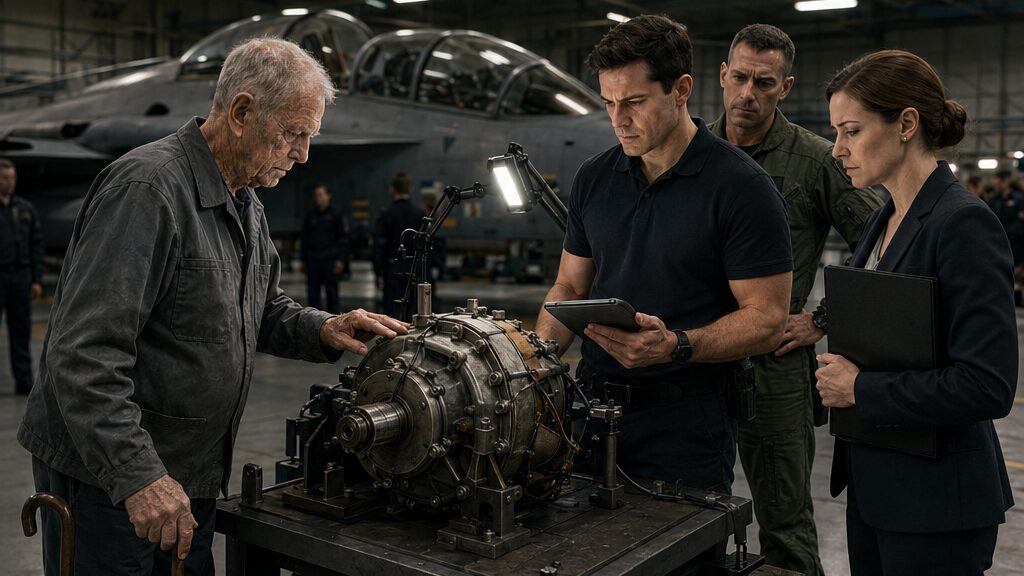
Near the center of the hangar, a metal worktable had been cleared. Two men stood beside it. One wore a green flight suit with a commander’s bearing and tired eyes. The other was younger, broad-shouldered, in a maintenance supervisor’s dark polo with sleeves tight around his arms. Between them sat a heavy aircraft component wrapped in old oil stains and fresh warning tags.
Samuel stopped before anyone spoke to him.
He knew the housing shape.
Not by part number. The part number would be stamped somewhere under grime and official handling stickers. He knew it the way a man knew a voice through a closed door. Squared casing. Offset collar. Old bearing seat that never liked winter starts. A gearbox assembly from a training bird no one was supposed to care about anymore.
The younger supervisor saw him first.
“Mr. Bennett?” he said. “Joseph Miller. Maintenance lead.”
Samuel shifted the toolbox to his right hand and accepted the handshake. Joseph’s grip was strong and quick, the handshake of a man who had three other things to do.
“Samuel,” he said.
“Commander Carter asked if you’d take a look at something. Mostly historical context.” Joseph turned toward the flight-suited officer. “Sir.”
The commander offered his hand more carefully. “Anthony Carter.”
Samuel shook it. “Commander.”
“Thank you for coming in.” Anthony glanced toward the jet behind him. “We had a taxi incident yesterday. No injuries. Pilot reported a shudder on roll-out. Diagnostics gave us more questions than answers.”
Joseph added, “The aircraft’s current gearbox scanned clean. This one came out of storage because it’s the same model family. We’re documenting legacy patterns before disposal.”
Samuel looked at the component, then at the warning tag tied around one bolt flange.
“Disposal?”
Joseph’s smile tightened, not enough to be disrespectful, but enough to show the word had been argued already. “It’s been cannibalized twice and marked beyond economical repair since before I got here. Contractor takes it this afternoon. We just need photographs.”
Samuel set his toolbox down beside the table but did not open it. He could feel Anthony watching him, measuring whether he was worth the interruption. That was fair. Commanders had to measure everyone.
The gearbox sat dead and dull in the overhead light. A seam of dried brown grease ran along one edge. One access plug had been replaced with a red plastic cap. There were handling marks where a forklift had kissed the housing hard enough to scar paint but not metal. A new mechanic might see scrap. A very new one might see weight.
Samuel saw hands.
Hands bracing the casing during a midnight change. Hands wiping the flange clean with rags that left lint. Hands rotating the shaft by quarter inches while someone listened in the hush between engine runs.
Joseph picked up a tablet. “We pulled the scan reports if you want to see them.”
Samuel did not look away from the gearbox. “Turn the shaft.”
Joseph paused. “Excuse me?”
“The input shaft. Turn it.”
Joseph looked at Anthony. “It’s not mounted.”
“Doesn’t need to be.”
“It’s dry.”
“Then turn it slowly.”
Joseph set the tablet down with controlled patience. He put on gloves, reached for the exposed shaft, and gave it a short turn. Metal shifted inside the housing with a faint dry scrape. Samuel listened.
The sound disappeared beneath a cart rattling past the next bay.
Joseph stepped back. “That’s what old bearings sound like when they’ve been sitting.”
Samuel raised one hand, not to silence him but to ask the hangar to settle. Nobody noticed. The compressor kicked on. Someone called for a torque wrench. A phone rang in the office.
Samuel looked at the gearbox until the sounds separated. Compressor. Wheels. Voices. The lingering ring of the turned shaft dying inside the housing.
There.
Not loud. Not even a proper knock. A short tick after the longer scrape, tucked at the end like a man clearing his throat in the back of a church.
Samuel’s fingers curled once against his palm.
Anthony noticed. “You heard something.”
Joseph exhaled. “Sir, this assembly has been moved three times this morning.”
Samuel reached into his jacket pocket and felt the folded card he had brought without knowing why. The paper had softened at the creases. He kept it the way some men kept photographs. Not because paper could save anyone by itself, but because some lessons deserved to stay close to the body.
“What happened yesterday?” Samuel asked.
Anthony answered before Joseph could. “Pilot reported a shudder after a training sortie. On taxi back. Brief vibration through the left side, then normal. No cockpit warnings.”
“After load came off?”
Anthony’s eyes narrowed. “After landing, yes.”
“Temperature?”
Joseph glanced at the tablet. “Within range.”
“Wind?”
“Crosswind, but not outside limits.”
Samuel nodded once, though the answer had not comforted him.
Joseph shifted his stance. “Mr. Bennett, with respect, we’ve run the current aircraft through vibration analysis and borescope. We’re not ignoring anything.”
“No,” Samuel said. “You’re looking where the checklist tells you to look.”
The words came out flatter than he intended. Joseph’s face changed.
Anthony stepped in before the younger man answered. “That’s why we asked you here. If there’s legacy context, we’d like to hear it.”
Legacy context. Samuel looked at the gearbox again. The phrase had a museum smell.
A suited woman entered from the office corridor carrying a slim folder against her ribs. Her hair was pinned back; her shoes clicked once, then softened on the hangar’s worn path. She took in Samuel, Joseph, Anthony, and the tagged component with a single sweep.
“Katherine Reed,” Anthony said. “Civilian safety investigator.”
Katherine offered Samuel her hand. “Mr. Bennett.”
“Samuel.”
“I’m told you worked this airframe family.”
“I worked around it long enough for it to work on me.”
Her mouth moved almost into a smile, then returned to business. “We’re establishing whether the incident aircraft has any connection to known legacy defects. The disposal contractor is waiting, but if you see something documentable, I can hold the item.”
Documentable. That was the better word. Samuel respected it more than context.
He looked at the gearbox. A strip of light ran over the bolt collar at the edge of the housing. There, near the underside, under dried grease, was a crescent shape too regular to be from a forklift and too shallow to interest a scan unless the person running the scan already knew to ask.
Samuel leaned closer. His hip objected. He ignored it.
“Don’t move it yet,” he said.
Joseph folded his arms. “It has to be photographed, tagged, and out before sixteen hundred.”
“Then photograph it where it sits.”
Katherine followed his gaze. “What are you looking at?”
Samuel did not answer at once. He could feel all three of them waiting. The old desire rose in him—the urge to explain everything quickly enough that no one would think him slow. He had seen other retired men do that. Fill the room with stories before the room closed against them.
Instead, he set one finger on the table beside the gearbox, not touching the part.
“Grease pencil,” he said.
Joseph blinked. “What?”
“In my toolbox.”
Joseph did not move. A young mechanic passing nearby stopped, saw the commander, and stepped back.
Samuel opened the toolbox himself. The latch resisted, then gave with a tired snap. He took out the stub of grease pencil and held it between thumb and forefinger. His hands had thickened over the years. They were not as steady as he wished. He waited until they were steady enough.
Without marking the component, he drew a small crescent on the metal table beside it.
“That,” Samuel said, “is not from storage.”
Anthony leaned forward. Katherine came closer. Joseph stayed where he was.
The hangar noise thinned around them, or maybe Samuel only stopped hearing it.
Joseph looked at the mark on the table. “You can tell that from a smear under old grease?”
Samuel put the pencil down.
“No,” he said. “I can tell it from the tick.”
Behind him, the disposal contractor’s cart beeped as it backed toward the bay.
Chapter 2: The Tick No One Wanted To Hear
The disposal contractor wore orange hearing protection around his neck and the bored expression of a man paid by weight, not by history. He stopped his cart near the yellow line and checked the tag number on his sheet.
“This the assembly going out?”
Joseph turned too quickly. “Not yet.”
Samuel heard irritation in the answer, and under it, embarrassment. Joseph did not like being corrected in front of a contractor. Samuel could not blame him for that. A maintenance bay ran on confidence. Doubt spread fast.
Katherine stepped between the cart and the table. “Give us a few minutes.”
The contractor shrugged and leaned against the cart handle.
Joseph lowered his voice. “Sir, ma’am, we can’t hold every obsolete component because somebody hears something. We scanned the active aircraft. We scanned this one for reference. Both clean.”
Samuel looked at Anthony instead of Joseph. “May I rotate it?”
Anthony hesitated only long enough to show he understood the weight of permission. “Go ahead. Carefully.”
Joseph’s jaw worked once. “At least let me secure it.”
He fitted chocks against the housing and nodded toward the young mechanic, who brought over a block and strap. They worked quickly, competent hands, no wasted movement. Samuel watched without correcting. Joseph knew his shop. That was not the problem.
When the gearbox was braced, Samuel stepped to the side where the shaft faced the hangar doors. He flexed his fingers. The knuckles ached. They often did before rain, and rain was coming; he had felt it walking from the parking lot. He set two fingers of his left hand lightly on the housing near the collar.
Joseph noticed. “You’re not going to feel much through that casing.”
“I’m not trying to feel much.”
The younger man looked away.
Katherine opened her folder and clicked a pen. Anthony stood across from Samuel with his arms loose at his sides. He had the kind of stillness pilots learned from waiting for clearance.
Samuel put his right hand on the shaft and turned.
A dry scrape answered. Nothing more.
Joseph lifted one palm as if the part itself had testified.
Samuel turned it back. Not all the way. Just a few degrees. He waited, listening not to the sound but to the silence after it. The hangar seemed determined to interfere. A radio cracked. A tool clanged against concrete. Somewhere behind the jet, compressed air hissed.
Samuel closed his eyes.
The old hangar came back wrong at first, layered under this one. Same lights, older fixtures. Same concrete, fewer painted lines. A crew chief laughing too loud at two in the morning because everyone was tired enough to make bad jokes. A pilot standing with his helmet under one arm, pretending not to worry. Samuel younger, faster, too sure that if he wrote something down clearly enough, someone would read it.
He opened his eyes.
“Again,” Katherine said, softer now.
Samuel turned the shaft. Long scrape. Pause. Short tick.
This time Anthony heard it. His eyes moved from Samuel’s hand to the housing.
Joseph shook his head. “That could be lash. Old gears settle.”
Samuel rotated the shaft backward, then forward again. “Long. Short.”
The tick came again, late and small.
The contractor had stopped leaning on the cart.
Joseph reached for the shaft. “Let me.”
Samuel stepped aside. Joseph turned it faster. The scrape blurred. The tick vanished.
“See?” Joseph said.
Samuel waited until the shaft stopped. “Too fast.”
Joseph’s face flushed, not brightly, just enough to show above his collar. “Mr. Bennett, with respect, we use calibrated equipment now. We don’t diagnose by ear in a bay full of noise.”
“No,” Samuel said. “You diagnose by asking the right question first.”
Katherine looked up from her notes.
The sentence had landed harder than he meant. Samuel felt it in the room: the small tightening, the expectation that the old man might start lecturing. He had earned some of that expectation over the years. Old mechanics could be proud, and pride was only useful until it started making decisions for you.
So he picked up the cotton cloth from his toolbox and folded it once.
“May I?” he asked Joseph.
Joseph looked surprised. After a beat, he nodded.
Samuel wiped the grease from the lower collar, slow enough not to disturb the old mark. A crescent emerged, shallow and bright at one edge, darker at the other. He did not touch it with bare fingers. He pointed with the folded cloth.
“This mark happens when the load shifts after release. Not during steady rotation. Not during storage. Something inside moves a little late.”
Joseph leaned in despite himself. “A delayed load mark?”
“Near enough.”
“That is not a standard term.”
Samuel almost smiled. “No.”
Katherine crouched enough to see under the light. “Why would it appear on this assembly if the active aircraft is the one that had the incident?”
Samuel looked at the gearbox. “Same family. Same habit. Different day.”
“That’s not evidence,” Joseph said.
“No,” Samuel said. “It’s a warning.”
Joseph’s patience finally thinned. “A warning based on a sound no one can hear unless they already believe it’s there.”
Samuel turned to him fully. Joseph was maybe thirty-five, maybe younger. Strong shoulders, sharp eyes, clean boots. A man trusted by his crew. A man who had probably spent the last twenty-four hours wondering whether his shop had missed something that could end a career or worse.
Samuel softened his voice. “I don’t need you to believe me. I need you not to throw it away before you prove me wrong.”
That quieted Joseph more than anger would have.
Anthony stepped closer to the table. “What would proving you wrong require?”
Samuel took the folded card from his jacket pocket. He did not open it at first. The paper looked smaller in his hand than he remembered. Its edges had gone soft. A faint gray smudge marked one corner where grease had lived longer than some careers.
“Old check,” he said. “Manual. After warm load if you can get it. Simulated if you can’t. Slow rotation, pressure at the collar, listen after the scrape. Then inspect under light for crescent transfer.”
Joseph looked at the card. “That’s not in the current procedure.”
“I know.”
“Why not?”
Samuel did not answer quickly enough.
Katherine noticed. “Mr. Bennett?”
The old memory moved behind his ribs, not sharp anymore, but heavy. A runway wet with early morning mist. A young pilot’s voice too calm over the radio. A crew standing still while emergency vehicles rolled. Samuel’s own report typed with two fingers because his hand had been bandaged.
He folded the card again. “Because procedures get rewritten by people who think rare means gone.”
Anthony’s face changed at that. Not belief yet. Concern.
Joseph pointed toward the component. “Even if this mark means something, this gearbox isn’t installed. The active aircraft cleared diagnostics. We can’t ground a line because of a retired part and an old note.”
The words were reasonable. That was what made them dangerous.
Katherine stood. “I can hold disposal pending documentation.”
Joseph turned to her. “On what basis?”
“Possible legacy failure correlation.”
“That’ll read like we’re chasing ghosts.”
Samuel looked down at his grease pencil mark on the table. A crescent drawn beside a real one. Old hand, old habit, old warning. He felt suddenly foolish. Tired. Too visible.
The young mechanic near the strap spoke before anyone else did. “I heard it.”
Joseph turned. “What?”
The mechanic swallowed. “The second time. When he did it slow. There was a little tick.”
Joseph looked at him for a long moment. The mechanic dropped his eyes.
Samuel wished the young man had stayed quiet. Not because he was wrong, but because now Joseph would feel surrounded.
Anthony placed one hand on the table. “Joseph, nobody is assigning blame.”
“No, sir,” Joseph said, but his voice had gone flat. “Not yet.”
Katherine wrote something in her folder. “Mr. Bennett, I need more than this card. Dates. Incident references. Prior reports.”
Samuel nodded. “Records room may have them.”
“May?”
“If they didn’t clear the cabinets.”
Joseph gave a short laugh with no humor. “We’re basing a safety hold on whether somebody kept a file cabinet?”
Samuel opened the folded card. Katherine leaned in. Anthony did too. The card had three lines written in faded pencil and a small diagram of a collar mark. No title. No official number. Only initials in the corner: S.B.
Katherine looked from the card to Samuel. “You wrote this?”
“Yes.”
“When?”
Samuel folded it closed before she could ask the next question.
“After we almost learned it too late.”
For the first time since Samuel had entered the hangar, no one spoke over the machines. The contractor looked down at his sheet and stopped pretending not to listen. The young mechanic’s hand rested on the strap. Joseph stared at the card, anger and uncertainty fighting behind his eyes.
Anthony’s voice came low. “Show us the mark again.”
Samuel placed two fingers on the housing. He turned the shaft slowly, not for drama, not to win, only to let the part speak as plainly as it could.
Long scrape.
A breath.
Short tick.
Katherine’s pen stopped moving.
Anthony looked at Joseph. Joseph looked at the gearbox.
Samuel took his hand away and stepped back. His hip hurt. His fingers tingled from the vibration. He wanted coffee. He wanted the room to stop looking at him as if he had just become useful.
Katherine pointed to the crescent scrape.
“How,” she asked, “did you know it would be there?”
Samuel looked at the old mark beneath the light.
“That mark,” he said, “does not happen on the ground.”
Chapter 3: The Report That Made Him Sound Old
Katherine Reed preferred records rooms to hangars.
Hangars made people perform. Records did not. Records could be incomplete, misfiled, misread, or quietly altered by policy, but they did not square their shoulders when challenged. They did not mistake volume for truth. They sat in boxes and cabinets and servers, waiting for someone patient enough to find what had been made inconvenient.
This records room sat behind the hangar offices, past a coffee station and a wall of framed squadron photographs. Most of the active files had been digitized. What remained in cabinets were legacy binders, maintenance histories, retired technical orders, and the kind of paper nobody wanted to destroy because nobody wanted to be the person who destroyed it.
Samuel stood just inside the doorway as if uncertain whether he had permission to enter the past.
Katherine noticed but did not comment. She set her folder on a narrow table and opened her laptop. Anthony had been called back to the flight office. Joseph had stayed in the hangar with the gearbox, officially to supervise the hold, unofficially because he did not trust the situation to stop growing.
The records clerk rolled out a cart with three gray archive boxes.
“This is what we have under the airframe family and gearbox legacy references,” the clerk said. “Some of the older incident reports were scanned during the conversion, but the indexing is not great.”
Katherine nodded. “We’ll start with paper.”
The clerk glanced at Samuel. “You worked these?”
“For a while,” Samuel said.
The clerk smiled politely, the way people smiled when they thought an old answer was modest instead of tired.
Katherine pulled the first box closer. Inside were binders with cracked plastic covers and labels faded from white to tea-colored. She slid one toward Samuel. “If you see anything familiar, say so.”
Samuel did not open it immediately. “Familiar can mislead.”
That made her look at him.
He tapped the binder with two fingers. “You start thinking you remember, then you make the page fit what you want.”
“A fair warning.”
“I learned it from being wrong.”
Katherine opened her own binder. “Then we will let the paper argue with both of us.”
For several minutes, there was only the whisper of pages and the distant pulse of hangar noise through the wall. Katherine moved quickly. Dates, part families, failure categories, corrective actions. She built a map in her head: reports that mattered, reports that only looked like they mattered, gaps where something should have been.
Samuel read slowly. Not because he could not read faster, she thought, but because he seemed to be listening to the page as much as seeing it. His finger tracked margins. Once he paused over a photograph of a younger maintenance crew standing beside a stripped aircraft.
“Someone you knew?” Katherine asked.
“Most of them.”
“Are you in it?”
He slid the binder slightly away. “Behind the camera, probably.”
She let that be.
Her first digital search found nothing for delayed tick. Nothing for crescent transfer. Nothing for load-release collar mark. She tried broader terms and got too much: vibration, gearbox, taxi shudder, post-flight noise, bearing wear. Hundreds of entries, most unrelated.
Samuel set a binder aside. “Your system won’t call it what I called it.”
“What would the report call it?”
He closed his eyes briefly. “Intermittent rotational anomaly under residual load. Maybe transient collar contact. Depends who wanted it to sound expensive.”
Katherine typed both. The system thought. Then returned three results.
One was a training memo from decades earlier. One was a parts procurement note. The third was restricted to archived maintenance corrective actions.
Katherine clicked.
A scanned page loaded sideways, grainy and gray. She rotated it. The type was faint, stamped with an old unit designation. Halfway down the page, under “recommended local inspection supplement,” someone had written a note in block capitals: MANUAL CHECK ADVISED AFTER LOAD RELEASE EVENT.
Katherine felt the small satisfaction of a door opening.
Then she saw the initials.
S.B.
She looked across the table.
Samuel was still reading paper, unaware. His shoulders had settled lower. In the hangar, standing at the table, he had seemed diminished by the attention. Here, among records, he looked older in a different way. Not weak. Burdened by the number of things a room could remember badly.
“Samuel,” she said.
He looked up.
She turned the laptop slightly. “Is this yours?”
He did not come around the table. He only looked from where he stood, and she saw recognition move through him before he controlled it.
“Yes.”
“Local inspection supplement. It references an incident report.” Katherine scanned the page. “But the incident number is partially obscured.”
Samuel’s mouth tightened. “Carbon copy probably slipped.”
“Do you remember the number?”
“No.”
She waited.
He looked at her then, and she understood he had heard the question underneath. Not do you remember the number, but how much of this are you willing to reopen?
“I remember the morning,” he said.
Katherine did not reach for her pen. Some answers changed if people saw you preparing to take them.
“It rained,” Samuel said. “Not hard. Just enough to make everything shine. Pilot came back from a routine hop and said the bird felt like it had a limp. We checked the obvious things. Found nothing. I signed the release after a second inspection.”
His eyes moved to the laptop but did not focus on it.
“Next taxi, it shuddered again. Worse. We pulled the assembly hot and found the mark. Same shape. Same late tick.” He paused. “No one got hurt.”
But that was not the whole truth. Katherine could hear the missing part in the way he said it.
“No one got hurt,” she repeated.
Samuel’s hand rested on the binder. “A young pilot trusted our release. That is hurt enough.”
Katherine let the silence stand.
The door opened behind them. Joseph stepped in holding a tablet, his face controlled.
“Contractor’s asking for written hold authority.”
Katherine turned the laptop toward him. “I have basis for temporary hold.”
Joseph came closer, read the screen, and frowned. “This is a local supplement from decades ago.”
“Yes.”
“Not current technical guidance.”
“No.”
He looked at Samuel. “And you wrote it.”
Samuel nodded.
Joseph’s laugh was quiet, almost unwilling. “You understand how this looks.”
Katherine closed the binder in front of her. “It looks like an archived maintenance note that matches the physical mark.”
“It looks like we’re using Mr. Bennett’s old memo to prove Mr. Bennett’s old memory.”
Samuel did not answer.
Joseph’s frustration sharpened because Samuel would not meet it. “I’m not trying to insult you. But if I walk into a safety review and say a retired crew chief heard a tick, they’ll ask for data. They’ll ask why current diagnostics didn’t flag it. They’ll ask why the procedure was removed.”
“Those are good questions,” Samuel said.
Joseph seemed thrown by the agreement.
Katherine leaned back. “Then we answer them.”
“With what? A scan of a bad copy and a pencil card?”
The folded card sat near Samuel’s hand. He had placed it on the table without ceremony. Now Joseph looked at it as if it were both too little and too much.
Samuel picked it up. “This card isn’t proof.”
“Then why bring it?”
Samuel ran his thumb along the crease. “Because I don’t trust myself to remember only the parts that make me feel better.”
That stopped Joseph.
Katherine saw it land. Not enough to change his mind, but enough to make him hear the man instead of the obstruction.
Joseph looked back at the laptop. “The active aircraft scan is clean.”
“I know,” Samuel said.
“The removed gearbox is old and dry.”
“I know that too.”
“And you still think yesterday’s shudder matters.”
“Yes.”
“Because of a tick.”
Samuel opened the card and laid it flat. The small diagram looked almost childish beside Katherine’s official forms.
“Because of when the tick comes,” he said.
The records clerk knocked lightly on the open door. “Ma’am? There may be another box. Off-site inventory says some incident files were transferred before digitization. Not sure if they’re still here.”
Katherine stood. “Where?”
“Cage storage. Back wall.”
“How long?”
The clerk looked apologetic. “Could take a while. The labels aren’t consistent.”
Joseph checked his watch. “The hold expires at sixteen hundred unless Commander Carter signs an extension.”
Katherine looked toward the hangar wall, as if she could see through it to Anthony, the jet, the gearbox, and the contractor waiting with his cart.
Samuel folded the card again.
Joseph’s voice lowered. “Mr. Bennett, if this turns into nothing, it won’t just be paperwork. My crew will wear it. The commander will wear it. I’ll wear it.”
Samuel slipped the card back into his pocket. “Better than a pilot wearing it.”
Joseph looked away first.
Katherine closed her laptop. “We find the incident file.”
The clerk led the way out. Joseph followed, still unconvinced but no longer laughing. Samuel remained a second longer in the records room, his hand on the back of the chair.
Katherine paused at the door. “Samuel?”
He looked at the shelf of old binders.
“The report made me sound old even then,” he said.
“What do you mean?”
He gave a small, tired smile without humor. “Too cautious. Too particular. Hearing things.”
From the hangar came the muffled beep of the contractor’s cart again, waiting to haul the past away.
Chapter 4: Sarah Finds The Grease On His Sleeve
Sarah Bennett saw the grease before she saw her father’s face.
It was a dark smear along the cuff of his gray jacket, worked into the fabric near the wrist where he always pushed the sleeve back before touching anything mechanical. He stood just inside the kitchen door with his toolbox hanging from one hand and rainwater spotting his shoulders. He had driven home before the rain broke, but the clouds had followed him in.
“You said you were only going to answer questions,” she said.
Samuel closed the door gently behind him. “I did.”
Sarah pointed at his sleeve. “With grease?”
He looked down as if the stain had arrived without consulting him. “It was on the housing.”
“You touched it.”
“Beside it.”
“That is not better.”
He set the toolbox near the back wall, exactly where he had set it for years after coming home from the hangar. The old place on the linoleum was still faintly darker, a rectangle of habit that no amount of cleaning had erased. Sarah hated that she noticed. She hated more that he did.
“Coffee?” he asked.
“No.”
He filled the kettle anyway. Not because he was ignoring her. Because motion bought him time.
Sarah stood at the edge of the kitchen table. On it lay the mail she had brought in for him that morning, a pill organizer, a grocery list in her handwriting, and now, from his jacket pocket, the folded inspection card. He had taken it out with his keys and placed it there as if it were as ordinary as a receipt.
She touched one corner. “This again?”
Samuel turned from the stove. “Don’t bend it.”
“I’m not bending it.” Her voice came out sharper than she meant. She pulled her hand away. “Dad, you promised you weren’t going back there to work.”
“I didn’t work.”
“You came home with grease on your sleeve and that card on the table.”
He watched the kettle as if the water required supervision. “They had a question about an old component.”
“They always have a question. Somebody calls, and you go. Somebody says, ‘Mr. Bennett, you worked those birds,’ and suddenly you’re twenty years younger until you get home and can barely get up the porch steps.”
Samuel said nothing.
The silence bothered her more than any denial would have. Sarah had grown up with hangar silence. It came home in the evenings with her father, along with the smell of hydraulic fluid and metal dust, and it meant some problem had not been solved yet. It meant he was still listening to something no one else could hear.
She lowered her voice. “Your hip was bad this morning.”
“It’s weather.”
“It’s not just weather.”
“Mostly weather.”
She almost laughed because she nearly cried. “You always say that.”
The kettle began to tremble on the burner. Samuel shut it off before it whistled. He poured water over coffee grounds in the old ceramic dripper he refused to replace. Sarah watched his hands. They moved carefully, slower than they had when she was young, but not uncertain. That was what frightened her. He could still make slow look like control until the pain caught him later.
“What happened?” she asked.
He carried the cup to the table and sat down. He did not drink.
“A training aircraft had a shudder yesterday.”
“Was anyone hurt?”
“No.”
“Then why did they need you?”
He looked at the folded card. “They didn’t know they did.”
Sarah closed her eyes for a second. “Dad.”
“I heard something.”
“In the aircraft?”
“In a gearbox from the same family.”
“And they listened?”
He turned the cup once by the handle. “Not exactly.”
The answer made her sit across from him. Outside, rain began tapping the kitchen window, soft at first, then steadier. The sound carried her backward to nights when she was little and her mother would look at that same window while Samuel sat at this table writing reports long after dinner had gone cold.
Sarah unfolded the card despite his warning, careful along the creases. The pencil lines were faint. A small crescent, three short notes, initials in a corner. S.B. She had seen it before, though she could not remember the first time. It was one of those objects that had lived in drawers, jacket pockets, glove compartments, always appearing when something in him grew restless.
“You kept this all these years,” she said.
“Yes.”
“Why?”
He took the card back and folded it with a tenderness that made her angry.
“Because I wrote it after I almost missed something.”
“You didn’t miss it.”
His eyes lifted.
Sarah had not meant to say it so quickly. The old story had never been fully told, but enough pieces had slipped out over the years: rain, a young pilot, a release he regretted, a second inspection that came too late to spare him shame but soon enough to spare a life. In her childhood, that story had been a locked room. In adulthood, she had learned not to knock.
Samuel rubbed his thumb along the paper’s edge. “I signed the release.”
“And then you fixed the procedure.”
“After.”
“After matters.”
He looked toward the window. Rain striped the glass and blurred the small backyard. “After only matters if people read it.”
Sarah wanted to say that was not his burden anymore. She wanted to say he had given the Air Force his back, his hearing, his sleep, and half the evenings of her childhood. She wanted to say no aircraft part was worth the way his face looked when memory got behind his eyes.
Instead she asked, “Is it dangerous?”
He took too long.
“It might be nothing,” he said.
“That is not what I asked.”
His cup steamed between them. “It might be the same kind of warning.”
Sarah leaned back. The kitchen felt smaller. The rain made the room smell of damp pavement and old wood.
“And if they decide you’re wrong?”
“Then they decide I’m wrong.”
“You say that like it doesn’t cost you anything.”
He smiled faintly. “I’m old. People expect old men to be wrong.”
“That’s not funny.”
“No.”
The phone rang before either of them could speak again.
Samuel looked at it on the counter. Sarah did too. The caller ID showed the base exchange line. He did not reach for it at first.
“Don’t,” she said, then regretted the word as soon as it left her.
His hand paused on the table.
Sarah softened. “Please. Just let them handle it.”
The phone rang again.
Samuel looked at the inspection card, then at the grease on his cuff. “That’s what I did the first time.”
He stood. The movement cost him; she saw the small brace of his hand against the chair. He answered before the last ring.
“Bennett.”
Sarah watched his face change by degrees. Not surprise. Not fear. A settling.
“Yes,” he said. “I understand.”
He listened longer.
“No,” he said finally. “A clean scan doesn’t answer that question.”
Another pause.
“I’ll come in.”
Sarah pushed back from the table. “Dad.”
He covered the phone with one hand.
“The preliminary scan found nothing,” he said.
“Then it’s over.”
He looked at her with tired gentleness.
“They’re sending the gearbox out again.”
Chapter 5: The Clean Scan And The Dirty Silence
Anthony Carter had learned, early in command, that a room did not need to be loud to be divided.
The inspection bay was nearly quiet when he arrived the next morning. The old gearbox sat on the metal table beneath a portable light. Its warning tag had been replaced with a temporary hold tag, yellow instead of red, the sort of tag that asked questions without yet accusing anyone. Joseph stood beside a diagnostic cart with a tablet in one hand. Katherine Reed stood opposite him with her folder closed against her chest. Samuel Bennett was not at the table. He sat on a low bench near the tool cabinets, hands folded over the head of his cane.
Anthony noticed the cane first.
Samuel had not carried it yesterday.
That mattered, though Anthony was not yet sure how.
Joseph looked up. “Sir, the expanded scan came back clean.”
He handed over the tablet. Anthony read the summary. No fracture indication. No abnormal wear beyond storage condition. No measurable deformation in the accessible gear path. Recommended disposition unchanged.
A clean report should have felt like relief. Instead, it gave the room a brittle edge.
Katherine said, “The scan doesn’t recreate load release.”
Joseph’s jaw tightened. “It checks the actual metal.”
“It checks what it is configured to check.”
“And the metal is clean.”
Anthony scrolled through the data. Charts, tolerances, measurements. The language was precise and comforting. He had spent his career trusting systems because systems kept people alive when memory and instinct got tired. Yet he had also flown long enough to know that the machine rarely failed in the exact way the form predicted.
He looked at Samuel. “You saw the report?”
Samuel nodded.
“And?”
“It answers what it asked.”
Joseph made a small sound. “There it is again.”
Anthony held up one hand, not sharply. “Joseph.”
“No, sir. I understand caution. I do. But we’re building a case on absence. The current aircraft is clean. The reference gearbox is clean. The old procedure isn’t current. The disposal hold is already raising questions.”
“From whom?”
“Logistics. Safety office. Contractor. My own crew.” Joseph lowered his voice. “They think we missed something. Or they think I’m letting an old story steer the investigation.”
Anthony heard the word old and glanced at Samuel. Samuel’s expression did not change. That was worse than if it had.
Katherine opened her folder. “I found the supplement. Not the full incident file yet, but enough to establish that the check existed.”
“Local supplement,” Joseph said.
“Yes.”
“Retired.”
“Archived.”
“Same practical difference.”
Samuel stood slowly. The cane made one soft sound against the concrete. “No.”
Joseph turned. “No?”
“Retired means done. Archived means someone thought it might matter later.”
The sentence hung there without force, which made it harder to push aside.
Anthony studied Samuel. Yesterday the old man had seemed rooted to the gearbox, hands and ears still trained to the metal. Today he looked smaller away from it. The bench, the cane, the careful rise from sitting—these were the things younger crews saw first. Anthony had seen them too, and disliked himself for it.
Joseph took the tablet back. “Mr. Bennett, I’m not trying to erase your experience. But if the active aircraft had a mechanical issue, the current tools would catch it.”
Samuel walked to the table. “Tools don’t catch what no one tells them to chase.”
“That’s a good line. It’s not data.”
“No,” Samuel said. “It’s a reason to get better data.”
Katherine’s eyes moved between them. “What would better data require?”
“Warm it,” Samuel said. “Load the collar. Rotate slow. Pressure here.” He indicated the housing near the crescent mark but did not touch it. “Then listen after the scrape.”
Joseph looked incredulous. “We’re not heating and loading a scrapped assembly in the bay because of a sound.”
“It doesn’t have to be full heat.”
“Still not approved.”
Anthony asked, “Can it be done safely?”
Joseph hesitated, and that hesitation answered part of the question. “Technically, yes. Practically, it’s a waste unless we have authority.”
Katherine said, “A temporary engineering evaluation could authorize it.”
“And ground the active aircraft longer.”
Anthony glanced toward the jet visible through the open bay. Its panels were closed now, its painted skin glossy under the lights. It looked ready. That was the trouble with aircraft. They could look ready while keeping secrets.
The pilot involved in the near-miss had filed a calm report. Slight shudder after landing roll. No warning lights. No repeat on initial ground check. Anthony knew calm reports. Pilots wrote them when they wanted to sound professional, not frightened.
He looked at the tablet again. Clean scan.
Then at Samuel’s cane.
“Mr. Bennett,” he said, “you understand what happens if I extend this hold and nothing turns up.”
Samuel nodded. “Yes.”
“My squadron takes the delay. Joseph’s shop takes scrutiny. The aircraft stays down. People who weren’t in this room will ask why.”
“Yes.”
“And you still believe we should hold it.”
Samuel rested one hand on the table. “No, Commander. I believe you should ask the question the scan did not ask. If the answer clears it, then clear it.”
Joseph’s voice sharpened. “And if the answer is still nothing?”
Samuel looked at him. “Then I was wrong.”
The simplicity of it should have ended the matter. Instead, it exposed something rawer.
Joseph set the tablet down. “Do you know what that costs now? Being wrong? Every delay becomes a report. Every report becomes a review. Every review looks for the person who should have known. It’s not like it was when you could write a note on a card and stick it in a binder.”
Samuel’s face went still.
Anthony almost intervened, but Katherine’s slight movement stopped him. Let it speak, her posture seemed to say. Let the real argument show itself.
Samuel leaned a little on the cane. “You think I don’t know what being wrong costs?”
Joseph opened his mouth, then closed it.
“I know,” Samuel said. “That’s why I keep asking you to prove me wrong properly.”
No one moved.
The clean scan glowed on the tablet. The gearbox sat under the light. The crescent mark, now cleaned and photographed, looked less dramatic than it had the day before. Just a shallow curve on an old housing. Easy to dismiss. Easy to explain away. Anthony had signed off on bigger decisions with less doubt and more confidence.
Katherine’s phone buzzed. She checked it, then looked up.
“Records clerk found an off-site transfer list. There may be a box in cage storage tied to the old incident number.”
Joseph exhaled. “May be.”
“Yes.”
“And while we chase may be, the disposal hold expires.”
Anthony checked the time. If he signed an extension, his name would sit on the delay. That was fine. Command meant signing things. The harder part was deciding whether he was protecting safety or protecting himself from the fear of ignoring an old man who might be right.
He walked to the gearbox. “Mr. Bennett.”
Samuel looked up.
“When you heard it yesterday, did it sound exactly like before?”
For the first time all morning, uncertainty crossed Samuel’s face. Not doubt about the sound. Something more honest.
“Not exactly,” he said.
Joseph’s shoulders shifted, almost in relief.
Samuel continued, “This one is colder. Drier. Older. The active aircraft may not sound the same.”
Anthony felt the room lean toward disappointment.
“But the timing,” Samuel said, “the timing is close.”
Anthony nodded slowly.
Joseph rubbed a hand over his face. “Sir, please.”
Anthony looked at him. He saw a capable supervisor cornered between data and fear, not arrogance. Then he looked at Samuel and saw a man old enough to know that fear did not excuse haste.
“Katherine,” Anthony said, “find the box.”
Joseph went still.
Anthony picked up the tablet and handed it back to him. “Prepare a request for temporary engineering evaluation. Not full teardown. Limited reproduction of the old check if the records support it.”
Joseph’s face closed. “Yes, sir.”
“And Joseph?”
“Sir?”
“No one in this bay is being blamed for asking one more question.”
Joseph nodded, but the nod did not reach his eyes.
Katherine left for cage storage with the records clerk. Anthony turned toward the office to make the call he knew would not be pleasant.
Samuel remained beside the gearbox. He did not look victorious. If anything, he looked ashamed of the trouble his warning had caused.
Anthony paused near him. “You all right?”
Samuel’s hand tightened on the cane. “Clean reports make the room quiet.”
“What does that mean?”
Samuel looked at the old housing under the light.
“It means people stop listening.”
Chapter 6: The Procedure They Forgot To Teach
Cage storage was colder than the records room and less honest about what it held.
Katherine stood between rows of wire partitions while the records clerk worked through a stack of warped labels. Old training aids, retired avionics, obsolete binders, broken stands, sealed boxes whose contents had outlived the people who packed them. Dust softened every edge. The overhead lights flickered once, then steadied.
She had spent years investigating accidents and near-accidents. The public imagined revelation as a dramatic discovery: a broken part, a confession, a smoking piece of evidence. Most of the time, truth arrived as inconvenience. A mislabeled box. A procedure no one taught. A warning downgraded because it created too many delays.
The clerk pulled a carton from the lower shelf. “This might be it.”
The label read only: LEGACY MX / LOCAL SUPP / GEAR TRAIN. No dates. No incident number.
Katherine used a box cutter to slit the tape. Inside were folders, brittle carbon copies, and a plastic sleeve containing laminated cards from an older inspection station. She lifted the first folder. The top page bore a faded stamp and a partial number matching the corrupted scan.
Her pulse quickened, though she kept her face still.
“Got it,” she said.
By the time she returned to the hangar, the weather had broken. Rain hammered the roof in waves, loud enough to make conversations pause. The aircraft bay doors had been lowered halfway, turning the outside world into a gray band beneath the metal ribs of the building.
Samuel stood at the worktable with Anthony and Joseph. Joseph had set out equipment for the limited evaluation, but each item looked placed with protest: heat blankets coiled beside the table, a load fixture still tagged from storage, a torque handle, temporary sensors.
Katherine laid the folder down.
Joseph looked at it as if it might accuse him.
“It exists,” she said.
Anthony opened the file. Samuel did not move closer.
The pages were old but legible enough. Incident summary. Pilot statement. Maintenance notes. Corrective action. Local supplemental check recommended after transient vibration events under load release. Manual rotation required. Collar inspection required. Diagram attached.
Anthony turned one page and stopped.
Katherine had already seen the line.
Prepared by: S. Bennett.
Reviewed by two officers whose names were no longer in the squadron. Approved for local use. Later archived during procedure consolidation.
Joseph read over Anthony’s shoulder. His expression changed not into surrender, but into the discomfort of a man who had found a door where he insisted there was a wall.
“This still doesn’t make it current,” he said.
“No,” Katherine said. “It makes it forgotten.”
Samuel looked down at the table. The folded card was in his shirt pocket today, visible at the top like a small square of old bone.
Anthony read further. “The original incident aircraft was released after initial inspection, then returned with worsening vibration.”
Samuel nodded once.
“No injury,” Anthony said.
“No.”
Joseph’s eyes flicked toward Samuel. Something softened, then hardened again out of habit. “Why was the check removed?”
Katherine answered from the file. “Procedure consolidation. Low occurrence. No repeated events after implementation.”
Joseph gave a humorless breath. “So the check worked long enough for someone to decide they didn’t need it.”
No one corrected him.
Rain drummed harder on the roof. Samuel’s gaze moved toward the aircraft beyond the table.
Anthony closed the folder. “We’ll run the limited check.”
Joseph straightened. “Sir, before we do, I want it clear that my objection is procedural.”
“It’s clear.”
“I’m not objecting because of Mr. Bennett.”
Samuel said, “Yes, you are.”
Joseph looked at him, startled.
Samuel’s voice remained even. “Not only because of me. But partly.”
The younger man flushed. “I don’t think you’re incompetent.”
“No. You think I may be remembering too much.”
Joseph did not answer.
Katherine watched Samuel carefully. This was the place where men often tried to win back dignity by forcing someone else to lose theirs. Samuel did not.
“You’re allowed to think it,” he said. “Memory can lie. So can machines. That’s why we check both.”
Joseph’s eyes dropped to the folder.
Anthony stepped back from the table. “Set it up.”
The bay shifted into motion.
The young mechanic brought the heat blanket. Joseph inspected the old load fixture himself, muttering to the mechanic about clamps and clearance. Katherine photographed the setup and logged the chain of custody. Anthony made two calls, one to engineering and one to the operations desk, each shorter and colder than the last. Samuel stood aside, hands clasped around the cane, watching but not interfering.
That restraint seemed harder on him than work.
When Joseph struggled with a clamp that wanted a different angle, Samuel’s fingers moved slightly on the cane. He said nothing. Joseph noticed anyway.
“What?”
Samuel shook his head.
Joseph stared at the clamp, then tried again. It slipped.
Samuel waited one more breath. “Turn the saddle over.”
Joseph looked down. The saddle was reversible, its old casting worn on one side. He turned it. The clamp seated cleanly.
The young mechanic glanced at Samuel with open surprise.
Joseph did not say thank you. He did not need to. He tightened the clamp with care.
As the heat blanket warmed the housing, the smell of old oil rose, faint but immediate. Samuel closed his eyes for half a second. Katherine saw it. The smell had taken him somewhere. Not away from the room exactly, but deeper into it.
“Mr. Bennett,” she said quietly, “the file says you recommended annual familiarization on this check.”
“Yes.”
“Do you know why that was removed?”
He opened his eyes. “Same reason most quiet things get removed. Too much time for something that almost never happens.”
“And now?”
He looked at Joseph, who was checking the sensor placement against the engineering authorization. “Now almost never came back.”
The heat cycle took longer than anyone wanted. The gearbox expanded by small measures. The sensors stayed within safe range. The rain softened. The hangar crew pretended not to gather, but people found reasons to work closer to the bay.
Joseph finally stepped back. “Ready for limited rotation.”
Anthony looked to Samuel. “Do you want Joseph to perform it?”
Samuel’s hand tightened around the cane. For a moment, Katherine thought he would say yes. His face held fatigue she had not seen in the morning. The day had asked him to be memory, evidence, teacher, and accused man all at once.
Then he set the cane against the table.
“I’ll show it once,” he said. “Then he should do it.”
Joseph looked at him.
Samuel took his position by the housing. His right hand hovered near the shaft, but he did not touch it yet. With his left, he removed the folded card from his pocket and placed it beside Katherine’s archived procedure.
Old pencil beside old carbon copy. One private. One official. Neither impressive until they met.
He looked at Anthony. “If it doesn’t sound, that matters too.”
Anthony nodded.
Samuel placed two fingers on the housing.
Before he could turn the shaft, a crew member approached from the flight office too quickly to be casual. Anthony saw him and stepped away. The crew member spoke low, but not low enough.
“The pilot from yesterday just called in a supplemental note. He remembered a second shudder during taxi out last week. Same aircraft. He thought it was pavement.”
Joseph slowly turned from the gearbox.
Anthony’s face went still. “Was it written up?”
“No, sir. He said it passed before he could call it in.”
The hangar seemed to hold its breath.
Samuel looked down at the gearbox, not surprised, not pleased, only older.
Joseph’s voice was barely above the rain. “Same side?”
The crew member checked the note in his hand.
“Yes,” he said. “Left side.”
Chapter 7: One More Turn Of The Shaft
Samuel had heard many kinds of silence in a hangar.
There was the ordinary silence after an engine shut down, when everyone waited for the ringing in their ears to surrender. There was the alert silence before a launch, when crews moved quickly but voices lowered as if noise itself might disturb the aircraft. There was the bad silence after a radio call went wrong.
This silence was different.
It was the silence of people realizing they might have been standing beside a warning and calling it scrap.
The crew member’s note passed from Anthony to Joseph, then from Joseph to Katherine. No one spoke while each of them read the same few lines. Second shudder. Taxi out last week. Left side. Thought it was pavement. No cockpit warning.
Joseph lowered the paper slowly.
The rain had thinned to a steady ticking on the hangar roof. Samuel listened to it because it gave him somewhere to put his eyes. He did not want Joseph’s shame. He did not want Anthony’s concern. He did not want Katherine’s sharp attention. He wanted the gearbox to be wrong. He wanted the old note to belong to a dead problem. He wanted the aircraft beyond the worktable to be innocent.
But wanting had never been maintenance.
Anthony folded the note once. “Joseph?”
Joseph looked at the active aircraft, then back at the warmed gearbox. “We proceed with the limited check.”
No one commented on the change in his voice.
Samuel took his cane from where it leaned against the table. He moved it aside, out of the work area, and flexed his right hand. The fingers did not straighten as cleanly as they used to. The middle knuckle had swollen overnight. He rubbed it once, then stopped when he saw the young mechanic watching.
“You don’t have to do this yourself,” Katherine said.
Samuel looked at the gearbox. “Yes, I do.”
Anthony began to object. Samuel lifted his eyes.
“Once,” he said. “Then Joseph does it.”
The commander held his gaze, then nodded.
Joseph stepped to the load fixture. “We’re within the authorized range. Heat blanket stabilized. Sensors recording.”
Katherine checked the camera mounted above the table. “Recording.”
The hangar crew had collected in a loose half circle, pretending to be busy with clipboards and tool carts. A disposal contractor stood near the bay doors with his hands in his pockets, his cart forgotten behind him. The pilot involved in the near-miss was not there, but Samuel felt him anyway, the way he had felt every pilot whose life had ever passed through the hands of a maintenance crew.
Samuel positioned himself at the shaft.
The warmed metal gave off a faint smell of old oil and dust. It crawled into his throat. The years folded thin for a second: wet runway, gray dawn, a young man in a flight suit trying not to look shaken, Samuel’s own younger hand signing a release because the first inspection had found nothing.
He placed two fingers on the housing near the collar.
His fingertips trembled.
Joseph saw it. “Mr. Bennett—”
“Wait.”
Samuel closed his hand once, opened it, then set the fingers down again. Not hard. The pressure had to be light enough to listen through. Heavy hands lied. Heavy hands made every vibration sound important.
“Load,” he said.
Joseph applied the fixture pressure in slow increments. “Ten percent.”
Samuel shook his head.
“Fifteen.”
Still nothing.
“Twenty.”
Samuel felt the first change. Not sound. Not yet. A small reluctance inside the casing, as if something wanted to arrive late.
“Hold there.”
Joseph held.
The rain kept time above them.
Samuel put his right hand on the shaft and turned it forward a few degrees. The long scrape came first, fuller now with warmth in the metal. He stopped. Waited.
Nothing.
Behind him, someone shifted weight.
He turned it back a little less than before, just enough to take up the slack without erasing it. He waited again. His hip burned. His fingers ached. Sweat gathered under his collar though the bay was cool.
“Again?” Joseph asked.
Samuel nodded.
Forward.
Long scrape.
A soft tick followed late, so small it might have been imagined.
Samuel did not look up. “You hear it?”
No one answered.
He turned again. Slower.
Long scrape.
Late tick.
This time Katherine’s pen stopped against her folder.
Joseph leaned closer despite himself. “I heard something.”
“Not enough,” Samuel said.
He moved his left fingers a quarter inch along the housing. The old card had shown three positions, but the official procedure had flattened them into one diagram. He had forgotten that. Or maybe he had chosen not to remember how much the paper had failed to carry.
“Load twenty-three,” he said.
Joseph’s eyes flicked to the gauge. “That’s not on the card.”
“No.”
Anthony stepped closer. “Is it safe?”
Joseph checked the fixture, then the sensors. “Within range.”
“Twenty-three,” Anthony said.
Joseph adjusted. The fixture gave a low creak as the collar took the change.
Samuel waited until the housing settled. Then he turned the shaft one more time.
The long scrape sounded.
The late tick followed, sharper now, with a second tiny click under it.
A murmur passed through the crew and died quickly.
Samuel kept his fingers in place. The vibration that followed was not strong. It was almost shy. But there it was: a delayed answering movement under the collar, metal shifting after the main rotation had already stopped. A thing pretending to be settled when it was not.
“Light,” Samuel said.
The young mechanic brought the inspection light without being asked. Samuel did not take it. His hands were occupied.
“Joseph,” he said.
Joseph hesitated, then accepted the light and angled it toward the lower collar. The crescent scrape shone bright at one edge. As the load held, a hairline shadow appeared just beyond it, so fine it looked at first like oil.
Joseph moved the beam.
The shadow moved wrong.
His face changed.
Katherine stepped in. “What is it?”
Joseph did not answer at once. He set the light down, took a magnifier from the tool tray, and bent close. When he spoke, his voice had lost every trace of argument.
“Transfer mark under load. Not storage.” He swallowed. “There’s movement behind the collar.”
Anthony’s mouth tightened. “Can that correlate to the reported shudder?”
Joseph looked at Samuel before answering. It was not asking permission. It was acknowledgment that the question belonged first to the man who had heard it.
“Yes,” Joseph said. “If the active assembly has the same delayed movement under load, the scan could miss it unloaded.”
Katherine stepped toward the camera. “State that again for the record.”
Joseph did. Slowly. Precisely. Without hiding behind jargon.
Samuel removed his fingers from the housing. The skin tingled where the vibration had passed through him. He picked up his cane because he suddenly needed it more than he wanted anyone to see.
Anthony turned to the crew member by the office. “Ground the aircraft pending engineering inspection. Notify operations. I want the active assembly checked under load using this procedure.”
“Yes, sir.”
The words moved through the hangar faster than any shout. Grounded. Check under load. Procedure. The aircraft beyond the table seemed to change in the light, no longer ready and waiting but held back from a mistake.
Joseph remained bent over the gearbox. He had not moved since finding the mark. Samuel recognized the posture. It was the posture of a good mechanic meeting the thing he had missed.
Samuel stepped beside him, careful with the cane.
“You didn’t miss it,” he said.
Joseph looked up.
“You weren’t taught to ask it.”
Joseph’s face tightened. For a second Samuel thought the younger man would turn away. Instead, Joseph looked back at the mark.
“I should have listened sooner.”
Samuel let that sit between them. An apology could become too easy if a man rushed to accept it.
Then he said, “Listen now.”
Joseph nodded once.
Anthony approached the table. His command face had returned, but his eyes were different. “Mr. Bennett, I owe you—”
Samuel shook his head.
Anthony stopped.
“No debts,” Samuel said. “Just check the aircraft.”
Katherine watched him over the folder. “The file, your card, and this test together will support the hold.”
“Good.”
“You understand what you did?”
Samuel looked at the gearbox, at the old crescent mark under harsh light, at Joseph still holding the inspection lamp like he had forgotten it was in his hand.
“I turned a shaft,” he said.
Katherine’s expression softened, but she did not argue.
The active aircraft was towed into position an hour later. Panels came off. The crew moved with clean urgency now, not panic. Samuel stayed near the edge of the bay on a stool someone had brought without asking. He watched Joseph lead the setup on the installed assembly. The young mechanic held the light. Katherine documented. Anthony stood behind them, not interfering.
This time Joseph placed two fingers near the collar.
Samuel saw him press too hard and cleared his throat.
Joseph glanced back, adjusted lighter, and tried again.
The first rotation gave nothing.
The second gave a faint delayed tick.
Joseph froze.
No one needed Samuel to say he had heard it. The whole hangar heard what Joseph’s stillness meant.
By evening, engineering had enough to order a deeper inspection. The initial finding was not dramatic to look at: a hidden load-transfer flaw, small enough to avoid the earlier scan, meaningful enough to ground the aircraft until corrected. No explosion. No broken wing. No cinematic disaster. Just a quiet fault caught before it became louder.
That was how good maintenance was supposed to end. With nothing happening.
When the bay finally loosened, Anthony came to Samuel where he sat near the tool cabinets.
“I’d like you here tomorrow,” Anthony said.
Samuel looked toward the aircraft. “For what?”
“To teach the check.”
Samuel’s first instinct was to refuse. His body had already spent tomorrow’s strength. His hands hurt. Sarah would see the limp before he reached the porch. And there was danger in being useful again. Usefulness could tempt a man to forget what age had honestly taken.
Joseph stood a few feet away, listening without pretending not to.
Samuel looked at him. “You can teach it.”
Joseph shook his head. “Not yet.”
The answer held no flattery. That made it harder to dismiss.
Samuel rubbed his thumb along the cane handle. “One time.”
Anthony nodded. “One time.”
Samuel rose slowly. Joseph moved as if to help, then stopped himself. Samuel noticed and was grateful.
At the table, the old gearbox remained under the light. The folded inspection card lay beside the archived procedure, held flat by Katherine’s pen. For the first time all day, Samuel looked at it without feeling that it accused him.
The hangar had heard the tick.
Now it had to remember it.
Chapter 8: What The Hangar Heard After He Left
The next morning, Sarah drove him to the base.
Samuel did not ask her to. She came into the kitchen before sunrise, took one look at the way he stood at the counter, and picked up his keys from the hook.
“I’m driving,” she said.
He was too tired to argue well. “I can drive.”
“I know.”
She poured his coffee into a travel cup, wrapped two slices of toast in a napkin, and waited by the door with his jacket over her arm. The inspection card was already in the breast pocket. He had put it there before shaving.
Rain had washed the night clean. The roads shone under a pale morning sky. For a while, neither of them spoke. Samuel watched the passing fences, the low buildings, the base entrance coming closer. He had ridden toward hangars most of his adult life, but never quite like this: not as crew, not as contractor, not as a man called in to answer questions. As something harder to name.
Sarah stopped at the visitor lot and turned off the engine.
“You don’t have to prove anything today,” she said.
He looked at the hangar beyond the windshield. The bay doors were open. Light spilled across the concrete apron. “No.”
“I mean it.”
“So do I.”
She studied him. “Then why are you nervous?”
He smiled faintly. “Because teaching is worse than proving.”
That surprised a small laugh out of her. It eased something between them.
At the gate, the same young guard checked Samuel’s badge. This time he looked at the clipboard, then at Samuel’s face.
“Good morning, Mr. Bennett.”
Samuel nodded. “Morning.”
The guard stepped aside without reminding him not to touch anything.
Inside, the hangar had changed in small ways. The old gearbox was still on the metal table, but no disposal tag hung from it. The yellow hold tag had been replaced with an evidence label and a clean placard: LEGACY LOAD-RELEASE INSPECTION DEMONSTRATION. Someone had placed chairs in a half circle facing the table. Not many. Ten, maybe twelve. Maintenance crew, the young mechanic, two engineering representatives, Katherine with her folder, Anthony in his flight suit, Joseph standing near the front with a notebook in hand.
Samuel stopped at the sight of the chairs.
Anthony approached before the pause could become awkward. “No ceremony,” he said quietly. “Just the people who need to learn it.”
Samuel looked at him. “Good.”
Sarah stayed near the back wall, arms folded. She had said she would wait in the car, then had followed him in anyway. He pretended not to notice so she would not have to explain.
Joseph came forward. “Mr. Bennett.”
“Joseph.”
“I set the fixture the way we left it. Heat cycle already complete. Active aircraft is still grounded pending replacement inspection.”
Samuel nodded. “Show me.”
Joseph led him to the table. His movements were brisk, but not defensive now. He pointed through the setup: collar position, load range, light angle, rotation direction, sensor recording. He had corrected the saddle orientation without being told. He had marked the three finger positions with removable tape.
Samuel looked at the tape and said nothing for a moment.
Joseph glanced down. “Too much?”
“No.” Samuel touched the nearest strip lightly. “Better than my card.”
Joseph did not smile, exactly, but his face changed.
Anthony called the group in. “This is not a tribute session. This is a maintenance lesson. Yesterday, we found a gap between what our current process measured and what the aircraft was trying to tell us. Mr. Bennett is here to show the legacy check that helped us find that gap.”
Samuel disliked being introduced. Introductions turned a man into a summary, and no man survived that undamaged. But Anthony kept it short, and for that Samuel was grateful.
He stepped beside the gearbox.
The faces looking back were younger than he wanted. Not children, though he sometimes caught himself thinking that way. Mechanics with tired eyes, coffee cups, notebooks, guarded curiosity. People who would be blamed when things went wrong and rarely remembered when things went right.
He placed the folded inspection card on the table.
“This is not a magic trick,” he said.
A few eyes flicked toward one another.
“It is not better because it is old. It is not right because I wrote it. If your tools answer the question, use your tools. But first make sure you know the question.”
He felt Sarah watching him from the back. He kept his eyes on the gearbox.
Joseph stood beside him, holding the inspection light.
Samuel demonstrated the hand position. Two fingers, not palm. Light contact, never pressure enough to create the vibration you wanted to find. Slow rotation. Stop. Wait after the long scrape. Listen for the late tick. Then inspect the collar under angled light.
He kept the explanation plain. No war stories. No speeches about standards. No complaints about modern crews. When his fingers cramped, he let Joseph take over.
“Lighter,” Samuel said.
Joseph adjusted.
“Stop after the scrape. Don’t chase the tick. Let it come or not.”
Joseph turned the shaft again.
Long scrape.
Late tick.
This time half the room heard it. Samuel saw it in their faces: not awe, not fear, but the sober recognition that small things could carry large consequences.
The young mechanic raised a hand. “What if the bay is too loud?”
“Then make it quiet.”
Someone chuckled softly.
Samuel looked at him. “I mean it.”
The chuckle stopped.
“You can’t hear a quiet warning while proving you’re busy.”
The words settled harder than he expected. He had not planned them. They were not only about gearboxes, and the room seemed to understand that without him saying more.
Katherine asked two precise questions for the record. Samuel answered them as precisely as he could, and when memory blurred, he said so. That mattered. He could feel Joseph noticing each time Samuel refused to pretend certainty.
At the end, Joseph repeated the check alone. He moved carefully. Too slowly once, then corrected. He found the sound. He found the mark. He explained the likely failure path in his own words.
Samuel stepped back.
The lesson had left his hands and remained standing.
Anthony waited until the notebooks closed before speaking. “This check will be added to local training guidance pending engineering review. Mr. Bennett’s archived procedure will be attached to the interim safety notice.”
Samuel looked down at the card.
Anthony turned toward him, not to the room. “Samuel, yesterday I almost let a clean report end a question you knew wasn’t finished. Thank you for not letting this hangar stop listening.”
There was no applause.
Samuel was grateful for that.
Instead, the crew remained quiet. Joseph looked at him, then at the gearbox, then back.
“I’ll make sure they learn it right,” Joseph said.
Samuel believed him.
He picked up the folded card. For a second, his fingers closed around it out of old habit. The paper had lived with him so long that letting it go felt like setting down a tool before the job was finished.
But the job was finished because it no longer belonged only to him.
He placed the card beside the archived procedure and flattened it gently with two fingers.
“Keep a copy,” Katherine said. “The original can stay with you.”
Samuel shook his head. “Originals are only useful if people know where they are.”
Sarah shifted near the back wall. He did not look at her yet. If he did, he might pick the card back up.
Joseph took a clear sleeve from the records clerk and slid the card inside with care. Not reverence. Care. That was better.
The group dispersed slowly. Some returned to the aircraft. Some stayed near the table to look again at the mark. Katherine packed her folder but left the archived copy beside the card. Anthony was called to the office and went with a nod, already carrying the next decision.
Samuel stood by the gearbox until Sarah came to his side.
“You ready?” she asked.
“In a minute.”
She waited.
He looked across the hangar. The aircraft sat grounded, panels open, surrounded by people who now knew one more way to listen. The old gearbox remained on the table, no longer scrap, not quite evidence only, something in between. A teacher made of metal.
Sarah touched his sleeve. “You left the card.”
“Yes.”
“You’re sure?”
“No.”
She smiled sadly. “That sounds honest.”
He leaned on the cane and let her take his other arm. Not because he could not walk alone. Because she offered, and because dignity did not require refusing every hand.
At the hangar door, the young guard held it open. Outside, the air smelled clean after rain. Samuel paused on the threshold and heard, behind him, Joseph’s voice at the worktable.
“Not that fast. Slow it down. Listen after the scrape.”
Samuel did not turn around.
Sarah looked at him. “You heard that?”
“Yes.”
“Good?”
He watched the morning light spread across the wet concrete.
“Good enough,” he said.
Together they walked toward the parking lot, slowly, without hurry. Behind them, inside the hangar, the old gearbox sat under the portable light with Samuel’s faded card beside it, and one by one, the younger hands learned the quiet tick that the room had almost thrown away.
The story has ended.