The Officer Told the Old Veteran to Move Until the General Read His Misprinted Name
Chapter 1: The Chair in the Wrong Aisle
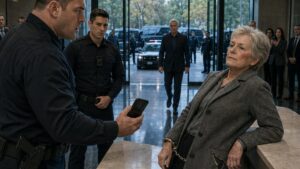
The young officer’s shadow fell across Richard Roberts’s knees before the man said a word.
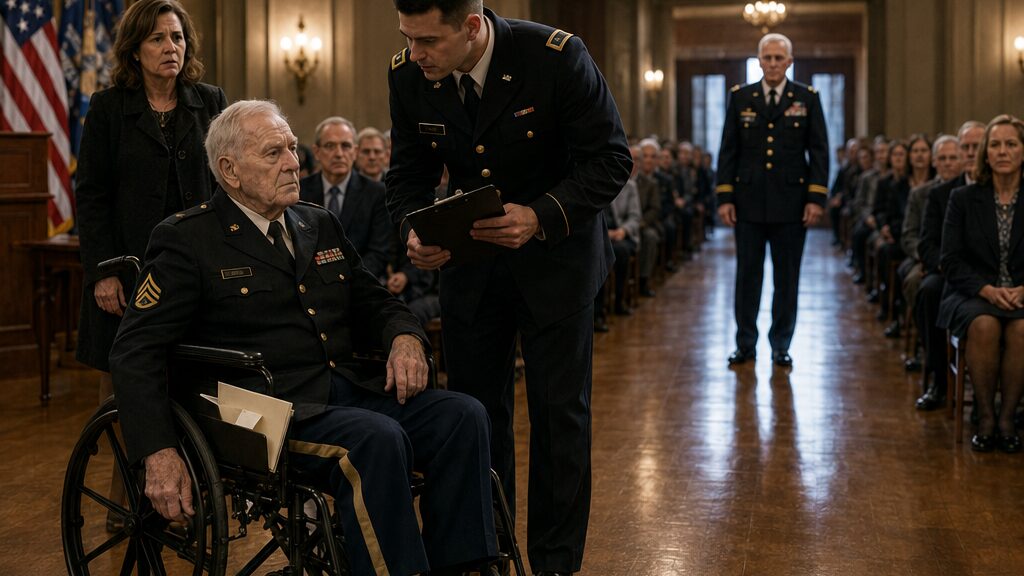
Richard had been watching the color guard rehearse near the side doors, their white gloves flashing as they adjusted the flags, when the shadow crossed the polished floor and stopped at the footrests of his wheelchair. The hall had grown quiet in the careful way official rooms did before ceremonies, all low voices and chairs nudged into straight lines. Rows of veterans sat beneath chandeliers that made the brass trim on uniforms blink like small signals. American flags stood near the podium. A blue state flag leaned beside them. At the front, a lectern waited with a microphone angled toward men who could still stand easily behind it.
Richard looked down at the folded program resting against his wheelchair armrest.
The card tucked into it said R. Robert.
Not Roberts. Not Richard Roberts. Just R. Robert, printed in small black letters beneath a row number that did not match the front seating chart.
The young officer cleared his throat.
“Sir,” he said, bending at the waist so his voice stayed private. “I’m going to need you to move your chair back behind the second row.”
Richard lifted his eyes slowly.
The officer was neat in the way young men were neat when they had not yet learned what could ruin a day. His uniform was pressed, his haircut sharp, his nameplate bright. Taylor. His expression held no malice, only urgency wrapped in politeness. That made it harder.
Richard’s right hand rested on the wheel rim. His fingers, thin and spotted with age, curved over the metal as if they had been placed there by habit, not intention.
“I was told this was where I should wait,” Richard said.
The officer glanced toward the aisle, then toward the doors where the color guard would enter. “I understand, sir, but this aisle has to stay clear. We have a procession coming through in seven minutes. The front row is reserved.”
Richard let his gaze travel to the empty chair beside him. There was a printed sign on it, but the letters blurred under the bright hall lights. Honored Guests. He had read it once already and then stopped reading it, because there were some words that did not know what to do with a body like his.
“My granddaughter checked me in,” Richard said.
“Yes, sir.” The young officer’s voice lowered another degree. “That may be the issue. Your card isn’t matching the list. We have a Robert, first initial only, but not front-row authorization. If you’ll allow me, I can have someone help you to the accessible seating area.”
The accessible seating area was along the side wall, near the rear. Richard had noticed it when Elizabeth pushed him in. He had noticed everything. The short slope at the doorway. The scuff marks where chairs had been dragged back. The gap in the front row that was almost wide enough for his wheelchair but not quite. The way the usher had looked from the program to Richard’s lap and then to Elizabeth, as if the younger face might explain the older one.
Richard pressed his thumb once against the wheel rim.
“I can move myself.”
The officer’s relief showed too quickly. “Thank you, sir.”
Behind him, someone laughed softly in the third row. Not at Richard, maybe. Maybe at a private remark, maybe at nothing at all. Still, the sound slipped under his collar and settled there.
Richard lowered his eyes to the program again.
The paper was heavy, cream-colored, expensive. Across the front it read: Fort Ainsley Veterans Remembrance Ceremony. Beneath that: Honoring the Evacuation at Lark Ridge. The words were clean, centered, balanced. He had held the program for twenty minutes without opening it past the first page.
He did not need to.
He knew what a ceremony program could fit and what it could not.
“Sir?” Brandon Taylor said.
Richard looked past him to the podium. The microphone had a small foam cover tilted slightly left. A photographer crouched near the center aisle, testing angles. Veterans adjusted their jackets. A chaplain turned pages in a small book. At the far wall, under a framed service emblem, Elizabeth stood near the check-in table speaking with the usher who had brought them in. Her face had changed. She had noticed the officer now. She was already stepping away from the table.
Richard gave the wheel a small push.
The chair shifted half an inch.
The right front caster squeaked.
It was not a loud sound, but in Richard’s ear it became the wheel of a stretcher against concrete, a metal frame shuddering over a door threshold, a voice behind him saying, left side, left side, keep it open.
He stopped.
The young officer leaned closer, misunderstanding the pause. “Do you need assistance?”
“No.”
The word came out flatter than Richard intended.
Brandon straightened a little, then glanced toward the side doors again. The procession would be coming soon. Procedure was closing around him. Richard knew that look. Young men did not have to be cruel to become hard. Sometimes all they had to do was believe the schedule mattered more than the person in front of them.
Elizabeth’s shoes clicked across the floor.
“Granddad?” she called softly, but the softness had an edge.
Richard did not turn. He did not want her face in this moment. He had promised her on the drive that there would be no trouble. He had sat in the passenger seat while she folded his jacket over his knees and told him it was not trouble to come, that the invitation had said honored survivor, that it mattered to show up. He had looked out at the highway and said only that ceremonies made parking difficult.
The truth was less simple.
He had not come for applause. He had not come for a certificate or a photograph beside men whose boots shone brighter than memory allowed. He had come because the notice had named Lark Ridge, and for forty years most notices had not.
Now the card said R. Robert.
Brandon moved a hand toward the back of Richard’s wheelchair, then stopped just before touching it. At least he knew that much.
“Sir, I really do need to clear this path.”
Richard looked at the young man’s hand suspended in the air.
“Do not push the chair,” he said.
Brandon’s face colored. “I wasn’t going to without permission.”
Richard nodded once. “Good.”
Elizabeth reached them then. She was breathing harder than the short walk required. “What’s wrong?”
“Ma’am,” Brandon said, turning to her with professional quickness, “we’re just correcting a seating issue.”
Elizabeth looked at Richard’s hand on the wheel. “He was invited.”
“I’m sure he was.” Brandon held up his clipboard. “But I don’t have his full name here for the front section, and the aisle has to remain open.”
“The aisle has to remain open,” Richard said.
Both of them looked at him.
He had not meant to speak the sentence aloud. It had come from somewhere old and exact, from a night when smoke had flattened the air and men had learned that a blocked path could become a sentence.
Elizabeth’s anger broke for a moment into concern. “Granddad?”
Richard closed the program carefully and set it back against the armrest. His fingers found the edge of the seating card. R. Robert. A little mistake. One letter gone. One name shortened. The sort of thing people fixed later, after the ceremony, after the photographs, after the room had already decided who mattered.
“It’s all right,” he said.
“It is not all right,” Elizabeth whispered.
“It is,” Richard said, but he was looking at the aisle now.
Brandon’s jaw tightened. He was not angry yet, but he was embarrassed, and embarrassment in uniform could make a man insist harder than he needed to.
“Sir,” he said, “I can’t delay the entrance.”
Richard pushed once on the wheel. The chair moved back another inch. His shoulders stayed square. His face stayed calm. He had learned long ago that people felt better about moving you aside if you helped them do it.
The front doors at the far end of the hall opened.
A small stir passed through the room. Conversations thinned. The photographer lifted his camera. The chaplain turned. Brandon glanced back, relief and alarm crossing his face together.
A white-haired senior officer had entered with two aides behind him.
Richard saw the officer only in pieces at first: dark dress uniform, measured pace, silver hair, ribbons arranged with severe precision, one hand holding a folder against his side. The man had the bearing of someone accustomed to rooms making space for him before he asked.
Then the officer slowed.
The aides behind him nearly continued forward before realizing he had stopped.
From the far end of the aisle, James Wilson looked straight at Richard’s wheelchair.
For a breath, no one moved.
Richard’s fingers remained on the wheel rim. The card with the wrong name slid slightly against the armrest, caught by the crease of the program. Brandon stood half-turned between protocol and the sudden stillness of a superior officer who had forgotten the ceremony clock.
Elizabeth’s hand came to rest on the back of Richard’s chair, light and trembling.
James Wilson took one step into the aisle, then another.
The room, which had been waiting for a procession, began waiting for something else.
Chapter 2: The Name James Wilson Could Not Ignore
James Wilson had walked into hundreds of ceremony halls and forgotten most of them by evening.
They shared the same polished floors, the same careful flags, the same murmured instructions from young aides who believed every second could be controlled if the clipboard was accurate. He had learned to respect the ritual without trusting it too much. Ceremony had a way of making grief stand at attention and calling that healing.
But halfway down the aisle, with the color guard waiting near the doors and the audience beginning to rise by instinct, James saw an old man in a wheelchair moving backward out of the front row.
A young officer stood over him.
A woman stood behind the chair with one hand pressed against the handle as if holding herself still.
And on the wheelchair armrest lay a cream-colored program with a small seating card tucked into it.
R. Robert.
James did not know why the missing letter struck him first. Perhaps because the room was full of complete names printed in careful ink. Perhaps because every ceremony he had attended had depended on the belief that names could repair what time had damaged. Or perhaps because the old man’s face, pale under the hall lights, had turned toward the aisle with the expression of someone who had already decided not to correct anyone.
James stopped walking.
The aide behind him whispered, “Sir?”
James did not answer.
The young officer near the wheelchair stiffened. “General Wilson.”
“At ease,” James said, though nobody was at ease.
He approached slowly, not because he wanted drama but because his right knee ached in cold weather and because the old man was watching him with a stillness James recognized before he understood it.
Brandon Taylor snapped his clipboard against his side. “Sir, we had a seating discrepancy. I was just moving the gentleman to accessible seating before the procession.”
“Were you?” James asked.
The question landed harder than he intended. Brandon’s face tightened.
“Yes, sir. His card doesn’t match the front-row list, and the aisle—”
“Has to remain open,” the old man said.
James looked at him.
The words had been spoken quietly, with no emphasis, but they entered James like a hand around the ribs.
Keep the left aisle open.
Not the aisle. The left aisle. A phrase from a brittle after-action file. A line quoted in training notes. A voice on a damaged recording he had heard once as a young officer and never forgotten, though he had not known the man behind it.
James took another step forward.
The old man’s uniform was formal but old-fashioned in its fit, the jacket altered around a body that had lost weight and height. Ribbons sat above his breast pocket, not many, not arranged to impress. His hands were bare. No medal case. No display. No attempt to announce himself.
James held out his hand, palm upward. “May I see your program, sir?”
Brandon shifted as if to retrieve it.
James did not look at him. “From him.”
The old man watched James for a moment. Then he lifted the program with two fingers and placed it in James’s hand.
The card slid loose.
James caught it before it fell.
R. Robert.
Inside the program, under Honored Survivors, the printed list included several names. Richard’s was not among them. Under Historical Acknowledgments, the evacuation team listed two officers, one chaplain, one medical unit designation, and a line reading additional enlisted support.
Additional enlisted support.
James felt heat rise behind his eyes, sharp and unwelcome.
He turned the program slightly so the light struck the page. “Who checked this list?”
Brandon swallowed. “The records office prepared the final print, sir.”
“Did you ask this gentleman his full name?”
Brandon’s silence answered.
Elizabeth spoke before he could. “His name is Richard Roberts.”
James looked back at the old man.
Richard Roberts did not lift his chin. He did not smile. If anything, he seemed to retreat further into himself, as if his name had become a burden once spoken aloud in that room.
James had heard the name before, though not from a program. Not on a plaque. It had lived in footnotes, in recovered testimony, in a training lecture from a colonel who had tapped a folder and said, remember this: when everything collapses, discipline sounds like a calm voice repeating the same order until frightened men obey it.
Roberts, Richard. Army medic attached to evacuation control. Lark Ridge.
James had been nineteen when Lark Ridge became the thing his family was never told fully. He remembered heat, dust, a bandage over one eye, the taste of metal, and someone shouting too many names at once. He remembered a voice cutting through it all.
Keep the left aisle open. Walking wounded to the wall. Stretcher cases through the center. Do not block the door.
He had never known whether that voice belonged to a captain, a sergeant, a medic, or a ghost.
Now the voice sat in a wheelchair beneath chandeliers while a young officer explained seating authorization.
James lowered the program.
“Mr. Roberts,” he said.
Richard closed his eyes for half a second.
The room had gone quiet enough for the microphone at the podium to hum faintly.
James took one step closer. The difference in height between them was suddenly intolerable. Not because Richard was in a wheelchair. Because everyone else had allowed that height to become part of the mistake.
James bent, then lowered himself carefully until one knee touched the polished floor. Pain flashed through his leg, but he ignored it. The program remained in his left hand. With his right, he held the seating card between two fingers, not as evidence, not as accusation, but as something fragile.
“Mr. Roberts,” he said again, his voice low enough that the front row had to lean to hear, “I apologize for the way this room received you.”
Brandon inhaled sharply behind him.
Richard’s eyes opened. They were gray, tired, and clear.
“You don’t need to kneel, General.”
“Yes,” James said. “I do.”
It was not a salute. James knew better than to turn the moment into theater. It was a correction of posture. A refusal to speak down to a man whose name the room had shortened.
Richard looked at the card. “It’s only a letter.”
“No,” James said. “It isn’t.”
Elizabeth pressed her lips together behind the chair.
James shifted the program in his hand. “This is wrong.”
“A lot of programs are,” Richard said.
The answer carried no bitterness. That made it worse.
Brandon stepped forward, voice tight with concern. “Sir, the ceremony is scheduled to begin. We can correct the seating quietly and—”
James raised a hand.
Brandon stopped.
James kept his eyes on Richard. “Were you told this was your place?”
Richard glanced at the front row. “I was told to come. The place was less certain.”
“Did you serve at Lark Ridge?”
Richard’s fingers moved once on the wheel rim, a small tightening. “A lot of men served at Lark Ridge.”
“That is not what I asked.”
Richard looked toward the flags, not at James. “Yes.”
Something in the room changed. Not loudly. No one gasped. No one clapped. But shoulders straightened. A veteran in the front row removed his cap from his knee and held it more carefully. The photographer lowered his camera without taking the shot.
James looked down at the program again. “Your name is not here.”
Richard’s mouth moved in the faintest line. Not a smile. Not quite pain. “You read the wrong name first.”
James did not understand.
“Sir?”
Richard reached toward the program. James gave it back immediately.
The old man opened it with controlled hands, turning to the page James had just read. He tapped the list of names under Historical Acknowledgments. Two officers. One chaplain. A unit designation. Additional enlisted support.
His finger rested there.
“There,” Richard said. “That was the first wrong name.”
James stared at the line.
Additional enlisted support.
The words seemed to widen on the page until they were large enough to bury men.
Richard folded the program closed and set it again against his armrest. “If the aisle is needed, General, I can move.”
James remained on one knee. “No.”
Brandon looked from James to the waiting color guard. “Sir?”
James stood slowly, but he did not step back into command distance. “Delay the procession.”
The young officer blinked. “For how long?”
James looked at Richard, then at the program, then at the row of flags waiting to enter as if nothing were wrong.
“As long as it takes to learn who we invited here.”
Chapter 3: The Program Was Not the Only Mistake
Elizabeth Roberts had spent most of her adult life learning the difference between helping her grandfather and humiliating him.
It was never as simple as opening a door or pushing a wheelchair. Richard could open some doors himself if the handle sat low enough. He could wheel himself across a parking lot if the pavement did not slope too sharply. He could lift his own folded jacket from his lap, adjust his cuffs, sign his name, refuse dessert, sharpen a pencil with a pocketknife he was not supposed to carry into public buildings, and remember the exact location of objects no one else had noticed.
What he could not do was tolerate being fussed over.
So when James Wilson delayed the ceremony and an usher guided them into the side corridor, Elizabeth kept her hands folded in front of her instead of reaching for the chair handles. Richard pushed himself. Slowly. With the same controlled rhythm he had used after Brandon Taylor told him to move.
The corridor was cooler than the hall. Framed photographs lined the wall: past ceremonies, old unit portraits, groups of men smiling beneath flags. In one frame, the glass reflected Richard’s wheelchair before it reflected his face.
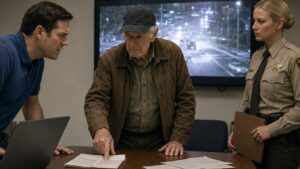
Brandon followed several steps behind, silent now. James had sent him to find Patricia Clark from the records office, but the young officer lingered just close enough to be useful and just far enough to avoid Elizabeth’s eyes.
She wanted to turn on him.
She wanted to say, You saw the chair and not the man. You saw the list and not the invitation. You saw an old body and decided it could be moved.
Instead, she watched Richard stop beside a wooden bench beneath a photograph of a military hospital tent. He placed the program on his lap and smoothed it once with his palm.
“Granddad,” she said, keeping her voice low, “you should have let me say something.”
“I heard you start.”
“I should have finished.”
“No.”
The answer came gently, but it closed the matter in the way his answers often did. Elizabeth hated that tone more than anger. Anger allowed an argument. Calm made her feel ten years old again, standing in his kitchen while he fixed a broken cabinet hinge and told her a loose screw was not the same as a ruined door.
Brandon cleared his throat. “Mrs.—Miss Roberts, I’m sorry for the confusion.”
Elizabeth turned to him. “Confusion?”
His face tightened. “I mean the seating error.”
“You mean when you told him to move.”
“I was following the chart.”
“Did the chart tell you to lean over him like that?”
Brandon looked at Richard before answering, which only sharpened Elizabeth’s anger.
Richard’s hand rested on the program. “Enough.”
She stared at him. “No, not enough. This is exactly what you always do.”
His eyes lifted.
She regretted it immediately, but the words had already moved. They stood between them in the corridor, more personal than anything Brandon had done.
Richard did not ask what she meant.
That was how she knew he understood.
“You let people make you smaller,” Elizabeth said, quieter now. “Then you call it manners.”
Brandon lowered his eyes. For the first time, he looked younger than his uniform.
Richard turned the program sideways and folded it along the line that read additional enlisted support. He pressed the crease with his thumb until it held.
“I have never been made smaller by someone else’s mistake,” he said.
Elizabeth looked at the folded page. “Then why didn’t you correct it?”
“Because the mistake was not only mine.”
The hallway door opened before she could answer.
Patricia Clark came through with a tablet held against her chest, her expression pulled tight between concern and irritation. She wore a dark suit instead of a uniform, with a small event badge clipped to her lapel. James entered behind her, carrying the authority of the hall with him but not using it yet.
“Mr. Roberts,” Patricia said, “I’m Patricia Clark. I manage ceremony records and archival coordination. I want to apologize for the program discrepancy. We can issue a corrected insert before the reception.”
“An insert,” Elizabeth said.
Patricia paused. “It’s the fastest print option available on site.”
Richard looked at her with no accusation. “Who gave you the Lark Ridge list?”
Patricia’s eyes shifted to James.
James answered. “The archive file. Reviewed last month.”
“Which file?” Richard asked.
Patricia tapped her tablet awake. “The official evacuation summary, casualty addendum, survivor list, and historical note prepared for the anniversary.”
Richard nodded as if she had confirmed something he expected. “Does it name the litter teams?”
Patricia’s thumb stopped moving.
James watched her.
“The summary names command personnel,” she said carefully. “Medical units are referenced by attachment.”
“Does it name the drivers?”
“No.”
“The radio operator who kept the second channel open?”
Patricia said nothing.
Richard looked back down at the folded program. “Does it name the men who carried stretchers until their hands tore?”
Brandon’s face changed. He looked toward the hall doors, as if the ceremony beyond them had become a different place.
Patricia’s professional composure thinned. “Mr. Roberts, I only have what is in the official archive.”
“That is usually where the trouble starts,” Richard said.
Elizabeth felt her anger loosen, not because it had faded but because it had found a larger target than Brandon. She stepped closer to Richard. “You knew.”
“I suspected.”
“Why didn’t you tell me in the car?”
“Because you would have driven faster.”
The small answer, almost dry, almost like him on an ordinary morning, startled a breath from her. It was not a laugh, not quite.
James moved nearer. “Richard.”
Elizabeth noticed the first name. So did Richard, though he did not correct it.
James lowered his voice. “The ceremony honors the Lark Ridge evacuation. If this program is incomplete, we need to know before we continue.”
Richard ran one finger along the folded crease. “The ceremony honors the version that fit.”
Patricia’s shoulders stiffened. “Records from that period are often incomplete. That doesn’t mean anyone intended disrespect.”
“No,” Richard said. “It means disrespect learned to look like paperwork.”
The corridor went still.
Elizabeth looked at her grandfather’s lap, at the careful fold through the printed line, at the old hands resting on either side of it. She had thought the wound was Brandon. The young officer, the clipboard, the order to move. She had thought the insult was fresh and visible and therefore simple.
But Richard had not come to defend his chair.
He had come to sit in a room where men without names were about to be honored as a category.
James turned to Patricia. “Can you pull the full file?”
“I can try,” she said. “But if the archive packet is incomplete, there may not be much more available.”
Richard looked up then. His face remained composed, but something old moved behind his eyes.
“It was incomplete before it became a packet.”
Patricia held the tablet closer. “There may be supporting material in the attached digital inventory. Scanned notes, audio fragments, handwritten rosters. I didn’t review every item personally.”
“Then review them now,” James said.
She hesitated. “General, the audience is waiting.”
James looked toward the closed hall doors. Beyond them, hundreds of people sat beneath flags with programs folded in their laps.
“Yes,” he said. “They are.”
Richard placed both hands on his wheels as if preparing again to move. Elizabeth’s chest tightened.
But he did not push.
He looked at Patricia Clark and said, “If you find the file, look for the names that were too tired to spell themselves.”
Patricia’s face softened despite herself.
Brandon stepped forward. “Ma’am, I can help search.”
Elizabeth glanced at him, ready to resent the offer. But his voice had changed. It had lost the bright hardness of schedule and rank.
Patricia nodded once. “Come with me.”
As Brandon followed her down the corridor, James remained beside Richard.
Elizabeth watched the young officer disappear through a records door, then looked back at her grandfather. “You’re not protecting him, are you?”
Richard folded the program once more, sharper this time.
“No,” he said. “I’m protecting the men he almost walked past.”
At the end of the corridor, Patricia’s voice called from the records room, suddenly less controlled.
“General Wilson?”
James turned.
She stood in the doorway with the tablet in her hand, her face pale under the fluorescent light.
“The archive file,” she said. “It’s missing pages.”
Chapter 4: The Roster Behind the Ceremony Door
Patricia Clark had spent eleven years believing that records failed only when people stopped caring about them.
She had built her career on the opposite habit. She labeled folders no one asked for. She checked spellings against discharge forms. She kept duplicate scans in a locked server and paper copies in cabinets that smelled faintly of dust, toner, and metal. She was the person commanders thanked in passing when ceremonies went smoothly and blamed privately when a date, rank, or middle initial was wrong.
But the file on Lark Ridge had not failed in any way she recognized.
It was too clean.
The records office sat behind a heavy door off the side corridor, a narrow room with two desks, a wall of gray cabinets, a scanner, and a small window that looked out toward the parking lot instead of the hall. The ceremony noise came through as a muffled weight: chairs shifting, low conversation, a microphone being tested and then silenced again. On the desk in front of Patricia, the digital archive glowed open on her tablet.
Brandon Taylor stood beside the file cabinet with his cap tucked beneath one arm. He looked as if he wanted to apologize to the room itself.
James Wilson stood near the door, arms still at his sides, watching the tablet without asking for it. Richard Roberts had wheeled himself to the end of the desk and stopped there. Elizabeth remained behind him, close enough to help, far enough not to touch.
Patricia scrolled through the index again.
“Official evacuation summary,” she said. “Casualty addendum. Survivor transport sheet. Historical note. Press release draft. Ceremony background packet.”
“Open the transport sheet,” James said.
She did.
Rows of names appeared, some scanned crookedly from old forms. Several had typed ranks. Several had handwritten corrections. The first page was clear enough. The second page darkened near the margin. The third page had a black smear across the bottom, as if copied from a damaged original.
Patricia felt the first real unease under her ribs.
“This is the version we received,” she said.
Richard’s eyes moved across the screen. “That is not the first version.”
She looked at him. “How can you tell?”
“The columns are wrong.”
Brandon leaned slightly closer. He caught himself and stepped back.
Richard lifted one hand from the wheel and pointed, not touching the screen. “Litter team should be before transport status. Not after. Whoever retyped this didn’t know how we moved them.”
Patricia enlarged the scan. “The summary lists command personnel because that was the final signed report.”
“Yes,” Richard said.
His tone did not accuse her. It only made room for what she had not seen.
Patricia opened the ceremony packet beside it. The printed program lay on the desk, folded sharply through the line that had begun to embarrass them all: additional enlisted support. Richard had made that crease. It had turned the phrase into a wound.
“We pulled from the signed report,” Patricia said. “The office assumed the supporting names were unit-level, not individual.”
“Offices assume a lot,” Richard said.
Elizabeth’s eyes flicked toward him, but he did not soften the words.
James stepped forward. “Mr. Roberts, can you identify who is missing?”
Richard did not answer immediately.
Patricia watched his hand return to the wheel rim. Not moving. Holding. The same restrained grip she had seen in the hallway. He was an old man at the edge of a desk with papers open in front of him, yet everything in the room seemed to have shifted around his silence.
“Some,” he said at last.
“Some?” Brandon asked, then seemed to regret speaking.
Richard looked at him. “It was not a school photograph, Lieutenant. Men came through smoke, rain, blood, and shouting. Some I knew before that night. Some I knew only by what they carried.”
Brandon’s jaw worked once. “Yes, sir.”
The “sir” sounded different now. Not automatic. Smaller.
Patricia opened the casualty addendum. “There are six unidentified support references.”
Richard shook his head. “Not unidentified. Unwritten.”
The distinction landed in Patricia’s chest.
James pulled a chair out from the desk and set it near Richard without making a show of it. He did not sit. He placed it within reach of Elizabeth, then stepped back. Patricia noticed. Elizabeth did too.
“Start where you can,” James said.
Richard studied the scan. His face changed very little, but Patricia saw his thumb move once against the wheel. Back and forth. Back and forth.
“The driver on the north road,” he said. “He kept the engine running after the windshield cracked. His last name was Flores. I remember because he said everybody spelled it wrong when he was tired. He laughed about it. Not much of a laugh. Just enough.”
Patricia typed quickly into a temporary note.
“First name?” she asked.
Richard closed his eyes. “I will not guess.”
She stopped typing.
He opened his eyes again. “If I don’t know, write that I don’t know.”
Patricia deleted the blank space where she had almost filled a placeholder.
Richard continued. “There was a radio operator with a burn on his left wrist. He kept saying the second channel was still breathing. That was his phrase. I never knew his name. There were two stretcher bearers from the maintenance attachment. One tall, one with a limp before he ever picked up the stretcher. The tall one had tape around two fingers. The limping one sang under his breath when the shelling got close.”
Brandon turned away slightly.
Patricia kept typing, each description feeling both necessary and insufficient.
James said, “And you?”
Richard’s gaze did not move from the screen. “I was where they needed someone to stand and say the same thing until panic became motion.”
“The voice,” James said.
Richard’s hand stopped on the wheel.
Patricia looked up.
James was no longer watching the file. He was watching Richard as if the old man’s face had become a door to a room he had avoided for years.
“I was on one of those stretchers,” James said.
The records office held still.
Brandon looked at him. Elizabeth’s hand tightened on the back of Richard’s chair.
Richard’s expression remained careful. “You were young.”
“I was nineteen.”
“Most of you were.”
James breathed in. “I had a bandage over one eye. I remember someone ordering the left aisle kept clear. I remember thinking he sounded angry.”
“I was not angry.”
“I know that now.”
Richard looked down at the program on the desk. “No. You know I am old. That is not the same as knowing then.”
Patricia expected James to flinch. He did not. He accepted the correction with a slight bow of his head.
“You’re right.”
Richard tapped one line on the transport sheet. “This roster has your name?”
James leaned over. Patricia shifted the tablet so he could see.
There it was, typed cleanly, complete, preserved. James Wilson. Evacuated. Stable.
James stared at it.
Richard said, “Then the roster remembers you.”
James said nothing.
“It should remember who got you there.”
Patricia felt heat rise in her face. It was not shame alone. It was the terrible embarrassment of realizing she had prepared a room full of flags around a document she had not understood.
“I can print an addendum,” she said. “We can read a correction before the keynote.”
Richard looked at her.
The look was not harsh. That made it harder to bear.
“You can print paper,” he said. “Can you stop the ceremony from pretending paper is truth?”
She had no answer.
James did. “Yes.”
Richard turned to him.
“If Mr. Roberts agrees,” James said, “the ceremony does not proceed as written.”
Patricia looked toward the closed door. “General, with respect, the audience has been waiting almost thirty minutes. The color guard is staged. The families—”
“The families came for remembrance,” James said. “Not stage management.”
Brandon spoke from near the cabinet, quiet but urgent. “Sir, if we change the sequence, I need to tell the floor team. Seating, camera position, color guard timing, podium order.”
James glanced at him. “Then tell them.”
Brandon nodded, but he did not move. His eyes were on Richard now.
“Mr. Roberts,” he said, voice low, “should the center aisle remain open?”
The question struck Patricia as strange until she saw Richard look at him.
For the first time since entering the office, Richard’s face shifted. Not into approval. Not forgiveness. Something smaller. Recognition that the young man had listened to the words before repeating them.
“Yes,” Richard said. “Keep the left side clear if anyone needs to pass. Don’t make people turn their backs to the flags if they can help it. And don’t move chairs while someone is speaking.”
Brandon absorbed each instruction as if it had been entered into a manual he should have read years ago.
“Yes, sir.”
He left the room quickly.
Patricia looked back at the tablet. “There may be attached media files. I didn’t open them for the program. Most were marked low quality.”
“Open them,” James said.
She selected the folder.
Several thumbnails appeared: scanned notes, a damaged map, two unreadable photographs, and one audio file with no title, only a timestamp from an old transfer. Patricia clicked it.
Static filled the office.
Elizabeth’s hand moved to Richard’s shoulder but stopped before touching.
The audio crackled. A confusion of voices rose beneath the static, distant and flattened by age. Then a voice cut through, calm and firm, not loud but carrying the shape of command without rank.
“Keep the left aisle open. Walking wounded to the wall. Stretcher cases through the center. Do not block the door.”
Richard closed his eyes.
The voice continued beneath shouting. “Again. Keep the left aisle open. If he can walk, he waits. If he can’t, he moves first. Count hands on every stretcher.”
James lowered his head.
Patricia stared at the screen, her fingers frozen above the tablet. The voice was younger, but it was unmistakably Richard’s. Not because it sounded the same, exactly, but because the room changed around it the same way the ceremony hall had changed when he spoke.
The recording dissolved into static.
No one moved.
Then Brandon appeared in the doorway, breath uneven from hurrying.
“I told the floor team,” he said. “They’re holding.”
He looked from James to Patricia, then to Richard.
Patricia saw the old man’s eyes still closed.
Brandon lifted a small plastic evidence sleeve from his hand. “The archivist found this attached behind the physical packet. It was stuck to the back cover.”
Inside the sleeve was a narrow strip of old paper, folded twice and browned at the edges.
Patricia took it carefully and opened it on the desk.
Names. Not clean, not complete, not typed. Handwritten under pressure. Some letters cramped. Some crossed out and rewritten. Some followed by question marks. At the top, in faded pencil, someone had written: Litter and lane control, Lark Ridge.
Richard opened his eyes.
Patricia turned the strip toward him.
His hand lifted from the wheel, then stopped in the air.
He did not touch the paper.
“Mr. Roberts?” James said.
Richard looked at the names for a long time.
Then he said, “Before you print anything, there are men missing from that too.”
Chapter 5: The Voice That Kept the Aisle Open
The hall looked larger when it was empty.
Richard sat at the edge of the center aisle with the flags still posted near the podium and the rows of chairs waiting in obedient lines. The audience had been moved to a reception room with coffee and quiet explanations. Their programs remained on seats and in purses and folded beneath hands. The color guard stood down somewhere behind the doors. The microphone at the lectern had been switched off.
For a while, the ceremony hall belonged to the people who were not yet ready to speak.
James Wilson stood near the first row with the handwritten strip in his hand. He had read it three times. Patricia had printed a working copy and spread it across the podium beside the official program. Brandon had gone back and forth between the hall and records office, carrying instructions he no longer treated as mere errands.
Elizabeth sat in the chair James had placed for her earlier. She had finally taken it, though she sat forward, elbows on knees, watching Richard as if he might disappear into the polished floor.
Richard kept his chair angled toward the left aisle.
Not the center. The left.
The old recording had been played only once, but the voice had not left the room. Richard could still hear it echoing off the walls, younger and steadier than he remembered feeling. He disliked recordings. They made lies out of time. They took a living moment and pinned it down as if what came after had not altered its meaning.
James approached slowly. “Richard.”
“You keep doing that.”
“Using your first name?”
Richard looked at the podium. “Using it carefully.”
James glanced down. “Would you prefer Mr. Roberts?”
“I prefer accuracy. Carefulness is sometimes just fear dressed well.”
James accepted that with a faint movement of the mouth that was not quite a smile. “Then I’ll ask accurately. What do you want us to do?”
Richard’s hands rested in his lap now, not on the wheels. His fingers ached. That happened in cold halls. It also happened when memory asked too much of bone.
“The ceremony should continue,” he said.
James’s shoulders eased, but Richard had not finished.
“Not as written.”
“No,” James said. “Not as written.”
From the podium, Patricia looked up. She had been marking the working list with small, precise notes: confirmed, partial, unknown first name, unit uncertain, description only. Each mark seemed to cost her.
James held the old strip. “We can acknowledge the incomplete record. We can read the names we have and state that others remain unidentified.”
Richard turned his head. “Unidentified by whom?”
James did not answer too quickly this time.
Richard looked down the aisle. “They had names when they were carrying men. They had names when they were afraid. They had names when they bled through their sleeves and kept moving. The file lost them. That is not the same as them being unidentified.”
Elizabeth covered her mouth with one hand. She did not make a sound.
James folded the strip along its old crease, then opened it again, as if punishing himself for almost hiding it. “Then tell me what to say.”
Richard’s left hand drifted toward the wheel rim and stopped.
The hall blurred for a moment, not from age but from smoke remembered too sharply.
There had been no chandeliers at Lark Ridge. There had been hanging bulbs, two working, one shattered, one swinging from a wire each time the walls shook. The floor had been concrete slick with rain and dust, then with things rain could not wash. The building had once been a school or a municipal office; Richard had never known which. By the time he reached it, all rooms had become sorting rooms. Men who could walk argued that they could not. Men who could not walk tried to stand. Everyone wanted the same door. The door was too narrow.
He had been younger than Brandon then, though he had felt ancient by midnight.
Someone had shouted for the officers. Someone else had shouted that the road was closing. The first stretcher had struck the doorframe and jammed sideways. That was when Richard saw how men would die: not because no one cared, but because everyone cared in a different direction at once.
So he had climbed onto a broken chair and made his voice flat.
Keep the left aisle open.
Again.
Again.
Again until the words were no longer words but rails.
He remembered choosing. That was what the program did not know how to print. Every orderly movement looked merciful after the fact. In the moment, order meant one man moved while another waited. One stretcher through the center. One walking wounded to the wall. One hand on a chest. One face turning toward him with a question Richard could not answer.
Will I be next?
Sometimes yes.
Sometimes no.
The voice on the recording had sounded calm because panic was a luxury he could not afford. It had not recorded the part afterward, when he found the limping stretcher bearer sitting against the wall with his torn hands open on his knees, still humming with no sound coming out. It had not recorded Richard stepping over a dropped glove because bending to pick it up would have blocked the aisle.
“Richard,” James said quietly.
The hall returned.
Richard realized his hand was gripping the wheel.
He let go.
“You want to honor me,” he said.
James did not deny it. “Yes.”
“That would be easier for you.”
James lowered his eyes.
“It would be easier for the room,” Richard continued. “One old man. One mistake. One apology. Then everyone can stand, feel solemn, and go home believing respect was restored.”
Patricia stopped writing.
Richard looked toward the reception doors. Beyond them, the audience waited with coffee cups and lowered voices. Some would be irritated now. Some concerned. Some would enjoy being present for an unexpected correction because it would make the day feel important. They would not mean harm. People rarely meant harm when they turned pain into a story they could carry comfortably.
James said, “What would be harder?”
Richard looked at the folded program on his lap. He had creased it so sharply that the printed phrase additional enlisted support now broke across two planes of paper.
“Say that the record is incomplete,” he said. “Say it before you say my name. Say the ceremony was prepared from a report that remembered command more easily than labor. Say the men who carried, drove, counted, bandaged, lifted, and held the line of movement were part of the rescue, whether their names survived the file or not.”
James listened without moving.
Richard’s voice stayed even. “Then read the names you can confirm. Not as support. As men.”
Patricia looked down at the working list. “We don’t have all first names.”
“Then say that,” Richard said. “Do not decorate the blank spaces.”
Elizabeth whispered, “Granddad.”
He looked at her.
Her eyes were wet, but not with the anger from the corridor. “You never told us any of this.”
Richard’s first instinct was to apologize. He stopped himself. An apology would make his silence sound like an accident.
“I told you what I could live beside,” he said.
She pressed her hands together. “And today?”
“Today they printed it.”
That was all.
Brandon entered from the side doors with two staff members behind him. They stopped near the rear, waiting for James. Brandon came forward alone.
“Sir,” he said to James, then turned to Richard. “Mr. Roberts.”
Richard noticed the order. James did too.
Brandon held a fresh sheet. “The floor team can reseat the front row without moving your chair. We can widen the left aisle by removing two chairs from each row. I told them not to touch yours.”
Richard studied him.
Brandon stood straighter, but not stiffly. There was embarrassment in him still, and something more useful than embarrassment: attention.
“Good,” Richard said.
The word seemed to matter to Brandon more than it should have.
James looked at Richard. “If we do this, they will want you at the podium.”
“No.”
James waited.
Richard glanced at the microphone. “Not at first.”
Patricia stepped down from the podium with the working copy in her hand. “We need someone to verify pronunciation where we can. The archivist is searching unit supplements, but we may not have enough before the ceremony resumes.”
Richard reached for the paper. Patricia gave it to him carefully.
He scanned the names, descriptions, half-lines. His eyes paused at Flores. No first name. Driver, north road. Then radio operator, second channel. Then two stretcher bearers, maintenance attachment. Then question marks. Then blank space.
“This one,” Richard said, pointing. “Not Sanchez. The old handwriting makes the Z look like that, but it was Garcia. He corrected me once.”
Patricia marked it.
Richard moved down the page. “This one should not be listed under medical. He was a mechanic. He fixed a stretcher wheel with wire and cursed the whole time. Put him where he was.”
Patricia marked that too.
James watched, his face drawn.
At last Richard stopped at an empty line Patricia had left beneath confirmed names.
“What is that?” he asked.
“For additional names you remember.”
Richard looked at the blank line.
It was meant kindly. That was the problem.
“I remember more than I know,” he said.
Patricia swallowed. “Then we leave it blank.”
“No,” Richard said. “Write: Names not yet recovered.”
Patricia wrote it by hand.
The phrase sat on the page without pretending to heal anything.
James drew a breath. “Richard, when the ceremony resumes, I will explain the correction. I will take responsibility for the program.”
“You did not write the report.”
“I approved the ceremony.”
Richard looked at him. “Then take responsibility for listening now.”
James nodded.
The hall doors opened slightly. Sound from the reception room leaked in: a cup set on a saucer, someone clearing a throat, the low patience of people waiting to be told what their waiting meant.
Richard felt suddenly tired. Not weak. Tired in the old way, as if he had been holding a door open for decades and only now realized his arm had been shaking.
He reached for the wheels and turned his chair toward the podium.
Elizabeth rose at once, then stopped herself.
Richard moved the chair forward alone. The left caster squeaked once on the polished floor. The sound traveled farther in the empty hall than it had in the crowd.
At the bottom of the podium ramp, he stopped.
“There is one thing,” he said.
James came beside him. “Anything.”
Richard looked up at the microphone. Then at the flags. Then at the first row where the corrected pages waited on the chairs.
“No,” he said. “Not anything.”
James held still.
Richard’s hand rested on the wheel, then lifted away.
“When you call them back in,” he said, “do not begin with my service. Do not begin with your apology. Do not begin with what you remember from the stretcher.”
James’s face tightened, but he nodded.
Richard looked at Patricia’s handwritten page.
“Put the missing names before mine,” he said. “Then give me the microphone.”
Chapter 6: Before You Say My Name
When the audience returned to the hall, the left aisle was wider.
Not dramatically. No one had rebuilt the room. No one had hung new banners or replaced the printed programs already lying in laps. But two chairs had been removed from the first several rows, and the line of open floor now ran clean from the side doors to the front. The difference was modest enough that many people might not notice it at first. Richard noticed.
So did Brandon Taylor.
He stood near the front now, not in the aisle but beside it, leaving the path clear. His clipboard was gone. He held only a stack of corrected sheets, which he passed to the ushers with quiet instructions. Every time he approached a seated veteran, he bent less from the waist and more from the knees, bringing his voice lower without leaning over anyone’s chair.
Richard watched him do it once, then looked away.
The room filled slowly. The audience had changed during the delay. People spoke in softer voices, not because they understood yet, but because they sensed the ceremony had slipped out of its printed shape. Programs opened. Corrected sheets rustled. Heads turned toward Richard and then away quickly, as if looking too long might become rude.
Elizabeth stood behind him near the front row. She had asked once if he wanted her beside him at the podium. He had said, “I want you where you can hear.” She had not argued.
James Wilson stepped to the lectern.
He did not begin with the prepared welcome. Richard could see the original speech resting in a folder to one side, untouched.
James looked over the room. “Before this ceremony continues, we need to correct the way it began.”
A murmur moved and died.
Richard’s hands were folded in his lap. The misprinted program lay beneath them, its crease still sharp. On the podium beside James sat Patricia’s corrected page. Not elegant. Not centered. Not printed on cream paper. It was plain white, marked by hand, with several lines that admitted uncertainty.
James continued. “The program you received was prepared from an official record. That record was incomplete. Because of that, this ceremony repeated an omission instead of repairing it.”
He paused.
Richard looked at the flags.
“The Lark Ridge evacuation was not carried by rank alone,” James said. “It was carried by drivers, medics, radio operators, stretcher bearers, mechanics, orderlies, and men whose names were not preserved with the care they deserved.”
The room had gone very still.
James placed one hand on the corrected page. “We will not refer to them today as additional support.”
Richard closed his eyes once.
Not relief. Something nearer to breath.
James read the names they had. Where first names were missing, he said so. Where a role was certain and a name was not, he said that too. He did not smooth the blanks. He did not turn them into poetry. He let each absence sit in the room as an unfinished duty.
“Flores, first name not yet recovered, driver on the north road.”
A man in the second row lowered his head.
“Garcia, unit attachment uncertain, stretcher repair and lane movement.”
Patricia stood near the side wall with her hands clasped around her tablet, her lips pressed together.
“Radio operator, name not yet recovered, second channel.”
The microphone carried the blank through the hall.
“Two stretcher bearers from maintenance attachment, names not yet recovered.”
Richard felt Elizabeth behind him. He did not turn, but he knew she was crying by the way she had stopped breathing through her nose.
James finished the list. Then he looked down at the final line.
“And Richard Roberts,” he said, “Army medic attached to evacuation control.”
The room shifted. Not with applause. Not yet. With recognition trying to decide what shape it should take.
James turned from the microphone and looked at Richard.
The old instinct came back fast: hand to wheel, body ready to move away from attention. Richard’s fingers found the metal rim.
Then he remembered the blank line Patricia had written by hand.
Names not yet recovered.
He lifted his hand from the wheel.
Elizabeth saw. He heard the small catch in her breath.
James stepped aside from the podium.
Not back. Aside.
It was a small movement, but it changed the entire front of the room. The microphone no longer belonged to the senior officer. The lectern no longer looked like command. It waited.
Brandon moved toward Richard but stopped two steps away. “Mr. Roberts,” he said softly, “may I assist you to the ramp?”
Richard looked at him.
Brandon did not touch the chair. He did not reach for the handles. He waited.
“Yes,” Richard said.
Brandon walked beside him, not behind him, as Richard pushed once, twice, three times toward the low ramp beside the podium. Elizabeth remained where she was, both hands pressed together at her waist. James kept his eyes on the floor until Richard reached the microphone.
The ramp was shallow, but Richard’s arms trembled by the top. Brandon saw it and did not pretend not to. He simply stood near enough that if the chair rolled back, he could stop it. He still did not touch.
Richard positioned himself behind the microphone. It had been lowered as far as it would go. Still, he had to lift his chin slightly.
For a moment, he saw only faces.
Old veterans. Families. Young service members. The chaplain. The photographer with his camera lowered. Patricia near the wall. James beside the lectern. Brandon at the edge of the ramp, hands at his sides like a man learning what they were for.
Richard unfolded the misprinted program.
The sound of the paper traveled through the microphone.
“I was asked earlier,” he said, “whether I served at Lark Ridge.”
His voice was not strong at first. The room leaned toward it anyway.
“I answered yes. That was true. It was not complete.”
He looked at the folded line. Additional enlisted support. The paper had already begun to soften from the heat of his hands.
“I have let incomplete answers stand for a long time.”
Elizabeth looked at him then with a pain he could feel from across the front row.
Richard continued. “Some of that was pride. Some was tiredness. Some was because I did not trust rooms like this to know the difference between honoring a man and using him to make a story easier.”
No one moved.
“I was not the hero of Lark Ridge,” he said.
James’s head lowered slightly.
“I was one man in a bad doorway. I gave orders because someone had to. I repeated them because frightened men need the same words more than once. I chose who moved first because the aisle was narrow and the road was closing.”
He stopped.
The old air moved through his lungs. Smoke, rain, dust. A stretcher leg striking concrete. Someone asking for water. Someone else calling for his brother.
Richard placed the program on the podium shelf, wrong name facing up.
“Some men lived because of that order. Some men waited because of it. That is the part ceremonies do not like.”
The room seemed to hold the sentence without knowing where to put it.
Richard looked toward the corrected page.
“Today, you heard names that were almost left under a phrase. You heard blanks too. Those blanks are not empty. They are work left for the living.”
Patricia wiped quickly beneath one eye and looked down at her tablet.
Richard turned his gaze to Brandon. The young officer stood straighter, but his face was open now, unsettled in a way that might become useful if he did not rush to escape it.
“When you see a chair in an aisle,” Richard said, “you may be seeing an obstacle. Or you may be seeing the only person in the room who remembers why the aisle mattered.”
Brandon’s throat moved.
Richard looked back to the audience.
“I do not ask you to make me larger than I was. I ask you not to make them smaller than they were.”
He touched the corrected page with two fingers.
“If this ceremony means anything, let it mean the record changes after today. Not the mood. Not the photographs. The record.”
He leaned back slightly. The microphone caught the faint sound of the wheelchair creaking beneath him.
“That is all.”
For one suspended moment, no one clapped.
Richard was grateful.
Then the audience began to stand. Not quickly. Not all at once. Chairs shifted softly. Veterans rose with effort. Younger service members rose faster, then steadied those beside them. The gesture spread unevenly, imperfectly, humanly.
Richard did not look at them.
He looked at the program.
James stepped toward the microphone, but before he spoke, he looked down at Richard and waited.
Richard nodded once.
Only then did James say, “The archive office will remain open after the ceremony for anyone with records, names, photographs, or family testimony connected to Lark Ridge. Corrections will be documented. The revised record will be filed before this building closes tonight.”
That mattered more than standing.
Richard closed his eyes.
The ceremony continued, but not as it had been written. The color guard entered through the widened left aisle. The chaplain read briefly. The prepared keynote was cut in half. James removed every line that made memory sound clean.
When the final note of the anthem faded, there was applause, but it did not feel like the center of anything. It rose, passed through the room, and fell away. People began to approach one another quietly. Some went to Patricia. Some stood before the corrected page. Some looked at Richard and then seemed to understand that he did not need to be surrounded.
Elizabeth came to him first.
She knelt beside the chair, not because he needed it, but because the room had taught her something too.
“You did not make yourself smaller,” she said.
Richard looked at her.
“No,” he said. “I made the doorway narrow.”
She gave a broken little laugh, wiping her face with both hands.
James was speaking with Patricia near the podium when Brandon approached Richard.
The young officer stopped at a respectful distance. For several seconds, he said nothing.
Richard waited.
Brandon looked at the misprinted program in Richard’s lap, then at the widened aisle, then back at Richard’s face.
“Mr. Roberts,” he began.
The words failed him.
Richard could see the apology forming and collapsing under its own insufficiency. The young man wanted to say the correct thing. For the first time that day, he seemed to understand that correctness was not the same as repair.
Richard rested one hand lightly on the wheel rim.
Brandon lowered his eyes.
“I don’t know what to say,” he admitted.
Richard looked toward the left aisle, still open, still clear.
“That may be a good beginning,” he said.
Chapter 7: The Respect That Stayed After the Salute
By evening, the ceremony hall had lost its shine.
The flags still stood near the podium, but their shadows had stretched across the floor. The chandeliers remained bright, yet the light no longer made the room feel official. It only showed what the day had left behind: a forgotten coffee cup beneath a chair, a folded tissue near the front row, a few corrected sheets abandoned beside the old programs, the faint track marks of Richard Roberts’s wheelchair crossing the polish near the widened left aisle.
Brandon Taylor stood alone in that aisle with the misprinted seating card in his hand.
R. Robert.
He had picked it up from the floor after the audience left. At first he told himself he was cleaning the space. Then he stood there too long, staring at the missing letter, and understood he had not picked it up because it was trash.
He had followed orders all morning. That was what he had told himself. He had protected the procession route. He had checked the front-row list. He had kept the event from disorder. None of it had been false.
It had only been incomplete.
He looked toward the podium where Richard’s corrected page had been placed in a clear sleeve beside the official program. Patricia Clark had already taken copies to the records office. General Wilson had stayed with her until the revised entry was logged, signed, and marked for permanent review. Several audience members had come forward with old photographs, family stories, and names half-remembered from fathers and uncles who had long ago stopped speaking about Lark Ridge.
Brandon had expected apology to be the hard part.
It was not.
The hard part was discovering that apology did not move a single chair.
He heard the side door open and turned.
Richard Roberts came through slowly, pushing his own wheels. Elizabeth walked beside him, her coat folded over one arm. She did not hold the handles. Brandon noticed that now. Earlier in the day, he would have noticed only that she was not helping.
General Wilson followed a few steps behind, speaking quietly with Patricia near the records door. Their voices stayed low. The building had the hushed feeling of a church after the last hymn, when people were still deciding whether to leave or confess something.
Brandon stepped out of the aisle before Richard reached him.
Then he stopped himself and looked at the floor.
The left aisle was clear. He was not blocking it.
Still, he had moved as if the chair needed the path more than the man needed to be greeted.
Richard rolled to a stop several feet away. “Lieutenant.”
Brandon straightened. “Mr. Roberts.”
Elizabeth’s eyes moved to the card in his hand.
Brandon looked down at it, then back to Richard. “I found this under the front row.”
“I wondered where it went,” Richard said.
Brandon held it out, then hesitated. The card looked suddenly too small for a formal gesture and too large for a casual one.
Richard extended his hand.
Brandon placed the card in his palm.
Not dropped. Not passed quickly. Placed.
Richard looked at the printed mistake. “Still wrong.”
“Yes, sir.”
“Paper is stubborn.”
Brandon drew a breath. “So are people.”
Richard’s eyes lifted.
The words had come out before Brandon had measured them. For one frightened second, he thought they sounded disrespectful. Then Richard’s mouth shifted faintly at one corner.
“Sometimes that is what saves them,” Richard said.
Elizabeth looked between them and said nothing.
Brandon reached into the folder tucked beneath his arm. “I have something else.”
He removed a fresh program. It was not as polished as the original. The paper was plain white, printed from the office machine, with the ink slightly darker on one side. Across the front, the title remained the same, but inside, the acknowledgment page had been changed.
He held it with both hands.
Richard did not take it immediately.
“What is that?” he asked.
“The corrected program,” Brandon said. “Not the final archive version. Patricia said that will take time. But this is what will be sent to attendees tonight. General Wilson approved the correction, and the records office logged the missing names section before closing.”
Richard’s gaze rested on the paper.
Brandon continued, because if he stopped he might retreat into a simple apology and hide there.
“I also wrote a change to the reception protocol. For future ceremonies. Accessible seating won’t be treated as overflow. Front-row invitations will be confirmed by full name before the event, and no chair gets moved unless the person in it is asked first.”
Elizabeth’s face changed, but she still did not speak.
Brandon swallowed. “I don’t know if I wrote it right.”
Richard held out his hand for the program.
Brandon gave it to him.
Richard opened it slowly. The old card remained in his other hand. Wrong name in one palm, corrected page in the other.
His eyes moved across the new acknowledgment.
Names not yet recovered.
Brandon watched him read it and felt, with a force that embarrassed him, how badly he wanted to be forgiven. The desire was selfish. He knew that now. Forgiveness would make the day smaller. It would let him leave with a lesson instead of a responsibility.
Richard folded the corrected program closed.
“You asked whether you wrote it right,” he said.
“Yes, sir.”
Richard tapped the program once. “The paper is a start.”
Brandon nodded. He deserved no more than that.
“I wanted to apologize,” he said. “For the way I spoke to you this morning. For assuming the chart knew more than you did. For almost touching your chair.”
“You did not touch it.”
“I wanted to.”
Richard looked at him for a long moment.
Brandon forced himself not to look away.
“That is worth knowing about yourself,” Richard said.
The sentence did not absolve him. It gave him work.
Behind Richard, General Wilson and Patricia came closer but stopped before entering the conversation. Brandon sensed them there, listening without rescuing him.
He looked at the widened aisle. “When I told the floor team to remove the chairs, one of them asked why it mattered after the ceremony was almost over.”
“What did you say?”
“I said because the next person should not have to explain the same thing again.”
Richard was quiet.
The old man turned the wheelchair slightly, not toward the exit yet, but toward the front row where his chair had first been treated as a problem. He held the wrong seating card in his hand. Then he wheeled forward.
Brandon stepped aside.
Richard stopped beside the empty space in the first row. The sign reading Honored Guests still sat on the neighboring chair. Someone had straightened it before leaving, perhaps out of shame, perhaps habit.
Richard placed the misprinted card on the empty chair.
Elizabeth moved as if to pick it up. Then she understood and let it stay.
“Cross it out,” Richard said.
Brandon looked at him.
Richard held out a pen.
Brandon took it. His fingers felt clumsy around the barrel. He bent over the card and drew one line through R. Robert. Not hard enough to tear it. Clear enough that the mistake could no longer pretend to be a name.
“Now write it,” Richard said.
Brandon turned the card over.
Richard Roberts.
He wrote carefully, each letter slower than necessary.
When he finished, he set the card back on the chair with the crossed-out side facing up and the correct name beneath it, visible at the edge.
Richard watched the card for a moment. “Do not throw the wrong one away too quickly.”
Brandon capped the pen. “Why not?”
“So the right one remembers what it corrected.”
The room held the words gently.
General Wilson stepped forward then. For a moment Brandon thought he might salute. Part of him expected it. A clean final gesture, framed by flags, easy to understand. But the general only came to Richard’s side and lowered his voice.
“The archive entry is open,” James said. “Patricia will keep it that way until the remaining names are pursued. I will sign the order before I leave.”
Richard looked up. “You don’t have to tell me every good thing before you do it.”
James accepted the correction with a small nod. “No. I don’t.”
Patricia held her tablet against her chest. “Mr. Roberts, I may need to call you next week. Not for a statement. For verification. Only where you’re comfortable.”
Richard looked at Elizabeth before answering. “Call in the afternoon. Mornings are for arguing with my knees.”
Elizabeth let out a soft laugh, the first easy sound Brandon had heard from her all day.
Patricia smiled. “Afternoon, then.”
The hall security volunteer appeared near the rear doors and announced quietly that the building would lock soon. The words carried across the empty chairs with none of the morning’s urgency.
Elizabeth moved behind Richard’s chair, then paused. “Granddad?”
He looked back at her.
“Do you want me to push?”
Richard considered the aisle, the distance to the entrance, the fatigue settling into his shoulders.
“Yes,” he said. “Beside him.”
Elizabeth glanced at Brandon.
Brandon stood still, unsure whether he had been invited into kindness or duty.
Richard solved it by turning his chair toward the door. “Lieutenant, walk on the left. If someone opens that door too fast, stop it with your foot, not your hand. It is heavier than it looks.”
“Yes, sir,” Brandon said.
They moved together through the widened aisle.
Elizabeth guided the chair from behind with a light touch. Brandon walked at Richard’s left, matching the slow pace instead of rushing ahead to manage the door. James and Patricia followed several steps back. No one spoke for a while. The wheels made a soft sound over the polished floor, steady and unhidden.
At the entrance, Brandon reached the door first. He did not fling it open. He checked the threshold, held the door with his foot as instructed, and looked back.
“Ready, Mr. Roberts?”
Richard looked at him, then at the open path beyond the hall.
“Yes.”
Outside, evening had settled over the parking lot. The flags near the entrance moved in a light wind. The air smelled of rain that had not yet fallen.
Elizabeth pushed the wheelchair across the threshold. Brandon stayed beside them until the front wheels cleared the lip. Then he stepped back, not because protocol told him to, but because Richard had enough room now.
At the curb, Richard turned slightly in his chair.
“Lieutenant.”
Brandon straightened. “Sir?”
Richard held up the corrected program.
“Keep one for training.”
Brandon nodded. “I will.”
“No,” Richard said. “Not in a folder.”
Brandon waited.
“Use it.”
The young officer looked through the open doorway, down the aisle where the empty chair still held the crossed-out card.
“Yes, Mr. Roberts,” he said. “I will.”
Richard studied him for another second, then gave one small nod.
Elizabeth wheeled him toward the car. James remained at the entrance, hands behind his back, not saluting, not calling attention to the departure. Patricia stood beside him with the tablet held carefully, as though it contained more than files.
Brandon stayed in the doorway until Richard reached the passenger side.
The old man did not look back again.
Inside the hall, the widened aisle remained open. The corrected program rested on the podium. On the empty front-row chair, the misprinted card lay crossed out but not discarded, a small white witness to the difference between making room and giving respect.
The story has ended.