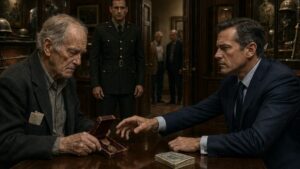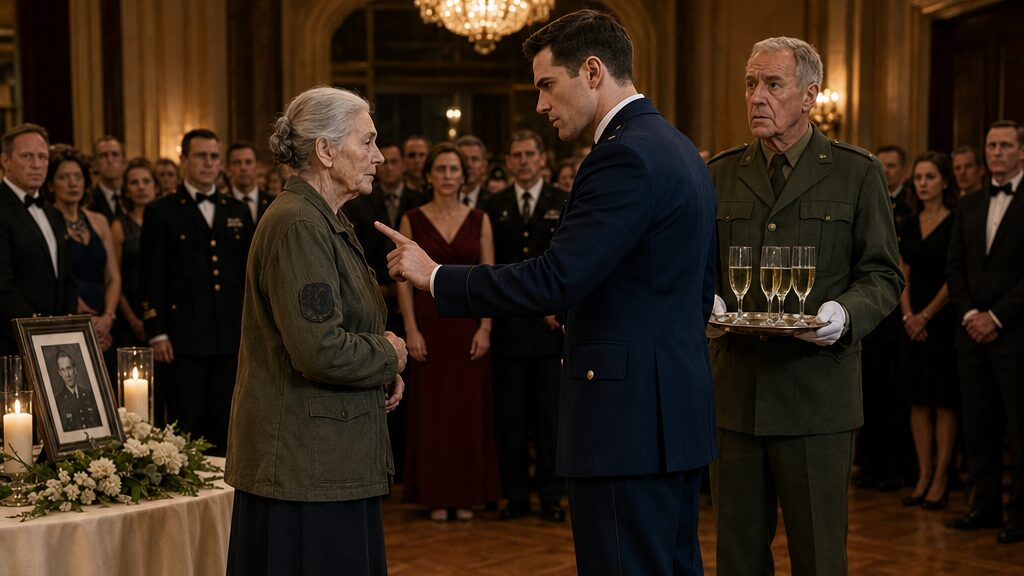
The Officer Pointed at Her Old Field Jacket Before He Learned Why She Kept Wearing It
Chapter 1: The Old Jacket at the Wrong Door
The sleeve patch caught on the brass handle before Ruth Walker could enter the banquet hall.
For one small second, the old field jacket held her back.
She stopped with her hand on the door, her thin fingers resting against the polished metal, and looked down at the dark patch on her left sleeve. The thread around its edge had loosened in two places. The cloth had faded almost to black, though once it had carried a deeper color. Under the hotel lights, it looked like a stain.
Behind her, someone cleared his throat.
Ruth eased the fabric free without tugging. She had learned, a long time ago, not to pull at things that were already worn. Buttons, bandages, tempers, memory. All of them came apart faster when handled roughly.
The ballroom doors stood open before her. Beyond them, the military association banquet glowed in gold and white. Round tables filled the room in neat rows, each covered in linen so bright it made her eyes narrow. Small flags stood in glass vases beside folded programs. Men in dark uniforms moved like polished pieces on a board. Women in evening dresses spoke softly beneath the hum of old patriotic music coming from hidden speakers.
Ruth looked down at herself.
Olive field jacket. Dark skirt. Low black shoes with soles she trusted. Hair pinned back without fuss. No ribbons. No medals. No name tag. Nothing in the room seemed to know what to do with her.
The young attendant at the check-in table watched her approach as if she might have wandered into the wrong building from a bus stop.
“Ma’am?” the attendant said.
Ruth gave her name quietly. “Ruth Walker.”
The attendant ran one finger down the printed guest list. Then again. She glanced toward Ruth’s jacket before looking back at the pages.
“I’m sorry. Could you repeat that?”
“Ruth Walker.”
The music swelled behind them, a string arrangement trying to sound noble without becoming too loud for conversation. Ruth held her small purse in both hands and waited. Waiting had never embarrassed her. It only embarrassed people who believed time belonged to them.
The attendant checked another page. “Are you with one of the families?”
Ruth’s eyes moved past the check-in table and into the hall. At the far side of the room, near a line of framed photographs and a folded display cloth, stood the memorial table. She could not read the card from here, but she knew whose picture would be centered there.
Andrew Clark.
The name had taken up space in her kitchen for three weeks, printed on the invitation she had not asked for and almost thrown away twice.
“No,” Ruth said. “I came alone.”
The attendant’s smile stiffened. “This evening is reserved. Veterans, registered guests, family members, invited donors, and association members.”
Ruth nodded as though the information were useful.
“Do you have an invitation?”
She opened her purse. Inside were a comb, a handkerchief, a folded envelope, and the invitation. The paper had softened where her thumb had pressed it over and over. She handed it across.
The attendant read it, then looked at the guest list again. “This says general memorial reception access. But the main dinner seating is sealed. I don’t see a seat assignment.”
“I don’t need dinner.”
The attendant did not seem to know where to put that answer. “Most guests are here for the program.”
“I need a minute at the table.”
Ruth said it with care. Not pleading. Not demanding. Just placing the words down where they belonged.
A man in a dark suit brushed past them, glanced once at Ruth’s jacket, then looked away with the quick politeness of someone avoiding a spill. Two uniformed officers entered behind him, laughing softly until they noticed the delay at the door. Their voices lowered.
The attendant leaned closer. “Ma’am, there’s a dress code tonight.”
Ruth looked at her.
“It’s not strict for family, of course,” the attendant added quickly. “But old service garments, unless part of the authorized display, need to be cleared.”
The words were careful, practiced, and too smooth to be cruel. Ruth had heard worse from people trying to be kind.
She folded the invitation back along its original crease. The edge trembled once between her fingers. Not from anger. Her hands did that now when she used them too long.
“This jacket won’t trouble anyone,” she said.
The attendant’s eyes went again to the patch. “It’s just that we’ve had issues before. People bring things. They want them placed on tables. Sometimes families object.”
Families.
Ruth’s thumb found the seam under the patch through the lining. The old cloth beneath the newer stitching was there, hidden against her wrist.
“I won’t put it on any table without permission,” she said.
The attendant hesitated, and that hesitation became a small wall.
Ruth turned slightly so she could see the memorial display better. A photograph had been placed on an easel near the far wall. A younger Andrew Clark looked out from beneath glass, his face not yet thinned by age, his jaw set in the fixed seriousness of formal military portraits. Beside it, candles burned in battery-powered cups. His name appeared in a silver frame.
For a moment, the ballroom dissolved behind Ruth’s eyes. Not fully. Memory no longer came in clean pictures. It came in pieces: a sleeve soaked at the cuff, a voice asking for water, the weight of a man who believed he was too heavy to be carried, the smell of dust and metal and boiled coffee gone cold.
Then the ballroom returned.
A photographer lifted his camera near the wall and caught the memorial table in a burst of light.
Ruth lowered her gaze.
“Ma’am,” the attendant said, more softly now, “maybe someone can escort you to a side seat after the opening remarks.”
“I don’t need a seat.”
“You can’t stand near the display during guest entry. The board is very particular about the flow tonight.”
Ruth almost smiled at the word flow. She had once guided stretchers through a hallway narrow enough to scrape skin from knuckles. Flow had meant keeping the living moving and making peace with what could not be moved.
“I’ll stand where you tell me,” she said. “After I go to the table.”
The attendant looked relieved by the obedience but not by the request. She turned her head toward the ballroom as if searching for someone with more authority.
Ruth remained by the threshold.
People continued to arrive. Their shoes made clean sounds against the floor. A woman in pearls leaned toward her companion and whispered something Ruth did not catch. A young enlisted staff member passed carrying folded napkins and looked at Ruth’s jacket with open curiosity before remembering not to stare.
No one asked her what the patch meant.
That was the thing about old cloth. People saw dirt before history. They saw age before service. They saw a woman standing alone and thought the story had already ended.
Ruth lifted her left hand and smoothed the patch once, not to display it, not to defend it, but to make sure the edge still lay flat. The gesture was small. Her fingers knew it too well. They had done it in hospital corridors, in rental rooms, outside funeral homes, in her own kitchen when the house went too quiet.
The attendant returned with another program in hand. “I’m going to check with protocol.”
“That’s all right.”
“If you’ll wait here.”
Ruth nodded.
But then the crowd shifted inside, opening a narrow view to the memorial table. There was the framed card. There was Andrew Clark’s name. There was space beside the photograph, an empty square of white cloth between a folded program and a small arrangement of white flowers.
Her breath changed.
She had not come to be seated. She had not come to eat chicken under chandeliers while men remembered only the clean parts. She had come because Andrew Clark was the last of them, and because some promises waited until the room was finally empty enough to hear them.
Ruth stepped past the check-in table.
The attendant made a startled sound. “Ma’am—”
“I’ll be quick.”
She did not hurry. Hurrying made people think they had caught you doing something wrong. She walked with the pace her knees allowed, one hand low by her side, the other brushing the seam of the jacket.
Inside the hall, conversations thinned around her. Faces turned. Not all at once, but enough. A few eyes dropped to the jacket. One man’s mouth tightened. Someone near the memorial table shifted a stand of programs away from the edge, as if Ruth might touch it.
She stopped three steps from Andrew Clark’s photograph.
The face in the frame was not the face she remembered. The face she remembered had been gray with dust, younger than it deserved to be, trying to apologize for bleeding on her sleeve.
Ruth reached into her purse.
“Ma’am.”
The voice came from her right. Firm. Young. Trained to carry across a room without sounding like shouting.
Ruth turned.
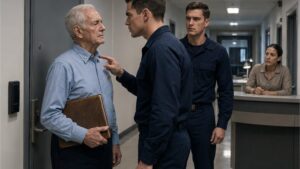
An officer in a dark blue dress uniform moved toward her from the side of the reception floor. He was tall, clean-shaven, with the clipped expression of someone who believed every problem had a correct lane. His nameplate caught the light: Green.
Patrick Green stopped in front of her and glanced first at her hand inside the purse, then at the patch on her sleeve.
“This area is restricted during reception entry,” he said.
Ruth withdrew her hand empty. “I understand.”
His eyes stayed on the jacket.
The room behind him continued to murmur, but Ruth felt the change. A question had found a uniform. Now it had authority.
Patrick Green stepped into her path and looked directly at the patch.
Chapter 2: When the Officer Pointed at Her Sleeve
Patrick Green did not raise his voice. That made the moment worse.
“Ma’am,” he said, “I need you to step away from the memorial table.”
Ruth stood with the table behind him, close enough now to see the silver frame and the printed card beneath Andrew Clark’s photograph. Retired Colonel Andrew Clark. Service. Leadership. Devotion. Words clean enough to polish.
“I only need a minute at the table,” she said.
Patrick’s face tightened in the way of a man trying to remain respectful while already deciding she was a problem.
“I’m not sure who cleared you to enter the reception floor, but personal items can’t be added to the memorial display without authorization.”
Ruth kept both hands in front of her. “I’m not adding anything.”
His eyes moved to her purse.
“Then what do you need from the table?”
The answer sat behind her ribs, old and heavy. She had carried it through winter mornings and summer heat, through doctor appointments, through nights when the house clicked and settled and she woke thinking someone had called her name.
Not here, she thought. Not like this.
“I need to stand there,” she said.
Patrick looked past her toward the check-in table. The attendant was speaking anxiously to Emily Taylor, the event coordinator, whose black folder was tucked against her chest like a shield. Emily’s eyes flashed from Ruth to the memorial display and back again.
Guests near the first two tables had stopped pretending not to watch.
Patrick lowered his voice. “Ma’am, this is a formal memorial event. That jacket is not part of tonight’s authorized display.”
Ruth felt the words touch the sleeve before his hand did.
He lifted one finger and pointed, not quite touching the dark patch.
“This patch especially,” he said. “Where did you get it?”
A small heat rose in Ruth’s throat. Not anger first. Shame came faster, though she had done nothing shameful. Age had made her easier to corner. People saw the white hair, the old shoes, the careful pause before answering, and they mistook patience for confusion.
Behind Patrick, a retired officer glanced at his wife. A younger man near the bar frowned at the patch as if trying to identify a counterfeit. Someone whispered, “Is she family?”
Ruth folded her hands over the cuff of the jacket.
Patrick waited.
“It was given to me,” she said.
“By whom?”
She looked at Andrew Clark’s photograph.
Patrick followed her gaze, then returned to the patch. “Colonel Clark’s family authorized only specific items for the display. If this belongs to the family, you can speak with the coordinator after the program. If it doesn’t, then I need you to step back.”
The words were not cruel. They were worse. They were reasonable enough for everyone around them to accept.
Ruth nodded once.
“I won’t disturb your program.”
“Our program isn’t the issue.”
“It usually is,” she said softly.
Patrick blinked. “Excuse me?”
Ruth did not repeat it.
Across the room, Frank Campbell moved through the reception floor with a silver tray balanced on one gloved hand. Champagne glasses trembled slightly as he walked, catching the chandelier light. He was older than most of the volunteers, his green uniform fitted too carefully across shoulders that had narrowed with time. His eyes had been on the room, making sure glasses were filled, chairs aligned, donors acknowledged.
Then he saw Ruth’s sleeve.
The tray dipped.
Ruth saw it before the glasses fell. Old training noticed weight shift, wrist failure, the half-second when a body forgot its task. Her own hand moved a little, uselessly, from too far away.
Glass struck the polished floor with a sharp, bright crash.
The music did not stop, but conversation did. Champagne spread in a pale fan across the wood. Broken stems rolled under a table. One of the guests gasped and lifted her dress hem.
Frank stood frozen, his white-gloved hand still open where the tray had been.
Patrick turned sharply. “Are you all right?”
Frank did not answer him. He was staring at the patch.
Emily Taylor hurried in from the check-in table. “Please don’t move. Everyone, just step back. We’ll get this cleaned.”
The hotel floor manager appeared with a towel. A junior staff member crouched near the glass, but Frank remained upright, eyes fixed on Ruth’s sleeve as if the room had tilted and only that patch told him where he stood.
Ruth lowered her hand over it again.
Patrick noticed.
“What is going on?” he asked, this time not to Ruth alone.
Frank swallowed. The sound seemed too dry for a man surrounded by spilled champagne.
“I’ve seen that,” he said.
Emily looked irritated. “Frank, are you hurt?”
He shook his head once. “Not here.”
Patrick stepped between Frank and Ruth, though not as aggressively now. “Seen what?”
Frank’s gaze moved from the patch to Ruth’s face. He searched her features the way men search old photographs, hoping time has left some doorway open.
“That mark,” Frank said. “Only once. In a casualty transfer record.”
The air around Ruth changed.
It did not become kind. It became uncertain.
Patrick’s finger lowered from the place where it had been pointing. His jaw moved as though he had prepared another official sentence and lost it before speaking.
Ruth looked at Frank. She did not know him. Not his face. Perhaps she knew his kind of face: men who had stood near supply trucks and manifest tables, men who had learned to count blankets, bodies, blood bags, missing boots, and then go home and be asked whether the event had gone well.
“It was a long time ago,” she said.
Frank’s eyes sharpened. “Then you know.”
Ruth said nothing.
Emily stepped closer, voice hushed but tense. “Know what?”
Frank’s face had gone pale beneath the ballroom lights. “That patch was not supposed to survive.”
Patrick looked from Frank to Ruth, and for the first time Ruth saw doubt enter his posture. It came in the slight straightening of his shoulders, the withdrawal of his hand, the small space he gave her without being asked.
But the room had already seen enough to make its own story.
An old woman in a questionable jacket. An officer correcting her. A tray breaking. A strange patch. A volunteer whispering like a ghost had entered the hall.
Ruth knew how fast a room could make use of a person.
Emily bent to the staff member cleaning glass. “Careful. Get all of it. We cannot have anyone slipping before the toast.” Then to Patrick, quietly: “Move this out of the reception area.”
“This?” Ruth asked.
Emily turned, startled by the calmness in Ruth’s voice.
Ruth did not look at her. She looked at Andrew Clark’s photograph. The young face behind glass. The empty square of cloth beside it.
Patrick spoke more softly. “Ma’am, maybe we should step into the corridor.”
“I told you,” Ruth said. “I only need a minute at the table.”
Frank made a small sound, not quite a breath, not quite a warning.
Patrick’s eyes dropped again to the patch, but he did not point this time.
Around them, guests shifted away from the broken glass. Some went back to their conversations too loudly. Others watched with the fixed attention people use when they want to witness a mistake without admitting they are part of it.
Ruth felt the floor beneath her shoes. Polished, hard, shining around the champagne spill. She had stood on worse floors. Floors that shook. Floors that stuck to the soles. Floors where people called for mothers, chaplains, water, morphine, God.
She folded her hands and waited for the young officer to decide what kind of man he wanted to be in the next ten seconds.
Patrick glanced toward Emily, then Frank, then Ruth.
“Please,” he said, no longer commanding. “Come with me for a moment.”
Ruth looked once more at the memorial table.
Andrew Clark smiled from the old photograph as if no one had ever carried him anywhere.
She nodded.
As Patrick guided her toward the side corridor, Frank bent slowly and picked up the fallen tray. His white gloves were wet with champagne. A small triangle of glass clung to the cuff.
He did not look away from Ruth’s sleeve.
When she passed him, he whispered, so low only Ruth and Patrick could hear, “That patch was not supposed to survive.”
Chapter 3: The Patch No One Put in the Program
Patrick Green had spent most of his adult life trusting the usefulness of rules.
Rules kept doorways clear. Rules kept families from fighting over display tables. Rules kept donors away from electrical cords, photographers out of restricted aisles, junior staff from guessing when they should ask. Rules gave shape to grief when grief arrived wearing too many faces.
But as he stood in the side corridor with Ruth Walker and Frank Campbell, he felt for the first time that evening that a rule had become a wall and he had been standing on the wrong side of it.
The corridor outside the banquet hall was narrow and carpeted in dark blue. Brass sconces cast warm circles along the wallpaper. Behind the closed doors, the reception had begun repairing itself. Music resumed. Glass was swept. Voices rose again, careful and bright.
Ruth stood near a service cart, hands folded, her old jacket catching none of the hallway’s polish. The patch on her sleeve seemed darker here. Less like cloth. More like a door.
Patrick held the event program in one hand. He had taken it from the registration table on the way out, needing something official to look at. Something printed. Something that would explain why an old woman had shaken a retired quartermaster more than broken glass had.
The cover showed Andrew Clark’s formal portrait beneath the association seal.
A Life of Service and Command.
Patrick opened it.
Emily Taylor came into the corridor with her black folder pressed tight to her ribs. “We have seven minutes before the opening remarks. Patrick, I need to know whether this is handled.”
“Give us a minute.”
“I gave you a minute on the floor, and now half the second table thinks there’s a security problem.”
“There isn’t.”
Emily’s eyes moved to Ruth, then to the jacket. “Then help me understand why a guest not listed for dinner crossed into the memorial area wearing an unverified military garment.”
Patrick heard the phrase as he might have used it ten minutes earlier. Unverified military garment. It sounded clean enough to hide behind.
Ruth did not react.
Frank stood a few steps away, holding the damp tray against his side. He had refused to sit down. A hotel staff member had offered him a towel; he had used it on the tray instead of his gloves.
“Frank,” Patrick said. “What did you mean?”
Frank looked at the closed ballroom doors. “Not here.”
“We’re already not in there.”
The older man’s mouth tightened. “That patch was from a temporary evacuation section. Field medical transfer. It wasn’t official in the way people like official things. No parade history. No clean unit plaque.”
Patrick looked down at the program. “Is it connected to Colonel Clark?”
Frank hesitated.
Ruth answered before he could. “Everything tonight seems to be connected to Colonel Clark.”
Her voice held no bitterness. That made Patrick feel worse.
Emily opened her folder. “The memorial materials were approved by the family and the board. Colonel Clark’s record is well documented.”
“Not all of it,” Frank said.
Emily’s expression sharpened. “Frank.”
“I handled archived supply donations for the association years ago,” Frank said. “Old boxes came in. Unit newsletters. transfer notes. casualty paperwork that should’ve gone somewhere better. There was a photocopy with that mark on it.” He nodded toward Ruth’s sleeve. “Dark patch. Rough edges. Hand-sewn. I remember because somebody had written beside it, ‘Do not list.’”
Patrick looked at Ruth.
Her eyes were lowered to the program in his hand.
He turned a page. Andrew Clark’s biography filled two columns. Academy years. Command assignments. Advisory boards. Decorations listed with commas between them. Survived injuries during overseas field evacuation, later returned to duty.
That was all.
One phrase for the injury. One phrase for the survival.
Patrick felt the program grow heavier.
“There’s no mention of evacuation staff,” he said.
Emily’s voice cooled. “This is a memorial program, not a full personnel history.”
Ruth’s fingers moved once over the cuff of her jacket.
Patrick saw it this time not as a suspicious gesture, but as a person checking whether something precious remained in place.
“Mrs. Walker,” he said, then corrected himself. “Ms. Walker. Are you a veteran?”
Emily closed her eyes briefly, as if he had asked the one question that would complicate everything.
Ruth lifted her face.
“Yes.”
The answer should have solved something. Instead it opened the corridor wider.
Patrick waited for more. Rank, branch, dates, proof. She gave him none.
“Do you have identification?”
Ruth looked at him for a long moment.
The shame struck him before she spoke. He heard the question as she must have heard it: after the pointing, after the public staring, after the crash, after being led out like a problem.
“I have my driver’s license,” she said.
“That’s not what I meant.”
“I know.”
Frank lowered his gaze.
Patrick looked away first.
From inside the ballroom came a burst of laughter, too large for whatever had caused it. The sound made the corridor feel like a place where truth had been asked to wait until dessert.
Emily stepped closer to Patrick and lowered her voice. “We cannot let an unverified claim disrupt the program. If she is a veteran, we can absolutely make arrangements after dinner. But not at the memorial table right now.”
Ruth’s eyes moved to the doors.
“I don’t need arrangements.”
Patrick still held the program open. He scanned the page again, searching for any mention that might match Frank’s memory. Nothing. The text was complete in the way official things were complete: it said what it intended and left no space for what it had chosen not to carry.
“Why tonight?” Patrick asked.
Ruth did not answer immediately.
Frank shifted. “Colonel Clark was the last?”
Her stillness changed. Barely. But Patrick saw it.
Ruth looked at Frank, and something passed between them that left Patrick outside the room though he stood beside them.
“The last I knew of,” she said.
Emily frowned. “The last what?”
Ruth reached into her purse slowly enough that no one could mistake the motion. Patrick hated that he noticed his own body preparing to stop her. She withdrew the folded invitation and held it in both hands.
“It came three weeks ago,” she said. “I thought someone had made a mistake.”
Patrick looked at the envelope. Her name and address had been printed on a label. No title. No veteran designation. Just Ruth Walker.
“Who sent it?” he asked.
“The association.”
Emily took a half step forward. “We mailed several courtesy invitations from archival donor lists and prior contact records. It doesn’t mean—”
Ruth folded the invitation again and returned it to her purse.
“It means someone had my name in a box,” she said.
The sentence quieted the hallway.
Patrick looked again at the program. Andrew Clark’s portrait smiled without complication. The page had no room for boxes, omissions, unlisted nurses, or patches that were not supposed to survive.
“Ms. Walker,” Patrick said, carefully now, “what do you want to do?”
Emily gave him a sharp look.
Ruth’s hand came to rest over the dark patch. Not hiding it this time. Holding it.
“I want to leave it at the table before the last toast.”
Frank’s damp glove tightened around the tray.
Patrick heard the word leave and understood, suddenly, that the jacket itself was not the offering. Something about the patch was.
Emily spoke before he could. “That is not possible without approval.”
Ruth nodded, accepting the refusal as if she had expected nothing else.
Patrick looked at Emily. “Can we check the archive materials?”
“Now?”
“Yes.”
“The opening remarks are starting.”
“Then delay me, not her.”
Emily stared at him. “Patrick, this is not how the evening is scheduled.”
“No,” he said, looking at the broken shine of champagne still drying on Frank’s glove. “I don’t think it is.”
Ruth watched him, not grateful, not relieved. Only watchful.
That steadied him more than praise would have.
He closed the program and held it at his side. “Ms. Walker, would you be willing to wait here while we look?”
“I’ve been willing to wait most of my life,” Ruth said.
There was no accusation in it.
That was why it landed.
Behind them, through the ballroom doors, a microphone tapped twice. A voice asked the guests to begin finding their seats.
Ruth turned toward the sound, toward Andrew Clark’s memorial table hidden beyond wood and music and polished glass.
Patrick expected her to ask for entry. Instead she looked at him with the same quietness she had carried since the door.
“Just before the last toast,” she said. “That’s all I’m asking.”
Then she touched the patch again, as if reminding it to hold a little longer.
Chapter 4: The Name Missing from the Memorial Toast
Frank Campbell had never liked storage rooms at banquets.
They were where the shine went to be stacked and forgotten. Spare chairs leaned against the wall. Boxes of programs sat under folding tables. Extension cords curled like sleeping snakes beside plastic bins labeled with years nobody had opened in a long time. The air smelled faintly of dust, cardboard, and hotel carpet cleaner.
He stood in the doorway for a moment, still holding the damp tray, listening to the muffled life of the banquet beyond the wall.
A microphone tapped. A chair scraped. Someone laughed softly, then stopped. The evening was continuing because evenings like this always continued. A glass could break. An old woman could be led from a memorial table. A name could be missing for decades. Still, the salad would be served at the proper time.
Patrick Green came in behind him with the program folded under one arm. Emily Taylor followed, moving faster than both men, her black folder open and her phone already in her hand.
“We do not have time to dig through archive boxes,” she said.
Frank set the tray on a metal shelf. The wet circle it left behind spread silently.
“We have time,” he said.
Emily looked at him as if he had forgotten who was in charge of the schedule. “Frank, the board chair is waiting at the podium.”
“Then he can wait at the podium.”
Patrick shut the door halfway, not all the way. Through the gap came the low swell of the banquet hall, controlled and ceremonial.
Emily lowered her voice. “You know how this looks?”
Frank turned toward her.
For most of his life, people had mistaken his quiet for agreement. It had been useful in supply work. Men said things near a quartermaster because they forgot he was counting more than towels and boots. He had heard blame shifted, records softened, names misspelled, losses made tidy. He had learned to put his hands on the thing that remained and keep it from vanishing.
“I know exactly how it looks,” he said. “That’s what concerns me.”
Patrick moved to the rows of boxes stacked beneath a table. “Where would old transfer records be?”
Emily pressed her lips together. “Most of the real archives are offsite. What’s here is event material, donor history, old programs, display copies.”
“Then we start there.”
“This is not an investigation.”
Patrick looked at her. “No. It’s a correction.”
Emily closed the folder. “A correction requires facts.”
Frank bent stiffly and pulled out the first box. His knees gave a small complaint, which he ignored. The label read CLARK MEMORIAL MATERIALS / PROGRAM DRAFTS / PHOTO RELEASES.
“That one,” he said.
Patrick crouched beside him and lifted the lid. Inside were folders, plastic sleeves, old photocopies, and a stack of unused name cards bound with a rubber band. Emily hovered at first, then gave in with a sharp breath and knelt on the other side, sorting with the efficient irritation of someone determined to prove there was nothing to find.
Frank took the folders slowly.
His hands were not as steady as they had been. The white gloves made the papers harder to feel. He pulled one off with his teeth and tucked it into his belt, then turned pages with bare fingers.
The patch had opened a room inside him he had kept locked without knowing it. Dark cloth. Rough border. Hand-sewn. He had seen it on a bad photocopy years before, one of those documents passed to the association by a widow cleaning out a garage. He remembered a scribble in the margin because it had annoyed him at the time.
Do not list.
Not classified. Not destroyed. Not corrected.
Do not list.
“What exactly are we looking for?” Patrick asked.
Frank did not answer at once. He found a copy of Andrew Clark’s official biography, then an older draft with several lines crossed out in blue pen. The same words appeared in every version. Injured during field evacuation. Returned to duty after recovery.
“Something that doesn’t want to be found,” Frank said.
Emily made a soft sound of disbelief but continued sorting.
A knock came at the door. A junior staff member leaned in. “Ms. Taylor? They’re asking if we should start seating for the first toast.”
Emily glanced at Patrick. “Tell them two minutes.”
The staff member disappeared.
Patrick lifted a binder from the box. “Field notes?”
“Display research,” Emily said. “We gathered material from multiple sources for the memorial table.”
Frank took the binder from Patrick and opened it. Photocopies slid loose. He caught them before they fell. Old letterhead. Association intake forms. A grainy image of Andrew Clark in a hospital bed, younger than the photograph in the ballroom but older than any boy should look when trying not to be afraid.
Frank’s breathing changed.
Patrick noticed. “What?”
Frank laid the photograph on the table. “That’s him after.”
Emily leaned in despite herself.
The image showed Andrew Clark sitting upright, one arm wrapped, his face gaunt. Beside the bed stood a blurred figure whose head had been cut off by the copy machine. Only the body remained: plain fatigues, rolled sleeves, one hand resting against the rail, a dark patch visible near the left shoulder.
Patrick went still.
Emily whispered, “That could be anyone.”
Frank did not look at her. “Yes.”
He turned another page.
The next document was pale, the old type broken in places. TRANSFER SUMMARY. TEMP FIELD EVAC SECTION. Names appeared in columns, some legible, some reduced by poor copying to gray scars. Andrew Clark’s name had been circled. Beside the circle, in handwriting, someone had written: survived transport.
Below, another line had been half-covered by a black copying streak.
Assisted by unnamed nurse and two litter staff.
Patrick read it twice.
“Unnamed,” he said.
Frank felt the word settle in the room like dust.
Emily reached for the page. “This doesn’t identify Ms. Walker.”
“No,” Frank said. “It identifies the hole.”
He turned the page again, more carefully now.
There it was.
A smaller photocopy, almost swallowed by the binder pocket. A rough drawing or copied mark, dark and uneven. Beside it, in blue ink faded nearly gray, were the words Frank had carried unknowingly for years.
Patch not entered on official display. Do not list. Returned items unverified.
Below that, another note, written in different handwriting.
Nurse kept one.
Frank sat back on his heels.
The storage room seemed to shrink around him.
Patrick took the page carefully. “Nurse kept one.”
Emily’s face had lost some of its professional color. She looked toward the door, toward the ballroom where Andrew Clark’s memorial card stood clean and complete.
“Why would it say do not list?” Patrick asked.
Frank rubbed his bare fingers together. Paper dust clung to his skin.
“Sometimes because somebody didn’t know what it was,” he said. “Sometimes because somebody knew exactly what it was and didn’t want another question.”
Patrick looked at the photocopied patch. “Could it be unauthorized?”
Frank gave a tired half-smile. “Son, half the things that kept people alive were unauthorized until someone needed them.”
Emily flinched at the word son, though Patrick did not.
The microphone sounded again from the hall, louder now. A voice thanked everyone for attending. The first formal welcome had begun without them.
Emily stood abruptly. “I have to go.”
Patrick rose. “Emily.”
“No, I have to go because two hundred people are out there, and the chair cannot keep looking at an empty doorway.” She gathered herself, but her eyes went back to the page. “Bring me something stronger than this before you ask me to alter a memorial display in front of Colonel Clark’s family.”
Frank looked at her carefully. “Is the family here?”
Emily hesitated. “Distant relatives. Association board. Former command staff. People who funded the memorial scholarship.”
“So not the people who carried him.”
The words left Frank before he could soften them.
Emily’s mouth tightened, but she did not answer. She opened the door. Banquet sound poured in: applause, silverware, the chair’s polished voice rolling over the room. Then she closed it behind her.
Patrick remained with the photocopy in his hand.
Frank leaned against the table. For a moment, he was very aware of his age. The ache in his hips. The stiffness of his fingers. The wet cuff where champagne had soaked through. He thought of Ruth standing alone in the corridor, not asking to be believed. Not offering proof like a ticket.
“Do you know her?” Patrick asked.
Frank shook his head. “No.”
“But you believe her.”
Frank looked at the storage shelves, the boxes, the neat labels pretending history stayed where people put it.
“I believe the way she touched that patch,” he said.
Patrick absorbed that without speaking.
From the hall came the words Distinguished service, then sacrifice, then legacy. Each one rounded and warm through the wall.
Frank picked up the old transfer note again. Assisted by unnamed nurse and two litter staff.
Unnamed. That was the kind of word people used when they were too far away to hear someone breathing.
“She didn’t come to make trouble,” Frank said.
Patrick looked toward the corridor. “Then why won’t she just say what happened?”
Frank slid the photocopy back into the binder sleeve. “Maybe because saying it makes it belong to them.”
Patrick frowned.
Frank nodded toward the ballroom. “The room. The program. The people who decide what sounds good in a toast.”
A long silence held.
Then Patrick folded the photocopy once, carefully, and placed it inside the program.
Frank reached for the box lid but stopped when he saw something else at the bottom: an unused display card, blank except for the association seal at the top. Clean, heavy paper. Waiting for a name.
He touched its edge.
The door opened again before he could lift it.
Emily stood there, face controlled, voice too calm. “They’re beginning the memorial toast.”
Patrick turned at once. “Already?”
“The chair moved it forward. He wants to regain the room.”
Frank looked past her into the corridor.
Ruth was not visible from where he stood.
Emily’s eyes flicked once to the paper in Patrick’s hand. “If Ms. Walker wants to attend, she needs to take a seat now. If she doesn’t, we cannot hold the program for her.”
Frank heard the old machine turning. The schedule. The donors. The clean line of the evening moving forward over anything left on the floor.
He picked up the blank display card and held it flat against his chest.
For the first time that night, he understood Ruth’s silence not as uncertainty, but as discipline.
She had not come to interrupt their ceremony.
She had come to finish something before they sealed it wrong again.
Chapter 5: The Toast Given Before the Truth
Ruth heard Andrew Clark’s name through the closed door.
It came softened by wood and distance, carried on the banquet chair’s careful voice. The syllables reached her in the corridor like something wrapped in cloth.
Andrew Clark.
The name had changed over the years. In official letters it had been formal. In newspaper clippings it had been honorable. In the invitation it had been printed under a gold association seal. But the first time Ruth had heard it, it had been shouted from the far end of a dim hallway filled with dust, smoke, and men trying not to die loudly.
Clark! Keep him awake!
She sat on a narrow bench near the service corridor, her purse in her lap, her hands folded over it. A hotel worker had offered her a chair in a small waiting alcove. Ruth had chosen the bench because it let her face the ballroom doors.
Her knees ached. Her back had begun its low burning complaint. She ignored both. Pain, if listened to too closely, became greedy.
The old jacket lay heavy on her shoulders.
Through the door, the chair spoke of Colonel Clark’s courage, leadership, and distinguished recovery after injury. A pause followed each phrase, leaving space for agreement. Ruth could picture the room: heads bowed at the correct angle, glasses lifted slightly but not yet raised, programs open on laps, the memorial photograph catching candlelight.
She had wanted only one minute before all of that.
The door opened a little. A server slipped out carrying an empty tray. The sound of the toast grew clearer.
“Many men would not have returned from such wounds,” the chair was saying. “But Colonel Clark’s strength of will carried him forward.”
Ruth looked down at her hands.
Strength of will. Yes, Andrew had that. He had clenched his teeth until blood darkened one corner of his mouth. He had apologized every time the litter dipped. He had tried to lift his own weight when there was no strength left to lift. But will did not carry a man through a broken route. Hands did. Shoulders did. Straps did. Two litter bearers too young to grow old did. A nurse with one sleeve torn open and no time to be afraid did.
The server let the door close.
Ruth breathed in through her nose and out slowly.
On the carpet near the wall, a tiny piece of glass glittered beneath the sconce light. The cleanup crew had missed it. It was no larger than a fingernail clipping, a curved sliver from one of the champagne stems. Ruth leaned forward, then stopped. If she bent too far, she might not rise gracefully, and she had already given the room enough reason to misunderstand her body.
So she watched the glass catch the light each time someone passed.
A door opened down the corridor. Patrick stepped out from the storage area with Frank behind him. Patrick held the evening program differently now, as if it contained something fragile instead of printed ceremony.
He saw Ruth and slowed.
Frank remained farther back, his face drawn. He did not rush toward her. Ruth appreciated that. Men who rushed with concern often made a wound feel public before it needed to be.
Patrick came to the bench. “Ms. Walker.”
The toast continued inside.
Ruth listened past him.
“His life reminds us,” the chair said, “that service does not end when the battle is over. It continues in leadership, community, and example.”
Patrick’s jaw tightened.
Ruth looked at him. “You found something.”
He lowered himself slightly, not sitting, not towering. “Not enough.”
“That is often what gets found.”
He glanced toward the ballroom doors. “There’s a transfer note. It mentions an unnamed nurse.”
Ruth’s expression did not change.
Frank looked down.
Patrick continued, more quietly. “And a note about the patch. It says a nurse kept one.”
Ruth’s fingers closed around the purse clasp.
Not fear. Not surprise. Something older moved through her hand, a pressure from a promise made when promises were easier to speak because no one knew how long they would last.
Inside the hall, applause rose gently.
“Would you like to come in?” Patrick asked.
Ruth turned her head toward the doors.
The question was not cruel. It was not enough either.
If she entered now, she would do so under his permission, after being removed. If she interrupted, the room would hear an old woman correcting the dead in front of people who had come to feel noble. If she left, the patch would remain where it had always been: close to her body, hidden under years, known only in fragments.
The applause faded.
“I was already in,” she said.
Patrick lowered his eyes.
Frank moved closer. “Ms. Walker, the note doesn’t name you. But I remember the mark. I remember thinking someone should have asked more.”
Ruth looked at him with something near kindness. “Most people think that later.”
He accepted it.
The ballroom doors opened wide enough for Emily to step out. Her face held the strain of someone trying to manage three emergencies while smiling in one of them. She closed the door quickly behind her.
“They’re moving from the memorial toast into the scholarship announcement,” she said. “If anything is going to be adjusted, it cannot happen in the next few minutes.”
Patrick said, “The program omits the evacuation staff.”
Emily’s eyes flashed to Ruth, then back to him. “The program is already printed.”
Frank held up the blank display card. “This isn’t.”
Emily’s mouth opened, then closed.
Ruth watched the card in Frank’s hand. Heavy white stock. Association seal. No name. No sentence. No mistake yet.
Her chest tightened in a way she disliked. Hope, at her age, needed watching. It could make a person careless.
Emily looked at Ruth. Not at the jacket this time. At Ruth.
“Can you tell me what should be written?” she asked.
Ruth felt Patrick still beside her.
The corridor seemed to wait.
She could have said the names. Not all, but some. She could have said what the hallway looked like, how Andrew Clark’s boots dragged once they lost the second strap, how the first boy on the litter had whispered a prayer without moving his lips, how the second had kept counting steps until the counting stopped. She could have said that the patch had been cut from a torn sleeve by hands that shook only after the last transport left.
Instead she looked down at her own sleeve.
“No,” she said.
Emily’s face fell slightly, though she tried to hide it.
Patrick said, “Ms. Walker—”
“I said no because you’re asking for a sentence before you know the cost of it.”
The words were quiet. They did not echo. But all three of them heard the door close inside them.
Ruth rose carefully from the bench.
Patrick stepped forward as if to help, then stopped before touching her. That, at least, he had learned.
She stood with her back straight enough. The tiny glass sliver on the carpet shone near her shoe.
“I should go,” she said.
Frank’s voice was rough. “Before the last toast?”
She did not answer.
From inside the hall, the chair’s voice brightened. The scholarship announcement had begun. Young people. Future service. Legacy continued. Good phrases, all of them. Good phrases had their place. Ruth had seen men die asking for ordinary things instead: a cigarette, a letter mailed, a mother told, a brother forgiven.
Patrick stepped into her path, not as he had before. There was no command in him now. Only a question he had not earned the right to ask and knew it.
“Were you the nurse?”
Ruth looked at him.
For a moment, the corridor vanished and he was not Patrick Green, not a young officer in polished blue, not the man who had pointed at her sleeve in front of a room. He was simply someone standing at the edge of a thing too large to enter carelessly.
Ruth could have spared him. She could have said no. She could have left him with paperwork and doubt.
Instead she gave him one piece.
“One of them,” she said.
Patrick’s face changed.
Not dramatically. No collapse. No grand shame. Just the small, visible rearrangement of a man whose certainty had lost its footing.
Emily pressed the blank display card against her folder.
Frank closed his eyes once.
Ruth looked toward the ballroom doors. Beyond them, Andrew Clark’s name continued its polished journey through the evening without the weight that had carried it there.
“I was not the only one,” she said. “That is the part people keep losing.”
She moved toward the exit at the far end of the corridor. Her steps were slow but steady. The jacket shifted softly around her shoulders.
Patrick let her pass for three steps.
Then he followed.
Not close enough to guide her. Not close enough to stop her.
Only close enough to ask, when she reached the bend before the lobby, “Ms. Walker, please. What do you want us to do?”
Ruth stopped beneath a wall sconce. Its light touched the white in her hair and the dark patch on her sleeve.
The answer came from a place in her older than grief.
“Put the table right,” she said.
Patrick looked toward the hall, then back to her.
Ruth’s hand came to rest over the patch.
“Not me,” she added.
Chapter 6: The Promise Sewn Under the Dark Patch
The service corridor behind the ballroom was quiet enough for Ruth to hear the old thread give way.
Not all at once. Just a small, dry sound beneath her fingers as she worked at the inside seam of the jacket.
Patrick stood several feet away, turned slightly aside to give her privacy while failing, because there was no true privacy in a hotel corridor with banquet music leaking through the walls. Frank waited near the corner holding the blank display card. Emily had gone back into the hall, not because she wanted to, Ruth thought, but because the evening would fall apart without someone telling it where to stand.
Ruth sat on a wooden chair borrowed from the service alcove. It was plain and stackable, with scratches along the legs. She preferred it to the cushioned banquet seats. Those were designed to make discomfort invisible.
Patrick’s voice was low. “You don’t have to do this here.”
Ruth kept her eyes on the seam. “No. I don’t.”
He understood enough not to answer.
Her fingers were slow, but they knew the place. Inside the left sleeve, near the lining, there was a narrow fold of cloth that had been restitched more than once. The jacket itself had not been hers at first. That was the part no one had asked correctly. They had asked where she got it as though possession were theft unless a record approved it.
She slipped one finger under the loosened thread.
The seam opened a little.
Patrick looked, then looked away again.
Ruth almost smiled. “You can watch. It won’t bite.”
His face colored faintly. “I didn’t want to be disrespectful.”
“You already were.”
The words landed cleanly, without cruelty.
Patrick stood very still. “Yes, ma’am.”
Ruth paused. Ma’am had sounded different that time. Not automatic. Not a lid placed over an old woman’s name.
She drew from the lining a narrow piece of cloth backing, folded twice and flattened by years against her arm. It had once held the underside of the dark patch. Faded thread clung to it in uneven lines. On the back, in pencil almost worn away, were initials and a date.
Frank leaned forward despite himself.
Ruth held the cloth in her palm.
“This was not made by command,” she said. “That bothered people later. At the time, nobody cared what was official. We needed to know who could move wounded men through a route that kept changing.”
Patrick listened without reaching for the cloth.
“There were nurses, drivers, litter teams, two radio men, a cook who had better hands than half the medics, and whoever else could still stand.” Ruth touched the edge of the backing. “Someone cut cloth from ruined sleeves. Someone else marked them dark so we could see each other through smoke and dust. It was not a unit in the way your program would like.”
Frank swallowed. “Temporary field evacuation section.”
“That’s what they called it when they had to file something.”
From the ballroom came another wave of applause, distant and well behaved.
Ruth looked toward the sound. “We didn’t call it much of anything.”
Patrick’s hands hung at his sides. He seemed younger now than he had when he pointed at her. Not weaker. Just younger. There was room in him for uncertainty, and uncertainty had taken the shine off his certainty.
“Andrew Clark was one of the wounded?” he asked.
“One of many.”
“But you came for his table.”
Ruth nodded. “Because he was the last one I knew how to find.”
She unfolded the cloth backing. The pencil marks showed more clearly beneath the corridor light. A.C. was not there. Patrick noticed and frowned.
Ruth saw the question before he asked it.
“It wasn’t Andrew’s,” she said.
Frank’s breath caught.
Ruth kept the cloth steady. “It belonged to a litter man. He was younger than you.” She glanced at Patrick. “Strong enough to lift two ends when the rest of us were failing. Foolish enough to smile with blood on his teeth so the wounded wouldn’t panic.”
Patrick’s eyes lowered.
“He gave you the patch?”
“Not like a ceremony.” Ruth’s thumb moved over the pencil. “His sleeve tore when we pulled Clark over a broken threshold. Later, after we got them loaded, he cut the patch loose and put it in my hand. Said if records got cleaned up, at least one dirty piece should stay dirty.”
The corridor held the words.
Frank sat slowly on an overturned crate. The blank display card rested on his knees.
“What happened to him?” Patrick asked.
Ruth folded the backing once, then unfolded it again. Delay was not avoidance. Sometimes the body needed a second before opening a door.
“He went back for the second group.”
No one spoke.
The music beyond the wall shifted into something softer, strings rising beneath the murmur of dinner service.
Ruth looked down at the jacket. “By morning, the route had been written as successful. The list of wounded transferred was sent forward. The dead were handled elsewhere. The temporary section was described in one line because one line was easier to carry.”
Patrick’s voice was barely above the hum of the lights. “And the patch was excluded.”
“Unofficial items complicate official gratitude.”
Frank’s face tightened at that. He had lived long enough among warehouses, donation boxes, and archive labels to recognize the sentence as true.
Ruth folded the backing and placed it on her knee. “Years later, Andrew Clark wrote me once. Not a long letter. He said he remembered being told not to sleep. He remembered a woman’s hand on the rail. He remembered someone saying he was not allowed to die because he was too heavy to move twice.”
A faint smile touched her mouth, then left.
Patrick did not smile. He knew better.
“He asked if I had kept the patch,” Ruth said. “I told him yes. He said if he outlived the others, I should bring it when there was finally a table for all that had been left out. I didn’t promise to speak. I promised to bring it.”
Frank looked at the blank card. “And now he’s gone.”
“Now he’s gone.”
Patrick took one slow breath. “Why not tell them in there?”
Ruth looked at him fully.
For the first time that night, Patrick did not seem to brace himself against her answer. He received the look without armor.
“Because rooms like that know how to swallow a person,” she said. “They would stand. They would say kind things. Someone would ask for a photograph. Someone would call me a hero because it is easier than asking who else was not named. By tomorrow, the story would be about the old nurse at the banquet.”
Her fingers closed over the cloth backing.
“That is not why I came.”
Patrick’s face shifted with pain he had no right to display loudly.
“I’m sorry,” he said.
Ruth looked back at the seam. “For which part?”
He opened his mouth, then stopped.
Good, she thought. Let him count.
“For pointing at you,” he said after a moment. “For assuming. For asking for proof before asking why you were there. For moving you out of the room like the room mattered more than you did.”
Ruth listened.
Apologies were strange things. Some people used them to wash their hands. Others used them to open them.
She held out the cloth backing.
Patrick did not take it immediately.
“It isn’t for you,” Ruth said. “It’s for the table.”
He nodded once, then accepted it with both hands. The carefulness in the gesture made Frank look away.
Ruth reached to the sleeve again. The dark patch itself remained attached outside, though loosened now by the work beneath. She pressed around its edge until she found the old hidden stitch. Her fingers struggled. Patrick took half a step forward, then stopped.
Ruth glanced at him. “You may help if you can do it without taking over.”
He came closer.
She guided his hand to the thread. His fingers were young, precise, and nervous. Together they loosened the last stitch. The patch lifted from the sleeve with a soft tear of old cloth separating from old cloth.
Without it, the jacket looked suddenly bare.
Ruth felt the absence along her arm like a change in temperature.
Patrick held the patch in his palm. Dark, rough, almost weightless.
“I thought it was just unauthorized,” he said.
“It was,” Ruth said.
Frank gave a quiet, broken laugh, then covered his mouth.
Ruth looked at the jacket sleeve. A darker square remained where the patch had been, protected from years of light and weather. Proof not of rank, not of display, but of how long a thing had been carried.
Emily appeared at the corridor entrance, slightly breathless. Her expression changed when she saw the bare sleeve and the patch in Patrick’s hand.
“The final memorial acknowledgment is after dessert,” she said. “I can still change the table card.”
Frank stood, holding up the blank card.
Emily came forward slowly. “What should it say?”
Patrick looked at Ruth.
This time he did not speak for her.
Ruth rose from the chair. The jacket hung differently now. Lighter, and somehow more exposed.
She looked at the patch, then at the blank card, then toward the ballroom where Andrew Clark’s photograph waited under warm light among words that were not yet whole.
“Not my name,” she said.
Emily nodded, pen ready.
Ruth’s voice remained steady.
“Unlisted nurses and evacuation staff.”
Emily wrote it down.
Patrick watched the words appear, each one smaller than what it carried.
Ruth touched the bare square on her sleeve.
Frank cleared his throat. “Ms. Walker, would you like to place it yourself?”
The question trembled because everyone in the corridor understood that it was not about placement.
Ruth looked toward the hall.
“No announcement,” she said.
Emily nodded. “No announcement.”
“No photograph.”
Patrick said, “No photograph.”
“No one stops the toast to look at me.”
Frank held the card carefully by its edges. “No one stops the toast.”
Ruth took the patch back from Patrick.
For a second, she felt again the young litter man pressing it into her hand, his grin too tired to be brave, his voice telling her one dirty piece should stay dirty.
She closed her fingers around it.
Then she looked at Patrick Green, the officer who had pointed, and the man still standing there after learning why pointing had not been enough.
“Put the table right,” she said.
Her voice was calm.
“Not me.”
Chapter 7: The Table Set Right Without Applause
The ballroom had dimmed for dessert.
Small candles glowed along the tables, and the guests leaned toward one another in the softer hour of the evening, when speeches had begun to loosen and coffee cups replaced raised glasses. From the service corridor, Ruth watched the room through the narrow opening between two doors.
No one was looking for her now.
That was easier.
Patrick stood beside her, holding the dark patch in both hands. Frank held the corrected display card flat against a program binder so the ink would not smear. Emily waited with them, one hand on the door, listening for the right moment in the program.
Ruth had put the jacket back on after removing the patch. The bare square on the sleeve looked darker than the rest of the cloth, a shadow where the patch had protected it from years of sun, rain, and washing. She had expected to feel lighter. Instead, the jacket felt strange against her arm, as if a familiar weight had shifted from cloth to skin.
Inside the ballroom, the board chair announced the final memorial acknowledgment.
Emily looked at Ruth. “Now.”
Ruth did not move.
Patrick saw it and did not hurry her. That mattered more than he knew.
The memorial table waited near the far wall. Andrew Clark’s photograph stood between two small lamps, his formal portrait glowing behind glass. The original display card remained in front of it, bright and complete in its incompleteness. Around the table were flowers, a folded program, and a small empty space where Ruth had wanted to stand hours before.
The space was still there.
She took one step into the ballroom.
The nearest guests did not notice at first. A server passed with a tray of coffee cups. Someone laughed softly near the back. A spoon chimed against porcelain. The world did not stop because Ruth Walker entered it. She had known that all her life.
Then Patrick moved ahead of her.
Not too far. Just enough to clear the narrow route past the first table. He did not announce her. He did not touch her elbow. He only shifted his body so a chair did not block her path, then stood aside.
Ruth walked slowly.
Each step brought back the earlier walk across the same floor: the glances, the whisper, Patrick’s finger near her sleeve, the crash of glass. She saw the place where the tray had fallen. The floor had been cleaned so well that no mark remained. That was the trouble with polished rooms. They could make a break disappear before anyone understood what had shattered.
Frank came behind her with the corrected card. Emily followed him, her black folder tucked under one arm, her face pale but steady.
The board chair was speaking at the podium, his voice warm and practiced.
“Colonel Clark’s legacy continues not only in memory, but in the young people inspired by his service—”
Patrick paused near the edge of the memorial table and looked at Ruth.
Her choice.
She appreciated that he knew it now.
Ruth stepped to Andrew Clark’s photograph.
The face in the frame looked younger than the man who had written her the letter. Younger than the voice that had once whispered, Don’t let me sleep, ma’am, then apologized for saying ma’am because she could not have been much older than twenty-five. Younger than the old colonel who had written in careful blue ink that some debts could not be paid, only carried honestly.
Ruth took the patch from Patrick.
For a moment, it lay in her palm, small and dark and almost shapeless. It did not look like much. A torn piece of cloth. Rough stitching. No shine. No ribbon. No polished brass. Nothing a room like this had been taught to recognize.
Her fingers closed around it once.
Then she placed it beside Andrew Clark’s photograph.
Not in front of his face. Not over his name. Beside him.
Frank set the corrected display card beneath it.
Unlisted Nurses and Evacuation Staff
The words were simple. Too small for what they carried. But they were there.
Emily removed the old card without ceremony and slid the new one into place. Her hand trembled only once. She caught herself and squared the card with the edge of the table.
The board chair continued speaking, unaware of the correction happening behind his own polished words.
Ruth looked at the new card.
The old ache in her chest did not vanish. She had not expected it to. Grief was not a stain that lifted when the right sentence was written. But something loosened. Not enough to be joy. Enough to be breath.
Patrick stood near her right shoulder, silent.
A guest at the nearest table noticed the change. His eyes moved from Ruth’s bare sleeve to the patch on the table. He leaned toward the woman beside him. She looked too, then lowered her voice. A small ripple began, not applause, not recognition, only attention trying to understand what had appeared in the empty space.
Ruth felt it starting and turned slightly away.
Patrick noticed.
He stepped into the line of sight, blocking the nearest table’s view of her without making it obvious. Frank moved to the other side of the table and adjusted the flowers, giving the guests something else to look at. Emily placed one hand on the old display card and folded it into her folder.
No one announced Ruth’s name.
No one asked for a photograph.
No one called her to the front.
For the first time that night, the room gave her what she had asked for.
The board chair reached the end of his remarks. “May we continue to honor service in all its forms.”
It was a sentence he had planned before knowing what stood behind him. Ruth almost smiled at that. Sometimes even polished words stumbled into truth.
The guests lifted their glasses.
Patrick did not.
Frank did not.
Emily did not.
Ruth looked at the patch beside Andrew Clark’s photograph and thought of the young litter man cutting it loose with a knife too dull for the job. She thought of his grin, blood at his teeth, dust across his lashes, the way he had pressed the cloth into her hand as if giving her something grand instead of something ruined.
One dirty piece should stay dirty.
It had stayed.
Now it rested under clean light, not cleaned, not explained, not made grand.
Remembered enough.
Ruth touched the bare square on her sleeve. The jacket felt incomplete, but not empty.
Patrick leaned slightly toward her, voice low. “Is it right?”
She looked at the card. At the patch. At Andrew Clark’s young face.
“No,” she said.
Patrick’s expression tightened.
Then Ruth added, “But it is closer.”
He nodded.
That was all she needed from him.
When the toast ended, conversation resumed in a cautious wave. A few guests rose from their tables, curious. Emily intercepted one with a quiet word and a hand angled toward the dessert service. Frank remained by the memorial table, shoulders squared, as if guarding not an object but a correction.
Ruth stepped back.
Patrick turned to her. “Would you like me to walk you out?”
“No.”
He accepted the answer without injury.
She took two steps, then stopped. The floor near the first table caught the light. Something tiny glittered by the leg of a chair.
Ruth looked down.
A sliver of glass.
The cleanup crew had missed another piece.
Patrick followed her gaze. For a moment, both of them stared at it. Earlier, he might have called for staff. Earlier, he might have stepped around it, trusting someone else to clear what did not belong in the path.
Now he bent.
The motion was careful in his dress uniform, almost awkward. He picked up the small piece of broken glass between thumb and forefinger and held it without cutting himself. It caught the chandelier light one last time.
Ruth watched him cross to a service station and drop it into the trash.
A simple act. Barely visible. No one applauded. No one even noticed.
When he returned, he did not speak.
Ruth looked at him, and the restrained smile came before she could decide whether to allow it. Small, tired, and not given away easily.
Patrick lowered his eyes, not in shame now, but in respect.
Ruth turned toward the exit.
Behind her, Andrew Clark’s table stood a little less wrong than before. The patch rested beside his photograph. The corrected card held its place. Frank adjusted one flower stem and stepped back. Emily slipped the old card into her folder, not discarded, not displayed, but kept as evidence of what had needed changing.
Ruth walked past the tables without hurry.
A few people looked up. They saw an old woman in an old olive jacket with a dark square missing from her sleeve. They did not know what she had carried into the room. They did not know what she had left behind.
That was all right.
At the ballroom doors, Ruth paused and placed one hand on the brass handle.
This time, nothing caught.
She stepped into the quiet corridor, leaving the music, the candles, the polished floor, and the corrected table behind her.
The story has ended.