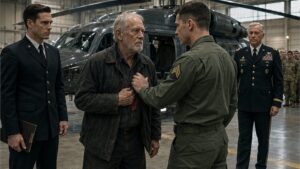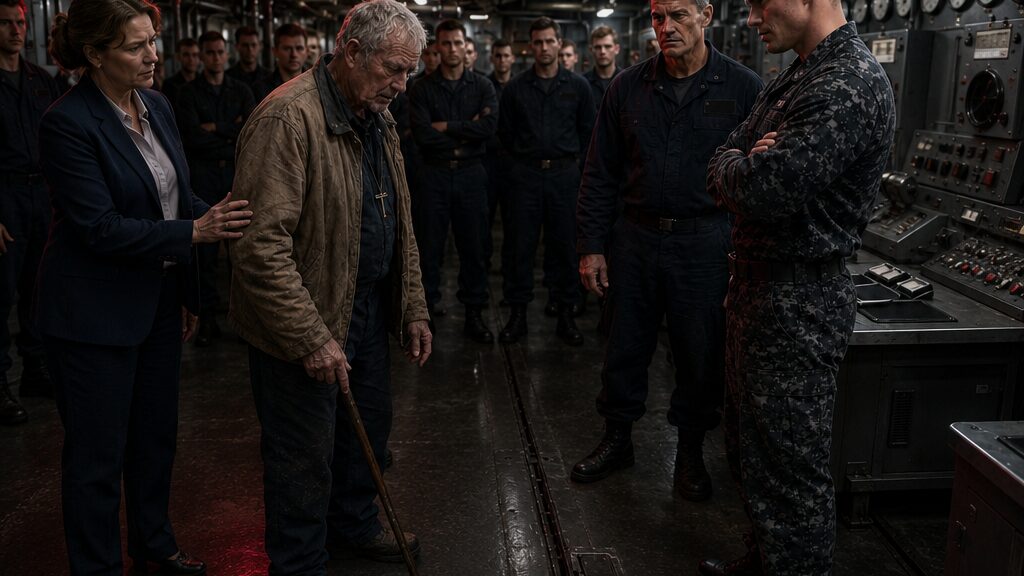
They Laughed When the Old Sailor Tapped the Deck Seam With His Cane
Chapter 1: The Old Man Tapped Where No One Looked
The cane stopped before Thomas Davis did.
Its rubber tip landed on the gray deck with a soft, dull sound, then settled into a vibration so small no one else turned their head. The sailors ahead kept moving. The visitor line kept shuffling through the narrow gangway. A young petty officer at the hatchway lifted his clipboard and called for the next group to keep their hands off exposed piping, low fittings, and anything painted red.
Thomas stood still.
Behind him, someone sighed.
“Dad,” Sarah Lewis said quietly, close to his shoulder. “You okay?”
He did not answer at once. He kept his eyes on the deck, on the dark seam running beneath the worn nonskid coating, half hidden by decades of paint and newer safety tape. His fingers tightened around the cane handle. The vibration rose again through the rubber tip, passed into the wood, and found the bones of his hand.
It was not loud. It was not dramatic. It was only a wrongness.
A ship could speak wrong.
Thomas had learned that before men learned to shout.
A museum-board representative near the front gave a bright practiced laugh. “We’re on a schedule, folks. The demonstration starts in less than an hour.”
Sarah touched Thomas’s sleeve. “Dad.”
He blinked once and lifted the cane. The sound vanished.
The gangway smelled of steel, damp paint, old oil, and too many bodies packed inside a vessel built for narrower men and shorter conversations. The training vessel was not active in the old way, not truly. It had been converted for controlled demonstrations, cadet walk-throughs, visiting inspectors, and ceremonial events. Still, the hull held sound. It carried pressure. It remembered hands.
Thomas had promised Sarah he would not make trouble.
He had promised himself he would not come at all.
But the invitation had arrived with the Navy seal in blue ink and polite language about honoring retired instructors whose work had shaped generations of damage-control training. Sarah had read it at his kitchen table while he cut a piece of toast into four neat squares and pretended not to notice how carefully she watched him.
“You don’t have to speak,” she had said. “You don’t have to do anything. Just attend.”
Just attend. As if the act of stepping back into a vessel did not require every old door in the body to unlock.
Now the vessel pressed close around him. Overhead lights hummed. Boots rang against metal. A junior sailor ducked past him with a coil of cable over one shoulder and a look that skimmed across Thomas’s face without landing there. To the young, old men in jackets all looked like delays.
Thomas looked down at his own clothing: tan jacket, dark shirt, work pants, old shoes polished that morning because Sarah had done it before he could stop her. No uniform. No ribbons. No proof arranged over the heart.
Good.
Proof had never stopped water.
“You need a minute?” Sarah asked.
He shook his head. “No.”
His voice sounded rougher than he intended. He took one step. The cane found the deck again, but he placed it away from the seam this time.
The petty officer at the hatchway glanced up. He was young enough to have no patience for hesitation and trained enough to hide most of it. His name tape read KING. Ryan King, according to the visitor schedule Sarah had shown him in the parking lot.
“Sir, please keep moving,” Ryan said. “We need to get your group clear of the gangway.”
Thomas nodded.
Ryan’s eyes dropped to the cane, then to Thomas’s knees, then back to the clipboard. Not cruel. Not yet. Only measuring him by the wrong equipment.
“I can have someone take you to the seating area,” Ryan added.
“I can walk.”
“Of course, sir. Just watch the step there.”
The step was not where Ryan’s hand pointed. It was three inches aft of it, under a shadow cast by a pipe bracket. Thomas stepped over without looking down. Ryan noticed, or perhaps he did not. Young men noticed what they had been told mattered.
Inside, the passage narrowed. The vessel’s ribs showed through paint and careful restoration. Some panels were new, brushed metal with clean labels and electronic readouts installed for training. Others were old enough to have absorbed the skin oil of men long dead. Thomas did not touch them. He let his cane mark time beside his right foot.
Tap. Step. Tap. Step.
Sarah walked at his left, close enough to catch him if he slipped, far enough to pretend she was not planning to. Her badge identified her as a civilian historical liaison. She had arranged parts of the day: the archived photographs in the wardroom, the families of retired crew, the plaque that would be unveiled near the end of the demonstration. She had chosen work that kept her near the Navy without requiring her to understand why her father sometimes went silent at the sound of running water behind walls.
“Control room is ahead,” she said. “They restored the old layout but left some of the training instruments modernized.”
Thomas gave a faint nod. He could already feel it.
The control room did not announce itself with space. It gathered itself out of darkness and metal: panels, wheels, valves, gauges, red covers over emergency switches, curved pipes crossing overhead like ribs. A handful of sailors stood at stations, rehearsing motions that had clearly been rehearsed too many times. The air carried the dry warmth of electronics over the colder smell of old steel.
At the far end, a red warning lens sat dark above a low panel near the deck.
Thomas stopped again.
This time Sarah did not speak. She followed his gaze.
“What is it?”
“Changed the panel,” he said.
“I’m sorry?”
He lifted his chin slightly toward the low section beneath the red lens. “That plate wasn’t there.”
Sarah looked. To her, Thomas knew, it was just another square of gray metal among many. “They modernized sections of it.”
“They covered the old line.”
A passing junior sailor glanced over, heard only enough to decide he had heard an old man commenting on old things, and moved on.
Sarah lowered her voice. “Dad, not today.”
He turned his eyes to her.
The words had been gentle, but they struck with the familiar softness of being managed. Not today meant not in public. Not where people might stare. Not where he might lose his place and become the thing she feared: an old man trapped in a memory, embarrassing himself among strangers.
He looked away first.
“All right,” he said.
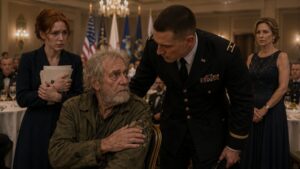
Senior Chief Robert Anderson approached from the forward side of the control room, one hand braced briefly on a ladder rail as he came through. He was in dark coveralls, thick through the shoulders, with gray beginning at his temples and a face that had learned to be both respectful and busy.
“Ms. Lewis,” he said. “Good to see you. We’re just about ready.”
“Senior Chief.” Sarah smiled with relief. “This is my father, Thomas Davis.”
Robert Anderson’s expression changed by half a degree. Not recognition exactly. A name brushing against something stored away.
“Mr. Davis,” he said.
Thomas offered his hand. Robert shook it carefully, the way people shook the hand of an old man when they wanted to show strength by not using any.
“You served on this class?” Robert asked.
“A while back.”
“Damage control?”
“Some.”
Robert waited for more, but Thomas had spent half his life learning not to fill silence for other people’s comfort.
The senior chief nodded. “We’re honored to have you aboard.”
Honored. Thomas had heard the word in too many clean rooms.
“Thank you,” he said.
Ryan King appeared behind Robert, clipboard still in hand. “Senior Chief, inspection group is five minutes out. Captain wants the visitors kept behind the marked line once the demonstration starts.”
“Understood.” Robert glanced toward Sarah. “We’ll have seating in the observation section. Best view without interfering.”
Ryan was already looking at Thomas’s cane. “Sir, that line there is for crew only.” He pointed to a yellow boundary stripe across the deck. “Please stay on the visitor side.”
Thomas looked down.
The yellow stripe crossed directly over the old seam.
His cane tip hovered above it, not touching. Beneath the stripe, hidden by paint and modern caution tape, the deck seam ran forward toward the low panel under the red lens.
He could almost see the old arrangement: inspection slot, bypass cover, hand wheel behind it, cramped enough to skin two knuckles every time. Men had cursed that placement. Then they had thanked it when it mattered.
“Sir?” Ryan said.
Thomas lifted the cane and set it back on the visitor side.
“Yes,” he said.
The demonstration rehearsal continued around him. A sailor called out a mock pressure reading. Another repeated it. A switch clicked. Somewhere below, a pump cycled with a smooth mechanical thrum.
Too smooth.
Thomas heard the gap in it, the tiny stagger between the pump’s rise and the hull’s answering tremor. The old ship had never liked being dressed in newer clothes. You could polish over age. You could update panels and relabel systems. But water, pressure, and steel kept their own records.
The cane shifted in his hand.
Tap.
Not hard. Not obvious. One soft touch against the deck seam, just outside the yellow stripe.
The vibration came back.
Not imagination. Not memory. A low, uneven tremor moved beneath the nonskid paint, then faded before anyone else cared.
Thomas drew in a slow breath.
For a moment, the control room fell away. He saw another red light, not this one, older, dirtier, shining through condensation. He heard men breathing too loudly in a compartment that had gone too quiet. He felt his younger hand, slick with oil and water, searching blind beneath a panel while someone behind him prayed without knowing it.
Then Sarah’s hand closed around his forearm.
“Dad?”
The present returned in pieces: Ryan’s clipboard, Robert’s coveralls, the museum representative laughing too loudly near the hatch, the smell of coffee somewhere aft, the dim red lens above the covered panel.
Thomas swallowed. “I’m fine.”
Sarah did not believe him. He could feel the shape of her worry beside him.
The overhead speakers crackled. “Demonstration team, stand by for visitor briefing in Control.”
Ryan stepped toward the group. “All right, ladies and gentlemen, we’ll need everyone behind the line. Please don’t touch equipment, piping, panels, or deck fittings unless instructed.”
Thomas’s eyes remained on the red lens.
It flickered.
Less than a second. A tiny pulse, gone so quickly the room did not react. No alarm. No tone. No callout. Just a brief red eye opening in the dark.
Thomas’s hand tightened until the cane handle pressed into his palm.
Sarah looked from him to the lens. “Was that part of the demonstration?”
“No.”
“You’re sure?”
He leaned closer, barely moving his lips.
“That light shouldn’t be tied to that deck line.”
Chapter 2: Ryan King Folded His Arms Before the Crew
Ryan King had been warned about visitors.
Not about this visitor specifically, but about the type. Retired Navy men who came aboard with soft shoes and hard opinions. Museum donors who knew the old names of valves no one used anymore. Family members who thought every closed hatch concealed a secret. Elderly men who drifted too close to controls because memory pulled harder than instruction.
He had been told to be patient.
He had also been told not to let anyone interfere with the demonstration.
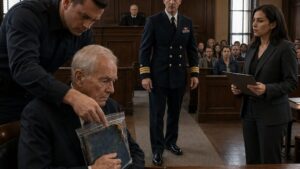
So when Thomas Davis crossed the yellow stripe with one careful step and placed his cane tip near the low panel beneath the red warning lens, Ryan moved before the senior chief saw it.
“Sir,” Ryan said, sharp enough to carry. “Step back.”
The control room changed at once. Not fully. Not in a way civilians would notice. But the sailors heard the edge in his voice and looked over. One by one, conversations thinned.
Thomas did not step back immediately.
He was looking down, not at Ryan, not at the panel, but at a section of deck so ordinary it irritated Ryan that it had become the center of attention. The old man’s cane tip rested near a seam under the yellow stripe. His left hand hovered slightly away from his body, fingers spread for balance.
Sarah Lewis moved toward him. “Dad, please.”
Ryan kept his voice controlled. “That area is restricted.”
Thomas lifted the cane. “It wasn’t always.”
A few sailors exchanged glances. One near the aft console gave a short breath through his nose, not quite a laugh.
Ryan felt heat rise behind his collar. He did not like being challenged in front of crew, especially not by a visitor who looked as though a strong wake could put him on the deck.
“This vessel has been refitted for training,” Ryan said. “The current layout is marked. Visitors stay behind the line.”
Thomas looked at him then. His eyes were pale, tired, and steadier than Ryan expected.
“You ever open that plate?”
Ryan glanced at the low panel. “Maintenance handles maintenance.”
“Not that plate. Under it.”
“There is no under it for visitors.”
The small laugh came again, this time from more than one direction. Ryan did not smile, but he did not stop it either.
Senior Chief Anderson stepped in from the forward side. “What’s the issue?”
“No issue,” Ryan said. “Sir was just stepping into crew space.”
Thomas lowered his gaze. “That red lens flickered.”
Ryan almost answered too quickly. “It’s a training indicator.”
“No.”
The word was soft. It irritated Ryan more than if it had been loud.
Sarah moved beside Thomas, embarrassment tightening her mouth. “Dad, maybe we should sit down.”
Thomas’s fingers shifted around the cane handle. “Ask if they checked the bypass behind that plate.”
Ryan folded his arms. It was not planned. It happened because if he did not hold himself still, he might gesture too sharply. “Sir, with respect, the demonstration systems were checked this morning.”
“With the modern list.”
“The current list,” Ryan corrected.
“Current doesn’t mean complete.”
This time the room went quieter. The museum representative at the hatch stopped smiling. A junior sailor near the communications board looked down at his boots. Senior Chief Anderson studied Thomas with the expression of a man trying to place an old photograph.
“Mr. Davis,” Robert said, “what bypass are you referring to?”
Thomas did not answer him directly. He shifted his cane, moving the tip along the deck seam. Once. Twice. A third time.
Tap. Tap. Tap.
Ryan heard nothing but rubber on painted metal.
Thomas heard something else. Ryan could see it in the way the old man’s shoulders tightened, not with fear but recognition.
“That seam,” Thomas said, “runs forward to a manual access slot. If they plated over the face, they should’ve left the dog open.”
Ryan gave a short, disbelieving smile. “The dog.”
Thomas nodded. “Locking tab. Old language.”
“Old is the word.”
“King,” Robert said quietly.
Ryan stopped smiling.
Thomas began to lower himself.
For one bad second, Ryan thought the old man was falling. Sarah reached out. Robert stepped forward. But Thomas had already set the cane at an angle, right hand firm on the handle, left hand touching the bulkhead lightly enough not to lean on any fitting. He bent with the slow care of someone whose joints charged him for every inch, but there was no confusion in the motion.
“Sir, don’t,” Ryan said.
Thomas paused only long enough to breathe.
Then he set the cane tip into a shallow notch no one had noticed because paint had almost filled it. It was not on the training schematic posted near the hatch. It was not marked. It was half hidden beneath the yellow boundary stripe, where hundreds of boots had passed over it without question.
The cane tip sank a fraction.
A small metallic click answered.
No one laughed.
Ryan uncrossed his arms.
Thomas shifted the cane, not prying, not forcing. He used the rubber tip to press down and forward, then angled the handle toward his knee. A narrow line appeared along the deck where Ryan had seen only paint. The low panel beneath the red lens trembled.
“Senior Chief,” Brenda Carter called from the maintenance station, “that panel just moved.”
Robert’s face went still. “Kill the rehearsal feed.”
A sailor reached for a switch.
The control room fell into a mechanical hush. Pumps settled. The electronic training tone stopped. Without it, the older sounds of the vessel came through: faint ticks, pipe hum, the deep hold of water beyond steel.
Thomas eased the cane back.
The low deck plate opened half an inch.
Red light glowed from inside.
Not the polished red lens above. This was duller, older, coming from a narrow compartment behind the seam. It painted Thomas’s hand and the cane tip the color of memory.
Ryan stared.
“That’s not on the visitor route,” Brenda said from behind him.
“It’s not on any route I was given,” Ryan replied.
He heard the defensiveness in his own voice and disliked it.
Thomas remained bent longer than he should have. Sarah slipped a hand under his elbow, but he did not let her lift him until he had looked into the gap. His face changed then—not triumph, not satisfaction. Something closer to grief passing behind a locked door.
“You smell that?” he asked.
Ryan smelled oil, dust, paint, warm circuitry, men, and old steel. “Smell what?”
Thomas’s mouth tightened. “Hot packing.”
Brenda stepped closer. “I don’t smell heat.”
“You won’t from up there.”
Ryan exhaled. “Senior Chief, we have inspectors coming aboard and a scheduled demonstration. We can have maintenance look after.”
Thomas looked at him again. “After pressure cycle?”
Ryan hesitated.
“Is that what you’re demonstrating?” Thomas asked.
Brenda’s eyes moved to Robert.
Robert did not answer quickly enough.
Thomas straightened, but the effort cost him. The cane shook once before he steadied it. Sarah’s hand stayed near his elbow, not touching now, waiting for permission he did not give.
Robert spoke carefully. “Controlled ballast-response demonstration. No live hazard.”
Thomas nodded, as if that was exactly the answer he had feared. “Controlled by the modern panel.”
“Yes.”
“With the old bypass sealed behind a plate.”
“Refit documentation says the line is isolated,” Brenda said.
Thomas turned slightly toward her. “Documentation ever been wrong?”
No one answered.
Ryan recovered himself by reaching for procedure. “Sir, I understand you may have served on older systems, but this vessel has been inspected, certified, and modified. You can’t just open panels during a visitor event.”
“I didn’t open it,” Thomas said.
The words were quiet.
Ryan frowned. “You just—”
“I found where it still opens.”
The difference hung in the control room.
Robert stepped between them, not quite blocking Ryan, not quite shielding Thomas. “Close it for now.”
Brenda looked at him. “Senior Chief?”
“Close it. We’ll log it and inspect after the visitor cycle.”
Thomas’s expression did not change, but Sarah’s did. She looked relieved, then ashamed of the relief.
Ryan crouched near the seam, reluctant to touch what the old man had touched. “How does it lock?”
Thomas did not move to help. “You pressed too far.”
Ryan looked up.
“With your thumb,” Thomas said. “Not the palm. Palm bends the lip.”
Ryan’s jaw tightened. He used his thumb.
The plate settled back into place with a small, clean click.
Thomas closed his eyes for half a second.
Robert turned to him. “Mr. Davis, we appreciate you bringing it to our attention. We’ll have maintenance confirm it.”
“Before the cycle,” Thomas said.
Robert’s face hardened with the burden of rank and schedule. “We’ll handle it.”
Thomas looked at the sealed plate, then at the young sailors who had watched him bend down like a fragile inconvenience and stand up like a problem they did not want.
He could have said his rate. He could have said the years. He could have named the instructors who had used his notes long after his knees began waking him at night. He could have told Ryan King that old language became old because it survived long enough to be forgotten.
Instead, he stepped back behind the yellow line.
Ryan glanced once at the cane, then at Thomas’s face. The confidence had returned to his posture, but not all the way.
Sarah whispered, “Dad, let it go.”
Thomas set the cane down beside his shoe. The deck answered with that same uneven tremor, patient and low.
Robert Anderson looked toward the hatch where the inspection team’s voices were beginning to gather.
“Panel stays closed,” he said. “Demonstration continues on schedule.”
Inside the seam, the red glow disappeared.
Chapter 3: The Sealed Panel Made Everyone Quiet
Brenda Carter did not like mysteries hidden under paint.
She liked clear labels, updated schematics, torque values written where human beings could find them, and maintenance histories that did not depend on some retired sailor remembering what a compartment had looked like before she was born. She had no problem with old systems. She had a problem with old systems pretending to be gone.
The hidden plate sat closed beneath her flashlight, innocent as any other section of gray deck.
Beside her, Ryan King stood with his arms loose now, though he kept finding reasons to put his hands on his belt or clipboard or the edge of the maintenance station. He was trying not to look rattled. That made him look younger.
“I told you,” Ryan said. “It’s probably just an old access point they left for restoration.”
Brenda did not answer.
She ran her light along the seam. The paint was thick over the edges, but not cracked the way a sealed plate should have been. Someone had opened it after the refit. Maybe not recently, maybe not often, but the line was too clean beneath the topcoat.
Senior Chief Anderson had ordered a quick inspection, which meant not an inspection, exactly, but enough of a look to say they had looked. The visitor briefing had been moved forward to the observation area. The captain wanted no delay. The museum-board representative wanted no confusion. The inspection team wanted the schedule honored. Everyone wanted the ship to behave like the ship on paper.
Brenda pressed her thumb into the notch.
Nothing happened.
Ryan shifted. “The old man used the cane at an angle.”
“I saw.”
“You want me to get him?”
She glanced up.
Ryan looked away first. “I mean, if the trick is special.”
“It’s not a trick.”
Brenda adjusted the light, pushed down with her thumb, then forward, just as the old man had instructed Ryan. For a moment, the plate resisted. Then a small metal tongue released under the paint.
The panel opened half an inch.
A dry, warm smell escaped.
Not smoke. Not burning. Old oil, dust, and something faintly sharp that made Brenda’s attention narrow.
Ryan leaned closer. “Is that hot packing?”
Brenda gave him a look.
He flushed. “He said it.”
“Yes,” she said. “He did.”
The compartment behind the plate was smaller than she expected, a tight recessed space with a manual bypass wheel set behind a partial guard. Most of it had been painted red decades ago, though newer gray overspray marked one side where the refit crew had covered the surrounding area. A small indicator bulb sat dead in its housing. The glow from earlier had come from reflected training light bleeding through a gap behind the panel, not from the bulb itself.
“See?” Ryan said. “No active warning.”
Brenda did not answer.
Her flashlight caught the edge of a metal tag under a film of grime. She reached in with a gloved hand and wiped it once. The lettering was worn nearly flat.
BYP—
The rest disappeared under paint.
“Bypass,” Ryan said quietly.
Brenda looked deeper. A narrow line ran aft from the wheel assembly, vanishing behind newer conduit. She knew the updated schematic. She had signed off on the morning check herself. According to the file, that line had been isolated during the training conversion. According to the file, it could not affect the demonstration pressure cycle.
According to the file, the access point should not have opened.
“Hand me the small mirror,” she said.
Ryan retrieved it from the tool roll without comment.
Brenda angled the mirror into the gap. The space returned her own eye in a warped sliver, then the underside of the wheel assembly, then a shadowed fitting with an old seal around it. The seal was not pretty. It was not failed in any obvious way either. But on one side, where the updated panel pressed closer than the old clearance allowed, the packing looked slightly compressed and dark.
She sat back on her heels.
Ryan watched her face. “Problem?”
“Maybe.”
“That means no?”
“That means maybe.”
He exhaled through his nose and glanced toward the control room hatch. “Senior Chief needs a clean answer.”
Brenda closed the panel halfway, then opened it again, listening. Click. Shift. A faint rub of metal under paint.
She heard footsteps behind them.
Thomas Davis stood at the passage entrance, Sarah beside him, her hand wrapped around the strap of her visitor badge as if it were something to hold herself steady with. The old man looked smaller in the maintenance passage than he had in the control room. The light from Brenda’s flashlight carved deeper lines into his face. His cane was planted a little ahead of him, ready for weight.
“I thought you were in observation,” Ryan said.
Sarah answered before Thomas could. “We were.”
Brenda looked at Thomas. “You said hot packing.”
He gave a small nod.
“I don’t have heat on the surface.”
“You wouldn’t.”
“Why?”
He moved closer with a care that made the passage seem even narrower. Sarah took one step with him and stopped when he glanced at her hand. She let it fall.
Thomas lowered himself to look at the gap. Brenda resisted the impulse to tell him not to. He used the cane, the bulkhead, and his own stubborn balance to get down far enough. His breathing changed, but he did not complain.
“The line used to sweat under cycle,” he said. “Not much. Enough to show if you knew where to wipe.”
Brenda followed his gaze. “This line is documented isolated.”
Thomas looked at the old tag. “Then why leave the wheel?”
“Training conversion,” Ryan said. “They leave old hardware all the time.”
Thomas nodded. “They do.”
The agreement did not comfort anyone.
Brenda handed him the mirror without thinking. Ryan’s eyebrows lifted, but she ignored him.
Thomas held the mirror in a hand that trembled only until he found the angle. Once he did, the tremor seemed to move somewhere else inside him. He studied the underside of the wheel assembly, the seal, the darkened compression point.
For a second, his face was no longer in the maintenance passage. He was listening to something none of them could hear.
The red reflection from Brenda’s flashlight filter glimmered in the open gap.
Thomas’s jaw tightened.
“Mr. Davis?” Brenda said.
He blinked. “Modern conduit’s too close.”
Brenda looked in again. “Clearance is tight, but it’s not touching.”
“Not now.”
Ryan crossed his arms, then seemed to remember himself and dropped them. “What does that mean?”
Thomas shifted the mirror. “Under cycle, line moves. Not like a hose. Enough. Pressure comes in, metal talks. That conduit holds it where it didn’t use to be held.”
Brenda could see it then—not as proof, not yet, but as a possibility. The old line, assumed dead. The new conduit, installed clean and tight. The training cycle, low-risk on paper. Movement restricted where the original designers had left a fraction of space.
She reached for her tablet and pulled up the morning readings. “We didn’t see pressure transfer.”
“You weren’t looking there.”
Ryan gave a dry laugh. “We can’t look everywhere.”
Thomas turned his head toward him. “That’s why you listen when a ship repeats itself.”
The passage went quiet.
Brenda scrolled through the logs. The numbers were all within acceptable limits. That was the trouble with acceptable limits. They gave people permission to stop thinking. She checked the timestamp from the moment the red lens flickered in the control room.
A tiny spike sat between two normal readings.
Too small to trigger alarm. Too brief to require action. Exactly the sort of thing a system swallowed and a human dismissed.
She enlarged it.
Ryan leaned over her shoulder. “That’s nothing.”
“Maybe.”
“You keep saying that.”
“Because I don’t know yet.”
Thomas began to rise. The movement cost him more than the lowering had. Sarah stepped forward despite herself. This time he accepted her hand for half a second, then released it as soon as he was upright.
The acceptance struck Brenda more than refusal would have.
He was not trying to seem young. He was trying to remain useful without becoming someone else’s burden.
Senior Chief Anderson appeared at the hatch. “Carter. King. Status.”
Brenda stood. “No obvious failure. But there’s an old bypass assembly behind the panel, and I found a small undocumented pressure spike during the last rehearsal feed.”
Ryan’s head turned toward her. “Undocumented sounds bigger than it is.”
Robert’s eyes moved to Thomas, then back to Brenda. “Is it unsafe?”
Brenda looked at the open panel. The worn tag. The compressed packing. The old man’s cane planted beside the seam.
“I can’t call it unsafe yet.”
Ryan’s relief was visible.
“But,” Brenda continued, “I can’t explain why an isolated bypass line showed any pressure behavior at all.”
The senior chief’s mouth flattened.
From above them, the speaker crackled. “Demonstration team, prepare for cycle reset in twenty minutes.”
Thomas looked down at the seam.
The red reflection inside the hatch trembled with the vessel’s low vibration.
Brenda checked the tablet once more, then froze.
There was another reading buried under the automatic smoothing line, so slight she had almost missed it. It matched the timing of Thomas’s cane tap in the control room, when no system should have responded to anything at the deck level.
She turned the screen toward Robert.
“Senior Chief,” she said, “the old line moved when he found the slot.”
Chapter 4: Sarah Lewis Wanted to Take Him Home
Sarah Lewis had spent the last twelve years learning the difference between helping her father and cornering him.
She still got it wrong.
The crew mess had been cleared for visitors, which made it feel less like a place where sailors ate and more like an apology made of folding chairs. A long table held paper cups, coffee urns, bottled water, and a tray of cookies no one had touched. Old framed photographs leaned against one bulkhead, waiting to be arranged for the evening reception. In one of them, men half Thomas’s current age stood shoulder to shoulder on a pier, their white hats bright under a sun that had forgotten them.
Thomas sat at the end of a bench, cane resting against the table. A smear of dark grease marked the lower shaft, just above the rubber tip, where it had touched the hidden hatch.
Sarah could not stop looking at it.
“That was too much,” she said.
He held a paper cup of coffee with both hands. He had not drunk from it.
The ship hummed beneath them. Every few minutes a speaker clicked and released another announcement somewhere forward. Demonstration reset. Visitor group moving. Inspection party aboard. Words of order, words of confidence.
Her father kept his eyes on the tabletop.
“Dad.”
“I heard you.”
“I don’t think you did.”
His thumb moved along the cup seam. “I embarrassed you.”
The words landed so plainly that Sarah looked away.
“No,” she said, too quickly.
He gave a small nod, not believing her, not accusing her either. That was worse. He had always accepted other people’s discomfort like weather.
Sarah sat across from him. The metal bench chilled through her skirt. She lowered her voice. “You didn’t embarrass me. I’m worried about you.”
“That’s a nicer sentence.”
“It’s the true one.”
His eyes lifted. They were tired, but not clouded. That was what she hated most about moments like this. He was not confused. He was simply old, and the world treated those two conditions as neighbors.
“Sarah,” he said, “I know when you’re sanding the corners off.”
She folded her hands, then unfolded them. “You were down on the deck in front of everyone. You could barely get back up.”
“I got up.”
“With help.”
“Yes.”
He did not flinch from it. She did.
All her childhood, Thomas Davis had been a quiet man, but not a fragile one. He fixed sinks without discussing them. He carried boxes without asking who had packed them too heavy. He stood in the rain during school pickup because the car heater had failed and he wanted the engine warm by the time she got in. He did not tell stories about the Navy unless someone else told them badly first.
Then age had arrived, not all at once but in small thefts. First the knee brace. Then the cane. Then the days when he forgot he had left soup on the stove but remembered the serial number of a pump assembly from forty years ago. Sarah had begun stepping closer. Taking the heavier grocery bag. Scheduling appointments. Answering questions before he had to.
She had called it love.
Sometimes it looked too much like control.
“The senior chief said they’ll inspect it,” she said.
“After the cycle.”
“Brenda seemed concerned.”
“Concerned isn’t stopped.”
Sarah leaned forward. “And what do you want to do? Walk back in there and argue with active-duty crew in the middle of an inspection?”
“No.”
“Good.”
“I don’t argue with water either.”
The answer made her close her mouth.
He stared into the coffee. Steam had stopped rising. “You ever wonder why I didn’t bring you here when you were little?”
Sarah had not expected the question. “You said the tours were too crowded.”
“They were.”
“And Mom said you didn’t like ceremonies.”
“I didn’t.”
“Was that not the reason?”
His fingers tightened around the cup until the paper bent. “There was a cycle once. Not here exactly. Same bones. Older skin. We were running a controlled test after repairs.”
The ship seemed to grow quieter around his words.
Sarah waited. She had learned not to reach too quickly when he opened a door.
“The numbers looked fine,” he said. “A little lazy on one rise, but within tolerance. Young officer said proceed. He wasn’t careless. Just young. Believed the gauge more than the deck.”
He paused.
Sarah could hear a faint metallic rhythm beneath the mess, something like a pump starting and stopping behind layers of steel.
“I heard the line bind,” Thomas said. “Not loud. Just a drag where there shouldn’t have been drag. Told them to hold. Took too long to make them hear me.”
“What happened?”
He looked at the old photographs against the wall. “We stopped it. Not clean. Not soon enough. Two men burned their hands getting the bypass open. One never came back right after that. Neither did I, maybe.”
Sarah’s throat tightened. “You never told me.”
“No reason to put it in your room.”
“I was your daughter.”
“You were a child.”
“I’m not now.”
He looked at her then, and the softness in his face hurt more than any sharpness could have. “No. You’re the woman who thinks if she stands close enough, old age won’t take another bite.”
She looked down at the table.
The grease mark on the cane seemed darker under the mess lights. Thomas reached for it and rubbed once at the smear with his thumb. It did not come off.
“I’m not trying to keep you small,” Sarah said.
“I know.”
“But I do.”
He did not answer.
“That young petty officer looked at you like you were in the way,” she said. “And for a second, I wanted to get you out before he could look again.”
Thomas’s mouth moved faintly, not quite a smile. “He’s afraid of looking wrong.”
“He was rude.”
“He’s young.”
“You always say that like it excuses everything.”
“No.” Thomas set the coffee down. “It explains the shape of the mistake.”
The speaker clicked overhead. “All hands involved in demonstration sequence, report to assigned stations. Countdown begins in fifteen minutes.”
Sarah closed her eyes briefly.
Thomas’s head turned toward the deck.
Not fast. Not dramatic. Only enough for her to see that he had heard something beneath the announcement, something hidden under the smooth prepared voice. His cane rested against the table, but his right hand moved toward it before he seemed to know he had moved.
Sarah saw him listening.
Not remembering. Listening.
The ship hummed. The pump began again, low and steady, then caught on a small uneven beat.
Her father’s face changed.
“Dad,” she whispered.
He stood slowly.
She rose too. “No.”
He placed one hand on the table until his balance settled. “Sarah.”
“They told you to stay out of it.”
“They told me to stay out of their way.”
“That is not the same?”
“No.”
His cane scraped softly as he took it. The grease mark flashed under the overhead light.
Sarah stepped into the narrow aisle before he could move past her. “Please. If you go back in there and they’re wrong, they’ll say you’re confused. If you’re wrong, they’ll say worse.”
“And if I’m right?”
She had no answer.
Thomas looked past her toward the passage, toward the control room hidden beyond two hatches and a turn in the corridor. The shipwide countdown tone sounded once, polite and artificial.
Beneath it, the old vibration returned.
This time Sarah heard it too.
Chapter 5: Robert Anderson Read the Procedure Twice
Robert Anderson read the procedure once because he was supposed to.
He read it twice because Thomas Davis had looked at the deck like a man recognizing a voice through a wall.
The maintenance station was barely wide enough for three people without elbows becoming arguments. Brenda Carter stood at the console with the tablet braced against one forearm, her jaw set in the way good maintenance officers wore when the numbers obeyed but the machinery did not. Ryan King hovered behind her, restless, glancing toward the control room every time another announcement came over the speaker.
Robert held the printed demonstration checklist in one hand and the refit summary in the other.
The papers did not agree.
Not openly. Not in a way that would let him slap them down in front of the captain and say, There. They disagreed in omissions, in language polished clean by contractors and approved by committees. The demonstration checklist called the ballast-response cycle isolated and controlled. The refit summary stated that legacy bypass assemblies were deactivated unless otherwise marked. The old inspection note Brenda had pulled from a scanned archive used different words entirely.
Manual bypass presence to be verified by physical access, not diagram.
Robert read that line for the third time.
“Where did this note come from?” he asked.
“Archive packet attached to the pre-conversion files,” Brenda said. “Not the current maintenance set. It was cross-indexed under damage-control training history.”
Ryan leaned over. “Training history. So not operating procedure.”
Brenda did not look up. “It was written because someone thought it mattered.”
“A lot of things mattered forty years ago.”
Robert lowered the paper.
Ryan caught himself. “Senior Chief, I’m not saying ignore it. I’m saying we have a live schedule and a controlled system signed off by engineering.”
“Engineering signed off using the current list,” Brenda said.
“Which is what we use.”
Robert looked from one to the other. “Enough.”
Ryan closed his mouth.
Beyond the hatch, visitors shifted in the observation section. Their voices came muffled through steel. A few laughed. A child asked whether the red lights meant the ship was going underwater. Someone explained, incorrectly but cheerfully, that everything was pretend.
Robert envied them for half a second.
The captain had already called once. The inspection team was present. The demonstration had been advertised to donors, retired crew, families, and local officials. A delay over an old hidden bypass would ripple outward into questions no one wanted during an event meant to celebrate precision.
But Robert had spent too many years aboard Navy machinery to trust a clean schedule more than an unexplained sound.
“Carter,” he said, “what can you prove?”
Brenda enlarged the graph on her tablet and placed it on the work surface. “Two pressure irregularities. Small. One during the rehearsal feed when the red lens flickered. One when Mr. Davis opened the access slot.”
“Causation?”
“Unproven.”
“Hazard?”
“Unproven.”
Ryan’s shoulders loosened slightly.
Brenda continued, “But both readings show movement in a line documented as isolated.”
Robert looked at Ryan. “And that bothers you how much?”
Ryan hesitated. The answer he wanted to give was written all over his face: not enough to stop the demonstration. But he was not a fool. He had seen the hidden panel open. He had heard the old man name the bypass before Brenda uncovered the worn tag.
“It bothers me,” Ryan said, “that it isn’t on my schematic.”
That was the first honest thing he had said in ten minutes.
Robert took it.
“All right.”
The hatch behind them opened.
Thomas Davis entered without ceremony, Sarah Lewis just behind him. The old man had one hand on the cane and one palm grazing the bulkhead. The trip from the mess had cost him. Robert saw it in the set of his mouth, the careful way he kept his breathing shallow enough not to be noticed.
Sarah looked at Robert with apology and defiance mixed together. “He heard the cycle start from the mess.”
Ryan muttered, “Of course he did.”
Thomas’s eyes moved to him, then away. No anger. That somehow made Ryan stand straighter.
Robert held up the archived note. “Mr. Davis. Do you know this line?”
Thomas did not take the paper. He leaned enough to read it from where he stood.
A change passed through him.
It was not pride. Robert would have known what to do with pride. This was smaller and heavier.
“I wrote the first version,” Thomas said.
The maintenance station went still.
Ryan looked sharply at him. “You wrote this?”
“Not that copy. First version.”
Robert studied the page. The scanned note had no large signature, no dramatic stamp. Just initials in the corner, nearly blurred by age and conversion. T.D.
Thomas Davis did not point to them.
Brenda saw them anyway.
“Why was it in training history?” she asked.
“Because they didn’t want it in the operating book.”
Ryan frowned. “Why not?”
Thomas shifted his weight. The cane tip rested near his right shoe. “Because it came out of a bad day.”
No one filled the silence.
Thomas looked toward the control room, but Robert suspected he was seeing another compartment entirely. “After that, we taught men to verify the bypass by hand. Not because diagrams were useless. Because diagrams don’t sweat. Diagrams don’t bind under load. Diagrams don’t change when someone installs new conduit too close because the drawing says there’s space.”
Brenda looked at the refit summary.
Ryan said, more quietly now, “The line is supposed to be isolated.”
Thomas nodded. “Supposed to be.”
“But if it isn’t?”
Thomas turned the cane in his hand, aligning the worn side of the handle with his palm. “Then during a pressure cycle, it may take a bite before the system knows it has teeth.”
Robert felt the room choose a shape around that sentence.
He had to decide whether the shape was caution or fear.
The speaker clicked. “Demonstration sequence in ten minutes. Inspection team seated.”
Robert picked up the phone handset mounted beside the console.
Ryan’s head came up. “Senior Chief?”
Robert paused with the handset in his hand. Stopping a demonstration was easy after alarms. Before alarms, it was a career made briefly visible.
He looked at Thomas.
The old man did not plead. He did not say, Listen to me. He did not tell them what he had done or who had trained under him. His eyes were on the deck as if the ship, not his reputation, had the right to be heard.
Robert put the handset down without making the call.
“Carter,” he said, “what’s the minimum check?”
Brenda answered immediately. “Open the panel. Verify wheel position. Check clearance against conduit during low pre-cycle pressure rise. If there’s movement, we stop.”
“How long?”
“Five minutes if everything behaves. Longer if it doesn’t.”
Ryan stared at the countdown display. “We don’t have five clean minutes.”
Thomas spoke. “Then start with your hand on the wheel.”
Ryan looked at him. “What?”
“Not turning. Feeling. Two fingers on the spoke. If it loads wrong, you’ll feel the line before the gauge decides.”
Brenda glanced at Robert. “That’s not in current procedure.”
“No,” Thomas said. “It’s older than current.”
Ryan gave a tense breath. “So now we’re doing hand-feel maintenance during a demonstration?”
Thomas looked at him then. Not harshly. Not gently either.
“You ever stood watch in a room where every sound mattered?”
Ryan’s face tightened. “Yes.”
“Then you’ve trusted your body before.”
Ryan did not answer.
Robert watched the young petty officer’s confidence struggle against his training. Ryan wanted the book to be complete. Robert understood. A complete book meant the world had fewer traps.
He picked up the archived note again. T.D. in the corner. Manual bypass presence to be verified by physical access, not diagram.
“All right,” Robert said. “We do the manual check.”
Ryan’s mouth opened, then closed.
Robert pointed toward the control room. “King, you assist Carter.”
Ryan nodded once. “Aye, Senior Chief.”
“Mr. Davis,” Robert said, “you’ll advise from behind the line.”
Sarah’s shoulders eased slightly.
Thomas nodded. “That’ll do.”
They moved toward the control room in a tight file: Brenda with the tool roll, Ryan with the tablet and schematic, Robert with the old note folded in his hand, Thomas following at his own pace. Sarah walked beside him, not touching.
At the hatch, Ryan slowed unexpectedly.
Thomas nearly stopped behind him.
Ryan looked back, not quite meeting the old man’s eyes. “When you opened it, you tapped three times.”
Thomas waited.
“Was that necessary?”
“No.”
Ryan’s jaw flexed. “Then why?”
Thomas looked past him into the cramped red-lit control room.
“Counting what the ship gave back.”
Ryan glanced down at the cane.
The demonstration countdown tone sounded again.
In the control room, the modern schematic refreshed on a screen. Ryan stepped to it, entered the access panel reference Brenda had found, and searched the bypass line.
Nothing appeared.
He searched again, slower.
Still nothing.
This time when Ryan looked at Thomas, there was no mockery in his face.
Only the first clean edge of doubt.
Chapter 6: The Red Light Returned During the Demonstration
Thomas stood behind the yellow line and felt the ship prepare to lie.
It was not malice. Machines did not lie the way men did. They repeated what they had been built to repeat, carried what had been added to them, suffered what had been bolted too close, painted over, forgotten, renamed. If a gauge told the truth too late, that was not betrayal. It was design meeting time.
The control room was full but silent in the way working rooms became silent when the wrong kind of attention entered them. Visitors watched through the observation barrier. The inspection team stood with tablets lowered. The captain had allowed the manual check only because Robert Anderson had used the phrase “unverified legacy movement” instead of “an old man thinks.”
Thomas appreciated that.
He also knew language would not hold pressure.
Brenda Carter knelt by the deck seam with the panel open. Ryan King crouched opposite her, one knee on the deck, tablet set aside. The hidden compartment glowed under a maintenance lamp, its old red paint dull and scarred. The manual bypass wheel sat behind the partial guard, smaller than Thomas remembered and exactly where his hand expected it.
“Two fingers,” Thomas said.
Ryan looked back.
Thomas held up his right hand, index and middle finger slightly curved. “Not your palm. Don’t grip it. You grip, you’ll fight yourself.”
Ryan nodded. He placed two fingers lightly on the wheel spoke.
“Too much,” Thomas said.
Ryan eased.
“Now you’re listening.”
The words were not praise. Ryan treated them like an order.
Brenda watched the clearance point with her flashlight angled under the conduit. “Pre-cycle pressure rise on my mark.”
Robert stood near the control console, handset in one hand, eyes on the captain. The captain’s face gave away nothing, but his shoulders held the stiffness of a man allowing a delay he did not yet believe in.
From the speaker, a voice announced, “Controlled ballast-response demonstration beginning. Pre-cycle rise in five.”
Sarah stood just inside the hatchway, where visitors were not supposed to linger and daughters were not supposed to look afraid. She did not call to Thomas. She had stopped trying to pull him back.
“Four.”
Thomas’s left hand tightened on the cane.
“Three.”
The old room behind his eyes returned without asking.
Condensation falling from overhead. A young sailor saying the gauge was still green. Someone cursing because the wheel would not move. The red light smeared by vapor. His own hand sliding into a space too hot to hold.
“Two.”
Thomas breathed once through his nose.
“One.”
The pump rose.
The modern panel displayed a smooth curve. Green. Acceptable. Controlled.
Under the deck, the old line answered late.
Thomas heard it before Ryan felt it. A tiny drag in the vibration beneath the floor, like a breath catching behind ribs.
“Hold,” Thomas said.
The captain looked toward Robert. The curve on the screen remained normal.
Ryan’s brow furrowed.
“Do you feel it?” Brenda asked.
Ryan did not answer right away. His two fingers stayed on the spoke. Thomas watched the young man’s face change from skepticism to concentration to something quieter.
“It’s loading,” Ryan said.
Brenda leaned closer. “Direction?”
Ryan swallowed. “Aft. No—down and aft. Like it wants to turn but can’t.”
Thomas said, “Don’t let it.”
“I’m not touching it.”
“You are touching it. Don’t argue with it.”
Ryan’s jaw tightened, but he adjusted his fingers, not resisting, only feeling.
The red warning lens above the low panel flickered.
This time everyone saw it.
A murmur rose behind the observation barrier. The museum-board representative whispered something that ended quickly when the captain looked back.
“Gauge still green,” a sailor at the console called.
Thomas did not take his eyes off Ryan’s hand. “Gauge is late.”
Brenda’s flashlight caught movement. It was slight, almost nothing: the old line shifting against the newer conduit, the compression point darkening as pressure came into a space it was not supposed to remember.
“There,” she said. “Contact.”
Robert lifted the handset. “Pause the cycle.”
The captain hesitated.
The red lens flickered again, longer.
Thomas stepped over the yellow line.
“Mr. Davis,” Robert began.
Thomas did not look at him. He moved to the seam with the careful urgency of a man who knew he had a limited number of steps and had already chosen where to spend them. His cane tip slid into the edge of the open panel, not forcing, not prying. He set the rubber end gently against the deck seam to mark the alignment point.
“Brenda,” he said, “back the guard screw half a turn.”
Brenda did it.
“Ryan, take your fingers off.”
Ryan obeyed.
“Now put them on the rim. Lightly. Feel the bind leave when she backs it.”
Brenda eased the screw. The wheel gave a faint metallic tick.
Ryan’s eyes widened. “It moved.”
“Not enough,” Thomas said.
The speaker crackled with a clipped voice from the control sequence. “Cycle is still within safe training parameters.”
Thomas turned his head toward Robert. “Stop it now.”
The room stilled.
There it was. Not a suggestion. Not a story. Not an old habit disguised as fear.
A decision.
Robert lifted the handset fully. “Terminate the cycle.”
The captain looked at him.
Robert repeated it, louder. “Terminate the cycle.”
The sailor at the control console looked to the captain. The captain’s mouth tightened.
“Terminate,” the captain said.
Switches moved.
The pump began to drop.
For half a second, nothing improved.
The old line held its tension like a body refusing to unclench. The red lens burned steady now, not bright, but alive.
Thomas lowered himself, too fast for his knees. Pain flashed white behind his eyes. Sarah said his name from the hatch, but he raised one hand without looking back.
“Cane,” Brenda said, reaching toward him.
“No.”
He set the cane tip against the seam, holding the spot where the plate met the old alignment notch. “Ryan. Left hand on the bulkhead. Right hand two fingers on the wheel. When I say, ease clockwise until it breathes. Not a turn. A whisper.”
Ryan moved. His face had gone pale under the control-room light. “I don’t know what a whisper is on a wheel.”
“You will.”
“I might overdo it.”
“Yes.”
Ryan stared at him.
Thomas looked up. “That’s why you go slow.”
Brenda watched the gauge. “Pressure is dropping, but the line still shows transfer.”
Robert crouched enough to see. “Can Carter do it?”
Thomas’s knee burned. His hand shook on the cane. For a moment he wanted to say yes, let Brenda do it, let the young ones with good joints and steady backs finish what he had started.
Then the line caught again.
The sound entered his palm through the cane, old and ugly.
“No,” Thomas said. “She has the screw. He has the wheel.”
Ryan looked like he might argue. Then he set his fingers exactly where Thomas had told him.
Thomas listened.
Not to the people. Not to the captain. Not to Sarah’s breathing. To the pump falling, the pipe cooling, the line binding under the conduit, the little delayed tremor trapped beneath paint and procedure.
“Now,” he said.
Ryan eased the wheel.
Nothing.
“Hold.”
Ryan held.
“Again. Less.”
Ryan made a movement so small Thomas barely saw it.
The line ticked.
Brenda’s flashlight beam shivered as the old bypass settled a fraction away from the conduit. On the console, the small pressure trace dipped, rose once, then dropped clean.
The red lens went dark.
No one spoke.
The control room sound changed. The hidden strain left the deck, and with it went something Thomas had been carrying since he stepped aboard that morning. Not all of it. Not the old day. Not the men with burned hands. Not the years Sarah had spent watching him age as if she could guard every door.
But enough.
His cane slipped.
Ryan caught his elbow.
It was quick, instinctive, and strong enough to steady him without yanking him upright.
Thomas almost pulled away.
Then he did not.
“Easy,” Ryan said, and the word had no impatience in it.
Thomas let the young man hold his arm for the three seconds his body required. Then he nodded, and Ryan released him.
Brenda looked at the gauge, then at the hidden wheel, then at Thomas. “Pressure transfer cleared.”
Robert remained crouched beside the open panel. His face had lost its official shape.
Behind the observation barrier, the visitors were silent.
The captain stepped down from the console platform. “Senior Chief.”
Robert stood. “Sir.”
The captain looked at the old red compartment. “Document everything. Demonstration remains suspended until maintenance clears the system.”
“Aye, sir.”
No applause came. No one cheered. The absence felt almost merciful.
Thomas drew the cane back from the seam.
The rubber tip slid over the painted deck with a soft, tired sound.
Only then did the room breathe.
Chapter 7: Ryan King Asked Where to Put His Hands
No one knew where to put their hands afterward.
That was the first thing Ryan King noticed.
The captain stood near the console with one hand still resting beside the terminated sequence switch, as if removing it would admit something had happened outside the plan. Senior Chief Anderson held the handset at his side. Brenda Carter sat back on her heels beside the open panel, flashlight angled toward the old bypass wheel, her face lowered in thought rather than triumph. The junior sailors at the stations stared at their boards, then at the deck, then at Thomas Davis, and each time their eyes reached him they seemed unsure whether to salute, apologize, or look away.
The visitors behind the observation barrier had gone silent in the strange way civilians did when ceremony turned real but no one told them what to feel.
Thomas remained on one knee longer than Ryan thought he should.
Ryan had released the old man’s elbow as soon as Thomas nodded, but now he wished he had not. The decision to let go had been automatic, a return to giving the man his space. But Thomas’s right hand still gripped the cane, and the tendons stood out under skin thin as old paper. His breathing was measured too carefully.
Brenda noticed too. “Mr. Davis?”
“I’m all right,” Thomas said.
It was the kind of answer that closed doors.
Sarah Lewis stepped forward from the hatchway. She did not rush. Ryan saw the effort in that, the way she held herself back from making her father smaller by rescuing him too quickly.
“Dad,” she said.
Thomas’s shoulders softened at her voice. “Just give me a second.”
Ryan looked at the deck seam, the open panel, the old red paint inside the hidden compartment. Ten minutes earlier, he had been certain the old man was a visitor with memories too large for the room. Now the room itself seemed arranged around what Thomas had heard before anyone else believed there was anything to hear.
Ryan reached for the cane where it had slid near the seam.
Then he stopped.
It seemed wrong to grab it like any other misplaced object.
He picked it up carefully, one hand around the shaft below the grease mark, the other near the rubber tip. The cane was lighter than he expected. Worn smoother too. Its lower end carried a crescent of dark grease from the hatch lip and a gray scrape from the deck seam.
He turned toward Thomas. “Sir.”
Thomas looked up.
Ryan held out the cane handle first.
For a moment, Thomas did not take it. Not because he was refusing, Ryan thought, but because he understood the weight of how it was being offered. Then his fingers closed around the handle. Ryan kept his hand beneath the shaft until he was sure Thomas had it.
“Thank you,” Thomas said.
The words were simple. They made Ryan feel worse than anger would have.
Brenda stood and stepped aside. “We need to secure the panel, but I don’t want to close it until we mark the interference point.”
“Leave the guard loose,” Thomas said.
Brenda looked at him, not as a visitor now, not as a problem, but as a man whose words belonged inside the work. “How loose?”
Thomas shifted to rise.
Ryan moved before thinking. He offered his forearm, not under Thomas’s elbow this time, not grabbing, not guiding. Just there.
Thomas looked at the arm.
Ryan almost withdrew it.
Then Thomas set one hand lightly on Ryan’s sleeve and pushed himself upright with the cane in his other hand. His weight passed through Ryan for only a second, but it was enough. The old man was not frail in the way Ryan had imagined. He was heavy with effort. Heavy with pain he did not advertise. Heavy with the discipline of not making other people witness every cost.
When Thomas was standing, Ryan stepped back.
“Half a thread showing,” Thomas said to Brenda. “No more. If the guard floats, vibration chews the screw. If it’s tight, line binds against the conduit.”
Brenda nodded. “Half a thread.”
The captain approached. His face had changed from command composure to something quieter, more private. He looked at Thomas, then at the panel.
“Mr. Davis,” he said, “we owe you a review of the system.”
Thomas answered without looking for ceremony. “You owe the system a review.”
The captain absorbed that.
“Yes,” he said. “We do.”
No one clapped. Ryan was grateful. Applause would have made the room cheap.
Robert Anderson came forward with the folded archive note in his hand. “I’ll add this to the maintenance hold package. Carter, photograph the panel, the conduit contact point, and the wheel position before anything moves. King, assist her.”
“Aye, Senior Chief,” Ryan said.
He knelt beside Brenda. The deck was warmer there, close to where the line had held pressure. He could feel it through the fabric at his knee. Not much. Enough.
Brenda handed him a grease pencil. “Mark where the cane was.”
Ryan looked up. “Where exactly?”
Thomas had started toward the lower passage, Sarah beside him. He stopped at the question.
Ryan held the pencil awkwardly. His first impulse had been to mark the whole seam, make a bold circle so no one could miss it. But the old man had not found the place by circling everything. He had found one notch hidden beneath paint and traffic and the assumption that old things were decorative.
“Mr. Davis,” Ryan said. “Where should I put it?”
The question changed the air more than Ryan expected.
Thomas turned back fully. The red warning lens above the panel remained dark. Without it, his face seemed less carved by the ship’s shadows and more simply tired.
He came back slowly. No one hurried him.
At the seam, he lowered the cane. Not with the sharp tap from earlier. Not to prove. The rubber tip touched down once, almost gently, just forward of the notch.
“There,” he said.
Ryan marked the point.
“Not over the notch,” Thomas said. “Beside it. You cover a thing completely, men stop knowing it opens.”
Ryan moved the pencil and made a smaller mark.
Brenda watched. “We’ll have to create a temporary tag until the full correction.”
Thomas nodded. “Use plain language.”
Ryan glanced at him. “What would you write?”
Thomas considered the open panel, the wheel, the conduit, the hidden space that had almost become important too late.
“Manual bypass present,” he said. “Verify by hand before cycle.”
Brenda typed it into the maintenance log word for word.
Ryan’s throat tightened. He looked down at the grease pencil in his hand. “That was in the old note.”
Thomas’s eyes flicked to him. “Some sentences survive because they’re useful.”
The captain returned to the control platform to speak with the inspection team. The museum-board representative began guiding visitors away from the observation barrier in a lowered voice. The junior sailors moved carefully now, not fearfully, but with the sharpened attention that came after a room learned it had missed something.
Sarah stood beside her father. She did not touch him, but Ryan could see that every part of her wanted to.
“Dad,” she said, “the medical corpsman should check you.”
Thomas’s first expression was refusal.
Sarah’s was not.
He looked at her for a long moment. Then he gave a small nod. “After they secure it.”
The look that crossed Sarah’s face was brief and unguarded. Relief, not because she had won, but because he had let her stand beside him without making it a contest.
Ryan looked away to give them that much.
Robert crouched near the panel with Brenda. “Mr. Davis,” he said, “before you go, I need to ask. This note—your note—why didn’t it remain in the active procedure?”
Thomas leaned both hands on the cane handle. “Procedures get cleaned up.”
“That’s not an answer.”
“It’s the one that fits.”
Robert waited.
Thomas looked at the hidden wheel. “After the incident, they added the check. Years later, systems changed. People retired. Someone decided the old line was dead, so the old check became clutter.”
Brenda’s voice was quiet. “But it wasn’t dead.”
“No,” Thomas said. “Just quiet.”
Ryan felt the words move through him with more force than they should have.
Just quiet.
That was how he had mistaken the old man too. Quiet for irrelevant. Slow for lost. Restrained for empty.
The medical corpsman arrived at the hatch with a small kit, but Thomas lifted one hand, asking for a minute without saying it. The corpsman stopped.
Thomas looked at Robert. “You don’t need me for the paperwork.”
Robert gave a dry breath. “I think we need you for more than that.”
Thomas’s expression closed slightly.
Ryan saw it: the old man bracing against being turned into a symbol. A plaque. A story told over coffee. Another ceremonial use.
Robert seemed to see it too. He lowered his voice. “Not a ceremony. Training. If you’re willing. One afternoon, maybe. You show Carter what the old notes don’t show. She decides what belongs in the current book.”
Brenda looked up, surprised but not opposed.
Sarah watched her father, saying nothing.
Thomas rubbed his thumb along the cane handle. “I don’t teach fast anymore.”
Brenda said, “That may be the point.”
Ryan looked at her. Then at Thomas.
The old man’s mouth moved with the faintest hint of humor. “You always this polite after trouble?”
“No,” Brenda said. “I’m making an exception.”
Thomas gave a small nod, but not agreement yet. “I’ll think on it.”
Robert accepted that like an order. “Fair enough.”
The panel remained open while Brenda photographed the inside. Ryan held the light where she asked, and for the first time all day he noticed how much there was to see when he stopped trying to prove he already understood it. The old wheel had not looked important until Thomas named its danger. The worn tag had not looked useful until Brenda wiped away grime. The seam had not looked like a seam until a cane found the notch.
When the temporary tag was ready, Brenda held it against the panel.
Manual bypass present. Verify by hand before cycle.
Ryan pressed the tape down carefully along the edges.
Thomas watched from a few feet away.
“Too high?” Ryan asked.
“Readable standing and kneeling,” Thomas said.
Ryan adjusted it lower.
The medical corpsman finally guided Thomas to a nearby bench in the lower passage. Sarah sat beside him this time, not across from him, close enough that their shoulders touched. Thomas allowed the corpsman to check his pulse, his breathing, the color in his hands. He answered questions shortly but honestly. When the corpsman asked about pain, Thomas looked annoyed.
Sarah leaned toward him. “Tell the truth.”
Thomas sighed. “Knees. Back. Pride.”
The corpsman smiled before catching himself.
Sarah laughed once, soft and startled. Thomas looked at her, and for a second Ryan saw the man he might have been at her kitchen table, not aboard any vessel, not carrying any history for strangers.
The captain came down before Thomas left. He did not bring the inspection team with him. He did not make an announcement. He stood in the passage where the overhead pipes forced him to lower his head.
“Mr. Davis,” he said, “the demonstration is canceled for today. We’ll brief the visitors that a maintenance discrepancy was found during safety checks.”
Thomas nodded.
The captain hesitated. “That description leaves some things out.”
“Most descriptions do.”
“I want the record to show you identified the discrepancy.”
Thomas looked down at the cane between his shoes. “Record should show Carter verified it. King felt it. Anderson stopped it.”
Ryan looked up sharply.
The captain studied Thomas. “And you?”
Thomas’s fingers closed around the handle. “I listened first.”
No one corrected him.
When it was time to leave, Sarah stood and offered her arm. Thomas looked at it, then at her face. Something passed between them that Ryan could not read fully because it did not belong to him.
Thomas took her arm.
Not because he had to. Not entirely.
Because she had offered it differently now.
They moved toward the gangway through a vessel no longer pretending nothing had happened. Sailors stepped aside without theatrical respect. No salutes. No speeches. Just room made with care.
Ryan followed with Brenda’s tool roll under one arm. At the control-room threshold, he paused by the seam. The temporary tag sat clean against the panel. The red warning lens above it remained dark.
Thomas reached the hatch and stopped as if the air outside surprised him. Evening light came through the open gangway, pale and cool after the red-shadowed compartments. The harbor moved beyond the rail in small flashes.
Sarah helped him over the threshold. This time she did not say, Watch the step.
She let him see it.
On the pier, the museum-board representative hovered nearby with a face full of questions and unused speeches. Robert intercepted him before he could reach Thomas.
Ryan stood just inside the hatch, looking at the old man’s back.
“Mr. Davis,” he called.
Thomas turned.
Ryan did not know what sentence would not sound too large or too late. Sorry was not enough and too much. Thank you felt borrowed from ceremonies. He looked down at his own hands, then back toward the seam.
“Tomorrow,” Ryan said, “if they let us open it again—where do I put my hands first?”
Thomas’s face remained still. Then he lifted the cane slightly and pointed, not at Ryan, but back into the vessel.
“On the ship,” he said. “Lightly.”
Ryan nodded.
“And after that?”
Thomas’s eyes held his for a moment.
“You wait until it answers.”
Sarah smiled down at the deck, not at either of them.
Thomas turned and continued down the gangway.
Behind Ryan, the control room settled into evening quiet. The red warning lens stayed dark. The temporary tag held. The seam waited under paint, no longer invisible.
Ryan stepped back inside once more before securing the hatch. He stood over the mark he had made beside the notch. The room smelled of steel, warm dust, and cooling machinery.
He lowered two fingers to the deck seam.
Then, with the care of a man trying to remember correctly, he tapped once.
The story has ended.