A Young Pilot Blocked The Dirty Old Man Beside The Jet, Then Her Tablet Showed His Command Record
Chapter 1: The Old Man In Red Coveralls Beside The Jet
The security sailor looked at Paul Martin’s coveralls and moved one hand over the scanner as if dirt could spread through glass.
“Sir, maintenance check-in is on the pier side,” the sailor said. “This access point is for rededication personnel and flight-deck clearance only.”
Paul stood still beneath the gray morning light, one shoulder slightly lower than the other from age and old injuries. The carrier rose around him like a city of steel. The wind carried salt, fuel, paint, and the thin metallic bite of equipment warming before use. Above the access hatch, a banner snapped hard enough to crack in the wind: rededication ceremony, flight demonstration, invited guests.
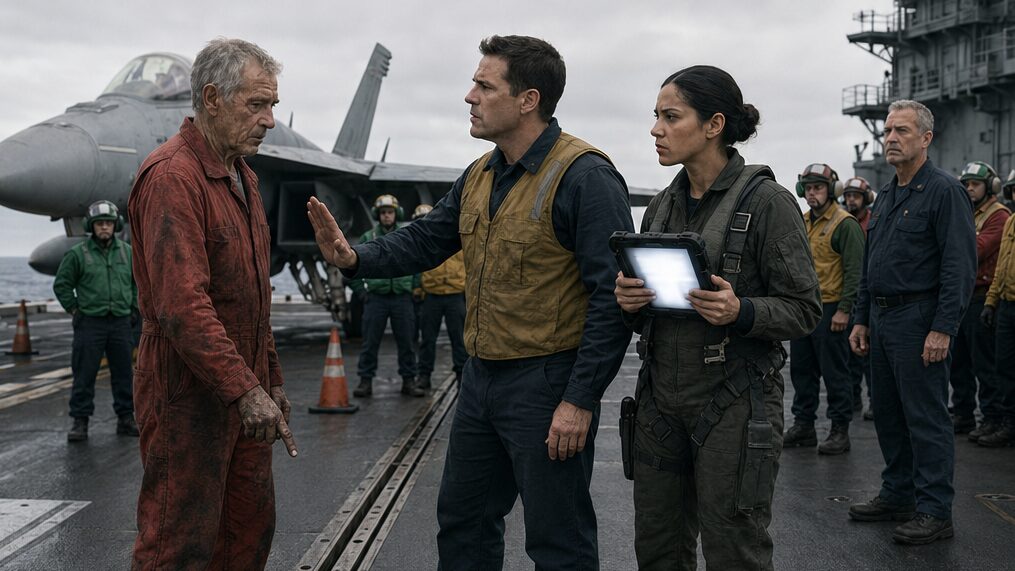
Paul’s red coveralls had once been bright. Now they were faded at the knees, stained dark at the cuffs, and marked with old grease that no washing had ever fully lifted. He had shaved that morning, but the lines in his face made him look as though sleep had forgotten him. A visitor badge hung from a lanyard at his chest, its plastic yellowed by age. The printed code was still legible if a person cared enough to read it.
The sailor did not.
“I’m expected,” Paul said.
His voice was low and even. Not offended. Not pleading.
The sailor glanced behind him at the growing line of visitors, public-affairs personnel, and uniformed escorts waiting to come aboard. A woman in dress whites adjusted a stack of programs. A camera operator shifted a tripod. Far beyond them, near the forward section of the deck, a fighter jet sat under armed watch, its canopy catching the pale sun.
“Name?” the sailor asked.
“Paul Martin.”
The sailor typed it into a rugged tablet bolted inside a protective black case. The device hesitated. A spinning wheel turned. The young man frowned.
“Your temporary code is old.”
“It usually is.”
The sailor looked up.
Paul did not smile.
The tablet chirped, then showed a yellow warning line. The sailor turned it away before Paul could see the full message. “This says limited access. No escort listed. No current command sponsor.”
Paul looked past the sailor, over the low barrier, toward the flight deck. Men and women in colored jerseys crossed between tie-down points and safety cones. A yellow-shirted director lifted one arm and then dropped it. A cart moved slowly beside a row of equipment. The jet waited in its marked spot, polished and dangerous.
His eyes stopped at the launch rail.
The carrier had been modernized twice. New surfaces, new systems, new names painted over old ones. But some lines in a ship remained like bones beneath skin. Paul saw the deck seam near the rail before anyone pointed it out. He saw the slight patched rectangle where older steel had once been opened. He saw the dark line between plates and remembered a sound that had not belonged to wind.
The sailor followed his gaze. “Sir?”
“I need to speak with the deck officer.”
“You can speak with public affairs once you’re cleared.”
“I came for the rail.”
The sailor gave a small, polite laugh, the kind young people used when they wanted an old man to cooperate without feeling insulted. “Sir, no guests go near the launch system. Especially today.”
“I’m not a guest.”
“Then who are you with?”
Paul lowered his eyes to the tablet. “Check the code again.”
“I did.”
“Check the suffix.”
The sailor’s fingers paused. “The what?”
“The last four characters. They were assigned before the current visitor system.”
The sailor did not like being corrected. Paul could see it in the tightening at his jaw. But the young man looked down anyway and tapped the screen twice.
The tablet changed from yellow to amber.
Another warning line appeared.
The sailor read it, blinked, and then turned the screen farther toward himself. “This is directing me to call the red-deck liaison.”
“Then call.”
The sailor glanced at Paul’s sleeves, at the grease under his fingernails, at the cracked black shoes that had stepped on carrier decks before the sailor had been born. “Sir, I don’t mean disrespect, but if you’re a former contractor, you still need a proper escort. We can’t have people wandering because they remember where things used to be.”
People in the line began to look over. Paul heard the shift: the soft scrape of shoes, the drop in conversation, the little silence that gathers around public inconvenience. An older visitor in a blazer leaned aside to see. A public-affairs assistant whispered into a radio.
Paul felt the old badge against his chest. He could have said one sentence and changed the young man’s posture. He could have given a rank, a former command, a string of titles that would make hands move faster. He had carried those titles once because men had needed decisions, not because he had needed doors opened.
He kept them behind his teeth.
“I’m not wandering,” Paul said.
The sailor softened, but only slightly. “Sir, please step out of the line while I verify.”
Paul stepped aside.
He did it carefully. His left knee resisted on the metal lip of the hatch, and he felt the familiar hot thread climb from bone to hip. He took the weight without reaching for the rail. The sailor noticed the slow movement and mistook it for uncertainty.
“There’s seating inside,” he said. “Someone can help you.”
“I can stand.”
The public-affairs assistant approached with the bright smile of someone trained to remove problems gently. “Good morning, sir. We’re asking all non-credentialed visitors to wait in the interior reception area until their escorts arrive.”
Paul looked at her badge, not her face. “Reception is two decks down.”
“That’s right.”
“If I go two decks down, I’ll lose sight of the rail.”
Her smile thinned. “The rail is not part of the visitor experience.”
“No,” Paul said. “It never was.”
The sailor’s tablet chirped again. A new line appeared. He touched his earpiece, listened, and looked toward the deck. “Red-deck liaison says send him to the flight-deck edge and hold there. Do not clear him past the safety cone.”
The assistant turned sharply. “Who approved that?”
The sailor shrugged, uneasy now. “System did.”
Paul moved before anyone offered to guide him. The old route rose in his body without thought: six paces to the painted line, turn before the cable cover, watch the low lip where boots could catch. His steps were slow but exact. He did not look around like a visitor. He looked down and outward, reading the deck as if it still spoke a language he had once been required to understand before anyone got hurt.
The wind strengthened at the flight-deck edge. Sound changed there. Engines turning somewhere below became a dull tremor underfoot. A crew member in a green jersey stared openly at Paul’s coveralls, then looked at another crew member and lifted his eyebrows. Two sailors moved equipment away from the jet. The aircraft’s nose pointed toward the open sea.
Paul stopped at the safety cone.
There it was.
The seam near the launch rail looked clean to anyone who had not learned to distrust clean lines. The new coating lay smooth over it, the paint unbroken, the inspection markers neat. But the rail had a faint tremor that moved wrong. Not visible. Felt. A thin, irregular shudder passing through the deck every few seconds, too small to alarm a checklist, too familiar for Paul to ignore.
He closed his right hand slowly.
The grease in the creases of his fingers had come from the old coveralls themselves, pulled from a storage trunk before dawn. He had worn them not for theater, not for memory, but because the cloth carried the old deck easily. It let him crouch, kneel, lean, work. Dress uniforms had no place beside a rail that might be lying.
A young enlisted sailor assigned to escort duty hurried up behind him. “Sir, you’re supposed to stay right here.”
Paul nodded once.
“Do you need a chair?”
“No.”
“Water?”
“No.”
The sailor shifted, unsure what to do with an old man who did not complain. “They said you asked for the deck officer.”
“I asked for whoever will listen.”
The young sailor glanced toward the launch rail. “About what?”
Paul kept his eyes on the seam.
The tremor came again.
There were moments that age did not soften. A sound could cross forty years without losing shape. A vibration could travel through steel and time and arrive under an old man’s shoes as if no one had ever painted over the place where grief began.
Paul took one step closer to the cone.
The escort sailor stiffened. “Sir.”
Paul did not cross the line. He only leaned forward, listening with his whole body.
The deck under the rail gave that faint uneven shiver again.
His breath left him slowly.
“Same old shiver,” Paul said.
The escort sailor frowned. “What does that mean?”
Paul looked at the jet, then at the rail, then at the young faces moving around both as though the morning belonged to them.
“It means,” he said quietly, “someone needs to stop trusting the paint.”
Chapter 2: The Safety Officer Who Would Not Listen
Virginia Torres first noticed the old man because he was standing too still.
On a flight deck, stillness meant one of two things: discipline or danger. Everyone else moved in short, trained bursts around the fighter jet—hands signaling, boots clearing, heads turning, radios checking and rechecking the day’s schedule. The rededication demonstration had already drawn more attention than Virginia liked. There were visitors in controlled areas, public-affairs staff in shoes too polished for the deck, and senior officers watching from above with the kind of patience that was not patience at all.
The old man in red coveralls stood near the safety cone and stared at the launch rail like it had spoken to him.
Virginia had one glove tucked under her arm and a rugged tablet braced against her hip. The tablet held the aircraft status board, visitor restrictions, and the day’s clearance chain. Her flight suit was zipped to the throat. Her hair was tied tight enough to pull at her temples. She had been told the demonstration would be simple: taxi, launch simulation, flyover, return. Clean lines for cameras. No surprises.
Then the old man lifted one grease-darkened hand and pointed at the seam beside the rail.
A green-shirted crew member gave Virginia a look that said, You seeing this?
She started across the deck.
Before she reached him, Andrew White cut in from the side, headset tight over his ears, clipboard in one hand though everyone else used tablets now. Andrew had the clipped walk of a man trying to look calm while carrying three people’s anxiety. He stopped between the old man and the rail.
“Sir, you need to step back from the equipment.”
The old man turned his head. His face was narrow, weathered, unsmiling. Not defiant. Not confused either.
“I am back,” he said.
Andrew pointed to the cone. “That cone is not a suggestion.”
“I didn’t cross it.”
“You leaned over it.”
Virginia arrived in time to see the old man’s eyes move from Andrew’s face to the deck seam and back again. “The port-side rail channel has a vibration mismatch.”
Andrew looked at the rail, then at Virginia, then at two crew members watching nearby. “Who cleared him onto my deck?”
“Access point routed him to red-deck liaison,” Virginia said.
Andrew’s mouth tightened. “Of course it did.”
The old man’s gaze did not leave the seam. “You have a faint irregular tremor under the forward plate.”
Andrew laughed once. No humor. Just disbelief. “Sir, with respect, we have had three system checks since 0600.”
“System checks don’t hear everything.”
“They hear more than memory.”
Virginia felt the sentence land too hard. The old man did not react, but the escort sailor behind him looked down.
Andrew turned to Virginia. “Run his clearance.”
She lifted the tablet. “Name?”
The old man answered without looking at her. “Paul Martin.”
She typed it in. The tablet searched through the active visitor roster, then the contractor list, then temporary access. A yellow bar appeared. Limited credential. Legacy suffix. Red-deck liaison hold. No current escort.
“You’re listed as limited access,” she said. “No current sponsor.”
“I know.”
Andrew spread one hand. “There it is. Sir, this is a live flight deck before a public demonstration. You cannot walk in wearing old coveralls and start diagnosing launch equipment.”
Paul looked at him then. “I did not walk in. I was held exactly where your system sent me.”
“That system shouldn’t have sent you here.”
“Maybe it knows something you don’t.”
The crew members nearby went silent. Virginia’s eyes flicked to Andrew. His neck had reddened above his collar.
“Are you former maintenance?” he asked.
Paul did not answer.
“Contractor?”
No answer.
Andrew stepped closer. “Sir, I am trying to keep this professional. If you are retired from some older program, I respect that, but you don’t get to interfere with current deck operations because something reminds you of another decade.”
The old man’s right hand closed at his side, slowly enough that Virginia almost missed it.
He said, “Check the name again.”
“I checked it,” Virginia said.
“Not the visitor list. The historical credential.”
Andrew gave her a sharp look. “Don’t chase ghosts. We’re behind already.”
Virginia hesitated. She knew that tone. Not an order exactly, but close enough to punish later. Still, the old man had not raised his voice. He had not pushed past anyone. He had only pointed at a seam and spoken with the tired certainty of someone who had learned not to waste words.
She tapped into the deeper access menu. The tablet asked for her officer code. She entered it. A warning flashed: restricted historical personnel record. She looked up at Paul.
His eyes remained on the rail.
Andrew saw the warning. “Why is there a restricted record?”
Virginia opened the header.
For half a second, the tablet showed only a loading grid. Then a photograph appeared: a younger man, hard-faced, clean-shaven, standing on a carrier deck in red coveralls beside a launch rail. The image was grainy, decades old, tinted by bad scanning and age. His hair was darker. His shoulders were straighter. But the eyes were the same.
Virginia’s grip changed on the tablet.
Paul Martin.
Below the name, another line began to populate, slow across the screen.
Former carrier strike group commander.
Virginia felt the deck noise pull away from her. The wind stayed. The jet stayed. Andrew’s impatience stayed. But something in the arrangement of the moment changed, as if all the rank insignia and colored jerseys had shifted one place to the left and no one knew where to stand.
Andrew reached for the tablet. “Let me see.”
Virginia angled it away by instinct.
He noticed. “Lieutenant.”
“It’s still loading.”
“Then lower it until it finishes.”
Paul spoke before she could answer. “You don’t need the rest to inspect the seam.”
Andrew turned back to him. “No, what I need is for unauthorized personnel not to create a scene five hours before a command event.”
“I’m not creating the vibration.”
“And you’re not authorized to evaluate it.”
Paul nodded once, almost to himself. “That has been said before.”
Andrew’s jaw tightened. “What is that supposed to mean?”
“It means the rail doesn’t care who is embarrassed.”
Virginia looked again at the tablet. The screen had frozen under the line naming Paul as former carrier strike group commander. Beneath it, a lock icon blocked further detail. Her thumb hovered over the authorization prompt. She had enough clearance to request more. Maybe not enough to receive it. Maybe enough to get noticed by people who disliked curiosity.
Behind Andrew, two public-affairs staff members had stopped walking. A few deck crew watched openly now. One of them glanced between Paul’s dirty coveralls and Andrew’s clean safety vest with the uneasy awareness that something was off.
Andrew lowered his voice. “Sir, whatever you were, whatever list you’re on, this deck has a chain of command.”
Paul’s face did not change. “Good. Use it.”
“I am.”
“No,” Paul said. “You are protecting the schedule.”
The words were quiet. They struck harder because they were quiet.
Andrew stepped closer, invading the old man’s space without quite touching him. “You will wait below until public affairs sorts out why you’re here. If your credentials check out, someone will escort you to the ceremony seating. Not the rail. Not the aircraft. Seating.”
Virginia saw Paul’s eyes move past Andrew to the fighter jet. The aircraft sat clean and ready, nose pointed into a ceremony built around confidence. Paul looked at it as though he saw not one jet but many mornings layered over one another, some that had ended well and one that had not.
He turned back to Virginia.
“Check the name again,” he said.
“I did,” she answered, softer than she meant to.
“Then don’t stop at the first line.”
Andrew snapped his hand down between them. “That’s enough. Lower the tablet.”
Virginia froze.
Paul did not ask again. He only pointed, with two grease-darkened fingers, to the narrow seam beside the rail.
“Put your hand there when the auxiliary power cycles,” he said. “Not your meter. Your hand.”
Andrew stared at him. “We are done.”
The tablet pulsed once in Virginia’s grip. A request option appeared beneath the restricted line: archive authentication available through public-affairs command file.
She looked at Paul. He had already turned away from her, back toward the rail.
The wind lifted the loose gray hair at his temple. The old red coveralls flapped against his thin frame. No rank, no ribbons, no command voice. Just an old man on a deck full of younger authority, waiting for someone to listen before metal proved him right.
Virginia lowered the tablet halfway.
But not before she saw the next line appear for one clear second.
Former carrier strike group commander, launch-system safety redesign authority.
Then Andrew’s hand closed over the top edge of the tablet and pushed it down.
Chapter 3: The Name Buried In The Carrier Archive
Jessica Roberts had written the rededication program three times, revised it six times, and removed four names because a captain’s aide told her the ceremony had to move “with patriotic efficiency.”
That phrase had made her tired the first time she heard it. By midday, it made her want to throw the printed programs into the sea.
She sat in the public-affairs office two decks below the flight deck, where the air was colder, flatter, and full of copier toner. Above her, the carrier carried on with its heavy metallic life: boots on ladders, carts rolling, pipes ticking behind panels, distant announcements swallowed before they became words. A stack of glossy ceremony programs sat on the desk beside her tablet. The cover showed the ship at sunset, the jet silhouette, and a title that had pleased everyone: honoring the future of naval aviation.
Jessica had argued for one page about the past.
She had been given two paragraphs.
Her office hatch opened without a knock. Virginia Torres stepped inside, helmet under one arm, tablet in the other. Her face held the controlled urgency of someone trying not to make trouble while already carrying it.
Jessica glanced up. “If this is about the civilian photographer, I already told them no one stands forward of the marked line.”
“It’s not the photographer.”
“Then tell me it is not another seating change.”
Virginia placed the tablet on the desk and turned it toward Jessica. “Do you have archive access for historical personnel attached to today’s rededication?”
Jessica looked at the screen. “Why?”
“Because there’s an old man on the deck in red coveralls, and his file is restricted.”
“That sentence needs fewer problems in it.”
Virginia did not smile. “Name is Paul Martin.”
Jessica’s hand stopped over the program stack.
She knew the name. Not from memory exactly, but from the archaeology of event planning. Names passed through her screen for weeks, some on draft lists, some in footnotes, some in scanned letters written before she entered the Navy. Paul Martin had appeared in one early packet, then vanished from the final seating plan after someone decided all retired senior leadership would be represented by a single current speaker.
“Paul Martin,” she repeated.
“You know him?”
“I know the name.”
“Who is he?”
Jessica pulled her own tablet closer. “That depends which version of the program you believe.”
Virginia’s eyes narrowed. “That sounds bad.”
“It sounds normal,” Jessica said, and immediately disliked herself for saying it.
She opened the rededication folder. The visible files were neat: schedule, talking points, approved speaker bios, visitor route maps, media restrictions. She bypassed them and opened the working archive, the ugly folder where old scans lived without formatting. The search bar blinked.
Martin, Paul.
Twenty-seven hits appeared.
Jessica sat back.
Virginia stayed standing. “His active clearance only shows limited access, but when I pulled historical credential, it gave me former carrier strike group commander and then locked.”
Jessica looked up sharply. “It showed you that on the deck?”
“For about two seconds.”
“Who else saw?”
“Maybe Andrew White. Maybe not. He told me to lower it.”
Jessica sighed through her nose. Andrew White again. She knew his type. Not cruel. Not stupid. Worse in some ways: ambitious, frightened of disorder, convinced that following the shape of authority was the same as respecting it.
“Where is Paul now?”
“Held below the flight-deck edge. Andrew wants him moved away from the aircraft.”
“Why was he near the aircraft?”
Virginia glanced at the closed hatch as if the answer might be listening. “He says there’s a vibration mismatch in the launch rail.”
Jessica almost laughed, but Virginia’s expression stopped her.
“The rail passed inspection,” Jessica said.
“That’s what Andrew said.”
“And?”
“And the old man told me not to trust the paint.”
Jessica’s fingers hovered over the tablet. Somewhere above them, a muffled mechanical thump passed through the deck. She typed faster.
The first file opened as a scanned roster from decades earlier. The text was faint. Paul Martin’s name appeared halfway down beside a designation Jessica did not immediately understand. The next file was a ceremony transcript from the carrier’s first major launch-system modernization. A third was a letter recommending a safety review. A fourth was marked restricted pending historical declassification.
She opened the program draft folder and found the original version sent by the naval history office. There, on page two, a paragraph had been cut from the printed program.
The launch-system redesign was ordered under the command authority of then Rear Admiral Paul Martin following the Hallway Three deck incident, leading to protocols still used across carrier operations.
Jessica read the paragraph twice.
Virginia watched her face. “What is Hallway Three?”
“I don’t know.”
But the answer had weight even before she found it. Some phrases were built that way. They arrived carrying silence.
Jessica opened another file. This one contained a scanned black-and-white photo, slow to load from the ship’s archive server. First came gray blocks. Then a strip of deck. Then men in old safety gear. Then red coveralls.
A younger Paul Martin stood beside a launch rail with one hand resting near the seam. Not posing. Listening. His coveralls were clean enough to show their color but already dark at the knees. Around him stood officers, engineers, and deck crew. No one in the image looked ceremonial. They looked exhausted.
Jessica zoomed in.
The man in the photograph had a face made harder by youth, not softer. But the eyes were unmistakable. She had seen them once already in Virginia’s frozen file header.
Virginia leaned over the desk. “That’s him.”
Jessica nodded slowly. “Yes.”
The office seemed suddenly too small for the mistake forming inside it.
She opened the current printed program and scanned the final language. The launch-system redesign was described as “a collective milestone achieved by generations of naval innovation.” No Paul Martin. No Hallway Three. No names of the crew whose deaths or injuries or warnings had likely turned into those bloodless words. No old man in red coveralls.
Jessica felt heat rise into her face. She had not meant to erase anyone. That was the easiest defense and the weakest one. She had shortened what she was told to shorten. She had polished what she was told to polish. She had made the past easier to seat, easier to film, easier to survive a six-minute speech.
Virginia said, “Why would he come dressed like that?”
Jessica looked again at the old photo. “Maybe because that’s what he wore when it mattered.”
The tablet chimed with a new archive result.
Historical image set: original rail vibration investigation.
Jessica opened it.
The first image showed the same stretch of deck from decades earlier. The second showed a rail seam marked with chalk. The third showed Paul Martin kneeling in red coveralls, one hand pressed flat to the metal, while younger sailors stood behind him waiting. His rank was not visible. His posture was not ceremonial. He looked like a man asking steel for the truth.
Virginia touched the edge of the desk. “He told me to put my hand on the seam when auxiliary power cycles.”
Jessica swallowed. “Did you?”
“No. Andrew stopped it.”
Of course he had. Andrew wanted a clean deck. A clean schedule. A clean demonstration. Jessica understood the pressure; she had helped create it.
She opened the restricted file request. A prompt asked for command justification. Her fingers paused only once before she typed: possible rededication honoree access error and launch-system safety concern.
The request sent.
For several seconds, nothing happened.
Then a new file appeared.
It was another photograph, larger than the others, tagged from the old launch trials. The carrier deck filled the frame. The launch rail ran under harsh light. A younger Paul Martin stood beside it in red coveralls, one sleeve rolled to the elbow, grease on his forearm. Behind him, painted on a bulkhead that had long since been repainted, was the old ship number. At the bottom of the scan, someone had typed a caption.
Rear Admiral Paul Martin, acting commander during post-incident safety redesign inspection.
Jessica stared at the words until they stopped being only words.
Virginia was already reaching for her tablet.
“We need to get back up there,” she said.
Jessica gathered the program draft, the archive image, and the authorization file into one folder. Her hands moved quickly now, but not gracefully. One of the glossy printed programs slid off the desk and scattered across the floor.
On the cover, the jet silhouette pointed toward a future that looked clean because no one had printed the cost beneath it.
Jessica left the programs where they fell.
As she followed Virginia into the passage, the tablet in her hand loaded the old image one final inch clearer.
A younger Paul Martin in red coveralls stood beside the same launch rail, looking down as if he could already hear the shiver everyone else had missed.
Chapter 4: The Chief Remembered The Phrase No One Used
Benjamin Hall heard the old phrase before he saw the old man.
“Listen under the paint.”
It came from the far side of the maintenance bay, spoken low, almost swallowed by the hum of blowers and the clank of tools being set back in drawers. The bay sat beneath the flight deck like the underside of a living machine. Pipes ran along the overhead. Cable bundles disappeared behind panels. The air smelled of hydraulic fluid, warm metal, and coffee left too long on a burner.
Benjamin stood beside a workbench, one hand on a folded checklist, and felt the words go through him with a cold familiarity.
No one said that anymore.
The young maintenance crewman beside him kept talking, unaware. “Senior Chief, they told us not to touch the rail again unless safety signs off. We already logged the faint vibration at 0830.”
Benjamin turned slowly. “Who said that?”
The crewman blinked. “Sir?”
“That phrase.”
“What phrase?”
Benjamin did not answer. Across the bay, near an open tool locker, the elderly man in red coveralls stood with his back slightly bent and his hands resting on the edge of a steel table. He had been brought below deck after the argument near the aircraft, not exactly detained, not exactly respected. A young escort waited nearby, nervous and watchful. Two deck crew pretended not to stare.
The old man was looking at a tray of tools.
Not grabbing. Not demanding. Just looking.
Benjamin had seen plenty of retired contractors wander through ceremonial days wanting a last look at the ship, a last handshake, a last chance to correct young sailors who did not ask for correction. This man did not have that hunger. He stood as if waiting for the ship to finish speaking.
Benjamin approached. “You need something?”
The old man glanced up. His eyes settled on Benjamin’s collar, then on his face, then moved away.
“A soft mallet,” he said. “Grease pencil. Clean rag. No metal probe.”
The specificity made Benjamin pause. “For what?”
“For a seam that doesn’t want to confess.”
The escort sailor shifted. “Sir, he’s not cleared to work on anything.”
“I heard you,” Benjamin said, without turning.
The old man’s fingers moved over the table, stopping near a grease pencil. He did not pick it up. The restraint bothered Benjamin more than if he had.
“You were told to wait here,” Benjamin said.
“I am waiting.”
“For public affairs?”
“For someone who can tell the difference between a schedule and a warning.”
One of the young crew members looked down quickly, hiding either a smile or fear. Benjamin did not smile. He had spent too long around machinery and command decisions to enjoy that sentence.
“What’s your rate?” Benjamin asked.
The old man gave him a tired look. “Old.”
“That isn’t a rate.”
“It becomes one if you live long enough.”
Benjamin studied him. Red coveralls. Grease in the lines of the hands. Shoes wrong for ceremony but right enough for deck work. No visible insignia. No chest full of memory. No attempt to be impressive.
And yet the phrase still hung in the air.
Listen under the paint.
Benjamin had been nineteen the first time he heard it. He had been standing too close to a rail channel after midnight, trying to look older than he was, while officers argued and sailors avoided stepping near a stained rectangle of deck. A commander in red coveralls had knelt near the seam and told everyone to stop talking. Listen under the paint, he had said. Paint hides pride before it hides damage.
Benjamin had never forgotten it.
He had tried to forget the rest.
“You worked launch systems?” Benjamin asked.
“A long time ago.”
“On this class?”
Paul looked toward the overhead as a dull vibration passed through the bay. “On this ship.”
Benjamin’s throat tightened. He looked at the escort sailor. “Step outside.”
The young sailor hesitated. “Senior Chief, I was told—”
“I know what you were told. Stand at the hatch.”
The sailor obeyed.
Benjamin leaned one hand on the bench. “Your name is Paul Martin.”
The old man did not react.
“Lieutenant Torres asked public affairs to pull your archive file.”
Paul’s mouth tightened almost imperceptibly. “She should be careful with archive files. They make people believe the wrong part of a story.”
“What is the right part?”
“The rail.”
Benjamin let that sit between them. Above, a distant announcement crackled, then faded. The demonstration timeline continued to move, indifferent to the men below it.
Benjamin picked up the grease pencil and placed it on the table between them. “The crew logged a faint vibration this morning. Andrew marked it as within tolerance.”
“Was it measured during auxiliary cycle?”
“I don’t know.”
“Was a hand placed at the forward seam?”
Benjamin almost said no one checks that way anymore. He stopped himself because he heard the answer inside the sentence.
“No,” he said.
Paul nodded once. “Then it wasn’t checked.”
Benjamin looked at his face again, trying to align the old skin with the memory. The man from decades ago had been broad-shouldered, sharp-voiced when he had to be, terrifying only because he wasted nothing. This old man was thinner, worn down by years and weather, but his stillness was the same.
“Were you on the deck after Hallway Three?” Benjamin asked.
Paul’s hand moved. Only a little. His thumb pressed once into the scarred wood edge of the workbench.
The maintenance crewman behind them looked up at the phrase. He had heard it from somewhere then. Not the story, perhaps. Only the superstition. The bad-luck name sailors passed without understanding.
Paul said, “A lot of people were on that deck.”
“That isn’t an answer.”
“It is the only one I like.”
Benjamin felt anger stir, not at Paul exactly, but at the old habit of men in command carrying truths in locked boxes and expecting everyone else to live around the weight. “I was nineteen. I was assigned to cleanup after. Nobody told us anything except where to stand and what not to step on.”
Paul closed his eyes for one breath.
When he opened them, he looked older.
“You should have been told more,” he said.
The sentence was not large. It did not heal anything. But Benjamin heard the cost in it.
A cart rolled past outside the hatch. Someone laughed in the passage, then stopped when they saw the faces inside. Benjamin reached for the soft mallet and set it beside the grease pencil.
“You can’t go back up there without clearance,” he said.
“I know.”
“And if Andrew sees you with tools, he’ll call it interference.”
“He might be right.”
Benjamin almost laughed then, despite himself. “That doesn’t help.”
“No.”
“Why come today?”
Paul looked toward the overhead again. The vibration passed faintly under their boots, a whisper from the deck above.
“Because ceremonies make people look up,” he said. “Warnings are usually lower.”
Benjamin stared at him.
The old phrase had been bad enough. The way he said that was worse. It carried command, not rank. It carried the memory of a man who had once stood between pressure from above and danger below, and had not always won.
Benjamin pushed the tools across the table.
Paul looked at them but did not take them.
“You heard the shiver?” Benjamin asked.
“Yes.”
“Same as before?”
Paul’s jaw worked once. “Close enough to make an old man impolite.”
Benjamin’s hand tightened around the checklist. He was no longer seeing a retired contractor or an unauthorized visitor. He was seeing a younger version of himself in the reflection of a polished panel, holding a mop he had not wanted to hold, waiting for an officer to explain why the deck had gone quiet and never receiving the explanation.
He lowered his voice. “Sir, were you on this deck the night Hallway Three went quiet?”
Paul looked at the tools, then at the hatch, then back at Benjamin.
After a long moment, he said, “I gave the order that kept everyone else away from it.”
Chapter 5: The Demonstration That Could Not Wait
Paul Martin had spent most of his life learning how long a man could hesitate before hesitation became a decision.
On a flight deck, the answer was never as long as people wanted. A second could be caution or cowardice. A minute could save a crew or bury one. The older Paul became, the less he trusted anyone who spoke about hard choices as if they had been clean.
The soft mallet was tucked under Benjamin Hall’s arm as they climbed toward the deck, but Paul carried nothing. He had asked for the tools and then left them behind because the sight of them in his hands would give Andrew White the wrong argument. It would become about unauthorized work. Procedure. Liability. An old man touching equipment he had not been ordered to touch.
Paul did not need a tool yet.
He needed the launch stopped long enough for someone younger to feel what the rail was saying.
The passage narrowed before the ladderwell. Paul climbed slowly, one step, breath, one step, the ship moving under him with a living steadiness he had missed and dreaded in equal measure. Benjamin stayed a pace below without offering help. Paul was grateful for that. Assistance had its place. So did allowing an old man to keep what balance he had left.
At the top, sunlight hit hard.
The flight deck had changed in the hour since Paul was sent below. More visitors had been guided to safe viewing positions. Public-affairs staff moved with tense smiles. A camera crew stood behind marked tape. The fighter jet waited under the bright, clean authority of the demonstration schedule. Its nose pointed toward the catapult path. Heat shimmered behind equipment housings. Wind pulled at every loose edge.
Andrew White stood near the command observation line, speaking into his headset, one hand pressed against his ear. His posture stiffened when he saw Paul.
“No,” Andrew said before they reached him. “Absolutely not.”
Benjamin stopped. Paul did not.
Virginia Torres stood beside the jet with her tablet in both hands. She saw Paul and something changed in her expression—not certainty, not yet, but the memory of the restricted line on her screen. Jessica Roberts came up behind her carrying another tablet and a folder pressed flat to her chest.
Andrew stepped into Paul’s path. “You were instructed to remain below.”
Paul stopped at a respectful distance. “The auxiliary cycle is scheduled before final demonstration clearance.”
“That is correct.”
“Run it with a hand on the forward seam.”
Andrew looked around. Crew members were watching again. So were visitors now, though they could not hear everything. The day’s clean ceremony was gathering dirt at the edges.
“We are not modifying demonstration procedure because you have a feeling,” Andrew said.
Paul looked toward the rail. “It is not a feeling.”
“Then provide authorized documentation.”
“Your documentation is missing the condition.”
Andrew turned to Benjamin. “Senior Chief, why is he back up here?”
Benjamin held Andrew’s gaze. “Because the logged vibration should have been checked during auxiliary cycle.”
“It was within tolerance.”
“Measured how?”
Andrew’s lips pressed together. “Standard sensor readout.”
Benjamin said nothing.
The silence did more than an argument would have. Andrew knew the gap. Maybe he had known it all morning and buried it under acceptable numbers.
Virginia stepped closer. “Sir, the archive file shows—”
Andrew cut her off. “The archive file is not the active safety checklist.”
Paul looked at him then, and for the first time that day allowed disappointment to show. It was slight, but Andrew saw it. So did Virginia.
“No,” Paul said. “But sometimes the dead write better checklists than the living.”
The words struck him as soon as he said them. He had not meant to speak of the dead on a deck dressed for ceremony. He had come to avoid exactly that. Yet the name Hallway Three had already risen below deck, and with it the face Paul had carried longer than rank.
The young sailor had been eighteen or nineteen. Paul remembered the boy’s glove first. That was the cruelty of memory. Not the official casualty line, not the investigation folder, not the names spoken in uniform voices. A glove. Red fabric dark at the palm. A boot half turned near the painted edge. A sound in the rail that had been dismissed because a demonstration was behind schedule and no one wanted to be the officer who delayed a visiting delegation.
Paul had been younger then, but not young enough to forgive himself for believing the first answer.
He had ordered the deck cleared after the failure. He had ordered the redesign. He had signed letters, faced families, stood through hearings, taken praise later for safety improvements born from a morning that should have ended differently. People remembered the reform. Paul remembered the glove.
Virginia’s tablet chirped. She looked down.
Jessica moved beside her, breathless from the climb. “I have the archived program language and the restricted image set.”
Andrew rounded on her. “Not now.”
“Yes,” Jessica said, surprising even herself. “Now.”
A command announcement sounded above them, clipped and official. Final demonstration preparation. Crew to positions. Visitors to remain behind marked lines. The words moved across the deck like a closing gate.
Paul felt the ship’s timing tighten.
There were moments when explanation became luxury. He could wait for Jessica to convince Andrew, for Virginia to unlock the file, for Benjamin to push the maintenance concern up three levels. He could allow the schedule to roll one more minute and hope the old shiver was nothing.
He had lived with what hope had cost once.
The jet’s ground crew began final movements. A yellow-shirted director signaled. The auxiliary cycle sequence neared. Paul watched the rail, saw the seam, saw the painted smoothness hiding what it could.
Andrew was still talking. “This is a rededication demonstration under command review. If you interrupt it without authority—”
Paul stepped around him.
Not fast. His body could not give him fast anymore. But he moved with a suddenness of intention that froze the nearest crew. He crossed the open space between the cone and the launch path, past the point where an old man in dirty coveralls was supposed to stop.
“Sir!” Virginia shouted.
Andrew cursed and grabbed for his radio.
Paul kept walking until he stood at the edge of the launch path, not in front of the jet’s nose but far enough into the cleared zone that no competent crew would continue. The wind pressed his coveralls against his thin frame. For one second the entire deck seemed to misunderstand what it was seeing.
Then the signals stopped.
The yellow-shirted director threw up both hands.
A warning call snapped down the line.
Virginia moved first, not toward Paul but toward the rail seam. She dropped to one knee and placed her gloved palm where Paul had pointed, just as the auxiliary power cycle began.
Paul watched her face.
At first there was only concentration. Then confusion. Then the smallest widening of her eyes.
She felt it.
The uneven shiver passed through the rail beneath her hand, faint but wrong, like a heartbeat skipping under steel.
Benjamin reached her side and put his own hand down. His jaw tightened.
Andrew arrived hard behind them, fury and fear mixed together. “Get him out of the launch path.”
Virginia did not move her hand.
“Lieutenant,” Andrew barked.
She looked up at him. “There is a mismatch.”
“The sensor says—”
“I don’t care what the first sensor says.”
The sentence stunned them both. Virginia rose, tablet clutched in one hand, glove marked with deck dust at the palm. She looked at Paul standing in the cleared path. He seemed smaller out there than he had near the cone, and older. But not lost.
Andrew pointed toward him. “You are interfering with flight operations.”
Paul nodded once. “Yes.”
“You admit that?”
“I chose it.”
“On what authority?”
Paul looked past him to the rail. “On the authority of having once failed to stop for the same sound.”
For a moment, no one spoke.
Jessica held up her tablet, the archived image bright in the sunlight. “Andrew.”
He did not look.
The command observation area had noticed. Officers were turning. A carrier captain’s aide was already moving toward them. Visitors behind the line murmured without knowing what had happened. Cameras tilted, then were lowered under sharp orders.
Paul remained where he was.
Every instinct from his old life told him to step out of the path now that he had achieved the delay. Every wound told him to stay until someone made the right decision for the right reason. His legs ached. His left knee burned. The wind dried his eyes.
He thought of the young sailor’s glove.
He thought of the letters he had signed.
He thought of all the years people had thanked him for a redesign without asking what sound had taught him to order it.
Andrew’s voice dropped. “Sir, move.”
Paul looked at Virginia, then at Benjamin, then at the rail.
“Not until the seam is opened,” he said.
Chapter 6: The Tablet Showed The Admiral They Had Forgotten
Virginia Torres had trained for engine warnings, bad weather, failed instruments, deck emergencies, and the strange calm that was supposed to come when fear had no useful place to go.
She had not trained for an old man in grease-stained red coveralls stopping a carrier demonstration by standing in the launch path while every visible symbol of authority tried to decide whether he was a danger or the only person listening.
The deck had gone unnaturally still.
Not silent. A carrier never became silent. Wind snapped at safety flags. Radios crackled. The jet gave off a low mechanical readiness that seemed impatient with human doubt. But the practiced rhythm of the flight deck had broken, and everyone felt it. Crew members held positions without signaling. Visitors behind the marked line leaned into whispers. The camera crew had stopped filming under orders, though Virginia saw one lens still angled in their direction before a public-affairs sailor blocked it with a shoulder.
Andrew White stood red-faced near the launch rail. “This is now a command issue,” he said. “Security will remove him, and we will document the rail concern after the demonstration window.”
Virginia looked at her tablet. The restricted file remained open but incomplete. Jessica Roberts stood beside her, breathing hard, her own tablet loaded with archive images and program drafts. Benjamin Hall knelt at the seam with one palm still pressed to the deck.
“After the demonstration window,” Benjamin said, “is how you get people hurt.”
Andrew pointed at him. “Senior Chief, do not escalate this.”
Benjamin rose slowly. “I think we are past pretending it’s not escalated.”
Virginia’s thumb hovered over the restricted record request. Her clearance had brought up the header but not the full file. Jessica’s archive had brought images but not the command order. The carrier captain’s aide was approaching fast with two security sailors behind him. If Virginia made the wrong request, she could slow everything down or make herself look like she had lost judgment in front of half the command.
Paul had not moved.
He stood beyond the cone, wind pulling his red coveralls, his old hands relaxed at his sides. He did not look triumphant. He looked tired in a way Virginia did not know how to measure.
The captain’s aide arrived. “What is the status?”
Andrew answered first. “Unauthorized individual entered the cleared launch path and forced a hold. We have a logged concern about rail vibration, previously within tolerance. I recommend removal and continuation pending post-event inspection.”
Virginia heard the clean shape of it. Andrew had made the event sound orderly again. One unauthorized individual. One logged concern. One recommendation. If she had not put her hand on the seam, she might have accepted it.
The aide turned to Virginia. “Lieutenant?”
She felt everyone look at her.
“The vibration is real,” she said.
Andrew’s head snapped toward her.
Virginia continued before he could speak. “It occurs during auxiliary power cycle at the forward seam. It was not captured in the earlier check because the earlier check relied on the standard sensor readout.”
The aide looked at Benjamin.
Benjamin nodded. “I felt it too.”
“And the individual?” the aide asked.
Jessica stepped forward. “That is where the problem gets larger.”
Andrew muttered, “Public affairs does not determine deck authority.”
“No,” Jessica said. “But public affairs apparently misplaced the man this ceremony was supposed to remember.”
She turned her tablet outward.
The screen showed the old photograph: a younger Paul Martin in red coveralls beside the same rail, one hand near the seam, surrounded by officers and deck crew from another generation. The image was grainy but unmistakable. Virginia looked from the screen to Paul and back again.
The aide’s expression changed first in small ways. The irritation left his eyes. Then the procedural mask slipped into caution.
“Where did you get that?”
“Ship archive,” Jessica said. “Historical file attached to the rededication program.”
Virginia lifted her own tablet. “His active access is limited, but his historical credential is restricted. The header identifies him as former carrier strike group commander and launch-system safety redesign authority.”
Andrew stared at the screen but seemed to refuse what it meant. “A historical title doesn’t grant current authority on a live deck.”
Paul spoke from the launch path. “He is right.”
The statement unsettled everyone more than if Paul had argued.
Andrew looked at him, caught off balance.
Paul continued, “My old title does not give me command here.”
Virginia felt the moral ground shift under Andrew’s feet. The old man had not reached for rank even now. He had refused the easiest weapon.
The aide asked, more carefully, “Sir, are you Paul Martin?”
Paul looked at him. “Yes.”
Jessica scrolled to the program draft, then to the archived note from the naval history office. “The original rededication language named Rear Admiral Paul Martin as the officer who ordered the post-incident safety redesign after Hallway Three. His name was cut from the final program.”
A faint murmur moved through the people close enough to hear.
Andrew’s face had gone still.
Virginia reopened the restricted file and entered the justification code Jessica had received. For a moment, the tablet showed only a gray loading wheel. The whole deck seemed to wait with it.
Then the record opened.
The screen split into sections: official portrait, command history, historical safety order, archive image. The official portrait was old but clear. Paul Martin in dress uniform, face younger but eyes the same, shoulder boards bright with authority. Beneath it: Vice Admiral Paul Martin, retired. Former carrier strike group commander. Acting commander, post-incident launch-system safety redesign.
Virginia stared at the rank. She had expected admiral by then, but expectation did not soften the impact of proof. The man everyone had treated like a confused contractor had commanded groups of ships, aircraft, crews, decisions. The man Andrew wanted removed had signed the order that shaped the rail beneath their boots.
The aide straightened. “Admiral Martin.”
Paul’s eyes flicked toward him. “Retired.”
“Yes, sir.”
Paul’s mouth tightened. “Retired means you still check the seam.”
The aide turned to Andrew. “Hold the demonstration.”
Andrew opened his mouth, closed it, then looked toward the visitors. His career anxiety, his embarrassment, his fear of being blamed—all of it passed across his face before he could hide it.
“Sir,” he said to the aide, “with respect, we have senior visitors, media, command review—”
“And an unresolved launch-system warning,” Virginia said.
Andrew looked at her. For the first time that day, he seemed less angry than exposed.
Virginia lowered her tablet slightly. “He told us where to check. We didn’t listen because of what he looked like.”
No one moved.
That was the silence the reveal created—not worship, not applause, not a sudden wave of theatrical respect. Just men and women standing with the knowledge that an old man had offered a warning and they had measured his worth by grease and age.
Benjamin stepped closer to Paul but did not touch him. “Sir, if you want the seam opened, I can get maintenance on it.”
Paul looked at Andrew.
Virginia saw it then: Paul was not waiting for obedience. He was giving Andrew a chance to choose the right action after choosing wrongly in public.
Andrew’s throat moved. His voice, when it came, was quieter. “Open the forward seam panel. Full manual inspection. Log it as a safety hold.”
The words cost him. Not enough to erase what he had done, but enough to begin.
The aide nodded to security, and the security sailors moved away from Paul rather than toward him.
Virginia exhaled.
Paul finally stepped out of the launch path. He did it slowly. His knee stiffened, and for a second Virginia wanted to move to help him. She did not. Benjamin stayed close, ready without reaching. Paul crossed back over the safety line and stood near the rail seam, no more decorated than before.
Andrew turned toward him. “Admiral—”
Paul cut him off gently. “Mr. White.”
The use of his name without rank or insult stopped Andrew cold.
Paul nodded toward the rail. “Do not clear that jet until the youngest mechanic gets heard.”
Chapter 7: The Rail Was Checked Before The Room Apologized
By evening, the flight deck no longer looked ceremonial.
The banners still snapped in the wind. The visitors still stood behind marked lines. The fighter jet still waited with its nose toward the open sea. But the clean surface of the day had been opened.
A panel lay removed beside the launch rail, its underside exposed to the fading light. Maintenance crew knelt around the seam with tools, lamps, and careful hands. The soft mallet Benjamin Hall had carried from below deck rested on a folded rag. Grease pencil marks circled the forward plate where Virginia Torres had placed her palm and felt the shiver Paul Martin had heard before anyone trusted him.
Paul stood several feet back in the same red coveralls, hands clasped loosely in front of him.
No one had asked him to move again.
That was not the same as respect, not fully. Some of the silence around him still came from embarrassment. Some came from fear of having missed something. Some came from the awkward discovery that the old man they had tried to remove had once held more command authority than anyone currently standing on that section of deck.
Paul had seen that kind of silence before. He did not mistake it for understanding.
Virginia stood beside the open panel, tablet braced against her forearm. The screen displayed a maintenance hold form, the archive file minimized in one corner, Paul’s old command record now reduced to a small official thumbnail. She looked younger than she had that morning. Not less capable. Just less certain in the way certainty sometimes had to break before judgment could grow.
A young maintenance crew member leaned over the rail channel, light angled into the gap. “Senior Chief.”
Benjamin crouched. “What do you have?”
The crew member pointed with a gloved finger. “Hairline shift under the forward bracket. Not enough to trip the main sensor under idle load. But during auxiliary cycle, it transfers vibration into the seam.”
Andrew White stood behind them, arms folded too tightly. “Cause?”
“Looks like a retaining shim seated wrong after the last service. Maybe heat expansion made it worse.” The crew member glanced toward Paul and then away. “It would have shown up under manual contact before launch load.”
The words did not strike loudly. They did not need to.
Virginia entered the finding into the tablet. Her thumb hesitated over the field marked initial report source.
“The 0830 vibration log,” she said, “who filed it?”
The young maintenance crew member straightened slowly. “I did, ma’am.”
Virginia looked at him. “Name is already in the system?”
“Yes, ma’am.”
“Good.” She typed. “Then it stays in the system.”
Andrew shifted. “Lieutenant, final report language should go through safety review before attribution.”
Benjamin looked up from the open panel. “The sailor logged it. The log was right.”
“I’m not saying remove it.”
“No,” Benjamin said. “You’re saying smooth it.”
Andrew’s face tightened, but he did not answer quickly. That was new. All day he had moved as if speed could become authority. Now he seemed to feel every person waiting for his next sentence.
Paul watched him without satisfaction.
There had been a time when Paul might have wanted punishment for a man who did not listen. Age had worn that desire down. Punishment was sometimes necessary, but it was rarely the same as repair. Andrew had been arrogant. He had been dismissive. He had placed schedule and appearance above warning. But Paul had also heard the panic under it—the fear of being the officer who delayed a public demonstration, the fear of losing standing in front of command, the fear of disorder on a day built to look perfect.
Fear did not excuse him. It only made him human enough to correct.
Virginia finished typing and turned the tablet toward Andrew. “Safety hold entry. Original vibration report credited to maintenance. Manual confirmation by Lieutenant Torres and Senior Chief Hall. Historical concern raised by retired Vice Admiral Paul Martin. Corrective inspection initiated before launch clearance.”
Andrew stared at the screen.
The rank sat there plainly now, but it no longer dominated the form. It was one line among the actions that had mattered. A young crew member had noticed. An old man had insisted. A pilot had checked. A chief had remembered. The institution, late but not too late, had stopped.
Andrew swallowed. “Add that initial sensor reading was within tolerance.”
Virginia nodded. “It was.”
“And add that the procedure did not require manual contact under auxiliary cycle.”
Benjamin’s eyes narrowed.
Andrew looked at him, then at Paul. His voice lowered. “Because after today, it should.”
No one praised him for it. No one needed to. Virginia added the line.
The carrier captain arrived a few minutes later, bringing with him a pressure that made uniforms straighten even without orders. Jessica Roberts walked beside him, tablet and folder in hand. She had changed the ceremony schedule so many times that the printed programs were now useless except as evidence of what the day had tried to be.
The captain stopped in front of Paul.
“Admiral Martin,” he said.
Paul nodded. “Captain.”
“I owe you an apology.”
Paul looked past him to the open rail panel. “You owe them an inspection.”
The captain accepted the correction with a slight lowering of his chin. “That is underway.”
“Then the apology can wait.”
Jessica glanced at Paul, then down at her folder. “Sir, the rededication remarks are being revised. Your original role in the safety redesign will be restored. The Hallway Three incident will be referenced with care. No names without family authorization.”
Paul’s jaw tightened at the old phrase, but he nodded. “Care is good.”
“The captain would like you to take the honored seat for the shortened ceremony.”
Paul looked toward the visitor section. People were still watching, though most had stopped pretending not to. Some knew now. Information traveled faster than orders, especially when shame carried it. He saw the bright programs in their hands, the polished shoes, the phones held low, the faces trying to understand why the flight demonstration had stopped and why the old man in red coveralls was suddenly being addressed with formal respect.
He did not want the honored seat.
For most of his life, seats had been assigned to him because of rank. At first, he had accepted them as duty. Later, he had endured them as armor. But the older he became, the more he saw how chairs on platforms could distort a room. People looked up and believed elevation meant worth.
That had never been the lesson he wanted taught.
“Put the youngest mechanic who logged the vibration in that seat,” Paul said.
Jessica blinked. “Sir?”
“The one who reported it.”
The young maintenance crew member froze beside the rail.
The captain studied Paul for a moment. “That seat was reserved for you.”
“I had enough seats.”
Wind moved across the deck. The captain followed Paul’s gaze to the crew member, then to the tablet in Virginia’s hands, then to Andrew White standing with his arms no longer folded.
“Very well,” the captain said.
The young crew member looked terrified. Benjamin leaned close and muttered something Paul could not hear. Whatever it was, it made the crew member breathe again.
Andrew approached Paul after the captain moved toward the inspection team. He stopped at a distance that was neither too close nor too performative.
“Sir.”
Paul turned.
Andrew’s face had lost its flushed certainty. What remained was harder to look at. Not humiliation exactly. Recognition, perhaps, arriving late and finding no comfortable place to stand.
“I was wrong,” Andrew said.
Paul waited.
“I should have checked the concern when it was raised. I should have listened before I knew who you were.”
The second sentence mattered more than the first. Paul heard that it cost him.
“Yes,” Paul said.
Andrew flinched slightly, as if he had expected rescue from the bluntness.
Paul looked toward the visitors, then the crew. “Do not apologize because of who I was.”
Andrew’s eyes lifted.
“Apologize because of who you thought I was,” Paul said.
For a moment, Andrew said nothing. Then he turned.
The young maintenance crew member was still near the open panel, holding a light. Andrew walked to him, not quickly, not with theatrical shame. Just directly.
“I dismissed your log,” Andrew said.
The crew member looked startled. “Sir, I—”
“No. You logged a concern. I treated it like a nuisance because it was inconvenient.” Andrew’s voice stayed controlled, but everyone close enough could hear it. “That was my failure. Your name stays on the report.”
The crew member did not know what to do with that. He nodded once, stiffly.
Paul looked away.
That was enough. Not complete. Not clean. Enough to begin.
The ceremony that followed was shorter than planned and better for it. The demonstration flight was delayed pending full inspection, then converted into a static acknowledgment from the deck. The visitors were told only what they needed to know: a safety concern had been confirmed, the aircraft would not launch until cleared, and the rededication would honor not only innovation but the discipline to stop when something was wrong.
Jessica stood at the temporary lectern, wind fighting the corners of her revised pages. She did not polish Hallway Three into a slogan. She said it as a place where the Navy had learned at cost. She named the redesign, the crews, the habit of listening to warnings before they became memorials. She named Paul Martin once, formally, and did not turn him into a statue.
Paul stood off to the side, not seated, hands still clasped. When the visitors turned toward him, some began to clap. The sound rose uncertainly, then steadied.
Paul did not bow. He did not wave. He looked uncomfortable enough that Virginia, standing nearby with the tablet against her chest, almost smiled.
The young maintenance crew member sat in the honored chair with his hands fixed on his knees, looking as if he would rather be inside the open rail channel than in front of everyone. Benjamin stood behind him like a wall.
When the applause faded, Paul walked to the rail.
The open panel had been marked, photographed, logged. The tablet now held the corrected inspection order, the young crew member’s original report, Virginia’s manual confirmation, Benjamin’s note, Andrew’s procedural correction, and the captain’s hold authorization. For once, the machine had recorded more than rank. It had recorded listening.
Virginia met Paul near the seam.
“Sir,” she said, then corrected herself. “Admiral.”
“Paul is fine when nothing is on fire.”
She looked down, smiling despite herself. “The report is complete.”
“Reports are rarely complete.”
“This one is better than it was.”
He accepted that.
Virginia turned the tablet so he could see. The final line read: future launch-rail inspections to include manual seam verification during auxiliary cycle when vibration is reported by deck personnel.
Paul read it twice.
His face did not change much, but something behind his eyes loosened.
“Good,” he said.
The sun had begun to lower, throwing long strips of gold across the deck. The carrier’s island cast a shadow over the rail, over the open panel, over Paul’s red coveralls. For a second Virginia could see the old photograph laid over the present: the younger man kneeling beside steel, the older man standing in the same place, both listening for what others missed.
“Why did you wear them?” she asked.
Paul looked at his stained sleeves.
The question had been waiting all day.
“They remind me not to stand too far from the work,” he said.
Virginia nodded slowly.
Behind them, Andrew supervised the closing of the inspection perimeter. He did not look at Paul for approval. That, too, was a small improvement. Jessica collected the unused glossy programs from a folding table and set them aside. Benjamin spoke quietly with the young crew member, one hand resting on the back of the honored chair.
The deck began to return to motion, but not the same motion as before. People stepped more carefully near the rail. Crew members looked down as well as ahead. The delay had changed the day, and the day had changed the people who cared enough to let it.
The captain approached once more. “Admiral Martin, transportation is waiting when you are ready.”
Paul looked toward the access route. “I came aboard on my own feet.”
“Yes, sir.”
“I can leave the same way.”
The captain did not argue.
Paul started across the deck. His steps were slow, but they held their line. No one rushed him now. No one offered a chair. No one asked whether he was lost. The old red coveralls moved through the evening light, stained and faded, no longer mistaken for proof of smallness.
Virginia watched him go.
At the hatch, Paul paused and turned back once toward the fighter jet, the launch rail, the crew around it, and the open sea beyond. He did not look like a man leaving triumph behind. He looked like a man leaving a warning in better hands than he had found it.
Then he disappeared below, and the last flash of red coveralls faded into the steel shadow of the ship.
The story has ended.