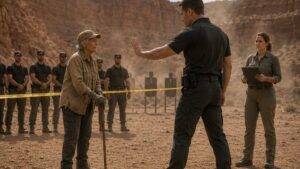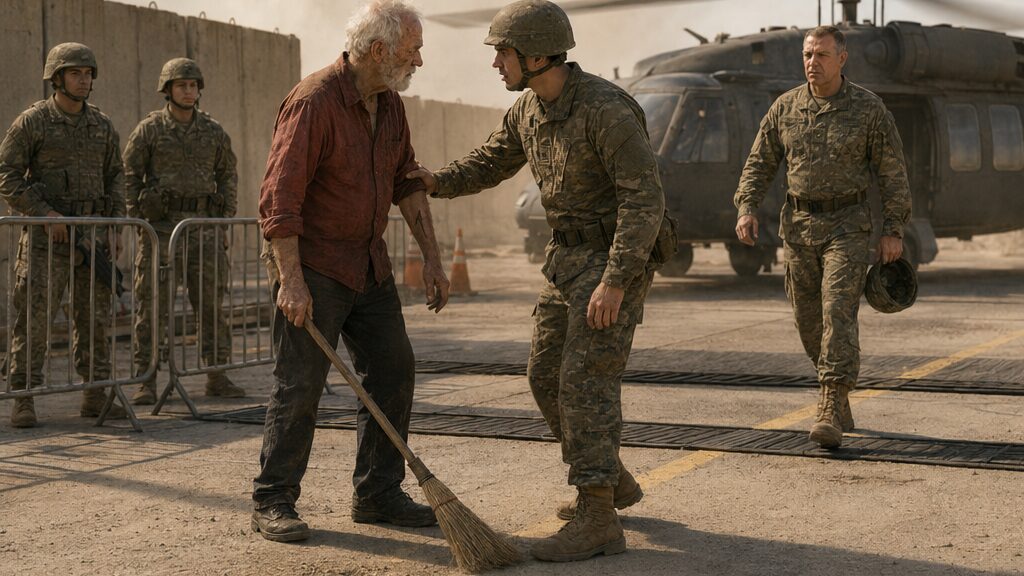
The Old Man With The Broom Saw What The Young Soldiers Stepped Over
Chapter 1: The Old Man Swept Around The Wrong Patch Of Dirt
The broom stopped moving when Stephen Martin saw the dust rise in the wrong shape.
Everything else on the airfield kept going.
The helicopter crew rolled a tool cart past the painted lane. Two soldiers dragged cable mats over the sand-colored concrete. A mechanic shouted over the whine of a generator. Farther out, beyond the low blast walls, the desert shimmered as if the whole base had been set on a hot stove before sunrise.
Stephen stood still with both hands on the broom handle.
A man who did not know the ground would have missed it. Most people would have seen only dirt gathered at the edge of the staging strip, a little crescent of powder and grit caught against a shallow rise. The renovation crew had scraped and leveled this part of the airfield three weeks earlier. New paint marked the safe vehicle path in white and yellow. Fresh gravel had been pressed into the shoulders. A young soldier could look at it and see order.
Stephen saw a crescent.
Wind did not leave a crescent like that. Tires did not leave it either. A broom did not make it unless the ground below answered back.
He bent slowly, not because he wanted to seem careful, but because his knees no longer forgave hurry. His red work shirt stuck to his back. The morning heat had already climbed under the collar. One of his hands, darkened by sun and age spots, slid down the wooden handle until the broom head rested flat in the dust.
He drew the bristles across the patch once.
The dust shifted in a smooth line, then broke.
Stephen stopped again.
Behind him, a voice called, “Grounds crew, keep that lane clear.”
He did not turn. The voice was young, sharp, full of morning command. Stephen had heard a thousand voices like it in fifty different places. Some of them had grown wise. Some had not had time.
He moved the broom three inches to the left and swept again, lighter now. The straw bristles whispered over the dirt. A tiny point of metal flashed, then disappeared beneath the dust as though it had blinked.
Stephen’s fingers tightened on the handle.
The old habit came back so fully that for a breath he was not seventy-six, not wearing worn black shoes and a civilian badge, not assigned to sweep sand away from a demonstration route. He was kneeling beside a road that had no painted lines, listening to a silence that should have contained birds. He smelled hot rubber, old oil, and the mineral bite of disturbed soil. He heard someone behind him laughing because a nervous man always seemed funny before he became right.
A gust from the helicopter’s idle rotor pushed across the staging area and lifted dust around his ankles. The memory thinned. Stephen breathed through his nose until the present returned: the helicopter, the concrete barriers, the cable mats, the clipboard under a crew chief’s arm.
He looked down again.
The metal point was not large. Maybe the head of an old stake. Maybe scrap from the renovation. Maybe nothing. But the dust around it had settled in a shallow ring, and half a foot away, where the broom had not touched, the ground held a second faint shadow. Thin. Straight. Too straight.
Stephen set the broom upright and rested his weight against it.
The base had been in a hurry all week. Everyone knew it. The commander wanted the inspection clean. The flight demonstration had been moved up after two delays. The renovation contractor had promised the staging lane was safe. Digital maps said the old training range ended beyond the far berm, well away from the helicopter route.
Digital maps had not learned to smell turned earth.
Stephen took one step closer to the metal glint.
His right foot dragged slightly, a small betrayal he never mentioned. The medic had once told him it was nerve damage, old and ordinary. Stephen had nodded as if ordinary meant harmless. He shifted the broom to his left hand and lowered the handle, using the rounded end instead of the bristles. He did not jab. He touched the dirt beside the glint and watched.
The dust trembled loose.
Not much. Just enough.
He straightened and looked toward the operations trailer. Through the heat blur he could see Pamela Torres crossing from logistics with a stack of folders hugged to her chest. She walked fast, head angled toward the flight line as if the whole day were chasing her. Past her, a group of soldiers moved portable barriers closer to the lane.
One of those barriers was about to be set over the second shadow.
Stephen raised a hand.
“Hold there,” he called.
His voice came out lower than he expected. The generator swallowed half of it.
No one stopped.
Stephen stepped away from his sweep line and lifted the broom sideways, not high enough to threaten, only enough to mark space. The nearest soldier glanced at him, then looked away with the practiced impatience people saved for old maintenance men.
Stephen tried again. “Don’t set that there.”
This time one of the soldiers looked over. “What?”
“That barrier. Leave it where it is.”
The soldier frowned. He was young enough that the skin beneath his helmet strap still looked soft. “We were told to move these.”
“Then tell whoever told you that the ground’s wrong.”
The soldier gave the dirt a quick look and saw nothing. He gave Stephen a longer look and saw even less.
“Specialist Harris!” he called.
Stephen knew the name before the young man turned. Nicholas Harris had been posted along the staging area since sunrise, clean uniform, clean boots, clean confidence. He had a way of standing with one hand near his radio and his chin raised half an inch too high, as if the world were a room he had already inspected and found acceptable.
Nicholas walked over with a tablet in one hand. His eyes flicked to the broom, then to Stephen’s face.
“Problem?”
Stephen pointed with the handle. “This lane shouldn’t be crossed until range control looks at that patch.”
Nicholas did not look where Stephen pointed. He looked at the painted line. “This lane is cleared.”
“I’m saying it isn’t.”
“You’re grounds maintenance?”
Stephen’s jaw moved once before he answered. “Today, yes.”
“Then maintain the ground outside the marked lane.” Nicholas turned toward the soldiers. “Move the barrier.”
Stephen shifted the broom in front of the metal glint. “No.”
The word was not loud. It did not need to be. The two soldiers stopped anyway, more surprised by the refusal than persuaded by it.
Nicholas’s face tightened. “Sir, you need to step back.”
Stephen heard the sir and understood its shape. It had no respect in it. It was a clean word placed over irritation.
He lowered the broom until the bristles nearly touched the glint again. “There’s something under here.”
“Debris.”
“Maybe.”
“Then we’ll have maintenance clear it after the demonstration.”
Stephen looked past him to the helicopter. A crew chief stood near the open side door, one hand on the frame, talking to another crew member inside. The aircraft’s nose pointed toward the painted lane. Under the rotor wash, loose dust slid and gathered in small ridges.
“Not after,” Stephen said.
Nicholas exhaled hard through his nose. “This area’s been inspected.”
“By eyes that didn’t know what to ask.”
The young soldier’s expression changed. Not anger yet. Embarrassment first. There were people watching now. Two soldiers with the barrier. A mechanic by the tool cart. Pamela, slowing near the trailer stairs.
Nicholas stepped closer. “You don’t get to block a secured area because you don’t like how the dirt looks.”
Stephen let the words pass. He leaned down and used the broom tip to draw a careful circle around the glint, leaving the metal point untouched. As the bristles completed the arc, dust slid away from another spot three inches beyond the first.
A second glint appeared.
Stephen’s mouth went dry.
The first one might have been scrap. The second made a line.
Nicholas followed his gaze at last. For one brief second, Stephen saw uncertainty cross the young man’s face. Then pride covered it.
“Back up,” Nicholas said.
Stephen did not move.
The helicopter’s rotor washed dust across the broom head. The two glints vanished again beneath a thin veil of sand.
Stephen kept his broom planted around the wrong patch of dirt.
Chapter 2: Nicholas Grabbed The Arm With The Faded Arrow
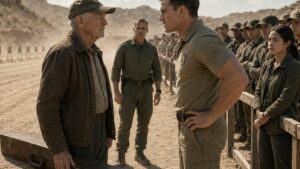
Nicholas Harris moved like a man who believed hesitation could be mistaken for weakness.
He stepped around the broom and reached for Stephen’s sleeve. Stephen saw the hand coming and could have pulled away. Instead, he stayed still. Sudden movement near uncertain ground was for young men who thought speed solved everything.
Nicholas caught his forearm just above the wrist.
The grip was not brutal, but it was public. That made it heavier.
Stephen felt the young soldier’s fingers press into skin thinned by age. His sleeve rode up. The faded mark on his forearm showed in the sun: a dark arrowhead shape, blurred at the edges now, the old ink softened by years of weather and work. It had once been sharp enough to look cut into him.
One of the soldiers behind Nicholas went quiet.
Nicholas glanced down at the mark, then back at Stephen. “What is this?”
Stephen looked at the hand holding him. “Old.”
“That’s not what I asked.”
“No.”
The word hung there, dry as the air.
Nicholas’s ears reddened. “You’re interfering with an active flight line.”
“I’m keeping your boots off something.”
“You don’t know that.”
Stephen turned his head slowly toward the dirt. The broom lay at his feet now, dropped when Nicholas pulled his arm aside. Its bristles rested just short of the circle he had drawn. The two glints were covered again, but Stephen could still see the place by the way the dust had folded around it.
“I know enough not to step there,” Stephen said.
Nicholas tightened his grip half a breath before letting go. The release left a pale shape on Stephen’s skin.
“Pick up your broom,” Nicholas said, “and clear out.”
Stephen bent, slower than he wanted. His back had stiffened during the confrontation, and his right knee clicked as he reached down. He heard one of the watching soldiers shift his weight. Maybe impatience. Maybe discomfort. He took the broom handle and stood.
For a moment, he thought of obeying.
That was the old danger. Not fear of Nicholas. Not fear of being wrong. Fear of being dramatic. Fear of becoming the kind of old man people humored until he left the room. Fear of hearing himself explain something no one had asked him to remember.
He saw the road again, not clearly, never all at once. A crescent in dust. A wire shadow where no wire should have shown. A pinhead glint. A lieutenant smiling with all his teeth and saying, Martin, we don’t have time for ghosts.
Stephen swallowed.
Nicholas turned away. “Move the barrier.”
The soldiers reached down.
Stephen lifted the broom and laid the handle across the space in front of their boots.
No one spoke.
Nicholas turned back. “Are you serious?”
Stephen pointed with the broom tip, not at the glint this time, but at the three signs around it. “There. Crescent ridge. There. Cable shadow. There. Pinhead reflection. They don’t belong together unless something underneath is holding the ground.”
Nicholas stared at the dirt. “You got all that from sweeping?”
“I got that from looking.”
A mechanic nearby gave a short laugh, then killed it when no one joined.
Nicholas’s face hardened. “You’re not range control.”
“No.”
“You’re not explosive ordnance.”
“No.”
“You’re not on the inspection roster.”
Stephen met his eyes. “No.”
“Then you don’t get to call this.”
The words landed cleanly. Stephen could feel the truth in them, at least the military truth. Authority traveled through paper, rank, radio, and assignment. A man with a broom had none of those things. He had the ground. He had his old eyes. He had a memory he had spent years trying not to keep polished.
He lowered the broom, touched the dust beside the first sign, and dragged the bristles lightly outward. The crescent reappeared. The shape was small but wrong, a shallow lip as if the dirt beneath had risen and settled after being disturbed.
Nicholas looked at it, then away too quickly.
“That could be from anything,” he said.
“Could be.”
“Then stop acting like you know.”
Stephen looked at the helicopter. The crew chief had stopped talking. She stood with both hands on her hips now, watching the delay build around them. The rotor turned lazily above her, chopping sunlight.
“I don’t need to act,” Stephen said.
Nicholas stepped close enough that his shadow fell over the broom. “Listen to me. The commander’s coming through here in less than an hour. We’ve got a demonstration window, a safety brief, and a contractor who already signed off on this lane. I am not shutting it down because an old man found shiny trash.”
An old man.
Stephen had been called worse by better men. It still found a place to cut.
His fingers tightened on the broom. The straw bristles trembled lightly against the dirt. He made himself relax them. Anger had weight. Weight moved too much ground.
“I’m not asking you to shut it down,” he said. “I’m asking you not to cross this line until someone checks what the renovation covered.”
“The renovation covered nothing dangerous.”
“Then checking won’t hurt.”
Nicholas opened his mouth, but a new voice cut through the rotor wash.
“What’s holding my lane?”
The watching soldiers straightened.
Senior Warrant Officer Brian Roberts walked in from the helicopter side of the staging area, helmet tucked under one arm, sleeves neat, expression unreadable. He was not tall, but he carried the stillness of someone people made space for. Dust moved around his boots. He looked first at Nicholas, then at the barrier, then at the old man with the broom.
Stephen knew the type. Not by rank. By eyes.
Brian’s gaze dropped to Stephen’s uncovered forearm.
The faded arrow mark sat in the open sun.
For the first time that morning, no one spoke quickly.
Nicholas shifted. “Sir, grounds maintenance is interfering with a cleared lane.”
Brian did not answer him. He kept looking at the mark, then at Stephen’s face, as if he were trying to match a name from somewhere half-remembered.
Stephen tugged his sleeve down with two fingers.
Too late.
Brian stepped closer. “What did you find?”
Nicholas looked at him, surprised. “Sir, it’s debris. He won’t move.”
Brian raised one hand without looking away from Stephen. Nicholas stopped.
Stephen pointed with the broom.
“Two glints in line,” he said. “Crescent dust here. Straight shadow there. Ground doesn’t settle like that unless something underneath made it.”
Brian crouched, careful not to put his knee near the marked area. He studied the dirt. Not long. Long enough.
Nicholas watched his face and began to understand that the conversation had changed without his permission.
Brian looked up. “What’s your name?”
Stephen felt the heat, the eyes, the old mark burning under his sleeve though it was covered now.
“Stephen Martin.”
Brian stood very slowly.
“Martin,” he said, and the name came out different in his mouth, not loud, not official, but weighted by recognition.
Stephen looked at him and said nothing.
Brian’s eyes returned to the ground.
Behind them, the helicopter rotor kept turning, patient and blind.
Chapter 3: The Map In The System Said The Ground Was Clear
Brian Roberts did not trust hunches. He trusted procedures, signatures, coordinates, and the kind of doubt that forced a man to check twice.
That was why Stephen Martin troubled him.
The operations trailer smelled of burnt coffee, printer heat, and dust tracked in by too many boots. A wall monitor showed the airfield diagram in clean digital lines: staging lane, helicopter position, restricted zones, access routes, inspection path. Everything was bright, squared, labeled, and confident.
On the screen, the patch of ground Stephen had circled was clear.
Nicholas stood near the door with his jaw set, helmet tucked under his arm. He had said little since Brian ordered a temporary hold on the barrier movement. Not a shutdown. Not yet. A hold. Five minutes had become fifteen, and fifteen minutes on an inspection morning was enough to turn everyone’s patience brittle.
Stephen stood by the folding table, broom in one hand, cap shadowing his eyes. He looked out of place among the radios and screens. That made it too easy to dismiss him. Brian disliked easy dismissals.
Pamela Torres tapped at the workstation keyboard. “The renovation file shows this area cleared by ground survey after grading. Contractor sign-off, safety review, digital overlay. No active range hazard within the staging lane.”
“Show me the older layer,” Brian said.
Pamela gave him a tired look. “How old?”
“Pre-renovation.”
She clicked twice. The map changed, adding gray outlines beneath the newer colored routes. The former training boundary sat beyond the berm, just as the file said.
Nicholas leaned slightly forward. “That’s what I told him.”
Brian heard the edge in it and ignored it. “And before that?”
Pamela’s mouth tightened. “Before that may not be in the system.”
Stephen’s eyes moved from the monitor to her face.
Brian noticed. “Mr. Martin?”
Stephen lifted one shoulder. “That line’s too clean.”
Nicholas exhaled. “The map line?”
“The old range boundary.”
Pamela turned from the screen. “The line is pulled from survey data.”
“Current survey data,” Stephen said.
“It includes historical overlays.”
“Only what somebody entered.”
Silence moved through the trailer. Not dramatic silence. Working silence. The kind that came when a simple problem began to grow corners.
Brian crossed his arms. “Tell me what you think is missing.”
Stephen looked at the screen as if it were a window with the wrong view painted on it. “Old temporary lanes. Engineer practice strips. The ones nobody kept after they moved the berm.”
Pamela’s fingers hovered over the keyboard. “There’s no record of practice strips in that section.”
Stephen nodded once, almost to himself. “That would be the problem.”
Nicholas shifted by the door. “Sir, with respect, he’s guessing from memory.”
Stephen did not look at him. “Memory’s not the same as guessing.”
Brian studied the old man’s hands. The right hand rested lightly on the broom handle. The left hand, the one with the mark hidden under the sleeve now, tapped once against his thigh, then stopped. A controlled movement. A habit locked down before it could become visible.
Brian had seen that before in men who carried maps inside their skin.
“What unit?” he asked.
Stephen’s face closed a fraction.
Pamela looked between them. Nicholas looked at Stephen’s sleeve.
“I’m not here under that,” Stephen said.
“That wasn’t my question.”
“No.”
Brian accepted the refusal. Rank could demand answers from soldiers. It could not drag them from old men who had already given more than records showed.
He turned to Pamela. “Print the current map and the historical overlay.”
Pamela did it. The printer rattled, slow and irritated. When the pages came out, Brian spread them across the table. Stephen set the broom against the wall and reached for a pencil from a chipped cup near the radio.
Nicholas stepped forward. “You want him drawing on official maps?”
Brian looked at him. “I want him showing us what he saw.”
Nicholas stopped.
Stephen did not take the chair Pamela offered. He leaned over the map, one hand braced on the table, pencil held loosely. He did not draw at first. He looked from the map to the trailer window, through which the helicopter tail and blast wall were visible. Then he marked a small crescent near the staging lane.
“That’s where the dust lifted.”
He marked two dots.
“Glints.”
Then a thin line, not quite straight.
“Shadow. Could be cable. Could be edge. Could be nothing.”
Nicholas gave a small, humorless sound.
Stephen added no defense. He moved the pencil farther out, past the painted lane, toward the old gray boundary on the map. His hand paused.
Brian saw it.
“What?”
Stephen looked closer. “This boundary turns too soon.”
Pamela leaned over. “That’s the digitized range edge.”
“No,” Stephen said softly. “That’s the part somebody remembered.”
His pencil hovered above a blank space between the old boundary and the current helicopter lane. Not much space. On paper it was nothing. On the ground it was enough for wheels, men, fuel, rotor wash, and error.
Pamela turned back to the computer. “If there was an older chart, it would be archived under range control or facilities. But the contractor packet references only the digitized set.”
Brian looked at the monitor again. Clean lines. Clean lies, maybe. Or incomplete truths. He had spent enough years around official systems to know the difference mattered only after someone got hurt.
A knock came at the trailer door. A soldier leaned in. “Warrant Officer, commander wants update. Demonstration window opens in forty.”
Brian nodded. “Tell them we’re checking a possible discrepancy.”
The soldier glanced at Stephen, then at the broom against the wall. “Yes, sir.”
Nicholas’s face tightened again. He waited until the door closed. “Sir, a possible discrepancy based on what? Dust?”
Brian turned to him. “Based on a man noticing a pattern before we did.”
Nicholas looked as if he had been corrected in front of a crowd all over again.
Stephen picked up the pencil and drew one more line, very light, extending from the missing boundary toward the two dots. His hand was steady, but Brian saw the effort it took.
“Old practice strips didn’t always follow the permanent maps,” Stephen said. “Sometimes they ran temporary lanes off the books until the paperwork caught up.”
Pamela stared at the blank space he had marked.
“And if paperwork never caught up?” she asked.
Stephen put the pencil down.
“Then the ground remembers.”
Chapter 4: Pamela Found The Box Nobody Wanted To Open
Pamela Torres had learned that old paper was where military schedules went to die.
She kept the logistics office moving because she knew which forms mattered, which signatures were theater, and which forgotten folders could trap an entire base for three days if somebody opened them at the wrong time. That was why she stood in the records storage room doorway for half a second longer than necessary, looking at the rows of gray archive boxes with the tired suspicion of a woman who had seen “quick checks” become investigations.
Behind her, Brian Roberts waited without crowding her. Stephen Martin stood beside a metal shelf, broom still in hand, saying nothing. Nicholas Harris had been left outside with orders to keep the staging lane frozen and his opinions to himself.
The storage room was cooler than the trailer but heavier with dust. Old binders sagged on shelves. Rolled site plans leaned in cardboard tubes near the back wall. A humming fluorescent light blinked once every few seconds, turning the room briefly older each time it dimmed.
Pamela set the printed map on a waist-high cabinet. “If this exists, it’s not going to be under airfield renovation.”
Stephen’s eyes moved across the boxes. “Range control.”
“That would be another building.”
“Not for retired ranges.”
Pamela looked at him. “You know that, or you remember that?”
Stephen gave the smallest shrug. “Both get old.”
Brian almost smiled, but Pamela did not. The demonstration window was shrinking. The commander had already called twice. The contractor had sent a representative who used the phrase “documented clearance” as though repeating it could make it true. Every minute she spent digging through old records made her the person slowing the base down over a groundskeeper’s dust pattern.
She pulled the first box from the shelf anyway.
The label read: RANGE TRANSITION / FACILITIES / 1998–2004.
“Too recent,” Stephen said.
Pamela’s jaw tightened. “You haven’t seen what’s in it.”
“Berm moved before that.”
Brian watched Pamela’s face. She did not like being corrected in her own domain, but she put the box back.
“What year?” she asked.
Stephen looked at the floor. His thumb rubbed once against the broom handle.
“Late seventies layout. Maybe kept into the eighties. Temporary engineer lanes. Before they pushed aviation farther east.”
Pamela turned toward the older shelves, the ones nobody wanted because their labels had faded into tea-colored smudges. She ran a finger along the boxes, reading half-words.
FACILITIES—UNPAVED ACCESS.
RANGE SAFETY—DISCONTINUED.
TRAINING AREA—LEGACY.
She stopped.
The box was wedged sideways behind two newer cartons, its lid bowed inward, one corner crushed. Someone had written on the side in black marker long ago, then crossed it out with blue tape. Beneath the tape, almost hidden, was a faint symbol like an arrowhead.
Pamela glanced at Stephen.
He was staring at the mark.
“Is that it?” Brian asked.
Stephen did not answer immediately. His face had gone still in a way Pamela did not understand. Not blank. Contained.
“Could be,” he said.
Pamela pulled the box. Dust slid down its side and scattered across her blouse. She shut her eyes for one second, annoyed despite herself, then set the box on the cabinet.
“This is probably unrelated,” she said, because saying it helped keep the room from becoming too important.
The lid resisted. Brian helped her ease it open.
Inside were brittle folders, folded maps, range cards, and handwritten maintenance notes tied with cotton string. The smell that rose from the box was dry and chemical, paper and old ink and desert grit. Pamela handled the first folder carefully. The date line was faded. The map inside had been copied so many times the numbers blurred at the edges.
Brian leaned in. “Can we match this to the airfield?”
“Maybe,” Pamela said. “If the grid is still compatible.”
Stephen set the broom against the cabinet. Without it in his hand, he looked smaller. Pamela noticed the slight bend in his shoulders, the way one knee did not fully straighten. Then he reached toward the map, stopped, and waited for permission.
The gesture bothered her more than the delay.
She slid the map toward him.
Stephen did not touch the paper at first. He looked at it as if it might look back. Then he placed two fingers near a thin broken line at the lower right corner.
“This is the old wash.”
Pamela frowned. “There’s no wash there now.”
“Filled.”
“This whole section was graded.”
Stephen nodded. “That’s how things disappear.”
Brian tapped the printed modern map beside the old one. “Where are we?”
Pamela took a ruler from the cabinet drawer, aligned the old coordinates as best she could, then marked the rough modern equivalent. The old broken line ran closer to the staging lane than the digital map showed. Not on top of it. Close enough to make her stomach go quiet.
She pulled another sheet from the box. This one was a range closure note. Half the ink had faded, but the attached sketch showed a temporary engineer practice strip extending beyond the old boundary. There were symbols along it—small arrowheads, dots, and short crescent marks.
Pamela heard herself breathe in.
Stephen pointed to one symbol. “Pressure marker.”
“It says training use only,” Pamela said.
“Training charges still have markers. Markers still have stakes. Stakes still disturb ground when they rot, shift, or get buried.”
Brian’s voice stayed even. “Are charges still possible?”
Stephen’s eyes remained on the paper. “Possible isn’t my word.”
“What is?”
“Unverified.”
Pamela looked at him then. She had expected alarm, maybe old-man stubbornness dressed up as expertise. Instead Stephen seemed almost reluctant to be correct. His hand hovered above the map, never pressing hard enough to damage it.
She pulled another folder. “There should be a closure certification.”
Brian moved closer. “Find it.”
She did. It was in the bottom half of the box, folded around two smaller sheets. The certification listed cleared sections, removed markers, and inspected lanes. Pamela scanned the page quickly, then slower.
One line had been stamped incomplete.
Not failed. Not cleared. Incomplete.
A handwritten note beside it read: “Deferred pending aviation expansion survey.”
Pamela looked at the date. Then at the modern map. Then at Stephen.
“That strip was supposed to be checked later,” she said.
Brian’s expression darkened. “Was it?”
Pamela turned the remaining pages. Her fingers moved faster now, but the answer did not appear. No follow-up. No completion stamp. No transfer note. No final clearance. Only a contractor packet from decades later that had inherited a clean digital boundary as if the unresolved strip had never existed.
Outside, through the wall, the muted thump of rotor blades deepened.
Pamela flinched toward the sound. “They’re spinning up?”
Brian was already at the door. “They shouldn’t be moving.”
Stephen picked up the broom. “The first marker isn’t the end.”
Pamela stared at the old map. The symbols ran in a faint curve, not straight, across the area that had become the helicopter staging lane.
A curve.
A crescent.
She looked down at the faded symbol on the corner of the map, then at Stephen’s sleeve.
“Mr. Martin,” she said, quieter now, “that mark on your arm.”
Stephen paused in the doorway.
Pamela touched the arrowhead printed on the old range sheet. “It matches this.”
Stephen pulled his sleeve down though no one had asked him to show it.
“Yes,” he said.
Then he stepped back into the heat with the broom in his hand.
Chapter 5: The Helicopter Crew Trusted The Painted Line
Rachel Martinez trusted lines because people’s lives depended on them.
A red line meant stop. A yellow line meant caution. White paint marked where wheels belonged. Cable mats had edges for a reason. Rotor clearance zones were measured, briefed, checked, and checked again until every crew member could move inside them without wasting thought.
By early afternoon, the painted lane in front of her helicopter looked clean enough to pass inspection. That was the problem. It looked clean.
Rachel stood beside the nose wheel with her gloves tucked under one arm, watching a delay harden into something nobody wanted to name. Her crew had run through the demonstration prep twice. Fuel was good. Radios were good. The maintenance note that had worried her in the morning had cleared. The only thing stopping them now was an old groundskeeper, a warrant officer, a logistics coordinator with dust on her shirt, and a young specialist pretending not to look embarrassed.
The old man stood near the edge of the lane with his broom.
Not dramatic. Not wild-eyed. Not even loud. That made him harder to dismiss.
Rachel had watched the earlier confrontation from a distance, close enough to see Nicholas grab the man’s arm, too far to hear every word. She had disliked the grip on sight. Soldiers sometimes forgot that authority was not the same thing as hands. Still, she had assumed the delay would end with an apology, a note in the log, and everyone getting back to work.
Now a strip of orange cones cut across the staging area.
Brian Roberts walked toward her from the operations side, Pamela close behind with folded maps against her chest. Stephen came last. Nicholas stood at the frozen barrier line, his expression caught between duty and resentment.
Rachel met Brian halfway. “Are we holding or moving?”
“Holding,” Brian said.
“For how long?”
“Until range control verifies a legacy strip.”
That answer changed the air around her.
“Legacy strip where?”
Brian nodded toward the painted lane.
Rachel looked down at the concrete and packed dirt beneath the nose wheel path. “This was cleared.”
“Current files say it was.”
“Current files are what we fly on.”
Stephen’s voice came from behind Brian. “Current files missed the curve.”
Rachel turned to him.
Up close, he looked older than he had from the helicopter door. His beard was white, his face deeply lined, his shirt faded at the seams. But his eyes were not vague. They were fixed on the ground with a kind of tired attention she recognized from crew chiefs who listened to machines through their fingertips.
“What curve?” she asked.
Stephen looked at Brian first, as if rank still mattered even when the ground did not care. Brian gave a small nod.
Stephen stepped toward the lane. Nicholas moved immediately.
“Sir,” Nicholas said to Brian, “he shouldn’t go closer.”
Stephen stopped before anyone ordered him to. He lifted the broom slightly. “I don’t need closer.”
Rachel watched him angle the handle toward the dust gathered along the lane’s edge. “There’s the first crescent. The one by the barrier.”
She followed the line of the broom. She saw dust. Nothing more.
Stephen moved the broom tip slowly, tracing air. “Then another shallow ridge there, under the cable mat edge. Then there, by your nose wheel path. Same arc.”
Rachel crouched, because pride had no place near aircraft. From standing height it was nothing. From the ground, with the sun lowered enough to throw small shadows, she saw a fine raised lip in the dust, pale against the packed surface. It curved away from the painted lane.
She looked back at Stephen. “Could be rotor wash.”
“Rotor wash scatters loose dust outward,” he said. “This caught and held.”
“Could be from grading.”
“Then it would follow the blade marks.”
Rachel leaned closer. He was right about that much. The grader’s faint parallel lines ran one direction. The crescent crossed them.
Nicholas’s voice came tight behind her. “We’re calling off a demonstration over a dust ridge?”
Rachel stood slowly. “Nobody said call off.”
Stephen looked beyond her helicopter, past the painted route, toward the far berm. His face had changed. It was not fear exactly. It was recognition unwanted.
“Your front wheel crosses here?” he asked.
Rachel pointed. “We roll forward six feet, pivot slightly left, then taxi along the marked path.”
Stephen shook his head once.
The movement was small, but Rachel saw Brian notice it.
“What?” Brian asked.
Stephen walked along the outside edge of the lane, keeping well clear of the marked patch. His broom moved with him, sometimes a cane, sometimes a pointer. At the cable mat, he stopped and crouched with effort. Rachel almost reached to help him, then didn’t. Something in the way he balanced told her help would distract him more than ease him.
He used the broom bristles to brush dust away from the cable mat’s edge. Not hard. Barely enough to move the top layer.
A tiny metal head appeared, duller than the earlier glint, almost the color of stone.
Rachel’s throat tightened.
Brian stepped closer. “Don’t touch it.”
Stephen gave him a dry look. “Wasn’t planning to.”
Pamela unfolded the old map on the hood of a nearby utility cart. The paper snapped in the rotor wash until she pinned it with both hands.
“The symbols run in an arc,” she said. “If this overlay is right, the old temporary strip crosses just inside the current lane, then curves under the staging path.”
Rachel looked from the paper to her helicopter. A line drawn decades ago, nearly forgotten, now touched the place her crew had trusted.
Nicholas walked closer, stopping a few feet from Stephen. “Why didn’t the survey catch it?”
Pamela answered before Stephen could. “Because the survey checked the digitized boundary. The temporary strip wasn’t in the digital layer.”
Nicholas’s face went still.
Rachel did not look at him. She watched Stephen instead. The old man’s hand had closed around the broom handle until his knuckles paled. He was staring at the nose wheel path.
“What are we dealing with?” Rachel asked.
Brian answered, but his eyes stayed on Stephen. “Possible buried training markers. Maybe nothing hazardous. Maybe old components. We don’t know yet.”
Stephen’s mouth tightened at maybe nothing. He did not contradict Brian. Rachel respected that. Panic was easy. Precision cost more.
The base commander’s vehicle appeared near the operations trailer, moving fast enough to raise a tail of dust. The contractor’s representative followed in another vehicle. The delay had become visible to people who counted time in blame.
Brian turned toward Rachel. “Keep your crew clear.”
“Already done.”
She signaled to the helicopter crew. They began stepping back from the aircraft, confused but obedient. Rachel stayed near the nose, eyes on the ground she had trusted all morning.
Stephen moved to the front of the marked path, studying the dust between the helicopter and the cones. His breathing had become heavier. Not from panic. From the effort of standing in heat, holding old memory and present danger at the same time.
Rachel came beside him, leaving two careful feet between her boots and the crescent he had shown her.
“You’re sure enough to stop us,” she said.
Stephen kept looking at the ground. “Sure enough to ask you not to make me prove it the hard way.”
Before Rachel could answer, rotor wash pushed another sheet of dust across the lane. For a moment it covered everything: paint, cable mat, old marks, new tracks. Then the air cleared.
Under the helicopter’s front wheel path, a crescent line showed itself in the dust, clean as a drawn warning.
Stephen saw it.
Rachel saw him see it.
He lifted the broom and placed the handle across the painted lane.
Chapter 6: Stephen Refused To Step Off The Line
The base commander did not shout when he arrived. That made the pressure worse.
He stepped from the vehicle, looked once at the halted helicopter, once at the cones, and then at Stephen Martin standing in the painted lane with a broom laid across his body like a gate. The contractor’s representative hurried behind him with a folder already open, as if paper could outrun dust.
Brian Roberts met the commander before he reached Stephen.
“Possible legacy range hazard crossing the staging lane,” Brian said.
The commander’s eyes narrowed. “Possible.”
“Yes, sir.”
“Verified?”
“Not yet.”
The contractor’s representative lifted his folder. “Sir, our clearance documentation is complete. The graded section was surveyed and released.”
Pamela Torres, holding the old map with both hands, said, “The survey used a digital boundary that omitted a temporary engineer strip.”
The representative glanced at the paper and dismissed it with his eyebrows before his mouth moved. “That map is decades old.”
Stephen looked at the ground.
So many men had once died between those two ideas: old and useless.
The commander walked closer, stopping outside the cone line. His gaze settled on Stephen’s broom. “Mr. Martin, is it?”
Stephen nodded.
“I’m told you found a marker.”
“More than one.”
“I’m told you believe the lane is unsafe.”
“I believe nobody knows it’s safe.”
The commander’s face held. He was not a cruel man. Stephen could see that. But command trained a person to hear delay as threat. A schedule broken in public had its own sound. The helicopter crew waiting. The inspection clock moving. Soldiers watching. Contractors ready to defend their signatures. One old groundskeeper in the middle of the path.
“Step out of the lane,” the commander said. “Range control will inspect from there.”
Stephen did not move.
Nicholas, standing near the cones, looked at him sharply. Rachel Martinez had pulled her crew back, but she remained near the helicopter’s side, helmet in hand. Pamela clutched the map to keep the wind from folding it. Brian said nothing.
The commander’s voice cooled. “Mr. Martin.”
Stephen felt the whole base lean toward his answer.
His right knee throbbed. Sweat ran down his back. His hand ached around the broom handle. He wanted, with a sudden and ordinary longing, to step away. To let men with radios and titles carry the weight. To be an old worker again, sweeping where he was told, invisible enough to be left alone.
Then the dust shifted under the rotor’s idle breath, and the crescent under the wheel path appeared again.
He saw another road.
No helicopter. No painted line. A convoy waiting under a white sky. His younger hand flat over soil that looked too smooth. A lieutenant looking past him at a watch.
Martin, we don’t have time for ghosts.
He had stepped back then.
Not far. Just enough to obey. Just enough to let another man’s certainty become everyone’s road.
The sound afterward had removed a part of the world.
Stephen blinked and was back in the desert airfield, old and sweating, with a broom instead of a rifle and a line in front of his shoes that no one else had learned to fear yet.
“No,” he said.
No one moved.
The commander’s expression changed. Not anger first. Surprise.
Stephen lifted the broom and planted its bristles upright in the dust at the edge of the crescent. The straw spread slightly, harmless and ridiculous, a janitor’s tool pretending to be a flag.
“I stepped off once,” Stephen said. His voice was rough, and he hated that. He steadied it. “Men crossed because someone with more rank said there wasn’t time. The ground was telling us before the map did.”
The contractor’s representative shifted. “Sir, with respect, that has nothing to do with this site.”
Stephen looked at him then. “The ground doesn’t care which site you’re paid for.”
Brian took one step forward, not between Stephen and the commander, but beside Stephen. “Recommend full stop until range control verifies the strip.”
The commander stared at the broom. “That will cancel the demonstration.”
“Yes, sir,” Brian said.
“That will trigger a review.”
“Yes, sir.”
Pamela held out the old map. “It already should have.”
The commander did not take it. He looked toward Rachel. “Crew chief?”
Rachel answered without hesitation. “My crew stays clear until we know.”
Nicholas looked at her, then at the old man. His face had lost its hard certainty. Something else had entered it, uncomfortable and new.
A radio crackled near Brian’s shoulder. Range control was en route with detection equipment. Ten minutes out.
Ten minutes. Stephen almost laughed. Ten minutes was exactly the kind of time people said they did not have until they had no more of it.
The commander’s jaw worked once. “Hold all movement.”
The words traveled faster than relief. Soldiers repeated them. A hand signal passed down the lane. The helicopter’s rotor slowed, blade chop softening into heavy beats. Rachel turned and sent her crew farther back.
Stephen did not step away until Brian touched his elbow lightly.
“Come back from the line,” Brian said.
This time Stephen obeyed, because the line had been seen.
Range control arrived in two vehicles. No one spoke much while the team set up. The first specialist approached the marked patch with equipment held low. Stephen stood beside Brian and watched the sweep begin. He did not offer advice. He had said what he could. Anything more would sound like wanting to be right.
Nicholas stood a few yards away, helmet under one arm. Dust clung to his boots. His eyes kept returning to the place where his hand had gripped Stephen’s forearm that morning.
The detector passed over the first glint.
A tone sounded.
Small. Thin. Terrible.
The range-control specialist raised a hand.
The contractor’s representative stopped breathing loudly.
The team worked with slow care, brushing away dust, exposing the top of a corroded marker stake set deeper than it should have been. Not scrap. Not random debris. A training-range pressure marker, old, shifted, almost swallowed by renovation fill.
Pamela closed her eyes.
Brian’s face stayed still, but Stephen saw his shoulders change.
The commander stepped closer to the range-control team. “Is it hazardous?”
“Marker only so far,” the specialist said. “But it indicates buried training components may still be aligned with this strip. We need to clear the whole arc.”
Stephen looked beyond the first marker to the curve under the helicopter path.
“The whole arc,” Rachel repeated softly.
The team moved to the second glint. Another tone. Then a third, under the cable mat edge. The map in Pamela’s hands trembled in the rotor wash, showing its old symbols exactly where the ground had begun to answer.
Nicholas walked toward Stephen, then stopped before he got too close.
“Mr. Martin,” he said.
Stephen looked at him.
The young soldier’s mouth opened, then closed. Whatever apology he had tried to form was not ready yet. Stephen was grateful. Public apologies could become another kind of performance.
The range-control specialist called from the lane, “We have another marker at the nose wheel path.”
Rachel turned away sharply, one hand rising to her forehead.
The commander stood silent for a long moment. Then he looked at Stephen, not as a man looks at a symbol, or a problem, or an inconvenience. Just at a person he should have listened to sooner.
“Mr. Martin,” he said, “thank you.”
Stephen nodded once.
The words did not repair the old road. They did not bring back the men who had crossed it. They did not make his knee stop aching or his hands stop shaking after he lowered them out of sight.
But they did not make a spectacle of him either.
That was something.
He picked up the broom from where it leaned against a cone. Dust fell from the bristles in a fine stream. The range team had uncovered the first buried marker exactly where he had drawn the circle in the morning, and now everyone could see the line he had refused to leave.
Stephen rested both hands on the handle and watched younger eyes learn the ground.
Chapter 7: Nicholas Learned How To Look At The Ground
By evening, the airfield had become quiet in a way Nicholas Harris had never heard it.
Not silent. A base never went silent. Generators still ran. Radios still clicked. Distant trucks moved behind the maintenance sheds. But the staging lane itself had been closed, taped, marked, and emptied of all the motion that had filled it that morning. The helicopter sat farther back now, safely out of the path, its blades tied down. Orange cones curved across the dust in the shape Stephen Martin had seen before anyone wanted to see it.
Nicholas stood at the edge of that curve with the broom in his hands.
He had not meant to hold it.
Stephen had set it against a cone while the range-control team worked. Nicholas had picked it up when a gust of wind knocked it sideways. At first he held it by the middle, awkwardly, like something that belonged to another man’s hands and might accuse him if gripped wrong. The wood was worn smooth in places, rough in others. The bristles were split and darkened with dust. There was nothing special about it.
That made it worse.
A special tool would have been easier to respect. A piece of equipment with a number etched into it, a sensor, a sealed case, a warning label—those things announced their importance. This was a broom. Nicholas had stepped over brooms his whole life. He had ordered people carrying them to move faster, clear out, come back later.
He looked toward the closed lane.
The range team had found three old marker stakes and enough buried training components to keep the area sealed through the night. Not active in the way people feared in movies. Not harmless either. Corroded material. Old pressure housings. Misplaced remnants from a strip that had never been fully closed because one record had not followed another into the new system.
Not shiny trash.
Nicholas swallowed.
Stephen stood a few yards away with Brian Roberts near the hood of a utility vehicle. The old man’s shoulders sagged now that no one was asking him to hold a line. He looked more tired than victorious. Nicholas had expected victory to make a person taller. Stephen looked as if the day had taken an old debt from him and left him standing with less.
Brian spoke quietly to him, then stepped away toward the operations trailer. For a moment Stephen was alone at the edge of the airfield, looking toward the closed lane.
Nicholas walked over.
He stopped at a respectful distance. He had not known that distance in the morning. He knew it now.
“Mr. Martin.”
Stephen turned. His eyes went first to the broom in Nicholas’s hands.
Nicholas held it out. “Wind knocked it over.”
Stephen accepted it with a nod. “Wind does that.”
Nicholas waited for more. There was no more.
The apology he had tried to form earlier had grown heavier as the day went on. In the morning he might have said it quickly, to clear the air, to make himself feel decent. Now quickness felt like theft. He had grabbed an old man’s arm in front of soldiers. He had looked at a warning and called it pride. He had trusted a screen because it sounded official and distrusted a man because he looked worn.
“I shouldn’t have put my hand on you,” Nicholas said.
Stephen looked toward the lane, then back at him. “No.”
The single word landed harder than anger.
Nicholas nodded. “I’m sorry.”
Stephen’s face did not soften exactly. It changed by a degree, enough to show he had heard the difference between apology and performance.
“Don’t do it to the next man,” he said.
Nicholas looked down. Dust clung to the seams of his boots. In the morning, he had thought clean boots meant readiness. Now they looked like things that had walked without asking permission from the ground.
“I didn’t know what I was looking at,” he said.
“No.”
The word again, not cruel, not forgiving too easily.
Nicholas looked up. “How did you?”
Stephen shifted the broom in his hands. For a moment Nicholas thought the old man would walk away. He would have had the right. Instead Stephen looked across the marked arc, measuring something only he could see.
“You want the short answer?”
“Yes.”
“The dirt was holding its breath.”
Nicholas almost frowned, then stopped himself.
Stephen saw it anyway. “That’s not technical enough?”
“I’m trying to understand.”
“Then don’t start with technical.” Stephen stepped closer to the edge of the cone line and pointed with the broom. “Look there.”
Nicholas followed the handle. At first he saw the same things he had seen all day: dust, tire marks, paint, shadows.
Stephen waited.
The waiting was worse than a lecture. It left Nicholas alone with what he could not see.
“Tell me what belongs,” Stephen said.
Nicholas stared. “The tire tracks.”
“Which ones?”
He looked harder. The fresher tracks were darker, sharper, pressed into the loose surface. Older marks ran beneath them, faint and parallel.
“The grader marks,” he said.
Stephen nodded. “What else?”
“The cable mat edge. The cone shadows. Footprints.”
“What doesn’t belong?”
Nicholas almost answered too fast. He held himself back. The question opened differently when he let it sit.
Near the cone line, a shallow ridge cut across the other marks. It did not run with the wind. It did not match the tire path. It crossed the grader lines at a slight angle and held a brighter dust along its lip.
“That curve,” he said.
Stephen’s eyes stayed on the ground. “Why?”
“It cuts across the other marks.”
“And?”
Nicholas crouched, feeling foolish and determined at once. From lower down, the line became clearer. “It collected dust on one side.”
“Because something under it changed how the surface settled.”
Nicholas looked up.
Stephen placed the broom in his hands again, this time deliberately. “Don’t jab. Don’t sweep like you’re mad at it. Lay the bristles flat. Move only the top dust.”
Nicholas accepted the broom. The handle felt less ridiculous now. He lowered it toward a safe patch Stephen indicated, outside the marked zone.
“Slow,” Stephen said.
Nicholas moved the bristles.
“Slower.”
He tried again. The dust parted differently where it was loose and where it had crusted. A small line appeared, nothing dangerous, just the edge of a buried pebble beneath the surface. Still, the difference startled him. The broom had not discovered anything on its own. It had only made his hand quiet enough to see.
Stephen watched. “Modern equipment matters. Maps matter. Procedures matter. But none of them excuse you from looking.”
Nicholas kept his eyes on the dust. “I thought you were trying to make a point.”
“I was.”
He looked up.
Stephen’s mouth barely moved. “The point was under your boot.”
The words could have humiliated him. They didn’t, because Stephen gave them without enjoyment.
Nicholas stood and handed the broom back carefully. “I don’t know what to say.”
“Good.”
That almost startled a laugh from him, but it died before becoming sound.
Stephen rested the broom against his shoulder. The sunset had pulled the harsh white out of the desert and left the air copper-colored. In that light, the faded arrow on his forearm showed faintly where his sleeve had slipped again.
Nicholas glanced at it, then away.
Stephen noticed. “Ask.”
“What does it mean?”
Stephen rubbed his thumb over the old mark. “It meant we found lines before others crossed them.”
“Combat engineers?”
“Among other things.”
Nicholas waited, but Stephen offered no history beyond that. For once, Nicholas did not push.
From the operations trailer, Brian Roberts approached. He stopped beside them, his gaze moving from Nicholas to the broom and then to Stephen’s uncovered mark.
The day had cooled enough for men to speak softly.
Brian said, “Does the old unit mark still mean find the line before others cross it?”
Stephen looked out at the closed arc where the cones glowed orange in the evening light.
After a while, he said, “Only if somebody listens when it’s found.”
Chapter 8: The Broom Stayed By The Door After They Knew His Name
The next morning, Stephen Martin arrived before sunrise and found his broom leaning beside the groundskeeper’s shed door.
Someone had cleaned the handle.
Not much. No polish. No ceremony. The wood still held stains from years of sweat and dust, and the bristles still bent unevenly to one side. But the dried mud near the lower grip had been wiped away, and a strip of fresh tape had been wrapped around the cracked place where his palm usually rested.
Stephen stood in front of it for a while.
The airfield was cooler in the blue hour before heat returned. Beyond the shed, the closed section of the staging lane lay under cones and warning tape. Range control had worked until midnight and would work again after breakfast. The helicopter demonstration had been canceled, then rescheduled elsewhere with less complaint than Stephen had expected. Official language had already begun to settle over the day before: legacy discrepancy, temporary closure, procedural review.
Words that made danger easier to file.
Stephen picked up the broom.
The new tape felt strange under his hand. Too clean. He turned the handle once and saw no note, no name, no attempt to turn a tool into a plaque. Good. He would have thrown away a plaque.
Inside the shed, the other civilian maintenance workers moved with the careful silence people used when they wanted to acknowledge something without embarrassing anyone. One looked at him and nodded. Another stepped aside so Stephen could reach the water cooler. No one clapped. No one called him hero. The absence of it eased him.
On the wall beside the work assignment board, a new sheet had been posted.
AIRFIELD GROUND OBSERVATION REPORTING UPDATE
Stephen read it slowly.
All grounds staff were to report unusual settling, exposed markers, inconsistent dust patterns, unexpected metallic glints, and discrepancies between physical surface conditions and digital site maps. Legacy paper maps were to be cross-checked before future grading near former range boundaries. No civilian worker’s safety concern was to be dismissed without supervisor review.
There were more words after that, official and necessary. Stephen stopped reading.
Pamela Torres stood just outside the shed, a clipboard held against her hip. Dust still marked the edges of her boots from the records room and the lane. She looked as if she had slept little.
“I didn’t write all of it,” she said.
Stephen turned. “Enough of it?”
“Enough.”
He nodded.
Pamela glanced at the broom. “The tape was the maintenance crew. Not me.”
“I figured.”
“I would have labeled it.”
“I figured that too.”
For the first time since he had known her, Pamela smiled without checking whether she had time for it.
Then the smile faded into something more serious. “The old records are being pulled. All of them. Not just that strip.”
“That’ll make enemies.”
“Paper usually does.”
Stephen looked toward the airfield. The sun had begun to edge over the horizon, turning the concrete barriers pale gold. “Better paper than names.”
Pamela’s mouth tightened. She understood. Not fully. Enough.
A vehicle passed near the operations trailer. Brian Roberts stepped out with a folder under one arm, speaking to a range-control specialist. He saw Stephen by the shed and raised two fingers in a small greeting. No salute. Stephen appreciated that more than Brian could know.
The base commander had offered him a formal commendation the night before, carefully, in private. Stephen had declined just as carefully. He had accepted the procedural review. He had accepted a chair while making his statement because his knee had been shaking by then. He had accepted Rachel Martinez’s quiet thank-you when she found him outside the trailer and told him her crew was home safe.
He had not accepted being turned into a story people could use to feel better for a day and forget by Monday.
The shed radio crackled. Morning assignments began.
Stephen stepped out with the broom and started along the familiar path toward the open sections of the airfield. The closed lane stayed to his left. Cones marked the old curve. The dust there had been disturbed by careful work now, not ignorance.
Near the edge of the staging area, Nicholas Harris stood with another soldier, pointing toward the marked boundary. He looked different without trying to. Still young. Still straight-backed. Still carrying the reflexes of rank and procedure. But when the other soldier started to step over a faint dust line outside the cones, Nicholas put out a hand.
Not grabbing. Stopping.
“Wait,” Nicholas said.
Stephen slowed.
The other soldier looked down. “What?”
Nicholas crouched. He did not call for Stephen. He did not make a show of having learned something. He looked at the ground first.
Stephen stood far enough away that the moment did not belong to him.
Nicholas studied the dust, then brushed the top layer lightly with his gloved fingertips. After a second he shook his head.
“Tire scuff,” he said. “But don’t step before you look.”
The other soldier gave him a puzzled glance, then stepped around it anyway.
Nicholas remained crouched another moment. When he stood, he saw Stephen.
For a breath, neither of them moved.
Then Nicholas looked down at the ground between them, not in shame this time, but in habit. He crossed only after choosing where to put his boots.
Stephen continued walking.
The broom whispered over concrete, then over packed dirt. Its sound was ordinary again. That was what he wanted. Ordinary things were allowed to matter without becoming monuments.
At the edge of the reopened path, Rachel Martinez supervised her crew around the helicopter now parked on the alternate strip. She saw him and touched two fingers to the side of her helmet. Not a salute. A crew chief’s acknowledgment across noise and distance. Stephen answered with a small lift of the broom, then lowered it before anyone else noticed.
The day warmed.
He swept sand away from a drain, cleared gravel from a painted line, and paused when the dust behaved strangely near a utility box. This time, a young soldier nearby saw him pause and asked, “Want me to call it in?”
Stephen looked at the ground, then at the soldier.
“Not yet,” he said. “First we look.”
The soldier nodded and waited.
Stephen lowered the broom. The bristles touched the dust lightly, moving only the surface. A harmless bottle cap emerged, flattened and dull. The soldier let out a quiet breath.
“Trash,” the soldier said.
Stephen picked it up and dropped it into his pocket. “Today.”
The soldier did not laugh until Stephen did. Even then, it was small.
Later, when the sun had climbed and the base returned to its measured noise, Stephen walked back toward the shed for water. The broom’s new tape had already collected dust from his palm. It felt less strange now.
Brian waited near the door.
“They’re adding grounds observation to the morning safety brief,” he said.
Stephen looked toward the assignment board through the open shed door. “That your doing?”
“Partly.”
“Pamela’s?”
“Mostly.”
Stephen nodded. “Good.”
Brian shifted the folder under his arm. “I looked up what records we had on you.”
Stephen’s face closed before he could stop it.
Brian noticed and did not open the folder. “Not to use. To understand.”
Stephen said nothing.
“There wasn’t much,” Brian continued. “Enough to know you were there when some people didn’t come home. Enough to know somebody wrote that you warned them.”
The desert seemed to grow quieter around the words.
Stephen looked at the broom in his hand. For years he had remembered the lieutenant’s voice more clearly than the report. We don’t have time for ghosts. He had not known anyone wrote down the warning. He had not known the paper had kept that small mercy.
Brian held the folder out, then stopped halfway. “You don’t have to take it.”
Stephen stared at it.
His hand did not move.
After a while, Brian lowered the folder. “I’ll keep it in my office if you ever want it.”
Stephen swallowed once. “All right.”
Brian nodded and stepped away, leaving the choice where it belonged.
Stephen entered the shed. He drank water from a paper cup, slowly. His hand trembled once. He let it. Outside, a truck passed. Someone called for a wrench. The radio cracked with a routine request. Life resumed, not unchanged, but not transformed into something false either.
When his break ended, Stephen set the cup down and picked up the broom again.
At the doorway, he paused.
Across the airfield, Nicholas stood before a dust line with two younger soldiers. He was not speaking loudly. He was pointing with two fingers, showing them the angle of the wind, the tire marks, the places where the surface held and where it scattered. One of the soldiers bent lower to see.
Stephen watched only long enough to understand.
Then he stepped out into the heat.
The broom stayed in his hands, ordinary and worn, as he crossed the base where people now looked twice at the