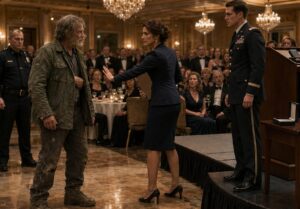
The Soldier Held Up His Worn Meal Card Until One Faded Sentence Changed the Room
Chapter 1: The Card That Would Not Scan
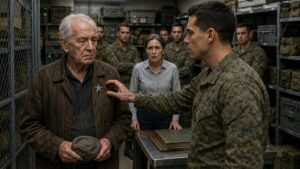
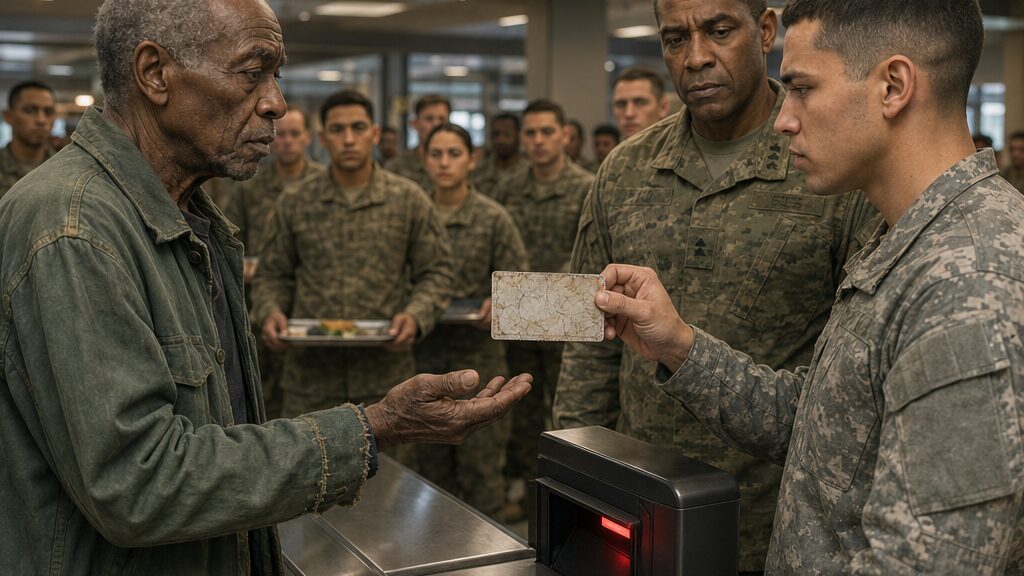
The scanner rejected Charles Scott’s card three times before the young soldier held it up for the room to see.
A hard red light flashed across the cracked laminate. Behind Charles, trays stopped sliding for half a second. Forks still struck plates, the ventilation fans still pushed warm air scented with coffee and roasted chicken through the dining facility, but the line had developed a silence of its own.
The soldier turned the card beneath the ceiling lights as though searching for the trick in it.
“This isn’t in the system, sir.”
Charles watched the card bend slightly between the soldier’s thumb and forefinger. His own photograph had faded until one side of his face looked washed away. A fracture ran through the laminate near the old facility number.
“I heard the machine,” Charles said.
The name tape on the soldier’s uniform read MILLER. He looked young enough that the skin beneath his chin still reddened when he became uncomfortable.
“Then you understand I can’t accept it.”
Charles’s green field jacket had been washed so often that the elbows had gone pale. A loose thread hung from the right cuff. He had considered cutting it that morning, then decided against it. Barbara used to remove such threads with the small scissors she kept beside her chair.
He extended his hand.
The soldier did not return the card.
“This may have meant something once,” Jacob Miller said, speaking louder and more slowly. “But memorabilia doesn’t authorize a meal. You’ll need current identification or a registered guest sponsor.”
A few soldiers farther back in line looked away. Others did not.
Charles felt the old pressure gather behind his breastbone. It was not anger yet. Anger was hot and useful. This was colder. It had the shape of being explained to by someone who had already decided what you could understand.
“I didn’t ask what it meant to you,” Charles said. “I asked for it back.”
Jacob glanced toward the security desk near the entrance. “Sir, please step aside so I can process the line.”
The card turned in his hand.
The writing on the reverse faced outward.
Charles saw the faded ink before anyone else did.
Keep one place for Allen.
His fingers curled once and opened.
“You can deny the meal,” he said. “You cannot hold the card like that.”
Jacob’s expression tightened. “Like what?”
“As if it belongs to the room.”
The soldier behind Jacob shifted his weight. A tray rattled down the metal rails. Somewhere near the beverage station, a dispenser released a hiss of steam.
Charles held out his palm again.
Jacob looked at it but kept the card.
A taller man in uniform had stopped near the end of the serving line. Charles had noticed him earlier only as another officer moving through the room with the practiced attention of someone who expected to be interrupted. Now the officer’s gaze had fixed on the back of the card.
He stepped closer.
“What facility number is that?” he asked.
Jacob straightened. “Sir, it appears to be an expired local pass. There’s no digital record.”
“I asked for the number.”
Jacob read it aloud.
The officer’s face changed—not dramatically, but enough that Jacob lowered the card by an inch.
“Turn it over,” the officer said.
Jacob did.
The officer looked first at the photograph, then at Charles. His eyes moved to the faded name.
“Charles Scott?”
Charles did not answer immediately. He had been called by rank, last name, first name, and numbers during different parts of his life. Hearing his full name in that room felt less like recognition than a door opening behind him.
“Yes.”
The officer drew a breath through his nose. His name tape read DAVIS.
“Sir,” Anthony Davis said, his voice quieter now, “would you place that card in Mr. Scott’s hand?”
Jacob’s face flushed. “Sir, I was only following—”
“Place it in his hand.”
The line had gone still enough that Charles could hear the hum of the refrigerated display case.
Jacob turned toward him. For the first time, he seemed to see more than the jacket, the worn shoes, the bent shoulders. He placed the card in Charles’s open palm instead of dropping it there.
Charles closed his fingers around it.
Anthony’s eyes remained on the old facility number.
“That pass was issued from the field kitchen that operated during the north-range casualty surge,” he said. “The installation still teaches that operation.”
Charles slid the card into the inner pocket of his jacket.
Anthony looked at him. “Not completely, I suspect.”
The watching soldiers shifted. One of them stood straighter. Charles disliked that almost as much as the staring. A room could turn a person into a symbol very quickly, especially when no one knew enough to see the person underneath.
Anthony faced Jacob without raising his voice.
“You may enforce access procedures. You may not speak to a guest as though age has taken away his understanding.”
“Yes, sir.”
“And when someone asks for a personal item back, you return it unless security requires otherwise.”
“Yes, sir.”
Jacob’s certainty had left him. What remained was not yet remorse. It was the discomfort of discovering that the rule he had applied correctly had not made his conduct correct.
Anthony turned back to Charles. “Mr. Scott, I apologize for how this was handled.”
Charles touched the edge of the card through his jacket.
“The machine did what it was built to do.”
“I’m not apologizing for the machine.”
That answer made Charles look at him more carefully.
Anthony gestured toward the dining room. “You’re welcome to eat as my guest.”
Several faces in the line shifted toward Charles, waiting for him to accept, perhaps hoping the moment would settle into something they understood. An apology. A meal. A senior officer making things right.
Charles looked past them.
The dining facility had been modernized since his last visit. The walls were brighter. Digital menu boards hung where handwritten cards once stood in metal frames. The old rear section remained beyond a half-closed partition, dimmer than the rest of the room.
He could just see the end of a wooden table.
One chair stood crooked beneath it.
He had not expected the table to remain. He had not expected the sight of it to take the strength from his knees.
Anthony followed his gaze. “We can find you a quiet seat.”
Charles shook his head.
Jacob stepped aside, leaving the entrance open.
Charles could have walked forward. He had crossed greater distances carrying heavier things. Yet the card in his pocket seemed to pull him toward the shadowed rear of the facility, where one place had once been left untouched after every meal.
Anthony waited.
“That is kind of you,” Charles said.
Then he looked toward the old table again.
“But that is not the table I came back for.”
Chapter 2: The Place No Longer Set for Allen
The woman who came from the facility office carried a tablet under one arm and a ring of keys clipped to her belt.
“Rebecca Taylor,” she said. “Operations manager.”
She shook Charles’s hand without glancing at his jacket or shoes. Her attention went immediately to the closed rear section.
“Colonel Davis says you’re asking about one of the old tables.”
“I asked whether it was still there.”
“That part of the building is closed.”
Anthony stood a few feet away, careful now not to speak for Charles. Jacob remained near the scanner. He processed the next diners quietly, though Charles felt the young soldier watching whenever he thought Charles would not notice.
Rebecca unlocked the partition.
“Five minutes,” she said. “There’s staging equipment in back, and some flooring has already been lifted.”
The old section smelled different from the main room. Less of hot food, more of dust, cooling grease, and the dry wood scent released when furniture had been disturbed after years of standing still.
Plastic sheeting covered part of the wall. Metal carts had been pushed together beneath taped signs. A stack of chairs stood upside down on two tables.
Charles walked slowly, not because he was uncertain of the way, but because the room had grown smaller.
The table remained against the far wall.
Its varnish had worn thin along the edge. One corner bore a dark crescent from decades of cups set down in the same place. Charles had made some of those marks himself.
An orange sticker had been pressed across the tabletop.
REMOVE—PHASE ONE.
Rebecca stopped beside him. “The contractor starts demolition Monday.”
Charles ran one finger along the table’s edge without touching the sticker.
“This section wasn’t used anymore?”
“Storage overflow, mostly. The renovation will open the space and increase seating.”
“There was enough seating before.”
“There are more people now.”
He almost told her there had once been too many people and not enough chairs, too many trays cooling while names were called, too many men standing because sitting meant admitting they were staying. Instead he asked, “Coffee still over there?”
Rebecca followed his glance toward a stainless-steel station stripped of its machines.
“The active station is in the main room.”
Charles turned to Anthony. “I’ll take that meal now, if the invitation stands.”
“It does.”
“I only need coffee.”
Anthony nodded, but Jacob was already moving.
A few minutes later he returned carrying a plain white cup on a saucer. He had filled it close to the rim. His hands were steady until he reached Charles.
“Black,” Jacob said. “Sir.”
Charles looked at the cup, then at him. “Did I tell you black?”
“No, sir.”
“Then you guessed.”
Jacob swallowed. “Yes, sir.”
“Allen took sugar.”
The name seemed to settle into the room.
Jacob glanced toward Anthony, then back to Charles. “I can get another.”
“This one will do.”
Charles carried the coffee to the end of the table. The chair there had once belonged on the other side. He corrected it, placing its front legs square with the floor seam.
From inside his jacket he took the cracked meal card.
He set it beside the cup.
For a moment the orange removal sticker, the white cup, and the faded card formed a line across the table. Something condemned, something untouched, something that had survived too long.
Rebecca shifted the tablet against her hip. “Mr. Scott, I don’t want to rush you, but I need to understand what you’re asking us to preserve.”
“I haven’t asked you to preserve anything.”
“You asked about the table.”
“I asked if it was here.”
She looked at Anthony, frustrated by the distinction. “The contractor has already cataloged it for disposal.”
Charles lowered himself into the chair opposite the empty place. His knees objected. The room did not.
For many years, he had come on the same date. He would buy two coffees, carry them to the old table, and leave one untouched until it cooled. Barbara never asked to come inside. She waited in the car with a book, sometimes for forty minutes, sometimes for two hours.
The last year she waited, her hands shook too much to hold the book open. He told her they could skip it.
She had said, “Not because of me.”
But the next year there were appointments. Then the chair beside her bed. Then oxygen tubing, pill boxes, and nights measured by the sound of her breathing.
After she died, the card remained in the drawer beside his keys.
Four years passed.
Charles touched the cup’s handle.
Rebecca softened her voice. “Was Allen a family member?”
“No.”
“A member of your unit?”
“Yes.”
“What happened to him?”
Charles looked at the empty chair.
The answer existed in official language somewhere. Casualty. Evacuation. Time of death. Location. The Army had always known how to fit a man into a line.
“He missed a meal,” Charles said.
Rebecca waited, expecting more.
Charles gave her none.
Anthony moved toward the doorway. “We can place a temporary hold on the table.”
Rebecca shook her head. “A hold requires a preservation basis. We have a schedule, hazardous-material clearance, labor windows—”
“He said he didn’t ask for a hold,” Anthony replied.
Charles looked at him. The correction was small, but it mattered.
Rebecca exhaled. “Then I’m not sure what any of us are doing here.”
“Neither am I,” Charles said.
He sat until the coffee stopped steaming.
No one spoke. From the active dining room came the muted rise and fall of conversation, trays returning, chairs moving. Ordinary sounds. They were the sounds James had always noticed first.
Who had eaten.
Who had not.
Who was missing.
Charles picked up the meal card but left the cup where it stood.
Outside, the sunlight reflected sharply off windshields. He reached his car and sat behind the wheel without starting the engine.
In the glove compartment, beneath registration papers and a folded road map, lay Barbara’s envelope.
He had read the first page many times but never the second.
Her handwriting leaned more heavily near the bottom, where illness had weakened her grip.
Charles unfolded the paper.
When you go back, do not only tell them how he died—
The sentence ended at the fold.
His thumb rested over the hidden half.
He could not bring himself to open it farther.
Chapter 3: A Renovation Schedule Against a Memory
By the following morning, Rebecca Taylor had placed red labels on twelve storage boxes.
DISPOSE AFTER REVIEW.
The words were printed in block letters large enough to be read from the doorway of the records room.
Jacob stood beside one of the boxes with a pair of cotton gloves he had not yet put on. The room was windowless and cool. Shelves held binders, maintenance logs, payroll files, menu plans, equipment inventories, and handwritten ledgers from years before the facility had transferred to digital systems.
Anthony Davis examined the cracked card beneath a desk lamp while Charles sat across from him.
Charles had not surrendered it. He kept two fingers on one corner as the officer studied the old photograph and facility number.
“The database confirms the format,” Anthony said. “It was a local lifetime pass.”
“Then the machine was wrong?” Jacob asked.
“No. The machine contains current authorizations. This was never transferred.”
Rebecca tapped her tablet. “Which means it has historical interest but no administrative validity.”
Charles took the card back.
“That is what the young man said yesterday.”
Jacob’s ears reddened.
Rebecca looked at him. “And procedurally, he was correct.”
Charles slid the card into his pocket. “That sentence keeps doing a lot of work around here.”
No one answered.
A records technician opened a binder and pointed to a photocopied signature. “The issuing officer approved seven passes after the north-range operation. The recipients are listed by service number, but the justification page is missing.”
“Seven?” Anthony asked.
“Seven surviving passes documented. There may have been more.”
Charles studied the red disposal labels. “What happens to these boxes?”
“Most are facility records past retention,” Rebecca said. “Anything historically relevant goes to the installation archive. Duplicates, routine logs, outdated supply documents—those are destroyed.”
“Who decides what is routine?”
“The review team.”
“Anyone on that team ever feed two hundred men when the power was out?”
Rebecca’s expression tightened, though not with anger. “Probably not.”
“Then they may not know which page mattered.”
Anthony leaned back. “Mr. Scott, if the card came from that operation, your account could establish context for the archive.”
Charles looked toward the shelves. “You want context now because your scanner embarrassed you.”
“That isn’t fair,” Rebecca said.
“No. Fair would have been keeping the records before an old man made them interesting.”
Jacob lowered his eyes.
Anthony did not defend the institution. “What would you have us do?”
“Don’t make my answer your permission.”
The officer sat with that.
Charles stood. His right knee stiffened before it straightened. Jacob stepped forward instinctively, then stopped himself before offering an arm.
That, Charles noticed.
Rebecca moved one red-labeled box from the floor onto the table. “The contractor begins Monday. I can hold records under active review through the weekend. I cannot stop the entire project because of an undocumented story.”
“I didn’t ask you to.”
“You keep saying that.”
“Because you keep trying to turn me into the person causing your problem.”
The room went quiet.
Charles left before they could apologize again.
At home, he placed the meal card in the shallow dish beside his keys. The house held afternoon light in long, dusty bands. Barbara’s chair remained near the window, though the little scissors were gone. He had put them away after cutting his thumb with them one night.
He heated soup and did not eat it.
Near sunset, someone knocked.
Jacob stood on the porch without his cap. He held no folder, no official paper, nothing that would have made the visit formal.
“How did you get my address?”
“I asked Colonel Davis.”
“That was his first mistake today.”
“Yes, sir.”
Charles waited.
Jacob rubbed his palms against his trousers. “I wanted to apologize.”
“You already did.”
“No, I said the words yesterday because he was standing there.”
The honesty almost earned him entry.
Almost.
Charles stayed in the doorway.
Jacob looked past him toward the dish where the card lay. “I thought you were confused.”
“I know.”
“I thought if I bent the rules for you, I’d be failing at my job.”
“You didn’t bend the rules.”
“No, sir.”
“And you still failed.”
Jacob accepted the sentence without flinching.
Charles looked at the young man’s bare hands. “What do you want?”
“To help find Allen.”
“He isn’t lost.”
“I mean in the records.”
Charles’s jaw tightened. “A name in a book won’t tell you who he was.”
“No, sir.”
“Then why are you looking?”
Jacob took time before answering. “Because yesterday I wanted the card to be fake. It would have made everything simpler. Today I don’t want the record to be simple.”
Charles studied him.
The young soldier’s discomfort was still there, but it had changed. It was no longer the embarrassment of being corrected in public. It was the unease of discovering that procedure could protect a person from responsibility.
“Eight tomorrow,” Charles said. “Records room.”
Jacob nodded. “Thank you.”
“I didn’t invite you inside.”
“No, sir.”
After he left, Charles shut the door and looked at Barbara’s envelope on the side table.
He did not open it.
The next morning, the records technician brought out the oldest kitchen ledger in the collection. Its cloth cover had darkened at the corners, and several pages were stuck together with grease that had outlived the men who spilled it.
Charles put on gloves.
He turned each page slowly.
Supply counts. Meal tallies. Names of cooks assigned to shifts. Notes about fuel, water, refrigeration failures, and deliveries delayed by weather.
Jacob stood beside him without speaking.
Near the middle of the ledger, Charles found his own name.
SCOTT, CHARLES—FIELD FEEDING SUPPORT.
The line beneath it read:
ALLEN, JAMES—MEDICAL ATTACHMENT.
Charles stopped breathing for a moment.
The rest of James’s entry continued toward the damaged edge of the page. A strip had been cut or torn away long ago. Only a few words remained.
Departed aid point—
Then nothing.
Anthony leaned over the table. “That may connect him to the casualty operation.”
“It connects his name to a shift,” Rebecca said. “Not to the card or the table.”
The records technician examined the binding. “The missing portion is not in the box.”
Jacob looked at Charles. “Do you know what the rest said?”
Charles removed his gloves.
He remembered James arriving through the back entrance with blood on one sleeve and mud to his knees. He remembered shouting because James had taken a cup of coffee and left it untouched. He remembered the chair remaining empty long after the trucks stopped moving.
He looked at the mutilated line in the ledger.
“Yes,” he said.
Everyone waited.
Charles closed the book.
“But you are not ready to write it down.”
Chapter 4: What the Missing Ledger Could Not Prove
The archive annex had once been a supply office. Its windows were too narrow, its fluorescent lights too white, and the air carried the dry smell of paper that had been handled by generations of people who assumed someone else would remember why it mattered.
Charles sat at the end of a metal table with the grease-stained ledger open before him.
The missing strip beside James Allen’s name looked deliberate now. Not torn by age. Cut.
The records technician held the page toward the light. “Could have happened during rebinding.”
“Could have,” Charles said.
Anthony stood near a cabinet, reading a copied operational report. Rebecca had brought three more boxes from the dining facility, each marked for review. Jacob worked through them without complaint, separating supply sheets from personnel rosters and meal counts.
The young soldier had stopped looking for the kind of document that would settle everything.
At first, he had searched for awards, commendations, citations, any official line that could transform James into someone whose importance required no explanation. By midday, he was reading handwritten margins.
“Sir,” Jacob said, “did Specialist Allen always write in green ink?”
Charles looked up.
Jacob held a kitchen inventory sheet. Beside a shortage in canned fruit, someone had written: Ask Allen who took the peaches.
Charles remembered James arriving at the field kitchen with two cans under his shirt and a grin too broad to conceal guilt.
“He claimed green was easier to find when everyone else used black.”
“Did he take the peaches?”
“He relocated them.”
“To where?”
“Men who hadn’t eaten.”
Jacob gave the smallest smile and placed the sheet in the historical pile.
Anthony lowered the report. “The official account says the field kitchen supported the aid point for eleven hours after the range accident.”
“Fourteen,” Charles said.
“The report says eleven.”
“The report began counting when somebody with clean hands arrived.”
Rebecca looked at him but said nothing.
Charles turned a page in the ledger. Grease had spread beneath the ink like a pale shadow. The entries reduced that night to quantities: coffee, bread, fuel, water. Six hundred paper cups. Forty pounds of ground meat. Three failed burners.
No mention of the rain turning the service road to mud. No mention of men carrying stretchers through the kitchen because the aid point had overflowed. No mention of James using a serving tray as a splint.
Anthony pulled out a chair. “The report places Allen at the aid point until evacuation.”
“It places his name there.”
“You said he didn’t die where the report says.”
Charles closed the ledger halfway.
“I said you weren’t ready to write it down.”
“What would make us ready?”
“You keep asking questions like answers belong to the first person who has authority to request them.”
Anthony accepted the rebuke with a slight nod.
The contractor needed access to the old storage room that afternoon, so Rebecca led them back through the dining facility. The room stood behind the former kitchen wall, where shelves bowed beneath obsolete cookware and sealed cartons of serving utensils.
Charles paused at the threshold.
A dented coffee urn sat on the floor beneath a drop cloth.
It was not the same urn. He knew that before he crossed the room. The handles were wrong, and the lid lacked the burn mark James had made by resting it too close to a field stove.
Still, Charles counted the cups stacked beside it.
Twelve.
He always counted cups before sitting. Barbara had noticed the habit on their third date. She had asked whether he expected more people.
“Sometimes,” he had told her.
Jacob watched him finish the count.
“Was Allen a medic the whole time you knew him?”
“No. He started as a truck driver.”
“How did he end up medical?”
“He noticed things.”
Jacob waited.
“Men hiding injuries. Men not eating. Men writing letters and never mailing them. He started carrying bandages because somebody had to.”
“That isn’t in his record.”
“Most of what a man is won’t fit in his record.”
They left the base near dusk and stopped at a diner across the highway because Rebecca needed the storage room cleared and Anthony had another meeting. Jacob ordered coffee. Charles ordered nothing.
When the server placed three cups on the table, Charles counted them before he sat.
Jacob noticed but did not ask.
For several minutes, traffic moved beyond the window in a silver stream. Anthony had remained at the base. It was only Charles and Jacob now, the young soldier sitting with both hands around a cup he had not tasted.
“What did he sound like?” Jacob asked.
Charles looked at him.
“Allen,” Jacob said. “Did he have an accent?”
It was the first question anyone had asked that did not seek proof.
“Georgia,” Charles said. “But he could imitate a man from almost anywhere if he wanted to irritate him.”
“Was he funny?”
“Not as funny as he believed.”
“What did he eat?”
“Whatever was left.”
Jacob stared into his coffee. “That sounds like something people say about good men after they’re gone.”
“It was an irritating habit while he was alive.”
A laugh escaped Jacob before he could stop it.
Charles did not smile, but the hard place in his chest shifted.
He told Jacob about James hiding peaches. About the green ink. About the way he whistled only the first six notes of the same song because he never learned the rest. He did not speak of the evacuation.
When the cups were empty, Jacob gathered them without being asked and set them at the edge of the table.
“The report says he died at the aid point,” Jacob said quietly.
Charles looked through the window at the base lights coming on beyond the highway.
“No.”
Jacob waited.
“He came back to the kitchen.”
“After the evacuation started?”
“Yes.”
“Why?”
Charles’s fingers pressed against the cracked card inside his pocket.
James had returned soaked through, one sleeve dark with blood that was not all his own. He had stood in the doorway and asked who had eaten. Not who was alive. Not who was leaving. Who had eaten.
Charles rose from the booth.
“Sir?”
Charles put several bills beneath the untouched sugar jar.
“James Allen did not die where that report says.”
Jacob stood too.
Charles faced him across the table.
“You will not repeat that until I decide what it means outside my mouth.”
Jacob’s expression tightened, not with disappointment but responsibility.
“Yes, sir.”
Charles walked out before the young soldier could ask the next question.
Chapter 5: The Story Charles Refused to Surrender
On Saturday morning, Anthony arrived at Charles’s house carrying a recording proposal in a blue folder.
Charles let him into the kitchen because rain had begun falling and because Barbara would have considered leaving a guest on the porch an unnecessary form of pride.
Anthony placed the folder beside the sugar bowl.
“The installation historian can record your account tomorrow. Private session. No audience.”
Charles read the first page.
The second page contained a public-affairs release.
His name had already been typed beneath a blank signature line.
He closed the folder.
“No.”
Anthony did not reach for it. “The release is standard.”
“So was the scanner.”
“It allows portions of the interview to be used for education.”
“It allows portions to be used for anything described as official communication.”
“We can limit it.”
“You should have limited it before bringing it here.”
Anthony sat back. Rain tapped against the kitchen window. Barbara’s chair stood in the next room, angled toward a patch of gray light.
“I’m trying to prevent the story from disappearing,” Anthony said.
“You’re trying to collect it.”
“Is there a difference?”
“Yes.”
Charles pushed the folder across the table.
Anthony looked older than he had in uniform at the dining facility. Without the room responding to his rank, he seemed like a man accustomed to solving problems who had discovered one that resisted being solved.
“The demolition begins Monday,” he said. “The table will be removed. The records may establish that you and Allen served there, but they cannot preserve what you know.”
“What I know belonged to him first.”
“And now?”
Charles looked toward Barbara’s chair.
Anthony followed his gaze. “Your wife?”
“Barbara.”
“Did she know?”
“All of it.”
“What did she want you to do?”
“That was between us.”
Anthony stood. “Then I’ll leave the folder.”
“No.”
“You may change your mind.”
“I don’t want it in the house.”
Anthony picked it up.
At the door, he stopped. “Mr. Scott, I apologize. Not for asking. For deciding the shape of your answer before you gave it.”
Charles said nothing.
After the door closed, he returned to the kitchen table.
Barbara’s letter lay in the drawer beneath old batteries, rubber bands, and takeout menus she had refused to throw away. He unfolded both pages this time.
When you go back, do not only tell them how he died—
The rest continued beneath the fold.
Tell them how he lived when nobody was watching.
Charles sat very still.
Rainwater traveled down the glass in crooked lines.
He remembered James on the worst night.
The aid point had run out of room before midnight. The injured came in from the north range in trucks, utility vehicles, and the beds of pickups. The field kitchen became a passageway because its rear doors opened toward the service road.
Charles kept water heating and coffee moving. He tore bread with his hands when the knives disappeared. He shouted at men who tried to work without eating.
James moved between the aid point and the road.
He carried bandages in one pocket and hard candy in the other. He gave the candy to frightened soldiers before anyone thought to call them frightened.
Near dawn, a helicopter had one remaining evacuation space.
James was already on the litter.
He heard a younger wounded soldier crying behind the canvas partition. Not loudly. That was what James noticed—the ones trying not to be heard.
He gave up his place.
By the time the helicopter returned, weather had closed the route.
James came back to the kitchen because he refused to lie still while others were hungry.
He sat at the end of the table, pale and shivering, and asked Charles to count the cups.
“One short,” Charles had said.
“Then someone’s missing.”
“You’re the one missing.”
James smiled without strength.
He made Charles promise that the unit would never eat as if absence meant nothing.
Then he died before the next pot of coffee finished.
Charles had spent decades turning that promise into a punishment. Each untouched cup said James was missing. Each annual visit said Charles had not forgotten. Each year he stayed away during Barbara’s illness said he had failed.
He folded the letter and placed it beside the cracked card.
That afternoon he drove to the base.
The renovation staging area occupied half the parking lot behind the dining facility. Plastic barriers snapped in the wind. Workers rolled equipment beneath tarps while Rebecca checked items on her tablet.
Jacob saw Charles first.
He approached but stopped several feet away.
“May I speak with you?”
Charles nodded.
“I found another sheet with green ink,” Jacob said. “It wasn’t about the operation. Allen wrote that one of the kitchen workers had been skipping breakfast and asked someone to save him a biscuit.”
Charles looked toward the building.
“That sounds like him.”
“I thought you should know.”
Rebecca joined them. “The table comes out Monday morning. I can preserve a sample if the historian approves it, but not the whole piece. The wood has damage.”
Charles watched rain bead on the orange safety barriers.
“A sample,” he said.
“One section. Possibly the corner.”
“The corner isn’t the part that mattered.”
Rebecca lowered the tablet. “Which part did?”
“The place where people set things down.”
She waited.
Charles took out Barbara’s letter but did not unfold it.
“I won’t sign a release,” he said.
Rebecca nodded. “All right.”
“No cameras. No prepared remarks. No one arranged in rows.”
“All right.”
“No ceremonial chairs.”
A brief crease appeared between her brows. “We don’t have ceremonial chairs.”
“Then don’t find any.”
Jacob looked down, hiding what might have been a smile.
Charles returned the letter to his pocket.
“I will tell it once,” he said. “The historian may record the facts. The rest stays with the people in the room unless I say otherwise.”
Rebecca looked toward the building. “When?”
“Before they take the table.”
“Monday morning?”
“No. People perform in the morning.”
She considered that.
“Sunday evening?”
Charles shook his head. “Monday. After the dining room closes.”
Rebecca nodded.
Charles drove home before the rain stopped. He slept badly and woke while the windows were still black.
At four thirty, he sat in Barbara’s chair with the telephone in his hand.
Rebecca answered on the fifth ring, her voice thick with sleep.
“It’s Charles Scott.”
“I know.”
“I’m coming back tonight.”
“Yes, sir.”
“No cameras,” he said.
“No cameras.”
“No release.”
“No release.”
“And remove the chairs you set up.”
A pause.
“We set up six folding chairs yesterday.”
“Move them.”
“All of them?”
“People who need to listen can sit at the table.”
Rebecca was quiet for a moment.
Then she said, “I’ll take care of it.”
Charles looked at the cracked meal card lying on his palm.
“And Ms. Taylor?”
“Yes?”
“Do not polish the table.”
Chapter 6: The Meal Where Charles Chose the Words
The rear dining room looked smaller with the folding chairs gone.
Only the old table remained, its surface marked by cups, trays, scratches, and the orange removal sticker Rebecca had not peeled away. Overhead, half the lights were off. The active kitchen beyond the partition had gone quiet except for the hum of refrigeration.
Six people sat around the table.
Charles chose the chair opposite the empty place.
Jacob stood beside a cart holding coffee, cups, sugar packets, and a plain metal pitcher of water. Anthony sat without his jacket at the far end. Rebecca kept her tablet facedown. The installation historian had placed a small recorder near the center but had not switched it on.
Charles counted the cups.
Six on the table.
One on the cart.
“Bring that one,” he told Jacob.
Jacob set the seventh cup at the empty place.
“Sugar,” Charles said.
Jacob added two packets beside it.
Charles looked at him. “He used one.”
Jacob removed one without embarrassment.
The room settled.
The historian touched the recorder. “May I?”
Charles considered the machine.
“You may record names, dates, and what I tell you is fact. When I stop, you stop.”
“Yes, sir.”
“I am not ‘sir’ tonight.”
The historian nodded. “Mr. Scott.”
Charles took the meal card from his pocket and laid it on the table.
Jacob’s eyes dropped to it, then lifted again.
“Pick it up,” Charles said.
Jacob hesitated. “May I?”
That was the first answer Charles had wanted from him.
“Yes.”
Jacob received the card with both hands. He did not lift it toward the light or turn it for anyone else to see. He read the faded sentence silently.
Keep one place for Allen.
Then he returned it to Charles’s open palm.
Charles placed it beside the untouched cup.
“James Allen was a medic by function before the paperwork caught up,” he began. “He noticed things.”
The recorder’s small red light came on.
Charles told them about the green ink and the stolen peaches. About James carrying hard candy for frightened soldiers. About his habit of leaving the best portion for whoever arrived last.
He spoke without decoration. Whenever Anthony asked for a unit designation or date, Charles answered if he could. Whenever the historian tried to shape a sentence into a cleaner form, Charles corrected it.
“No,” he said once. “He did not ‘rally the wounded.’ He asked whether they had eaten.”
The historian crossed out a note.
Charles described the casualty surge. He did not describe injuries. He described wet boots lined beneath the wall, coffee grounds spilled across a supply crate, and the sound of rain beating on the canvas roof.
He described the last evacuation place.
Anthony leaned forward. “Allen surrendered his seat voluntarily?”
“He heard someone behind the partition.”
“A more severely wounded soldier?”
“A younger one.”
“Was he more severely wounded?”
Charles looked at him. “James did not ask for a comparison.”
Anthony lowered his eyes.
Charles continued.
When the weather closed the route, James returned to the kitchen. He should have stayed at the aid point. He did not. He sat at the end of the table and watched Charles pour coffee.
“He asked me to count the cups,” Charles said.
Jacob looked at the seven places.
“I told him one was missing. He said that meant someone had been left out.”
Charles’s voice thinned, but he did not stop.
“He made me promise the unit would never eat as though absence meant nothing.”
The historian’s hand had gone still above the page.
“And then?” Rebecca asked quietly.
Charles looked at the untouched cup.
“Then the coffee finished before he did.”
No one moved.
The recorder captured the hum of the refrigerator and the faint click of cooling metal from the kitchen.
Charles reached toward it.
The historian switched it off before his hand arrived.
For several breaths, the room held no official record.
“I came back every year,” Charles said. “Same date. Two coffees. One chair empty.”
Rebecca looked at the card. “Until your wife became ill.”
Charles nodded.
“I told myself staying with Barbara was the right thing. It was. But grief does not care when two duties are both right. It only counts the one you did not perform.”
Anthony started to speak.
Charles raised a hand.
“This is not where you tell me I did enough.”
Anthony closed his mouth.
Charles took Barbara’s letter from his pocket.
“She knew what I was doing. Turning a promise into a sentence I served once a year.”
He unfolded the paper and read the line aloud.
“Tell them how he lived when nobody was watching.”
Jacob looked toward the empty place.
Charles tapped the cracked card.
“This was issued after the operation. Not because I was important. Seven of us received them. Cooks. Drivers. A mechanic. People who kept the place working.”
“Why the sentence on the back?” Jacob asked.
“The issuing officer saw the empty setting the next year. He asked about it. I told him enough.”
Charles slid the card across the table toward the historian.
The historian did not touch it.
“Are you giving this to the archive?” she asked.
Charles looked at the faded photograph. For years, the card had been proof that the door should open. Later it became proof that Charles still remembered. When the scanner rejected it, he had felt as if both claims had been denied.
Now he understood that the card had also kept him standing at an entrance.
“Yes,” he said. “On conditions.”
Rebecca turned her tablet over but did not activate it.
“No display calling James a hero,” Charles said. “No language about sacrifice unless you include the men who washed cups, carried water, and stayed awake because somebody else was afraid.”
The historian nodded.
“The card is shown with the sentence visible. The record says the full account came from memory and that the official report is incomplete.”
“Yes.”
“And this room does not become a shrine.”
Anthony glanced around the dim space. “What should it become?”
“A place where people notice who hasn’t spoken.”
Rebecca folded her hands. “A listening meal?”
“Once a month. Veterans, current soldiers, kitchen workers. No stage. No speeches required. Food on the table. One place left open until everyone arrives.”
Jacob looked at Charles. “And if someone doesn’t arrive?”
“Someone asks why.”
The proposal did not solve itself in the silence that followed. Rebecca mentioned staffing. Anthony mentioned approval. The historian asked about access. Charles listened until they began making the idea sound like a program that had existed before him.
Then he put his palm flat on the table.
“One meal,” he said. “Try one. After that, decide whether it taught you anything.”
Rebecca nodded first.
“One meal.”
Anthony followed. “Agreed.”
Jacob said nothing. He simply moved the untouched cup an inch farther from the table’s edge, where no careless sleeve could knock it down.
Charles saw the gesture.
The historian placed an archival sleeve beside the card. Charles lifted the card one last time. The cracked laminate caught the overhead light. His younger face looked back at him, impatient and unfinished.
He inserted the card into the sleeve himself.
Rebecca waited until the historian had secured it before speaking.
“There is another decision.”
Charles looked at her.
“The table cannot remain intact. The underside has water damage, and the contractor says the joints will fail when it is moved.”
Charles’s hand tightened against the wood.
Rebecca did not soften the fact.
“We can preserve one section and integrate it into a table in the renovated room. You should choose which section.”
Everyone looked toward the empty place at the end.
Charles did not.
He ran his fingertips across the middle of the table, over the worn stretch where countless hands had set down cups and trays. The place where people passed food. The place where elbows rested while someone listened.
“Not the empty seat,” he said.
Rebecca waited.
Charles touched the broad, scarred section between the places.
“This part.”
“Why?”
“Because remembering the missing is not enough.”
He looked at Jacob, then Anthony, then Rebecca.
“You have to make room for the living too.”
Chapter 7: Respect After Everyone Stopped Watching
Six weeks later, Charles stood outside the renovated dining facility and watched a digital screen announce the first listening meal.
The words were plain.
SHARED TABLE—6:00 P.M.
No photograph. No flag graphic. No phrase about heroes. No invitation to the press.
That was almost enough to make him trust it.
Almost.
Inside, the room had changed without becoming unrecognizable. The serving line had been widened. New lights softened the hard shine of the floor. The closed rear section was gone, replaced by an open area with several ordinary tables and enough space for wheelchairs to pass without chairs being dragged aside.
Charles searched for the old table.
He did not see it.
Rebecca approached from the kitchen entrance. She wore the same clipped ring of keys, though fewer keys hung from it now.
“You came,” she said.
“You put it on the sign.”
“I wasn’t sure that would be sufficient.”
“It nearly wasn’t.”
She accepted that.
“The public-affairs office asked twice whether they could attend.”
“And?”
“I told them the room was full.”
Charles looked around. Fewer than twenty people had arrived.
Rebecca followed his gaze. “Full is not always a number.”
That sounded like something she had practiced, but she did not wait for praise.
She led him toward a long communal table near the windows.
At first, Charles thought it was new. Its legs were new, and most of its surface was pale maple. Then he saw the darker section running through the center.
The wood from the old table had been planed smooth but not stripped of its marks. Cup rings remained beneath the finish. A shallow scratch crossed one edge. The broad section Charles had chosen sat where people would place bowls, pass bread, and rest their hands while speaking.
Not at the end.
Not beneath glass.
In use.
Charles laid his palm against it.
“They wanted to remove the stains,” Rebecca said. “I told them those were the reason we kept it.”
He looked at her.
She added, “Some of them, anyway.”
The cracked meal card rested in a small archival display on the wall nearby. The writing on the label was brief.
LOCAL MEAL PASS ISSUED AFTER NORTH-RANGE EMERGENCY OPERATIONS.
CHARLES SCOTT, FIELD-FEEDING SUPPORT.
HANDWRITTEN ON REVERSE: KEEP ONE PLACE FOR ALLEN.
ORAL ACCOUNT RECORDED WITH THE CONTRIBUTOR’S CONDITIONS.
No hero. No forgotten legend. No claim that the card had opened every door.
Charles read the label twice.
“Who wrote this?”
“The historian.”
“Who shortened it?”
“I did.”
He nodded.
At the table, Jacob arranged cups beside a metal coffee pot. His movements were careful but no longer self-conscious. He wore no expression asking Charles to notice how much he had changed.
One cup stood at the far end.
Charles counted.
There were twelve.
Every place had a chair.
“No empty setting?” he asked.
Jacob looked toward the entrance. “Not yet. Two retired service members called to say they might come late.”
“So you’re waiting.”
“Yes.”
Charles removed his jacket and placed it over the back of a chair. The loose thread still hung from the cuff.
Jacob reached toward it, then stopped.
“May I?”
Charles looked down at the thread.
“For what?”
“There are scissors at the desk.”
Charles rubbed the frayed end between his fingers.
“No,” he said. “Leave it.”
Jacob nodded and moved away.
The meal began without an announcement. Rebecca brought out bowls of stew. A kitchen worker placed bread in the center. Anthony arrived alone, took a chair along the side, and spoke only when spoken to.
The first veteran told a story about losing a boot during training and finishing a march with one foot wrapped in a towel. A kitchen worker described the night a freezer failed and the staff cooked through dawn rather than waste food. A young soldier admitted he had stopped eating breakfast because he hated sitting alone.
No one corrected him by saying others had suffered worse.
Someone moved a bread basket within his reach.
Charles listened.
When attention turned toward him, he said, “Not tonight.”
No one pressed.
That mattered more than an invitation to speak.
Halfway through the meal, one of the retired service members arrived carrying an outdated visitor form. Jacob rose from the table, helped him with the entrance procedure, and returned without making the interruption part of the gathering.
The second never came.
For several minutes, the chair reserved for him remained open.
Charles watched people glance toward the door.
Then Rebecca asked whether anyone had his number.
A kitchen worker did.
She stepped outside to call.
The meal paused, not formally, but in the way a room pauses when absence has been noticed.
“He’s fine,” she said when she returned. “Car trouble. His neighbor is helping.”
Conversation resumed.
Charles looked at the open chair.
James’s promise had changed shape. It was no longer an untouched cup waiting for a dead man. It was a question asked before people continued eating.
Where is he?
Does anyone know?
Has someone called?
After the dishes were cleared, Charles remained at the table. Anthony left without offering a salute. Rebecca went to help stack bowls. The historian never appeared.
Respect, Charles thought, was quieter when nobody was watching for it.
The entrance scanner gave a low rejection tone.
Charles turned.
An elderly visitor stood near the desk holding a folded packet of papers. His coat was buttoned wrong, and confusion had tightened his mouth. The security clerk pointed toward a form on the counter while the man tried to explain that someone had told him to come for the meal.
Jacob approached.
Charles felt the old room return for an instant: the card held up, the line waiting, the slow voice used for someone assumed not to understand.
But Jacob stopped at arm’s length.
“Sir,” he said, “may I look at what you brought?”
The visitor stared at him, then nodded.
Jacob accepted the papers with both hands.
He did not raise them for the room to see.
He lowered his voice and read the first page. “This form is outdated, but that isn’t your fault. We can fix it here.”
The man’s shoulders loosened.
Jacob asked his name, checked the list, and found it. Then he returned the papers before explaining the next step.
When the visitor glanced toward the communal table, Jacob said, “There’s a place for you.”
He brought the man across the room without touching his elbow or hurrying his steps.
Charles looked at the cups remaining on the cart.
For years, he had poured one for himself and one for James. One warm, one left to cool.
He stood and reached for the coffee pot.
The visitor took the chair beside him. Jacob placed a clean cup at the man’s setting, then waited.
Charles poured coffee into it.
After a moment, he took another cup and filled that too.
Not for an empty chair.
For himself.
He set the two cups side by side on the dark strip of old wood, where hands had rested and food had passed between the living.
The story has ended.