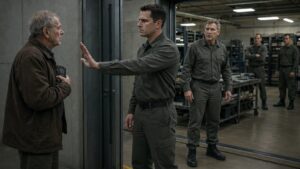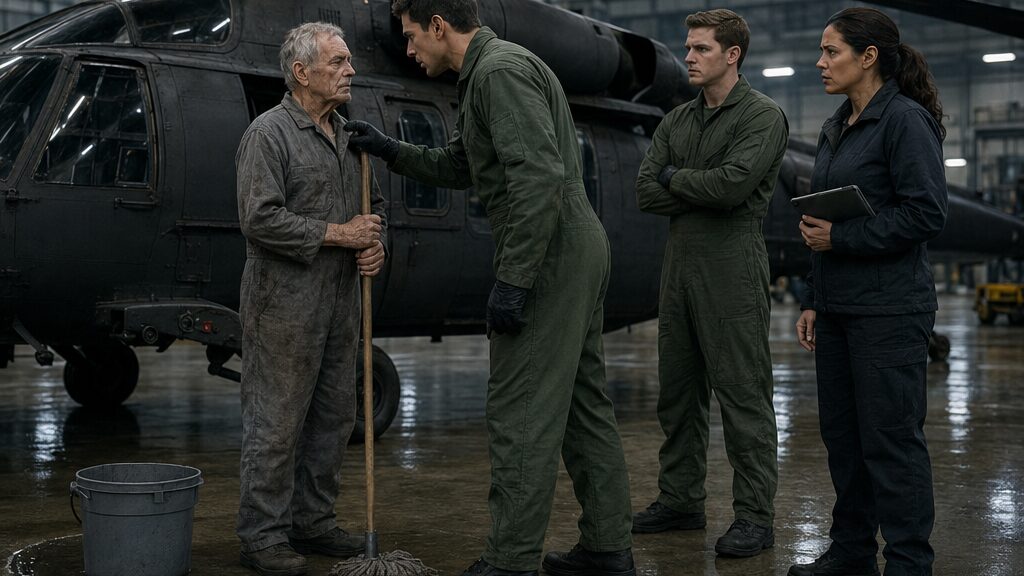
The Young Pilot Mocked the Old Hangar Cleaner Until a Hidden Rescue Tab Changed His Voice
Chapter 1: The Old Man Was Already Mopping Beneath the Helicopter
Brian Harris had the mop head under the helicopter before the hangar lights finished warming.
The concrete was still dark from the night air, slick where the bay doors leaked a thin morning mist across the floor. The helicopter sat above him like a sleeping animal, its black belly and landing skids reflected in the water he had wrung from the gray bucket. Every few minutes the fluorescent lights clicked overhead, one row at a time, throwing long pale bars across the rotor blades.
He moved slowly because his knees made speed expensive now. Not because he did not know where to step.
The bucket wheels gave a soft squeak as he nudged it with the side of one old work shoe. He set the mop head down exactly where a skid shadow crossed a faded yellow line on the concrete, then dragged it back in one careful pull. Water gathered in a dark crescent, carrying oil dust, boot grit, and the thin black crumbs that collected under aircraft no matter how many people swore the hangar was clean.
Brian stopped before the mop touched the helicopter’s left nose panel.
He always stopped there.
The panel was older than the rest of the aircraft, a duller shade beneath the polish. Its rivets did not match perfectly. The paint had been refreshed more than once, but a faint unevenness remained if a person stood close enough and knew how to look. Most people did not. Most people saw a display aircraft being prepared for a base open house, something to admire from behind a rope.
Brian saw a seam that had outlived men.
He leaned the mop against his hip, took a folded rag from his back pocket, and wiped one low corner of the panel without pressing hard. His fingers shook a little. He held them still until the tremor passed, then tucked the rag away.
Behind him, the personnel door opened with a metallic sigh.
“Brian?”
Kimberly Garcia’s voice carried across the empty hangar with the sharpness of someone already behind schedule. Her heels clicked twice, then stopped when she saw the bucket inside the marked aircraft bay.
Brian turned his head but not his body.
Kimberly stood under the side lights with a tablet in one hand and a radio clipped to her belt. Her civilian operations jacket was zipped halfway up, her hair pulled tight, her eyes moving from the helicopter to the wet floor to Brian’s mop.
“Tell me that is not water inside the restricted prep line.”
Brian looked down at the yellow boundary beneath the thin film of water. “It’ll dry.”
“That is not what I asked.”
He bent, squeezed the mop into the bucket, and the wringer gave a tired metal cough. “Dust settled overnight.”
“Dust can wait until after the flight crew signs off.”
“This dust can’t.”
Kimberly stared at him as if the answer had been a small object handed to her in a language she did not read. She stepped closer, careful not to cross the wet area. Her face softened by a fraction, not into sympathy exactly, but into the look she used with old equipment and old employees that had become harder to manage without becoming useless.
“Brian, we talked about this. This week is not normal cleaning. The open house is Saturday. The commander wants Bay Three locked down, photographed, inspected, and visitor-ready. Flight operations gets priority.”
Brian nodded once. “They should.”
“Then why are you under the aircraft?”
He looked at the helicopter’s underside again. A dark line of water trembled beneath it, catching the shape of the rotor hub above. “Because people look up when they come in here. They don’t look down.”
Kimberly let out a controlled breath. “That sounds nice, but I need you outside the line.”
He dipped the mop again. “Give me twenty minutes.”
“I can give you zero.”
Brian’s left hand tightened around the mop handle. The wood was smooth where years of palms had worn the varnish away. This was not the same handle from the old days. It was too light, too clean, too young. Still, it answered his grip.
Kimberly took two steps closer and lowered her voice. “I’m not trying to make trouble for you. You know that. But the inspection team is coming through at ten. The demonstration crew is coming through before that. If they see a civilian cleaner with a bucket under their aircraft, I’m the one answering for it.”
He did not say he had answered for worse things under worse aircraft.
He only said, “It won’t be wet when they get here.”
“You are not hearing me.”
“I hear you fine.”
The words came out flatter than he meant them to. Kimberly’s expression changed. She was not cruel. That almost made it harder. Cruel people could be dismissed. Busy people believed they were being reasonable.
Her eyes moved over his gray coveralls, the knees darkened from old work, the sleeves faded, the collar bent inward at one side. He had worn them because they did not invite questions. At his age, most uniforms became costumes in other people’s eyes. Coveralls were simpler. A man holding a mop was allowed to be ignored.
“Brian,” she said, “this aircraft is not yours.”
The hangar seemed to draw in around that sentence.
Somewhere high in the roof, a fan clicked on. The rotor blade shadows shifted across the floor. Brian lowered the mop into the bucket and watched the water darken around the strings.
“No,” he said. “It isn’t.”
Kimberly waited for more. When none came, she rubbed a thumb along the edge of her tablet. “Then help me keep my job easy. Please. Pull the bucket back behind the line and finish somewhere else.”
Brian looked toward the far bays. Two newer helicopters sat in cleaner light, their panels smooth, their markings crisp, their histories sealed inside maintenance software and fresh paint. They had their own crews. Their own hands. Their own ghosts, probably, though young machines did not look haunted yet.
He returned his gaze to the older aircraft.
The left nose panel caught the light unevenly.
“I’ll pull back when I’m done with this section,” he said.
Kimberly’s patience broke quietly. Not with shouting. With posture. Her shoulders squared, her tablet lifted, her voice became official.
“You don’t get to decide that.”
Brian bent again and pressed the mop against the wringer. Water spilled through the metal teeth and slapped into the bucket.
“That’s true,” he said.
But he did not move the bucket.
The open hangar door at the far end began to lift, groaning upward on its track. Morning widened into the building. Air rolled in carrying the smell of damp asphalt, fuel, and cut grass from beyond the flight line. Voices followed it.
Young voices.
Brian heard boots first. Not polished parade boots. Flight boots, confident and fast, striking concrete like the floor belonged to them. A laugh came next, then the click of a helmet case being set down too hard. Someone said the weather would hold. Someone else complained about public affairs wanting another rehearsal.
Kimberly looked toward the sound, then back at Brian.
“Move the bucket now.”
Brian rested the mop upright, both hands folded over the top of the handle.
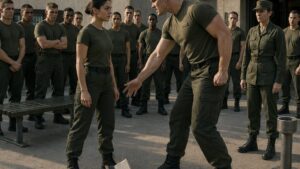
Three men in green flight suits came around the tail end of the helicopter. The first was tall, clean-cut, with black gloves tucked through one shoulder strap and a walk that had not yet learned to doubt itself. His name patch read TORRES. Behind him, Jeffrey Wilson carried a clipboard and wore the expression of a man who had seen enough small problems become large ones. Two younger aircrew members trailed behind, talking until they noticed Kimberly’s face.
Anthony Torres stopped at the edge of the wet floor.
His eyes dropped to the bucket. Then to the mop. Then to Brian.
“What is this?”
Kimberly answered before Brian could. “Maintenance cleaning overlap. I’m handling it.”
Anthony stepped around her, just far enough to make clear he did not think she was handling anything. “Why is there water under my aircraft?”
Brian kept his hands on the mop handle. He did not correct the phrase.
Anthony’s gaze moved over him quickly, taking in the gray coveralls, the stooped shoulders, the old shoes, the bucket. It was a fast inventory, the kind young men made when they had already decided what category a person belonged in.
“Sir,” Kimberly said, “we’ll have it cleared.”
Anthony looked at the wet crescent below the skid and gave a short laugh without humor.
“Who let the janitor near my aircraft?”
Chapter 2: The Young Pilot Reached for the Wrong Seam
Anthony Torres had not meant for the word to land as hard as it did.
That was what he told himself in the first second after saying it.
The second second was worse, because no one laughed.
The old man did not flinch. Kimberly’s mouth tightened. Jeffrey Wilson glanced down at the clipboard in his hand as if a page there might give him something else to do. The two younger crewmen behind him went still in that embarrassed way soldiers had when somebody outranked the moment but not the truth.
Anthony felt heat rise behind his ears and mistook it for irritation.
“We are six days out from putting this bird in front of families, press, retirees, and half the county,” he said, pointing at the water. “And somebody thinks a mop bucket inside the prep line is a good idea?”
Brian Harris looked at the floor. Not at Anthony. Not at the other men. At the floor.
“It’s not in the skid path,” Brian said.
Anthony blinked. The answer was too calm and too specific.
“What?”
“The water. It’s inside the yellow, but not in the skid path.”
Anthony stepped closer, stopping just short of the wet area. “That is not the point.”
“It’s usually the point when people worry about slipping.”
Jeffrey’s eyes lifted.
Anthony heard the old man’s words as insolence because that was easier than hearing the accuracy in them. He took another step, the sole of his boot touching the edge of damp concrete. The helicopter loomed beside them, its dark windows reflecting their shapes: green flight suit, gray coveralls, mop handle planted like a thin post between them.
“You don’t get to decide what matters around an aircraft,” Anthony said.
Brian’s fingers shifted slightly on the handle. “No.”
“Then move.”
Kimberly cut in. “Anthony, I said I’d handle—”
“With respect, Ms. Garcia, this is flight safety.” Anthony’s voice sharpened because he had an audience now, and because the old man had not given him the satisfaction of looking ashamed. “We brief every visitor not to cross the line, and somehow our own cleaning staff is under the bird before the crew even arrives.”
Brian turned his head toward the helicopter’s left side. Only for a moment. Anthony followed the glance and saw nothing except a duller nose panel and a reflection of lights on aging paint.
“You listening to me?” Anthony asked.
Brian looked back. “Yes.”
“Doesn’t seem like it.”
“I’m listening.”
“Then why are you still standing there?”
The old man did not answer.
That silence worked under Anthony’s skin. He had been trained to fill silence with command. In the cockpit, hesitation had weight. In the hangar, he preferred problems that moved when told.
Jeffrey shifted behind him. “Torres.”
Anthony ignored him.
He stepped fully into the damp area. His boot left a print in the thin water, a dark oval that stretched and blurred. Brian’s eyes dropped to it, then to the mop handle, as if measuring how much cleaning that one step had undone.
The look made Anthony feel ridiculous. He turned the feeling into authority.
“You got identification?” he asked.
Kimberly sighed. “He works nights. He’s cleared.”
“I asked him.”
Brian slowly released the mop with one hand and touched the front of his coveralls. His fingers searched the chest pocket, found nothing, then moved toward the collar as if remembering where the badge clip had been before the fabric had worn too thin to hold it.
Anthony saw only delay.
“Come on,” he said. “You can’t be inside a restricted aircraft bay with no visible badge.”
Brian’s hand stopped at the left side of his collar. The coverall seam there had been repaired more than once. A small fold of fabric turned inward, darker at the edge.
“My badge is in the office,” Brian said.
“Convenient.”
Kimberly’s voice went hard. “That’s enough.”
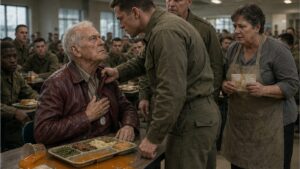
But Anthony was already close enough to smell floor soap and old cotton. He saw the bent seam at Brian’s collar and mistook it for a loose flap covering a hidden clip. He reached out with two gloved fingers, not roughly at first, more impatient than violent.
Brian’s hand came up and closed around his wrist.
Not tight. Not threatening.
Just stopping him.
The hangar went quiet enough for Anthony to hear the distant tick of cooling metal.
Brian looked at him then.
His eyes were pale, tired, and perfectly awake.
“Don’t pull that seam,” he said.
The words were low. They did not carry anger. That made them stranger.
Anthony should have stepped back. He knew that later. In the moment, surrounded by his crew, with Kimberly watching and the old man’s hand still on his wrist, he felt challenged by the gentleness of it.
He pulled his wrist free and caught the edge of the collar seam with his fingertips.
The fabric turned outward.
A small strip of yellow cloth showed beneath it, worn almost smooth, stitched by hand into the inside of the coverall. Not a modern patch. Not a decoration made for visitors. A rescue tab, faded at the edges, its old lettering nearly lost, but the shape and color still unmistakable to anyone who had spent enough time around Army aviation history.
Anthony’s fingers froze.
The word in his head came before he could stop it.
Dustoff.
He had seen one like it once in a glass display outside a training classroom, mounted under a photograph of a battered medevac crew standing beside a helicopter with a red cross fading on its door. The instructor had said the old crews flew into places other aircraft circled. They brought people out when maps stopped being useful.
Anthony looked from the tab to Brian’s face.
The old man’s expression had not changed, but something in the room had. Anthony felt it move through Jeffrey first. The senior crewman’s shoulders straightened. One of the younger aircrew members stopped chewing gum. Kimberly’s tablet lowered a few inches.
Anthony released the collar as if the fabric had burned him.
The seam fell back into place, hiding the yellow strip.
For a breath, nobody spoke.
Anthony noticed then that Brian’s coveralls were not dirty in the way careless work made a thing dirty. The cuffs were worn from use, the knees faded from kneeling, the sleeves patched where solvent had thinned the fabric. The hands around the mop handle had old scars across the knuckles, pale lines half-buried in age spots.
Anthony also noticed the wet floor.
The water reflected the underside of the helicopter, and in that reflection the old man looked taller.
“Where did you get that?” Anthony asked.
Brian’s eyes moved once toward Kimberly, once toward Jeffrey, and then settled somewhere beyond Anthony’s shoulder.
“I didn’t get it,” he said.
Anthony swallowed.
The correct thing to do should have been obvious. Apologize. Step back. Ask properly. But embarrassment and recognition arrived at the same time, and neither knew how to speak first.
Jeffrey did it for him.
“Torres,” he said quietly.
Anthony turned his head, just enough to see Jeffrey’s face. The senior crewman was no longer wearing the expression of a friend waiting for a scene to end. He was watching Brian with the cautious attention men gave to things they had almost stepped on.
Anthony faced Brian again.
His voice came out lower. “Were you assigned to a Dustoff unit?”
Brian let the question hang.
A younger crewman shifted behind Jeffrey, and the small noise brought Brian’s hand tighter around the mop handle. Not fear. Containment.
Kimberly seemed to sense something fragile in the air. “Brian, you don’t have to—”
“I know,” Brian said.
Anthony felt the words close a door.
He stepped back, this time out of the wet area. The print from his boot remained where he had crossed into the old man’s work. Dark. Obvious.
Brian looked at it for a moment.
Then he lifted the mop and drew it once across the print, slowly, evenly, erasing the shape Anthony had left.
No one moved while he did it.
The sound of the mop strings on concrete filled the hangar. It was a small sound, almost nothing under the bulk of the aircraft, but Anthony heard every inch of it.
When Brian finished, he set the mop back into the bucket, wrung it, and moved the bucket two feet away from the skid path. Not behind the line. Not surrender. Just enough to make space.
Anthony took another breath.
“Sir,” he said before he could decide whether the word was too much or not enough. “Were you Dustoff?”
Brian’s face turned slightly toward him.
For a moment Anthony thought he might answer. The old man’s lips parted, then closed. His gaze passed over the helicopter’s left nose panel, and something old moved behind his eyes, too deep to name in a hangar full of witnesses.
“Not today,” Brian said.
Then he picked up the bucket handle and walked it toward the shadow of the aircraft, leaving Anthony standing where his boot print had been.
Chapter 3: The Crew Learned the Tab Had a History
By Monday afternoon, Anthony had heard the word janitor three times, and each time it sounded worse.
The first came from one of the younger crewmen while they checked tie-down points near Bay Two.
“Guess the janitor had a past life,” the crewman said, trying for casual.
Jeffrey Wilson looked up from the inspection sheet. “Don’t call him that.”
The crewman blinked. Anthony pretended to be studying a rotor blade support clamp.
The second came from someone in the ready room, telling the story wrong before the coffee had even gone cold.
“Torres found some old patch under the cleaner’s collar.”
Anthony shut his locker harder than needed.
The room went quiet.
The third came from Anthony himself, silently, while he sat in front of an office terminal after lunch with an access form he did not need and a reason he would not admit.
Janitor.
He saw again the old man’s face when the seam turned outward. Not humiliated. Not proud. Guarded, as if Anthony had opened a drawer in someone else’s house and found a photograph face down.
The hangar office smelled of paper, stale coffee, and the printer that Kimberly kept threatening to replace. Outside the glass wall, Bay Three gleamed under the afternoon lights. The helicopter had been wiped, staged, and marked with temporary ropes that would guide open-house visitors later in the week. Brian’s bucket was gone.
Anthony clicked through the personnel access list and found Brian Harris under civilian night support. The record was thin: active clearance, contractor support, hangar sanitation, after-hours maintenance access, emergency contact blank. No military service listed. No veteran notation. No explanation for a hand-stitched rescue tab hidden under a coverall seam.
He leaned back.
Jeffrey appeared in the office doorway with two paper cups. He set one beside Anthony without asking.
“You’re not good at pretending,” Jeffrey said.
Anthony did not look away from the screen. “Pretending what?”
“That this is about access compliance.”
Anthony picked up the coffee and put it down again. “He had no visible badge inside a restricted bay.”
“He also knew the skid path without looking at the floor markings.”
Anthony clicked open another database window. “A lot of old maintenance guys know their way around aircraft.”
“You called him a janitor.”
Anthony’s jaw tightened.
Jeffrey took the chair beside the filing cabinet. “I’m not saying it to rub it in.”
“You just did.”
“I’m saying it because you’re sitting here trying to prove you didn’t miss something.”
Anthony exhaled through his nose. “I did miss something.”
Jeffrey was quiet long enough for the printer to click and settle.
Anthony lowered his voice. “You see the tab?”
“I saw enough.”
“It was old. Not costume-shop old. Real old.”
Jeffrey nodded toward the screen. “You won’t find that in a cleaning contract.”
“No.”
“So where are you looking?”
Anthony hesitated, then opened the aircraft maintenance archive. “The demonstration bird has a rebuild history. The left nose panel is older than the rest of the airframe. Brian looked at it like—” He stopped.
“Like what?”
Anthony saw the wet floor again, the reflection, the way Brian had cleaned the boot print without making a point of it.
“Like we were standing too close to a grave.”
Jeffrey’s expression changed, but he did not answer.
The archive took too long to load. Anthony drummed two fingers on the desk until Jeffrey glanced at him, and he stopped.
Records appeared in uneven batches: overhaul dates, part transfers, paint updates, inspection compliance, display-readiness notes. The helicopter’s present number had a clean digital history going back years. Before that, parts had been drawn from decommissioned airframes. Anthony scrolled past engine components, transmission records, avionics replacements, fuselage panel transfers.
There.
Left forward nose panel: salvaged from retired UH airframe, historical retention approved pending cosmetic restoration.
Anthony clicked the linked file.
The scan was old, the kind made from paper that had been folded too many times before anyone thought to preserve it. The aircraft number was different. The unit designation sat halfway down the page in faded type.
Medical evacuation detachment.
Jeffrey leaned forward.
Anthony kept scrolling.
The file included a photograph, black-and-white and grainy. A helicopter in a muddy clearing. Men in flight gear and stained fatigues. A red cross on the side door, bright even without color. The crew stood in a row, all of them young enough to look unfinished.
Anthony enlarged the image.
The faces blurred when the resolution stretched, but one man stood near the nose, one hand on the panel, head turned slightly away from the camera. He was lean, dark-haired, not smiling. His hand rested below the seam Anthony had noticed that morning.
The caption beneath the photo loaded in pieces.
Crew chief: Brian Harris.
Anthony stopped breathing for a moment.
Jeffrey said nothing.
The office light hummed above them.
Anthony scrolled to the next document. Mission summary. Several lines were redacted or too damaged to read. A date appeared. Same week as the open house. Decades earlier. Location: [unlisted in scan]. Aircraft status: recovered for parts. Crew status: partial recovery.
That phrase sat alone in the box as if the person who typed it had not known what else to do with the dead.
Partial recovery.
Anthony read the line again, then again, as if repetition might make it less cold.
“What does that mean?” Jeffrey asked, though both men knew enough to hate the answer.
Anthony moved the cursor but did not click. “Means not everybody came back whole. Or not everybody came back.”
Outside the glass, a junior cleaner pushed a cart past Bay Three, then slowed near the helicopter as if tempted to look closer. Brian appeared from behind a storage rack before the cleaner crossed the line. He said something Anthony could not hear, gentle enough that the cleaner smiled and turned away. Then Brian bent, lifted his gray bucket from beside a cabinet, and tucked it behind a stack of old maintenance logs where it would not be noticed.
Anthony watched him.
The old man’s movements were economical. No wasted bend, no unnecessary step. He carried age in his joints, but not confusion. When a mechanic left a rag too near an intake cover, Brian picked it up and placed it exactly where the tool cart shadow ended. When someone rolled a ladder too close to the left nose, Brian moved it six inches without looking around for permission.
This was not wandering.
This was memory with a work order.
Jeffrey stood and came closer to the screen. “Does Kimberly know?”
“I don’t think so.”
“The commander?”
Anthony shook his head. “The archive was attached to the aircraft file, but nobody reads past the current inspection notes unless something breaks.”
Jeffrey’s mouth tightened. “Something did.”
Anthony looked at him.
Jeffrey nodded toward the hangar. “This morning.”
Anthony turned back to the record. He clicked the personnel link attached to the old mission. More names appeared, some clear, some smeared by the scan.
Brian Harris remained legible.
Another name caught halfway in the damaged text, the surname easier to read than the first.
Hill.
Anthony sat very still.
From outside came the long, hollow roll of Brian’s bucket wheels crossing concrete. The sound passed beneath the office window, steady and soft. Anthony did not look up until the wheels stopped beside Bay Three.
Brian stood near the helicopter, one hand resting on the mop handle, the left nose panel just beyond him.
Anthony looked back at the screen.
The final line of the record had loaded at the bottom of the page.
Crew chief Brian Harris present at recovery site. Mission file marked incomplete. Partial recovery pending family notification.
Chapter 4: The Open House Wanted a Cleaner Story
By Wednesday morning, Kimberly Garcia had divided the hangar into what could be shown and what had to be hidden.
The open-house map on her tablet looked clean: Bay One for the children’s safety talk, Bay Two for the maintenance display, Bay Three for the demonstration helicopter, visitor rope lines marked in blue, exit flow marked in green. In person, the hangar refused to behave so neatly. Extension cords appeared where none were scheduled. A hydraulic stain bloomed beneath a cart that had passed inspection the week before. Someone left coffee cups on a parts cabinet with a sign taped to it that said NO FOOD OR DRINK.
And Brian Harris kept drawing a wet line around the old helicopter.
Not a careless puddle. That would have been easier to address. His mop left a narrow half-moon of clean concrete beneath the left side of the aircraft, close enough to the skid to make pilots complain, careful enough that no one could quite call it unsafe. The line dried almost as soon as he made it, but while it was wet it caught the overhead lights and turned the floor into a dark mirror.
Kimberly watched him from the operations office window while the base commander spoke beside her.
“Public affairs wants the nose panel replaced before Saturday,” the commander said.
Kimberly turned from the glass. “Replaced?”
“Cosmetic swap. Temporary. The current panel photographs unevenly.”
“It’s historic retention.”
“It’s a panel, Ms. Garcia.”
The commander said it without cruelty. He was looking at the tablet schedule, not the helicopter. That was the problem Kimberly kept running into this week. Everyone saw the aircraft as a responsibility, a display piece, a flight asset, a photo backdrop. Brian alone looked at it as if it could hear.
“The maintenance file says that panel was retained for historical reasons,” she said.
“And the replacement is approved. The old one will be stored, tagged, and reinstalled later if the museum people care enough to ask for it.”
“If?”
He looked up then. “We are not running a museum. We are running an open house. Families are coming to see discipline, readiness, and pride. They do not need to see mismatched paint.”
Kimberly felt the answer settle in her throat and stay there.
Outside the window, Brian moved his bucket two feet back to let a mechanic pass. The mechanic did not thank him. Brian did not seem to expect it. He simply waited, then guided the mop head along the same crescent of concrete.
The commander followed her gaze. “Is that the employee from Monday?”
“Yes.”
“The one Captain Torres questioned?”
She disliked the way questioned sounded cleaner than what had happened. “Yes.”
“I was told there was a minor access issue.”
“It was handled.”
“Good. Then handle this too. The panel comes off Friday afternoon, or Saturday morning at the latest. I don’t want visitors asking why our showcase aircraft looks patched together.”
Kimberly marked the instruction on her tablet because that was what her job required. Her thumb hesitated over the confirmation box.
“Has anyone asked Brian?” she said.
The commander’s brows lifted. “The custodian?”
“His name is Brian Harris.”
“I’m sure he’s a good man. But no, I don’t ask custodial staff for aircraft display approval.”
Kimberly tapped the screen. The order logged itself with a small chime.
The commander left her office with two aides and a trail of polished decisions. Kimberly stayed by the window.
Below, Brian had stopped mopping.
He was looking at the left nose panel.
Not touching it. Not protesting. Just standing close enough that his reflection broke across the wet floor beneath the aircraft. For the first time, Kimberly wondered how long he had been cleaning this bay before she ever noticed the pattern.
She opened the staff schedule and searched his timecards.
The dates lined up in a way that made her sit down.
Every year, same week. Extra night shifts volunteered. Bay Three requested. No overtime complaint. No notes except “floor prep,” “display cleaning,” “hanger support,” with hangar misspelled twice in old records by a manager who had retired before Kimberly took over.
The first year in the digital system went back only so far, but even there the pattern held.
Brian Harris did not linger randomly.
He returned.
That afternoon, Kimberly found him near the storage racks, rinsing out the gray bucket. The water in the utility sink turned dark, then pale. His coverall sleeves were rolled to the wrists. The left collar seam lay flat, as if he had taken extra care with it since Monday.
“Brian,” she said.
He shut off the tap.
For a moment neither of them spoke. The hangar behind them was loud with preparation: ladders rolling, tape tearing, radios popping, a mechanic calling for a wrench no one admitted borrowing. In the utility corner, the silence felt borrowed from another building.
“The nose panel,” Kimberly said. “They want to remove it before Saturday.”
Brian’s hands remained on the bucket rim.
“Why?”
“Cosmetic.”
He nodded once, too small.
“They’ll store it,” she added, hating how weak that sounded.
The bucket shifted under his fingers. “Where?”
“I don’t know yet.”
“Storage gets damp behind Bay Five.”
“I can make sure it doesn’t go there.”
“That panel shouldn’t come off.”
Kimberly waited. “Because it’s historically retained?”
Brian looked at her then, and she knew he had heard the office language in her mouth.
“No.”
“Then why?”
He dried his hands on a towel that had already been used too many times. The skin along his knuckles was thin, blue-veined, marked with small scars she had never noticed because she had never had reason to look at his hands.
“There’s writing behind it,” he said.
Kimberly lowered the tablet. “Writing?”
“Grease pencil. Some of it under the brace. Some scratched later.”
“From the old aircraft?”
“Yes.”
“What does it say?”
Brian folded the towel carefully and placed it beside the sink. “Names. Counts. A few numbers that won’t mean anything to them.”
“To whom?”
“The people taking it off.”
She looked toward Bay Three. “Brian, if there are markings with historical value, we can document them properly.”
The corner of his mouth moved, not quite a smile. “Properly.”
“I’m trying to help.”
“I know.”
But he did not look helped.
Kimberly remembered Monday morning. Her own voice telling him the aircraft was not his. The way he had said no, it isn’t, and left the words there for her to misunderstand.
“How long have you been cleaning that bay this week?” she asked.
“This week?”
“Yes.”
“Since Sunday night.”
“No. I mean how many years.”
Brian’s eyes shifted to the sink drain. A thin ring of dirty water circled once and disappeared.
“Long enough.”
“That’s not an answer.”
“It’s the one I have.”
Kimberly nearly pushed. She had built a career on pushing, because hangars did not run on gentleness. But something in Brian’s shoulders warned her that the wrong pressure would close him completely.
“The commander wants a cleaner story for visitors,” she said.
Brian reached for the bucket handle. “Most people do.”
He lifted the bucket before she could stop him. Not fast. Not dramatically. But with a finality that made her step aside.
On his way past her, the wheels squeaked once against the floor.
“Brian.”
He paused.
“I saw the timecards.”
His hand tightened around the handle.
“You come back every year this week,” she said.
He did not turn around. “Floor gets dirty every year.”
“Not like that.”
For a moment, only the hangar answered. Metal rolled. Radios clicked. Somewhere, Anthony Torres’s voice carried across Bay Two, lower than it had been Monday but still unmistakable.
Brian looked toward the sound, then toward the helicopter.
“Some things don’t stay clean,” he said. “You just keep coming back.”
He walked the bucket toward Bay Three, leaving Kimberly beside the utility sink with her tablet dimming in her hand.
Back in the office, she opened the open-house guest list to distract herself with names, parking passes, accessibility notes, and public affairs requests. Most of the names meant nothing. Retirees. Local officials. Families. Former crews.
Then one entry caught because it carried the same surname she had seen Anthony scribble on a note and leave face down beside the archive printer.
Sharon Hill.
Widow. Special visitor access. Former medevac family.
Kimberly looked through the office window again.
Brian had stopped at the edge of the wet crescent beneath the helicopter. He stood with the mop handle upright, his old body small beneath the aircraft, his reflection broken by the lights.
On the tablet, Sharon Hill’s name glowed in a neat black font, scheduled to arrive Friday afternoon.
Chapter 5: The Widow Stood Where the Bucket Had Been
Brian saw Sharon Hill before she saw him.
She stood just inside the visitor walkway on Friday afternoon, one hand resting on the rope stanchion, the other holding a small folded program she had not opened. The hangar lights made her silver hair brighter at the edges. She wore a navy jacket despite the warmth and carried herself with the careful composure of someone who had been greeted too often with pity.
For a moment, Brian did not move.
The bucket was beside his right foot. The mop handle leaned against his shoulder. Beneath the helicopter, the floor was almost dry, except for the narrow crescent he had just finished pulling away from the left skid.
Sharon looked toward the aircraft first.
That was mercy.
Brian used it to breathe.
Her eyes went to the nose panel, to the rotor, to the open side door arranged for visitors. Then they moved across the floor and found the gray bucket. After that, they found him.
The years between them did not vanish. They stood up.
“Brian Harris,” she said.
Her voice was not loud. It still seemed to reach every corner of him.
He set the mop upright with both hands. “Mrs. Hill.”
She flinched slightly at the formality. Not much. Just enough to tell him she had not wanted it and had expected it anyway.
“Sharon,” she said.
He nodded. “Sharon.”
The rope line separated them by less than six feet. It felt like a safer distance than he deserved. Behind her, a security guard checked a clipboard near the entrance. Farther across the hangar, Kimberly spoke with a maintenance inspector. Anthony stood near Bay Two with Jeffrey, but both men had gone still when they noticed the woman by the walkway.
No one came closer.
Sharon looked down at the bucket. “Still working.”
“Yes.”
“You always were.”
Brian’s hand slid along the mop handle until it found the worn place where his palm fit.
She turned back toward the helicopter. “They told me there would be a special aircraft on display. I didn’t know it would be this one.”
“It’s not the same one.”
“I know.” Her eyes stayed on the left nose panel. “They said some parts were.”
Brian could not tell whether someone had prepared her or whether memory had done its own inventory. He had hoped she would arrive Saturday with the others, surrounded by noise, children, speeches, all the ordinary shields public events gave to private grief. Instead she had come early, when the hangar still held too much truth.
“I can move the bucket,” he said.
Sharon looked at it, then at the clean crescent on the floor. “Is that why you’re here?”
He bent and picked up the handle. The wheels squeaked as he pulled the bucket back from the aircraft, beyond the rope line, then farther still so there would be room for her to stand if she wanted to. His knee protested when he straightened. He kept his face still.
“There,” he said.
She watched the bucket settle. “You didn’t answer.”
“No.”
“That means no, or no, you won’t answer?”
He looked at her then. Her eyes were steady, but not hard. That made it worse. Hardness could be endured. A person could lean against it. Sharon Hill had brought something more dangerous: the patience of a woman who had already survived the answer she feared.
Brian glanced toward the aircraft. “You want to come closer?”
The security guard looked uncertain, but Kimberly, from across the hangar, gave a small nod. The rope was unhooked. Sharon stepped carefully into Bay Three.
Brian moved aside, not behind her, not in front. Beside the aircraft, but far enough away that the space near the nose panel belonged to her.
She stopped where the bucket had been.
Her hand rose, then lowered before touching the panel. “They painted over the red cross.”
“Long time ago.”
“Of course.”
The words were simple. Her mouth held them like something bitter.
Brian looked at the panel but did not let his eyes stay. He knew every uneven line in that paint. He knew where old metal met newer bracket, where one rivet sat a hair higher than its neighbor, where, behind the skin, grease pencil marks waited in the dark.
Sharon opened the folded program without reading it. “They wrote that this aircraft honors medical evacuation history.”
“Yes.”
“Does it?”
Brian did not answer fast enough.
She turned toward him. “You knew my husband.”
It was not a question.
“Yes.”
“You flew with him.”
“Yes.”
“I was told you were crew chief.”
“Yes.”
The word came out smaller each time.
A mechanic rolled a cart somewhere behind them. The sound faded quickly, as if the hangar itself had asked for quiet.
Sharon studied his face. “I wrote to you once.”
Brian’s throat tightened.
“I know.”
“You didn’t answer.”
“No.”
“I thought you hated me.”
The mop handle shifted in his grip. “No.”
“I thought maybe I reminded you of something you wanted gone.”
Brian stared at the damp floor. The last thin line of water reflected both their shoes: her polished black flats, his old work shoes with white streaks of dried soap at the soles.
“You did,” he said.
Sharon breathed in, held it, released it slowly.
Brian wished she had shouted. He wished she had accused him with clean words he could accept and carry. Instead she looked back at the helicopter, and her quiet became another weight.
“He used to keep a yellow tab in his dresser,” she said. “Not in a display case. Just in the top drawer with cuff links he never wore.” A faint smile crossed her face and disappeared. “I found it after they came to the house.”
Brian’s hand rose without his permission toward his collar. He stopped before touching the seam.
Sharon noticed.
Her eyes moved to the left side of his coveralls.
“May I?” she asked.
The question nearly undid him because Anthony had not asked. Because she did. Because respect, when offered too late, could hurt more than disregard.
Brian nodded once.
Sharon stepped closer and lifted the edge of the collar with two careful fingers.
The yellow rescue tab showed in the shadow beneath the gray fabric, faded nearly to bone. Her face changed, but not in surprise. Recognition, yes. Also anger. Also grief returning to a place it had never left.
“He had one too,” she whispered.
Brian closed his eyes for one second.
When she let the seam fall back, she did not step away.
“Why hide it there?” she asked.
He opened his eyes. “Because I didn’t know where else to put it.”
Sharon’s gaze moved over his coveralls, the bucket, the mop, the helicopter. The pieces gathered in her face, not into understanding yet, but into the suspicion that understanding would cost her.
“What happened that night, Brian?”
The hangar seemed to widen around the question. Across the bay, Anthony lowered his head. Jeffrey turned slightly away, giving them what privacy a public building allowed.
Brian looked at Sharon Hill and saw the woman from a porch decades ago, younger than memory had any right to keep her, holding the doorframe while two officers stood in dress uniforms on the walkway. He had been in the truck down the street, not invited, not brave enough, hands still smelling of hydraulic fluid no soap could remove.
He had not gone to the door.
He had not answered her letter.
Now she stood where the bucket had been, asking him to open a room he had spent years mopping around.
“We brought people out,” he said.
Her face held.
“Your husband kept us low enough to reach them,” Brian continued. “Lower than he should have.”
“That sounds like him.”
Brian swallowed. “We took fire going in. Took more leaving.”
“Was he afraid?”
The question cut through every official version of bravery he had ever heard.
“Yes,” Brian said. “But not of dying.”
Sharon’s eyes shone. She did not wipe them.
Brian almost said the rest. He almost told her about the smoke inside the cabin, the torn map, the boy on the stretcher calling for his mother, the way her husband had laughed once into the headset because a man needed something human in the noise. He almost told her what he had been unable to repair, what he had held together, what he had let go.
Instead he looked at the left nose panel.
“I should have written back,” he said.
“That isn’t what I asked.”
“No.”
“Then answer me now.”
He touched the mop handle with both hands again.
The old wood steadied him, but only enough to remain standing.
“Not here,” he said.
Sharon’s mouth tightened, and for the first time anger reached the surface.
“Where, then?”
Brian looked around the hangar: the open-house banners half-hung, the visitor ropes, the polished aircraft, the crew pretending not to listen.
“When it’s quiet,” he said.
She nodded once, but the movement carried no forgiveness.
As she turned to leave the bay, her eyes dropped again to his collar.
“My husband kept one too,” she said. “But he never hid it.”
Then she walked back across the dry floor, leaving Brian beside the helicopter with the mop handle in his hands and the words he had not said pressing harder than the ones he had.
Chapter 6: Anthony Finally Changed What Respect Meant
On Saturday morning, Anthony Torres saw two junior crewmen rolling the old nose panel toward a cart, and the first thing he noticed was Brian Harris standing too still.
The hangar was already dressed for the open house. Flags hung from the rafters. Visitor ropes gleamed. Folding chairs lined the far wall for families who would need to sit between tours. Children’s activity tables waited near Bay One with plastic model helicopters still sealed in bags. Public affairs had placed a sign beside Bay Three that read HONORING THE LEGACY OF MEDICAL EVACUATION.
The sign looked clean.
The panel did not.
It had been removed from the left side of the aircraft and rested upright on padded stands, dull paint facing the bay, interior surface turned partly toward the crew. Behind it, where visitors had never looked, old marks crossed the metal in faded grease pencil and shallow scratches. Some were numbers. Some were initials. Some were short lines grouped in fives. Near a brace, four names had been written so small they seemed more hidden than recorded.
Anthony stopped at the edge of the work area.
Brian stood beside the panel, gray coveralls buttoned to the neck, mop handle planted against the concrete. He was not touching the aircraft. He was not blocking anyone with his body. But the end of the mop lay across the path between the panel stand and the rolling cart.
One of the junior crewmen looked irritated. “Mr. Harris, we’ve got orders.”
Brian’s gaze stayed on the panel. “I heard.”
“Then we need to move it.”
“No.”
The word did not rise. It did not need to. It sat in the hangar like a chock under a wheel.
Kimberly came quickly from the operations office, tablet in hand. The base commander followed at a distance with a public affairs aide. Sharon Hill stood near the visitor walkway, early again, watching the exposed inside of the panel with both hands closed around her program.
Anthony felt Monday morning return: his boot in the wet floor, his fingers at Brian’s collar, the yellow tab appearing in the fold.
This time he did not step forward first.
The junior crewman glanced toward Kimberly. “Ma’am?”
Kimberly looked at the panel. Her face changed when she saw the writing.
Anthony moved close enough to read some of it.
EVAC 6.
HILL.
BAKER.
UNKNOWN MALE CIV.
Two marks. Then three more. Then a line struck through as if someone had started counting and stopped because numbers had become people.
The public affairs aide whispered to the commander, “We can photograph it before storage.”
Brian’s hand tightened on the mop.
Anthony heard the sentence as if he had spoken it himself four days ago. Clean it up. Move it out. Make the story easier to present.
The commander cleared his throat. “Mr. Harris, we respect the historical nature of the component, but the event opens in under two hours. We have a replacement panel ready. This one will be documented.”
Brian looked at him. “Documented where?”
“In the maintenance file.”
“No one reads the maintenance file.”
The commander’s expression tightened at being corrected by a man in coveralls. “That is not the issue.”
“It’s been the issue for forty years.”
A few crew members looked at one another. Kimberly lowered her tablet.
Anthony stepped forward.
“Sir,” he said to the commander.
The commander turned. “Captain Torres, please tell me your aircraft will be ready.”
Anthony looked at the exposed panel again. The name Hill sat near the brace, not centered, not ceremonial, just there. A mark made by someone with dirty hands in a moment too urgent for proper records.
“It won’t be ready if we treat that like scrap,” Anthony said.
Silence spread quickly.
The commander’s eyes narrowed. “Excuse me?”
Anthony felt Jeffrey come to stand just behind his right shoulder. Not rescuing him. Present.
“The panel is part of the aircraft’s story,” Anthony said. He kept his voice even. “If we remove it for cosmetics, visitors see a cleaner aircraft and learn less.”
The public affairs aide shifted. “Captain, the display plan was approved.”
“I approved the aircraft walk-around checklist,” Anthony said. “Not the erasure of original mission markings.”
The word erasure made the commander glance toward Sharon Hill. She had not moved.
Brian’s face remained still, but Anthony saw the older man’s eyes turn toward him, just once.
The junior crewman near the cart muttered, too softly for the commander but not for Jeffrey, “Since when do we let cleaning staff run the display?”
Jeffrey turned his head. “Since the cleaning staff knows what we’re standing in front of.”
The crewman flushed.
Anthony looked at Brian. “Mr. Harris.”
Brian’s hand stayed on the mop handle.
Anthony made himself ask in front of everyone, because that was where the damage had been done Monday.
“What should happen to the panel?”
Brian did not answer immediately. The hangar noise continued around them in distant fragments: chairs scraping, radios clicking, a child laughing outside before being hushed by an adult. The open house had not begun, but the public world was already pressing at the doors.
Brian looked at Sharon first.
She gave no instruction. Only waited.
Then Brian stepped closer to the panel, lifting the mop handle out of the cart path but keeping it in his hand. He did not point at the writing. He seemed unwilling to hover a finger over any name.
“It stays with the aircraft,” he said. “Interior side visible only when someone asks why the paint doesn’t match.”
The public affairs aide opened his mouth. Kimberly spoke before he could.
“We can adjust the rope line.”
The commander looked at her.
She held his gaze. “We can place a small note that says the panel contains original mission markings. No dramatic copy. No display language beyond that.”
Anthony added, “And no one touches it without gloves.”
Brian’s eyes moved to him again. A small thing passed across his face, not gratitude exactly. Permission, maybe, to continue.
The commander was a practical man before he was a sentimental one. Anthony watched him calculate visitors, press, risk, optics, truth. The aircraft stood open behind them, incomplete without the panel, somehow more honest because of it.
Finally, the commander said, “Reinstall it.”
The junior crewmen moved at once, too fast.
“Slow,” Anthony said.
They stopped.
He looked to Brian. “Show us how to hold it.”
For a moment Brian did not seem to understand the request. Then he set the mop gently against the wall and stepped to the panel. His old hands lifted, hovering before contact.
“Here,” he said, indicating the lower brace. “And here. Don’t press the center.”
The crewmen obeyed.
Anthony took the upper edge himself, gloved hands careful against the metal. The panel was lighter than he expected and heavier than it should have been. Brian guided them with few words. Left. Lower. Wait. Not that angle. There.
When the panel settled back into place, the mismatched paint returned to the aircraft’s face.
It looked imperfect.
It looked kept.
Sharon covered her mouth with one hand, then lowered it before anyone could turn the moment into something for her.
The commander gave one curt nod and walked away with the public affairs aide, already revising whatever would be said when visitors arrived. Kimberly stayed behind, staring at the panel as if the hangar had changed shape around it.
Anthony removed his gloves. He wanted to say something to Brian, but every sentence that came to mind sounded either too late or too polished.
Brian saved him from both.
“There were more names,” he said.
Anthony looked at him.
Brian’s eyes were on the panel, but his voice had gone somewhere lower than the hangar. “Behind that metal. In the file. In the letters that didn’t get answered.”
Sharon stood very still by the rope line.
Brian picked up the mop again. Its handle scraped softly against the concrete.
“The names behind the panel,” he said, “are not all the names from that night.”
Chapter 7: The Names Were Left Where the Light Could Find Them
By evening, the hangar had emptied of visitors, folding chairs, children’s questions, and the bright voices people used around aircraft when they wanted history to feel clean.
The flags still hung from the rafters, barely moving in the slow current from the ceiling fans. The demonstration helicopter sat in Bay Three with its mismatched nose panel restored, its old paint visible beneath the new lights. A small note had been placed near the rope line in plain black lettering: Original mission markings preserved behind this panel. Please ask staff before touching display components.
Brian stood beside the utility sink, rinsing the mop.
The water ran gray at first, then pale, then clear enough to show the metal drain beneath. He watched it longer than necessary. His hands ached from guiding the panel back into place that morning. His knees hurt from too many careful bends. His collar rubbed against the place where the rescue tab lay hidden again, stitched under plain gray cloth.
He had made it through the open house without saying more.
That should have been enough.
Across the hangar, Anthony Torres spoke quietly to two younger crewmen near the aircraft. Jeffrey Wilson stood with him, arms folded, not with judgment now but with attention. Kimberly Garcia was by the operations office, reviewing the revised display notes with the base commander. Sharon Hill sat alone in one of the remaining folding chairs near the visitor walkway, the unopened program resting in her lap.
She had stayed after everyone else left.
Brian shut off the tap.
The mop strings dripped into the sink. He wrung them by hand, slowly, feeling the cold water press through his fingers. In the old days, his hands had known cables, panels, pulleys, hot metal, torn canvas, blood-slick buckles, headset wires, the frantic weight of someone who was not yet gone. Now they knew a mop handle and a bucket rim. It was not a lesser knowledge. It was quieter.
He carried the mop and bucket back toward Bay Three.
The wheels squeaked once.
Sharon heard it and turned.
Brian stopped at the edge of the clean crescent beneath the helicopter. The floor there was dry now, though he could still see the path his hands had made. A dark half-moon in memory only. He set the bucket down, leaned the mop against it, and looked at the panel.
Anthony noticed him first. He said something to the crewmen. They moved away without argument. Jeffrey followed, giving Brian a small nod as he passed, then waited near the operations office with Kimberly.
Anthony stayed, but farther back than he would have on Monday.
Brian looked at him.
Anthony straightened. “Mr. Harris.”
The title did not feel polished. It felt practiced, as if Anthony had chosen it carefully and meant to keep choosing it.
Brian nodded.
Anthony held a folded pair of clean work gloves. “They want to secure the panel for the night.”
Brian’s eyes went to the helicopter.
“I told them we’d ask first,” Anthony said.
Behind him, the younger crewman who had muttered that morning looked down at his boots.
Brian took the gloves but did not put them on yet. “Not before Mrs. Hill sees it.”
Sharon rose slowly from the chair.
No one spoke while she crossed the hangar. The rope line had been unhooked and left open. She stepped into Bay Three as she had on Friday, but now the floor beneath her was dry and clean, and the bucket was behind Brian instead of between them.
Anthony moved to the panel. “Ma’am, the markings are on the interior side. We can loosen the lower fasteners and swing it out slightly. It won’t come free.”
He looked to Brian before touching anything.
Brian nodded once.
Anthony put on gloves and motioned to the crewman. They worked slowly, under Brian’s small corrections. Not that angle. Hold the brace. Don’t lift from the center. Their movements were almost silent now.
When the panel opened enough, the interior marks came into view.
Sharon stepped closer.
Her husband’s surname sat near the brace, small and faint, written in a hand that had been hurried and tired. HILL. Beside it were marks that might have been numbers or counts or an unfinished attempt to make order from what had happened. Other names sat near it, some clear, some half-hidden beneath old grime that Brian had never scrubbed away.
Sharon lifted one hand, then stopped.
Brian said, “You can touch the brace. Not the writing.”
She placed her fingertips on the metal edge.
For a while, that was all.
Then she said, “Who wrote it?”
Brian looked at the marks. “I did.”
Her fingers tightened on the brace.
“I thought so,” she said.
He had expected anger. He had expected a demand. Instead she kept looking at the name, and her face carried something worse than anger: the slow recognition that part of her husband had been held in a place she had never known to search.
Brian put the clean gloves on, though he did not need them yet. His hands needed something to do.
“We were coming out low,” he said. “Too low for the load, but that was the only way through. We had six aboard who weren’t crew. Two walking wounded crammed against the door, four on stretchers. Your husband kept asking for weight checks like the numbers might forgive us.”
Sharon did not move.
Anthony looked down, but he stayed. Jeffrey had turned toward the far wall, giving the words room without leaving.
Brian continued because if he stopped now he would not start again.
“We took hits before the clearing. Lost hydraulics enough to make every movement argue back. Your husband kept her level. He talked the whole way. Not to me. Not really. To the aircraft.”
A faint breath left Sharon.
“He used to do that in the car,” she said.
Brian looked at her then. “Did he?”
“When it wouldn’t start. When the heater rattled. He’d pat the dashboard and say, ‘Stay with me, girl.’”
The corner of Brian’s mouth moved with pain that almost resembled a smile. “He said that.”
Sharon closed her eyes.
“The nose took damage on landing,” Brian said. “We got down hard. Hard enough the panel bent inward. I remember thinking it had no business staying attached.”
He looked at the metal, at his own writing.
“We got people out. Not all. But more than we should have. Your husband stayed in the seat until we had them clear.”
Sharon opened her eyes. “And then?”
Brian’s throat closed.
The hangar lights hummed above them. The helicopter waited, patient as an old witness.
“Then there was another hit,” he said.
Sharon’s hand left the brace and fell to her side.
Brian stared at the panel because looking at her would have stopped him. “I tried to get him loose. Harness jammed. Panel edge shifted. Smoke inside. I had my knife. I had both hands on him. He told me to get the boy out.”
“The boy?”
“One of the stretchers. Maybe nineteen. Maybe younger. Burned bad. Calling for his mother.”
Sharon covered her mouth, but no sound came.
“Your husband said, ‘Crew chief, move.’ Not Brian. Not please. Crew chief.” His voice thinned. He steadied it. “So I moved.”
The words hung between them.
No one in the hangar seemed to breathe.
“I came back,” Brian said. “I did. I went back twice. The second time the heat drove me down. The third time someone pulled me out before I knew I was outside. After that, there were pieces of aircraft. Pieces of record. Pieces of men. I wrote what I could before they took the panel away.”
Sharon looked at the name.
“You saved the boy?”
“Yes.”
“And others?”
“Yes.”
“But not him.”
“No.”
The answer was bare. It did not ask for mercy.
Sharon stood very still, then lowered herself into a crouch with difficulty until her face was level with the writing. Brian started to reach out, but she lifted one hand to stop him. She did not touch the name. She only looked.
“He would have hated that you carried that alone,” she said.
Brian’s eyes burned. He blinked until the hangar steadied. “I didn’t know how to give it back.”
“You could have answered my letter.”
“I know.”
“I needed to hate someone.”
“I know.”
“And you decided I should hate the silence instead?”
Brian looked down at his gloved hands. “I decided wrong.”
Sharon stood slowly. This time he did offer his arm, and this time she took it. Her fingers were light, but the acceptance passed through him harder than blame.
When she was steady, she released him.
“What do you want done with it?” she asked.
Brian looked at the panel. For years, he had thought the answer was simply keep it. Don’t polish it flat. Don’t hide it behind storage shelves. Don’t let damp and convenience take the last marks from metal. But now Sharon stood beside him, and Anthony behind him, and Kimberly near the office with her tablet lowered, and the answer had to belong to more than his guilt.
“Leave it with the aircraft,” he said. “Not open all the time. Not made into a show. But when someone asks why the paint doesn’t match, tell them there are names behind it. Tell them people came out because others stayed long enough.”
Sharon nodded.
Anthony said quietly, “We can do that.”
Brian turned toward him. “Can you?”
Anthony accepted the question. He did not answer too fast. “Yes. I’ll put it in the aircraft brief. Not as a speech. As handling instructions. Crew knowledge. If someone flies her, displays her, cleans her, moves her, they know before they touch that panel.”
Kimberly came forward. “I’ll add it to the hangar procedure and visitor notes. Permanently.”
The base commander, standing behind her now, removed his cap. He did not salute. He did not make an announcement. He only said, “Mr. Harris, the panel stays.”
Brian nodded once.
The finality of it did not free him. Not completely. But it shifted something from his chest into the room, where other hands could help hold it.
Anthony stepped closer with the gloves still on. “May I secure it now?”
Brian heard the difference. Not permission as theater. Permission as care.
He looked at Sharon. She touched the brace once, gently, away from the writing, then stepped back.
“Yes,” Brian said.
Anthony and the crewman eased the panel into place under Brian’s guidance. Their hands moved slowly, without the careless confidence of men handling a part. When the fasteners were set, Anthony wiped the outer edge with a clean cloth and stopped before rubbing the mismatched paint.
“Leave that,” Brian said.
Anthony’s hand halted. “Yes, sir.”
Brian looked at him.
Anthony corrected himself without panic. “Mr. Harris.”
The old man let the correction stand.
Later, when the hangar had thinned to only those who chose to remain, Brian took the mop to the utility sink one last time. Anthony followed, carrying the bucket without being asked. At the sink, Brian began to lift the heavy bucket, but Anthony put a hand near it and waited.
Brian gave the smallest nod.
Together they emptied it.
Gray water rushed down the drain, taking with it the dust of open-house shoes, aircraft grit, and the last damp trace of the crescent beneath Bay Three. Brian rinsed the bucket and set it upside down.
As he reached to unbutton the top of his coveralls, his fingers caught at the repaired seam. Age made small tasks clumsy at the end of long days. Anthony saw him pause.
“May I?” Anthony asked.
Brian looked at him for a moment, then lowered his hands.
Anthony stepped close and handled the collar carefully, thumb and forefinger avoiding the hidden rescue tab until the fabric loosened. The yellow strip showed briefly in the utility room light, faded, private, no longer exposed by force.
Anthony did not stare.
He simply eased the seam free.
Brian slipped out of the coveralls and folded them over one arm. Underneath, he wore an old blue shirt, thin at the elbows. Without the gray coveralls, he looked less like a cleaner and more like what he had always been: an old man who had carried several lives inside one body.
Across the hangar, Sharon stood beside the helicopter. Kimberly had left one overhead light on above the left nose panel. Not bright. Just enough.
Brian walked back with the folded coveralls and stopped beside her.
For a long while they looked at the aircraft together.
“I don’t forgive you for the letter yet,” Sharon said.
“I wouldn’t ask.”
“But I’m glad I know.”
“So am I.”
She reached into her jacket pocket and removed a small yellow tab, protected in a clear sleeve worn cloudy at the edges. She held it in her palm, not offering it to him, only letting him see.
“He kept his,” she said.
Brian looked at the two traces of cloth: hers in her palm, his hidden in the folded coveralls. Same color once. Different fading. Both still here.
Anthony approached with Jeffrey behind him and stopped several feet away.
“Mr. Harris,” Anthony said.
Brian turned.
The younger crew had gathered near Bay Two, quiet now, uncertain what respect looked like when no one ordered it. Anthony seemed to know he was teaching them by not performing.
He lowered his voice before them all. “Before we finish securing the aircraft, may I touch the panel?”
Brian held his gaze.
Monday morning stood between them for one final second: the boot print in the water, the gloved hand at the collar, the word janitor hanging ugly in the air.
Then Brian looked at the helicopter, at Sharon, at the mop bucket drying upside down by the sink.
“Yes,” he said. “Use the lower brace.”
Anthony nodded.
He touched the panel exactly where Brian had taught him.
No one applauded. No one saluted. The hangar gave only the soft hum of lights, the scent of clean concrete, and the old helicopter holding its imperfect face toward the evening.
Brian stood beside Sharon where the bucket had been, and for the first time in years, he did not feel the need to mop the space between them.
The story has ended.