When the Old Dog Obeyed Him, the Soldier Finally Saw Who He Had Been
Chapter 1: The Old Man Kneeling Beside the Dog
The dog’s front paws scraped backward in the dirt, and every man near the fence missed what William Baker saw.
The left ear had gone flat.
Not both ears. Just the left, folding once against the skull before lifting again. A small thing. A thing no donor behind the rope would notice, no camera would catch from a clean angle, no young handler would feel through a tight leash if he was thinking more about applause than breathing.
William stopped walking.
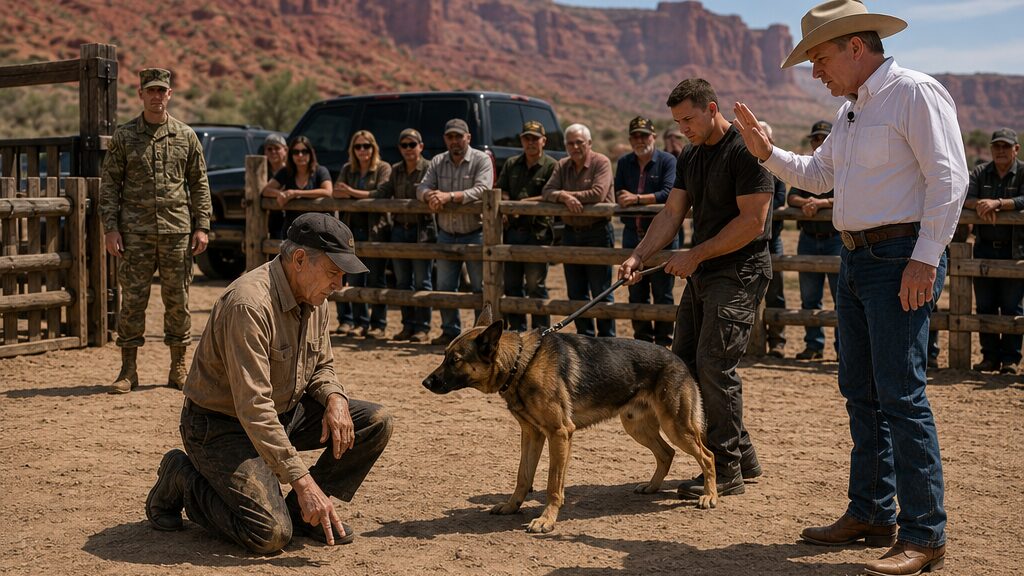
The demonstration pen spread under the late-morning sun, a wide oval of packed sand and tire marks bordered by rough wooden rails. Beyond it, red cliffs rose in tired layers. Heat slid off the hoods of three black SUVs parked near the gate. A local news camera waited under a canopy. Veterans in ball caps leaned along the fence. A donor couple stood near a folding table with bottled water and printed brochures about rehabilitation, service, and second chances.
In the middle of the pen, the dog stood rigid beside a young handler. Lean muscles under tan-and-black fur. Open mouth. Tongue low. Eyes too fixed.
William had seen that look in places with no fences.
The handler tugged once.
The dog’s mouth closed.
William moved before he gave himself permission.
He slipped between two sections of rail where a ranch hand had left a gap and stepped into the pen. Dust climbed around his shoes. His knees complained at the uneven ground, but he kept his pace slow, shoulders loose, hands where the dog could see them.
A voice cracked across the arena.
“Sir. Hey. Sir, you can’t be in there.”
William did not look at the voice. He looked at the leash line, the handler’s wrist, the dog’s narrowed stare.
“Loosen your hand,” William said.
The handler frowned as if an old fence post had offered advice.
The dog shifted its weight back.
“Loosen it now,” William said, softer.
The handler’s grip tightened instead.
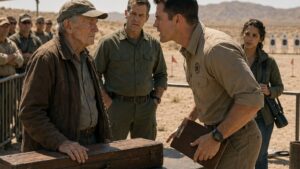
A man in a white shirt, jeans, polished boots, and a broad tan cowboy hat came through the gate with the speed of someone used to being obeyed. Jeffrey White had a microphone clipped to his collar and a smile that had not decided whether to become anger yet.
“Hold up, folks,” Jeffrey called toward the spectators. “Just a small interruption. Sir, I’m going to need you outside the working area.”
William lowered himself one careful inch at a time. His old right knee touched dirt first, then the left. Heat pressed through the cloth of his trousers.
The dog looked at him.
Good, William thought. Look here.
“Sir,” Jeffrey said, closer now. “That is a trained working dog. This is not a petting zoo.”
A few people behind the fence laughed, not loud, but enough.
William kept his eyes low. “He’s stacking pressure.”
Jeffrey stopped beside him, tall enough that his shadow cut across William’s shoulder. “My handler has him under control.”
“No,” William said. “He has the leash.”
The handler flushed. “Who is this guy?”
“Someone who wandered where he shouldn’t.” Jeffrey’s voice stayed smooth for the crowd. “Sir, I’m asking respectfully. Stand up and step behind the rail.”
William placed two fingers near the dirt, not reaching for the dog, not touching the leash. Just there, where the animal could mark the shape of his hand. The dog’s nostrils moved. His body did not soften, but the fixed stare broke for half a breath.
There you are.
The young handler jerked the leash again. “Back.”
The dog flinched.
William’s fingers curled slightly, then relaxed. An old motion moved through him, so familiar it hurt: not command yet, only invitation. His thumb tucked in. Two fingers low. Palm turned away so the dog would not read threat.
Jeffrey stepped closer. “Sir, I’m not going to repeat myself.”
William heard the people beyond the fence quieting. He heard a shutter click. He heard the high electric buzz of the microphone on Jeffrey’s shirt. He also heard the dog’s breathing, fast at the top, held too tight in the chest.
“You repeat yourself,” William said, “he’ll read you wrong.”
Jeffrey gave a short laugh, then bent slightly as if speaking to someone hard of hearing. “I don’t know what you think this is, but we’re hosting an evaluation. We have donors, county officials, and military observers arriving. You can’t kneel in the middle of my pen and lecture my staff.”
My pen.
William let that pass.
The dog shifted again, one paw sliding in dust. Its gaze moved from the handler to William and back. The handler mistook it for compliance and pulled the animal into a sit. The dog sat too fast, spine stiff, ears uneven.
William’s knee burned. He kept it there.
“Give him space,” he said.
Jeffrey’s jaw tightened. The public smile disappeared. “Get up.”
A county sheriff’s deputy at the gate took two steps in, uncertain whether this was a safety matter or an embarrassment. A teenage volunteer clutched a stack of brochures to her chest. Near the rail, George Thomas, an older man in a faded veterans cap, watched without smiling.
William saw the deputy’s hand hover near his belt and made himself smaller. He lowered his shoulders. He did not reach, did not argue, did not give the dog a reason to protect him from the wrong thing.
“I’ll stand,” William said, “when he stops holding his breath.”
Jeffrey turned to the handler. “Reset him.”
The handler tried.
The dog did not move.
For the first time, the young man looked worried. He clicked his tongue, gave the leash a short upward correction, and the dog’s body locked harder.
William felt the old cold open inside his ribs. A kennel yard at dusk. A radio too loud. A young handler saying, He’s fine, Sergeant. He’s just excited. Then the silence after everyone learned the difference too late.
Not now.
Not in a demonstration pen with brochures and water bottles and a man in a clean hat.
William breathed out slowly through his nose. The dog’s eyes found him again.
Jeffrey crouched halfway, not to meet William, but to lower his voice beneath the public noise. “Listen to me. I don’t care if you worked with farm dogs or watched videos online. This animal is part of a veteran rehabilitation program. These people are here to support it. You are making this difficult.”
At that, William looked up.
Only for a second.
Jeffrey seemed surprised by the eyes that met his. Not angry. Not confused. Just tired in a way the sun could not cause.
“Then don’t make the dog carry your schedule,” William said.
The words landed badly. Jeffrey stood straight again, color rising under his cheekbones.
“Deputy,” he called.
The dog made a small sound. Not a bark. Not a growl. A swallowed whine, almost too quiet.
William turned back at once.
The young handler heard it too late. He glanced down, then toward Jeffrey, ashamed to need permission.
William flattened his two fingers near the ground. The dog’s head lowered an inch.
“That’s it,” William whispered.
“Do not engage that dog,” Jeffrey snapped.
William did not touch. He only held the shape.
The dog’s breathing changed first. Then its shoulders loosened a fraction. The leash sagged, barely, because the handler had gone still with surprise.
Behind the fence, the donor woman lowered her sunglasses. Someone muttered, “What’s happening?”
Jeffrey heard the shift in the crowd and hated it. He stepped into William’s line of sight, boots sending dust against William’s trousers.
“Up,” he said.
William’s knees stayed in the dirt.
The word was simple enough. Up. Men had said it to dogs, recruits, prisoners, patients, old fathers in hospital rooms. William had obeyed it most of his life when the order served something larger than pride.
This time, the dog’s left ear folded again.
William stayed down.
The rumble came from beyond the outer gate. Tires over gravel. The black SUV nearest the road rolled forward, then another behind it. Dust rose in a pale curtain against the red cliffs.
Jeffrey turned sharply, rearranging his face into welcome.
“Military observer’s here,” the teenage volunteer whispered.
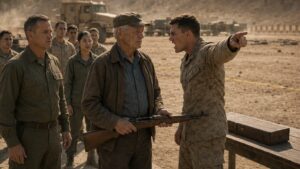
The first SUV stopped near the pen. Its rear door opened. A man in Army camouflage stepped down into the heat, cap low, boots clean but not new. He paused at the gate, taking in the scene: the dog stiff beside the handler, Jeffrey standing over an old man, the spectators silent, William’s knees pressed into dust.
William did not turn.
The dog had finally begun to breathe.
Chapter 2: The Command No One Expected to Work
Brandon Johnson knew an unsafe pen before anyone explained it to him.
He saw it in the shape of bodies. The handler’s elbow was too high. The civilian manager in the cowboy hat stood too close to the kneeling old man. The old man himself had made his body low and angled, not toward the crowd, not toward the manager, but toward the dog’s shoulder.
That gave Brandon pause.
Most civilians crouched wrong around a working dog. They reached over the head. They smiled with teeth. They talked too much, hands fluttering, fear leaking through perfume or aftershave. This old man did none of that. He had put himself where the dog could read him without feeling cornered.
“Captain Johnson,” Jeffrey White called, coming toward the gate with both hands out. “Glad you made it. We had a small issue, but we’re clearing it now.”
Brandon entered the pen and kept walking slowly. “What issue?”
“Spectator crossed the rail.”
The old man did not react to being called that.
“Is anyone hurt?” Brandon asked.
“No. But we can’t have this.” Jeffrey gestured with irritation he tried to disguise. “We’re about to start the formal evaluation.”
Brandon looked at the dog again. “Who tightened him up?”
The young handler swallowed. “Sir, he was already keyed up when we brought him out.”
“That wasn’t my question.”
The handler’s eyes flicked toward Jeffrey.
Brandon understood the chain at once: civilian event, donor money, cameras, schedule, polished commands, no room for hesitation. He had been invited as the military observer, but the demonstration already had the feel of a show designed to look like work.
The dog took one breath, then stopped it halfway.
The old man noticed before Brandon did.
“Don’t crowd the front,” the old man said.
His voice was quiet, worn at the edges. He spoke to no one and everyone. The handler shifted back an inch.
Jeffrey’s face hardened. “Sir, that’s enough.”
Brandon held up one hand. “Let him finish.”
Jeffrey blinked. “Captain, with respect—”
“With respect,” Brandon said, still watching the dog, “let him finish.”
The crowd behind the rail had gone still enough that Brandon could hear the drag of the leash clip against the dog’s collar. Heat rolled across the arena. The camera operator lifted the lens again.
The old man’s fingers rested low near the dirt. Two fingers, not a flat palm. Thumb tucked. Wrist loose. Brandon had seen variations of that before, buried in old training footage, in notes passed down by handlers who treated some commands like family recipes. Not standard anymore. Not exactly obsolete either. Just old.
The dog’s eyes moved to the fingers.
Jeffrey spoke sharply. “Bring him out of it.”
The handler tried to step the dog away.
The dog resisted.
Not aggressively. Worse. He froze with such complete obedience to fear that no ordinary correction would move him cleanly. Brandon felt the tightness spread through the pen. One mistake and the dog might spin, not out of malice, but because every path out had been closed.
The old man’s mouth barely moved.
“Easy line,” he said.
The words were not loud. They were not even words meant for the crowd. The dog heard them anyway.
Brandon did too.
A strange cold moved along the back of his neck.
Easy line.
He had read that phrase once in a photocopied handler manual from an older Army kennel program, marked with handwritten corrections from men who had worked dogs in desert heat and convoy dust. It was not a trick command. It was not a performance cue. It meant the leash was no longer a fight. It meant the handler would give the dog a path back to himself.
The old man’s two fingers dipped once.
The dog lowered its head.
A sound moved through the spectators, not applause, not quite a gasp. The dog’s front legs bent. Slowly, with dignity that seemed almost human, he sank to the dirt beside the old man, not collapsing, not surrendering, but choosing the calm offered to him.
The leash went slack.
The young handler stared. Jeffrey went motionless.
Brandon had seen obedience. He had seen fear disguised as obedience. He had seen dogs perform under lights, under gunfire, under the foolish confidence of men who thought control and trust were the same thing.
This was neither show nor accident.
The old man lifted his gaze just enough to check the dog’s eyes. “Good,” he whispered. “That’s enough.”
The dog’s tail moved once in the dust.
Brandon’s chest tightened.
He saw the old man differently then—not transformed, not magically revealed, but brought into focus. The line of his shoulders. The economy of motion. The way he had endured humiliation because standing too fast would have cost the dog the calm he was building. The dirt on his knees was not weakness. It was position.
Brandon straightened before he knew he had decided.
His right hand rose to the brim of his cap.
The salute cut the air.
No band played. No one clapped. The gesture seemed too formal and too intimate for a dusty pen with bottled water and folding chairs. It changed the weight of the silence.
The old man looked at the salute the way a person looks at a door he does not want opened.
Jeffrey’s mouth parted slightly.
“Captain?” he said.
Brandon did not answer him. His hand stayed up long enough to be understood, not long enough to become performance. Then he lowered it.
“Sir,” Brandon said to the old man, “may I ask your name?”
The old man’s fingers remained near the dog, but his eyes came to Brandon’s face.
“William Baker.”
The name struck some corner of memory, but not fully. Brandon searched for it and found only fragments: Baker, leash protocols, field kennel notes, a warning written in red beside an old report.
Jeffrey recovered badly. “Mr. Baker, if you had experience, you could have introduced yourself at the office instead of walking into an active demonstration.”
William let his hand fall to his thigh. The dog remained low beside him.
“I did stop at the office,” he said. “No one there looked up.”
The words were not bitter. That made them worse.
A few spectators shifted behind the fence. The donor man looked away. Sarah Lewis, who had been approaching from the registration tent with a folder pressed to her chest, stopped just inside the gate. She had the face of someone watching her schedule tear in half and her conscience ask to be heard.
Jeffrey’s voice lowered. “This is not the time.”
William nodded once, as if that confirmed something he had expected. “Usually isn’t.”
Brandon crouched, not beside the dog but several feet away, giving both dog and man space. “Mr. Baker, where did you learn that command?”
William looked back to the dog. “Long time ago.”
“Army?”
William did not answer.
The dog’s breathing had settled fully now. His ears were balanced. His mouth opened, tongue easing out, not in heat alone but in release.
The young handler swallowed. “I’ve never seen him do that for anyone.”
“He didn’t do it for me,” William said. “He did it because somebody finally stopped pulling.”
The handler looked down at the leash, shame flushing up his neck.
Jeffrey stepped between William and the line of spectators, trying to reclaim the event. “All right. We appreciate the assist. Captain Johnson, we can restart with the obstacle pattern in five.”
“No,” Brandon said.
Jeffrey froze. “No?”
“Not with that dog. Not yet.”
Sarah came closer. “Captain, is there a safety concern?”
“There’s a listening concern.” Brandon looked at Jeffrey, then at the handler. “And Mr. Baker seems to be the only one who heard it early.”
William shifted his weight, preparing to stand. The movement cost him. Brandon saw the stiffness in both knees and moved forward, then stopped himself from offering a hand without permission.
William noticed.
That was the first time his expression changed. Not into gratitude. Into something like wary approval.
He braced one palm against his thigh and rose slowly. Dust clung to both knees in pale ovals. The dog lifted its head but did not stand.
Behind the fence, George Thomas removed his cap and held it against his chest. No flourish. Just a private correction.
Jeffrey saw that too.
“Mr. Baker,” Sarah said carefully, “we clearly mishandled your arrival. I’m Sarah Lewis, program coordinator. I’d like to understand—”
“No need.” William brushed one knee, then stopped when the dust would not come off. “You’ve got your event.”
Brandon heard the distance in his voice. Not anger. A withdrawal practiced over years.
“Sir,” Brandon said.
William looked at him.
Brandon wanted to ask about the old command again. He wanted to ask why the name Baker had stirred memory. He wanted to ask whether this man had written those notes or learned from whoever had. But the salute still hung between them, and William’s eyes made clear that respect could become another kind of trespass.
William spoke first.
“Don’t salute me for what you don’t know.”
Then he stepped away from the dog, careful not to break the calm too suddenly, and walked toward the shadow of the equipment shed while the crowd watched without understanding what had changed.
Chapter 3: The Name Brandon Remembered Too Late
The ranch office smelled of printer toner, sun-warmed plastic, and old coffee left too long on a burner.
Brandon stood beside a metal filing cabinet while Jeffrey White paced in front of the desk, his hat in one hand, his public smile gone. Through the small office window, the demonstration pen sat bright and empty. Staff moved equipment in uncertain lines, no one sure whether they were resetting for an event or recovering from a mistake.
“We cannot have a random walk-in controlling the schedule,” Jeffrey said. “I understand he has some background. Fine. Great. I’ll thank him. But we have donors here, a county partnership, a camera crew, and a military evaluation that determines whether this program keeps expanding.”
Brandon flipped through a binder labeled K9 Rehabilitation Grant Packet. “Who said anything about expanding?”
Jeffrey stopped. “That’s why you’re here.”
“I’m here to observe handling standards.”
“And support the program if standards are met.”
“If.”
The word landed hard.
Sarah Lewis stood near the door with her folder against her ribs. She had not sat down. Since leaving the pen, she had been quieter than Jeffrey and more worried. That made Brandon trust her a little.
“Captain Johnson,” she said, “we can adjust the schedule. Give the dog a rest period, move the donor remarks earlier.”
“Do that.”
Jeffrey laughed once. “You’re letting one old man derail a full-day event.”
Brandon looked up. “No. The dog did that. Mr. Baker noticed why.”
Jeffrey pressed his lips together.
Sarah’s eyes moved to the binder. “What are you looking for?”
“Training lineage. Handler notes. Intake history.” Brandon turned another plastic sleeve. “The dog came through a military transfer channel?”
“Partially,” Sarah said. “He was retired from contract work, not direct active duty. Records were incomplete.”
“Who evaluated him on arrival?”
Jeffrey lifted a hand. “Our trainers did.”
Brandon waited.
Jeffrey added, “And a remote consultant.”
“What consultant?”
Sarah crossed to the desk and opened a laptop. “The early intake files might have that.”
Brandon turned back to the binder. Most pages were clean: vaccination reports, temperament charts, donor-facing summaries, careful language about rehabilitation outcomes. Then, near the back, he found copied training notes from an older packet, the kind that had been scanned crookedly and printed too light.
A phrase caught his eye.
EASY LINE — do not repeat under pressure; reset breath before movement.
Below it, a small diagram showed a two-finger position near a leash drop.
Brandon’s pulse slowed.
In the lower corner, the note had initials and a last name typed beneath a faded signature.
W. Baker.
He touched the page with one finger before he meant to.
Sarah saw. “What is it?”
Brandon did not answer at once. He slid the page free and held it under the desk lamp. The paper was a copy of a copy, but the structure was unmistakable: old Army kennel language, practical and blunt, written by someone who cared less about theory than keeping men and dogs alive when noise and command pressure made everyone stupid.
Jeffrey leaned over. “Is that supposed to prove something?”
“It proves Mr. Baker didn’t learn that from watching videos.”
Sarah moved closer. “That’s his name?”
“One of them.” Brandon scanned the page. “This was attached to a field training review. Older program. Pre-standardization.”
Jeffrey exhaled with frustration. “So he used to train dogs. That’s helpful, but it doesn’t give him authority to walk into my pen.”
Brandon folded the page gently. “You keep saying your pen.”
Jeffrey’s face tightened. “Because I’m responsible for what happens in it.”
“Then be responsible.”
The office went quiet.
Outside, a microphone squealed from the donor tent and cut off. A staff member apologized to the crowd. Someone laughed awkwardly.
Sarah lowered herself into the chair behind the desk and typed quickly. “William Baker,” she murmured. “Army K9. Handler training. Desert deployment.”
Jeffrey watched the door as if William might appear and embarrass him again.
Brandon’s memory began to assemble itself in pieces. The old manual at the training school. An instructor tapping a page and saying, This came from people who learned the hard way. The name Baker beside field corrections. A case study about fear response misread as refusal. A handler lost after a forced push through a search route.
“Look for incident reports,” Brandon said.
Sarah hesitated. “Are we allowed?”
“You’re evaluating a dog using his protocol without knowing whose protocol it is. Look.”
Her fingers moved again. The laptop fan hummed. After a moment, her expression changed—not dramatically, not enough for Jeffrey to notice at first, but Brandon saw her shoulders draw inward.
“There’s an archived reference,” she said. “Not full access. It lists William Baker as senior handler adviser on a convoy kennel unit. There was an after-action review attached to a loss event.”
Jeffrey’s impatience thinned. “Loss event?”
Sarah read silently for a few seconds. “A dog and a junior handler. It says recommendations were made afterward regarding pressure stacking, leash correction, and command repetition.”
Brandon closed his eyes briefly.
There it was.
The dog in the pen had not simply obeyed William. The dog had answered a man who had once written instructions in the language of regret.
“Does it say what happened?” Jeffrey asked, quieter now.
“Not here.” Sarah swallowed. “Only that Baker’s warnings were included in the review.”
Jeffrey put his hat on the desk and rubbed both hands over his face. For the first time since Brandon had arrived, he looked less like a man guarding a brand and more like a man who had stepped on something sacred without seeing it.
The change did not absolve him. It only made him human enough to disappoint more honestly.
“Where is he now?” Brandon asked.
Sarah looked through the window. “Equipment shade, I think. Near the kennel row.”
Jeffrey reached for his hat. “I’ll talk to him.”
“No,” Brandon said.
Jeffrey stopped.
“You’ll wait.”
“I run this place.”
“And you already showed him what that means.”
Jeffrey’s jaw worked, but he did not argue.
Brandon picked up the copied page, then thought better of it and set it back on the desk. He did not want to approach William carrying proof like a warrant. Recognition had already trespassed close enough.
Sarah stood. “Captain, before you go—if he is who that file suggests, the donors should know. Not in a cheap way. But it could help them understand why this program matters.”
Brandon looked at her, and she heard her own words a second too late.
“To them,” Brandon said, “or to him?”
Sarah’s face reddened.
Outside, the wind carried dust against the window in a soft, dry hiss. In the shade beyond the pen, William Baker sat alone on an overturned feed bucket, elbows on his knees, hands hanging loose. The dog was not with him, but Brandon could see the old man’s two fingers move once near his thigh, as if quieting an animal only memory could see.
On the laptop screen, Sarah opened the archived line fully.
Brandon leaned close enough to read the names listed beneath the loss event.
One belonged to the dog.
One belonged to the handler.
Both were marked under William Baker’s advisory watch.
Chapter 4: What the Dog Heard in His Voice
William found shade behind the kennel row where the desert wind could reach him without carrying too many voices.
The kennels were set back from the demonstration pen, half hidden behind a long equipment shed and stacks of plastic barriers. Chain-link doors faced a strip of hard-packed earth. Metal water bowls reflected broken pieces of sky. Somewhere inside, one dog slept through the commotion. Another paced three steps, turned, paced three steps back, toenails ticking against concrete.
William sat on an overturned feed bucket with his elbows on his knees.
The dust on his trousers had turned pale where his kneecaps had pressed into the pen. He brushed at it once, then let it be. There were stains that came off and stains that only changed color.
From beyond the shed came Jeffrey White’s voice, clipped and busy, telling someone to move the donor remarks under the canopy. A microphone squealed, then went dead. Sarah Lewis answered him in a lower tone William could not make out. The public event had bent, not broken, and everyone was trying to decide who to blame for the bend.
The dog from the pen was in the third kennel.
He had been brought back by the young handler, who moved differently now, as if every leash ring were an accusation. The dog had entered without a fight, turned once, and stood facing the door instead of drinking.
William watched him without staring.
“That was a hard room,” he said.
The dog’s ears shifted.
William did not know if the animal knew the word room. Dogs learned whole worlds that way, not by grammar but by weather. A room could be a convoy road, a kennel, a truck bed, a hospital hallway. A room was anywhere pressure collected and no one named it.
The dog lowered his head, then lifted it again.
William’s fingers moved near his thigh before he stopped them. Two fingers low. Thumb tucked. Old habit, old mercy.
“You don’t need it now,” he murmured.
The dog blinked slowly.
William felt, rather than heard, someone approach. Shoes on dirt, lighter than Jeffrey’s boots, slower than staff in a hurry. He did not turn until Sarah Lewis stopped at the edge of the shade.
“Mr. Baker?”
He looked up.
She held a folder against her chest, but not like a shield now. Her hair had loosened from the wind, and there was dust along the hem of her black slacks. A program badge hung crookedly from her lanyard.
“I’m sorry to interrupt,” she said.
“Then don’t.”
She accepted that without flinching, which made him look at her longer.
“I deserve that,” she said. “But I’m still going to ask for two minutes.”
William looked back at the kennel. “Everybody asks for two.”
Sarah stepped into the shade but kept a careful distance from him and from the dog. “We found some old training notes.”
His jaw tightened.
She saw it and lowered the folder. “Captain Johnson did. I’m not here to wave papers at you.”
“That’s good. Papers don’t know what happened.”
“No,” she said. “They don’t.”
The dog began pacing, three steps and turn, three steps and turn.
William’s eyes moved with him. “He shouldn’t work again today.”
Sarah followed his gaze. “Jeffrey thinks if we cancel the evening demonstration, the donors will walk.”
“Let them walk.”
“It funds feed, medical care, veteran placements, kennel repairs. It funds the reason some of these dogs don’t end up forgotten in back lots.”
William looked at her then, and she wished she had not made it sound so clean.
“That’s what they told you?” he asked.
“That’s what I tell myself when I ask people for money.”
It was honest enough that he did not answer quickly.
Sarah took a breath. “Mr. Baker, I need to ask something. Not for the microphone. Not for the donors. For the program.”
The dog stopped pacing.
William could feel the question before she shaped it.
“Would you speak tonight?” she asked. “Just briefly. Not about anything you don’t want to discuss. But if people understood that someone with your background believed the handling needed to change, they might listen. Jeffrey would have to listen.”
William gave a small laugh with no humor in it. “You want to borrow my knees.”
Sarah’s mouth parted, then closed.
He nodded toward the dust on his trousers. “They saw me down there. Now you want to make it useful.”
“I don’t mean it that way.”
“Most people don’t.”
Her face flushed, but she stayed still. That gave him some respect for her.
Inside the kennel, the dog sat. Not relaxed. Waiting.
William leaned forward, forearms against his thighs. “You train handlers?”
“We place veterans with dogs after transition, injury, grief, isolation. Some are former handlers. Some aren’t. Jeffrey runs the demonstration side. I manage the grant side.”
“That wasn’t my question.”
Sarah swallowed. “No. I don’t train handlers.”
“Then hear this.” William’s voice stayed low. “You don’t train a handler to dominate fear. You train him to read it before he becomes part of it. The leash is not a rope for dragging an animal into your plan. It’s a line that tells you whether you still have trust.”
The dog’s ears came forward at the sound of his voice.
Sarah looked from the dog to William. “Is that what happened today?”
“That’s what almost happened today.”
“Almost?”
William’s eyes dropped to his hands.
For a moment he was not in the kennel shade. He was beside a truck with a hot hood and sand in his teeth. A young handler was laughing too loud because men laughed when they wanted fear to pass for confidence. The dog had refused the road ahead, not because he was stubborn, not because he was poorly trained, but because he knew something under the dust did not belong there.
William had said, Wait.
Someone higher had said, Move.
The memory closed before it showed him the rest, but not before his fingers stiffened.
Sarah saw the change and softened her voice. “The record mentioned a loss event.”
William stood too fast. Pain shot through his knees, bright and private. The nearest dog barked once. The dog in the third kennel rose.
Sarah stepped back. “I’m sorry.”
“No, you’re curious.”
“I’m responsible.”
“Then be responsible for the animal in front of you.”
His words cut harder than he intended. Sarah looked toward the demonstration pen, where Jeffrey’s voice carried again, bright and reassuring for the crowd.
“I know Jeffrey is difficult,” she said. “But he built parts of this place when no one wanted to fund it. He believes the show keeps the doors open.”
“Shows teach people to clap at the wrong time.”
Sarah lowered her eyes.
William regretted that too, not because it was false, but because truth thrown carelessly could become another leash.
He turned to the kennel. The dog stood against the chain-link now, not pressing, just near.
William knelt before he thought about whether he could get back up.
The ground was warmer than before. Dust rose around his shins. He kept his hand low, two fingers near the bottom of the gate, not through the wire.
“Easy line,” he whispered.
The dog exhaled.
Sarah watched the animal’s body soften by degrees, the shoulders first, then the jaw, then the tail settling from rigid height to neutral. Nothing dramatic. No miracle. Just a creature hearing the difference between being handled and being understood.
William closed his eyes briefly.
“You hear the fear,” Sarah said.
“No.” He opened them. “He hears what I do with mine.”
The words surprised him. He had not meant to give her that much.
Sarah did not write it down. She did not reach for the folder. She only stood there with the wind moving dust around her shoes.
From the far side of the shed, Jeffrey called her name.
She turned, then looked back. “If I cancel tonight outright, the board may say I panicked. If Jeffrey runs it his way, the dog pays for our politics. Help me find another option.”
William looked at the dog. The animal’s eyes were clearer now, but the day had already taken too much from him.
“No obstacles,” William said. “No bite sleeve. No crowd noise close to the rail. No repeated commands. No correcting him for telling the truth.”
Sarah nodded with each instruction, not pretending she already knew.
“And if Jeffrey refuses?”
“Then you decide whether the program is for donors or dogs.”
Jeffrey rounded the corner before Sarah could answer. His hat was back on, his microphone clipped straight, his smile restored and brittle.
“There you are,” he said to Sarah. Then, to William, “Mr. Baker. Good news. We’re moving the main demonstration to early evening. Better light, cooler temperature, larger crowd. I’d like you nearby. After what happened, people will want context.”
William stayed kneeling.
Sarah’s voice tightened. “Jeffrey, we need to discuss the routine.”
“We will.” His eyes stayed on William. “But we’re not canceling the highlight. The dog just needed a reset. Our guests came to see capability.”
The dog in the kennel turned away from the gate and did not touch the food bowl waiting in the corner.
William saw it.
Sarah saw it too.
Jeffrey did not.
Chapter 5: The Demonstration Jeffrey Could Not Control
By early evening, Sarah Lewis had learned the difference between a crowd and pressure.
A crowd talked, shifted, fanned itself with brochures, checked phones, smiled at cameras, accepted paper cups of lemonade from the teenage volunteer. Pressure did none of that. Pressure gathered invisibly under the floodlights while the desert cooled and the arena dust turned gold. It sat in the reserved chairs where the donor couple waited with polite interest. It stood with the county sheriff’s deputy near the fence. It moved through the ranch staff as they dragged barriers into place for a routine Sarah had asked Jeffrey to simplify twice.
He had agreed both times with the same answer.
“We’ll keep it controlled.”
Then he added the bite sleeve station back.
Sarah stood near the donor table with a revised schedule in her hand, watching him cross the pen in his polished boots. He looked born under floodlights, hat brim low, microphone ready, gestures wide enough for the local camera.
“This evening,” Jeffrey said, voice carrying smoothly, “you’ll see why structured discipline gives these dogs a second purpose and gives veterans a partner they can trust.”
The crowd murmured approval.
Sarah’s eyes moved to the kennel gate.
The dog came out beside the young handler.
Something in Sarah’s stomach tightened. She did not have William’s experience, but after the afternoon she knew enough to see what she had missed before. The dog’s body was too contained. His eyes moved past the handler, past Jeffrey, past the crowd, searching the edges.
Near the equipment shed, William Baker stood in the narrow strip of shadow. He was not part of the event. He had refused a chair by the front rail, refused the bottled water she sent over, refused the suggestion that Brandon introduce him privately to the donors.
He had stayed where the dog might see him if needed and where people could forget him if they chose.
Brandon Johnson stood near the gate in uniform, still as a post. He had not saluted again. Sarah noticed that. He had spoken to William once after the kennel row conversation, and she had seen him stop at a respectful distance, cap in hand, not officer to subordinate, not young man to old man, but one handler approaching another’s ground.
Jeffrey moved the routine forward.
The dog cleared the first low obstacle. Then the second. The crowd applauded lightly. The handler relaxed too soon.
Sarah gripped the schedule.
Jeffrey’s voice warmed. “These dogs are not broken. They are disciplined, capable, and ready to serve again when guided by confident leadership.”
William’s gaze lifted at that phrase.
Confident leadership.
The dog reached the third marker and hesitated.
The handler gave the command again.
The dog’s ears split: one forward, one back.
Sarah stepped toward Jeffrey. “Skip the sleeve.”
Jeffrey covered the microphone with his palm. “Not now.”
“He’s tired.”
“He’s working.”
“He’s warning us.”
Jeffrey looked down at her, annoyed not because he had not heard, but because he had. “Sarah, the board is watching. The donors are watching. Captain Johnson is watching. If we look uncertain, the funding goes uncertain.”
“If we push him into failure, what exactly are we funding?”
His expression flickered. Then the microphone came back up.
“And now,” he said to the crowd, “we’ll demonstrate controlled engagement and release.”
Brandon’s head turned sharply.
Sarah felt heat rise in her face despite the cooling air. “Jeffrey.”
But the young handler had already moved toward the bite sleeve station.
The dog stopped.
Not froze entirely. Not yet. He planted his paws in the dirt, neck long, mouth closed. The handler repeated the command, sharper. The dog’s eyes moved to the crowd. A child near the rail leaned forward. The deputy shifted his stance.
“No,” Sarah whispered.
The handler corrected the leash.
William stepped out of the shadow.
It was such a small movement. One old man taking three steps into light. No announcement, no drama. Yet Sarah felt the arena change around him. Brandon saw him too and moved toward the gate, not entering, just ready.
Jeffrey saw William and misread the moment again.
His eyes flashed—not with cruelty, Sarah thought, but with fear that control was slipping. He turned toward the crowd with a practiced laugh.
“Looks like Mr. Baker has taken a special interest in our dog today,” Jeffrey said. “Some of you saw earlier that he has quite a history with old training methods. Perhaps after this, we’ll persuade him to share a few words about his service.”
The sentence traveled through the spectators like bait.
Heads turned toward William.
Sarah felt shame before she found words for it. Jeffrey had taken the quietest man on the property and made him an exhibit.
William stopped walking.
The dog looked at him.
Jeffrey smiled wider, sensing attention return to his hands. “But first, let’s show everyone what modern handling can do.”
Brandon opened the gate.
“Hold,” he said.
The word was not loud, but the uniform helped it carry.
Jeffrey’s jaw tightened. “Captain, we are mid-demonstration.”
“That’s why I said hold.”
The young handler looked trapped between them. The dog had not moved, but his body had gone still in the way Sarah now recognized as dangerous—not danger to others, necessarily, but danger to the trust everyone kept spending like money.
The donor woman leaned toward Sarah. “Is this part of the program?”
Sarah looked at the arena. At Jeffrey. At the dog. At William standing with dust still on his knees from the first humiliation, refusing to turn himself into a lesson for people who had not earned it.
“No,” Sarah said. “This is the part we need to learn from.”
The woman blinked.
Sarah left the donor table and walked into the open.
The floodlights made every step visible. Her throat dried. She had given presentations in county rooms, argued budgets, written appeals about service and healing. None of that had taught her how to interrupt a man with a microphone in front of donors whose checks she needed.
“Jeffrey,” she said, “stop the sleeve work.”
His smile held, but his eyes warned her. “Sarah, please return to the table.”
“No.”
The crowd quieted further.
William looked at her now, and the look was not warm. It was measuring. She accepted that. She had earned measurement, not trust.
Jeffrey lowered the microphone. “You’re making this worse.”
“I should have made it worse earlier.”
The words surprised her. They were not polished. They would not look good in a donor report. But they felt cleaner than anything she had said all day.
The young handler loosened his grip slightly, and the dog’s head moved at once toward the space it created.
William saw it. Sarah saw him see it.
“Back him out,” Brandon told the handler.
The handler tried. “Come.”
The dog did not come.
He remained in the center of the arena, eyes fixed now on nothing Sarah could see. The crowd’s silence sharpened. Even the camera operator lowered the lens halfway.
Jeffrey’s face lost color. “Give him the release.”
The handler gave it.
Nothing.
The dog stood as if the earth under him had turned to a memory and one more pull would drop him through.
Sarah heard William’s earlier words inside her: The leash is not a rope for dragging an animal into your plan.
“William,” she said quietly.
He did not move.
She corrected herself before Brandon had to.
“Mr. Baker,” she said, louder, but still not for the crowd. “Will you help him?”
Jeffrey turned on her. “You cannot put liability in the hands of—”
“Enough,” Brandon said.
It was the first hard edge Sarah had heard from him.
William’s gaze remained on the dog. His face gave away almost nothing, but Sarah saw the struggle in his hands. They wanted to move. They wanted to stay. Every part of him seemed to know what intervention would cost.
The crowd waited for a hero moment.
William did not give them one.
He turned to Sarah instead. “No microphone.”
She nodded immediately. “No microphone.”
“No announcement.”
“Yes.”
“No story.”
Her voice softened. “Your choice.”
That seemed to reach him more than any praise could have.
He walked toward the dog, slow and empty-handed.
Jeffrey stood in the dust with his microphone lowered, trapped between anger and the knowledge that everyone was now watching whether he would make the wrong thing worse. Sarah stepped beside him, not to comfort him, but to make sure he did not speak.
The dog’s eyes flickered as William entered his field of view.
William stopped several feet away.
He did not give the command.
Not yet.
He lowered himself carefully, one knee touching dirt, then the other, until he was back where the day had first mistaken him for weak.
The crowd made a small sound, quickly swallowed.
William placed two fingers near the ground.
The dog did not move.
For the first time all day, Sarah saw fear pass openly across William Baker’s face.
Then the dog’s legs locked harder, and the entire arena went silent.
Chapter 6: Permission Before the Salute
The dirt under William’s knees was cooling, but the old heat found him anyway.
It rose from places that had nothing to do with the desert ranch. From a road with no name left in him. From a dog refusing the next step while men with radios turned urgency into orders. From a young handler looking over his shoulder, waiting for William to say the thing that would save him from choosing.
Wait, William had said then.
Move, someone else had ordered.
Now the dog in the arena stood in the same impossible stillness, not the same animal, not the same war, not the same boy holding the leash. But fear had a pattern. Men changed uniforms, programs changed names, donors changed chairs. Fear still held its breath before breaking.
William kept his two fingers low.
No one behind him spoke.
Good.
He did not look at Jeffrey. He did not look at Sarah. He did not look at Brandon standing near the gate, though he felt the soldier there as one feels a post in the dark.
The young handler’s hand trembled on the leash.
“Let go of winning,” William said.
The handler’s eyes filled with confusion.
“Not the leash,” William said. “Winning.”
The young man swallowed. His grip softened by one degree.
The dog’s ear twitched.
William breathed once through his nose, long enough for the dog to see his chest settle. He did not call. He did not coax. Dogs knew when men were begging for themselves.
“Easy line,” he said.
The dog did not move.
William accepted it. The command was not magic. It had never been magic. It was only a door. The animal still had to believe there was a room beyond it.
He lowered his hand another inch.
“Easy line,” he repeated, softer.
The dog’s eyes shifted to his fingers.
There you are.
Behind William, a board in the fence creaked as someone leaned forward. Sarah whispered, “Back up,” to the spectators nearest the rail, and to her credit, they did. Brandon murmured something to the deputy, and the outer gate cleared. Quiet became organized around William instead of imposed on the dog.
That was respect. Not the raised hand. This.
The leash sagged.
The dog lowered his head, then took one step toward William.
The crowd held itself still.
The young handler started to exhale too loudly. William lifted his left hand, palm down, and the boy caught himself. Boy, William thought, though he was a man. They were always boys at the exact moment they learned force had limits.
The dog took another step.
William’s right knee pulsed with pain. He ignored it until ignoring became too close to pride, then shifted slightly, showing the dog movement without threat. The animal watched the shift and kept coming.
When the dog reached him, William did not touch his head. He turned his hand so the back of his fingers rested near the dust. The dog lowered beside him, chest first, then hips, the same way he had earlier, but slower now, choosing each inch.
The sound that moved through the crowd was relief, but William did not let it become applause.
“Quiet,” he said.
He did not say it loudly. Somehow they heard.
The dog’s body leaned against his shin.
William closed his eyes for one second.
Not long enough to disappear.
The young handler crouched, tears standing bright in his eyes, shame and gratitude mixing in a way that made him look younger than he was. “I’m sorry,” he whispered.
William opened his eyes. “To him.”
The handler looked at the dog. He lowered his head. “I’m sorry.”
The dog blinked.
William nodded once. That was enough.
Jeffrey approached with care now, his boots stopping farther away than they had that morning. He had removed the microphone from his collar. It hung dead in his hand.
“Mr. Baker,” he said.
William kept his hand near the dog. “Not yet.”
Jeffrey stopped.
That, too, was something.
Brandon entered the pen and came no closer than William’s shoulder line. “Do you want the arena cleared?”
William looked at the dog’s breathing. “No sudden movement. Let them leave in rows.”
Brandon turned and began giving quiet instructions. Sarah moved with him, her voice steady as she guided donors, staff, veterans, and camera crew away from the rail. No speech. No explanation. The event dissolved into soft footsteps and folding-chair sounds.
Jeffrey watched the crowd leave, and the loss showed on his face. Money, control, reputation—William could see each concern pass through the man’s eyes. But Jeffrey did not reach for the microphone.
After the front rows had cleared, he said, “I was wrong about the sleeve.”
William said nothing.
“I was wrong about you too.”
William looked at him then. “Those are different mistakes.”
Jeffrey absorbed that as if it had weight. “Yes.”
The dog’s tail moved once against the dirt.
Brandon returned, stopping where William could see him without turning fully away from the animal. “The pen is clear except essential staff.”
William nodded.
Sarah stood a few feet behind him. “No one is recording.”
“Somebody always is.”
“I asked them to stop.”
He glanced back. She held his look. Not proud of herself. Not asking to be praised. Just telling him what she had done.
William believed her enough to continue.
He looked at the young handler. “What did he tell you before he froze?”
The handler wiped his face with his sleeve. “He stopped.”
“That’s what he did. What did he tell you?”
The man looked at the dog, then at the slack leash. “That I was too tight.”
“Before that.”
The handler struggled.
William kept his voice even. “Left ear. Mouth closed. Weight back. Eyes off the target, then past it. He was telling you the sleeve wasn’t the problem. The path was.”
The handler stared toward the center markers. “The path?”
“Too much noise at the rail. Too much heat from the lights. Too many repeated commands. Too many people needing him to prove your point.”
Jeffrey flinched.
William looked at him. “That one’s yours.”
Jeffrey did not defend himself.
The restraint cost him; William could see that. Good. Let it cost.
Brandon’s voice was careful. “This happened before.”
William felt the old door open.
The dog beside him shifted, sensing the change in his body.
William almost closed the door again.
He had done it for years. Closed it in grocery aisles when someone asked if he had served. Closed it at Veterans Day breakfasts when men compared patches and dates. Closed it when younger handlers thanked him for manuals they had never had to bleed into. Silence had kept the dead from becoming anecdotes.
But silence had also let men like Jeffrey mistake performance for care.
William stroked the air above the dog’s shoulder without touching. “There was a road,” he said. “Dog didn’t like it. Handler listened. Command didn’t.”
The young handler stopped breathing.
William did not look at him. “I said wait. They said move. Dog was right.”
The arena seemed to dim around the floodlights.
Sarah’s hand rose to her mouth, then lowered.
Brandon removed his cap.
William’s throat tightened, but he forced the next words through because they were the only ones that mattered. “Afterward, they wanted procedures. Notes. Terms that could fit on paper. Pressure stacking. Reset breath. Easy line.” His fingers moved once near the dirt. “Those were not theories. Those were names I could still stand to say.”
No one asked whose names.
That mercy held him together.
Jeffrey looked down at the dead microphone in his hand, then slowly set it on the ground as if it had become something shameful. “I tried to turn it into a donor moment.”
“Yes,” William said.
“I thought if people knew who you were, they would support us.”
William’s eyes stayed on the dog. “If they need my wound to write a check, you’re asking the wrong people.”
Sarah took that in like instruction, not insult. “Then we change what we ask.”
William looked at her. “Change what you do first.”
Brandon stepped closer by half a pace, then stopped. His right hand began to rise, the motion old as uniform and instinct.
William saw it.
Brandon saw William see it.
The soldier lowered his hand before the salute formed. His face changed—not embarrassed, but corrected.
“May I?” Brandon asked.
The question moved through William more deeply than the morning salute had. Not because of rank. Not because of ceremony. Because it gave him the one thing orders had once taken from the moment that still woke him at night.
Choice.
William did not answer quickly.
The dog breathed against his shin. Sarah stood silent. Jeffrey waited without touching the microphone. The young handler kept the leash slack.
William looked at Brandon Johnson, at the cap held in the young soldier’s left hand, at the respect no longer trying to prove itself.
Finally, William gave one small nod.
Brandon raised his hand.
This time the salute did not open a door William feared.
It stood outside and waited.
Chapter 7: The Fence Opened Quietly After Everyone Left
By morning, the arena looked smaller.
Without chairs, cameras, donors, floodlights, and Jeffrey White’s voice filling every open space, the demonstration pen was only dirt inside a fence. The tire marks from the black SUVs still curved near the gate. A paper cup rolled once against a wooden post and stopped. Wind carried the dry smell of hay, dust, metal bowls, and the faint clean bite of kennel disinfectant.
William Baker arrived before the ranch office opened.
He had not planned to return.
He had told himself that twice while dressing in the dim motel room outside town, once while sitting on the edge of the bed with both knees aching, and once more while his hand rested on the truck key. He had no contract here. No rank. No duty roster with his name written in black ink. If people wanted to mistake a dog’s fear for a scheduling issue, he had spent a lifetime learning he could not stand in every road and stop every wrong order.
Still, he drove back.
The front gate was closed but not locked. He got out, lifted the chain, and pushed the gate open slowly so it would not shriek. The hinges complained anyway, a low metal groan across the empty ranch.
The sound reached the kennel row.
One dog barked once. Another answered. Then silence settled again.
William left the gate open behind him.
The pen held the marks of last night more faithfully than any report would. Two deep prints where his knees had pressed into the dirt. A scuffed line where the young handler had shifted backward. A crescent mark from the dog turning in place. Near the center, the ground still showed the place where the animal had frozen and where everyone else had finally stopped pretending not to see.
William stood at the rail for a while.
He did not make a ceremony of it. He did not remove his cap or bow his head. He only looked.
The young handler came from the kennel row carrying two empty bowls, saw William, and stopped.
“Morning, sir.”
William turned. The young man’s face had the raw, sleepless look of someone who had replayed the same mistake all night.
“Morning.”
The handler shifted the bowls against his hip. “He ate a little after midnight.”
William nodded. “Good.”
“Not much. But some.”
“That counts.”
The handler looked down at the bowls. “I loosened the leash before I opened the kennel this morning.”
William waited.
“And I waited until he looked at me.”
“That counts too.”
The young man’s mouth trembled with something like relief, but he held it down. “I wrote down the ear thing. And the mouth closing. And the weight shift.”
“Writing won’t help if you only read it after.”
“I know.”
Maybe he did. Maybe he was beginning to.
The handler glanced toward the office. “They’re waiting for you.”
William almost turned back to the gate.
The handler saw it and added quickly, “They said only if you came. They didn’t ask me to fetch you.”
That made William stay.
He walked past the pen toward the office, slower than the day before, because pain was less willing to be hidden in the morning. The dog from the demonstration stood in the third kennel, head lifted, eyes clearer. When William passed, the dog came to the chain-link door but did not press against it.
William stopped.
“Morning,” he said.
The dog’s tail moved once.
William held his hand low at his side. Not the command. Not the two fingers. Just presence.
The dog breathed, then turned and drank from his bowl.
William went on.
The ranch office door was open. Sarah Lewis stood inside at the desk with three folders laid out in front of her. Brandon Johnson stood by the filing cabinet in uniform trousers and a plain tan shirt, cap tucked under one arm. Jeffrey White stood near the window without his hat on.
That was the first thing William noticed.
The second was that the microphone was not on the desk anymore.
Sarah looked up. “Good morning, Mr. Baker.”
He waited for the rest: We were hoping, We thought, The donors, The board.
It did not come.
Instead, she turned one folder around so he could read the first page from where he stood. The title was plain, printed in black.
Handling Change Notes — Draft Pending Review.
William did not step closer yet.
Sarah seemed to understand. “No public statement. No donor story. No biography. These are program changes.”
Brandon added, “Nothing leaves this office with your name attached unless you approve it.”
William looked at Jeffrey.
Jeffrey took a breath. It did not come easily. “The evening routine is canceled for the next cycle. Sleeve work suspended until the dogs are reevaluated. Crowd distance doubled. No repeated command corrections during public events. Handlers can call a stop without asking me first.”
William watched him speak each sentence as if it cost him something.
Good, he thought again. Let it cost.
Sarah touched the second folder. “We’re adding a review board for demonstrations. Not donors. Handlers, veterans placed with the dogs, and outside evaluation. Captain Johnson offered to recommend names.”
“Not mine,” William said.
“No,” Brandon said. “Not yours.”
Sarah looked at him directly. “Unless you choose otherwise.”
There it was again. Choice. The word no one said but everyone in the room was learning to build around.
William stepped inside.
The office felt different without urgency. The burned coffee smell remained, but the air had cooled. On the desk beside the folders lay the old copied training note Brandon had found the day before. EASY LINE — do not repeat under pressure; reset breath before movement. The page had been placed in a clear sleeve, not framed, not displayed. Protected.
William looked at it.
Brandon said, “I put it there so it wouldn’t get handled more than necessary.”
William did not thank him. Gratitude would have been too easy and not entirely true. But he did not tell him to put it away either.
Sarah opened the third folder. “This one is a question.”
William’s eyes lifted.
“We’d like you to advise on the handling protocols. Limited. Private. Paid, if you allow that. Anonymous in donor materials unless you later decide otherwise.”
Jeffrey looked out the window when she said paid, as if he expected William to reject it and wanted not to influence the answer.
William’s hands hung at his sides. He could feel the old reflex rising—the refusal before the request finished, the retreat before anyone could make him useful in ways that cut too close to the dead.
“How often?” he asked.
Sarah’s expression changed only slightly, but hope moved through the room anyway.
“You decide what is manageable,” she said. “One morning a month. Or less. We can send notes. You can mark what you want changed.”
“No video calls.”
“No video calls.”
“No donors.”
“No donors.”
“No speeches.”
Jeffrey said, “No speeches.”
William looked at him again.
Jeffrey held the look, then lowered his eyes first. “I owe you an apology.”
William said nothing.
Jeffrey swallowed. “Yesterday morning, I saw an old man in my pen and thought about liability. Schedule. Optics. I didn’t think about why the dog had gone quiet. I didn’t think about what you might know. I didn’t even ask your name.”
The apology sat in the room, imperfect and late.
William did not pick it up for him.
Jeffrey nodded once, accepting the silence. “I’ll do better.”
“Don’t do better for me,” William said.
Jeffrey looked back up.
William pointed toward the kennel row with two fingers, not the handler gesture, just direction. “Do better there.”
Jeffrey’s face tightened. “Yes, sir.”
The sir landed differently this time. Not polished. Not public. Not for the room.
William let it stand.
Brandon moved slightly, then stopped. William noticed and almost smiled. The young officer was learning that respect had weight, and that lifting it too quickly could bruise.
Sarah slid a pen across the desk, then stopped halfway. “May I?”
William looked at the document. “What is it?”
“A line for the draft notes. Not a signature. Just approval for one phrase.” She turned the page so he could see.
At the bottom, beneath a short section about leash pressure and reset protocols, she had written:
Easy line: handler creates a path back to trust before asking for movement.
William read it twice.
It was cleaner than the old notes. Softer, maybe. But it did not lie.
He took the pen.
His fingers were stiff around it. The first mark came out uneven. He crossed out before asking for movement and wrote before asking for obedience.
Sarah read the change and nodded. “That’s better.”
“Obedience without trust is only stillness,” William said.
No one wrote that down.
He appreciated them for it.
Outside, the young handler walked the dog along the far fence with the leash slack enough to make a shallow curve. When the dog paused, the handler stopped too. He did not correct. He waited. After a moment, the dog looked back at him, and together they moved on.
William watched through the window.
George Thomas stood near the rail with a paper cup of coffee, his veterans cap low over his eyes. He had come early too, apparently, and had chosen not to come inside. When he saw William looking, he raised the cup slightly.
Not a salute.
A morning acknowledgment from one old man to another.
William raised two fingers from the pen in answer.
Sarah closed the folder gently. “We’ll make the first changes today.”
“Changes are easy on paper.”
“That’s why we’re starting in the kennel.”
William looked at her then, and something in his face eased—not trust fully, but the door where trust might eventually pass.
He signed no contract that morning. He gave no speech. He allowed Sarah to copy his corrected phrase into the working draft without his name attached. He allowed Brandon to ask one question about the old field note and answered with three sentences, no more. He allowed Jeffrey to stand beside him at the kennel row while the young handler practiced doing nothing too quickly.
That was harder than leaving would have been.
Near noon, when the sun climbed high and the ranch sounds settled into ordinary rhythm, William walked back toward the front gate. His knees hurt. Dust had gathered again on his shoes. The dog watched him from the shade of the kennel, calm enough now to lie with his head between his paws.
Brandon followed at a distance that had become natural.
At the gate, William stopped with one hand on the weathered wood.
“Captain.”
Brandon straightened. “Sir?”
William looked at the open road beyond the ranch, pale and wavering in the heat. “Don’t let them make yesterday the story.”
Brandon understood enough not to answer quickly. “What should the story be?”
William pushed the gate wider instead of closing it.
“The dog ate this morning,” he said.
Then he stepped through.
Behind him, no one clapped. No camera lifted. No microphone carried his name over the dust.
The gate remained open, just wide enough for the next person who needed to enter quietly and be seen before being used.
The story has ended.