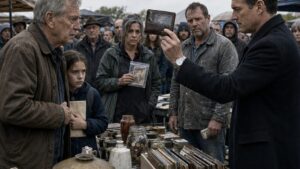
They Laughed When the Old Veteran Checked the Snow Before He Took the Knife
Chapter 1: The Old Cloth on the Snowy Tailgate
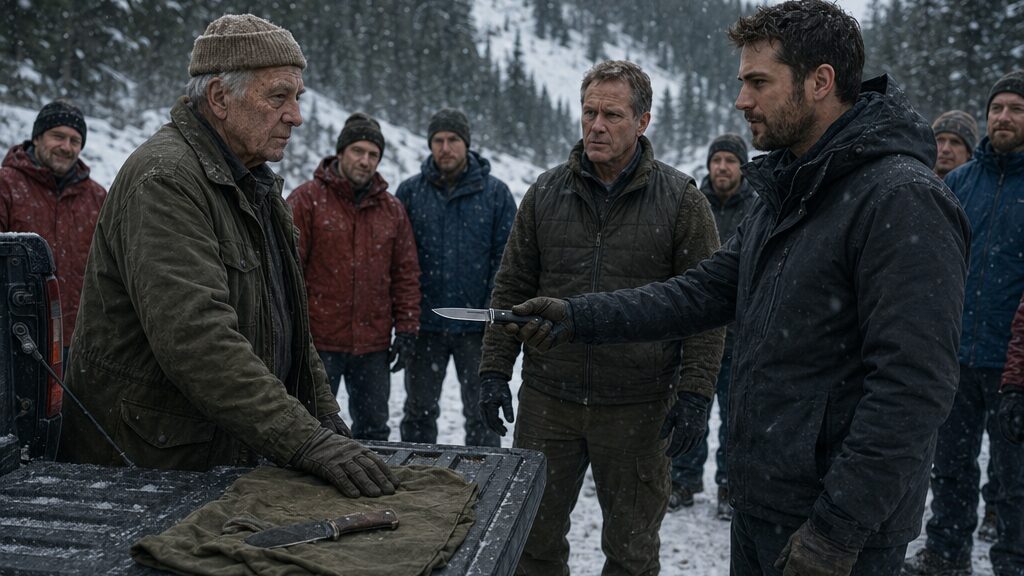
The knife was already on the tailgate when Samuel Thompson noticed the snow had changed.
Not the snowfall. That still came down light and dry, slanting past the dark pines in thin white threads. The change was lower, almost hidden, where the wind had shaved the top crust from the open clearing and pushed it in a pale lip toward the creek trail.
Samuel stood beside the pickup with one gloved hand resting on the dropped tailgate, his breath coming short in the cold. The truck bed smelled of rubber mats, old rope, and pine pitch. Someone had laid out new gear in straight rows: bright-handled fire starters, packaged cord, a folded emergency blanket still in plastic, two polished blades with clean sheaths.
His own cloth looked out of place among them.
It was square, faded olive, patched twice at one corner and darkened in places where oil had never fully washed out. He spread it with two careful pulls, smoothing it over the metal tailgate before setting down his old field knife. The blade was not pretty. The handle had been worn smooth by years of use, and a shallow nick sat near the spine where no display knife would have been allowed to keep its flaw.
Behind him, someone chuckled.
Samuel did not look up.
“Is that Army issue?” one of the men asked.
“Maybe museum issue,” another said.
A few boots shifted in the snow. The younger men had gathered in a loose half circle around the pickup, all waterproof jackets and clipped radios and new gloves with the palms still clean. One wore a red jacket bright enough to warn aircraft. Another stood in a blue parka with his arms folded. They watched Samuel’s hands more than they watched the weather.
That told him enough.
Daniel White came up from the lodge steps, smiling the way men smiled when they were managing a room that had no walls. He wore a quilted vest over a fleece jacket and carried a clipboard tucked under one arm.
“Gentlemen,” Daniel called, “before we break for the first field segment, I want to introduce someone special. Samuel Thompson served in the Army, spent years training men in difficult conditions, and he was kind enough to join us this weekend.”
Kind enough.
Samuel kept his eyes on the cloth. He had not come for an introduction. He had come because Daniel had written three times, each message more polished than the last, saying the retreat wanted to honor older veterans by including them in practical outdoor training. His daughter Lisa had read the last email at his kitchen table with her mouth pressed flat.
“You don’t owe them a display,” she had said.
“I know.”
“And you don’t need to prove anything.”
“I know that too.”
But she had still placed his wool cap beside his gloves before leaving, because Lisa never believed in stopping him with words if she could not stop him with love.
Now Daniel was saying something about experience and respect while the men in expensive jackets looked over Samuel’s old knife and cloth as if respect were part of the opening schedule.
Samuel’s left knee stiffened. The cold always found the old injury before it found the rest of him. He shifted his weight slowly, not enough to show pain unless someone was looking for it. None of them were. They were looking for shakiness, confusion, the first small sign that the old man belonged inside by the lodge stove instead of out here beside the blades.
Daniel stepped closer and lowered his voice. “You doing all right, Samuel?”
Samuel nodded once.
“We’ll keep it light today. Just introductions, gear familiarity, maybe a few stories if you feel up to it.”
Stories.
Samuel looked toward the creek trail again. The path dropped out of the clearing between two black spruce stands, then curved where the ground fell away beyond sight. The snow above that bend had a duller surface than the rest, packed by wind, not by weight. A young instructor would see white ground and call it passable. A tired man who had watched snow carry sound in the wrong direction might call it something else.
“Wind shifted an hour ago,” Samuel said.
Daniel blinked, then followed his gaze without understanding what he was supposed to see. “Forecast says we’re clear until tomorrow evening.”
“Forecast doesn’t walk the slope.”
The red-jacketed man heard that and grinned toward the others.
Daniel’s smile tightened. “We’ve got Justin watching route safety. He’s excellent.”
At the mention of his name, Justin Clark turned from the gear table near the truck cab. He was broad-shouldered, young enough to still trust the strength in his legs, and careful with his beard in a way that made him look rugged from a distance. He had the polished confidence of someone used to being filmed while doing hard things.
“Everything’s flagged,” Justin said. “We ran the creek trail this morning.”
Samuel nodded, not because he agreed, but because he had heard him.
Justin’s eyes dropped to the old cloth. “You brought your own setup.”
Samuel folded back one edge of the cloth so melted snow would run off the tailgate instead of pooling under the handle.
“Habit,” he said.
The man in the blue parka leaned closer. “What’s the cloth for?”
“Keeping things where I put them.”
Another soft laugh.
Samuel let it pass. Men laughed when they needed to put distance between themselves and what they did not understand. He had learned that before most of these men were born.
Daniel clapped his gloved hands once. “All right. We’ll do a quick blade safety overview before dinner. Justin, you want to lead us off?”
Justin reached for one of the newer knives on the tailgate. It had a broad polished blade and a handle shaped for grip, the kind sold with clean photographs of campfires and split wood. He held it up so the men could see the shine.
“Modern field blades are safer than people think,” Justin said. “As long as you respect the edge and don’t use them like pry bars.”
His glance flicked toward Samuel’s old knife at the last part, not cruel exactly, but easy. Easy was often worse. Cruel men knew what they were doing. Easy men thought the harm was harmless.
Samuel looked past Justin’s shoulder. The wind had lifted loose snow from the upper bank and feathered it through the trees. The creek trail disappeared and reappeared in pale strips. Something about that pattern pressed against an old place in his mind.
A ridge. A white valley. A young voice insisting the shortcut was fine.
He closed his fingers around the edge of the cloth until the memory thinned.
“Mr. Thompson,” Justin said, louder now, bringing Samuel back to the tailgate. “You mind if I ask what you taught back then?”
Samuel could have answered plainly. Cold-weather movement. Field discipline. How to keep men alive when maps went soft and fear started sounding like confidence.
Instead he said, “Enough to know cold doesn’t care what you believe.”
The blue parka man smiled at the ground. The red jacket man coughed into his glove. Daniel looked quickly between them, then gave a light laugh to soften the moment.
“Samuel has a dry sense of humor,” Daniel said.
Samuel did not correct him.
He adjusted the old field knife so the blade lay parallel to the tailgate seam. His hand moved slowly, and he knew they saw the slowness but not the reason. A man with younger hands could snatch, flip, impress. Samuel’s hands had learned not to waste motion. They had learned that a dropped blade disappeared fast in snow. They had learned that blood looked black in moonlight and too bright in daylight.
Justin picked up the polished knife and rotated it once, showing its edge to the group.
“Now,” Justin said, “since we have a real old-school man with us, maybe we should see how they taught it back then.”
Daniel made a small sound that might have been caution, but he did not stop him.
The men shifted closer.
Samuel could feel their attention settle on his shoulders, his cap, his fingers, the bend in his knee. The clearing seemed to narrow around the tailgate. Snow ticked against the metal truck bed. Somewhere down the slope, beyond the spruce, the creek moved under ice with a muted, hollow murmur.
Justin held the knife out handle-first.
“Careful, sir,” he said, smiling just enough for the others. “It’s sharper than it looks.”
Samuel looked at the knife, then at the snow beyond Justin’s boots.
The lip at the trail had grown another inch.
He took one breath, slow and white in the air, and did not reach for the handle yet.
Chapter 2: The Knife They Thought Would Shame Him
Samuel had seen men hand over tools as invitations, tests, insults, apologies, and traps.
Justin’s knife was not a trap. That would have required more thought than the young man had put into it. It was a performance, held out in front of the watching men with the handle angled slightly low, as if Samuel might not know to take it without cutting himself.
Samuel let the silence remain for one second longer than comfort allowed.
The smile on Justin’s face thinned.
“You want me to set it down?” Justin asked.
“No.”
Samuel removed his right glove first, tucking it beneath the edge of the old cloth so the wind would not take it. His fingers felt the cold at once, sharp in the joints, a familiar punishment. He flexed them once. Not for show. To make certain they would close when asked.
He took the knife.
The polished handle was colder than it should have been. New material, poor warmth. Good grip pattern, though too aggressive near the heel. It would chew a wet palm if held too long. Samuel turned the blade flat across the cloth and did not look at the men watching him.
He looked at the edge.
A good edge told the truth of its day. Not all of it. Enough.
Near the forward belly of the blade, a faint cloudy streak had dried and frozen in a curve. Pine resin. Not much. Near the handle, tucked into the groove where a hurried wipe had missed, sat a line of gray grit. Creek grit was different from road grit. Finer. Darker. It carried itself like silt even when frozen.
Samuel placed the knife on the cloth. Meltwater gathered beneath it and ran toward the tailgate seam.
Justin shifted his stance. “Well?”
Samuel lifted his eyes toward the spruce gap.
“You used this above the creek this morning.”
The clearing went still for half a breath.
Justin’s brows lowered. “What?”
Samuel touched the air above the blade, not the blade itself. “Resin on the edge. Grit by the handle. You cut something green near water and wiped it fast.”
The man in the red jacket stopped smiling.
Justin glanced at Daniel, then back at the blade. “We cleared a branch off the trail. That’s not exactly magic.”
“No.”
“Then what’s the concern?”
Samuel looked down at Justin’s boots. Snow had packed hard around the tread, wet at the bottom and dry on top. He had walked through lower creek snow, then crossed wind-scoured open ground. Recent.
“You cleared it from the upper bend,” Samuel said. “Where the trail narrows.”
Justin gave a short laugh. “The trail’s fine.”
“It was fine this morning.”
Daniel stepped in, voice smooth. “Samuel, we appreciate the eye for detail. That’s exactly the kind of experience we’re glad to have with us.”
Glad to have. Like a framed photograph.
Samuel looked at him. “The wind’s loading that side now.”
Justin turned enough to glance toward the trees, then back. “We checked it.”
“When?”
“Before lunch.”
“It changed.”
The blue parka man spoke from behind Justin. “Snow changes every five minutes up here. That doesn’t mean we cancel the weekend.”
Samuel did not answer him. He picked up his glove and pulled it back on carefully, working each stiff finger into place. The simple act took too long. He could feel the younger men notice.
Justin’s voice softened into a kind of patience that was worse than mockery. “Mr. Thompson, I promise we’re not taking anyone into avalanche terrain. It’s a creek trail. We use it every season.”
“Every season isn’t this hour.”
The words came out quieter than Samuel intended. The wind carried them poorly. Half the men probably missed them.
Daniel checked the faces around him and smiled again, gathering control. “Let’s not turn a knife demo into a weather debate. Justin has the route handled. Samuel, maybe you can show them your grip method?”
There it was. Bring the old man back to harmless ground. Let him show a grip, maybe a stance, maybe something that looked good without challenging the plan.
Samuel placed Justin’s knife down across the cloth and drew his own old blade from its sheath.
It made no dramatic sound. The steel came free with a soft scrape. The blade was shorter, darker, and uglier than Justin’s. It had been sharpened many times by hands that cared more about work than symmetry.
He held it low, edge away from everyone.
“The grip changes with the work,” he said.
Justin folded his arms. “Of course.”
Samuel ignored the tone. He set the point against a thin dead branch Daniel had left on the tailgate for demonstration. With two small motions, he shaved a curl of wood, then another, each thin enough to catch a spark. His hand never rose high. His elbow stayed close. The knife did not flash.
The red-jacketed man muttered, “That’s it?”
Samuel gathered the curls and placed them under the shelter of his palm so the snow would not wet them.
“That’s enough,” he said.
Justin gave a light chuckle, relief returning now that the moment had become small again. “All right. Feather sticks. Classic.”
“Dry core,” Samuel said. “Wind cover. Edge control. Hands where you can keep them.”
“Good fundamentals.”
“Fundamentals keep people alive after clever fails.”
The smile left Justin’s face.
Daniel stepped between them with his clipboard like a man closing a gate. “Excellent. Really excellent. We’ll cover fire craft tomorrow after the route walk.”
Tomorrow.
Samuel looked toward the creek trail again. A thin plume of loose snow lifted and vanished between the trees.
“Move the route,” he said.
The words were plain. No anger. No plea.
Daniel’s eyes flicked to the watching men. “We’ve got guests expecting the overlook loop.”
“Move it.”
Justin exhaled through his nose. “The overlook loop is the point of the weekend. People came to learn confidence in winter conditions, not stand around being afraid of shadows.”
Samuel felt something old and tired move in his chest. Not anger. Anger was hot. This was colder.
He had once heard nearly the same sentence from a young sergeant with red cheeks and perfect confidence. Different words, same shape. We’re not scared of a little snow. We can make the ridge before dark. You worry too much, Thompson.
By morning, the ridge had been gone. Not disappeared, exactly. Snow did not erase land. It erased the way back to it.
Samuel blinked once and the clearing returned.
Justin was still looking at him, waiting for the old man to retreat or argue.
Samuel slid his knife back into its sheath. He folded the cloth’s lower corner over the wood shavings and pressed it flat.
“I said what I saw.”
“That’s all?” Justin asked.
“That’s all I can make you hear.”
The men went quiet then, not out of respect, but because the sentence was heavier than anyone wanted it to be.
Daniel cleared his throat. “We’ll revisit route conditions in the morning. For now, dinner’s in forty minutes. Let’s get everyone warmed up.”
The circle loosened. Men turned toward the lodge, boots crunching, voices rising too quickly as they shook off the discomfort. Justin stayed a moment longer, then picked up his polished knife from the cloth and wiped it harder than necessary before sliding it into its sheath.
Samuel noticed he did not check the groove near the handle.
The cold had reached through Samuel’s glove into the old bones of his hand. He folded his field cloth slowly, corner to corner, then again. The wood shavings stayed inside, dry for now. His breath stung on the way out.
From the trees below the clearing came a low crack.
Not loud. Not close.
But it carried through the ground more than through the air.
Samuel turned his head.
Justin, already walking toward the lodge, glanced back and lifted one hand as if to wave the sound away.
“Ice settling,” he called.
Samuel kept looking at the spruce gap long after the others had stopped.
Chapter 3: The Route Marked Safe by Younger Men
Timothy Allen watched Samuel Thompson fold the old cloth as if the corners mattered more than the men around him.
Most people folded things to put them away. Samuel folded like he was preserving an order nobody else could see. First the bottom edge over the shavings, then the side with the patch, then a pause to let a bead of melted snow run off instead of soaking inward. His gloved thumb pressed along the crease. Exact. Patient. Not shaky.
Timothy stood just inside the lodge doorway with a paper cup of coffee cooling in both hands. He had gone in with the others when Daniel called dinner, but he had not sat down. Through the window, he could see Samuel still at the truck under the gray afternoon light, alone now except for the wind.
“Guy’s intense,” said the man in the red jacket, passing behind him.
Timothy gave a noncommittal sound.
“Probably gets invited to these things all the time,” the man added. “Makes people feel respectful.”
Timothy looked down into his coffee. The surface trembled from his grip. He tightened his hands until it stopped.
Inside, the lodge was all varnished logs, mounted snowshoes, and electric heat humming under the windows. Dinner was set out on long tables: chili, bread, salad nobody touched first. Men stood in clusters, laughing too loudly after the cold. Daniel moved from group to group with the satisfied urgency of a host counting successful moments.
At the far end of the room, Justin had spread a laminated map across a table. Two men leaned over it while he traced tomorrow’s route with one finger.
“We start here,” Justin said. “Creek trail to the lower bend, then up through the spruce cut. Overlook by ten if everyone moves well. Back before lunch.”
“Is that the place the old man was worried about?” the blue parka man asked.
Justin’s mouth pulled sideways. “He saw some wind on the snow.”
The men laughed, not sharply. That made it easier to join and harder to resist.
Timothy did not laugh.
He had come to the retreat because Daniel’s advertisement had promised veterans a weekend of winter confidence, practical skills, and brotherhood without judgment. Timothy had not believed the last part, but he had paid the fee anyway. Since leaving the service, he had been waiting for someone to tell him where to put his hands, where to stand, when to move, what kind of man to be when nobody was issuing orders anymore.
Justin looked like he knew. That was part of the appeal.
Samuel looked like he remembered the cost of knowing.
The lodge door opened behind Timothy, letting in a blade of cold air. Samuel stepped inside slowly, carrying his folded cloth beneath one arm and his sheathed knife in the other hand. No one stopped talking, but several heads turned just enough to register him.
Daniel crossed the room. “There he is. Warm up, Samuel. I saved you a seat near the stove.”
“Doorway’s fine.”
“Nonsense. You’ll freeze there.”
Samuel did not move toward the stove. He looked past Daniel to the window, where dusk had begun to gather blue in the trees.
“Wind’s still turning,” he said.
Daniel’s smile remained, but his eyes tightened. “We’ll check conditions before we head out.”
Justin rolled the map and slipped a rubber band around it. “Already checked.”
Samuel glanced at the map tube. “You marked the upper bend.”
“It’s part of the loop.”
“It should not be.”
The room did not go silent. Not exactly. It thinned. Voices lowered. Spoons slowed against bowls.
Daniel put one hand lightly on Samuel’s shoulder. Timothy saw Samuel’s eyes drop to that hand, then lift again without comment.
“Let’s eat first,” Daniel said. “No decisions need to be made in a doorway.”
Samuel stepped away from the hand. Not much. Enough.
Timothy felt it like a small crack in ice.
He wanted to ask Samuel what he had seen. The question rose halfway, then stopped behind his teeth. He imagined Justin hearing it. He imagined the red-jacketed man smirking. He imagined being the youngest veteran in the room and the first to sound afraid.
So he drank cold coffee instead.
After dinner, Daniel gathered everyone by the stone fireplace for the evening briefing. Snow tapped at the windows, light enough to be cozy if a man trusted glass.
“Tomorrow is our signature field segment,” Daniel said. “The overlook loop gives us a little navigation, a little terrain reading, and a safe taste of winter movement. Justin will lead. I’ll bring up the rear. Samuel will join at his own pace for the first leg and offer perspective where useful.”
Where useful.
Timothy looked at Samuel. The old man sat near the side wall, not by the stove, with his cloth folded on his lap. He had eaten little. His cap rested on the bench beside him, revealing thin white hair flattened by wool. Under the lodge light, he looked smaller than he had outside.
Justin stepped up with the laminated map and pinned it to the board by the fireplace. A red line marked the loop from the lodge, down the creek trail, past the upper bend, then toward the overlook. He tapped the creek crossing with a knuckle.
“This is the only narrow point,” Justin said. “Single file. No stopping on the slope. We keep spacing, we keep pace, we stay aware.”
Samuel’s gaze did not leave the map.
Daniel noticed. “Samuel?”
For one hopeful second, Timothy thought the older man would stand, cross the room, and put his finger on whatever everyone else was missing.
Samuel only said, “The safe route is not the one that looks cleanest.”
Justin looked over. “Meaning?”
“Meaning fresh snow can hide yesterday’s mistake.”
The words settled strangely in the room.
Daniel gave a short nod, as if translating them into something less troublesome. “Good reminder. Visibility can be deceptive. Justin will factor that in.”
Justin tapped the map again, just above the creek. “We’re still using the loop.”
Samuel looked down at the cloth in his lap. His thumb found the patched corner and rubbed once across the seam.
Timothy leaned forward. His mouth opened.
Ask him.
Ask him now.
But the blue parka man said, “What time do we gear up?” and the room moved on with visible relief.
“Seven-thirty,” Justin said. “Boots on. Packs ready. Nobody wanders off trail.”
Timothy closed his mouth.
Later, when the briefing ended and men drifted toward their rooms, Timothy stepped outside to throw away his coffee. The cold hit him hard and clean. Across the clearing, Samuel stood by the pickup again, facing the creek trail. The old cloth was no longer in his hands. It lay folded on the tailgate beside the old knife.
Timothy walked halfway toward him, boots crunching.
Samuel did not turn, but he spoke as if he had heard him from the doorway.
“You got a question?”
Timothy stopped.
The honest answer was yes. He had several. What did the crack mean? Why did the snow above the creek look wrong? How did a man learn to read a knife like a page? Why had Samuel’s face changed when Justin said the trail was fine?
Instead he looked back at the lodge window. Justin stood inside by the map, laughing at something Daniel had said.
“No, sir,” Timothy answered.
Samuel nodded once, still facing the trees.
The old man’s silence should have made Timothy feel dismissed. It did not. It made him feel seen, and that was worse.
The next morning’s route map remained pinned by the fireplace when Timothy went back in. The red line was bright under the lodge lights, clean and confident, cutting straight through the creek crossing Samuel had warned against.
Chapter 4: The Creek Trail Under Fresh Snow
By morning, the world had been wiped clean.
Snow lay over the clearing in a smooth white sheet, softening tire tracks, covering yesterday’s boot prints, making every old mistake look harmless. The pickup sat near the lodge with frost along its windows and a ridge of snow on the tailgate. Men moved around it in pairs, tightening pack straps, stamping feet, laughing into the cold because the morning was too sharp to enter quietly.
Samuel stood apart from them near the spruce edge, adjusting the strap on his old pack. The cold had settled in his knee during the night and stayed there. Every bend carried a private warning. He had wrapped the joint before dawn with slow hands, sitting on the edge of the lodge bed while the building creaked in the wind.
Lisa had called before he left his room.
“You sound tired,” she said.
“I woke up.”
“That isn’t the same as resting.”
He had looked at the field cloth folded beside his pack. “No.”
“Dad.”
“I’ll stay on the first leg.”
“You promise?”
Samuel had not answered quickly enough.
Now the men were gathering, and Justin stood at the head of the group with the laminated map tucked into his chest pocket. Daniel moved among the attendees, checking that everyone had gloves, water, and a radio clipped where it could be seen. The whole scene had the clean look of preparation. New packs. Bright straps. Breath hanging in white puffs.
Samuel looked beyond it all to the trail.
The upper snow was too smooth.
Justin caught him looking and came over with poles in one hand. “Morning, Mr. Thompson.”
“Morning.”
“We’ll take it slow for the first stretch. Daniel said you’re joining us to the lower junction.”
“If the trail allows.”
Justin smiled as if Samuel had made a joke only he was polite enough to acknowledge. “Trail’s not in charge. We are.”
Samuel looked at him then.
Justin’s smile faltered, but only slightly.
Timothy stood a few steps behind them, checking the strap on one snow gaiter. He watched the exchange without lifting his head. Samuel saw the watching. He saw the hesitation that went with it. The younger veteran had the look of a man who wanted someone else to speak first so he would not have to learn what his own voice sounded like.
Daniel clapped twice. “All right, everyone. Creek trail to the lower bend, then we’ll assess spacing before the spruce cut. Stay within sight. No wandering.”
The men started forward.
The first part of the trail ran easy through the trees, packed by yesterday’s movement and lightly covered with fresh snow. Justin led with confidence, planting his poles in rhythm. Daniel stayed near the rear, talking quietly to the man in the red jacket. Samuel walked in the back third of the line, letting the younger men set their pace and refusing to chase it.
His lungs warmed slowly. His knee warmed slower. He let his steps shorten until pain became information instead of argument.
Timothy drifted back near him after the first quarter mile.
“You okay, sir?”
Samuel glanced at him. “I’m moving.”
“That wasn’t the question.”
“No,” Samuel said. “It wasn’t.”
Timothy flushed under his cap and looked ahead.
They walked in silence for a while. Snow fell from branches when the wind touched them. A crow called once and then not again. The creek could be heard before it was seen, a hollow sound under ice, moving where the surface pretended stillness.
When the trail began to narrow, Samuel stopped.
Not abruptly. He simply stopped placing one foot in front of the other.
The line stretched ahead. Timothy stopped with him.
Justin turned from twenty yards up. “Everything all right?”
Samuel looked at the left bank. A narrow roll of snow had formed above the trail, smooth along the top and undercut near the spruce roots. Wind had pressed loose snow against older crust. It was not large enough to bury a valley. It did not need to be. A man stepping wrong could break through, slide, twist, vanish behind trees while others argued about where he had gone.
“Move the line downslope,” Samuel said.
Justin came back several steps. “We’re already on the marked trail.”
“The marked trail is under the loaded edge.”
Justin looked at the bank, then at the group. “It’s a drift.”
“Drifts fall too.”
The man in the blue parka muttered, “Here we go.”
Samuel heard him. He kept his eyes on Justin.
“This is exactly why we keep spacing,” Justin said. “Nobody bunches up, nobody steps off, nobody has a problem.”
Samuel crouched slowly, feeling his knee object, and brushed snow from the side of the trail. Beneath the fresh layer, yesterday’s boot track had collapsed at the outer rim. Not much. Enough. He pointed without touching.
“See the crescent?”
Justin bent halfway, impatient. “That’s from freeze-thaw.”
“No thaw last night.”
The red-jacketed man shifted. Daniel arrived, breathing harder than he wanted to show. “What have we got?”
“Samuel’s concerned about the bank,” Justin said.
“I am concerned about the men under it,” Samuel corrected.
A brief silence followed.
Daniel looked at the slope, then at the group waiting in the cold. The lodge was out of sight behind them now. The overlook loop had become real enough that turning back would no longer look like caution. It would look like failure.
“We can adjust spacing,” Daniel said.
Samuel took the folded field cloth from the side pocket of his pack.
Justin frowned. “What are you doing?”
“Marking the safe return side.”
He opened the cloth. The patched corner had stiffened in the cold. With his old knife, he cut a narrow strip from one edge, cleanly, without hurry. The sound of fabric tearing after the cut was small but distinct. The men watched. Yesterday they had watched his hands to see if they would fail. Now they watched because he had cut into something that seemed to matter to him.
Samuel tied the strip low around a spruce branch on the downslope side, where it could be seen from knee height but would not catch much wind.
Justin’s face tightened. “We have flagging tape.”
“Bright tape blows. Cloth freezes where you put it.”
“You always do things the hard way?”
Samuel pulled the knot firm. “No. Just the way that works when easy quits.”
Timothy looked at the strip against the snow. Olive cloth, almost dull until the white around it made it visible. He remembered the blade on the tailgate. The grit. The creek. Samuel’s quiet line from yesterday.
You used this above the creek this morning.
“How many more markers?” Timothy asked.
Justin glanced at him sharply.
Samuel stood, slower than he wanted. “As many as the trail asks for.”
The line moved again, but the rhythm changed. Men looked at the bank now, even if they pretended not to. Justin’s steps grew harder, his poles punching deeper. Daniel made bright comments about practical field awareness, trying to fold Samuel’s warning into the planned lesson as if it had always belonged there.
The trail bent toward the creek crossing.
Here the trees opened, and the wind moved differently. It came down the channel in a long, steady push, carrying powder across the surface in thin snakes. Samuel stopped twice more to look, once at a broken twig half-buried in snow, once at a shallow depression where yesterday’s trail vanished under drift.
He did not explain every pause.
Timothy wanted him to.
The creek crossing itself was a narrow place where packed snow led over a low wooden footbridge. Ice had formed along the railings, and the creek moved black in the gaps below. Justin crossed first, then signaled the others one at a time. It was safe enough if treated with respect. That phrase had saved men before. Safe enough. If treated with respect.
Samuel crossed last.
Halfway over, wind came hard across the bridge and caught his balance. His hand went to the railing. Pain flashed up from his knee into his hip.
Timothy stepped toward him.
Samuel raised one hand.
Not yet.
He finished the crossing without help, but when he reached the other side, his breath had shortened. Timothy saw it. Justin saw it too.
“We can have you wait here with Daniel,” Justin said.
Samuel looked beyond him. The trail ahead climbed toward the spruce cut, clean and bright in fresh snow.
“I’ll go to the next bend.”
Justin’s jaw worked. “That wasn’t the plan.”
“No.”
Daniel came across after the others. “Samuel, no shame in turning back.”
Samuel almost smiled.
Shame was not the problem. Men who had never carried it always thought they could identify it from a distance.
He cut another strip from the cloth and tied it low on the far side of the bridge.
“Return looks different in fog,” he said.
“There’s no fog,” Justin answered.
Samuel looked down the creek channel where white air had begun to gather in the trees.
“Not yet.”
They moved on.
By the time the group reached the spruce cut, the world behind them had blurred. The lodge was gone. The truck was gone. Even the line of their own prints had softened under windblown snow. Timothy turned once and saw the last olive strip on the branch, small but certain against the white.
Ahead, Justin called for everyone to keep moving.
Timothy looked toward Samuel, but the old man was staring into the low fog now sliding over the creek.
For the first time all morning, Timothy could not tell which way they had come.
Chapter 5: The Man Missing Beyond the White Trees
They noticed Timothy was missing only after Justin counted the wrong number twice.
At first, the mistake seemed ordinary. Men shifted packs, stepped around one another, answered for someone standing behind them. Fog had thickened along the creek basin, turning every parka into a softened shape. The group had stopped near the trail junction where the spruce cut rose toward the overlook, and Justin was trying to move them forward before the pause became doubt.
“Nine,” he said, pointing with his pole. “Ten. Wait.”
Daniel looked up from his radio. “What?”
Justin counted again, slower. His lips moved. His eyes landed on the empty space between the man in the blue parka and the red jacket.
“Where’s Timothy?”
No one answered quickly enough.
Samuel had been standing near the rear, one hand braced against a spruce trunk while his knee burned under the wrapped cloth beneath his pants. He had known something was wrong before Justin said the name. Not known, exactly. Felt the pattern break. Timothy had been close enough to hear his breathing for most of the trail. Then the wind had risen at the bridge. Then Justin had pushed the pace.
Now the line had a missing sound.
“Last visual?” Samuel asked.
Justin turned. “Everyone stay where you are.”
“Last visual,” Samuel repeated.
The blue parka man looked back down the trail. “He was behind me after the bridge.”
The red jacket man shook his head. “No, he stopped by one of those cloth things.”
Justin’s eyes snapped toward Samuel, as if the cloth had created the disappearance.
Daniel lifted his radio. “Timothy, check in.”
Static answered.
“Timothy Allen, radio check.”
More static. Then a faint click that might have been a glove brushing a button or nothing at all.
Daniel looked at Justin. “Could be a dead battery.”
“They were checked this morning,” Justin said.
Samuel looked at the snow under their boots. Tracks crossed and overlapped where the group had paused, but the approach trail showed enough. Timothy’s prints were shallower at the heel than most, slight outward turn on the right foot. He had been favoring that side since the lodge steps, probably a blister or old strain. Samuel followed the marks back with his eyes until fog swallowed them.
“He went back,” Samuel said.
Justin frowned. “Why would he go back?”
“Because he saw something.”
“You don’t know that.”
Samuel did not answer. He moved past him, slow but direct, toward the last visible set of Timothy’s prints.
Justin stepped in front of him. “Nobody goes anywhere until we establish a plan.”
“Then establish one that starts where he left the line.”
“My plan is to backtrack the trail fast with two men, then sweep from the bridge.”
“No.”
The word landed hard.
Justin stared. “Excuse me?”
Samuel’s face did not change. “No fast sweep under that bank.”
“We don’t have time to crawl around.”
“Speed that breaks the search makes more people missing.”
Daniel came close, voice low. “Samuel, let Justin handle initial response. He has protocols.”
Samuel looked at him. For a moment, the fog behind Daniel became another fog in another cold place, and the men around him were younger, louder, full of the cruel confidence of being alive at sunrise.
There had been a young soldier then. Not Timothy. Another face. Another name Samuel had not said aloud in years. The soldier had laughed when Samuel marked a return path with torn cloth from a damaged sleeve. Laughed and called it old man sewing, even though Samuel had not been old then. Not yet.
By evening, the ridge vanished in blowing snow.
By morning, they found one glove.
Samuel closed his hand against the spruce bark until the memory passed enough for him to speak.
“Your protocols are fine,” he said. “Your route is wrong.”
Justin’s cheeks flushed. “You’ve been waiting to say that since yesterday.”
Samuel looked at the younger man, and for the first time, he let the anger show only in stillness.
“I have been waiting not to need to.”
No one spoke.
Daniel’s radio hissed. He tried again. “Timothy, answer if you can hear me.”
A broken sound came through, too brief to be words.
The red jacket man swore under his breath.
Justin pointed down the trail. “I’m taking two back to the bridge.”
“He isn’t at the bridge,” Samuel said.
“You don’t know that.”
“He stopped at the cloth marker beyond it. He saw the return trail disappear. If he stepped toward the wrong sound, the wind would push him toward the creek hollow.”
Justin shook his head. “That hollow is off-route.”
“That is why he would be there.”
Daniel looked from Justin to Samuel. The organizer’s smooth control had begun to crack. “We should call the county.”
“Do it,” Samuel said. “Tell them one missing, cold exposure risk, creek basin fog, possible slope hazard.”
Justin drew himself up. “We’re not escalating to county for a man who wandered fifty yards.”
Samuel stepped closer. It cost him; the knee nearly buckled, but he held the line.
“Say that again after he stops shivering.”
Justin’s mouth closed.
Daniel lifted the radio and called the lodge, voice too fast. The lodge nurse answered first, then someone else was told to contact the county deputy. The group stayed clustered near the junction, all their modern gear suddenly looking insufficient against the white trees.
Samuel turned back.
“We need the truck tailgate,” he said.
Justin stared. “The truck? He’s out here.”
“The map is at the truck. The cloth is marked. Your memory is already defending itself.”
That struck. Justin looked away.
The walk back was slower than panic wanted. Samuel refused the direct line under the loaded bank, forcing them to follow the safer downslope side, finding each strip of cloth like a dull green word in a white sentence. Twice Justin started ahead and twice stopped when Samuel said his name, not loudly, but with enough command that even Daniel obeyed.
At the clearing, the pickup looked absurdly peaceful.
Samuel dropped the tailgate. His hands were clumsy now from cold. He hated that. He hated needing two tries to unfasten the strap on his pack while the young men watched again. Not laughing this time, but watching.
He spread what remained of the field cloth across the tailgate. It was smaller now, one edge ragged where he had cut strips for markers. He placed Justin’s laminated map on top, but weighted the corners with his old knife, a coil of cord, a stone, and Daniel’s radio.
“Show me where you cut the branch yesterday,” he said.
Justin hesitated.
“Show me.”
Justin leaned in and pointed near the upper bend.
Samuel moved his finger a few inches lower. “No. Resin was fresh and wet. You cut in shade. That branch was near water, not the open bend.”
Justin’s brow tightened. He looked again. “Maybe here.”
“That puts him near the hollow if he followed your boot track back and lost the bridge line in fog.”
The man in the blue parka said quietly, “Why would he leave the main trail?”
Samuel looked at the cloth, at the frayed edge, at the map trembling under the wind.
“Because he was trying to decide whether to trust what he’d been told or what he’d begun to see.”
No one answered.
The county deputy arrived in a utility vehicle fifteen minutes later, tires grinding over frozen snow. The deputy stepped out, listened to Daniel’s rushed explanation, then looked toward Justin.
“Who knows the terrain best?”
Justin opened his mouth.
Daniel looked at the map.
The men around the tailgate shifted their feet.
Samuel waited, one gloved finger still holding the creek hollow against the cloth.
Nobody answered.
Chapter 6: The Search Line That Followed the Cloth
Justin had never hated a silence more.
The county deputy stood beside the pickup, waiting for an answer that should have been simple. Daniel had organized the retreat. Justin had set the route. Justin had walked the creek trail at dawn and cleared the branch and told every man there to trust his lead.
Who knows the terrain best?
The old man’s finger remained on the map.
Not pressing. Not claiming. Just resting there, on the place Justin had dismissed all weekend.
Justin felt everyone looking at him and knew, with a flush of shame that made his ears burn, that he still wanted to say himself. Not because it was true. Because the shape of the day required it. Because he had built the whole weekend around being the man who knew.
Then Samuel coughed once into his glove.
It was a rough, contained sound, and it broke something in Justin’s pride. The old man looked exhausted. Not theatrical, not triumphant. His shoulders had sunk under his coat. His face had gone pale around the mouth. The hand on the map trembled slightly from cold or pain, but the finger did not move.
Justin looked at the deputy.
“He does,” Justin said.
The words came out smaller than he expected.
Daniel lowered his eyes.
The county deputy turned to Samuel at once. “Tell me.”
Samuel did not waste time. “No straight sweep. No one under the upper bank. Two lines. One follows the marked cloth back to the bridge and stops. Second line angles low toward the creek hollow. Spacing wide enough that one break doesn’t take two men. Radios checked every three minutes. Nobody crosses moving water unless I say.”
Justin almost objected to the last part. He stopped himself.
The deputy nodded. “Can you walk it?”
Samuel looked toward the spruce gap. For half a second, Justin saw the answer before Samuel gave it. The old man wanted to say yes because his mind was already out there, tracing snow and sound and fear. But his knee had stiffened badly on the return. His breath had not settled.
“I can go to the bridge,” Samuel said. “Not fast.”
“I can carry the radio beside him,” Justin said.
Samuel looked at him.
Justin held the look. “If that’s all right.”
Samuel gave one small nod. Not forgiveness. Not approval. Permission to be useful.
The search formed with less confidence than the morning hike. Men who had laughed now listened while Samuel cut the remaining damaged edge of his field cloth into narrow strips. He handed some to Justin, some to the deputy, and kept two in his own coat pocket.
“These go low,” Samuel said. “Not at eye level. Eye level vanishes in blowing snow.”
The man in the red jacket took one strip between his gloves, careful now as if the cloth had become something fragile.
They moved out under a sky that had turned the color of tin.
Justin walked beside Samuel, forcing his stride shorter. Every few steps, the old man looked not ahead but sideways: at branch tips, at snow lips, at depressions where wind had filled a print but not erased its edge. Justin tried to see what he saw and mostly saw only snow.
At the first cloth marker beyond the bridge, Samuel stopped and lowered himself with difficulty.
Justin reached out. “Here.”
Samuel accepted the steadying hand only after his own had found the branch.
The acceptance startled Justin more than refusal would have.
Samuel brushed snow from the base of the marker. “Timothy stopped here.”
Justin crouched beside him. “How can you tell?”
“Two prints facing the marker. One facing back toward the bridge. One angled out.”
Justin saw nothing at first. Then, slowly, the pattern separated from the mess: shallow ovals softened by wind, one turned toward the trees.
“He was thinking about going back,” Justin said.
“He was thinking about asking.”
The words hit Justin low in the chest.
Samuel rose with Justin’s help and pointed downslope, away from the upper bank. “He heard water or voices from there. Fog bends sound.”
The radio cracked. The deputy’s voice came through from the lower search line. “No contact at bridge.”
Samuel took the radio from Justin. “Do not move under the bank. Angle low. Look for cut spruce.”
“Copy.”
Justin stared toward the creek hollow. “Cut spruce?”
“Your branch.”
“My branch was on the main trail.”
“No.”
Justin swallowed. “You’re sure.”
Samuel did not answer. He began walking.
They found the cut branch twenty yards lower than Justin remembered, half buried near a bend where the creek widened under ice. The cut was clean and pale, sap frozen along the wound. Justin recognized it at once and felt the cold move differently inside him.
He had cut it. He had wiped the blade. He had told Samuel it meant nothing.
Samuel looked at the branch, then at the snow around it. “He came this way.”
“How?”
“Your morning track made a false trail. Then fog covered the difference.”
Justin saw it now: old boot marks compressed beneath fresh powder, drifting away from the main trail just enough to invite a man who doubted himself.
A faint call came over the radio from the red-jacketed man. “We’ve got disturbed snow near the hollow.”
Samuel lifted the radio. “Stop there. Do not enter.”
Justin was already looking toward the sound.
Samuel caught his sleeve.
It was not a strong grip. It stopped him anyway.
“Slow saves,” Samuel said.
Justin nodded, breathing hard. “Slow saves.”
They advanced in a line, cloth strips appearing behind them one by one, tied low where Samuel pointed. The search no longer felt like a rescue exercise or a retreat emergency. It felt like following a sentence written by someone who had known the ending before the others learned to read.
At the hollow, the snow dipped toward a cluster of fallen wood above the creek. Wind moved through it in a steady moan. The deputy waited with one hand raised, keeping two men back.
“Tracks go down,” the deputy said.
Samuel stood very still.
Justin watched his face and saw no triumph there. Only concentration, and beneath that, something like dread held on a short leash.
“Timothy!” Justin called.
The wind took the name and tore it thin.
No answer.
Samuel lifted one hand.
Everyone went quiet.
For several seconds, there was only creek water under ice, branch creak, breath.
Then Samuel turned his head slightly.
“Stop walking,” he said.
Justin froze with one boot half-set in the snow.
Samuel’s eyes narrowed toward the hollow.
Under the wind came a faint metal tap.
Once.
Then again.
Chapter 7: The Sound Under the Frozen Creek Wind
Samuel did not move toward the sound.
That was the hardest part.
The metal tap came from below the lip of the hollow, small and patient, too thin to be made by the creek and too regular to be a branch. Once. A pause. Twice. Then nothing while the wind dragged snow over the fallen wood.
Justin took one step.
Samuel’s hand came up.
“Wait.”
“He’s down there,” Justin said.
“Yes.”
“Then we go.”
“No.”
The word did not rise. It did not need to. The hollow below them sloped toward a tangle of dead spruce and ice-glazed roots. Snow had loaded above it in a soft overhang. One careless boot, one man rushing heavy with fear, and the whole bank could slough down over whoever was already trapped.
The deputy crouched near Samuel, eyes fixed on the hollow. “What do you need?”
“Two men on the high side, tied off. One low, no weight under the lip. Nobody steps past that bent spruce.”
Justin looked at the tree Samuel had indicated. Its trunk leaned outward, half-buried, a black curve under white crust.
“That’s not enough cover,” Justin said.
“It is not cover. It is the last place I trust.”
The tapping came again, weaker.
The sound reached through Samuel’s chest and opened an old door.
Snow moving under moonlight. A radio fading. A young man somewhere below a ridge, tapping metal against stone because his voice had frozen into breath. Samuel had been younger then, strong enough to climb fast, angry enough to believe strength could negotiate with winter. He had gone too close. The slope had shifted. Another man had pulled him back by the belt, cursing. By the time they reached the hollow, the tapping had stopped.
Samuel blinked and saw Justin watching him.
Not challenging now.
Waiting.
Samuel took a slow breath. “Your knife sheath. Does Timothy have it?”
Justin’s face tightened. “He borrowed it before we started. Said his clip was loose.”
“Metal snap?”
“Yes.”
Samuel nodded. “That’s him.”
Justin looked toward the hollow, and something in his face broke under the weight of recognition. Not fear alone. Responsibility.
“Tell me what to do,” he said.
Samuel handed him the radio. “You will go no farther than the bent spruce. Belly low if the snow softens. Speak before you move. If I say stop, you stop before you finish thinking.”
Justin nodded once.
The deputy tied a rope around Justin’s waist and passed the line back through two men braced behind a trunk. The red-jacketed man took the rope with both hands, no jokes left in him. The blue parka man stood beside him, jaw tight, eyes down.
Samuel took the last broad piece of field cloth from inside his coat. Wind snapped one torn edge. He looked at it only a moment before handing it to Justin.
“If his hands are wet, wrap first. Do not pull by the fingers.”
Justin took the cloth carefully, as if receiving something heavier than fabric.
“What about you?” the deputy asked Samuel.
Samuel looked at the hollow. “I listen.”
Justin lowered himself to the snow and moved forward on his elbows, slow as ordered. Every few feet he stopped and spoke.
“Snow firm.”
“Root under left hand.”
“Dropping two inches.”
Samuel watched the surface around him, not Justin’s face. Men in panic watched faces. Men who wanted people alive watched snow.
“Stop,” Samuel said.
Justin froze.
A shallow crack had appeared near his right knee, no longer than a finger.
“Weight left. Slide, don’t push.”
Justin obeyed.
The crack did not widen.
The tapping sounded again, clearer now. Three uneven strikes.
Justin lifted his head. “Timothy!”
A pause.
A voice answered, thin and raw. “Here.”
The sound changed the entire hollow. Men breathed too loudly. Someone behind Samuel muttered a prayer without meaning to. Daniel, standing useless near a tree, pressed one hand over his mouth.
Samuel shut all of it out.
“Ask him what’s trapped,” he said.
Justin called down, “Timothy, what’s holding you?”
The answer came broken. “Leg… under deadfall. Foot wet.”
Samuel closed his eyes briefly.
Wet foot. Cold hollow. Time narrowing.
“Any blood?” Justin called.
“Don’t know.”
“Can you feel your toes?”
A delay.
“Some.”
Samuel looked at the deputy. “Lodge nurse ready at the bridge. Warm packs, dry blanket, no walking him out.”
The deputy relayed the order.
Justin edged farther, reaching the bent spruce. He peered over the lip. “I see him.”
“Do not climb down yet,” Samuel said.
“He’s right there.”
“Do not climb down yet.”
Justin’s shoulders rose and fell. Then he stopped.
Samuel shifted his weight and pain flashed white through his knee. He gripped the nearest tree. For a foolish second, he wanted to go down himself, not because it was best, but because some old part of him still believed responsibility belonged to the body that carried the memory.
His knee trembled.
He hated it.
Then Timothy coughed from below, and hatred became useless.
“Justin,” Samuel said. “You are going to do the work.”
Justin looked back.
Samuel pointed with two fingers. “Not straight down. To your left. There is a root shelf. Test it with the pole. If it holds, sit, slide one leg, keep your chest uphill. The deputy keeps you on rope. You free the upper branches first. Not the heavy one. If you move the heavy one first, it pins him harder.”
Justin swallowed. “How do you know?”
“Because he is still tapping.”
Justin stared.
“If the main weight had crushed the leg, he would not be using both hands. The branches scared him more than they trapped him. Clear what scares him last.”
The deputy nodded slowly. “Do it.”
Justin moved.
No one laughed now at the old method, the slow method, the careful method. Each motion traveled through the line of men like a command none of them wanted to break. Justin tested the root shelf and slid down as Samuel directed. The rope tightened. Snow shifted but held.
Timothy’s face appeared between dead branches, gray with cold, eyes too wide under his cap. One glove was gone. His bare fingers clutched Justin’s sheath, tapping weakly against frozen wood.
Justin reached him. “I’ve got you.”
Timothy tried to laugh, but it came out as a shiver. “Mr. Thompson said… cloth low.”
Justin looked up once.
Samuel did not let his face change.
“Wrap his hand,” he called.
Justin wrapped Timothy’s bare fingers in the old field cloth, winding the torn olive fabric around skin that looked waxy and wrong. Timothy made a small sound but did not pull away.
“Good,” Samuel said. “Now clear the light branches.”
The work took time. Too much time for the men watching, not too much for the snow. Justin obeyed every instruction. He stopped when Samuel said stop. He shifted when Samuel told him to shift. He cut one branch with his polished knife, and this time before cutting, he checked where the blade would go if the wood snapped.
Samuel saw that.
He said nothing.
When Timothy’s leg came free, the deputy and the rope team hauled both younger men upward in slow increments. Justin pushed from below until Timothy reached the lip, then the red-jacketed man and the blue parka man caught him under the arms and slid him clear. Timothy’s boot was soaked. His pant leg was torn. His lips had gone bluish, but his eyes moved and found Samuel.
The lodge nurse arrived breathless with the deputy’s second group, carrying a pack of warming supplies. She knelt beside Timothy and began issuing calm orders. Dry layer. Heat packs. Check pulse. Keep him talking.
Timothy’s wrapped hands trembled inside the torn field cloth.
Samuel stood where he had stood through the rescue, one hand on the spruce trunk, the other closed around nothing. The hard part had passed, and only now did his body begin to collect its debts. His knee shook. His breath shortened. The hollow tilted slightly.
Justin climbed back over the lip, snow plastered to his jacket. He stood in front of Samuel, face open and stripped of performance.
“I almost ran straight down,” he said.
“Yes.”
“I would’ve dropped the bank.”
“Maybe.”
Justin flinched at the mercy of that answer. Maybe was worse than certainty. It left room for the life he might have cost.
Daniel came up behind him, pale and quiet. “Samuel, I—”
Samuel raised one hand, not harshly. He had no strength left for Daniel’s apology, and no use for it yet.
The lodge nurse looked over. “Mr. Thompson, sit down before I have two patients.”
“I’m standing.”
“Not well.”
Justin moved before Samuel could refuse, offering his arm without grabbing him. Samuel looked at the arm, then at the hollow, then at Timothy lying wrapped in emergency blankets while the old cloth covered his hands.
He placed his weight on Justin’s forearm.
It did not feel like surrender.
It felt like choosing what mattered.
Together, slowly, they moved him to a fallen log. Samuel sat, jaw tight, until the dizziness passed. Justin stayed near but did not fuss.
Timothy turned his head toward him from the blankets.
“Sir,” he whispered.
Samuel leaned forward slightly.
Timothy’s teeth chattered around the words. “You were right… before anybody else was scared.”
Samuel looked at the torn cloth around Timothy’s hands.
“No,” he said quietly. “I was scared first.”
Chapter 8: The Knife Laid Down Without Laughter
On Sunday morning, the clearing looked almost the same as it had on Friday.
The pickup stood with its tailgate down. Snow lay clean over the ground. Pines held white along their branches. The creek trail opened between the trees, quiet now, as if nothing had happened below the bend except weather doing what weather did.
But the men stood differently.
That was what Lisa noticed first when she stepped out of Daniel’s utility vehicle and pulled her coat tight against the cold. Not the truck, not the knives, not her father sitting on the tailgate with one boot on the snowy ground and one knee held stiff. She noticed the space around him.
No one crowded. No one smirked. No one watched his hands as if waiting for them to fail.
They waited because he had not spoken yet.
Lisa stopped beside the vehicle.
Samuel saw her and lifted two fingers from where his hand rested on the tailgate. It was not enough of a wave to satisfy a daughter who had driven through early snow after a phone call from a lodge nurse, but it was enough to tell her he was himself.
She walked to him anyway.
“You promised first leg,” she said.
“I misjudged the length.”
Her mouth tightened. “That’s your apology?”
“No. That’s my confession.”
She looked at his face, at the gray tiredness around his eyes, then at the blanket folded near him and the cup of coffee he had barely touched.
“You scared me,” she said.
Samuel nodded. “I know.”
No argument. That frightened her more than the rest.
On the tailgate beside him lay the old field cloth, washed in a lodge sink and dried overnight near the stove. It was smaller now, edges uneven where strips had been cut away, one corner darkened by creek water and another stained with pine resin. The lodge nurse had stitched the longest tear with black thread. Not neatly, but firmly.
Justin stood a few feet away holding the polished field knife.
He did not flip it or display it. He held it low, edge down, as if he had finally learned that a blade was not a sentence by itself. It mattered who held it, why, and what he noticed before using it.
Timothy sat in a camp chair near the truck, wrapped in a heavy coat with one boot unlaced and his injured foot elevated on a crate. The old cloth was no longer around his hands, but he kept looking at it on the tailgate as if part of him had stayed folded inside.
Daniel hovered near the lodge steps, quieter than he had been all weekend. The clipboard was gone. Without it, his hands looked uncertain.
The county deputy had left before dawn after taking statements. The lodge nurse remained inside, checking supplies and pretending not to watch from the window.
Samuel touched the mended field cloth with two fingers.
“Your stitch is crooked,” he said to Lisa.
Lisa blinked. “I didn’t stitch it.”
He glanced toward the lodge window.
Lisa followed his look and saw the nurse turn away quickly.
“It will hold,” Lisa said.
“That matters more.”
The men gathered closer only after Samuel shifted the cloth into place. It was the same motion from Friday: smoothing the surface over the metal, pressing the corners flat, keeping the edges from catching wind. But the act no longer seemed old-fashioned or fussy. It made a place where attention could settle.
Justin stepped forward. “Mr. Thompson.”
Samuel looked up.
Justin placed the polished knife gently on the cloth, not in Samuel’s hand, not as a challenge, but across the fabric with the handle turned toward him and the edge away from everyone.
“I wiped it,” Justin said. “But I didn’t check it.”
Samuel studied him.
Justin’s ears reddened in the cold. “Would you show us how?”
The question moved through the clearing more quietly than any apology could have. The red-jacketed man lowered his eyes. The blue parka man shifted his boots and looked toward the creek trail. Daniel took a breath and let it out without turning it into a speech.
Samuel looked at the knife on the cloth.
Then at Timothy.
“Can you see from there?”
Timothy straightened as much as the blankets allowed. “Yes, sir.”
“Don’t call me sir when you’re wrapped like a burrito.”
A small laugh broke from someone, brief and relieved. Even Lisa smiled before she could stop herself.
Samuel picked up the knife. His fingers were stiff this morning, and everyone could see it. The difference was that no one mistook stiffness for ignorance.
He turned the blade once, slowly.
“First,” he said, “you decide whether you need the knife at all.”
Justin looked down.
Samuel continued. “Most bad cuts start before the blade moves. Man wants to look useful. Wants to move fast. Wants to be seen knowing what he’s doing.”
The clearing stayed quiet.
He angled the blade toward the pale light. “Then you check what the tool already did. Edge. Handle. Groove. Anything left behind.”
“Resin,” Timothy said.
Samuel glanced at him. “Sometimes.”
“Grit,” Justin added.
“Sometimes.”
“Creek mud,” said the red-jacketed man, almost under his breath.
Samuel nodded once.
He laid the knife back on the cloth.
“Then you check yourself.”
Justin frowned slightly. “Yourself?”
“Cold hands. Tired legs. Pride. Fear. Audience.” Samuel looked at the men around the truck. “All of them change the way a tool behaves.”
No one wrote it down. That made Samuel glad. Some lessons died when men tried to own them too quickly.
Daniel stepped forward, removing his gloves. “Samuel, I need to say something.”
Samuel waited.
Daniel looked at the group first, then at him. “I invited you here because I thought having an older veteran present would mean something to people. I told myself that was respect.” He swallowed. “But I didn’t ask what you knew. I asked what your presence could do for the weekend.”
The wind moved across the clearing. Snow dust slid from the truck roof and fell in a soft line.
Samuel looked at Daniel’s bare hands reddening in the cold.
“Now you know the difference,” he said.
Daniel nodded, pain and relief crossing his face together. “Yes.”
Samuel did not forgive him aloud. He did not need to. Daniel had not asked for a performance, and Samuel would not give him one.
Lisa stood beside the tailgate, arms folded against the cold. She watched the men watching her father and tried to fit the sight against the version of him she carried daily: the man who forgot to eat lunch, who hid bills under a sugar jar, who winced when standing from a kitchen chair, who insisted the porch step was fine though it had nearly taken him down twice.
Both versions were true. That was the part she had fought. She had wanted one truth because one truth was easier to protect.
Samuel turned toward her. “You’re quiet.”
“I’m learning.”
His eyes softened, barely. “Dangerous habit.”
Timothy pushed himself more upright in the chair. “Mr. Thompson?”
Samuel looked over.
“When I’m not wrapped like a burrito,” Timothy said, voice still rough but steadier than the night before, “could I learn that marker method?”
Justin looked at Timothy, then at Samuel, and this time there was no jealousy in it.
Samuel picked up the field cloth. For a moment Lisa thought he was going to fold it away and end the morning there. Instead, he held it out toward Timothy.
Timothy stared. “Sir, I can’t—”
“You can carry it to the truck cab.”
“It’s already at the truck.”
“The cab is farther than your excuses.”
Timothy smiled, small and embarrassed. He reached for the cloth with both hands. His fingers were clumsy from cold and swelling, so Samuel did not let go until he was sure Timothy had it.
The fabric hung between them, patched, cut, mended, reduced, still holding.
Justin picked up the knife from the tailgate and sheathed it without flourish. Then he stepped back, leaving the space open.
Timothy stood with help from the red-jacketed man, balanced on one good foot, and tucked the old cloth against his chest. He moved slowly toward the passenger side of the pickup. Nobody hurried him. Nobody made a joke about the limp or the blanket or the careful way he breathed through the pain.
Samuel watched him go.
Lisa touched her father’s sleeve. “You’re letting him keep it?”
“No.”
“Then what?”
Samuel’s mouth moved toward a smile and did not quite arrive.
“I’m letting him bring it back.”
Timothy reached the cab and placed the cloth on the seat as if setting down something breakable. Then he looked over his shoulder, waiting.
Samuel pushed himself upright from the tailgate. His knee resisted, and for once he did not hide the effort completely. Justin took one step, then stopped short of touching him.
Samuel saw it and gave a small nod.
Justin offered his arm.
Samuel took it.
Together they crossed the snow toward the cab, not as rescuer and rescued, not as old proof and young apology, but as two men moving carefully over ground that deserved to be read.
Behind them, the creek trail remained quiet beneath fresh snow.
The story has ended.