They Treated the Old Man in Blue Like Maintenance, Until the Hallway Remembered His Name
Chapter 1: The Old Man Beneath the Stopped Clock
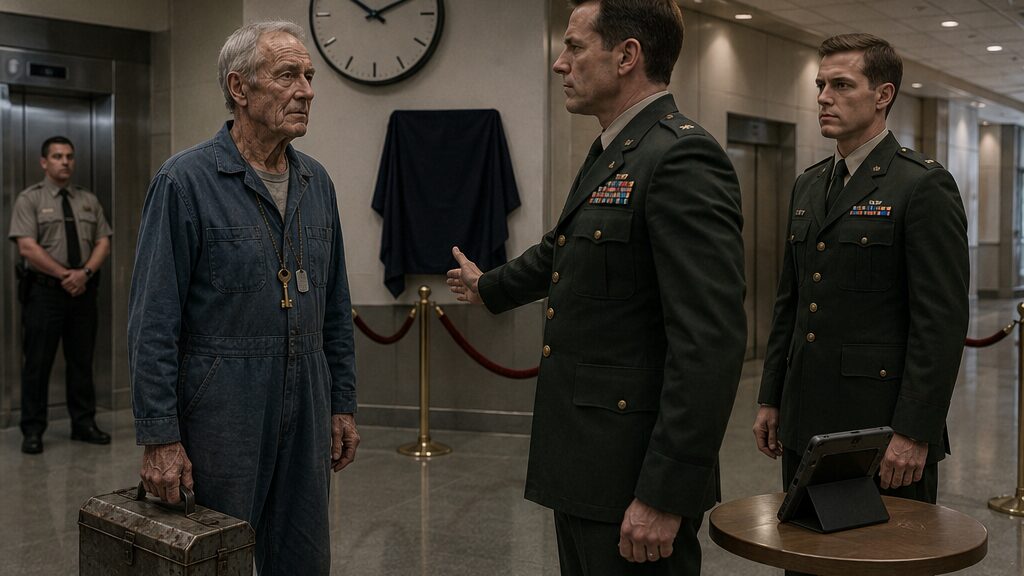
The clock above the Harris Recovery Corridor had stopped at 2:17, and Frank Harris knew before anyone told him that the day was already going wrong.
He stood beneath it in a faded blue work jumpsuit with a dented metal toolbox in one hand and an old brass key resting against his chest on the same chain as a worn dog tag. The corridor smelled of floor polish and fresh paint. Folding chairs waited in precise rows beyond a velvet rope. A covered plaque hung on the wall under a dark blue cloth, its corners taped down to keep curious hands away until the ceremony.
Frank looked up at the clock.
The minute hand trembled slightly, caught between numbers. It had done that before. Not this clock, maybe. Not this building in its current coat of paint. But time had a way of catching in the same places.
He shifted the toolbox to his other hand and walked toward the small round table positioned near the entrance. A stack of guest badges lay there beside a tablet, two pens, and a printed schedule with red blocks of time marked so tightly it looked less like a ceremony than a deployment plan.
A decorated officer sat behind the table with one polished shoe crossed over the other. The man wore his uniform like armor. Ribbons, badges, sharp creases, a nameplate bright enough to catch the overhead lights. Another officer stood behind him, younger, shoulders squared, eyes moving between the tablet and the hallway.
Frank slowed.
The seated officer did not look up at first. “Deliveries go around back.”
Frank stopped on the near side of the table. “I am not making a delivery.”
The officer lifted his eyes then, but only halfway, as if Frank did not require the whole of his attention. His gaze moved over the blue jumpsuit, the frayed cuff at Frank’s wrist, the toolbox, the scuffed shoes.
“Maintenance is checked in through the loading entrance,” he said. “This corridor is closed until after the ceremony.”
“The clock stopped.”
“We know.”
Frank looked past him, toward the high wall where the old face of the clock held the room in its quiet mistake. “It needs to run before the cloth comes off.”
The younger officer’s eyes followed Frank’s. The seated one did not turn.
“Sir,” the younger officer said carefully, “facilities did mention—”
“I have the list, Major.” The seated officer tapped the tablet without looking down. “No one enters this hallway without clearance.”
Frank set the toolbox softly on the floor, not because it was heavy but because he had learned long ago that lowering a thing gently could keep a room from hearing the shake in your hand.
The officer glanced at the toolbox as though it might leak dirt onto the polished floor. “Name?”
“Frank Harris.”
The officer’s brows moved, not quite interest, not quite annoyance. He looked down at the tablet and ran a finger along the screen.
Frank watched his face. Not because he expected recognition. Recognition had never been the point of coming here. He had come because the clock had been repaired badly three times, because the new staff did not know the old winding mechanism, because someone had covered the plaque before checking whether time itself was ready to stand straight for the families.
And because he had promised himself the corridor would never be left unattended on a day when people waited in it.
The officer tapped the screen again. “No Frank Harris under vendors.”
“I am not a vendor.”
“Contractor?”
“No.”
“Guest?”
Frank’s eyes moved to the covered plaque. Under the cloth, the metal corners hid their own reflection.
“I was invited,” he said.
The officer gave a short breath that was not quite a laugh. “You were invited to repair a clock?”
Frank did not answer at once. He heard the hum of the lights above him. Far down the hallway, a custodian pulled a rolling bin behind a set of doors and disappeared. A receptionist spoke softly into a phone. Somewhere beyond the corridor, folding chairs scraped the floor.
“I came because it should not be stopped,” Frank said.
The younger officer looked at him again, longer this time.
The seated officer leaned back. His nameplate read Ryan Adams. Colonel. He had a face too young for the hardness he was trying to wear and too tired for the confidence he was performing.
“Mr. Harris,” Ryan said, “this is a controlled rededication event with senior guests arriving in less than two hours. I don’t have time to debate hallway clocks with someone who is not on the access roster.”
Frank nodded once. “You can check the name again.”
“I did.”
“There may be an older list.”
Ryan’s mouth tightened. “The older list is not my concern.”
Frank lowered his eyes to the table. The printed schedule showed a line that read: 1400 — Corridor Rededication. Guest arrival. Remarks. Plaque unveiling.
No name beside the remarks. Just a blank space, as though whoever had prepared it had meant to come back later and fill in what mattered.
Ryan followed his gaze and snatched the paper half an inch closer to himself.
“This is not a public waiting area,” he said. “And it is not a workshop.”
Frank looked at the clock again. “No. It never was.”
The words came out softer than he intended. For a moment, the hallway seemed to narrow around them. Ryan’s expression sharpened, not with understanding, but with suspicion.
“Are you confused about why you’re here?”
The younger officer shifted behind him. “Colonel—”
Ryan lifted one hand without turning. “Major Nelson, I have it.”
Frank felt the old key move slightly against his chest as he breathed. It had worn a faint line into the fabric of his undershirt over the years. Most people noticed the dog tag first and made an easy assumption. Veteran. Old. Harmless. They rarely noticed the key, or the number stamped into its head.
HRC-01.
The first corridor key.
Frank reached for it without thinking, then stopped himself. He had not come to explain the chain. He had not come to put old titles into a young man’s mouth. He had not come for the chair at the front, or the ribbon, or the program that had never fit the truth anyway.
He had come because the clock had stopped.
Ryan saw the movement. “What’s that?”
Frank’s fingers rested against the chain. “An old key.”
“To this building?”
“To this hallway.”
Ryan stood then. The chair legs made a short, sharp sound against the floor. The corridor seemed to listen.
“You understand how that sounds?” Ryan said. “An unauthorized maintenance worker with an old key to a restricted corridor on a ceremony day?”
Frank picked up the toolbox again. “I understand how it sounds when no one checks.”
Ryan’s cheeks colored. He stepped around the small round table, putting himself between Frank and the hallway.
“Enough. You’ll use the service entrance, check in with facilities, and wait until after the event. If they need you, they’ll call you.”
“The event will be late if the clock stays stopped.”
“The event will not be delayed over a clock.”
Frank looked at him then, really looked, and found beneath the polish and impatience something he recognized: a man afraid that one loose thread would expose the weakness of the whole uniform. Frank had seen that fear in officers before. Sometimes it made them careful. Sometimes it made them cruel.
He could have ended it there. He could have said the words. He could have watched Ryan’s spine lock, watched the younger officer step back, watched the table become too small for what had just entered the room.
Instead, Frank held the toolbox and said, “All right.”
Ryan blinked, as if he had expected resistance and was disappointed not to get it.
Frank stepped to the side of the hallway. The dog tag and key swung once against the blue fabric. The younger officer’s gaze dropped to them. His eyes narrowed.
Frank felt him see it.
Not everything. Not enough. Just the stamped letters, perhaps. The old brass. The shape of a thing that did not belong to an ordinary contractor.
Ryan turned toward the security guard near the elevator doors. “See that he gets to the service entrance. Politely.”
The last word came too late to be true.
Frank lifted his toolbox and began walking left, away from the covered plaque, away from the stopped clock, away from the rows of chairs facing a wall that had forgotten how to tell time. He kept his pace even. Slow, yes. But not uncertain.
Behind him, the younger officer’s voice dropped to a whisper.
“Mr. Harris.”
Frank stopped but did not turn fully.
Mark Nelson had stepped closer, his attention fixed on the key resting against Frank’s chest. His face had lost its official blankness.
“Where did you get that?”
Chapter 2: The Door Mark Was Told Not to Open
Mark Nelson had been trained to notice things that did not match.
A scuffed boot in a polished formation. A nervous hand near an access panel. A name missing from a manifest. A room that went quiet for the wrong reason.
That morning, the thing that did not match was an old man in a blue jumpsuit carrying the first corridor key in a building that claimed he was not on any list.
Mark watched Frank Harris pause near the service hallway. The security guard hovered beside him with the careful discomfort of a man following orders he did not fully like. Frank did not look offended. That unsettled Mark more than anger would have. Most people protested when embarrassed in public. Frank simply stood with his toolbox, patient, as though he had been delayed by worse men in worse places.
“Major,” Ryan said behind him.
Mark turned.
Colonel Ryan Adams stood by the round table with the tablet in his hand and irritation in the line of his jaw. “VIP arrivals begin in ninety minutes. I need badge verification checked against the printed sheet, not your attention wandering down the hall.”
“Yes, sir.”
Ryan lowered his voice. “And do not encourage that kind of confusion. These events attract people who think their personal history gives them access.”
Mark looked once toward Frank. The old man had turned into the side corridor now, blue shoulders disappearing past a gray utility door.
“Understood,” Mark said, though he was not sure he did.
The corridor returned to its official rhythm. A receptionist carried a vase of white flowers past the check-in table. Two cadets unfolded a banner near the chairs. Someone tested a microphone in the ceremony room, producing a low pop that echoed under the fluorescent lights.
Above all of it, the clock remained stopped at 2:17.
Mark tried to focus on the tablet. Names, titles, spouses, arrival windows. Senior inspecting officer. Visiting families. Donors. Veterans. Center staff. Volunteers.
He searched Harris.
Nothing current appeared.
He searched Frank.
Nothing.
He searched HRC-01, feeling foolish before he finished typing. The tablet produced no result.
“Major,” Ryan said again, not looking up from the printed schedule. “Front entrance.”
A black sedan had pulled up outside the glass doors. Mark moved to receive the first early guest, but the number stamped on that old key stayed in his mind like a sound he could not place.
HRC-01.
He had seen HRC on the temporary signage: Harris Recovery Corridor. He had assumed it was the name of some donor, maybe a general from another era, maybe a family whose money helped keep the place open. The hallway had that kind of name: respectful, polished, distant enough that no one had to think too hard about the person behind it.
The old man’s key had not looked distant. It had looked used.
After the guests were directed to the waiting room, Mark returned to the round table. Ryan was speaking to the facilities supervisor over the phone, his tone clipped.
“No, I am not authorizing last-minute work in the corridor. If the clock is stopped, it is stopped. Put it on the post-event list.”
Mark waited until Ryan ended the call.
“Sir, facilities knows Mr. Harris?”
Ryan exhaled through his nose. “Facilities knows every old volunteer who shows up with a toolbox and a story.”
“He said he was invited.”
“He also said he had a key to a restricted hallway.”
“That’s what concerns me.”
Ryan looked at him. “What concerns me is that you are still discussing this.”
Mark straightened. “Yes, sir.”
“Your job today is not to investigate nostalgia. Your job is to make sure the people who are supposed to be in this building are treated accordingly.”
Mark felt the sentence land wrong but could not immediately say why.
Ryan’s eyes hardened. “Is that clear?”
“Yes, sir.”
The next half hour passed in fragments. Badges printed. Chairs adjusted. A cadet dropped a box of programs and scattered them across the polished floor. The receptionist asked whether the covered plaque should be photographed before the ceremony, and Ryan said no, not until the senior guests were present. Through it all, Mark kept glancing toward the service hallway.
At last, when Ryan stepped into the ceremony room to check the microphones himself, Mark took the chance.
He walked through the side door into the service corridor.
The air changed at once. Less polish, more dust. The walls were painted the same institutional gray, but here the scuffs had not been touched up for guests. A yellow mop bucket stood near a janitor’s closet. A stack of spare chairs leaned under a flickering light.
Mark heard metal scrape softly.
He followed the sound to a supply room where the door stood partly open.
Frank Harris was kneeling beneath a wall panel, one hand braced against the floor, the other fitting a small wrench into the old clock’s secondary access box. His toolbox sat open beside him. Inside were not the bright new tools Mark expected from a contractor, but older ones wrapped in cloth, each in its place.
“You shouldn’t be back here,” Mark said.
Frank did not startle. “Probably not.”
Mark stepped inside. “Colonel Adams told facilities not to authorize work.”
“He did.”
“And you’re doing it anyway.”
Frank turned the wrench once, carefully. Somewhere inside the wall, a gear answered with a faint click.
“I am checking whether the spring is cracked,” he said.
“That isn’t an answer.”
“It is the only one that matters to the clock.”
Mark almost smiled, then didn’t. The old man’s hands were steady in a way that did not fit his slow walk. Age had thinned the skin across his knuckles, but the movements were precise, economical.
“You volunteer here?” Mark asked.
“On Thursdays.”
“This is Saturday.”
“Yes.”
“Why come today?”
Frank paused. His thumb rested near a screw darkened by age. “Because they covered the plaque before checking the clock.”
Mark studied him. “That bothers you?”
“It would bother the ones who waited under it.”
The words were quiet enough to pass for nothing, but Mark felt the air shift.
“Who waited under it?”
Frank closed the panel halfway. “People who needed someone to meet them.”
Before Mark could ask more, Frank rose slowly. Mark stepped forward on instinct, ready to offer an arm, but Frank was already standing. Not easily. Not without pain. But without asking permission from either age or gravity.
Frank moved past him to the hallway. Through the open service door, the main corridor clock was visible at an angle. Frank reached into the access panel and made one small adjustment.
The clock ticked.
Once.
The sound traveled through the wall, clean and startling.
Then nothing.
Frank looked up as if listening to a voice that had gone silent mid-sentence.
Mark found himself whispering, “You knew exactly where to touch it.”
“I have opened that panel before.”
“When?”
Frank closed the access door. “Before your colonel had ribbons.”
Mark swallowed. It was not said with contempt. That made it harder to dismiss.
A voice sounded from the main hallway. “Major Nelson?”
Ryan.
Mark stepped back from the supply room, heart suddenly quicker.
Frank picked up his toolbox. “You should go.”
“What about you?”
Frank glanced at the clock through the narrow opening. “I will not make trouble for you.”
Mark had heard men say that before and mean the opposite. Frank meant it in a way that made Mark feel smaller.
He returned through the service door just as Ryan reached the round table.
“Where were you?” Ryan asked.
“Checking the side corridor, sir.”
“For what?”
Mark hesitated. One second too long.
Ryan’s eyes sharpened. “Major.”
“The old man is working on the clock.”
Ryan’s expression flattened. “After I gave a direct instruction?”
“He appears to know the mechanism.”
“He appears to know how to ignore boundaries.”
“Sir, the key he has—”
“I am done hearing about the key.”
Ryan turned toward the receptionist. “Call facilities and have them send someone authorized to escort him out if he won’t leave voluntarily.”
Mark felt heat rise in his neck. “Colonel, I think we should verify—”
Ryan stepped closer, lowering his voice into the tone senior officers used when they wanted obedience without witnesses noticing force.
“You think too much in the wrong direction. Today is not about an old maintenance volunteer. It is about this center not embarrassing itself in front of people who matter.”
Mark looked past him to the stopped clock.
People who matter.
The phrase stayed there.
Later, while Ryan dealt with a guest list correction near the entrance, Mark returned to the supply room under the pretense of retrieving tape. Frank was gone. The access panel was closed. The old tools were gone too.
But on a dusty shelf behind a box of replacement bulbs, Mark noticed a narrow binder with a cracked black spine. It had been pushed so far back that only the corner showed.
He pulled it free.
The cover read: Corridor Maintenance Log — Original Wing.
Most entries were typed sheets, yellowed at the edges, documenting repairs and inspections dating back decades. Mark turned pages until he reached the final handwritten section.
Clock checked.
Spring tension weak.
Do not replace face.
Do not remove original key plate.
F. Harris.
Mark stared at the signature.
Then he heard Ryan’s voice outside, closer this time.
“Find him.”
Chapter 3: A Ceremony Built on a Missing Name
Catherine Scott had three versions of the ceremony program on her desk, and all of them were wrong in a different way.
The first version had the wrong date on the front cover.
The second spelled “rededication” without the second d.
The third—the one already printed in two hundred copies and stacked in clean white boxes beside the door—had a blank space where the honored founder’s biographical note should have been.
Catherine stood over the boxes with a pencil behind one ear and a headache pressing behind both eyes.
Harris Recovery Corridor Rededication
Opening Remarks:
Center Director Mary Hall
Senior Inspecting Officer
Honored Founder:
Blank.
Not “to be announced.” Not “family representative.” Not even “archival tribute.” Just a colon-shaped silence sitting in the middle of the page.
She had flagged it twice the previous week. The response had come back from the event office with the breezy confidence of people who did not have to stand beside mistakes when the guests opened their programs.
Use current approved copy. Historical bio pending.
Pending had become printed. Printed had become boxes. Boxes had become her problem.
Catherine lifted one program from the top and ran her thumb over the blank space. The paper was thick and expensive. The omission looked deliberate in the way only an accident could.
Outside her office, the hallway carried the sound of ceremony preparation: shoes on polished tile, low voices, furniture shifted an inch and shifted back. The rededication was supposed to be simple. Honor the corridor. Uncover the plaque. Say a few words about service, recovery, and institutional memory. Let the visiting families take photographs. Let the senior guests shake hands. Finish before anyone noticed the clock had stopped.
Except Catherine had noticed.
Everyone had noticed, actually. They were pretending not to.
She crossed to the filing cabinet against the wall. Its bottom drawer stuck unless pulled at a slight angle. Inside were folders labeled by old building names, donor records, renovation phases, and photographs scanned from the original wing before it was modernized.
“Harris,” she murmured.
The folder was thicker than she expected.
Most people at the center spoke the name as if it belonged to the walls. Harris Corridor. Harris Wing before the remodel. Harris Recovery Corridor after the new therapy rooms were added. A place name, not a person. Catherine had worked there four years and had never heard anyone explain whether Harris had been a donor, a board chair, a commander, or a family that wrote one large check and vanished into bronze lettering.
She opened the folder on her desk.
The top pages were renovation documents. Contractor invoices. Paint samples. Old floor plans with the corridor highlighted. Beneath them lay a brittle envelope marked ORIGINAL PHOTOS — HANDLE CAREFULLY.
Catherine slid the photographs out.
The first showed the hallway before the new lights, darker and narrower, with older tile and wood benches along the wall. The clock was there even then, round-faced and severe, mounted above the corridor like a witness.
The second photograph showed a row of young service members seated beneath it, some in wheelchairs, some with duffel bags at their feet. A nurse stood beside a table with a coffee urn. No ceremony. No polish. Just waiting.
Catherine turned to the third.
A group of officers and staff stood under the clock. The photograph had faded toward brown at the edges, but the faces remained clear enough. A younger Mary Hall was there, hair pulled tight, posture straight, one sleeve rolled up. Beside her stood a tall officer holding a ribbon in one hand and an old brass key in the other.
Catherine leaned closer.
The officer was not smiling. Everyone else had the look people wore when a camera told them history was happening. He looked as though history had cost him something and he did not trust the camera to understand.
A caption had been taped to the back.
Original corridor opening, 1989.
Key transfer ceremony.
Harris Recovery Corridor.
Below that, in handwriting faded almost to gray, several names had been listed. The last line was partly smudged.
F. Harris.
Catherine stared at it.
A knock came at her open door. The receptionist leaned in, holding a radio. “Colonel Adams wants to know if the updated seating chart is ready.”
“It was ready twenty minutes ago.”
“He also wants to know if you can remove the blank founder line from the programs.”
Catherine looked at the boxes. “Remove it from two hundred printed copies?”
The receptionist gave an apologetic shrug. “He said it looks sloppy.”
“It is sloppy.”
“So can we fix it?”
Catherine almost laughed. “With what? A time machine?”
The receptionist’s eyes drifted to the old photographs on the desk. “Is that the corridor?”
“Yes.”
“Wow. The clock was there back then?”
Catherine picked up the third photograph again. “Apparently.”
“Maybe we can put one of those on the display board.”
“That was the plan before they cut the history section down to one paragraph.”
“Colonel Adams said guests don’t read long displays.”
“Colonel Adams is wrong about guests.”
The receptionist wisely said nothing.
Catherine slid the photograph into a protective sleeve and opened the digital archive on her computer. She searched Harris, then Corridor, then Founder. Too many results. Too few details. Most modern documents assumed the history was already known. Older scanned files were mislabeled or incomplete.
She found a ceremony draft from years earlier. A paragraph began: The corridor was established under the direction of—
The next line had been corrupted in the scan.
She found a donor acknowledgment: Funding secured through emergency transition grant authorized by—
Blank scan shadow.
She found a staff newsletter: We remain grateful to F. Harris for insisting that no returning service member should wait alone—
No title. No first name.
Catherine pushed back from the desk and rubbed her eyes.
No returning service member should wait alone.
The phrase struck harder than the formal language around it. It had a human shape. A promise, not a slogan.
She picked up the old photograph again.
The young officer beneath the clock had one hand on the brass key and the other at his side, fingers curled slightly, as though holding himself still. His face was leaner than age would later make it. Darker hair. Stronger jaw. But the eyes—
Catherine frowned.
She had seen those eyes that morning.
An old man in a blue jumpsuit had passed her office before the ceremony staff arrived in force. She had noticed him because he paused outside the corridor and looked up at the clock for a long time. She had assumed he was facilities. He carried a toolbox. He moved slowly. His collar was worn soft at the edges.
She had nearly asked if he needed directions.
Instead, she had kept walking because she was late and the programs were wrong.
Catherine set the photograph down and walked quickly to the doorway. From her office, she could see part of the main hall through the glass partition. Colonel Adams stood near the round table, speaking sharply to Major Nelson. A security guard waited by the service corridor. Two cadets were pretending not to listen.
The old man was not visible.
Catherine returned to her desk and searched the staff volunteer list.
Harris, Frank — Thursday maintenance support. No badge photo. No emergency contact displayed. Approved by Director’s office.
Frank Harris.
She looked from the screen to the photograph.
F. Harris.
A cold, careful feeling moved through her, not fear exactly, but the sense of a door opening somewhere she had not known there was a wall.
The phone rang. She ignored it.
She scanned the photograph at the highest resolution her office machine could manage. The image enlarged slowly, line by line. The clock sharpened first. Then Mary Hall’s younger face. Then the brass key. Then the officer’s name tape, nearly unreadable on the uniform but not entirely gone.
Catherine leaned close to the monitor.
The first letter was F.
The last name was Harris.
Outside, Colonel Adams’ voice rose.
“Escort him out before the guests arrive.”
Catherine grabbed the photograph, the corrupted ceremony draft, and one of the misprinted programs. As she stepped into the hallway, she looked once more at the enlarged face on her screen.
The man in the photo was not just familiar.
He looked like the old man in blue.
Chapter 4: Ryan Adams Checks Every Badge Except the Right One
Ryan Adams had learned early that ceremonies did not fail all at once.
They failed in small, visible ways.
A microphone squealed. A chair row drifted out of alignment. A guest badge printed with the wrong title. A program carried a blank line where a name should have been. A clock stopped above a corridor while senior people were expected to stand beneath it and pretend the day had been prepared with care.
He stood at the round table and forced himself not to look up at the clock.
2:17.
Still.
The number had started to feel accusatory.
“Move the front row six inches back,” Ryan told one of the cadets. “The aisle is too tight.”
The cadet nodded too quickly and went to fix chairs that had already been fixed twice.
Ryan checked the tablet again. The senior inspecting officer’s arrival had shifted earlier by fifteen minutes. Mary Hall was not answering her phone. The event office had failed to remove the blank founder line from the programs. Major Nelson had disappeared twice in the last half hour and returned each time wearing that careful look junior officers got when they thought they had discovered a principle.
Ryan had no patience for principles before a ceremony.
Principles did not keep schedules on time. They did not stop senior officers from noticing dust on a plaque cover or asking why a man in a stained blue jumpsuit had been allowed into a restricted corridor.
He adjusted the stack of badges at the table, aligning the edges with two fingers.
The center mattered. That was what everyone would have said if asked. Recovery. Transition. Dignity. Service. Ryan believed all of it. He had read the mission statement. He had repeated it to the cadets that morning. He had even meant it.
But missions needed order. Order needed visible authority. Visible authority needed clean lines.
And right now the clean lines were being threatened by an old man with a toolbox.
The receptionist approached with a box of printed programs held against her chest.
“Colonel Adams,” she said, “Catherine Scott is asking whether we should delay setting these out until the founder line is corrected.”
Ryan stared at her. “Corrected how?”
“She found some archive material.”
“Is the founder present?”
“I don’t know.”
“Is there a confirmed speaker?”
“I don’t think—”
“Then set the programs out.”
The receptionist hesitated. “She seemed concerned.”
“Everyone is concerned.” Ryan kept his voice low enough that the nearby guests would not hear the edge in it. “Concern does not move a ceremony forward.”
The receptionist nodded and carried the box toward the welcome table.
Ryan turned and saw Mark near the side corridor, the old binder tucked partly under his arm.
“Major.”
Mark stopped.
“What is that?”
“A maintenance log, sir.”
Ryan held out his hand. “Why?”
Mark placed it on the table but did not let go immediately. “It has entries signed by F. Harris. Original wing. The clock mechanism.”
Ryan looked down at the cracked black cover. Dust streaked its spine. It was the kind of thing old buildings collected and sentimental staff mistook for evidence.
“Put it with the archives.”
“Sir, I think it may explain why Mr. Harris has the key.”
“What it explains,” Ryan said, “is that he used to help with maintenance.”
“The entries go back decades.”
“Then he has had decades to learn proper check-in procedures.”
Mark’s jaw tightened. “He knew the clock would stop.”
Ryan leaned closer. “The clock is stopped. Everyone knows it is stopped. You are giving meaning to a maintenance issue because the man is old and quiet.”
Mark did not answer.
That silence irritated Ryan more than argument would have. It held judgment without offering a target.
“You think I am being unfair,” Ryan said.
“I think we should verify before removing him.”
“I verified the roster.”
“There may be older records.”
“Older records do not control today’s access.”
Mark’s eyes moved toward the covered plaque. “Maybe today is exactly when they should.”
Ryan felt something sharp move through his chest, not guilt, not yet, but the old familiar fear that a room might see him losing control. His last evaluation had used careful language: capable, disciplined, needs refinement under ambiguous conditions. Ambiguous conditions meant someone had decided he looked rigid when he thought he was being precise. The promotion board had passed him once already. He had not told anyone how much that stung.
This ceremony was not supposed to be ambiguous.
He had been given a corridor, a schedule, a guest list, and a simple instruction: make it look worthy.
Instead, an unauthorized volunteer had turned the hallway into a question.
Ryan picked up the maintenance log and closed it without reading past the first page. “Major Nelson, you will return to guest reception. If Mr. Harris is found in any restricted area before this ceremony concludes, you will notify security. You will not personally involve yourself further.”
Mark’s eyes held for one second too long. “Yes, sir.”
Ryan looked away first, angry at himself for doing it.
A staff member arrived with a rolling stand for the temporary banner. The cloth was navy with silver letters: HONORING SERVICE, RESTORING HOME. It had been intended for the ceremony room entrance, but Ryan pointed toward the clock.
“Place it there.”
The staff member looked up. “Over the clock?”
“Below it. High enough to cover it in photographs.”
“The clock face will still show from the side.”
“Then angle the stand.”
The staff member obeyed. The banner rose awkwardly beneath the stopped clock, hiding the lower half of its face from the main aisle. It did not fix the problem. It made the problem look managed, which for the next hour was close enough.
Ryan stepped back, assessing the sight line from where the senior guests would enter.
Acceptable.
Not ideal.
Acceptable.
The old man appeared again near the service corridor with his toolbox in hand. The security guard walked beside him, not touching him, but close enough to make the escort plain. Frank Harris’s blue jumpsuit looked more out of place now that more uniforms and dark suits had filled the hallway. He did not resist. He moved slowly, eyes flicking once toward the banner that half-covered the clock.
Ryan met him halfway.
“I thought we were clear,” Ryan said.
Frank stopped. “The spring is tired, not broken.”
“I did not ask for a diagnosis.”
“No.”
“Then why are you still here?”
Frank’s gaze moved from Ryan’s face to the guest badges, then to the families beginning to gather near the glass doors. “Because people will look up.”
“They will look at the plaque.”
“They will look up first.”
Ryan felt the words settle in the space between them in a way he disliked. “You are not authorized to decide what matters today.”
Frank nodded slightly, as though acknowledging a weather report. “That may be true.”
“Then you will leave through the service exit now.”
Behind Ryan, the hallway sounds thinned. Mark had gone still near the table. The receptionist had paused with the box of programs. One of the cadets held a chair in both hands and forgot to set it down.
Frank’s fingers tightened once around the toolbox handle. The old key and dog tag rested against his chest, dull brass and worn steel on faded blue.
“Colonel,” Mark said quietly.
Ryan did not turn. “Not now.”
“Sir, Director Hall is here.”
Ryan looked over his shoulder.
Mary Hall stood at the far end of the corridor just inside the glass doors, one hand still on the entrance handle. She wore a dark suit and a small service pin at her lapel. Her hair was silver now, pulled back with the same severity as the old photograph Catherine had not yet shown him. Her eyes were fixed not on the banner, not on the guests, not on the plaque.
On Frank.
The color had left her face.
Frank saw her too. Something crossed his expression too quickly to name, then disappeared under the old calm.
Mary took one step forward.
Ryan straightened, already preparing to explain the disruption before she could ask.
But Mary did not look at him.
She looked at the old man in blue as if the hallway itself had turned and spoken her name.
Chapter 5: Mary Hall Remembers the Corridor Before the Paint
Mary Hall had known Frank Harris before the walls were painted this soft gray, before the corridor had a plaque, before recovery became a department with printed brochures and donor luncheons.
She had known him when the hallway held folding cots instead of chairs, when coffee burned in a dented urn at midnight, when families slept upright under the clock because no one wanted to miss a door opening.
For one suspended moment, seeing him in the blue jumpsuit made the years fold badly.
Frank stood near the service exit with a toolbox in his hand while Ryan Adams faced him like a checkpoint. A security guard hovered nearby. Mark Nelson watched with a tension Mary recognized from young officers trying to decide whether obedience and honor were the same thing.
Frank’s eyes met hers.
Not here, they said without a word.
Mary had ignored many orders in her life. She had ignored pain, rank, bad weather, sleep, and men who told her a patient could wait when she knew he could not. But that look from Frank stopped her in place.
Ryan turned toward her. “Director Hall, I was just handling an access issue.”
Mary kept walking.
The hallway had been dressed for ceremony. Programs. Flowers. Covered plaque. Banner hiding the stopped clock like a hand over a mouth. It all looked expensive and wrong.
“An access issue,” Mary said.
“Yes, ma’am. Mr. Harris is not on the active contractor list and entered a restricted corridor with an old key.”
Frank lowered his gaze slightly.
Mary reached him. “Mr. Harris,” she said, because he had asked for privacy with his eyes and because she owed him more than a dramatic reveal in front of guests.
“Mary.”
The use of her first name nearly undid her. Not Hall. Not Director. Not Sergeant, as he sometimes called her when they were both pretending age had not caught them. Just Mary, softly, as if they were standing again beside the old coffee urn with casualty lists folded in someone’s hand.
Ryan looked between them. “You know him?”
“He volunteers here.”
“That was not the question troubling me.”
Mary turned to him then. “It should have been the first one you asked.”
Ryan’s expression tightened. “Ma’am, with respect, he was in a controlled area.”
“With a key?”
“Yes.”
“Did you ask why he had it?”
“He claimed it belonged to the hallway.”
Mary looked at the chain against Frank’s chest. The brass had darkened since she last saw it. HRC-01. The first key. The one he had refused to frame because he said a key that could not open anything had become decoration.
“It does,” she said.
Ryan blinked. “That key should be in archives if it’s original property.”
Frank gave a small, tired smile. “I said that once.”
Mary almost answered, but a group of guests entered behind her, their voices filling the lobby with polite uncertainty. The senior inspecting officer had not arrived yet, but the room was beginning to gather around the edges of the conflict. Mary felt the danger of the moment. Not danger to reputation. Something worse: the possibility that Frank’s pain would become entertainment.
She stepped closer to him. “My office,” she said quietly.
Frank looked up at the half-covered clock. “It stopped again.”
“I know.”
“It will stop during the unveiling if I don’t reset the tension.”
“Then we’ll fix that.”
Ryan stepped forward. “Director, the ceremony begins soon. We cannot keep delaying over—”
Mary’s look cut him off.
“Colonel Adams, give us ten minutes.”
“We don’t have ten minutes.”
“Then find them.”
For once, Ryan said nothing.
Mary led Frank down the side hallway toward her office. He walked without complaint, but she saw the stiffness in his left knee and the careful way he carried the toolbox to keep weight off his shoulder. She wanted to take it from him. She knew better.
Inside her office, the noise of the ceremony softened behind the closed door. On one wall hung framed photographs from the center’s history. Most were recent. Ribbon cuttings. Veteran art workshops. Staff award days. In the corner, partly hidden by a tall plant, was an older black-and-white print of the original corridor before renovation.
Frank saw it immediately.
Mary set her hand on the back of a chair. “Sit down.”
“I’m all right.”
“That was not a medical assessment. It was a request.”
He sat.
The toolbox rested between his feet.
For a moment neither of them spoke. The office clock ticked normally, a small, ordinary sound that made the stopped hallway clock feel even louder by absence.
Mary folded her arms. “You said you were coming next Thursday.”
“I was.”
“And yet.”
“The ceremony was today.”
“You were invited to sit in the front row.”
Frank looked toward the window in her office door. “Front rows are for people who can sit still under praise.”
“You have done harder things.”
“That is why I know the difference.”
Mary sat across from him. “They left your name blank in the program.”
He absorbed that with less reaction than she expected. A slight lowering of the eyelids. A breath through the nose.
“Maybe that is best.”
“No, Frank. It is not.”
“The corridor has a name. It doesn’t need my face.”
“You always say that as if the name arrived by itself.”
His hand went to the old key. “Names get heavy when people put them on walls.”
Mary softened. “So do silences.”
He did not answer.
Through the glass, she saw Catherine pass quickly with papers in her hand, then disappear toward the main hallway. Mark followed a few steps behind her. Ryan stood near the round table, posture rigid, speaking into a radio.
Mary leaned forward. “Tell me why you really came.”
Frank glanced at the toolbox. “I told them. The clock stopped.”
“It has stopped before.”
“Not today.”
The answer sat between them, plain and insufficient.
Mary waited.
Frank’s thumb rubbed the edge of the key, slow circles against brass. “At 2:17, the first list came in.”
Mary closed her eyes briefly.
She had known the time, of course. Not because anyone had written it in a report. Reports had rounded grief into blocks and tables. She knew because she had been standing beneath that clock when the call came through and watched Frank Harris take the paper from a young clerk whose hands were shaking so badly the page rattled.
Saved: many.
Missing: too many.
Confirmed: names that would follow them both into old age.
Frank had read it once. Then he had folded it carefully, as if neat edges could protect the people inside.
“That clock stopped that day too,” he said.
“It was an old building.”
“Yes.”
“It was a bad mechanism.”
“Yes.”
“You still think it was keeping score.”
He looked at her then, and the years in his face were not all from age. “No. I think I needed something I could repair.”
Mary swallowed.
Outside, a burst of laughter rose from the arriving guests. It faded quickly, swallowed by official quiet.
Frank looked toward the door. “That corridor was never supposed to be about command. It was supposed to be about waiting with people who had no one waiting for them. If they uncover that plaque and the clock is stopped, some young man will look up and think no one noticed. I noticed.”
Mary’s eyes stung. “You should have let me tell them.”
“You would have told them everything.”
“I would have told them enough.”
“Enough becomes too much in a room full of uniforms.”
“Frank.”
He shook his head once. “Do not turn an old repair into a spectacle.”
Mary sat back. She understood him. That was the trouble. She understood the mercy in his refusal and the pride hidden under it, the humility and the punishment braided so tightly even he might not separate them anymore.
A knock struck the office door before she could answer.
Ryan opened it without waiting fully. “Director Hall, I’m sorry, but the senior guests are arriving. Mr. Harris needs to be removed from the restricted side before the ceremony begins.”
Mary stood. “Removed.”
Ryan’s eyes flicked toward Frank, then back to her. “Escorted out, if that wording is preferable.”
Frank rose slowly, one hand on the toolbox handle.
Mary felt the old corridor around her again: waiting, names, a clock that would not move.
“No,” she said.
Ryan’s face hardened. “Ma’am?”
Frank touched Mary’s sleeve lightly. “Let him do his job.”
Mary turned to him. “And who will do mine?”
He looked tired then, more than old. Tired of being remembered wrong. Tired of being remembered at all.
Before he could speak, Ryan’s radio crackled.
“Colonel, we need security at the service exit. The maintenance volunteer is still inside.”
Ryan lifted the radio. His eyes stayed on Frank.
“Understood,” he said. “Escort him out before the guests arrive.”
Chapter 6: The Photograph Under the Covered Plaque
Catherine Scott reached the main hallway with the photograph pressed flat between two folders, afraid that if she bent it even slightly the past might crack in her hands.
The corridor had changed since she left her office.
Guests stood in small clusters near the entry, speaking in soft ceremony voices. Families held programs. Veterans in jackets with service pins leaned on canes or stood with the careful balance of people who had learned to make pain look like posture. Two cadets guarded the covered plaque with the solemnity of museum staff, though one kept glancing nervously toward Colonel Adams.
The clock was still half-hidden behind the temporary banner.
Catherine hated that banner.
Mark Nelson stepped beside her. “Did you find something?”
She showed him the edge of the old photograph without exposing it to the whole hallway. “I found a lot of almost-somethings.”
“Almost?”
“Corrupted scans. Partial captions. A maintenance log that shouldn’t be the only place his name survives.”
Mark’s face changed. “F. Harris.”
“You saw that too.”
“He signed the clock entries.”
“He also appears in the original corridor opening photo.”
Mark’s eyes dropped to the folder. “As maintenance?”
Catherine looked past him, toward the covered plaque. “No.”
Before she could say more, Ryan emerged from the side hallway with Mary Hall and Frank Harris behind him. Frank carried his toolbox. Mary’s face had gone still in a way Catherine had only seen during emergencies. Ryan spoke into his radio, then lowered it and gestured toward the service exit.
The old man in blue did not look at the guests. He looked at the clock.
Catherine stepped forward.
“Colonel Adams.”
Ryan turned, impatience already prepared. “Not now.”
“It is now.”
“I am managing an access issue.”
“You are about to make it worse.”
Several guests looked over. Ryan’s eyes warned her to lower her voice. She did not.
Mark moved closer, not quite between them, but near enough to be counted.
Catherine opened the top folder and pulled out the printed ceremony program. She held it so Ryan could see the blank line.
“You told us to remove the founder line because it looked sloppy,” she said. “It looks sloppy because no one filled in the name.”
Ryan’s jaw tightened. “That is an event office issue.”
“It became a history issue when the founder walked in carrying the original corridor key.”
The hallway changed.
Not loudly. No one gasped. But conversations thinned, then stopped at their edges.
Ryan’s eyes cut to Frank, then back to Catherine. “Be careful.”
“I am being careful.”
Mary spoke quietly. “Catherine.”
There was warning in it, but not refusal.
Catherine slid the old photograph from the protective sleeve.
Ryan glanced at it too quickly. “An archive image does not resolve current access.”
“Look at it.”
“I said—”
“Look at it, Colonel.”
The sharpness in her own voice surprised her. She had spent four years preserving files people praised and ignored. She had watched history become decoration whenever it was inconvenient. Now the man from the photograph stood ten feet away in a blue jumpsuit while security waited to remove him from a corridor bearing his name.
Ryan took the photograph.
His face showed annoyance first. Then concentration. Then the smallest break in certainty.
Mark watched over his shoulder.
The photograph showed the original hallway, darker and narrower, the same clock above the same long line of tile. A younger Mary Hall stood near a coffee urn. Beside her stood a tall officer with a brass key in his hand. The key caught a pale flash of camera light.
Ryan looked from the photograph to Frank.
Frank did not move.
“That proves resemblance,” Ryan said, but the words had less force than before.
Catherine opened the second folder. “This is the original dedication caption. It identifies Mary Hall. It identifies the corridor. It identifies the officer as F. Harris.”
“F. Harris could be—”
“Frank Harris,” Mark said.
Ryan turned on him. “Major.”
Mark held up the cracked maintenance log. “Same signature. Same corridor. Entries going back to the original wing.”
“That still does not confirm rank or authority.”
Mary stepped forward. Her voice was low but carried through the hallway because everyone else had become quiet enough to hear the lights hum.
“It confirms more than you checked.”
Ryan flushed. “Director Hall, with respect, if there is official documentation, I need to see it.”
Catherine almost laughed at the terrible timing of his need for documentation. Instead, she opened the archival draft with the corrupted line. “The scan is damaged, but the full paper file should be behind the plaque. The old display cavity was sealed when the renovation covered the original dedication panel. I noticed the old hinges on the photo.”
Mark looked toward the covered wall. “Behind the cloth?”
“Behind the plaque mount.”
Ryan stared at the covered plaque as if it had betrayed him.
“We are not dismantling the dedication wall in front of guests,” he said.
Mary looked at Frank. “We may not need to.”
Frank had remained silent through all of it, his toolbox in one hand, the key resting against his chest. His face held no triumph. If anything, the attention seemed to weigh on him.
A family near the entrance whispered. One of the veterans leaned closer, squinting at the photograph in Ryan’s hand. The senior inspecting officer had entered without ceremony and now stood near the glass doors, observing without interrupting.
Ryan noticed him and straightened so quickly Catherine almost felt sorry for him.
Almost.
“Colonel Adams,” the senior inspecting officer said, “is there a problem with the ceremony?”
Ryan held the photograph at his side. “A minor access confusion, sir. Being resolved.”
Mary’s gaze did not leave Frank. “It is not minor.”
Frank finally spoke. “Mary.”
Just her name. A request. A warning. A plea not to make the corridor into a courtroom.
Mary’s eyes softened. “You asked me once not to let this place forget why it was built.”
Frank’s fingers tightened on the toolbox handle.
“That was different,” he said.
“No,” she answered. “It was quieter.”
Catherine saw Ryan seize on the exchange. “Director Hall, I am asking clearly: is Mr. Harris authorized to be in this corridor today?”
Mary turned toward him. “Yes.”
“In what capacity?”
Frank lowered his eyes.
Mary did not answer at once. The hallway waited.
Ryan pressed, perhaps because he sensed ground shifting beneath him and mistook speed for balance. “Because if he is a volunteer repairman, then he should be coordinated through facilities. If he is a guest, he needs a badge. If he is part of the ceremony, his role should have been documented.”
Catherine felt the photograph tremble in her own hand now.
Frank set the toolbox down.
The sound was small but final.
“Colonel,” Mark said, quieter this time, “maybe let Director Hall answer.”
Ryan did not look at him. “Major, stand down.”
Mark swallowed. His eyes went to Frank.
Frank shook his head once, barely visible.
Do not risk yourself for me.
Mark stepped back, but not far.
Mary walked to the covered plaque. The two cadets moved aside at once. She reached under the edge of the blue cloth, not removing it, only lifting the lower corner enough to reveal the metal beneath.
Catherine saw the engraved letters first.
Harris Recovery Corridor
Below that, smaller text began, still partly hidden by cloth.
Founded under the direction of—
Ryan took one step closer.
The service radio at his shoulder crackled again. “Security is ready at the east exit.”
No one moved.
Mary let the cloth fall back into place. Then she turned, not to Ryan, not to Catherine, not to the senior inspecting officer, but to the old man standing in blue beneath the half-hidden clock.
Her posture changed. Her shoulders squared, not with ceremony but with memory.
“General Harris,” she said aloud, “I am sorry it took this long.”
Chapter 7: When the Hallway Remembered His Name
General Harris.
The words struck the hallway harder than any command Frank had ever given.
For a moment he did not breathe. He stood in his blue jumpsuit with one hand near the old brass key and felt the entire corridor tilt toward him. Guests turned. The cadets beside the plaque went rigid. The security guard lowered his radio without seeming to notice he had done it. Major Nelson’s face changed first with relief, then with something closer to shame, as if even suspicion had not prepared him for the shape of the truth.
Ryan Adams looked as though someone had removed the floor under his polished shoes.
Frank wished, with a sudden weariness that went deeper than age, that Mary had used any other word.
Frank would have done. Mr. Harris would have done. Even old man would have been easier.
General belonged to rooms where decisions were made before daylight and names arrived on paper after dark. It belonged to phones ringing at impossible hours, to maps covered in grease pencil, to young officers waiting for permission to do dangerous things. It did not belong in a hallway full of flowers and programs and guests wearing careful expressions.
Mary stood near the plaque, her hand still at the edge of the cloth. She did not look triumphant. That helped.
Frank bent slowly and picked up his toolbox.
The motion broke the spell enough for Ryan to speak. “Director Hall,” he said, but the words failed after that.
The senior inspecting officer stepped farther into the corridor. He was old enough to understand when silence meant more than uncertainty. His eyes moved from Frank’s face to the photograph in Catherine’s hand, then to the key against Frank’s chest.
“Is this Lieutenant General Frank Harris?” he asked.
Frank closed his eyes briefly.
There it was. The full title, placed in the air where no one could pretend it had been misunderstood.
Mary answered before Frank had to. “Yes.”
A soft rustle moved through the gathered guests. Someone whispered. A program slipped from a woman’s hand and slid across the polished floor. No one bent to pick it up.
Ryan’s face had gone pale beneath the practiced stillness of his uniform. He looked at the photograph again, then at the maintenance log on the table, then at Frank. The pieces were finally assembling for him, but the picture they made offered no place to hide.
Frank set the toolbox on the floor beneath the clock.
“Excuse me,” he said.
No one moved.
Then Mark did. He stepped aside quickly, clearing the space near the wall panel. Catherine gathered the folders to her chest. The cadets moved away from the plaque. Even Ryan, after a second too long, shifted back.
Frank knelt carefully.
The floor felt colder than he expected through the fabric of the jumpsuit. His left knee complained sharply. He ignored it and opened the panel below the clock with the brass key. The lock resisted, then turned. That familiar click traveled through his hand into his wrist, a small mechanical answer from a part of the building that had not forgotten him.
The inside smelled faintly of dust and oil.
He heard the hallway behind him holding its breath.
That was the danger of titles. They made people forget that a man still had to turn screws by hand.
Frank removed the small wrench from his toolbox, adjusted the spring tension, then paused with his fingers on the old gear. The last time he had touched the original mechanism in the old wing, Mary had been younger than Mark and too stubborn to leave a triage room after twenty hours on her feet. The corridor had held cots then. Not ceremony chairs. Not donors. Not banners.
He had stood beneath this same clock when the first list came in at 2:17.
Saved: many.
Missing: too many.
The mind did terrible math with survival. It subtracted the living from the dead and called the remainder guilt.
Frank inhaled, slow and quiet. “Not today,” he murmured.
The gear shifted.
The clock ticked once.
Then again.
The sound was small, almost plain, but every head in the corridor lifted. The minute hand, stuck for hours at the old wound in time, trembled forward.
2:18.
A woman near the front covered her mouth. Mary looked away.
Frank closed the panel and used the wall to stand. Mark took one half-step forward, stopped himself, and let Frank rise on his own. Frank appreciated that more than he could say.
The senior inspecting officer removed his cap. It was not a salute. Not quite. Just a gesture of respect in a place where respect had arrived late.
Mary nodded to the cadets. With careful hands, they drew down the blue cloth.
The plaque caught the overhead light.
Harris Recovery Corridor
Founded under the direction of Lieutenant General Frank Harris, for returning service members and families who should never have to wait alone.
Beneath the words, a small inset image showed the original corridor opening. Frank, younger and straighter, holding the first key. Mary beside him. The old clock above them both.
The room went silent in a way Frank had never trusted when it came from praise. But this silence was different. It was not worship. It was recognition struggling to become responsibility.
Ryan stared at the plaque as if the letters had been carved into him.
Frank looked at the printed programs in several guests’ hands and saw the blank line where the founder’s name should have been. For a moment, the omission almost made him smile. It seemed fair, in its clumsy way. Men who had done what he had done rarely fit cleanly into blank spaces.
Mary stepped beside him. “Frank.”
He knew what she was asking.
He could still walk away. The clock was running. The plaque was uncovered. The proof existed without his help. If he left now, the room would fill the silence with whatever version of him it preferred.
Hero. Founder. General. Humble old man. Wronged elder.
None of those words would tell them what mattered.
Frank turned toward the guests.
His voice, when he spoke, was not loud. It did not need to be. The hallway carried it.
“This corridor was not built because of me,” he said.
No one shifted. Even Ryan looked up.
“It was built because too many people came home and found themselves waiting under a clock with no one beside them. Some waited for families. Some waited for doctors. Some waited for news they already feared. Some waited because they did not yet know how to step back into a world that had kept moving without them.”
His fingers brushed the brass key.
“I gave an order once that saved many lives. It did not save all of them. People have tried to honor the first part for years. The second part is why this place exists.”
Mary’s eyes shone, but she stood still.
Frank looked at the blue jumpsuit sleeve, at the worn cuff, then at the rows of uniforms and jackets and careful clothes.
“I come here on Thursdays because hinges loosen. Chairs break. Coffee spills. Clocks stop. A place like this does not remain worthy because someone puts a name on a wall. It remains worthy because someone notices what has stopped working and fixes it before the next person has to wait.”
His gaze settled on Ryan.
Ryan’s shoulders stiffened, but he did not look away.
Frank’s voice stayed even. “No one in this hallway owed me recognition when I walked in today. But every person who walks through those doors is owed patience before suspicion. That includes generals. It includes volunteers. It includes clerks, custodians, families, and old men in blue work clothes carrying toolboxes.”
The words settled harder than applause would have.
No one clapped. Frank was grateful for that.
The senior inspecting officer bowed his head once. Mary stood beside the plaque, hands clasped tightly in front of her. Catherine held the old photograph with both hands, as if it had become fragile in a new way. Mark’s eyes were fixed on the floor near Ryan’s boots.
Ryan took one step forward.
The movement looked like effort. Not physical effort. Something more difficult.
“General Harris,” he said, his voice low enough that only the first rows heard clearly, but the hallway had become so quiet it carried anyway. “I owe you an apology.”
Frank looked at him.
Ryan swallowed. “I should have verified your identity. I should have recognized—”
“That is not the part you should be sorry for.”
Chapter 8: The Same Blue Jumpsuit After the Apology
Ryan Adams stood with his mouth slightly open, stopped by a sentence he had not prepared to hear.
Frank had seen men like him recover under pressure. He could almost watch the instinct move through Ryan’s face: correct the wording, contain the damage, redirect the moment toward procedure. But the hallway gave him no cover. The clock was running above them. The plaque was uncovered. The old photograph sat in Catherine’s hands like a witness that had waited decades to speak.
Ryan lowered his eyes. “Then tell me what part, sir.”
Frank did not answer immediately.
The sir landed wrong now, too clean and too late. It was not disrespectful. That was the trouble. It was polished respect, the kind men gave when rank left them no other option.
Frank picked up his toolbox. “Not here.”
Mary watched him carefully, understanding before anyone else did. She turned to the guests and, with a director’s calm, guided the ceremony forward without pretending the disruption had not happened. The senior inspecting officer spoke briefly. Catherine placed the original photograph on the display stand beside the plaque. Mark helped the cadets remove the temporary banner from beneath the clock.
The program remained wrong in everyone’s hands.
Frank liked that, in the end. A blank space could be useful if people remembered why it was there.
He stayed near the back while Mary said what needed saying. She did not decorate him with stories he had not approved. She spoke instead about the corridor’s first purpose, about waiting, about the simple promise that no returning service member should sit alone under bad lights wondering if anyone knew they were there.
When people finally did applaud, Frank let the sound pass around him rather than enter him. It was not for him, he decided. Or not only. It was for the names Mary had not said. For the old cots. For the coffee urn. For the clock moving one minute past the time he had carried too long.
Afterward, the guests moved slowly through the corridor. Some looked at Frank as if they wanted to approach and did not know how. A few thanked him. He nodded, answered quietly, and did not let any conversation become a shrine.
An injured young veteran paused under the clock and looked up.
“Did you fix that?” he asked.
Frank glanced at his toolbox. “For now.”
The young veteran smiled faintly. “Good. Stopped clocks make me nervous.”
“Me too,” Frank said.
That was the only thanks he accepted without discomfort.
Late afternoon emptied the hallway in stages. The senior guests left first, then the families, then the cadets carrying folded chairs two at a time. The flowers remained on the round table. The misprinted programs were stacked in a neat pile beside the tablet. The plaque shone softly beneath the lights.
The clock kept time.
Frank stood on a small step ladder, tightening the last screw in the access plate. His blue jumpsuit sleeve had picked up a streak of dust. The formal ceremony had ended. The repair had not.
Ryan waited near the front desk.
He had removed his cap and held it in both hands. Without the earlier hardness, he looked younger. Not innocent. Just less certain that certainty could save him.
Mark stood several steps away, close enough to be present, far enough not to interfere. Catherine sorted archive sleeves at the display table. Mary spoke quietly with the receptionist, one finger resting on a printed protocol sheet.
Frank climbed down from the ladder with care. This time Mark did step forward and steady the ladder, not Frank. Frank allowed it.
“Thank you, Major.”
Mark nodded. “Yes, sir.”
Frank looked at him.
Mark corrected himself. “Mr. Harris.”
That earned the smallest smile.
Ryan approached after that. He stopped at a respectful distance, but not the theatrical kind. The kind a man chose when he had learned he was not entitled to the center of the room.
“Mr. Harris,” he said.
Frank closed the toolbox.
Ryan’s throat moved. “I was wrong.”
“Yes.”
The answer was plain. Ryan took it without flinching.
“I judged what I saw,” Ryan said. “The clothes. The toolbox. The missing badge. I thought I was protecting the event.”
“You were protecting how the event looked.”
Ryan nodded once, slowly. “Yes.”
Frank picked up a rag and wiped a bit of oil from his fingers. “There is a difference.”
“I know that now.”
“No,” Frank said, not unkindly. “You have seen it now. Knowing takes longer.”
Ryan looked toward the front desk. Mary had handed the receptionist a revised sheet. The receptionist read it, then looked toward Frank with a quick expression of embarrassment and resolve.
“I asked Director Hall to review the access protocol,” Ryan said. “No one gets dismissed without verification. Volunteers, visitors, staff, anyone. If there is uncertainty, it gets checked before assumptions are made.”
“That is a start.”
“I also spoke to Major Nelson.”
Frank waited.
“He was right to question me.”
“Yes.”
“I told him that.”
Frank looked over at Mark, who pretended not to have heard and failed completely.
Ryan drew a breath. “I do not expect you to forgive the way I handled this.”
Frank folded the rag and placed it in the toolbox. “Forgiveness is not the problem.”
“What is?”
Frank touched the plaque with his eyes, then the front desk, then the glass doors where people would come in tomorrow without ceremony.
“The problem is what you would have done if my name had not been on that wall.”
Ryan said nothing.
The clock ticked above them, steady and unhurried.
Frank continued, “If I had been exactly who you thought I was—an old volunteer with a toolbox, maybe confused, maybe inconvenient—you still would have owed me a question before an escort. You still would have owed me patience. You still would have owed me the chance to be a person before I became a problem.”
Ryan’s face tightened, but he did not defend himself.
“That,” Frank said, “is the part.”
For a while, the only sound was Catherine sliding the photograph into a new frame.
Ryan looked down at his cap. “I am sorry for that.”
This time Frank believed he had reached the beginning of it.
He nodded once. “Then do better with the next person.”
Ryan looked up. “I will.”
Frank did not ask for more. Men promised many things under the pressure of shame. Time would determine which promises became conduct.
Mary crossed the hallway carrying the old protocol sheet. “We are removing the VIP-only language from the front desk instructions,” she said. “Replacing it with: Verify before refusing assistance. Treat uncertainty as a reason to ask, not dismiss.”
Frank looked at the page. “Good.”
“I should have written it years ago.”
“We all write some things late.”
Mary’s expression softened. “Are you still coming Thursday?”
Frank looked up at the clock.
2:46 now.
Moving.
“I may take this Thursday off.”
Mary almost smiled. “You?”
“The spring will hold a week.”
“That was not what I meant.”
“I know.”
He reached behind his neck and unclasped the chain. The dog tag and brass key slid into his palm. For a moment he held them there, old metal warmed by old skin.
Mary saw what he was doing and shook her head. “Frank, no.”
He separated the key from the chain. The dog tag stayed in his hand. The brass key lay alone on his palm, dark and worn, its stamped letters still visible.
HRC-01.
“This belongs here now,” he said.
“It has always belonged with you.”
“It belonged with the work.” He placed it in her hand and closed her fingers around it. “Make sure it opens something.”
Mary looked down at the key. When she looked back up, her eyes were wet, but her voice held. “I will.”
Frank put the dog tag back around his neck. It felt lighter without the key and heavier for the same reason.
Catherine approached with the framed photograph. “Where should this go?”
Mary glanced at Frank.
He considered the plaque, the official display, the clean wall space beside the corridor entrance. Then he pointed to the small round table where the day’s trouble had begun.
“Near there,” he said. “Where people check in.”
Catherine understood. “So they see it before they decide who belongs.”
Frank nodded. “Maybe.”
The receptionist, standing behind the desk, straightened as if the answer had been given to her too.
The building settled into late-day quiet. Chairs stacked. Doors closed. Radios went silent. Outside the glass entrance, the sky had turned the pale gold of early evening.
Frank lifted his toolbox.
Ryan moved as if to offer help, then stopped himself. “Good evening, Mr. Harris.”
Frank looked at him, then at Mark, then at Catherine and Mary and the receptionist holding the revised protocol.
“Good evening, Colonel.”
He walked toward the exit in the same blue jumpsuit he had worn when they mistook him for someone who did not matter. His steps were slow, but they carried him cleanly past the round table, past the framed photograph, past the plaque, past the place where the banner had tried to hide the stopped clock.
At the doors, he paused and looked back once.
The hallway did not look grand to him. It looked useful. Polished, yes. Too bright, maybe. Still imperfect. Still in need of care.
Above it all, the clock kept time.
Frank Harris nodded to it as if to an old soldier finally relieved from a post, then stepped outside with his toolbox in hand.
The story has ended.