The Last Four Feet of Betty Walker’s Driveway Were Not for Sale to the Developer
Chapter 1: The Wet Driveway Was Blocked Before Breakfast
Betty Walker opened her front door before sunrise and found two motorcycles parked sideways across her driveway.
For a moment she stood there with her hand still on the brass knob, letting the cold damp air touch her face. Rain had fallen through the night, soft but steady, and the driveway shone black beneath the porch light. The maple trees along both sides leaned over it like tired witnesses. Their wet leaves tapped and dripped. Beyond the motorcycles, a white pickup idled halfway on the asphalt, halfway in the strip of grass that ran along the right edge of her property.
That strip was narrow enough for most people not to notice.
Betty noticed it first.
Orange construction tape ran from a metal stake near Kevin Campbell’s side yard to one of her own lilac bushes. It sagged in the rain, bright and ugly, cutting across the edge of her driveway as if someone had drawn a new line while she slept.
She did not step outside right away. At seventy-eight, she had learned that surprise made people move too quickly. She reached to the little table by the door, found her glasses, and slid them on.
The motorcycles were not Kevin’s. They were lean, black worker bikes with mud on the tires and rain beading on the seats. One had a helmet hanging from the handlebar. The other had a pair of work gloves tucked beneath a bungee cord. Their front wheels faced her house, not the street, as if they had entered from Kevin’s lot and decided her driveway was the easiest place to stop.
Behind the pickup, three men moved around in dark rain jackets. One carried a bundle of wood stakes. Another unrolled more tape. A third stood near a compact backhoe, its yellow arm folded but alive-looking in the morning gloom.
Betty looked past them toward Kevin’s property.
For six months, Kevin Campbell had been changing the old ranch house next door into something taller, wider, and cleaner than the neighborhood wanted. First came the dumpster. Then the survey flags. Then the noise. The old carport disappeared. A cedar fence came down. A concrete pad was poured where Kevin said a workshop would go, then a garage, then “a tasteful side drive.”
Betty had tried to mind her own business.
Joseph used to say that was how decent neighbors survived each other. Keep your leaves raked, keep your dog quiet, return what you borrow, and never start a fight over a fence unless you are certain it is truly your fence.
Betty had not started a fight.
Someone else had moved the line.
She stepped onto the porch. The boards were damp under her slippers, so she went back inside long enough to put on rubber-soled shoes and the blue raincoat Samantha said made her look like a crossing guard. She took the house key from the hook, then paused and lifted Joseph’s old cap from the peg beside it. She did not put it on. She just touched the brim once and left it there.
Outside, the air smelled of wet leaves, diesel, and raw dirt. The pickup’s engine coughed softly. A radio played somewhere low enough that the words blurred into static and bass. Betty walked down the porch steps carefully, one hand on the rail.
No one saw her until she was halfway down the drive.
“Morning,” she called.
The man with the stakes glanced over, then looked away as if she were a porch light that had flickered on.
Betty walked another ten feet. The motorcycles blocked the center of the drive, leaving barely enough room for her to pass on either side. If Samantha came by, she would have to park on the street. If an ambulance came, Betty thought, it would not get past at all.
That thought made her stop.
A wide muddy boot print had been pressed into the wet asphalt just beyond the motorcycles. It angled from Kevin’s side toward her garage, crossing the place where the edge of the old gravel shoulder curved inward. The tread was deep, the mud pale against the black pavement. Whoever had made it had stepped with weight and purpose.
Betty stared at it longer than she meant to.
“Ma’am?”
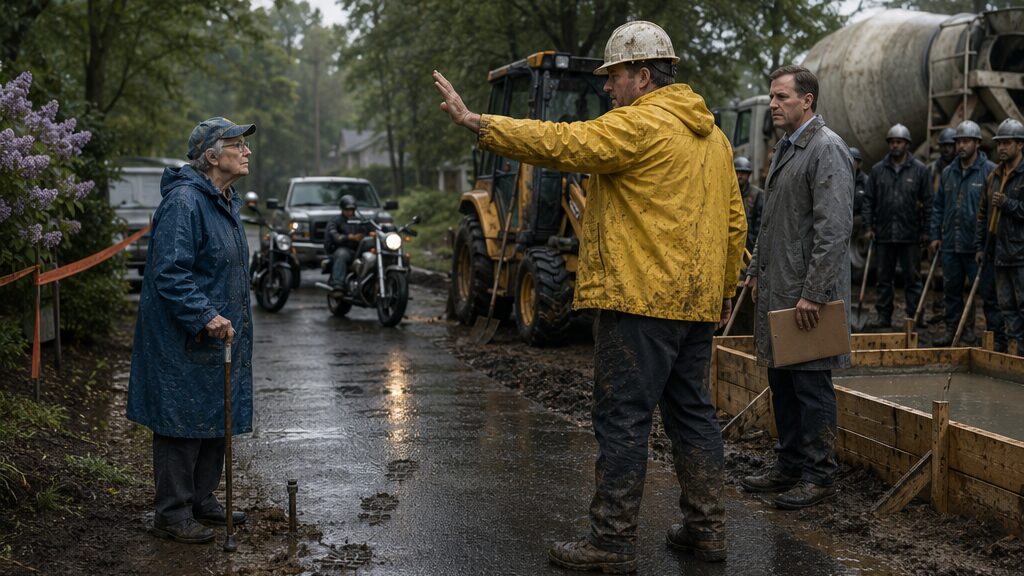
The voice came from behind the pickup. A man in a yellow rain jacket stood with a clipboard under his arm. He was younger than Kevin but not young, broad through the shoulders, clean-shaven, wearing a hard hat pushed back on his head. He had the brisk expression of someone already behind schedule.
“You need something?” he asked.
“These your motorcycles?” Betty said.
“One’s mine. One belongs to my guy.”
“They’re in my driveway.”
He glanced at them as if they had appeared there by natural weather. “We’ll move them once we get set up.”
“You are set up in my driveway.”
The man gave a small, polite laugh. “We’re doing work next door. Kevin probably told you we’d be close to the line today.”
“He told me there would be work next door.”
“Right.”
“He didn’t tell me I’d have vehicles across my drive before breakfast.”
The man tucked the clipboard under his jacket to keep it dry. “I’m Mark Davis. Davis Site and Concrete. We’re just staging for the form line. Shouldn’t be more than a little inconvenience.”
Betty looked at the orange tape again. “Why is that tied to my lilac?”
Mark turned his head, as if only now seeing it. “Temporary.”
“It’s tied to my lilac.”
“Ma’am, I promise, nobody’s trying to bother your plants.”
She did not answer. She stepped around the first motorcycle, slower than she wished but steady enough, and walked toward the tape. The muddy boot print lay at her left like a mark left for her to read.
Mark followed.
“Careful,” he said. “Ground’s slick.”
Betty almost smiled at that. Men who had placed motorcycles across an old woman’s wet driveway were suddenly worried about her footing.
She stopped where the asphalt met the strip of grass. The grass was no longer smooth. Tire marks cut through it, and a shallow rut held brown water. One of the new stakes had been hammered in just beyond the edge, near the bend where her driveway widened before the garage.
The bend was not decorative. It had been Joseph’s idea after the basement flood of 1989. Betty could still see him kneeling there in a white undershirt gone gray at the collar, palms muddy, explaining how water wanted the easiest path and people were foolish when they believed they could ignore it.
“Leave that strip alone, Bett,” he had told her. “Driveway needs room to breathe.”
She had laughed at him then. Driveways did not breathe. Houses did not remember. Lines were lines because men with maps said so.
Now she stood looking at a stake that did not belong where it had been put, and her throat tightened.
“Who placed this?” she asked.
Mark looked at the stake. “Surveyor marked the working line.”
“That isn’t my line.”
“It’s the construction line.”
“I didn’t ask what you call it.”
A worker behind Mark muttered something. Betty did not catch all of it, only the word “old” and the shape of a laugh that followed.
Mark’s face tightened in professional patience. “Mrs. Walker, Kevin has permits. We’re forming along his approved edge. If anything is over by an inch, we’ll clean it up.”
“An inch is not four feet.”
His eyes shifted. Not much, but enough.
Betty looked toward the backhoe. Its bucket was raised slightly now, its teeth dark with wet soil. The operator had turned the machine so the arm pointed not toward Kevin’s cleared yard, but toward her narrow strip beside the drive.
“Why is that bucket over my grass?” she asked.
“It’s not digging,” Mark said.
“It is over my grass.”
“We’re making room.”
“For what?”
“For the forms.”
Betty looked back to the orange tape, the mud, the moved line. Rain slid down the side of her glasses. She wiped it away with the cuff of her raincoat.
The backhoe gave a low mechanical groan. Its arm shifted, not far, just enough for the bucket to swing out over the strip Joseph had told her never to ignore.
Betty stood very still.
The first real fear of the morning did not come from the motorcycles or the men or the engine noise. It came from the simple fact that the bucket moved as if the land underneath it already belonged to someone else.
Chapter 2: Betty Walker Refused to Step Away From the Line
The backhoe bucket hung over the grass like a question nobody wanted Betty to ask.
A man in the driver’s seat looked from Mark Davis to Betty and back again. His hand rested on the controls. Rain ticked on the yellow metal roof. The bucket swayed slightly, its teeth dark and wet, close enough that if it dropped it would bite into the strip before Betty could say another word.
“Hold up,” Mark called to the operator.
The machine stilled.
Betty stood at the driveway edge with her shoes on the black asphalt and her toes pointed toward the grass. She could feel the cold from the pavement through the soles. Her right hand found the pocket of her raincoat, where she kept a folded tissue, two peppermint candies, and a small notebook Samantha had given her for grocery lists. She did not take any of them out.
Mark stepped closer.
Not too close, at first. Close enough that she could smell coffee on his breath and damp canvas from his jacket. He carried himself like a man used to people moving out of his way because he had a hard hat and a schedule.
“Mrs. Walker,” he said, softer now, “I understand this is upsetting.”
“You don’t.”
“I understand you’re concerned.”
“That isn’t the same thing.”
A worker behind him lifted a stack of wooden boards and carried them past the pickup. Another dragged a string line through the wet grass. The orange tape fluttered as he brushed against it.
Betty watched the string line cut across the curve of her driveway.
“Tell your men to stop,” she said.
“They’re not on your property.”
“They are.”
“We’ve got a permitted job.”
“You keep saying that like a permit can move a boundary.”
Mark’s mouth closed. Then he smiled with one side of it, the way people smiled when they wanted an argument to look unreasonable from the outside.
“Let’s not make this bigger than it is.”
Betty looked at the muddy boot print near her feet. It crossed from the wet grass onto her pavement. She could see where the heel had slipped slightly, leaving a smear toward the garage.
“I’m not making it bigger,” she said. “You are.”
Mark took another step forward, and the space between them became too small. Not frightening in the way a raised hand would be frightening. Worse, somehow. Casual. As though her age gave him permission to lean into her world.
“You need to step back from the work area,” he said. “Before somebody gets hurt.”
The words were meant to sound careful. The warning beneath them was not.
Betty lifted her eyes to his.
For a second, the rain, engines, and radio seemed to drop away. Mark had gray at his temples and lines beside his mouth from squinting outdoors. He was not a monster. He was a man who wanted the day to go smoothly, and somewhere between the permit folder and the concrete order, he had decided that Betty Walker was the rough spot to be smoothed over.
That made him more dangerous than a cruel man.
A cruel man knew he was taking something.
Mark thought he was managing her.
Betty reached up and wiped rain from her glasses again. Her hand trembled once before she steadied it. She pointed to the muddy print.
“Your man crossed here.”
Mark glanced down.
“That’s a boot print.”
“Yes.”
“People walk around job sites, Mrs. Walker.”
“This is not your job site.”
His smile thinned. “The property line is marked.”
“No. Your working line is marked.”
One of the crew members stopped moving. The operator in the backhoe leaned out slightly.
Betty pointed again, this time to the grass beside the bend in the driveway. Half-hidden under mud and dead leaves was a small round metal cap, nearly the color of the wet ground. It was easy to miss if you did not know to look for it. Joseph had shown it to her enough times that she could have found it blind.
“There,” Betty said. “That is the old pin.”
Mark bent his head but did not crouch. “Could be anything.”
“It is the pin.”
“Surveyor would’ve found it.”
“Did he look?”
Mark’s jaw moved. “The crew had a current layout.”
“Did he look?”
The worker with the string line said, “Mark, we’ve got forms to set.”
Mark lifted a hand without turning around. “Give me a minute.”
Betty moved one step off the asphalt. Mark’s hand came up quickly, palm out, not touching her but stopping her just the same.
“Don’t go into the work area.”
She looked at his hand. Then at his face.
“That is my grass.”
“It’s a safety issue.”
“You made it one.”
The words came out quiet. Quieter than she expected. But the worker with the boards heard them. So did the backhoe operator. So did the neighbor standing on Kevin’s newly scraped yard under a black umbrella, pretending to check his phone.
Kevin Campbell had not come over yet. He watched from beyond the orange tape, his expensive boots clean because other people were making the mud.
Betty saw him and felt a new kind of anger, not hot but deep.
Mark followed her gaze. “Kevin has approval to improve his drive access.”
“He can improve his.”
“That’s what we’re doing.”
“No,” Betty said. “You’re taking mine because it’s easier than building within his.”
The worker with the string line snorted. “It’s a strip of mud.”
Betty turned her head toward him. He looked away first.
She bent slowly, knees complaining, and picked up a small piece of gravel from beside the pin. With the edge of it, she scraped the mud away from the metal cap. The movement hurt her back, but she kept at it until the round top showed clear under the rain.
The letters stamped into it were faint. Not fully readable. But it was there.
Joseph had found that pin thirty years ago with a rented metal detector and the persistence of a man who believed the world always hid important things under ordinary dirt. He had tapped it with the handle of a screwdriver and grinned like he had discovered buried treasure.
“See?” he had said. “This little thing keeps everybody honest.”
Betty straightened slowly.
“That strip carries water away from my foundation,” she said.
Mark blinked. “What?”
“The slope. The gravel beneath it. Joseph built it after our basement flooded. If you cut across it and pour over the edge, water comes back toward my house.”
Mark looked impatient now. Not because the words were untrue, but because they were inconvenient.
“That’s something you can take up after the job if there’s an issue.”
“There is an issue now.”
“We’re not discussing drainage in the rain with equipment running.”
“That’s exactly when you discuss water.”
A brief silence followed. The kind that made the crew glance at one another.
Mark exhaled through his nose. “Mrs. Walker, I’m going to ask you one more time to step away from the line.”
Betty looked down at the muddy boot print, the exposed pin, the orange tape tied to her lilac. She thought of Samantha telling her last week not to get worked up over Kevin’s construction, that neighborhoods changed, that hiring people to argue was expensive, that Betty needed to think about her blood pressure.
She thought of Joseph’s cap on the hook by the door.
Then she stepped fully onto the narrow strip of grass.
The mud took the edge of her shoe and held it.
“I won’t move,” she said.
Mark’s face changed. The workman patience slipped, and beneath it was irritation sharpened by an audience.
“You’re obstructing permitted work.”
“I am standing on my property.”
“You don’t know that.”
“I know exactly where I am.”
The backhoe idled. Rain collected in the bucket and dripped from its teeth. The two motorcycles still blocked the drive behind her. She was aware of them without turning around, aware of the crew, the pickup, Kevin with his umbrella, the road beyond the trees where a neighbor slowed a car and stared.
Mark stepped closer again, close enough that the brim of his hard hat cast a shadow over her glasses.
“Mrs. Walker,” he said, each word clipped, “you are making this difficult.”
“No,” Betty said. “I am making it visible.”
The sentence seemed to land harder than she intended. Mark glanced toward Kevin. Kevin closed his umbrella halfway and started across the muddy yard.
He came carefully, stepping around puddles, holding a dark folder under his arm. He wore a gray raincoat that looked too new for the weather and carried the expression of a man arriving to settle something foolish.
“Betty,” he called, as if they were friends. “I was hoping we could avoid this.”
She did not answer.
Kevin stopped beside Mark and opened the folder just enough to show papers in plastic sleeves.
“That line was already approved,” he said.
Betty looked from the folder to the exposed pin at her feet.
Rain kept falling. The boot print filled slowly with water.
Chapter 3: The Permit Folder Did Not Show the Water
By noon, Betty’s kitchen smelled of wet wool, coffee left too long on the burner, and mud drying where it should not have been.
She had made Mark move the motorcycles before she went inside. Not with victory. Not even with certainty. She had simply stood on the driveway until he jerked his chin at the crew, and one worker rolled them toward Kevin’s side with a look that said the inconvenience was hers, not theirs. The pickup moved last, tires hissing through shallow water, leaving two dark tracks near the grass.
The orange tape stayed.
So did the stake.
So did Kevin’s words.
That line was already approved.
Betty hung her raincoat over the back of a kitchen chair and set her shoes on newspaper by the door. Mud clung to the soles in thick brown half-moons. One print had transferred to the porch mat when she stepped inside, the same blocky tread pattern she had seen on the driveway.
She stood over it, holding the coffee pot, unable to look away.
The print was smaller here, less dramatic without the backhoe and men around it. Just mud on a mat. Just a thing to wash. That was how it started, she thought. Not with someone taking your house. With someone leaving dirt where they had no right to step and expecting you to clean it up quietly.
The phone rang.
Betty let it ring twice before she answered.
“Mom?” Samantha Scott’s voice came through already worried. “Are you okay?”
“I’m in the kitchen.”
“That is not an answer.”
“It is the answer I have.”
Samantha sighed. Betty could picture her daughter in the school office where she worked, one hand over her other ear, hair clipped back, eyes moving toward the clock. Samantha had Joseph’s practical mouth and Betty’s habit of worrying a napkin into pieces.
“Kevin called me,” Samantha said.
Betty set the coffee pot down.
“Did he.”
“He said there was a misunderstanding with the construction crew.”
“There was no misunderstanding.”
“He said you stood in the work area.”
“I stood on my land.”
A pause. “Mom.”
Betty closed her eyes. The way Samantha said it held too much: love, fear, impatience, the exhaustion of an adult child who saw every conflict as the start of a fall, a hospital visit, a bill, a decision neither of them wanted to make.
“Samantha,” Betty said, “they moved the line.”
“Kevin said the permit was approved.”
“The permit doesn’t show my drain.”
“What drain?”
Betty looked toward the window above the sink. Rain streaked the glass, blurring the driveway beyond. The backhoe sat still for now, yellow arm folded, but men moved around it in dark jackets.
“The one your father built.”
“Under the driveway?”
“Beside it.”
“I thought that was just gravel.”
“It is gravel. And pipe. And slope. And a lot of Saturdays.”
Samantha was quiet long enough that Betty heard papers shifting on her end.
“How much land are we talking about?” Samantha asked.
Betty gripped the counter.
“Four feet at the widest.”
Another pause. Shorter this time. Worse.
“Mom, I know it feels personal.”
“It is personal.”
“I mean legally.”
Betty laughed once, without humor.
Samantha softened her voice. “I’m not saying let them do anything they want. But if it’s four feet of grass and Kevin has paperwork, maybe there’s a way to settle without you standing in front of equipment.”
“He wants the driveway access wider for his garage.”
“Did he say that?”
“He didn’t have to.”
“Mom.”
The word came again, gentler but still pressing.
Betty turned and looked at the wall beside the refrigerator, where an old photograph of Joseph hung in a cheap wooden frame. He was standing in the driveway in shirtsleeves, one hand on a shovel, smiling at something outside the picture. Behind him, the maple trees were smaller, the house paint brighter, the driveway newly sealed. Betty had taken the picture in July of 1990, after the drainage work was done and before either of them understood how quickly bodies became old.
“The basement filled with water up to the second stair,” Betty said.
Samantha’s voice changed. “I remember the fans.”
“You remember sleeping at Aunt Karen’s.”
“I remember Dad throwing out boxes.”
“He cried over your baby books.”
“I know.”
“No, you don’t.” Betty regretted the sharpness as soon as it left her. She lowered her voice. “You were little.”
Samantha did not answer.
Betty leaned against the counter. Outside, one of Mark’s workers pulled a board from the truck bed. The sound cracked through the rain.
“Your father dug that strip down himself because the first contractor wanted too much,” Betty said. “He said water would always try to come back unless we gave it somewhere else to go. So he gave it somewhere else.”
“And you think Kevin’s work will block it?”
“I think they don’t know it’s there. Or don’t care.”
“Can you show me?”
“The ground knows where it is.”
“That won’t help at a meeting.”
Betty closed her eyes again. “There’s a deed somewhere. Maybe an old sketch. Your father kept everything.”
“Then look for it.”
“I will.”
“But promise me you won’t stand in front of machines again.”
Betty’s eyes opened.
A worker outside laughed at something. The sound was muffled by the window but not enough.
“I can’t promise that.”
“Mom, please.”
“If I move every time they tell me to, they’ll decide where I belong.”
“You belong safe.”
“I belong here.”
The line went quiet except for Samantha’s breathing.
When she spoke again, she sounded tired. “I can come after work.”
“You don’t have to.”
“I know I don’t have to. I’m coming.”
After they hung up, Betty carried her coffee to the table but did not drink it. She sat with both hands around the mug, letting the heat touch her knuckles.
The kitchen looked smaller than it used to. Or perhaps she had filled it with too many things she could not throw away: Joseph’s recipe cards even though he had only cooked pancakes, the chipped blue bowl from Samantha’s childhood, the calendar with doctor appointments written too carefully, the drawer of rubber bands, twist ties, and keys that belonged to locks no one remembered.
She had let some things slide after Joseph died. The gutter over the garage needed fixing. The porch rail had a soft spot near the bottom. There were weeds along the fence Kevin had already removed on his side. Maybe people saw that. Maybe they looked at her house and thought an old woman who let paint peel would not notice a line moving.
Betty stood abruptly.
She took paper towels from under the sink and went to the porch mat. The muddy print had dried at the edges. She knelt with difficulty, one hand on the doorframe, and wiped at it. The first pass smeared the mud wider. She tried again, slower, folding the towel into a clean square.
When the mat was mostly clean, she stayed crouched for a moment, breathing through the ache in her knees.
Outside, rainwater gathered near the driveway bend where the crew had scraped away grass beside the new stake. It should have been running along the shallow channel toward the street. Instead it pooled in a brown, trembling crescent against the asphalt.
Betty watched one drop fall from the lilac branch into the rising water.
Then another.
Then another.
The driveway was already forgetting how to drain.
Chapter 4: Four Feet Became a Neighborhood Problem
The next evening, Betty sat in a folding chair beneath fluorescent lights while Kevin Campbell explained her driveway to a room full of people who did not live on it.
The HOA meeting room had once been the sales office for the subdivision. A framed map of the neighborhood hung crookedly near the coffee table, with its neat cul-de-sacs and green common areas drawn as though no tree had ever fallen, no basement had ever flooded, no person had ever needed more than a straight line to understand a home. Rain tapped at the windows again, lighter than the day before, and the carpet smelled faintly of damp coats.
Betty had chosen the chair nearest the aisle. She did not want to be trapped between knees and handbags if she needed to stand. Her cane rested against her leg, though she had carried it more for balance than for weakness. Samantha sat beside her, hands folded around a paper cup of coffee she had not touched.
At the front of the room, Kevin stood beside an easel with a large printed drawing clipped to it. He had dressed for the meeting in a blue sweater and clean boots. No umbrella, no mud, no hard hat. He looked neighborly now, the way men looked when they wanted the room to forget machinery.
“This is not an expansion into Mrs. Walker’s property,” Kevin said. “It’s an approved improvement to my side access. The contractor is using standard form placement, and any disturbance near the shared edge will be restored.”
Betty watched his finger move along the drawing.
The line on the paper ran straight.
Her driveway did not.
That was the first thing she noticed, and she held onto it because the room was already trying to turn the morning’s mud into something polite.
The HOA representative, seated behind a plastic table, nodded as though Kevin had presented weather data. “And the permit office signed off on this?”
“Yes.” Kevin lifted a page from his folder. “Site plan, concrete work, garage access. Everything submitted.”
A neighbor across the aisle leaned toward another and whispered. Betty caught only pieces.
“Four feet…”
“…poor thing…”
“…Kevin should’ve warned her…”
Samantha shifted in her chair. Betty did not look at her.
The HOA representative turned toward Betty. “Mrs. Walker, would you like to respond?”
There it was. Respond. As if something had happened in the air and not in her driveway.
Betty stood carefully. Her left knee gave its usual complaint, but she did not touch the cane. She took two steps toward the easel.
“May I see that drawing?”
Kevin hesitated only a fraction before smiling. “Of course.”
He moved back, but not far enough. Betty stopped beside the easel, close enough to smell printer ink and Kevin’s aftershave. The paper showed his lot, her lot, the proposed garage, the side drive, and the concrete line running clean along the property edge.
Too clean.
“Where did this line come from?” she asked.
“The submitted survey.”
“Whose survey?”
Kevin glanced at the HOA representative. “The one prepared for the project.”
“That wasn’t my question.”
The room stilled.
Samantha’s fingers tightened around the paper cup.
Kevin kept his pleasant face, but his eyes cooled. “It was prepared by a licensed survey company.”
“Did they find the old pin at the driveway bend?”
“I assume they used the correct markers.”
“Did they find it?”
“I’d have to ask them.”
Betty looked at the drawing again. The straight line cut through the curve where Joseph had widened the driveway and laid the drainage. It made the property look simpler than it was. It made her look wrong by removing the thing she knew.
She touched the paper lightly with one finger. “My driveway bends here.”
Kevin glanced down. “The pavement may, yes.”
“No. The land does.”
The HOA representative cleared her throat. “Mrs. Walker, we can’t settle boundary disputes here. We can only determine whether the project complies with the plans submitted.”
“That’s the problem,” Betty said. “You’re looking at plans that don’t show the water.”
A few people exchanged looks. Someone near the back gave a soft sigh, the sort people made when a meeting had begun to wander.
Betty heard it and felt heat rise in her neck. She could see herself from their side: an old woman in a brown cardigan, one hand near a cane, talking about water when the paper showed lines. For one terrible second she wondered if Samantha was right. Maybe she sounded like she was dragging the past into a room that had no place for it.
Then she remembered the pool of rainwater trembling against the scraped edge of her drive.
She kept her finger on the drawing. “There is a drainage strip beside my driveway. My husband built it after our basement flooded. If concrete is poured across that edge, water will come back toward my foundation.”
Kevin’s expression softened in a way that made Betty dislike him more. “I respect that history, Betty. I really do. But we can’t base current work on informal work from decades ago.”
“Informal work kept my house dry.”
“I’m not saying it didn’t.”
“You are saying it doesn’t count.”
The HOA representative looked from Kevin to Betty. “Do you have documentation of the drainage easement or the boundary marker?”
Betty’s mouth went dry.
Not because there was no documentation. Because there might be. Somewhere. In Joseph’s old boxes, in a deed packet, in the garage cabinet with paint cans and pipe fittings. Things he had kept because he kept everything, and things she had not looked at because looking meant admitting she was alone with them.
“Not with me,” she said.
Kevin folded his hands over the permit folder. “And that’s the difficulty. I can’t stop scheduled work based on memory.”
Samantha leaned forward. “Could the work be paused until the line is checked?”
Kevin’s face turned toward her, grateful for a voice he considered reasonable. “Samantha, I understand your concern. But the crew is booked, the concrete window is tight, and any delay affects costs. If there’s damage, I’m willing to address it. I’ve already said that.”
“After concrete is poured,” Betty said.
“If there is damage.”
“There already is.”
The HOA representative lifted both hands slightly. “Let’s keep this constructive.”
Betty almost laughed. Constructive. The word sat in the room like another tool from Kevin’s truck.
A nearby neighbor spoke up. “Maybe Mrs. Walker could be compensated for the strip, if it’s that small.”
Betty turned toward the voice. “It is not for sale.”
The room went quiet again, but this time not because she had sounded confused. Because she had sounded exact.
Kevin’s polite mask tightened. “No one is asking to buy your driveway.”
“No,” Betty said. “You’re asking me to pretend I didn’t see it move.”
The HOA representative shuffled papers. “Mrs. Walker, if you can bring recorded proof, we can request a review. But right now, with approved plans in hand, the association cannot order the contractor to stop.”
“When is the pour?” Betty asked.
Kevin looked at the representative instead of her.
The representative answered. “Monday morning, according to the notice.”
Samantha’s breath caught beside her.
Betty stared at the straight line on the drawing, the line that made Joseph’s bend disappear. The room seemed to tilt around it. Chairs, coffee, rain, polite faces, all arranged to make a wrong line look official.
“Monday,” Betty repeated.
“If you have documentation,” the representative said, “bring it before then.”
Betty stepped back from the easel. For the first time that evening, she picked up her cane.
Kevin closed his folder with a soft snap.
On the drawing behind him, the straight printed line lay across the place where Betty knew the driveway curved, and for a moment it looked less like a mistake than a decision.
Chapter 5: The Old Boundary Pin Was Still There
Joseph’s garage cabinet still smelled like oil, mouse dust, and the tobacco he had pretended not to chew.
Betty opened it Saturday morning with both hands and stood back before the top shelf could drop anything on her. Nothing fell. That almost made her more suspicious. Joseph had arranged the cabinet in layers only he understood: coffee cans full of bolts, jars of bent nails, folded sandpaper, plumbing tape, mismatched washers, two levels, three flashlights, and enough labeled envelopes to suggest he had expected the house itself to testify someday.
Outside, Kevin’s crew was gone for the weekend, but their absence did not make the driveway peaceful. The orange tape still sagged near the lilac. The stake still stood. Rainwater had dried into a brown rim along the scraped grass, marking the place where water had failed to move.
Samantha had offered to come help after breakfast. Betty told her no.
Not unkindly. Just no.
She needed to look before someone else started deciding what mattered.
She pulled down the first metal box and carried it to Joseph’s workbench. The box held receipts from roof repairs, appliance manuals, an expired warranty for the water heater, and a photograph of Samantha at ten years old holding a muddy baseball in the backyard. Betty set the photograph aside, then kept sorting.
The second box held tax papers.
The third held nothing but old seed packets and a pencil sharpener.
By noon, her back ached and her fingers were black with dust. She had found everything except what she needed. That felt like Joseph too. He could remember where he put a screw from 1978, but only if he was alive to tell her.
“Come on,” she whispered into the cabinet. “Don’t make me be mad at you today.”
The garage answered with the hum of the old refrigerator.
She sat on a stool and rubbed her thumb over a smear of dirt on her palm. Through the open garage door, she could see the bend in the driveway. Wet leaves had collected beside the exposed pin she had scraped with gravel. From this angle, the driveway’s curve was plain. It widened gently, not for looks, but to meet the slope of the land. Joseph had seen that. He had always seen where things wanted to go.
Water. Roots. Cracks. People.
Betty stood again.
The county records office closed at one on Saturdays. She got there at twelve-twenty, carrying a canvas grocery bag with her deed packet, two tax bills, and a notebook full of questions. The clerk behind the counter did not look pleased to see anyone arrive so close to closing, but Betty had spent twenty-three years serving lunch to children who remembered they needed ketchup only after sitting down. She knew the difference between inconvenience and refusal.
“I need the recorded plat and any drainage easement for my property,” Betty said.
The clerk adjusted her glasses. “Address?”
Betty gave it.
The clerk typed, frowned, typed again, and disappeared into a back room. Betty waited beside a bulletin board covered with notices about zoning appeals and stormwater rules. Her knees hurt from standing, but the chairs were too low and she did not want to get trapped in one.
The clerk returned with a thin file and a larger rolled sheet.
“There’s a subdivision plat,” she said. “Older deed references a utility and drainage reservation along one side, but the language is not very clear. You may need a surveyor.”
“I need to see it.”
The clerk spread the copy on the counter.
Betty leaned over it.
The map was old enough that the street names looked hand-lettered. Lots were marked in black lines, measurements written neatly along each side. Her lot was smaller on paper than it felt in the body. House, drive, setback, side yard. At the right edge, near the driveway bend, a small mark appeared where two measurement lines met.
Betty touched it.
“What’s this?”
“Boundary monument,” the clerk said. “Could be an iron pin, cap, stone, depends on what was set.”
“And this note?”
The clerk bent closer. “Drainage reservation. Looks like water runoff maintained along that edge. Again, I’m not an attorney.”
“I’m not asking you to be.”
Betty paid for copies with cash because she did not want to fumble with her card. The clerk rolled the plat into a rubber band and slid the deed pages into a folder. On the way home, Betty stopped twice at red lights and looked at the passenger seat as if the papers might vanish.
Back in the garage, she found the rest by accident.
She was putting the deed copy beside Joseph’s workbench when her elbow knocked a coffee can to the floor. Screws scattered across the concrete. She bent carefully, annoyed, and saw a manila envelope taped beneath the lower shelf.
It was brittle at the edges. Joseph’s handwriting ran across the front in pencil.
Driveway water, 1990. Don’t toss.
Betty sat down hard on the stool.
Inside were three Polaroids, a hardware store receipt faded nearly blank, and a sketch on yellow legal paper. Joseph had drawn the driveway bend, the house foundation, the gravel trench, and the pipe that ran beneath the strip toward the street ditch. He had marked the boundary pin with a small circle and written in the margin: Keep clear. Water path. B.W. will forget because she hates mud.
Betty made a sound that was half laugh, half sob.
“You old fool,” she said, though her hand was gentle on the paper.
She carried the folder outside.
The air had turned cold. The sky hung low and white above the trees. Betty walked to the driveway bend and stood over the place she had scraped before. The metal cap was visible, but barely. Mud had washed back around its edge. The boot print from Friday had softened into a shallow depression.
She went to the garage for Joseph’s old hand trowel.
Getting down was the hardest part. Her knees objected. Her back sent a warning up her spine. She ignored both with the kind of careful stubbornness that had gotten her through recovery after her hip surgery. Inch by inch, she cleared mud, leaves, gravel, and a tangle of grass roots from around the cap.
The more she uncovered, the steadier she became.
The cap was round, dull, and scarred. Stamped letters circled the top, worn but present. Beside it, under a thin layer of silt, the gravel was still there. Not decorative gravel. Drainage gravel. Joseph’s gravel. Larger stones below small ones, laid by hand, sloping away from the house.
Betty sat back on her heels and looked toward Kevin’s lot.
Without the orange tape, a person might not understand. With it, the insult was plain. The new stake stood on the wrong side of the curve, pretending the pin did not exist. The tape line cut across the drainage strip as if Joseph’s work were air.
A car slowed at the street. Betty did not look up.
She took out her phone and photographed the pin, the stake, the driveway curve, and the water-stained grass. She put Joseph’s sketch beside the cap and photographed that too, holding the paper down with the trowel so the wind would not lift it.
Then she stayed there for a moment longer.
Her palms were muddy. Her shoes were muddy. A streak of dirt marked the cuff of her sweater. She should have felt ridiculous, an old woman kneeling in her driveway with a trowel and a dead man’s drawing.
Instead she felt exact.
At dusk, Samantha came by with soup in a plastic container and found the garage workbench covered in papers.
“Mom,” she said, stopping in the doorway.
Betty looked up from labeling photographs with the date and time. “He kept it.”
Samantha set the soup down slowly. Her eyes moved over the Polaroids, the plat, the sketch, the deed copy, the muddy trowel.
“Dad drew this?”
“Yes.”
Samantha picked up the yellow paper. Her mouth trembled when she read the note in the margin. “He wrote that you’d forget.”
“He was wrong.”
Samantha looked toward the driveway.
For the first time, she did not say four feet as if four were small.
Betty put the photographs into the folder, one by one. She had copies now, but the folder itself felt alive in her hands, as if Joseph had been waiting in the cabinet with his pencil and stubborn little map.
By Sunday night, the rain had stopped.
At four-thirty Monday morning, Betty woke to the low beep of machinery backing up outside her window.
She sat straight up in bed.
For one confused second she thought she had dreamed it. Then it came again.
Beep. Beep. Beep.
The crew had started before sunrise.
Chapter 6: The Forms Were Set Before Anyone Could Object
By the time Betty reached the driveway, the concrete forms were already in place.
They ran like a wooden fence laid flat against the wet edge of the asphalt, straight where her driveway curved, stubborn where the land dipped. Stakes held them tight. Fresh mud pressed around them in clumps, and orange string stretched from Kevin’s yard to the far side of the drive as if the morning had been stitched shut before she woke.
Work lights glared from the pickup, turning rain puddles silver. The sky was still dark beyond the trees. Men moved in and out of the light with hammers, gloves, coffee cups, and the quick movements of people who had been told there was no time to waste.
Betty stood at the top of the driveway in Joseph’s cap.
She had put it on without thinking. Only after she closed the front door did she feel the worn brim above her glasses. It smelled faintly of dust and old cotton. The cap did not make her braver. It only reminded her not to rush.
Her folder was under one arm, wrapped in a clear plastic grocery bag to keep off the mist. Her cane was in her other hand.
Mark Davis saw her and said something to a worker before walking up the drive. His boots made wet sounds on the pavement. Fresh mud marked each step.
Not Friday’s print. New ones.
More of them.
They surrounded the exposed boundary pin Betty had scraped clean.
“Mrs. Walker,” he called, and this time there was no attempt at warmth. “We’re on a schedule.”
“So am I.”
He stopped in front of her. Behind him, one worker tightened a form board with a drill. Another bent over the string line. The backhoe idled in Kevin’s yard, its bucket lowered now, teeth resting inches from the scraped strip.
“You can’t be out here today,” Mark said.
“I live here.”
“You know what I mean.”
“I often do.”
His jaw tightened. “The concrete truck is booked. We’re pouring this morning.”
“No, you’re not.”
A worker looked over. Mark lowered his voice. “Don’t do this again.”
Betty looked past him to the forms. The wood crossed the place where the gravel should breathe. Some of the grass had been shaved down to mud, exposing pale stone beneath. Joseph’s drainage strip had been opened like a wound and pinned under straight boards.
Her stomach turned.
“This isn’t just close,” she said. “You set it across the strip.”
“The form is along the approved construction line.”
“It’s along Kevin’s line.”
“It’s along the submitted line.”
“Not the recorded pin.”
Mark took off his hard hat and wiped mist from his forehead with the back of his wrist. He looked tired. That mattered to Betty against her will. Tired people made sharper mistakes and defended them harder.
“I am not debating survey work at five in the morning,” he said.
“You should have debated it before setting boards over my drainage.”
“If there’s drainage damage, Kevin said he’ll address it.”
“After you cover it.”
“That’s how construction works sometimes. We fix what needs fixing.”
“No,” Betty said. “That’s how taking works. Damage first, apology later.”
Mark looked toward the street, then back at the crew. He was not worried about Betty. He was worried about delay becoming visible.
From Kevin’s side yard, Kevin Campbell appeared in a dark jacket, carrying the same permit folder as if it had multiplied overnight. His hair was neat despite the hour. He walked with a careful urgency, avoiding the mud.
“Betty,” he said, “I thought we settled the process at the HOA.”
“We settled nothing.”
“You were told to bring documentation.”
“I did.”
She lifted the plastic-wrapped folder.
Kevin glanced at it, then at the forms. “Good. Then submit it. But today’s work can’t just stop because you found old papers in a garage.”
Samantha’s car turned onto the street before Betty could answer. It slowed, then stopped behind the concrete crew’s smaller truck. Samantha got out wearing office clothes under a rain jacket, hair still damp from a rushed shower.
“Mom!” she called.
Betty did not turn fully. “I’m here.”
“I can see that.”
Samantha walked quickly to her, eyes moving from the forms to the backhoe to the folder under Betty’s arm. Her face changed when she saw the boards crossing the driveway edge.
“They set them already?”
“Before sunrise,” Betty said.
Kevin held up one hand. “We started early because rain is expected later. The concrete window matters.”
Samantha looked at him. “You said Monday morning.”
“It is Monday morning.”
“Not before anyone could object.”
Mark stepped in. “We can’t run a job around personal objections. We have approvals.”
Betty bent slowly and placed the folder on the hood of the pickup, still wrapped in plastic. She unlooped the bag, took out Joseph’s sketch, the county plat copy, and the photographs she had printed at the drugstore Sunday afternoon with Samantha’s help.
Her fingers were stiff, but she laid the pages in order.
“Here is the recorded plat,” she said. “Here is the drainage note. Here is Joseph’s sketch from 1990. Here is the old pin. Here is your stake. Here is your form.”
Mark barely looked. Kevin looked enough to see there might be trouble.
“This doesn’t prove the form is over,” Kevin said.
“It proves you didn’t check.”
Mark pointed toward the form line. “Our layout came from the surveyor’s control point.”
“Which one?” Betty asked.
“The temporary stake.”
“The one Kevin paid for?”
“The one placed for the project.”
Betty looked at Kevin. His eyes flicked away.
Samantha saw it too.
The small shift settled something in Betty. Until then, some part of her had allowed room for mistake, hurry, miscommunication, the ordinary clumsiness of men with trucks. But Kevin’s look told her the extra width was not an accident. He needed the side drive wide enough to swing vehicles into the new garage. Her bend made that difficult. Her drainage made it inconvenient. Her being old had made it seem possible.
“You need those four feet,” Betty said.
Kevin’s lips pressed together. “The access works better if the edge is cleaned up.”
“My land works better if it remains mine.”
“It’s not being taken. It’s being improved.”
“For you.”
“For the neighborhood, frankly.”
There it was. The bigger word brought out to swallow the smaller truth.
The neighborhood. Improvement. Clean lines. Approved plans.
Betty looked down the driveway. Fresh muddy boot prints circled the exposed boundary pin, some on Kevin’s side, some on hers, all careless. One print had landed partly on the metal cap itself, heel pressed into the mud around it.
The old pin had held its place while everyone stepped over it.
The distant rumble came before the truck appeared. Low, heavy, unmistakable.
Mark turned toward the street.
Kevin turned too.
A concrete truck rolled slowly around the corner, drum turning, headlights white in the morning mist.
Samantha moved closer to Betty. “Mom.”
Betty heard the fear in her daughter’s voice and loved her for it. She also knew fear could not be allowed to make the next decision.
She picked up Joseph’s sketch and slid it back into the folder. Then she tucked the folder under Samantha’s arm.
“Hold this.”
“What are you doing?”
Betty stepped off the driveway and onto the narrow strip beside the form. Mud gripped her shoes at once. The boundary pin was six feet ahead, half-ringed by boot prints. Mark took a step toward her.
“Mrs. Walker, don’t.”
Betty kept walking.
The concrete truck’s brakes hissed at the curb.
She reached the pin and planted her cane beside it. Not on the form. Not in front of the truck. On the small round marker everyone had tried to make irrelevant.
Then she looked at Mark, at Kevin, at the crew, at the machine with its turning drum.
“I am not moving,” she said, “until someone measures from here.”
Chapter 7: She Made Them Measure Where They Had Stepped
For a moment, no one moved.
The concrete truck idled at the curb with its drum turning slowly, a low grinding sound that filled the wet morning. Work lights shone on the driveway. The forms cut a straight line through the edge of Betty’s land. Her cane stood beside the old boundary pin, its rubber tip sunk slightly in mud.
Mark Davis walked toward her first.
“Mrs. Walker,” he said, very carefully, “you cannot stand there.”
Betty kept her eyes on the pin. “I am not in front of the truck.”
“You are inside the work area.”
“No,” she said. “The work area is inside my property.”
One of the workers muttered, “Here we go.”
Samantha stepped forward with the folder clutched against her chest. “Mark, just measure it.”
Mark turned on her. “From what? Your mother’s old cap in the mud?”
“From the recorded pin,” Betty said.
Kevin Campbell came down the driveway with his mouth set tight. “This is unreasonable. Betty, nobody is trying to take your house.”
She looked at him then. “That is what people say when they are taking the part they think won’t be missed.”
Kevin’s face flushed. “That’s not fair.”
“No,” Betty said. “It isn’t.”
The truck driver leaned out his window. “You want me to wait or circle?”
Mark threw up one hand. “Wait.”
The word cost him. Betty saw it in his shoulders. Every minute had a price attached, and she was meant to feel responsible for it. The crew looked at her as though she had reached into each of their pockets. Kevin looked at the forms as though they might save him if no one touched them.
Betty did not move.
The rain had become a fine mist, enough to bead on her glasses. She wiped them with the cuff of Joseph’s old jacket, which she had pulled on over her sweater before coming out. The motion steadied her. Wipe, breathe, look.
Mark stepped closer, stopping just outside the reach of her cane. “We used the layout we were given. If you have a dispute, file it. Don’t hold up a pour.”
“Measure from here.”
“That won’t settle anything.”
“Then it won’t hurt to do it.”
A neighbor had come out across the street in a bathrobe under a raincoat. Another stood near a mailbox with a dog pulling at its leash. Betty could feel the watching begin. Not support. Not yet. Just attention. The same kind of attention that had made the HOA room go quiet.
Kevin noticed too. His voice lowered. “Betty, this doesn’t have to be public.”
“You made it public when you put your crew in my driveway.”
He looked toward the workers. “Mark.”
Mark exhaled, then turned to one of the crew. “Get the tape.”
The worker stared at him. “Seriously?”
“Get it.”
The man went to the truck and returned with a measuring tape, the long metal kind Joseph used to snap back too fast and pinch his fingers. Mark took it, crouched near the temporary stake, and pulled the blade toward the form.
“Not from there,” Betty said.
Mark looked up.
Betty tapped the ground beside the pin with her cane. “From here.”
“That point wasn’t used in our layout.”
“I know.”
The sentence made Samantha look sharply at Kevin.
Mark’s face darkened. He stood, walked toward the pin, and bent down. Mud creased under his boots. One of his fresh prints landed near the old print from Friday, heel to heel, as if the driveway had been saving the pattern for this moment.
He brushed mud from the cap with two fingers. “It’s old.”
“Yes.”
“It may not be valid.”
“It was valid when the deed was recorded.”
Kevin said, “Old markers get superseded.”
“By what?” Samantha asked.
Kevin hesitated.
“By a proper survey,” he said.
“Where is it?” Betty asked.
“In the filed plans.”
“The filed plans show a straight line.”
“Because that’s the edge.”
“My driveway bends.”
“Pavement isn’t ownership.”
“No,” Betty said. “But neither is convenience.”
The concrete truck hissed again. The driver leaned back in his seat and folded his arms.
Mark hooked the end of the measuring tape at the pin. His hands were rough, competent, impatient. He pulled the tape across the wet pavement while another worker held it at the form. The bright yellow blade stretched from old metal to new wood, trembling slightly in the mist.
Betty watched the numbers appear.
She did not understand every measurement the way Joseph would have. She did not need to. She knew where the pin was. She knew where the drawing said the line should run. She knew what four feet looked like when it had been taken from the side of a driveway and called improvement.
Mark crouched by the form, read the tape, then read it again.
He said nothing.
Kevin stepped closer. “What is it?”
Mark did not answer right away. He moved down the form line, measuring again from the pin to another stake. Then another. The worker who had been holding the tape stopped looking bored.
“Mark,” Kevin said.
Mark stood. Rain ran from the brim of his hard hat. “The form’s over.”
The words were not loud, but they carried.
Betty heard Samantha inhale.
Kevin’s expression hardened into something almost boyish in its refusal. “By how much?”
Mark looked at the tape in his hand. “Depends where you measure. Three and a half here. Closer to four at the bend.”
“The temporary stake—”
“Was set off your layout,” Mark said.
“I gave you the approved drawing.”
“I laid out from what I was told was the working point.”
Betty looked from one man to the other. There it was, not the whole truth, but enough of it. No confession. No villain’s speech. Just two men discovering that a wrong assumption had weight and measurement.
Samantha stepped beside Betty. “So the form is on her side.”
Mark dragged one hand over his mouth. “It appears that way.”
Kevin turned toward Betty. “We can adjust after the pour. It’s not structural yet.”
Betty almost smiled, not because it was funny, but because some people could stand beside proof and still try to outrun it.
“You want to pour first,” she said, “then discuss where you poured.”
Kevin’s voice sharpened. “You don’t understand the cost of stopping this now.”
Betty looked at the wet form, the boot prints, the boundary pin. “You didn’t understand the cost of starting it wrong.”
A white city vehicle pulled to the curb behind the concrete truck.
For a moment, even the drum seemed quieter.
The city inspector got out wearing a rain jacket and carrying a tablet in a plastic case. Samantha had called before dawn, Betty realized, or perhaps after she first heard the machinery. Her daughter did not look at her, but her grip on the folder relaxed for the first time all morning.
The inspector walked up the driveway, eyes moving over the truck, the forms, the people gathered around the old pin.
“Who’s in charge here?” the inspector asked.
Mark lifted a hand. “I’m the contractor.”
Kevin stepped forward at the same time. “It’s my project.”
The inspector looked at Betty. “And you are?”
“Betty Walker. This is my driveway.”
He nodded once. “I received a complaint about a boundary and drainage issue.”
Kevin’s jaw tightened. “A last-minute complaint.”
The inspector did not react. “Most complaints arrive before the mistake is buried.”
Mark glanced down.
Betty handed Samantha the cane and took the folder. Her fingers were cold and stiff, but she opened it without dropping anything. She showed the inspector the plat, the deed language, Joseph’s sketch, the photographs from Saturday, and the picture of the exposed boundary pin before the forms were set.
The inspector did not rush. That alone nearly undid her.
He crouched beside the pin. He looked at the stamped cap. He looked at the form. He asked Mark for the permit drawing, then compared it to Betty’s plat. He had Mark stretch the tape again, this time while he watched. The yellow blade lay across the driveway like a bright nerve.
A worker kicked at the mud. The truck driver checked his phone. Across the street, the neighbor’s dog stopped pulling and sat.
Kevin spoke twice, both times about cost, schedule, and approved plans. The inspector listened without nodding.
Finally, the inspector stood and took a red marking crayon from his pocket.
He walked to the form boards.
Kevin stepped after him. “What are you doing?”
“Marking the encroachment.”
“This is not settled.”
“No,” the inspector said. “Which is why you’re not pouring over it.”
He bent and drew a red line across the wood where the form crossed the measured boundary. Then another. Then he wrote HOLD in thick letters on the damp board.
The word looked almost too small for what it stopped.
Mark closed his eyes briefly.
The inspector straightened. “No concrete in this section until the boundary discrepancy is resolved and drainage impact is reviewed.”
Kevin’s mouth opened, then closed.
Betty looked at the red mark on the form. She had expected to feel triumph, or relief sharp enough to stand on. Instead she felt the weight of her body all at once. Her knees hurt. Her back hurt. Her hands shook from cold and from the effort of not shaking earlier.
Samantha put an arm around her, not to pull her away, only to stand with her.
Mark gathered the tape slowly. When he passed Betty, he paused.
“I should’ve checked the pin,” he said.
It was not an apology, not fully. But it was the first true sentence he had said to her all morning.
Betty nodded once. “Yes.”
The concrete truck’s drum kept turning at the curb, but it no longer sounded like time running out.
It sounded like a machine waiting for permission it did not have.
Chapter 8: The Driveway Was Clear When the Rain Stopped
Three days later, the last muddy boot print disappeared in the rain.
Betty watched from the porch with Joseph’s cap in her lap and a blanket over her knees. The rain was steady but gentle, the kind that washed rather than punished. It ran along the driveway bend, found the gravel strip, and moved toward the street in a narrow silver thread.
For the first time all week, it went where it was supposed to go.
The forms were gone. The orange tape had been removed from the lilac. Kevin’s temporary stake lay in the back of Mark Davis’s pickup with the other discarded scraps, its pointed end muddy and unimpressive now that no one was pretending it meant authority.
There had been meetings after the inspector’s hold. Not dramatic ones. Long ones. Tired ones. Kevin brought corrected drawings. Mark brought the surveyor back. The city required a drainage review before any revised pour. The recorded pin remained where it had always been, dull metal in old mud, while everyone around it adjusted themselves to the truth of it.
Kevin did not apologize the way Samantha thought he should.
He came to the porch on Wednesday afternoon with a paper folded in thirds and a face that had not slept enough.
“I’ll move the form line,” he said.
Betty stood inside the screen door. “The city already required that.”
“And I’ll pay for the drainage restoration.”
“The city required that too.”
His mouth tightened. “I’m also signing the access limitation. My contractors won’t use your driveway or side strip for staging.”
Betty looked at the paper in his hand. Then at him.
“That should have been true before.”
“Yes,” he said.
The word was quiet enough that the rain almost took it.
For the first time, Betty saw not a villain, but a man who had expected the world to make room for him and had been embarrassed to discover it would not. That did not make the rut in her grass less real. It did not put back the scraped roots or undo the nights she had lain awake hearing machinery in her head. But it helped her decide what kind of ending she wanted to live beside.
“I want the lilac cleaned up,” she said.
Kevin blinked. “The lilac?”
“You tied tape to it and broke two branches.”
“I can replace it.”
“No,” Betty said. “You can have someone prune it properly. It was Joseph’s mother’s.”
Kevin looked toward the bush as if seeing it for the first time. Rain clung to its bare stems. One broken branch hung lower than the others.
“All right,” he said.
“And no trucks across the drive.”
“No trucks.”
“No materials.”
“No materials.”
“No talking to my daughter as if I need managing.”
Color rose in his face. He looked down at the paper, then back at her. “All right.”
Betty opened the screen door just far enough to take the document. She read slowly. She made him wait while she found her glasses, then read again. She did not understand every clause, but she understood the parts that mattered: corrected boundary, restored drainage, no staging, written acknowledgment of disputed encroachment.
Samantha reviewed it that evening at the kitchen table, lips moving as she read. When she finished, she set the paper down beside Joseph’s sketch.
“It’s not everything,” Samantha said.
“No.”
“But it’s something.”
“It’s what I asked for.”
Samantha looked at her mother then, really looked, not the quick worried scan she had been doing for years. “I’m sorry I said four feet like it was nothing.”
Betty folded her hands around her tea. “You were scared.”
“I still am.”
“So am I.”
That surprised Samantha more than anything else Betty had said all week. Her eyes filled, and she looked away toward the window.
Betty reached across the table and touched her wrist. “Being scared doesn’t mean we give things away.”
Samantha covered Betty’s hand with her own. Neither of them spoke for a while. Outside, rain tapped the glass, and the driveway shone beneath the porch light.
On Friday, Mark returned with two workers and no motorcycles. They parked on Kevin’s side. Mark came to the door before unloading anything.
“Mrs. Walker,” he said, holding his hard hat in both hands. “We’re going to clear the damaged edge today, reset the gravel, and pull back the form line. Inspector will check before we pour anything.”
Betty looked past him. “No backhoe over the strip.”
“No backhoe over the strip.”
“No one steps on the pin.”
He gave a tired half-smile. “I told them it bites.”
Betty did not smile back right away. Then she did, a little.
She watched from the porch as they worked. Not because she distrusted every movement, though some part of her still did. Because watching had been the beginning of saving it. The crew shoveled carefully this time. They exposed the drainage gravel Joseph had laid and added fresh stone where the old had been scattered. The city inspector came near noon, crouched, checked slope, took photographs, and marked the corrected form location with his own paint.
Kevin stayed on his side of the line.
When the work was done, Mark walked to the porch and showed Betty the measurements. He did not overexplain. He did not call the strip small. He simply pointed to the corrected line, the drainage edge, the protected pin.
“Looks right,” he said.
Betty came down the porch steps with her cane and walked slowly to the bend. The air smelled of wet stone and sawdust. The muddy prints had been trampled into shapeless patches, no single tread clear anymore. She stood over the boundary pin. Around it, the ground had been cleaned, not prettied. The difference mattered. Pretty could hide things. Clean showed where they were.
She looked toward the street.
The driveway was open from the garage to the curb.
No motorcycles. No pickup. No orange tape. No man telling her to step back.
Samantha arrived after work and found Betty in the garage, putting Joseph’s folder into a plastic storage box.
“Keeping it somewhere easier now?” Samantha asked.
“Top shelf was a poor filing system.”
Samantha smiled. “Dad would disagree.”
“Your father disagreed with labels, calendars, and measuring cups.”
“He believed in knowing where things were.”
Betty closed the lid on the box. Joseph’s sketch lay inside with the deed copy, the photographs, the inspector’s notice, and the signed access limitation. Not buried. Not hidden. Kept.
She carried the box into the kitchen and placed it in the lower cabinet beside the flashlight and batteries.
Later, after Samantha left, the rain stopped.
The clouds broke open just enough for pale evening light to touch the wet trees. Betty put on Joseph’s cap and stepped onto the porch. The boards were damp, but the air had changed. Softer. Washed out.
She walked down the steps carefully. At the bottom, she paused where the old porch mat lay clean. No mud print. No smear. She continued onto the driveway.
The pavement curved beneath her feet exactly where it always had.
At the bend, water moved through the restored strip in a thin, quiet line. Betty stood beside it until the last runoff reached the street. She thought of Joseph kneeling there with mud on his arms, making a joke about driveways needing room to breathe. She had laughed then. She understood now that he had not only meant water.
She walked the full length of the driveway, from the garage to the road, slowly, without having to squeeze past anything or ask anyone to move. At the curb she turned back.
Her house looked old. The paint still needed work. The porch rail still needed fixing. The gutter over the garage still sagged. None of that meant it was waiting to be taken.
Betty returned up the driveway with Joseph’s folder tucked under one arm. At the door, she looked once more at the narrow strip beside the asphalt.
Four feet at the widest.
Enough for water.
Enough for memory.
Enough for a woman to stand on and be right.
Then she went inside and shut the door gently behind her.
The story has ended.