The Old Veteran In The Gray Shirt Stayed Silent While The Locker Room Judged Him
Chapter 1: The Old Man In The Wrong Room
The first thing the young men noticed was not Nicholas Walker’s face.
It was the gray T-shirt.
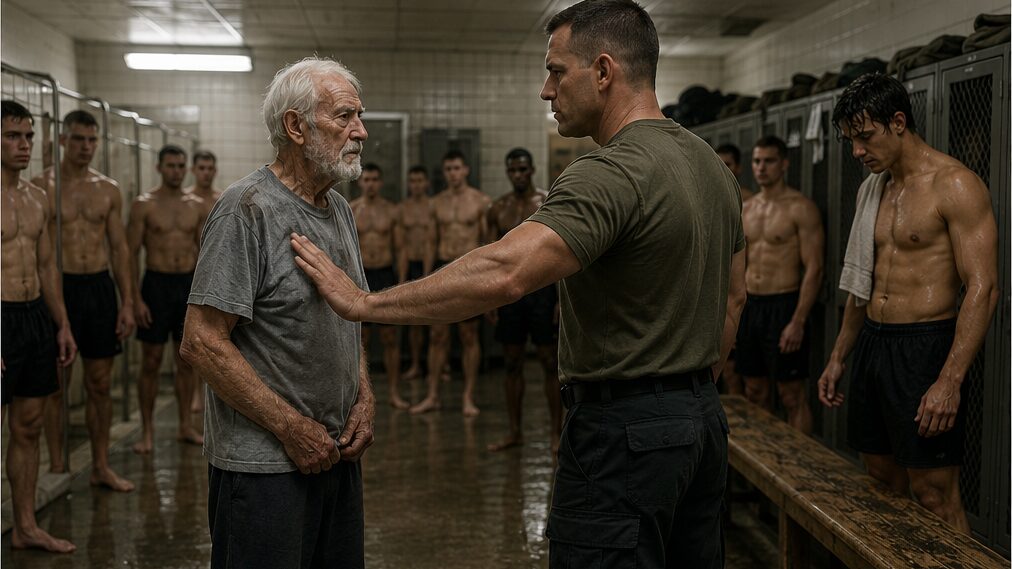
It hung loose from his shoulders, faded thin at the collar, the kind of shirt a man kept long after it should have been folded into a rag. In the white-tiled locker room, under the hard fluorescent lights, it looked almost colorless. The trainees around him wore black shorts and bare chests slick with shower steam. Their skin was young, their backs straight, their voices still sharp from morning drill.
Nicholas stood among them like something left behind after a room had changed owners.
A locker door slammed somewhere behind him. The sound struck the tile and came back twice.
“Sir,” said the instructor in the olive shirt, “you need to step out of this area.”
Nicholas had heard that tone before. Not the man’s voice, exactly. The tone. The flat edge used when patience had already been withdrawn and all that remained was procedure.
He turned his head slightly.
The instructor stood near the center aisle, blocking the way to the back row of lockers. He was a broad-shouldered man in his forties, with close-cut hair and a jaw that looked as if it had been trained never to soften in front of recruits. The name tape above his pocket read Hall.
Nicholas let his hands settle near the hem of his shirt. His fingers did not tremble, though the old knuckles wanted to. He had walked farther from the visitor lot than he had expected, past the administration entrance, past the old courtyard where the flagpole had been moved, past a hallway that smelled faintly of floor wax instead of boot polish. By the time he found the locker room, his left knee had begun its quiet complaint.
“I’m looking for locker one-seventeen,” Nicholas said.
A few trainees looked at one another. One of them gave a small laugh and swallowed it when Timothy Hall’s eyes cut sideways.
“This is a restricted training area,” Hall said. “Visitors check in at the front desk.”
“I did.”
“Then someone made a mistake.”
Nicholas looked past him. The old rows were still there, though not all of them. The far wall had been stripped down to pale rectangles where lockers had already been pulled. Blue tape marked the remaining banks. A rolling cart stood by the showers, loaded with tools and dust masks. The renovation had reached the room at last.
He had come just in time, or too late.
“I need five minutes,” Nicholas said.
Hall’s expression tightened. “No, sir. You need to step outside.”
The young men had gone still. Their towels hung from their fists. One stood with one foot in a shower sandal and one bare on the tile. Another kept glancing between Hall and Nicholas, curious in the way young men were when they knew they were watching trouble but had not yet decided what kind.
Nicholas did not blame them. At their age, an old man was a warning, not a history.
Hall moved closer. “Are you with a tour group?”
“No.”
“Family day?”
“No.”
“Then you are in the wrong room.”
Nicholas felt the words land. Not hard. Not new. Just familiar enough to find old bruises.
He looked at the lockers. There had been a time when the aisle seemed narrower, filled with steam, boot laces, shouted last names, and men pretending not to be afraid. A time when gray shirts were stacked on the bench in government-issue piles and every man tried to find one that did not smell like the last man who wore it. A time when one-seventeen had not been a number he had to request from strangers.
“I was assigned that locker,” he said.
One trainee’s eyebrows rose. Hall gave a short breath through his nose.
“When?”
Nicholas turned back. “A long time ago.”
That did it. The air changed. Not with laughter exactly, but with the pressure that comes before it. The young men watched Hall for permission to decide how foolish the old man was allowed to look.
Hall did not laugh. He was too disciplined for that. But something colder arrived in his face.
“Sir, this facility doesn’t keep lockers assigned for a long time. Whatever you think you left here, it’s not here.”
Nicholas pressed his thumb against the seam of his shirt. “It may be.”
“You don’t have authorization.”
“I was told to ask.”
“By who?”
Nicholas paused.
The person who had told him was at the desk, but the reason he had come had started before most of these men were born. He could not put that into the room without making it smaller.
“A volunteer,” he said.
Hall’s mouth made a line. “Front desk staff don’t authorize access to active training rooms.”
Behind him, one of the trainees shifted his weight. The tile squeaked under his heel.
Nicholas could smell bleach and metal. The room was brighter than he remembered. Or maybe his eyes were older and brightness had become less forgiving. He saw his reflection blurred in a locker door: white beard, hollowed cheeks, gray shirt, shoulders that had learned to move slowly so pain would not draw attention.
Hall saw the same thing and reached the wrong conclusion.
“Sir,” he said, louder now, for the room as much as for Nicholas, “I’m going to give you a simple instruction. Walk back through that door. Wait in the hallway. Someone will help you find where you’re supposed to be.”
Nicholas lowered his eyes once, not in obedience, but to gather himself.
He had promised he would not make a scene.
He had promised that long before the drive that morning, long before the letter about the renovation, long before the phone call confirming the old locker wing would be stripped by afternoon. He had promised it in a different version of this room, to a young man who had been laughing because he did not know yet what promises cost.
Five minutes, he thought.
Not for honor. Not for himself.
Just five minutes.
“I know where I’m supposed to be,” Nicholas said.
The room went quieter.
Hall’s face darkened, not with cruelty, but with the sharp embarrassment of an order not immediately followed. In front of trainees, every refusal had weight. Nicholas knew that, too. He had once stood where those boys stood, bare feet on cold tile, watching older men decide what kind of men they would be.
Hall stepped closer until Nicholas could see a tiny scar beside his chin.
“What is your business with locker one-seventeen?”
Nicholas looked at him for a long moment. “I left something for another man.”
The answer did not help. If anything, it made Hall more certain.
“Another man,” Hall repeated.
“Yes.”
“In a locker from a long time ago.”
“Yes.”
A trainee near the back gave a low whisper. Hall heard it. His shoulders squared.
“This is exactly why visitors are not allowed to wander through training areas,” Hall said. “You come in here with half a story, no badge, no escort, and now my trainees are standing around while I explain rules to a grown man.”
Nicholas felt the heat rise in his face. It did not show much anymore. Age had made his skin less willing to confess.
He did not answer.
Hall pointed toward the door. “Move.”
Nicholas remained where he was.
Not defiant. Not dramatic. Just still.
The stillness unsettled the room more than argument would have. Young men understood shouting. They understood challenge and correction. They did not know what to do with an old man who accepted humiliation without handing any back.
Nicholas looked once more toward the back row.
“One-seventeen,” he said quietly.
The number passed through the room like a dropped coin.
A tall trainee standing near the shower entrance lifted his head. He had been half-hidden behind two others, but now he stepped forward, forgetting for a second that he was not part of the conversation. His hair was wet. A towel hung over one shoulder. His eyes moved from Nicholas to the old wooden bench bolted beneath the far row of lockers.
“Sir,” the trainee said.
Hall turned sharply. “Torres.”
The young man froze, then forced himself to continue. “That number.”
“I didn’t ask you.”
“It’s on the bench,” Ryan Torres said.
No one moved.
Ryan pointed, not fully, just enough. “One-seventeen. It’s carved into the bench by the back row.”
Nicholas closed his eyes for half a breath.
There it was.
Not gone. Not painted over. Not sanded away by a man who thought old wood was only old wood.
Hall looked toward the bench. The trainees looked with him.
Nicholas did not.
He was already seeing a younger hand, a pocketknife, and two gray shirts folded side by side while a boy from nowhere important laughed and said, If one of us gets back, Walker, he takes both.
Chapter 2: The Number Cut Into The Bench
Ryan Torres knew better than to speak again.
He knew it before the words had fully left his mouth. He knew it by the way Instructor Hall turned his head, not quickly, but with controlled disappointment. Ryan had been at the center long enough to understand that disappointment was worse than shouting. Shouting passed through a room and disappeared. Disappointment stayed on a man’s record in ways no one wrote down.
But the number was there.
Once he had seen it, he could not pretend he hadn’t.
One-seventeen had been cut into the old bench near the far lockers, low on the side where most people would miss it unless they were sitting with their elbows on their knees. Ryan had noticed it his first week because he had been trying not to throw up after a conditioning run. He had sat right there, head down, sweat dropping onto the tile, and traced the numbers with his thumb until the dizziness passed.
He had thought some bored recruit carved it years ago.
Now the old man in the gray shirt had walked in and spoken the number like a key.
“Torres,” Hall said, “back in line.”
Ryan lowered his hand.
The other trainees stared at the bench. A few leaned slightly, trying to see without seeming to. The shower room steam had thinned, leaving the air cold on Ryan’s shoulders.
Nicholas Walker stood with his hands near the bottom of his gray shirt. He did not look relieved. That was what bothered Ryan most. If Ryan had just saved him from being thrown out, the old man should have shown something. Gratitude. Surprise. Satisfaction.
Instead, he looked as if the bench had accused him.
Hall walked to the far row.
The trainees parted. Ryan stepped back, but not far enough to lose sight. Hall stopped at the bench, bent slightly, and looked at the side rail. There, beneath a layer of age-darkened varnish and old scratches, were the numbers.
Not clean. Not decorative. Cut by hand.
Hall straightened. “Old damage,” he said.
No one answered.
The old man’s gaze remained on the lockers.
Hall faced him again. “A carved number doesn’t establish authorization.”
“I didn’t say it did,” Nicholas said.
Ryan felt that answer in his chest. Not sharp. Not angry. Just exact.
Hall heard it too. His jaw worked once.
“This bench has been here longer than most of the current building records,” Hall said. “Trainees carve things. Maintenance misses things. That doesn’t mean you get access to a restricted area.”
Nicholas nodded once. “I understand.”
“You understand, but you still walked in.”
“I was directed to this wing.”
“By a volunteer who had no authority to send you through that door.”
Nicholas looked toward the hallway. “Then she made an honest mistake.”
Ryan heard the softness in it and glanced at Hall. The instructor had been handed an opening. The old man could have blamed the volunteer. He did not.
A few minutes earlier, Ryan had thought Nicholas was lost. Not completely. Not in a cruel way. But in the way older visitors sometimes drifted through the center during public events, studying plaques, touching doorframes, reading names slowly. Ryan had seen them before. Men with hats. Women with careful shoes. People carrying folded papers, looking for someone at the front desk to tell them where the past had been moved.
Nicholas was not drifting.
He had walked straight to the locker room. He had known the number. He had known enough to stand still when Hall pressed him, as if being pressed was not new.
Hall pointed toward the hallway again. “We’re done in here. Outside.”
Nicholas took a step.
The trainees watched him move, and Ryan hated them a little for it, though he had been watching too. Nicholas’s left leg gave the smallest hesitation, almost invisible unless you were looking for weakness. The man corrected it before anyone could pity him.
Hall saw it anyway.
“Slowly is fine,” Hall said, and this time there was something in his voice Ryan wished had not been there.
Not mockery exactly. Worse. A public patience that made the person receiving it seem smaller.
Nicholas stopped.
For the first time, he looked directly at the trainees. His eyes moved across them without accusation. Ryan expected him to say something. Old men in stories always said something then. They made the room ashamed. They spoke about respect, sacrifice, country, memory. They forced everyone to look at themselves.
Nicholas only said, “Don’t stand on wet tile with your heels locked. You’ll go down before you know you’re falling.”
One trainee shifted his feet instantly. Another looked down, embarrassed.
Ryan almost smiled, then didn’t.
Hall’s expression changed for a fraction of a second. Recognition did not arrive, but uncertainty did. The old man had given a correction without asking for authority. It had come out of him naturally, like a habit too old to retire.
Then Nicholas walked toward the door.
Ryan saw the gray shirt move across the room, dull under the lights. On its lower left side, near the hem, there was a faint rectangular shadow, as if something had been ironed there once and removed. A laundry mark maybe. Or a patch long gone. The cloth was clean but worn thin, folded into the shape of the man’s body by years.
At the doorway, Nicholas stopped beside the bench.
He did not touch the carved number.
His hand hovered near it, then returned to his side.
Ryan saw that too.
In the hallway, the air was warmer. The trainees stayed inside until Hall snapped them back into motion. Towels moved. Lockers opened. Water ran in the showers. The room tried to become normal again, but it failed. The carved number sat under the far lockers like a question no one had permission to ask.
Ryan dressed quickly. His fingers stumbled with his shirt. He kept glancing toward the hallway where Hall had taken Nicholas.
“Why’d you say anything?” a trainee muttered beside him.
Ryan pulled his shirt down. “Because it was there.”
“So?”
So.
Ryan did not know how to explain it. He had spent weeks learning to keep his head down, follow orders, move when told, stop when told, answer only when addressed. There was sense in that. He wanted to make it through. He wanted no instructor to remember his name for the wrong reason.
But the old man had said one-seventeen, and the bench had answered.
Ryan stepped into the hallway with the others. Nicholas stood near the wall, not leaning against it, though Ryan suspected he wanted to. Hall stood in front of him, speaking in a lower voice now. The public part of the confrontation was over, but not the pressure.
“I’ll call administration,” Hall said. “They’ll sort out where you’re supposed to wait.”
Nicholas nodded.
“You don’t enter training rooms without escort. Not this building, not any building.”
“I heard you.”
The answer was not disrespectful. Still, Hall flinched at it.
Ryan slowed as he passed.
Nicholas noticed. His eyes moved to Ryan briefly. There was no plea in them. No request to speak up again.
That made Ryan feel worse.
He wanted the old man to need something simple from him. Say it again. Point to the bench. Tell them you saw it. Then Ryan could decide whether courage was worth the trouble.
But Nicholas had already removed that burden from him.
He stood alone with the same quietness he had carried in the locker room.
At the hallway entrance, a civilian man in a pressed shirt hurried toward them with a tablet in one hand and a ring of keys clipped to his belt. Two renovation workers followed several steps behind him, pushing an empty rolling bin.
The man glanced at Hall, then Nicholas, then the trainees.
“What’s going on?” he asked.
Hall’s shoulders tightened. “Unauthorized visitor in the old locker wing. Says he has a claim to locker one-seventeen.”
The civilian man looked down at his tablet, swiped once, and frowned in the distracted way of someone whose day had already been divided into too many delays.
“One-seventeen?” he said. “That whole row is scheduled for removal this afternoon.”
Nicholas’s face changed then.
Only slightly.
But Ryan saw it.
The old man looked past all of them, back toward the white-tiled room, as if something inside had just begun to disappear.
Chapter 3: The Deadline For Empty Lockers
Anna Wright saw the old man again through the glass panel beside the administration door, and her first thought was that she had sent him into trouble.
He stood in the hallway outside the old locker wing, hands at his sides, gray shirt washed pale by the building’s overhead lights. Instructor Hall was beside him. Paul Campbell from facilities stood with his tablet angled against his chest, wearing the pinched expression he got whenever human beings interfered with a schedule.
Anna set down the visitor forms she had been sorting.
“Oh no,” she whispered.
The security clerk looked up from the desk. “What?”
“Nothing.”
But it was not nothing. She had recognized the old man when he came in that morning because he had not asked his question the way most visitors did. He had not said he wanted a tour. He had not asked for records, plaques, ceremonies, or directions to a memorial wall.
He had said, “Is the old locker wing still standing?”
Still standing. Not open. Not available. Standing.
Anna had worked the veterans’ intake desk for six years, long enough to hear when a person was really asking whether a piece of himself had been thrown away. She had checked the renovation notice, seen that limited retrievals were allowed before demolition prep, and given him the temporary visitor sticker that now hung uselessly from his shirt.
She had told him to wait for an escort.
Then the phone rang, the front printer jammed, and a family arrived with three boxes of donated photographs. When Anna looked up again, Nicholas Walker was gone.
Now Paul Campbell was saying, “We cannot stop the crew for an undocumented personal claim.”
Anna stepped into the hall.
“That was my fault,” she said.
All four men turned. Ryan Torres, half-dressed in training gear and trying not to look involved, stood a few feet away with the uncertain posture of someone caught between obedience and conscience.
Paul adjusted his grip on the tablet. “Anna.”
“I issued his visitor sticker,” she said. “I told him the old wing was scheduled today.”
Hall’s eyes narrowed. “You authorized him into the locker room?”
“No. I told him to wait.” She looked at Nicholas. “I’m sorry.”
Nicholas inclined his head, as if the apology belonged to a much smaller matter.
Paul sighed. “All right. That explains how he got into the building. It does not give us authority to open sealed lockers.”
“They’re not sealed,” Nicholas said.
Paul looked at him.
Nicholas added, “Not all of them.”
There was no challenge in his voice, but Paul reacted as if there were. “Sir, the contents of that wing were cleared according to procedure.”
“Some things were missed.”
“That’s possible. It does not mean personal property can be removed without documentation.”
Anna glanced at the gray shirt. Up close, she could see how carefully it had been mended at the shoulder seam. The repair thread did not match exactly. Someone had done it by hand, slowly.
“Mr. Walker,” she said, “do you have any paperwork connecting you to the locker?”
“No.”
“Old orders? Training records? A photograph?”
“No.”
Paul spread one hand. “Then we have a problem.”
Nicholas accepted that with a small nod. Not defeated. Not surprised.
Anna wished he would explain more. She wished he would give them something practical. A date, a unit, a copy of an old assignment, anything she could carry to Paul and say, Here. Let him in.
But Nicholas stood there as if the explanation would cost more than the refusal.
Hall crossed his arms. “He gave a locker number that happens to be carved into a bench.”
Anna looked at him. “Carved?”
Ryan’s head lifted, but he said nothing.
“Old vandalism,” Hall said.
Nicholas’s gaze shifted toward the locker-room door.
Anna had seen many older veterans go quiet around objects that looked ordinary to everyone else. A chipped mug. A hallway photograph. A cap folded in two hands. Silence could mean confusion, but it could also mean a person was holding back a room no one else could see.
Paul checked the time on his tablet. “The contractors are scheduled to begin removal at thirteen hundred. Electrical disconnect is already done. Once the row comes out, anything remaining goes into disposal unless tagged by facilities.”
“Then tag it,” Anna said.
Paul looked tired. “Tag what?”
“Locker one-seventeen.”
“On what basis?”
“Pending review.”
“Review of what?”
Anna had no answer. She hated that.
Paul turned to Nicholas. “Sir, I’m not trying to be difficult. But people come through here often. They remember things. They misremember things. They attach meaning to spaces. I respect that, but I have a building deadline and safety rules. If we let one person search a restricted area without documentation, we create a problem.”
Nicholas looked at him steadily. “I am not asking to search.”
“What are you asking?”
“To open one locker.”
“With no proof it was yours.”
Nicholas took a breath. His eyes moved down the hall, toward the old room. “It wasn’t only mine.”
Anna felt something in the sentence open and close before anyone could reach it.
Hall shifted. “Whose was it?”
Nicholas did not answer.
Paul’s patience thinned. “That is exactly the issue.”
A group of trainees passed at the far end of the corridor. Their voices faded when they saw the cluster by the old wing. The hallway seemed to narrow around Nicholas. He was not surrounded cruelly, not exactly, but he was surrounded by rules, schedules, young eyes, official shirts, locked doors, and the terrible smallness of having to ask permission from people who did not know what they were holding shut.
Anna stepped closer to him. “Mr. Walker, maybe if you tell us what the item is, we can have facilities look for it.”
His hand went to the hem of his gray shirt again. She noticed then that he did that whenever someone came too close to the truth.
“A shirt,” he said.
Paul blinked. “A shirt.”
Nicholas nodded.
“In a locker for decades?”
“Behind a panel, if it is still there.”
Hall gave a short, controlled exhale. “You expect us to delay a renovation over an old shirt?”
Anna looked at him sharply.
Nicholas did not.
He only looked at the floor for a moment, at the white line where the hallway tile met the darker threshold of the locker room.
“No,” he said. “I expect nothing.”
The answer settled heavily.
Paul rubbed his forehead. “I can give you until the crew reaches that row. If we can verify the locker without disrupting training or safety, maybe we can have maintenance check. But I’m not authorizing unsupervised access.”
“That’s fair,” Anna said quickly.
Hall looked displeased. “I need my trainees back on schedule.”
“Then take them,” Paul said. “I’ll handle facilities.”
Ryan still had not moved. His eyes remained on Nicholas.
Anna touched the visitor clipboard against her side. “Mr. Walker can wait in the administration area.”
Nicholas looked at her then, and for the first time she saw fatigue plain in his face. Not confusion. Not helplessness. Fatigue from keeping something carefully folded inside himself while strangers handled it with busy hands.
“I can wait here,” he said.
“Sir, the hall has to stay clear,” Paul replied.
Nicholas nodded again.
That nod disturbed Anna more than refusal would have. It carried no expectation that the world would make room for him.
She led him toward the administration office. He walked beside her, slower than she had first noticed, but with a stubborn care that made assistance feel like trespass. She adjusted her pace instead of offering her arm.
Inside the waiting area, older visitors sat in plastic chairs beneath framed photographs of training classes. A vending machine hummed in the corner. Through the glass, the old locker-room door remained visible.
Anna handed Nicholas a paper cup of water.
He accepted it with both hands. “Thank you.”
“I really am sorry,” she said. “I should have made sure someone walked you back.”
“You were helping someone else.”
“That doesn’t make it all right.”
“No,” Nicholas said gently. “But it makes it human.”
She sat across from him. “The shirt. Is it yours?”
His thumb moved once against the cup.
“For a while,” he said.
Anna waited.
Nicholas looked through the glass toward the locker-room door, where Paul was speaking to the maintenance crew and Hall stood rigidly apart.
“I only need what I left for someone else.”
Chapter 4: What The Gray Shirt Was Holding
Nicholas had learned long ago that waiting rooms made memory louder.
The administration area had clean chairs, framed photographs, a muted television, and a vending machine that hummed like an insect trapped in a wall. Nothing about it resembled the room beyond the glass, yet the longer Nicholas sat there, the more the old locker room pressed against him.
The paper cup in his hands had softened near the rim. He had not taken more than two sips. Anna Wright had left him alone after realizing he was not a man who needed filling silence. She stayed near the desk, making calls, checking forms, speaking in low tones to Paul Campbell and the security clerk. Every few minutes, she glanced toward him, then away, as if kindness itself needed discipline.
Nicholas appreciated that.
Pity was heavy when strangers offered it too quickly.
Through the glass panel, he could see part of the hallway outside the locker wing. Trainees moved past in pairs, quieter now than before. Some looked at him and looked away. One stopped briefly, not Ryan Torres, another young man, then hurried on when Hall’s voice sounded from somewhere out of sight.
Nicholas lowered the cup to his knee.
His gray shirt lay against his chest as lightly as breath.
It was not the shirt he had come for. This one was newer, though still old enough that Anna had noticed the mended seam. He had chosen it that morning because it was plain. No veteran cap. No service jacket. No small pins on the collar. Nothing to ask strangers to behave differently before they decided who he was.
He had stood in front of the mirror before dawn and almost changed into a button-down shirt. Then his hand had gone to the folded gray cotton at the back of the drawer, and he had known.
A man kept promises with what he could carry.
The first gray shirt had been issued in a stack so high it leaned to one side. The shirts had been rough then, stiff from storage, smelling of cardboard and detergent that could strip paint. The room had been crowded with young men pretending not to search each other’s faces for fear. Nicholas had been nineteen and trying to make his shoulders look broader.
The other man had been sitting on the bench, grinning at a shirt that was too small.
“Look at this,” he had said. “They gave me one for a schoolboy.”
Nicholas had tossed him his own. “Take this.”
“And you wear the schoolboy one?”
“I’m skinnier.”
“You’re not skinnier. You just lie politely.”
That had made Nicholas laugh. He remembered the laugh more clearly than the face sometimes, and that frightened him. A laugh could survive longer than eyes. A voice could remain when the exact shape of a nose or jaw began to blur.
The other man had carved the number later. Not deep at first. Just a scrape where their locker number sat above them and where bored hands needed something to do. Nicholas had told him to stop before an instructor saw.
“If they wanted pretty benches,” the other man had said, “they should have issued pretty men.”
Nicholas had laughed again, too loudly. An instructor had barked from the showers. Both of them had gone silent, shoulders shaking.
That was how most of it lived in Nicholas now: fragments without ceremony. A shirt folded on a bench. Wet tile under bare feet. A hand slapping his shoulder. Someone singing off-key until three men told him to shut up. The other man’s pocketknife flashing once before disappearing into his palm.
And later, a promise spoken without understanding.
If one of us gets back, Walker, he takes both.
Nicholas had said, “Both what?”
“Both shirts.”
“That’s stupid.”
“Most sacred things are until they aren’t.”
The young made vows carelessly because they did not yet know the future listened.
Nicholas set the cup on the chair beside him and rubbed the heel of his hand over his left knee. Pain had a schedule of its own. It had begun in the parking lot, settled on the walk through the building, sharpened in the locker room when he refused to move, and now spread warmly down the shin.
A younger version of himself would have hated being seen like this.
The older version only hated the time it took.
Anna crossed the room with a folder held against her chest. “Mr. Walker?”
He looked up.
“Facilities is checking whether locker one-seventeen is still attached to the wall or already loosened. They’re also trying to find any older inventory notes, but I don’t want to promise there will be much.”
Nicholas nodded. “Thank you.”
She hesitated. “Mr. Campbell is concerned about safety. If they open anything, someone from maintenance may have to do it.”
“I understand.”
“And Instructor Hall is concerned about the trainees being delayed.”
Nicholas almost smiled, not because it was funny.
“Yes,” he said. “I imagine he is.”
Anna sat across from him instead of standing over him. That was good of her. “May I ask you something?”
“You may ask.”
“You don’t have to answer.”
“I know.”
She looked toward the hallway, then back. “Why today?”
Nicholas folded his hands. The skin over his knuckles seemed too thin for all it had held.
“I got a letter,” he said. “Not personal. Just a notice sent to old association contacts. Said this wing would be renovated. Lockers removed. Benches discarded unless marked for reuse.”
“You were on a mailing list?”
“Someone must have added me years ago.”
“And you knew something was still here?”
“I hoped.”
Anna waited with the patience of someone who worked around people who often needed three tries to say one true thing.
Nicholas looked down at his gray shirt. “There were two of us assigned to that locker for a few weeks. Overflow from another bay. We complained about it every day until they moved half the platoon. By then, we’d gotten used to it.”
“The other man was the someone else?”
Nicholas did not answer at once.
Across the room, the vending machine compressor stopped. The sudden quiet opened space for a distant metallic clatter from the locker wing. A tool dropped, perhaps. Or a locker door pulled too hard.
Nicholas’s hands tightened.
Anna noticed but did not speak.
“He was better at being young than I was,” Nicholas said. “Some men are. They make fear look like a joke. They make waiting feel like a game.”
“Did he come back here with you later?”
“No.”
The word was simple. It did not need dressing.
Anna lowered her eyes.
Nicholas watched a trainee pass the glass, then another. “We were told not to keep personal things in the lockers. So of course we did. Cigarettes. Letters. Candy. One man kept a photograph folded into his sock. The shirt was not supposed to matter. It was just a training shirt. Gray cotton. Laundry mark near the hem. Nothing anyone would stop to save.”
“But you saved it.”
“I hid it.” The admission came rougher than he intended. He cleared his throat. “We had been issued new ones. He said the old ones had the sweat of our first week in them and therefore were legally historic.”
Anna’s mouth softened.
Nicholas looked past her before kindness could undo him.
“Before we shipped out, he folded his and mine together. Put them behind a loose panel in the back of the locker. Said whoever came back first had to retrieve them.” His fingers moved once, remembering the panel’s lip, the scrape of metal, the foolish seriousness of young hands. “I told him we would both come back and argue over who had to carry old laundry.”
“And he didn’t.”
“No.”
Anna did not ask how. Nicholas was grateful. There were many ways a man did not come back. The details belonged to those who had already paid for them.
“I came back,” Nicholas said. “Not right away. Then life kept requiring the next thing. Work. Family. Funerals. Doctors. Years began stacking up like forms no one filed. I told myself it was only a shirt. Then the letter came.”
He looked toward the locker room door.
“What if it’s not there?” Anna asked softly.
Nicholas breathed in. The air tasted faintly of paper and floor cleaner.
“Then I waited too long.”
The words did what he had tried all morning to prevent. They made the matter small and enormous at once.
Anna looked down at her folder. “Mr. Walker, what happened in there earlier—”
“It happened because I walked in without escort.”
“That isn’t all it was.”
He looked at her then.
She met his eyes, but carefully. Not pleading with him to accept outrage. Not asking to be forgiven for a room she had not controlled.
“I don’t want them making this into something it isn’t,” Nicholas said.
“What is it?”
He touched the hem of the gray shirt.
“A promise.”
The hallway door opened. Timothy Hall entered with the security clerk behind him.
Hall’s face had recovered its official shape, but something restless moved beneath it. The security clerk stopped near the wall, hands clasped, already uncomfortable.
Hall looked at Anna first, then Nicholas.
“Mr. Walker,” he said. “Facilities can’t verify your claim. Mr. Campbell is giving the crew fifteen minutes before removal begins. If there’s no documentation by then, this ends here.”
Nicholas stood slowly.
Anna rose with him.
Hall’s eyes flicked toward Nicholas’s knee, then away.
“This is the last chance to leave without incident,” Hall said.
Nicholas looked through the glass toward the room where the bench still held a number cut by a young man’s careless hand.
“Then I would like to use it,” he said.
Chapter 5: The Instructor Who Needed Control
Timothy Hall had spent the last eight months telling himself that control was not pride.
Control was safety. Control kept trainees from slipping on wet tile, from leaving gear in walkways, from turning a shower room into a shouting match, from forgetting that small lapses became larger ones when men were tired and eager to impress each other.
Control was the reason he still had his job after a trainee fainted during a heat drill in April and the review board spent two hours asking why no one had noticed the warning signs sooner.
He had noticed everything since.
Untied shoes. Locked knees. Wandering eyes. A recruit favoring one ankle. A door left unsecured. A visitor sticker on an old man where no visitor should be.
So when Nicholas Walker stepped into the locker room in a thin gray shirt and spoke as if memory outranked procedure, Timothy’s first reaction had not been cruelty. It had been alarm sharpened by embarrassment. A room full of young men had watched an unauthorized civilian stand in a training space while Timothy decided whether rules meant anything.
He had chosen rules.
Now, in his small instructor’s office near the locker wing, the choice sat badly with him.
The office was barely wider than the desk. A schedule board filled one wall. A damp towel hung from a hook behind the door. Through the narrow window, Timothy could see the hallway where Nicholas waited under supervision, not pacing, not arguing, not performing injury, simply standing with his hands folded before him as if the building had asked him to be patient and he had agreed.
That irritated Timothy more than anger would have.
Anger he could meet.
Quiet made him review himself.
Paul Campbell stood by the desk, tablet in hand. “The crew is already staged. We can have maintenance pop the panel if you want, but if we do that for one locker, every old visitor with a memory will expect the same.”
Timothy looked at the tablet without reading it. “How long?”
“Ten minutes before they start on that row.”
“And if we check?”
“Then I lose ten minutes I don’t have.”
“You asked me?”
“I’m asking if this is worth making a training issue.”
Timothy almost answered too quickly. No. That would have been easy. That would have returned the day to order.
But the old man’s voice came back to him.
I left something for another man.
Not my property. Not my shirt. Not my keepsake.
Another man.
Timothy picked up a pen from his desk and set it down again. “He knows the room.”
“He knows a number carved into a bench.”
“He corrected a trainee’s stance without thinking.”
Paul frowned. “What?”
“In the locker room. Told one of them not to lock his heels on wet tile.”
“That proves he’s observant.”
“It proves he has stood in rooms like that before.”
Paul sighed. “A lot of people have stood in rooms like that.”
Timothy knew. That was part of the problem. The building was full of ghosts no schedule could include. Every hallway had been important to someone. Every bench had held a man on the worst or best day of his young life. If Timothy stopped for all of them, nothing would move.
But if he stopped for none of them, what exactly was he training the young men to become?
He rubbed the scar beside his chin, a habit he disliked. “What did archives say?”
Paul lifted his tablet. “Old paper rosters are incomplete. Digitized records don’t go back far enough in detail to locker assignments. The wing changed design twice. There’s no easy verification.”
“Not easy isn’t the same as impossible.”
Paul looked at him over the tablet. “That sounds expensive.”
Timothy said nothing.
A burst of trainee laughter sounded in the hall, then cut off quickly. Timothy recognized the pattern. Someone had seen him through the window.
Always watching.
The young men watched when he corrected them, when he overlooked things, when he chose which rule mattered and which didn’t. He had told himself they needed certainty. But certainty, he was beginning to understand, could be a hiding place.
He thought of Nicholas in the locker room, the gray shirt hanging loose, one hand near the hem. The old man had been embarrassed. Timothy saw that now. Not confused. Not defiant. Embarrassed, and working so hard not to make the embarrassment contagious.
Timothy had spoken louder because the room was watching.
Nicholas had spoken softer for the same reason.
A knock struck the office door.
Timothy straightened. “Come.”
Ryan Torres opened it halfway. His hair was dry now, his training shirt tucked with nervous precision. He held a flat archival sleeve in both hands.
“I know I’m supposed to be in equipment check,” Ryan said.
“Then why aren’t you?”
Ryan swallowed. “Because the volunteer said old photos were in the donation boxes. I asked if any showed the locker room.”
Timothy stared at him. “You asked?”
“Yes, sir.”
“During training hours.”
“Yes, sir.”
Paul made a small sound of irritation. “This is exactly what I mean.”
Ryan kept his eyes on Timothy. “I thought you should see it before they remove the bench.”
Timothy extended a hand. “Bring it here.”
Ryan stepped inside and laid the sleeve on the desk. Inside was a photograph, black-and-white, curled slightly at the corners. The image showed the old locker room before the overhead lights were changed, before the tile repair near the showers, before the far wall lost two rows of lockers. Young men sat on the bench in gray shirts and dark shorts, faces turned toward someone outside the frame.
The photograph was not clear enough to identify every face. Time had softened them into types: the grinner, the serious one, the one looking down, the one caught mid-sentence.
But the bench was unmistakable.
Near the lower edge of the frame, just visible on the wooden rail, were three carved marks. Not sharp enough to read completely, but enough.
Timothy leaned closer.
Paul did too.
Ryan pointed but did not touch the sleeve. “That’s the same spot.”
Paul’s expression shifted from annoyance to calculation. “Still doesn’t prove the locker contents.”
“No,” Timothy said.
Ryan looked at him quickly.
Timothy kept his eyes on the photograph. A young man sat above the carved number with his elbows on his knees. Beside him sat another in a gray shirt too loose at the shoulders. Both were looking away from the camera, not posed, not important to whoever had taken the picture.
One of them might have been Nicholas.
Or neither.
The uncertainty mattered. It prevented the photograph from becoming a magic key. It did not solve the day. It only made Timothy’s earlier certainty look careless.
He turned toward the window.
Nicholas stood in the hallway beside Anna. The gray shirt was folded neatly at the front where his hands rested, not grabbed, not twisted. Timothy noticed that now. The man carried himself as if disorder would dishonor the thing he came for.
Timothy remembered his own words.
You expect us to delay a renovation over an old shirt?
He felt heat climb the back of his neck.
Ryan shifted. “Sir?”
Timothy did not turn. “What?”
“I don’t think he’s trying to get special treatment.”
“No?”
“No, sir. I think he’s trying not to ask for it.”
Paul closed the archival sleeve. “We need a decision.”
Timothy looked at the schedule board, then at the photograph, then through the window again.
In April, after the review board, he had promised himself he would never again be the instructor who missed the thing standing in front of him. He had thought that meant watching bodies for weakness.
Maybe it also meant watching dignity for strain.
“Have maintenance open one-seventeen,” Timothy said.
Paul’s eyebrows rose. “You’re authorizing that?”
“I’m authorizing a supervised check before removal.”
“And if there’s nothing?”
“Then there’s nothing.”
Paul exhaled sharply, already calculating delay. “Fine. But this is on you.”
Timothy accepted that. It felt cleaner than passing it away.
Ryan started to step back.
“Torres,” Timothy said.
Ryan froze.
“You left equipment check without permission.”
“Yes, sir.”
“That will be addressed.”
Ryan’s face tightened. “Yes, sir.”
Timothy picked up the photograph again, careful not to bend the sleeve.
“But bring this with you.”
Ryan blinked.
Timothy moved toward the door. Through the glass, Nicholas turned his head as if he had heard footsteps before anyone else. For a second, Timothy saw him not as an old man in the way, but as someone holding a line no one else had known was there.
He opened the door and stepped into the hallway.
Chapter 6: No Apology In Front Of The Room
Nicholas knew from Timothy Hall’s face that something had changed, but not enough to trust it.
Men who carried authority often softened in stages. First the voice. Then the eyes. Last, if ever, the hand. Timothy’s voice was lower when he approached, and his eyes no longer treated Nicholas as a problem to be moved. But his shoulders still held the old shape of command.
A maintenance worker stood beside Paul Campbell with a tool pouch and a ring of keys. Ryan Torres lingered several steps behind them, holding a plastic sleeve carefully against his chest. Anna Wright stood near the wall, close enough to help, far enough not to claim the moment.
“Mr. Walker,” Timothy said, “we’re going to check locker one-seventeen.”
Nicholas’s breath moved once, shallowly.
“Thank you,” he said.
“I need to be clear,” Timothy added. “This doesn’t confirm ownership. If there’s anything inside, facilities will have to inspect it before removal.”
Nicholas nodded. “I understand.”
The words should have satisfied everyone. Instead, they made the hallway more quiet.
Paul unlocked the old locker-room door. The group entered without the trainees at first. The room had changed since morning. The showers were dry. The steam was gone. Without young bodies filling it, the place looked older, more tired. The white tiles showed hairline cracks. The floor drains were dark circles. Blue tape fluttered from the lockers marked for removal.
Nicholas walked toward the back row.
No one hurried him.
That was the first mercy.
The bench waited beneath the lockers, scarred and bolted down. He could see the carved number now. 117. Time had darkened the cuts until they looked burned into the wood. He did not touch it yet. If he touched it too early, he was not sure his hand would obey him after.
The maintenance worker examined the locker. “Door’s stuck.”
“It used to be,” Nicholas said.
Everyone looked at him.
He nodded toward the lower hinge. “Lift before pulling.”
The worker tried it. The locker door gave with a shriek of metal that made Nicholas’s jaw tighten. Dust stirred inside. The smell came out at once: rust, old paint, trapped air, and something faintly clothlike beneath it.
The locker appeared empty.
Paul leaned in with his phone light. “Nothing obvious.”
Nicholas stayed where he was.
Behind a panel.
He had said it aloud. He had known there was a chance age had made the memory too perfect, that the hidden fold and loosened edge belonged to some other locker, some other room, some version of himself that no longer existed. But seeing the empty locker still cut through him.
The maintenance worker tapped the back wall. “Panel’s fixed.”
Nicholas stepped closer. “Bottom right.”
Timothy glanced at him but said nothing.
The worker crouched and pressed along the lower panel. Nothing moved. He tried a flat tool. Metal scraped metal.
Paul checked his watch.
Anna’s hands tightened around her folder.
Ryan took one step forward, then stopped himself.
Nicholas looked at the bench. The carved number blurred, sharpened, blurred again.
The worker grunted. “There’s a lip.”
The panel shifted.
Not much. Just enough to release a thin fall of dust.
Nicholas closed his hand around the edge of the bench to steady himself. His fingers landed near the carved number. The wood was cold and worn smooth around the cuts.
The worker reached behind the panel and paused.
“Well,” he said quietly.
No one spoke.
He drew out a folded bundle wrapped in brittle brown paper. The paper had darkened at the edges, tied once with a cotton strip that looked ready to become dust if handled carelessly. It was smaller than Nicholas remembered.
That was how the past returned. Not as a room. As something that could fit between two hands.
The worker looked to Paul.
Paul looked to Timothy.
Timothy looked to Nicholas.
“Set it on the bench,” Nicholas said.
The worker obeyed.
Nicholas did not reach for it immediately. He stood over the bundle, gray shirt hanging from his old shoulders, the other gray thing waiting beneath paper and dust. For a moment, the years between them seemed less like time than like a door left partly open.
Paul cleared his throat. “We’ll need to inspect—”
“No,” Timothy said.
Paul turned. “Excuse me?”
Timothy kept his eyes on the bundle. “Not like that.”
“Facilities policy—”
“Then we’ll inspect it here. With him present.”
Paul started to object, then stopped. Something in the room had moved beyond schedule.
Nicholas untied the cotton strip. It broke near the knot. He folded back the paper with the care of a man handling skin. Inside lay two gray training shirts, pressed flat by decades. One had yellowed more than the other. Both bore faded laundry marks near the hem. The cloth looked too fragile to wear, too ordinary to explain the room’s stillness.
Ryan stared at them.
Anna looked away for a second, then back.
Timothy’s mouth tightened.
Nicholas lifted the top shirt. His thumb found the old laundry mark. He knew without needing to unfold it fully which one was his and which one was not. Memory lived in the smallest damages: a stretched collar, a crooked stitch, a faint rust spot from a locker hook.
The other shirt lay beneath, folded exactly as it had been folded by young hands pretending the world was simple enough to return to.
Nicholas sat on the bench.
No one told him not to.
The wood creaked softly under his weight. His thumb rested beside 117.
Timothy stepped forward. “Mr. Walker.”
Nicholas looked up.
The instructor’s face had changed more fully now. The command had not vanished, but it had been humbled by the fact of the shirts. He held the archival photograph in one hand. Ryan must have given it to him.
“I owe you an apology,” Timothy said.
The words rang too loudly in the empty locker room.
Nicholas saw Timothy glance toward the hallway, where several trainees had gathered at a distance. They had returned quietly, drawn by the delay, the rumor, the gravity of adults speaking softly where they usually barked.
Timothy turned as if he meant to face them all.
Nicholas stopped him.
“No.”
Timothy looked back.
Nicholas folded the shirt once over his palm. “Not in front of the room.”
“I spoke to you in front of the room.”
“Yes.”
“Then I should correct it there.”
Nicholas looked past him at the young men watching from the doorway. Ryan stood among them, still as a post.
“If you make your apology a lesson with me standing in the middle,” Nicholas said, “they will remember the apology. They may remember you felt bad. They may even remember an old man had shirts in a locker.” He looked down at the folded cloth. “That is not what they need.”
Timothy’s face tightened with the effort of listening.
“What do they need?” he asked.
Nicholas ran his fingers along the brittle fold.
“To be taught differently tomorrow.”
No one moved.
The answer did not excuse Timothy. It did not erase what had happened. In some ways, it asked more of him than a public apology would have. A public apology could end in one clean moment. Teaching differently tomorrow required remembering when no one was watching for remorse.
Timothy lowered his eyes.
“Yes, sir,” he said, almost too quietly for the trainees to hear.
Nicholas did not correct the sir. He did not accept it as tribute either. It passed between them and settled where it belonged.
Paul shifted near the lockers, uncomfortable with reverence that had no form to process. “Mr. Walker, once the items are removed, we can log them as returned to claimant.”
Nicholas nodded. “Thank you.”
“The bench,” Ryan said suddenly.
Everyone turned.
His face flushed, but he did not retreat. “They’re still removing it, aren’t they?”
Paul exhaled. “That bench is scheduled for disposal with the row.”
Nicholas placed the second shirt carefully atop the first.
Timothy looked at the carved number. “Can a section be preserved?”
Paul frowned. “That’s not in the plan.”
“Can it be done?”
“Anything can be done if someone wants to make paperwork.”
Timothy looked at him.
Paul looked away first. “A section. Maybe. Near the entrance. I’d have to clear it.”
Nicholas touched the carved number at last.
The cut was shallow after all these years. A foolish young mark. A scar in wood. A place where two boys had once believed returning was something men could promise each other and keep.
He gathered the shirts together in the broken brown paper and stood.
His knee protested. He let it. There were worse pains than being reminded one had walked this far.
At the doorway, the trainees made a path without being told. Some looked at the shirts. Some looked at Nicholas. Ryan looked at neither; his eyes stayed on the bench, as if guarding it until someone better could.
Timothy walked beside Nicholas, not ahead of him this time.
In the hall, away from the carved number and the open locker, Nicholas stopped.
“I would like five minutes alone with the bench before they remove it,” he said.
Timothy looked toward Paul.
Paul hesitated, then nodded.
Nicholas held the folded gray shirts under one arm and turned back toward the room.
For the first time that day, no one asked him why.
Chapter 7: The Room Remembered Him Quietly
Nicholas went back into the locker room alone.
Behind him, the hallway settled into a silence that was not empty. Timothy Hall remained near the door. Paul Campbell spoke softly to the maintenance worker. Anna Wright stood with the folder against her chest, and Ryan Torres waited among the trainees without pretending he was not waiting.
Nicholas did not look back at any of them.
The room felt larger without witnesses.
The fluorescent lights hummed overhead. One flickered near the showers, then steadied. The open locker still smelled of old metal and disturbed dust. The loose panel leaned against the bottom of the row like a piece of evidence no court would ever need. On the bench lay a faint square where the paper bundle had rested for only a minute, though to Nicholas it looked as if the shirts had left a shadow after all those years.
He sat carefully.
The bench accepted his weight with a dry creak.
For a moment, he simply breathed.
In the old days, five minutes alone in the locker room would have been impossible. Someone was always shouting, laughing, coughing, dropping soap, snapping towels, pretending he was not afraid. Young men filled every inch of the place because they did not yet understand how much of life would be spent alone with what they remembered.
Nicholas placed the two gray shirts on his lap.
The one on top was his. He knew it by the stretch in the collar and the crooked repair near the side seam. The other one was folded beneath it, flatter, more stubborn, as if the young hands that last touched it had insisted it keep its shape until someone returned.
He unfolded that one only halfway.
The laundry mark near the hem had faded to almost nothing. The cloth was weak at the shoulders. A small rust stain sat near the lower edge, likely from the locker hook. Nicholas touched it with one finger.
“You were right,” he said quietly.
The room gave him nothing back.
That was fair. The room had held enough.
He looked at the carved number beside his knee. 117. The cuts were rougher than memory had made them. The first one leaned. The second had been gone over twice. The seven cut too deep at the top, careless and proud.
Nicholas could still hear the other man laughing.
Most sacred things are until they aren’t.
He had hated that sentence for years after coming home. Hated its ease. Hated that the one who said it had not had to grow old enough to discover how true it was. Hated himself for leaving the shirts hidden while he built a life that kept offering reasons to wait another month, another year, another decade.
He had told himself the promise was foolish.
Then age had begun removing people. Friends. His wife. Men whose phone numbers had stayed in old address books because crossing them out felt too final. With each disappearance, the world had become less crowded and more exact. Objects started speaking. A cup. A chair. A shirt. A bench with a bad carving near the floor.
The letter about the renovation had arrived folded in half, ordinary as a utility bill.
Old locker wing scheduled for removal.
He had read the line three times before sitting down.
Now he smoothed the second shirt across his lap and saw not a relic, not proof, not a story anyone needed to applaud. He saw a boy making a joke because fear had found the room. He saw himself too young to know that coming back could be a burden. He saw two shirts hidden behind a panel by hands that believed tomorrow could be bargained with.
“I came,” Nicholas said.
His voice was low, but it did not break.
He folded the shirt again along the old lines. Not perfectly. The cloth had its own memory now, and he let it keep some of it. He placed his shirt around the other one, wrapping it carefully, as if one could still shelter the other.
When he stood, his knee locked for a second. He put one hand on the bench and waited until the pain loosened.
No one came in to help.
That was the second mercy.
At the doorway, Timothy stepped aside before Nicholas reached him.
“Thank you,” Nicholas said.
Timothy glanced toward the bench. “They’ll take a section from around the number. Mr. Campbell found a place near the entrance wall.”
Paul, standing with the maintenance worker, gave a stiff nod. “It won’t be fancy.”
“Good,” Nicholas said.
Paul looked uncertain. “Good?”
“Fancy things make people behave differently for the wrong reasons.”
The maintenance worker looked down to hide a small smile.
Anna came closer. “Do you need anything before you go?”
Nicholas looked at the shirts under his arm. “No.”
She nodded, but her eyes stayed on the bundle. “I’m glad it was there.”
“So am I.”
There was more she wanted to say. He could see it. But she had learned by then that not every silence was a space to fill. She only touched the edge of her folder and stepped back.
Ryan Torres stood a few feet away. His posture was straight, but his face was young in a way that made Nicholas suddenly tired for him.
“Sir,” Ryan said, then stopped.
Nicholas waited.
Ryan looked toward the bench. “I shouldn’t have spoken out of turn.”
“No,” Nicholas said. “You should learn when it is worth it.”
Ryan swallowed.
“That is harder,” Nicholas added.
The young man nodded once, as if he had been given something too plain to understand quickly.
Timothy heard it. Nicholas saw that he did.
A few minutes later, the maintenance worker carried tools into the room. The sound of the saw did not start right away. There was measuring first, murmured agreement, the scrape of a pencil marking old wood. Nicholas remained in the hallway until the first careful cut began. He did not watch the whole thing. He had not come to supervise memory being saved.
He walked toward the exit with Anna beside him and Timothy several steps behind.
At the front doors, afternoon light fell across the polished floor. Outside, the training field stretched under a pale sky. Trainees moved in formation at the far end, their voices carrying in brief, controlled bursts. The world had continued while Nicholas sat with a bench and two shirts. That seemed right too.
Anna held the door.
Nicholas stopped before crossing the threshold. “Ms. Wright.”
“Yes?”
“You did help.”
She looked down, then back up. “I almost made it worse.”
“Most help starts that way.”
This time she smiled.
Nicholas stepped outside. The air was warmer than the building, and it carried the smell of cut grass from the field. He tucked the folded shirts more securely under his arm. They weighed almost nothing. He had expected that and still resented it. Some burdens should have the decency to feel heavy.
Behind him, through the glass, Timothy remained in the lobby. He did not call out. He did not salute. He did not perform regret where trainees might see it and mistake it for the lesson.
Nicholas appreciated that most of all.
By the next morning, the section of bench had been mounted near the locker-room entrance. Paul had arranged it simply, without a plaque at first, just the dark strip of old wood set at hand height beside the door. The carved number remained visible. 117. Rough, uneven, unmistakably made by someone who did not yet know it would survive him.
Timothy stood before the trainees after morning drill.
Nicholas was not there.
The gray shirts were not there.
No one told the young men a story with a clean ending. No name was offered for them to repeat. No one asked them to feel grateful on command.
Timothy looked at the section of bench, then at the row of young faces.
“Before you enter this room,” he said, “understand something. You don’t know what a man is carrying just because you can see what he’s wearing. You don’t know whether silence is confusion, weakness, discipline, or mercy. So you will keep order here, but you will not confuse order with disrespect.”
The trainees were quiet.
Ryan Torres looked at the carved number and did not touch it.
Outside, Nicholas sat in his parked car for a while before starting the engine. The shirts rested on the passenger seat, folded together in fresh paper Anna had found for him. He placed one hand over them, not to hold them down, but to feel that they were truly there.
“I took both,” he said.
Then he drove away from the training center without looking for anyone to watch him leave.
Inside, near the locker-room door, the old piece of bench stayed where the young men would pass it every morning. It was not polished into heroism. It did not explain itself. It simply held the number, the cuts, the proof that a room could remember what people almost threw away.
The story has ended.