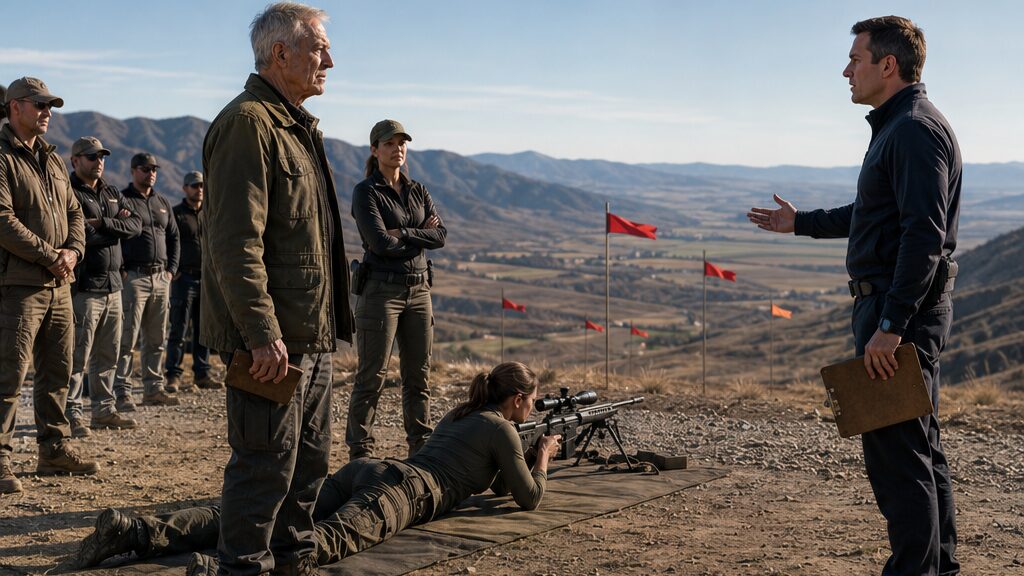
The Wind Flag Nobody Checked Until Daniel Miller Refused To Take The Shot
Chapter 1: The Shot Daniel Would Not Approve
The orange wind flag was moving the wrong way.
Daniel Miller noticed it before he noticed anything else.
The flag stood halfway down the valley, faded by years of sun and dust. Every other flag along the firing lane drifted gently from left to right. That one twisted sharply in the opposite direction, snapping once before going still.
Daniel narrowed his eyes.
Something wasn’t right.
Around him, the qualification range was already awake. Trainees moved between benches carrying rifles and data books. Instructors checked equipment. A line of observers stood behind the firing positions.
No one seemed interested in the flag.
No one except him.
He looked beyond it, across the shallow valley where heat shimmered above the rocky ground. The morning air felt calm near the firing line. Farther out, subtle currents moved differently.
The valley was breathing.
He had seen it before.
Not often.
But enough.
“Morning, Daniel.”
He turned.
Melissa Davis walked toward him holding a clipboard.
“Morning.”
She followed his gaze.
“What are you looking at?”
“The orange flag.”
Melissa squinted.
“The one by marker six?”
“Yeah.”
She studied it for a moment.
“I don’t see anything.”
Daniel nodded.
“That’s the problem.”
Melissa smiled politely. She had worked with him long enough to know he wasn’t joking.
“What is it?”
“I don’t know yet.”
That answer seemed to satisfy her less than usual.
Before she could ask another question, a voice carried across the range.
“Let’s move.”
Ryan Wilson.
The new training director strode toward the firing line with quick, confident steps.
He wasn’t rude.
That almost made things harder.
He simply believed the future belonged to people like him.
Digital systems.
Updated procedures.
Performance metrics.
Everything measurable.
Everything efficient.
Everything documented.
Ryan glanced toward Daniel.
“You ready for qualification day?”
Daniel nodded.
“As ready as yesterday.”
Ryan laughed.
“Good.”
Then he kept walking.
The conversation was over before it started.
Daniel watched him go.
Thirty years ago he had probably sounded exactly the same.
That thought bothered him more than Ryan did.
A few minutes later Sarah Johnson settled behind her rifle.
She was one of the strongest trainees in the class.
Steady.
Disciplined.
Smart.
Too eager to trust equipment.
Not eager enough to trust uncertainty.
Daniel had spent months trying to teach the difference.
The target sat nearly a thousand yards away.
Small.
White.
Motionless against a dusty hillside.
Observers gathered behind the firing position.
Among them stood William Thompson.
He folded his arms.
“This should be easy for her.”
Sarah heard him and smiled without looking up.
“Thanks for the pressure.”
William shrugged.
“You’ve hit harder shots.”
Ryan checked a tablet.
“Conditions are excellent.”
Daniel looked back toward the valley.
The orange flag snapped again.
Hard.
Brief.
Then stopped.
His stomach tightened.
Sarah settled behind the rifle.
Slow breath.
Exhale.
Focus.
The range became quiet.
Daniel watched her posture.
Nothing wrong there.
He watched the scope alignment.
Nothing wrong there.
He watched the wind flags.
Something wrong there.
Very wrong.
“Hold.”
His voice cut through the silence.
Sarah lifted her head.
Ryan frowned.
“What?”
Daniel pointed downrange.
“Pause the shot.”
Nobody moved.
Ryan looked toward the flags.
“Why?”
Daniel didn’t answer immediately.
He watched the valley.
Waited.
Counted.
Three seconds.
Five.
Seven.
The orange flag flicked sharply again.
Opposite direction.
Different layer.
Different current.
“There.”
Ryan stared.
“I didn’t see anything.”
“I did.”
Ryan folded his arms.
“Daniel, our sensors show stable conditions.”
Daniel nodded.
“I know.”
“And Sarah’s solution is correct.”
“I know.”
“Then what’s the issue?”
Daniel kept his eyes on the valley.
“The valley isn’t agreeing with your sensors.”
A few trainees exchanged glances.
William sighed.
“Come on.”
Ryan’s expression tightened.
“You want to delay qualification because of one flag?”
Daniel finally looked at him.
“No.”
The answer surprised Ryan.
Daniel pointed again.
“I want to delay it because that flag is telling me something.”
Ryan glanced toward the observers.
Daniel could almost hear the calculations behind his eyes.
Schedule.
Evaluators.
Efficiency.
Delays.
Everything had a cost.
“You can’t quantify that.”
“No.”
Ryan waited.
Daniel waited too.
The silence stretched.
Sarah remained behind the rifle.
Unsure whether to move or stay.
Finally Ryan spoke.
“What’s your recommendation?”
“Ten minutes.”
“Based on?”
“The flag.”
A few trainees laughed quietly.
Not maliciously.
Just disbelief.
Daniel felt the sting anyway.
Ryan rubbed his forehead.
“We have wind sensors.”
“I know.”
“We have ballistic software.”
“I know.”
“We have weather reports.”
Daniel nodded.
“I know.”
Ryan exhaled slowly.
Then he made his decision.
“We proceed.”
Nobody looked surprised.
Daniel wasn’t surprised either.
What surprised him was how tired he suddenly felt.
Not angry.
Just tired.
Ryan turned toward Sarah.
“Continue.”
Daniel stepped forward.
“No.”
The word landed heavily.
Everyone looked at him.
Ryan stared.
“What do you mean no?”
“I won’t approve the shot.”
The range fell silent.
Even the wind seemed to stop.
Ryan’s expression hardened.
“You’re refusing?”
“I’m refusing to authorize it.”
“On what authority?”
Daniel met his gaze.
“The authority you hired me for.”
Nobody spoke.
Sarah looked from one man to the other.
The pressure shifted from the target to the firing line.
Daniel could feel dozens of eyes on him.
Some confused.
Some irritated.
Some sympathetic.
Most doubtful.
Ryan lowered his voice.
“You really think you’re right?”
Daniel looked toward the orange flag.
It hung still now.
Quiet.
Harmless.
Almost ridiculous.
“I think something out there isn’t behaving the way it should.”
“And if you’re wrong?”
Daniel hesitated.
That question mattered.
Because age had not removed uncertainty.
Only arrogance.
“If I’m wrong,” he said quietly, “we lose ten minutes.”
Ryan looked at the waiting evaluators.
Then at the trainees.
Then back at Daniel.
“You don’t make that decision anymore.”
The words were calm.
Professional.
And somehow worse because of it.
Ryan turned toward Sarah.
“Qualification will proceed.”
Daniel said nothing.
What would be the point?
Sarah swallowed.
She looked at him.
For a second he thought she might ask a question.
Instead she lowered her face back behind the rifle.
The range officer called readiness.
The observers stepped back.
Daniel remained standing.
Watching.
Waiting.
The orange flag moved once.
Then stopped.
Sarah’s finger settled on the trigger.
Chapter 2: Too Old For The New System
The shot struck six inches left of center.
Good enough to pass.
Good enough to satisfy the evaluators.
Good enough to make Daniel’s concern look foolish.
The target came back with a clean qualification score.
Ryan didn’t celebrate.
He simply looked vindicated.
Which somehow felt worse.
The rest of the day moved forward without incident.
At least on the surface.
By afternoon Daniel sat alone in the training office, turning pages in his weathered notebook.
The cover was cracked.
The corners softened from years of use.
Every page carried observations.
Wind shifts.
Terrain effects.
Temperature changes.
Mistakes.
Lessons.
Things worth remembering.
Most of it would mean nothing to someone else.
To Daniel, it was a map of thousands of hours spent watching people miss details.
A knock sounded at the door.
Ryan entered.
“Got a minute?”
Daniel closed the notebook.
“Sure.”
Ryan remained standing.
That told Daniel everything.
This wasn’t a visit.
It was a meeting.
“Today’s incident caused concern.”
Daniel nodded.
“I figured.”
“You publicly challenged a qualification call.”
“I did.”
Ryan sat across from him.
For a moment neither spoke.
Then Ryan sighed.
“I respect your experience.”
Daniel almost smiled.
Whenever someone started with that sentence, trouble followed.
“But?”
Ryan noticed.
“Yeah. But.”
Daniel leaned back.
“Go ahead.”
Ryan tapped a folder against his knee.
“We’re restructuring the program.”
Daniel already knew.
Rumors had circulated for months.
Now they had become plans.
“How much restructuring?”
“Several positions are being consolidated.”
Daniel waited.
“You’ll move into an advisory role.”
There it was.
Not retirement.
Not dismissal.
Something softer.
Harder to argue against.
“Meaning?”
“You’ll mentor instructors.”
“Not trainees.”
Ryan hesitated.
“Mostly instructors.”
Daniel looked toward the range outside the window.
Tiny figures moved across the distant firing line.
The work he actually cared about.
“I see.”
Ryan shifted uncomfortably.
“I know this isn’t ideal.”
“No,” Daniel said. “It’s not.”
The younger man rubbed his neck.
“We need consistency.”
“You need efficiency.”
“That’s part of it.”
Daniel nodded.
At least Ryan was honest.
“We’re not pushing you out.”
Ryan meant it.
That was the difficult part.
He genuinely believed he was improving things.
Daniel had met officers like him throughout his career.
Competent.
Driven.
Certain.
Sometimes certainty caused more damage than ignorance.
Ryan stood.
“We’ll talk more next week.”
When the door closed, silence filled the room.
Daniel stared at the notebook.
For the first time in years he wondered whether he should simply stop.
Finish the season.
Walk away.
Let someone else worry about wind flags.
The thought lingered longer than he expected.
Near sunset another knock interrupted him.
Sarah stood outside.
“Am I bothering you?”
“No.”
She stepped inside.
Awkward.
Thoughtful.
Different from this morning.
Daniel waited.
Eventually she spoke.
“Why did you stop the shot?”
He studied her face.
Not defensive.
Curious.
That mattered.
“What do you think?”
She considered.
“You saw something.”
“Yes.”
“What?”
Daniel opened the notebook.
Flipped through several pages.
Then turned it toward her.
The entries meant nothing at first.
Numbers.
Arrows.
Distances.
Tiny sketches.
“What am I looking at?”
“Range observations.”
She frowned.
“Over how long?”
“Twenty-three years.”
Her eyes widened.
Daniel pointed to a drawing.
A small valley.
Several wind markers.
One highlighted circle.
Marker six.
The orange flag.
Sarah looked up.
“The same flag?”
“The same location.”
She examined the page again.
“There are dozens of notes.”
“Hundreds.”
“What does it mean?”
Daniel leaned forward.
“That valley creates layered wind.”
She frowned.
“The sensors didn’t show it.”
“I know.”
“Then how do you know?”
Daniel smiled faintly.
“Because valleys don’t read reports.”
Sarah laughed despite herself.
Then grew serious again.
“You really thought the shot was wrong?”
Daniel considered the question carefully.
“No.”
She looked confused.
“I thought the conditions were wrong.”
The distinction settled between them.
Subtle.
Important.
Sarah stared at the notebook.
“You knew I would still hit.”
“Probably.”
“Then why stop it?”
Daniel closed the notebook.
“Because one day you’ll face a shot that doesn’t forgive assumptions.”
Neither spoke for a moment.
Outside, the last light faded across the range.
Finally Sarah nodded.
Not agreement.
Not yet.
But something close.
As she reached the door she paused.
“Do you still think the flag mattered?”
Daniel looked toward the darkening valley.
“I know it mattered.”
Sarah stood there another second.
Then asked quietly,
“How?”
Daniel smiled.
“That’s what you need to figure out.”
She left.
Daniel remained alone.
For the first time all day, he felt slightly less tired.
Chapter 3: What The Scope Could Not Show
A week later Sarah found herself staring at the orange wind flag.
Again.
The range looked different now.
Not because anything had changed.
Because she was paying attention.
Daniel stood several yards away speaking with another trainee.
He wasn’t watching her.
At least she didn’t think he was.
That somehow made it harder.
She settled behind her rifle.
Checked her data.
Confirmed distance.
Verified wind readings.
Everything looked normal.
Exactly as it had during qualification.
And yet she couldn’t stop thinking about that notebook.
Twenty-three years of observations.
Not opinions.
Observations.
The distinction bothered her.
“Ready?”
William Thompson dropped beside her.
“Yeah.”
“You’ve been staring at that flag all morning.”
Sarah glanced at him.
“Maybe.”
William laughed.
“Daniel got into your head.”
“Maybe.”
“That’s dangerous.”
Sarah looked back through the spotting scope.
Far downrange the orange flag hung lazily in the morning air.
“Why?”
“Because next thing you know you’ll be measuring clouds.”
She smiled.
Maybe a week ago she would have agreed.
Now she wasn’t sure.
The exercise began.
Several trainees fired.
Impacts landed close to center.
Everything appeared normal.
Then Daniel walked over.
He crouched beside Sarah.
“See anything?”
She followed his gaze.
“No.”
“Good.”
She lowered the rifle.
“Good?”
“If you immediately see it, you’re probably imagining it.”
Sarah frowned.
Daniel pointed toward the valley.
“Watch for ten minutes.”
“Ten?”
“That’s shorter than twenty-three years.”
He stood and walked away.
William shook his head.
“I don’t know how he talks in riddles all day.”
Sarah couldn’t help laughing.
Still, she watched.
Minute after minute.
Nothing.
Then something.
A flicker.
The orange flag moved.
Not much.
Just enough.
She looked farther downrange.
The nearest flags still pointed another direction.
A few seconds later they aligned again.
Normal.
Ordinary.
Easy to miss.
Sarah sat up straighter.
Later that morning Daniel led a terrain-reading exercise.
No scopes.
No electronics.
No software.
Just observation.
The trainees hated it.
Which was probably why he kept assigning it.
“What do you see?” Daniel asked.
Nobody answered.
William finally shrugged.
“Hills.”
A few people laughed.
Daniel nodded.
“Fair.”
He pointed toward the valley.
“What else?”
Silence.
Sarah studied the landscape.
Dry grass.
Rock shelves.
Shallow depressions.
A narrow channel cutting through the center.
Then she noticed something.
“The wind doesn’t move through it evenly.”
Daniel glanced toward her.
The smallest hint of approval crossed his face.
“What makes you say that?”
She pointed.
“The terrain funnels it.”
“Sometimes.”
Sarah continued studying.
“Not always.”
Daniel nodded.
“Now we’re getting somewhere.”
The exercise lasted another hour.
By the end Sarah’s head hurt.
Not from complexity.
From realizing how much she usually ignored.
That afternoon a minor incident interrupted training.
A trainee fired during a sudden shift.
The round missed wide.
Not dangerously.
Not dramatically.
But farther off than expected.
The range briefly halted operations.
Melissa Davis reviewed conditions.
Ryan Wilson reviewed equipment data.
The trainee blamed himself.
Everyone seemed ready to move on.
Except Daniel.
Sarah watched him walk toward the valley with his notebook.
Alone.
As usual.
Later she found him near marker six.
The orange flag fluttered above them.
“What are you doing?”
Daniel finished writing before answering.
“Looking.”
“At what?”
“The same thing I’ve been looking at for years.”
Sarah stared across the valley.
“It caused the miss?”
Daniel closed the notebook.
“No.”
The answer surprised her.
Then he added,
“But it helped.”
She waited.
Daniel touched the weathered cover.
“The problem is everybody wants one answer.”
“There isn’t one?”
“There rarely is.”
Wind lifted the flag.
For a moment it pointed directly toward them.
Then away again.
Sarah watched carefully.
This time she saw the delay.
The hesitation.
The strange inconsistency.
Small.
But real.
“What happens if nobody notices?” she asked.
Daniel looked across the range.
“Then people start trusting certainty more than reality.”
The words stayed with her.
As they walked back toward the firing line, she glanced over her shoulder.
The orange flag twisted sharply against the others.
Just for a second.
This time she knew she wasn’t imagining it.
And for the first time, she wondered whether Daniel had been seeing something far bigger than a missed shot.
Chapter 4: The Valley Between Targets
The notebook grew heavier every week.
Not physically. It weighed the same as it always had.
But each new entry felt like another argument nobody wanted to hear.
Daniel sat alone beneath the shade structure overlooking the extended-range course. A dry wind drifted through the valley below, carrying dust across the rocky terrain.
He opened the notebook.
Marker six.
Unusual reversal.
Morning.
Increasing frequency.
He added the date.
Then paused.
A shadow fell across the page.
Melissa stood beside him.
“You’ve been writing a lot lately.”
Daniel closed the notebook.
“Maybe.”
“You ever think about putting all that into a report?”
He smiled faintly.
“I’ve written reports.”
“And?”
“People read reports when they already agree with them.”
Melissa laughed quietly.
Unfortunately, she understood exactly what he meant.
She sat beside him.
“Ryan isn’t trying to ignore you.”
“I know.”
“Then why do you look like you want to retire every time he walks into a room?”
Daniel looked out toward the valley.
Far below, a wind flag shifted.
Not the orange one.
Another.
The pattern was spreading.
“I spent most of my life teaching people to pay attention.”
Melissa waited.
“And now?”
“Now everyone wants faster answers.”
She considered that.
“Maybe they’re under pressure too.”
Daniel nodded.
“Maybe.”
Neither spoke for a while.
The range echoed with distant rifle fire.
Controlled.
Measured.
Familiar.
Sounds that had shaped most of Daniel’s adult life.
Eventually Melissa stood.
“Qualification event is next month.”
Daniel looked up.
“What qualification event?”
“The regional evaluation.”
That got his attention.
Every trainee in the program knew what that meant.
Outside evaluators.
Performance reviews.
Funding decisions.
Leadership scrutiny.
Pressure.
Lots of pressure.
“When was that decided?”
“Last week.”
Daniel frowned.
“No one told me.”
Melissa’s expression answered before she spoke.
“You weren’t in the meeting.”
The words landed harder than she intended.
Daniel looked back toward the valley.
“Right.”
She hesitated.
“I’m sorry.”
“No need.”
But there was.
Not because he had been excluded.
Because he hadn’t been surprised.
Later that afternoon Sarah joined him during terrain analysis.
The exercise required trainees to identify hidden influences across a firing corridor.
Most disliked it.
Sarah no longer did.
“Marker six again?” she asked.
Daniel nodded.
“Always marker six.”
She studied the valley.
“I’ve been watching it.”
“And?”
“I still can’t predict it.”
“Good.”
Sarah looked annoyed.
“You keep saying that.”
“Because certainty is dangerous.”
She crossed her arms.
“You know that’s frustrating.”
Daniel smiled.
“I know.”
They spent the next hour observing conditions.
No rifles.
No targets.
Just terrain.
Wind.
Time.
The kind of work modern systems rarely rewarded.
As they packed up, Sarah pointed toward the orange flag.
“Look.”
Daniel followed her gaze.
The flag snapped sharply.
Then another flag farther downrange responded several seconds later.
A delay.
Small.
But measurable.
Daniel’s expression changed.
Sarah noticed immediately.
“What?”
He opened the notebook.
Flipped pages.
Compared dates.
Then stared across the valley.
“What is it?”
Daniel didn’t answer.
He was thinking.
Connecting observations months apart.
The delay was increasing.
Not random.
Consistent.
Subtle.
Enough to matter.
Not enough to convince anyone.
Yet.
That evening Ryan stopped him outside the administration building.
“You got a minute?”
Daniel nodded.
Ryan held a folder.
“The evaluation team wants standardized qualification procedures.”
Daniel already disliked where the conversation was heading.
“Okay.”
“They don’t want discretionary delays.”
Daniel stared at him.
“What does that mean?”
“It means instructors can’t stop events based on intuition.”
The word irritated him more than it should have.
Intuition.
As if twenty years of observation were a feeling.
Ryan noticed the reaction.
“I didn’t write the policy.”
“No.”
“But you’re enforcing it.”
Ryan sighed.
“They want consistency.”
Daniel looked toward the range.
The orange flag was barely visible in the fading light.
“Consistency isn’t the same thing as accuracy.”
Ryan folded the folder under his arm.
“Daniel.”
His voice softened.
For once there was no argument.
Only concern.
“When was the last time you considered stepping back?”
The question lingered.
Daniel felt older hearing it than he had that morning.
“I consider it all the time.”
Ryan looked surprised.
“You do?”
Daniel nodded.
“Every week.”
The younger man seemed unsure what to say.
Eventually he settled on honesty.
“I don’t want you gone.”
Daniel almost believed him.
Almost.
“But you don’t want me making decisions.”
Ryan didn’t answer.
Which was answer enough.
That night Daniel sat alone at his kitchen table.
The notebook lay open.
Page after page.
Years of observations.
Thousands of small details.
He ran his hand across the worn cover.
Maybe Ryan was right.
Maybe it was time.
The thought stayed with him longer than usual.
For the first time he imagined closing the notebook forever.
No more ranges.
No more trainees.
No more arguments about things nobody noticed.
The idea should have felt peaceful.
Instead it felt empty.
His phone buzzed.
A message from Sarah.
One sentence.
I think the valley is teaching me something.
Daniel looked at it for a long time.
Then smiled despite himself.
The notebook remained open.
Chapter 5: Everyone Watching The Wrong Thing
Qualification day arrived beneath a bright, cloudless sky.
Perfect conditions.
At least according to every report.
Vehicles lined the access road.
Visiting evaluators moved between stations.
Clipboards appeared everywhere.
Performance boards were mounted beside the firing line.
The atmosphere felt less like training and more like judgment.
Daniel hated days like this.
Not because of pressure.
Because pressure made people stop seeing.
They became obsessed with scores.
Numbers.
Rankings.
Outcomes.
Everything except the process that produced them.
Sarah checked her rifle beside the firing line.
Across the range, William was already talking about qualification scores.
“You’ll finish near the top.”
Sarah tightened a scope mount.
“Maybe.”
“You sound nervous.”
She looked toward the valley.
The orange wind flag moved gently.
Then paused.
“No.”
William followed her gaze.
“Oh no.”
She laughed.
“What?”
“You’re looking at the flag again.”
“Maybe.”
“Daniel definitely got into your head.”
Sarah smiled but didn’t answer.
Because she wasn’t watching the flag.
She was watching the terrain around it.
There was a difference.
Nearby, Ryan greeted the visiting evaluators.
Everything seemed under control.
Everything looked professional.
Everything looked exactly how Ryan wanted it.
Daniel stood farther back from the firing positions.
Officially present.
Unofficially sidelined.
His role during the event had been reduced to observation.
No qualification authority.
No final approval.
No discretionary delays.
Observe only.
The title sounded harmless.
The reality did not.
Melissa approached.
“How are you holding up?”
Daniel shrugged.
“I’ve had worse days.”
She handed him a cup of coffee.
“You’re lying.”
He accepted the cup.
“Probably.”
They watched the firing line together.
The first relay began.
Shots echoed through the valley.
Targets moved.
Scores accumulated.
Evaluators nodded approvingly.
Everything worked.
Almost.
Daniel noticed the first warning sign before noon.
A distant flag changed direction.
Then recovered.
Minutes later another did the same.
Melissa noticed him watching.
“What?”
“Nothing yet.”
She frowned.
“I hate when you say that.”
“So do I.”
The second relay started.
A trainee missed farther than expected.
Not enough to fail.
Enough to raise eyebrows.
Equipment was checked.
Ballistics reviewed.
Nothing seemed wrong.
The event continued.
Daniel looked toward the orange flag.
Its movement had become erratic.
Not dramatic.
Worse.
Subtle.
Easy to dismiss.
Sarah saw it too.
When their eyes met across the range, neither said anything.
Neither needed to.
By afternoon the valley felt different.
The air had changed.
Daniel could feel it.
Not through instinct.
Through repetition.
Years of watching the same terrain.
The same ridges.
The same wind paths.
The same mistakes.
Ryan walked over.
“Everything okay?”
Daniel looked at him.
“No.”
Ryan sighed immediately.
“What’s wrong now?”
Daniel pointed toward the valley.
“The pattern’s getting stronger.”
Ryan followed his gesture.
“I don’t see anything.”
“I know.”
“Then help me.”
Daniel hesitated.
He wanted to.
But explanations without evidence sounded like excuses.
Especially today.
Finally he said, “Watch the flags, not individually. Watch the delay between them.”
Ryan studied the range.
For several seconds nothing happened.
Then a flag moved.
Another followed.
Then another.
Tiny delays.
Easy to overlook.
Ryan frowned.
Still unconvinced.
“Could be normal.”
“Could be.”
The answer irritated Ryan.
“You always do that.”
“Do what?”
“Refuse certainty.”
Daniel almost laughed.
“That’s because certainty is usually wrong.”
Before Ryan could respond, an announcement echoed across the range.
Final qualification relay.
Sarah’s relay.
The range grew quieter.
Observers gathered behind the firing positions.
Evaluators moved closer.
The atmosphere tightened.
Daniel looked toward the orange flag.
The fabric twisted sharply.
Harder than before.
Then settled.
His stomach sank.
The valley was changing again.
And nobody except Sarah seemed to be watching.
As she moved into position behind the rifle, Daniel opened his notebook.
For the first time in weeks, he began flipping rapidly through old entries.
Searching.
Comparing.
Looking for something he had missed.
Then he found it.
A note written seven years earlier.
One sentence circled twice.
Delayed cross-valley reversal before major shift.
Daniel stared at the page.
Then toward the valley.
Then back to the page.
The pattern was happening again.
Exactly again.
Sarah settled behind the rifle.
The range officer called readiness.
And Daniel suddenly realized the next shot might decide far more than a qualification score.
Chapter 6: The Detail Hidden In Plain Sight
Daniel walked toward the firing line before he consciously decided to move.
The notebook remained open in his hand.
The circled note stared back at him.
Seven years old.
Written after a weather anomaly during an advanced training course.
At the time, the shift had arrived minutes after the warning signs appeared.
Most people never noticed.
Daniel had.
And now the valley was repeating itself.
Sarah was already behind the rifle.
The target sat nearly a thousand yards away.
Observers crowded behind the line.
Evaluators watched closely.
Ryan stood near the scoring table.
Everything was ready.
Everything except the conditions.
“Hold.”
Daniel’s voice carried farther than he intended.
Several heads turned.
Ryan closed his eyes briefly.
Not again.
Daniel reached the firing position.
Sarah looked up immediately.
She saw the notebook.
She saw his expression.
“What is it?”
Daniel pointed toward the valley.
“The delay.”
Ryan approached.
“We’ve been through this.”
Daniel handed him the notebook.
“Read that.”
Ryan glanced down.
His eyes moved across the page.
Nothing more.
No dramatic reaction.
No revelation.
Just confusion.
“This is an old note.”
“Yes.”
“That’s not evidence.”
“No.”
Daniel looked toward the flags.
“It’s a warning.”
The orange flag snapped sharply.
A second later another flag responded.
Then another.
The chain moved across the valley.
Visible now.
Barely.
But visible.
Melissa stared.
For the first time, she saw it.
“What is that?”
Daniel exhaled.
Finally.
Someone else had noticed.
“The wind isn’t crossing the valley.”
He pointed toward the terrain.
“It’s rotating inside it.”
Ryan looked again.
Sarah followed the movement carefully.
Daniel knelt beside her.
His voice stayed calm.
Not urgent.
Not dramatic.
Teaching voice.
The same voice he had used for decades.
“Look at the ridgeline.”
Sarah focused.
“Okay.”
“Now the depression beneath it.”
She nodded.
“The air is dropping.”
“Yes.”
Daniel pointed farther left.
“And then?”
Her eyes followed the terrain.
Suddenly she understood.
The answer appeared not in the flag but in the land itself.
“It loops.”
Daniel nodded.
“Exactly.”
The valley wasn’t carrying wind straight across.
It was folding it back.
Creating delayed reversals.
Small at first.
Then stronger.
Sarah looked through the spotting scope again.
Everything changed.
The target remained the same.
The rifle remained the same.
The data remained the same.
Only her understanding changed.
And that changed everything.
Ryan remained silent.
Not convinced.
Not dismissive.
Somewhere between.
The range officer checked his watch.
“We need a decision.”
Nobody spoke immediately.
Daniel looked toward Sarah.
Not the target.
Not Ryan.
Sarah.
Because this wasn’t his shot.
It was hers.
“What do you think?” he asked.
She blinked.
“You want my decision?”
“Yes.”
For a moment the noise of the range disappeared.
Only wind remained.
Sarah watched the flags.
The terrain.
The valley.
The delay.
Things she would never have seen a month ago.
Then she lowered the rifle.
“Not yet.”
Silence.
The evaluators exchanged glances.
Ryan stared at her.
“You want to delay?”
Sarah nodded.
“Five minutes.”
Not because Daniel told her to.
Because she finally understood why he had.
Daniel felt something loosen inside his chest.
Not relief.
Something deeper.
The range officer reluctantly suspended the relay.
Five minutes.
Observers complained quietly.
Schedules shifted.
Evaluators checked watches.
Nobody applauded.
Nobody announced that Daniel had been right.
The valley did not care about being right.
It simply kept moving.
Four minutes later the shift arrived.
Visible.
Undeniable.
Flags across the range changed direction almost simultaneously.
Dust lifted from the depression below the ridgeline.
Even Ryan saw it.
The expression on his face wasn’t embarrassment.
It was realization.
A different thing entirely.
Sarah watched the terrain settle.
Then repositioned behind the rifle.
Daniel stood beside her.
Neither spoke.
Nothing remained to explain.
The shot belonged to her now.
She inhaled slowly.
Exhaled.
Waited.
The valley steadied.
The orange flag relaxed.
The rifle cracked.
The sound rolled through the range.
The distant target disappeared briefly behind dust.
Nobody could immediately tell the result.
The scoring team began its work.
Observers leaned forward.
Evaluators whispered.
Daniel closed the notebook.
For the first time all day, he stopped watching the flags.
Instead he watched Sarah.
And whatever the score turned out to be, he knew something important had already happened.
She had learned to see.
The result took longer than anyone expected.
Long enough for uncertainty to settle over the range.
Long enough for everyone to wait.
Long enough for Daniel to remember why patience mattered.
Then the target report finally arrived.
Chapter 7: The Lesson That Stayed Behind
The target report showed a near-perfect impact.
Not the best score of the day.
Not a record.
Not something that would be remembered outside the range.
Yet for a moment nobody spoke.
The evaluators examined the report twice.
Sarah remained behind the rifle.
Daniel stood beside her.
The score itself wasn’t what mattered.
The timing was.
The shot had been taken after the shift.
After the delay.
After the valley settled.
Ryan looked from the report to the range.
Then toward the orange flag.
The faded fabric moved gently in the afternoon breeze.
Nothing dramatic.
Nothing that announced victory.
Just a piece of cloth doing what it had always done.
Showing anyone willing to watch.
The event finished without further incident.
People packed equipment.
Vehicles departed.
Evaluators gathered paperwork.
The day quietly became another completed qualification exercise.
Most would remember scores.
Daniel would remember the delay.
As he always did.
Weeks passed.
Summer began to fade.
The heat softened.
The mornings arrived cooler.
Life at the range returned to its familiar rhythm.
One morning Daniel walked onto the firing line carrying his notebook.
The pages were fuller than ever.
The cover looked even more worn.
Yet somehow it felt lighter.
Several trainees greeted him.
Not because he was in charge.
Because they wanted to.
That difference mattered.
Near marker six, workers were installing a new wind flag.
Daniel stopped.
The fresh orange fabric stood beside the old faded one.
The contrast made him smile.
The new flag was bright.
Sharp.
Confident.
The old flag looked weathered and overlooked.
Like it had spent years trying to tell people something.
Sarah approached carrying a rifle case.
“You saw it.”
Daniel nodded.
“The new marker.”
Melissa walked over.
“We’re updating the observation stations.”
Daniel raised an eyebrow.
“Observation stations?”
Melissa smiled.
“Ryan’s idea.”
That surprised him.
A little.
Not entirely.
A week after qualification, Ryan had requested access to Daniel’s notebooks.
Not all of them.
Just the sections about terrain effects and delayed wind reversals.
Daniel had expected them to disappear into a filing cabinet.
Apparently they had not.
Sarah touched the old flagpole.
“They’re adding terrain observation training to qualification.”
Daniel looked at her.
“Really?”
“Required training.”
Melissa laughed.
“You caused paperwork.”
“That’s never been my goal.”
“Still happened.”
For a few moments they watched workers secure the new flag.
The old one remained in place.
Ryan had insisted on that.
According to Melissa, removing it had felt wrong.
Daniel never commented on that decision.
Privately, he appreciated it.
Later that morning Ryan found him near the range office.
Neither man seemed entirely comfortable.
That had become normal.
“You have a minute?” Ryan asked.
Daniel nodded.
Ryan held a folder.
For a second Daniel thought they were about to revisit old arguments.
Instead Ryan handed him a document.
“What is this?”
“Next season’s staffing plan.”
Daniel opened it.
His eyes moved across the page.
Then stopped.
Senior Mentor Instructor.
The title appeared beside his name.
Daniel looked up.
“I thought I was moving into advisory work.”
“You were.”
Ryan shoved his hands into his pockets.
Then corrected himself.
“I thought you were.”
The distinction wasn’t lost on either man.
Daniel closed the folder.
“You changed your mind.”
Ryan nodded.
“Partly.”
He looked toward the range.
The orange flags were visible in the distance.
Both of them.
Old and new.
“I kept thinking about qualification day.”
Daniel waited.
Ryan continued.
“I wasn’t wrong about modernization.”
“No.”
“I still believe in the systems.”
Daniel nodded.
“So do I.”
That surprised Ryan.
Then Daniel added, “I just don’t believe they see everything.”
A faint smile appeared on Ryan’s face.
“Yeah.”
For the first time, neither felt the need to defend themselves.
The conversation remained simple.
Human.
Ryan looked down.
“When you stopped that first qualification shot…”
He paused.
“I thought you were holding on too tightly.”
Daniel didn’t answer.
Ryan continued.
“Now I think you were paying attention.”
The words weren’t dramatic.
They didn’t need to be.
Recognition rarely arrived that way.
Sometimes it arrived quietly.
Like a correction.
Like an adjustment to aim.
Ryan extended his hand.
Daniel shook it.
No speeches followed.
No grand reconciliation.
Just understanding.
That afternoon Sarah joined Daniel on the observation platform overlooking the valley.
The same valley.
The same ridgeline.
The same deceptive terrain.
The notebook rested between them.
“What happens when you retire?” she asked.
Daniel laughed.
“You ask that like it’s inevitable.”
“It is.”
“Probably.”
Sarah looked across the range.
The new flag moved.
The old flag answered a moment later.
A tiny delay.
Almost invisible.
She noticed it immediately.
Daniel noticed her noticing.
Neither mentioned it.
Finally Sarah said, “I used to think marksmanship was about hitting the target.”
Daniel leaned back.
“And now?”
“It’s about seeing what other people miss.”
The answer pleased him more than any qualification score ever could.
Below them, trainees prepared for another day of shooting.
Some checked scopes.
Some checked weather reports.
A few looked toward the flags.
That was new.
The wind moved through the valley.
Not straight.
Never straight.
The terrain bent it.
Redirected it.
Changed it.
Just as experience changed people.
The notebook sat open.
For the first time in years, Daniel didn’t feel the need to write anything down.
Not because there was nothing left to learn.
Because someone else had started learning too.
The old orange flag fluttered beside the new one.
Neither seemed more important than the other.
Together they marked the same lesson.
Watch carefully.
Look longer.
Do not mistake confidence for understanding.
And never assume that something old has stopped teaching.
The story has ended.