When Everyone Ignored Deborah’s Warning About the Mountain Road Until the Fire Reached the Snow
Chapter 1: The Smoke Rising Against the Snow
The smoke should not have been there.
Deborah Walker stood on the overlook with one gloved hand resting against a weather-beaten fence post, staring across the white valley. Snow fell in slow sheets, soft enough to seem harmless, but she knew better. Storms in the mountains rarely announced their worst intentions at the beginning.
The dark column rose from the eastern road, thin but steady.
Not wildfire smoke.
Engine smoke.
Too much of it.
She narrowed her eyes.
A convoy of county vehicles crawled along the lower route, barely visible through drifting snow. Behind them, farther up the mountain, a single fuel truck moved where it had no business moving.
Deborah felt a small knot tighten in her stomach.
The county had evacuated people from the western ridge every winter storm season for years. The procedure wasn’t complicated. Dangerous materials stayed on designated routes. Fuel deliveries waited.
Yet there it was.
The truck was climbing.
She reached into her coat pocket and pulled out a battered handheld radio.
The tape wrapped around one side had yellowed with age.
Most people thought she carried it because old people liked holding on to things.
The truth was simpler.
She trusted equipment she knew.
The radio crackled softly.
“Operations Center to all road crews. Visibility dropping below one hundred yards.”
Deborah lifted the binoculars hanging from her neck.
The fuel truck slowed near a switchback.
A plume of powder snow rolled behind it.
She watched carefully.
Not the truck.
The road.
The snow.
The terrain.
The mountain always told its story first.
People rarely listened.
A gust of wind swept across the overlook.
For a moment the snow shifted and exposed darker patches beneath the fresh layer.
Deborah frowned.
The ridge had warmed briefly two days earlier before temperatures crashed again overnight.
Freeze-thaw cycles.
Hidden weakness.
Fresh snow covering old instability.
She lowered the binoculars.
The fuel truck disappeared around a bend.
Still wrong.
Something about the route felt wrong.
She turned and headed toward town.
The community shelter occupied an old school gymnasium. Pickup trucks filled the parking lot. Volunteers carried boxes through the snow while emergency vehicles came and went.
Inside, noise echoed from every direction.
Generators hummed.
Children cried.
Radios chirped.
People hurried.
Deborah moved through them carefully.
Nobody stopped her.
Nobody asked what she had seen.
A few nodded politely.
Most were too busy.
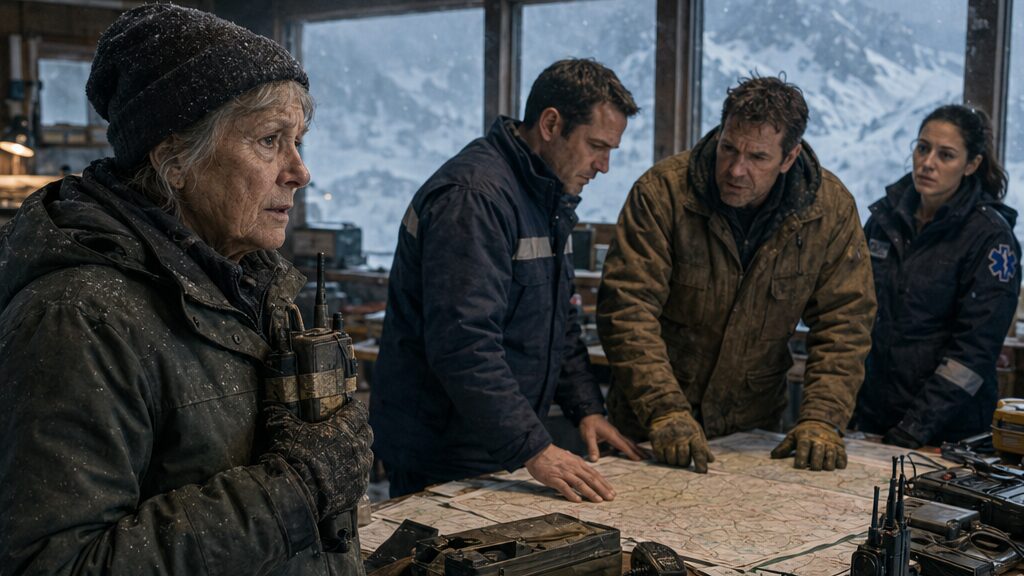
Near a folding table covered with maps, Brian Davis leaned over a laptop while Christopher Brown spoke with two road supervisors.
Deborah waited until Christopher finished.
“That fuel truck shouldn’t be on the eastern route.”
Christopher glanced up.
For a second she thought he hadn’t recognized her.
Then he smiled politely.
“Morning, Deborah.”
“Why is the truck climbing toward Granite Pass?”
Christopher shrugged.
“Road changes.”
“Whose?”
“The county’s.”
“Why?”
“We’re moving supplies ahead of the storm.”
Deborah studied the map.
The eastern route crossed older sections of mountain road.
Road sections she remembered from decades ago.
Road sections she had walked before satellite maps existed.
“You’ve got snowpack movement on that slope.”
Christopher shook his head.
“Our survey drones didn’t show anything.”
“Drones don’t see underneath fresh snow.”
“We checked.”
Deborah looked at him for several seconds.
Not angry.
Just disappointed.
Experience had taught her that arguing rarely improved listening.
“That road isn’t stable.”
Christopher folded his arms.
“Appreciate the concern.”
There it was.
The tone.
Polite dismissal.
The conversation ending before it began.
Brian finally glanced over.
“Everything okay?”
Christopher answered before Deborah could.
“Just discussing roads.”
Brian nodded and returned to his screen.
Meeting over.
Deborah stood still another moment.
Then she walked away.
Outside, snow drifted harder.
Nancy Robinson stepped out of a pickup truck carrying blankets.
“You’re freezing.”
“I’m fine.”
Nancy looked toward the mountains.
“You saw something.”
Deborah smiled faintly.
“You always know.”
“You get that face.”
“What face?”
“The one where you stop talking because nobody listened.”
Deborah laughed softly.
“I might have that face.”
Nancy handed her a thermos.
“What did you see?”
Deborah stared toward the eastern ridge.
“A road trying to pretend it’s stronger than it is.”
Nancy blinked.
“That sounds like one of your Army sayings.”
“It probably is.”
The smile faded.
“I hope I’m wrong.”
Nancy studied her carefully.
“You’re usually not.”
Deborah looked away.
That was exactly what worried her.
Hours passed.
The storm intensified.
By midday the mountains had vanished behind curtains of white.
Deborah remained near the shelter, helping unload supplies and check on elderly residents.
She tried not to think about the truck.
Tried.
Failed.
Every so often she stepped outside and scanned the slopes.
Listening.
Watching.
Waiting.
The same habit that had followed her home from military service decades earlier.
Not paranoia.
Observation.
A difference many people never understood.
Late in the afternoon she heard a radio transmission.
Brief.
Routine.
Easy to miss.
“Fuel transport proceeding east route. Estimated arrival delayed.”
Delayed.
Her eyes narrowed.
Delayed meant struggling.
The knot returned.
She crossed the parking lot and climbed into her old truck.
Twenty minutes later she reached the overlook again.
The storm had grown worse.
Visibility barely stretched beyond a few hundred yards.
Yet she could still see it.
A faint smear of dark smoke.
Higher now.
Closer to Granite Pass.
Deborah raised her binoculars.
The wind shifted.
For one brief moment the mountains revealed themselves.
She saw tracks.
Deep tracks.
Fresh tracks.
And beside them, a long fracture line cutting across the slope.
Her pulse quickened.
Not fear.
Certainty.
The road was beginning to fail.
The truck was directly above it.
She lowered the binoculars and reached for the radio.
“Operations Center.”
Static.
Then a response.
“Go ahead.”
“This is Deborah Walker.”
A pause.
She imagined the operator searching for the name.
“I’m reporting instability near Granite Pass.”
Silence.
Then:
“Copy.”
Nothing more.
No questions.
No urgency.
No request for details.
Just copy.
The most dangerous word in emergency communication.
Because sometimes it meant understood.
And sometimes it meant ignored.
Deborah stared at the mountains.
The smoke continued rising against the snow.
Chapter 2: Experience Nobody Requested
The emergency shelter smelled faintly of wet coats, coffee, and generator fuel.
By evening nearly every table inside the gymnasium was occupied.
Families sat together under donated blankets. Volunteers moved between rows carrying food trays. Outside, snow hammered the windows in steady bursts.
Deborah stood near the operations area, warming her hands around a paper cup.
Her radio rested on the table beside her.
Silent.
Nobody had followed up on her warning.
Not one question.
Not one request for coordinates.
Nothing.
Brian Davis walked past carrying a stack of printed weather reports.
“Brian.”
He stopped.
“Deborah.”
“I called in a report about Granite Pass.”
“I heard.”
“And?”
He glanced toward the maps.
“We’ve got a lot happening.”
“The road’s unstable.”
“We’ve got engineers looking at conditions.”
Deborah took a slow breath.
“I’ve walked those slopes.”
“Years ago.”
The words landed softly.
That somehow made them worse.
Brian wasn’t trying to insult her.
He genuinely believed the distinction mattered.
Years ago.
As though mountains reinvented themselves every decade.
As though gravity updated its policies.
“They’re still the same slopes,” Deborah said.
Brian offered a weary smile.
“Look, I appreciate it.”
Appreciate.
Another polite dismissal.
Another conversation ending before it began.
He moved on.
Deborah remained where she was.
The radio sat untouched.
Its worn casing reflected the fluorescent lights overhead.
For a moment she remembered another winter.
Different mountain.
Different storm.
Different uniform.
A young lieutenant ignoring a warning because a map looked cleaner than reality.
The memory disappeared as quickly as it arrived.
She rarely spoke about those years.
People either romanticized military service or treated it like ancient history.
Neither felt accurate.
Service had mostly taught her how often certainty became dangerous.
A sudden burst of static erupted from a nearby communication station.
Everyone looked up.
Then relaxed when the transmission proved routine.
Deborah noticed Stephanie Wilson watching her.
The younger woman approached carrying a medical supply box.
“You really think there’s a problem up there?”
Deborah considered the question.
“Yes.”
Stephanie shifted the box against her hip.
“What kind of problem?”
“The kind that starts small.”
“That’s not very specific.”
“No.”
Stephanie smiled.
At least she seemed curious rather than dismissive.
“What did you actually see?”
Deborah pointed toward a map hanging on the wall.
“See that ridge?”
Stephanie nodded.
“The snow there isn’t behaving normally.”
“What does that mean?”
“It means something underneath is moving.”
Stephanie looked doubtful.
“From binoculars?”
Deborah laughed quietly.
“Not from binoculars.”
“Then how?”
“From fifty years of watching mountains.”
Stephanie hesitated.
The answer clearly sounded unsatisfying.
Yet she didn’t walk away.
That alone made Deborah like her.
Christopher Brown joined them moments later.
“Still talking about Granite Pass?”
Deborah didn’t answer immediately.
Christopher shook his head.
“The sensors don’t show instability.”
“The sensors don’t walk the road.”
“They don’t need to.”
“Sometimes they do.”
Christopher sighed.
“Deborah, this isn’t 1975.”
“No.”
“Technology’s improved.”
“It has.”
“Then maybe trust it.”
Deborah met his eyes.
“Maybe trust the mountain.”
The conversation ended there.
Christopher turned away.
Stephanie watched him leave.
Then looked back at Deborah.
“You’re really sure.”
“Enough to worry.”
“What if you’re wrong?”
Deborah smiled faintly.
“That would be wonderful.”
For the first time Stephanie didn’t have a reply.
Hours passed.
The storm deepened.
Wind rattled the building.
Reports arrived from across the county.
Downed trees.
Blocked roads.
Power failures.
The room grew louder.
More chaotic.
More urgent.
Yet nobody mentioned Granite Pass.
Near midnight Deborah stepped outside.
The cold struck immediately.
Sharp and clean.
Snow drifted across the parking lot.
The mountains were hidden completely now.
Only darkness remained.
She switched on her radio.
Static.
Then voices.
Road crews.
Emergency services.
Shelter updates.
Nothing from the fuel truck.
She frowned.
The truck should have reported by now.
Should have checked in.
Should have reached its destination.
A simple absence settled heavily in her thoughts.
Not evidence.
Not proof.
Just one more detail.
One more thing that didn’t fit.
The gymnasium doors opened behind her.
Stephanie stepped outside.
“You haven’t gone home.”
Neither have you.”
“Fair.”
They stood together for a moment.
Watching snow move through the floodlights.
Finally Stephanie spoke.
“My grandfather used to do that.”
“Do what?”
“Stand outside and stare at weather.”
Deborah smiled.
“Did he know things?”
“Sometimes.”
“What kind of things?”
“The practical kind.”
Stephanie looked toward the mountains.
“He was usually right after everyone stopped arguing with him.”
The words surprised them both.
Silence followed.
Then a radio transmission crackled from Deborah’s hand.
Brief.
Broken.
Almost lost beneath static.
“…east route…”
“…delayed…”
“…visibility…”
Then nothing.
Deborah looked sharply toward the dark mountains.
Stephanie noticed immediately.
“What?”
Deborah didn’t answer.
Not because she didn’t want to.
Because she was listening.
Listening to what wasn’t said.
The radio remained silent.
And for the first time, Stephanie looked worried too.
Chapter 3: Tracks Beneath Fresh Snow
The next morning arrived without sunlight.
Only a gray glow filtering through storm clouds.
Deborah left before dawn.
The roads were nearly empty.
Snow covered everything.
Fence posts.
Mailboxes.
Road signs.
Entire sections of landscape seemed erased.
She parked near the lower access road leading toward Granite Pass.
The county had officially closed the route overnight.
A barricade blocked vehicle traffic.
No one stopped pedestrians.
Not yet.
Deborah slung binoculars around her neck and began walking.
The climb was slow.
Age demanded patience.
She accepted that.
What she refused to accept was the assumption that patience and weakness were the same thing.
The wind intensified as she gained elevation.
Fresh snow concealed most evidence.
Most.
Not all.
Tracks emerged gradually.
Truck tires.
Maintenance vehicles.
Footprints.
Deborah crouched beside one section.
The impressions sank deeper than expected.
Heavy load.
Soft foundation.
Not good.
She continued upward.
Several hundred yards later she found what she had been looking for.
The fracture.
Long.
Thin.
Almost invisible beneath fresh snow.
A wound stretching across the slope.
Her stomach tightened.
The mountain had shifted.
Not enough to trigger sensors.
Not enough to attract attention.
Enough to matter.
She photographed the area.
Measured distances.
Marked locations.
Then studied the surrounding terrain.
The truck route crossed directly above the weakest section.
Christopher had trusted the road.
The road had lied.
A vehicle approached from below.
Deborah turned.
A county pickup climbed slowly toward her.
Stephanie stepped out when it stopped.
“Please tell me you’re not hiking around a closed road alone.”
Deborah smiled.
“I was wondering when somebody would come looking.”
Stephanie trudged through the snow.
“You left a note.”
“I figured somebody should know where I went.”
“You found something?”
Deborah pointed toward the fracture line.
Stephanie stared.
At first she didn’t see it.
Then she did.
“Oh.”
“Exactly.”
The younger woman walked closer.
“The reports never mentioned this.”
“They wouldn’t.”
“Why?”
“Because yesterday it barely existed.”
Stephanie looked down the slope.
“Can I take pictures?”
“Please.”
Within minutes she was photographing everything.
Sending images.
Making calls.
Waiting for responses.
Most responses were frustratingly cautious.
Not dismissal.
Not belief.
Something in between.
Enough uncertainty to delay action.
Deborah expected nothing else.
The mountain rarely provided dramatic proof until it was too late.
A gust of wind swept snow across the roadway.
Stephanie checked her phone.
“No signal.”
“Try the radio.”
Stephanie looked at the old device.
“You still carry that thing everywhere.”
“It still works.”
She handed it over.
Moments later a voice answered.
The signal was weak but usable.
Stephanie relayed the information.
Coordinates.
Photos.
Observations.
Warnings.
The response came several minutes later.
“Copy.”
Deborah closed her eyes briefly.
The same word.
Again.
Stephanie lowered the radio.
“That’s it?”
“Usually.”
The younger woman looked annoyed.
For the first time Deborah felt something shift.
Not validation.
Trust.
A small beginning.
A distant engine echoed through the mountains.
Both women turned.
The sound faded.
Returned.
Then disappeared.
Stephanie frowned.
“What was that?”
Deborah scanned the slopes.
The answer came before she could speak.
The radio crackled violently.
Static exploded through the speaker.
Then a strained voice.
“…fuel transport…”
“…repeat…”
“…stuck…”
More static.
“…can’t…”
The transmission vanished.
Stephanie stared.
Deborah’s gaze remained fixed on the mountains.
Every muscle in her body seemed suddenly alert.
Not because she had been proven right.
Because the situation had changed.
The truck was no longer delayed.
The truck was in trouble.
And somewhere beyond the snowfall, something far worse was beginning.
Chapter 4: The Signal That Would Not Return
The transmission never came back.
Deborah held the radio close to her ear for nearly a minute after the voice disappeared into static.
Nothing.
Only the hiss of weather and distance.
Stephanie looked toward the mountain road.
“Can you tell where it came from?”
“Near Granite Pass.”
“Near isn’t much.”
“No.”
Deborah slipped the radio into her coat.
“But it’s enough.”
The younger woman stared uphill.
Snow drifted across the roadway in long white ribbons.
The mountain looked calm.
That was the problem.
Danger rarely looked dangerous from a distance.
They returned to the operations center before noon.
The atmosphere had changed.
People were still working.
Still moving.
Still making decisions.
But the confidence Deborah had seen the day before was thinner now.
Reports were arriving slower.
Road closures were increasing.
Power outages had spread farther than expected.
Brian stood beside a communications desk speaking with a radio operator.
When he noticed Deborah and Stephanie approaching, he ended the conversation.
“We heard the transmission.”
Deborah nodded.
“Any contact since?”
“No.”
“GPS?”
Brian shook his head.
“Signal’s gone.”
Stephanie placed her photographs from the fracture zone on the table.
“The road is worse than the reports show.”
Brian studied them.
His expression tightened slightly.
Not belief.
Concern.
A beginning.
Christopher arrived moments later.
Snow dusted his shoulders.
“We sent a maintenance vehicle toward the pass.”
“How far did it get?” Deborah asked.
“Not far.”
“Because?”
“The road collapsed near Marker Twelve.”
Deborah closed her eyes briefly.
Marker Twelve.
Exactly where she had expected trouble.
Christopher rubbed his forehead.
“The failure wasn’t major.”
“You don’t know that yet.”
“We know enough.”
“No,” Deborah said quietly. “You don’t.”
The room fell silent.
Christopher looked ready to argue.
Instead he looked away.
That worried Deborah more than anger would have.
Confidence disappears slowly.
Then all at once.
A deputy entered carrying fresh reports.
Brian scanned them.
“What about the truck driver?”
The deputy shook his head.
“No contact.”
The room became noticeably quieter.
People were listening now.
Not to Deborah.
To the possibility that something had gone wrong.
Outside, the storm continued building.
By late afternoon visibility had fallen again.
Search helicopters remained grounded.
Road crews reported worsening conditions.
Every solution seemed to depend on weather improving.
Weather showed no intention of cooperating.
Deborah spent much of the afternoon near the communications station.
Listening.
Patterns often emerged before facts did.
Years ago, people had mistaken that habit for intuition.
It wasn’t.
It was patience.
Most important information arrived incomplete.
A voice here.
A delay there.
One missing detail connecting to another.
The radio operator glanced at her.
“You expecting something?”
“Maybe.”
“What?”
“I don’t know yet.”
The operator smiled politely.
Not dismissive.
Just puzzled.
Deborah understood.
Most people wanted answers before they started paying attention.
She had learned to pay attention first.
Near sunset a transmission broke through.
Weak.
Distorted.
Brief.
The room immediately quieted.
“…truck…”
Static swallowed several words.
“…north embankment…”
More static.
Then silence.
Everyone stared at the speaker.
Brian grabbed a microphone.
“Fuel transport, repeat.”
Nothing.
Again.
Nothing.
The operator adjusted frequencies.
Still nothing.
The signal had vanished.
Deborah stepped closer.
“Play it back.”
The operator replayed the recording.
The room listened.
Twice.
Three times.
Most heard only fragments.
Deborah heard something else.
Background noise.
Not mechanical.
Not engine noise.
Wind.
Specific wind.
Her eyes narrowed.
“That’s not Granite Pass.”
Brian looked over.
“What?”
“The transmission.”
“You can tell where it came from?”
“Not exactly.”
“Then what?”
Deborah listened again.
The memory arrived immediately.
Years of mountain patrols.
Narrow canyons.
Crosswinds.
Echo patterns.
Certain sounds only happened in certain terrain.
“There’s a ravine north of the pass.”
Christopher folded his arms.
“Based on what?”
“The wind.”
Several people exchanged looks.
Deborah recognized those looks.
Not ridicule.
Skepticism.
Maybe worse.
The kind reserved for explanations that sounded impossible.
Brian hesitated.
“We can’t launch a search based on wind.”
“No.”
She nodded.
“You launch it because the truck is missing.”
Nobody answered.
The silence stretched.
Then another voice interrupted.
Stephanie.
“We already know the road failed.”
Everyone looked at her.
“We know contact was lost.”
She pointed toward Deborah’s photographs.
“And we know she predicted the unstable section before anyone else.”
Christopher opened his mouth.
Closed it.
For the first time, Deborah saw uncertainty on his face.
Not agreement.
But uncertainty.
Outside, darkness settled across the mountains.
The first report arrived shortly after.
A resident on a western ridge had seen something.
Not a vehicle.
Not lights.
Fire.
Far away.
Small.
But visible.
The room became completely silent.
Brian turned toward the windows.
Though nothing could be seen through the storm.
Deborah felt the knot return.
Only larger now.
The truck was carrying fuel.
The truck was missing.
And somewhere beyond the snowfall, a fire had appeared on the mountain.
Chapter 5: The Fire Inside the Storm
The fire should have been impossible to see.
That fact frightened Deborah more than the report itself.
For flames to be visible through snowfall and darkness, they had to be larger than anyone wanted to imagine.
Within minutes the operations center transformed.
Maps appeared.
Radios came alive.
Teams were reassigned.
Road crews checked routes.
The calm structure of emergency management gave way to controlled urgency.
Brian stood over a map.
“Possible locations?”
Several people pointed.
Different estimates.
Different assumptions.
Nobody knew.
Deborah remained quiet.
Watching.
Listening.
The radio operator replayed the last transmission again.
Christopher paced nearby.
The confidence that had once surrounded him seemed gone.
Not destroyed.
Just replaced by uncertainty.
Eventually Brian approached Deborah.
“Where would you start?”
She looked at him.
The question itself mattered.
Not because it gave her authority.
Because it meant he was finally asking.
“Marker Twelve wasn’t the destination.”
Brian waited.
“The road failure happened first.”
“You think the truck continued?”
“Partially.”
“How?”
“It slides.”
Christopher frowned.
“A fuel truck doesn’t slide half a mile through mountain terrain.”
“No.”
Deborah pointed at the map.
“But snow does.”
The room gathered around.
She traced a route with one finger.
“The collapse pushes the truck into the drainage channel.”
Her finger moved downslope.
“Everything follows gravity.”
Christopher stared.
Slowly his expression changed.
He could see it now.
Not certainty.
Possibility.
“The ravine.”
Deborah nodded.
“The one from the transmission.”
Brian looked toward the search teams.
“Can we reach it?”
“Maybe.”
Nobody liked that answer.
But it was honest.
Night had arrived fully by the time they left.
Deborah rode with Stephanie and a small rescue team.
The roads were terrible.
Snow hammered the windshield.
Visibility shrank to almost nothing.
Every mile felt longer than it should.
At a road closure, they abandoned vehicles and continued on foot.
The climb was exhausting.
Deborah’s knees complained.
Her breathing grew heavier.
Stephanie noticed.
“You okay?”
“I’m seventy-two.”
“That wasn’t an answer.”
“It was.”
Stephanie laughed despite the circumstances.
The sound helped.
A little.
Hours passed.
The storm showed no mercy.
Then someone pointed.
“There.”
A faint orange glow pulsed through the snowfall.
Not lightning.
Not reflected light.
Fire.
The rescue team moved faster.
The smell reached them before the flames did.
Burned fuel.
Hot metal.
Smoke.
The scene emerged gradually.
A section of roadway had collapsed exactly as Deborah expected.
Below it, in the ravine, wreckage burned against the snow.
The contrast looked unreal.
Orange fire.
White landscape.
Black smoke climbing into darkness.
For a moment nobody spoke.
Then training took over.
Search teams spread out.
Medical personnel moved forward.
Equipment appeared.
Orders followed.
Deborah remained near the edge.
Studying.
The mountain still wasn’t finished.
That bothered her.
A firefighter approached.
“No sign of the driver yet.”
Deborah nodded.
The answer felt wrong.
The truck should have left more evidence.
More tracks.
More movement.
Something.
Instead she found herself staring beyond the flames.
Toward a higher slope.
The snow there looked disturbed.
Not naturally.
A pattern.
A route.
Tracks.
She stepped closer.
Stephanie appeared beside her.
“What is it?”
Deborah pointed.
The younger woman squinted.
“I don’t see anything.”
“You will.”
Several seconds passed.
Then Stephanie’s eyes widened.
“Oh.”
Tracks.
Leading away from the crash.
Not toward safety.
Toward a frozen ridge.
The driver had survived.
At least initially.
Relief arrived.
Then vanished.
The tracks disappeared into dangerous terrain.
A rescue team followed the route with flashlights.
Minutes later a radio transmission arrived.
The driver had been found alive.
Injured.
Hypothermic.
But alive.
The news swept through the operation like warmth.
For the first time all day people smiled.
Only briefly.
Because another problem immediately emerged.
The wreck still contained fuel.
A lot of it.
The fire was spreading through the ravine.
And beneath the snow, runoff channels connected directly to storage facilities lower on the mountain.
Deborah listened as crews discussed containment options.
Something felt familiar.
Not comforting.
Dangerous.
Like recognizing a shape before seeing it clearly.
Then she understood.
The mountain wasn’t the only thing moving.
The fuel was moving too.
And if she was right, the worst part of the disaster had not happened yet.
Chapter 6: Through One Unblinking Eye
The argument lasted less than three minutes.
That was enough.
Engineers believed the fire would remain isolated.
Several responders agreed.
The terrain appeared contained.
The snowpack seemed too heavy for rapid spread.
Deborah stood at the edge of the ravine listening.
Not interrupting.
Not because she agreed.
Because she was thinking.
Years earlier, during winter reconnaissance training, an instructor had taught a lesson she never forgot.
The obvious path is rarely the real path.
Look again.
Then look once more.
She turned away from the fire.
Toward the ridge above it.
A narrow route climbed through darkness and blowing snow.
“What are you doing?” Stephanie asked.
“Looking.”
“At what?”
“I’ll know when I see it.”
The younger woman hesitated.
Then followed.
The climb was difficult.
The wind struck from the side, forcing them to lean into it.
Snow collected on Deborah’s coat and hat.
Every step demanded effort.
Yet she kept going.
Not quickly.
Steadily.
Eventually they reached a rocky outcrop overlooking the ravine.
Deborah pulled binoculars from her pack.
Old equipment.
Well maintained.
Like the radio.
Like most things she trusted.
She raised them slowly.
Below, the fire burned brighter.
Smoke rolled upward through the snowfall.
Emergency lights flashed across the landscape.
Tiny figures moved between drifts and wreckage.
Stephanie watched silently.
Deborah adjusted focus.
Then adjusted again.
The world narrowed.
Fire.
Snow.
Rock.
Movement.
Patterns.
The years seemed to disappear.
Not physically.
Her aching knees remained.
The cold remained.
Age remained.
But observation felt unchanged.
The same discipline.
The same patience.
The same requirement to ignore noise until only the important details remained.
She focused on the slope below the fire.
Then farther down.
Past the visible operation.
Toward terrain nobody was watching.
Suddenly she stopped moving.
Stephanie noticed immediately.
“What?”
Deborah didn’t answer.
Her eye remained fixed behind the binocular lens.
The image sharpened.
A shallow drainage channel.
Mostly hidden beneath snow.
Barely visible.
Except where heat had begun changing it.
Tiny dark lines cut through the white surface.
Fuel runoff.
Moving.
Exactly where she feared.
Her pulse quickened.
Not panic.
Recognition.
The fire itself wasn’t the greatest threat.
What the fire could reach was.
She lowered the binoculars.
“Radio.”
Stephanie handed it over instantly.
Deborah pressed the transmit button.
“Operations, this is Deborah Walker.”
Static.
Then Brian’s voice.
“Go ahead.”
“The runoff channel is active.”
A pause.
“Explain.”
“It’s carrying fuel downslope.”
“We don’t see that.”
“I know.”
Deborah raised the binoculars again.
The image remained clear.
“Follow the drainage line south.”
Silence.
Then hurried voices in the background.
Maps opening.
People checking coordinates.
She continued.
“If the fire reaches the lower channel, it’ll move toward the storage yard.”
This time nobody dismissed her.
Nobody told her the sensors disagreed.
Nobody suggested waiting.
Brian answered immediately.
“Can you confirm?”
Deborah looked once more.
Through snow.
Through darkness.
Through distance.
The narrow black line cut across the mountain exactly where she expected.
The mountain had told its story.
Again.
“Yes,” she said quietly.
“I can confirm.”
A sudden burst of activity erupted over the radio.
Orders.
Redirected crews.
Containment teams.
New routes.
New priorities.
Stephanie stared at her.
“How did you see that?”
Deborah smiled faintly.
“Same way I saw the road.”
Below them, rescue vehicles began repositioning.
The operation shifted direction.
Not dramatically.
Not heroically.
Just enough.
The kind of adjustment that saves lives without looking dramatic from a distance.
Stephanie looked back toward the fire.
“They finally listened.”
Deborah followed her gaze.
The flames reflected against snow-covered slopes.
Beautiful.
Dangerous.
Temporary.
“No,” she said.
“They finally looked.”
Far below, crews raced toward the runoff channel.
The outcome remained uncertain.
The fire still burned.
The fuel still moved.
And somewhere between those two facts rested the fate of everyone working on the mountain.
Chapter 7: What Finally Reached Them
The mountain did not surrender easily.
For nearly two hours after Deborah’s warning, crews worked along the drainage channel in darkness and blowing snow. Portable lights cast pale circles across the slopes. Engines growled. Radios crackled constantly.
Deborah remained on the ridge with Stephanie until a transport vehicle arrived.
By then her legs trembled from cold and exhaustion.
“You’re coming down,” Stephanie said.
“I can still stand.”
“Barely.”
Deborah looked at her.
Stephanie crossed her arms.
The expression reminded Deborah of medics she had known decades ago. People who understood that arguing and caring often looked similar.
She climbed into the vehicle without another word.
The descent felt longer than the climb.
Every bump sent aches through her knees and lower back.
Age always collected its payment eventually.
By the time they returned to the operations center, the building was quieter than before.
Not calm.
Focused.
The frantic uncertainty had narrowed into a single objective.
Contain the runoff.
Protect the storage yard.
Keep the fire from spreading.
Deborah found a chair near the communications station.
For the first time in nearly two days, nobody asked her why she believed something.
Nobody questioned where her observations came from.
People simply listened when she spoke.
The difference felt strange.
Not triumphant.
Just unfamiliar.
The radio operator handed her a cup of coffee.
“Thought you might need this.”
“Thank you.”
He nodded toward the radio resting beside her.
The old device looked even older beneath the bright lights.
Scratches.
Faded markings.
Yellowed tape.
For years it had been little more than a curiosity to most people.
Now several responders glanced toward it whenever a transmission arrived.
Not because the radio was special.
Because they associated it with the woman carrying it.
That realization made Deborah unexpectedly uncomfortable.
She had spent much of her life trying to avoid becoming a symbol of anything.
A voice burst through the speaker.
“Containment team to operations.”
The room immediately focused.
Brian stepped forward.
“Go ahead.”
“We’ve cut off the primary channel.”
A collective breath moved through the room.
Not relief.
Not yet.
Just hope.
The transmission continued.
“Fuel spread has slowed.”
Brian nodded.
“Any ignition risk near the yard?”
A pause.
Then:
“Minimal at this time.”
The room remained silent for several seconds after the message ended.
Deborah watched faces.
Tired faces.
Snow-burned faces.
People who had been working for hours beyond exhaustion.
No cheering followed.
No celebration.
Only movement.
The kind that happens when people realize a disaster might become survivable.
Near dawn, another update arrived.
The fire was under control.
The storage yard was safe.
The driver had been transferred to medical care and was expected to recover.
The mountain had finally stopped taking.
Deborah leaned back in her chair and closed her eyes.
Only for a moment.
When she opened them again, Brian stood nearby.
He looked older than he had two days earlier.
Storms did that.
Responsibility did too.
“You were right.”
The words arrived quietly.
Without ceremony.
Without witnesses gathering around.
Exactly the way Deborah preferred.
She wrapped both hands around her coffee cup.
“About some things.”
Brian laughed softly.
“Fair enough.”
Neither spoke for several seconds.
Outside, dawn slowly brightened the windows.
The storm had weakened.
Snow still fell, but gently now.
Almost peacefully.
Brian glanced toward the maps covering the wall.
“I kept thinking the weather was the problem.”
“It was a problem.”
“Not the problem.”
“No.”
He looked at her.
“I should’ve listened earlier.”
Deborah considered that.
Then shook her head.
“You should’ve looked earlier.”
Recognition crossed his face.
The same phrase she had used with Stephanie.
Not because it sounded wise.
Because it was true.
Listening mattered.
Observation mattered more.
Brian nodded slowly.
Then he returned to work.
The conversation ended there.
No apology speech.
No dramatic reconciliation.
Just understanding.
A little late.
But real.
Hours later the shelter began returning to something resembling normal life.
Families received updates.
Volunteers packed equipment.
Road crews planned repairs.
The emergency had not disappeared, but it no longer dominated every minute.
Deborah stepped outside.
Fresh snow covered the parking lot.
The sky remained gray.
Yet patches of pale blue appeared above the mountains.
Nancy Robinson emerged from a truck carrying supplies.
The moment she spotted Deborah, she hurried over.
“You look terrible.”
Deborah laughed.
“Good morning to you too.”
Nancy stopped in front of her.
For a second she looked as though she might cry.
Instead she hugged her.
Hard.
Deborah stood awkwardly through it.
“You scared people.”
“I wasn’t aware that was one of my talents.”
Nancy pulled back.
“Stephanie told me where you were.”
“Then Stephanie talks too much.”
“Stephanie was worried.”
The words settled gently.
Not because they revealed anything new.
Because Deborah had spent years assuming concern and usefulness were the same thing.
People worried when they needed something.
People called when they needed help.
People remembered when there was a task.
Age had a way of making those assumptions feel reasonable.
Yet Nancy had worried before any of that.
Simply because she cared.
The realization lingered.
The morning passed slowly.
Shortly before noon, Stephanie found her sitting on a bench near the shelter entrance.
The younger woman carried a clipboard in one hand.
And Deborah’s radio in the other.
“You forgot this.”
“I did.”
Stephanie held it carefully.
Like something valuable.
For a moment neither moved.
Then Deborah noticed the expression on her face.
“What?”
Stephanie smiled.
“I was wondering if you’d teach me how to use it properly.”
Deborah looked at the radio.
The old scratches.
The faded tape.
The years embedded in its worn surface.
A tool.
Nothing more.
Yet somehow not nothing.
“You know how to use a radio.”
“Not like you.”
Deborah laughed quietly.
“No one uses radios like me.”
“Exactly.”
The younger woman sat beside her.
The mountains stretched beyond the parking lot.
White ridges beneath clearing skies.
For the first time in days, Deborah looked at them without searching for danger.
Without analyzing snow movement.
Without scanning for smoke.
Just looking.
Stephanie placed the radio between them.
“I mean it.”
Deborah studied her for a moment.
Then nodded.
“All right.”
The younger woman smiled.
Not because she had gained access to special knowledge.
Because an invitation had been offered.
One generation reaching toward another.
Nothing dramatic.
Nothing symbolic enough for speeches.
Simply two people sitting together after a difficult night.
Deborah picked up the radio.
“First lesson.”
Stephanie leaned closer.
The morning sun broke briefly through the clouds, casting pale light across the snow-covered mountains.
And for the first time in a very long while, Deborah no longer felt invisible.
The story has ended.