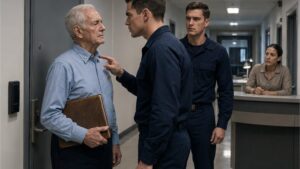
The Young Instructor Laughed At His Old Rifle Until The Desert Target Came Back Silent
Chapter 1: The Old Rifle Case At Lane Seven
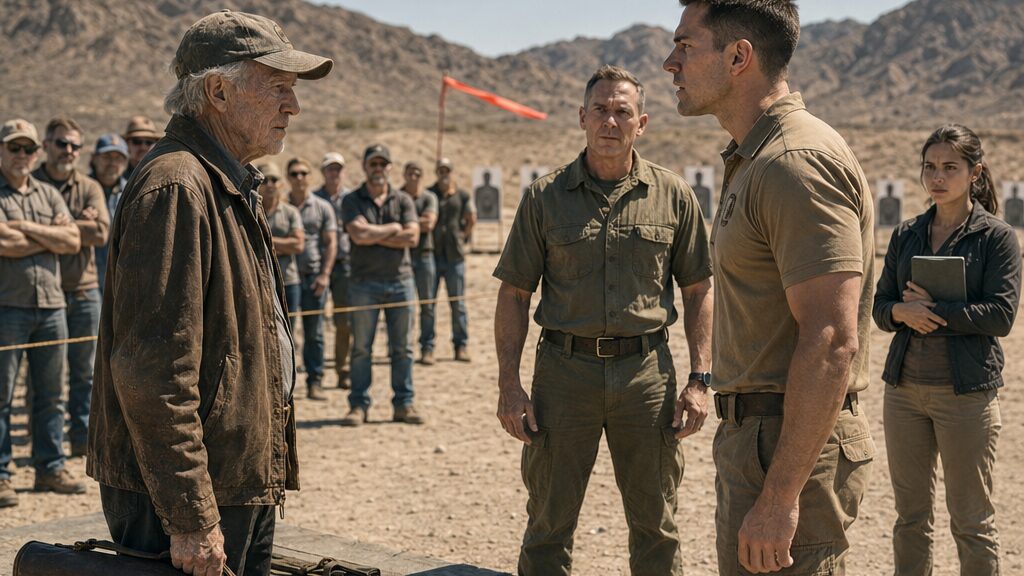
The young instructor’s hand came down on the old rifle case before Richard Harris had even set it fully on the bench.
“Sir,” the instructor said, loud enough for the nearest lanes to hear, “that line is for registered shooters only.”
Richard looked at the hand first. Not the face. The hand was broad, young, sun-browned, and impatient. It pressed the worn leather corner of the case as if the case itself might wander into danger if left unattended. Dust clung to the brass latch. One of the hinges had been repaired with a mismatched screw. The handle was darkened by years of palm oil and weather.
Richard lifted his eyes.
The instructor stood square in front of him, tan range uniform tucked clean, instructor badge catching the morning glare. His name strip read Tyler Clark. He had the lean confidence of a man who believed a straight back and a strong voice could solve most problems before breakfast.
Behind him, the desert range spread wide and pale under a hard blue sky. Targets hung at measured distances beyond the firing line. A row of benches faced the open sand. Tripods, spotting scopes, ammunition boxes, and folding chairs made a crooked little town of canvas and metal. Farther back, two dusty military-style vehicles sat near the shade tents, their tires half-white with powdery dirt.
A banner snapped in the dry wind.
VETERANS CHARITY MARKSMANSHIP DAY.
Richard had read it from the parking lot, though he had not needed to. Catherine Hall had sent him three reminder cards in the mail, each one more polite than the last. He had left the first two on the kitchen table. The third had found its way into the pocket of his old brown jacket beside a folded yellowed range card he had carried too long to call paper anymore.
“I registered,” Richard said.
His voice did not rise. It never had much use for climbing.
Tyler looked at him as if he had expected confusion and received inconvenience instead. “Name?”
“Richard Harris.”
The instructor glanced toward a clipboard tucked under his arm, but he did not lift it yet. His eyes traveled over Richard’s faded cap, lined face, brown jacket, dark trousers, and old boots. They paused at Richard’s left hand, where the fingers rested lightly on the rifle case.
The fingers were not still.
They trembled a little in the morning wind.
Richard knew that was where the young man would look. Everyone looked there eventually. Cashiers looked there when he counted coins. Nurses looked there when he signed forms. Children looked there with blunt curiosity and then looked away when their mothers touched their shoulders.
Tyler’s mouth tightened.
“This event includes live fire,” he said. “There are safety requirements.”
“I know.”
“I’m sure you do.” Tyler’s tone said he was not sure of anything. “But we’ve got junior shooters today, veterans, spectators. I can’t have someone on the line who might not have full control.”
The nearest junior shooters had gone quiet. Two boys in ball caps pretended to adjust ear protection while watching. A girl with a long braid stood near the shade tent with a small notebook pressed against her chest. A few visiting veterans turned their heads without moving their boots.
Richard felt the old familiar weather of a crowd gathering around a small humiliation. Not cruelty exactly. Curiosity. Discomfort. The relief of not being the one being measured.
He eased his hand from under Tyler’s and rested it on top of the case.
“I have control.”
Tyler finally checked the clipboard. He flipped one page, then another. “Richard Harris,” he read, then frowned. “Lane seven.”
“That’s what the card said.”
“Lane seven is for the demonstration relay.”
“So I was told.”
Tyler looked up sharply. “By who?”
Richard did not answer right away. Across the range, heat had begun to lift in thin glassy waves from the sand. The wind slid left to right, soft but steady, nudging the loose edge of the banner.
“By the invitation,” he said.
Tyler gave a small laugh, too short to be honest. “Sir, with respect, somebody probably made a mistake. Demonstration relay is for experienced shooters.”
The girl with the notebook looked down. One of the boys whispered something and then stopped when a range volunteer glanced his way.
Richard’s thumb brushed the latch of the case.
In his jacket pocket, the folded range card pressed against his ribs. He could feel the crease through the cloth. Slow is smooth. The words were written in pencil, not by him, though he had repeated them to more young shooters than he could count.
He had not come for Tyler Clark.
He had not come to be measured by a boy with a badge.
He had come because of a promise made in a hospital room where the machines had breathed louder than the man in the bed. He had come because a daughter was supposed to learn what her father had not lived long enough to teach her. He had come because, some promises did not expire just because the hands carrying them got old.
But he said none of that.
Catherine Hall hurried over from the registration table, clipboard hugged to her chest, sunglasses pushed into her hair. She had the anxious smile of someone responsible for donors, food trucks, insurance forms, and weather.
“Mr. Harris,” she said. “You made it.”
“I did.”
Her eyes flicked to Tyler’s hand near the case, then to the watchers pretending not to watch. “Everything all right?”
Tyler answered before Richard could. “Just checking registration. I think there may have been a lane assignment issue.”
Catherine blinked. “No, Lane seven is correct.”
The instructor’s jaw moved once. “For the demonstration relay?”
“Yes.”
Tyler lowered his voice, though not enough. “Catherine, I don’t think that’s wise.”
There it was. Not shouted. Not cruel. Worse, perhaps. Practical. Polished. The kind of dismissal people could call concern and sleep well afterward.
Richard looked beyond them both to Lane seven.
The bench was empty. A small paper number flapped from a stake beside it. Beyond the firing line, the targets waited in the sun with the blank patience of things that judged nothing until the moment came.
Catherine’s expression wavered. She wanted the day to go smoothly. Richard could see the calculation cross her face: an elderly man, an old rifle case, a public event, junior shooters, a young instructor insisting on caution. Nobody wanted trouble before lunch.
“Mr. Harris,” she said gently, “would you be comfortable maybe starting from the observation area? Just until we sort out—”
“No,” Richard said.
The word did not crack. It did not need to.
Catherine stopped.
Tyler’s eyebrows lifted, as if the old man had finally done something troublesome enough to confirm him.
Richard took his registration card from his jacket pocket. The yellowed range card came with it, caught against the newer paper. It unfolded halfway in the wind.
Tyler’s eyes dropped to it.
The old card was soft at the creases, darkened by time and handling. Across the top, in faded pencil, were the words: SLOW IS SMOOTH.
Richard folded it back before the rest could be read.
“I’ll follow every command,” he said. “I’ll clear when told. I’ll step back when told. I’ll shoot only when instructed. If I break a rule, remove me.”
Tyler’s face flushed faintly under the tan.
“That’s not the issue.”
“It usually is.”
The line went quiet enough for Richard to hear a target chain ticking in the wind.
Tyler straightened. His voice regained its public shape. “Sir, nobody’s questioning your intentions. But intention doesn’t keep a rifle steady.”
Richard looked at him for a long second. The young man’s boots were planted too wide. His shoulders were high. His hands wanted something to do. Pride, Richard thought, was a poor sling. It pulled a man off center.
“I’ve seen steady rifles miss,” Richard said. “And shaking hands remember.”
A volunteer near the shade tent looked up.
Tyler gave another short laugh, but this one had an edge. “That sounds nice. But today we go by current standards, not memories.”
Richard felt something old move behind his breastbone. Not anger. Anger was hot and wasteful. This was smaller and colder, like a latch closing.
He picked up the rifle case. The weight tugged at his shoulder, familiar as an old dog leaning against his leg.
“Lane seven,” he said.
Tyler stepped in front of him.
For a moment, the range seemed to hold its breath. The banner snapped once. Dust moved in a low sheet across the concrete pad.
“Sir,” Tyler said, louder now, “you can watch. You cannot shoot.”
Richard did not move.
His hand trembled on the handle.
His eyes did not.
Chapter 2: The Instructor Who Spoke Too Loud
Tyler Clark had learned early that hesitation looked like weakness from the back row.
So he did not hesitate.
He took two steps onto the safety briefing platform, clipped the microphone to his collar, and let his voice carry over the desert range with clean, practiced force. The junior shooters gathered on the folding benches. Their parents and the visiting veterans stood behind them beneath the shade canopies. Volunteers moved between water coolers and sign-in tables. Farther out, the firing line waited under the glare.
The old man stood at the edge of the group with his rifle case upright beside his boot.
Tyler made himself not look at him.
“Eyes up,” Tyler called. “Ears open. Today is a charity event, but it is still a live-fire range. That means discipline. That means commands. That means nobody touches a firearm until instructed.”
Heads turned toward him. Good. Attention settled him. The more eyes on him, the clearer the world became. He knew how to be the man in charge. He had built himself that way.
He had not been born with it.
At twenty-eight, Tyler was the youngest lead instructor the range had ever hired for the charity event. He knew what some of the older volunteers thought—that he liked the new optics too much, spoke too sharply, corrected too quickly. But the range had invited him for a reason. He was certified, current, quick, and clean. He could run a relay safely and on schedule. He could manage donors and veterans and teenagers with nerves in their fingers.
He could not afford an accident.
Especially not one involving an old man with a tremor and an antique rifle case on Lane seven.
“First rule,” Tyler said, pacing the platform, “muzzle discipline. A safe shooter knows where the muzzle is pointed before they know where the target is.”
He lifted a blue plastic training rifle from the table. “Second rule. Finger off the trigger until sights are on target and the command is given.”
The junior shooters watched closely. The girl with the braid—Samantha Wilson, according to the list—wrote something in her notebook. Tyler noticed that. He liked students who wrote things down. It meant they cared enough to be shaped.
“Third rule. Chamber clear until live fire. You will show clear when asked. You will not argue with the range officer. You will not assume experience excuses you from procedure.”
He let that last sentence hang.
This time he looked at Richard Harris.
The old man did not blink. He stood with both hands resting on the top of his rifle case, shoulders slightly rounded, cap brim shadowing his pale eyes.
Tyler felt irritation tighten in his throat. The man’s calm did not feel respectful. It felt stubborn. Worse, it made Tyler feel loud.
He turned back to the group.
“We’ll start with dry handling. No live rounds on the benches until I call for them.”
One of the tactical trainees helped distribute training rifles. Tyler watched the line form and corrected little things as they appeared: stance too narrow, elbow too high, cheek floating above the stock. He spoke fast because there were too many people and too little time. The charity schedule had a demonstration relay at noon, donor photos at one, junior practice afterward, and Catherine had already reminded him twice that the local paper might come.
A boy near the front swung his blue training rifle sideways while turning to ask a question.
Tyler saw it.
He started forward.
A dry, quiet voice reached the boy first.
“Freeze.”
The boy froze.
So did half the line.
Richard Harris had not raised his voice. He had not stepped onto the platform. He had not touched the boy. He simply stood three feet away, one hand lifted, palm down, like a man quieting a skittish horse.
The blue muzzle pointed across two other juniors’ knees.
“Lower your support hand,” Richard said. “Keep the muzzle downrange. Turn your feet before you turn the rifle.”
The boy swallowed and obeyed.
Richard nodded once. “Good. Now ask.”
The boy looked at Tyler, embarrassed.
Heat crawled up Tyler’s neck.
He had seen it too. He had been moving. But Richard had spoken first, and now the nearest parents were looking at the old man with surprise instead of worry.
Tyler forced a smile. “Exactly. That’s why we listen to the person running the briefing.”
Richard’s hand lowered.
He did not claim credit. He did not look pleased. That somehow made it worse.
Tyler came down from the platform and took the blue rifle from the boy, resetting the demonstration with crisp motions. “Let’s be clear,” he said. “Nobody gives commands on my line except authorized staff.”
Richard’s eyes rested on him.
“There was a muzzle crossing knees,” the old man said.
“I saw it.”
“I believe you.”
The answer landed gently, but Tyler heard the challenge anyway. Not in the words. In the fact that Richard had not apologized.
Tyler stepped closer, keeping his voice controlled. “Sir, I appreciate the concern. But jumping in can confuse students. We have a system.”
Richard glanced at the row of young faces. “The system worked slow.”
A few of the juniors looked down. One of the visiting veterans coughed into his fist.
Tyler felt the platform under his boots even though he was no longer standing on it. He felt the crowd, the schedule, the badge on his chest. He also felt, irritatingly, the truth: the old man had stopped the mistake cleanly.
But truth did not help if order cracked.
“Maybe that’s the difference between your day and mine,” Tyler said. “We don’t run ranges by instinct anymore.”
Richard’s expression did not change. “No good range ever did.”
The words were not loud, but they carried. Samantha Wilson’s pencil stopped moving over her notebook.
Tyler heard the silence forming again. He hated that silence. It made every next word heavier.
“Mr. Harris,” Catherine said softly from near the water table, but Tyler held up a hand without looking at her.
He knew he should move on. Give the next instruction. Let the old man fade back into the crowd. That would be professional.
Instead, he saw Richard’s trembling fingers settle again on the rifle case.
He imagined those fingers closing around a live firearm in front of donors and children. He imagined the questions afterward. Why did you let him shoot? Didn’t you notice? Didn’t you stop it?
“You seem confident,” Tyler said.
Richard waited.
“So let’s make it simple. Before any live fire, I’ll run you through a basic handling check. Publicly. Same as everyone else. If you pass, we’ll talk about observation privileges.”
A murmur moved through the shade.
Richard tilted his head slightly. “Observation privileges?”
Tyler knew the phrase had come out wrong the moment he said it, but he kept going. “You want to correct my line. Fine. Show the line you can meet current standards.”
The old man looked out toward Lane seven. Dust slipped over the concrete. The paper number fluttered against its stake.
Then Richard looked back at Tyler.
“Current standards,” he said.
“That’s right.”
“And if I meet them?”
Tyler’s pride answered before caution could stop it. “Then maybe we’ll see whether that old case is worth the trouble.”
Catherine’s mouth tightened. The visiting veterans went still. The juniors stared openly now.
Richard’s hand slid into his jacket pocket. For a moment, Tyler thought he was reaching for the registration card again. Instead the old man drew out the folded yellow range card. It opened just enough for Tyler to see the faded pencil line across it.
Slow is smooth.
Richard pressed the crease flat with one unsteady thumb.
“Careful, Mr. Clark,” he said quietly. “Trouble is usually louder than it thinks.”
Tyler’s smile hardened.
“Lane seven,” he said. “Noon.”
Chapter 3: When The Senior Officer Went Quiet
Dennis Roberts knew the sound of a range turning its attention toward the wrong thing.
It was not loud. Loudness was easy. Loudness was commands, steel plates ringing, bolts running, brass hitting concrete, laughter under shade tents. The sound that worried him was the thinning out before all that—the small pauses, the half-turned shoulders, the people pretending to check gear while listening with their whole bodies.
By the time he crossed from the operations trailer toward Lane seven, that sound had already settled over the firing line.
Tyler Clark stood near the bench with his clipboard tucked tight beneath one arm. The young instructor had squared himself in front of an elderly man Dennis had noticed earlier by the parking lot. Brown jacket. Faded cap. Old rifle case. Slow step but careful footing. A man easy to underestimate if a person had trained himself to see only speed.
Catherine Hall was close by, looking as if she wanted to stand between them but did not know which rule would let her.
The old man stood beside the bench at Lane seven, his hands resting on the case.
Dennis slowed.
Something about the posture bothered him.
Not bothered. Pulled.
The shoulders were older. The frame had narrowed. The hands trembled faintly. But the stillness beneath those things had a shape Dennis remembered from somewhere: weight balanced without fuss, eyes on the whole line rather than one face, patience held like a loaded thing that would never be pointed carelessly.
He had seen men try to imitate that stillness. Most only managed stiffness.
Tyler saw him approaching and turned with visible relief. “Mr. Roberts.”
Dennis did not correct him. People called him officer, chief, sir, boss, whatever steadied them. Titles mattered less than muzzle direction.
“What’s going on?” Dennis asked.
Tyler kept his tone formal. “Safety concern. Mr. Harris is registered for the demonstration relay. I’m conducting an additional handling check before allowing any participation.”
Catherine stepped in. “Dennis, I approved his lane based on the invitation list.”
“I understand.” Dennis looked at Richard. “Sir.”
Richard gave the smallest nod. “Mr. Roberts.”
Dennis felt the pull again.
He had been called many things across thirty years of ranges, schools, training contracts, and volunteer events. Roberts. Sergeant. Coach. Dennis. But the old man said his name as if he had once heard it shouted over wind and rifle fire.
Dennis studied the face under the cap.
Lines cut deep from nose to mouth. Pale eyes narrowed against the sun. Clean-shaven jaw. A face weather had handled more than vanity had. Nothing obvious. No decorated hat. No unit patch. No veteran shirt announcing a war, a branch, a grievance, or a memory.
Just an old man with an old case.
Tyler cleared his throat. “I already told him he can observe. Given his condition, that’s the safest accommodation.”
Richard did not react to the word condition, but Dennis did. He glanced at Tyler.
“What condition did he report?”
Tyler hesitated. “I mean visibly.”
“Visible is not a diagnosis.”
The young instructor’s neck reddened. “No, sir. But hand tremor is a relevant safety factor.”
“It can be,” Dennis said.
Richard’s fingers moved once against the case handle. Not defensive. Almost amused.
Dennis looked at the bench. The case had been placed parallel to the firing line, muzzle direction considered even before it had been opened. That was not proof of skill, but it was proof of habit.
“What did he do unsafe?” Dennis asked.
Tyler’s jaw tightened. “He hasn’t handled the rifle yet.”
“Then he hasn’t done anything unsafe with it.”
The crowd’s quiet deepened by half an inch.
Tyler’s eyes flickered toward the junior shooters, the volunteers, the donors near the shade. “With respect, I’m trying to prevent a problem before it happens.”
“That is your job,” Dennis said. “So is knowing the difference between prevention and embarrassment.”
Catherine exhaled softly.
Richard looked down at the rifle case, not at Tyler. That bothered Dennis too. Most men, when defended, looked at their defender. Richard looked at the object everyone else had turned into the center of the trouble.
Dennis stepped closer to the bench.
“Mr. Harris,” he said, “may I ask why you’re here today?”
Richard’s thumb brushed the top latch. “Invitation.”
“For the demonstration relay?”
“Yes.”
“From Catherine?”
“From the event.”
That answer was not evasion exactly. It was a door left closed.
Dennis looked to Catherine. She checked her clipboard, grateful for something to hold. “He was listed under legacy invitees. The notation said special instruction guest, Lane seven. I assumed it came through your office.”
Dennis frowned. “Not mine.”
Tyler seized on it. “Then we do have an issue.”
“Maybe,” Dennis said.
A gust moved across the range, dragging dust along the concrete. The old man’s jacket fluttered open. For one second, Dennis saw the folded yellow card in the inside pocket.
Slow is smooth.
The words struck him so sharply that the years behind his eyes shifted.
A hot training field. A younger version of himself with sunburned ears and a rifle that felt too heavy after the third hour. A voice behind him, quiet enough that he had to listen.
Slow is smooth, Roberts. Smooth is accurate. Fast is just fast until it learns manners.
Dennis stared at the card.
He heard Tyler talking, but the words blurred at the edges.
“—additional check, nothing unreasonable. If he’s qualified, he can demonstrate that. But I don’t want him creating confusion by correcting staff or acting outside command.”
Dennis lifted a hand. Tyler stopped.
The old man watched the targets.
Not Dennis. Not the crowd. The targets.
There were names a person carried cleanly, and names that gathered dust until some small thing exposed them. Dennis had not thought of Fort Hall in years without also thinking of sore shoulders, red dirt, and an instructor who never shouted because shouting wasted breath that could be used for shooting.
But that instructor had been taller in memory. Broader. Darker-haired. Impossible to age.
Men aged anyway.
Dennis felt a strange embarrassment rise in him, not because he had failed to remember a face, but because he had almost allowed a uniform and a tremor to tell him what the face meant.
“Mr. Harris,” Dennis said carefully.
Richard finally looked at him.
Those pale eyes held no demand.
That made it worse.
“Have we met?” Dennis asked.
A tiny crease appeared at the corner of Richard’s mouth. “Most men your age have met too many old instructors to keep count.”
Dennis swallowed. “Fort Hall?”
Tyler looked between them. “Fort Hall?”
Richard closed his hand around the rifle case handle. For a moment Dennis thought he would deny it, or make a joke, or tell the young instructor that memory was an unreliable witness.
Instead Richard looked past Dennis, toward the line of junior shooters.
Samantha Wilson stood very still with her notebook at her chest. Her braid had slipped over one shoulder. She was watching Richard not with excitement, but with the careful attention of someone who had come looking for something she did not know how to ask for.
Richard saw her too.
Dennis knew he did because the old man’s face changed almost imperceptibly. Not softer. More guarded.
“Yes,” Richard said at last. “I was at Fort Hall.”
The words passed through Dennis like the first clean breath after dust.
Tyler shifted his weight. “That doesn’t answer the safety question.”
“No,” Dennis said, though he kept his eyes on Richard. “It doesn’t.”
Richard gave him the slightest nod, as if approving the distinction.
The range waited.
Dennis felt the authority of his current position settle on one shoulder and the weight of old instruction settle on the other. He could stop this now. He could move Richard to observation, spare Tyler embarrassment, spare Catherine a scene, spare the crowd its appetite for reversal.
But he could also see the old case on the bench, placed correctly. The folded card. The eyes reading wind off target chains. The man who had once taught him that a rifle line was not a stage for pride.
“Mr. Harris,” Dennis said, “were you ever an instructor there?”
Richard’s expression closed just enough to warn him away.
Then Tyler, impatient, stepped into the silence.
“With respect, sir, whatever he was, this is my line today.”
Richard looked at Tyler then. Not sharply. Not angrily. Only fully.
And Dennis, remembering too late what that kind of look had once meant, felt the desert range go quiet around them.
Richard rested one trembling hand on the old rifle case.
“The line belongs to the rules,” he said. “Not the loudest man standing on it.”
Chapter 4: The Wind Nobody Else Was Reading
Samantha Wilson had expected the old man to leave.
Most people did, when a room or a field or a line of strangers made it clear they were unwanted. They gathered themselves, hid whatever had been bruised, and found a way to make leaving look like choice. She had seen her mother do it at offices where forms were missing, at school meetings where people used careful voices around the word military, at hospital desks where nobody wanted to explain why another signature was needed.
But Richard Harris did not leave.
He stood at Lane seven while the desert pressed heat up through the concrete and the wind dragged pale dust around his boots. His old rifle case lay closed on the bench in front of him. Tyler Clark stood a few steps away with a stiff jaw and a clipboard he no longer seemed to need. Dennis Roberts had moved close enough to intervene if required, but not close enough to take control.
That was what Samantha noticed first.
The senior range officer did not rescue Richard.
He waited.
Catherine Hall had gathered the spectators behind the marked rope. The demonstration relay had been delayed, but nobody complained. The donors in pressed shirts and the visiting veterans in faded caps stood shoulder to shoulder with junior shooters and volunteers. Even the two tactical trainees, who had joked earlier about optic prices and split times, had gone quiet.
The silence did not feel peaceful.
It felt aimed.
Samantha held her notebook against her chest. On the top page, she had written the three safety rules Tyler had given them. Below that, in smaller letters, she had copied the phrase she had seen on Richard’s old card.
Slow is smooth.
She did not know why the words unsettled her.
Her father had said something like that once. Not often. Not in a dramatic way. He had said it while teaching her to tie a fishing knot, while backing a trailer, while cutting a tomato thin enough for sandwiches. Slow first, Sammy. Smooth comes later. Speed can wait.
She had forgotten until that morning.
Tyler stepped to the front of the lane and lifted his voice. “For clarity, this is a controlled handling and marksmanship check. Mr. Harris will follow all range commands. No one crosses the firing line. No one speaks during live fire unless giving an authorized command.”
He sounded like a man building a fence around his pride.
Richard stood with his cap brim low, saying nothing.
Tyler turned to him. “Open the case.”
Richard’s fingers moved over the latches. Samantha expected him to fumble. Not because she wanted him to, but because Tyler had made everyone expect it. His hands trembled enough that the brass latch clicked twice before lifting.
A boy beside Samantha whispered, “He can barely open it.”
Samantha did not answer.
The case opened.
Inside lay an old bolt-action rifle in dark worn wood, clean but plain, with bluing rubbed thin at the edges. The sling was leather, cracked in places and softened by use. Beside it sat a small cloth roll, a chamber flag, and a folded patch of oiled flannel. Nothing looked expensive. Nothing looked new.
Tyler looked at it and gave a sound too small to be called a laugh. “That’s what you brought for a demonstration relay?”
Richard lifted the rifle with both hands, muzzle downrange, finger straight along the stock. The tremor in his fingers seemed to remain outside the motion, like wind shaking grass around a fence post.
“It’s what I brought,” he said.
Tyler glanced at Dennis. “No optic?”
Richard checked the chamber before answering. He angled the rifle properly, worked the bolt, showed clear, inserted the chamber flag, and placed it on the bench with the muzzle safely aligned.
“No optic.”
One of the tactical trainees muttered, “Great. Museum day.”
Dennis turned his head. The trainee looked at the ground.
Tyler lifted a hand toward the far berm. “Two hundred yards. Paper target. Five rounds. Standard bench position.”
Richard looked downrange.
Samantha followed his gaze. The target seemed very small against the pale berm. Heat shimmer made its edges tremble. To the left of the target line, thin strips of red survey tape hung from stakes, fluttering in uneven jerks.
Richard watched the tape. Then the dust near the target. Then the chain on a metal stand halfway downrange. Then the banner behind the firing line.
“Wind’s shifting,” he said.
Tyler looked toward the electronic wind meter clipped to the post. “It’s within range.”
“I didn’t say it wasn’t.”
“You want to delay?”
“No.”
Tyler’s smile tightened. “Then we’re good.”
Richard touched the leather sling. “Not from the bench.”
The crowd shifted.
Tyler stared. “Excuse me?”
“Prone.”
“This is a bench demonstration.”
“It’s your challenge. But if you’re checking me, check me in the position I can hold safely.”
Tyler opened his mouth, but Dennis spoke first.
“Prone is allowed on Lane seven.”
Tyler turned. “For the scheduled relay, yes. But—”
“If the shooter requests it and the line is clear, prone is allowed,” Dennis said.
Samantha saw something pass across Tyler’s face. Not defeat. Not yet. More like a man realizing the ground had moved half an inch under one boot.
“Fine,” Tyler said. “Prone. But no special treatment. Five rounds. You follow command.”
Richard nodded.
He opened the cloth roll and removed five cartridges, setting them in a neat line on the bench. He did not touch them again. Then he lifted the rifle, stepped back, and lowered himself toward the mat a volunteer hurried to place on the concrete.
The lowering was slow.
The crowd watched every inch of it.
His left knee bent with visible effort. One hand went to the bench, not for drama but for balance. The rifle remained pointed downrange, controlled and safe. His breath shortened once as he settled one knee, then the other. For a moment Samantha thought he might not make it all the way down.
Tyler watched with a look that tried to be neutral and failed.
Richard eased onto his side, then rolled into position behind the rifle. He adjusted the sling without hurry. His fingers shook while threading the leather, but once the sling seated against his arm, the rifle seemed to become part of a system older than the tremor.
The range went very still.
“Shooter ready?” Tyler called.
Richard did not answer immediately. He was watching the red tape downrange.
“Mr. Harris?”
“Wait,” Richard said.
Tyler’s eyebrows rose. “For what?”
Richard’s cheek rested near the stock. “The left gust has not reached the target yet.”
The boy beside Samantha whispered, “How would he know that?”
Samantha did not know.
The red tape nearest the firing line flicked sharply right. The tape near the midpoint moved a second later. The strip near the target hung still, then snapped.
Richard breathed out.
“Ready.”
Tyler’s face had changed. Only slightly, but Samantha saw it. His certainty had developed a hairline crack.
“Load one round,” he commanded.
Richard removed the chamber flag, loaded one cartridge, and closed the bolt. His finger remained straight.
“Commence fire.”
The first shot cracked across the desert.
Samantha flinched despite her ear protection. The sound struck the berm and came back smaller. Richard did not lift his head. He worked the bolt slowly, caught the brass before it rolled far, and set it aside.
He did not look pleased.
He watched the wind again.
“Load one round.”
He obeyed.
The second shot came after a longer pause.
Then the third.
Between each round, he waited. Not theatrically. Not as if he wanted the crowd to suffer. He waited the way a person waited for a pan to heat, or a child to finish speaking, or pain to pass through a knee before standing.
Tyler’s arms were folded now, clipboard pressed against his chest. He kept looking between the target and the old man, though no one could see the holes from the line.
By the fourth round, the murmurs had died entirely.
By the fifth, Samantha realized she was holding her breath.
Richard loaded the final cartridge. His right hand trembled when he lifted it from the mat. Then he settled, breathed, and the tremor disappeared into stillness.
He fired.
The range swallowed the sound.
Richard opened the bolt, showed clear, inserted the chamber flag, and only then moved his finger away from its straight line along the stock. He did not roll over. He did not look at Tyler.
He kept looking downrange.
Tyler’s voice came out flatter than before. “Cease fire. Rifle clear?”
“Clear,” Dennis said, though he was looking at Richard, not the rifle.
The target puller started downrange in a small utility cart.
No one spoke while the cart crossed the dust.
Samantha looked at Richard lying on the mat, old cheek against old wood, eyes fixed on the paper that was still too far away to read.
For the first time all morning, Tyler Clark had nothing to say.
Chapter 5: The Target Came Back Silent
Catherine Hall had spent six months preparing for applause.
Not loud applause, necessarily. This was a veterans’ charity range day, not a stadium. But she had prepared for the polite kind: donors clapping after speeches, junior shooters cheering when targets came back, volunteers laughing over burned hot dogs, visiting veterans nodding at ceremonies that ended on time. She had arranged banners, tables, water stations, insurance documents, sponsor logos, photographer slots, safety waivers, and emergency plans.
She had not prepared for silence.
Yet silence was what came back with the target.
The utility cart rolled slowly over the packed dirt from the berm, its small tires kicking dust behind it. The target puller sat rigid behind the wheel, one hand on the steering wheel and the other holding the paper upright against his chest like something fragile. From where Catherine stood, she could not see the holes yet.
She could only see his face.
That was enough.
The crowd leaned without stepping forward. Junior shooters craned around parents. Veterans adjusted caps and narrowed their eyes. Tyler Clark stood at the edge of Lane seven with his arms folded, but the shape of him had changed. His chest was no longer lifted quite so high. Dennis Roberts stood beside the bench, jaw locked, his gaze not on the approaching cart but on Richard Harris, who was still prone on the mat, rifle cleared, waiting for command before moving.
Catherine had misunderstood the old man.
The realization came without drama, like a dropped coin finally settling after a long spin.
She had seen his age, his old case, the tremor in his hand, and she had thought liability. Not unkindly. Not cruelly. But she had thought it all the same. She had been proud of being considerate while standing one step away from making the same mistake as Tyler, only in a softer voice.
The cart stopped.
The target puller got out.
No one asked him anything.
He carried the paper to Dennis first, because Dennis was senior staff and because the target puller seemed suddenly unsure who should be allowed to touch evidence. Dennis accepted it by the edges.
Catherine moved close enough to see.
Five shots.
Not one ragged hole exactly. That would have made it feel like a trick, like a story people exaggerated over coffee. This was better, because it was real. Four rounds sat in a tight cluster slightly right of center, close enough that the torn edges touched. The fifth was just apart from them, a deliberate correction toward the center after the wind shift. Together they made a mark so small and controlled that Catherine had to look twice to count them.
Tyler stepped forward.
His eyes moved over the paper.
He did not speak.
That was when the silence deepened into something almost physical.
The target had said what Richard Harris had refused to say about himself.
Catherine looked toward the old man on the mat. “Mr. Harris,” she said softly, then stopped because her voice sounded wrong in the stillness.
Dennis knelt beside Richard. “Line is cold. You may rise when ready.”
Richard nodded.
It took him longer to get up than it had taken him to shoot. He placed one palm flat on the mat, shifted one knee under him, and paused with his head lowered while the rifle remained safely downrange. Nobody laughed now. Nobody whispered about his hands. The same slowness that had looked like weakness earlier had become part of the lesson, and everyone had to watch it without the comfort of mockery.
Dennis reached out as if to help.
Richard glanced at the hand.
Dennis withdrew it.
Not offended. Corrected.
Richard got one boot under him, then the other. When he stood, the old rifle rested open and clear against the bench. He did not look at the target immediately. He dusted one knee with the side of his hand, then picked up the empty brass and placed each case in a small row beside the cloth roll.
Only then did he turn.
Dennis held out the paper.
Richard looked at it for less than a second.
“Wind moved on four,” he said.
Tyler’s mouth opened slightly.
Catherine almost smiled, not because it was funny, but because the line was so bare of triumph. Richard had not said good shooting. He had not looked around for admiration. He had looked at a near-impossible group and noted the one condition that had kept it from being cleaner.
One of the visiting veterans gave a quiet breath that might have been a laugh if the day had been different.
Samantha Wilson stepped closer, notebook clutched white-knuckled in both hands. She stared at the target with parted lips.
“You did that without a scope?” the boy beside her asked.
Richard looked at him. “I did it with a front sight, a rear sight, and enough waiting.”
The boy nodded as if he had been given something heavier than an answer.
Tyler finally found his voice. “That target needs to be measured.”
Dennis looked at him.
“For record,” Tyler added quickly. “For the event record.”
“No event record for a handling check,” Dennis said.
Tyler flushed.
Richard reached for the target, but not to take it. He touched the lower corner where the paper was clean. “No need to measure.”
Catherine felt the crowd react before anyone moved. They had wanted a number. A record. A label large enough to hold what they had seen.
Richard denied them that satisfaction so gently it almost hurt.
Tyler’s pride made one last stand. “A five-shot group like that at two hundred, with irons, in this wind—”
“Is not a miracle,” Richard said. “It is fundamentals.”
The words struck Tyler harder than an insult would have.
Dennis closed his eyes for a moment.
Catherine saw it.
The senior officer was no longer merely recognizing Richard’s skill. He was remembering the sound of those words in another place, in another version of himself.
“Fundamentals,” Dennis repeated.
Richard’s gaze shifted to him.
Dennis took off his sunglasses. His face looked older without them. “Fort Hall, summer cycle,” he said. “I was nineteen. Couldn’t stop jerking the trigger. Thought the rifle was bad.”
A faint line appeared at the corner of Richard’s mouth. “Usually is.”
Dennis laughed once, quietly, and it carried more emotion than Catherine expected.
“You took my rifle,” Dennis said, “fired three rounds, handed it back, and told me the rifle had manners but I didn’t.”
The visiting veterans turned toward Richard. Tyler stared at Dennis now.
Richard looked down at the old case. “Sounds like something an unpleasant man would say.”
“You trained half the instructors who trained my generation,” Dennis said.
The words moved through the crowd in a slow wave.
Catherine felt her skin tighten. Not because Richard had been important once. Importance was easy to misunderstand. People respected titles and forgot people. What struck her was that Dennis said it with embarrassment, as if confessing that he had nearly let the range forget its own foundation.
Tyler looked from Dennis to Richard to the target. His face had gone pale under the desert tan.
“I didn’t know,” he said.
Richard folded the cloth roll around his remaining cartridges. “Most people don’t.”
The sentence should have released Tyler. It did not. It placed the responsibility back where it belonged. Not knowing was not the sin. Deciding before knowing was.
Samantha took another step forward. “Sir?”
Richard looked at her.
She seemed to lose courage, then found a smaller version of it. “Did you know my dad?”
The crowd shifted again, but this time Richard’s stillness changed first.
Catherine saw his hand move toward his jacket pocket, toward the folded yellow card.
“What was his name?” Richard asked, though something in his face said he already knew.
Samantha swallowed. “He wrote that you might come. He said if I ever got nervous on a rifle line, I should ask for the man who said slow is smooth.”
Richard’s fingers closed over the pocket.
For the first time that day, the old man looked away from the target.
Chapter 6: The Promise Hidden In The Range Card
Richard had learned long ago that public respect could be as dangerous as public insult if a man leaned into it too quickly.
Insult tempted anger. Respect tempted vanity. Both could move the muzzle off the safe direction if a person let them.
So he stepped away from Lane seven with the old rifle cleared and cased, the target left in Dennis Roberts’s hands, and the murmurs behind him no different in weight from the laughter that had come before. He walked toward the shade tent because his knees needed shade more than his pride needed witnesses.
The tent smelled of canvas, bottled water, sunscreen, and dust. A folding table held stacks of programs, donation envelopes, and paper cups. Beyond the open side, the desert range stretched bright and flat, the targets now still in the afternoon glare.
Richard set the rifle case on the ground beside his chair, not on the table. Old habit. A firearm, even cased, deserved placement with intention. Then he sat slowly and let the pain settle where it wanted in his hips and lower back.
He heard footsteps stop at the edge of the tent.
Samantha Wilson stood there with her notebook against her stomach. She did not rush him. That counted for something.
“May I sit?” she asked.
Richard nodded toward the empty chair.
She sat carefully, as if afraid the chair might squeak too loudly.
For a while neither of them spoke. The range resumed in pieces behind them: Tyler’s lower voice giving commands, brass being swept, Catherine redirecting spectators, Dennis answering questions he should not have had to answer. Normal sound returned, but changed. Quieter around the edges.
Samantha looked at the old rifle case.
“My dad said you were strict,” she said.
Richard’s hand rested on his knee. The tremor had returned now that there was no sight picture to settle into. “He was polite.”
“He also said you once made him clean a rifle twice because he called it good enough.”
“That sounds more accurate.”
She smiled, but it faded quickly. “His name was Paul Wilson.”
Richard looked out toward the targets.
He had known, of course. Not from her face exactly, though the eyes were close. He had known from the way she watched a firing line: afraid of it, drawn to it, angry at needing it to mean something.
Paul Wilson had been twenty-two when Richard first met him, all elbows, jokes, and false confidence. He had learned slower than the others because he pretended not to care when he failed. Richard had seen that before. Some young men protected themselves with laughter until discipline gave them something stronger.
Years later, Paul had called him from a hospital bed. His voice had been thin, embarrassed by weakness, still trying to make jokes that broke halfway through. He had asked Richard for a favor without saying favor.
If Samantha ever wants to learn, don’t let some show-off teach her speed before safety. Teach her the breath first.
Richard had said yes.
Then Paul had died before anyone could decide when a good time might be.
There was never a good time for the unfinished.
Richard reached into his jacket and drew out the folded yellow range card. He placed it on the table between them.
Samantha stared at it.
The paper had been folded and unfolded so many times the creases had become pale threads. Pencil marks crowded the inside: sight notes, wind reminders, little diagrams, and three words printed in a younger hand across the top.
Slow is smooth.
“Your father wrote those,” Richard said.
Samantha touched the edge but did not pick it up. “He did?”
“He was tired of hearing me say it. Thought if he wrote it down first, I’d stop.”
“Did you?”
“No.”
A small laugh escaped her, then trembled into something else. She pressed her lips together.
Richard looked away to give her room.
“I almost didn’t come,” she said. “Mom said it might be too much. I thought maybe if I came here, I’d feel closer to him. Then everyone was staring at you, and I thought…” She stopped, embarrassed. “I thought maybe this place just makes people prove things.”
“It can.”
“Is that why you came? To prove them wrong?”
Richard let the question sit between them.
Outside the tent, Tyler’s voice gave a range command, quieter now, each word separated properly. The line answered by action, not chatter.
“No,” Richard said.
Samantha waited.
“I came because your father asked me to.”
Her eyes lowered to the card.
“I’m sorry,” she said.
“For what?”
“For what happened out there. For everyone watching. For Mr. Clark.”
Richard almost told her not to apologize for another man’s mouth. Instead he saw her fingers tighten around the notebook, and he softened the answer.
“You didn’t point it.”
She understood enough to nod.
Dennis appeared at the tent opening with the target in one hand. He did not enter until Richard looked at him.
“Catherine wants to frame this for the event table,” Dennis said. “I told her to ask you.”
“No.”
Dennis nodded as if he had expected that. “Thought so.”
Samantha looked surprised. “You don’t want people to see it?”
“They saw it.”
“But it proves—”
“What?”
She stopped.
Richard picked up the range card and folded it once along an old crease. “That I can still shoot? That he was wrong? That everyone should be nicer to old men with cases?”
Her cheeks colored.
He regretted the sharpness at once. Age did not make a man gentle by default. Sometimes it only made his impatience quieter.
He set the card down again.
“A target can prove where rounds landed,” he said. “It cannot prove what a person learned.”
Dennis leaned against the tent pole. “You sound exactly the same.”
“No one likes that.”
“I didn’t then.”
“You learned anyway.”
Dennis looked toward the firing line. Tyler was correcting a junior shooter’s stance, but he had lowered himself beside the student rather than standing over him. His hand indicated, not grabbed. His voice did not carry beyond the lane.
Dennis noticed too.
“So did he, maybe,” Dennis said.
Richard did not answer.
Samantha picked up her notebook. “Would you teach me the breath?”
Richard looked at her hands. Young hands. Stronger than she believed. Nervous enough to respect danger. That was a better beginning than confidence.
“Not today,” he said.
Her disappointment flashed before she could hide it.
“Today you watched too much pride,” Richard said. “That makes poor practice.”
She looked down, then nodded.
“Tomorrow?” she asked.
He almost said no.
No was easy. No meant going home with the promise technically honored by attendance and a few words. No meant returning the old rifle to the closet, placing the range card back in the drawer, letting silence fill the kitchen without complication.
Then he saw Paul Wilson at twenty-two, grinning after finally printing three clean shots in a row. He saw him years later in the hospital, trying to make an old instructor promise what a father could not finish.
Richard folded the yellow card and slid it across the table.
Samantha did not touch it at first.
“Keep that until tomorrow,” he said.
Her eyes lifted. “You mean it?”
“If you bring it back.”
“I will.”
“Don’t bend it more than it already is.”
She held it with both hands as if it weighed more than paper.
Tyler Clark stepped into the shade then, cap in one hand, clipboard gone. He looked younger without his platform voice. Dust marked one knee where he must have knelt beside a shooter.
He glanced at Samantha, then Dennis, then Richard.
“Mr. Harris,” Tyler said.
Richard waited.
Tyler swallowed. “When you corrected me earlier. About the system being slow.”
“I corrected the situation.”
“Yes, sir.” Tyler’s face tightened, but he stayed. “I missed the muzzle sweep because I was watching the group instead of the rifle. Then I covered it with authority.”
Dennis looked away, letting the confession stand on its own legs.
Richard said nothing.
Tyler held his cap with both hands. “I know I don’t deserve this after how I spoke to you. But if you’re willing…” He looked toward Lane seven, where the old mat still lay in the sun. “Would you show me what I missed?”
Chapter 7: Slow Is Smooth Before Sunset
Richard did not answer Tyler right away.
The young instructor stood in the edge of the shade with his cap gripped in both hands, asking for instruction in the same place where, only hours earlier, he had tried to turn an old man into a safety problem. His face held the strain of a man who wanted forgiveness but knew better than to reach for it too quickly.
Richard looked past him to the range.
The afternoon had begun to loosen. Donors drifted toward parked trucks. Volunteers folded unused chairs. Junior shooters carried empty cases and water bottles with the drowsy care of people who had spent too much time in sun and sound. The line was quieter now, not empty, but no longer hungry.
At Lane seven, the mat still lay facing the berm.
Richard could feel the old ache in his knees. The shooting had cost him more than anyone had seen. Getting down had been hard. Getting up had been harder. Pride wanted him to pretend otherwise. Discipline told him pretense was just another kind of unsafe handling.
He turned back to Tyler.
“What did you miss?” Richard asked.
Tyler’s eyes flicked toward Dennis, then dropped. “The boy with the training rifle. The wind. My tone. Your case.” He swallowed. “Mostly I missed the person standing in front of me.”
Richard studied him.
That was not everything. But it was enough to begin with.
He reached for his rifle case and set it gently across two chairs. The latches clicked open in the shade. Samantha sat forward, the yellow range card resting on her notebook. Dennis remained near the tent pole, silent. Catherine stood farther back, pretending to organize donation envelopes while listening with her whole face.
Richard did not remove the rifle.
Instead, he took out the leather sling.
Tyler looked confused.
Richard held it up. “You were teaching speed before connection.”
Tyler’s brow tightened. “Connection?”
“To the rifle. To the ground. To your breathing. To the rule you’re following before the one you’re reciting.”
The words were quiet. They were not kind exactly, but they were not cruel.
Richard handed Tyler the sling.
Tyler accepted it with unexpected care.
“Put your arm through,” Richard said.
Tyler obeyed.
“Not like that. Don’t fight it. Let it tell you where your elbow belongs.”
Tyler adjusted, slower this time.
Richard saw the embarrassment in him, and beneath that, the relief. Some men acted arrogant because they believed no one would correct them unless they failed completely. Correction before failure could feel like mercy if they were humble enough to recognize it.
“Your badge doesn’t hold the rifle,” Richard said. “Your voice doesn’t hold it either.”
Tyler nodded once.
Samantha’s pencil moved softly across paper.
Richard looked at her. “You too.”
Her head lifted. “Me?”
“You asked to learn the breath. Breath starts before the rifle.”
She stood quickly, then caught herself and slowed. Richard almost smiled.
He placed one chair facing the open side of the tent. “Sit. Feet flat.”
She sat.
“Hands on your knees. Shoulders down. Don’t perform calm. Just notice when you aren’t.”
Samantha closed her eyes, then opened them as if unsure whether that was allowed.
“Eyes open is fine,” Richard said. “The world doesn’t disappear because you need steadiness.”
Tyler watched from beside the case, sling still looped around his arm.
Richard pointed toward the far target line, where the last strips of red tape moved in the evening wind. “Pick one thing downrange. Not the target. Something smaller.”
Samantha looked. “The chain on the stand.”
“Good. Breathe in. Don’t lift your shoulders. Let the breath go. At the bottom, don’t grab the moment. Let it settle.”
Her first breath shook.
Richard waited.
Her second was better.
“Slow is smooth,” she whispered.
“Not yet,” Richard said.
She looked startled.
He tapped the yellow card lightly. “People like the phrase. They make it sound pretty. Your father did too, when he wanted to avoid practice.”
A faint smile broke through her concentration.
“Slow is only slow,” Richard said. “Smooth comes when slow has told you the truth enough times.”
Samantha looked back at the chain and breathed again.
This time her shoulders dropped without being told.
Richard nodded.
“That,” he said.
No one clapped. No one even moved much. The lesson was too small for applause and too large for noise.
Catherine came forward after a moment, holding the target from the demonstration. Someone had placed it in a protective sleeve, though Richard had not agreed to anything. She stopped before offering it.
“I won’t frame it if you don’t want that,” she said.
Richard looked at the paper. The five holes were still there, undeniable and unimportant in the way proof became unimportant after it had done its work.
“What will you do with it?” he asked.
“I thought…” Catherine glanced toward the event table, then shook her head at herself. “I thought it would make a good display. But maybe that’s just another way to use you.”
The honesty pleased him more than any apology would have.
“Put it in the range office,” Richard said. “Not with my name.”
Catherine blinked. “No name?”
“Write the rule under it.”
“What rule?”
Richard looked toward Tyler.
Tyler straightened, understanding arriving before permission. “Respect before judgment,” he said.
Richard gave him a dry look. “That’s a slogan.”
Tyler flushed.
Samantha covered a small smile.
Richard touched the target sleeve. “Write: The target only tells part of the story.”
Catherine nodded slowly. “I can do that.”
Dennis stepped away from the tent pole. “And the rest?”
Richard closed the rifle case. “The rest has to be taught.”
The sun had dropped low enough to turn the range gold at the edges. Shadows from the benches stretched thin across the concrete. The day’s heat still rose from the ground, but the bite had gone out of it.
Tyler took off his instructor badge, looked at it for a moment, then pinned it back on straighter.
“Mr. Harris,” he said, voice low enough that only those near the tent heard, “I was wrong. Not just about your shooting. About how I spoke to you. I’m sorry.”
Richard looked at him for a long moment.
“Don’t spend the apology on me,” he said. “Spend it on the next person you’re tempted to measure too fast.”
Tyler’s throat moved. “Yes, sir.”
“And stop saying ‘with respect’ when you haven’t decided to give any.”
Dennis made a sound that was almost a cough. Catherine looked down at her envelopes. Tyler accepted it without defense.
Richard reached for the yellow range card. Samantha held it out at once, but he did not take it.
“You bring that tomorrow,” he said.
Her fingers tightened around it. “I thought you said to keep it until tomorrow.”
“I did.”
“Then it’s mine tonight?”
“For tonight.”
She looked at the faded pencil words as if they might change if she stared long enough. “My dad really wrote this?”
“He did.”
“Was he good?”
Richard considered the question with care. The easy answer would have been yes. The honest answer had more respect in it.
“He became careful,” Richard said. “That mattered more.”
Samantha nodded, and the answer seemed to reach the place in her that had needed it.
The last relay ended downrange. A volunteer called the line cold. A few people began drifting toward Richard, then thought better of it. Instead they gave him space as he lifted the old rifle case from the chairs.
Tyler moved as if to help, then stopped himself.
Richard noticed.
That was a beginning too.
Dennis walked with him toward the parking area, but not too close. For several yards they listened to the crunch of dust under their boots.
“I should have known you sooner,” Dennis said.
“You knew enough in time.”
“Barely.”
“Barely counts when the muzzle stays safe.”
Dennis smiled faintly, then looked back at the range. “You’ll really come tomorrow?”
Richard followed his gaze.
Samantha stood near the shade tent with the yellow card in both hands. Tyler was beside a junior shooter, kneeling in the dust to adjust the student’s stance from below rather than commanding from above. Catherine taped the protected target to a board by the office door, leaving a blank space beneath it for the words Richard had chosen.
The target only tells part of the story.
Richard felt the old ache in his hand, the tremor returning now that the day no longer asked it to remember stillness. He shifted the case in his grip.
“I said I would.”
Dennis nodded. “You usually mean what you say?”
Richard glanced at him. “You were at Fort Hall. You know the answer.”
The senior officer laughed softly and stopped at the edge of the lot.
Richard continued alone.
His truck waited near the last row, dusty and plain under the lowering sun. He placed the rifle case carefully behind the seat. For a moment, his hand remained on the worn leather handle.
It felt no lighter.
Not really.
Wood and steel weighed what wood and steel weighed. Age weighed what age weighed. Promises did not become lighter because they were finally spoken aloud.
But as Richard closed the truck door and looked once more toward the range, he felt that the weight had shifted. It no longer pulled only backward.
At the shade tent, Samantha lifted the yellow card in a small, solemn wave.
Richard touched the brim of his faded cap.
Then he started the engine and drove slowly through the dust, leaving Lane seven behind until morning.
The story has ended.