When the Repair Bill Hit the Table, Sandra Remembered What the Rain Had Hidden
Chapter 1: The Bill Under the Restaurant Lights
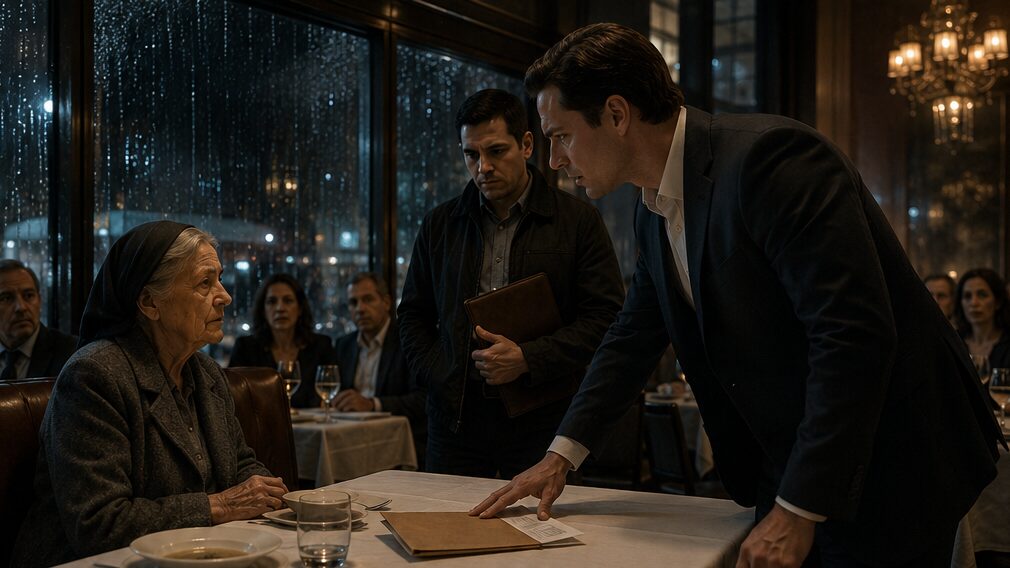
The brown envelope landed beside Sandra Walker’s water glass hard enough to make the lemon slice tremble.
For a moment, everything at the table seemed to hold its breath—the candle flame, the silver fork, the thin curl of steam rising from her untouched bowl of soup. Rain ran down the restaurant windows in bright, broken lines, turning the parking lot lights outside into long yellow smears. Sandra had chosen the booth because it faced the glass. She liked to watch rain when she ate alone. It made the room feel less empty.
Jonathan Taylor stood over her now, blocking most of that window.
He had not asked if he could sit. He had not lowered his voice. His black suit looked dry despite the storm, his hair combed into place, his expression polished in the way people looked when they had practiced being reasonable and were already angry that they had to perform it.
“You need to stop ignoring this,” he said.
Sandra kept both hands in her lap. Her fingers were stiff from the cold and from the old habit of not showing when they shook. “I haven’t ignored anything.”
Jonathan placed one palm on the white tablecloth and leaned forward. The gesture tilted the envelope closer to her. “Then you should have responded.”
“I received your first note yesterday.”
“You received notice of the damage last week.”
“I received a note saying you wanted to talk,” Sandra said. “That is not the same thing.”
Behind Jonathan, another man stood with a leather folder tucked under one arm. Sandra recognized him from the trucks that had been parked across the drainage easement for most of spring. Tyler Garcia. Contractor, or estimator, or whatever word men used when they arrived with measuring wheels and left with invoices. He glanced once at Sandra, then away, as if she were a task he had already completed.
A waiter slowed near the aisle with a tray of glasses. The restaurant manager stood near the host stand pretending not to watch. Two women at the next table had gone quiet over their salads.
Sandra felt the heat rise in her face. That was the part Jonathan had counted on, she thought. Not fear alone. Embarrassment. The old-fashioned kind, the one that still worked on people raised to keep private matters private.
Jonathan opened the envelope himself.
The papers came out clean and flat, with the confidence of documents printed on good paper. A repair estimate. A letterhead. Photographs clipped to the back. At the top of the first page, in bold, was a number large enough that Sandra saw it before she could stop herself.
$18,740.
Her stomach tightened.
Jonathan turned the page so it faced her.
“That is what your drainage problem has cost me so far,” he said.
“My drainage problem,” Sandra repeated.
“Yes. Your blocked rear line caused runoff across the property boundary. Water entered my lower-level room, damaged the flooring, and cracked the patio retaining wall. Tyler has inspected it. The insurance adjuster will be involved if you don’t handle this properly.”
Sandra looked at the number again. Eighteen thousand seven hundred forty dollars. More than her car was worth. More than the savings she allowed herself to think about without counting months of medicine, taxes, and winter heating. It was the kind of number that did not sit on a page. It came through the paper and put its hands around the edges of a house.
“My yard did not flood your room,” she said.
Jonathan’s mouth tightened. “Sandra, I’m trying to keep this civil.”
“You came to my dinner table.”
“I came here because you wouldn’t answer your door.”
“I was at the dentist.”
“You don’t get to disappear whenever there’s responsibility involved.”
The word responsibility hung there, too loud for the cloth napkins and low music.
Sandra picked up her spoon, though she did not want soup. She set it down again, gently, because the small sound gave her time. Jonathan had always known how to fill silence. He had joined the neighborhood association within three months of buying the big house behind hers, and six months after that, people were already saying he was useful because he knew how to get things done. Sandra had not disliked him then. She had thought he was impatient, but impatience was common in men who treated property like a ladder.
Now he pointed at the estimate with two fingers.
“The contractor’s assessment is clear. The water came from your side.”
Tyler shifted slightly. “The grading suggests runoff from the Walker property. There’s an old drain line that appears neglected.”
Sandra looked at him. His voice was careful, not accusing. That made it worse. Men like Tyler did not need to sound cruel. They only had to sound technical.
“Appears,” she said.
Tyler blinked.
Jonathan gave a short, humorless laugh. “This is exactly what I mean. We are past quibbling over words.”
Sandra reached toward the paper. Jonathan’s fingers pressed it down before she touched it.
“I’m not asking for a debate,” he said. “I’m asking you to acknowledge the damage so we can move forward. If you sign the responsibility statement, the claim can proceed without this becoming more expensive for everyone.”
“For everyone,” Sandra said.
“For you, Sandra.”
At the next table, a fork clicked against a plate and stopped.
Sandra looked up at him. She could see rain glittering on the shoulders of his suit now, tiny dark spots that had begun to show. He had walked through the same storm she had. He was not as untouched by weather as he wanted to seem.
“I will not sign anything tonight.”
Jonathan’s palm flattened harder against the table. The candle trembled. “That would be a mistake.”
“It may be,” she said. “But it will be my mistake after I read it.”
“You don’t understand the timeline.”
“I understand enough not to sign a paper someone puts in front of me while I’m eating soup.”
His face changed then—not much, but enough. The reasonable look thinned. For one second he was simply angry.
“Your husband used to handle these things, didn’t he?”
The words were quiet. That was why they cut so cleanly.
Sandra heard the rain. She heard the restaurant’s soft music, the murmur returning badly around them, the manager shifting his weight. She saw Tyler look down at his shoes.
Her husband had been dead nine years. People still found ways to bring him into rooms where he had not been invited.
Sandra slid her hand out from her lap and placed two fingers on the corner of the estimate. Her nails were short. There was a pale scar across one knuckle from a broken pickle jar years ago. She watched her own hand so she would not have to watch Jonathan’s face.
“My husband taught me not to sign under pressure,” she said. “So did my father. So did the woman at the bank after my husband died and three different people tried to sell me things I did not need.”
Jonathan straightened just enough for his shadow to move off the page.
“This is not a sales pitch.”
“No,” Sandra said. “It’s a bill.”
Tyler cleared his throat. “Mrs. Walker, the sooner this is acknowledged, the sooner we can prevent further water damage.”
She turned a page carefully. The estimate listed removal, drying, wall repair, flooring replacement, patio stabilization, emergency drainage correction. The language stacked itself like sandbags. She read slowly because she knew men sometimes mistook slow reading for poor understanding.
Then she saw the date.
Storm event: April 18.
Her fingers stilled.
Outside, rain streaked the glass harder, each drop chasing another toward the sill. April 18. She knew that date. Not because of Jonathan. Not because of his wall. Because that was the day the power had flickered twice while she sat in her kitchen circling a notice on her calendar—the neighborhood tree pickup had been postponed. She remembered standing at the window with a mug in both hands, watching water run clean along the old swale behind her hydrangeas.
No overflow. No standing water by the rear drain. No muddy sheet crossing the boundary.
The stain she had seen near Jonathan’s new patio had come later.
Jonathan tapped the page. “That is the incident date.”
Sandra looked up.
“No,” she said.
His brows drew together. “Excuse me?”
“That is a storm date,” she said. “It may not be your damage date.”
Jonathan stared at her as if she had moved the table.
“Don’t start.”
“I’m not starting anything.” Sandra folded the top page back into the envelope, not quickly, not slowly. “I’m stopping until the date and the drain line are checked.”
“You are refusing to cooperate.”
“I am refusing to sign.”
He leaned close again, voice low enough now that only she and Tyler could hear. “You really want to make me file this formally?”
Sandra slipped the estimate into the brown envelope. Her soup had gone cold. The lemon slice in her water had stopped moving.
“I want,” she said, “to finish my dinner.”
Jonathan held her gaze for a long second. Then he took his hand off the table, adjusted his cuff, and gave the room a small, controlled smile that belonged to someone leaving on purpose, not someone dismissed.
“You’ll hear from us tomorrow,” he said.
Sandra did not answer.
Only after he and Tyler walked away did she let her hand close fully around the envelope. The paper inside was crisp and official. But the date was wrong. Or if it was not wrong, it was hiding something.
She looked out at the rain and saw, as clearly as if it were happening again, the water behind her house on April 18 running exactly where it always had.
Chapter 2: Rainwater Lines Behind Two Houses
By morning, the rain had thinned to a gray mist that clung to Sandra’s windows and made the backyard look older than it was.
She stood at the kitchen sink with the brown envelope tucked under one arm, watching two men move along the property line as if they owned both sides of it. Jonathan wore a quilted jacket over a collared shirt. Tyler wore work boots and carried a measuring tape bright enough to be seen through the wet branches of the lilac bush. Neither had knocked.
Sandra dried her hands on a towel, folded it over the sink edge, and went outside.
The yard gave under her shoes. Not much. It had always held water for an hour after rain, then released it through the shallow swale that ran behind the hydrangeas and toward the old grate near the rear corner. Her husband had called it “the quiet river.” In spring, when the grass came up too fast, you could only see it if you knew how water bent around the roots.
Tyler had stretched the measuring tape from her drain grate toward Jonathan’s new patio wall. The metal line cut across the wet grass like an accusation.
Sandra stopped at the edge of the patio stones. “Good morning.”
Jonathan turned. “We were just documenting.”
“On my property?”
“Common drainage area.”
“My side of it.”
Tyler crouched near the grate and pushed wet leaves aside with the end of a pencil. “Mrs. Walker, this line is part of the runoff path.”
“I know what it is.”
Jonathan gave Tyler a look, the kind people used when they wanted another person to witness how difficult someone was being. “We’re trying to avoid making this adversarial.”
Sandra looked at the measuring tape, then at Jonathan’s shoes. They were clean enough that he must have walked along the stepping stones, not the grass. “You brought a repair bill to my dinner table.”
“And you refused to sign a basic acknowledgment.”
“Because I do not acknowledge what it says.”
Tyler stood. “The grading runs from your rear yard toward Mr. Taylor’s lower patio.”
“It always has,” Sandra said. “That is why there is a swale.”
Jonathan pointed toward his side. “And now that swale has failed.”
Sandra followed his gesture.
The back of Jonathan’s property had changed more than she liked to admit. When the previous owners lived there, the yard had sloped gently down toward a line of old shrubs. Children had left soccer balls in the grass. After Jonathan bought it, contractors came in waves. First the shrubs went. Then a stone patio appeared, squared and pale and too level for the land. Then came the lower room with its wide glass doors and recessed lights that glowed at night like a showroom.
Now one section of the small retaining wall below the patio had a dark water stain spreading along its base. Near the corner, the stone had cracked in a crooked line.
Sandra had seen the stain before, but from her kitchen window it had looked like shadow.
Tyler walked the tape toward Jonathan’s side. “The water appears to have crossed from here.”
“Appears,” Sandra said again.
Jonathan exhaled sharply. “Sandra.”
She ignored the tone and stepped closer to the boundary. Her knees disliked the damp, but she made them carry her. The brown envelope pressed under her arm. She had almost left it inside, then thought better of it. Papers belonged near the people who wanted them signed.
Tyler stopped by a black plastic outlet half-hidden behind a fresh strip of mulch at the edge of Jonathan’s patio.
Sandra had not seen that outlet before.
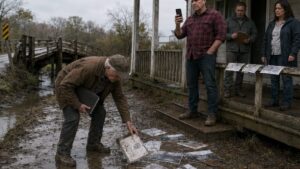
The plastic was new enough to shine, even under mud. The soil around it looked disturbed. Not fresh from last night’s rain—fresh from a shovel. Along one cut edge of the trim board near the patio, there were pale marks where saw teeth had exposed raw wood. A thin curl of something like sawdust clung to the wet mulch, swollen but still light in color.
Sandra looked at the old grate on her side, dark with age, then back at the new outlet.
“When was that put in?” she asked.
Tyler followed her eyes. “That’s part of Mr. Taylor’s downspout management.”
“That wasn’t there last year.”
Jonathan’s voice hardened. “This isn’t about my improvements.”
“Water is usually about where people send it.”
Tyler’s mouth tightened at the corner, not quite a smile. “Mrs. Walker, drainage systems are more complicated than they look.”
“My husband and I lived with this one for thirty-eight years.”
Jonathan stepped between her and the outlet, not fully blocking it, but enough to tell her he knew she was looking. “And things deteriorate. That’s the point. Old systems fail.”
Sandra looked at him. “Old does not mean failed.”
For a second, the backyard was silent except for dripping leaves.
Tyler pulled a form from his folder. The paper had already been clipped to a small board, protected by a plastic sheet. He held it out in a way that seemed casual until Sandra saw the blank line near the bottom.
“We’re not asking you to accept final cost today,” he said. “Just initial here that you’ve been notified and that your drainage feature is involved in the claim review.”
Sandra did not reach for it.
Jonathan’s voice softened, which made it more dangerous. “This helps everyone. If you cooperate, we can keep the insurance side cleaner.”
“I thought the insurance adjuster was not involved yet.”
Jonathan paused.
Tyler answered first. “Preliminary documentation.”
Sandra tucked the envelope tighter under her arm. “That is a long phrase for something that has not happened.”
Tyler looked toward Jonathan. Jonathan’s expression did not change, but Sandra saw a flicker pass between them. It was quick, no more than a glance. Still, she had spent years noticing small things: when milk was about to boil, when a storm would come before the forecast said so, when a person reached for one word and chose another.
Jonathan took the form from Tyler and held it closer to Sandra.
“Initialing this does not hurt you.”
“I do not know that.”
“It shows you’re acting in good faith.”
“My good faith is not proven by my signature.”
His jaw flexed. “You want to drag this out until the wall gets worse?”
“I want to know why there are fresh cut marks by your drain.”
Tyler looked back at the outlet. “Routine adjustment.”
“When?”
He did not answer immediately.
Sandra let the silence do what questions sometimes could not. The mist gathered on Tyler’s clipboard. Jonathan glanced toward the neighboring houses, perhaps checking whether anyone watched from a window.
“When?” she asked again.
Jonathan folded the form against his palm. “You’re focusing on the wrong thing.”
“No,” Sandra said, looking at the new black outlet, the pale raw wood, the swollen sawdust in the mulch. “I think I may finally be focusing on the right thing.”
Tyler slid the measuring tape back with a sharp metallic whir. “Mrs. Walker, refusing to initial will be noted.”
“Then note it accurately.”
The words surprised even her. They were not loud, but they landed.
Jonathan stepped closer. “You understand this could become a formal claim against your homeowner’s insurance.”
“I understand you keep saying what could happen.”
“And you keep acting as though memory is evidence.”
Sandra looked down at the old grate. A small thread of clear water moved beneath the leaves, narrow and steady. The quiet river still knew where to go.
“Sometimes memory tells you where to look for evidence,” she said.
Jonathan stared at her, then gave Tyler the form back.
“We’ll proceed without your cooperation for now.”
“For now,” Sandra said.
They crossed back toward Jonathan’s side. Tyler stopped once to photograph her grate, crouching low so the picture would show leaves and age and little else. Sandra watched the angle of his phone. It did not include the new outlet. It did not include the fresh cut marks. It did not include the path water would take after leaving Jonathan’s downspout.
When they were gone, Sandra walked carefully to the boundary. She did not touch anything. She only looked.
The outlet pointed toward the lowest part of Jonathan’s patio, not toward the old swale. The soil under it had washed into a small fan. At the edge of the fan, mixed into the mud, were tiny pale chips from newly cut material.
Sandra opened the brown envelope and slid the restaurant estimate halfway out. The storm date stared back at her.
April 18.
The new outlet had not been there on April 18. She was almost sure of it.
Almost was not enough.
Behind her, the phone began ringing inside the house. She let it ring twice, still looking at the outlet and the wet line of the measuring tape left behind in the grass. Then she went in, carrying the envelope against her ribs like something breakable.
By the time she reached the kitchen, the call had stopped.
On the counter, the answering machine blinked red.
Sandra pressed play.
Tyler’s recorded voice filled the room, polite and smooth.
“Mrs. Walker, this is Tyler Garcia. Since we were unable to complete the acknowledgment on-site, I’ll need you to initial the responsibility form as soon as possible so we can start the claim.”
Sandra stood very still.
Not review.
Not discussion.
The claim.
Chapter 3: The Envelope on the Kitchen Table
Amy Baker arrived that afternoon with a grocery bag in one hand and worry already arranged across her face.
Sandra saw it through the screen door before her niece even knocked. Amy had her mother’s quick walk and her father’s habit of checking windows as if trouble might leave fingerprints. She had driven over from the next town after Sandra mentioned, too lightly, that there had been a disagreement with Jonathan about drainage.
“You said disagreement,” Amy said as soon as she stepped inside. “That does not sound like a disagreement.”
Sandra took the bag from her. “I said it because I did not want you driving in the rain.”
“It isn’t raining now.”
“It was when I called.”
Amy gave her a look, then softened. “Aunt Sandra.”
That was the tone people used when they were about to be kind and firm at the same time. Sandra had heard it from doctors, bank employees, the man who tried to sell her a new roof after one loose shingle, and once from a teenage cashier who thought she had forgotten her change.
She set the grocery bag on the counter. “There’s tea if you want some.”
“I want to see what he gave you.”
Sandra did not move for a second. Then she took the brown envelope from beside the breadbox and placed it on the kitchen table.
The table was old maple, its surface marked by ordinary life: a faint ring from a hot saucepan, a nick where her husband had once tried to fix a toaster, tiny dents from years of grocery lists written too hard. Sandra liked those marks. They told the truth about use.
Amy sat and slid the estimate out.
Her face changed when she saw the number.
“Oh,” she said.
Sandra filled the kettle.
“Aunt Sandra.”
“I know.”
“Eighteen thousand dollars?”
“Seven hundred forty.”
“That’s—” Amy stopped herself, but the unfinished sentence filled the room anyway. That’s too much. That’s frightening. That’s the kind of money people pretend elders have because they own a house, forgetting houses could eat money faster than they gave it.
Amy read the first page, then the second. “He says your drainage caused interior water damage.”
“He says many things.”
“And there’s a form?”
Sandra pointed with the kettle toward the envelope. Amy found the copy Tyler had left folded behind the estimate.
“This looks official.”
“It was made to look official.”
Amy frowned. “It may still matter. If insurance gets involved, ignoring it could hurt you.”
“I am not ignoring it.”
“I know, but refusing to sign might look like you are.”
Sandra set the kettle on the stove harder than she meant to. The small clack made Amy look up.
Sandra turned the burner on low. “He brought that to me in a restaurant.”
Amy’s face tightened. “You didn’t tell me that part.”
“He stood over me while people watched. Tyler was behind him with his folder. Jonathan said my husband used to handle these things.”
Amy closed her eyes briefly. “That was cruel.”
“It was useful.”
“Useful?”
“It told me he wanted me embarrassed.”
The kettle began its low metal murmur.
Amy pushed the papers away and rubbed both hands over her face. “I’m not defending him. I just don’t want this to become something bigger. Court letters, insurance calls, HOA fines. You don’t need that.”
“No.”
“And if there’s a way to settle for less—”
Sandra looked at her.
Amy stopped.
The kitchen seemed to shrink around them. Afternoon light lay flat on the counter. Outside, the grass still shone wet. On the wall by the pantry hung the calendar Sandra had used for years, each square neat with appointments, pickup days, reminders. April was still tucked behind the current month, held by the same nail, because she never tore pages off until the year ended.
Amy lowered her voice. “I’m sorry. I just mean maybe paying something now keeps them from coming after more later.”
“That is what Jonathan wants me to think.”
“It might also be true.”
Sandra poured hot water into two cups. Her hand was steady now. That steadiness felt almost stubborn. “If I pay something, I say I caused something.”
“You could say you’re helping without admitting—”
“Men like Jonathan do not hear help. They hear weakness with a check number.”
Amy sat back, hurt flickering before she hid it. “I’m trying to protect you.”
“I know.” Sandra placed a cup in front of her. “But sometimes people protect old women by making our world smaller.”
Amy’s eyes dropped to the table.
Sandra regretted the sharpness, but not the truth. She sat across from her niece and pulled the envelope closer. “I am scared, Amy.”
Amy looked up.
Sandra made herself continue. “I woke up at three this morning thinking about property taxes and the furnace and whether my insurance would raise the premium even if I did nothing wrong. I thought about selling the dining room set. I thought about how much the house would be worth if people believed the drainage was bad. I thought about your uncle’s tools in the garage and whether I should have sold them years ago instead of leaving everything where he put it.”
“Aunt Sandra…”
“But fear is not the same thing as guilt.”
Amy’s face softened in a way that made her look younger. “No. It isn’t.”
Sandra opened the envelope wider and took out the estimate, the responsibility form, and the two photos Jonathan had included. One showed the water stain along the retaining wall. Another showed Sandra’s old drain grate with wet leaves around it. The photo was angled low, ugly and convincing.
Amy studied it. “That does look bad.”
“It looks old,” Sandra said. “That is not the same as broken.”
“Do you have anything showing it was maintained?”
Sandra looked toward the hallway.
For years after her husband died, she had avoided the bottom drawer of the file cabinet in the small back room. Not because of grief exactly. Grief had many rooms, and she had learned to enter most of them. But that drawer belonged to the kind of life where someone wrote down gutter cleanings, pipe inspections, mower repairs, paint colors, roof patches. It belonged to a man who believed that keeping receipts was a form of care.
“I might,” she said.
Amy stood. “Let me help.”
Sandra almost said no. The word rose automatically, an old defense. Then she saw Amy’s hands hovering over the papers, wanting something useful to do besides worry.
“In the back room,” Sandra said.
The file cabinet resisted when she pulled the drawer. Its metal track gave a tired scrape. Inside were folders labeled in her husband’s blocky handwriting: ROOF, TAXES, APPLIANCES, TREE WORK, DRAINAGE / YARD. Sandra touched that last tab and felt something loosen painfully in her chest.
Amy did not speak.
Sandra carried the folder to the kitchen like a fragile dish.
They spread the contents across the table. Receipts. Handwritten notes. A sketch of the yard with arrows showing runoff. A bill from years ago for clearing the rear grate. Another for checking the underground line after a heavy spring. Sandra’s husband had circled dates. He always circled dates.
The tea cooled.
Amy lifted one receipt. “This one says rear drain inspected and cleared.”
Sandra took it.
The printed ink had faded, but the date was readable.
April 23.
Five days after the storm date on Jonathan’s estimate.
Sandra sat down slowly.
Amy leaned closer. “Is that after the storm he listed?”
“Yes.”
“And it says no blockage found.”
Sandra read the line again, though she had understood it the first time.
Rear yard drain inspected after heavy rainfall. No blockage observed. Flow clear at time of service.
Amy whispered, “That matters.”
Sandra looked at the brown envelope lying open on the kitchen table. In the restaurant, it had looked like something meant to trap her. Now, with the old receipt beside it, the envelope looked different. Not safe yet. Not strong. But not empty.
Sandra slid the receipt inside, behind Jonathan’s estimate.
Her fingers brushed the calendar page on the table where she had set it after taking April down from the wall. The square for April 18 held her own handwriting: tree pickup postponed, power flicker, water clear by back grate.
She had written it small because it had seemed unimportant.
Sandra touched the note with the tip of one finger.
Amy watched her. “What are you thinking?”
Sandra looked from the calendar to the receipt, then toward the window where the backyard lay quiet and wet.
“I’m thinking,” she said, “that he chose the wrong date.”
Chapter 4: Photos, Measurements, and Quiet Doubt
By Monday morning, Jonathan’s photographs had already made Sandra’s yard look guilty.
The HOA office was a narrow room behind the community clubhouse, with framed notices on beige walls and a long table where people brought complaints about trash cans, paint colors, and branches that crossed invisible lines. Sandra had been in the room only twice before. Once to ask about replacing her mailbox post. Once to sit through a meeting about streetlights that ended with no streetlights.
Now her old drain grate lay in the middle of the table in glossy color.
Not the grate itself, of course. A photograph of it. Cropped close. Wet leaves matted over the metal. Mud dark around the edges. The picture made it look abandoned, almost shameful, like something Sandra had hidden behind her house and hoped no one would find.
The HOA secretary turned the photo toward her with two careful fingers.
“This is the drainage point in question,” the secretary said.
Sandra looked down at it, then at Jonathan, who sat across the table in a navy jacket with his phone beside his hand. Tyler stood near the wall with his folder open. He had not sat down, which made him seem less like a visitor and more like someone waiting to be called as proof.
“It is one drainage point,” Sandra said.
Jonathan let out a small breath. “It is the one affecting my property.”
The secretary glanced between them. “Mrs. Walker, Mr. Taylor has submitted a preliminary damage report. Until insurance determines responsibility, the association is asking both parties to cooperate.”
“Both parties,” Sandra repeated.
Jonathan leaned back. “I’ve cooperated fully.”
Sandra kept her hands folded around the brown envelope in her lap. Since Saturday, she had added the April calendar page, the April 23 receipt, and a copy of Tyler’s phone message written down in her own hand. She had not decided yet what to show. It was strange, how paper could feel heavier when it carried restraint.
The secretary slid another page across the table. “This is not a fine notice yet. It is a warning that failure to address drainage maintenance may result in HOA action.”
“May,” Sandra said.
“Yes.”
“And the warning is based on those photographs?”
“And Mr. Garcia’s assessment,” the secretary said, nodding toward Tyler.
Tyler stepped forward. “The grate shows debris accumulation. The slope from Mrs. Walker’s rear yard leads toward Mr. Taylor’s patio level. In my professional opinion, her line should be inspected further.”
“It was inspected,” Sandra said.
Jonathan’s eyes sharpened.
The secretary looked down at her notes. “Recently?”
Sandra did not open the envelope. Not yet. “After the April storm listed in Mr. Taylor’s estimate.”
Tyler’s expression stayed still, but the fingers holding his folder shifted.
Jonathan gave a controlled laugh. “Sandra, we have no documentation of that.”
“You do not.”
“I mean here.”
“No one asked me to bring it.”
The secretary hesitated. “Mrs. Walker, any documentation would be helpful.”
“I understand.”
Jonathan leaned forward. “Then why not provide it?”
Sandra looked at him. “Because I came to hear what you had already provided.”
For the first time since she entered the room, Jonathan had no immediate reply.
The secretary cleared her throat and moved to the next photograph. This one showed the lower corner of Jonathan’s patio wall, the crack running crooked through pale stone. The stain at the base was dark and convincing. Sandra studied the frame. The picture showed wall, puddled water, a strip of grass, and nothing else.
“What is to the left of this photograph?” she asked.
Jonathan frowned. “The rest of the wall.”
“And beyond that?”
“My patio.”
“And beyond that?”
The secretary looked up. “Mrs. Walker?”
Sandra touched the edge of the photograph. “There is a new black outlet near that corner. It is not in this picture.”
Tyler moved before he spoke, one shoulder tightening. “The outlet is not relevant to the origin point.”
“How do you know if it is not in the picture?”
“It was part of separate drainage management.”
“Separate from water?”
Jonathan’s voice dropped. “This is not helpful.”
“It is very helpful to know what a photograph leaves out.”
The secretary took the photo back and examined it as though a missing object might appear if she looked hard enough. “Mr. Taylor, do you have wider shots?”
Jonathan unlocked his phone. “These were the clearest.”
“That is not what she asked,” Sandra said quietly.
The room cooled.
Jonathan stared at her across the table. “You are implying I selected photographs unfairly.”
Sandra felt the old pull to soften it, to make her words easier for the room. She resisted. “I am saying these photographs do not show everything near the damage.”
Tyler closed his folder halfway. “The damage pattern is consistent with runoff from her side.”
Sandra turned to him. “Then the full view should help you.”
The secretary shifted in her chair. She was not on Sandra’s side. Not yet. But she was no longer moving papers with the same certainty.
Jonathan tapped the table once with two fingers. “While we’re debating angles, my wall is getting worse. I have contractors scheduled. I have a room I can’t use. I have flooring coming up. And I have a neighbor who refuses to take responsibility for an old drainage system she clearly hasn’t kept up.”
The words struck harder because part of Sandra feared them. Old system. Kept up. Her husband had handled so much, and after he died, she had learned one thing at a time, sometimes late, sometimes badly. She had missed the furnace filter once until the heat smelled dusty. She had let the gutters go too long the year her knees bothered her. Not everything Jonathan said was impossible.
But guilt was not the same as evidence.
Sandra drew the envelope from her lap and laid it on the table. She did not open it. The worn brown paper looked out of place among the clean printouts and glossy images. One corner had softened from being held too tightly.
“My drain may be old,” she said. “That does not make it the cause of your damage.”
Jonathan’s eyes flicked to the envelope. He recognized it from the restaurant. So did Tyler.
The secretary looked at it too. “Mrs. Walker, if you have records—”
“I will bring copies to the review meeting,” Sandra said. “I want the full photographs included. Not cropped ones.”
Jonathan’s face tightened. “There is no review meeting scheduled.”
“There should be if you are warning me.”
The secretary looked uncomfortable. “We can set one for Thursday evening, if both parties agree.”
“I agree,” Sandra said.
Jonathan did not answer at first. His gaze moved from Sandra’s face to the envelope and back again. He seemed to be recalculating something, not frightened, only annoyed that the path had not stayed as straight as he expected.
“Fine,” he said. “But the insurance timeline won’t wait because Sandra wants to turn this into a scrapbook.”
The secretary wrote a note. Tyler looked down.
Sandra let the insult pass over the table without picking it up. She had learned, after her husband died, that not every thrown thing had to be caught.
When the meeting ended, the secretary gathered the photographs into a folder. Sandra stood slowly. Her knees complained after the hard chair, but she did not hurry.
At the door, Jonathan came close enough that his voice could stay low.
“You’re making people wonder why you’re stalling,” he said.
Sandra looked through the clubhouse window toward the wet lawns beyond the parking lot. “No,” she said. “I’m making them wonder what was outside the frame.”
He looked at her for a long second. Then he smiled, small and flat. “The adjuster will explain it better than I can.”
At home, the red light on her answering machine was blinking again.
Sandra kept her coat on while she pressed play.
A woman’s recorded voice filled the kitchen, professional and distant.
“This message is for Sandra Walker. I’m calling regarding a homeowner liability inquiry filed in connection with water intrusion at the neighboring property. At this stage you have been named as potentially responsible. Please return this call at your earliest convenience.”
The machine clicked off.
Sandra stood in the quiet kitchen with the brown envelope still in her hand. The photographs had made her yard look guilty. The warning had made her look negligent. Now the word responsible had entered the house without knocking.
She set the envelope on the table and touched its top edge.
The paper no longer felt like something Jonathan had given her.
It felt like something she had to teach to speak.
Chapter 5: A Storm Date No One Checked
Sandra did not call the adjuster back that night.
She wrote the number carefully on a yellow pad, placed the pad beside the telephone, and then sat at the kitchen table until the room grew dark around the edges. Some calls needed facts before voice. Some questions punished a person for answering too soon.
On Tuesday morning, she made coffee, took the April calendar page from the brown envelope, and laid it beside Jonathan’s estimate. April 18. The date sat in both places, but it did not mean the same thing in each. On Jonathan’s paper, it was the beginning of blame. On Sandra’s calendar, it was a wet day when the power flickered and the water by her grate ran clear.
She turned to a clean page in her notebook and wrote three columns.
Date. What happened. Who can prove it.
Her handwriting had grown smaller over the years, but it was still straight.
April 18. Heavy rain. Power flicker. Tree pickup postponed. Water clear by back grate.
April 23. Drain inspected. No blockage. Receipt.
May? Jonathan patio work? Need records.
Saturday. Tyler measured. New outlet visible. Sawdust.
Monday. HOA photos cropped.
She stopped at “May?” and frowned.
Jonathan’s lower patio had not appeared all at once. There had been trucks, then stone, then the glass doors, then men with saws. She remembered one morning in late April when the noise started before breakfast and she had shut the kitchen window. Or had that been early May? After seventy-six years, memory was not a drawer where every item stayed folded. It was more like the yard after rain. Paths were there, but you had to look for the flow.
She put on her beige coat and took the bus to the county records office.
The building smelled of old paper, floor polish, and damp wool. A clerk behind the counter wore reading glasses on a chain and did not seem surprised when Sandra asked about residential permits.
“Address?”
Sandra gave Jonathan’s address, then added her own. “The issue concerns drainage between both properties.”
The clerk typed slowly. Sandra waited. She had brought the brown envelope in a canvas tote so the papers would not bend. The tote rested against her shin like a patient animal.
“There are permits for interior renovation,” the clerk said. “Patio wall repair. Drainage modification.”
Sandra’s hand tightened on the tote handle. “Drainage modification?”
The clerk turned the monitor slightly, not enough for Sandra to read everything, but enough to show rows of dates. “Submitted by contractor. Approved with conditions.”
“May I get copies?”
“There’s a fee.”
Sandra opened her wallet. The fee was small. The meaning was not.
While the copies printed, Sandra looked through a binder of older property maps the clerk brought from a side shelf. The pages were large and awkward, with lines thin as thread. Her husband would have loved them. He used to say a map was a promise someone had made to the future.
The clerk pointed with a capped pen. “This is the drainage easement. Your rear swale runs here. Neighbor’s original downspout outlet tied into this side channel.”
“Original,” Sandra said.
“That’s what the old plan shows.”
Sandra bent closer. The lines blurred until she adjusted her glasses. There was her house, smaller in outline than it felt in life. There was Jonathan’s property, once owned by people who had planted tomatoes near the fence. Between them ran the old drainage path, simple and sensible. Water from both lots had been meant to move toward the back corner, not toward the patio wall.
The printer clicked behind the counter.
The clerk handed Sandra three pages. “Permit note says contractor to maintain existing easement flow and avoid discharge toward lower patio structure.”
Sandra read the sentence once. Then again.
Contractor: Tyler Garcia.
Not his company name alone. His name, printed below the permit note as the applicant contact.
Sandra felt no triumph. Not yet. The paper did not prove the damage came from Jonathan’s side. It proved only that Tyler had worked there, that drainage had been modified, and that someone had warned him not to send water toward the lower structure.
But that was enough to change the shape of the question.
“Could I have a copy of the old map too?” Sandra asked.
The clerk nodded. “Large format costs more.”
Sandra took out the last bill in her wallet.
On the bus home, she kept one hand on the tote and watched water gather along the curb. The sky had cleared, but gutters still dripped from roofs. At one stop, a man offered her his seat though she already had one. She thanked him anyway. People could be kind without knowing what kind of day they had entered.
Back home, Amy called while Sandra was spreading the copies across the kitchen table.
“Did you call the adjuster?” Amy asked.
“Not yet.”
“Aunt Sandra—”
“I went to county records.”
There was a pause. “By yourself?”
Sandra smiled faintly, not because it was funny. “They allow widows inside.”
“I didn’t mean—”
“I know.”
“What did you find?”
Sandra looked at the permit note. “Tyler worked on Jonathan’s drainage before the damage.”
“How long before?”
Sandra checked the page. “The permit was approved May 2. Inspection note May 9. Jonathan’s estimate claims damage from April 18.”
“That sounds good for you.”
“It sounds strange,” Sandra said. “Good comes later.”
Amy was quiet for a moment. “Do you want me to come over?”
“Tonight, no. Tomorrow maybe. I need to put things in order.”
After they hung up, Sandra cleared the table except for five pieces of paper: Jonathan’s estimate, the April calendar page, the April 23 drain receipt, the permit note, and the copied drainage map. She moved them around like quilt squares, trying to make the pattern show itself.
If the storm was April 18, and the drain was clear April 23, then Jonathan’s wall damage could not be blamed on a blocked drain that had already been inspected clear. If Tyler modified drainage in early May, and the water stain appeared after that, then the later damage mattered more than the earlier storm. If Jonathan’s photographs excluded the new outlet, then the photos did not simply show damage. They avoided context.
She wrote another note.
Question: When did wall stain first appear?
Sandra closed her eyes.
She saw herself at the sink in late May, rinsing strawberries. She saw movement near Jonathan’s wall, two men carrying a wet shop vacuum through the lower doors. She remembered thinking they should have covered the doorway better because rain was blowing sideways. But had the stain been there then? Maybe. Maybe not.
She pressed both palms to the table.
This was the part that frightened her most. Not Jonathan. Not Tyler. Not even the money. It was the possibility that her own memory would fail at the exact place she needed it.
On Wednesday morning, she walked the yard again. The air smelled of wet soil warming under sun. She did not step onto Jonathan’s property. She stood at the boundary and looked.
The new black outlet pointed toward the low corner of the patio. Beneath it, the mulch had washed into a shallow channel. Sandra crouched slowly, one hand on her knee. A few pale chips still clung near the edge. She did not touch them. She only studied the direction.
Water had not come from her grate to that corner. It had been sent there.
At noon, Amy came over with sandwiches neither of them ate. Together they placed the papers in order. Amy wanted to scan them. Sandra agreed, though she insisted on keeping the originals in the envelope.
“This is more than I thought you had,” Amy said.
“It is less than I need.”
“You have the permit.”
“I have a permit note. I have a receipt. I have questions.”
“That’s still a lot.”
Sandra touched the map. “Not if people have already decided old means careless.”
Amy folded her hands. “I’m sorry I pushed you to settle.”
Sandra did not answer right away. She looked at her niece’s face, the worry that had not left it, only changed shape.
“You were scared too,” Sandra said.
Amy nodded.
That evening, Sandra finally called the adjuster and left a message. She did not explain everything. She said only that she disputed responsibility, had maintenance records, and would provide documents after the HOA review meeting.
Then she slid the new copies into the brown envelope.
It barely closed now.
At the bottom of the permit note, beneath the typed conditions, was a line Sandra had almost missed. It listed the contractor contact for final drainage verification.
Tyler Garcia.
The date beside it was May 12—two weeks before Jonathan said the wall had become unusable in his insurance inquiry.
Sandra read that line until the kitchen light reflected off the paper.
Then she wrote one more question in her notebook.
If Tyler verified the new drainage, why is his work missing from his estimate?
Chapter 6: The Signature Jonathan Needed
Thursday evening brought a drizzle so fine it seemed to float instead of fall.
Sandra had just turned on the porch light when Jonathan’s car stopped at the curb. She saw the headlights slide across her front window, pause on the wallpaper, then disappear. A second vehicle pulled in behind him, a white truck with Tyler’s company logo on the door.
Sandra stood in the hallway with the brown envelope held closed against her stomach.
She had expected a call. Maybe a letter. Maybe another message left in a smooth, official voice. She had not expected them to come before the review meeting, though perhaps she should have. People who wanted signatures rarely waited for rooms where questions could be asked.
The doorbell rang.
She counted to three before opening it.
Jonathan stood on the porch with his collar turned up against the drizzle. Tyler waited one step behind, holding a plastic sleeve with papers inside. The porch rail shone wet between them. Water dripped from the gutter into the flower bed with soft, steady ticks.
“Sandra,” Jonathan said. “We need five minutes.”
“It is not a good time.”
“This cannot wait.”
“It can wait until the meeting.”
His smile appeared and vanished. “That meeting is exactly why we’re here.”
Tyler lifted the plastic sleeve. “There’s an updated acknowledgment form. It clarifies that signing does not assign final legal fault. It simply confirms your drainage feature is part of the loss review.”
Sandra looked at the sleeve but did not reach for it. “You left a message saying responsibility form.”
“That was shorthand,” Tyler said.
“For responsibility?”
Jonathan stepped closer to the threshold. Sandra did not move back.
“Look,” he said, softening his voice in the way he had at the restaurant before placing the knife. “This has gotten more complicated than it needs to. The association is involved. Insurance is involved. If you sign this tonight, we can tell everyone you’re cooperating and keep the cost from climbing.”
“How does my signature keep the cost from climbing?”
“It prevents delay.”
“In repairing your wall?”
“In processing the claim.”
Sandra heard it then: not wall, not water, not even repair. Claim.
She shifted the envelope slightly under her hands. “And if I do not sign?”
Jonathan’s eyes held hers. “Then the adjuster will have to note noncooperation. The HOA may proceed with penalties. Tyler may have to document refusal. None of that helps you.”
Tyler slid the paper from the sleeve and held it out flat enough for the porch light to catch the blank line near the bottom. “Initial here and sign here. We can leave you a copy.”
The paper fluttered slightly in the damp air.
Sandra thought of the restaurant table, the candle trembling when Jonathan pressed his palm down. She thought of the photograph of her drain, cropped close enough to turn age into neglect. She thought of Amy saying paying something might keep things smaller. Smaller was such a tempting word. Smaller bill. Smaller fight. Smaller fear.
But the signature line was not small. It was a door.
“Why tonight?” Sandra asked.
Jonathan’s patience thinned. “Because the review meeting is tonight.”
“In two hours.”
“Yes. And if we walk in with this resolved, we save everyone time.”
“Resolved,” Sandra said.
Tyler glanced toward Jonathan. Jonathan did not glance back.
Sandra lowered her eyes to the form. The words were smoother than the first version, but the shape was the same. Not final fault, but drainage feature involved. Not responsibility, but acknowledgment. Not confession, but cooperation. She had seen enough paperwork now to know that softer words could still carry hard consequences.
“I will not sign it.”
Jonathan’s face closed. “You are being unreasonable.”
“No.”
“This is exactly the sort of thing that makes people worry you don’t understand the process.”
There it was, placed carefully in the drizzle between them.
Sandra felt her throat tighten. She could have told him about the county office. She could have taken out the permit note and watched his face change. She could have shown Tyler his own name on the paper and asked him why it had disappeared from the estimate. The envelope seemed to warm beneath her hands with everything inside it.
Instead, she kept it closed.
“I understand that you want my signature before other people see the documents,” she said.
Tyler’s expression sharpened.
Jonathan laughed once. “What documents?”
“The ones I will bring.”
“Old receipts won’t change water damage.”
“Then you do not need to worry about them.”
A car moved slowly down the street behind them, tires whispering on wet pavement. From somewhere nearby came the faint sound of a television through a neighbor’s open window. Ordinary evening sounds. Sandra held on to them. They reminded her this was her porch, her door, her house.
Jonathan stepped nearer again, close enough that the porch board creaked under his shoe.
“Sandra, I have tried to be respectful.”
She looked at him. “No, you have tried to be quiet when other people were listening.”
His mouth tightened.
Tyler shifted the form back into the plastic sleeve. “Mrs. Walker, from a technical standpoint, refusing to acknowledge the drainage feature may make the claim less favorable to you.”
Sandra turned to him. “Did you verify the drainage modification at Jonathan’s property on May 12?”
Tyler froze so briefly that someone else might have missed it.
Jonathan looked at him. “What is she talking about?”
Tyler recovered. “There were routine adjustments.”
“Was there a permit?” Sandra asked.
Jonathan’s eyes returned to her.
Tyler’s voice lowered. “That’s not relevant to your drain.”
“Then it will not hurt to discuss it at the meeting.”
Jonathan’s hand tightened on the porch rail. Rainwater gathered around his fingers. “This is getting ridiculous.”
Sandra watched the water bead against his knuckles. At the restaurant, his hand had pressed the tablecloth. In the HOA office, his fingers had tapped beside the photos. Here, on her porch, he gripped her railing as if pressure could travel through wood.
“You said my yard caused your damage on April 18,” she said. “My drain was inspected April 23. Clear. Your drainage was modified after that.”
Tyler looked away toward the truck.
Jonathan’s voice went cold. “You don’t know what you’re implying.”
“I am not implying. I am asking why you need my signature before the question is asked in front of others.”
The drizzle thickened. A drop slid from the edge of the porch roof and struck the top of the plastic sleeve in Tyler’s hand.
Jonathan straightened, smoothing his jacket as though the conversation had dirtied it. “Fine. Bring whatever you think you have. But if you turn tonight into an accusation, don’t expect the association to appreciate it.”
“I am not responsible for what they appreciate.”
“You are responsible for the damage.”
Sandra felt fear move through her again, quick and familiar. Eighteen thousand seven hundred forty dollars. Insurance. HOA penalties. Letters. The possibility of losing not the house itself at once, but the feeling that the house was hers to stand inside without permission.
She let the fear pass before she spoke.
“I remember where the water used to run,” she said.
Jonathan stared at her.
The sentence seemed to unsettle him more than any threat would have. Perhaps because it was not a threat. It was a fact from a woman he had counted on to doubt herself.
Tyler slipped the form back into his folder.
“We’ll see you at the meeting,” Jonathan said.
Sandra did not say goodbye. She closed the door gently and stood with her palm against the wood until their footsteps left the porch.
Then she went to the kitchen table.
The envelope was damp at one corner where drizzle had touched it. Sandra wiped it with a dish towel and took out the papers one by one. Estimate. Photos. April calendar. Drain receipt. Permit note. Map.
She arranged them in the order water had actually moved through time.
For the first time since the envelope struck the restaurant table, Sandra was not thinking about how large the bill was.
She was thinking about why Jonathan needed her name beneath it.
Chapter 7: The Map Beneath the Estimate
By the time Sandra entered the community meeting room, Jonathan had already placed the repair estimate in the center of the table.
He had chosen the seat nearest the front, where the overhead light made the document look especially clean. Tyler sat beside him this time, not standing behind, with his folder closed and one hand resting on it. The HOA secretary sat at the end with a notepad, and the insurance adjuster had taken the chair closest to the wall outlet, her laptop open and waiting.
A few neighbor residents filled the back row, not enough to call it a crowd, but enough to make the room feel public. Sandra recognized two faces from mailbox conversations and one from the restaurant. The woman glanced at Sandra, then away, as if embarrassed to know what she knew.
Sandra carried the brown envelope against her side.
Amy had offered to come. She had stood in Sandra’s kitchen with her purse over one shoulder and said, “You don’t have to do this alone.” Sandra had believed her. That was why she had answered carefully.
“I know,” she had said. “But I have to be the one who does it.”
Now, in the meeting room, that decision felt heavier than it had at home. The chairs were too low. The light hummed faintly. Someone had brewed coffee that smelled burned. The envelope’s softened corner brushed her wrist as she sat across from Jonathan.
The HOA secretary began with a tired formality. “This review concerns drainage-related damage at the Taylor property and potential maintenance responsibility at the Walker property. We are here to clarify documentation before any association action proceeds.”
Jonathan leaned forward. “I’d like to make clear that I did not want this to become a public matter.”
Sandra looked at the estimate on the table. He had put it there before she arrived.
The adjuster typed something.
Jonathan continued. “I’ve submitted photographs, a contractor assessment, and a repair estimate. The damage is real. The cost is real. I have tried repeatedly to get Mrs. Walker to acknowledge her property’s involvement so we can resolve this.”
The secretary nodded. “Mrs. Walker?”
Sandra opened the brown envelope, but she did not remove anything yet. “The damage may be real. The cost may be real. The question is whether my property caused it.”
Tyler’s chair creaked. “The runoff path indicates—”
“I would like to ask questions in order,” Sandra said.
Her voice was not loud. It was quiet enough that the room had to lean toward it.
Jonathan’s eyes narrowed. “This is not a courtroom.”
“No,” Sandra said. “That is why it should be easier to answer.”
The adjuster looked up from her laptop. “Orderly questions would be helpful.”
Sandra took out the first page: Jonathan’s estimate. She placed it beside the copy already on the table. His paper was cleaner, but hers had a small crease from the restaurant, where his hand had pressed it down.
“This estimate lists April 18 as the storm event that caused the damage.”
“Yes,” Jonathan said quickly. “There was significant rain.”
“There was.” Sandra took out her April calendar page and laid it beneath the estimate. “That same day, I noted power flickers and tree pickup postponed. I also wrote that water was clear by the back grate.”
Jonathan gave a small laugh. “Your handwritten calendar is not technical evidence.”
“No,” Sandra said. “It is why I checked for technical evidence.”
She took out the April 23 receipt and placed it under the calendar.
“My rear drain was inspected five days later. No blockage observed. Flow clear at time of service.”
The secretary leaned closer.
Tyler said, “A drain can be clear after a storm and still contribute to runoff during heavy rainfall.”
Sandra looked at him. “Yes. So I checked the rest of the water path.”
She took out Jonathan’s photographs next. Two glossy images. The old grate. The cracked wall. She set them down carefully.
“These photos were submitted as evidence that water traveled from my side. They show my drain and Mr. Taylor’s wall. They do not show the new black outlet near the patio corner.”
Jonathan shifted. “Because the outlet is irrelevant.”
Sandra removed a copied permit note from the envelope.
“Then why did the county require the contractor to maintain existing easement flow and avoid discharge toward the lower patio structure?”
The room changed.
It did not become dramatic. No one gasped. No one rose from a chair. But the small sounds rearranged themselves. A pen stopped moving. The adjuster’s typing paused. Tyler’s hand closed more firmly around his folder.
Jonathan looked at Tyler.
Tyler said, “That’s a standard condition.”
Sandra nodded. “It may be. But it was a condition attached to drainage modification at your property.” She looked at Jonathan. “After April 18.”
The adjuster reached out. “May I see that?”
Sandra slid the permit copy across the table.
The adjuster read it without expression. That was her job, Sandra supposed—not to show too early where facts were landing. She looked at Tyler. “Your company performed this work?”
Tyler opened his folder at last. “We performed adjustments related to downspout management and patio drainage. It was not the source of the original water intrusion.”
“Was it included in your estimate?” Sandra asked.
Tyler’s eyes moved to her.
Jonathan answered for him. “Because it isn’t relevant.”
Sandra took out the final folded paper, the large copy of the old drainage map. She unfolded it slowly. It was too big for her place at the table, so she stood, though her knees protested, and spread it beneath the estimate, beneath the photos, beneath the permit note.
The old map was not pretty. The lines were thin, the labels small. But it showed what the photographs did not: the rear swale behind her hydrangeas, the old grate, Jonathan’s original side channel, the direction water had been meant to move.
Sandra placed two fingers on the map. “This is the drainage easement as recorded before Mr. Taylor remodeled.”
The secretary stood enough to see.
Sandra moved her fingers from her yard to the shared rear corner. “My water ran here. His original outlet tied into this side channel. The permit note says the modification had to maintain that flow.”
She took out one more page: her own hand-drawn sketch from Saturday, copied cleanly by Amy but labeled in Sandra’s handwriting. No new names. No accusations. Just outlet, patio wall, swale, low corner.
“On Saturday morning,” Sandra said, “Tyler measured from my grate to the wall. He did not measure from the new outlet to the low corner. The photographs submitted here do not show the new outlet. The estimate does not mention the permitted drainage modification. The request I was asked to sign did not mention it either.”
Jonathan’s face had gone still in a way that was more revealing than anger.
The adjuster looked at Tyler. “Mr. Garcia, did your company verify final drainage on May 12?”
Tyler looked at the permit note. “There was a final check.”
“Is that included in the loss report?”
“It was separate from the damage assessment.”
“Was the new outlet discharging toward the patio structure at any point after installation?”
Tyler’s mouth opened, then closed. He adjusted the papers in front of him. “I’d need to review the site notes.”
Sandra sat down again. Her legs were grateful.
Jonathan leaned forward. “This is being twisted. Mrs. Walker is trying to bury a simple issue under old maps and receipts. The wall cracked after a storm. Her property sits uphill.”
Sandra looked at him. “My house is older than yours. That does not mean every drop of water belongs to me.”
One of the neighbor residents in the back shifted in her chair. The secretary looked down quickly, perhaps to hide a reaction.
The adjuster turned her laptop slightly and typed. “For the purposes of the claim, we cannot assign neighbor liability based on the current documentation. The omitted drainage modification is material. I will need Tyler’s site notes, wider photographs, and any post-modification inspection records.”
Jonathan stared at her. “So the claim is delayed because of a map from twenty years ago?”
“Because of a recent modification not disclosed in the estimate,” the adjuster said.
Tyler’s face flushed.
Sandra began placing the papers back in order, but the adjuster stopped her.
“May I copy these?”
Sandra paused, her hand over the old map. For a moment she felt the old instinct to guard everything. Paper had become protection only because she had kept it close. But keeping it close would not correct the claim.
“Yes,” she said. “Copies only. I keep the originals.”
“Of course.”
Jonathan pushed back from the table. “This is absurd.”
Sandra looked at him then, fully.
At the restaurant, he had stood over her. On the porch, he had tried to step through the doorway with a signature line in his hand. Now he was sitting across from her, and the table between them held more than his bill.
“You asked me to sign before I knew what was missing,” she said. “I know now.”
He did not answer.
The secretary cleared her throat. “Association action will be paused pending review.”
“Paused?” Jonathan said.
“Paused,” she repeated, more firmly.
Sandra slid the brown envelope toward herself. It was nearly empty now, but somehow it felt lighter for having given up its contents in the right order.
The adjuster turned to Tyler.
“One more question,” she said. “Why is your company’s May permit missing from the estimate you prepared for this damage?”
Tyler looked at Jonathan before he looked at the adjuster.
And Sandra saw, in that brief glance, that the question had finally reached the place they had hoped she would never find.
Chapter 8: What the Rain Had Hidden
One week later, Sandra received two letters on the same morning.
The first arrived in a clean business envelope with the insurance company’s return address printed in blue. The second came from the HOA, folded too tightly into a windowed envelope that had softened in the mailbox from a light overnight rain.
Sandra placed both on the kitchen table and made herself eat half a piece of toast before opening either one.
The house was quiet except for the refrigerator hum and the small clock above the stove. Outside, the backyard was bright after rain, every leaf holding light. The old grate near the hydrangeas showed through the grass, dark and ordinary. It had never looked beautiful to her before. Now it looked honest.
She opened the insurance letter first.
It did not apologize. Insurance letters did not know how. It said, in careful language, that based on additional documentation, neighbor liability could not be established against Sandra Walker’s property. It said the claim file would be revised to reflect possible contributing factors related to drainage modification on the claimant’s property. It said no payment or acknowledgment was required from her at this time.
Sandra read “no payment” three times.
Then she set the letter down and opened the HOA envelope.
That one was shorter. The warning would be withdrawn pending no further evidence of neglect. No fine would be issued. No maintenance violation would be recorded against her property. Future drainage concerns between neighboring lots would require full, uncropped photographic documentation and review of any recent permitted work before notices were sent.
Sandra put that letter beside the first.
She sat very still.
Relief did not arrive like joy. It came slowly, almost painfully, loosening places she had not known she had clenched. Her shoulders. Her jaw. The hand resting near her checkbook. For days, every ring of the phone had made her stomach tighten. Every car slowing at the curb had turned into a possible delivery of more paper, more pressure, more words meant to make her smaller.
Now the papers lay flat.
Not victory papers. Not revenge. Just enough.
The phone rang at eleven.
Sandra let it ring twice before answering.
“It’s me,” Amy said. “Did they come?”
“They came.”
“And?”
Sandra looked at the letters. “No payment. No fine.”
Amy exhaled so sharply Sandra heard it catch. “Oh, thank God.”
Sandra smiled faintly. “I thanked the county clerk first.”
Amy laughed, then sniffed. “Can I come over?”
“After lunch.”
“I’ll bring something.”
“No groceries.”
“A cake?”
Sandra looked at the letters again. “A small one.”
After they hung up, Sandra took the brown envelope from the sideboard. Its corners were worn now, one edge slightly wrinkled from the drizzle on the porch. She emptied it completely onto the table: Jonathan’s estimate, the responsibility form she had never signed, the April calendar page, the receipt, the permit note, the map copy, the insurance letter, the HOA withdrawal.
There should have been anger in seeing all of it together. There was some. It moved quietly through her, not hot enough to burn the morning. Jonathan had known how to use rooms. The restaurant, the HOA office, her own porch. He had known how to place a paper where people would look first and an old woman second.
But Sandra had learned something too.
A signature was not manners. Silence was not guilt. And being frightened did not mean being wrong.
Just before noon, an email arrived from the HOA secretary, followed by a printed copy delivered later that day. Jonathan had agreed to submit revised materials to the insurance company. Tyler’s company would provide site notes. Any further repair responsibility would be handled between Jonathan, his contractor, and his insurer. The association requested that all direct contact between neighbors about the claim stop unless submitted in writing.
Sandra read that last sentence twice and appreciated it more than an apology.
Jonathan did not call.
Tyler did not come by.
At one, Amy arrived with a lemon cake from the grocery store bakery and a face that had not yet decided whether to cry or smile. She hugged Sandra carefully, as if afraid to hurt her, then held on longer than usual.
“I should have trusted you faster,” Amy said into her shoulder.
Sandra patted her back. “You were afraid.”
“That doesn’t make it fair.”
“No.”
Amy drew away. “Are you angry with me?”
Sandra considered saying no because it would be easier. Then she looked at the table, at the papers that existed because she had stopped making things easier for other people.
“A little,” she said.
Amy nodded, eyes wet. “I can take that.”
Sandra touched her hand. “I needed you to worry with me, not for me.”
Amy looked down. “I’ll remember.”
They ate cake on small plates at the kitchen table. Amy asked if Sandra wanted to do anything about Jonathan’s restaurant confrontation. Sandra could have complained. She could have told the manager. She could have written a letter to the association about conduct unbecoming or whatever phrase people used when they wanted rudeness dressed in policy.
But she found she did not want to build her week around him.
“I want the correction in writing,” she said. “I have it.”
“And if he does it again?”
Sandra slid the responsibility form from the pile and tapped the blank signature line. “Then I know what blank spaces are for.”
Amy smiled.
After Amy left, Sandra found a fresh manila folder in the back room. For a moment, she almost retired the brown envelope completely. It was worn and too small now for all the copies. But when she picked it up, she remembered the restaurant window, the rain, Jonathan’s hand on the table, the way her own fingers had found the corner of the bill.
It had begun as something placed before her to make her afraid.
She wrote a note on an index card in firm letters.
Do not sign under pressure.
She slipped the card into the brown envelope, then placed the envelope inside the new folder with the final letters on top. The old estimate remained there too, not because she needed to keep the fear, but because she wanted a record of where it had started.
That evening, rain returned.
Not a storm. Just a steady, silver rain that softened the streetlights and tapped gently against the kitchen window. Sandra made tea and stood at the sink while it steeped. Across the boundary, Jonathan’s patio lights were off. The new black outlet near the wall was visible in brief glints whenever water ran from its edge.
Sandra watched the yard.
The old swale behind her hydrangeas filled, curved, and carried water toward the rear corner the way it always had. It did not hurry. It did not defend itself. It simply followed the path that had been there before anyone tried to rename it.
For the first time in days, Sandra did not count what she might have lost.
She lifted her mug in both hands and looked at the rain on the glass.
It no longer looked like warning.
It looked like proof that water, given enough time, showed where it had truly been.
The story has ended.