The Rich Neighbor Put A Ferrari Repair Bill In Front Of The Old Man And Expected Him To Fold
Chapter 1: The Ferrari Bill On The Red Hood
Daniel Hill slapped the invoice onto the red Ferrari’s hood hard enough to make two people near the showroom windows turn around.
Richard Walker did not look at Daniel first. He looked at the paper.
The white sheet lay flat against the polished curve of the car, held there by Daniel’s spread hand. The hood was so clean the overhead lights swam across it like water. Behind the Ferrari, the showroom’s black marble floor reflected shoes, legs, the bright car, and Richard’s own worn brown work jacket as if the room wanted to show him how badly he fit inside it.
“Eighteen thousand seven hundred forty dollars,” Daniel said.
He said it loudly, not like a man giving information, but like a man calling witnesses.
Richard heard the small quiet that followed. A salesman stopped near a silver coupe. A woman holding a paper coffee cup covered her mouth with her fingers. A security guard by the glass doors shifted his weight. Somewhere in the building, a phone rang twice and went unanswered.
Daniel’s suit was dark and fitted. His hair was combed back in the way of men who expected mirrors to agree with them. He had called Richard that morning and said there had been “a situation” with the car, and that they needed to meet at the dealership “before things got ugly.” Richard had come because ignoring a man like Daniel usually made him louder.
Now Daniel was already loud enough.
“You know what this is?” Daniel asked.
Richard kept his right hand at his side. The fingers were stiff from years of sanding, taping, and holding spray guns in cold garages. He could smell wax, leather, showroom coffee, and faintly, beneath it all, the chemical sweetness of compound.
“It looks like an estimate,” Richard said.
Daniel laughed once, short and sharp, as though Richard had proved something disappointing.
“It’s not just an estimate. It’s the repair bill for the damage you caused.”
The woman with the coffee cup looked from Daniel to Richard. Richard knew that kind of look. It was not exactly cruelty. It was worse in some ways. It was a person deciding which story was easier.
Daniel lifted the invoice, then pressed it down again with two fingers. “Left rear quarter abrasion. Lower panel. Paint correction, refinishing, blending. This is what your little metal cart did when you dragged it past my driveway yesterday morning.”
Richard’s eyes moved to the Ferrari’s side. The car was red in the deep, expensive way a wound could be red, if a wound had been polished and admired under lights. Near the rear lower panel, a pale scrape ran along the paint. It was not huge. That made it worse somehow. Small damage on an expensive thing made people act as if the world had tilted.
“I didn’t drag anything past your car,” Richard said.
Daniel stepped closer. “You were seen there.”
“I was in my yard.”
“With that cart.”
“My garden cart was by the side gate.”
Daniel turned slightly, as if letting the little audience hear. “Your garden cart has a metal corner, doesn’t it? Rusted. Sharp. You think because I didn’t come running out at that exact second, I don’t know what happened?”
Richard pictured the cart: green, old, one rubber wheel softer than the other, handle wrapped with black tape. It had carried soil bags, broken clay pots, pruned branches, and once, after Ellen got sick, a folded chair so she could sit in the sun while he trimmed the hedge. The left side of the cart had a bent lip, but it sat high. Too high.
Daniel reached into a leather folder and pulled out another page. “Responsibility statement. Sign it. My insurance needs acknowledgment. I’m giving you a chance to keep this simple.”
Richard looked at the second paper, then at Daniel’s thumb covering the signature line.
“You brought me here to sign papers?”
“I brought you here to look at what you did.”
The showroom doors opened behind Richard, bringing in a strip of hot air from the street. He felt it cross the back of his neck. His shirt collar was damp. He had taken care to put on his cleanest work jacket, but the cuffs were frayed and a paint spot near the pocket had never come out. Beside Daniel’s suit and the car and the glass walls, he looked like he had wandered in through the service entrance.
Daniel knew it. Richard could see that he knew it.
“I’m on the HOA board, Richard,” Daniel said, lowering his voice just enough to make it more dangerous. “You ignore this, and it becomes an insurance claim, an HOA complaint, late fees, maybe court. I don’t want that. You don’t want that. Sign and we’ll work out payments.”
Payments.
The word found the old fear under Richard’s ribs. Not panic. He had learned long ago that panic wasted breath. But fear had a way of counting for him. Roof repair last winter. Property taxes due in November. The prescription plan that kept changing. The savings account Ellen had protected like a second marriage.
He took one step closer to the Ferrari.
The security guard straightened.
Richard did not touch the car. He touched the edge of the invoice.
Daniel’s hand moved as if to block him, then stopped. Maybe he thought an old man reading slowly would help his case.
Richard adjusted the paper without lifting it. His eyes found the line Daniel had read aloud.
Left rear quarter abrasion. Lower panel. Approximate impact height: 22 inches.
Richard read it once.
Then again.
The numbers stayed where they were.
Twenty-two inches.
He saw his garden cart in his mind, its bent metal lip just under the handle, its lower frame higher where the wheel mount had been replaced after the storm five years ago. He saw the rubber wheel, the patched handle, the old scrape on the garage door from when he had misjudged it in the dark. He saw not only objects, but measurements. Years of repair work had trained him to think that way. Height, angle, residue, pressure. Damage always told on itself if people stopped shouting long enough to listen.
“That is not where my cart would have touched it,” Richard said.
Daniel blinked. “What?”
Richard lifted his eyes. “That line. Twenty-two inches. My cart wouldn’t mark there.”
A man near the silver coupe gave a faint laugh, unsure which side he was laughing with.
Daniel’s jaw tightened. “Now you’re an expert?”
Richard did not answer quickly. Quick answers gave men like Daniel something to grab.
“I spent thirty-six years prepping panels before paint,” he said. “Not on cars like this. Mostly trucks. Insurance work. Fleet vans. Hail repair when the weather was bad. But paint is paint.”
The showroom was quiet now in a different way.
Daniel took the invoice off the hood and held it against his chest. “Don’t start that. Don’t try to confuse the issue.”
“I’m not confused.”
“You were by my driveway.”
“Yes.”
“You had the cart.”
“Not near your car.”
Daniel shoved the responsibility statement toward him. “Sign the statement, Richard.”
Richard looked at the paper. There was a line for his name. Daniel had already typed it there.
Richard Walker.
Seeing it printed under words he had not agreed to made his chest go colder than the showroom air.
“I’m not signing that.”
Daniel stepped in close enough that Richard could smell mint on his breath. “You really want to make this hard?”
Richard folded his hands in front of him, right thumb over left knuckle, the way he used to do when a customer accused his shop of causing damage that had clearly been there before. He had been younger then. Stronger. Less tired. But the trick was the same.
You did not fight the person. You followed the mark.
“I want the truth of it,” Richard said.
Daniel’s eyes flicked toward the watchers. He smiled without warmth. “The truth is you hit my Ferrari and now you’re pretending you don’t remember.”
That one reached Richard. Not because it was loud, but because it was ordinary. Men said things like that about old people with such ease. Pretending you don’t remember. As if age erased the right to be believed.
Richard looked at the Ferrari again. The scrape sat low on the panel, pale and dusty at the edge. He could not inspect it from where he stood, not with Daniel guarding it like a stage prop. But he had already seen enough to know the room was being arranged around him.
The car. The invoice. The typed statement. The bystanders. The polished floor showing his old shoes.
Daniel had not brought him here to understand damage.
He had brought him here to make refusal look like guilt.
Richard turned toward the glass doors.
“We’re not done,” Daniel said.
Richard paused.
“No,” Richard said. “We’re not.”
He walked toward the exit slowly, because his knee did not like polished floors and because he would not give anyone the satisfaction of seeing him hurry. Near the door, the security guard looked at him as if deciding whether to stop him. Richard gave him a small nod. The guard stepped aside.
Outside, late morning heat pressed against him. His reflection passed across the glass: gray hair, tired eyes, work jacket, shoulders not as straight as they used to be.
Behind him, through the showroom window, Daniel stood beside the red Ferrari with the invoice still in his hand.
Richard did not need the paper in his pocket to remember it.
Eighteen thousand seven hundred forty dollars.
Left rear quarter abrasion.
Lower panel.
Twenty-two inches.
He let the faintest smile come and go before he reached his truck.
Chapter 2: The Driveway Line Nobody Wanted Measured
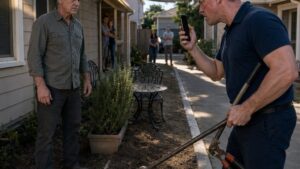
By the time Richard got home, Daniel’s driveway had a measuring tape stretched across it like a trap.
One end sat near Richard’s cracked side path, pressed under the boot of a man in dusty work pants. The other end ran past the edge of Daniel’s new stone curb and stopped near the black iron gate track that had been installed three weeks earlier. A contractor’s pickup was parked half on the street, its tailgate down, orange cones stacked in the bed.
Daniel stood with his phone raised, taking pictures.
Richard stopped his truck at the curb and turned off the engine. For a moment he sat with both hands on the wheel.
His house looked smaller from there. A single-story place with faded blue shutters, a porch rail he had repainted last spring, and two empty hooks where Ellen’s hanging ferns used to be. Daniel’s house, next door, rose higher and newer, with pale stone along the front and a driveway wide enough for two cars not to touch. The line between them had always mattered, but only quietly: where leaves fell, where sprinklers overshot, where Richard kept his trash bins on collection morning.
Now there were men standing on that line as if they owned it.
Richard got out.
Daniel saw him and lowered the phone. “Good. You’re here.”
The contractor looked up from the tape. He was younger than Daniel, broad-shouldered, with a pencil behind one ear and concrete dust on his knees. Richard recognized him from the curb work. Brandon Taylor. He had seen him walking the job site early, talking fast into his phone, sometimes waving his crew back into place when Daniel came out to inspect.
“What are you measuring?” Richard asked.
Brandon glanced at Daniel before answering. “Clearance.”
“Clearance for what?”
“For where the vehicle was parked. And where your cart would’ve passed.”
Richard looked at the tape. It crossed onto his side by several inches, running over the old seam in the asphalt where his driveway apron met Daniel’s pavers.
Daniel pointed with his phone. “We’re documenting everything. Since you refused to sign.”
“I refused to sign something untrue.”
Daniel’s smile was tight. “You refused to take responsibility.”
Richard stepped closer, not to Daniel, but to the tape. His knee twinged when he bent, so he rested one hand on his thigh. The tape read twenty-six inches at the edge of Daniel’s curb. The contractor had a clipboard on the hood of his truck. On it was a rough sketch of the driveways, not drawn well.
Richard saw his own property line shifted half a foot toward his house.
He looked down the shared edge until he found what he wanted: a dull metal cap set low beside a tuft of crabgrass. Most people missed it. He never did. He had paid for the survey after Ellen worried about the fence dispute with the previous owner. The cap had been there seventeen years.
“The marker is here,” Richard said.
Daniel frowned. “What marker?”
Richard touched the grass beside it. “Property marker.”
Brandon came over, pulled his pencil from behind his ear, and leaned down. “Huh.”
Daniel walked closer. “That doesn’t mean anything. We’re measuring the path you took.”
“You’re measuring from the wrong line.”
The contractor’s eyes moved from the marker to his sketch. He did not speak.
Daniel did. “Richard, this is exactly what I mean. You’re making everything difficult. The car was here yesterday morning.”
He pointed to the spot near his gate.
“Was it?” Richard asked.
Daniel’s face hardened. “Yes.”
Richard remembered yesterday morning clearly because the garbage truck had come late and the air had smelled like rain though the sky stayed dry. He had been trimming the dead bloom off Ellen’s rosebush when a delivery van blocked half the street. Daniel’s Ferrari had not been at the gate then. At least not when Richard had crossed the yard to pick up the fallen branch near the mailbox.
But memory, spoken too soon, could sound like excuse.
Richard let it sit.
Brandon pulled the tape back a few inches. “Mr. Hill, if the marker’s there, the drawing’s off.”
Daniel snapped his head toward him. “We’re not surveying the entire subdivision, Brandon.”
“No, sir. I’m just saying—”
“I know what you’re saying.”
The contractor stopped. That told Richard something.
Daniel turned back to Richard. “You had a cart. You were near my driveway. There’s damage at the exact height of a metal edge.”
“No,” Richard said. “Not exact.”
Daniel’s eyes narrowed. “What?”
“The invoice said twenty-two inches.”
“And?”
Richard looked at Brandon’s tape. “My cart’s lower frame is higher than that. The wheel hub is lower, but rubber doesn’t scrape paint like bare metal.”
Daniel gave a short laugh. “Listen to him.”
Brandon did not laugh. He looked toward Richard’s side gate, where the old green cart sat upside down beside a stack of clay pots.
“Mind if I look?” Brandon asked.
Daniel said, “No need.”
Richard said, “You can look.”
The two answers collided in the afternoon heat.
Brandon hesitated, then stepped toward the side gate. Daniel followed, irritated now, shoes clicking against his new pavers. Richard walked slower behind them.
The garden cart was where Richard had left it, with one handle wrapped in black tape and dried soil along the inside corners. Brandon crouched and held his tape against the lower metal frame, then the bent upper lip.
“Frame’s twenty-six,” Brandon said quietly. “Bent lip’s closer to thirty.”
Daniel folded his arms. “Maybe he tilted it.”
Richard looked at him. “Loaded with what?”
Daniel did not answer right away.
“What was I carrying?” Richard asked.
Daniel’s eyes went to the cart as though the answer might be sitting inside it.
Richard did not press. He knew better than to help a false story repair itself.
A truck passed behind them. Wind lifted a few dry leaves along the curb. Brandon stood and scratched one note onto his clipboard, then seemed to think better of it and turned the page.
Richard noticed the movement.
Near Daniel’s new gate post, pale dust clung to the black metal track. Not ordinary road dust. This was lighter, almost chalky, like the stone curb after Brandon’s crew cut it. There were two narrow drag marks on the pavement beside the gate where something heavy had been moved and then lifted.
Richard’s eyes followed the marks to the side of the driveway where Daniel often parked the Ferrari nose-in, close to the gate.
“You used ramps here?” Richard asked Brandon.
Brandon’s pencil stopped.
Daniel said, “What does that have to do with anything?”
“I’m asking him.”
Brandon glanced at Daniel again. “We had a loading ramp out here for the stone sections.”
“When?”
Brandon put the pencil back behind his ear. “During the curb install.”
“That was weeks ago,” Daniel said.
“Three weeks,” Brandon said. “And again yesterday morning. For cleanup.”
The words hung there.
Daniel turned slowly. “You told me your crew was done before eight.”
“We were loading before eight,” Brandon said. “Couple things ran over.”
Richard looked at the gate post. The pale scrape on its lower edge was fresh enough that the black paint around it still looked sharp, not weathered. He bent carefully, using one hand on the post to steady himself, and measured with his eyes first. Then he pointed.
“What’s that?”
Daniel stepped between him and the mark. “Don’t touch my gate.”
“I’m not touching it.”
Brandon moved to see around Daniel. His expression changed, not much, but enough.
A pale horizontal scrape crossed the lower gate post, nearly the same height as the Ferrari damage line Richard had memorized. Around it, the chalky stone dust gathered in the seam.
Richard straightened slowly.
Daniel looked from Richard to Brandon. “This is ridiculous. We are talking about my car.”
“Yes,” Richard said.
His voice was soft enough that Daniel had to lean toward it.
“And now we are finally near where it was.”
Daniel’s mouth tightened. For the first time that day, he did not have a paper to slap down or a room full of people to perform for. He had a driveway, a crooked drawing, a quiet contractor, a property marker in the grass, and an old man who had begun to look at the ground.
Richard did not feel victorious. Not even close.
He felt the shape of the thing widening.
This was not only Daniel.
Something had moved across that driveway. Someone had put it there. Someone had decided Richard was easier to blame than the truth was to untangle.
Richard looked again at the scrape on the gate post.
Twenty-two inches, give or take.
He went inside without saying more, because the mark would still be there after the shouting changed direction.
Chapter 3: Lisa Counts The Savings Before The Facts
Lisa Martinez had already put the invoice beside the saltshaker before Richard sat down.
She had not meant it cruelly. Richard knew that. His daughter had a way of organizing fear into piles: bill here, envelope there, pen straight across the table. When she was a girl, she had lined up her crayons by shade whenever Ellen was late coming home from the doctor. Now she was forty-nine and still trying to make worry behave by arranging objects.
The Ferrari repair invoice lay in the yellow light of Richard’s kitchen.
He had not brought the original home. Daniel still had it. But before leaving the dealership, Richard had asked the receptionist for a copy, and she had printed one while avoiding his eyes. The paper looked less dramatic here than it had on the red hood. Smaller. Thinner. More dangerous.
Lisa tapped the amount with one fingernail.
“Dad.”
“I know what it says.”
“Eighteen thousand dollars.”
“Eighteen thousand seven hundred forty.”
“That doesn’t make it better.”
Richard eased into the chair across from her. His knee had stiffened since the driveway. He did not reach for the bill. He had read it enough times.
Lisa wore her work blouse, the sleeves rolled up, her hair clipped back in a hurry. She had come straight from the clinic where she handled scheduling and insurance questions for other people’s emergencies. That was the trouble with her job, Richard thought. She saw the paperwork side of disaster all day long. By evening, every envelope looked like the beginning of a loss.
“I didn’t do it,” he said.
“I believe you.”
But she said it too quickly.
Richard looked toward the window over the sink. Outside, the last light sat on Ellen’s rosebush, the one that always bloomed unevenly no matter how carefully he pruned it. Ellen had called it stubborn, then defended it whenever he threatened to replace it.
Lisa followed his gaze, then looked back at the invoice.
“Believing you and fighting this are two different things,” she said.
“There’s nothing to fight if it isn’t true.”
“That is not how these things work.” Her voice softened, which was worse than if she had raised it. “He’s on the HOA board. He has insurance. He has money. You have—”
She stopped.
Richard finished it for her. “Me.”
“You know that isn’t what I meant.”
He did know. That did not keep it from landing.
Lisa rubbed both hands over her face, then pulled a small notepad from her purse. She had written numbers on it already. Property tax. Home insurance. Emergency savings. Car insurance deductible. He recognized her handwriting, tight and practical.
“You have enough to offer a settlement,” she said. “Not the full amount. Maybe a few thousand. Maybe he takes it to avoid the trouble.”
“Pay him for damage I didn’t cause?”
“Pay him to go away.”
Richard stared at the notepad.
The kitchen had not changed much since Ellen died. The same round oak table with a burn mark near the edge from a pan Lisa had set down when she was twelve. The same fruit-pattern curtains Ellen had insisted were cheerful. The same cabinet door that did not close unless pushed at the top corner. There were rooms in the house where grief still moved quietly, but the kitchen held grief and habit together. It was the place where bills had been paid, peaches canned, homework corrected, medicine sorted.
It was the place where Ellen had made him promise not to let anyone rush him when she was gone.
Take your time, Richard. People make mistakes when they’re afraid of being difficult.
He heard it so clearly that for a second he expected Lisa to hear it too.
“He put my name on a statement,” Richard said.
Lisa’s eyes lifted.
“At the showroom. Typed already. Said I should sign before insurance and HOA got involved.”
“That’s exactly what I’m worried about.”
“It’s what I’m worried about too.”
“Then why are you acting so calm?”
Richard looked down at his hands. The knuckles were swollen. A faint line of old primer still sat in one crease no soap had ever fully removed. Calm was not the absence of fear. Calm was what he used to keep fear from driving.
“I’m not calm,” he said.
Lisa’s face changed. She looked suddenly younger and more tired.
He picked up the invoice at last. “I’m scared that one loud lie can cost more than the roof. I’m scared if I sign one wrong sentence, I won’t be able to undo it. I’m scared you think I don’t understand what can happen.”
“I don’t think that.”
He let the silence answer.
Lisa’s eyes filled, but she blinked it back. “I think you’re alone here most of the time. I think Daniel knows that. I think people like him can make things expensive even when they’re wrong.”
Richard nodded. “Yes.”
“So let me help.”
“You can help by not asking me to say I did something I didn’t do.”
She looked away.
The refrigerator hummed. Somewhere outside, a dog barked twice. Richard folded the invoice along its existing crease, then unfolded it again, smoothing the paper with his palm.
“Today Brandon measured from the wrong line,” he said.
“Who’s Brandon?”
“The contractor who did Daniel’s curb.”
Lisa frowned. “What contractor?”
Richard told her about the driveway, the tape, the property marker, the gate track, the scrape on the post. He kept it plain. No drama, no accusation beyond what he could hold in his hand. Lisa listened, but her eyes kept dropping back to the invoice amount.
“Could that prove anything?” she asked.
“No.”
Her shoulders fell.
“Not by itself,” Richard said.
“That’s what I mean.”
“But it means there are facts Daniel left out.”
Lisa pressed her lips together. “Facts still cost money to prove.”
Richard stood slowly and went to the narrow cabinet beside the back door. The bottom drawer stuck halfway, as it always did. He pulled harder, and it gave with a wooden groan.
Inside were old folders Ellen had once labeled in blue marker. Roof. Taxes. Medical. Insurance. Property. Richard slid out the thick brown folder with the cracked spine and brought it back to the table.
Lisa stared at it. “You still have all that?”
“Your mother kept everything.”
“She did.”
The words opened a softer place between them.
Richard untied the string around the folder flap. The smell that rose from it was paper, dust, and a little mildew. Old receipts. Carbon copies. Paint notes from jobs he had done on his own truck. The survey from seventeen years ago. A photograph of the driveway before Daniel bought next door. Ellen’s handwriting on sticky notes, still firm and slanted.
Lisa reached out, touched one tab, then pulled her hand back as if the folder were fragile.
Richard sorted slowly. He did not know exactly what he was looking for until he saw it.
A small notepad page, torn at the top, tucked behind the property survey.
Yesterday’s date was not on it. The date was from a week earlier, when he had started writing reminders for the yard work he planned around the trash pickup and Daniel’s curb cleanup. Under Ellen’s old grocery magnet, he had also kept a habit of noting outside work by time, mostly because forgetting sprinkler days had once cost him half a bed of tomatoes.
There, in his own handwriting, was the line:
Tuesday: 7:40 trash truck late. Daniel curb crew loading ramp by gate. Cart stayed side yard.
Richard read it once.
Then he read it again.
Lisa leaned forward. “Dad?”
He did not smile this time. The paper was too small for that, and the trouble too large.
He placed the note beside the Ferrari invoice, aligning the edges carefully.
“Your mother used to say,” he said, “old paper waits better than people do.”
Chapter 4: The Insurance Letter Uses Daniel’s Words
The envelope arrived two days later with Richard’s name showing through the little plastic window.
It was not in the mailbox. It was in the hand of a man standing on Richard’s porch at 9:15 in the morning, wearing a tan sport coat despite the heat and holding a leather case against his hip. Richard saw him through the screen door before the man knocked. He had been at the kitchen table, sorting the old folder into smaller piles: property survey, driveway notes, repair receipts, photographs, insurance papers. The Ferrari invoice sat by itself, faceup, like it did not want to mix with honest records.
The man knocked lightly.
Richard opened the main door but left the screen latched.
“Mr. Walker?” the man asked.
“Yes.”
“I’m Jonathan Baker. I’m handling the claim involving Mr. Hill’s vehicle.”
Richard looked at the envelope.
Jonathan followed his eyes and gave the practiced smile of a man who delivered bad news for a living. “This is just preliminary paperwork.”
“Preliminary to what?”
“To resolving liability.”
Richard waited.
Jonathan shifted the leather case to his other hand. “May I come in?”
Richard looked past him toward Daniel’s house. The Ferrari was not in the driveway. The new gate stood closed. Pale dust still gathered along the track where Brandon’s crew had worked. From this distance, the scrape on the post was only a lighter interruption in the black paint, but Richard knew where to look now.
“No,” Richard said. “We can speak here.”
Jonathan’s smile tightened a little, then returned. “Of course.”
He opened the case and took out a printed packet on a clipboard. The top page had Richard’s name, Daniel Hill’s name, a claim number, and a section marked Statement of Involved Party.
Involved. Richard noticed words like that. They sounded neutral until someone used them to move money.
Jonathan clicked a pen. “Mr. Hill reported damage to his Ferrari after an incident near the shared driveway on Tuesday morning. According to the initial account, you acknowledged being near the vehicle with a metal garden cart.”
Richard kept his hand on the doorframe. “I acknowledged being in my yard.”
Jonathan glanced down. “The statement says you admitted being near the Ferrari.”
“Who wrote that?”
“This was prepared from Mr. Hill’s report.”
“Then it uses Mr. Hill’s words.”
Jonathan looked up at him. For the first time, the practiced expression slipped. Not much. Enough.
“That’s why I’m here,” he said. “To get your version.”
Richard opened the screen door. “Then you can sit at the kitchen table while I read it.”
Jonathan stepped inside carefully, as though the house might tell him something he did not want to know. His eyes moved over the narrow hall, the framed photograph of Ellen near the coat hooks, the old umbrella stand, the polished but worn floorboards. Richard led him into the kitchen.
The table was already covered with paper.
Jonathan noticed the Ferrari invoice first. Men always did. The number seemed to shine up from the page.
“You have a copy,” Jonathan said.
“I asked for one.”
“Good. That saves time.”
Richard did not answer.
Jonathan sat across from him and laid the statement form on top of the invoice without asking. The edge of the insurance paper covered the line Richard had memorized: left rear quarter abrasion, lower panel, twenty-two inches.
Richard moved the insurance form half an inch to the left.
Jonathan watched the gesture.
“This is standard,” he said.
“Standard can still be wrong.”
The adjuster tapped the page. “I’m not here to accuse you personally. My job is to document facts.”
Richard looked at the typed paragraph.
I, Richard Walker, acknowledge that on Tuesday morning I was operating a metal garden cart in the vicinity of Daniel Hill’s Ferrari and may have made contact with the vehicle’s left rear quarter panel.
The words were worse than Daniel’s shouting. They were quiet. They wore a tie. They waited for a signature and then became harder to move.
“I didn’t say this,” Richard said.
“You can add clarification below.”
“No.”
Jonathan leaned back. “Mr. Walker, refusing to cooperate may complicate things.”
“There it is,” Richard said.
“Excuse me?”
“The part where you call it cooperation when I sign something untrue.”
Jonathan set the pen down. “I’m trying to keep this from escalating. Mr. Hill has already contacted the HOA. If the claim proceeds without your statement, the carrier may make decisions based on the available report.”
“The available report being his.”
“At this stage, yes.”
Richard pulled a chair leg back with his foot and sat slower than he wanted to. His knee had been sore since he crouched near Daniel’s gate, and he hated that Jonathan saw the care with which he lowered himself. People mistook careful movement for uncertain thought.
He turned the statement toward himself and picked up the pen.
Jonathan relaxed a fraction.
Richard drew a neat line through the sentence that said may have made contact.
Then he wrote beneath it, in block letters because he wanted no room for interpretation:
I DID NOT CAUSE THIS DAMAGE.
Jonathan stared.
Richard capped the pen and set it down.
“That’s my statement.”
Jonathan lifted the paper, as if checking whether ink could be undone by disappointment. “Mr. Walker, this form is intended to capture your account in more detail.”
“That is my account.”
“You were seen near the vehicle.”
“I was seen in my yard.”
“You had the cart.”
“The cart stayed by the side gate.”
“Mr. Hill said—”
“I know what Mr. Hill said.”
Jonathan stopped. Richard heard the refrigerator hum into the space between them.
The adjuster’s eyes moved to the old repair folder. “What is all this?”
“Records.”
“Related to the vehicle?”
“Related to the property line, the driveway, my cart, and Tuesday morning.”
Jonathan’s professional calm shifted into caution. “You understand none of that necessarily changes vehicle liability.”
“I understand you came with my name already typed under Daniel’s story.”
A flush rose slightly under Jonathan’s collar. He gathered the pages into order, then paused with the invoice still visible.
“May I ask how you know the cart couldn’t have contacted that area?”
Richard reached for the folded note from his old folder, but did not hand it over yet. “The invoice says the mark is twenty-two inches high. My cart’s lower metal frame is twenty-six inches. The rubber wheel is lower, but rubber doesn’t leave a hard abrasion like that.”
Jonathan looked at him longer this time. Not kindly. Not dismissively either.
“You measured it?”
“Brandon Taylor measured it in front of Daniel.”
Jonathan wrote that down.
Richard watched the pen move. There was power in getting a thing written correctly. Smaller than shouting. Stronger, if it lasted.
“Who is Brandon Taylor?” Jonathan asked.
“Contractor. He worked Daniel’s curb and gate.”
“When?”
“Recently. And Tuesday morning.”
Jonathan’s pen paused.
Richard noticed.
“Tuesday morning?” Jonathan asked.
“That is what he said.”
Jonathan flipped through his packet. “The dealership intake shows the vehicle was brought in Tuesday morning at 10:32. Mr. Hill’s report says he confronted you after you refused to accept responsibility.”
“He confronted me Thursday at the dealership.”
“I mean the initial neighborhood complaint.”
Richard looked up slowly.
Jonathan seemed to realize he had said more than he intended. He closed the packet, but the words were already in the room.
“What time was that complaint filed?” Richard asked.
“I don’t have the exact—”
“You brought a packet.”
Jonathan inhaled, then opened the folder again. “HOA notice of incident was entered Tuesday at 9:18 a.m. That’s what was forwarded to us.”
Richard looked at the kitchen clock, as if Tuesday morning might come back if he gave it a place to stand.
Tuesday at 9:18.
Before the dealership intake.
Before Daniel ever put the invoice on the hood.
Before Richard was asked anything.
Jonathan gathered the papers. “I’ll note that you dispute the statement.”
“I don’t dispute my statement,” Richard said. “I dispute his.”
The adjuster gave a small nod, not agreement exactly, but acknowledgment. At the door, he paused with his hand on the latch.
“For what it’s worth,” he said, “the dealership logged the car before Mr. Hill submitted the final repair estimate. If you intend to challenge the timing, you may want to ask them for the intake record.”
Richard stood in the doorway after Jonathan left, watching the man cross the yard toward his car.
On the kitchen table, the insurance form lay over the Ferrari invoice, but it no longer covered the twenty-two-inch line.
Richard turned back inside and wrote one more note beneath Tuesday’s page.
HOA complaint: 9:18.
Dealership intake: 10:32.
Then he underlined both times once.
Chapter 5: Amanda Reads The Line Twice
The dealership smelled the same the next morning, but Richard did not enter it the same way.
He still wore the old work jacket. He still felt the black marble floor trying to make every step look uncertain. The red Ferrari was no longer on the main display pad; a white convertible sat there instead, bright under the lights and meaningless to him. People still glanced at him as he crossed the showroom, but he did not look at their faces long enough to receive whatever story they were making.
At the service desk, a receptionist looked up and gave the careful smile she had given him two days earlier.
“I need to speak with Amanda Roberts,” Richard said.
“Do you have an appointment?”
“No.”
“Is this regarding service?”
“It’s regarding an estimate that was used against me.”
The smile vanished. She looked toward the glass-walled office behind her. A woman inside stood with a tablet in one hand, speaking to a technician through the open door. She had short dark hair, a navy blazer, and the look of someone who did not have time to be pulled into someone else’s argument.
The receptionist went to her. Richard waited with his folder tucked beneath his arm.
Amanda Roberts came out after a moment.
“Mr. Walker?”
“Yes.”
“I remember you.” Her eyes flicked to the folder. “I’m sorry, but if this is about Mr. Hill’s repair, we cannot release customer information without authorization.”
Richard nodded. “I understand.”
That seemed to unsettle her more than an argument would have.
“I’m not asking for his payment information,” he said. “I’m asking about the estimate he placed on a car hood and told me to sign under.”
Amanda’s mouth tightened. She glanced toward the showroom floor. “That should not have happened here.”
“It did.”
“I’m aware.”
Richard slid the copy of the invoice from his folder and placed it on the counter. Not hard. Flat. The way Daniel had placed it on the Ferrari, except without the performance.
Amanda looked down at it.
“I need to know when this estimate was opened,” Richard said.
“We can’t—”
“The claim has my name in it.”
Amanda did not answer.
Richard took out the statement form with his handwritten correction. He did not push it at her. He simply laid it beside the invoice.
“They typed that I may have made contact with the vehicle. I did not. The adjuster says your intake time may matter.”
Amanda read the crossed-out sentence. Her expression became less official and more tired.
“Mr. Walker,” she said quietly, “even if I wanted to help, there are privacy limits.”
“I’m not asking you to help me. I’m asking you to help the record stop leaning.”
For a moment, the sounds of the dealership went on around them: soft music, a printer, distant voices, a car door closing somewhere in service. Amanda looked at the invoice again.
Then she picked it up.
“Come to the side counter,” she said.
The side counter had no chairs. Richard stood while Amanda logged into a computer angled away from him. She worked in silence, and he did not try to look around the monitor. After half a minute, she said, “I can confirm limited procedural information.”
“That’s all I’m asking.”
“Estimate was opened Tuesday at 10:47 a.m. Preliminary intake note was entered at 10:32 a.m.”
Richard wrote the times on a small pad.
Amanda watched him write. “You already had 10:32.”
“Insurance adjuster mentioned it.”
“And you’re asking because?”
“HOA complaint was entered at 9:18.”
Amanda’s fingers paused above the keyboard.
She turned back to the screen and clicked once. “Mr. Hill brought the vehicle in after the complaint?”
“That is what I’m trying to understand.”
“I can’t speak to the HOA.”
“No.”
Amanda looked at the invoice again, then leaned closer to the screen. “The damage description here was copied from the preliminary intake note.”
“Not from a full inspection?”
“No. The full inspection adds refinishing recommendations later. But the first description came from the intake advisor’s visual note.”
She highlighted something on her screen, then glanced at the paper copy. Richard saw only the glow reflected in her glasses.
“What does the first note say?” he asked.
Amanda hesitated.
“My name is in the claim,” he said again, not louder.
She exhaled. “Left rear quarter abrasion, lower panel. Approximate impact height, twenty-two inches. White-gray residue at lower edge.”
“White-gray residue,” Richard repeated.
Amanda looked at the invoice, then read the printed line twice, the second time more slowly.
“That did not make it onto the estimate,” she said.
“What kind of residue?”
“The note doesn’t identify it.” Her voice lowered. “It says surface contamination present before wash.”
Richard wrote that down too.
Behind him, a familiar voice cut through the dealership air.
“What is he doing here?”
Daniel Hill stood ten feet away, already angry, already polished, already performing for a room that had not yet agreed to watch. His suit was lighter today, gray with a pale shirt. The woman beside him, likely his wife, stopped just behind his shoulder and looked from Amanda to Richard with alarm.
Amanda straightened. “Mr. Hill.”
Daniel came to the counter. “I asked your staff not to discuss my vehicle with him.”
“We are not discussing protected payment details,” Amanda said.
“He’s harassing me now?”
Richard put the cap back on his pen. “I asked for times.”
Daniel looked at the papers on the counter and then at Amanda. “This is exactly why I wanted the responsibility form signed. He’s dragging this out.”
“You filed the HOA complaint at 9:18,” Richard said.
Daniel’s eyes snapped back to him.
“The car was brought here at 10:32.”
“So?”
“So before anybody inspected the car here, before I saw any invoice, before you asked me a question, you filed the complaint.”
Daniel spread his hands. “Because I knew what happened.”
“You knew before the estimate?”
“I saw the damage.”
“When?”
Daniel’s mouth opened, then closed.
The woman beside him touched his sleeve. “Daniel.”
He shook her off lightly, not cruelly, but impatiently. “I don’t need to answer him.”
“No,” Richard said. “You don’t.”
Amanda looked between them. “Mr. Hill, this needs to leave the showroom floor.”
Daniel leaned toward Richard. “You think a few times written on an old man’s notepad change anything? You were there. You had the cart. Everyone knows it.”
Richard heard the old phrase hiding inside the new one.
Everyone knows.
That was what people said when proof had not arrived but judgment had.
He slid the invoice back into his folder. “The first note said white-gray residue.”
Amanda looked down sharply.
Daniel’s expression did not change fast enough. That told Richard the words meant something to him.
“Cars pick up road grime,” Daniel said.
“Maybe.”
“It’s a lower panel.”
“Yes.”
“Then stop acting like you found gold.”
“I found a word you left out.”
Daniel stepped closer. “Careful, Richard.”
Amanda’s voice cut in. “Mr. Hill.”
Richard did not move back. He was aware of his age, his knee, the bright floor, the fact that everyone could see the difference between Daniel’s shoes and his own. But he had entered this room because Daniel had used it as a stage. He would not leave just because the stage lights were unkind.
“I’m careful,” Richard said. “That’s why I’m still reading.”
Daniel stared at him with open dislike now, no polished edge left on it.
Amanda turned the invoice toward herself and marked the intake time on a sticky note. She did not hand over a printout. She did not make a speech. She simply wrote the two times and the words surface contamination present before wash, then initialed it.
“This confirms what I am permitted to confirm,” she said.
Richard took the sticky note and placed it inside his folder.
As he turned to leave, Amanda spoke again, too quietly for Daniel’s wife to hear but not too quietly for Richard.
“Mr. Walker.”
He paused.
“The lower-panel mark had construction grit in it. Not just dust. The advisor mentioned it because it scratched under the wipe.”
Richard held her eyes for one beat.
Then he nodded.
Outside, he sat in his truck before starting it. He opened the folder and looked at the invoice again.
The paper had not grown less dangerous.
But now it had begun to point away from him.
Chapter 6: The Curb Dust On The Wrong Side
Richard set his garden cart on level pavement and measured it three times before he let himself trust the answer.
The lower metal frame sat at twenty-six inches. The bent lip near the handle sat just under thirty. The rubber wheel center was lower, but the tire was broad and soft-edged, worn smooth from years of rolling over mulch and driveway cracks. He wrote each number on a page from his old repair folder, then set the measuring tape against the cart again.
Twenty-six.
Not twenty-two.
He knelt longer than he should have, and getting back up cost him a hand against the side gate. No one was there to see it, which helped. He did not mind being old. He minded people using it as permission.
Across the driveway, Daniel’s gate stood open. The Ferrari was still gone. Brandon Taylor’s pickup was parked near the curb, and Brandon was loading a metal ramp into the bed with the help of a crewman. Pale stone dust puffed off the ramp edge when it scraped the tailgate.
Richard watched from his side yard.
The ramp was narrow, ribbed, and heavy enough to require both men. One end had a rough metal corner where the protective rubber cap had split.
Richard’s eyes went to Daniel’s gate post.
Then to the ramp.
Then to the invoice in his folder.
He walked over with the measuring tape hanging from his hand.
Brandon saw him first and said something to the crewman, who carried a toolbox toward the truck cab and busied himself there.
“Mr. Walker,” Brandon said.
“Mr. Taylor.”
Brandon looked toward Daniel’s house. “If this is about yesterday, I’m not trying to get in the middle.”
“You already are.”
The contractor wiped his palms on his pants. He seemed more worn down than guilty, though Richard had learned that people could be both.
“I just do the work I’m hired for,” Brandon said.
Richard nodded toward the ramp. “How high is that corner when two men carry it?”
Brandon’s eyes moved to the ramp too quickly.
“Depends.”
“On what?”
“How you’re holding it.”
Richard handed him the tape. “Hold it how you held it Tuesday.”
Brandon did not take the tape. “I don’t remember exactly.”
“Yes, you do.”
The words were not sharp. That made Brandon look at him.
Richard said, “A man remembers when a heavy thing almost catches paint.”
Brandon looked toward Daniel’s front windows. No movement behind the glass.
Finally he took the tape.
He and the crewman lifted the ramp from the tailgate and held it at carrying height. The broken-capped corner sat just over twenty-two inches from the pavement.
Richard did not speak.
Brandon lowered the ramp.
“It didn’t hit the car,” Brandon said.
“I didn’t ask.”
“It didn’t.”
“Then why did you answer?”
Brandon’s jaw worked. He leaned the ramp against the truck and brushed dust off his sleeve. “Look, the car was too close to the gate. Mr. Hill wanted the cleanup done before he left. We were trying to get the last stone off the site. The ramp slipped against the post. That’s all I saw.”
“The gate post has a scrape.”
“Because the ramp slipped.”
“And the car?”
Brandon looked down the driveway. “I didn’t see it hit the car.”
That was not the same as no.
Richard knew the difference. All his working life had lived inside such differences.
Daniel’s front door opened.
He came out holding his phone, expression already set. “Why are you talking to my contractor?”
Richard looked at the phone first. Daniel had it raised just enough to record or pretend to.
“I asked about the ramp.”
Daniel descended the steps. “The ramp has nothing to do with your cart.”
“No,” Richard said. “It doesn’t.”
Daniel stopped, hearing the turn in that.
Brandon rubbed the back of his neck. “Mr. Hill, I told him we used the ramp Tuesday.”
Daniel’s head turned slowly. “You told him what?”
“That we loaded the stone Tuesday.”
“I told you to stop discussing my property with him.”
“Your property line is not where your drawing showed,” Richard said.
Daniel pointed toward him. “Do not start that again.”
From down the sidewalk, an older neighbor slowed near a mailbox. Another resident walking a small dog paused, pretending the dog needed the grass. The neighborhood had a way of arriving whenever voices rose, and Daniel knew how to use that too.
“Fine,” Daniel said, louder now. “Let’s be clear. This man damaged my vehicle and now he’s harassing workers, challenging property lines, and making up stories about dust.”
Richard felt the watchers more than saw them. It was the showroom again, only with lawns instead of marble.
He opened the folder and took out the invoice.
Daniel laughed. “Still carrying that around?”
“Yes.”
“Good. Maybe read the total again.”
Richard unfolded the paper. “I’m reading the line you didn’t like.”
Daniel’s face hardened.
Richard held the invoice beside the measuring tape, not for drama but because he wanted the objects together.
“Twenty-two inches. Lower panel. White-gray residue before wash.”
Brandon looked away.
Daniel said, “You are not qualified to investigate my car.”
“I’m qualified to read.”
“Barely qualified to mind your own business.”
The neighbor with the dog looked down at the sidewalk.
Richard let the insult pass through without giving it a place to stay.
Lisa’s car turned onto the street then. She pulled up too fast, parked at Richard’s curb, and got out with worry already in her face.
“Dad?”
Daniel saw her and changed his tone. “Lisa, maybe you can talk some sense into him. He’s making this worse.”
Lisa looked at Richard, then at the invoice in his hand, then at the ramp.
For one breath Richard thought she would say what she had said in the kitchen. That he should settle. That people like Daniel made wrong things expensive.
Instead she came to stand beside him, not in front of him.
“What’s happening?” she asked.
Richard handed her the note from Amanda.
She read the times, then the words about construction grit.
Daniel snatched his sunglasses off the top of his head. “That note is not evidence of anything.”
“No,” Richard said. “It’s a question.”
“I am tired of your questions.”
“That doesn’t answer them.”
The quiet after that was brief but clean.
Brandon shifted, then reached into the cab of his truck. Daniel’s eyes followed him.
“What are you doing?” Daniel asked.
Brandon pulled out a folded work order. “I’m not getting blamed for this later.”
Daniel strode toward him. “Put that away.”
But Brandon held it back. “It says final load-out Tuesday, 7:30 to 9:40. Gate side. Stone curb and track cleanup. Metal ramp used.”
Richard’s pulse changed, not faster exactly, but deeper.
Lisa looked at him. Her expression had opened in a way he could not bear to study too long.
Daniel’s voice dropped. “Brandon.”
The contractor swallowed. “You told us to move fast because you had the service appointment.”
“No. I told you to clear the driveway.”
“You told us to put the ramp by the gate.”
Daniel’s face reddened. “Because that was where it belonged.”
Richard looked again at the broken corner of the ramp. White-gray dust clung there. Not proof by itself. Not enough to solve everything. But enough to stop the story from being only Daniel’s.
From across the street, a car slowed. Daniel noticed and straightened, smoothing his shirt cuff as if the neighborhood had caught him in some minor inconvenience instead of a lie beginning to fray.
“I’m calling an HOA meeting,” he said. “Tonight. Emergency session.”
Lisa turned. “For this?”
“For property damage caused by negligent conduct.” Daniel looked at Richard. “If he wants to play investigator, let him do it in front of the board.”
Richard folded the invoice carefully. His hands shook once, not from fear alone but from the effort of keeping everything contained.
Lisa said, “Dad, you don’t have to—”
“Yes,” Richard said.
She stopped.
He looked at his house, then Daniel’s gate, then the property marker in the grass. Ellen’s rosebush moved slightly in the warm air, one uneven bloom leaning over the porch rail.
For two days, people had been putting papers in front of him and asking him to shrink.
He was tired.
But tired was not the same as finished.
“I’ll come,” Richard said.
Daniel gave him a thin smile. “Bring your little folder.”
Richard slid the invoice back under the brown flap and tied the string.
Brandon watched Daniel walk away. When the front door closed, the contractor spoke without looking at Richard.
“I only moved the ramp where Daniel told me to.”
Chapter 7: Richard Refuses To Pay For Another Man’s Hurry
The community meeting room had folding chairs, a coffee urn no one touched, and a long table at the front where the HOA board sat with nameplates in front of them like little shields.
Richard arrived ten minutes early.
He did not want to walk in after Daniel had already made the room his. He came with his old repair folder under one arm, the Ferrari invoice inside it, the property survey folded twice, and the measuring tape in his jacket pocket. Lisa walked beside him from the parking lot to the door, but when they reached the entrance, Richard stopped.
“You can sit with me,” she said.
“I know.”
“You don’t have to do this alone.”
“I’m not alone.”
She looked at the folder under his arm, then back at him. “That’s not what I meant.”
Richard touched her shoulder, just once. “I know what you meant.”
Inside, a few neighbors had already gathered. People looked up when he entered, then looked away with the quick discomfort of those who had heard enough to judge but not enough to be responsible. Daniel stood near the front table, speaking to the HOA secretary. He wore the same controlled posture he had worn in the showroom, but his smile had lost its easy shine.
Brandon Taylor stood near the side wall, hands in his pockets, dusty boots planted together. Jonathan Baker sat in the second row with his leather case on his lap. He looked at Richard and gave a small nod. Richard returned it.
Daniel saw the nod.
His face tightened.
The HOA secretary called the meeting to order with a pen tapped against a yellow pad. Daniel sat at the front, though no one had invited him to yet. He spread his papers neatly, the way he had spread the invoice on the Ferrari’s hood, and Richard felt the old anger stir under his ribs.
Not hot. Not wild.
Useful.
“This emergency meeting concerns a property damage complaint submitted by board member Daniel Hill,” the secretary said. “The complaint alleges negligent conduct by resident Richard Walker resulting in damage to Mr. Hill’s vehicle and potential violation of community property standards.”
Richard heard Lisa inhale beside him.
Daniel stood before anyone asked him to.
“I’ll keep this simple,” he said.
That was how men like Daniel began when they wanted complicated things to disappear.
“My vehicle was damaged along the left rear quarter panel after Mr. Walker moved an old metal garden cart near my driveway. He was seen in the area. He refused to take responsibility at the dealership. He has since harassed my contractor, interfered with measurements, and attempted to confuse a straightforward matter with irrelevant details.”
He put a copy of the invoice on the front table.
Even from the third row, Richard saw the amount printed near the bottom.
Eighteen thousand seven hundred forty dollars.
Somebody behind him whispered.
Daniel continued. “I am asking the board to record his responsibility, require cooperation with insurance, and consider fines if he continues obstructing the process.”
The secretary looked toward Richard. “Mr. Walker?”
Richard stood slowly.
His knee objected. The chair leg scraped the floor. The sound was small and sharp.
He walked to the front with his folder held in both hands. Daniel shifted aside only enough to say he had done so. Richard placed the folder on the table but did not open it immediately.
“I did not damage Daniel’s car,” he said.
Daniel gave a faint laugh. “That’s your whole statement?”
“No.”
Richard untied the string around the folder. His fingers were steady now, which surprised him a little. Maybe fear had tired itself out. Maybe it was waiting somewhere else. He took out Daniel’s invoice and laid it flat.
The room quieted.
This time, the paper was not on red paint. It was on a plastic folding table under fluorescent lights, where it looked less like authority and more like a thing that could be read.
Richard pointed to one line.
“Left rear quarter abrasion. Lower panel. Approximate impact height: twenty-two inches.”
Daniel folded his arms. “We’ve all seen the invoice.”
“You showed the amount,” Richard said. “I am showing the damage.”
No one laughed.
Richard took the measuring tape from his pocket and set it beside the invoice. Then he took out a page with his own measurements written in block letters.
“My garden cart’s lower metal frame is twenty-six inches. The bent upper lip is nearly thirty. The rubber wheel sits lower, but rubber does not leave a hard abrasion with white-gray grit under the wipe.”
Daniel leaned forward. “He is not a certified appraiser.”
“No,” Richard said. “I worked thirty-six years preparing damaged panels before paint.”
A few heads turned toward him.
He had not said that loudly. He had not said it like a credential. He said it like a fact, and facts did not need to stand taller than they were.
Richard placed Amanda’s sticky note beside the invoice.
“The dealership intake note says the car had white-gray surface contamination before wash. The service manager confirmed the estimate was opened at 10:47 Tuesday morning from a 10:32 intake note.”
Daniel’s eyes went to the sticky note. “That note is not an official report.”
Jonathan stood from the second row. “It matches the intake time forwarded to the carrier.”
Daniel turned. “You’re the adjuster, not the board.”
Jonathan’s expression stayed neutral. “And I’m confirming the times I provided.”
The secretary wrote something down.
Richard took out the HOA incident page Jonathan had copied for him. “Daniel’s complaint was entered at 9:18 that morning.”
The room seemed to lean in.
Richard looked at Daniel, not angrily, but directly. “Before the dealership wrote the estimate. Before anyone here asked me whether my cart touched your car. Before you placed that bill in front of me and told me to sign.”
Daniel’s jaw moved once. “I saw the damage before the dealership.”
“When?”
“In the morning.”
“What time?”
Daniel looked toward the secretary. “This is not a courtroom.”
“No,” Richard said. “It is a neighborhood meeting about whether I should pay eighteen thousand dollars for something I did not do.”
The sentence settled over the room.
Lisa’s hands were clasped tightly in her lap. Richard did not look at her long. If he did, he might lose the thin line of calm he had left.
He took out the property survey next and unfolded it. The paper had softened at the creases from years in Ellen’s cabinet. He smoothed the corner with his palm.
“This is the property marker between our driveways. Brandon measured from the wrong line at first. After the marker was shown, the path of my cart did not match where Daniel said the car was damaged.”
Brandon shifted against the wall.
The secretary looked at him. “Mr. Taylor, is that accurate?”
Brandon rubbed his palms on his jeans. “The marker was farther toward Mr. Hill’s side than the sketch we had.”
“Your sketch?” the secretary asked.
“Mr. Hill’s sketch,” Brandon said.
Daniel’s chair scraped. “That sketch was approximate.”
Richard did not answer that. He took one more page out of the folder.
It was his note from before all this had begun. Tuesday: 7:40 trash truck late. Daniel curb crew loading ramp by gate. Cart stayed side yard.
He put it down without explaining Ellen, or the drawer, or the habit of writing down work before his memory could be accused of bending.
“This was written before Daniel accused me,” Richard said. “It says his crew was loading by the gate Tuesday morning.”
Daniel shook his head. “Convenient.”
“Yes,” Richard said. “Old paper can be convenient when it waits long enough.”
Brandon looked at the floor.
The secretary turned to him again. “Mr. Taylor, did your crew use a metal ramp by the gate Tuesday morning?”
Brandon’s face tightened. “Yes.”
“During what time?”
“About 7:30 to 9:40.”
Richard heard Lisa let out a breath.
The secretary wrote. “Was Mr. Hill’s Ferrari near that area?”
Brandon looked at Daniel.
Daniel’s eyes warned him.
Brandon swallowed. “It was parked close to the gate part of the time.”
Daniel stood. “This is absurd. My contractor did not damage my car.”
“No one here has said who damaged it,” Richard said.
“You have implied it all evening.”
“I have said your story does not fit your invoice.”
That stopped Daniel more effectively than a shout would have.
Richard took the final photograph from his folder. Lisa had taken it that afternoon, after Daniel announced the meeting. It showed the lower gate post, the pale scrape, and the measuring tape held beside it. Twenty-two inches.
He placed it next to the invoice line.
“The gate post scrape is at the same height. The ramp’s broken corner is at the same height when carried. The dealership noted construction grit. Brandon’s work order says metal ramp, gate side, Tuesday morning. Your HOA complaint was entered before you spoke to me.”
Daniel stared at the table.
For the first time since Richard had known him, Daniel looked not poor or weak or ashamed, but cornered by the simple refusal of paper to flatter him.
The secretary asked, “Mr. Hill, did you file the complaint before speaking with Mr. Walker?”
Daniel’s voice came out lower. “I believed I knew what happened.”
“That is not the question.”
His wife sat near the back, eyes fixed on the floor.
Daniel looked around the room and found no showroom audience waiting to be led. Just neighbors, papers, a contractor, an adjuster, and an old man who had not raised his voice once.
“Yes,” Daniel said finally. “I filed it before speaking to him.”
The secretary wrote that down.
Jonathan stood again. “Given the inconsistencies in timing and possible contractor involvement, I cannot recommend recording Mr. Walker as responsible without further review. The claim should be revised.”
Daniel turned sharply. “You don’t get to—”
“I get to correct my file,” Jonathan said.
That was all. No drama. No victory bell. Just a sentence that moved weight off Richard’s chest.
The secretary looked at the other board members, then at Daniel. “The HOA will not issue a violation or fine against Mr. Walker based on the present complaint. The incident record will be corrected to show disputed responsibility and pending insurance review.”
Richard looked down at the invoice.
For days it had been a weapon. Now it sat among the other papers, stripped of its performance. Same amount. Same print. Same threat. But no longer alone.
Daniel’s face had gone pale with anger. “I withdraw the HOA request,” he said.
The secretary nodded once. “That will be noted.”
Richard gathered his papers slowly. He did not want to drop anything. He did not want trembling fingers to become Daniel’s last comfort.
As he slid the invoice back into the folder, Daniel spoke under his breath.
“You could have made this easier.”
Richard tied the folder string and looked at him.
“For who?” he asked.
Daniel had no answer ready.
Richard walked back to Lisa. She stood when he reached her, eyes wet but not spilling.
“I’m sorry,” she whispered.
He shook his head once. “Not now.”
She understood and did not say more.
At the door, Brandon stepped aside.
“Mr. Walker,” he said quietly. “I’ll give the adjuster my work order.”
Richard nodded. “Give him the true one.”
Brandon looked down. “Yes, sir.”
Outside, the evening air was warm and smelled faintly of cut grass and asphalt cooling after sun. The parking lot lights had come on. Richard walked toward his truck with the folder under his arm, the same old folder Ellen had labeled years before, now carrying one more proof that being careful was not the same as being afraid.
Lisa walked beside him.
After a few steps, she said, “You knew in the showroom, didn’t you?”
Richard thought of the red Ferrari, the invoice slapped on the hood, Daniel’s voice rising so everyone would look, the bystanders deciding which story was easier. He thought of twenty-two inches and the faint smile he had not meant to show.
“I knew enough not to sign,” he said.
Lisa reached for his hand.
He let her take it.
They crossed the lot slowly, without hurry, without applause, without anyone calling after them. Behind them, inside the meeting room, Daniel still had his car, his house, his money, and the problem he had tried to hand to an old man.
Richard had his home.
And for tonight, that was enough.
The story has ended.