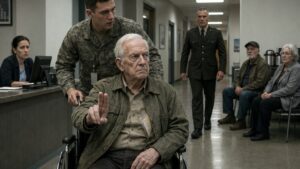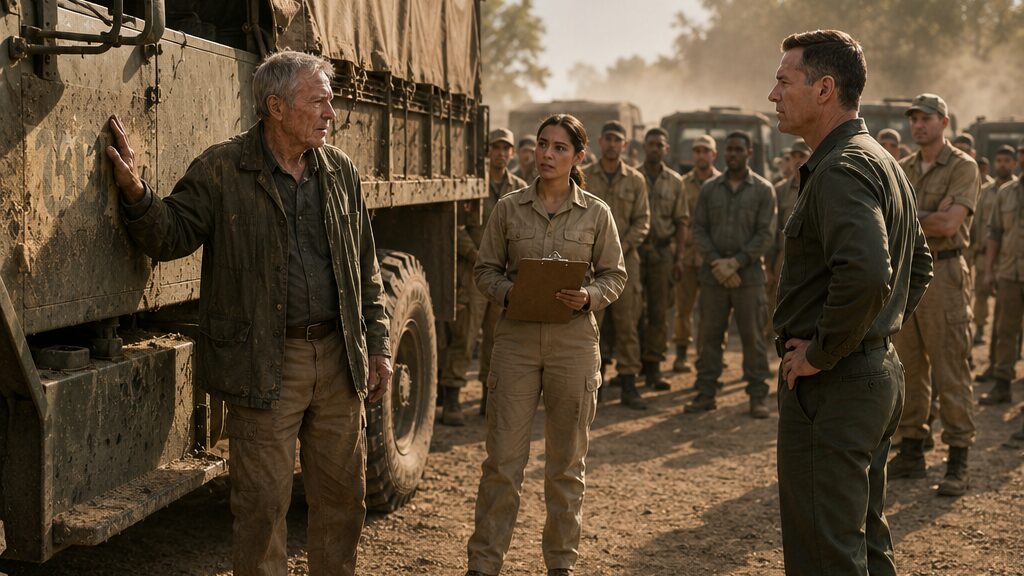
The Old Man Beside the Dust-Covered Army Truck Nobody Wanted to Listen To
Chapter 1: The Argument Beside the Forgotten Truck
“Move it by Thursday.”
The voice cut through the vehicle yard before Ronald Hill saw who said it.
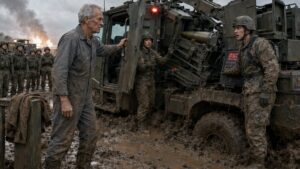
He was standing beside the truck again, one hand resting on the faded steel door. Dust coated the windshield so heavily that it reflected the morning sun like dull glass.
A maintenance crew stood nearby with clipboards.
The younger men barely looked at Ronald anymore. Over the past month they had learned that if they mentioned the truck, the old volunteer would appear within minutes.
“Thursday,” the voice repeated.
Ronald turned.
Colonel Mark Davis was walking toward him across the yard.
Two logistics officers followed several steps behind.
The maintenance crew immediately straightened.
Ronald stayed where he was.
Mark stopped beside the truck and glanced at a folder.
“This vehicle is scheduled for removal.”
Ronald looked back at the truck.
“No.”
The colonel blinked.
“No?”
“No,” Ronald repeated.
Several workers exchanged looks.
Mark closed the folder.
“Mr. Hill, this project has already been approved.”
The museum expansion had been discussed for months. Storage space needed to be cleared. Several aging vehicles were marked for transfer.
Everyone knew it.
Everyone except Ronald seemed willing to accept it.
“This truck stays.”
Mark sighed.
“Because you say so?”
Ronald didn’t answer.
The silence irritated people.
It always had.
The colonel took a step closer.
“You’ve opposed every proposal involving this vehicle.”
“It shouldn’t leave.”
“Why?”
Ronald looked at him.
The answer sat in his chest where it had lived for fifty years.
He gave the same answer he always gave.
“It belongs here.”
A few workers laughed quietly.
Mark noticed.
His expression hardened.
“That’s not a reason.”
Ronald ran a hand along the truck’s fender.
Dust clung to his fingers.
The metal felt familiar.
Too familiar.
Mark folded his arms.
“This isn’t your property.”
“No.”
“It’s government property.”
Ronald nodded.
“It was government property the first time too.”
The words slipped out before he could stop them.
The colonel frowned.
“The first time?”
Ronald looked away.
Mistake.
Too much.
The old habit returned immediately.
Silence.
One of the logistics officers shifted uncomfortably.
The other made a note on a tablet.
Mark waited.
When nothing came, he shook his head.
“Mr. Hill, with respect, we’re not delaying a construction project because of sentiment.”
The word hit harder than Ronald expected.
Sentiment.
As if memory were a hobby.
As if loss were decoration.
He stared at the faded hood.
The white numbers painted near the front had nearly disappeared beneath decades of dust and weather.
Most people never noticed them.
He always did.
Mark turned toward the maintenance crew.
“Proceed as scheduled.”
The crew chief nodded.
Ronald stepped forward.
“No.”
The yard became quiet.
Mark looked back.
Ronald wasn’t tall anymore.
Age had taken some of that.
His shoulders stooped slightly.
His hands shook on cold mornings.
But the expression on his face stopped the crew chief from moving.
For a moment the old man looked impossible to push aside.
The colonel’s voice dropped.
“Are you refusing an order?”
“I’m asking you to leave it alone.”
“Based on what authority?”
The question hung in the air.
Workers watched.
A few trainees walking between buildings slowed down.
Even the logistics officers seemed interested now.
Ronald had no authority.
Not anymore.
Not for a long time.
Which made his refusal look stubborn.
Maybe foolish.
Mark glanced toward the crew.
“Move the vehicle Thursday.”
Then he turned away.
The confrontation should have ended there.
Instead Ronald stepped toward the truck.
His sleeve brushed across the door.
Dust smeared beneath the fabric.
A patch of old paint appeared.
Faded white numbers.
7-4-2.
His mouth moved before he realized it.
“Convoy Seven-Four-Two. Call sign Echo Lead.”
The words came quietly.
Instinct.
Memory.
The kind that survives even when names begin to fade.
Someone nearby heard him.
“What’s that?”
Ronald didn’t answer.
He had already made another mistake.
A young officer was watching him now.
Emily Rivera.
She looked from Ronald to the numbers.
Then back again.
Unlike the others, she wasn’t smiling.
Ronald recognized the look.
Curiosity.
Dangerous thing.
Mark was already halfway across the yard.
Emily called after him.
“Sir?”
He stopped.
“What?”
She pointed toward the truck.
“Did you know that number means something?”
Mark glanced back.
“No.”
Neither did most people.
The colonel shrugged.
“Not relevant.”
Then he continued walking.
The workers slowly returned to their jobs.
Conversations restarted.
The tension dissolved.
But Emily remained where she was.
Looking at the truck.
Looking at Ronald.
Looking at the numbers.
Ronald wished she would leave.
Instead she approached.
“Echo Lead?”
He sighed.
“Forget it.”
“You recognized the convoy number.”
“No.”
“You said it immediately.”
“Memory does strange things.”
She smiled slightly.
“That wasn’t memory. That sounded practiced.”
Ronald turned away.
Conversation over.
At least for him.
Emily wasn’t finished.
“Did you serve with that unit?”
“No.”
The answer arrived too quickly.
She noticed.
He knew she noticed.
People always thought old age made others less observant.
Sometimes it made them more observant.
Emily stepped closer to the truck.
Her fingers traced the edge of the painted numbers.
“They almost removed these markings during restoration.”
Ronald’s head snapped toward her.
The reaction happened before he could hide it.
There it was.
The confirmation she needed.
A clue.
Not an answer.
But enough.
She nodded slowly.
“That’s what I thought.”
Ronald walked away before she could ask another question.
The farther he moved from the truck, the heavier his chest felt.
He crossed the yard and headed toward the museum building.
Behind him machinery started.
Someone measured the vehicle.
Someone discussed transport equipment.
Thursday.
Three days.
Three days before the truck disappeared.
Inside the museum, Michael Clark looked up from a desk covered with paperwork.
“How’d it go?”
Ronald didn’t stop walking.
“Same as yesterday.”
“That bad?”
“Worse.”
Michael removed his glasses.
“The colonel?”
Ronald nodded.
Michael sighed.
“I tried.”
“I know.”
“They want the space.”
Ronald sat heavily in a chair.
For several moments neither man spoke.
Michael eventually asked the question nobody could get answered.
“Why this truck?”
Ronald stared at the floor.
Silence.
Again.
Michael looked disappointed but not surprised.
“You know, eventually someone else is going to start asking.”
Ronald laughed softly.
“They already have.”
That afternoon, while Ronald sat alone at a workbench pretending to repair an exhibit placard, Emily Rivera entered the archive building across the base.
She wasn’t supposed to be investigating anything.
She had reports waiting.
Schedules.
Supply requests.
Actual responsibilities.
Instead she found herself standing beside a records clerk.
“I’m looking for convoy records.”
The clerk raised an eyebrow.
“What year?”
Emily hesitated.
“I don’t know.”
“Unit?”
She thought of the faded numbers.
“Seven-Four-Two.”
The clerk stared.
“That’s old.”
“How old?”
The clerk typed.
Minutes passed.
Then his expression changed.
“Huh.”
“What?”
“There was a convoy designation by that number.”
Emily leaned forward.
The screen reflected in her eyes.
“Can I see it?”
The clerk shook his head.
“Most records are incomplete.”
“Why?”
“Storage damage years ago.”
Her excitement faded.
Then the clerk pointed.
“Looks like one surviving logbook exists.”
Emily’s pulse quickened.
“Where?”
The clerk read the location.
A warehouse archive beneath the museum.
She looked toward the window.
Toward the yard beyond.
Toward the dust-covered truck.
And toward the old man who somehow knew a forgotten convoy call sign by heart.
For the first time, she wondered if everyone—including Colonel Davis—had been arguing with the wrong version of Ronald Hill.
Chapter 2: Names Hidden in Old Records
The logbook wasn’t where it was supposed to be.
Emily discovered that thirty minutes after crawling through three rows of archive shelving beneath the museum.
Dust coated everything.
Old binders leaned sideways.
Boxes sagged under their own weight.
The basement smelled like paper and forgotten decisions.
Michael Clark looked embarrassed.
“It should be here.”
Emily held up the inventory sheet.
“It says Shelf C-Twelve.”
“I know.”
“Then where is it?”
Michael rubbed the back of his neck.
“Records move.”
“Apparently.”
He sighed.
“Give me an hour.”
Emily glanced around the storage room.
The deeper she looked, the more she realized how much history had been buried beneath the base.
Maintenance reports.
Training records.
Photographs.
Retirement programs.
Names of people whose service had slowly disappeared into boxes.
And somewhere among them was a convoy logbook connected to Ronald Hill.
If Ronald Hill was connected at all.
The possibility still existed that she was chasing nothing.
An old man recognized a number.
That alone proved very little.
Yet she couldn’t shake the image of his face when she mentioned the truck markings.
That wasn’t nostalgia.
It wasn’t ordinary attachment.
It looked closer to pain.
Michael disappeared into another aisle.
Emily continued searching.
Half an hour later she found something unexpected.
Not the logbook.
A maintenance ledger.
Its cover was damaged, but the year was still visible.
She opened it.
Most entries were technical.
Repairs.
Parts replacements.
Fuel issues.
Then one page stopped her.
Vehicle designation: Convoy Unit 742.
Her eyes moved lower.
Several names appeared beside inspection signatures.
Most meant nothing.
One did.
Hill, Ronald.
She stared.
Not a combat report.
Not a commendation.
A maintenance inspection.
Small.
Ordinary.
Real.
Her pulse quickened.
The name existed.
Ronald hadn’t imagined the convoy.
The convoy hadn’t been imagined either.
A voice interrupted her.
“What did you find?”
Michael approached carrying a thin ledger wrapped in plastic.
Emily held up the maintenance record.
His eyes widened.
“Hill?”
She nodded.
“And?”
Michael lifted the object in his hands.
“The logbook.”
For a moment neither spoke.
Then they moved to a table.
The plastic crackled as Michael carefully removed it.
The book looked fragile.
Water damage had darkened the edges.
Several pages were missing entirely.
Emily opened the cover.
Convoy Operations Log.
Unit 742.
The date sat beneath the title.
Almost fifty years old.
She turned pages slowly.
Names.
Locations.
Supply routes.
Checkpoints.
Nothing dramatic.
Not at first.
Then she noticed something.
One name appeared repeatedly.
Not at the top.
Not in command listings.
In route annotations.
R. Hill.
Over and over.
She frowned.
“Why would the same person be signing route changes?”
Michael leaned closer.
“Maybe logistics.”
“Maybe.”
Yet the frequency felt unusual.
Emily continued reading.
Several pages later the writing changed.
Different handwriting.
Different ink.
A notation had been added beside one route adjustment.
Approved by Acting Route Coordinator.
R. Hill.
She looked up.
“Coordinator?”
Michael read the line.
His expression shifted.
“That’s more responsibility than maintenance.”
Emily sat back.
Layer by layer.
The story kept changing.
The old volunteer in the yard.
The man who recognized a convoy call sign.
The signature inside route records.
Not a spectator.
Part of the operation itself.
Maybe more.
She closed the book.
“I need to talk to him.”
Michael laughed softly.
“Good luck.”
“That difficult?”
“Have you tried?”
“No.”
“Then enjoy the experience.”
An hour later Emily found Ronald behind the museum.
He was repairing a display frame.
At least pretending to.
The screwdriver hadn’t moved in several minutes.
He saw her approach.
His shoulders tightened immediately.
Not fear.
Resignation.
“You’re back.”
“I found records.”
Ronald returned his attention to the frame.
“Congratulations.”
“Your name was in them.”
The screwdriver stopped.
Only for a second.
Then it resumed.
“Lots of names are in records.”
“Not like yours.”
No answer.
Emily stepped closer.
“You served with Convoy 742.”
Ronald kept working.
“You already decided that.”
“So it’s true?”
The screwdriver slipped.
Metal scraped wood.
A small mistake.
The first she’d seen him make.
Ronald set the tool down.
“Why does it matter?”
The question surprised her.
Not defensive.
Tired.
Because she didn’t know.
Not completely.
At first it had been curiosity.
Now it felt different.
The base was preparing to remove something.
Maybe erase something.
And the one man who cared most refused to explain why.
“It matters because nobody understands why you’re fighting this.”
Ronald laughed once.
A humorless sound.
“No.”
“They think you’re being difficult.”
“I am being difficult.”
“Why?”
His eyes drifted toward the vehicle yard.
Toward the truck she could barely see from here.
“Because sometimes people throw things away before they understand them.”
Emily waited.
He said nothing more.
Silence again.
The wall he always built.
Finally she tried another angle.
“Were you in charge?”
His expression changed.
Not much.
Just enough.
A flicker.
Gone almost immediately.
“Go home, Lieutenant.”
“I’m not leaving.”
“You should.”
“Why?”
For the first time he looked directly at her.
Because if you keep digging, you’re going to find things that don’t fit the story you’re building.
The words never left his mouth.
But she saw them anyway.
He stood.
Picked up the frame.
And walked away.
Leaving her alone.
That evening Emily returned to the archive.
The logbook sat open beneath a lamp.
She turned pages carefully.
Near the back she discovered a section damaged by water.
Most entries were unreadable.
One line remained visible.
Convoy losses confirmed.
The rest had vanished.
Her stomach tightened.
Losses.
Not equipment.
People.
Several pages later she found another surviving entry.
Route adjustment approved by R. Hill.
The date matched the damaged section.
Emily stared.
A route adjustment.
Losses.
The same period.
The same name.
A coincidence.
Maybe.
Maybe not.
She photographed the page.
Then looked at the dark space where the missing records should have been.
The convoy suddenly felt less like history.
And more like a wound.
Chapter 3: The Route Nobody Discusses
Susan Wilson slammed the folder onto Ronald’s kitchen table.
“What is this?”
Ronald looked at it without touching it.
Outside, traffic moved quietly past the small house.
Inside, the question waited.
Susan folded her arms.
“I got a call.”
“From who?”
“The museum.”
That explained her expression.
Not anger.
Concern disguised as anger.
A habit she’d inherited from her mother.
“They said you’re fighting with base leadership.”
“I’m not fighting.”
She laughed.
“Ronald, they described a public argument.”
He shrugged.
“People describe things dramatically.”
Susan pulled out a chair.
“Why are you doing this?”
There it was.
The same question.
From everyone.
Michael.
Emily.
Now Susan.
Ronald stood and carried his coffee cup to the sink.
The movement bought him several seconds.
Not enough.
“The truck matters.”
“I know.”
“Then that’s the answer.”
“No.”
Susan pointed toward the folder.
“The answer is in there.”
Ronald didn’t move.
She opened the folder.
Photocopies.
Archive pages.
Convoy records.
Someone had been busy.
Emily.
Of course.
Susan watched him carefully.
“You were involved.”
Ronald said nothing.
“You never told me.”
“There wasn’t much to tell.”
“Don’t do that.”
His jaw tightened.
She continued.
“You spent my entire childhood refusing to talk about your service.”
“Some things stay in the past.”
“Apparently not.”
The words landed harder than she intended.
Both of them knew it.
Silence filled the kitchen.
Susan’s voice softened.
“Dad.”
He looked away.
Not because he was angry.
Because he remembered.
The truck.
The route.
The desert.
The radio.
The choice.
Fifty years and it still arrived intact.
Susan followed his gaze.
“You still think about it.”
Not a question.
A fact.
Ronald sat down slowly.
His hands rested on the table.
Older hands.
Hands that no longer looked capable of carrying much.
Yet somehow still carried that.
“The route changed.”
The words surprised even him.
Susan didn’t interrupt.
“The original route wasn’t safe.”
He stopped.
Memory pushed closer.
He pushed back.
Not today.
Susan leaned forward.
“And?”
“And that’s enough.”
Her disappointment showed immediately.
Ronald hated seeing it.
But not enough to continue.
Not yet.
The conversation ended when his phone rang.
Museum.
Michael.
Ronald answered.
“What?”
Michael skipped greetings.
“You need to come down here.”
“Why?”
“We found something.”
Ronald closed his eyes.
Of course they had.
An hour later he entered a storage room beneath the museum.
Emily stood beside a table.
Michael looked uncomfortable.
Neither was a good sign.
The convoy logbook sat open.
Emily pointed to a page.
“We found additional route entries.”
Ronald didn’t approach.
He already knew what they contained.
Or thought he did.
Michael spoke carefully.
“Your signature appears repeatedly.”
Ronald nodded.
“So?”
Emily exchanged a glance with Michael.
“So you weren’t just part of the convoy.”
No answer.
“You coordinated route decisions.”
Still no answer.
The silence irritated Emily now.
She had earned more than silence.
At least she believed she had.
“You keep letting people think you’re just some volunteer.”
Ronald finally looked at her.
“Just some volunteer?”
“You know what I mean.”
“I do.”
His voice remained calm.
Too calm.
“Then choose better words.”
Emily flushed.
Michael quickly stepped in.
“We aren’t trying to attack you.”
Ronald’s gaze softened slightly.
“I know.”
Emily took a breath.
Started again.
“The route changes happened shortly before the loss reports.”
The room became very still.
There it was.
The real question.
Not who Ronald was.
What Ronald had done.
He looked at the page.
The handwriting felt familiar.
Younger.
Certain.
The certainty bothered him most now.
Young men believed decisions came with correct answers.
Older men learned otherwise.
Emily watched him.
“Did your route changes cause the losses?”
The question arrived quietly.
No accusation.
Just truth seeking.
Yet it struck harder than any accusation.
Ronald stared at the logbook.
For a long moment he said nothing.
Then he answered.
“I don’t know.”
Emily frowned.
“You don’t know?”
“No.”
“How can you not know?”
Because that was the problem.
Because fifty years later he still didn’t know.
Because every answer created another question.
Because every life saved stood beside a life lost.
Because war rarely provided clean arithmetic.
Ronald stepped back from the table.
The room suddenly felt smaller.
Michael spoke carefully.
“Ronald…”
But Ronald was already leaving.
Emily watched him go.
Frustration mixed with sympathy.
For the first time she wasn’t sure which emotion deserved more space.
After he disappeared, Michael slowly turned another page.
A folded document slipped free.
The paper landed on the table.
All three froze.
Even Ronald stopped at the doorway.
Michael unfolded it carefully.
An official casualty summary.
The date matched the route changes.
Emily’s eyes moved down the page.
Then widened.
There were names.
More names than she expected.
At the bottom was a handwritten notation.
Decision approved by Route Coordinator R. Hill.
No one spoke.
The room seemed to lose its air.
Ronald stared at the document from across the room.
The old wound opened immediately.
Not because the names were new.
Because they were not.
He had memorized them decades ago.
And now other people were reading them.
For the first time.
Emily slowly lifted her eyes.
The question had changed.
Not who Ronald was.
Not whether he served.
Something far heavier.
What exactly had Ronald Hill carried all these years?
And why had he never tried to defend himself?
Chapter 4: What the Colonel Thinks He Knows
Colonel Mark Davis dropped the casualty summary onto his desk and stared at it as if it might change.
It didn’t.
The names remained.
The route changes remained.
So did Ronald Hill’s signature.
Outside his office window, a formation of trainees crossed the parade ground. Everything looked orderly from a distance.
His desk felt considerably less orderly.
A knock came at the door.
“Come in.”
Emily stepped inside.
Mark gestured toward a chair.
She sat.
Neither spoke immediately.
The document remained between them.
“You believe he caused it,” Emily finally said.
Mark leaned back.
“I believe he was responsible for the route.”
“That’s not the same thing.”
“No.”
He rubbed his forehead.
“But it’s not nothing either.”
Emily looked at the casualty report.
She had spent half the night reading every surviving record she could find.
The more she learned, the less certain she became.
Ronald was no longer a mystery.
He was becoming something harder.
A person.
People complicated mysteries.
“Did you schedule the review meeting?” she asked.
Mark nodded.
“Friday.”
“That’s fast.”
“The construction deadline doesn’t stop because we found old paperwork.”
His tone sounded harsher than intended.
Emily noticed.
So did he.
Mark sighed.
“Look, Lieutenant. You think I’m trying to push an old veteran around.”
“I didn’t say that.”
“You didn’t have to.”
He stood and walked toward the window.
The base expansion wasn’t his idea.
Neither were the budget reductions.
Neither was the inspection team arriving next month.
But he was the one who would answer when projects fell behind.
The burden belonged to him whether he liked it or not.
“Everyone keeps talking about Ronald,” he said.
“Because this is about Ronald.”
“No.”
He turned toward her.
“This is also about a project involving hundreds of people.”
Emily remained quiet.
Mark continued.
“If I stop every approved decision because someone objects, nothing gets done.”
“Even if they’re right?”
That question lingered.
Mark looked away first.
Later that afternoon he drove past the vehicle yard.
The truck remained exactly where it had been.
Dust-covered.
Motionless.
Stubborn.
Like Ronald.
A maintenance worker waved him down.
“Sir.”
Mark lowered the window.
“What is it?”
The worker pointed toward the truck.
“Old guy was here again this morning.”
Mark almost smiled.
“Not surprised.”
“He cleaned it.”
Mark frowned.
“What?”
“The truck.”
The worker shrugged.
“Took him three hours.”
Mark looked toward the vehicle.
The windshield appeared clearer.
Part of the hood had been wiped clean.
So had the faded markings.
For reasons Mark couldn’t explain, the sight bothered him.
Not because Ronald had cleaned it.
Because it looked less like scrap now.
More like something waiting to be remembered.
That evening Emily returned to the archives.
Michael sat at a table surrounded by documents.
“You look tired.”
“I am.”
“Good. Means you’re actually researching.”
She laughed despite herself.
Michael slid a folder toward her.
“Found another piece.”
Emily opened it.
Inside was a personnel report.
Not Ronald’s.
A commanding officer’s assessment of Convoy 742.
She scanned the page.
Then stopped.
“Wait.”
Michael nodded.
He had already found the same line.
Emily read it again.
Temporary route coordination assigned due to officer casualty.
R. Hill.
“Officer casualty?” she asked.
Michael leaned back.
“The original coordinator was injured before the mission.”
Emily stared at the document.
Everything shifted again.
Ronald hadn’t been the designated route coordinator.
He had inherited the responsibility.
Unexpectedly.
Under pressure.
The revelation answered one question.
And created another.
How old had he been?
She found the age listing.
Twenty-three.
Emily sat back slowly.
Twenty-three years old.
A responsibility large enough to affect dozens of lives.
She imagined Ronald at twenty-three.
Impossible.
The old man and the young soldier refused to occupy the same picture.
Michael watched her.
“Changes things.”
“Yeah.”
“It doesn’t clear him.”
“No.”
“But it changes things.”
Emily nodded.
It did.
A choice made by a reckless authority figure would be one story.
A decision made by a young man suddenly carrying someone else’s burden was another.
Her phone vibrated.
A message from base administration.
Mandatory attendance.
Public review meeting regarding museum expansion project.
Friday.
The confrontation was becoming official.
The next morning Ronald arrived at the museum and found a notice taped to the door.
PUBLIC REVIEW HEARING.
Attendance Requested.
He read it once.
Then again.
Michael emerged from inside.
“You saw it.”
Ronald nodded.
“Mark’s idea?”
“Probably.”
Ronald removed the paper.
Folded it carefully.
Placed it into his pocket.
Michael studied him.
“You going?”
“No.”
“Ronald.”
“No.”
Michael stepped closer.
“If you don’t show up, they’ll make the decision without you.”
“Then they’ll make it.”
“That’s not really the issue anymore.”
Ronald knew that.
The truck was no longer the issue.
The route wasn’t the issue either.
The names were.
The questions were.
The truth was waiting at the edge of the room.
And Ronald wasn’t ready to step into it.
He turned to leave.
Halfway across the parking lot, Emily called his name.
He stopped.
She hurried toward him carrying a folder.
“We found another record.”
Ronald’s stomach tightened.
“What record?”
She opened it.
Only long enough for him to see a line highlighted in yellow.
Temporary route coordination assigned due to officer casualty.
His face lost color.
Emily saw it happen.
Not guilt.
Not exactly.
Recognition.
Memory.
The kind that arrives without permission.
“You were twenty-three,” she said quietly.
Ronald looked away.
“Go home, Lieutenant.”
“Ronald—”
“I said go home.”
His voice wasn’t angry.
It was frightened.
For the first time since she’d met him.
And that frightened her more than any document.
Because people only guarded certain memories that fiercely when those memories still had the power to hurt them.
Chapter 5: The Weight of the Correct Decision
The radio had been screaming when Ronald inherited the route.
Even after fifty years, that was the first thing he remembered.
Not the heat.
Not the trucks.
The radio.
Voices talking over each other.
Orders changing.
Reports arriving incomplete.
And a medic shouting for space around the wounded coordinator.
Twenty-three years old.
That was all.
Twenty-three and suddenly responsible.
The memory returned while Ronald sat alone in his kitchen three days before the public hearing.
The casualty summary lay on the table.
He had not looked at it directly.
He knew every name already.
Susan arrived without calling first.
She found him sitting exactly where she’d left him.
The paper remained untouched.
“Dad.”
He didn’t answer.
She crossed the room and placed groceries on the counter.
“You haven’t been sleeping.”
“No.”
“You planning to start?”
“No.”
She sighed.
The conversation felt familiar.
Not because it had happened before.
Because versions of it had happened for decades.
She sat across from him.
Neither mentioned the hearing.
Not immediately.
Susan picked up the casualty report.
Ronald finally looked up.
“Don’t.”
“Why?”
His eyes returned to the table.
Because reading it made them real again.
Because memory could sometimes be managed until words appeared on paper.
Susan scanned the names.
Then the notation at the bottom.
Her expression softened.
“You thought this was your fault.”
Ronald laughed quietly.
Not a happy sound.
“Thought?”
The single word told her enough.
That evening he drove to the base.
The truck sat alone in the fading light.
No workers.
No visitors.
Just steel and silence.
Ronald rested his hand against the hood.
The metal felt cool.
The way it had not felt in the desert.
The desert had baked everything.
Men.
Machines.
Decisions.
The memory came harder this time.
The convoy stopped beside a damaged checkpoint.
The original route coordinator bleeding onto a stretcher.
An officer shoving maps into Ronald’s hands.
You know logistics. You’re taking over.
Not a request.
An order.
Young Ronald looking at roads crossing empty terrain.
One route longer.
One route shorter.
One route recently flagged for possible activity.
Possible.
That word.
Always possible.
Never certain.
The convoy couldn’t wait.
Supplies needed delivery.
Fuel calculations left little room for delay.
The decision belonged to him.
Ronald remembered tracing the map.
Remembered choosing.
Remembered believing he was right.
A truck door slammed somewhere nearby.
The sound pulled him back to the present.
He opened his eyes.
Emily stood several yards away.
She looked uncomfortable.
As though she knew she was interrupting something private.
“I wasn’t trying to sneak up on you.”
Ronald nodded.
“You usually do.”
A faint smile appeared.
Then vanished.
She stepped closer.
“I found another report.”
“Of course you did.”
Emily held the folder against her chest.
“I think you should see it.”
“No.”
“You haven’t even looked.”
“No.”
The answer frustrated her.
For days she had chased records.
Asked questions.
Dug through archives.
And Ronald kept retreating from every answer.
Finally she said it.
“Why are you so determined to stay guilty?”
The question landed like a physical blow.
Ronald stared at her.
Emily immediately regretted the wording.
But not the question.
Silence stretched between them.
Then Ronald surprised her.
He answered.
“Because innocent people don’t spend fifty years wondering.”
Emily swallowed.
For the first time she heard the exhaustion beneath his silence.
Not secrecy.
Punishment.
Self-inflicted.
She slowly opened the folder.
“Read this.”
He almost refused.
Almost.
Then he took the page.
The report was written by an after-action review board.
Most sections had been damaged.
One paragraph survived.
Route alteration likely prevented larger convoy exposure to secondary threat corridor.
Ronald read it twice.
Then a third time.
His hand trembled.
Emily watched.
“You never saw that report?”
He shook his head.
“No.”
The word barely emerged.
A vehicle passed in the distance.
Neither looked up.
The paper felt impossibly heavy.
For fifty years he had remembered the dead.
Never the possibility that more might have died.
Because no one had ever told him.
Or maybe because he had stopped looking.
He wasn’t sure which truth hurt more.
Emily spoke carefully.
“The route didn’t save everyone.”
“No.”
“But it may have saved others.”
Ronald stared at the page.
May have.
Not certainty.
Never certainty.
Just enough doubt to reopen everything.
That night Ronald returned home carrying the report.
He placed it beside the casualty list.
Two documents.
Two versions of the same day.
Neither complete.
Both true.
Around midnight he finally opened an old wooden box hidden in a closet.
Inside sat letters.
Maps.
Photographs.
Things he rarely touched.
At the bottom rested a folded notebook.
His notebook.
The original route calculations.
The pages had yellowed with age.
He opened them carefully.
Numbers.
Distances.
Fuel estimates.
Threat reports.
A young man’s handwriting trying desperately to make uncertainty behave like mathematics.
Halfway through the notebook he found something else.
A sentence.
Written after the convoy returned.
Made the best decision available.
Ronald stared at it.
He had no memory of writing those words.
None.
Yet there they were.
A younger version of himself leaving evidence for the older one.
The realization unsettled him.
Because the young man sounded more forgiving than the old one.
The following morning a notice arrived from base administration.
Attendance confirmed.
Public review hearing.
Final recommendation pending.
Ronald folded the notice.
Placed it beside the reports.
The hearing was no longer about a truck.
Or even a convoy.
It was about whether he could finally tell the truth he had spent half a century avoiding.
And for the first time, he wasn’t sure silence would protect anyone.
Chapter 6: The Story Behind the Dust
Every seat in the review room was occupied before Ronald arrived.
Veteran volunteers.
Base staff.
Museum personnel.
A handful of trainees.
People who had heard fragments of the story and wanted the rest.
Ronald nearly turned around at the door.
Then he saw the truck through the window outside.
Still waiting in the yard.
Still covered in dust despite the places he had cleaned.
And somehow that was enough to keep him moving.
Emily noticed him first.
She stood.
Not dramatically.
Just enough to acknowledge his presence.
Ronald nodded once.
Then took a seat near the back.
Mark Davis stood at the front reviewing documents.
When he looked up and saw Ronald, surprise flickered across his face.
He had not expected him to come.
The meeting began.
Project costs.
Space requirements.
Construction schedules.
Necessary details.
Important details.
Yet everyone in the room could feel another conversation waiting underneath.
Eventually Mark reached it.
“The removal of Vehicle 742 has become a point of dispute.”
Murmurs followed.
Mark continued.
“New historical records have also been discovered.”
Several heads turned toward Ronald.
He immediately wished they wouldn’t.
Mark looked down at his notes.
Then back up.
“Mr. Hill, if you wish to speak, you may.”
The room became silent.
This was the moment Ronald had avoided for fifty years.
His instinct told him to stay seated.
Say nothing.
Let history remain buried.
The old habit.
The old flaw.
Silence.
Susan sat three rows away.
She didn’t gesture.
Didn’t encourage him.
She simply waited.
Ronald slowly stood.
The room watched.
Not because he was a veteran.
Because they wanted answers.
That mattered.
He walked toward the front.
The casualty report sat on the table.
Beside it lay the after-action review.
Two truths.
Neither complete.
Ronald looked at the papers.
Then at the people.
Finally he spoke.
“The truck wasn’t important because it was old.”
His voice sounded rough.
Unused.
“It was important because I remembered where it had been.”
Nobody interrupted.
“I was twenty-three years old.”
He glanced toward Emily.
“I wasn’t supposed to be coordinating anything.”
Emily lowered her eyes briefly.
She already knew.
“The officer responsible was injured.”
Ronald paused.
“The decision became mine.”
The room remained quiet.
Outside, a vehicle engine started somewhere across the base.
Then faded.
Ronald continued.
“There were two routes.”
He explained the map.
The threat reports.
The uncertainty.
The impossible calculations.
No speeches.
No heroics.
Just facts.
The way soldiers often told difficult stories.
When he reached the casualties, his voice nearly failed.
But he kept going.
“I believed I caused those deaths.”
No one moved.
“I spent fifty years believing it.”
He placed a hand on the report.
“I knew every name.”
Emily saw several people exchange glances.
The room’s mood had changed.
Not admiration.
Understanding.
A harder thing to earn.
Ronald picked up the second document.
“The part I never knew…”
He stopped.
Gathered himself.
“The part I never allowed myself to know…”
His correction mattered.
“…was this.”
He handed the report to Mark.
Mark read the surviving paragraph aloud.
The room listened.
Route alteration likely prevented larger convoy exposure to secondary threat corridor.
Silence followed.
Not because the statement solved everything.
Because it solved nothing completely.
It simply complicated the blame.
Complicated the guilt.
Made the story human.
Ronald nodded.
“People want clear answers.”
His gaze drifted toward the truck outside.
“Sometimes there aren’t any.”
No one applauded.
He was grateful.
This wasn’t that kind of moment.
Mark slowly lowered the report.
For the first time since the dispute began, he wasn’t looking at Ronald as a problem.
He was listening.
And that changed everything.
At the rear of the room, Michael opened a folder.
“There’s one more document.”
The room turned.
Michael looked surprised himself.
“I found it this morning.”
He handed copies forward.
Ronald frowned.
He had never seen the paper.
Neither had Emily.
Mark scanned it first.
Then stopped.
Very slowly, he looked up.
The decision hanging over the truck—and over Ronald—was no longer simple.
And now the choice belonged to him.
Chapter 7: Respect That Changes Behavior
Nobody spoke while Mark Davis finished reading the document.
The room waited.
Mark read it again.
Then a third time.
Finally he lowered the page and looked toward Michael.
“Where did you find this?”
“Inside a sealed archive box,” Michael said. “Misfiled decades ago.”
Mark nodded slowly.
The document was not dramatic.
It contained no medals.
No extraordinary commendations.
No hidden heroics.
Just an official review completed months after the convoy mission.
A dry administrative conclusion.
Yet it changed everything.
The review board had reached a simple assessment.
The route selected by Acting Route Coordinator Ronald Hill had likely reduced overall casualties despite the losses sustained.
Not certainty.
Not praise.
Just the judgment of people who had reviewed evidence while it was still fresh.
Ronald stared at the table.
The words felt distant.
As if they belonged to someone else.
The young man in those reports.
Not the old man standing here.
Emily watched him carefully.
She expected relief.
Instead she saw confusion.
For fifty years Ronald had carried one version of the story.
Removing it entirely was impossible.
People did not set down burdens that quickly.
Mark folded the document.
Then looked around the room.
“I think we’ve all spent the last week arguing about the wrong thing.”
No one disagreed.
He turned toward Ronald.
For the first time since their confrontation in the vehicle yard, his posture changed.
Not dramatically.
Not ceremonially.
Simply less defensive.
Less certain.
And more willing to listen.
“Mr. Hill,” he said quietly, “I should have asked questions before I gave orders.”
The room remained silent.
Ronald considered the statement.
A younger version of himself might have wanted vindication.
Age had changed that.
He shook his head.
“You had a project to run.”
Mark almost smiled.
“And you had a reason for standing in my way.”
“Apparently.”
A few people laughed softly.
The tension eased.
Only slightly.
But enough.
The hearing continued for another hour.
Museum funding was discussed.
Storage concerns were reviewed.
Construction options were reconsidered.
This time, however, Ronald noticed something different.
Whenever the truck was mentioned, people looked toward him.
Not for approval.
Not because he outranked anyone.
Because his perspective mattered.
Because they wanted to hear it.
The change was subtle.
Yet it felt larger than any formal recognition.
By the time the meeting ended, no final decision had been announced.
Mark gathered the documents into a folder.
“I’ll issue a recommendation tomorrow.”
No one argued.
Outside, people drifted into small conversations.
Emily caught up with Ronald near the parking lot.
For several moments they stood beside each other without speaking.
Then she asked, “How are you doing?”
Ronald laughed.
“I have absolutely no idea.”
That answer felt honest enough.
Emily nodded.
“I don’t think you were ever the person everyone assumed.”
“No.”
“Maybe including you.”
That made him look at her.
She wasn’t smiling.
The comment wasn’t meant as encouragement.
It was an observation.
And perhaps she was right.
Later that evening Susan visited.
This time neither pretended the conversation would stay on safe topics.
She found Ronald sitting on his porch.
The hearing papers rested beside him.
Susan picked up the review board report.
“I read it.”
Ronald nodded.
“They didn’t blame you.”
“No.”
“You know that now.”
Ronald watched a car pass on the street.
The answer took time.
“No,” he said eventually. “I know they didn’t blame me.”
Susan frowned.
“That’s different.”
“Very.”
She sat beside him.
The silence felt easier than it once had.
Not empty.
Just shared.
After a while she asked, “What happens if they keep the truck?”
Ronald thought about it.
The question surprised him.
For months the truck had felt like everything.
Now it felt like part of something larger.
“If they keep it,” he said, “then they keep it.”
“And if they don’t?”
Ronald looked toward the darkening sky.
For the first time, he realized he could survive either answer.
The discovery felt strange.
And freeing.
The next morning Ronald arrived at the base before most people.
The vehicle yard sat quiet.
The truck stood exactly where it always had.
Dust covered parts of it again.
Wind never stopped working.
He smiled faintly.
Then reached into his pocket and pulled out a rag.
Old habits.
A few minutes later footsteps approached.
Mark Davis.
The colonel carried a folder.
Ronald immediately recognized it.
Decision papers.
Mark stopped beside him.
Neither spoke.
For several seconds they simply looked at the truck.
Finally Mark opened the folder.
“The vehicle isn’t being removed.”
Ronald said nothing.
“The expansion plans have been adjusted.”
He handed over a document.
Ronald glanced at it.
Official approval.
Vehicle 742 would remain.
Not as storage overflow.
Not as scrap waiting for transfer.
As part of a permanent exhibit.
The truck’s history would be included.
So would the convoy.
So would the difficult choices attached to it.
Ronald read the page twice.
Then handed it back.
“Thank you.”
Mark accepted the document.
The gratitude made him uncomfortable.
Because it felt incomplete.
He studied the truck.
Then Ronald.
“There’s something else.”
Ronald waited.
Mark cleared his throat.
“When I first saw you standing here, I thought you were just an old volunteer causing problems.”
The honesty surprised them both.
Ronald chuckled.
“Fair assessment.”
“No.”
Mark shook his head.
“Easy assessment.”
The distinction mattered.
He looked toward the faded convoy markings.
Then back at Ronald.
“You never once used your service to win the argument.”
Ronald shrugged.
“Wouldn’t have changed the facts.”
“No.”
Mark paused.
“But it probably would’ve changed how people treated you.”
“That would’ve been worse.”
The answer came instantly.
And Mark understood.
Respect demanded through status wasn’t respect at all.
The realization settled between them.
A maintenance crew arrived in the distance.
Several workers slowed when they saw Ronald.
One raised a hand in greeting.
Not because of the hearing.
Not because of the reports.
Because they now knew who he was.
And because they had started listening.
One of them approached.
“You still want us to leave those markings visible?”
Ronald looked at the faded numbers.
7-4-2.
Once they had been a wound.
Then a mystery.
Now they felt like a responsibility.
“Yes.”
The worker nodded.
“No problem.”
Simple.
Respect expressed through action.
Exactly as it should be.
Emily arrived shortly afterward carrying a camera.
Michael followed with exhibit notes.
The museum project had already begun changing direction.
No ceremony.
No speeches.
Just work.
Good work.
Necessary work.
Michael handed Ronald a draft exhibit description.
“Thought you might want to read it.”
Ronald accepted the page.
The text described the convoy.
The mission.
The uncertainty.
The losses.
And the decisions made under pressure.
Nothing exaggerated.
Nothing sanitized.
He looked up.
“It’s honest.”
Michael smiled.
“That was the goal.”
Hours later, after everyone else drifted away, Ronald remained beside the truck.
The yard had become quiet again.
A breeze moved dust across the pavement.
For a long time he stood there without touching the vehicle.
Without cleaning it.
Without guarding it.
The burden felt different now.
Not gone.
It would never be gone.
Some losses remained part of a person.
But they no longer had to remain hidden.
Footsteps approached from behind.
Ronald turned.
Mark had returned.
The colonel stopped several feet away.
Neither spoke.
Then Mark stood a little straighter.
Not dramatically.
Not for an audience.
Just two men beside an old truck.
He gave a small, respectful nod.
Nothing more.
Ronald returned it.
Nothing more was needed.
The truck remained where it belonged.
The story remained attached to it.
And for the first time in fifty years, Ronald Hill no longer carried that story alone.
The story has ended.