The Day They Ordered Robert Hall Out of the Briefing Room Before Learning Why He Never Left That Building
Chapter 1: Ordered Out Before Anyone Asked Why He Came
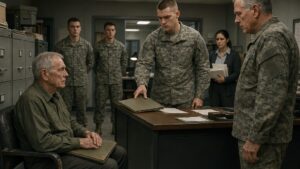
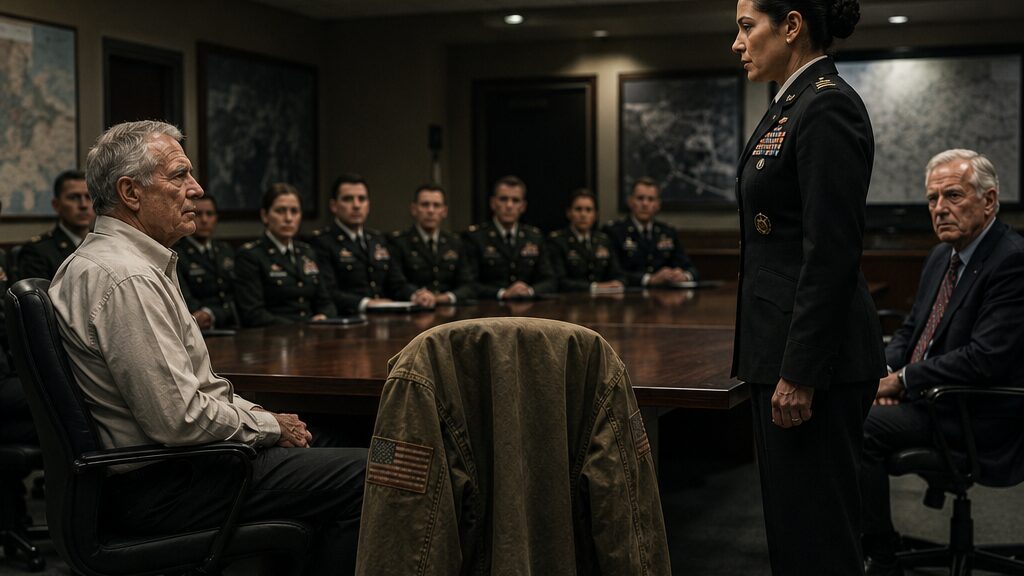
“Who authorized him to be in this meeting?”
The question snapped through the briefing room hard enough to stop the low conversations around the table.
Robert Hall remained standing near the back wall.
He already knew the voice.
Commander Karen Ramirez stood at the head of the room beside a projector screen displaying renovation plans for Building 14. Her expression was sharp, impatient, and directed entirely at him.
Around her sat officers, engineers, and civilian contractors.
Several turned in their chairs.
A few recognized Robert.
Most did not.
Karen looked toward an administrative clerk.
“Well?”
The clerk shuffled papers. “Sir isn’t listed on the attendance roster.”
Karen folded her arms.
“Then why is he here?”
No one answered.
Robert kept both hands loosely clasped in front of him.
His worn military jacket hung over the back of a nearby chair. The faded flag patch on the sleeve had begun peeling at one corner.
Karen finally addressed him directly.
“Mr. Hall, this is a restricted planning session.”
Robert nodded once.
“Yes, ma’am.”
“Then you understand this discussion doesn’t involve retired personnel.”
Several people glanced at each other.
The room had become uncomfortably quiet.
Robert could feel it happen.
People always became interested when someone older was being corrected.
Especially when that person didn’t fight back.
Karen clicked a remote.
An image appeared on the screen.
Building 14.
The old training facility.
The same building Robert had walked through nearly every week for years.
“This facility is scheduled for demolition,” Karen said. “Construction begins in less than sixty days.”
Her eyes returned to him.
“You’ve already submitted three objections.”
“Four,” Robert said quietly.
A few people smirked.
Karen’s jaw tightened.
“Four.”
Robert nodded.
“Yes, ma’am.”
“Those objections have been reviewed.”
“Yes, ma’am.”
“And denied.”
“Yes, ma’am.”
The same answer.
The same calm tone.
Somewhere behind Robert, a chair squeaked.
Karen looked increasingly frustrated.
“Then what exactly are you trying to accomplish?”
Robert looked toward the projected image.
The building looked smaller in the photograph.
Older.
Almost fragile.
“I wanted to hear the plans.”
“You aren’t part of the process.”
“No, ma’am.”
“Then why are you here?”
For a moment he considered answering.
Not fully.
Just enough.
But the answer wasn’t simple.
And simple answers were dangerous.
So he said nothing.
The silence stretched.
Karen interpreted it as resistance.
“Mr. Hall, if you have information relevant to this project, there are official channels.”
Robert nodded.
“Yes, ma’am.”
“Then use them.”
Another silence.
A contractor chuckled under his breath.
Not loudly.
Just enough.
Karen noticed.
She continued.
“You can’t keep appearing in meetings because you’re emotionally attached to an old building.”
The words landed harder than she intended.
Several people lowered their eyes.
Robert did not react.
Inside, however, something shifted.
Not anger.
Disappointment.
The same disappointment he’d carried for years.
Buildings disappeared.
Records disappeared.
People disappeared.
Memory disappeared fastest of all.
Karen pointed toward the door.
“I need you to leave.”
No one moved.
No one intervened.
The room watched.
Robert walked toward the chair holding his jacket.
His movements were slow but steady.
He picked up the jacket carefully.
Folded it.
Draped it over his arm.
The gesture felt strangely deliberate.
Like a routine practiced thousands of times.
A retired colonel sitting near the wall suddenly leaned forward.
William Baker.
He had barely spoken during the meeting.
Now his eyes followed the jacket.
Specifically the inside collar.
Something stitched beneath the fabric.
His expression changed.
Only slightly.
But enough.
Robert noticed.
William noticed that Robert noticed.
Neither man spoke.
Karen mistook the exchange for reluctance.
“Mr. Hall.”
Robert looked back.
“Yes, ma’am?”
“I don’t want security involved.”
A younger officer shifted uncomfortably.
The statement sounded harsher than the situation required.
Robert spared her the embarrassment.
“I understand.”
Then he walked out.
The door closed softly behind him.
Inside the room, conversation resumed.
Outside, Robert stood alone in the hallway.
For several seconds he simply listened.
Voices.
Air vents.
Distant footsteps.
The familiar sounds of a military installation that no longer belonged to him.
He adjusted the folded jacket against his arm.
Then began walking.
By noon, everyone on base seemed to know.
The old veteran had finally been thrown out of a planning meeting.
Joshua Rivera heard the story twice before lunch.
The first version claimed Robert had shouted at Karen.
The second claimed he’d threatened legal action.
Neither was true.
Joshua knew because he had seen Robert around for years.
The man barely raised his voice.
Still, Joshua found himself annoyed.
Every renovation meeting somehow circled back to Building 14.
Every delay involved Robert Hall.
Every budget discussion included another objection letter.
At some point progress had to matter.
That afternoon Joshua found Karen reviewing demolition schedules.
“You handled that poorly,” he said.
Karen glanced up.
“Excuse me?”
“You made him look sympathetic.”
Karen sighed.
“Joshua, I don’t have time for this.”
“You know people are talking.”
“They can talk.”
She rubbed her eyes.
“We’re six months behind schedule. Headquarters wants answers. Contractors want approvals. Every delay costs money.”
Joshua sat across from her.
“You think he’s hiding something?”
Karen laughed.
“Everyone thinks he’s hiding something.”
“Maybe he is.”
“Or maybe he’s an old man who can’t let go.”
The words sounded convincing.
Yet neither of them fully believed them.
That evening William Baker sat alone in his office.
The image of the jacket lingered.
Eventually he opened a desk drawer.
Inside lay an old photograph.
Young soldiers standing outside Building 14.
Decades ago.
William studied the faces.
Then one name returned to him.
A name he hadn’t thought about in years.
The same name stitched inside Robert’s jacket.
William slowly closed the drawer.
For the first time all day, concern replaced curiosity.
Long after sunset, Robert parked beyond the maintenance fence.
The base was quieter at night.
Not silent.
Never silent.
Generators hummed somewhere in the distance.
Security lights cast pale pools across empty pavement.
Building 14 stood alone near the edge of the property.
Most windows were boarded.
Demolition notices covered the entrance.
Robert approached anyway.
His access badge no longer worked.
Karen had seen to that.
He wasn’t surprised.
He had expected it.
The chain on the side entrance remained loose, however.
Maintenance workers often used it.
Robert slipped through.
Inside, dust hung motionless in the dark.
His flashlight revealed old classrooms.
Training maps.
Broken desks.
Memories layered beneath neglect.
He moved deeper into the building.
Past rooms few people remembered existed.
Past a hallway hidden behind temporary walls added years earlier.
Finally he reached a locked storage door.
From his pocket he removed an old key.
The lock clicked.
The door opened.
Robert stepped inside.
Rows of forgotten shelves emerged from darkness.
Boxes.
Records.
Photographs.
History.
The kind that disappeared when nobody protected it.
He exhaled slowly.
Then his flashlight landed on something lying atop a box.
An old photograph.
It wasn’t supposed to be there.
Robert picked it up.
The image showed six young soldiers standing outside Building 14.
Five faces he knew.
One space he remembered.
Someone had been carefully cut out of the picture.
Robert stared at the empty gap.
His expression tightened.
For the first time all day, he looked worried.
Chapter 2: The Building He Refused To Abandon
The photograph trembled slightly in Robert’s hand.
Not from age.
From surprise.
Someone had removed the missing figure recently.
The edges of the cut were clean.
Too clean to be decades old.
He lowered himself onto an old storage crate and examined the image under his flashlight.
Five soldiers remained.
The sixth should have stood between Robert and another young recruit.
Instead there was only an empty shape.
A wound cut through paper.
Someone had wanted that face gone.
The question was why.
Robert slipped the photograph inside his jacket and moved deeper into the storage room.
Dust coated everything.
Metal cabinets.
Cardboard boxes.
Shelves filled with forgotten binders.
Most people assumed Building 14 contained nothing worth saving.
Most people had never looked.
Robert knew every corner.
He had first entered the building fifty-one years earlier carrying a duffel bag and more confidence than wisdom.
Back then the place had been alive.
Voices.
Orders.
Laughter.
Fear.
Young men learning how quickly life could change.
Now only silence remained.
He walked to the rear wall.
Behind a rusted shelving unit sat a narrow doorway almost impossible to notice.
Years ago he and another soldier had hidden records there during a reorganization.
The room beyond wasn’t officially listed on current blueprints.
Most administrators didn’t know it existed.
Robert opened the concealed door.
The small archive remained untouched.
At least for now.
He exhaled.
The missing photograph bothered him.
Someone had found their way here.
Someone besides him.
A noise echoed somewhere outside.
Robert switched off the flashlight.
Listened.
Nothing.
After a minute he carefully left.
The next morning demolition notices appeared across the base.
Joshua Rivera personally supervised their placement.
A bright red date sat at the center of every notice.
Sixty days.
Building 14 would be gone.
No exceptions.
Joshua stepped back and studied one of the signs.
A shadow fell across it.
Robert stood nearby.
Joshua hadn’t heard him approach.
“Morning,” Robert said.
Joshua nodded.
“Mr. Hall.”
His tone wasn’t hostile.
Just cautious.
Robert looked at the notice.
“Looks official.”
“It is.”
Neither moved.
Joshua finally asked the question that had lingered for months.
“Why that building?”
Robert smiled faintly.
“That’s what everyone wants to know.”
“Can you blame them?”
“No.”
Joshua folded his arms.
“Then tell me.”
Robert’s gaze remained on the sign.
“Would it change anything?”
Joshua hesitated.
“Maybe.”
Robert shook his head.
“Not yet.”
The answer irritated Joshua more than outright refusal.
Before he could respond, Robert turned and walked away.
Leaving the younger man with even more questions.
Later that afternoon Susan Jackson received a formal request.
Karen wanted a complete historical review of Building 14.
Susan disliked rushed projects.
This one felt especially rushed.
She sat surrounded by archives and maintenance records.
Most documents described renovations, inspections, and structural assessments.
Nothing unusual.
Yet Robert Hall’s name appeared repeatedly.
Visitor requests.
Preservation appeals.
Historical inquiries.
Letters.
More letters.
Enough to fill an entire folder.
Susan skimmed through one appeal.
It contained no dramatic arguments.
No emotional pleas.
Just careful questions.
What records had been inventoried?
What records had not?
Who verified historical contents?
What procedures protected unofficial archives?
The questions were oddly specific.
Susan frowned.
Most people fought demolition by talking about memories.
Robert talked about records.
That interested her.
That evening Robert returned to Building 14 before security rounds began.
The official deadline had changed everything.
He no longer had time to wait.
Inside the hidden archive room he began opening boxes.
Old training rosters.
Maintenance logs.
Personnel transfers.
Photographs.
Letters.
The smell of aging paper filled the room.
Hours passed.
Finally he found a binder he had not opened in years.
Inside were names.
Dozens of names.
Men who had trained in Building 14.
Some still alive.
Many not.
Robert paused at one page.
His finger rested beside a particular entry.
The same name stitched inside his jacket.
His expression softened.
Then hardened again.
The missing photograph returned to mind.
Someone was looking.
The question was whether they knew what they were looking for.
A faint sound echoed from outside.
Footsteps.
Robert closed the binder.
Someone was in the building.
Joshua Rivera stepped cautiously through the hallway.
A maintenance worker had reported movement inside.
He expected vandals.
Maybe teenagers.
Instead he found an unlocked door.
Then another.
The deeper he walked, the more uneasy he became.
The building felt occupied.
Not abandoned.
He rounded a corner.
A flashlight beam vanished ahead.
Joshua froze.
Someone was here.
“Hello?”
No answer.
He moved forward.
The beam disappeared again.
A door clicked shut.
By the time Joshua reached it, the hallway beyond was empty.
Only dust and silence remained.
Yet on the floor lay something recently disturbed.
A photograph.
Joshua picked it up.
Five young soldiers stared back at him.
One section had been cut away.
Deliberately.
Joshua turned the picture over.
Nothing.
But now he knew two things.
Robert had been inside recently.
And whatever he was protecting involved someone missing from that photograph.
Near midnight Robert sat alone in his truck overlooking the dark outline of Building 14.
The old photograph rested on the passenger seat.
He compared it with another copy he had kept for decades.
One intact.
One altered.
The difference was obvious.
The missing face belonged to someone history had nearly forgotten.
Someone Robert had promised never to forget.
His eyes drifted toward the building.
A light flickered briefly inside.
Then disappeared.
Robert straightened.
He wasn’t alone anymore.
Someone else had entered the building again.
Chapter 3: Records That Explained Too Little
Susan Jackson disliked mysteries that arrived disguised as paperwork.
Yet that was exactly what Building 14 had become.
Three folders lay open across her desk.
Historical records.
Preservation requests.
Demolition assessments.
Individually they made sense.
Together they raised questions.
Most curious was Robert Hall.
The retired veteran had filed objections for years.
Not months.
Years.
Long before demolition plans existed.
Long before Karen Ramirez arrived at the base.
Susan adjusted her glasses and opened another file.
A personnel roster from decades earlier.
Many names had faded.
One caught her attention.
Not because she recognized it.
Because someone had referenced it repeatedly.
In letters.
In preservation requests.
In margin notes.
The same surname appeared again and again.
A forgotten serviceman.
No rank highlighted.
No special designation.
Nothing remarkable.
And yet Robert seemed unable to stop returning to it.
Susan leaned back.
“Who were you?” she murmured.
Across the base Karen sat through a budget call that left her exhausted.
Deadlines had become demands.
Delays had become failures.
Headquarters wanted progress reports by the end of the month.
Every unfinished project reflected on her command.
When the call finally ended, Joshua entered carrying a photograph.
“I found this.”
Karen barely looked up.
“What is it?”
“Inside Building 14.”
That got her attention.
“You were inside?”
“Maintenance report.”
Joshua handed over the picture.
Karen studied it.
Five young soldiers.
One missing figure.
“What am I looking at?”
“That’s what I’d like to know.”
Karen flipped the photograph over.
Nothing.
“Could be vandalism.”
“Could be.”
Joshua didn’t sound convinced.
Karen noticed.
“You think it involves Hall.”
“Yes.”
“Because?”
Joshua hesitated.
“Because nobody fights this hard over concrete.”
Karen set the photo down.
Part of her agreed.
Another part resisted.
If Robert had a legitimate reason, why keep hiding it?
Silence was beginning to look less like dignity and more like obstruction.
At least from her perspective.
Yet certainty no longer came as easily as before.
Susan spent the afternoon in a basement archive room.
Dusty inventory books lined shelves from floor to ceiling.
Most people hated working there.
She loved it.
Records had a way of exposing assumptions.
Eventually she located transfer files connected to Building 14.
Many were incomplete.
Several referenced boxes moved during renovations decades earlier.
One inventory sheet stopped her cold.
Archive Box 27.
Status: Relocated.
Destination: Not recorded.
Susan checked again.
Same result.
A missing archive box.
Officially transferred.
Unofficially vanished.
She continued searching.
Three separate inventories referenced the same box.
None documented where it ended up.
That wasn’t normal.
She copied the references and headed upstairs.
By evening she had uncovered another detail.
Archive Box 27 was connected to personnel records from a specific training cycle.
The same cycle that included Robert Hall.
And the forgotten serviceman whose name kept appearing.
The connection felt significant.
Unfortunately it explained almost nothing.
Susan carried the information directly to Karen.
Karen listened in silence.
“A missing box?”
“Yes.”
“That’s your breakthrough?”
Susan resisted the urge to roll her eyes.
“People don’t spend decades protecting random paperwork.”
Karen looked away.
“What exactly are you suggesting?”
“I don’t know yet.”
“That isn’t helpful.”
“No,” Susan said. “But it’s honest.”
Karen stood and walked to the window.
The demolition project suddenly felt less straightforward than it had a week ago.
She hated uncertainty.
Especially when it threatened schedules.
“Keep digging,” she said.
Susan nodded.
“I intend to.”
That night Robert sat on a bench outside Building 14.
Not hiding.
Not sneaking inside.
Simply sitting.
The jacket rested beside him.
The same jacket he had worn during the briefing-room confrontation.
Headlights approached.
A vehicle stopped nearby.
William Baker stepped out.
Robert looked up.
“You found me.”
William smiled faintly.
“You weren’t hiding.”
“No.”
William sat beside him.
For several moments neither man spoke.
Finally William said, “I saw the stitching.”
Robert looked down at the jacket.
“Thought you might.”
“After all these years.”
Robert nodded.
“After all these years.”
William stared toward the building.
“You should have told somebody.”
The older veteran’s expression tightened.
“So should you.”
William absorbed the remark without argument.
Because it was true.
They sat in silence.
Two men carrying different versions of the same regret.
Eventually William spoke again.
“People are asking questions.”
“I know.”
“Karen won’t stop.”
“I know.”
“You still aren’t going to explain?”
Robert’s gaze remained fixed on Building 14.
“No.”
William shook his head.
“Stubborn.”
“Probably.”
“Even now?”
Robert smiled sadly.
“Especially now.”
William looked as though he wanted to argue.
Instead he stood.
“Then at least tell me one thing.”
Robert waited.
William pointed toward the building.
“Does it involve him?”
For the first time, Robert answered immediately.
“Yes.”
William closed his eyes briefly.
The confirmation hit harder than expected.
Because now he knew.
The forgotten serviceman wasn’t merely part of the story.
He was the story.
The following morning Susan returned to the archive room.
Something bothered her.
She pulled the inventory sheets again.
Compared dates.
Signatures.
Transfer approvals.
Then she noticed it.
One inventory entry referenced Box 27.
Another referenced Box 28.
The handwriting matched.
The dates matched.
Yet one signature was missing.
An approval line had been left blank.
The transfer should never have happened.
Susan stared at the page.
A procedural mistake.
Or something deliberate.
Either possibility mattered.
She copied the documents and hurried upstairs.
Halfway there she nearly collided with a clerk carrying old storage ledgers.
Several books tumbled to the floor.
One landed open.
Susan froze.
Inside was another inventory reference.
Archive Box 27.
This time accompanied by a handwritten note.
Three words.
Stored separately.
Authorization pending.
Susan’s pulse quickened.
The box hadn’t disappeared.
Someone had moved it intentionally.
And nobody had recorded where.
She looked down the hallway toward Karen’s office.
For the first time, the mystery felt close enough to touch.
Yet the most important question remained unanswered.
Who had hidden the box—and what were they trying to protect?
Chapter 4: The Promise Buried Beneath Renovation Plans
“Mr. Hall, you are required to attend.”
The letter sat on Robert’s kitchen table beside a cold cup of coffee.
Required.
Not invited.
Not requested.
Required.
He folded the paper carefully and slipped it into the inside pocket of his jacket.
The same pocket that held something else.
A yellowed note folded into a square so many times the edges had become soft.
Robert touched it briefly.
Then withdrew his hand.
By ten o’clock he was sitting inside a small hearing room overlooking the parade grounds.
The atmosphere was different from the briefing-room confrontation.
Quieter.
More formal.
No audience looking for entertainment.
No contractors.
No whispered comments.
Only a review panel.
Karen Ramirez sat at one side of the table.
Joshua Rivera beside her.
William Baker occupied a chair near the wall.
Susan Jackson had brought several folders.
Robert sat alone.
The empty chair beside him felt intentional.
Karen opened the meeting.
“This hearing concerns continued interference with authorized redevelopment plans for Building Fourteen.”
Interference.
The word lingered.
Robert said nothing.
Karen continued.
“You have repeatedly entered restricted areas after access privileges were revoked.”
“Yes.”
“You admit that?”
“Yes.”
Joshua looked surprised by the immediate answer.
Karen pressed forward.
“You’ve ignored written notices.”
“Yes.”
“You’ve submitted objections based on information you refuse to provide.”
Robert nodded.
“Yes.”
Karen exhaled slowly.
The hearing had barely begun and already felt like walking through wet concrete.
“Why?”
The room became still.
The same question.
Again.
Always again.
Robert looked toward the window.
The training field beyond had changed.
Everything changed eventually.
Except promises.
Karen leaned forward.
“Mr. Hall.”
He returned his attention to her.
“Why?”
For a moment it seemed he might answer.
Even Susan noticed.
His shoulders shifted.
His jaw tightened.
His fingers brushed the jacket pocket.
Then he looked away.
“I can’t.”
Karen stared at him.
“Can’t?”
“Yes.”
“Or won’t?”
Robert remained silent.
Karen’s frustration surfaced.
“You are asking everyone to delay decisions based on information nobody else is allowed to see.”
“I know.”
“Do you understand how unreasonable that sounds?”
“Yes.”
“Then help me understand.”
The request sounded less hostile than before.
Almost genuine.
That made it harder.
Robert lowered his eyes.
He thought about the folded note.
About the missing photograph.
About a promise made in a room that no longer existed.
“No.”
Karen blinked.
“No?”
“I can’t help you understand.”
The answer landed like a closed door.
Joshua shook his head.
Susan looked disappointed.
Only William seemed unsurprised.
The hearing continued.
Questions.
Dates.
Reports.
Procedures.
Robert answered every factual inquiry.
But whenever the discussion approached motive, he stopped.
The silence became its own testimony.
Halfway through the hearing Susan requested permission to present her findings.
Karen agreed.
Susan opened a folder.
“I confirmed that Archive Box Twenty-Seven was intentionally removed from official inventory records.”
That immediately drew attention.
Karen sat straighter.
“Removed by whom?”
“I don’t know.”
Susan turned a page.
“But the transfer authorization was never completed.”
Joshua frowned.
“So somebody moved it without proper approval.”
“Yes.”
“Could Hall have done it?”
Susan glanced at Robert.
“Possibly.”
Robert didn’t react.
Karen noticed.
“You aren’t denying it?”
“No.”
The room fell silent again.
Karen rubbed her forehead.
Every answer seemed to create more questions.
Susan continued.
“The box appears connected to training records from one specific class.”
“Robert’s class?” Joshua asked.
“Yes.”
The younger officer exchanged a look with Karen.
There it was.
Proof.
Or something close to proof.
The old veteran had a personal connection.
Maybe that was all this had ever been.
Nostalgia.
Sentiment.
An inability to move on.
Karen almost accepted that explanation.
Almost.
Then Susan added one more detail.
“The records repeatedly reference another serviceman.”
Robert’s head lifted slightly.
Only slightly.
But Karen caught it.
So did William.
“Name?” Karen asked.
Susan shook her head.
“Several files are incomplete.”
The disappointment in the room felt tangible.
Another clue.
Another dead end.
After a short break William found Robert standing alone in the hallway.
Neither man spoke immediately.
People passed around them.
Doors opened and closed.
The building carried on.
Finally William said, “You’re making this harder than it has to be.”
Robert smiled faintly.
“Probably.”
“You always did.”
“That true?”
William laughed quietly.
“Unfortunately.”
They stood together.
Two aging men surrounded by younger officers who believed paperwork could explain everything.
William lowered his voice.
“The promise still matters that much?”
Robert’s eyes moved toward the floor.
“Yes.”
William nodded.
No judgment.
No argument.
Just understanding.
Because he knew what promise Robert meant.
And because he knew something else.
The promise had never belonged to Robert alone.
That truth carried its own weight.
One William had avoided for years.
When the hearing resumed, Karen’s patience was nearly gone.
“We are running out of time.”
Nobody disagreed.
“The demolition schedule cannot remain frozen indefinitely.”
Robert remained seated.
Motionless.
Karen looked directly at him.
“If there is information that could alter this decision, this is the moment.”
Again it seemed possible.
His hand entered the jacket pocket.
Touched the folded note.
A memory rose.
A young soldier smiling despite exhaustion.
A promise exchanged after midnight.
A request that had seemed temporary.
Not lifelong.
Not then.
Robert closed his hand around the paper.
Then released it.
“No.”
Karen stared.
Something in her expression shifted.
Not anger.
Confusion.
Perhaps even disappointment.
She had expected stubbornness.
Instead she saw pain.
The distinction mattered.
But not enough.
Not yet.
The hearing ended without resolution.
The review panel withdrew.
Karen remained seated.
Joshua gathered files.
Susan collected documents.
Robert stood.
Slowly.
Carefully.
Like a man carrying something fragile.
An administrator entered with a sealed envelope.
Karen opened it.
Read the contents.
Her face hardened.
The decision had arrived from higher command.
Faster than expected.
She looked across the room.
At Robert.
Then at Building 14 visible through the distant window.
“Demolition approval has been finalized.”
Nobody spoke.
The words hung in the air.
Cold.
Final.
Robert nodded once.
As though he had expected them all along.
Then he turned and left.
Karen watched him go.
For the first time, victory felt disturbingly similar to failure.
Chapter 5: What Silence Was Really Protecting
Karen found herself standing outside Building 14 before sunrise.
She had not planned to come.
Yet there she was.
Coffee in one hand.
Demolition approval paperwork in the other.
The old structure looked smaller than it had in every report.
Less like a problem.
More like something waiting to be forgotten.
A maintenance truck passed nearby.
The driver barely glanced at the building.
Why would he?
Most people didn’t see history.
They saw schedules.
Karen understood that.
Her career depended on it.
But lately she had begun wondering whether she had missed something.
Or someone.
By midmorning Susan arrived carrying another stack of records.
“You look tired,” Karen said.
“I found something.”
That immediately had Karen’s attention.
Susan laid several documents across a table.
Personnel transfers.
Family correspondence.
Benefit forms.
The connection wasn’t obvious.
At first.
Then Karen noticed the dates.
Everything revolved around the same period.
The same missing serviceman.
The same incomplete trail.
“Explain.”
Susan pointed to one document.
“His family never received a complete service summary.”
Karen frowned.
“That happens?”
“Not often.”
“Why?”
Susan hesitated.
“Because somebody intervened.”
The room grew quiet.
Karen studied the forms.
Names had been redacted.
Pages removed.
References erased.
Not entirely.
Just enough.
Enough to make a person disappear slowly.
“Who intervened?”
Susan shook her head.
“I don’t know.”
“Hall?”
“Maybe.”
Karen looked unconvinced.
“So he spent decades protecting a file?”
“No.”
Susan leaned forward.
“I think he spent decades protecting a family.”
The sentence settled heavily between them.
For the first time Karen felt genuine uncertainty.
Not administrative uncertainty.
Moral uncertainty.
They were different things.
Later that afternoon Karen reviewed Robert’s objection letters again.
This time she read them differently.
Not as delays.
Not as complaints.
As warnings.
Every letter focused on records.
Documentation.
Missing inventories.
Unverified removals.
Not once did Robert mention himself.
That detail bothered her.
If this was about personal pride, his name should have been everywhere.
Instead it barely appeared.
A knock interrupted her thoughts.
Joshua entered.
“The demolition crew wants early access.”
“How early?”
“Next week.”
Karen frowned.
“That’s ahead of schedule.”
“They have equipment available now.”
Of course they did.
Everything was moving faster.
She approved the request.
Then immediately regretted it.
That evening Karen drove past Building 14 again.
Workers had already begun placing markers around the property.
Temporary fencing.
Survey flags.
Preparation for demolition.
The sight should have reassured her.
Instead it felt strangely rushed.
A figure sat on a bench near the entrance.
Robert.
The jacket rested beside him.
Karen considered driving away.
Instead she stopped.
Robert looked up as she approached.
Neither spoke immediately.
The silence felt different now.
Less hostile.
More complicated.
Karen sat at the opposite end of the bench.
“You could have appealed higher.”
“I know.”
“You didn’t.”
“No.”
“Why?”
A faint smile touched his face.
“You ask that a lot.”
Karen almost smiled back.
Almost.
“You never answer.”
“No.”
The familiar wall remained.
Yet somehow it no longer felt arrogant.
Only sad.
Karen looked toward the building.
“Were you protecting someone?”
Robert’s expression changed.
Not much.
But enough.
The reaction answered more than words.
Karen noticed.
“Who?”
Robert stared ahead.
The opportunity sat between them.
Simple.
One answer.
One explanation.
Instead he shook his head.
“No.”
Karen laughed softly.
Not because it was funny.
Because she finally understood something.
He wasn’t refusing to win.
He was refusing to betray something.
The distinction unsettled her.
“You know,” she said quietly, “people might actually help if you told them.”
Robert looked down at his hands.
“Maybe.”
“Then why not?”
He took a long breath.
When he finally spoke, his voice sounded older than before.
“Because some promises stop belonging to you.”
Karen had no response.
That night Susan remained in the archives long after everyone else left.
The inventory records continued bothering her.
Eventually she returned to the transfer ledgers.
Page by page.
Line by line.
Hours passed.
Then she found it.
A reference number.
Tiny.
Nearly overlooked.
Connected to Box 27.
Her pulse quickened.
She followed the trail.
One ledger.
Then another.
Finally a storage map.
Not a missing box.
A relocated box.
Stored separately.
The notation included a location code.
Susan immediately recognized it.
Building 14.
Her chair scraped backward.
The box had never left.
It was still there.
Hidden somewhere inside the building.
The next morning demolition workers arrived earlier than expected.
Heavy equipment rolled toward the perimeter fence.
Joshua supervised access.
Karen watched from across the lot.
Something felt wrong.
Not enough evidence.
Not enough answers.
Not enough time.
Her phone rang.
Susan.
Karen answered immediately.
“I found it.”
“Found what?”
“The location.”
Karen straightened.
“What location?”
“The archive box.”
Silence.
Then Susan said the words that changed everything.
“It was hidden inside Building 14 the entire time.”
Karen turned toward the old structure.
At that exact moment a demolition worker unlocked the main gate.
And for the first time since this began, Karen felt genuinely afraid they were about to destroy something they did not yet understand.
Chapter 6: The Truth Behind the Name in the Jacket
The first demolition crew member stepped through the gate carrying a clipboard.
“Stop.”
Karen’s voice cut across the lot.
The worker turned.
“So we’re delaying again?”
“Temporarily.”
The answer earned several frustrated looks.
Joshua approached.
“Karen—”
“Not now.”
Her attention remained fixed on Building 14.
Susan’s discovery had arrived at the last possible moment.
Maybe too late.
Workers had already begun clearing equipment paths.
Survey markers had been removed.
Schedules had been finalized.
Headquarters expected progress.
Yet Karen couldn’t shake the feeling that the building itself was trying to tell them something before it disappeared.
“Get Hall,” she said.
Joshua blinked.
“You want him here?”
“Yes.”
“Why?”
“Because I think we’re finally asking the right question.”
An hour later Robert stood inside Building 14 beside Karen, Susan, Joshua, and William Baker.
Dust floated through shafts of light.
The atmosphere felt different.
Not adversarial.
Expectant.
Susan held the storage map she had discovered.
“The location code points somewhere in this section.”
She indicated a hallway near the rear of the building.
Robert immediately knew where she meant.
His expression alone confirmed it.
Karen saw the change.
“So there is something here.”
Robert looked away.
“Robert.”
For the first time she used his first name.
“Please.”
The word surprised everyone.
Including her.
Robert hesitated.
Then quietly nodded.
He led them through the hallway.
Past classrooms.
Past storage rooms.
Past walls built long after the original construction.
Finally he stopped before an old shelving unit.
Joshua stared.
“This?”
Robert moved the shelf aside.
A hidden doorway appeared.
Nobody spoke.
Susan’s eyes widened.
Karen simply watched.
The room beyond contained rows of boxes.
Records.
Photographs.
Binders.
Decades of forgotten history.
Susan stepped forward first.
“My God.”
Robert stood near the doorway.
Not proud.
Not relieved.
Only tired.
Karen looked around.
“You hid all this?”
“No.”
“Then who did?”
Robert’s gaze settled on one corner of the room.
“Several of us.”
William closed his eyes.
“Robert…”
The older veteran looked at him.
“You remember.”
It wasn’t a question.
William nodded slowly.
“Yes.”
The admission shifted the room.
For the first time someone besides Robert stood inside the truth.
Susan located Archive Box 27 within minutes.
Its label had faded.
Its seal remained intact.
She carried it to a table.
Everyone gathered around.
Karen expected answers.
Instead she found more humanity than she anticipated.
The box contained personnel records.
Letters.
Transfer forms.
Training evaluations.
Family correspondence.
Nothing dramatic.
Nothing glorious.
Just lives.
Susan carefully sorted through the contents.
Then she stopped.
“Here.”
A personnel file.
The same forgotten serviceman.
The same missing name.
Karen looked at Robert.
“Who was he?”
Robert remained silent.
William answered instead.
“His name was George Brown.”
The room became still.
William took a breath.
“He trained here with us.”
Robert stared at the floor.
Joshua looked between them.
“What happened?”
William’s expression tightened.
“A training accident.”
Silence.
No one interrupted.
“George died before deployment.”
Karen looked toward Robert.
Understanding remained frustratingly incomplete.
“Then why hide records?”
Robert finally spoke.
Because the question mattered.
“Because they blamed him.”
Everyone turned.
Robert’s voice remained steady.
“Reports said he made mistakes.”
Susan glanced through documents.
Several evaluations supported that claim.
Robert continued.
“Some did.”
Joshua frowned.
“So?”
William spoke quietly.
“Not the one that killed him.”
Karen looked at him.
“What are you saying?”
William stared at the box.
“At the time there was pressure.”
The words sounded painful.
“Pressure to close investigations quickly.”
Karen felt her stomach tighten.
Not corruption.
Not conspiracy.
Something worse.
Ordinary institutional convenience.
William continued.
“A training defect was overlooked.”
Nobody spoke.
“The easiest solution was blaming George.”
Robert’s jaw tightened.
After all these years the wound remained visible.
Susan turned pages rapidly.
Then found it.
An engineering note.
Buried beneath unrelated paperwork.
A documented equipment fault.
Ignored.
Her eyes widened.
“This should have changed everything.”
“Yes,” Robert said.
“It didn’t.”
The room remained silent for several moments.
Joshua looked genuinely shaken.
“His family never knew?”
Robert reached into his jacket.
Slowly.
Carefully.
He removed the folded note.
The paper had aged with him.
He unfolded it.
Placed it on the table.
Karen read the short message.
If anything happens, make sure my mother knows I wasn’t careless.
George.
Nothing more.
No dramatic farewell.
No heroic declaration.
Just a request.
One friend asking another for fairness.
Karen looked up.
Robert’s eyes never left the note.
“I promised him.”
The room finally understood.
Not completely.
But enough.
The next revelation came from William.
And it hurt.
More because of who he was.
“I should have spoken.”
Everyone looked at him.
William met Robert’s gaze.
“I knew parts of it.”
Robert said nothing.
“I didn’t know everything.”
William swallowed hard.
“But I knew enough.”
Karen stared.
“You knew?”
“Not immediately.”
His voice grew quieter.
“Later.”
“Then why didn’t you correct it?”
The question hung heavily.
William answered honestly.
“Because I thought someone else would.”
No one challenged him.
The explanation felt painfully human.
Fear.
Career concerns.
Delay.
Silence.
Years becoming decades.
Robert looked at his old friend.
There was disappointment there.
But not hatred.
Perhaps there never had been.
Outside, demolition crews waited.
Inside, everything had changed.
Yet a problem remained.
Part of the building had already been marked for clearance.
Workers had begun preliminary removal.
The project couldn’t simply disappear.
Karen knew that.
So did everyone else.
Susan carefully repacked the records.
Joshua stared at the hidden archive.
Robert folded George’s note and returned it to his jacket.
The same pocket where it had rested for half a century.
Karen watched the gesture.
Finally understanding why the jacket mattered.
Why the building mattered.
Why Robert had remained silent.
Not to protect himself.
To protect a promise.
She took a slow breath.
Then looked directly at him.
“Robert.”
He raised his eyes.
“Will you meet with me tomorrow?”
The request sounded personal.
Not official.
Robert studied her for a moment.
Then nodded.
“Yes.”
Karen looked around the hidden room one last time.
The judgment that had once seemed obvious now felt unbearable.
And tomorrow she would have to decide what to do with that understanding.
Chapter 7: Respect Restored Without Anyone Needing To Applaud
The meeting began in the same briefing room where Robert Hall had once been ordered to leave.
That fact was impossible to ignore.
The same walls.
The same long table.
Even the old sign identifying the room still hung near the entrance, though someone had marked it for removal months earlier.
Robert paused before entering.
His jacket rested over one arm.
For a moment he considered turning around.
Not because he was afraid.
Because he was tired.
Tired of carrying explanations.
Tired of carrying promises.
Tired of carrying fifty years of silence.
Yet he entered anyway.
Karen Ramirez was already waiting.
No audience filled the room this time.
No contractors.
No collection of curious observers.
Only Karen, Susan Jackson, William Baker, Joshua Rivera, and an administrative clerk taking notes.
The difference mattered.
Karen stood when Robert entered.
A small gesture.
Easy to miss.
Robert noticed it anyway.
“Thank you for coming,” she said.
He nodded.
“You asked.”
The clerk closed the door.
The room settled into silence.
Karen looked at the documents spread across the table.
Then at Robert.
“I spent most of the night reviewing the records.”
Robert said nothing.
“The engineering report should have triggered a formal investigation.”
“Yes.”
“It didn’t.”
“No.”
Karen glanced toward William.
“You knew something was wrong.”
William nodded.
“I did.”
Karen looked back at Robert.
“And you spent decades trying to make sure the truth wasn’t erased.”
Robert considered the statement.
Then slowly shook his head.
“No.”
The answer surprised everyone.
Even now.
Karen frowned.
“No?”
“I wasn’t trying to protect the truth.”
Nobody spoke.
Robert carefully placed his jacket across the back of a chair.
The same motion everyone had seen before.
The same deliberate care.
Then he sat down.
“I was trying to protect a promise.”
The distinction changed the room.
Susan lowered her pen.
Joshua leaned forward.
Robert looked at the table.
Not at the records.
Not at the reports.
At George’s folded note.
The note rested beside the recovered files.
“I thought the truth would come eventually.”
His voice remained calm.
“People always say that.”
William looked away.
Robert continued.
“I kept waiting for someone else to fix it.”
The words landed gently.
Yet William flinched.
Because they applied to him too.
“Then years passed.”
Robert touched the note.
“George’s mother died believing her son made a mistake.”
Nobody interrupted.
“After that, the records weren’t about proving anything.”
His eyes lifted.
“They were all that was left.”
Silence followed.
Not uncomfortable silence.
Understanding.
The kind that takes time to arrive.
Karen opened a folder.
Inside sat a revised recommendation.
She pushed it across the table.
“We’ve reviewed alternatives.”
Robert looked down.
The demolition project would continue.
Parts of Building 14 were beyond repair.
That reality had not changed.
But another page lay beneath the recommendation.
Then another.
Robert studied them carefully.
A preservation plan.
A revised historical designation.
A proposal to retain the archive room and adjoining briefing area.
Not the whole building.
A portion.
The part that mattered.
He looked up.
Karen met his gaze.
“The memorial space will remain.”
Nobody smiled.
Nobody celebrated.
The moment felt too quiet for that.
Robert read the pages again.
Slowly.
Carefully.
As if afraid they might disappear.
“Why?”
Karen almost laughed.
Because the question sounded exactly like him.
“Because we finally understand what was here.”
Robert looked down at the documents.
Then back at her.
“No.”
Karen blinked.
He nodded toward the preservation recommendation.
“Why do this?”
For several seconds she searched for an answer.
Not an official answer.
A real one.
Finally she found it.
“Because I judged the situation before I understood it.”
The room remained still.
Karen continued.
“I judged you too.”
Robert watched her.
She didn’t look away.
That mattered.
People apologized in many ways.
Most avoided responsibility while doing it.
Karen did not.
“I should have asked better questions before I ordered you out of that meeting.”
The words hung between them.
Simple.
Direct.
No excuses.
No speeches.
Robert thought about the briefing room.
The humiliation.
The silence.
The assumptions.
Then he nodded once.
“Thank you.”
That was all.
No demand.
No punishment.
No need to prolong the wound.
The conversation moved forward.
Later, after signatures and approvals had been completed, the others slowly drifted away.
Susan carried boxes toward temporary archive storage.
Joshua coordinated preservation logistics.
The clerk left with finalized paperwork.
Eventually only Robert and William remained.
The room felt larger without everyone else.
William stood near the window.
“I should’ve said something years ago.”
Robert smiled faintly.
“You did.”
William looked confused.
“Yesterday.”
“That wasn’t years ago.”
“No.”
Robert adjusted the jacket.
“But it was something.”
William laughed quietly.
The sound carried equal parts relief and regret.
“You always were better at forgiveness than me.”
Robert considered that.
“No.”
William raised an eyebrow.
“No?”
“I was better at waiting.”
The distinction mattered.
Both men understood why.
Several weeks later the preserved section of Building 14 reopened.
Not as a museum.
Not as a monument.
Simply as a historical room.
A place where records would remain accessible.
Where names would remain visible.
Where forgotten stories would be harder to erase.
No ceremony had been planned.
Robert preferred it that way.
So did Karen.
Still, a handful of people stopped by throughout the afternoon.
Some read the documents.
Some studied photographs.
Some simply looked around.
Joshua spent several minutes examining the restored picture.
The missing face had been restored from another copy.
George Brown stood where he belonged.
No larger than anyone else.
No smaller.
Just present.
Joshua stared at the image for a long time.
Then quietly walked away.
Near closing time Karen found Robert alone inside the preserved briefing room.
The old sign had been cleaned and rehung.
The walls looked different.
But not unfamiliar.
“You never wanted recognition, did you?” she asked.
Robert smiled.
“No.”
Karen leaned against the doorway.
“Then why keep fighting?”
Robert looked around the room.
At the photographs.
The records.
The names.
Finally he answered.
“Because disappearing isn’t the same thing as being gone.”
Karen absorbed the words.
They felt important.
Not only for George.
Not only for the building.
For people.
For memory.
For dignity.
She nodded.
Then left him alone.
The room grew quiet.
Robert walked slowly to a photograph mounted beside the archive display.
George’s restored image sat among the others.
No spotlight.
No plaque larger than anyone else’s.
Just a name.
A face.
A place.
Exactly what had been missing.
Robert reached into his jacket pocket.
The folded note remained there.
As it always had.
He touched it briefly.
Then let it rest.
The promise had changed.
Not ended.
Changed.
For the first time in many years, it no longer belonged only to him.
He removed the jacket and hung it on a wooden hook beside the preserved briefing-room plaque.
The faded flag patch caught the afternoon light.
Then Robert stepped back.
The jacket remained where it was.
Beside the room.
Beside the names.
Beside the history he had spent half a lifetime protecting.
He stood there for a moment longer.
Then quietly walked out.
The story has ended.