The Young Instructor Mocked His Old Rifle Until The Desert Target Came Back Silent
Chapter 1: The Old Case At The Desert Range
The first thing people noticed was the rifle case.
Not the man carrying it.
The case.
It looked older than half the trucks parked along the desert range. The leather corners were worn smooth. The brass latches carried scratches layered over decades. Dust had settled into the seams so deeply that it seemed part of the material itself.
Samuel King carried it with one hand as he walked through the gate.
The late-morning sun hung bright above the desert. Heat shimmered above the gravel lanes. Voices drifted from the firing line where competitors checked equipment for the charity precision event.
Nobody paid much attention to Samuel at first.
Then a few trainees started looking.
An elderly man in a faded brown jacket was not what most people expected to see at a rifle competition.
Samuel stopped near the registration table.
The organizer glanced up.
“Name?”
“Samuel King.”
The organizer searched the list.
A faint smile appeared.
“You’re registered.”
Samuel nodded.
He reached into his jacket and removed a faded range card.
The edges were yellowed. Several corners had been repaired with old tape.
The organizer stared at it.
“You still carry that?”
Samuel looked down at the card.
“Habit.”
The organizer laughed softly.
“Fair enough.”
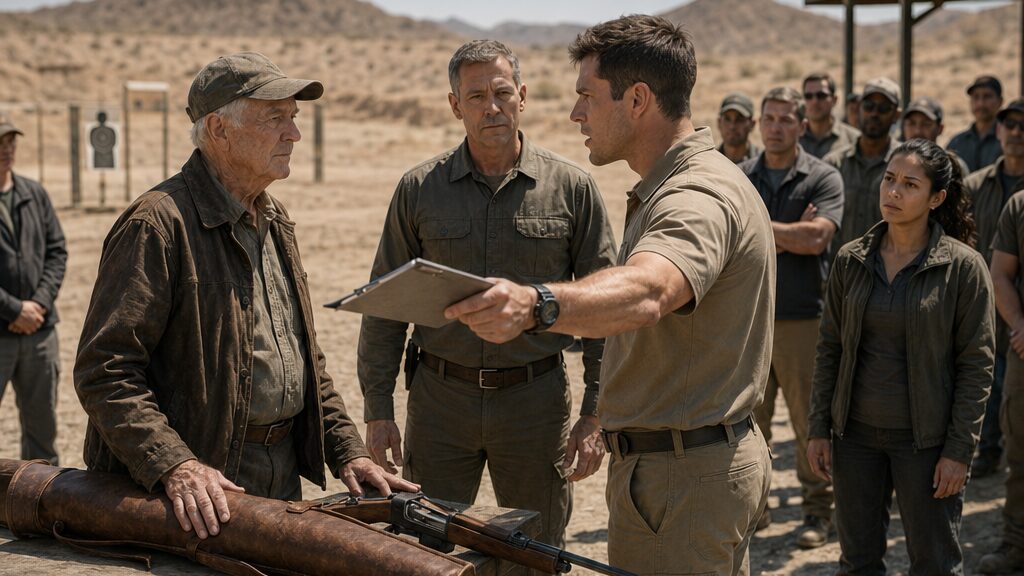
Before Samuel could answer, another voice interrupted.
“Excuse me.”
The tone was sharp.
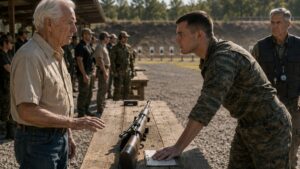
A young man in a range uniform approached.
Confident stride.
Clipboard under one arm.
Clean haircut.
Bright instructor badge.
Samuel recognized the type immediately.
The young man looked at the case.
Then at Samuel.
Then back at the case.
“Can I help you?”
Samuel nodded.
“I’m here for the charity relay.”
The young man’s expression tightened.
“For spectators, parking is over there.”
A few people nearby chuckled.
Samuel remained calm.
“I’m competing.”
The young man blinked.
Then laughed.
Not loudly.
Just enough.
“Sir, this event isn’t a museum exhibit.”
More laughter.
Samuel said nothing.
The young man extended a hand.
“Mark Allen. Range instructor.”
Samuel shook it.
“Samuel King.”
Mark looked at the registration list.
His smile faded.
“You actually signed up.”
“I did.”
Mark examined Samuel again.
The slow movements.
The weathered jacket.
The old case.
Everything about him seemed out of place beside modern rifles and expensive optics.
“You sure you’re in the right event?”
“I believe so.”
A trainee nearby snorted.
Mark smirked.
“This is a precision competition.”
Samuel nodded.
“I read the flyer.”
The answer irritated Mark more than open disagreement would have.
The older man wasn’t defensive.
Wasn’t embarrassed.
Wasn’t trying to prove anything.
He simply stood there.
Steady.
Patient.
That calmness drew attention.
People started watching.
Mark seemed to notice.
His posture straightened.
“You know, we have safety requirements.”
“Good.”
“And physical requirements.”
“Also good.”
Mark folded his arms.
“Can you handle that rifle safely?”
Samuel looked at the case.
“I’ve managed so far.”
Another ripple of laughter.
Mark expected irritation.
Instead he received calm agreement.
It unsettled him.
The organizer cleared his throat.
“He’s registered, Mark.”
“I can see that.”
Mark’s eyes remained on Samuel.
“Maybe he should sit this one out.”
Samuel finally met his gaze directly.
The young instructor suddenly felt something unexpected.
Not intimidation.
Not exactly.
Just the sense that the older man was measuring him.
Quietly.
Without judgment.
Without hurry.
“Why?” Samuel asked.
Mark opened his mouth.
Then paused.
The spectators waited.
“So nobody gets embarrassed.”
Samuel considered the answer.
Then nodded.
“I agree.”
For a moment Mark looked pleased.
Then Samuel added,
“That’s why we have targets.”
Several people exchanged glances.
The organizer hid a smile.
Mark’s face hardened.
The conversation had slipped somewhere he hadn’t intended.
He tapped his clipboard.
“We’ll see.”
Samuel picked up the old case and walked toward the equipment area.
The whispers followed him.
Too old.
Wrong event.
Probably someone’s grandfather.
Maybe he used to shoot.
Used to.
The word followed him everywhere now.
Samuel set the case on a bench.
He opened it carefully.
Inside rested a rifle that looked almost as old as the case.
Not neglected.
Maintained.
The wood carried years of careful handling.
Nothing flashy.
Nothing modern.
Just a tool.
A familiar one.
Samuel ran a cloth over the stock.
The same way he always had.
The same way he had taught countless others.
For a moment the desert noise faded.
Breath in.
Breath out.
The ritual remained unchanged.
A shadow fell across the bench.
Heather Flores stood nearby.
Young.
Curious.
Holding a beginner’s rifle case.
“Is that really what you’re using?”
Samuel glanced up.
“That’s the plan.”
She hesitated.
“Everyone says modern rifles are better.”
“Sometimes they are.”
Her eyebrows rose.
“You don’t sound offended.”
Samuel smiled faintly.
“No reason to be.”
She looked confused.
Before she could continue, Mark’s voice rang out across the range.
“Competitors, gather for lane assignments.”
Everyone moved toward the firing line.
Samuel closed the case.
The worn latches clicked shut.
The sound seemed strangely final.
Lane numbers were announced.
Names followed.
When Mark reached Samuel’s name, his smile returned.
A different smile this time.
One meant for an audience.
“Samuel King.”
A pause.
“The far lane.”
Several heads turned.
The farthest lane sat beyond the others.
The longest distance.
The strongest wind exposure.
The least forgiving position on the range.
Mark glanced toward the spectators.
“Figure it’s safer where he can’t embarrass anyone.”
The laughter came louder this time.
Samuel heard it all.
Every word.
Every chuckle.
Every assumption.
He lifted the old rifle case.
And walked toward the far lane without saying a single thing.
Chapter 2: The Rule Mark Forgot To Say
Heather Flores had arrived hoping to learn.
By noon she wasn’t sure whom she was learning from.
The firing line stretched across the desert like a ruler laid over gravel and dust. Competitors checked rifles. Spotters adjusted equipment. Wind flicked at flags mounted near the targets.
Heather listened carefully.
At least she tried to.
Mark Allen moved quickly through instructions.
Too quickly.
“Eye protection on. Ear protection on. Chambers clear until command.”
He spoke confidently.
The trainees nodded.
Several hurried to keep up.
Heather noticed one young shooter struggling to adjust a sling while handling a rifle at the same time.
Mark didn’t see it.
Or didn’t slow down enough to care.
The line remained busy.
Voices overlapped.
Movement increased.
Something about it felt rushed.
Then she noticed Samuel.
He stood alone at the far lane.
Not preparing to shoot.
Watching.
Observing.
The old rifle remained inside its case.
A competitor nearby lifted a rifle without fully checking the chamber.
Samuel spoke immediately.
Calmly.
“Chamber first.”
The competitor froze.
Looked down.
Then corrected the mistake.
No lecture followed.
No embarrassment.
Just a reminder.
The competitor nodded.
“Thank you.”
Samuel returned the nod.
Nothing more.
Heather watched the exchange.
Minutes later another shooter stepped backward while distracted by conversation.
Again Samuel noticed.
Again a quiet correction came.
“Mind your muzzle.”
The shooter adjusted instantly.
No irritation.
No argument.
Just correction.
The strange part was that people listened.
Even those who had laughed earlier.
Heather couldn’t explain why.
Maybe it was the tone.
Maybe it was the certainty.
Maybe it was the absence of ego.
Meanwhile Mark continued moving up and down the line.
Confident.
Busy.
Talking.
Heather began noticing details.
Samuel never interrupted unless safety was involved.
When he spoke, people obeyed immediately.
When Mark spoke, people obeyed because he wore authority.
The difference bothered her.
A command sounded from the line.
Several competitors responded.
Without thinking, Samuel quietly repeated the next command before it came.
A second later the range officer issued the exact instruction.
Word for word.
Heather stared.
Later it happened again.
And again.
Samuel knew every sequence.
Every procedure.
Every timing cue.
As if the range lived somewhere inside his memory.
She finally walked toward him.
“How do you know all the commands?”
Samuel closed a latch on the rifle case.
“Been around ranges a long time.”
“That’s all?”
“Mostly.”
Heather laughed despite herself.
He wasn’t trying to be mysterious.
That made it more mysterious.
The desert wind brushed across the lanes.
Samuel lifted his face slightly.
Breath in.
Breath out.
Slow.
Measured.
Heather noticed he did it constantly.
Not dramatically.
Naturally.
Like a metronome nobody else could hear.
Then the atmosphere changed.
A vehicle rolled toward the range office.
Several staff members straightened immediately.
Mark turned.
The organizer looked relieved.
“Gregory’s here.”
Heather had heard the name.
Everyone had.
Gregory Moore.
Senior range officer.
Respected throughout the region.
The truck stopped.
The door opened.
Gregory stepped out.
Middle-aged.
Professional.
Observant eyes.
The kind of person who seemed to notice everything before speaking.
He walked toward the firing line.
People greeted him.
He nodded politely.
Then his gaze moved across the competitors.
Past the modern rifles.
Past the spectators.
Past Mark.
Until it reached the far lane.
Heather watched his expression change.
Not dramatically.
Just enough.
He stopped walking.
Completely stopped.
His eyes locked onto Samuel.
The old rifle case sat beside the bench.
Samuel stood quietly in the desert sunlight.
For several seconds Gregory said nothing.
The noise around them continued.
But Heather noticed something strange.
The senior officer looked shaken.
Not frightened.
Not confused.
Recognizing.
As though he had unexpectedly found a page from his past standing in front of him.
Samuel glanced up.
Their eyes met.
Neither man spoke.
Yet something passed between them.
Something old.
Something important.
Heather suddenly realized there was far more to this story than anyone understood.
Gregory took one step forward.
Then another.
Still staring.
Mark noticed.
“So you know him?”
Gregory didn’t answer.
The question seemed not to reach him.
His attention remained fixed on Samuel King.
And for the first time all day, uncertainty crossed Gregory Moore’s face.
Chapter 3: The Instructor Who Leaned Too Close
By midday the heat had settled over the range like a blanket.
The competition briefing was ending.
Targets waited in the distance.
Dust drifted lazily across the firing lanes.
Samuel sat on a bench beside the far position assigned to him.
The old rifle rested across his lap.
He checked it carefully.
Not because it needed checking.
Because routine mattered.
The rifle case remained at his feet.
Its worn leather carried more history than most people guessed.
Nearby voices grew louder.
Mark Allen was approaching.
Several trainees followed.
Spectators too.
A small audience had formed around the far lane.
Samuel wasn’t surprised.
Public embarrassment attracted attention.
Mark stopped a few feet away.
“Comfortable out here?”
Samuel looked up.
“Seems fine.”
“The distance doesn’t bother you?”
“No.”
Mark smiled.
“Good.”
The smile wasn’t friendly.
The crowd sensed it.
People lingered.
Waiting.
Heather stood among them.
Gregory remained farther back.
Watching.
Silent.
Mark folded his arms.
“You know, there are easier events.”
Samuel said nothing.
“Plenty of charity booths. Plenty of raffles.”
Still nothing.
Mark gestured toward the rifle.
“That thing probably belongs in a display case.”
A few spectators laughed.
Samuel ran a cloth along the stock.
Carefully.
Respectfully.
Not defensively.
Mark continued.
“How old is it?”
“Old enough.”
More laughter.
Mark shook his head.
“I’ll give you credit. You’ve got confidence.”
“No.”
The answer surprised everyone.
Mark blinked.
“No?”
Samuel looked at the distant targets.
“Discipline.”
The laughter faded slightly.
Mark leaned closer.
Too close.
Close enough that several spectators noticed.
“Discipline doesn’t beat physics.”
“No.”
“Glad we agree.”
Samuel nodded.
“Physics doesn’t care how old someone is.”
Silence.
Brief.
Awkward.
Mark stepped back.
The crowd shifted.
The exchange wasn’t going the way he wanted.
He wanted frustration.
Anger.
Excuses.
Instead he kept receiving calm answers that sounded simple until people thought about them.
Gregory’s eyes never left Samuel.
Or the rifle case.
Eventually Mark pointed toward the shooting position.
“Let’s see what discipline looks like.”
A challenge now.
Public.
Visible.
The crowd sensed it immediately.
Samuel rose slowly.
No rush.
No performance.
He carried the rifle forward.
The desert stretched before him.
Wind flickered across the distant target line.
Samuel paused.
Watching.
Listening.
Feeling.
Then he lowered himself into a kneeling position.
The movement was smooth despite his age.
Practiced.
Efficient.
A posture worn into memory.
The crowd quieted.
Heather felt it.
The atmosphere changing.
Not because anyone expected greatness.
Because Samuel looked completely at home.
The rifle settled.
His shoulders relaxed.
Breath in.
Breath out.
Steady.
The same rhythm Heather had noticed all day.
Mark crossed his arms.
Waiting for failure.
Waiting for proof that he had been right.
Gregory watched with a different expression.
Recognition.
Respect.
And something close to disbelief.
Samuel adjusted slightly.
Reading the wind.
Feeling the temperature.
Watching the flags.
The range officer prepared the relay.
Commands echoed across the desert.
Competitors took positions.
The world narrowed.
Dust.
Distance.
Breath.
Target.
Nothing else mattered.
Heather glanced toward Gregory.
His eyes had fallen to the rifle case.
For a moment he looked as though he were remembering something from decades ago.
Then he looked back at Samuel.
The relay was seconds from beginning.
Mark called out loudly enough for spectators to hear.
“Hope that antique still works.”
A few nervous laughs followed.
Samuel didn’t react.
He remained kneeling.
Calm.
Still.
The range seemed quieter than before.
Even the wind felt distant.
The old rifle rested firmly against his shoulder.
Samuel looked through the sights.
At last he spoke.
Not loudly.
Not dramatically.
Just enough for those nearest him to hear.
“The target will tell you.”
Chapter 4: Three Breaths Before The First Shot
Mark Allen expected the old man to shake.
That was what age did, he told himself. It took steadiness first. It took vision next. Then it left a person standing in front of younger people pretending the past still counted.
Samuel King did not shake.
He knelt at the far lane as if the gravel had been placed there for him. One knee down. One boot planted. Rifle settled. Shoulders loose. Chin low. No wasted motion.
Mark stood behind the safety line with his clipboard pressed against his side.
The sun glared off the target carriers. Heat blurred the far berm. A wind flag near the middle distance twitched, sagged, then snapped lightly toward the right.
Mark noticed Samuel watching it.
“You waiting for perfect weather?” Mark called.
A few people laughed, but softer now.
Samuel did not look back.
“Waiting for honest weather.”
Mark frowned.
The answer sounded like nonsense to him, but Gregory Moore’s expression sharpened when he heard it.
Samuel lifted his head slightly and watched the second flag. Then the third. His breathing remained slow.
In.
Out.
A pause.
In.
Out.
The line officer called the final safety check.
Samuel opened the chamber again.
The motion was deliberate.
Mark rolled his eyes.
“You already checked it.”
Samuel glanced over his shoulder.
“Then it won’t mind being checked twice.”
That drew no laughter.
One of the trainees quietly copied him and checked her own rifle again.
Heather saw it.
Mark saw it too.
His jaw tightened.
The relay command came.
“Load.”
Rifles moved along the line.
Bolts slid.
Metal clicked.
Samuel did not hurry.
He placed the round with careful fingers, closed the bolt, and returned to position.
The old rifle looked small among the heavy modern equipment around it. No polished tactical frame. No oversized optic. No showy stock.
Just wood.
Steel.
Hands that knew it.
Mark stepped closer, still behind the line.
“You understand this is scored, right?”
Samuel’s cheek settled against the stock.
“Yes.”
“Not just for fun.”
Samuel’s finger remained outside the trigger guard.
“I know.”
The wind flag nearest the target trembled.
Samuel waited.
The line grew impatient.
Mark smiled again.
There it was.
Hesitation.
The old man could posture all he wanted, but the shot still had to be fired.
“Having trouble finding the target?”
Samuel’s left hand made a tiny adjustment.
“No.”
“Then what?”
Samuel’s eyes stayed forward.
“The wind’s about to lay down.”
Mark almost laughed.
The wind flag still moved.
The desert still breathed hot air across the lane.
But Gregory shifted his weight.
He looked from Samuel to the far flag.
A moment passed.
Then another.
The flag dipped.
The cloth softened.
For half a breath, the range seemed to hold still.
Samuel inhaled once.
Exhaled.
Inhaled again.
Exhaled.
The third breath barely moved him.
The rifle fired.
The crack was not louder than the others, but it cut cleaner through the air.
Mark looked toward the far target as if he could see the hole from where he stood.
He couldn’t.
Nobody could.
The target remained far away, white paper trembling in heat shimmer.
Samuel did not move.
He worked the bolt with the same calm rhythm.
No smile.
No glance back.
No performance.
Mark waited for some sign of uncertainty.
There was none.
The second shot came only after another pause.
Then the third.
Each one separated by silence.
Each one placed inside Samuel’s breath.
Other shooters fired faster. Some adjusted scopes. Some muttered to spotters. One cursed softly after a miss.
Samuel remained almost still.
Mark felt irritation rising into something less comfortable.
He had seen good shooters before. He had trained good shooters. He knew the body language of competence.
Samuel had it.
Worse, he had something beyond it.
He did not appear to be trying to impress anyone.
That made Mark feel suddenly exposed.
“Cease fire.”
The command moved down the line.
Rifles cleared.
Bolts opened.
Chambers checked.
Samuel checked twice again.
This time several others did too.
Mark looked away.
The scorekeeper began calling for target returns.
Paper carriers hummed to life one by one.
Down the line, competitors leaned forward.
People joked again, but carefully.
Mark forced a grin.
“Well,” he said loudly, “let’s see what the old rifle managed.”
Samuel rose slowly from the kneeling position.
He did not answer.
He opened the chamber one final time, confirmed it empty, and laid the rifle down with the muzzle safe.
Only then did he stand fully.
His face revealed nothing.
The first targets came back.
There were good groups.
There were decent ones.
A few disappointing ones.
The scorekeeper marked them.
Then the far lane’s carrier began moving.
A thin sheet of target paper slid toward them across the distance.
The hum of the motor seemed louder than it should have.
Mark watched it come.
Still too far to read.
Still too far to judge.
Yet something cold touched the back of his neck.
Gregory Moore had stepped closer.
Heather had stopped breathing for a moment without realizing it.
Samuel stood beside the bench with his hands resting lightly on the old rifle case.
The paper kept coming.
White.
Small.
Silent.
Chapter 5: When The Paper Came Back Quiet
At first Heather thought the target was blank.
That was impossible, of course.
Samuel had fired.
Everyone had heard the shots.
But as the paper carrier rolled closer, she could not see scattered holes the way she could on the other targets. No loose triangle. No wandering cluster. No obvious miss.
Just the black center of the target.
And one dark mark inside it.
The carrier stopped.
The range fell quiet in pieces.
First the trainees.
Then the spectators.
Then the competitors nearby.
The scorekeeper stepped forward with a pen in hand.
He leaned toward the target.
Stopped.
Leaned closer.
His mouth opened slightly.
Mark moved in beside him.
“What is it?”
The scorekeeper didn’t answer.
He touched the edge of the paper, careful not to disturb it.
Heather stepped onto her toes.
The black center held a single ragged hole.
Not perfectly round.
Slightly torn at the edges.
But tight.
So tight that the shots seemed to have passed almost through the same place.
The scorekeeper looked back at Samuel.
Then at Gregory.
Then at the paper again.
“That’s…” he began.
His voice failed him.
Mark snatched the target frame lightly with one hand and stared.
His face changed.
Heather saw the moment clearly.
The confidence did not vanish all at once.
It cracked first.
Like dry clay under pressure.
His eyes moved over the paper, searching for some explanation that would restore the world as he had arranged it.
Bad target.
Wrong distance.
Scoring error.
Luck.
Anything.
There was nothing to hold.
The paper held the truth plainly.
Samuel King stood a few feet away, quiet as before.
No raised chin.
No smirk.
No speech.
Heather looked at him and suddenly felt embarrassed, though she had not been the one laughing.
The old rifle sat on the bench, action open, harmless and still.
The worn case rested below it.
The same case everyone had mocked without knowing what it carried.
Someone whispered, “That’s nearly one hole.”
Another person said nothing, but removed his cap.
Mark heard the whisper.
His ears reddened.
“It could be luck,” he said.
The words came out too quickly.
Too thin.
Gregory looked at him.
Not sharply.
Worse.
Sadly.
The scorekeeper cleared his throat.
“Three shots. Same relay. Same distance.”
Mark did not look at him.
Heather watched Samuel’s hands.
They were aged, yes.
Veined.
Weathered.
Marked by time.
But they were steady.
The silence grew heavy enough that even the wind seemed careful.
Mark lifted the target from the carrier and held it up.
That might have been meant to challenge it.
Instead it made the proof visible to everyone.
A wave moved through the crowd without sound.
Faces shifted.
Laughter disappeared.
Postures changed.
People who had leaned casually now stood straight.
Trainees looked from the paper to Samuel as though a hidden door had opened in the desert and shown them something they had not known to ask for.
Heather’s throat tightened.
All morning she had watched Mark occupy space like authority belonged to the loudest person on the line. She had believed him because he looked the part. Because he spoke quickly. Because others listened.
Samuel had done none of that.
He had only waited.
Corrected danger.
Breathed.
And let the target answer.
Mark lowered the paper.
He tried to speak.
Nothing came.
The scorekeeper finally marked the result.
His pen moved slowly.
Almost respectfully.
“Top group so far.”
No cheers came.
That made it more powerful.
The desert range did not erupt.
It absorbed the fact.
Samuel picked up a small cloth and wiped dust from the rifle stock.
Heather walked closer without planning to.
“Mr. King?”
Samuel glanced at her.
“Yes?”
“How did you keep it that steady?”
He looked toward the target.
Then at the wind flags.
“By not arguing with what was there.”
She thought about that.
The answer sounded like shooting.
It sounded like more than shooting.
Mark heard it too.
His face remained tight.
A club member near the back murmured, “Who is he?”
Another answered, “I don’t know.”
Gregory Moore stepped into the space between curiosity and rumor.
For a while he said nothing.
He looked at Samuel the way a grown man might look at a door he had once walked through as a boy.
Then Gregory spoke quietly.
“He taught me that breath.”
Heather turned.
Mark turned too.
The crowd shifted toward Gregory.
Samuel’s hand paused on the rifle stock.
Just for a moment.
The first visible sign that the day had reached something beneath his calm.
Gregory kept his voice low, but the people nearest him heard every word.
“Long before most of us stood on this line.”
Mark stared at him.
“You know him?”
Gregory did not look away from Samuel.
“Yes.”
Samuel closed the rifle case slowly.
The old brass latches clicked.
Gregory’s expression carried memory now.
And regret.
Heather looked from one man to the other.
The target still hung in Mark’s hand.
Its small torn center suddenly seemed less like a score and more like a key.
The question passed through the crowd in silence.
Who exactly was Samuel King?
Chapter 6: The Name On The Old Range Card
Gregory Moore found the old photograph in the range office before he found the courage to speak.
It hung crooked beside a cabinet of faded score sheets and spare ear protection. Most people walked past it without looking. A sun-bleached line of men stood in front of the same desert berm decades earlier, their faces younger than memory wanted to allow.
Samuel King stood near the end of the row.
No cap then.
Back straighter.
Eyes the same.
Gregory stared at the photograph until the office noise faded.
Outside, the final relay was being reset. Voices drifted through the thin walls. Mark Allen’s voice was among them, quieter now than it had been in the morning.
The charity event organizer stepped in and followed Gregory’s gaze.
“You knew him?”
Gregory nodded.
“He was the first person who made me slow down.”
The organizer looked at the photograph.
“He worked here?”
Gregory almost smiled.
“No.”
He reached toward a drawer beneath the old filing cabinet and opened it.
Inside were range cards, archived rule sheets, yellowing qualification forms.
Gregory knew where to look.
He had avoided looking there for years.
At the back of the drawer, inside a plastic sleeve, sat a faded card with careful block letters across the top.
Range Safety Standards.
Below that, several signatures.
One near the middle was Samuel King’s.
Gregory touched the plastic sleeve lightly.
“He helped build what we still use.”
The organizer took the card.
His eyebrows lifted.
“His name is on the standards.”
“Most of the commands too.”
Gregory remembered them in Samuel’s voice.
Not shouted.
Never shouted unless danger demanded it.
Commands were not about volume, Samuel had once said. They were about clarity.
Gregory had been younger than Mark then.
Proud.
Fast.
Too eager to prove he belonged.
Samuel had corrected him in front of others once, and Gregory had hated him for nearly a week.
Then he had understood.
Pride recovered.
Negligence did not always allow that.
A knock sounded on the office door.
Samuel stood outside.
His old rifle case rested beside his leg.
Gregory straightened.
For a second, age folded backward.
He was a young trainee again, dusty and impatient, trying to impress a man who cared more about safe hands than impressive talk.
“Mr. King,” Gregory said.
Samuel looked at the card in the organizer’s hand.
“Still have that?”
Gregory nodded.
“Should’ve been framed better.”
“It was never meant for a frame.”
The organizer looked between them.
“People should know.”
Samuel’s expression remained calm, but his eyes narrowed slightly.
“No.”
Gregory expected the answer.
It still hurt.
“They laughed at you out there.”
Samuel shrugged.
“Laughter passes.”
“Mark crossed a line.”
“He did.”
“Then let me say what needs saying.”
Samuel stepped into the office.
The old floor creaked beneath his boots.
He set the rifle case carefully on a chair, as though it deserved not to be placed on the dusty ground again.
“Gregory,” he said.
The name softened the room.
“Yes, sir.”
Samuel shook his head gently.
“Don’t make me a monument just because a young man made a mistake.”
Gregory looked down.
“He didn’t just make a mistake.”
“No,” Samuel said. “He revealed one.”
The organizer frowned.
“What does that mean?”
Samuel glanced toward the window.
Outside, trainees prepared for the next relay.
Some moved carefully now.
Others copied the double-checks they had seen him perform.
“Your line has gotten loud,” Samuel said. “Fast. Impressive. Busy.”
Gregory absorbed the words.
Samuel looked at the faded card.
“But the first rule hasn’t changed.”
The organizer waited.
Gregory knew it.
He said it under his breath.
“Respect the rifle before you respect yourself.”
Samuel nodded once.
“That rule kept people safe before any of us cared about trophies.”
The office fell quiet.
Through the window, Mark stood alone near the firing line with the target paper still in his hand.
He was no longer holding it up.
He was looking at it.
Really looking.
Gregory watched him.
“He has to apologize.”
Samuel did not answer immediately.
“He has to decide whether he wants to learn,” he said at last.
The distinction landed harder than a command.
Gregory placed the faded card back into its sleeve.
“Why did you come today?”
Samuel looked down at the rifle case.
For the first time that day, tiredness showed on his face.
Not weakness.
Weight.
“The charity event said the proceeds helped young shooters who couldn’t afford proper safety instruction.”
“It does.”
“Then that was reason enough.”
Gregory studied him.
“There is more.”
Samuel’s mouth tightened faintly.
“There is always more.”
He reached into his jacket and removed his own faded range card.
The same one he had shown at registration.
Gregory recognized the old format immediately.
Samuel held it between two fingers.
“I didn’t come back for a score.”
“No.”
“I came to see whether this place still remembered why it existed.”
Gregory looked away first.
The words were not angry.
That made them worse.
The organizer lowered his voice.
“And does it?”
Samuel placed the card on the desk.
Outside, Heather Flores checked her chamber twice before stepping away from the bench.
Samuel saw it.
A faint warmth entered his eyes.
“Some of them do.”
Gregory followed his gaze.
Then Mark turned toward the office.
He stood still for several seconds.
The target paper hung at his side.
No clipboard.
No smile.
No audience around him now.
Just a young instructor facing the distance between authority and responsibility.
Samuel picked up the rifle case.
“Final relay soon?”
Gregory nodded.
“In a few minutes.”
Samuel moved toward the door.
At the threshold, Gregory spoke.
“Should I tell them who you are?”
Samuel paused.
The desert light outlined his cap and shoulders.
“No.”
Gregory’s jaw tightened.
Samuel looked back.
“Let him tell us who he is.”
Outside, Mark Allen took one step toward the office.
Then stopped.
Then started again.
Chapter 7: The Lesson Was Never The Shot
By sunset, Samuel King had stopped listening for laughter.
The desert had changed color.
The white heat of midday softened into amber light along the berms. Shadows stretched across the gravel. The wind flags moved with less urgency now, lifting and settling like tired hands.
Samuel stood beside the far lane with the old rifle case open on the bench.
He packed slowly.
Cloth first.
Then the small tin of oil.
Then the faded range card, returned to the inside pocket of his jacket.
The old rifle came last.
He checked it again before laying it into the case.
Open.
Clear.
Safe.
Habit.
A few spectators remained near the firing line, quieter than before. Nobody crowded him. Nobody tried to turn him into a story while he was still standing there. That, Samuel thought, was a kindness.
The charity event organizer approached with an envelope.
“Mr. King.”
Samuel looked up.
“You won the precision relay.”
The organizer held out the prize envelope.
Samuel glanced at it, then toward the trainees clustered near the benches.
Heather Flores stood among them, holding her rifle case against her side with both hands.
“Put it toward the youth safety scholarship,” Samuel said.
The organizer hesitated.
“Are you sure?”
Samuel closed one latch on the case.
“That’s why I came.”
Gregory Moore, standing a few steps away, turned toward him.
The words landed quietly.
Not for spectacle.
Not for praise.
Samuel had not come for the target.
He had come for the next hands that would touch a rifle before they understood what responsibility weighed.
The organizer nodded once.
“I’ll make sure it goes there.”
“No name.”
Gregory almost smiled.
“Of course.”
Samuel closed the second latch.
The click carried in the evening stillness.
Then Mark Allen approached.
He no longer carried the clipboard.
The absence mattered.
He stopped several feet away, close enough to speak but not close enough to crowd.
“Mr. King.”
Samuel waited.
Mark swallowed.
His uniform still looked sharp. His badge still caught the light. But the posture beneath it had changed.
“I owe you an apology.”
The range grew quieter.
Samuel did not rescue him from the silence.
Mark looked at the old case, then at Samuel.
“I judged you before I knew anything about you. I made it public. I made it worse because people were watching.”
Samuel’s eyes remained steady.
“And?”
Mark’s face tightened, but he did not look away.
“And I rushed the line. I missed things I should have caught.”
That was the apology Samuel had been waiting for.
Not the wounded pride.
Not the embarrassment.
The safety.
Samuel nodded.
“Then say the first rule.”
Mark glanced toward Gregory.
Gregory gave him nothing.
Mark looked back at Samuel.
“Respect the rifle before you respect yourself.”
Samuel held his gaze.
“Again.”
Mark’s voice steadied.
“Respect the rifle before you respect yourself.”
Samuel nodded once.
“Good.”
No applause followed.
No one laughed.
For the first time all day, Mark seemed relieved not to be performing.
Heather stepped forward carefully.
“Mr. King?”
Samuel turned.
She held her rifle case as if it had become heavier since morning.
“Could you show me the breathing?”
Mark looked down.
Not offended.
Listening.
Samuel studied Heather for a moment.
Then he gestured toward the bench.
“Set the case down first.”
She obeyed.
“Open it.”
She did.
“Check it.”
Heather checked.
Samuel waited.
She checked again.
Only then did he nod.
“Now kneel.”
Heather lowered herself awkwardly onto one knee.
Samuel did not touch the rifle.
He adjusted nothing for her.
“Don’t fight the position,” he said. “Find where it stops arguing.”
She shifted.
The wind moved over the lane.
Samuel stood beside her, hands clasped behind his back.
“First breath clears the noise. Second breath finds the target. Third breath belongs to the shot.”
Heather breathed in.
Out.
Her shoulders lowered.
Samuel watched her.
Not the rifle.
Her.
“Better,” he said.
The word lit her face more than praise would have.
Mark stood nearby, silent.
Gregory watched from the edge of the lane with the look of a man seeing something repaired without being announced.
The final light caught the target paper still posted near the score table. The tight group remained visible in the center, but Samuel no longer looked at it.
The shot had done its work.
The lesson was elsewhere now.
In Heather’s careful hands.
In Mark’s lowered voice.
In the old rule spoken again on the line.
Samuel picked up his rifle case.
The weight pulled gently against his shoulder.
Same case.
Same worn leather.
Same brass latches.
But the eyes that followed it had changed.
He walked toward the parking area as the sun slipped behind the desert ridge.
No one called after him.
No one needed to.
At the gate, Samuel paused and looked back once.
Heather was still kneeling at the far lane.
Mark stood beside her, giving her room.
Gregory Moore raised one hand.
Samuel raised his in return.
Then he turned away from the range and carried the old case into the cooling desert light.
The story has ended.