The Young Instructor Mocked His Old Rifle Case Until The Desert Target Came Back Silent
Chapter 1: The Old Case At The Desert Range
The first thing people noticed was not the rifle.
It was the case.
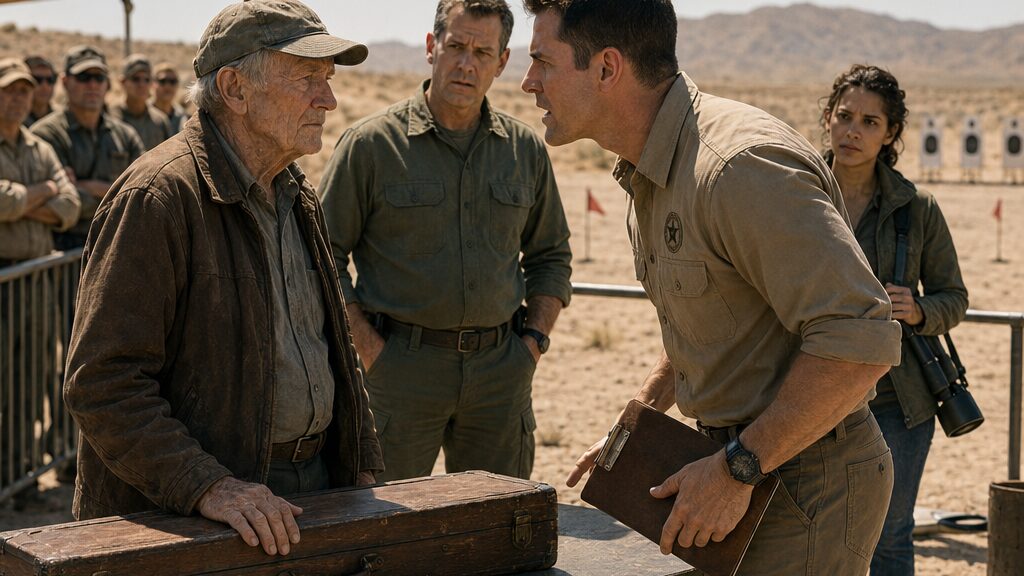
The wooden case sat on a folding table beneath the desert sun, scratched at the corners and faded by decades of weather. Around it were sleek polymer rifle bags, wheeled hard cases, expensive optics, and equipment that looked newer than some of the shooters carrying it.
The old case looked like it belonged somewhere else.
So did the man standing beside it.
Patrick Green adjusted the brim of his worn cap and looked across the firing range. Heat shimmered above the sand. Targets waited in neat rows against distant berms. Volunteers moved between stations preparing for the annual charity precision match.
The place had changed.
The land hadn’t.
The wind still moved the same way across the flats.
Patrick could feel it against his cheek.
He rested one hand on the wooden case.
Not because it was heavy.
Because it mattered.
Voices echoed from the registration tent.
A line of competitors stretched toward a folding table where Sarah Johnson checked names and collected forms.
Patrick joined the end of the line.
A few shooters glanced at him.
One looked at the case.
Another looked at his age.
The expressions were familiar.
Patrick had seen them for years.
People always assumed old age arrived all at once.
As if experience vanished the moment hair turned gray.
The line moved slowly.
When Patrick reached the table, Sarah smiled politely.
“Registration?”
Patrick handed over a folded card.
The paper looked older than everything else on the table.
Sarah unfolded it carefully.
“This isn’t one of this year’s forms.”
“It got me in before.”
The answer made her smile.
She checked the card again.
The name was written in faded ink.
Patrick Green.
She frowned.
“I’ll need to verify this.”
“Take your time.”
The people waiting behind him shifted impatiently.
Sarah disappeared into a trailer office.
Patrick waited.
The desert wind brushed against the side of the wooden case.
A younger competitor walked past.
He looked down.
“Didn’t know they let antiques compete.”
His friend laughed.
Patrick said nothing.
A few moments later Sarah returned.
“We found your registration history.”
“Good.”
“You haven’t competed here in a long time.”
“No.”
“Everything’s fine.”
She handed him a badge.
“Welcome back.”
Patrick nodded.
“Thank you.”
He picked up the case and walked toward the firing area.
The smell of dust and gun oil drifted through the warm air.
A whistle sounded somewhere beyond the practice lanes.
Competitors prepared equipment.
Instructors moved through the crowd.
One instructor stood out.
He was younger than most of the shooters.
Clean uniform.
Perfect posture.
Clipboard under one arm.
Confident voice.
People listened when he spoke.
Eric Allen.
Patrick read the name on the patch.
Eric was directing competitors toward assigned lanes.
He moved quickly.
Everything about him suggested efficiency.
Everything about him suggested certainty.
Patrick stopped near the lane assignment board.
Eric looked up.
His eyes landed on the wooden case.
Then Patrick.
Then the case again.
The pause lasted less than a second.
But Patrick noticed.
Eric walked over.
“Can I help you?”
“I’ve got registration.”
Patrick showed the badge.
Eric examined it.
“You competing?”
“That’s usually why people register.”
Several nearby shooters chuckled.
Eric didn’t.
He looked Patrick over carefully.
“You sure you’re in the right place?”
Patrick met his gaze.
“I believe so.”
“This isn’t a museum exhibit.”
The laughter came quicker this time.
Patrick remained still.
Eric tapped the wooden case.
“What exactly is in there?”
“A rifle.”
More laughter.
One competitor shook his head.
Eric smiled slightly.
“You know we’re running a precision match, right?”
Patrick nodded.
“I read the sign.”
The answer earned a few grins from spectators.
Eric’s smile faded.
He wasn’t accustomed to being answered that way.
Not because it was rude.
Because it wasn’t.
The old man wasn’t challenging him.
He simply wasn’t intimidated.
Eric checked the badge again.
“You haven’t competed here in years.”
“No.”
“Range rules have changed.”
“Then I’ll learn them.”
“You know how to operate safely?”
The question hung in the air.
Several heads turned.
Patrick felt the weight behind it.
Not curiosity.
Judgment.
The assumption that age had made him fragile.
Or confused.
Or dangerous.
Patrick opened the wooden case slowly.
The crowd expected something dramatic.
Instead they saw a clean rifle.
Old.
Plain.
Well maintained.
Nothing flashy.
No expensive accessories.
No oversized optics.
Everything looked practical.
Patrick checked the chamber before lifting it.
The movement was automatic.
Careful.
Controlled.
Safe.
He closed the bolt.
Then opened it again.
A habit.
A discipline.
Eric watched.
“So you do know the basics.”
Patrick returned the rifle to the case.
“The basics matter.”
A trainee nearby rolled her eyes.
Another competitor whispered something about old-timers.
Patrick ignored them.
The desert wind shifted.
A range flag fluttered.
His eyes followed it automatically.
Eric noticed.
“You worried about wind already?”
Patrick looked back.
“No.”
“Then why stare at the flags?”
“Just saying hello.”
A few people laughed.
This time Patrick almost smiled.
Eric sighed.
“Listen.”
His voice grew louder.
Loud enough for others to hear.
“We’ve got serious shooters here today.”
Patrick nodded.
“Good.”
“You sure this is something you want to do?”
The question wasn’t really a question.
It was a suggestion.
Leave.
Avoid embarrassment.
Don’t slow things down.
Patrick had heard versions of it his entire life.
From officers.
From competitors.
From people who mistook confidence for competence.
“The target will tell us,” Patrick said.
Eric stared at him.
“What?”
“The target.”
Patrick closed the wooden case.
“It usually tells the truth.”
The nearby crowd exchanged looks.
The answer sounded simple.
Yet something about it lingered.
Eric opened his mouth.
Then closed it.
The old man wasn’t arguing.
That made him difficult to dismiss.
A vehicle rolled across the range access road.
Several officials stepped out.
One of them was George Moore.
Gray at the temples.
Steady expression.
The kind of authority that didn’t need volume.
George walked toward the registration area carrying a clipboard.
He stopped beside Sarah.
She pointed toward the firing line.
Toward Patrick.
George looked.
The distance between them was considerable.
Yet Patrick saw the moment happen.
George’s eyes narrowed.
His attention fixed on the old man.
Then on the badge clipped to his shirt.
Then on the wooden rifle case.
George took several steps closer.
Sarah said something.
George didn’t answer immediately.
He kept staring.
The expression on his face changed.
Recognition.
Not complete.
Not certain.
But enough.
Patrick looked away.
He had not come for recognition.
He had come for something else.
Still, he knew that look.
People searching memory.
Trying to place a name.
Trying to understand why something familiar suddenly mattered.
Across the range, George stopped walking.
For several seconds he remained perfectly still.
Then he looked directly at Patrick.
And froze.
Chapter 2: The Instructor Who Spoke Too Loud
Eric Allen hated surprises.
The charity event mattered more than anyone realized.
Officially, it raised money for veterans’ programs and youth marksmanship training.
Unofficially, it was his opportunity.
Senior staff would be watching.
Sponsors would be watching.
George Moore would be watching.
A strong performance could open doors.
A promotion.
More responsibility.
Maybe even leadership of the training division.
Everything needed to run smoothly.
Which was why Patrick Green irritated him.
The old man had appeared from nowhere carrying equipment older than most of the volunteers.
And somehow he had already become a distraction.
Eric stood near the briefing platform studying the competitor list.
Patrick’s name bothered him.
Not because he recognized it.
Because George seemed to.
George wasn’t a man who reacted visibly.
Yet he’d gone quiet the moment he saw the registration badge.
Eric looked toward the parking area.
Patrick sat alone beneath a shade canopy.
The wooden rifle case rested beside him.
The old man wasn’t talking to anyone.
Wasn’t showing off.
Wasn’t asking for attention.
Yet people kept glancing his way.
Amy Torres stood nearby with a practice rifle.
She followed Patrick with curious eyes.
Eric walked toward her.
“You ready for the afternoon stages?”
“I think so.”
“You think so?”
She straightened.
“Yes, sir.”
“Good.”
His attention drifted back toward Patrick.
Amy noticed.
“Who is he?”
“No idea.”
“You seemed interested.”
“I’m interested because safety matters.”
Amy looked unconvinced.
“He hasn’t done anything wrong.”
“Yet.”
The answer came too quickly.
Even Eric heard it.
Amy said nothing.
He moved on.
The briefing began twenty minutes later.
Competitors gathered around the platform.
Sarah welcomed everyone.
Explained the charity goals.
Reviewed procedures.
Then handed the microphone to Eric.
This part he enjoyed.
Structure.
Order.
Control.
He explained lane assignments and scoring rules.
Most people listened.
Patrick listened more carefully than anyone.
Eric noticed because the old man never interrupted.
Never checked his phone.
Never whispered.
He simply paid attention.
When the briefing ended, competitors dispersed.
Patrick approached a posted rules sheet.
He read every line.
Twice.
Then he compared it to a folded card taken from his rifle case.
The card was yellowed with age.
Handwritten notes covered the margins.
Amy happened to pass nearby.
She glanced at it.
Wind values.
Distances.
Corrections.
Numbers written neatly.
Patrick folded it away before she could see more.
Eric approached.
“Everything clear?”
Patrick looked up.
“Seems straightforward.”
“You reading the rules again?”
“Yes.”
“You’ve already read them.”
Patrick shrugged.
“Important things are worth reading twice.”
Eric fought the urge to roll his eyes.
There it was again.
That calm certainty.
Not arrogance.
Something harder to challenge.
“You planning to shoot with that rifle?”
Patrick nodded.
“Unless someone else wants it.”
Several nearby competitors laughed.
Eric didn’t.
He examined the old wooden stock.
“It belongs in a display case.”
“It prefers fresh air.”
A few more chuckles.
Eric felt the conversation slipping away from him.
The old man never argued.
Never raised his voice.
Yet somehow he never looked defeated either.
George appeared at the edge of the crowd.
Watching.
Always watching.
Eric changed direction.
“Lane assignments have been updated.”
He pointed toward the far end of the range.
The most difficult firing position.
The worst visibility.
The hottest section of ground.
“You’re down there.”
Patrick looked.
“That’s fine.”
“No complaints?”
“Should there be?”
The question irritated Eric more than any protest could have.
He folded his clipboard.
“Most people would ask why.”
Patrick lifted the wooden case.
“Most people aren’t carrying this.”
Then he walked away.
Amy watched him leave.
“So why put him there?”
Eric glanced at her.
“It’s just a lane.”
She looked toward the distant firing position.
Everyone knew it wasn’t.
The far lane caught stronger crosswinds.
Targets appeared smaller.
Heat distortion was worse.
The assignment wasn’t unfair.
But it wasn’t generous either.
Eric knew that.
Amy knew it.
Patrick probably knew it too.
Yet the old man hadn’t objected.
Hours of preparation followed.
Competitors checked equipment.
Range officers confirmed safety procedures.
The desert heat intensified.
Through it all Patrick remained quiet.
He checked his rifle.
Reviewed his notes.
Observed the flags.
Nothing more.
As midday approached, Eric watched him through binoculars.
The old man seemed entirely at ease.
That bothered him.
Because confidence usually announced itself.
Patrick’s didn’t.
George stepped beside Eric.
“You put him in the far lane.”
“Yes.”
George kept watching.
“Why?”
“It’s available.”
George was silent for a moment.
Then he said, “Sometimes the loudest thing on a range isn’t a voice.”
Eric frowned.
“What does that mean?”
George didn’t answer.
Instead he walked away.
Leaving Eric with a growing sense that something important sat just outside his understanding.
Minutes later the range loudspeaker announced the first live-fire stage.
Competitors moved toward assigned positions.
Patrick picked up the wooden case.
The faded range card slipped partially free.
For a moment sunlight struck the handwriting.
Amy saw a phrase written across the bottom.
Respect before speed.
Before she could read more, Patrick tucked the card away.
Then he headed toward the farthest lane on the range.
Chapter 3: The Wind Moved Before The Flag Did
Amy had expected the old man to struggle.
Not because she wanted him to.
Because everyone else seemed certain he would.
Confidence was contagious.
Especially when it came from people wearing uniforms and carrying authority.
By midday most competitors had accepted Eric’s unspoken judgment.
Patrick Green was old.
Slow.
Probably outmatched.
The only disagreement was how badly.
Amy carried her spotting scope toward the observation area beside the firing line.
The desert stretched before them in waves of heat and light.
Targets stood hundreds of yards away.
Small white squares against dusty earth.
Spectators gathered behind safety barriers.
Competitors prepared rifles.
Range officers moved through final checks.
Patrick arrived at the far lane carrying the wooden rifle case.
He didn’t hurry.
He didn’t appear nervous.
He looked like someone arriving for work.
Nothing more.
Several shooters nearby exchanged amused looks.
One competitor glanced at the case.
“That thing still open?”
His friend laughed.
Patrick continued walking.
Amy watched him reach his station.
He set the case beside the firing mat.
Then opened it.
The gesture drew attention.
People expected some hidden surprise.
An antique masterpiece.
A rare collector’s item.
Instead they saw the same plain rifle.
Old.
Clean.
Simple.
Patrick inspected it carefully.
He checked the chamber.
Verified the action.
Verified it again.
Every movement was deliberate.
Amy noticed something strange.
No one else on the line appeared as careful.
Most competitors relied on routine.
Patrick treated each step as if it mattered.
Eric approached the lane.
Clipboard tucked beneath one arm.
“Everything good here?”
Patrick nodded.
Eric looked at the rifle.
Then at the spectators.
“Need help seeing the target?”
Several people laughed.
Amy winced.
Patrick didn’t react.
“The target is where they usually put it.”
More laughter.
Eric smiled thinly.
“Good answer.”
But his smile looked forced.
The crowd had started enjoying Patrick’s responses.
Not because they were sharp.
Because they were calm.
The loudest person wasn’t controlling the conversation anymore.
A range officer called for shooters to prepare.
Rifles remained unloaded.
Safety checks continued.
Patrick knelt slowly onto the firing mat.
The movement triggered whispers.
Someone behind Amy muttered, “Look at those hands.”
Patrick’s fingers trembled slightly.
Age showed there.
The observation spread quickly through the crowd.
Amy heard it.
So did Eric.
His expression hardened.
As if the shaking confirmed everything he believed.
Then Patrick settled into position.
And the trembling stopped.
Not completely.
Just enough.
His breathing slowed.
His shoulders relaxed.
The rifle became still.
Amy found herself leaning forward.
Something had changed.
Not dramatically.
But noticeably.
The old man no longer looked old.
He looked focused.
The range officer announced wind conditions.
Eric repeated them down the line.
Competitors adjusted accordingly.
Patrick listened.
Then looked toward the distant berm.
Toward a patch of brush far beyond the targets.
His eyes narrowed.
He raised one hand slightly.
“Wind’s moving left.”
Eric glanced at the flags.
“No.”
Patrick continued watching the brush.
“It will.”
Several shooters exchanged looks.
Eric folded his arms.
“The flags say otherwise.”
Patrick nodded.
“They haven’t caught up yet.”
A few people laughed.
Amy didn’t.
She looked where Patrick was looking.
The distant brush moved first.
Only slightly.
A ripple across dry leaves.
Several seconds later the nearest flag shifted.
Then another.
Then another.
The wind changed direction.
Silence settled over the lane.
Eric stared at the flags.
Then at Patrick.
No one laughed this time.
Patrick simply adjusted a note on his range card.
As if nothing unusual had happened.
Amy felt a small chill despite the heat.
The range officer called for loading procedures.
Competitors prepared.
Metal clicked.
Bolts cycled.
Safety protocols continued.
Patrick followed each instruction precisely.
No shortcuts.
No wasted motion.
A shooter two lanes over rushed through part of the sequence.
Patrick glanced over.
Nothing more.
Yet somehow the younger shooter noticed and corrected himself immediately.
The old man hadn’t spoken.
He hadn’t needed to.
The live-fire command arrived.
The range fell quiet.
Amy raised her spotting scope.
Patrick rested behind the rifle.
The wooden case remained open beside him.
The faded range card sat inside.
Visible now.
Covered with years of notes.
Wind values.
Distances.
Tiny handwritten corrections.
The pages looked used.
Loved.
Remembered.
Eric stood behind the line watching.
Waiting.
The crowd waited too.
Not for success.
For failure.
Most of them still expected it.
Patrick inhaled slowly.
Then exhaled.
The rifle remained motionless.
Another breath.
Another pause.
The world seemed to shrink around him.
Amy forgot everyone else.
Forgot the heat.
Forgot the competition.
The old man looked completely at home.
As if the rifle belonged there.
As if he belonged there.
As if time itself had stepped aside.
The shot broke.
Not loudly.
Not dramatically.
Just one clean report.
The rifle barely moved.
A second passed.
Then another.
Everyone looked toward the distant target line.
No immediate reaction came.
The target runners began their work.
One volunteer started bringing Patrick’s target back.
Halfway through the return trip, the volunteer stopped.
Looked down.
Looked again.
Then stopped walking altogether.
A murmur moved through the crowd.
The volunteer raised the target closer to his face.
Stared.
Amy lowered her spotting scope.
People were standing now.
Trying to see.
Trying to understand.
The volunteer remained frozen in the desert sunlight.
And nobody on the firing line knew why.
Chapter 4: When The First Target Came Back
George Moore knew the sound of a range changing.
It was never the shot itself.
Shots came and went. Loud ones, clean ones, bad ones, hurried ones. A range could swallow them all and keep moving. What mattered was what happened after.
After Patrick Green fired, the firing line stopped breathing.
George stood behind the safety barrier with one hand resting against the rail. The desert light was hard on the eyes, but he kept watching the target runner. The volunteer had stopped halfway back, holding the paper as if it had turned heavier in his hands.
Eric noticed it too.
“Keep moving,” Eric called.
The volunteer looked toward him, then down at the paper again.
George felt something old move inside his chest.
Not surprise.
Recognition trying to find its shape.
The target runner finally walked the rest of the distance. Not quickly. Not proudly. Carefully, as if the paper deserved respect. He brought it to the scoring table where Sarah Johnson stood with the scorekeeper.
A small crowd pressed closer.
“Behind the line,” George said.
His voice was low, but it carried.
People eased back.
Eric reached the table first. He took the target before the scorekeeper could clip it to the board.
For a moment, he said nothing.
George watched his face.
That told him enough.
Sarah leaned in. Her brows lifted.
The scorekeeper adjusted his glasses.
Amy Torres stood near the barrier, gripping the strap of her spotting scope.
“What is it?” someone asked.
Eric held the paper flat.
There was one clean hole near the center.
Not a ragged tear. Not an uncertain mark. One small, precise opening where the shot had passed through the target.
A murmur spread.
“That’s one shot,” Eric said.
His tone tried to make the result smaller.
George looked from the paper to Patrick.
The old man remained at the far lane. He had not stood to see the reaction. He had not turned toward the spectators. He was still in position, rifle safe, eyes on the range, waiting for instruction.
That mattered more to George than the hole.
“Good shot,” Sarah said quietly.
“Lucky shot,” Eric replied.
The word landed badly.
Several competitors shifted.
Amy looked at Eric as if she wanted to object but wasn’t sure she had earned the right.
George stepped closer.
“Score it.”
Eric turned.
“For one round?”
“For the round fired.”
Eric’s jaw tightened.
“The stage requires more than one. He only fired once.”
“The command allowed one confirming shot before the full relay,” George said. “Score what happened.”
The scorekeeper clipped the target.
Eric stared at the hole again.
“It’s still luck.”
George let the silence stretch.
Luck had a sound too.
It usually came with laughter, relief, surprise, some burst of human noise.
Patrick’s shot had brought none of that.
It had brought quiet.
George looked toward the far lane again.
Patrick had opened the bolt and stepped back from the rifle. His movements were exact. Old hands, yes, but sure hands. There was no wasted gesture, no hunger for attention.
A memory pressed against George’s mind.
A younger version of himself on a sunburned range.
A voice behind him saying, Don’t chase the shot. Let the shot tell you where you were.
He could not see the man’s face clearly.
Only the posture.
Only the hand resting near a wooden rifle case.
George turned away from the memory before it fully opened.
Eric was already walking toward Patrick with the target in hand. George followed.
The crowd trailed at a distance, pretending not to.
When Eric reached the far lane, he held up the paper.
“You want to explain this?”
Patrick glanced at it.
“No.”
“No?”
“It’s a target.”
Eric laughed once, without humor.
“A target with one hole.”
Patrick nodded.
“That happens when one round is fired.”
A few spectators smiled.
Eric’s face reddened.
“You know what I mean.”
Patrick removed his eye protection and set it beside the open case.
“I don’t think I do.”
Eric lowered his voice, but not enough.
“You made a wind call nobody saw, then put a round dead center with an old rifle. Now everyone thinks they’re watching some kind of show.”
Patrick looked at the crowd.
Then back at Eric.
“I’m not performing.”
“Then what are you doing?”
Patrick’s gaze moved to the target again.
“Following the line.”
George felt the phrase strike somewhere deep.
Following the line.
He had heard it before.
Years ago.
On this same range, when the buildings were smaller and the signs were fresh paint instead of vinyl.
He took one step forward.
“Mr. Green.”
Patrick looked at him.
Not startled.
Not pleased.
Just attentive.
“Have we met?” George asked.
Patrick studied his face.
“Maybe.”
“Forty years ago, this range ran an instructor cycle for military and civilian safety officers.”
Patrick said nothing.
George’s pulse slowed.
“There was a senior instructor,” George continued. “He used to mark wind on pocket cards instead of trusting the flags.”
Patrick looked down at the folded range card inside the case.
For the first time all day, something in his face moved.
Not much.
Enough.
“I remember a lot of cards,” Patrick said.
George looked at the wooden case.
His memory cleared another inch.
“You taught a rule. Respect before speed.”
Patrick closed the case halfway.
“Good rule.”
Eric looked between them.
“You know him?”
George did not answer immediately.
Because recognition was not proof.
And proof mattered.
Especially on a range.
“I know the rule,” George said.
Eric’s shoulders relaxed slightly, as if the answer helped him.
Patrick noticed.
George did too.
The younger man was not cruel. Not truly. He was scared of losing control in front of people who judged control as competence.
That kind of fear could make a man loud.
Eric turned back to Patrick.
“Then you’ll understand why we can’t let luck decide a charity match.”
Patrick nodded.
“No argument.”
Eric blinked.
“You agree?”
“A single shot doesn’t tell enough.”
George watched him carefully.
Patrick lifted the target from Eric’s hand and studied the hole.
He didn’t smile.
Didn’t admire it.
Didn’t use it as a weapon.
He simply looked.
Then he handed it back.
“Hang a clean one.”
The crowd quieted.
Eric frowned.
“What?”
“Clean target. Same lane. Same distance.”
Patrick placed his eye protection back on the table.
“If the range permits.”
All eyes shifted to George.
There it was.
Not a boast.
Not a challenge shouted across the firing line.
A request made through proper authority.
George felt the old range under his boots again.
The one that had taught him the difference between command and noise.
He turned to Sarah.
“Can the schedule hold?”
Sarah checked her tablet, then the line of competitors.
“Barely.”
“Then we’ll hold it.”
Eric stiffened.
“Sir—”
George raised one hand.
“Clean target.”
The scorekeeper signaled the runner.
A new sheet went downrange.
The spectators whispered.
Eric’s grip tightened around the clipboard.
Patrick lowered himself back onto the mat.
Slowly.
Carefully.
The movement was not graceful. Age had taken too much for that. His knee resisted. His back took time. His left hand braced against the table before he settled.
Somewhere behind George, a competitor whispered, “He’s too old to be doing this.”
Patrick heard it.
Everyone close enough heard it.
Patrick simply reached into the wooden case, took out the folded range card, and smoothed it beside him.
George saw the bottom line clearly now.
Respect before speed.
The handwriting pulled the past closer.
Patrick adjusted his position.
The flags shifted again.
Eric looked toward them.
Then, despite himself, he glanced at Patrick’s eyes to see where the old man was looking.
George saw it.
The first crack in certainty.
Sarah’s voice came over the speaker.
“Final public precision round will begin after this verification stage.”
That announcement sent a ripple through the crowd.
This was no longer a curiosity.
It had become a question the whole range wanted answered.
Patrick rested behind the rifle.
The clean target waited downrange, bright against the desert berm.
George stood very still.
He finally remembered the voice.
He remembered a younger officer making every mistake speed could make, and an instructor behind him saying, Slow down. The rifle knows when you’re lying.
George swallowed.
Patrick Green had not come back to the range for applause.
Men like him never did.
But now the range was watching.
And the target would have to speak again.
Chapter 5: The Safety Rule Everyone Forgot
Patrick had spent most of his life learning when not to speak.
Silence could be discipline.
It could be patience.
It could keep pride from turning into foolishness.
But silence could also become permission.
He stood beside the training bay while the range reset for the public precision round. Beyond the shade structure, the desert glowed white in the afternoon sun. Volunteers moved with purpose. Spectators gathered closer to the scoring area. The event had shifted around him, though he had done nothing to invite it.
That was the trouble with a good shot.
People looked at the shooter instead of the lesson.
Patrick kept the wooden case on the table beside him. The rifle was safe, action open, chamber clear. The range card lay folded under his palm.
He did not need to open it to know the words at the bottom.
Respect before speed.
He had written them years ago after watching too many young shooters mistake urgency for skill.
Back then, the phrase had been taped to doors, printed on range packets, repeated at every briefing.
Now it lived in his pocket like a forgotten receipt.
Amy Torres entered the training bay with three other trainees. Eric stood in front of them, clipboard tucked under his arm, voice sharper than before.
“The final round will be observed by senior staff and donors,” he said. “No careless movement. No wasted time. You will follow my commands exactly.”
The trainees nodded.
Patrick turned slightly away.
This was not his class.
Not anymore.
Eric demonstrated a dry sequence with a training rifle. His movements were fast and polished. Safe enough on paper. Efficient. Impressive to anyone who had never seen efficiency turn brittle under pressure.
Amy watched closely.
Too closely.
Patrick noticed the way she copied the speed before she understood the order of thought behind it.
Eric snapped the training rifle up, checked the chamber, shifted his stance, and moved through the sequence.
“Smooth,” he said. “Clean. Decisive. You hesitate out there, you lose.”
Amy nodded hard.
Patrick’s hand tightened on the folded card.
One of the trainees asked a question about confirming a clear chamber after moving between stations.
Eric waved it off.
“We covered that. Don’t overthink.”
Patrick looked down.
Don’t overthink.
He had buried men who hadn’t thought enough.
The words were too heavy for a charity range on a bright afternoon. He left them unspoken.
Amy stepped forward for her turn.
She mimicked Eric’s speed.
Training rifle up.
Bolt checked.
Muzzle shifted.
Her foot caught on the edge of the mat.
The movement was small.
Not dangerous yet.
But close enough.
Patrick moved before anyone else did.
His hand came down gently but firmly on the barrel, guiding it toward the safe zone.
“Stop.”
The word was quiet.
The bay froze.
Amy’s eyes widened.
Eric turned sharply.
Patrick released the training rifle only after Amy had steadied herself.
“Finger straight,” Patrick said.
Amy looked down and corrected it.
“Eyes first,” he added. “Feet second. Rifle last.”
Her face flushed.
“I didn’t mean—”
“I know.”
That was all.
No scolding.
No performance.
Just correction.
Eric strode over.
“What do you think you’re doing?”
Patrick turned toward him.
“Keeping the line safe.”
“This is my instruction block.”
“Then instruct.”
The words were not loud.
They did not need to be.
The trainees looked at the floor.
Amy swallowed.
Eric’s face hardened.
“She was fine.”
“She was almost fine.”
“Almost fine isn’t unsafe.”
Patrick held his gaze.
“Almost safe is unsafe.”
Silence dropped into the bay.
George had entered without speaking.
Sarah stood just behind him, drawn by the change in voices.
Eric noticed them and straightened.
“Mr. Green interrupted a controlled training demonstration.”
Patrick said nothing.
George looked at Amy.
“What happened?”
Amy hesitated.
Then she looked at Patrick.
“I rushed the sequence.”
Eric started to speak.
George raised a hand.
Amy continued, voice smaller.
“I copied the speed. Not the checks.”
Patrick looked away.
He did not want her embarrassed.
Eric did not seem to know what to do with that answer.
George walked to the training table and picked up the folded card near Patrick’s case.
He did not unfold it without permission.
Patrick saw the question in his hand.
After a moment, he nodded.
George opened the card.
The paper had softened at the creases. Pencil marks covered both sides. Wind notes, distance conversions, old lane numbers, and names half-faded by time.
At the bottom were the words.
Respect before speed.
George stared at them.
Sarah stepped closer.
“That’s the phrase on the old plaque in storage.”
Eric frowned.
“What plaque?”
“The wooden one we found when we cleaned out the east office,” Sarah said. “We didn’t know where it came from.”
George still held the card.
“It came from here.”
Patrick took the card back carefully.
“Not from me.”
George looked at him.
Patrick folded the paper.
“From mistakes.”
No one spoke.
Outside, a rifle case snapped shut in the distance. The sound cut through the stillness.
Patrick looked toward Amy.
“You weren’t careless,” he said. “You were trying to be what someone praised.”
Amy’s face changed.
Not relieved.
Seen.
Eric’s mouth tightened.
“Are you saying I taught her wrong?”
Patrick slid the range card into the case.
“I’m saying she learned what you emphasized.”
The words landed harder than an accusation because they were measured.
Eric stepped closer.
“You’re undermining me in front of my students.”
Patrick closed the wooden case.
“I’d rather undermine your pride than reinforce her mistake.”
The trainees stared.
George did not intervene.
Sarah looked as if she wanted to, then thought better of it.
Eric’s voice rose.
“You walk in here after disappearing for decades, carry some old card, fire one lucky shot, and now everyone treats you like the range belongs to you.”
Patrick’s eyes lifted.
For the first time that day, something like pain showed through the calm.
Only briefly.
Then it was gone.
“The range belongs to whoever leaves it safer than they found it.”
Eric laughed, but the sound broke at the edges.
“That’s convenient.”
“No,” Patrick said. “It’s difficult.”
The training bay held its breath.
Eric looked toward the open doorway where spectators had begun to gather again.
His pride had an audience.
So did his anger.
“Then prove it without lecturing,” he said.
Patrick did not answer.
Eric gestured toward the long-distance range.
“Final round. Same far lane. Hardest wind of the day. No warm-up. No second clean target. Just shoot.”
George stepped forward.
“Eric.”
“No, sir. He keeps telling everyone the target tells the truth.”
Eric looked at Patrick.
“So let it.”
Patrick studied him.
He saw the young man’s anger.
But beneath it he saw fear.
Fear of being exposed.
Fear of losing authority.
Fear of discovering that loud certainty had been built on a narrow foundation.
Patrick had known men like that.
He had been one, once.
For that reason alone, he did not answer cruelly.
He lifted the wooden case.
“If the range is clear,” he said, “I’ll shoot.”
Amy looked at him.
“Why?”
Patrick paused at the doorway.
The question was honest.
Not about the match.
About the man.
Why accept humiliation?
Why not leave?
Why carry grief into a place that had forgotten you?
Patrick looked across the desert toward the far targets.
“Because silence doesn’t teach if danger fills it.”
Then he walked toward the final lane.
Behind him, Eric stood among his trainees, looking less victorious than he wanted to appear.
Chapter 6: The Final Lane Was The Hardest
The wind was worse at the far lane.
Patrick felt it before the flags admitted it.
It came low across the sand, struck the berm, curled back in uneven breaths, then slid sideways through the final hundred yards. A younger man might have blamed the range. A proud man might have tried to beat it.
Patrick listened instead.
The wooden case lay open beside him on the bench.
Inside, the old range card rested in its worn crease, and beneath it was a photograph he had not meant to uncover.
A younger man in a faded cap stood beside Patrick years ago, both of them holding targets and smiling awkwardly at the camera. The younger man’s face had been browned by the same desert sun. His name was not printed anywhere on the photograph.
It didn’t need to be.
Patrick knew it.
The charity was for him.
Not officially by Patrick’s arrangement. Officially, the event bore a memorial title, a foundation logo, and Sarah’s careful planning. But Patrick had seen the name on the flyer months earlier and sat at his kitchen table for a long time before deciding to come.
The man in the photograph had once been his student.
Not the best at first.
Too impatient.
Too certain.
Too eager to prove something.
Patrick had nearly failed him.
Then, late in training, the young man had stayed after class and asked how to slow down without feeling weak.
That was the day Patrick wrote the rule again on a fresh card.
Respect before speed.
Years later, that student had helped build this charity match.
Years after that, he was gone.
Patrick had not come back for a trophy.
He had come because a promise had outlived the man who made it.
The firing line filled behind him.
Competitors, instructors, volunteers, veterans, donors, trainees. They gathered with the restless hush of people pretending they were only watching procedure.
Eric stood with his clipboard.
George stood beside Sarah at the scoring table.
Amy remained near the observation rail, very still.
Patrick took the photograph and placed it beneath the range card, hidden again. Memory had no place on the firing line unless it steadied the hand.
He checked the rifle.
Clear.
Safe.
Ready only when commanded.
The range officer reviewed the final round.
Three shots.
Long-distance target.
Timed window.
Wind variable.
No coaching once the command began.
Eric listened with his jaw set.
Patrick knew the young man expected the wind to do what pride could not.
Make the old man ordinary.
Maybe it would.
Patrick was not foolish enough to believe age had left him untouched. His knee ached. His eyes tired faster now. His hands had tremors when he held them empty. Every movement required negotiation.
He did not resent that.
A man who lived long enough made peace with some losses.
But the breath remained.
The patience remained.
The discipline remained.
He knelt.
Slowly.
The crowd watched the effort.
This time no one laughed.
That was a kind of mercy.
Patrick settled behind the rifle. The old wooden stock fit into the hollow of his shoulder like a remembered sentence. He adjusted his position by inches. Not to look smooth. To be stable.
A flag at two hundred yards fluttered right.
A dust line beyond the target moved left.
The brush behind the berm shivered, then stilled.
Three winds.
One bullet path.
Patrick heard Eric speak behind him.
“Target one. Final lane. Shooter ready?”
Patrick did not answer immediately.
He checked his chamber.
Checked his muzzle.
Checked the range.
Then said, “Ready.”
The command came.
Patrick breathed.
The first shot broke clean.
The target did not move.
No visible sign.
No reaction.
Only the report fading into the desert.
Patrick did not chase it through the scope. He knew where he had been when the trigger broke.
Slightly early.
A fraction.
Enough to matter.
He adjusted.
The wind folded.
He waited.
The time window continued.
Someone behind him shifted impatiently.
Patrick ignored it.
The second shot came after a longer pause.
This one felt truer.
Not perfect.
True.
He opened the bolt, closed it, and waited again.
The third wind arrived late, sliding low and quick. The flags barely showed it. The dust did.
Patrick’s eyes followed the ground, not the cloth.
The old lesson returned.
You do not beat the wind by shouting at it.
He smiled faintly.
Not for the crowd.
For the student in the photograph.
For every impatient young shooter who had ever thought calm looked like surrender.
The final shot broke.
The range fell silent.
Patrick opened the bolt and stepped back.
Rifle safe.
Chamber clear.
No celebration.
No raised fist.
No glance at Eric.
He rested one hand briefly on the wooden case and let the ache in his knee speak first when he stood.
The target remained downrange.
The runner waited for permission.
Patrick watched the heat shimmer.
For the first time that day, uncertainty touched him.
Not fear of missing.
He had missed before.
Everyone worth teaching had missed.
What he feared was simpler.
That the lesson might become only spectacle.
That people would remember the old man beating the young instructor and forget the reason he had shot at all.
George approached the lane.
“Patrick.”
The use of his first name carried old respect.
Patrick looked at him.
George’s eyes moved to the open case.
To the edge of the photograph visible beneath the card.
He understood more than Patrick wanted him to.
“He was one of yours,” George said quietly.
Patrick closed the case halfway.
“Most of them were only mine for a little while.”
“But he remembered you.”
Patrick looked toward the memorial banner near the registration tent.
The name moved in the wind.
“Long enough to build something better than himself.”
George stood beside him in silence.
Eric remained several yards away.
He had heard some of it.
Not all.
Enough to stop looking angry for a moment.
The range officer signaled the runner.
The final target began its journey back.
All eyes followed it.
Patrick did not.
He looked down at his old hands.
The tremor had returned.
He let it.
The work was done.
The paper moved slowly across the desert, growing larger with each step.
No one spoke.
Even the wind seemed to wait.
Then the runner looked at the target.
His pace changed.
He slowed.
Not the startled halt of the first shot.
Something heavier.
He turned the paper slightly, as though checking whether the light had deceived him.
Then he carried it toward the scoring table.
Patrick closed the rifle case.
The latch clicked softly.
Downrange, the final target disappeared behind t
Chapter 7: The Silence After The Target Returned
Amy Torres saw the target before Eric did.
Not clearly.
Not at first.
The paper was still in the runner’s hands, still moving through the broken light of late afternoon, still wavering in the heat rising off the sand. But something about the way the scorekeeper straightened told her the answer had arrived before the target reached the table.
The crowd pressed closer.
No one shouted.
No one joked.
Even the competitors who had laughed earlier stood with their arms loose at their sides, faces turned toward the same small rectangle of paper.
Amy realized she was holding her breath.
The target runner handed the sheet to the scorekeeper.
Sarah Johnson stepped in beside him.
George Moore leaned forward.
Eric came last.
Patrick Green remained by the far lane, wooden case closed in one hand, rifle secured and safe inside it. He had not walked over to see the score. He had not asked.
That made the waiting worse.
Amy watched George’s face.
He looked at the target for a long time.
Then he closed his eyes.
Only briefly.
When he opened them, the whole range seemed to understand something had changed.
The scorekeeper clipped the target to the board.
Three holes sat in a group so tight that from behind the barrier they looked almost like one torn mark, centered where the wind should have made such neatness impossible. The first hole from the earlier stage hung beside it, clean and lonely, like the beginning of a sentence completed too late.
A sound moved through the spectators.
Not applause.
Not yet.
Just a low release of breath.
Eric stared at the paper.
He stepped closer.
Then closer again.
He bent as if distance might change what he was seeing.
It didn’t.
Amy looked toward Patrick.
The old man’s eyes were not on the target.
They were on the memorial banner near the registration tent.
The late sun made the white fabric glow. The printed name moved gently in the wind. Amy had walked past it all morning without thinking much about it beyond the event schedule and charity announcement.
Now Patrick looked at it as if it were a person.
George left the scoring table and walked toward him.
The crowd parted without being asked.
Amy followed a few steps behind, stopping close enough to hear but not close enough to intrude.
George stood before Patrick.
For a moment neither man spoke.
Then George said, “You trained him.”
Patrick’s hand tightened around the case handle.
“A long time ago.”
“The man this event honors.”
Patrick nodded once.
“He came through here young. Too fast. Too eager. Good heart. Bad patience.”
George’s mouth softened.
“Sounds familiar.”
Patrick glanced toward Eric.
Not accusing.
Remembering.
“He wanted to build a match where skill and safety were taught together. Not just measured.” Patrick looked back at the banner. “He wrote me a letter before the first one. Said I should come see what he’d made.”
“You didn’t?”
“No.”
The word was quiet.
Amy felt the weight inside it.
Patrick looked down at the old case.
“I kept meaning to. Then there was always next year. Until there wasn’t.”
George said nothing.
The desert wind moved dust lightly across the ground between them.
Patrick lifted the case a little.
“So I came today.”
“To compete?”
“To keep an appointment.”
Amy looked toward the target again.
The tight group, the old paper, the silent crowd. All morning she had thought she was watching a contest. Then a confrontation. Then a lesson.
Now it felt like something more private had been happening in public, and none of them had understood.
Sarah came over with the final score sheet.
Her voice was careful.
“Mr. Green, that round wins the precision award.”
A few spectators began to clap, uncertainly at first.
Patrick raised one hand.
Not high.
Just enough.
The applause faded before it became loud.
He looked uncomfortable with it, and somehow the crowd respected that too.
Sarah lowered the paper.
“There’s a sponsored advanced training slot included with the award.”
Patrick looked toward Amy.
She felt herself go still.
“No,” she said before she realized she had spoken.
A few people turned.
Her face warmed.
Patrick studied her.
“You want to learn?”
Amy swallowed.
“Yes, sir.”
“Then take it.”
“I didn’t win it.”
“No.”
He shifted the case in his hand.
“But you listened.”
Amy could not answer.
Eric stood near the scoring board, the clipboard hanging at his side.
For the first time all day, he looked young.
Not powerful.
Not polished.
Young.
He walked toward Patrick, stopped, then glanced at Amy, George, Sarah, and the watching crowd. His pride fought him visibly. Amy saw it in his jaw, in his hands, in the way he seemed to search for the right posture and found none.
“Mr. Green,” he said.
Patrick waited.
Eric looked toward the target, then back.
“I was wrong.”
No long speech followed.
No dramatic apology.
Just those three words, plain enough to survive the silence around them.
Patrick nodded.
“That’s a hard sentence.”
Eric’s eyes dropped.
“Yes, sir.”
Patrick reached into his jacket pocket and took out the folded range card. He opened it with care, smoothing the creases with his thumb. The handwriting was faded, but Amy could read the bottom line from where she stood.
Respect before speed.
Patrick held it out to Eric.
Eric hesitated.
“I can’t take that.”
“No.”
Patrick turned the card slightly toward Sarah.
“Copy it.”
Sarah understood at once.
“The plaque,” she said.
George nodded.
“We still have the old one in storage.”
Patrick looked at the training bay.
“Put it where students see it before they touch a rifle.”
Sarah’s expression changed.
Not merely respectful.
Responsible.
“I will.”
Eric stared at the card.
“I never knew that was ours.”
Patrick folded it again.
“It isn’t yours because it’s on a wall. It’s yours when you practice it.”
The words stayed in the air.
Eric gave a small nod.
This time it wasn’t for the crowd.
Amy looked at the wooden case in Patrick’s hand. All morning it had seemed like a relic, something people judged before opening. Now she saw it differently. Not as proof of who he had been, but as a thing that had carried memory without asking anyone to admire it.
George walked back to the scoring table and removed the final target from the board. He placed it beside Patrick’s old range card while Sarah took a photograph for the new display.
The image was simple.
A tight group of holes.
A folded card.
A phrase written by a steady hand long ago.
No medal.
No announcement.
No raised trophy.
Just evidence.
As the sun lowered, competitors began packing their gear. Voices returned slowly, softer than before. People shook Patrick’s hand only when he offered it. A few veterans stood near him without speaking much, which seemed to suit him better.
Amy waited until the crowd thinned.
Patrick was closing the wooden case when she approached.
“Thank you,” she said.
“For what?”
“For stopping me.”
He latched the case.
“You stopped yourself after that.”
“I almost didn’t.”
“Almost matters.”
She looked toward the training slot certificate Sarah had handed her.
“I don’t want to waste it.”
Patrick adjusted his cap.
“Then don’t rush it.”
Amy smiled faintly.
“I’ll try.”
“Trying fast isn’t the same as learning slow.”
She nodded, storing the words carefully.
Eric approached again, quieter now.
He looked at Amy first.
“Tomorrow morning, I’ll rerun the safety block.”
Amy glanced at Patrick.
Eric noticed.
“Slower,” he added.
Patrick gave him the smallest nod.
It was not forgiveness exactly.
It was room.
Sometimes that was enough.
George walked with Patrick toward the parking area. Amy followed at a distance with Sarah, both carrying things that now felt more important than equipment.
At the edge of the gravel lot, George stopped.
“You could come back,” he said.
Patrick looked toward the range.
The targets were being lowered. The flags still moved. The desert held the last light the way old wood held oil.
“Maybe.”
George smiled a little.
“That’s more than no.”
Patrick looked at the wooden case in his hand.
For years, it had felt heavier every time he lifted it.
Today, somehow, it did not.
He turned once more toward the range wall, where Sarah had already leaned the old storage plaque against a post until it could be rehung properly.
Respect before speed.
The words caught the sunset.
Patrick nodded to Amy.
Then to Eric.
Then to George.
No one called after him as he walked to his truck.
No one needed to.
The old case went with him, scratched and faded and closed, but not quite as silent as before.
The story has ended.