The Old Sailor They Stopped At The Rainy Gate Was Carrying One Last Promise
Chapter 1: The Man With The Wet Duffel At Gate Three
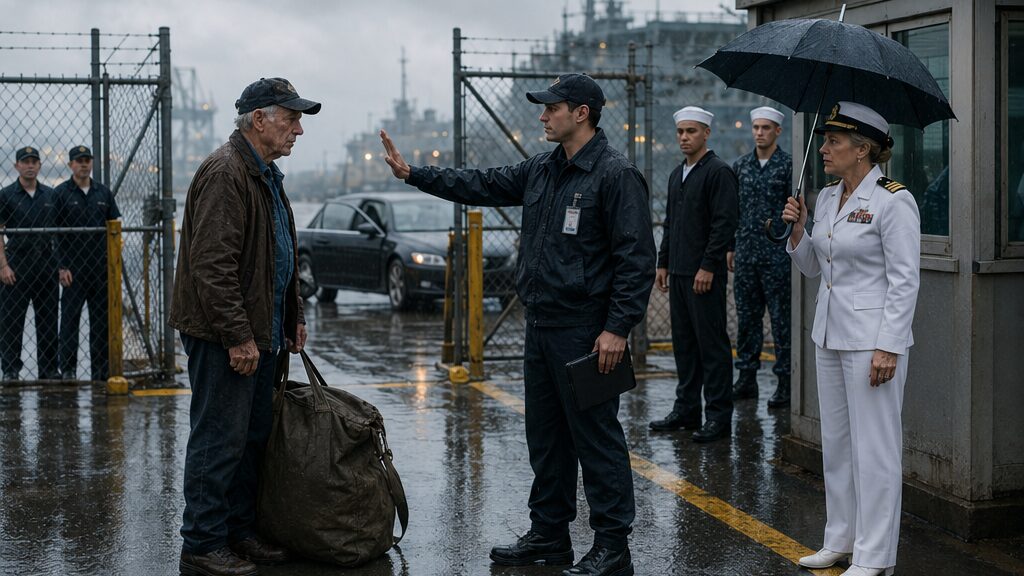
The young guard put one hand out before Ronald Davis had crossed the painted yellow line.
“Sir, you need to step back.”
Ronald stopped with his boot half in a puddle and half on the dry strip beneath the guard shack awning. Rain ticked off the brim of his faded Navy cap and ran down the canvas sides of the old duffel bag hanging from his right hand. Beyond the fence, the gray water of the harbor moved without hurry, and the white shapes of naval buildings stood behind mist like they had been built out of weather.
Ronald looked at the guard’s hand, then at the gate beyond him.
“I’m here for the rededication,” he said.
The guard’s name tape read Wilson. He was young enough that the skin around his jaw still looked too smooth for the authority in his voice. His rain jacket was zipped high, his badge clipped square, his boots polished despite the wet pavement.
“Credentials?” Scott Wilson asked.
Ronald shifted the duffel a little higher. The strap had worn a permanent crease into his palm over the years, though he had not carried it this far in a long time.
“I called last month,” Ronald said. “They said my name would be on the list.”
Scott glanced down at the tablet in his hand. Behind him, two younger sailors hurried through the gate with coffee cups and garment bags covered in plastic. One glanced at Ronald’s cap, then at the soaked cuffs of his trousers, then quickly looked away.
“Name?”
“Ronald Davis.”
Scott tapped the screen. Rain made small dark circles on the glass. His mouth tightened before he spoke.
“I don’t have you.”
Ronald nodded once, not as agreement, but as if the words had landed and he needed to give them room.
“There may be a second list.”
“There’s one access list for this gate.”
“I was told Gate Three.”
“By who?”
Ronald paused. The woman on the phone had given her title, not her name, and he had written only the time and gate number on the back of an envelope. At his age, people expected him to have forgotten things. He hated giving them evidence.
“I don’t recall her name.”
Scott’s expression changed in a way Ronald knew too well. It was not open disrespect. It was worse because it looked like patience.
“Sir, there’s a ceremony today. We’ve got families, officers, and invited guests coming through. I can’t let anyone wander in because they think they’re supposed to be here.”
Ronald heard the word wander more clearly than the rest.
A black government sedan rolled up behind him, tires whispering through rainwater. Ronald stepped aside as far as his knees allowed. The duffel swung and brushed the wet pavement. He caught it before it settled fully down.
Scott noticed the movement.
“You can set the bag down, sir.”
“No,” Ronald said quietly.
Scott looked at him.
Ronald adjusted his grip. “Please don’t ask me to put it on the ground.”
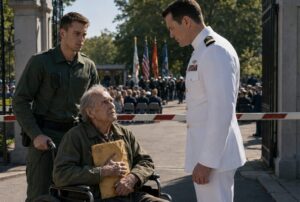
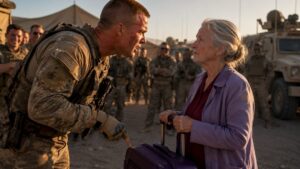
The sedan’s rear door opened. A woman in a white dress uniform stepped out beneath a dark umbrella held by a driver. She moved with a clean, practiced authority, her cover tucked under one arm, silver hair pinned neatly beneath the damp morning. Her eyes passed over the guard, the gate, the old man, the duffel.
Scott straightened.
“Commander Moore.”
Samantha Moore gave a small nod, but her gaze returned to Ronald. Not long enough to be rude. Long enough to notice him.
“Problem at the gate?” she asked.
“No, ma’am,” Scott said quickly. “Just sorting out an access issue.”
Ronald lowered his eyes to the puddle near his boot. The rain had turned the oil on the pavement into faint colors, blue and green sliding apart whenever drops struck them.
Samantha looked at him again. “Sir, are you here for the memorial event?”
“Yes, ma’am.”
“Name?”
“Ronald Davis.”
Something flickered across her face, but it passed too quickly for Ronald to read.
Scott checked the tablet again, as if the name might have appeared out of respect for her rank. “He’s not listed, ma’am.”
Samantha held out a gloved hand. Scott gave her the tablet. She scrolled with her thumb while rain collected along the edge of the umbrella. Ronald waited. He had waited in longer lines, in worse weather, for reasons that mattered less.
A small group gathered under the awning behind him: a maintenance worker with a toolbox, two sailors carrying folded chairs, a woman in a dark coat holding a plastic-covered program. No one stared openly. They simply watched in the way people watched when a delay was not their fault.
Scott lowered his voice, but not enough.
“Sir, if you don’t have credentials, I’m going to need you to move away from the entrance. We can’t block the lane.”
Ronald looked behind him. He was not blocking anything now except other people’s comfort.
“I’ll stand over there,” he said.
“You’ll need to wait outside the secured area.”
Ronald nodded again. The rain ran down the side of his face and slipped into the lines beside his mouth. He took one slow step toward the edge of the awning, away from the gate, away from the dry spot.
The duffel bumped his leg. Its canvas was dark now, nearly black in places. One end sagged where the stitching had loosened. A metal zipper tooth had gone missing near the corner years ago, and Ronald kept that part turned toward him.
Scott reached for the bag. “I can inspect that while we sort this out.”
Ronald’s hand closed tighter.
For the first time, Scott’s face hardened.
“Sir.”
“It stays with me.”
“Then I need to know what’s inside.”
Ronald lifted his eyes. “Nothing dangerous.”
“I can’t take your word for that.”
“No,” Ronald said. “I suppose you can’t.”
The quietness of the answer seemed to irritate Scott more than an argument would have. He looked toward Samantha, expecting support. Samantha was still holding the tablet, but she was no longer looking at the list. She was looking at the duffel.
The flap near the handle had folded open where the canvas had torn. Beneath the outer layer, protected from the worst of the rain, a faded line of stitched numbers showed through in dull yellow thread.
Samantha took one step closer.
Ronald noticed her movement and turned the bag slightly, not hiding it, only holding it closer to his side.
“Where did you get that bag?” she asked.
Ronald’s expression did not change. “A long time ago.”
Scott gave a small breath through his nose. “Ma’am, with respect, we have a line forming.”
Samantha did not look away from the stitching.
“Those numbers,” she said. “They match the ship being rededicated today.”
The rain seemed louder for a moment.
Scott glanced at the bag, then at Ronald’s cap, then back at Samantha. “Could be surplus.”
Ronald did not correct him.
Samantha’s eyes moved from the torn flap to Ronald’s face. The practiced officer in her remained composed, but something more human had entered her attention, something careful and unsettled.
“Mr. Davis,” she said, “would you come inside the gate office for a moment?”
Scott shifted. “Ma’am, he hasn’t been cleared.”
“I’m aware.”
Ronald looked through the open gate toward the harbor. Beyond the chain-link fence and concrete barriers, he could see a temporary canopy near the water. White chairs stood in rows beneath it, their seats shining with rain. A covered shape, likely the memorial plaque, waited on a stand.
He had not come all this way to be important. He had come because a promise did not stop aging just because the man who made it did.
Scott stepped aside, but only halfway.
Ronald moved toward the office door. As he passed the young guard, the duffel brushed against Scott’s rain jacket, leaving a dark wet mark. Scott looked down at it, annoyed before he caught himself.
Ronald saw the look and said nothing.
At the office threshold, Samantha held the door open. Warm air spilled out, carrying the smell of coffee, damp wool, and printer toner.
Before stepping inside, Ronald glanced once more at the bag in his hand. The torn flap had opened wider now. The old stitched number was visible, faint but unmistakable.
Samantha saw it fully this time.
Her eyes narrowed, not in suspicion anymore, but recognition.
Chapter 2: The Number Inside The Torn Canvas
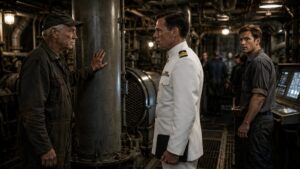
Samantha Moore had spent twenty-four years learning to read a room before speaking in it, but the small gate office made that difficult. It was too crowded with damp coats, humming equipment, and the sour smell of rainwater drying on old floor mats. Every sound seemed close: the radio crackle on the desk, the printer waking in the corner, Scott Wilson’s controlled breathing near the door, Ronald Davis’s duffel dripping steadily onto the rubber mat.
The old man stood instead of sitting.
There were two chairs against the wall. One held a stack of visitor badges. The other was empty. Ronald did not take it, though Samantha gestured toward it.
“You’re welcome to sit, Mr. Davis.”
“I’m all right.”
His voice was neither proud nor stubborn. It carried the flat patience of someone who had learned not to spend strength where it would not change the outcome.
Scott remained by the door, tablet in hand. “Ma’am, I can call the event office again, but if he isn’t listed—”
“Call them,” Samantha said.
Scott stopped. “Yes, ma’am.”
He stepped aside and picked up the wall phone. Samantha kept her attention on Ronald.
“May I see the bag?”
Ronald did not move.
“I’m not asking to search it,” she added.
His hand loosened slightly around the strap.
“It’s old,” he said.
“I can see that.”
“Older than most things people still let through gates.”
Samantha heard the edge beneath the mild words. Not anger. Not exactly hurt either. Something practiced and tired.
She crouched just enough to look at the torn flap without touching it. The stitched numbers were faint, the yellow thread rubbed pale by decades of handling. But they were there. They matched the hull number printed on every program stacked in the visitor badge chair, the same number now on banners being hung beside the waterfront memorial.
She stood slowly.
“Were you assigned to her?”
Ronald looked toward the window. Rain blurred the gate beyond the glass. “For a time.”
Scott, still holding the phone, glanced over. His face had changed from annoyance to guarded curiosity, but his tone stayed official.
“Event office says they don’t have Davis on the guest list,” he said. “They have family representatives, command staff, local officials, and surviving association members. No Ronald Davis.”
Samantha turned. “Ask for the supplemental veteran list.”
“I did.”
“Ask again.”
Scott’s jaw moved once, but he obeyed.
Ronald’s eyes lowered to the duffel. A dark puddle had begun forming beneath it. He shifted the bag an inch so it would drip onto his own boot instead of the office mat.
Samantha noticed.
“Mr. Davis, did someone invite you personally?”
“No.”
“But you called.”
“Yes.”
“Why today?”
His thumb moved over the strap. The canvas had frayed where his fingers rested.
“Because they were changing the wall.”
“The memorial wall?”
Ronald nodded.
“And you wanted to attend the rededication?”
“I wanted to see it before they covered it again.”
Samantha waited. She had learned that some answers came only if no one rushed to fill the silence.
Scott hung up the phone. “They’re checking with the coordinator, ma’am. But they said ceremony access is tight. They’re expecting press near the waterfront after noon.”
The word press made Ronald’s shoulders settle lower, almost imperceptibly.
Samantha saw it.
“You don’t want attention,” she said.
“No, ma’am.”
“Then why not mail whatever concern you have?”
Ronald’s eyes lifted to hers. They were pale, but not weak. Rainwater still clung to his brows.
“I tried once.”
“When?”
“A few years back.”
“To whom?”
He gave a small, dry breath. “The Navy is a large place, Commander.”
That, more than anything, held her. He had addressed her by rank only after hearing Scott say it outside. Not to flatter. Not to perform. Simply because that was the proper thing.
Scott shifted beside the desk. “Sir, with respect, if you have a complaint about the memorial, there’s a process.”
Ronald looked at him, then away.
Samantha heard the dismissal in Scott’s sentence before Scott seemed to. A process. It was the kind of phrase people used when they wanted responsibility to dissolve into paperwork.
“What is inside the bag?” she asked.
Ronald’s fingers tightened again.
“Something that doesn’t belong to me.”
Scott straightened. “Then we definitely need to inspect it.”
Ronald did not look at him. “No.”
Samantha held up a hand before Scott could answer.
“Mr. Davis,” she said carefully, “I can’t bring an uninspected bag into the secure area. You know that.”
“Yes.”
“But you came anyway.”
“Yes.”
The simplicity of it unsettled her. Most people at gates argued from entitlement. He stood there as if the gate was only one more hardship he had expected.
She picked up one of the printed programs from the chair. Across the front, beneath the base insignia, was the name of the rededication ceremony and the ship number. The program smelled faintly of fresh ink.
Ronald looked at it and then looked away too quickly.
“Did you know someone listed on the memorial?” Samantha asked.
The rain tapped harder against the office window.
Ronald’s answer came after a long breath.
“I knew someone who should be.”
Scott lowered the tablet a little.
Samantha’s hand tightened on the program. “Should be?”
Ronald’s face stayed composed, but the skin around his mouth moved as if he had set his teeth.
“There was a mistake.”
“What kind of mistake?”
“The kind that lasts when nobody living has time to correct it.”
For a moment, no one spoke. Outside, a truck backed up near the gate, its warning beep thin and steady in the rain. The normal machinery of the day continued as if nothing in the office had changed.
Samantha set the program down.
“Do you have documentation?”
Ronald looked at the duffel.
“Yes.”
Scott exhaled softly, almost relieved. “Then we can review it and—”
“No,” Ronald said.
Scott’s patience cracked. “Sir, you can’t refuse to show documentation and expect us to let you through because you say there’s a mistake.”
Ronald turned to him fully then. He was shorter than Scott, bent slightly at the shoulders, water running from the hem of his jacket. But the office seemed to narrow around his stillness.
“I don’t expect anything from you.”
The words were quiet enough that Scott had no answer ready.
Ronald turned back to Samantha. “I was told the wall would be uncovered at eleven. I wanted to see one name before that happened. If it’s right, I’ll go. If it isn’t, I’ll go anyway.”
Samantha studied him. “You came all this way just to check a name?”
His eyes moved toward the harbor beyond the rain-streaked glass.
“No, ma’am,” he said. “I came because I said I would.”
The phone rang before Samantha could respond. Scott picked it up, listened, then held the receiver out to her.
“Event coordinator.”
Samantha took it.
She listened without taking her eyes off Ronald. The coordinator spoke quickly: no Davis on the list, ceremony schedule tight, staff already behind, no unverified additions through Gate Three. Samantha said very little. When she hung up, Scott looked ready for the decision to be simple.
It was not.
Samantha picked up a visitor badge, blank and temporary, the kind used for vendors and late approvals. She held it in her hand but did not write on it yet.
“Mr. Davis,” she said, “I can escort you to the preparation hall. The bag stays closed unless security requires otherwise. You stay with me. If there’s any issue, we stop. Do you understand?”
Scott’s head turned sharply. “Ma’am—”
“I understand,” Ronald said.
Samantha took a pen and wrote VISITOR on the badge, then beneath it, R. DAVIS. She clipped it to his jacket herself when his stiff fingers struggled with the clasp.
Only then did he look embarrassed.
“Thank you,” he said.
Scott opened the office door, but his posture made it clear he was not finished objecting. Rain-cooled air entered the room.
As Ronald stepped into it, Samantha walked beside him. The duffel swung between them, old canvas dark and heavy, the torn flap still showing the faded number.
At the threshold, she heard Scott behind them.
“Sir,” he said, more controlled now, “who are you here for?”
Ronald stopped but did not turn all the way around.
“I’m not here for myself.”
Chapter 3: A Name Missing From The Wall
By the time Samantha Moore escorted Ronald Davis across the secured road, the rededication ceremony had begun to take shape without permission from the weather.
White chairs waited in wet rows beneath a canopy near the waterfront. Sailors in dress uniforms moved equipment from one dry patch to another. A maintenance worker taped down cords that refused to stay flat on the damp concrete. Beyond them, the harbor opened wide and gray, its surface broken by slow rings of rain.
Ronald walked beside Samantha without asking to slow down, though she noticed how carefully he chose each step. The duffel hung from his right hand. Whenever they passed a puddle, he lifted it higher.
Scott followed several paces behind.
He had not been ordered to come. He had said, “I should remain with the visitor until the access question is resolved,” and Samantha had allowed it. There were worse reasons for a young guard to stay close than discomfort.
The memorial preparation hall stood beside the waterfront, a low building with glass doors and a polished stone wall visible inside. Temporary signs pointed guests toward registration. Through the doors, Samantha saw staff moving programs, flowers, and folded flags into position. The ceremony was not meant to be complicated. A corrected plaque, a few remarks, a private reception, photographs for the families.
That was how these things were written on schedules.
People who wrote schedules rarely included ghosts.
Inside, the air smelled of floor polish and wet wool. The hall’s central wall was covered by a dark blue cloth. Beneath it, mounted on the stone, was the memorial plaque that had been removed, cleaned, and updated. A smaller temporary display stood nearby, showing photographs of the ship and crew.
Ronald stopped just inside the entrance.
Samantha turned. “Do you need a moment?”
He shook his head, but he did not move.
His gaze had found the covered wall.
For the first time since the gate, his composure seemed to cost him something visible. His shoulders did not shake. His face did not collapse. But he stood as if every year he had carried behind him had suddenly stepped into the room.
A coordinator in a dark suit hurried over, holding a clipboard under one arm.
“Commander Moore, we’re about twenty minutes behind, and the family seating chart still needs—”
“This is Mr. Davis,” Samantha said. “He needs to verify a name on the plaque before the ceremony.”
The coordinator blinked at Ronald, then at the duffel. “The plaque has already been approved.”
“I understand,” Samantha said.
“The cover comes off during the ceremony.”
“It comes off now.”
The coordinator’s mouth opened slightly. “Ma’am, the photographer—”
“Now, please.”
The coordinator looked at Samantha’s face and chose not to continue. She waved to a maintenance worker near the wall.
Ronald did not step forward until the worker reached for the cloth. His fingers tightened around the duffel strap.
The fabric came down with a soft whisper.
The plaque underneath was bronze, newly polished, its engraved letters darkened for readability. Names lined the surface in careful columns. Samantha had seen it in proofs, in photographs, in approval packets. Standing before it now with Ronald beside her, it felt less like a document and more like a door.
Ronald moved closer.
No one interrupted him.
He scanned the names slowly, lips barely moving. Samantha stood a few feet behind, watching his eyes shift line by line. Scott remained near the door, arms at his sides now, tablet held loosely.
Ronald reached the third column.
His hand lifted, then stopped short of touching the plaque.
Samantha stepped closer.
“What is it?”
Ronald did not answer.
She followed his gaze. There, among the names, was one that seemed ordinary unless someone knew it was wrong.
John Peres.
Samantha looked once, then again.
“Peres,” she read softly.
Ronald’s voice was almost too quiet. “Perez. With a z.”
The coordinator leaned in. “That may be how it was submitted.”
Ronald looked at her then. Not sharply. That might have been easier to withstand.
“No,” he said. “That’s how it was missed.”
The coordinator colored. “I only mean the records we received—”
“I know what you mean.”
The hall went still in small circles around them. A sailor setting programs on a table slowed. The maintenance worker folded the blue cloth with unnecessary care. Scott’s eyes moved from the plaque to Ronald.
Samantha asked, “Was John Perez assigned to the ship with you?”
Ronald nodded.
“Family representative?”
“No family coming.”
“Do you know that for certain?”
“His wife died seven years ago. No children.”
The coordinator checked her clipboard, perhaps looking for a place to put the discomfort. “Commander, changing the plaque today isn’t possible. The engraving is complete, and the ceremony starts in less than an hour.”
Ronald’s hand lowered from the plaque.
“I didn’t ask you to change it today.”
Samantha turned toward him. “Then what did you come to ask?”
Ronald looked at the duffel.
Rainwater dripped from the bottom seam onto the polished floor. A small dark spot spread beneath it.
“I came to see whether I could keep my word.”
Scott finally stepped forward. His voice was quieter than it had been at the gate.
“You knew him?”
Ronald’s eyes stayed on the misspelled name.
“Yes.”
“Were you friends?”
The question was plain, but something in Scott’s face had altered. Maybe it was curiosity. Maybe shame beginning its slow work.
Ronald took a long breath.
“He took the bunk above mine because I didn’t like heights.”
No one laughed. It was not told like a joke.
Samantha looked again at the plaque. John Peres. One wrong letter. Small enough to pass through committees, approvals, printers, ceremonies. Large enough to trouble an old man into carrying a wet duffel through a security gate.
The coordinator shifted. “We can make a note for the next update.”
Ronald’s face did not change, but Samantha felt the sentence land badly.
“The next update,” he repeated.
The coordinator looked down at her clipboard.
Samantha knew the practical answer. The bronze could not be fixed before guests arrived. The program was printed. The ceremony was scheduled. Leaders disliked last-minute complications, especially ones that appeared small from a distance.
But Ronald was not looking at the bronze as if it were bronze. He was looking at it as if the wrong letter had been placed over a living face.
“What documentation do you have?” Samantha asked.
Ronald did not move to open the duffel.
“Enough.”
“I need to see it.”
His eyes met hers. “Not here.”
The refusal was gentle, but final.
Samantha understood then that the bag was not evidence to him. It was not a folder, not a complaint packet, not a prop for a ceremony. Whatever it contained had traveled with him as something nearer to remains.
She turned to the coordinator. “Find out whether we have a clean temporary name card stock. Something formal enough to stand beside the plaque.”
The coordinator hesitated. “For today?”
“For today.”
“That won’t change the engraving.”
“No,” Samantha said. “But it will change what we choose to ignore.”
Scott looked down.
Ronald did not thank her. Not yet. His eyes remained on John’s name, wrong and shining under the hall lights.
The radio on Scott’s shoulder crackled. A voice announced that the first guests had arrived at the outer gate.
The coordinator gathered her clipboard and hurried off. The maintenance worker lifted the folded blue cloth and waited for direction.
Samantha looked at Ronald. “We’ll need to cover it again before the ceremony.”
Ronald nodded.
For the first time, he reached into his jacket and removed a folded envelope, softened at the corners from years of handling. He did not open it. He held it against the duffel.
Scott saw the gesture.
His face shifted as if the gate, the rain, the bag, and the old man had rearranged themselves into a shape he should have recognized sooner.
“You served with John Perez,” Scott said.
Ronald looked at him.
“I came home with his bag,” he answered.
Chapter 4: The Guard Who Thought He Was Protecting The Gate
Scott Wilson stood outside the preparation hall with his back to the glass and told himself he had done nothing wrong.
He had followed the list. He had checked the name twice. He had kept an unverified visitor from walking through a secured military entrance with a closed bag. Any instructor would have said the same thing. Any supervisor would have backed the decision. A gate was not a welcome mat. A gate was a line, and lines mattered because people trusted someone to hold them.
Still, through the glass, he could see Ronald Davis standing before the memorial wall with the duffel at his feet, though not quite touching the floor. The old man had hooked the strap over his wrist so the bag hung suspended an inch above the polished stone, dripping onto his boot instead.
Scott looked away.
The security corridor outside the hall was narrow and too bright. Fluorescent lights flattened everything: the gray paint, the framed safety notices, the shine on his boots. A radio sat in its charging dock near the wall. Somewhere down the hall, a printer clicked and fed paper into a tray.
He checked his tablet again even though nothing had changed.
No Ronald Davis.
No special access note.
No approved exception.
He could have stopped there. He wanted that to matter.
The security supervisor came down the corridor carrying a cup of coffee. He nodded toward the hall.
“That the old guy from Gate Three?”
“Yes.”
“Commander Moore cleared him?”
“Escorted access.”
The supervisor sipped his coffee. “Bag checked?”
Scott hesitated.
“No.”
The supervisor’s eyebrows rose.
“Commander’s call,” Scott added.
The supervisor looked through the glass. “You flag it?”
“Yes.”
“Then you did your job.”
Scott nodded. The words should have settled him. Instead they landed like a thin board across deep water.
Inside the hall, Samantha Moore spoke to the coordinator near the covered plaque. Ronald stood alone now, the envelope in one hand, duffel in the other. He did not look around the room with curiosity. He looked only at the place where the wrong name waited.
Scott’s eyes drifted to the Navy cap on the old man’s head. The cap had lost its shape from years of rain and sun. The lettering on the front was faded enough to be unreadable from the corridor, but Scott could still see how carefully Ronald had set it on his head. Not costume. Not display. Habit.
His own father had a cap like that in a closet.
Scott had not thought of it in months.
Maybe longer.
His father had never served at sea. Army. Mechanics. Two bad knees. A temper that came and went with pain and bills. When Scott was a teenager, the old man had worn his veterans’ cap to grocery stores and ball games, and Scott had hated how strangers stopped them to say thank you while his father could barely say anything kind at home.
After Scott joined base security, his father had mailed one note.
Proud of you. Keep your eyes open.
Scott had read it once, then put it in a drawer.
He told himself he disliked confusion at gates because confusion became risk. But watching Ronald through the glass, he wondered how much of his impatience had come from something smaller and meaner. The sight of old men carrying history badly. The way they moved slower than the world around them and expected people to make room for whatever they would not say.
The hall door opened.
Samantha stepped out. “Wilson.”
Scott straightened. “Ma’am.”
“I need you to pull the incident log from Gate Three.”
“Yes, ma’am.”
“And I need the visitor camera clip preserved.”
His chest tightened. “Was there an issue with my handling?”
She studied him for a moment. Not unkindly. That made it worse.
“There may be an issue with what we missed.”
Scott swallowed. “Ma’am, he was not on the access list.”
“I know.”
“And the bag was unsearched.”
“I know that too.”
He heard his own defensiveness and hated it. “I’m responsible for that gate.”
“Yes,” she said. “You are.”
She let the sentence stand. Then she glanced back through the glass.
“He asked not to put the bag on the ground.”
Scott remembered the moment clearly: Ronald’s hand tightening, the quiet please, the annoyance he had felt because the request had interrupted procedure.
“Yes, ma’am.”
“Did you wonder why?”
“I thought he was being difficult.”
Samantha said nothing.
Scott looked at the floor.
The supervisor had disappeared down the corridor. Guests’ voices rose faintly from the registration area. Ceremony time was getting closer. Whatever was happening now was not supposed to happen now.
“I didn’t mean disrespect,” Scott said.
“I believe you.”
He looked up, surprised.
“That doesn’t mean he didn’t receive it,” she added.
The words stayed with him after she went back inside.
Scott pulled the incident log and saved the camera footage. He completed every task cleanly, precisely, as if correctness could repair tone. When he returned to the hall, Ronald had moved to a side bench near the wall. The duffel rested across his knees now, not on the floor. His fingers lay over the strap. The envelope sat beside him, still unopened.
Scott approached, stopped, and nearly turned back.
Ronald noticed him anyway.
“Need me to move again?” the old man asked.
There was no bitterness in it. That was what made Scott feel worse.
“No, sir.”
Ronald nodded.
Scott glanced toward the plaque. The cloth had been placed back over it. Behind the blue fabric, the wrong letter remained.
“I didn’t know,” Scott said.
Ronald’s fingers moved once on the strap. “Most people don’t.”
“That’s not an excuse.”
“No.”
Scott waited for more, but Ronald gave him nothing to push against. No accusation. No lecture. Not even forgiveness. Just the plain shape of what had happened.
The hallway door opened again and a pair of younger sailors entered carrying a framed photograph for the display table. One of them glanced at Ronald’s duffel.
“Is that original ship gear?” the sailor asked.
Ronald looked at him. “It belonged to a sailor.”
The sailor seemed to understand that he had stepped close to something private. “Sorry, sir.”
Ronald nodded.
The sailors moved on.
Scott watched Ronald’s hand return to the strap. It was the same movement every time: protective, automatic, almost like checking a pulse.
“My father served,” Scott said before he could decide whether to say it.
Ronald looked at him.
“Army,” Scott added. “Not Navy.”
“Service is service.”
Scott gave a small nod. “He keeps everything in boxes. Old patches, letters, tools. I used to think he just didn’t know how to throw things away.”
Ronald’s mouth softened, not into a smile, but into recognition.
“Sometimes a box is the only place that doesn’t ask questions.”
Scott looked at the duffel. “Is that what that is?”
Ronald did not answer directly. “It’s what came home.”
The words struck Scott harder than they should have. He thought of his father’s closet, the old cap hanging from a nail, the note in the drawer. Keep your eyes open.
He had kept his eyes open for threats. He had not kept them open for meaning.
A coordinator passed by quickly with a stack of programs. “Commander Moore needs the old service record copies, if Mr. Davis has them.”
Ronald stood slowly. The duffel slid from his knees. Scott moved without thinking to help steady it.
The bag’s zipper caught.
A tired metallic sound broke from the seam.
Ronald froze.
The zipper had split near the corner, opening the duffel just enough for Scott to see a folded piece of faded blue cloth inside. It was not a uniform jacket, not dress blues, not anything polished for ceremony. It looked like a work shirt, carefully folded until its creases had become permanent.
Ronald’s hand covered the opening at once.
Scott stepped back.
“I’m sorry,” he said.
Ronald held the bag close against his chest. For the first time all morning, his composure faltered enough to show fear.
Not fear of Scott.
Fear of losing hold.
Chapter 5: What Ronald Refused To Say At The Gate
Ronald Davis had promised himself he would not open the duffel in front of strangers.
He had kept it closed through moves, through funerals, through the long thinning of friends’ voices on the telephone, through years when the Navy sent newsletters addressed to men who had already died. He had kept it on a shelf in the back bedroom, wrapped in a clean sheet, where dust could settle on the sheet but not on the canvas. He had told himself the bag was not a shrine. Then he had caught himself speaking to it once in the dark.
Now the zipper had broken in a room near the memorial hall, and strangers were waiting.
Samantha Moore had found them a small side room used for staff briefings. It had one rectangular table, six chairs, a whiteboard with faded marker shadows, and a narrow window looking toward the harbor. Rain striped the glass. The ceremony noise reached the room only as a low, distant murmur.
Scott stood near the door, not blocking it this time. Samantha sat across from Ronald, hands folded, patient but alert. The envelope lay on the table between them.
Ronald kept the duffel on his lap.
“You don’t have to show more than you choose to,” Samantha said.
He looked at her. “But you need proof.”
“I need enough to act responsibly.”
“That’s a careful sentence.”
“It’s the truest one I have.”
Ronald accepted that. He had known officers who hid behind careful sentences and officers who used them to avoid doing harm. He was still deciding which kind she was.
His fingers found the broken zipper. The metal tab was cold and slick. He pulled gently. The opening widened with an uneven rasp.
A smell rose from the bag, faint but unmistakable to him: old cloth, paper, cedar, and time.
For a moment he was not in the side room. He was twenty-three again, sweating through his undershirt, trying to sleep beneath machinery noise while John Perez muttered from the bunk above him.
“You breathe like a busted valve, Davis.”
“You snore like one.”
“At least I’m musical.”
John had always claimed the top bunk because Ronald hated climbing when the ship rolled. He said it as if he were doing Ronald no favor. That was how he did kindness. Sideways, with a joke attached so nobody had to thank him.
Ronald lifted the folded blue work shirt from the duffel.
Samantha’s eyes lowered to it, then back to his face. Scott did not move.
The shirt was clean. Ronald had washed it once after it came home and never again. The name tape over the pocket read PEREZ. The letters had faded, but the z remained clear.
Ronald laid it on the table with both hands.
“This was his.”
Samantha leaned forward slightly. “John Perez.”
Ronald nodded.
He removed the envelope next. Inside were photocopies, old letters, a casualty notice, and a yellowed photograph of two young sailors leaning against a bulkhead, both too thin, both grinning as if nothing ahead of them could happen without asking permission. Ronald did not look at the photograph long.
Samantha examined the name on the copies. Perez. Perez. Perez.
Scott took one small step closer and stopped himself.
Ronald noticed. “You can look.”
Scott came to the table. He looked at the shirt first, not the papers. That mattered to Ronald more than it should have.
Samantha set one document beside the printed ceremony program. The wrong name on the program seemed suddenly careless, almost crude.
“This is enough to show the spelling error,” she said.
Ronald gave a small nod.
“But there’s more,” she added.
He looked toward the window.
Outside, the rain had begun to lighten, though drops still clung to the glass. The harbor blurred and cleared in turns.
“There was an accident,” Ronald said.
Neither Samantha nor Scott interrupted.
“Not the kind that makes movies. No heroic music. No last words that sound good on a plaque.” He touched the edge of the work shirt. “A valve line ruptured. Steam where steam shouldn’t be. Bad visibility. Men shouting over each other. I went down hard and couldn’t get my leg free.”
He felt the room narrow around the memory.
“John was ahead of me. He could’ve kept going.”
The shirt lay flat beneath his hand.
“He came back.”
Scott’s face had gone still.
Ronald swallowed once. The old guilt had not softened with age. It had only grown familiar enough to carry.
“He got me loose. Pushed me clear. Then another line gave way.”
Samantha lowered her eyes.
Ronald’s voice stayed even because he had trained it to do that. “They wrote it up correctly at first. His records were right. His wife had copies. Years later, when the memorial association started updating names from old digitized files, something got entered wrong. Peres. One letter. I wrote. She wrote. Then she got sick.”
“His wife?” Samantha asked softly.
Ronald nodded. “She made me promise.”
The room seemed to wait.
“Promise what?” Scott asked.
Ronald looked at the folded shirt. “That if they ever fixed the wall, I’d bring this back. She said he shouldn’t be remembered only by paperwork. Said he’d hate that.”
A faint breath escaped him, almost laughter but not quite.
“She said, ‘Make them spell him right, then give him back to the water.’”
Samantha sat very still.
Ronald reached into the duffel again and removed a small sealed packet wrapped in wax paper and tied with string. He did not open it.
“Letters,” he said. “A few things she asked me to keep until the day came.”
Scott’s voice was low. “And they still got it wrong.”
“Yes.”
“After all that.”
Ronald looked at him. “People make mistakes.”
Scott flinched slightly.
Ronald had not meant it as a blade, but he saw how it landed. He was tired, and tired men sometimes cut by telling the truth plainly.
“I made one too,” Ronald said.
Samantha watched him. “What mistake?”
“I waited.”
He looked down at his hands. They looked older today than they had yesterday. Knuckles swollen. Nails ridged. Skin thin enough that old scars showed pale beneath it.
“I kept thinking someone else would correct it. Someone with an office. Someone with a title. Then years went. Then more. His wife died still angry at a letter on a wall. I told myself I was respecting her grief by not pushing too hard.”
His hand closed over the duffel strap.
“Truth is, I didn’t want to come back here.”
No one tried to rescue him from the admission.
Outside the room, a burst of voices rose as guests were moved toward seating. A microphone gave a low feedback hum, then stopped.
Samantha gathered the papers carefully, not stacking them too fast.
“I can correct the ceremony program verbally,” she said. “I can arrange a temporary name card beside the plaque today. The bronze correction will take official action, but with these documents, I can start that before the end of the day.”
Ronald looked at her. “Will it be done?”
“I’ll make sure the request does not disappear.”
“That isn’t what I asked.”
Samantha held his gaze. “Then yes. I’ll see it done.”
He studied her long enough to make the promise uncomfortable. Good, he thought. A comfortable promise was too easy to put down.
Scott cleared his throat.
“Sir,” he said, “I owe you an apology.”
Ronald turned to him.
“At the gate. I treated you like you were in the way.”
“You were doing your job.”
“I was doing part of it.”
Ronald did not answer.
Scott’s face colored, but he did not look away. “I should have asked better.”
Ronald looked at the young guard’s badge, his straight posture, the effort it took him to stand there and not excuse himself.
“My father used to say a gate swings both ways,” Ronald said.
Scott frowned slightly.
“Meant it can keep trouble out,” Ronald said, “or keep decency from getting in.”
The words sat between them, not gentle, not cruel.
Samantha checked the time. “The ceremony begins soon.”
Ronald began folding the shirt. His hands were careful, but slower now. He placed the letters back into the duffel and left the documents on the table for Samantha.
“I won’t sit through it if his name stays wrong,” he said.
Samantha nodded. “I understand.”
“No,” Ronald said, zipping the broken bag as far as it would go. “I mean I won’t stand there and pretend it’s close enough.”
Through the window, the rain thinned to mist. The waterfront chairs waited beneath the canopy. The memorial wall waited under blue cloth. Somewhere beyond the door, people were ready to honor names they had not all taken time to read.
Ronald lifted the duffel from his lap.
“If John Perez isn’t there,” he said, “then I’m not either.”
Chapter 6: The Ceremony Without The Speech They Expected
Samantha Moore had delayed ceremonies before.
A late dignitary. A storm warning. A missing microphone. Once, a family member fainted in July heat before the first speaker reached the podium. Those delays had been irritating but simple. Everyone understood them. Everyone knew whom to blame.
This one was different.
The guests were already seated beneath the waterfront canopy, their programs damp at the edges. Younger sailors stood in formation along the side, white covers bright against the gray day. The harbor behind the memorial had settled into a dull silver calm as the rain faded to mist. Drops clung to the backs of chairs and the polished bronze beneath the blue cloth.
The coordinator found Samantha near the side entrance, face tight with worry.
“Ma’am, they’re asking when we start.”
“In a few minutes.”
“We’ve said that twice.”
“Say it once more.”
“The local office sent a representative. The families are waiting.”
Samantha looked toward the covered plaque. “One family is not.”
The coordinator lowered her voice. “With respect, Commander, no family representative came for that sailor.”
Samantha turned to her.
“That’s what Mr. Davis is.”
The coordinator absorbed the correction and looked down at the folder in Samantha’s hand. Inside were copies of John Perez’s documents, the old photograph, and the corrected temporary name card the staff had printed in black ink on heavy cream stock.
It was not perfect. It was not bronze. But it was clean, spelled correctly, and placed in a simple frame from the registration table.
John Perez.
One letter restored.
Samantha carried it herself.
When she stepped toward the memorial, a few guests turned. The microphone stood ready at the podium. A senior official near the front checked his watch. Scott Wilson stood at the edge of the canopy, assigned now to guest movement but watching the framed card in Samantha’s hands as if it were heavier than it looked.
Ronald Davis remained near the back, outside the rows of chairs.
He had refused a front seat. He had refused the reserved family section. He stood where the canopy barely covered him, the duffel hanging from one hand, the broken zipper turned inward. His Navy cap was damp around the brim. Without the rain falling hard, he seemed smaller somehow, more visible and more easily overlooked at the same time.
Samantha approached the plaque.
The maintenance worker lifted the lower edge of the blue cloth just enough. Samantha placed the framed card on the narrow ledge beside the bronze, close to the third column where the wrong spelling waited beneath the cover. It did not hide the mistake. That mattered. The day should not pretend the mistake had not happened.
The senior official stepped toward her. “Commander Moore, what is this?”
“A correction.”
“We can address corrections after the ceremony.”
“We are addressing this one before.”
His eyes moved to the guests. “This is not on the program.”
“No,” Samantha said. “The program is part of the problem.”
The official’s expression tightened. Not anger exactly. Calculation. Cameras were not yet rolling, but people were watching. No leader enjoyed being surprised in public.
Samantha kept her voice low. “The sailor’s name is John Perez. It appears incorrectly on the plaque and in the program. We have documentation. We also have a man here who carried that correction further than we carried our responsibility.”
The official looked past her toward Ronald.
Ronald lowered his gaze.
Samantha saw that and understood what he feared. Not confrontation. Not even embarrassment. He feared becoming the ceremony.
She turned slightly, shielding him from the official’s stare.
“We don’t need to announce Mr. Davis beyond what he permits,” she said. “We need to say the name correctly.”
The official looked at the framed card. Then at the rows of waiting guests. Then at Samantha.
“Can you make this brief?”
Samantha almost smiled, but did not. “Yes.”
The ceremony began four minutes later.
No one explained the delay at first. The chaplain offered a short invocation. The harbor remained quiet behind them. The wind moved the canopy edges with soft snaps. Ronald stood at the back with both hands on the duffel strap.
Scott watched from the side.
He had replayed the gate in his mind too many times by then: his hand out, his voice saying step back, the old man moving away from shelter into the rain, the bag nearly touching the wet pavement. None of it looked cruel in memory. That was what troubled him. It looked ordinary.
Ordinary was where the damage had hidden.
Samantha stepped to the podium after the official’s opening remarks. Her prepared speech waited in a folder, printed and approved. She did not open it.
“Before we unveil this memorial again,” she said, “there is a correction we must make aloud.”
A small movement passed through the guests.
Samantha kept her hands still on the podium.
“Today’s program contains a misspelling of one sailor’s name. The plaque behind me does as well. The correction is already being submitted formally, but formality is not an excuse for delay in saying the truth.”
The official shifted in his chair.
Samantha continued.
“The sailor’s name is John Perez.”
At the back, Ronald closed his eyes.
Not long. Just the length of one breath.
Samantha did not look at him. She gave him that privacy.
“His name will be spoken correctly today,” she said, “and it will be corrected permanently.”
She stepped away from the podium.
No applause followed. She had not asked for any. The silence that came instead was cleaner. It allowed the name to remain in the air without being covered by noise.
The cloth was lifted.
The bronze plaque shone. The wrong letter remained in the third column. Beside it, on the ledge, the framed temporary card stood with the corrected name.
John Perez.
People noticed. Samantha saw them notice. A woman in the second row leaned toward the program, found the wrong spelling, and stilled. One of the younger sailors looked from the card to Ronald, then lowered his eyes in a way that was not shame exactly, but attention.
The ceremony continued.
Speeches were given, shorter than planned. A wreath was placed. The ship’s history was mentioned. Names were read. When the reader came to the third column, Samantha saw his finger pause on the bronze.
“John Perez,” he said correctly.
Ronald did not move.
Scott watched the old man’s hand. It was still wrapped around the strap, but not as tightly now.
When the ceremony ended, there was no crowd around Ronald. Samantha made sure of that without making it obvious. She redirected the official toward the families. She sent the coordinator to collect corrected contact information. She asked the maintenance worker to leave the framed card in place until the bronze correction was complete.
Ronald stood alone near the back until most guests had moved toward the reception hall.
Then he walked to the memorial.
Not to the podium. Not to the officials. To the plaque.
Samantha stayed where she was.
Scott did not.
He approached slowly, stopping several feet away. Ronald seemed to know he was there, but did not turn.
The old man looked at the framed card beside the bronze. Rainwater still clung to the top edge of the frame.
“He would’ve said it was too fancy,” Ronald murmured.
Scott heard him but did not answer at once.
After a moment, he said, “Would he have been right?”
Ronald’s mouth moved, almost a smile. “Usually was.”
Scott looked at the corrected name.
“I called my father,” he said.
Ronald turned slightly.
“Left a message,” Scott added. “Didn’t know what to say, so I just said I’d come by this weekend if he was home.”
“That’s something.”
“It doesn’t fix this morning.”
“No.”
Scott accepted that. He looked toward Gate Three in the distance, where the wet pavement still reflected the fence and sky.
“I’m sorry I made you step aside like that.”
Ronald studied him. The apology was not polished. That helped.
“You’ll have other old men at your gate,” Ronald said.
“Yes, sir.”
“Some will be confused. Some will be angry. Some will be wrong.”
Scott nodded.
“Look twice anyway.”
Scott’s throat moved. “I will.”
Ronald turned back to the memorial.
The harbor wind shifted. The last of the rain slipped from the canopy in silver threads. The duffel at Ronald’s side was still damp, still old, still broken at the zipper. But beside the bronze, John Perez’s name stood correctly in black ink, plain and steady, waiting for permanence.
Samantha watched from across the walkway as Scott remained beside Ronald, not too close, not leaving either.
Fo
Chapter 7: The Promise Left Beside The Water
By evening, the harbor had turned the color of old pewter.
The guests were gone. The chairs had been folded and stacked beneath the canopy. The temporary sound system had been unplugged, and the last of the programs had been gathered from wet seats and tucked into a cardboard box by the door. Only the memorial remained lit, bronze catching the low light, the framed card beside it still plain and correct.
John Perez.
Ronald Davis stood before it for a long while after everyone else found reasons to move away.
No one hurried him now.
That was a mercy he had not expected from the day.
Samantha Moore had stayed near the hall entrance, speaking quietly with the coordinator about permanent correction paperwork. Scott Wilson remained farther back, close enough to help if Ronald needed it, far enough not to crowd him. The young guard’s posture was different than it had been that morning. Less square. Less certain. More awake.
Ronald noticed without looking directly.
He had spent a lifetime noticing men at gates, men in corridors, men trying to decide whether authority meant standing taller or listening harder.
The duffel sat at his feet now.
For the first time all day, he had set it down.
Not on wet pavement. Not in the path of strangers. Here, on the dry stone before the memorial, beneath John’s corrected name.
The broken zipper had opened again, and Ronald did not close it. There was no need. The bag had held its silence long enough.
He bent slowly, knees objecting, and reached inside. His fingers found the folded work shirt. He lifted it and held it against his chest for a moment, not theatrically, not high enough for anyone else to make meaning from it. Just close enough that he could feel the old cloth against his jacket.
“You were right,” he said quietly.
The harbor answered with small water sounds against the pier.
John Perez had been right about a lot of things. Right that Ronald breathed like a busted valve. Right that coffee on night watch tasted better when stolen from the chief’s pot. Right that a man could complain all day and still do what needed doing. Right, maybe, that the world did not owe them remembrance.
But John’s wife had believed otherwise.
Ronald could still see her kitchen table, the envelope between them, the duffel resting against a chair leg. She had been thinner by then, her hair wrapped in a scarf, her hand firm around his wrist.
Make them spell him right.
He had promised because he could not refuse her.
Then he had waited because promises were easier when tomorrow still looked generous.
Ronald unfolded the shirt. The name tape showed clearly in the evening light.
PEREZ.
The letters had outlasted men, offices, files, and carelessness. That almost made him smile.
He placed the shirt carefully against the base of the memorial, beneath the framed card. The stone was dry there. He smoothed one sleeve with his palm.
A sound came from behind him. Not footsteps. A breath held too long.
Ronald turned his head.
Scott stood several paces away, cap in his hands.
“Didn’t mean to interrupt,” Scott said.
“You didn’t.”
Scott looked at the shirt. “Do you want me to leave?”
Ronald considered the question. That morning, he might have said yes just to keep the last part private. But the day had changed something. Not everything. Enough.
“No.”
Scott came a little closer, then stopped.
Ronald lowered himself onto the bench facing the water. The duffel rested open beside him, empty except for a few folded papers and the old wax paper wrapping. Empty looked strange on it. Smaller. Less like a burden and more like a thing made of cloth.
Scott sat at the far end of the bench only after Ronald gave a slight nod.
For a while, they watched the harbor.
“My father called back,” Scott said.
Ronald kept his eyes on the water. “That so?”
“Yeah.” Scott turned his cap in his hands. “Asked if something was wrong.”
“What did you tell him?”
“That I was wrong about something.”
Ronald waited.
“He laughed,” Scott said. “Not mean. Just like he’d been waiting twenty years to hear me say that.”
This time Ronald did smile, though it was faint.
“Fathers can be patient when it suits them.”
Scott looked down. “I don’t know if he’ll want me to come by.”
“Go anyway.”
The young guard nodded slowly.
Across the walkway, Samantha finished speaking with the coordinator. She signed one form against a clipboard, then looked toward Ronald. She did not approach until the coordinator left.
When she reached the bench, she held a folder in one hand.
“The correction request is filed,” she said. “I sent copies to records and facilities. I also wrote a command endorsement so it doesn’t sit in a general inbox.”
Ronald looked up at her. “Thank you.”
“It should have been done before you had to come here.”
“Yes,” Ronald said.
Samantha accepted that too.
“The framed card will stay until the bronze is corrected,” she said. “I’ll send you a photograph when it’s finished, if you’d like.”
Ronald thought about that. A photograph would be proof. A small square of permanence. Something to put where the duffel had been.
“I’d like that.”
Samantha looked at the work shirt beneath the memorial. “Do you want that preserved with the association?”
Ronald followed her gaze.
For decades, he had thought bringing the shirt back would mean handing it over to someone official. A museum drawer. A display case. A label beneath glass. But standing there now, he knew John would have hated that. John had been a working sailor. He would have rolled his eyes at being trapped under polished lights.
“No,” Ronald said. “Not today.”
Samantha nodded. “Then what would you like done?”
Ronald stood carefully. Scott rose too, but did not reach for him. Ronald appreciated that.
He picked up the shirt, folded it once, then again. Not as tightly as before.
“There’s water here,” he said.
Samantha understood without asking more.
They walked together toward the pier beyond the memorial, the three of them moving slowly across the damp concrete. No ceremony remained. No microphone. No officials waiting to turn grief into wording. Just evening air, gulls over the channel, and the soft slap of harbor water against pilings.
At the edge, Ronald stopped.
He did not throw the shirt. That would have felt careless.
Instead, he untied the wax paper packet and removed the letters, keeping them in his jacket pocket as John’s wife had asked. Then he took the old work shirt in both hands and lowered it toward the water.
For a moment it floated, darkening slowly.
Then the harbor took it.
Ronald watched until the cloth lost its shape.
His chest hurt, but the hurt was clean.
Beside him, Scott stood silent. Samantha stood on the other side, hands folded before her, white uniform dimmed by the evening light.
Ronald looked down at the empty duffel in his hand. Without the shirt, without the letters, without the weight of the promise, it seemed almost ordinary.
He folded it under one arm.
“Mr. Davis,” Samantha said.
He turned.
She did not salute. He was glad. It would have made the moment too easy.
Instead, she offered her hand.
Ronald took it.
Her grip was firm. “I’m sorry we made you fight for something that should have been guarded already.”
Ronald looked past her to the memorial, where the framed name remained.
“You corrected it.”
“Not enough.”
“No,” he said. “But enough for today.”
Scott walked with him back toward Gate Three.
The pavement still held shallow puddles, but the sky above the harbor had opened in a narrow band of pale gold. The guard shack lights had come on. Their reflections trembled in the wet lane where Ronald had been told to step aside that morning.
At the gate, Scott stopped.
“I can call a cart,” he said. “It’s a long walk to the visitor lot.”
Ronald adjusted the folded duffel beneath his arm. “I walked in.”
“Yes, sir.”
Scott opened the pedestrian gate.
Not halfway. Not reluctantly. He opened it wide and held it there.
Ronald passed through slowly. At the other side, he turned back.
“Look twice,” he said.
Scott nodded. “I will.”
Ronald walked toward the visitor lot without looking back again. The duffel was lighter now, but his arm still remembered its weight. Maybe it always would. Maybe that was right.
Behind him, another car rolled up to Gate Three. An elderly man stepped out carefully, one hand braced on the door, a folded invitation trembling slightly between his fingers.
Scott moved from the shack before the man reached the yellow line.
“Evening, sir,” he said, holding the gate open against the last wet shine of the day. “Take your time.”
Ronald heard the words faintly as he walked on.
He did not smile until he reached the edge of the lot, where the harbor win