The Gate Sergeant Thought Patrick Had Come to the Wrong Place Until He Opened the Old Envelope
Chapter 1: The Man Waiting at the Barrier Gate
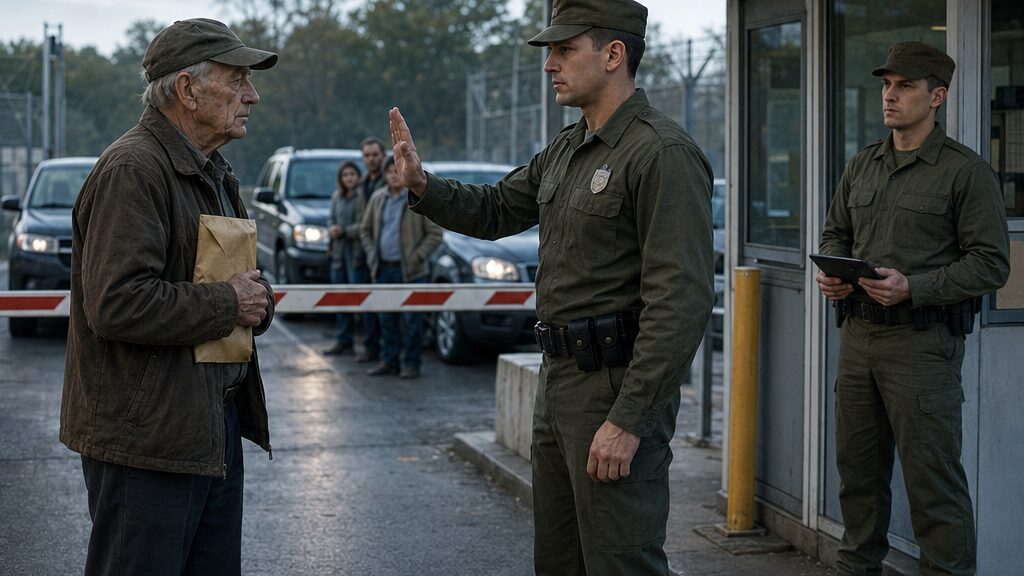
Patrick Walker had been standing at the barrier gate for twenty-three minutes when the young sergeant told him, for the third time, that he needed to leave.
The white-and-red arm of the gate stayed lowered between them. Beyond it, the road curved into the military installation, past clipped grass, a row of brick administration buildings, and a flag moving gently in the morning wind. Cars rolled in through the next lane, slowing just long enough for badges to flash against the glass. Drivers nodded, guards waved them through, and the gate rose with a clean mechanical hum.
Patrick stood beside the visitor lane with both hands folded over a worn manila envelope.
The envelope had been handled so many times that the corners were soft and the flap had darkened where his thumb usually rested. A strip of old tape held one side together. His name was written on the front in careful block letters, though not by him.
The sergeant looked at the envelope as though it were something that had fallen from a drawer no one had opened in years.
“Sir,” he said, keeping his voice low but firm, “this is an active installation. You can’t stand here blocking the visitor lane.”
Patrick was not blocking it. He had moved twice already, each time when asked, until his shoes were nearly touching the painted yellow line near the curb. He looked down at the line, then back at the sergeant.
“I have an appointment with the archive office.”
“You said that.”
“At ten.”
“It’s after ten.”
Patrick glanced at the watch on his left wrist. The leather strap was cracked, and the face had a small scratch across the six. “I know.”
The sergeant’s jaw worked once. His name strip read Miller. He was clean-shaven, squared away, and too young to have learned how long a minute could feel to an old man with a reason to wait.
“Do you have a current visitor pass?”
“No.”
“Do you have an escort coming to the gate?”
“I was told to check in here.”
“By who?”
Patrick lifted the envelope slightly. “The letter is inside.”
The sergeant exhaled through his nose. Not a sigh exactly, but close enough. Behind him, another young man stood near the checkpoint booth, holding a tablet against his chest. He had been watching more than speaking. His name strip read Anderson.
“Mr. Walker,” Sergeant Miller said, “I looked at what you showed me. That letter is not a pass. It doesn’t have today’s date printed on it. It doesn’t have a scannable code. It doesn’t have an escort name I can verify.”
“It has the office.”
“It has an office that changed names years ago.”
Patrick nodded once, as though that was not new information.
A pickup truck pulled into the lane behind him. The driver leaned out, saw the delay, then looked toward the other gate. The guard there waved him over.
Miller’s eyes followed the truck, then came back to Patrick.
“You see what I mean?” he said. “This creates a problem.”
Patrick heard the words without changing his face. He had been called a problem in softer language before. In hospitals. At service counters. At the veterans’ office when a printer stopped working and the clerk told him to come back another day. People did not always mean harm. Sometimes they were just tired, and old men became one more thing in the way.
He tightened his fingers around the envelope, careful not to bend it.
“I came by bus,” he said.
Miller blinked. “Sir?”
“The first one was late. Then the transfer broke down on Pine Street. I walked from there.”
“That’s not what I’m asking.”
“No,” Patrick said. “But it is why I missed ten.”
For the first time, Anderson looked away from his tablet.
Miller glanced toward the booth, toward the traffic camera, toward the waiting road beyond the gate. “I understand that may be frustrating. But it doesn’t change procedure.”
Patrick looked past him.
The base had changed since the last time he had been allowed beyond that gate. The old wooden sign was gone. The guard shack had glass walls now. The road had been widened. The row of sycamores near the administration building had been cut down and replaced by young trees still tied to support posts.
But the wind smelled the same: cut grass, hot asphalt, distant fuel, and the faint metal scent that seemed to live on every post where soldiers came and went.
He remembered walking through a different gate in a different body, boots new enough to bite, duffel strap cutting into his shoulder. He remembered laughter behind him, fear inside him, and a voice beside him saying, “Don’t look so serious, Walker. They can smell it.”
Patrick lowered his eyes.
Miller shifted his weight. “Do you have someone I can call?”
“Yes.”
“Who?”
“The archive office.”
“I already told you, I can’t let you through based on an old letter.”
“Then call them.”
“I don’t have time to track down an office because you brought paperwork from—” Miller stopped himself. His eyes flicked to Anderson, then back. “From a long time ago.”
Patrick did not rescue him from the sentence.
A woman in a sedan slowed beside the gate and watched through her passenger window. Two maintenance workers crossed near the curb and paused just long enough to take in the scene: the old man, the envelope, the sergeant standing squarely in front of him. Patrick felt their glances settle on the back of his neck. He had known heavier things than strangers looking, but it still took effort not to turn away.
Miller stepped closer, lowering his voice.
“Sir, I’m trying to be respectful.”
“I believe you.”
“Then please respect what I’m telling you. You can’t wait here all morning. If you don’t have valid access, you need to return when someone can sponsor you properly.”
Patrick looked at the lowered gate arm. A small streak of old paint had chipped near its end. The chip looked like a pale scar.
“I returned last Thursday,” he said.
Miller’s expression tightened.
“And Monday before that. A woman at the visitor center told me the archive office was moving boxes and I should come today. Before that, the phones weren’t being answered. Before that, the letter came back with a yellow sticker saying forwarding expired.”
“You’ve been here multiple times?”
“Yes.”
“And no one told you how to request access online?”
Patrick gave the faintest smile, not because anything was funny, but because the young man looked genuinely surprised that the world might not have arranged itself around his screen.
“They did.”
“And?”
“I don’t own a computer.”
Miller looked down at the envelope again, then away. His patience was thinning now, not cruelly but visibly. It was in the straightening of his back, the clipped rhythm of his breathing, the way his eyes stopped seeing Patrick and began seeing a task that would not resolve.
“Mr. Walker, I can’t make an exception because of that.”
Patrick nodded. “I did not ask for an exception.”
“What are you asking for?”
“One call.”
“To an office I can’t verify from that paper.”
Patrick slid one thumb under the edge of the envelope flap. He did not open it. Not yet. He had promised himself he would not open it at a gate, under a camera, beside idling cars and impatient eyes. Some things deserved a table, a chair, and quiet.
He pressed the flap closed again.
Miller noticed the movement. “What’s in there?”
“A letter.”
“You said that.”
“Not the appointment letter.”
Miller waited.
Patrick looked toward the administration buildings. “Something that belongs here.”
The words changed the air between them, but only slightly. Enough for Anderson to step closer to the doorway of the booth. Enough for Miller’s brow to crease before authority smoothed it back down.
“Sir,” Miller said, “that doesn’t help me.”
“No.”
“Then I need you to step away from the checkpoint.”
Patrick looked at him for a long moment.
In another season of his life, he might have argued. In another body, with a stronger voice and quicker legs, he might have let anger rise. Not because the sergeant was young. Not because the gate was closed. But because every delay seemed to take a little more time from a promise already running out of it.
But Patrick had learned that anger spent strength too quickly.
He stepped back from the painted line.
Miller relaxed, just barely.
Patrick moved to the low concrete bench beside the visitor shelter. It sat under a narrow roof that gave more shade to the wall than to anyone sitting beneath it. He lowered himself carefully, one hand on his knee, the other still holding the envelope.
Miller watched him sit.
“Sir,” he said, “waiting there won’t change the answer.”
Patrick placed the envelope across his lap, smoothing one bent corner with his thumb.
“I know.”
“Then why stay?”
Patrick looked through the gate, toward the road that led deeper into the base.
“Because I told him I would come back.”
Miller’s face changed, but not enough to become understanding.
“Told who?”
Patrick did not answer.
The wind moved the flag again. Somewhere beyond the gate, a truck reversed with three sharp beeps. Anderson stood in the checkpoint doorway, tablet forgotten at his side.
Patrick sat straight on the concrete bench, old shoes planted together, envelope resting across both knees.
Miller waited for a moment longer, then turned away.
The gate rose for another car. It lowered again.
Patrick remained where he was.
Chapter 2: Procedure and Assumptions
Nicholas Miller had been trained to notice things that did not belong.
An unattended bag near a curb. A driver avoiding eye contact. A badge held too low or too quickly. A visitor who gave too much information. A visitor who gave too little. A vehicle drifting across painted lines. A hesitation before answering a simple question.
The old man at the bench did not fit any category neatly, and that was what irritated Nicholas most.
He was not threatening. He was not loud. He was not drunk, confused in the obvious way, or trying to slip through. He had no vehicle to search, no expired base sticker, no angry spouse in the passenger seat demanding an exception. He only sat there with that envelope across his knees, as if patience were a form of paperwork.
Nicholas stood inside the checkpoint office and watched him through the glass.
“Want me to ask the duty desk again?” Brian Anderson asked.
Nicholas turned. “No.”
Brian held the tablet in both hands. He was newer, careful in the way new people were careful, wanting to be useful without being wrong.
“You sure?”
“I’m sure.”
Nicholas took the visitor log from the counter and turned it toward himself. Patrick Walker’s signature sat on the top line for the day. The handwriting was slow but steady, each letter formed with old-fashioned care.
Below it were two blank spaces.
Nicholas tapped the page. “He’s signed in before.”
Brian leaned closer. “Today?”
“No. I mean last week.” Nicholas flipped back. “And Monday.”
Brian said nothing.
Nicholas found the earlier entry. Patrick Walker. The same careful handwriting, though the W had been slightly uneven that day. Reason for visit: Archive office.
He flipped again. There it was on another page. Patrick Walker. Archive office. Same hand, same purpose.
Nicholas felt a small, unwelcome pinch of doubt. He pushed it aside. Repetition did not make bad paperwork valid.
“He’s persistent,” Brian said.
“That’s one word.”
“What’s the other?”
Nicholas closed the log. “Potential problem.”
Brian looked out the window at Patrick. “He doesn’t seem like one.”
“That’s not how problems work.”
The radio crackled. A delivery vehicle requested clearance at the service lane. Nicholas answered, checked the manifest, waved it through, then returned to the counter where Patrick’s envelope lay in his mind like an object he could still see even when it was outside.
When the old man had first arrived, Nicholas had asked for identification. Patrick had produced a state ID, a veterans health card, and the envelope. The ID was current. The veterans card meant nothing for base access. The envelope contained an appointment letter printed on office stationery that looked legitimate only if one ignored the date, the outdated letterhead, and the missing barcode.
The letter had referred to a memorial archive review. It had included the phrase personal effects and correspondence. It had not included enough information to move Patrick past the gate.
Nicholas had seen people try all kinds of things. Old orders. Retired IDs that no longer scanned. Photocopies. Yellowed invitations. Stories about knowing someone inside. Most were harmless. Some were not. The rule existed because appearance was not proof.
Still, Patrick’s face stayed with him.
Not pleading. Not offended. Just waiting.
Nicholas rubbed at the bridge of his nose.
“Bring him in,” he said.
Brian looked up. “Into the office?”
“Out of the sun. I’ll go through it one more time.”
Brian moved quickly, as though grateful for something to do.
A minute later, Patrick stepped into the checkpoint office with his envelope held against his chest. The room was cool from air-conditioning. It smelled of printer toner, coffee, and the rubber mat beneath the counter. There were three chairs against one wall, a bulletin board with security notices, and a framed reminder that all visitors must present valid authorization.
Patrick removed his cap, though no one had asked him to. His hair was thin and silver, combed back carefully.
Nicholas stood behind the counter. “You can sit.”
“Thank you.” Patrick sat in the nearest chair, but he did not lean back.
Brian stayed near the door.
Nicholas opened a blank incident note on the computer. “I need to clarify a few things.”
Patrick nodded.
“You said you have an appointment at ten with the archive office.”
“Yes.”
“Who specifically?”
Patrick hesitated. “The letter did not name a person.”
“That’s an issue.”
“I understand.”
“Who sent it?”
Patrick opened the envelope slowly and removed the first sheet. He placed it on the counter with both hands, turning it so Nicholas could read it.
The paper had been folded in thirds. The creases were soft from use. Nicholas scanned it again.
Dear Mr. Walker,
In response to your inquiry regarding the Anderson Field Memorial Archive project, we invite you to bring any original correspondence, personal notes, or surviving materials related to service members formerly assigned to this installation…
Nicholas stopped.
Anderson Field. That had been the old name of the installation before it was consolidated and renamed. He knew that much because the base history display in the administration lobby had a faded photograph of the original sign.
The date on the letter was nearly six years old.
“You received this six years ago?” Nicholas asked.
Patrick looked down at his hands. “Yes.”
“And you’re coming now?”
“Yes.”
Nicholas set the letter flat on the counter. He kept his voice even, but impatience had already entered it. “Mr. Walker, this is exactly the problem. An invitation from six years ago is not an active appointment.”
“It was not possible then.”
“Why?”
Patrick’s fingers rested on the envelope. For a moment Nicholas thought he would answer. Instead, the old man only said, “It became possible now.”
Nicholas glanced at Brian. Brian was watching Patrick, not the letter.
“That’s not enough,” Nicholas said.
“No,” Patrick agreed.
The agreement made Nicholas feel strangely cornered. It was easier when people argued. Procedure was built for resistance. Calm acceptance left no clean place to put frustration.
“What else is in the envelope?” Nicholas asked.
Patrick did not move.
“If it relates to your visit, I need to know.”
“It relates.”
“Then show me.”
Patrick’s thumb moved once along the envelope flap. “I would rather show the archive office.”
Nicholas straightened. “Sir, you can’t use mystery as authorization.”
Brian shifted near the door.
Patrick looked up. His eyes were pale, steady, and more tired than Nicholas had noticed outside.
“I am not trying to make your morning difficult, Sergeant.”
Nicholas felt heat rise beneath his collar. “I didn’t say you were.”
“No.”
“But I have a line of responsibility here. I don’t know you. I don’t know what you’re carrying. I don’t know whether this is a misunderstanding, a memory issue, or something else. What I do know is that I can’t let an unsponsored visitor through because he brings an old envelope and says it belongs here.”
The words landed harder than he intended.
Patrick lowered his eyes to the envelope.
For several seconds, no one spoke.
Outside, the gate rose and lowered. A car engine passed with a low vibration through the wall.
Then Patrick lifted the envelope, turned it over, and slid one finger beneath the flap. He opened it just wide enough to remove a smaller inner envelope, browned with age and sealed along the edge with brittle tape.
Nicholas stared despite himself.
Across the front, in faded ink, were three words:
For Ruth King.
Underneath was another line.
If I do not return.
Patrick set it on the counter and kept two fingers lightly on top of it, as though preventing even the air from taking it.
Nicholas did not reach for it.
Brian stepped closer.
“That,” Patrick said quietly, “is why I came.”
Nicholas read the words again.
For Ruth King.
If I do not return.
The office seemed smaller than before.
Nicholas cleared his throat. “Who wrote that?”
Patrick’s hand stayed on the old paper. “A soldier who trusted me.”
“When?”
“A long time ago.”
“Is he connected to this base?”
Patrick nodded once.
Nicholas looked toward the computer. The rules had not changed. The gate was still the gate. The old letter was still invalid. But the envelope on the counter had shifted the shape of the morning. It was no longer only an old man with bad paperwork.
It was a sealed message from someone who had not come home.
Brian moved to the second workstation. “Sergeant.”
Nicholas looked over.
Brian had opened the old installation directory search, the one used when visitors referenced former units, decommissioned offices, or archived records. His face had gone still.
“What?” Nicholas asked.
Brian turned the screen slightly.
A search result glowed beneath the outdated base name.
Anderson Field Memorial Archive — legacy personnel correspondence index.
Below it was a list of surnames.
Walker appeared once.
King appeared twice.
And between them, in a line of gray text, was a name Nicholas did not recognize, tagged with a note that made Brian’s voice drop before he read it aloud.
“Unresolved personal effects transfer.”
Patrick closed his eyes for just a moment.
Nicholas looked from the screen to the envelope under Patrick’s fingers.
Outside, another car pulled to the gate and waited.
No one moved to raise it.
Chapter 3: The Name No One Expected
Brian Anderson had always believed rules were strongest when they kept emotion out.
That was what he told himself when the man in the contractor van complained about being late. It was what he remembered when visitors forgot their IDs, when spouses cried at the gate because a ceremony had already started, when retired personnel became angry that the card they had carried for years no longer opened every door.
The gate did not care what people felt. The list was the list. Access was access. Brian liked that clarity.
But clarity had begun to blur around Patrick Walker.
He sat at the second workstation while Sergeant Miller stood behind him, arms folded, watching the screen as if it might embarrass him by showing too much.
Patrick remained in the chair by the counter. The old inner envelope had gone back inside the manila one, but Brian could still see its shape pressing faintly through the paper. For Ruth King. If I do not return.
Brian typed slowly, careful not to misspell anything.
“Search Walker again,” Nicholas said.
“I did.”
“Full name?”
“Patrick Walker. Nothing in current access. Veteran status verified through state ID match, but that doesn’t grant entry.”
“I know that.”
Brian clicked into the legacy personnel correspondence index. The system loaded slowly, each page seeming to resent being disturbed. It was not part of the daily workflow. Most people in the checkpoint office forgot it existed until someone appeared with a document from a time before the current badge system.
A list opened.
Patrick Walker appeared under an old unit support roster. No rank displayed on the first line. No dramatic title. No decoration marker. Just a name, service dates, and a linked note.
Brian clicked the note.
Legacy archive request pending. Personal correspondence related to deceased service member transferred to memorial review, incomplete.
Nicholas leaned closer. “What does incomplete mean?”
Brian shook his head. “Could be missing paperwork. Could be missing recipient information.”
“Call the archive.”
“I need an internal contact.”
“Find one.”
Brian searched the directory. Several office names appeared, most crossed with redirects. Records Management. Historical Files. Memorial Review. Archive Support. Finally, one current listing appeared.
Base Archives and Memorial Collections.
A phone number.
Brian looked at Nicholas.
Nicholas nodded once.
Brian dialed.
While the phone rang, he glanced toward Patrick. The old man sat with his cap in his lap now. Without it, he looked smaller, but not weaker. More exposed, maybe. His hands rested on the envelope as if the paper had weight beyond paper.
The call clicked.
“Archive office,” a woman’s voice said.
Brian straightened. “This is the main gate checkpoint. I’m calling about a visitor requesting access to your office. Patrick Walker.”
There was a pause.
“Patrick Walker?” the woman repeated.
“Yes, ma’am.”
Another pause, longer this time. Brian looked at Nicholas, who frowned slightly.
“Is he there now?” the woman asked.
“Yes, ma’am.”
“Is he alone?”
Brian looked toward Patrick. “Yes.”
“Please don’t send him away.”
The sentence was quiet, but it changed the room.
Nicholas unfolded his arms.
Brian lowered the phone slightly, then lifted it again. “Ma’am, he doesn’t have current access authorization.”
“I understand. We’ve been trying to reach him through the address on file. The mail kept coming back.”
Patrick’s face did not move, but his fingers tightened around the cap.
Nicholas stepped closer to the phone. “This is Sergeant Miller. Who am I speaking with?”
“Laura Thomas, base archivist.”
“Ms. Thomas, we have an elderly visitor with an outdated invitation letter and sealed personal correspondence. I can’t clear him without sponsorship.”
“I’ll sponsor him.”
Nicholas paused. “You understand he’s at the gate now?”
“Yes. I’m leaving my office.”
“Ma’am, before you come down, I need to know whether his material is connected to an active archive case.”
“It is.”
Nicholas’s tone remained formal. “Can you confirm the case?”
Brian watched Patrick look toward the window. Outside, traffic continued moving in the other lane. Life had resumed around them, unaware that a name in an old index had made a woman in the archive office leave her desk.
Laura Thomas answered carefully.
“The case concerns personal correspondence associated with a deceased soldier formerly assigned to Anderson Field. The archive review was opened years ago and never completed because we could not verify the surviving recipient.”
Nicholas glanced at the manila envelope.
“Recipient being Ruth King?” he asked.
This time, Patrick looked up.
The phone line went quiet.
Then Laura said, “Where did you see that name?”
Nicholas did not answer immediately.
Brian felt a chill move along his arms.
“On an envelope Mr. Walker brought,” Nicholas said.
“Is it opened?”
“No.”
“Please keep it that way.”
Patrick’s head lowered slightly.
Nicholas looked at him, and for the first time since morning, his expression lost its sharpness.
Laura continued, “Sergeant, I need you to understand something. If that envelope is what I think it is, Mr. Walker may be carrying the only surviving original correspondence in that case.”
Brian looked at the visitor log beside the keyboard. Patrick’s name on three different days. Each time written carefully. Each time stopped at the same gate.
Nicholas said, “Why wasn’t he given access before?”
“I can’t speak for every attempt,” Laura said. “But the archive moved twice. The project was suspended, restarted, and folded into another office. Some families were never located. Some veterans who contacted us passed away before we could complete review.”
The words settled heavily.
Passed away before we could complete review.
Brian looked at Patrick again and suddenly understood something he had missed. The old man had not been patient because he had endless time. He had been patient because impatience would not give him more of it.
Nicholas took the phone from Brian. “How long until you reach the gate?”
“Ten minutes.”
“I’ll hold him here.”
“Thank you.”
Nicholas ended the call.
For a few seconds, the checkpoint office had no sound except the hum of the air conditioner.
Patrick broke the silence.
“I did not want to trouble anyone.”
Nicholas turned toward him. His face colored faintly, not enough for apology, but enough for discomfort.
“You should have said more.”
Patrick looked at the envelope. “Some things were not mine to say at a gate.”
Brian understood that before Nicholas did. Or maybe Nicholas understood and did not like the feeling of it.
The sergeant placed both hands on the counter. “Mr. Walker, when Ms. Thomas arrives, she can sponsor you inside. Until then, I need the envelope to remain with you.”
Patrick nodded.
“And I need to ask—” Nicholas stopped, then adjusted his tone. “Have you been carrying it since the letter was written?”
Patrick’s thumb moved over the worn corner. “Longer.”
“How much longer?”
Patrick did not answer.
Brian thought of the words on the inner envelope. If I do not return. He imagined someone young writing them, not knowing whether the paper would matter, not knowing if the person trusted to carry it would live long enough to try.
The office door opened as a delivery driver stepped halfway in, holding a clipboard. “Where do you want me?”
Nicholas turned quickly, all procedure again. “Service lane. Wait for inspection.”
The driver glanced at Patrick, the envelope, the three faces in the room, then backed out.
Normal life kept interrupting.
Brian looked down at the legacy index again. There was one more linked field under the incomplete transfer note. It had not loaded fully before.
He clicked it.
A scanned roster appeared, low-resolution and gray. Names marched down the page in uneven type. Most meant nothing to him. But two caught his eye.
Patrick Walker.
And below it, separated by one line:
Paul King.
Brian stared.
Nicholas noticed. “What is it?”
Brian enlarged the scan. The old roster sharpened just enough.
Patrick Walker and Paul King had been assigned to the same field support detachment.
Brian read the next line under Paul’s name.
Status: deceased during overseas deployment.
He did not read it aloud.
Patrick was watching him now.
Brian felt suddenly clumsy sitting behind a government computer, uncovering in minutes what the man across from him had carried for most of a lifetime.
The phone rang again. Brian answered by habit.
“Main gate.”
“This is Laura Thomas. I’m approaching the checkpoint now.”
Through the window, Brian saw a woman walking quickly from the direction of the administration road, a folder tucked under one arm, her badge swinging against her blouse.
Patrick stood before anyone asked him to.
Not fast. Not easily. But with purpose.
Nicholas moved toward the door, then stopped and looked back at the visitor log.
Patrick Walker’s name sat there under the date, alone on the top line.
Brian could not stop seeing the earlier entries beneath it in his mind.
Returned. Denied. Returned again.
Nicholas opened the door for Laura Thomas before she reached it.
She stepped inside, slightly out of breath, and her eyes went first to the envelope, then to Patrick’s face.
“Mr. Walker,” she said softly. “I’m sorry it took us so long.”
Patrick held the envelope with both hands.
“I’m here now,” he said.
Laura looked at Nicholas. “I need to take him to the archive building.”
Nicholas nodded, but his eyes stayed on Patrick.
The gate outside rose for another vehicle, then lowered.
This time, when Patrick walked toward it, Nicholas did not stand i
Chapter 4: The Promise Inside the Envelope
Patrick had forgotten how long the road from the gate to the archive building felt when walked under someone else’s permission.
Laura Thomas moved beside him at a pace that tried to be respectful without being obvious. Sergeant Miller walked two steps behind, not escorting exactly, but not letting go of the matter either. Brian Anderson stayed at the checkpoint. Patrick had seen him through the glass as they left, standing beside the visitor log with his hand resting near the page where Patrick had written his name.
The base had grown sharper edges. New signs. New cameras. New buildings where open lots had been. Yet certain things survived. The slope in the road near the administration turn. The smell of grass after sprinklers. The distant thud of a loading dock door. The way young soldiers looked past old civilians unless given reason not to.
Patrick kept the envelope tucked against his chest.
“Do you need to stop?” Laura asked quietly.
“No, ma’am.”
“Please call me Laura.”
He nodded but did not use the name.
The archive building sat behind the old headquarters, in a low brick structure that had once held training classrooms. Patrick remembered windows there fogged with breath on cold mornings. He remembered Paul King sitting on the back row of a classroom, carving a tiny line into the side of a pencil with his thumbnail because he could never keep his hands still.
The memory came so sharply that Patrick slowed.
Laura noticed. “Mr. Walker?”
“This used to be classrooms.”
“It did,” she said. “Before my time.”
“Everything is before somebody’s time eventually.”
She did not answer, which Patrick appreciated.
Inside, the building was cool and dry. The hallway smelled faintly of cardboard, dust, and clean floor wax. Framed photographs lined one wall: units, buildings, ceremonies, rows of young faces staring out from years that had become captions.
Patrick did not look too closely. Names had a way of finding him when he was not prepared.
Laura led him into a small review room with a table, three chairs, a scanner, and a box of cotton gloves. Nicholas remained near the door until Laura looked at him.
“You don’t need to stay, Sergeant.”
“I’m responsible for the access exception.”
“And I’m taking responsibility for the visitor.”
Nicholas’s face remained controlled. “I’ll wait in the hall.”
Patrick turned before the sergeant stepped out.
“Sergeant Miller.”
Nicholas stopped.
“Thank you for bringing me this far.”
The young man seemed unsure what to do with that. “Yes, sir.”
The door closed softly.
Laura pulled out a chair. Patrick sat. His knees ached from the walk, though he would not have said so. The envelope lay on the table between them.
Laura placed a folder beside it. “I want to be careful with expectations. We have fragments of the case, not a complete file.”
“I came with a fragment.”
“That may be the one we’ve been missing.”
Patrick rested both hands on the table. The skin across his knuckles looked thin in the room’s fluorescent light. He hated that about old age, how it made the body honest before the heart was ready.
Laura opened her folder. “Paul King was assigned here before deployment. We have his unit roster, a service summary, and a note that personal effects were returned through standard channels. But there’s a separate reference to correspondence that was never transferred.”
Patrick looked at the envelope.
“He gave it to me the night before he left.”
Laura’s hand paused above the folder.
Patrick had not said the sentence aloud in years. Once released, it seemed to remain in the air between them.
“We were both waiting on transport,” he continued. “Bad weather had everything delayed. Men were sleeping on bags, writing letters, pretending they weren’t thinking too hard. Paul had already written one to Ruth. Then he wrote this.”
“The sealed envelope?”
Patrick nodded.
“He said the first letter was ordinary. The kind a man writes when he expects to come home and be teased for sounding sentimental. This one was different.”
Laura spoke gently. “Did he tell you what was inside?”
“No.”
“Never?”
“No.”
Patrick’s fingers moved toward the old manila envelope but stopped short. “He said, ‘If I come back, give it to me and we’ll burn it. If I don’t, find Ruth.’”
Laura lowered her eyes.
Patrick looked toward the small window. Beyond it, part of the base road was visible. A vehicle passed, white and silent behind the glass.
“I was twenty-two,” he said. “Twenty-two-year-old men make promises as if time will stand still just because they mean them.”
“What happened?”
Patrick swallowed once. “Paul did not come back.”
He expected Laura to ask about the deployment, the notification, the details. She did not. She waited.
“I was injured before I could return stateside with the others. By the time I got home, Ruth had moved from the address he had. Her family had moved too. I wrote. I asked. I carried it from one apartment to another, one house to another. Then my wife got sick. Then life became appointments and pill bottles and insurance forms. I told myself the envelope was safe. I told myself safe was the same as done.”
His voice stayed even, but the last word cost him.
Laura’s eyes softened. “And then the archive project contacted you.”
“Years ago.” Patrick tapped the outer envelope. “I thought maybe the base could locate the family. Then my wife fell again. After she passed, I found this in the bottom drawer, wrapped in an undershirt. I had put it there so carefully I nearly forgot where careful was.”
Laura sat still.
Patrick looked at the flap. “I do not know if Ruth King is alive.”
“We don’t know yet.”
“No.”
“But we can try.”
He nodded.
Laura put on cotton gloves, then hesitated. “May I see the outer documents first?”
Patrick removed the appointment letter, then a photocopy of an old unit roster he had kept, then a small note in his own handwriting with addresses crossed out and rewritten. Last came the inner envelope.
He did not hand it over immediately.
The old paper seemed impossibly fragile now that it was lying under archive light. Faded ink. Brittle tape. Paul’s hand across the front, still young.
For Ruth King.
If I do not return.
Patrick had carried those words through jobs, houses, funerals, and winters when his fingers hurt too much to button his coat. He had been angry at the envelope. Ashamed of it. Protective of it. Once, after his wife’s diagnosis, he had nearly mailed it to an old address just to be free of it. He had stood at a blue mailbox for ten minutes before walking home with the envelope inside his jacket.
Laura did not reach across the table.
“It has waited a long time,” she said. “It can wait another minute.”
Patrick looked at her then.
That was when he knew she understood something Sergeant Miller had not. The envelope was not evidence. It was not a key. It was not proof of Patrick’s right to enter a building.
It was a promise with paper around it.
He slid it toward her.
Laura examined the front without opening it. She checked the edges, the seal, the aging of the adhesive. Then she looked up.
“I would prefer not to open this until we know whether Ruth King or a direct family representative can be present.”
Patrick let out a breath he had not realized he was holding.
“Thank you.”
“But I need to document that it exists. I’ll scan the exterior. No opening.”
Patrick nodded.
Laura placed the envelope carefully on the scanner bed. The machine’s light moved beneath the glass with a soft mechanical sweep. Patrick watched it pass under Paul’s name.
When the scan finished, Laura returned the envelope to him immediately.
Then she opened the archive file.
“There is something I need to show you.”
She turned a page toward him. It was a digitized transfer log, printed and marked with yellow notes. Patrick leaned close.
Paul King. Personal effects processed. Standard notice complete. Additional correspondence referenced.
Under that, a blank field.
Recipient confirmation: missing.
Laura pointed to another notation. “This suggests someone attempted to locate Ruth King through the original address. No confirmation was entered. The archive project flagged it again years later, which is why you were contacted.”
Patrick read the words slowly.
Missing.
No confirmation.
Flagged.
Words that made failure sound tidy.
Laura turned another page.
“This is the part I don’t understand.”
Patrick looked.
The final correspondence line had been marked with an item number, but no item was attached to the archive file. Instead, there was a handwritten notation scanned into the margin:
Held by Walker pending delivery.
Patrick stared at it.
Laura spoke softly. “Someone knew you had it.”
Patrick’s mouth went dry.
“Who wrote that?”
“We don’t know. The initials are unclear.”
Patrick leaned closer, but the letters in the margin swam slightly before his eyes. He saw a mark that might have been a P, or an R, or nothing more than a clerk’s hurried hand.
Laura continued, “There should be a companion note explaining why the item stayed with you. That note is missing.”
Patrick sat back.
For decades, he had believed the promise existed only between himself, Paul, and God. Now a mark in an archive said otherwise. Someone, somewhere, had known. Someone had written it down. Someone had left the rest blank.
Laura closed the folder halfway.
“I need to search the vault records,” she said. “If the companion note exists, it may tell us whether Ruth was ever located.”
Patrick placed his palm over the envelope.
“And if it does not exist?”
Laura did not soften the answer.
“Then we start from what we have.”
Outside the door, a footstep shifted in the hallway. Sergeant Miller, still waiting.
Patrick looked toward the sound, then back at the old envelope.
He had come to deliver a letter.
Now the base itself seemed to be holding back one more piece of the promise.
Chapter 5: What the Records Never Said
Laura Thomas had learned that old records rarely vanished all at once.
They shed pieces.
A form separated from a folder. A box relabeled during a move. A clerk retired with a memory no one thought to write down. A temporary note became permanent by accident. A permanent file disappeared because someone set it on the wrong cart before lunch.
People imagined archives as places where the past rested in order. Laura knew better. Archives were places where the past survived by stubbornness, luck, and the patience of whoever came looking.
Patrick Walker sat in the review room while she unlocked the vault.
Sergeant Miller had remained in the hallway for several minutes, then asked if he should return to the gate. His voice had been different by then, quieter, stripped of the edge that had shaped the morning. Laura told him she would call if she needed anything. He left with a formal nod to Patrick, who returned it without triumph.
That lack of triumph stayed with Laura as she entered the vault.
Patrick had every reason to be angry. He had been made to stand at a gate with a letter he did not know how to make modern. He had been asked to explain a promise in front of men young enough to be his grandsons. He had walked through a base that owed him at least patience and had offered procedure first.
Yet his first words to the sergeant after access was granted had been thank you.
Laura pulled the rolling ladder toward the legacy correspondence shelves.
The vault lights clicked on row by row. Gray archival boxes sat in long ranks, marked with dates, unit numbers, and transfer codes. The air was kept cool enough that she had learned to leave a cardigan over her chair. Somewhere behind her, a dehumidifier hummed with steady effort.
She found the section marked Anderson Field Memorial Archive, suspended cases, unresolved recipient transfer. The box she needed was on the third shelf.
It was heavier than expected.
Laura carried it to the worktable and lifted the lid. Inside were folders arranged by surname. King had two folders. Walker had one thin file. The transfer log had suggested a companion note, but not where it belonged.
She began with King.
The first folder held standard service records and copies of casualty notification paperwork. Paul King had been twenty-four. Born in Ohio. Married less than a year. Assigned to Anderson Field before deployment. The photograph clipped to the inside showed a young man with narrow shoulders and a grin that looked too quick for the stillness of the camera.
Laura studied the photograph longer than she usually allowed herself.
Records had a way of reducing people to categories. Date. Unit. Status. Recipient. Disposition. But the grin remained outside all categories. It seemed almost rude in its aliveness.
She turned the page.
Ruth King appeared in the file as next of kin. Several addresses had been entered, each crossed through or updated. The last confirmed address was decades old. A later note suggested returned mail. Another mentioned possible relocation after remarriage, but no supporting document followed.
Laura opened the second King folder.
This one had been created during the memorial archive project. It contained printed emails, phone logs, and research notes. Many were incomplete. A staff member years earlier had searched public records, veterans’ family networks, and obituary notices. Ruth had not been confirmed deceased, but she had not been located either.
Laura found a sticky note attached to one page, its adhesive long dead and held in place by the folder crease.
Check community center veterans luncheon? Possible R. King attending under married name? Not verified.
Laura sat back.
Community center.
No city listed on the note’s first line, but the phone log beneath it showed an area code. Local. Not far.
She set that aside and opened the Walker folder.
It was thin because Patrick had never been the subject of the archive case. He had been a reference, a holder of something wanted by the file. A photocopy of his inquiry letter sat inside. His handwriting matched the visitor log: careful, deliberate, slightly compressed as if each word had been asked not to take up too much room.
Dear Memorial Archive Office,
I received notice through the veterans mailing list that you are collecting correspondence from former Anderson Field personnel. I have in my possession a sealed letter entrusted to me by Paul King before deployment. I am seeking help locating Mrs. Ruth King or appropriate family. I have not opened the letter.
Laura read the final sentence twice.
I have not opened the letter.
A lesser man might have opened it years ago, out of curiosity, grief, or desperation to know whether the promise still mattered. Patrick had not. That restraint said more about him than any service summary could.
At the bottom of the folder was a half-sheet of old copy paper.
Laura lifted it carefully.
The handwriting in the margin matched the notation from the transfer log.
Held by Walker pending delivery.
Below it, in smaller writing:
Walker declined archive custody unless recipient found. States promise was personal, not institutional.
Laura felt a tightening in her throat.
There it was. Not the missing note, perhaps, but enough to reveal the shape of the decision. Patrick had not failed to hand over the letter. He had refused to let it become an artifact before it had the chance to be a message.
She kept reading.
If recipient located, contact Walker. If Walker unreachable, document existence. Do not open without next-of-kin authorization.
The note was unsigned except for two initials Laura could not identify.
She brought the paper back to the review room.
Patrick was sitting exactly where she had left him. The envelope remained before him. His cap sat beside it. He looked up when she entered, and for a moment Laura saw the effort it took him not to ask too quickly.
“I found a note,” she said.
His shoulders moved, barely.
She placed it in front of him.
He read slowly. His eyes stopped on the sentence about archive custody. His mouth tightened. Not in anger. In recognition.
“I said that?”
“It appears so.”
Patrick touched the edge of the copy, not the writing. “I remember a man at a desk. I do not remember his name. He wanted me to leave it here.”
“You declined.”
“I was afraid it would be filed away.”
“It might have been.”
He looked at the envelope. “Paul did not ask me to preserve it. He asked me to deliver it.”
Laura sat across from him. “There’s another lead.”
Patrick looked up.
“A note from the project suggests Ruth may have attended a veterans luncheon at a community center. It was never verified.”
“How old is the note?”
“Several years.”
“Several years,” Patrick repeated.
Laura understood what he heard in that. More time lost. More doors closing.
“I can call now,” she said.
Patrick nodded once.
The phone number on the old note had changed, but the community center still existed. Laura found the current number through the base directory’s public outreach list and dialed from the review room phone. Patrick watched silently, hands folded.
A receptionist answered.
Laura explained only what was necessary. She asked about veterans luncheons, records, attendance lists, whether a Ruth King had ever been connected with the program.
The receptionist put her on hold.
A soft instrumental version of a patriotic song played through the speaker. Patrick looked away toward the window.
Laura almost apologized for the music, though she did not know why.
The receptionist returned with an older voice beside her, perhaps a program coordinator. Laura repeated the name.
Ruth King.
There was a pause.
Then the coordinator said something Laura could not fully hear over the speaker, but she heard enough to sit straighter.
“Yes,” Laura said. “Yes, we can come there. Is she there now?”
Patrick’s hands gripped each other.
Laura looked at him as she listened.
“No, I understand,” she said. “Tomorrow morning. Thank you. Please don’t alarm her. Just tell her someone from Anderson Field Archives would like to speak with her if she’s willing.”
She hung up.
Patrick did not speak.
Laura folded her hands over the note, giving him one clean sentence.
“She’s alive.”
The room became very still.
Patrick closed his eyes.
Laura had seen people receive news of found records, corrected spellings, identified photographs. She had seen sons cry over discharge papers and daughters press fingers to signatures of fathers they barely remembered. But Patrick did not cry. His face held, not because he felt little, but because the feeling had to pass through almost sixty years before it reached the surface.
When he opened his eyes, they were wet but steady.
“Where?”
“A community center about forty minutes from here. She helps with a veterans luncheon there once a week. The coordinator says she still uses King.”
Patrick looked at the envelope.
For the first time since Laura had met him, fear broke through his composure.
“What if she does not want it?”
Laura answered honestly. “Then you will have kept your promise by offering it.”
He breathed in slowly.
“What if it hurts her?”
“It may.”
He nodded. “Paul knew that.”
Laura waited.
Patrick’s fingers moved over the flap but did not open it.
“He was always braver on paper,” he said. “In person, he joked too much when he was scared. But on paper, he could say a true thing plainly.”
Laura thought of the unopened letter, sealed through all the years Ruth had lived without it.
“Would you like me to go with you tomorrow?” she asked.
Patrick nodded before pride could stop him. “Yes.”
The answer seemed to surprise him.
Laura picked up the folder. “I’ll arrange it through outreach. You won’t need to go through the visitor lane again for this part.”
Patrick gave a faint, tired smile. “That may disappoint the sergeant.”
Laura smiled too, then let it fade.
At the doorway, she turned back. “Mr. Walker?”
“Yes?”
“Why now?”
He looked down at his hands.
“My doctor says I should stop putting difficult things after easier ones.”
Laura did not ask more.
Patrick placed the inner envelope back inside the worn manila one and smoothed the corner with his thumb, as he had done at the gate. Only now the gesture looked less like worry and more like preparation.
Ruth King had been found.
And the letter still had not been opened.
Chapter 6: The Person Who Was Waiting Too
Patrick saw Ruth King before she saw him.
She was standing near the coffee table at the community center, straightening a stack of paper napkins that did not need straightening. She was smaller than he had imagined and older than he had allowed himself to picture. Her white hair was cut neatly around her face. She wore a pale blue cardigan, dark slacks, and a name tag from the veterans luncheon program.
Ruth.
Not Mrs. King. Not next of kin. Not recipient confirmation missing.
Ruth.
Patrick stopped just inside the doorway.
Laura stood beside him, carrying the archive folder. She did not urge him forward. The room held six round tables, folded flags in glass cases along one wall, and a bulletin board crowded with photographs from pancake breakfasts, holiday drives, and memorial programs. The smell of coffee and warmed bread hung in the air.
At one table, two veterans spoke quietly over paper cups. Near the kitchen window, a volunteer arranged sandwiches on trays. Nobody knew that a sealed envelope had entered the room after waiting most of a lifetime.
Patrick pressed his thumb to the worn corner.
Laura leaned closer. “That’s her.”
“I know.”
“Are you all right?”
“No.”
Laura accepted that.
The program coordinator approached, speaking softly with Laura first, then guiding Ruth’s attention toward the doorway. Ruth turned.
Her eyes moved from Laura to Patrick, then to the envelope.
Sometimes age hides surprise because the face cannot rearrange itself quickly. Ruth’s did not. Her expression changed at once, but not into understanding. First came politeness. Then caution. Then something guarded and fragile.
Laura stepped forward. “Mrs. King? I’m Laura Thomas from Anderson Field Archives. This is Patrick Walker.”
Ruth looked at him.
Patrick removed his cap.
At the sound of his name, her hand tightened around the napkins. “Walker?”
“Yes, ma’am.”
“Patrick Walker?”
“Yes.”
The napkins bent in her hand.
For a terrible second, Patrick thought she might ask why he had waited so long. He had prepared for that question in a hundred versions and had never found an answer that did not sound like an excuse.
Instead, Ruth said, “Paul wrote about you.”
Patrick could not speak.
“He said you were too serious,” she said.
The words were so ordinary and so exact that Patrick had to look down.
Laura drew them toward a small side room off the main hall. It had a square table, four chairs, and a window facing a narrow strip of lawn. The coordinator closed the door gently, leaving them in a quiet broken only by muffled voices from the luncheon room.
Ruth sat first. Patrick lowered himself across from her. Laura took the chair at the side, placing the archive folder on the table but keeping her hands away from the envelope.
Patrick laid the manila envelope before him.
“I should have found you sooner,” he said.
Ruth watched him carefully. “Did you try?”
“Yes.”
“Then don’t begin with the part that hurts you most.”
He looked at her.
Her eyes were clear, but there was no softness wasted in them. She had carried her own years. Patrick could see that now. He had imagined her frozen as Paul had left her: young wife, waiting, unaware. But life had not stopped for her just because Paul’s had. She had aged through bills, work, winters, illnesses, other people’s advice, and rooms where his name may or may not have been welcome.
Patrick nodded once.
“He gave me this before deployment.” He removed the inner envelope and set it between them. “He said if he came back, I was to return it to him. If he did not, I was to find you.”
Ruth stared at Paul’s handwriting.
Her hand rose, then stopped.
Laura spoke gently. “Mrs. King, the archive has confirmed the correspondence reference, but the letter has never been opened. Mr. Walker declined to surrender it to the archive unless you or family could be located.”
Ruth’s eyes remained on the envelope. “All these years?”
Patrick answered. “Yes.”
“Did you read it?”
“No.”
“Not once?”
“No.”
Her mouth trembled, and she pressed it closed.
Patrick expected relief, perhaps gratitude. Instead, Ruth looked wounded in a way he had not foreseen.
“I was angry at him,” she said.
Patrick stayed still.
“Not after they came to the door. Not at first. At first I was just gone from myself. But later, I was angry. He left me with the ordinary letter. Told me he missed my biscuits, told me not to let his brother borrow his tools, told me he would be home before I knew it.” She gave a small sound that was not quite a laugh. “I hated that letter for being cheerful.”
Patrick looked at Paul’s writing.
“He wrote this one after.”
Ruth closed her eyes.
“I thought maybe he never said the true things because he didn’t know how.”
“He knew,” Patrick said. “He just needed paper.”
Ruth opened her eyes again.
Laura placed a small archival blade and gloves on the table. “You don’t have to open it now.”
Ruth looked at Patrick. “Do you want to be here?”
The question struck him harder than he expected.
“It is yours.”
“That isn’t what I asked.”
Patrick folded his hands in his lap. “I promised to bring it. I did not promise to hear it.”
Ruth studied him. “And after carrying it this long, you think you can leave before knowing whether you delivered comfort or trouble?”
Patrick’s throat tightened.
“I do not know what I deserve to know.”
Ruth looked at him for a long moment, then pushed the envelope slightly toward Laura. “Open it.”
Laura put on gloves. Her movements were careful and professional, but her face showed she understood the room did not belong to procedure. She cut the brittle tape without tearing Paul’s handwriting. The paper gave a faint dry whisper as she lifted the flap.
Inside was one folded sheet.
Laura removed it and looked to Ruth.
Ruth nodded.
Laura unfolded the letter and placed it flat between them, turning it so Ruth could read first.
Ruth did not touch the paper. Her eyes moved across the lines slowly. Patrick looked away toward the window, refusing to steal what had waited for her.
Then Ruth said, “Read it.”
Laura looked up.
Ruth’s voice was strained but steady. “Please.”
Laura began.
The letter was short. Paul had written that he was scared, though he had made jokes all day so no one would notice. He wrote that marrying Ruth had been the only brave thing he had done without being ordered. He wrote that if he did not return, he did not want her life to become a room built around his absence. He asked her to forgive him for leaving the harder words in a sealed envelope instead of saying them when he had the chance.
Laura’s voice faltered only once.
Patrick kept his eyes on the window until Ruth said his name.
“Patrick.”
He turned.
Ruth had one hand over the letter now, not touching the ink, just resting above it as if feeling warmth through air.
“He wrote about you.”
Patrick’s breath caught.
Laura looked down and read the final lines.
Walker is holding this because he keeps things better than I do. If this reaches you, it means he carried one more weight than was fair to ask. Don’t let him stand there blaming himself. He was my friend, and I trusted him.
Patrick lowered his head.
For years he had imagined Paul’s final words to Ruth as something separate from him. A private message he had no right to know. But Paul, reckless and kind even in fear, had left him inside it—not as the man who failed to deliver quickly, but as the man trusted to carry.
Ruth folded her hands together.
“I did wait,” she said, voice barely above a whisper. “Not forever. People think widows either stay frozen or forget. I did neither. I lived. But some part of me kept waiting for the true goodbye.”
Patrick looked at her. “I am sorry.”
Ruth shook her head. “No. Not for bringing it.”
“For the years.”
She looked at the letter again. “The years were going to pass anyway.”
Laura remained quiet.
Ruth wiped beneath one eye with the side of her finger. “Paul was right about one thing.”
Patrick waited.
“You do look too serious.”
It was such a small mercy that it nearly undid him.
A knock came at the door.
Laura rose and opened it slightly. The program coordinator stood outside, uncomfortable. Behind her, visible through the gap, was Sergeant Nicholas Miller in uniform.
“He says he’s from the gate,” the coordinator whispered. “He asked if Mr. Walker is here.”
Patrick saw Nicholas through the opening.
The young sergeant stood with his cap tucked under one arm, no longer behind a counter, no gate between them, no procedure to stand inside. His face held the stiffness of a man who had come somewhere without knowing whether he had the right.
Ruth looked from Nicholas to Patrick.
“Another old promise?” she asked softly.
Patrick looked at the envelope, now open at last.
“No,” he said. “This one is new.”
Chapter 7: The Gate Opens Differently
Patrick returned to the base the next morning with the empty manila envelope tucked under his arm.
It looked thinner now.
For years, the envelope had held more than paper. It had held Paul King’s last private words, Ruth King’s missing goodbye, and Patrick’s own unfinished sentence to a friend who had trusted him too young. Now the inner envelope and letter were with Ruth. Laura had made the proper copies for the archive, taken careful notes, and prepared a folder that would preserve the record without stealing the message from the person it belonged to.
Patrick had expected relief to feel lighter.
Instead, it felt quiet.
The bus dropped him near the same road as before. He walked the last stretch slowly, using his cane only when the pavement sloped near the entrance. The morning was bright, with a pale sky and a clean wind moving over the trimmed grass. Cars passed him toward the visitor lane. Nobody inside them knew his name. Nobody knew what he had delivered yesterday in a side room of a community center while coffee cooled beyond the door.
That was all right.
Patrick had never wanted the world to know. He had wanted Ruth to know.
When he reached the checkpoint, the red-and-white barrier arm was down.
For a moment, his body remembered yesterday before his mind could stop it: the waiting, the heat rising from the pavement, Sergeant Miller’s clipped voice, the feeling of being measured and found inconvenient.
Patrick stopped at the painted yellow line.
Nicholas Miller stepped out of the booth before Patrick could speak.
He was in uniform, cap on, posture straight. But there was something different in the way he approached. Less speed. Less possession of the space. He stopped on the other side of the line and did not crowd Patrick away from it.
“Mr. Walker,” he said.
“Sergeant.”
Nicholas looked at the envelope under Patrick’s arm. His eyes stayed there only a moment before returning to Patrick’s face.
“I didn’t know if you’d come back this way.”
“The bus is the same.”
Nicholas nodded. Behind the glass, Brian Anderson stood at the workstation. He looked up, saw Patrick, and came to the doorway with the visitor log in his hand.
Nicholas took one breath. “I owe you an apology.”
Patrick held still.
“I treated you like a delay instead of a person. I thought I was only following procedure, but I made assumptions I didn’t have the right to make.”
A car rolled into the lane behind Patrick. Nicholas lifted one hand to signal the driver to hold. Not impatiently. Not as if Patrick were the problem. Simply because this moment had room.
Patrick looked at the young sergeant.
“You had a job to do.”
“I did,” Nicholas said. “That doesn’t excuse how I did it.”
Patrick shifted the envelope under his arm. “No.”
The word landed plainly. Nicholas accepted it.
Brian came out with the visitor log and placed it on the small counter near the lane. “Ms. Thomas called ahead,” he said. “She put you on the archive access list for today, sir.”
Patrick looked at him. “Thank you.”
Brian opened the log to the fresh page. At the top, in the first blank line, his own handwriting had already printed the date. Below it waited an empty signature space.
Yesterday, Patrick’s name had looked like a question in that book.
Today, the pen lay ready beside it.
Nicholas stepped aside. “Whenever you’re ready.”
Patrick picked up the pen.
His hand paused above the page.
He thought of the first time he had signed something at Anderson Field, a young man with stiff boots and too much fear hidden under a regulation haircut. He thought of Paul King leaning over a barracks table, writing Ruth’s name on an envelope while pretending the words did not cost him anything. He thought of Ruth’s hand hovering over the letter, afraid to touch it after waiting so long. He thought of Laura Thomas placing the archive copy into a folder as carefully as if paper could bruise.
Then he signed.
Patrick Walker.
The letters came out slower than he meant them to, but steady.
Brian looked at the signature, then at Patrick. “I saw your earlier entries,” he said.
Patrick closed the log gently. “I made a few.”
“Yes, sir.”
Brian seemed to want to say more. He did not. Patrick appreciated that.
Nicholas held out a temporary visitor badge. “This will get you to the archive building and back. Ms. Thomas is expecting you.”
Patrick accepted it.
The badge felt light compared with the envelope.
Nicholas glanced toward the barrier, then back at Patrick. “Yesterday, after I left the community center, I checked the log from last week.”
Patrick waited.
“You came three times.”
“Yes.”
“I was on shift two of those days. I didn’t remember you.”
Patrick looked at him with no accusation in his face. “Most people did not.”
Nicholas’s throat moved.
The driver behind them waited without honking. Through the windshield, the person looked curious but not angry. Life had softened for one minute, or perhaps Nicholas had made room for it to do so.
“I’ll remember now,” Nicholas said.
Patrick placed the visitor badge in his shirt pocket. “Remember the next person before you know why.”
Nicholas did not answer immediately.
Then he said, “Yes, sir.”
Patrick looked toward the road beyond the gate.
The base still belonged to the young. It should, in many ways. Young shoulders carried present duties. Young feet crossed the pavement with urgency. Young voices answered radios and gave directions. But the place did not belong only to them. Under the new buildings and renamed offices, beneath fresh paint and updated systems, old promises remained. Some had been kept. Some had been buried. Some waited in drawers, boxes, envelopes, and men.
Nicholas turned and pressed the gate control.
The barrier arm rose.
Not dramatically. Not with music. Just the familiar hum of a machine doing what it had always done.
Patrick stepped forward.
This time, no one asked him to move aside.
He walked through the visitor lane slowly, past the booth, past the camera, past the yellow line where he had stood the morning before. Brian remained by the log. Nicholas stood at the edge of the lane, not saluting, not performing respect for anyone watching, only standing still enough to show he understood that an old man’s pace did not make him lost.
Halfway through the gate, Patrick stopped and turned back.
“Sergeant Miller.”
“Yes, sir?”
“Paul used to say I looked too serious.”
Nicholas blinked, caught by the unexpectedness of it.
Patrick’s mouth curved faintly. “He was usually right.”
For the first time, Nicholas smiled without embarrassment.
Patrick continued along the road toward the archive building.
The manila envelope under his arm moved lightly against his side. It no longer carried the sealed letter, but he had not thrown it away. Laura had asked whether he wanted it preserved with the archive file. Ruth had touched its worn edge and said it had traveled farther than most people ever would. Patrick had told them he wanted to keep it one more day.
He did not know yet what he would do with it.
Maybe he would leave it with Laura after the final paperwork was complete. Maybe he would take it home and place it in the drawer where it had waited so long, empty now, not hidden. Maybe he would write Paul King’s name on a clean sheet of paper and place it inside, not because the archive needed it, but because Patrick did.
At the archive building, Laura Thomas waited near the entrance with a folder against her chest.
“She called this morning,” Laura said when he reached her.
“Ruth?”
Laura nodded. “She wanted me to tell you she slept.”
Patrick looked down.
It was such a small report. No grand healing. No erasing of years. Just sleep, after a letter had finally said what silence could not.
“That is good,” he said.
“She also asked whether you’d come to next week’s luncheon.”
Patrick considered the road behind him, the gate in the distance, the booth where Nicholas and Brian were returning to work.
“I might.”
Laura smiled. “That sounds like a yes trying not to be one.”
Patrick looked at her. “Paul said I was serious. Not easy.”
“No one said easy.”
Inside the archive room, Laura had prepared a place at the table. The copy of Paul’s letter lay in a protective sleeve. Ruth had agreed that the archive could keep the copy, not the original. Beside it was the note Laura had found in the Walker file, the one that said Patrick had declined archive custody unless the recipient was found.
Patrick sat and read the note again.
States promise was personal, not institutional.
He did not remember saying those exact words. Perhaps the clerk had improved them. Perhaps young Patrick, still angry and grieving, had somehow found the sentence cleanly. Either way, it was true.
Laura handed him a pen. “There’s one final acknowledgment. It records that the correspondence was delivered to Ruth King in person.”
Patrick took the pen.
The form did not ask what it had cost. It did not ask how many times he had failed, how many years he had carried it, how many mornings he had looked at the envelope and chosen not to open it. It only made room for completion.
Delivered to recipient.
Patrick signed beneath it.
His hand trembled at the end of his name, leaving the final r slightly uneven.
Laura did not comment.
When the paperwork was finished, Patrick slid the empty manila envelope across the table.
“I think it belongs here now.”
Laura looked at it. “Are you sure?”
“No.” He rested his hand on top of it once. “But I think Paul would like knowing it made it back.”
Laura accepted the envelope with both hands.
Patrick stood slowly. His knees complained; his back answered. Laura offered no help until he reached for the chair, and even then she only steadied it, not him.
At the door, he looked back once.
The envelope lay beside the archive folder, worn and ordinary, no longer hiding anything. Just paper. Just proof that something fragile had survived because someone had refused to treat it as finished before its time.
When Patrick returned to the checkpoint later that morning, Nicholas was outside the booth speaking to a woman who had forgotten one of her forms. Her face was flushed with embarrassment. A child sat in the back seat of her car, twisting a toy in both hands.
Patrick slowed as he approached.
Nicholas held up one finger to pause the woman’s apology. He turned to Brian. “Call the office listed on her email. See if they can confirm sponsorship.”
Brian nodded and reached for the phone.
The woman let out a breath. “Thank you. I’m sorry. I thought I had everything.”
Nicholas’s voice remained professional, but not cold. “It happens. We’ll check before sending you back.”
Patrick watched for only a moment.
Nicholas saw him then.
No words passed between them at first. None were needed.
The barrier arm rose for Patrick to exit. He walked beneath it into the public road beyond the base, where the bus stop waited in the sun.
Before he stepped away, he turned back.
Brian stood by the visitor log inside the booth. Nicholas stood near the lane, cap shadowing his eyes. Behind them, cars moved, radios crackled, gates rose and lowered. The morning had returned to its ordinary work.
Patrick lifted one hand.
Not a salute. Not quite a wave.
A small acknowledgment.
Nicholas returned it the same way.
Patrick walked to the bus stop and sat on the bench. His lap was empty. For the first time in years, his hands had nothing to guard.
When the bus arrived, he rose carefully and climbed aboard.
The base gate receded through the window as the bus pulled away. The barrier lowered after another car. Then rose again.
Patrick watched until the checkpoint disappeared behind the bend in the road.
He had thought dignity meant carrying what was entrusted to you without complaint.
Now, with the empty weight gone from his arms, he wondered if dignity also meant knowing when to let something be received.
The bus turned toward town.
Patrick sat back, folded his hands over his knees, and let the morning pass without holding it down.
The story has ended.