He Carried A Fallen Soldier’s Letter For Sixty Years Until The Door Finally Opened
Chapter 1: The Door He Finally Found
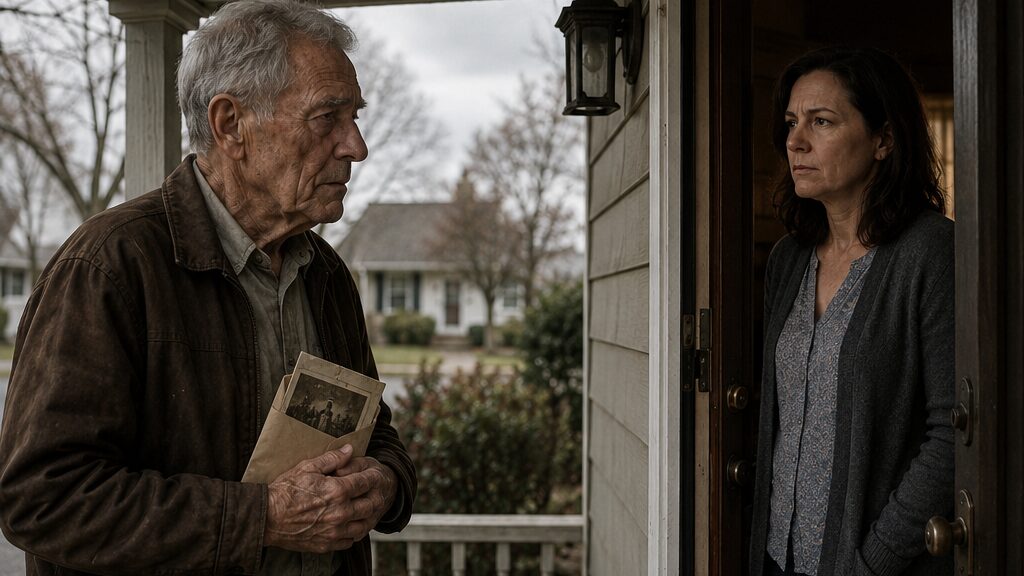
Joseph Hall stood on the porch with the envelope in his hand and the address written on a folded piece of paper in his coat pocket.
The envelope looked smaller than he remembered.
Maybe because everything else had grown heavier.
The porch light was already on though the sun had not fully disappeared. A wind chime clicked softly against itself somewhere near the garage.
Joseph checked the house number again.
He had checked it four times while walking from his car.
Three times while sitting behind the steering wheel.
Once while standing at the mailbox.
The numbers matched.
For sixty years, names had changed. Streets had changed. Counties had redrawn records. People had died before he found them.
But this address existed.
And someone named Sarah Martin lived here.
His hand trembled as he reached for the bell.
Not from fear.
At least that was what he told himself.
He pressed it.
The sound echoed inside.
Then silence.
Joseph straightened.
He suddenly became aware of how old he looked.
The worn jacket.
The bent shoulders.
The faded military ring he no longer wore outside his glove.
The envelope.
Especially the envelope.
A curtain moved.
Someone was looking.
The door opened three inches.
A woman stood behind it.
Forties.
Dark hair pulled back.
Suspicious eyes.
“Can I help you?”
Joseph nodded.
“I hope so.”
She didn’t smile.
“What do you need?”
He studied her face.
Not because he recognized her.
Because he was searching for traces of someone else.
Michael Smith.
He saw none.
“I was looking for Sarah Martin.”
“I am Sarah.”
Joseph felt something tighten in his chest.
After all these years.
After all the wrong addresses.
After all the dead ends.
She existed.
For a moment he simply stared.
Sarah’s expression hardened.
“What is this about?”
Joseph carefully removed the envelope from his coat.
Immediately her posture changed.
Not softer.
More guarded.
“What is that?”
“A letter.”
“I don’t accept solicitations.”
“It’s not a solicitation.”
“Then what is it?”
Joseph looked down at the envelope.
The paper had yellowed decades ago.
The seal was still intact.
His thumb rested against the edge worn smooth by years of handling.
“I’ve been trying to deliver this for a long time.”
Sarah frowned.
“To me?”
“To your family.”
The door opened another inch.
Not because she trusted him.
Because she was confused.
“My family?”
“Your grandfather’s family.”
The confusion vanished.
The wall came back immediately.
“My grandfather died before I was born.”
“I know.”
The answer came too quickly.
Sarah noticed.
Her eyes narrowed.
“Who are you?”
“Joseph Hall.”
The name meant nothing to her.
She waited.
Joseph knew she expected an explanation.
Instead he carefully withdrew a photograph tucked behind the envelope.
A small black-and-white picture.
The edges were curled.
A little girl stood beside a porch swing.
No older than six.
Sarah stared at it.
Then at him.
Then back at the photograph.
“What is this?”
“I think that’s your mother.”
The door stopped moving.
For the first time, Sarah looked unsettled.
“My mother?”
Joseph nodded.
Sarah reached toward the photograph.
Then stopped herself.
“Where did you get that?”
Joseph looked at the image.
He had looked at it thousands of times.
Sometimes during sleepless nights.
Sometimes in hospital waiting rooms.
Sometimes while driving through towns where another lead had failed.
Michael had shown him the photograph only once.
Yet Joseph could still remember the battlefield dirt on Michael’s fingers as he held it.
“Her father gave it to me.”
Sarah’s expression hardened again.
“My grandfather?”
“Yes.”
“My grandfather died in the war.”
“I know.”
“Then how exactly did he give that to you?”
Joseph inhaled slowly.
Because here it was.
The moment he had imagined for decades.
The first step.
The first crack.
And somehow it felt harder than all the years before it.
“I was there.”
Sarah stared.
The silence stretched.
Then she laughed once.
Not because anything was funny.
Because disbelief needed somewhere to go.
“You were there.”
“Yes.”
“How old are you?”
“Eighty-two.”
Sarah folded her arms.
“Look, Mr. Hall, I don’t know what you’re trying to do.”
“I’m trying to finish something.”
“You don’t even know me.”
“No.”
“Then why are you here?”
Joseph looked at the envelope.
Because I promised him.
The words sat behind his teeth.
He swallowed them.
Instead he said, “Your grandfather asked me to bring this home.”
Sarah’s face changed.
Not belief.
Not yet.
Something closer to irritation.
“My grandfather died sixty years ago.”
“Yes.”
“And you’re showing up now?”
“Yes.”
“Why?”
Joseph looked away.
Toward the driveway.
Toward the street.
Anywhere except her eyes.
Because he did not have an answer she would understand in thirty seconds.
Because the truth took sixty years.
Sarah noticed the hesitation.
Wrongly.
The same way many others had.
“This is some kind of scam.”
“No.”
“Then what is it?”
Joseph held out the envelope.
She didn’t take it.
Neither moved.
Finally Sarah spoke.
“What do you want?”
The question landed harder than she intended.
Because Joseph had heard it before.
At other doors.
In other towns.
What do you want?
Money?
Recognition?
Attention?
An audience?
A story?
He shook his head.
“Nothing.”
“No one shows up with a mystery letter and wants nothing.”
“I do.”
Sarah glanced toward the envelope again.
Then at the photograph.
Then back at Joseph.
For a moment uncertainty appeared.
Then caution won.
“My mother died three months ago.”
Joseph froze.
“What?”
Sarah looked away.
“As far as I know, she was the last person alive who actually knew anything about my grandfather.”
The words struck harder than expected.
Three months.
Sixty years searching.
Three months late.
Joseph felt suddenly tired.
Sarah saw something change in his face.
Not guilt.
Not manipulation.
Something else.
Loss.
Real loss.
But she didn’t know what it meant.
“I think you should go.”
Joseph nodded slowly.
Reasonable.
Expected.
He should have prepared better.
Explained better.
Said more.
Said less.
He never knew which.
The same flaw followed him through every decade.
Silence.
Always silence.
Sarah began closing the door.
Joseph looked down at the photograph.
Then back up.
The door was almost shut.
He heard Michael’s voice.
Not literally.
Memory.
Young.
Bleeding.
Certain.
Promise me.
The gap narrowed.
Joseph spoke.
“He died asking for her.”
The door stopped.
Sarah’s hand froze.
Neither moved.
The evening seemed to hold its breath.
“What did you say?”
Joseph held up the photograph.
“The little girl.”
Sarah stared.
“He died asking for her.”
For the first time, fear appeared behind her eyes.
Not fear of Joseph.
Fear of what he might know.
Fear that he might be telling the truth.
“What was her name?” she asked quietly.
Joseph answered without hesitation.
“Nancy.”
Sarah’s face drained of color.
The photograph slipped slightly in his hand.
The door remained half-open.
Half-closed.
Balanced between rejection and belief.
Then Sarah stepped back.
Not to invite him in.
To create distance.
“You need to leave.”
Joseph waited.
She pointed toward the driveway.
“Leave the property.”
“Sarah—”
“I said leave.”
He stopped.
The old envelope remained in his hand.
The seal remained unbroken.
The promise remained unfinished.
Sarah shook her head.
“I don’t know who you are.”
“I know.”
“I don’t know how you know my mother’s name.”
“I know.”
“I don’t know where you got that photograph.”
Joseph nodded.
“I know.”
The door began moving again.
This time it did not stop.
Joseph stood still.
The final thing he saw was Sarah looking at the envelope.
Not at him.
At the envelope.
Then the door closed.
The lock clicked.
Joseph remained on the porch for several seconds.
The photograph in one hand.
The letter in the other.
Sixty years.
And the door had closed.
Chapter 2: Sixty Years Of Wrong Addresses
Joseph sat on the edge of the motel bed staring at the envelope.
The room smelled faintly of old carpet and cleaning chemicals.
The television was off.
The lamp beside the bed cast a yellow circle across the blanket.
The envelope rested in the center of that light.
Untouched.
As it had always been.
He could still hear the lock clicking behind Sarah’s door.
He had imagined hundreds of outcomes over the years.
Not that one.
Not Nancy being dead.
Three months.
Three months.
Joseph leaned back and closed his eyes.
For a dangerous moment, quitting felt reasonable.
The address had been found.
The family had been found.
The letter had been offered.
Maybe that was enough.
Maybe promises had expiration dates.
At eighty-two, perhaps he had earned one.
His phone buzzed.
A message.
Kevin Adams.
Found another record. Call me tomorrow.
Joseph stared at it.
Then placed the phone down.
Tomorrow.
There had been too many tomorrows.
That was part of the problem.
Years became decades while waiting for better timing.
Better health.
Better information.
A clearer path.
Tomorrow was a thief.
The next morning he drove to the diner where he and Kevin usually met.
The waitress already knew his coffee order.
She placed the mug down without asking.
“Your friend is in the back.”
Joseph nodded.
Kevin sat surrounded by folders.
The younger man looked excited.
Joseph looked exhausted.
“Rough night?” Kevin asked.
Joseph lowered himself into the booth.
“The family doesn’t want the letter.”
Kevin winced.
“That’s not surprising.”
“It should be.”
“No.”
Kevin leaned back.
“An old stranger shows up talking about a dead grandfather? Most people would react exactly the same.”
Joseph looked out the window.
He knew Kevin was right.
That somehow made it worse.
Kevin slid a file across the table.
“I found something.”
Joseph opened it.
Property records.
Marriage licenses.
Address changes.
Names connected by decades of movement.
“You were looking in the wrong county for years.”
Joseph laughed softly.
Not because it was funny.
Because it was painful.
“Years?”
Kevin tapped the page.
“More like twenty.”
Joseph stared at the document.
Twenty years.
Gone because of one mistake.
One wrong assumption.
One record filed under a different jurisdiction.
Twenty years.
Kevin watched him carefully.
“You couldn’t have known.”
“I should have.”
“You didn’t have the internet in 1965.”
Joseph smiled despite himself.
“Fair point.”
Kevin hesitated.
Then asked the question he had been avoiding.
“Why didn’t you give it to the military?”
Joseph’s expression changed immediately.
Kevin noticed.
There it was.
The wall.
The same wall Joseph always built.
“I promised him.”
Kevin nodded.
“Okay.”
“No. You don’t understand.”
“Then explain.”
Joseph looked at the envelope inside his coat.
He had spent decades avoiding explanations.
Perhaps too many decades.
“He didn’t ask the military.”
Kevin remained silent.
“He asked me.”
The answer sounded simple.
But it wasn’t.
Kevin accepted it anyway.
After a moment he pointed to another page.
“Nancy moved three times before Sarah was born.”
Joseph leaned closer.
A photograph was attached to one of the records.
Nancy Green.
Middle-aged.
Serious eyes.
A resemblance to the little girl in the photograph.
Joseph stared longer than necessary.
For years Nancy had existed only as a child frozen in black and white.
Now she had become a woman.
A mother.
A person who had lived an entire life while he searched.
“She died recently,” Kevin said quietly.
“I know.”
The words hurt.
Kevin studied him.
“You really thought you’d get there in time.”
Joseph nodded.
“I did.”
For a while neither spoke.
Then Kevin pulled out one final document.
“This is the interesting one.”
Joseph looked down.
A handwritten note attached to an old file.
One sentence.
Family requested military records repeatedly. Information unavailable.
Joseph frowned.
“What is that?”
Kevin tapped the paper.
“It means somebody in the family spent years looking too.”
Joseph looked up sharply.
“What?”
“They were searching for answers.”
The diner suddenly felt smaller.
For decades Joseph believed he was the only person still carrying the story.
Now evidence suggested otherwise.
Nancy had been looking.
Or someone close to her had.
Searching from the other side.
The thought unsettled him.
Because it created a new question.
If they wanted answers…
why had Sarah slammed the door?
Kevin folded the paper and pushed it toward him.
“Take it.”
Joseph slipped it into his pocket.
A small clue.
A small victory.
A larger mystery.
His phone buzzed.
Unknown number.
Joseph almost ignored it.
Then answered.
“Hello?”
Silence.
A breath.
Then a woman’s voice.
Not quite steady.
“Mr. Hall?”
Joseph sat upright.
“Yes.”
“Don’t come back to my house.”
Sarah.
The line crackled.
Joseph waited.
“You were right about my mother’s name.”
He said nothing.
“That’s not public information.”
Still nothing.
Silence had always been his habit.
This time it forced Sarah to continue.
“How did you know?”
Joseph looked at the envelope.
“He told me.”
Another silence.
Longer now.
More uncertain.
Then Sarah spoke again.
“What else did he tell you?”
Before Joseph could answer, another call beeped through.
Kevin frowned.
Joseph glanced at the screen.
County records office.
He switched lines.
A clerk’s voice greeted him.
“Mr. Hall? We located something connected to your inquiry.”
Joseph’s grip tightened.
“What kind of something?”
“A file from 1966.”
His heart began beating faster.
“A file concerning Michael Smith.”
Chapter 3: The Photograph On The Kitchen Table
The photograph sat in the middle of Sarah’s kitchen table.
She had placed it there the night before.
She had not touched it since.
Yet she kept finding herself staring at it.
The little girl in the picture looked familiar.
Not because Sarah had known her.
Because she had seen another version of that photograph her entire life.
Different angle.
Different day.
Same child.
Her mother.
Nancy.
Sarah wrapped her hands around a mug of untouched coffee.
The old photograph seemed impossible.
And yet it existed.
That was the problem.
If Joseph Hall were lying, he was doing it with evidence that shouldn’t exist.
A chair scraped across the floor.
Sarah looked up.
Her husband sat down across from her.
He studied the photograph.
“Still thinking about him?”
“Unfortunately.”
“You could throw it away.”
Sarah looked at him.
“I could.”
Neither believed she would.
He picked up the picture.
Carefully.
As if age had made it fragile.
“Where do you think he got this?”
“I don’t know.”
“Do you think he knew your grandfather?”
Sarah wanted to say no.
Wanted certainty.
Instead she said, “I don’t know.”
The answer irritated her.
The entire situation irritated her.
Three months ago her mother had died.
Now a stranger arrived carrying pieces of family history nobody should have.
The timing felt cruel.
Her husband turned the photograph over.
Something caught his attention.
“There’s writing.”
Sarah stood immediately.
On the back, nearly faded away, was a short note written in pencil.
For Nancy.
Love always.
The final word had almost disappeared.
Sarah’s chest tightened.
She knew that handwriting.
Not from letters.
There were no letters.
Only one thing remained.
An old Christmas card preserved in a memory box.
Her mother had kept it for decades.
Sarah left the kitchen and returned several minutes later carrying a worn cardboard container.
Inside were photographs.
Documents.
Cards.
The leftovers of a life.
She found the Christmas card.
Placed it beside the photograph.
Compared the handwriting.
Her husband looked from one to the other.
Neither spoke.
The letters leaned the same way.
The loops matched.
The shape of the capital N.
The spacing.
Close enough to raise questions.
Not enough to prove anything.
Sarah sat down slowly.
“What if he’s telling the truth?”
Her husband didn’t answer immediately.
Because the question wasn’t really about Joseph.
It was about what happened next.
If Joseph was telling the truth, then everything became larger.
More painful.
More complicated.
A knock sounded at the back door.
Sarah nearly jumped.
The neighbor stood outside holding a package.
A normal interruption.
An ordinary moment.
Yet after the neighbor left, nothing felt ordinary anymore.
The photograph remained on the table.
Watching.
Waiting.
That afternoon Sarah drove to her mother’s house.
Most of the belongings remained untouched.
She moved through familiar rooms until she found the filing cabinet Nancy had kept locked for years.
Inside were insurance papers.
Tax records.
Medical files.
And a folder labeled simply:
Michael.
Sarah froze.
She had never seen it before.
The folder contained requests.
Letters.
Forms.
Military inquiries.
Addresses.
Returned mail.
Dozens of attempts.
Her mother had been searching.
For years.
The discovery hit harder than expected.
Nancy had rarely spoken about her father.
Sarah assumed she didn’t care.
Now evidence suggested the opposite.
She cared enough to keep looking.
Care enough to save every failed lead.
At the bottom of the folder sat a final document.
A response from decades earlier.
Information unavailable.
The same phrase appeared again.
And again.
And again.
Sarah sat on the floor staring at the stack.
The image she carried of her mother suddenly felt incomplete.
A new question replaced the old one.
What exactly had Nancy been trying to find?
The answer wasn’t in the folder.
But Joseph Hall might know.
Her phone remained in her hand for nearly ten minutes before she finally used it.
The number was still in her call history.
She pressed it.
The phone rang.
Once.
Twice.
Three times.
Then Joseph answered.
“Hello?”
For a moment she almost hung up.
Instead she asked the question she had been fighting since the porch.
“Did you really know Michael Smith?”
The silence on the other end felt different now.
Not evasive.
Careful.
“Yes.”
“My mother spent years looking for him.”
Joseph said nothing.
Then quietly:
“I know.”
Sarah closed her eyes.
“How could you know that?”
The answer came immediately.
“Because I spent years looking for her.”
And suddenly the story she thought she understood no longer fit together at all.
Chapter 4: What Michael Never Mailed
Sarah arrived at the diner ten minutes early.
She chose a booth near the window where she could see the parking lot.
Part of her still expected Joseph Hall not to come.
Or to arrive with some new story that would finally expose the lie.
Instead she watched his old sedan pull slowly into a space near the entrance.
He sat behind the wheel for several seconds before getting out.
Not gathering courage.
Gathering strength.
That detail bothered her more than she expected.
He looked tired.
Not theatrical.
Not dramatic.
Simply old.
When Joseph entered, he spotted her immediately.
The envelope was tucked under one arm.
The photograph rested inside a clear plastic sleeve.
He carried them the way some people carried fragile glass.
Sarah gestured toward the opposite seat.
Joseph sat.
Neither spoke for a moment.
The waitress appeared.
Coffee for both.
Then disappeared.
Sarah folded her hands.
“Let’s start simple.”
Joseph nodded.
“All right.”
“Who was Michael Smith?”
Joseph looked down into his coffee.
The question seemed easy.
It wasn’t.
“He was my friend.”
Sarah waited.
“That’s all?”
“No.”
“Then tell me the rest.”
Joseph stared out the window.
For years, silence had protected him.
Protected the promise.
Protected the letter.
Protected himself.
Now silence only made him look guilty.
“He was twenty-three.”
Sarah listened carefully.
“He carried that photograph everywhere.”
Joseph touched the edge of the plastic sleeve.
“The one of my mother?”
“Yes.”
“He talked about her?”
“Every chance he got.”
Sarah’s expression shifted.
Just slightly.
The version of Michael she had grown up with was mostly an absence.
A name.
A photograph.
A military record.
Not a man who talked too much about his child.
Joseph continued.
“He worried she wouldn’t remember him.”
Sarah looked away.
That hurt.
Because her mother had spent decades trying to remember someone she never really knew.
The irony sat between them.
Joseph took a slow breath.
“We were together during the last weeks.”
“You were in the same unit?”
“Yes.”
Sarah hesitated.
Then asked the question she had wanted to ask since the porch.
“Did you see him die?”
Joseph’s hand stopped moving.
The diner sounds faded.
Plates.
Conversations.
Coffee cups.
All distant now.
“Yes.”
Sarah immediately regretted how blunt the question sounded.
But Joseph didn’t appear offended.
Only older.
Much older.
“He was hurt?”
Joseph nodded.
“Around dawn.”
“Did he suffer?”
Joseph looked at her.
For the first time she saw something close to anger.
Not directed at her.
At memory itself.
“I don’t think that’s what you’re really asking.”
Sarah swallowed.
Maybe it wasn’t.
Maybe what she wanted was something impossible.
To know whether her grandfather had been afraid.
Whether he thought about home.
Whether he wanted them.
Whether he regretted leaving.
Joseph reached into his coat.
Sarah stiffened.
He pulled out the envelope.
The same one.
Still sealed.
Still closed.
He placed it carefully on the table.
The waitress walked past.
Neither noticed.
Sarah stared at it.
“So this is it.”
“Yes.”
“My grandfather’s letter.”
“Yes.”
She looked at the seal.
A faint discoloration marked where decades had worn against fabric and skin.
“You never opened it?”
“No.”
“Not once?”
“No.”
“Why?”
Joseph looked almost offended.
“Because it wasn’t mine.”
Sarah stared at him.
The answer arrived so quickly.
So simply.
No hesitation.
No performance.
Just certainty.
For the first time since meeting him, she felt ashamed of something.
Not because she had doubted him.
Because she realized he had carried temptation for sixty years and never surrendered to it.
Most people wouldn’t last six days.
She looked away.
“What did he ask you to do?”
Joseph touched the envelope.
“He asked me to deliver it.”
“Only that?”
“No.”
The word hung there.
Heavy.
Sarah waited.
Joseph didn’t continue.
“You’re doing it again.”
“What?”
“Stopping.”
His eyes met hers.
She was right.
He knew she was right.
The silence stretched.
Finally he spoke.
“He wanted me to find Nancy.”
Sarah glanced at the photograph.
“My mother.”
“Yes.”
“And if I couldn’t find her, he wanted me to find her children.”
The words landed hard.
Because suddenly this wasn’t an object.
It was a mission.
A task aimed directly at people who now existed.
Sarah.
Her family.
Their lives.
“He planned that?”
Joseph nodded.
“He knew there was a chance.”
“A chance of what?”
Joseph looked away.
“A chance he wasn’t coming home.”
Sarah’s throat tightened.
The answer should have been obvious.
Yet hearing it spoken aloud felt different.
Real.
The waitress returned.
Refilled coffee.
Left again.
Neither touched their cups.
Finally Sarah asked the question that had been building all morning.
“If he gave you the letter sixty years ago…”
Joseph closed his eyes briefly.
He knew what was coming.
“…why didn’t you deliver it sixty years ago?”
There it was.
The question.
The one he had feared.
The one he had spent decades avoiding.
Joseph opened his eyes.
Looked at the envelope.
Then at Sarah.
And for the first time, he had no simple answer.
Chapter 5: The Weight He Carried Home
The cemetery was quiet except for the distant sound of maintenance equipment somewhere beyond the trees.
Joseph stood before a row of grave markers.
His hands rested on the top of his cane.
The envelope remained tucked inside his jacket.
As always.
Sarah’s question followed him there.
Why didn’t you deliver it sixty years ago?
Because there was no answer that didn’t sound weak.
Cowardly.
Wrong.
Footsteps approached from behind.
Kevin.
Joseph had called him that morning.
Kevin stopped beside him.
Neither spoke immediately.
The white stones stretched across the hillside.
Names.
Dates.
Entire lives reduced to a few lines.
“You look terrible,” Kevin finally said.
Joseph laughed softly.
“Thank you.”
“I’m serious.”
“I know.”
Kevin looked at the marker Joseph had been staring at.
No name.
Just another veteran.
Another stranger.
Another reminder.
“You still haven’t answered her, have you?”
Joseph shook his head.
“No.”
“Because you can’t?”
“Because I don’t know how.”
Kevin folded his arms.
Joseph rarely spoke about himself.
That was one reason Kevin liked him.
And one reason Kevin worried about him.
People who carried things alone often carried them too long.
“What happened after the war?” Kevin asked.
Joseph remained silent.
Then, unexpectedly, he answered.
“I came home.”
Kevin waited.
“I had the letter.”
Another pause.
“I told myself I’d deliver it once I got settled.”
Kevin nodded.
Reasonable so far.
Joseph stared at the grave markers.
“Then I couldn’t find them.”
“What do you mean?”
“The address was wrong.”
Kevin frowned.
“Wrong?”
“The street existed.”
Joseph swallowed.
“The family didn’t.”
Kevin stayed quiet.
Joseph continued.
“I looked for months.”
Then years.
One search became another.
One dead end became three.
A move.
A marriage.
Work.
Illness.
Responsibility.
Time.
Always time.
And underneath it all, something uglier.
Something harder to admit.
“I started avoiding it.”
Kevin looked at him.
“What?”
Joseph’s voice dropped.
“I started avoiding it.”
The confession seemed to cost him.
Kevin could see it.
“Why?”
Joseph stared at the rows of stones.
Because now came the truth.
Not the letter’s truth.
His.
“He died in my arms.”
Kevin said nothing.
Joseph continued.
“He kept asking if I understood.”
The memory sharpened.
Not because he wanted it to.
Because it never left.
“I told him yes.”
Joseph’s hand tightened around the cane.
“But afterward…”
His voice nearly failed.
“…afterward I wasn’t sure I deserved to be the one carrying it.”
Kevin slowly exhaled.
There it was.
Not laziness.
Not indifference.
Guilt.
Decades of it.
“You thought you failed him.”
Joseph nodded.
“I did fail him.”
“You don’t know that.”
“I do.”
The answer came too fast.
Too certain.
Kevin recognized the difference between truth and self-punishment.
Joseph did not.
Or perhaps refused to.
A long silence followed.
Then Kevin asked quietly:
“Did Michael ever blame you?”
Joseph looked confused.
“No.”
“Then why are you doing it for him?”
Joseph didn’t answer.
Because he had never truly asked himself.
A buzzing sound interrupted them.
Joseph’s phone.
Sarah.
He stared at the screen.
Did not answer immediately.
Kevin noticed.
“There it is again.”
“What?”
“Silence.”
Joseph sighed.
Then answered.
“Hello?”
Sarah spoke before he could say anything else.
“Where are you?”
“Cemetery.”
A pause.
Then:
“I think we need to talk.”
Joseph closed his eyes.
Not relief.
Not fear.
Something between.
“I agree.”
“We’re coming to you.”
We.
Not I.
The word mattered.
Sarah had crossed a line.
Maybe not toward belief.
But away from dismissal.
After the call ended, Joseph sat down heavily on a nearby bench.
Kevin looked concerned.
“You okay?”
Joseph nodded.
Then immediately swayed.
The world tilted.
The cemetery blurred.
The bench seemed to move beneath him.
Kevin stepped forward.
“Joseph?”
Joseph tried to answer.
Instead darkness rushed in from the edges of his vision.
The cane slipped from his hand.
And everything disappeared.
Chapter 6: The Letter Finally Opens
Sarah arrived at the medical clinic twenty minutes after Kevin called.
Joseph was sitting upright on an examination table when she entered.
A nurse was finishing paperwork.
“Dehydration,” the nurse said. “Exhaustion. He needs rest.”
Joseph looked embarrassed by the attention.
The nurse left.
The room became quiet.
Sarah stood near the door.
For a few seconds neither knew how to begin.
Finally Joseph broke the silence.
“I’m sorry.”
Sarah frowned.
“For what?”
“For collapsing.”
Unexpectedly, she laughed.
Not because it was funny.
Because it was such a Joseph Hall thing to apologize for.
The laugh faded quickly.
“What happened to you?”
“Eighty-two years happened.”
She looked at him.
The answer wasn’t a joke.
Joseph slowly climbed down from the table.
His movements seemed more careful than before.
Not weaker.
More honest.
Like he no longer had energy left to hide it.
Sarah noticed the envelope sitting beside him.
Still there.
Still sealed.
Still waiting.
“Come with me,” she said.
Joseph looked surprised.
“Where?”
“Home.”
The word landed between them.
Not your home.
Not my house.
Home.
A place where the letter belonged more than it belonged anywhere else.
Joseph stared at her for several seconds.
Then nodded.
“All right.”
The envelope sat in the middle of the dining room table.
No one touched it.
Sarah sat on one side.
Her husband beside her.
Joseph across from them.
The photograph rested next to the letter.
The little girl in the image seemed to be watching.
The room felt smaller than usual.
The envelope felt larger.
Sarah finally spoke.
“If we open this…”
Joseph nodded.
“I know.”
“No. I don’t think you do.”
Her voice tightened.
“My mother spent her entire life wondering who her father really was.”
Joseph listened.
“Maybe this answers that.”
She looked at the seal.
“Maybe it doesn’t.”
Neither possibility felt safe.
Joseph folded his hands.
“You don’t have to open it.”
Sarah looked up sharply.
“What?”
“You don’t owe me anything.”
The statement surprised her.
Because for weeks she had imagined him as a man driven by obligation.
A man who needed something from her.
Yet here he was giving her an exit.
Again.
The realization changed something.
Not completely.
But enough.
Sarah reached toward the envelope.
Her fingers stopped.
Then continued.
The seal cracked.
A sound no one in the room had heard for sixty years.
Joseph closed his eyes.
Only briefly.
When he opened them again, the letter was unfolding.
The paper trembled slightly in Sarah’s hands.
She wasn’t sure if it was age or her own fingers.
The handwriting was unmistakable.
The same writing from the photograph.
The same writing from the Christmas card.
The same writing from the notes hidden inside Nancy’s records.
Michael Smith.
Real.
Present.
Speaking from another century.
Sarah swallowed.
Then began reading.
“My dearest Nancy…”
The room became still.
Joseph stared at the tabletop.
He had imagined this moment thousands of times.
He had never imagined actually surviving long enough to see it.
Sarah continued.
Michael wrote about missing her.
About carrying her photograph.
About counting birthdays he knew he might not witness.
There was no grand speech.
No heroic language.
No dramatic farewell.
Just a father trying desperately to speak to a child.
Several times Sarah had to stop reading.
Not because the words were unclear.
Because her voice was.
At one point her husband quietly took her hand.
Neither acknowledged it.
The letter continued.
Michael wrote about fear.
About mistakes.
About wanting Nancy to know that leaving had not meant forgetting.
Joseph slowly looked up.
The room had changed.
Not because of proof.
Because of humanity.
Michael was no longer a mystery.
He was a man.
Flawed.
Afraid.
Loving.
Then Sarah reached a section that made her stop entirely.
She read it once silently.
Then again.
The color left her face.
Joseph noticed.
“What is it?”
Sarah stared at the page.
For a moment she couldn’t answer.
Then she finally read aloud.
“If this letter reaches you, it means Joseph kept his promise. If it does not, it will not be his fault.”
The room went silent.
Joseph froze.
The words seemed impossible.
Sarah continued reading.
“He has spent too much time blaming himself for things that belong to war. If I do not come home, tell him I knew he would try.”
Joseph looked away.
The table blurred.
Not from age.
Not from exhaustion.
Something else.
Something he had carried for sixty years suddenly shifted.
Michael knew.
Michael had known.
Sarah lowered the paper.
The room remained quiet.
No one rushed to speak.
No one knew how.
The letter continued for several more pages.
A father’s hopes.
Regrets.
Memories.
Love.
Nothing miraculous.
Nothing that erased loss.
Only truth.
When Sarah finally reached the final line, her voice barely remained steady.
“I loved you every day I was gone.”
She folded the letter.
Carefully.
The way Joseph always had.
No one moved.
Eventually Sarah looked up.
Joseph sat motionless.
His eyes fixed somewhere far beyond the room.
The burden he carried had not disappeared.
But it had cracked.
And through that crack, something like peace had entered.
Hours later, after conversations that wandered through memory and silence alike, Joseph stood.
“I should go.”
Sarah looked surprised.
“Now?”
Joseph nodded.
“You just got here.”
“I know.”
She glanced toward the letter.
Then back at him.
Part of her wanted him to stay.
To tell stories.
To fill decades of missing space.
But she understood something now.
This had never been about claiming a place in their family.
It had been about returning something that belonged to them.
Nothing more.
Nothing less.
Sarah walked him to the door.
Outside, the evening had settled quietly over the neighborhood.
Joseph paused on the porch.
The same kind of porch where he had once been turned away.
Sarah looked at him.
“Thank you.”
Joseph smiled faintly.
A tired smile.
A relieved one.
Then he walked toward his car carrying less than he had carried that morning.
But not nothing.
There was still one thing left to do.
Chapter 7: The Promise He No Longer Carried
Sarah found Joseph at the cemetery the next afternoon.
He was standing near a row of old markers.
Hands empty.
For the first time since she had met him, there was no envelope under his arm.
No photograph tucked into his pocket.
No visible mission.
Just an old man looking at names carved into stone.
He heard her footsteps before she reached him.
“I thought I might find you here,” she said.
Joseph smiled.
“It seemed likely.”
Sarah stopped beside him.
For a moment neither spoke.
The silence felt different now.
Not guarded.
Comfortable.
The cemetery caretaker worked in the distance.
A lawn mower hummed somewhere beyond the trees.
Life continuing around memory.
Sarah held something in her hand.
The photograph.
Protected in a new frame.
She offered it to him.
Joseph looked at it.
Then gently pushed it back.
“No.”
“It’s yours.”
His smile deepened slightly.
“It never was.”
Sarah stared at the photograph.
Then nodded.
For the first time she understood.
The entire story rested inside those words.
It never was.
The letter.
The photograph.
The promise.
He had carried them.
But he had never claimed them.
They belonged to someone else.
Always.
Sarah slipped the photograph back into her bag.
“We’re making copies of the letter.”
Joseph nodded.
“Good.”
“My children are going to read it one day.”
He nodded again.
“Good.”
Sarah studied him.
“You don’t say much, do you?”
Joseph laughed softly.
“No.”
The answer contained more honesty than humor.
Sarah hesitated.
Then asked the question that remained.
“Why didn’t you tell me all this on the first day?”
Joseph looked toward the grave markers.
Because silence had protected him for decades.
Because guilt had disguised itself as responsibility.
Because talking made things real.
Because sometimes carrying a burden became easier than setting it down.
He finally answered.
“I spent so long holding it that I forgot how to share it.”
Sarah absorbed that quietly.
Then she stepped closer.
“My mother would’ve wanted to meet you.”
Joseph lowered his eyes.
The statement hurt.
Because it was kind.
Because it was probably true.
Because it had arrived too late.
“I wanted to meet her too.”
Neither tried to fix that sadness.
Some things could not be fixed.
Only acknowledged.
They stood together for several minutes.
The wind moved through the trees.
The afternoon light softened.
Eventually Sarah spoke again.
“You know, she never stopped looking.”
Joseph looked at her.
“My mother.”
She smiled sadly.
“She kept every record. Every request. Every dead end.”
Joseph felt something tighten in his chest.
Nancy had searched.
All those years.
From the opposite side of the same distance.
Neither had known.
Neither had found the other in time.
Yet somehow the promise had still arrived.
Not perfectly.
But honestly.
And perhaps that was all life ever offered.
Sarah reached into her bag once more.
This time she pulled out the letter.
Protected inside a clear sleeve.
She held it out.
Joseph looked startled.
“What are you doing?”
“I wanted you to see it one last time.”
Carefully, he accepted it.
The paper felt lighter than he remembered.
Or perhaps he was simply stronger without the weight attached to it.
He looked at Michael’s handwriting.
The familiar curves.
The familiar slant.
Then he handed it back.
“No more.”
Sarah took the letter.
No argument.
No insistence.
She understood.
The promise had crossed the finish line.
Holding onto it now would only create another burden.
Joseph looked across the cemetery.
Rows of names.
Rows of unfinished stories.
Rows of promises kept and broken and forgotten.
Michael’s story would never have a happy ending.
He was still gone.
Nancy was gone too.
Nothing could return them.
But something had been restored.
Not a life.
Not lost time.
A connection.
A truth.
A voice.
Sometimes that was enough.
Sarah extended her hand.
Joseph looked at it.
Then shook it.
The gesture seemed too formal.
Too small.
So Sarah stepped forward and hugged him.
Joseph stood awkwardly for a second.
Then returned the embrace.
When they separated, both were smiling.
Neither entirely succeeded.
There were too many tears involved.
Sarah wiped her eyes.
“Will we see you again?”
Joseph considered the question.
Then nodded.
“If you’d like.”
“We would.”
The answer came immediately.
No hesitation.
No suspicion.
No closed doors.
Just an invitation.
The kind that mattered.
Joseph looked toward the cemetery one last time.
Then toward the parking lot.
The path ahead felt unfamiliar.
Not because he was beginning something.
Because he was finished.
For sixty years, every road had pointed toward a single destination.
Find the family.
Deliver the letter.
Keep the promise.
Now there was no destination waiting.
No obligation pulling him forward.
The emptiness should have frightened him.
Instead it felt strangely peaceful.
Sarah watched him start walking.
Slowly.
Steadily.
An old man leaving a cemetery with empty hands.
Halfway to the parking lot, Joseph stopped.
Turned back once.
Sarah raised a hand.
He returned the gesture.
Then continued on.
The letter remained with the family.
The photograph remained with the family.
Michael’s voice remained with the family.
And Joseph Hall finally carried nothing that was not his own.
The story has ended.