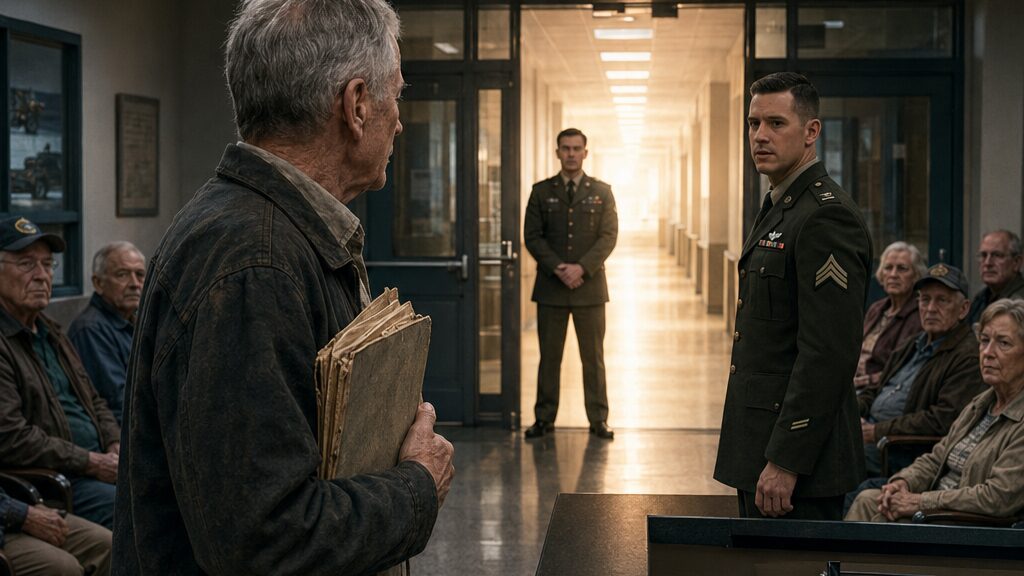
The Young Sergeant Kept Sending Him Away Until He Read The Name On The Old File
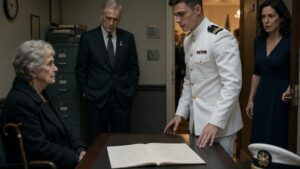
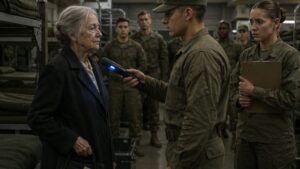
Chapter 1: The Wrong Line At The End Of The Hall
“Sir, that’s not your line.”
The words echoed louder than they should have in the military facility’s lobby.
Dennis Walker stopped with one hand resting on the metal railing that guided visitors toward the security checkpoint. Around him, people shifted impatiently. A young woman holding paperwork sighed. A man in a wheelchair glanced away. Nobody said anything.
Behind the desk, Sergeant Joshua Harris pointed toward another queue.
“The civilian assistance line starts over there.”
Dennis looked at him for a moment.
Not angry.
Not embarrassed.
Just tired.
“I need Records Access.”
Joshua barely glanced at the papers in Dennis’s hand.
“Then you’ll need authorization first.”
“I’ve been told that before.”
“Then you already know the process.”
The younger man’s attention moved to the next visitor.
Conversation over.
Dennis stood still for another second before turning away.
The civilian assistance line was nearly thirty people long.
He walked toward it without complaint.
The facility was larger than most people expected. Corridors stretched behind secured doors. Uniformed personnel moved between offices carrying folders and tablets. Bright overhead lights reflected off polished floors.
Most visitors never went beyond the lobby.
Dennis knew exactly what lay beyond it.
That knowledge sat quietly behind his eyes.
Three corridors past security.
A left turn.
Then the bright hallway.
The one that led toward the archive wing.
The one he had been trying to reach for nearly six months.
He took his place in line.
Nobody noticed the old man studying the building’s layout without looking around.
Nobody wondered how he already knew where the restricted elevator opened.
Nobody asked why he came every Tuesday and Thursday.
The clerk finally called him forward forty minutes later.
“What service are you requesting?”
“Archive records.”
The clerk typed something.
“Case number?”
“I don’t have one.”
“Then you need a referral.”
“I was told the records may predate the digital system.”
The clerk sighed.
“Sir, everybody says that.”
Dennis said nothing.
The clerk looked up.
“You need a referral.”
Again.
Another wall.
Another door that would not open.
Dennis gathered his papers carefully.
The clerk was already looking past him.
Outside, the parking lot shimmered under afternoon sunlight.
Dennis sat in his pickup truck for several minutes before starting the engine.
The folder rested on the passenger seat.
The corners were worn smooth.
Forty years of handling could do that.
His phone rang.
Heather.
He stared at the screen before answering.
“Dad.”
“Hello.”
“You went again.”
It wasn’t a question.
Dennis watched a security guard emerge from the facility.
“Just checking on something.”
“You’ve been checking on something for months.”
Silence.
Heather exhaled.
“You know they’re not going to suddenly change the rules.”
“Maybe.”
“You could let it go.”
His jaw tightened.
Heather heard the pause.
“Dad?”
“I’ll call you later.”
“You always say that.”
He ended the call gently.
Not because he was angry.
Because he knew where the conversation would go.
She thought he was chasing paperwork.
She thought he was trapped in old memories.
She thought this was about pride.
Dennis started the truck.
If it were only pride, he would have stopped months ago.
Three days later he returned.
The lobby looked exactly the same.
The same polished floor.
The same security barriers.
The same bright corridor visible through a secured doorway beyond the checkpoint.
And the same sergeant.
Joshua Harris looked up from his desk and frowned immediately.
Recognition.
Not respect.
Recognition.
“You again.”
Dennis nodded.
Joshua glanced at the folder.
“No referral?”
“No.”
“Then nothing’s changed.”
Dennis waited.
Sometimes people filled silence.
Joshua did.
“Sir, I don’t know what you expect me to do.”
Dennis looked toward the secured doorway.
The bright corridor beyond it glowed under white lights.
A hallway that seemed almost too clean.
Too distant.
Like it belonged to another world.
“I need access to archive records.”
“And I need authorization.”
“Who grants it?”
Joshua pointed toward a printed sign.
“The process grants it.”
Several people nearby laughed softly.
Not cruelly.
Just the way people laugh when they think someone is refusing reality.
Dennis felt heat rise behind his eyes.
Not anger.
Something older.
Something harder to name.
He nodded once.
“Thank you, Sergeant.”
Joshua blinked.
Most frustrated visitors argued.
This old man never did.
Dennis turned away.
As he walked back toward the exit, he heard one of the waiting visitors mutter:
“Guy doesn’t know when to quit.”
Dennis kept walking.
The words followed him farther than they should have.
That evening he opened the folder at his kitchen table.
Inside were copies.
Requests.
Letters.
Reference numbers.
A photograph.
The edges had faded nearly white.
Five young soldiers stood beside a transport vehicle.
One of them was Dennis.
Another smiled directly at the camera.
Dennis rested a finger on that face.
The room stayed silent.
The promise returned as it always did.
Not in words.
In weight.
He closed the folder.
Across the room the clock ticked.
Morning would come.
The facility would open.
The corridor would still be there.
And so would he.
The next morning Joshua arrived early.
Coffee in one hand.
Tablet in the other.
As he crossed the lobby, the security officer nodded toward the entrance.
“Your favorite visitor’s back.”
Joshua looked.
Dennis sat quietly on a bench.
Waiting.
Before opening time.
Again.
Something about that bothered him.
Most people gave up eventually.
This man didn’t.
Joshua watched him for a second.
The old man sat perfectly still.
Not confused.
Not lost.
Waiting.
Like someone expecting orders.
Joshua shook the thought away.
Rules were rules.
People always believed their situation was different.
That was exactly how mistakes happened.
The doors unlocked.
Visitors entered.
The day began.
Dennis stood, picked up his worn folder, and joined the line once more.
Chapter 2: The Name On The File
By ten o’clock Joshua was already behind schedule.
The audit team wanted updated compliance reports.
The records division wanted visitor logs.
The front desk phone wouldn’t stop ringing.
Then he saw Dennis Walker approaching again.
The old man moved with the same steady pace.
No hurry.
No hesitation.
As if rejection had become part of the routine.
Joshua felt irritation before the conversation even began.
“Mr. Walker.”
Dennis stopped.
Joshua hadn’t realized he knew the name until he said it.
The old man looked mildly surprised.
“You remembered.”
“You’ve been here enough.”
A few visitors glanced over.
Joshua lowered his voice.
“What exactly are you trying to access?”
“Archived personnel records.”
“We’ve covered this.”
Dennis nodded.
“Yes.”
“Then why are we having the same conversation again?”
The old man considered the question.
For a moment Joshua expected an argument.
Instead Dennis said quietly:
“Because the answer matters.”
Something about the reply lingered.
Joshua looked away first.
“Do you have any new authorization?”
“No.”
“Then I can’t help you.”
Dennis placed the folder on the counter.
Not aggressively.
Simply setting it down.
Preparing to leave.
Joshua’s eyes dropped briefly toward the worn cover.
Then he noticed the faded stencil.
Old military lettering.
Nearly rubbed away by time.
He frowned.
Dennis gathered the folder.
A loose paper slipped free and landed on the counter.
Joshua picked it up automatically.
His gaze caught the designation near the top.
For several seconds he didn’t move.
Dennis reached for the document.
Joshua didn’t release it immediately.
“What unit was this?”
The question surprised both of them.
Dennis finally took the paper.
“A long time ago.”
Joshua stared at him.
He knew enough military history to recognize the designation.
Not famous.
Not something that appeared in movies.
But significant.
A combat deployment.
The kind discussed in training courses.
The kind that left people carrying things for decades.
The lobby noise seemed to fade slightly.
Joshua looked at the old man differently.
Not because he was suddenly important.
Because he suddenly became real.
Not another claimant.
Not another complaint.
A person.
A history.
A life.
Dennis slid the paper back into the folder.
Joshua straightened unconsciously.
The change was small.
But visible.
“Mr. Walker.”
Dennis paused.
“I may have been… too quick.”
The old veteran said nothing.
Joshua continued.
“What exactly are you looking for?”
Dennis’s expression closed immediately.
Not hostile.
Guarded.
The answer disappeared before it reached his mouth.
“I appreciate your concern, Sergeant.”
Concern.
Not help.
Not permission.
Concern.
Then Dennis picked up the folder.
Joshua felt unexpectedly frustrated.
He was finally asking.
The man still wasn’t answering.
“Mr. Walker.”
Dennis stopped again.
Joshua stood from behind the desk.
Several visitors looked over.
Not because of what he said.
Because he stood.
The younger sergeant no longer looked past the old man.
“I’d like to understand.”
Dennis studied him.
For the first time there was something almost sympathetic in his eyes.
“Asking is different from listening.”
Then he walked away.
Joshua remained standing long after the veteran reached the exit.
That evening the conversation refused to leave him alone.
At home he searched the unit designation.
A few archived articles appeared.
Photographs.
Historical references.
Names.
The kind of service that rarely made headlines.
The kind that often disappeared into footnotes.
Joshua leaned back.
The realization felt uncomfortable.
He had spent months assuming Dennis wanted benefits.
Compensation.
Special treatment.
Yet the old man never mentioned any of those things.
Not once.
He simply wanted access.
Nothing more.
The next morning Joshua arrived early again.
Dennis was already there.
Waiting on the same bench.
The folder rested beside him.
Joshua approached before opening the desk.
“Good morning, Mr. Walker.”
Dennis looked up.
The greeting itself felt unusual.
“Morning.”
Joshua hesitated.
Then made a decision.
“Come with me.”
The old man’s eyes narrowed slightly.
“Where?”
“The records review office.”
“I don’t have authorization.”
“No.”
Joshua glanced toward the corridor beyond security.
“But maybe we should figure out why you need it.”
For several seconds Dennis didn’t move.
The bright hallway beyond the checkpoint seemed brighter than before.
Long.
Silent.
Waiting.
Finally Dennis stood.
Together they approached security.
The officer looked surprised.
Joshua handed over a temporary escort form.
“He’s with me.”
The officer nodded.
No questions.
No arguments.
The barrier opened.
Dennis stepped forward.
The corridor stretched ahead in clean white lines.
For a moment he stopped walking.
Joshua noticed.
“You okay?”
Dennis looked down the hallway.
Something passed across his face.
Memory.
Grief.
Recognition.
Then it was gone.
“I’m fine.”
They walked together.
Neither spoke.
At the end of the corridor a records clerk reviewed the request.
Minutes later she returned shaking her head.
“No archive retrieval.”
Joshua frowned.
“Why?”
“Missing transfer authorization.”
Another obstacle.
Dennis simply reached for his folder.
As though he expected nothing else.
The clerk handed back the paperwork.
One document slipped loose.
Joshua caught it before it hit the floor.
At the bottom of the page, half hidden beneath a staple, was a handwritten name.
Not Dennis Walker.
Someone else.
Someone connected to the request.
Joshua read it twice.
Then looked up.
“Who’s Thomas Anderson?”
Dennis froze.
The silence that followed answered more than words ever could.
Chapter 3: Beyond The Bright Corridor
The name hit Dennis harder than he expected.
Thomas Anderson.
Forty years had passed, yet seeing it spoken aloud felt like hearing a voice through a closed door.
Joshua noticed the change immediately.
The old man’s grip tightened on the folder.
The room became very still.
Finally Dennis took the paper.
“Where did you see that?”
“At the bottom.”
Dennis looked down.
A corner of an old request form had folded over the handwriting.
For months he hadn’t noticed it.
Or perhaps he had avoided noticing it.
Some truths could wait decades.
Some could wait only until someone else pointed at them.
The records clerk cleared her throat.
“Without transfer authorization, there’s nothing I can do.”
Dennis nodded.
The conversation was over.
Again.
Joshua wasn’t ready to let it end.
“Is Thomas Anderson the person you’re looking for?”
Dennis looked toward the bright corridor outside the office.
Not at Joshua.
Not at the clerk.
The corridor.
Always the corridor.
“I don’t know anymore.”
Then he walked away.
Joshua followed him into the hallway.
“Mr. Walker.”
Dennis kept moving.
“You asked me to listen.”
The old veteran stopped.
Joshua continued.
“I’m trying.”
For several seconds neither man spoke.
People passed them carrying files and tablets.
The bright corridor stretched ahead, silent and orderly.
Dennis finally sighed.
“Thomas served with me.”
That was all.
One sentence.
Yet it changed everything.
Joshua waited.
Dennis didn’t continue.
The younger man realized something important.
The silence wasn’t manipulation.
It wasn’t stubbornness.
It was pain.
Some memories had sharp edges.
“You’ve been trying to find him?”
Dennis shook his head.
“No.”
“Then what?”
The old veteran stared toward the far end of the corridor.
“I’ve been trying to find what happened after.”
Joshua frowned.
After what?
But Dennis had already started walking again.
Susan Anderson’s office sat beyond another secured door.
Shelves filled with records lined the walls.
Boxes stacked neatly in rows reached almost to the ceiling.
Joshua explained the situation.
Susan listened quietly.
She had worked with archives for nearly twenty years.
Nothing surprised her quickly.
Still, when she reviewed Dennis’s request, her expression changed slightly.
“These files are old.”
Dennis nodded.
“I know.”
“Some may have been transferred.”
“I know.”
Susan looked at him carefully.
“You’ve done this before.”
The comment sounded almost casual.
Dennis answered without thinking.
“Many times.”
Susan set down the paperwork.
“Not here.”
“No.”
Something passed between them.
Recognition.
Not military recognition.
The recognition of someone who understood persistence.
“Let me see what I can find.”
She disappeared into the archive section.
Minutes stretched.
Joshua stood awkwardly near the door.
Dennis remained motionless.
The waiting seemed familiar to him.
Too familiar.
Finally Susan returned.
Not with a box.
With a problem.
“The archive reference exists.”
Dennis looked up immediately.
Joshua saw hope flash across his face.
Then disappear.
“But the storage container is missing.”
The hope vanished completely.
Susan continued.
“It should be in Section C-14.”
“It isn’t?”
“No.”
Joshua stepped forward.
“Missing?”
“Transferred, misfiled, damaged. Could be several things.”
Dennis closed his eyes briefly.
Joshua realized this wasn’t the first dead end.
Not even close.
Susan handed over a printout.
“There is one thing.”
Dennis took it.
The page contained inventory references.
Numbers.
Dates.
Transfer codes.
Then one line near the bottom.
His eyes stopped.
Joshua noticed.
“What is it?”
Dennis read silently.
Thomas Anderson.
The name appeared again.
This time attached to a personnel cross-reference.
A connection.
A trail.
Not enough answers.
Just enough hope to continue.
“That shouldn’t be there,” Susan said quietly.
“What do you mean?” Joshua asked.
“The archive request wasn’t filed under Dennis Walker.”
Joshua frowned.
“Then why was it connected?”
Susan pointed.
“Because someone linked both names years ago.”
Dennis looked up.
“Years ago?”
“Long before the records became digital.”
The room felt smaller.
Joshua sensed the shift immediately.
A small answer had appeared.
And with it, a larger question.
Who connected the names?
And why?
Susan tapped the printout.
“If we locate the missing container, we may find out.”
May.
Not will.
May.
Dennis folded the paper carefully.
For the first time since Joshua had known him, there was visible uncertainty in his eyes.
Not about procedure.
About memory.
About the possibility that the past contained something he no longer understood.
As they left the office, Joshua glanced back toward the shelves.
Thousands of records.
Thousands of lives reduced to folders and labels.
Somewhere among them sat a missing box.
And somehow that missing box seemed to matter far more than any audit report waiting on his desk.
At the end of the corridor Dennis stopped once more.
The bright hallway stretched ahead.
Long.
White.
Almost identical to the one he remembered from his first visit months ago.
Except now he was standing inside it.
Not staring at it from behind a barrier.
Not being turned away.
Inside.
Yet the answer remained out of reach.
Joshua looked at the printout in Dennis’s hand.
“Who was Thomas Anderson to you?”
Dennis remained silent for several seconds.
When he finally spoke, his voice was almost lost beneath the hum of the lights.
“He was the reason I came.”
Joshua stared at him.
Dennis folded the paper and slipped it into the folder.
Then he turned toward the exit.
The corridor no longer looked like a destination.
It looked like a path leading somewhere deeper.
And neither man knew where it ended.
Chapter 4: The Promise Nobody Recorded
The name was waiting for Dennis when he arrived the next morning.
Not the man.
The name.
Printed on a photocopied reference sheet Susan Anderson had left at the reception desk.
Thomas Anderson.
Cross-reference file incomplete.
Associated archive container: Missing.
Dennis stared at the paper before folding it into his folder.
The receptionist pointed toward the records wing.
“Ms. Anderson asked you to come directly to her office.”
A week ago nobody in the building would have known his name.
Now people were opening doors.
It should have felt satisfying.
Instead it made him uneasy.
Recognition was dangerous.
Recognition led to questions.
Questions led to answers.
And Dennis had spent forty years avoiding some of those answers himself.
Susan’s office door stood open.
Joshua was already there.
He looked tired.
Dennis suspected he had spent part of the night researching.
The young sergeant stood when Dennis entered.
Not out of military protocol.
Out of respect.
The difference mattered.
Susan motioned toward a chair.
“We found another inventory reference.”
Dennis sat.
Susan slid a document across the desk.
“This is all that’s left of the transfer log.”
The page contained faded handwriting and water damage.
Several sections were unreadable.
One line remained clear.
Personnel linkage request.
Walker, Dennis.
Anderson, Thomas.
Reason for connection: pending casualty review.
Dennis felt his stomach tighten.
Joshua noticed immediately.
“What does that mean?”
Dennis didn’t answer.
Susan looked between them.
“You know.”
“Maybe.”
“Mr. Walker—”
“Dennis.”
The correction surprised even him.
Susan nodded.
“Dennis. If we’re going to locate the missing records, we need context.”
He looked at the damaged page.
Pending casualty review.
The words seemed impossible.
Not because he didn’t understand them.
Because he understood them too well.
The room slowly disappeared.
And another place returned.
Vietnam.
A narrow dirt road.
Rain.
Heat.
The smell of fuel.
Dennis remembered Thomas sitting on the hood of a transport vehicle cleaning mud from his boots.
Twenty-three years old.
Always smiling.
Always talking.
Always making plans for after.
The future came easily to young men.
Thomas had carried photographs in his shirt pocket.
His wife.
His baby daughter.
Pictures folded and unfolded until the edges wore thin.
One afternoon the unit received movement orders.
Nothing unusual.
Nothing dramatic.
Another assignment.
Another road.
Another day.
Thomas had climbed into the passenger seat and slapped the dashboard.
“Home in six months.”
Dennis remembered laughing.
“That’s what you said six months ago.”
“This time I mean it.”
The memory sharpened unexpectedly.
Thomas looking through the windshield.
The engine running.
The last conversation they ever had.
Dennis closed his eyes.
When he opened them, Susan’s office returned.
Joshua remained silent.
Waiting.
Finally Dennis spoke.
“They told his family he was killed during the withdrawal.”
Joshua frowned.
“And he was?”
Dennis didn’t answer immediately.
The pause itself became an answer.
Something wasn’t that simple.
Susan leaned forward.
“What happened?”
Dennis stared at the transfer log.
“I don’t know.”
The admission sounded weak.
But it was true.
For forty years he had lived with uncertainty.
Not certainty.
Uncertainty.
Thomas disappeared during a chaotic evacuation.
Records were incomplete.
Witness accounts conflicted.
The military closed the file.
Life moved on.
Except for one thing.
Dennis looked toward the bright corridor visible through Susan’s office doorway.
The corridor seemed endless today.
A path stretching backward through decades.
“Before we separated,” he said quietly, “I promised him something.”
Neither Susan nor Joshua interrupted.
“If anything happened, I’d make sure his daughter knew the truth.”
Silence settled over the room.
Joshua finally spoke.
“You couldn’t.”
Dennis laughed once.
A short sound with no humor.
“That’s what I told myself.”
The words hung there.
Year after year.
Excuse after excuse.
Distance.
Time.
Incomplete records.
Life.
All of it useful.
All of it true.
And yet none of it erased the promise.
Susan looked down at the transfer sheet.
“The connection request may have been created by someone investigating the same question.”
Dennis nodded.
“Maybe.”
Joshua studied him.
For the first time he saw something beneath the veteran’s determination.
Fear.
Not fear of failure.
Fear of discovering the answer.
The next clue arrived an hour later.
Susan entered carrying another file.
“I found a storage movement request.”
Dennis straightened immediately.
The paper was old.
Very old.
The handwriting almost unreadable.
But one section remained clear.
Archive box relocated following record discrepancy.
Joshua frowned.
“What discrepancy?”
Susan turned the page.
Then stopped.
Her expression changed.
Not dramatically.
Just enough.
Dennis felt tension return instantly.
“What is it?”
Susan hesitated.
“According to this, there were concerns about witness statements.”
The room went silent.
Dennis stared at her.
“What concerns?”
“They didn’t agree.”
Joshua looked between them.
“Witnesses disagreed about what happened to Anderson.”
The words landed like a physical weight.
For years Dennis had assumed uncertainty came from missing paperwork.
Now another possibility emerged.
Maybe the records weren’t unclear.
Maybe the people were.
Susan continued.
“The relocation request mentions a supplemental review.”
Dennis reached for the paper.
His hands felt older than usual.
More fragile.
More tired.
A supplemental review meant somebody had questioned the original conclusion.
Somebody had looked again.
Somebody had doubted.
Joshua leaned forward.
“Did they finish the review?”
Susan shook her head.
“No record of completion.”
Hope appeared.
Dangerous hope.
The kind Dennis had spent years suppressing.
Because hope created expectations.
And expectations could still be broken.
That evening Heather arrived at his house without calling.
She found him sitting at the kitchen table with documents spread across the surface.
“Dad.”
Dennis looked up.
She closed the front door.
“You missed dinner.”
“I wasn’t hungry.”
“You were at the facility again.”
He nodded.
Heather sat opposite him.
For several seconds she studied the papers.
Then she noticed the name.
Thomas Anderson.
“Dad… who is that?”
Dennis looked away.
The old habit.
The old silence.
Heather saw it immediately.
“You never tell me anything.”
“I tell you enough.”
“No.”
Her voice sharpened.
“You tell me what lets you avoid the real conversation.”
Dennis remained silent.
Heather pushed the papers gently.
“Is this why you’ve been going there?”
No answer.
“Dad.”
The hurt in her voice finally reached him.
Not because she demanded information.
Because she deserved it.
Yet the words still refused to come.
After all these years they remained trapped behind the same wall.
“I need to figure something out.”
Heather shook her head.
“You always say that.”
She stood.
For a moment Dennis almost stopped her.
Almost.
Instead he watched her leave.
The front door closed.
Silence returned.
And for the first time in months he wondered whether his stubbornness was protecting the promise—or preventing it from ever being fulfilled.
The next morning Susan called before he could leave home.
Her voice sounded unusually serious.
“We found another notation.”
Dennis gripped the phone tighter.
“What notation?”
There was a brief pause.
Then she said the words that changed everything.
“Dennis… the supplemental review may have concluded you were the wrong witness.”
Chapter 5: What Joshua Could Not Understand
Joshua read the audit notice three times.
The language was simple.
Unauthorized access reviews were increasing.
Documentation procedures would be examined.
All personnel were expected to follow regulations without exception.
Ordinarily he would have agreed with every word.
Instead he found himself staring at Dennis Walker’s file.
Or what little existed of it.
The old veteran had never requested compensation.
Never demanded priority.
Never claimed entitlement.
He wanted records.
Only records.
Joshua rubbed his eyes.
The realization continued bothering him.
For months he had assumed Dennis was fighting for something tangible.
Money.
Recognition.
Benefits.
Now none of those explanations fit.
The facility felt different after Susan’s phone call.
Dennis arrived before noon.
Joshua met him in the corridor outside the records office.
The veteran looked older than he had the day before.
Not physically.
Emotionally.
The call had done damage.
“You okay?”
Dennis gave a small shrug.
“I’ve been better.”
Joshua nodded.
The answer felt honest.
Susan emerged from her office carrying several folders.
“We need to talk.”
The three of them moved inside.
Susan closed the door.
“The notation isn’t complete.”
Dennis remained standing.
“What exactly does it say?”
She opened the file.
“Review concern. Witness identification may be unreliable.”
Joshua frowned.
“Meaning?”
“It means investigators believed someone may have confused events.”
Dennis stared at the page.
For years he had lived with uncertainty.
Now uncertainty was becoming something worse.
Doubt.
“What if they’re right?” he asked quietly.
Neither Susan nor Joshua answered immediately.
Susan finally said, “We don’t know.”
Dennis laughed softly.
A tired sound.
“That’s the problem.”
The meeting ended without resolution.
Another answer that wasn’t really an answer.
Joshua watched Dennis walk down the corridor alone.
The veteran stopped halfway down the bright hallway and stood staring at nothing.
Joshua suddenly realized something.
Dennis had spent decades carrying responsibility for a promise.
But responsibility wasn’t the same thing as certainty.
Maybe the old man didn’t know what happened any more than anyone else.
That thought changed everything.
Joshua returned to his desk.
Then he made a decision he normally wouldn’t have made.
He opened an archive request system.
Not to bypass rules.
To understand them.
Several old transfer records appeared.
Most were routine.
One wasn’t.
A storage container relocation request connected to the missing archive box.
The authorization signature looked familiar.
Joshua frowned.
Then checked another document.
Same signature.
Years apart.
Same name.
Susan Anderson.
Not the current Susan.
Someone else.
Possibly a relative.
Possibly coincidence.
But the connection felt important.
Later that afternoon Joshua carried the documents to Susan.
She studied them for several moments.
Then sighed.
“That’s my father.”
Joshua blinked.
“What?”
“My father worked archives before I did.”
She took the page.
“He retired twenty years ago.”
The discovery shifted the room instantly.
Joshua sat down.
“Did he ever mention this case?”
“No.”
Susan continued reading.
The color slowly left her face.
“What is it?” Joshua asked.
She handed him the paper.
Attached to the transfer request was a note.
Handwritten.
Brief.
Preserve pending family clarification.
Joshua read it twice.
Family clarification.
Not witness clarification.
Family.
The distinction mattered.
He looked up.
“You think the review wasn’t about Dennis?”
Susan nodded slowly.
“Maybe not.”
The possibility changed everything.
If the review centered on family information, then Dennis’s memory might never have been questioned at all.
Someone else may have misunderstood the situation.
Someone else may have stopped the investigation.
Joshua felt a rush of frustration.
A man had spent forty years carrying guilt.
And the records might not even support it.
That evening Joshua drove home later than usual.
Instead of turning off the engine, he sat in his car reviewing copies of the documents.
His phone buzzed.
An email.
Audit division.
Subject: Records Access Review.
Joshua opened it.
A warning notice.
Questions had been raised regarding recent archive inquiries.
Personnel were reminded not to pursue unauthorized investigations.
He stared at the screen.
The timing felt too precise.
Someone had noticed.
The easiest choice was obvious.
Step back.
Close the file.
Follow procedure.
Return to normal.
For several minutes he considered doing exactly that.
Then he remembered Dennis standing in the corridor.
Not demanding.
Not complaining.
Simply carrying something alone.
Joshua closed the email.
The next morning he found Dennis waiting outside the facility.
The old veteran held the folder against his side.
Like always.
Joshua walked over.
“We found something.”
Dennis immediately straightened.
“What?”
Joshua handed him a photocopy.
The handwritten note from Susan’s father.
Dennis read it once.
Then again.
His expression changed.
Not relief.
Not yet.
But something close.
“The review wasn’t about me.”
“We don’t know that for sure.”
“No.”
Dennis looked at the note.
“But we know it might not have been.”
Hope returned.
Small.
Fragile.
Real.
For the first time Joshua understood why hope frightened people.
Once it appeared, losing it became possible.
A security officer stepped outside.
“Sergeant Harris.”
Joshua turned.
“The audit office needs you.”
Now.
Not later.
Now.
The officer handed over an official memorandum.
Joshua read it quickly.
Then felt his stomach drop.
The audit team was ordering suspension of further archive access pending review.
Dennis saw the change immediately.
“What happened?”
Joshua folded the paper.
For several seconds he said nothing.
Then he looked directly at the old veteran.
A choice stood between them.
Rules.
Or truth.
And for the first time in his career, he wasn’t sure those two things were on the same side.
Chapter 6: The Doorway He Avoided For Forty Years
The suspension order should have ended everything.
Instead it forced the truth into the open.
Joshua read the memorandum again inside Susan’s office.
Archive access frozen pending compliance review.
Effective immediately.
Susan set the paper down.
“This is ridiculous.”
“It’s standard procedure.”
“Not this fast.”
Joshua knew she was right.
Someone higher up had noticed the activity.
Someone wanted the matter paused.
Dennis stood near the doorway.
Quiet.
Watching.
After a long silence he spoke.
“It’s fine.”
Neither Susan nor Joshua answered.
Dennis gave a tired smile.
“I’ve had forty years. A few more weeks won’t matter.”
The statement sounded reasonable.
That was what made it painful.
Joshua looked at him.
“No.”
Dennis frowned.
“What?”
“No. That’s not what’s happening.”
The younger man surprised himself.
He had spent months enforcing rules.
Now he was arguing against surrender.
Susan leaned back.
Thinking.
Then she opened a cabinet drawer.
Inside sat a small stack of old archive indexes.
Paper records.
Predating the digital system.
Not restricted.
Not suspended.
Not forgotten.
“Maybe there’s another way.”
Two hours later they sat around a table covered with index cards.
Thousands of names.
Transfer numbers.
Storage references.
A maze built long before modern databases.
Dennis sorted quietly.
The work seemed familiar to him.
Patient.
Methodical.
Military.
Joshua watched him occasionally.
The old veteran never rushed.
Never complained.
Even now.
Even after decades.
That realization bothered Joshua more than any audit notice.
Around noon Susan suddenly stopped turning pages.
“Wait.”
Dennis looked up.
Susan pulled out a yellowed card.
Then another.
Her eyes widened.
“What is it?” Joshua asked.
She placed both cards on the table.
One belonged to Thomas Anderson.
The other belonged to the missing archive container.
A notation connected them.
Location transfer: Restricted Memorial Archive Corridor.
Dennis stared at the words.
His breathing slowed.
The corridor.
Another corridor.
Another doorway.
A place he had never reached.
Susan looked up.
“The memorial archive isn’t part of the standard records wing.”
Joshua frowned.
“I’ve never been there.”
“Most people haven’t.”
Dennis touched the card gently.
Restricted Memorial Archive Corridor.
The words felt strangely familiar.
As if he had been walking toward them all along.
Access required special approval.
Normally.
But Susan had authority to request escorted entry.
The process took hours.
Long enough for doubt to return.
Long enough for Dennis to wonder whether he should stop.
The closer he came to the answer, the heavier it felt.
Joshua noticed.
“You can still walk away.”
Dennis looked toward the bright hallway outside.
“No.”
“Why not?”
The old man remained silent for a long moment.
Then finally answered.
“Because if I walk away now, I’ll never know whether I kept my word.”
No one replied.
There was nothing to add.
Late that afternoon the authorization arrived.
Temporary.
Limited.
Approved.
Susan handed Dennis the document.
His hands trembled slightly.
Not from age.
From anticipation.
The corridor awaited.
The same feeling returned from the first day.
The bright passage.
The unknown destination.
The question at the end of it.
Only now he was finally approaching it.
Together they passed through secured doors.
Past offices.
Past storage rooms.
Past hallways Dennis had imagined hundreds of times.
Then they reached a final doorway.
Simple.
Unremarkable.
A plaque mounted beside it.
Memorial Archive Corridor.
Dennis stopped.
Forty years of memory seemed to gather in the silence.
Joshua waited.
Susan waited.
Nobody pushed him forward.
At last Dennis stepped through.
The corridor beyond was bright and impossibly quiet.
White walls.
Rows of secured archive cabinets.
Soft overhead lights.
For a moment the present blurred into memory.
A younger soldier walking toward an uncertain future.
A road disappearing into distance.
A promise unfinished.
Dennis walked slowly.
Each step felt deliberate.
Necessary.
Earned.
At the far end stood a records cabinet waiting to be opened.
Susan entered the authorization code.
The lock clicked.
The drawer slid outward.
Inside sat a thin archive folder.
Much thinner than Dennis expected.
Thomas Anderson.
The name appeared clearly across the front.
For several seconds nobody moved.
Then Dennis opened it.
The file contained letters.
Review notes.
Witness statements.
Transfer documents.
One document immediately caught his attention.
Final family clarification memorandum.
Dennis began reading.
Halfway through, his vision blurred.
Joshua stepped closer.
“What does it say?”
Dennis swallowed hard.
Then handed him the page.
Joshua read silently.
The clarification had been completed.
Decades ago.
Thomas Anderson’s family had received additional testimony.
Additional evidence.
Additional confirmation.
The investigation concluded that Thomas had deliberately remained behind to assist evacuation efforts.
His actions had saved others.
Including Dennis Walker.
Joshua looked up.
Dennis wasn’t reading anymore.
He was staring into space.
Forty years.
Forty years carrying guilt.
Forty years believing he had failed.
The memorandum continued.
Family notified.
Promise fulfilled through military channels.
No further action required.
Dennis closed his eyes.
The promise had been kept.
Not by him.
By others.
Without his knowledge.
Relief arrived.
Then grief followed immediately behind it.
Because knowing the promise survived did not bring Thomas back.
At the bottom of the file sat one final item.
A letter.
Addressed but never mailed.
Written by Thomas’s wife after receiving the clarification.
Dennis unfolded it carefully.
The handwriting trembled across the page.
Thank you to the men who came home carrying him with them.
Dennis stopped reading.
His hands shook.
The room remained silent.
Joshua looked away.
Susan blinked rapidly.
No one interrupted.
After several minutes Dennis folded the letter.
Carefully.
Respectfully.
Like something fragile.
Something sacred.
Then he looked toward the far end of the corridor.
Toward the light.
Toward the doorway he had avoided for forty years.
And for the first time he understood something.
The promise was never only about Thomas.
It was about telling the truth.
And he had never told it.
Not to Heather.
Not to himself.
Not completely.
Dennis held the letter against his chest.
Then turned toward the others.
“I need to talk to my daughter.”
Chapter 7: Walking Toward The Light Again
Heather arrived at the facility expecting another argument.
She parked outside the administration building and sat behind the wheel for nearly a minute before getting out.
Her father had called the night before.
Not texted.
Not left a message.
Called.
That alone felt unusual.
“I need you to come with me tomorrow,” he had said.
“Where?”
“The facility.”
“Dad—”
“Please.”
Nothing more.
No explanation.
No debate.
Just please.
She had not heard that word from him in years.
Now she stood inside the lobby where so much of his time had disappeared.
The same lobby.
The same lines.
The same security barriers.
People moved through the building without noticing anything unusual.
To them it was another workday.
To Heather it felt like standing at the edge of something she did not understand.
A security officer directed her toward the records wing.
When she reached the corridor entrance, she saw Dennis waiting.
Joshua stood nearby.
Susan beside him.
For a moment Heather almost didn’t recognize her father.
Not because he looked different.
Because he looked lighter.
The strain that had followed him for months had softened.
Not disappeared.
Softened.
“Dad.”
Dennis smiled faintly.
“Thanks for coming.”
Heather folded her arms.
“Now are you finally going to tell me what’s going on?”
Dennis looked down at the folder in his hands.
The worn folder.
The one she had seen for years without ever asking enough questions.
The one he had never opened for her.
“Yes.”
The single word immediately erased her irritation.
Something serious sat behind it.
Something old.
They walked together.
Joshua remained slightly behind them.
Susan carried a small archive box.
Nobody hurried.
The corridor stretched ahead under bright white lights.
Heather noticed her father looking at it.
Not the way someone looked at a hallway.
The way someone looked at a destination.
At the far end waited a small memorial archive room.
Quiet.
Private.
Several framed photographs lined one wall.
Nothing ceremonial.
Nothing grand.
Just records.
Lives.
History preserved carefully.
Dennis entered first.
Heather followed.
Joshua and Susan remained near the doorway.
Giving space.
Dennis placed the old folder on a table.
Then he set another item beside it.
The letter.
The one written decades earlier.
Heather looked at it.
Then at him.
“Dad?”
Dennis sat down slowly.
For a few seconds he seemed unsure where to begin.
The silence felt fragile.
Joshua understood then what no record could fully explain.
The hardest thing Dennis had done was not finding the file.
It was choosing to speak.
“There was a man named Thomas Anderson.”
Heather listened.
Dennis continued.
“We served together.”
No dramatic voice.
No performance.
Just facts.
“He had a wife. A daughter.”
Heather remained quiet.
The room seemed to shrink around his words.
“We were separated during an evacuation.”
Dennis paused.
The old habit returned.
The instinct to stop.
To protect.
To carry things alone.
This time he pushed through it.
“When we last spoke, I promised him something.”
Heather watched his hands.
Still strong.
Still careful.
“I told him that if anything happened, I’d make sure his family knew the truth.”
The truth.
Not the word she expected.
Not survival.
Not heroism.
Truth.
Dennis opened the recovered file.
He showed her the memorandum.
The clarification.
The investigation.
The completed review.
Heather read silently.
Then looked back up.
“You thought you failed.”
Dennis nodded.
“For forty years.”
The room went quiet.
Heather suddenly understood every unanswered question.
Every visit to the facility.
Every closed conversation.
Every moment her father looked distracted while pretending he wasn’t.
It had never been paperwork.
It had never been bureaucracy.
It had been guilt.
A promise.
A burden carried so long that it had become part of him.
Joshua stood near the doorway watching.
Months ago he would have viewed this as another records issue.
Another administrative request.
Now it felt entirely different.
The file mattered.
But not because of what was written inside.
Because of what it had done to a man.
Susan quietly placed one final document on the table.
Dennis looked at it.
Then frowned.
“I didn’t see this.”
“It was attached behind the letter.”
Dennis unfolded the page.
His eyes moved slowly across the text.
Then stopped.
Heather saw emotion appear before she knew why.
“What is it?”
Dennis handed her the paper.
The document contained a statement from Thomas’s daughter.
Written years after the review concluded.
A short note thanking everyone who helped preserve the truth about her father.
At the bottom was a single sentence.
I hope the man who came home knows my father never blamed him.
Heather lowered the page.
No one spoke.
The words settled into the room.
Into Dennis.
Into forty years of silence.
Joshua looked away first.
The moment felt too personal to witness directly.
Yet it mattered.
Because respect was not standing straighter.
Not saying the right words.
It was recognizing what someone had carried without asking anyone else to carry it for them.
After a while Heather reached across the table.
She placed her hand over her father’s.
The gesture surprised them both.
“You should have told me.”
Dennis smiled sadly.
“I know.”
“You didn’t have to do all of this alone.”
“No.”
His voice softened.
“I didn’t.”
For the first time, he truly believed it.
Thomas’s family had carried part of it.
The investigators had carried part of it.
The people who preserved the records had carried part of it.
And now Heather carried part of it too.
Not the burden.
The understanding.
There was a difference.
Eventually they left the memorial room.
The corridor waited outside.
Bright.
Silent.
The same corridor that had once represented denial.
Then mystery.
Then pursuit.
Now it meant something else.
Closure.
Joshua walked beside Dennis toward the exit.
For several moments neither spoke.
Then Joshua stopped.
“Dennis.”
The old veteran turned.
The young sergeant stood a little straighter.
Not formally.
Respectfully.
“I owe you an apology.”
Dennis shook his head.
“You were doing your job.”
“I wasn’t listening.”
The distinction mattered.
Dennis considered him for a moment.
Then nodded.
Joshua extended his hand.
Dennis took it.
No speeches.
No audience.
No ceremony.
Just two men standing in a corridor.
One finally seeing the other clearly.
When they released hands, Joshua spoke again.
“If you ever need access here again, you won’t have to explain yourself.”
Dennis smiled faintly.
“That’s not what I learned from all this.”
Joshua looked confused.
Dennis glanced down the hallway.
“You should ask people why they’re here.”
Then he continued walking.
At the lobby entrance Dennis paused one final time.
The sunlight beyond the glass doors spilled across the floor.
Heather waited beside him.
Susan stood farther back.
Joshua remained near the corridor.
The building behind them looked exactly the same as it always had.
But Dennis no longer felt trapped by it.
He reached into the folder and removed the letter.
Not to keep hidden.
To keep.
There was a difference.
Then he stepped outside.
Heather followed.
The afternoon air felt warm.
Ordinary.
Life continuing.
No applause waited.
No crowd gathered.
No public recognition arrived.
And somehow that made the moment feel more honest.
Dennis looked toward the sky for a second.
Then toward his daughter.
“Want to get lunch?”
Heather laughed through unexpected tears.
“Yeah.”
Together they walked across the parking lot.
Behind them, through the glass doors, the bright corridor remained visible.
Not as an obstacle.
Not as a mystery.
But as a path finally completed.
The story has ended.