They Stopped The Old Man At The Gala Door, Not Knowing His Name Built The Room
Chapter 1: The Card At The Gold Rope
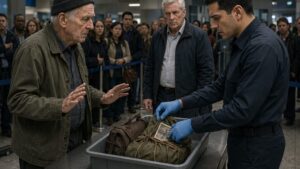
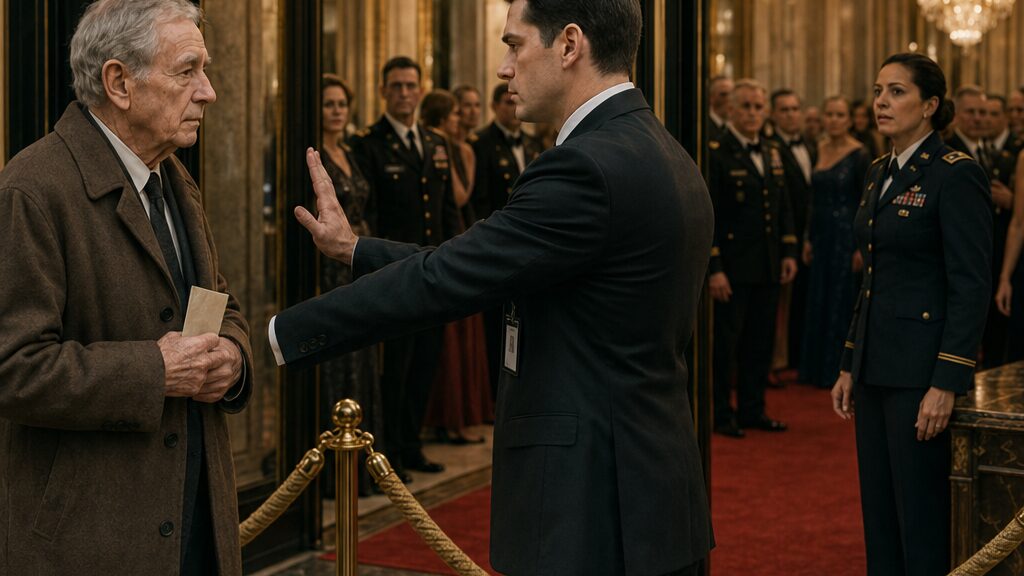
The young man in the black suit put his hand up before William Lewis could step over the gold rope.
It was not a hard gesture. Not violent. Not even angry. Just a flat palm in the air, polished cuff showing beneath a tailored sleeve, the kind of gesture used for taxis, waiters, and people expected to stop without asking why.
William stopped.
Behind the young man, the gala hall glowed as if someone had poured warm light over marble. Chandeliers hung above the red carpet in bright tiers. Gold stanchions marked the entrance path. Uniformed officers moved between donors in dark gowns and dinner jackets. A photographer’s flash caught the silver rims of glasses and the shine of polished shoes.
William stood on the other side of the rope in his old brown coat.
It had been brushed that afternoon. He had done it carefully, standing in front of the narrow mirror by his apartment door, working the clothes brush over the shoulders until the nap lay flat. But age had a way of staying in cloth. The elbows were softened. The collar kept the faint bend of years. One button was newer than the others.
In his left hand, he held a folded invitation card.
The card was cream-colored once, maybe. Time had made it closer to bone. Its corners had gone soft from being taken out, looked at, put away, and taken out again. William kept his thumb along the fold, not tight enough to crease it further, not loose enough to let it fall.
“Sir,” the young man said, “this entrance is for registered honorees and VIP guests.”
William looked at the badge clipped to the man’s lapel.
Scott Perez. Access Manager.
“I was asked to come,” William said.
His voice was low enough that the couple behind him leaned slightly to hear and then decided not to. The woman glanced at his coat, then at the rope. The man adjusted his cuff links.
Scott’s eyes dropped to the invitation in William’s hand. “May I see that?”
William held it out.
Scott took it between two fingers, as though old paper could stain him. He unfolded it halfway, scanned the front, then frowned.
“This isn’t the current design.”
“No,” William said. “It wouldn’t be.”
Scott looked up. “Excuse me?”
“It was sent some time ago.”
The line behind William shifted. A donor in a navy tuxedo looked over the gatekeeper’s shoulder. Somewhere deeper inside the hall, a string quartet changed pieces, the music rising in a polished, practiced swell.
Scott turned the card over, as if the correct answer might be printed on the back. “There’s no QR code.”
William waited.
“No digital confirmation,” Scott added.
“I don’t carry one.”
“A phone?”
“A confirmation.”
Scott gave him a brief, professional smile that did not reach his eyes. “Sir, everyone was confirmed in advance. If your name is not in the system, I can’t allow you through this entrance.”
“You can check the name again.”
“I did not get your name.”
William held out his hand for the card. Scott did not return it immediately.
“Lewis,” William said. “William Lewis.”
Scott tapped the tablet in his other hand. His fingers moved quickly. William noticed the speed of them, the impatience in the small motions. The young man wore a watch with a dark face and a silver band. It caught the chandelier light each time he lifted his wrist.
Scott’s expression flattened. “I have several Lewises attending tonight, but no general admission under that name.”
“I’m not general admission.”
A man behind William made a small sound, half cough, half laugh. Scott heard it. His jaw tightened.
“Sir, this is not a public veterans’ dinner. This is a foundation gala with assigned seating.”
William looked past him, into the hall.
At the far end, a stage had been set beneath a blue velvet curtain. A podium stood at its center. Beside it was an empty chair with a reserved card on the seat, though from this distance William could not read the name. On the left side of the room, beyond the columns, he saw a memorial exhibit wall washed in soft white light. Photographs in black frames. Dates in brass. Faces from another life.
He lowered his eyes before memory could sharpen.
“I know what it is,” he said.
Scott stepped slightly to the side, closing the space between William and the open entrance. The gesture was small, but everyone nearby understood it.
“Then you understand why I have to be careful.”
William reached for the card again. “That belongs to me.”
Scott glanced down at it. For one moment, William saw the old handwriting inside the fold, not fully revealed. A few words, slanted and faded. Scott saw them too, but they meant nothing to him.
“Sir,” Scott said, lowering his voice, “where did you get this?”
The couple behind William went quiet.
William looked at Scott then. Not sharply. Not with anger. He had looked at worse men under worse lights, in rooms where the air shook and maps changed by the hour. He had learned long ago that anger spent itself quickly. Silence, used correctly, lasted longer.
“It was given to me,” he said.
“By whom?”
William did not answer.
Scott’s face showed the first sign of irritation. “This appears to be an old commemorative invitation. It may have value as a keepsake, but it does not grant entry tonight.”
“Has the seating office been asked?”
“I am the access manager.”
“That is not what I asked.”
The words were calm, but something in the line behind him changed. The donor in the navy tuxedo stopped pretending not to listen. The woman beside him glanced toward Scott.
Scott straightened. He was young enough to believe posture could settle truth.
“I’m going to ask you to step aside so we can continue admitting confirmed guests.”
William folded his fingers once, carefully, against his palm. The card still rested in Scott’s hand.
“My card,” William said.
Scott looked down as if surprised he still held it. He handed it back, but not with apology.
William took it and placed it inside his coat, against the inner pocket.
The coat had been Shirley’s choice.
Not for tonight. Years before tonight. She had once stood in a small department store, holding two coats against him while he pretended not to care which one she liked better. The brown one, she had said, because it makes you look less like someone who’s about to give orders. He had worn it until the lining frayed.
Now the lining brushed the back of his hand as he pushed the invitation into place.
“Sir,” Scott said, “please move to the side.”
William did.
Not because Scott had earned obedience. Not because the gold rope had authority. He moved because the doorway was narrow, and the people behind him had places to be, and Shirley had never liked scenes.
He stood near a marble column beside the coat-check table. The attendant there looked at his coat, uncertain whether to offer a ticket. William gave the attendant a faint nod, saving them both the discomfort.
The guests resumed their flow. Perfume and wool and polished leather passed him. Snatches of conversation drifted by.
“Is that the exhibit?”
“I heard there are generals here tonight.”
“Major donors from three states.”
“Beautiful program this year.”
William kept his hands still.
Scott admitted a couple with bright badges and then a retired officer in dress uniform. His smile returned for them. He laughed at something the retired officer said. He unclipped the rope with both hands and held it aside.
William watched the gesture.
He did not feel envy. That would have been too simple. What he felt was older and more tiring: the slow recognition that a room could be built around memory and still fail to recognize a living man standing three feet away.
A photographer lifted his camera toward the entrance, then lowered it when he saw William at the column. Not the image they wanted, William supposed.
The string music softened. A bell chimed once from inside the hall.
William drew the folded card from his pocket just enough to feel its edge. He did not open it. He did not need to. He knew the handwriting by the pressure of it.
Come if you can. Not for them. For the ones they forgot.
Shirley had written those words on a small slip and tucked them into the invitation before the first gala, years earlier, when William still had reasons not to attend. After she died, the card had remained in a drawer under his service watch, waiting like an unanswered order.
He had come because promises did not expire.
Across the entrance, a woman in dress uniform turned from a conversation near the donor table. Silver eagles shone on her shoulders. Her hair was drawn back cleanly. She had the practiced stillness of someone who noticed exits without looking for them.
Her gaze moved over Scott, the gold rope, the line of guests, and finally settled on William.
For a moment, she only seemed concerned.
Then William’s hand shifted, and the folded card caught the chandelier light.
The woman’s face changed.
She stepped away from the donor table so quickly that the officer beside her stopped mid-sentence.
William slipped the card back into his coat.
But she had already seen enough.
Chapter 2: The Officer Who Noticed The Fold
Amanda Rivera had seen hundreds of old invitations, commemorative cards, unit programs, folded letters brought to ceremonies by people who needed history to touch something they could hold. Most were tender. Some were inaccurate. A few were desperate.
The one in the old man’s hand made her stop breathing for half a second.
It was not the paper.
It was the line visible inside the fold before he tucked it away.
Three words, written in faded ink at a slant.
Hold until dawn.
Amanda had first read those words at twenty-six, long before anyone called her colonel, in a training archive no one else in the room had cared about. The phrase had appeared in an after-action fragment from an evacuation operation whose public name sounded clean and official, but whose surviving records carried smoke around the edges.
Operation Lantern Field.
Tonight’s gala was built around it.
Amanda crossed the marble floor toward the side corridor, keeping her pace controlled. She did not want to startle the old man. She did not want to give Scott Perez the satisfaction of thinking she was hurrying toward a problem he had already solved.
Scott saw her coming and straightened.
“Colonel Rivera,” he said, smiling too quickly. “Good evening. Is everything all right?”
Amanda looked past him. The old man stood beside the coat-check table with his hands folded loosely in front of him. He was studying the room, not like a guest wanting attention, but like a man measuring whether a place had changed beyond recognition.
“Who is he?” Amanda asked.
Scott glanced over his shoulder. “Unconfirmed attendee. I’ve asked him to step aside.”
“That wasn’t my question.”
Scott’s smile thinned. “He gave the name William Lewis, but he’s not registered under general admission. He has an old invitation. No digital confirmation. No current credential. It looked copied, frankly.”
Amanda kept her eyes on the old man.
William Lewis.
The name struck somewhere deeper than memory. She had seen it tonight already, printed in embossed navy ink on the program at her table. She had not studied it closely because names like that occupied ceremonial space until the living person appeared.
General William Lewis. Honored guest.
But the man at the column wore an old brown coat and stood alone.
Amanda turned back to Scott. “Did you check VIP seating?”
Scott’s face tightened. “The VIP list is on a separate tablet with the foundation director. My instructions were clear. No badge, no entry.”
“Did you ask the seating office?”
“I followed the access protocol.”
“That is not the same thing.”
The words were quiet enough not to carry into the hall. Scott heard the rebuke anyway. Color rose under his collar.
“With respect, Colonel, we have donors, senior officers, and press coming through this entrance. People try to use old memorabilia to get close to these events. It happens.”
Amanda looked at him for a long second.
Then she walked to William.
He saw her coming and turned slightly, not quite facing her full on. There was no surprise in his eyes. Only patience, and something guarded beneath it.
“Sir,” Amanda said, “may I ask about your invitation?”
Scott moved closer, but Amanda lifted one hand without looking at him. He stopped.
William studied her uniform first. Not admiringly. Not ceremonially. Precisely. Unit ribbons, shoulder marks, posture, eyes. Amanda felt, with sudden discomfort, that she had been read more accurately in that single glance than she had read him.
“You may ask,” he said.
She accepted the distinction. “May I see it?”
William did not immediately reach for the card. His hand rested over the inside of his coat.
“What are you looking for, Colonel?”
“My answer depends on what I find.”
A faint line appeared at the corner of his mouth. Not a smile. Almost.
“That is usually true.”
He drew out the folded card and gave it to her.
Amanda took it with both hands.
The paper was softer than she expected. Old, but not neglected. It had been kept carefully, maybe too carefully. On the front, the foundation seal appeared in an earlier design, the eagle less stylized, the lettering slightly faded. The printed date was from the first Lantern Field commemoration, years before this annual gala had become a donor showcase.
She opened the fold.
Inside, beneath the formal text, someone had written in dark blue ink:
Hold until dawn. Bring them all home.
Amanda’s finger stopped on the first word.
Scott leaned in. “See? It’s not even standard printing.”
Amanda did not answer him.
In the archive, the phrase had appeared in a field transmission attributed only to Command Lead. It had been sent after a landing zone was compromised and evacuation aircraft were ordered to circle in blackout conditions. The official summary reduced it to a delay. The human accounts called it the longest night of their lives.
Hold until dawn.
Amanda had used those words once in a lecture to young officers who thought command meant being obeyed. She had told them command meant deciding who waited, who moved, and who carried the cost after.
Her throat tightened.
“Where did you get this?” she asked, then hated that her question echoed Scott’s.
William looked down at the card, not at her.
“It came to my house.”
“For the first commemoration?”
“Yes.”
“And you kept it all this time?”
“My wife did.”
The answer landed softly, but Amanda heard the closed door behind it.
Scott shifted his weight. “Colonel, old invitations are exactly why we have current registration procedures.”
Amanda folded the card halfway, enough to protect the handwriting but not hide it from herself.
“Mr. Lewis,” she said carefully, “were you expected tonight?”
He looked toward the hall. “That depends on what they remember.”
Scott exhaled through his nose, impatient now. “This is exactly the kind of vague answer that makes verification impossible.”
William turned to him then.
There was nothing sharp in the movement, nothing theatrical, but Scott took half a step back before he caught himself.
“Young man,” William said, “verification was not impossible. You chose not to begin it.”
For the first time, Scott had no quick answer.
Amanda felt the corridor narrow around them. Guests continued to pass in the main entrance, unaware that the air had changed beside the coat-check table. The attendant pretended to sort hangers. A junior staff member slowed, then hurried on.
Amanda handed the card back to William.
“I’m going to check something,” she said.
“I imagine you are.”
“Would you wait here?”
“I’ve waited in worse places.”
The line was spoken without bitterness. That made it worse.
Amanda turned back toward the hall. Scott followed close enough to speak under his breath.
“Colonel, I need to keep this entrance clear. If he’s confused, we can have someone escort him to the public reception desk.”
Amanda stopped.
“He is not confused.”
“You don’t know that.”
“No,” Amanda said. “But I know you don’t either.”
Scott’s jaw worked once.
Inside the hall, the lights dimmed slightly over the dining tables. The string quartet faded. The master of ceremonies stepped toward the podium, smiling into a microphone as conversations settled into a low hush.
Amanda could see Kathleen Green near the stage, one hand pressed to her earpiece, the other holding a program folder. The empty chair beside the podium remained waiting under a small white card.
Amanda opened her own program.
There it was.
Honored Keynote Guest: General William Lewis.
Her eyes moved from the printed name to the side corridor, where the old man stood with his brown coat buttoned and the folded invitation resting in his hand.
Onstage, Kathleen Green stepped to the microphone.
“Ladies and gentlemen,” she said, her voice bright but strained, “thank you for your patience. We are still awaiting the arrival of tonight’s honored guest.”
Amanda looked at Scott.
He was still watching the entrance, still guarding the rope.
Chapter 3: The Empty Seat Beside The Podium
Kathleen Green had learned to smile through delay.
A late donor, a missing microphone, an officer stuck in traffic, a seating dispute between two men who both believed proximity to the podium measured national importance—these were ordinary disturbances. A good foundation director absorbed them without letting the room feel the bruise.
But the empty chair beside the podium was not ordinary.
It sat under the stage lights with a small white card on its seat, angled toward the room.
General William Lewis.
Kathleen had checked that card twice before the doors opened. She had checked the program proofs three times in the week before. She had confirmed with the outreach office, the veteran liaison, the board chair, and the transportation coordinator. The general was elderly. He preferred no escort. He had declined the hotel room, the car service, the press interview, and the pre-gala reception.
A man that private, she had told the board, deserved careful handling.
Now careful handling had become an empty chair.
Kathleen stood at the microphone beneath the blue velvet curtain and felt the room watching her smile.
“While we wait,” she said, “I invite you to enjoy the first portion of the Lantern Field memorial exhibit in the east gallery. Tonight’s program honors the courage, discipline, and sacrifice of those whose service made this foundation possible.”
The sentence was polished. It had sounded better in rehearsal.
Guests nodded. Some turned toward the exhibit. Others glanced at the empty chair with the alert politeness of people smelling trouble beneath perfume.
Kathleen stepped away from the microphone and motioned to the master of ceremonies to continue with the short video introduction. The hall darkened further. On the screen behind the podium, archival footage began: aircraft silhouettes, grainy maps, a flag at half-mast, young faces in old photographs.
Operation Lantern Field.
Kathleen had built this year’s gala around that name because donors responded to stories with shape. The operation had danger, rescue, secrecy, a clean anniversary, and one living commander who had never sought attention. The board loved that phrase: living commander. It gave the evening urgency.
If only the living commander had arrived.
A staff member hurried toward her from the side aisle. “No update from transportation.”
“He refused transportation.”
“I know, ma’am, but we checked anyway.”
“Phone?”
“No answer.”
Kathleen pressed her fingers lightly to the folder in her hand. Inside were her remarks, the award citation, and a revised seating chart. “Keep trying.”
Across the hall, Colonel Amanda Rivera stood near the entrance with unusual stillness. Beside her, Scott Perez looked rigid.
Kathleen noticed that because she noticed everything near doors. Doors made or broke events.
She crossed toward them, weaving between tables without appearing to hurry. The video narration spoke over the hall in a deep, respectful tone.
“In the final hours of the operation, command decisions made under impossible conditions allowed hundreds to reach evacuation points before dawn…”
Kathleen reached Amanda as the screen flashed to a black-and-white photograph of a field command tent.
“Colonel,” Kathleen said softly. “Is there a problem at the entrance?”
Amanda did not answer at once. Her eyes were fixed on the printed program in her hand.
“Kathleen,” she said, “who confirmed General Lewis tonight?”
Kathleen blinked. “The outreach office. Then my office. Why?”
“Did anyone meet him in person?”
“No. He requested no public handling.”
Scott spoke quickly. “We have a gentleman outside the rope claiming that name, but he does not have current credentials.”
Kathleen turned to him. “Claiming what name?”
“William Lewis.”
The noise of the room seemed to draw back.
On the screen, the video showed a younger officer in a blurred archival image, face turned partly away, one hand braced on a radio table. The narrator continued, unaware of the small crisis forming under the chandeliers.
Kathleen looked toward the side corridor.
An old man stood there beside the coat-check table, brown coat buttoned, shoulders slightly stooped, hands still. He was not watching the video. He was watching the memorial exhibit beyond the columns.
“That man?” Kathleen asked.
Scott lowered his voice. “He had an outdated invitation, no badge, no digital confirmation, and he would not explain where he got it.”
Amanda’s face tightened. “He explained enough for us to check.”
Kathleen felt irritation prick through her anxiety. “Scott, why wasn’t I called?”
“I was managing access according to protocol.”
“Protocol for unlisted guests,” Amanda said. “Not for the name printed on the honored chair.”
Scott’s expression changed. Not collapse, not yet. Defensiveness came first. “There was no way to know he was that William Lewis. We have donors using family names all the time. People hear about an honoree and try things.”
Kathleen barely heard him after that.
She was looking at the old man’s coat.
Not because it proved anything. It proved nothing. That was the discomfort. She had expected a retired general to arrive in a dark suit, perhaps with a lapel pin, perhaps leaning on the arm of an aide. She had expected old authority to announce itself in some acceptable visual form.
The man by the coat-check table looked like he might have taken two buses and walked the final block.
Kathleen hated herself a little for thinking it.
“What did he show you?” she asked.
Scott hesitated. “An old invitation.”
Amanda held up her program. “With a phrase inside it. Hold until dawn.”
Kathleen’s eyes moved sharply to Amanda.
The phrase belonged to the exhibit script. Not the public brochure. Not the donor materials. It appeared in one restricted archive excerpt they had received permission to paraphrase, not display. The board historian had called it the moral spine of the operation.
“How would he have that?” Kathleen asked.
Amanda did not answer. She did not need to.
For a moment, Kathleen saw the evening from outside herself: the red carpet, the gold rope, the old man set aside, the printed name waiting in the empty chair. The shape of disaster was almost elegant.
She turned to Scott. “Bring him in.”
Scott glanced at the room. “Now?”
Kathleen’s voice sharpened. “Yes, now.”
But Amanda was still looking at the program, then at the card barely visible in William’s hand.
“Wait,” Amanda said.
Kathleen stared at her. “Colonel, if that is General Lewis—”
“If it is,” Amanda said, “then we have already made one mistake by treating him as a problem to move. Let’s not make another by treating him as a schedule correction.”
The words stopped Kathleen more effectively than any raised voice.
The video ended. Applause rose across the hall, polite and full, filling the space where certainty should have been. Guests began to stand and drift toward the exhibit gallery. The donor group nearest the entrance turned in the same direction.
Toward William.
Kathleen looked at the old man again. He had not moved. His gaze rested on the memorial wall, where the first guests were now gathering under the brass title.
Operation Lantern Field: The Night They Held Until Dawn.
Amanda stepped toward Scott.
“What name,” she asked, each word quiet and exact, “did he give you?”
Scott looked from Amanda to Kathleen, then toward the old man at the edge of the light.
His answer came out smaller than before.
“William Lewis.”
Chapter 4: The Name Missing From The Wall
William did not enter the main hall when Kathleen Green looked his way.
He stepped instead toward the exhibit corridor, where the light was softer and the carpet swallowed sound. Guests moved past him in small currents, holding champagne glasses and folded programs, their voices lowered out of respect for the photographs along the wall. No one stopped him now. No one had opened the rope either. He had simply moved when the crowd moved, unnoticed in the flow.
That suited him.
The memorial wall began with a brass title.
Operation Lantern Field: The Night They Held Until Dawn.
William stood before it with the folded invitation inside his coat and read the words as if they belonged to someone else’s memory.
There were photographs beneath the title. Some had been enlarged until the grain blurred the edges of faces. Young soldiers standing beside transport aircraft. A temporary command tent under canvas. A line of civilians with blankets around their shoulders. A medic kneeling beside a child. A map under glass, its routes marked by arrows clean enough to make the night look orderly.
It had not been orderly.
The guests around him admired the wall with soft sounds.
“Powerful.”
“I never knew this part.”
“Such bravery.”
William kept his eyes on the photographs.
A caption beneath one image read: Evacuation teams coordinate final movements under hostile conditions.
Coordinate.
He almost smiled at that. Not because it was wrong, exactly. Words like that were often chosen by people who came after. They made terror sit politely on a plaque.
His hand drifted to the inside of his coat.
The card was still there. So was the narrow sealed envelope tucked behind it, thinner than his finger, its paper worn at the edges from the years he had not opened it in public. Shirley had written the names with him at the kitchen table the winter after the first invitation arrived. The two of them had sat under a yellow lamp with records, letters, clippings, and old notes spread between their coffee cups.
“You can’t carry them all by staying home,” she had said.
“I can’t make them clean up what they chose to leave out.”
“You don’t have to make them clean. Just don’t let them call the room complete.”
She had not pushed after that. Shirley rarely pushed. She placed words where he could find them later, then waited for him to decide whether he was brave enough to pick them up.
William moved along the wall.
There was a photograph of the first aircraft that made it out. He knew the tail number before he read the caption. He knew the pilot had sung under his breath when nervous, though no exhibit would say that. He knew the young radio operator visible at the left edge of the image had lied about his age to enlist. He knew the woman wrapped in a blanket at the bottom of the frame had refused to leave until her brother was carried beside her.
The wall remembered some things.
Not enough.
At the center of the exhibit stood a vertical panel titled Command Decisions. William stopped before it. The text praised senior leadership, rapid coordination, disciplined restraint. There were three names in bold: two headquarters officials and one field commander who had given a public interview years later.
William read the paragraph twice.
His own name was not there.
That did not trouble him as much as it should have.
Below the command panel, a second list honored “key personnel and recognized participants.” The names were arranged in neat columns. William found some he expected. He found others placed higher than they had earned, but that was an old habit of institutions. Men near clean desks often appeared nearer the center of history.
Then he saw the empty space where the others should have been.
Not a literal empty space. There was no blank line, no visible wound. The absence was worse because the wall had been designed to look finished.
He read the list again.
The night crew from Ridge Point was missing.
The local guides were missing.
The two volunteer drivers who had run the road after artillery began falling were missing.
The medic who stayed behind to mark the second route was missing.
The radio operator who sent the final transmission was missing.
Hold until dawn.
William closed his eyes for one beat.
The room around him became too polished. The air carried citrus from drinks and beeswax from the floors. Somewhere behind him, donors murmured over the cost of the floral arrangements. A photographer told a group to shift closer together.
He opened his eyes.
A reflection in the glass showed him an old man in a brown coat, smaller than the uniformed portraits around him. He looked tired. That, at least, was accurate.
He drew out the folded invitation.
The paper opened with the faint resistance of something that remembered being shut. Inside, Shirley’s small note lay against the old printed script. He had read it before leaving home, then again on the bus, then once outside the building while standing under the winter-blue evening sky.
Come if you can. Not for them. For the ones they forgot.
Behind the note was the sealed roster.
Shirley had written the names on the envelope in her careful hand.
For the wall, if anyone still has the courage to add them.
William touched the ink with one finger.
He had commanded men who mistook obedience for courage. He had known politicians who mistook speeches for duty. He had also known clerks, drivers, medics, cooks, interpreters, mechanics, and frightened young soldiers who did what had to be done while important people argued over what to call it afterward.
A guest beside him leaned forward to read the command panel.
“General Lewis is supposed to speak tonight,” the guest said to someone just behind him. “They say he never gives interviews. Very private.”
“Is he here?”
“Not yet, I think.”
William folded the invitation slowly.
A child might have laughed at the timing. Shirley would have lifted one eyebrow and waited for him to decide whether irony was useful.
He slipped the note and envelope back into the fold, then placed the card in his coat.
At the far end of the corridor, Scott Perez appeared between two donors. His black suit made a clean line against the pale wall. He was looking for someone, and when his eyes found William, his mouth tightened with relief and annoyance at once.
William did not move.
Scott approached quickly, lowering his voice only when he was close enough for the guests not to notice.
“Sir, you can’t be in this exhibit area without clearance.”
William looked at the wall, then at Scott. “I was invited to this room.”
“We’re resolving that. Until then, I need you to return to the side corridor.”
“Why?”
“The donor tour is about to begin, and this area needs to remain clear.”
“It is clear.”
Scott glanced over his shoulder. A few guests were watching now. Not openly. People at galas knew how to watch while pretending to study photographs.
Scott stepped closer. “Please don’t make this difficult.”
William heard the strain under the formal wording. The young man was not enjoying this. He was afraid of losing control of an evening measured in rules he had been hired to enforce. William understood that kind of fear. He did not excuse what fear made a man do.
“I am not making it difficult,” William said.
“You are standing in a restricted exhibit after being asked to wait.”
“I was looking at the names.”
Scott looked toward the wall, then back. “The names will still be here after we verify your status.”
“No,” William said. “That is the problem.”
Scott stared at him.
For one unguarded moment, confusion broke through the man’s practiced authority. It almost made him look young enough to forgive.
Then he recovered. “Sir, I don’t know what that means. I need you to come with me.”
William’s hand settled over the inside pocket of his coat. He could give Scott the envelope. He could say the words. He could end the performance and watch the young man’s face drain.
He did none of those things.
A title used as a weapon became smaller in the hand that held it.
“Mr. Perez,” William said, “have you ever read the wall?”
Scott blinked. “What?”
“This wall. Have you read it?”
“I’m working the event.”
“That was not my question.”
Scott’s face reddened, the same way it had at the entrance. “I don’t have time for this.”
“No,” William said softly. “Most people don’t.”
The words landed harder than he intended. Scott’s eyes flicked toward the watching guests.
William regretted the edge in his voice. Not because Scott had not earned it, but because Shirley would have noticed.
He drew a slow breath.
“I’ll wait where you asked,” William said.
Scott seemed surprised by the sudden compliance. He stepped aside, gesturing toward the corridor entrance.
William walked past him, but stopped beside the command panel one last time.
Under the glass, the official text gleamed without error, without apology.
He looked at the list of names that were there, and at the space history had filled too neatly around the ones that were not.
Then he turned away.
At the corridor entrance, Amanda Rivera stood with Kathleen Green. Amanda’s eyes moved from William’s coat to the memorial wall to Scott’s outstretched arm.
Kathleen’s expression carried calculation, alarm, and courtesy arranged into a professional mask.
“Mr. Lewis,” she began.
Before William could answer, Scott spoke from behind him, crisp and low.
“Ma’am, he needs to leave this area before the donors enter the exhibit wing.”
William looked at Kathleen.
Then at Amanda.
Then he felt the old envelope inside his coat, thin as a final chance.
Chapter 5: When The Photograph Answered The Room
Amanda Rivera did not move when Scott said the old man needed to leave.
She watched William’s hand instead.
It rested over the inside of his brown coat, not defensively, not nervously. Protectively. Whatever he carried there mattered more to him than the room, more than the insult, maybe even more than whether anyone believed his name.
Kathleen Green recovered first.
“Scott,” she said, each syllable smoothed for the benefit of the nearby guests, “please give us a moment.”
Scott’s eyes flicked to the donors beginning to gather at the exhibit entrance. “Ma’am, the tour is scheduled—”
“A moment.”
He stepped back, but Amanda could feel the argument still running through him.
Kathleen turned to William with her director’s smile, gentler now and late by several minutes. “Mr. Lewis, I apologize for the confusion. We are trying to verify—”
“You should do that,” William said.
Kathleen’s smile faltered.
Amanda looked at him. His face had not changed much since the doorway. That was what unsettled her. Men who wanted recognition leaned toward it. Men who feared exposure backed away from it. William Lewis seemed to be standing exactly where some inner order had placed him.
“Sir,” Amanda said, “the phrase in your invitation. Hold until dawn. Do you know where it came from?”
William’s eyes met hers.
The gala noise softened behind them. The guests at the edge of the corridor pretended to study the first panel while listening.
“Yes,” he said.
Amanda waited.
He offered nothing more.
Kathleen clasped the program folder against her waist. “Mr. Lewis, if you are the General William Lewis listed in tonight’s program, we need to know immediately.”
William glanced toward the empty chair visible through the open hall doors. “Do you?”
Kathleen drew a breath, and Amanda saw irritation flash beneath her worry.
“Yes,” Kathleen said. “Because this evening has been arranged to honor General Lewis and the operation he commanded.”
William turned back to the memorial wall. “Then perhaps the evening can wait long enough to remember the operation correctly.”
The words were not loud. They traveled anyway.
Scott’s posture stiffened. Kathleen’s lips parted, then closed.
Amanda felt the shape of the answer before she had proof, but feeling was not enough. Not here. Not after what had already happened.
She stepped toward the central exhibit panel.
The archival photograph from the introductory video had been reproduced there under glass, larger and clearer. A field command tent. A radio table. Men in rolled sleeves and tired eyes. At the center, a younger officer stood half-turned toward the camera, his face lean, his jaw set, one hand braced over a map.
Amanda had passed that photograph earlier and accepted it as history.
Now she looked at the old man standing six feet away.
Time had changed the face. It had folded the skin, narrowed the shoulders, whitened the hair. But it had not altered the line of the brow, the set of the mouth, or the way his eyes seemed to measure the room without asking permission from it.
Amanda stepped closer to the photograph.
There was a small caption beneath it.
Unidentified command staff, Lantern Field forward coordination site, final evacuation phase.
Unidentified.
A pressure formed behind Amanda’s ribs.
“Kathleen,” she said.
Kathleen came to her side.
Amanda pointed to the younger officer in the image, then looked back at William.
Kathleen followed the line of her finger.
For a moment, she did not understand. Then her face changed so completely that Scott took a step forward.
“No,” Kathleen whispered.
Amanda did not know whether the word meant disbelief or shame.
Kathleen opened her program folder, pulled out the citation sheet, then fumbled for her phone. “The archival index,” she said to no one. “There’s a file number. We requested the higher resolution image from the repository. There should be a metadata sheet.”
Scott’s voice came tight behind them. “A resemblance doesn’t prove—”
Amanda turned.
He stopped.
Not because she outranked him. Not only that. Because something in her face must have shown him that the evening had moved beyond access protocol.
Kathleen had the phone to her ear now, speaking in a low rush to someone from the foundation office. “Pull the Lantern Field exhibit file. The command tent image. I need the original caption metadata, not the donor display caption. Yes, now.”
William remained beside the wall, silent.
Guests had begun to notice that the tour was no longer moving. The photographer lowered his camera. The master of ceremonies looked from the podium toward Kathleen, uncertain whether to fill the pause.
Amanda approached William with the photograph still in her peripheral vision.
“Sir,” she said, quieter now, “why didn’t you tell him?”
William looked at Scott, then back to Amanda.
“Tell him what?”
“That he was stopping the man this event was waiting for.”
A few people heard. A murmur moved outward, soft but fast.
Scott’s face drained, then flushed again. “Colonel, with respect, that has not been verified.”
William turned toward Scott fully.
Amanda expected anger now. Anyone would have understood it. The old man had been stopped, questioned, set aside, then nearly removed from an exhibit dedicated to his own command.
Instead, William looked almost sad.
“You are still waiting for permission to be decent,” he said.
Scott’s mouth opened. Nothing came out.
Kathleen returned, phone pressed to her ear, eyes fixed on William. Whatever she heard on the line made her straighten.
“Say that again,” she said.
The hall seemed to hold its breath.
Kathleen lowered the phone slowly. “The repository’s original metadata identifies the officer in the command tent photograph as Major General William Lewis, field command lead, Operation Lantern Field.”
The words did not strike loudly.
They removed sound.
The string quartet had stopped. The room’s polite conversations thinned into silence. Heads turned from the tables, from the exhibit, from the entrance. Someone near the front of the hall whispered, “That’s him?”
Scott looked at the photograph, then at William, then at the folded edge of the invitation visible inside the old coat.
Amanda saw the exact moment he understood—not all of it, not the history, not the cost, but enough. His shoulders lowered by a fraction. The authority he had worn like a fitted jacket no longer fit.
Kathleen swallowed. Her voice was careful now, too careful. “General Lewis.”
William’s eyes closed briefly at the title.
Not in pride.
In weariness.
“Mr. Lewis is fine,” he said.
Kathleen looked as if she had been corrected in front of the entire room, which she had. But the correction was gentle, and that made it harder to defend against.
Amanda stood straighter. She did not salute. Not yet. The moment felt too fragile for ceremony, too human for a gesture that might turn it into theater.
“Sir,” she said, “I owe you an apology.”
“No,” William said. “You asked a question.”
His eyes moved to Scott.
Amanda did not follow his gaze at first. She heard Scott’s breath, shallow and uneven.
“Mr. Lewis,” Scott said, then stopped. He tried again. “General—”
William lifted one hand slightly.
Scott fell silent.
Kathleen stepped into the space before more people could gather. Her professional instincts returned, though changed now by panic. “General Lewis, we can correct this immediately. Your seat is ready. The audience is waiting. We can escort you to the podium and adjust the remarks.”
William looked past her to the memorial wall.
The command photograph stared back through glass, younger and unfinished.
“Your wall calls me unidentified,” he said.
Kathleen glanced at the caption as if seeing it for the first time. “That was an archival error. We can fix that.”
“There are larger errors.”
Kathleen’s face tightened. “Of course. We can discuss any concerns privately after the program.”
William’s hand moved to his coat.
This time, he drew out not only the folded invitation but the narrow sealed envelope tucked behind it. The paper bore Shirley’s handwriting.
Amanda saw Kathleen read the words on the outside.
For the wall, if anyone still has the courage to add them.
Kathleen’s expression shifted again. Less fear now. More understanding, and with it a deeper fear.
“What is that?” she asked.
“Names,” William said. “People your wall forgot.”
The silence around them changed texture. Before, it had been shock over identity. Now it was something more uncomfortable.
Kathleen glanced toward the room full of donors and officers. “General Lewis, this is important. I don’t doubt that. But we are in the middle of a live program.”
“I know.”
“We can honor those names properly once we verify the documents.”
“You verified me when it became embarrassing not to,” William said. “Verify them before it becomes convenient to forget them again.”
The words carried just far enough.
Amanda saw several officers lower their eyes.
Scott stood near the gold rope, no longer blocking anything, his hands hanging uselessly at his sides.
Kathleen looked toward the podium. The honored chair waited beneath the lights. The room waited too, not with celebration now, but with the strained attention of people who understood they had entered a story at the wrong moment and might not like their role in it.
“Please,” Kathleen said, softly enough that only those near her heard. “Take your seat. Let us restore the evening.”
William looked at the chair.
Then he looked at the wall of photographs, at the polished captions, at the missing names hidden behind the envelope in his hand.
“No,” he said. “Not yet.”
Kathleen’s face went still.
William held the folded card and sealed roster against his coat, the old paper trembling only slightly between his fingers.
“I did not come for the chair,” he said.
Chapter 6: The Speech He Refused To Give
The podium was taller than William remembered podiums being.
Or perhaps he had become shorter around the years.
He stood behind it with the folded card resting flat beneath his right hand. The sealed envelope lay beside it, Shirley’s handwriting facing up. The microphone had been adjusted twice by the master of ceremonies, who approached him with the careful movements people used around old objects and unexploded things.
William had not wanted the stage.
Kathleen had offered a private room first, then a corrected introduction, then a revised award presentation. Each offer had been framed as respect. Each one had also been a way to place the damage where it could not stain the tablecloths.
William had listened. Then he had asked whether the microphone worked.
Now the hall looked back at him.
The chandeliers shone over dress uniforms, dark suits, pearl earrings, folded hands. Scott stood near the entrance, no longer at the rope. Amanda remained near the front aisle, her cap tucked beneath one arm. Kathleen stood offstage with the folder held against her side, all her prepared remarks suddenly useless.
The empty chair beside the podium still bore his name.
William did not sit in it.
He looked down at the card.
The formal invitation text had faded at the fold. The foundation seal was old enough to look modest beside the embossed programs on the tables. Inside, Shirley’s note rested against the paper like a pulse.
He touched the edge of it once.
Then he looked up.
“I was asked to speak tonight,” he said.
The microphone carried his voice cleanly, almost too cleanly. He had spoken into worse equipment. Radios with static, field phones slick with rain, rooms where a wrong word could move men into darkness. This room listened better than any of them had, and perhaps that was why he trusted it less.
“I declined several times.”
A few people shifted. Not laughter. Just discomfort finding a chair.
“I did not decline because I was ungrateful. I declined because memory is a dangerous thing when it becomes decoration.”
Kathleen looked down.
William let the sentence settle and did not hurry to fill the room. Silence was not an enemy. Sometimes silence was the only honest witness left.
“Many of you came to honor Operation Lantern Field,” he said. “Some of you served. Some of you lost people. Some of you gave money to keep the story from disappearing. That matters.”
His hand rested over the card.
“But tonight, before I entered this hall, I stood at the door and watched a young man decide whether I belonged.”
Scott’s eyes lifted.
A rustle moved through the room. William did not look at him yet.
“That moment is not the reason I am standing here. It is only the clearest version of a mistake people make every day. We look at a coat, a face, a missing badge, a slow walk, and we decide how much respect a person has earned before they speak.”
No one moved.
William felt tired suddenly. Not weak. Tired of the old bargain between truth and comfort. He could make this easy for them. He could smile, accept the corrected introduction, allow the room to feel noble for recognizing him at last.
He had done harder things than letting a room feel noble.
He opened the sealed envelope.
The paper made a small sound that seemed to reach the back tables.
Inside was the roster. Two pages, folded once. Shirley’s handwriting marked the top margin with a date, but the names were his. He knew because some had been written with pauses between them long enough to change a man.
He unfolded the first page.
“These are the names missing from your wall.”
Kathleen closed her eyes briefly.
William read the first name.
Then the second.
Then the third.
He did not add descriptions to all of them. That would have turned remembrance into performance. But some names required one sentence because the official records had left them with less than that.
“A driver who made the road twice after being told it was closed.”
“A radio operator who stayed at the set when the roof started coming down.”
“A medic who marked the children’s route with strips from his own shirt.”
“A guide who refused a seat on the last truck because he knew another path.”
The room did not interrupt him.
Halfway through the second page, his voice roughened. He took a sip of water from the glass at the podium, though he did not remember anyone placing it there.
Amanda stood in the front aisle with her eyes fixed forward. Her face had the controlled stillness of an officer refusing to hide from an order.
When William reached the final name, he folded the pages along their old crease.
“Most of them did not hold rank anyone would put on an invitation,” he said. “Some had no uniform. Some had no country that would later claim them properly. Some made mistakes. Some were afraid. All of them helped bring people home.”
He placed the roster on top of the folded card.
“I commanded that operation. That is true.”
The room tightened at the words, as if the title they had wanted was finally being handed to them.
William did not let them have it cleanly.
“But command is not ownership. A commander does not become the story because his name is easiest to print.”
He looked toward the memorial wall beyond the columns.
“My wife kept this invitation for years. She told me if I ever came here, I should not come for myself. I should come for the ones the room had forgotten. I waited too long.”
The admission cost more than he expected. He felt it under his ribs, a dull pressure.
For the first time, his voice nearly failed.
He looked down, not from shame, but to gather the next words from the old paper beneath his hand.
“I do not blame this foundation for every omission. Records fail. People die. Files are sealed. Sometimes the truth arrives late because those who carry it are too proud, too tired, or too hurt to knock on the door.”
He lifted his eyes.
“But when someone does knock, do not ask first whether their coat is good enough.”
The sentence moved through the room like a slow opening.
Scott’s face changed.
William saw it from the podium: not the shocked embarrassment of being caught, but the beginning of something heavier. The young man was no longer thinking only about the general he had blocked. He was thinking about the old man he would have turned away even if no title had followed.
That mattered more.
Kathleen stepped closer to the edge of the stage. “General Lewis,” she said quietly, though the microphone caught it, “we will add the names.”
William turned to her.
“Not because I was a general.”
“No,” Kathleen said. Her voice shook once, then steadied. “Because they belong there.”
William nodded.
It was not absolution. It was a beginning.
A sound rose from somewhere near the back, one person starting to clap from instinct or discomfort. William lifted his hand before it could spread.
The room stilled again.
“Please don’t,” he said.
The person stopped.
William folded the roster and placed it back on the podium, but he did not return it to the envelope.
“I have heard applause in rooms that changed nothing by morning.”
No one knew where to look.
“If you want to honor Lantern Field, read the names. Fix the wall. Teach the operation without sanding down the parts that embarrass you. And when an old person stands at your door with paper you don’t recognize, begin with dignity. Verification can follow.”
His hand left the card.
For the first time that evening, he looked directly at Scott.
The young man stood near the entrance under the same chandelier light that had shone on his raised palm. His badge still read Access Manager. It looked smaller now.
Scott stepped forward, then stopped, uncertain whether he had permission to approach the stage.
William saved him from having to guess.
“Mr. Perez.”
Scott’s throat moved. “Sir.”
William did not correct the title. Not yet.
“I believe you wanted to apologize.”
Scott came down the aisle slowly. Every eye in the room followed him. By the time he reached the foot of the stage, his face was pale.
“I do,” Scott said. “General Lewis, I am deeply sorry. I didn’t know who you were.”
William let the words hang there.
Scott heard them after he said them. Amanda saw it. Kathleen saw it. The room saw it.
William leaned slightly toward the microphone.
“That,” he said, not unkindly, “is not the apology you owe.”
Chapter 7: The Door He Left Open
Scott stood at the foot of the stage with every polished shoe and uniformed shoulder in the room turned toward him.
For a few seconds, he looked like a man trying to find the correct badge for his own shame. His hands opened once at his sides, then closed. The apology he had offered lay between him and William, too small for the distance it needed to cross.
William waited.
He had learned, long ago, that silence could punish or invite. He chose invitation, though not softness. There were men on the roster who would never hear an apology. There were people whose names had been left off the wall because no one important had stood in a beautiful room and insisted.
Scott drew a breath.
“I’m sorry,” he said, and this time his voice did not reach for ceremony. “I saw an old man in an old coat, and I decided that told me enough. I treated you like you were in the way.”
The room remained still.
Scott looked down, then forced himself to look up again. “I should have checked. But before that, I should have spoken to you like you belonged at the door, whether or not your name was on my list.”
William studied him.
The young man’s face was pale, the careful confidence gone from it. What remained was not yet wisdom. That would take longer than one public mistake. But it was the beginning of discomfort without defense, and William knew there were worse places to begin.
“Yes,” William said. “That is the apology.”
Scott’s shoulders dropped as if some hidden strap had loosened.
William turned to Kathleen.
“The names,” he said.
Kathleen stepped forward without her folder. For the first time that evening, her hands were empty.
“They will be added,” she said. “Not to a temporary insert. Not to a donor update. To the permanent wall.”
William nodded once.
“And the caption?”
Kathleen looked toward the photograph of the command tent. “Corrected by morning.”
“Not only mine.”
“No,” she said. “All of it.”
He believed her enough to leave the roster on the podium.
Not completely. Complete belief was for younger men and easier nights. But he saw Amanda move to the stage and stand beside the papers as if guarding a position. He saw Kathleen signal to a staff member and send the photographer away from the foot of the steps. He saw Scott remain where he was, no longer trying to disappear.
That was enough for the hour.
William picked up the folded invitation. He separated Shirley’s note from the card and held it between two fingers.
For a moment, he thought of putting it with the roster, letting the foundation preserve it under glass with the rest. Then his thumb felt the pressure mark where Shirley’s pen had paused before the word forgot.
He slid the note back into his coat pocket.
Some things belonged to history.
Some things belonged to the living.
The gala did not recover its shine. It changed into something quieter. Guests moved through the exhibit without the easy murmur from before. Officers stood longer at the panels. Donors read names instead of glancing at photographs. At Kathleen’s request, the master of ceremonies returned to the microphone only to say that the program would pause while the foundation corrected the memorial record.
No one clapped.
William was grateful for that.
Amanda walked with him to the exhibit wall after the hall began to thin. She did not hover, but she stayed close enough to be useful if he needed an arm. He did not. Still, he did not resent the offer.
At the photograph of the command tent, Kathleen had placed a temporary card beneath the old caption. The handwriting was hers, hurried but legible.
Major General William Lewis, field command lead, Operation Lantern Field. Full corrected caption pending archival update.
Beside the missing-name panel, another temporary card had been placed.
Additional verified participants to be added to the permanent memorial record.
William looked at the phrase verified participants.
“Better than recognized,” Amanda said quietly.
He glanced at her.
She almost smiled. “Recognition comes late sometimes.”
“Yes,” he said. “It does.”
Kathleen approached with the sealed roster held carefully in a clear archival sleeve. “We’ll document the transfer properly tomorrow. For tonight, it will stay in the foundation safe. Colonel Rivera has agreed to witness.”
William looked at the pages inside the sleeve. Shirley’s envelope was no longer sealed. The names had entered the room.
“Good,” he said.
Kathleen hesitated. “General Lewis, I know this cannot undo the entrance.”
“No.”
She accepted the answer. “We will change the entrance process. Any veteran, honoree, or elderly guest without digital confirmation gets a seated verification, not a public denial. Staff will be trained to begin with assistance, not suspicion.”
William looked toward the gold rope at the end of the corridor.
It still stood where it had stood all evening, shining under soft light, innocent as every object used by people to divide one side from another.
“Make sure they understand why,” he said.
Kathleen nodded. “I will.”
Near midnight, William left the hall through the same doorway where he had been stopped.
Scott was there.
The rope had been unclipped and drawn aside. Not removed. Just opened. Scott stood beside it with his badge still on his lapel, but he did not touch the tablet until William had passed.
“Mr. Lewis,” he said.
William stopped.
Scott swallowed. “Your coat, sir.”
The coat-check attendant held it, though William had never checked it. Sometime during the evening, someone had brushed a bit of lint from the sleeve.
William took it and put it on himself.
The brown coat settled over his shoulders with familiar weight. He buttoned the middle button, the newer one, and felt Shirley’s note in the inside pocket.
Scott looked at the coat, then at William’s face. This time, he seemed to understand that the coat had not hidden the man. The room had hidden its eyes.
“Good night, Mr. Perez,” William said.
“Good night, sir.”
Outside, the air was cold. The city street shone faintly from earlier rain. Amanda offered to call a car. William declined. Kathleen offered again. He declined that too.
He stood on the exterior steps for a moment, looking back through the glass doors at the hall.
He had not come for the chair.
He had not left empty-handed.
The next morning, William returned before the gala flowers had fully wilted.
The hall looked smaller in daylight. Workers moved quietly between tables, collecting glasses and folding linens. The chandeliers were dim. Without music and perfume, the place became a room again.
Kathleen met him at the memorial wall with Amanda beside her. The corrected temporary captions had been printed overnight, plain and neat. The roster names appeared on a new panel marked Pending Permanent Installation. Not perfect. Not final. But visible.
William read every name.
He did not hurry.
When he finished, Kathleen handed him the original invitation card in a protective sleeve. “We would like to include this in the display, with your permission.”
William looked at the old paper through the clear covering. The formal text. The faded seal. The fold his thumb had worn soft over the years.
Shirley’s note was not inside it now. That remained in his coat.
“You may display the card,” he said.
Kathleen received it as if it weighed more than paper.
By the entrance, Scott was back on duty for the final morning reception. His suit looked the same. He did not.
An elderly veteran came through the doors slowly, one hand on a cane, the other holding a crumpled printout. His jacket was too thin for the weather, and his badge was turned backward on its lanyard.
Scott stepped forward.
For one sharp second, William saw the old gesture beginning to form: the hand, the stop, the rule.
Then Scott changed it.
He opened the door wider.
“Good morning, sir,” Scott said. “Let’s get you inside first. We can check that together.”
The elderly veteran blinked, then nodded with cautious relief.
William watched from beside the memorial wall.
Amanda followed his gaze. Kathleen did too.
No one said anything.
Scott held the door until the old man had crossed the threshold. Only then did he look at the printout.
William touched the inside pocket of his brown coat, where Shirley’s note rested close to his heart.
The room had not become perfect overnight.
But the door had changed.
The story has e