The Old Veteran Wouldn’t Raise His Voice When A Young Clerk Dismissed His Worn Card
Chapter 1: The Finger Pointed At The Worn Card
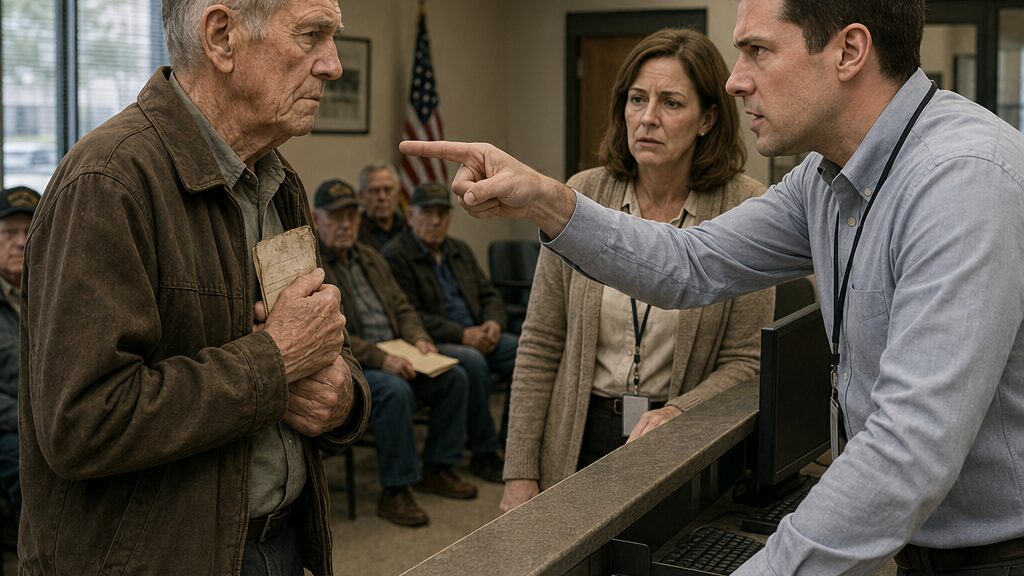
The finger stopped less than an inch from Stephen Walker’s chest.
Not touching him. Not quite. But close enough that Stephen felt the air move through the thin denim shirt beneath his worn brown jacket, close enough that the old card in his right hand trembled before he steadied it with his thumb.
“That number doesn’t exist here anymore,” Mark Adams said.
He did not shout. He did not need to. The county veterans service office had already gone quiet in the way public rooms go quiet when everyone pretends not to listen.
The ticket machine by the door hummed. A wall clock clicked over the counter. Somewhere behind the partition, a printer dragged paper through its teeth. Seven men and two women sat in the row of plastic chairs facing the service windows, each with a folder on a lap or a prescription bag at the feet. A younger applicant stood near the clipboard station, phone in hand, eyes lowered but still watching.
Stephen kept his gaze on the finger.
It was a clean finger, the nail squared and clipped, the skin smooth over the knuckle. Mark wore a dark quarter-zip with the county seal stitched over one breast and a laminated badge clipped straight at his belt. His hair was neat, his sleeves pushed up, and he carried himself like a man trying to keep an overflowing room from spilling into his own life.
Stephen understood tired people. He understood full desks. He understood the hard little voice that grew inside a man when he had too many names to process and too little time to remember any of them.
That did not make the finger lighter.
“I’m not asking you to search that screen,” Stephen said.
His voice came out soft and dry. He had meant it to carry only to Mark, but the room heard him because the room had chosen silence.
Mark glanced over his shoulder toward Janet Clark at the front desk. Janet had been standing halfway between her chair and the copy machine since the conversation changed shape. She had kind eyes and a cautious mouth, the look of someone who had survived in offices by knowing when not to interrupt.
Mark turned back. “Sir, you came in without an appointment. You brought a card from—” He looked down at the paper again, squinting, as if age itself might rub off on him. “I don’t even know from when. We can’t process a request if the file number isn’t in the system.”
“It won’t be in that system.”
“That’s exactly what I’m telling you.”
Stephen folded his left hand over his right, cupping the card between them. It was no bigger than an index card, though it had once been stiff enough to feel official. Time had softened it. The corners had rounded; one edge bore a crescent stain from a coffee cup set too close decades ago. A faded county prefix sat near the top in old blue ink, followed by numbers pressed hard enough that Stephen could still feel the indent when he ran his thumb over them.
Mark’s eyes followed the movement. “Please don’t keep handling it. If you want us to scan it, hand it over.”
Stephen looked up then.
The first thing people noticed now was what age had taken. The stoop in his shoulders. The silver stubble he missed when his hand was stiff. The slow rise from a chair. The old shoes shined in uneven patches because his right hand did better work than his left.
Fewer people noticed what age had left.
Stephen had spent half his life reading small numbers under bad light. Supply tags. transfer forms. casualty rosters. Names copied three times because a single wrong letter could leave a man’s family waiting in the wrong line. He had learned that paper was fragile, but systems were more fragile. Paper could burn, tear, stain, fade. Systems could decide you had never existed.
He placed the card on the counter.
He did it carefully, smoothing the bowed center with both thumbs before letting go. The gesture made Mark’s finger look worse, hovering over it like an accusation.
“I’m asking you to look before you decide it’s nothing,” Stephen said.
A man in the second row shifted. The vinyl chair complained beneath him. Someone coughed into a sleeve. The younger applicant stopped pretending to read his phone.
Mark’s face tightened, not in cruelty, but in the small panic of a man losing control of a line. Behind Stephen, the ticket board showed B-42. Stephen’s paper ticket, folded once in his jacket pocket, said B-37. He had been at the counter for nine minutes.
“Mr. Walker,” Mark said, pulling Stephen’s name from the sign-in sheet with a clipped patience, “I am trying to help you understand. This office cannot chase paper that predates our system because someone believes it should still matter.”
The words did not land where Mark intended.
They moved through the room, touching folders, canes, hearing aids, swollen knuckles. One elderly veteran near the water cooler dropped his gaze to the envelope in his lap. A woman with a walker closed her hand around the strap of her purse.
Stephen felt heat rise behind his ears. Shame was an old animal. It knew its way around his ribs.
He did not pick up the card.
Instead, he rested his hands flat on the counter, palms down, on either side of it. The counter was laminate, chipped along the edge. Under his left palm he could feel a place where something heavy had struck it long ago and left a dent no cleaning could erase.
“I don’t believe,” Stephen said. “I remember.”
Mark exhaled sharply through his nose. “Memory isn’t a filing method.”
“No,” Stephen said. “But sometimes it’s where a file starts.”
Janet’s eyes flickered. Not to Stephen’s face, but to the card.
Mark noticed. “Janet, can you please print Mr. Walker a new intake packet?”
Janet did not move right away.
“Janet,” Mark repeated.
She came closer to the counter, one hand still on the back of her chair. “May I see the prefix?”
Mark turned his head. “We already looked.”
“I didn’t.”
The room held itself still.
Stephen could have slid the card toward her. Instead he waited until Janet looked at him, not Mark. When she did, he gave the smallest nod.
She leaned forward without touching it. Her blouse sleeve brushed the counter. She read the faded letters once, then again, and something in her face changed from polite concern to careful attention.
“That isn’t a current claim prefix,” Mark said.
“No,” Janet said quietly. “It isn’t.”
Mark spread his hands, as if that proved his point.
Janet stayed bent over the card. “But I’ve seen this kind before.”
Stephen’s fingers curled against the counter’s edge.
The room seemed to breathe in.
Janet looked from the card to Mark, lowering her voice though everyone heard her anyway.
“This looks older than the digital system.”
Chapter 2: The Number Nobody Wanted To Enter
Mark Adams did not like being corrected in front of a full waiting room.
Stephen saw it in the way Mark’s jaw locked before he smiled. It was not a pleasant smile, but it did the work of one. It told the room there was no problem here, only procedure.
“All right,” Mark said. “We’ll take a closer look.”
He lifted the card between two fingers.
Stephen’s hand moved before he could stop it. Not fast, not dramatic, but enough that his fingertips caught one corner of the card and held it down.
Mark looked at him.
Stephen looked back.
“I’ll hold it,” Stephen said.
For one second, Mark seemed ready to pull. Then he let go. “Fine. Janet can make a copy.”
Janet brought a clear plastic sleeve from a drawer. “We don’t have to remove it from your sight, Mr. Walker.”
“Thank you.”
The words were ordinary. The gratitude behind them was not.
Mark stepped aside to let Stephen move toward the smaller intake desk beside the counter. It had two chairs, a computer monitor, and a copier on a rolling stand that shook whenever the machine warmed up. Janet sat in the staff chair. Stephen lowered himself into the visitor chair with care, keeping the card flat in his palm.
Behind them, the waiting room released its breath in small noises: folders opening, legs crossing, whispers beginning and ending when Mark looked back.
Janet typed Stephen’s name.
“Stephen Walker,” she said, reading from his driver’s license. “Date of birth?”
He gave it.
“Branch of service?”
“Army.”
“Years?”
He gave those too, not as a story, just numbers. Janet entered them without looking up until Mark, standing behind her, said, “Service record isn’t the issue. The issue is the claim identifier.”
Stephen heard the edge in it. He kept his eyes on the card.
Janet cleared her throat. “What kind of claim are we looking for?”
Stephen’s thumb pressed the plastic sleeve. The sleeve had been replaced twice over the years. The first one had yellowed. The second had cracked down the side. This one had come from a drugstore three winters ago, bought with exact change while a cashier called him honey and double-bagged nothing.
“It may be listed under David Hall,” he said.
Janet typed. “David Hall. Relation?”
“None by blood.”
Mark shifted. “Mr. Walker, if this isn’t your claim, we definitely can’t—”
“He served with me.”
“That still doesn’t give you authority to access someone else’s file.”
“I’m not asking to access it.”
Mark leaned over Janet’s shoulder. “Then what are you asking?”
Stephen did not answer immediately. He had learned, over many years, that people who demanded an answer often wanted it in the shape they had already prepared.
Janet’s fingers paused over the keyboard.
“I’m asking you to confirm the file exists,” Stephen said.
Mark gave a short laugh, then caught himself when Janet glanced up. “Sir, if it existed in a way this office can use, it would come up under the name.”
The search field showed nothing. No matches found.
Janet tried a different spelling. Nothing. She tried the card number. A red message flashed, invalid format.
Mark tapped the screen. “There. That’s what I mean.”
The tap was light, but Stephen disliked it almost as much as the finger. The screen had answered a question no one had asked properly, and Mark trusted it because it glowed.
Janet said, “The prefix has four letters.”
“Our current ones have three.”
“I know.”
“Then it’s not current.”
“I said that too.”
Stephen looked at her then. There was no defiance in her face. Only thought. The kind of thought that could get a person in trouble in a room built for speed.
Mark folded his arms. “Copy it, attach it to a general inquiry, and give him the packet. We have people waiting.”
Janet hesitated. “The copy may not catch the indentation.”
“We don’t need indentation. We need an image for the file.”
Stephen’s fingers closed around the card.
Janet opened the copier lid. The glass was scratched across one corner and dust had gathered along the hinge. She placed the plastic sleeve down, then paused. “Mr. Walker, may I?”
He did not want to release it. He wanted to say no and leave with the card safe in his pocket, away from the red error messages and the polite little traps of forms that asked for things the dead could no longer provide.
But Carolyn Hall’s notice was folded on his kitchen table. He had not brought it because it had her address on it, her case number, her private worry in black county ink. He saw it anyway.
Review pending closure.
He withdrew his hand.
Janet made the copy.
The machine light passed beneath the lid with a thin white glare. Stephen watched it move under the glass, washing the card in brightness, making it look flatter than it was, younger than it was, less true. The paper slid out warm and faintly damp with toner.
Janet picked it up and winced before she could hide it.
The copy had blurred the old prefix. The stain became a gray smear. The pressed numbers vanished into shadow. It looked, Stephen thought, like the sort of thing a person could dismiss without losing sleep.
Mark took the page. “Good enough.”
“No,” Stephen said.
Mark stopped.
Stephen reached for the original. Janet returned it at once, and he slid it back into the plastic sleeve with both hands.
“The copy is not good enough,” Stephen said.
Mark held up the blurred page. “It’s for reference.”
“It’s missing what matters.”
“What matters is whether we can process it.”
Stephen looked toward the waiting room. The people there were not staring openly now, but he felt their attention. The elderly veteran by the water cooler had leaned forward. The woman with the walker had stopped rummaging in her purse. The younger applicant’s number had been called, but he had not moved.
Stephen hated that most of all. Not their judgment. Their hope.
They thought maybe if he won something, it would count for them too.
Mark lowered his voice. “Mr. Walker, I’m going to be clear. If you want this office to create an inquiry, the original supporting document stays here.”
Stephen’s thumb found the card’s rounded corner through the sleeve.
“No.”
Janet’s eyes lifted.
Mark blinked once. “Excuse me?”
“No,” Stephen repeated. “Not today.”
“Then we can’t move forward.”
Stephen stood slowly. His knee complained, but he did not reach for the desk. He slid the card inside his jacket, into the inner pocket he had sewn deeper himself after the old lining tore.
Mark’s patience cracked enough to show what lay underneath. “You came here asking for help, sir.”
“I did.”
“And now you’re refusing the process.”
“I’m refusing to lose the only thing you haven’t learned how to read.”
The words settled harder than Stephen expected. He had not meant them to sound like accusation. They had come out as fact.
Janet looked down at the blurred photocopy beside her keyboard. Mark looked at the line of waiting people, then back at Stephen.
“Take a new packet,” he said.
Stephen picked up his folded ticket from the desk and placed it beside the bad copy.
“No,” he said again, softer this time.
Then he turned toward the door, carrying the original card inside his jacket while the office held on to a copy that had already forgotten it.
Chapter 3: The Promise Folded Inside His Pocket
The bus stop bench was cold through Stephen’s trousers.
He sat at the far end, away from the advertisement for discount hearing aids, his hands folded over the front of his jacket as if the wind might reach inside and take what the office had not. Cars moved past in wet gray lines. Across the street, the county building’s glass doors opened and closed, swallowing people with folders and releasing others with faces arranged for disappointment.
Stephen had not been angry when he walked out.
Anger would have been simpler. Anger gave a man a place to put his hands. It tightened the body and made the world sharp. What he felt instead was older and less useful, a tired heaviness that pressed behind his breastbone.
He took the card from his inner pocket.
The plastic sleeve caught the pale light. Beneath it, the card looked almost foolish. A little stained rectangle. A line of faded ink. Numbers that belonged to a filing system no clerk under fifty would recognize. He imagined Mark describing it after lunch as some old gentleman’s keepsake, another sentimental piece of paper dragged into a modern office by someone who did not know how things worked now.
Stephen almost smiled.
He knew how things worked now. That was the trouble.
The bus came late. He climbed aboard carefully, showed his pass, and took the seat behind the driver. The card stayed in his jacket. His hand stayed over it.
At home, his kitchen held the quiet of a place arranged by habit. One cup in the dish rack. One plate. A small table pushed near the window because the morning light was better there. The county notice lay exactly where he had left it, weighted under the saltshaker so the furnace draft would not move it.
He did not pick it up right away.
First he washed his hands. Then he filled the kettle. Then he removed the card from his jacket and laid it on the table beside the notice from Carolyn Hall’s caseworker.
His fingers looked too large for it now. Knuckles swollen, nails ridged, skin gone thin and spotted. David Hall used to say Stephen’s hands were made for forms because he could write small enough to fit truth into government boxes.
Stephen had told him truth did not fit in boxes. Only names did, if a person was careful.
The memory came without warning: canvas tent walls snapping in wind, a field desk balanced on uneven boards, David leaning over a stack of damp papers with his sleeve rolled past one brown elbow. Not young exactly, but younger than either of them would ever be again. Laughing because rain had blurred three signatures and Stephen had cursed at the sky like the weather had enlisted under him.
“You keep copies of copies,” David had said.
“Because men lose things.”
“Not you.”
“Especially me.”
David had tapped the card then, brand new, stiff and clean. “This one matters.”
“They all matter.”
“This one matters to Carolyn.”
That had been the first time Stephen heard her name. Not as a beneficiary, not as a spouse printed on a line, but as the person David’s voice changed for.
Years later, after service had become memory and memory had become boxes in closets, David arrived at Stephen’s apartment with the card in an envelope. He was thinner then, his breath shorter, his jokes fewer. There had been a county transition in progress, paper files moving, offices merging, old numbers being replaced by new ones. David’s claim had stalled between systems. He had been told to wait for a letter.
He had handed Stephen the envelope.
“If I’m not here when the letter comes,” David said, “make sure Carolyn isn’t left chasing it.”
Stephen had told him not to talk that way.
David had smiled like a man granting kindness to a lie. “You were always better with records.”
Two weeks later, the letter did not come. Then David was gone. Then Carolyn had grief to survive, and Stephen had a card.
At first he believed the matter would take a month. Then three. Then a year. Each time he went to an office, someone said another office had the file. Each time the county changed forms, he filled out what he could. Carolyn signed what she was asked to sign. Once, a clerk found a note that said pending transfer. Once, another clerk said the transfer number belonged to a closed storage series. Once, a supervisor promised to call.
The calls never came.
Carolyn stopped asking after the fifth winter. “Stephen,” she said then, “you have carried enough.”
But he had not.
At three o’clock, he placed the card back into its sleeve and walked six blocks to Carolyn Hall’s house.
She lived in a narrow white bungalow with a ramp that her nephew had built too steep and a porch rail wrapped in peeling green tape. A ceramic bird sat by the door, cracked down one wing. Stephen knocked twice, then once, the pattern she knew.
“Come in before you freeze out there,” Carolyn called.
She sat in the front room with a blanket over her knees and a stack of mail beside her. Her hair was pinned back with two clips, but loose strands had escaped around her temples. She looked smaller than she had at David’s funeral, though Stephen knew that was how time worked: it took people by inches and made the room seem guilty for staying the same size.
“You went,” she said.
Stephen removed his cap. “I went.”
“They were kind?”
He took too long to answer.
Carolyn’s mouth pressed together. “Stephen.”
“They were busy.”
“That is not the same thing.”
“No.”
He sat in the chair near the window. For a moment neither of them spoke. A clock on her mantel ticked with a soft wooden knock. Beside it stood a photograph of David in a short-sleeved shirt, smiling at something outside the frame. No uniform. No ceremony. Just David, alive and amused.
Carolyn followed Stephen’s gaze. “He would have told you to stop.”
“He did not have good sense about paperwork.”
“He had good sense about people.”
Stephen looked down.
Carolyn reached for the mail stack with a hand that trembled only when she was tired. She pulled one envelope free and passed it across to him.
“I wasn’t going to show you.”
He unfolded the notice.
The language was careful, bloodless. Review pending closure. Missing supporting documentation. Ten calendar days to respond. Services subject to reduction if eligibility could not be confirmed.
Stephen read it twice. Not because he did not understand it the first time, but because the first time made him feel too much.
Carolyn watched him. “It’s only the home aide hours. I can manage with less.”
“No.”
“I can.”
“No,” he said again, and heard the office in the word, heard Mark Adams and the bad copy and the red message on the screen. He softened his voice. “You shouldn’t have to.”
Carolyn leaned back, tired suddenly. “Neither should you.”
Stephen took the card from his jacket and placed it on the small table between them. In Carolyn’s house, it did not look foolish. It looked old, yes. Worn. Insufficient against the clean county notice. But it also looked like something that had survived because someone kept choosing not to throw it away.
“I walked out with it,” he said.
“Good.”
“They wanted to keep the original.”
Carolyn’s eyes sharpened. “And lose it properly this time?”
A small smile moved across Stephen’s face before it faded.
Carolyn reached toward the card but did not touch it. “David trusted you too much.”
“He trusted me the right amount.”
“Stephen.”
He looked at the photograph again. David’s smile remained fixed in its easy, impossible afternoon.
“I promised him,” Stephen said.
Carolyn closed her eyes.
It was not the first time he had said it. It was the first time in years that neither of them pretended the promise had become unreasonable.
When she opened her eyes, they were wet but steady. “Then promise me one more thing.”
He waited.
“Don’t let them make you small just because they have a counter between you.”
Stephen folded the notice along its original crease. His hand moved slowly, pressing the edge flat.
“I’ll go back tomorrow,” he said.
Carolyn shook her head. “No. Rest tomorrow.”
“There are ten days.”
“There were ten days in that letter when it was mailed. I got it late.” She tapped the envelope. “There are fewer now.”
Stephen looked at the postmark, then at the printed deadline.
The room seemed to narrow around the card.
Carolyn’s voice lowered. “Stephen, the review closes in ten days from their date. Not ours.”
Chapter 4: The File Room That Still Remembered Paper
Janet Clark found the bad photocopy in the recycle tray before the office opened.
It lay half-curled beneath a stack of misprinted appointment reminders, the card’s old prefix reduced to a smudge and the numbers blurred into gray. Someone had drawn a diagonal line across the page in black marker. Not maliciously. Just the office habit for dead paper.
She stood beside the copier with her coat still on and her purse hanging from one shoulder, staring at the copy as the overhead lights buzzed awake in rows.
The original had not looked like this.
The original had looked tired, but not false. It had weight even before she touched it, the strange authority of a thing carried too long to be casual. The indentation of the numbers had caught her eye because no office printer made marks like that anymore. The blue prefix had been faded but deliberate. Four letters, then a dash, then a sequence that did not belong to any system she had been trained to use.
Mark came in twelve minutes late with a coffee in one hand and a stack of folders under his arm. “You’re here early.”
“Couldn’t sleep,” Janet said.
He gave the tired smile of someone who thought everyone in the building should understand exhaustion as an excuse. “If this is about yesterday, don’t make it bigger than it was.”
She folded the photocopy and slipped it beneath her keyboard blotter before he reached the counter.
The waiting room was empty except for the cleaning smell and the low hum of the ticket machine. In that quiet, the counter looked different. Less official. More like a long table people had agreed to fear.
“I wasn’t making it bigger,” Janet said. “I was thinking maybe it already is.”
Mark set his folders down. “He walked out.”
“Because you asked to keep his original.”
“That’s standard.”
“For current documents.”
“For any document that supports an inquiry.”
Janet sat, logged in, and opened a training archive she had not looked at in years. “Do you remember the county conversion notes?”
Mark frowned. “The what?”
“When they digitized old veterans files. Before your time here. Mostly before mine too.” She clicked through nested folders with names that meant nothing until they did: inactive intake, legacy claim labels, paper conversion exceptions. “I remember a supervisor telling us some older prefixes were never entered unless someone came back with a live issue.”
Mark took a slow drink of coffee. “That sounds like a good way to bury us in ghost cases.”
“Or a good way to bury people.”
He looked at her then.
She did not raise her voice. She had watched Stephen Walker refuse to raise his, and now she understood that quiet could still push.
At nine fifteen, Stephen returned.
He wore the same brown jacket, the same denim shirt, the same old black shoes polished across the toes. He had shaved more carefully, though he had missed a narrow line beneath his chin. The card was not visible. His cap was folded in one hand.
The waiting room had begun to fill. A man with an oxygen tube sat near the door. A woman with a walker arranged her papers in a grocery bag. Two veterans argued gently over which number had just been called. Stephen took no ticket.
Mark noticed from the side intake desk. His shoulders tightened. Janet saw him decide, almost visibly, whether to take offense.
Stephen approached the counter and placed a folded county notice on it. Janet recognized the format immediately. Review pending closure. Missing supporting documentation.
“This belongs to Carolyn Hall,” Stephen said. “I am not asking to discuss her private information in the waiting room. I am asking where an old paper-series claim would have been stored before conversion.”
Mark stepped forward. “Mr. Walker—”
Janet said, “Back hallway.”
Mark stopped. “Janet.”
She kept her eyes on Stephen. “There’s an old records room behind the supply closet. Most of it is boxed and indexed. Some ledgers were kept separately.”
“That room is not for walk-ins,” Mark said.
“I’m not asking him to walk in alone.”
The argument that followed was quiet enough that the waiting room heard only pieces. Procedure. Liability. Time. Chain of custody. Janet heard all of it and felt each word try to return her to the safe place of staying still.
Then Stephen said, “If the answer is no, say no. But don’t say the room does not exist.”
Mark’s face changed.
Not softened. Not yet. But checked, as if Stephen had reached past the rule and touched the fear beneath it.
Ten minutes later, Janet led Stephen down the back hallway while Mark followed with a clipboard and a look that said he was documenting every step so none of this could become his fault.
The records room smelled of cardboard, dust, and old floor wax. Metal shelves lined three walls. Some boxes had printed barcode labels; others bore handwritten dates in marker. A small desk stood beneath a vent that clicked when the heat came on. Janet switched on the light, and the room blinked into a yellowish patience.
Stephen did not step forward right away.
Janet watched him from the doorway. “Mr. Walker?”
He looked at the shelves the way some people looked at cemeteries.
“What year?” she asked gently.
Stephen took the card from his inner pocket and removed it from the plastic sleeve only halfway. “The card was issued before the transfer. The claim started under David Hall. The prefix should correspond to dependent review or survivor support, but county offices used different language then.”
Mark made a note. “You’re saying should.”
Stephen ignored the tone. “It would not have been filed by the current claim number. It would have been in the year ledger first, then by last name, then moved if the case was active during conversion.”
Janet looked at him.
He spoke without hurry, but not vaguely. There was a clipped precision in the way he separated each step, as though the map had been folded in his mind for years.
“You worked records?” she asked.
“Among other things.”
Mark looked up from the clipboard. “Military records?”
Stephen slid the card back into the sleeve. “Enough to know names get lost faster when people hurry.”
Janet turned to the shelves.
The legacy binders sat on the bottom row, because no one used them and no one wanted to bend. She crouched and pulled one free. Dust lifted in a soft sheet. The spine read SURVIVOR SUPPORT TRANSITION — H-K. Not Hall’s year, but close enough to make her pulse quicken.
Stephen said, “Earlier.”
She chose another binder. Then another. The third had a faded corner label with the same four-letter prefix as the card.
She looked back.
Stephen’s mouth had gone still.
Mark stepped closer despite himself. “That could be coincidence.”
“It could,” Janet said.
She set the binder on the desk and opened it. The pages were thick, ruled, and yellowed at the edges. Names marched down the columns in careful handwriting. Each line carried cross-references, initials, dates, and transfer marks. Janet moved her finger down the H section.
Harper. Harris. Hart. Hayden.
Then a gap.
Not a blank line. Not an unentered name. A torn edge.
A page had been removed.
Janet turned forward, then back. The sequence jumped from Haines to Hamlin, then from Harding to Hayes. Hall should have been there, and the paper where Hall should have been showed the ragged teeth of old binder rings.
Mark stared at the missing place.
Stephen did not speak.
Janet touched the torn strip carefully. Her throat felt dry.
“Mr. Walker,” she said, “the page for David Hall is gone.”
Chapter 5: The Waiting Room Learned His Name
Two days after the missing page, Mark Adams began hearing Stephen Walker’s name before he saw him.
Not from Janet. Janet had stopped bringing it up unless there was something specific to say, which somehow made the matter worse. Not from the office manager either, though the manager had started asking twice a day whether “the Hall issue” was contained.
Mark heard it first from the waiting room.
“Ask Mr. Walker,” someone said near the clipboard station.
Mark looked up from a benefits intake form and saw Stephen sitting in the second row with an elderly veteran beside him. The man’s hands shook too hard to separate two carbon copies. Stephen leaned closer, not touching the papers until invited.
“No, that one stays with you,” Stephen said. “This one goes to the clerk. The yellow page is only your receipt if they stamp it.”
The man nodded with the solemn relief of someone receiving instructions in a language he had once known but had begun to forget.
Stephen did not look toward Mark.
He wore the same jacket. The card was not visible, but Mark knew where it was. Inner pocket, left side. Protected like evidence or prayer.
The waiting room had a rhythm Mark depended on. Numbers, windows, signatures, copies, exits. Too many people unsettled that rhythm by coming unprepared, asking questions already answered by forms, losing patience when told to wait. Mark’s job was to keep the room moving. People thought that meant he lacked compassion. They did not see the days when every delay cost another veteran a bus ride home before the last appointment, or made a widow cry because the office closed before her number came up.
Still, he had begun noticing things he had trained himself not to notice.
The man Stephen helped had arrived with his papers stuffed into an old cereal box. Mark had seen the box and immediately filed the man under difficult. Stephen had seen the same box and asked whether the man wanted the pages sorted by date.
A woman near the water cooler could not remember which doctor had signed her mobility form. Stephen asked if the signature had been blue or black ink. She remembered blue. That led her to the right envelope.
At ten forty, a younger applicant took a chair across from Stephen and complained loudly that the line was ridiculous. “Some people come in with a whole museum in their lap,” he muttered.
Stephen looked up.
Mark saw it from the counter and prepared himself for the old man to finally show anger.
Stephen only said, “Some papers take longer because someone waited longer.”
The younger applicant looked away.
No one applauded. No one made a scene. The ticket machine kept spitting numbers. But the waiting room changed in a small way after that, as if the chairs had shifted half an inch toward Stephen.
Mark hated that he noticed.
Near noon, Janet passed his desk with a folder. He stopped her. “Do we have anything new?”
“On Hall?”
“You know that’s what I mean.”
She lowered the folder. “The missing page isn’t in the binder. The old index says removed for transfer, but there’s no transfer destination listed.”
“So dead end.”
“Not necessarily.”
“Janet.”
She glanced toward Stephen. “He said some transferred cases were tagged by clerk initials before they were assigned new numbers.”
Mark followed her gaze. Stephen was helping the woman with the walker clip three pages together. He had turned the clip sideways so her stiff fingers could manage it.
“He remembers that?” Mark asked.
“He remembers a lot.”
Mark leaned back in his chair. “Or he says he does.”
Janet looked at him long enough to make him uncomfortable. “You don’t trust him because he’s old.”
“That’s not fair.”
“No,” she said. “It isn’t.”
She walked away before he could answer.
The words stayed with him through lunch, through three calls, through a printer jam, through an argument with a man who had missed two deadlines and blamed the office for both. By midafternoon, Mark had a headache pulsing behind his right eye.
Then Stephen came to the counter.
Mark braced without meaning to.
Stephen placed three appointment slips down, not the card. “The gentleman in the blue cap was called while he was in the restroom. The woman by the water cooler has B-61, but the board skipped from B-60 to B-62. The man with the cereal box needs a stamp on his receipt copy.”
Mark looked at the slips, then at Stephen. “Are you organizing my waiting room now?”
“No.”
“It looks like it.”
Stephen’s eyes were tired, but not offended. “Your waiting room was already organized. Some people just fell out of the order.”
Mark felt the answer strike somewhere he did not want touched.
He picked up the slips. “You could’ve told Janet.”
“She had someone crying at window two.”
Mark looked over. Janet was leaning across the counter, speaking softly to a woman clutching a tissue.
He stamped the receipt copy himself and called the man in the blue cap to the side window. When he turned back, Stephen was still there.
“Mr. Walker,” Mark said, “about your card.”
Stephen’s expression did not change, but one hand moved to his jacket.
“I’m not asking for it,” Mark said.
The old man’s hand stopped.
Mark hated that too, the way his own previous mistake now stood in the space between them like furniture no one could move.
“We’re still looking,” Mark said. “But if the page is missing and the system has no record, there may be a limit to what we can establish.”
Stephen nodded once. “There is always a limit to what paper can prove.”
That was not surrender. Mark could hear it.
“What did you do in the Army?” Mark asked before he could stop himself.
Stephen looked toward the row of waiting chairs. “I kept records when records had to travel in rain.”
“That’s not a job title.”
“No.”
“What was the title?”
“Field records assistant for part of it. Unit clerk before that. Whatever they needed after.”
Mark had expected something grander or nothing at all. The plainness of it unsettled him more. “So forms.”
“Names,” Stephen said.
Before Mark could answer, the office manager appeared at his shoulder.
“Mr. Adams,” the manager said, “a word.”
The tone was pleasant and fatal. Mark followed into the small office behind the counter. Through the glass panel, he could still see Stephen return to his chair.
The office manager closed the door. “This Hall matter. How far has it gone?”
“We found a missing ledger page.”
“That is not what I asked.”
Mark rubbed his forehead. “Janet checked the legacy binders. The page was removed during transfer.”
“Which means it may have been handled under older retention rules.”
“Or mishandled.”
The manager’s mouth thinned. “Be careful with that word.”
“I’m being accurate.”
“You are being exposed.” The manager lowered their voice. “Reopening old paper claims invites questions about what else was missed. If every person with an obsolete card thinks we can dig through storage until something turns up, this office stops functioning.”
Mark glanced through the glass. Stephen had leaned toward the man with the cereal box again, listening as if no one else in the room were more important.
“He isn’t every person,” Mark said.
The office manager followed his gaze. “No. He is the one in the waiting room teaching everyone else to ask.”
Chapter 6: The Card Was Never About Him
Stephen arrived before the office opened and waited outside in the morning shade.
The glass doors reflected him faintly: brown jacket, cap in hand, shoulders bent more than he liked. Behind his reflection, county employees moved through the lobby with coffee cups and key cards. None of them saw him at first. That was all right. He had spent many years learning what could be seen only after someone decided to look.
Inside his jacket, the card rested against his ribs.
Carolyn Hall’s deadline was the next morning.
He had slept badly, waking twice with the old fear that he had misplaced something. Each time, his hand went to the chair beside his bed where the jacket hung. Each time, the card was there. The fear did not leave. It only changed names.
At eight sharp, Janet unlocked the front door. Her face registered surprise, then concern.
“Mr. Walker.”
“Morning.”
“You should have come in from the cold.”
“Door was locked.”
She almost smiled, then did not. “We found another notation.”
Mark appeared behind her, his badge slightly crooked, his expression less certain than it had been three days before. “It isn’t much.”
“Most things aren’t until they’re put beside the right thing,” Stephen said.
Mark accepted that without defending himself. “The office manager wants to be present.”
Stephen nodded.
They took him not to the public counter, but to the manager’s office, a room too small for its desk and too bright from fluorescent lights. A county records worker stood by a cart with two boxes on it. Janet sat with a yellow legal pad. Mark remained near the door until Stephen looked at the empty chair beside the desk.
“You can sit,” Stephen said.
Mark did.
The office manager folded their hands. “Mr. Walker, before we proceed, I need to be clear. We cannot guarantee any outcome based on incomplete historical documents.”
“I know.”
“We also cannot discuss Mrs. Hall’s current eligibility in detail without proper authorization.”
Stephen removed a folded paper from his jacket pocket and placed it on the desk. “She signed the release yesterday.”
Janet leaned forward, checked it, and gave a small nod.
The office manager’s expression shifted just enough to show disappointment at one road closing. “Very well. We can review whether a historical file exists.”
Stephen took out the card but did not yet set it down.
The room watched his hands.
He disliked that. He disliked how easily an old man’s hands became a scene. If they shook, people saw weakness. If they stilled, people saw stubbornness. No one saw the mornings buttoning cuffs with fingers that remembered younger orders. No one saw the envelopes opened carefully because tearing a flap felt too much like losing.
He placed the card beside the missing ledger copy Janet had made.
“This card was issued to David Hall after a county intake appointment,” Stephen said. “Not to me.”
Mark’s eyes lifted.
Stephen kept going before anyone could interrupt. “David was told his survivor support review needed a local verification because his service-related documentation had crossed between offices during the county transition. He came to me because I had kept copies of his earlier forms when he couldn’t get answers.”
The office manager said, “Why would you have copies of another veteran’s forms?”
“Because he asked me to help him read them.”
“That is not a legal answer.”
“No,” Stephen said. “It is the human one.”
Janet’s pen stopped.
Stephen touched the card’s faded edge. “I am not here to claim anything for myself. I am here because David died before this card became a file number your system recognizes. His widow received notice that her support review will close because the missing documentation is still missing.”
The office manager glanced at the release, then at the county records worker. “That still leaves us with a removed ledger page.”
“It was removed by a clerk,” Stephen said.
Mark leaned forward. “You know that?”
“I know the mark.”
He pointed to the tiny faded notation at the corner of the card. It had always been there, but most people looked at the large number first, then the stain, then the age. Stephen looked where clerks left themselves reminders.
“Those initials,” he said. “Not a signature. Routing mark. The clerk who issued this used a pencil slash under the prefix when a case had to be transferred out before assignment.”
The county records worker bent over the card. “I’ve seen slash marks in old boxes.”
Janet turned a page on her legal pad. “The legacy guide mentioned clerk initials, but not the slash.”
“Guides are written after work is cleaned up,” Stephen said. “Not while it’s happening.”
The office manager’s voice cooled. “Mr. Walker, you’re asking this office to accept your memory as procedural evidence.”
Stephen felt the old shame rise again, sharper this time because the room was smaller and Carolyn’s deadline sat unseen on every surface.
He could have spoken then about service. About tents and rain and names copied by lantern light. About David’s breath shortening in Stephen’s kitchen when he handed over the envelope. About years of coming to counters where people changed but the answer did not. He could have made grief fill the room until no one dared question him.
He did not.
Instead, he turned the card ninety degrees. “The slash points to where the transfer box would have been logged. The missing ledger page should have had the same routing. If the page was removed, the transfer notation may still be in the box list.”
The county records worker straightened. “Box list?”
“Storage inventory,” Stephen said. “Not the claims ledger. The movement log.”
Janet stood so quickly her chair legs scraped. “The old destruction schedules include movement logs.”
Mark looked at her. “We checked the binders.”
“Not the schedules.”
The office manager said, “Those are retention documents, not claim records.”
“Exactly,” Stephen said.
For the first time, the office manager had no immediate answer.
The county records worker went to the cart and opened the first box. Hanging folders, brittle at the hooks, leaned against one another. Janet joined the search. Mark stayed seated for three seconds, then rose and began reading labels from the second box.
The room became quiet except for paper.
Stephen sat back. His body wanted to help, to stand, to sort by year, to put hands on the work. He made himself remain still. This was their office. Their records. If they were going to remember, their hands had to learn the weight.
Mark found the notation.
It was on a half-sheet stapled to a retention schedule, written in faded pencil: HALL, DAVID — SURV. SUPPORT TRANSFER — TEMP BOX 14B — HOLD PENDING REVIEW.
Beneath it, in newer red ink, someone had stamped: SCHEDULED FOR DESTRUCTION.
Janet covered her mouth.
The office manager reached for the sheet. Mark did not hand it over at once.
“When?” Mark asked.
The county records worker checked the bottom of the page. “End of this week.”
Carolyn’s deadline moved through Stephen like cold water.
Mark looked at him, then at the card still lying on the desk.
For once, he did not look at it as old paper.
He looked at it as the reason the box had not yet disappeared.